56 |
57 |
58 | {routes.map((route) => (
59 |
62 |
63 |
64 |
6 |
8 | );
9 | }
10 |
--------------------------------------------------------------------------------
/client/src/utils/eventEmitter.ts:
--------------------------------------------------------------------------------
1 | import mitt from 'mitt';
2 |
3 | type Events = {
4 | scrollToPage: { pageNo: number; time: number };
5 | cleanChat?: null;
6 | refreshFileList?: null;
7 | refreshSettings?: null;
8 | };
9 |
10 | const eventEmitter = mitt
18 | {loading ?
20 | );
21 | }
22 |
--------------------------------------------------------------------------------
/.github/workflows/issue.yml:
--------------------------------------------------------------------------------
1 | name: 'Close stale issues'
2 |
3 | permissions:
4 | contents: write # only for delete-branch option
5 | issues: write
6 | pull-requests: write
7 |
8 | on:
9 | schedule:
10 | - cron: '30 1 * * *'
11 |
12 | jobs:
13 | stale:
14 | runs-on: ubuntu-latest
15 | steps:
16 | - uses: actions/stale@v8
17 | with:
18 | stale-issue-message: 'This issue is stale because it has been open 5 days with no activity. Remove stale label or comment or this will be closed in 2 days.'
19 | close-issue-message: 'This issue was closed because it has been stalled for 2 days with no activity.'
20 | days-before-issue-stale: 5
21 | days-before-issue-close: 2
22 | days-before-pr-close: -1
--------------------------------------------------------------------------------
/client/.eslintrc.json:
--------------------------------------------------------------------------------
1 | {
2 | "env": {
3 | "browser": true,
4 | "es2021": true
5 | },
6 | "extends": ["eslint:recommended", "plugin:react/recommended", "plugin:@typescript-eslint/recommended", "prettier"],
7 | "overrides": [],
8 | "parser": "@typescript-eslint/parser",
9 | "parserOptions": {
10 | "ecmaVersion": "latest",
11 | "sourceType": "module"
12 | },
13 | "plugins": ["react", "react-hooks", "@typescript-eslint", "prettier"],
14 | "rules": {
15 | "react/react-in-jsx-scope": "off",
16 | "@typescript-eslint/no-explicit-any": "off",
17 | "prettier/prettier": [
18 | "error",
19 | {
20 | "endOfLine": "auto"
21 | }
22 | ]
23 | },
24 | "settings": {
25 | "import/resolver": {
26 | "typescript": {}
27 | }
28 | }
29 | }
30 |
--------------------------------------------------------------------------------
/client/index.html:
--------------------------------------------------------------------------------
1 |
2 |
3 |
4 |
5 |
6 |
7 | {item.name.split(item.ext)}
26 | Test Markdown
2 |The Test File chunk size is 10
3 |list
4 |-
5 |
- first 6 |
- second 7 |
- third 8 |
Table
10 || Syntax | 14 |Description | 15 |
|---|---|
| Header | 20 |Title | 21 |
| Paragraph | 24 |Text | 25 |
CodeBlock
29 |{
30 | "firstName": "John",
31 | "lastName": "Smith",
32 | "age": 25
33 | }
34 | Other
36 |long textstronglong textlong textlong textlong textlong textlong textlong textlong textlong textlong textlong textlong textlong textlong textlong textlong textlong textlong text
-------------------------------------------------------------------------------- /.github/ISSUE_TEMPLATE/bug_report.yml: -------------------------------------------------------------------------------- 1 | name: 🐞 Bug Report 2 | description: Create a report to help us improve 3 | title: "[Bug]: " 4 | labels: ["bug"] 5 | body: 6 | - type: markdown 7 | attributes: 8 | value: | 9 | Thanks for taking the time to fill out this bug report! 10 | - type: textarea 11 | id: description 12 | attributes: 13 | label: Describe the bug 14 | description: A clear and concise description of what the bug is. If applicable, add screenshots to help explain your problem. 15 | validations: 16 | required: true 17 | - type: textarea 18 | id: logs 19 | attributes: 20 | label: Relevant log output 21 | description: Please copy and paste any relevant log located at `logs/app.log` and the client error (browser console) so that I can better understand the issue. If there are no errors, fill in no 22 | render: shell 23 | validations: 24 | required: true 25 | - type: checkboxes 26 | id: validations 27 | attributes: 28 | label: Validations 29 | description: Before submitting the issue, please make sure you do the following 30 | options: 31 | - label: Already read the README 32 | required: true 33 | - label: Check that there isn't already an issue that reports the same bug to avoid creating a duplicate. 34 | required: true 35 | validations: 36 | required: true -------------------------------------------------------------------------------- /client/src/components/settingsModal/index.tsx: -------------------------------------------------------------------------------- 1 | import { Form, Input, Modal } from 'antd'; 2 | import { useEffect, useRef } from 'react'; 3 | import eventEmitter from '../../utils/eventEmitter'; 4 | 5 | interface SettingsModalProps { 6 | open: boolean; 7 | onChange: (open: boolean) => void; 8 | } 9 | 10 | export default function SettingsModal({ open, onChange }: SettingsModalProps) { 11 | const settings = useRef
45 |
46 |
56 |
62 |
63 |
64 | );
65 | }
66 |
--------------------------------------------------------------------------------
/client/src/components/sideMenu/index.tsx:
--------------------------------------------------------------------------------
1 | import { Alert, Button, Divider, Space } from 'antd';
2 | import FileItem from '../../constants/fileItem';
3 | import FileCard from '../fileCard';
4 | import FileUpload from '../upload';
5 | import { GithubOutlined, SettingOutlined } from '@ant-design/icons';
6 |
7 | interface SideMenuProps {
8 | fileList: FileItem[];
9 | activeFile: string;
10 | onFileClick: (item: FileItem) => void;
11 | onOpenSetting: () => void;
12 | }
13 |
14 | const disableUpload = import.meta.env.VITE_DISABLED_UPLOAD;
15 |
16 | export default function SideMenu({
17 | fileList,
18 | onFileClick,
19 | activeFile,
20 | onOpenSetting
21 | }: SideMenuProps) {
22 | return (
23 |
57 |
Click or drag file to this area to upload
60 |Support .md,.pdf
61 |
24 |
42 | The upload is not available on the current website. You can
43 |
44 | {' '}
45 | fork and clone the project{' '}
46 |
47 | to your local device to complete the upload.
48 |
49 | }
50 | />
51 | ) : (
52 |
68 | );
69 | }
70 |
--------------------------------------------------------------------------------
/client/src/components/chatWindow/Loading.tsx:
--------------------------------------------------------------------------------
1 | export default function Loading() {
2 | return (
3 |
4 |
78 |
79 | );
80 | }
81 |
--------------------------------------------------------------------------------
/client/src/styles/globals.scss:
--------------------------------------------------------------------------------
1 | @tailwind base;
2 | @tailwind components;
3 | @tailwind utilities;
4 |
5 | :root {
6 | font-family: Inter, Avenir, Helvetica, Arial, sans-serif;
7 | font-size: 16px;
8 | line-height: 24px;
9 | font-weight: 400;
10 |
11 | color: #0f0f0f;
12 | background-color: #f6f6f6;
13 |
14 | font-synthesis: none;
15 | text-rendering: optimizeLegibility;
16 | -webkit-font-smoothing: antialiased;
17 | -moz-osx-font-smoothing: grayscale;
18 | -webkit-text-size-adjust: 100%;
19 | }
20 |
21 | * {
22 | margin: 0;
23 | box-sizing: border-box;
24 | }
25 |
26 | body {
27 | position: fixed;
28 | width: 100%;
29 | height: 100%;
30 | overflow: hidden;
31 | }
32 |
33 | .markdown-body {
34 | table {
35 | &.hl-source {
36 | border-radius: 0;
37 |
38 | tr, td {
39 | background-color: #eff6ff;
40 | border-radius: 0;
41 | }
42 | }
43 | }
44 |
45 | .hl-source {
46 | background-color: #eff6ff;
47 | border-radius: 6px;
48 |
49 | pre {
50 | background-color: #eff6ff !important;
51 | }
52 | }
53 | }
54 |
55 | .markdown-body {
56 | box-sizing: border-box;
57 | min-width: 200px;
58 | max-width: 980px;
59 | margin: 0 auto;
60 | padding: 20px 40px;
61 | }
62 |
63 | /* 修改滚动条的宽度和颜色 */
64 | ::-webkit-scrollbar {
65 | width: 8px;
66 | height: 8px;
67 | background-color: #f2f2f2;
68 | }
69 |
70 | /* 修改滚动条滑块的样式 */
71 | ::-webkit-scrollbar-thumb {
72 | background-color: #ccc;
73 | border-radius: 5px;
74 | }
75 |
76 | /* 修改滚动条滑块悬停时的样式 */
77 | ::-webkit-scrollbar-thumb:hover {
78 | background-color: #999;
79 | }
80 |
81 | /* 修改滚动条轨道的样式 */
82 | ::-webkit-scrollbar-track {
83 | background-color: #fff;
84 | border-radius: 8px;
85 | }
86 |
87 | .markdown-body video {
88 | width: 100%;
89 | }
90 |
91 | // TODO: 使用 antd 的 Token实现
92 |
93 | .ant-menu-item {
94 | padding-left: 16px !important;
95 | }
96 |
97 | .ant-menu-item-active {
98 | background-color: #eff6ff;
99 | }
100 |
101 | .ant-collapse-header {
102 | padding: 4px 12px;
103 | }
104 |
105 | .ant-collapse-content-box {
106 | font-size: 12px;
107 | padding: 8px 12px !important;
108 | }
109 |
110 | .react-pdf__message--loading {
111 | height: 100%;
112 | }
113 |
114 | @media (prefers-color-scheme: dark) {
115 | }
116 |
--------------------------------------------------------------------------------
/client/src/App.tsx:
--------------------------------------------------------------------------------
1 | import './styles/globals.scss';
2 | import 'github-markdown-css/github-markdown-light.css';
3 | import { BrowserRouter, Route, Routes } from 'react-router-dom';
4 | import routes from './routes';
5 | import SideMenu from './components/sideMenu';
6 | import SettingsModal from './components/settingsModal';
7 | import { useEffect, useState } from 'react';
8 | import request from './utils/request';
9 | import FileItem from './constants/fileItem';
10 | import { CurrentFileContext } from './context/currentFile';
11 | import eventEmitter from './utils/eventEmitter';
12 |
13 | const App = () => {
14 | const [currentFile, setCurrentFile] = useState
25 | {fileList.map((item) => (
26 | onFileClick(item)}
30 | item={item}
31 | />
32 | ))}
33 |
34 |
35 |
56 | Made by Alan
57 |
58 |
59 | }
63 | >
64 | } onClick={onOpenSetting}>
65 |
66 |
67 |
83 | handleHighLight(item, 0)}
108 | />
109 |
110 | );
111 | };
112 |
113 | export default Home;
114 |
--------------------------------------------------------------------------------
/client/src/components/chatWindow/Message.tsx:
--------------------------------------------------------------------------------
1 | import { DollarOutlined, HighlightOutlined } from '@ant-design/icons';
2 | import classNames from 'classnames';
3 | import { FC, MouseEvent, PropsWithChildren, ReactNode, useEffect, useState } from 'react';
4 | import { MessageItem } from './constants';
5 | import Loading from './Loading';
6 | import { isEmpty, isString } from 'lodash';
7 | import { Collapse, Space, Tooltip } from 'antd';
8 |
9 | const { Panel } = Collapse;
10 |
11 | interface MessageProps extends PropsWithChildren {
12 | isQuestion?: boolean;
13 | loading?: boolean;
14 | text: ReactNode;
15 | item?: MessageItem;
16 | chunkIdList?: number[];
17 | error?: boolean;
18 | onSourceClick?: (data: any) => void;
19 | }
20 |
21 | const Message: FC
84 | {file ? (
85 | <>
86 | {isPdf(currentFile?.ext || '') ? (
87 | No uploaded file.}
98 | />
99 | )}
100 |
101 |
102 |
58 |
87 | {item?.sources?.map((item, index) => (
88 | handleSourceClick(e, item)}
95 | />
96 | }
97 | >
98 | {item.text}
99 |
100 | ))}
101 |
102 | )}
103 |
104 |
122 | );
123 | };
124 |
125 | export default Message;
126 |
--------------------------------------------------------------------------------
/client/src/assets/react.svg:
--------------------------------------------------------------------------------
1 |
--------------------------------------------------------------------------------
/README.md:
--------------------------------------------------------------------------------
1 | # DocsMind
2 |
3 | DocsMind is an open-source project that allows you to chat with your docs.
4 |
5 | 
6 |
7 | It is currently under development and there may be major changes at any time.
8 |
9 | ## 🎬 Demo
10 |
11 | [Demo Site](https://docs-mind.alanwang.site/)
12 |
13 | > **Warning**
14 | >
15 | > Due to the free plan of Railway only providing 500 hours per month, the Demo on the 21st day of each month will not be available. Please clone it locally for use at that time.
16 |
17 | ## 🌟 Features
18 |
19 | - 🤖 Ask a question with your docs
20 | - 📝 Summarize docs
21 | - 🖍️ Highlight source
22 | - 📤 Upload docs .pdf,.md(best support)
23 | - 💾 Data saved locally
24 | - 💰 Token usage tracker
25 | - 🐳 Dockerize
26 |
27 | ## 🚀 Road Map
28 |
29 | - [ ] Chat mode
30 | - [ ] Dark mode
31 | - [ ] / command (/fetch /summarize)
32 | - [ ] Reduce the size of the server image.
33 | - [ ] Support for more docs formats: txt...
34 | - [ ] Download docs from the internet
35 | - [ ] Markdown-formatted message
36 | - [ ] i18n
37 | - [ ] Desktop application
38 |
39 | If you find this project helpful, please consider giving it a star 🌟
40 |
41 | ## 💻 Environment Variables
42 |
43 | | Name | Description | Optional |
44 | | -------------------- | -------------------------------------- | -------- |
45 | | OPENAI_PROXY | will replace https://api.openai.com/v1 | ✅ |
46 | | VITE_SERVICES_URL | backend url for frontend code | ✅ |
47 | | VITE_DISABLED_UPLOAD | DISABLED_UPLOAD | ✅ |
48 |
49 | ## ❓ FAQ
50 |
51 | This project includes both frontend (/client) and backend (/server) code. The frontend code is used to display the UI, while the backend code provides services to the UI.
52 |
53 | ### How to deploy?
54 |
55 | [More details](https://github.com/3Alan/DocsMind/blob/main/Deployment.md)
56 |
57 | ### How to run?
58 |
59 | > **Warning**
60 | >
61 | > Please check if you can access OpenAI in your region, you can refer to the [issue](https://github.com/3Alan/DocsMind/issues/3#issuecomment-1511470063) for more information.
62 |
63 | 1. Create .env
64 |
65 | Create a `.env` file and copy the contents of `.env.example` to modify it.
66 |
67 | 2. Run App
68 |
69 | ```bash
70 | docker-compose up -d
71 | ```
72 |
73 | Please add `--build` to rebuild the image after each code update.
74 |
75 | ```bash
76 | docker-compose up -d --build
77 | ```
78 |
79 | now you can access the app at `http://localhost:8081`
80 |
81 | All data will be saved in the `./data` directory.
82 |
83 | ### Local Development
84 |
85 |
63 |
64 | {isQuestion ? 'You' : 'AI'}
65 |
66 | {item?.cost && (
67 |
68 |
69 |
72 | )}
73 |
74 |
75 | {!isEmpty(item?.sources) && (
76 |
84 |
85 | {showSources && (
86 |
80 | {showSources ? 'Hide Sources' : 'Show Source'}
81 |
82 | )}
83 |
110 | {isQuestion ? (
111 |
121 | {text}
112 | ) : (
113 |
114 | {error && text}
115 | {words.map((word, index) => (
116 | {word}
117 | ))}
118 |
119 | )}
120 |
86 |
144 |
145 | ## 📝 License
146 |
147 | [AGPL-3.0 License](https://github.com/3Alan/DocsMind/blob/main/LICENSE)
148 |
149 | ## ☕ Buy me a coffee
150 |
151 | [](https://ko-fi.com/N4N1L5Y7V)
152 |
153 | Detail
87 | 88 | #### Create .env 89 | 90 | Create a `.env` file and copy the contents of `.env.example` to modify it. 91 | 92 | #### Run Frontend UI 93 | 94 | 1. Install dependencies 95 | 96 | ``` 97 | yarn 98 | ``` 99 | 100 | 2. Run app 101 | 102 | ``` 103 | yarn dev 104 | ``` 105 | 106 | #### Run Backend Services 107 | 108 | you need a python environment 109 | 110 | 1. Create virtual environment 111 | 112 | ``` 113 | cd server 114 | python -m venv .venv 115 | ``` 116 | 117 | 2. Active virtual environment 118 | 119 | windows 120 | 121 | ``` 122 | .venv\Scripts\activate 123 | ``` 124 | 125 | mac 126 | 127 | ``` 128 | . .venv/bin/activate 129 | ``` 130 | 131 | 3. Install dependencies 132 | 133 | ``` 134 | pip install -r requirements.txt 135 | ``` 136 | 137 | 4. Run Services 138 | 139 | ``` 140 | flask run --reload --port=8080 141 | ``` 142 | 143 |
154 |  156 |
156 |
157 |
--------------------------------------------------------------------------------
/server/custom_loader.py:
--------------------------------------------------------------------------------
1 | from typing import Any, List
2 |
3 | import tiktoken
4 | from bs4 import BeautifulSoup
5 | from llama_index.readers.base import BaseReader
6 | from llama_index.readers.schema.base import Document
7 |
8 | staticPath = "static"
9 |
10 |
11 | def encode_string(string: str, encoding_name: str = "p50k_base"):
12 | encoding = tiktoken.get_encoding(encoding_name)
13 | return encoding.encode(string)
14 |
15 |
16 | def decode_string(token: str, encoding_name: str = "p50k_base"):
17 | encoding = tiktoken.get_encoding(encoding_name)
18 | return encoding.decode(token)
19 |
20 |
21 | def num_tokens_from_string(string: str, encoding_name: str = "p50k_base") -> int:
22 | """Returns the number of tokens in a text string."""
23 | encoding = tiktoken.get_encoding(encoding_name)
24 | num_tokens = len(encoding.encode(string))
25 | return num_tokens
26 |
27 |
28 | def split_text_to_doc(
29 | text: str, current_chunk_id, chunk_size: int = 400
30 | ) -> List[Document]:
31 | """Split text into chunks of a given size."""
32 | chunks = []
33 | token_len = num_tokens_from_string(text)
34 |
35 | for i in range(0, token_len, chunk_size):
36 | encode_text = encode_string(text)
37 | decode_text = decode_string(encode_text[i : i + chunk_size]).strip()
38 | chunks.append(
39 | Document(
40 | decode_text,
41 | extra_info={"chunk_id": f"chunk-{current_chunk_id}"},
42 | )
43 | )
44 |
45 | return chunks
46 |
47 |
48 | class CustomReader(BaseReader):
49 | def __init__(self, *args: Any, **kwargs: Any) -> None:
50 | """Init params."""
51 | super().__init__(*args, **kwargs)
52 |
53 | def load_data(self, html, filename) -> List[Document]:
54 | soup = BeautifulSoup(html, "html.parser")
55 | current_chunk_text = ""
56 | current_chunk_id = 1
57 | document_list = []
58 | # 单位是token,openai限制4097,如果实现连续对话大概可以进行6轮对话
59 | current_chunk_length = 0
60 | chunk_size = 400
61 |
62 | # 只处理前三级标题,其他的按照段落处理
63 | headings = ["h1", "h2", "h3"]
64 | heading_doms = soup.find_all(headings)
65 |
66 | if len(heading_doms) == 0:
67 | heading_doms = [soup.find()]
68 |
69 | for tag in heading_doms:
70 | tag["data-chunk_id"] = f"chunk-{current_chunk_id}"
71 | current_chunk_text = tag.text.strip()
72 |
73 | # 遍历所有兄弟节点,不递归遍历子节点
74 | next_tag = tag.find_next_sibling()
75 | while next_tag and next_tag.name not in headings:
76 | stripped_text = next_tag.text.strip()
77 |
78 | if (
79 | current_chunk_length + num_tokens_from_string(stripped_text)
80 | > chunk_size
81 | ):
82 | document_list.append(
83 | Document(
84 | current_chunk_text.strip(),
85 | extra_info={"chunk_id": f"chunk-{current_chunk_id}"},
86 | )
87 | )
88 | current_chunk_text = ""
89 | current_chunk_length = 0
90 | current_chunk_id += 1
91 |
92 | document_list += split_text_to_doc(stripped_text, current_chunk_id)
93 |
94 | else:
95 | current_chunk_text = f"{current_chunk_text} {stripped_text}"
96 | current_chunk_length += num_tokens_from_string(stripped_text) + 1
97 |
98 | next_tag["data-chunk_id"] = f"chunk-{current_chunk_id}"
99 | next_tag = next_tag.find_next_sibling()
100 |
101 | document_list.append(
102 | Document(
103 | current_chunk_text.strip(),
104 | extra_info={"chunk_id": f"chunk-{current_chunk_id}"},
105 | )
106 | )
107 | current_chunk_text = ""
108 | current_chunk_length = 0
109 | current_chunk_id += 1
110 |
111 | # 保存修改后的HTML文件
112 | with open(f"{staticPath}/file/{filename}.html", "w", encoding="utf-8") as f:
113 | f.write(str(soup))
114 |
115 | return document_list
116 |
--------------------------------------------------------------------------------
/server/static/file/AA-README.html:
--------------------------------------------------------------------------------
1 | Alipay and Wechat
155 |
156 | DocsMind
2 |DocsMind is an open-source project that allows you to chat with your docs.
3 |Demo
5 | 6 |7 |10 |Warning
8 |Due to the free plan of Railway only providing 500 hours per month, the Demo on the 21st day of each month will not be available. Please clone it locally for use at that time.
9 |
Features
11 |-
12 |
- 🤖 Ask a question with your docs 13 |
- 📝 Summarize docs 14 |
- 🖍️ Highlight source 15 |
- 📤 Upload docs .pdf,.md(best support) 16 |
- 💾 Data saved locally 17 |
- 💰 Token usage tracker 18 |
- 🐳 Dockerize 19 |
Future Development
21 |-
22 |
- [ ] Chat mode 23 |
- [ ] Dark mode 24 |
- [ ] / command (/fetch /summarize) 25 |
- [ ] Reduce the size of the server image. 26 |
- [ ] Support for more docs formats: txt... 27 |
- [ ] Download docs from the internet 28 |
- [ ] Markdown-formatted message 29 |
- [ ] i18n 30 |
- [ ] Desktop application 31 |
If you find this project helpful, please consider giving it a star 🌟
33 |Environment Variables
34 || Name | 38 |Description | 39 |Optional | 40 |
|---|---|---|
| OPENAI_PROXY | 45 |will replace https://api.openai.com/v1 | 46 |✅ | 47 |
| VITE_SERVICES_URL | 50 |backend url for frontend code | 51 |✅ | 52 |
| VITE_DISABLED_UPLOAD | 55 |DISABLED_UPLOAD | 56 |✅ | 57 |
Q&A
61 |This project includes both front-end (/client) and back-end (/server) code. The front-end code is used to display the UI, while the back-end code provides services to the UI.
62 |How to deploy?
63 |You need to deploy this project using Docker Compose.
64 |Can I deploy on Vercel?
65 |No, Vercel is a serverless platform where you can only deploy your UI code (/client).
66 |How to run?
67 |68 |71 |Warning
69 |Please check if you can access OpenAI in your region, you can refer to the issue for more information.
70 |
-
72 |
- Create .env 73 |
Create a .env file and copy the contents of .env.example to modify it.
-
76 |
- Run App 77 |
docker-compose up -d
79 | Please add --build to rebuild the image after each code update.
docker-compose up -d --build
82 | now you can access the app at http://localhost:8081
Local Development
85 |
86 |
98 |
99 | 2. Run app
100 |
101 |
103 |
104 | #### Run Backend Services
105 |
106 | you need a python environment
107 |
108 | 1. Create virtual environment
109 |
110 |
113 |
114 | 2. Active virtual environment
115 |
116 | windows
117 |
118 |
120 |
121 | mac
122 |
123 |
125 |
126 | 3. Install dependencies
127 |
128 |
130 |
131 | 4. Run Services
132 |
133 |
135 |
136 | Detail
87 | 88 | #### Create .env 89 | 90 | Create a `.env` file and copy the contents of `.env.example` to modify it. 91 | 92 | #### Run Frontend UI 93 | 94 | 1. Install dependencies 95 | 96 |yarn
97 | yarn dev
102 | cd server
111 | python -m venv .venv
112 | .venv\Scripts\activate
119 | . .venv/bin/activate
124 | pip install -r requirements.txt
129 | flask run --reload --port=8080
134 | License
137 | 138 |Buy me a coffee
139 |
140 |
142 |
--------------------------------------------------------------------------------
/server/app.py:
--------------------------------------------------------------------------------
1 | import json
2 | import logging
3 | import os
4 | from pathlib import Path
5 |
6 | import openai
7 | from create_index import create_index
8 | from dotenv import load_dotenv
9 | from flask import Flask, Response, jsonify, request, stream_with_context
10 | from flask_cors import CORS
11 | from llama_index import (
12 | GPTListIndex,
13 | GPTSimpleVectorIndex,
14 | MockEmbedding,
15 | MockLLMPredictor,
16 | ServiceContext,
17 | download_loader,
18 | )
19 | from llama_index.optimization.optimizer import SentenceEmbeddingOptimizer
20 |
21 | openai_proxy = os.environ.get("OPENAI_PROXY", "https://api.openai.com/v1")
22 | openai.api_base = openai_proxy
23 |
24 |
25 | staticPath = "static"
26 |
27 | if not os.path.exists(f"{staticPath}/file"):
28 | os.makedirs(f"{staticPath}/file")
29 | if not os.path.exists(f"{staticPath}/index"):
30 | os.makedirs(f"{staticPath}/index")
31 | if not os.path.exists(f"{staticPath}/temp"):
32 | os.makedirs(f"{staticPath}/temp")
33 | if not os.path.exists(f"logs"):
34 | os.makedirs(f"logs")
35 |
36 |
37 | app = Flask(__name__, static_folder=f"{staticPath}")
38 |
39 |
40 | CORS(app)
41 |
42 | logger = logging.getLogger(__name__)
43 | file_handler = logging.FileHandler("logs/app.log", encoding="utf-8")
44 | formatter = logging.Formatter(
45 | "%(asctime)s %(levelname)s: %(message)s", datefmt="%Y-%m-%d %H:%M:%S"
46 | )
47 | file_handler.setFormatter(formatter)
48 | file_handler.setLevel(logging.ERROR)
49 | logger.addHandler(file_handler)
50 |
51 | load_dotenv()
52 |
53 |
54 | @app.errorhandler(Exception)
55 | def handle_error(error):
56 | """全局错误处理"""
57 | message = str(error)
58 | status_code = 500
59 | if hasattr(error, "status_code"):
60 | status_code = error.status_code
61 | print("some error:", error)
62 | response = jsonify({"message": message})
63 | response.status_code = status_code
64 | logger.error(error, exc_info=True)
65 | return response
66 |
67 |
68 | @app.route("/api/summarize", methods=["GET"])
69 | def summarize_index():
70 | file = request.args.get("file")
71 | open_ai_key = request.args.get("openAiKey")
72 | if open_ai_key:
73 | os.environ["OPENAI_API_KEY"] = open_ai_key
74 |
75 | UnstructuredReader = download_loader("UnstructuredReader")
76 | loader = UnstructuredReader()
77 | documents = loader.load_data(file=Path(f"./{staticPath}/file/{file}"))
78 | index = GPTListIndex.from_documents(documents)
79 |
80 | # predictor cost
81 | llm_predictor = MockLLMPredictor(max_tokens=256)
82 | embed_model = MockEmbedding(embed_dim=1536)
83 | service_context = ServiceContext.from_defaults(
84 | llm_predictor=llm_predictor, embed_model=embed_model
85 | )
86 |
87 | # TODO: Format everything as markdown
88 | prompt = f"""
89 | Summarize this document and provide three questions related to the summary. Try to use your own words when possible. Keep your answer under 5 sentences.
90 |
91 | Use the following format:
92 | QR code
141 |
142 |
200 | {messageList.map((item, index) => (
201 |
202 | {item.question ? (
203 |
214 | ))}
215 |
216 |
217 |
218 |
239 |
219 | setQuery(e.target.value)}
228 | />
229 | }
235 | onClick={onSearch}
236 | >
237 |
238 | TypeScript 常用知识点总结
2 |3 | 4 | 5 |6 | 7 |
什么是 TypeScript
8 |TypeScript 是 JavaScript 的一个超集,在 JavaScript 的基础上增加了可选的静态类型和基于类的面向对象编程。它可以编译成纯 JavaScript,未编译的 ts 代码无法在浏览器执行。我们可以把它和 JavaScript 的关系理解成 css 和 less、sass 的关系。
9 |TypeScript 好在哪里
10 |-
11 |
- TS 可以进行动态类型检测,可以检测出一些潜在的 bug(例如拼写错误、参数缺失、undefined 等),提升代码健壮性 12 |
- 使用 vscode 进行开发可以很好的提示代码,提高开发效率 13 |
- 代码可读性好 14 |
创建第一个 TypeScript 文件
16 |首先安装 TypeScript
17 |npm install -g typescript
18 | 安装后看是否成功
20 |tsc --version
21 | 我安装后出现了以下问题:
23 |  24 | 这种情况只需要以管理员的身份打开命令行运行以下命令:
set-ExecutionPolicy RemoteSigned
26 | 创建第一个 ts 文件Hello.ts
function sayHello(name: String) {
 29 |   console.log(`Hello ${name}`);
 30 | }
 31 | let person = 'Alan';
 32 | sayHello(person);
33 | 我们发现 ts 代码和普通的 js 代码在 sayHello 函数的参数上有所不同。
35 | sayHello(name: String)
36 | 大致的意思就是 sayHello 传入一个名为 name 的参数,该参数的类型必须是 String ,不然无法通过 ts 的编译。
37 | 代码写好后用 tsc 编译上面的 Hello.ts 文件
tsc Hello.ts
39 | 编译成功后在同级目录下生成一个 Hello.js 文件,可以看到生成的 js 文件只是将 es6 语法转化成了 es5 语法,并没有改变其他代码。
function sayHello(name) {
 42 |   console.log('Hello ' + name);
 43 | }
 44 | var person = 'Alan';
 45 | sayHello(person);
46 | 如果把Hello.ts文件改写一下
function sayHello(name: String) {
 49 |   const text = 3 + name;
 50 |   console.log(`Hello ${name}`);
 51 | }
 52 | let person = 123;
 53 | sayHello(person);
54 | 再次编译发现会报错但是仍然能生成 js 文件:
56 | 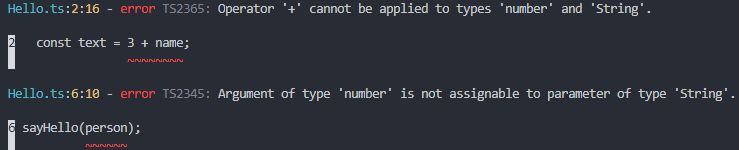
上面错误的具体意思是
58 |-
59 |
- 由于声明了函数形参
name为静态类型string,而在调用时传入得是number类型123,与前面的string不符。
60 | - 在
sayHello函数中将name(string)和3(number)两种不同类型得值进行了相加。
61 |
我们发现每次都要通过 tsc 来编译 ts 文件能得到 js 文件后再去运行 js 文件,过于麻烦。可以使用插件 ts-node 来直接运行 ts 文件。
npm i ts-node -g
64 | ts-node Hello.ts
66 | :::info
68 |ts 能够尝试分析变量类型(类型推断),ts 无法分析出的变量最好显式声明变量类型(类型注解)
69 |:::
70 |基础类型
71 |变量的声明:let [变量名] : [类型] = 值
例如: let age: number = 21
TypeScript 支持与 JavaScript 几乎相同的数据类型
74 |-
75 |
- boolean(布尔值) 76 |
- number(数值) 77 |
- string(字符串) 78 |
- []/Array<元素类型>(数组) 79 |
- 元组 Tuple 80 |
- enum(枚举) 81 |
- any(任何值) 82 |
- void(空值) 83 |
- null 84 |
- undefined 85 |
- never 86 |
数组
88 |有 2 种方式定义数组
89 |let arr: number[] = [1, 2, 3]; // 元素类型后接上`[]`
90 | let arr: Array<number> = [1, 2, 3]; // 数组泛型
91 | let arr: (number | string)[] = [1, '2', '4']; // 元素类型可以是number或string(类似元组)
92 | 元组 tuple
94 |表示一个数组(各个元素的类型不必相同)
95 |let list: [string, number]; //第一个元素为string类型,第二个为number类型
96 | a = ['abc', 123]; //合格
97 | b = [123, 'abc']; //不合格
98 | 枚举
100 |其实有点类似对象 101 | 看例子吧
102 |enum lan {js, ts, css};
103 | console.log(lan.js); // 0 js对应的下标,第一个默认下标为0
104 |
105 | enum lan {
106 | js = 3,
107 | ts,
108 | css,
109 | }
110 | console.log(lan.js); // 3
111 | console.log(lan.ts); // 4
112 | console.log(lan.css); // 5
113 |
114 | enum lan {
115 | js,
116 | ts = 3,
117 | css,
118 | }
119 | console.log(lan.js); // 0
120 | console.log(lan.ts); // 3
121 | console.log(lan.css); // 4
122 | console.log(lan[4]); // css
123 | console.log(lan[1]); // undefined
124 | // 第一个默认下标为0,css接着ts的值+1
125 |
126 | enum lan {js = 'good', ts = 'nice', css = 'well'};
127 | console.log(lan.js); // good
128 |
129 | // const枚举,为了避免在额外生成的代码上的开销和额外的非直接的对枚举成员的访问。
130 | const enum People {
131 | name: 'Alan',
132 | age: 23
133 | }
134 |
135 | // 编译时会自动转化成常量值,不会保留其他代码
136 | console.log(People.name); // Alan
137 | any
139 |顾名思义,任意值,当我们想为还不清楚类型的变量指定一个类型时, any 就是最好的选择 🤭
let a: any = 4;
141 | a = '123'; //合格
142 |
143 | let arr: any[] = [1, '123', true]; // 和元组很像
144 | arr[1] = 'good';
145 | void
147 |常用于无返回值的函数声明
148 |function func(): void {
149 | console.log('learning typescript...');
150 | }
151 | func(); //合格
152 |
153 | function func(): void {
154 | return 1;
155 | }
156 | func(); // 不合格:Type '1' is not assignable to type 'void'
157 | null 和 undefined
159 |用处不大,默认情况下是所有类型的子类型,例如下面代码是没有问题的:
160 |let a: string;
161 | a = undefined;
162 | a = null;
163 | 但是,当指定--strictNullChecks标记时,null 和 undefined 只能赋值给 void 和他们自己本身。
never
166 |表示永不存在的值的类型 167 | never 类型是那些总是会抛出异常或根本就不会有返回值的函数表达式或箭头函数表达式的返回值类型; 168 | 变量也可能是 never 类型,当它们被永不为真的类型保护所约束时。
169 |never 类型是任何类型的子类型,也可以赋值给任何类型;然而,没有类型是 never 的子类型或可以赋值给 never 类型(除了 never 本身之外)。 即使 any 也不可以赋值给 never。
170 |function error(message: string): never {
171 | throw new Error(message);
172 | }
173 |
174 | // 返回never的函数必须存在无法达到的终点
175 | function infiniteLoop(): never {
176 | while (true) {}
177 | }
178 | 结构赋值的写法
180 |function sayAge({ name, age }: { name: string | number; age: number }): void {
181 | console.log(`${name} is ${age} years old`);
182 | }
183 | sayAge({ name: 'Alan', age: 22 });
184 | sayAge({ name: 2, age: 22 });
185 | 联合类型
187 |用 | 来表示取值存在多种可能
let a: string | number;
189 | a = 1;
190 | a = 'A';
191 | 类型断言
193 |可以自己指定一个值的类型
194 | 格式如下
195 | <类型>值
196 | 值 as 类型
interface student {
198 |   isStudent: boolean;
199 |   education: number;
200 | }
201 | interface worker {
202 |   isStudent: boolean;
203 |   seniority: number;
204 | }
205 | function Recruit(candidate: worker | student): void {
206 |   if (candidate.isStudent) {
207 |     console.log(`your education is ${(candidate as student).education}`);
208 |   } else {
209 |     console.log(`your seniority is ${(candidate as worker).seniority}`);
210 |   }
211 | }
212 |
213 | const a: student = { isStudent: true, education: 4 };
214 | const b: worker = { isStudent: false, seniority: 2 };
215 | Recruit(a);
216 | Recruit(b);
217 | 由于 candidate 使用了联合类型,所以 ts 无法判断 candidate 究竟是属于 student 还是 worker ,所以要使用类型断言来显式告诉 ts。
当然还有其他方式来实现
220 |interface student {
221 | isStudent: boolean;
222 | education: number;
223 | }
224 | interface worker {
225 | isStudent: boolean;
226 | seniority: number;
227 | }
228 | function Recruit(candidate: worker | student): void {
229 | 'education' in candidate && console.log(`your education is ${candidate.education}`);
230 | 'seniority' in candidate && console.log(`your seniority is ${candidate.seniority}`);
231 | }
232 |
233 | const a: student = { isStudent: true, education: 4 };
234 | const b: worker = { isStudent: false, seniority: 2 };
235 | Recruit(a);
236 | Recruit(b);
237 | -
239 |
- typeof 240 |
- instanceof 241 |
非空断言
243 |!. 对应 --strictNullChecks
interface person {
245 |   name: string;
246 | }
247 | function work(personObj?: person) {
248 |   // 由于 personObj 可能不传,所以 personObj 可能为 undefined,使用 !. 可以断言 personObj 不为空
249 |   console.log(personObj!.name);
250 | }
251 | 接口 interface
253 |先看一个接口的例子
254 |interface person {
255 | name: string;
256 | }
257 | function work(personObj: person) {
258 | console.log(personObj.name);
259 | }
260 | let person1 = { name: 'Alan', age: 21 };
261 | work(person1);
262 | let person2 = { age: 21 };
263 | work(person2);
264 | 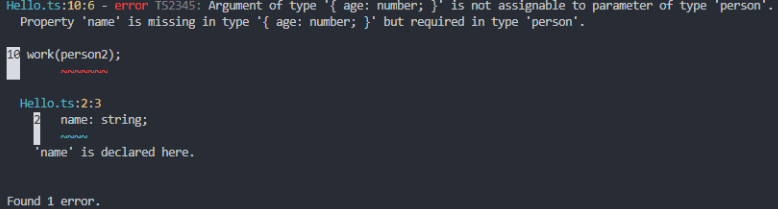
定义接口的关键字是 interface
267 | 这个例子需要传入 work 的参数必须是一个带有 name(string)的对象,可以理解为我要招聘一个有名字的员工,没有名字的都不需要。当然我们的 person1 中还多了一个age属性,这并不会报错。可是当我们直接传递参数时是会出错的。
work({ name: 'Alan', age: 21 });
269 | 那如果我不确定要招聘的员工除了有姓名外还需要其他什么属性时,可以像下面一样重新定义接口就可以解决上面的问题了。
271 |interface person {
272 | name: string;
273 | [propName: string]: any;
274 | }
275 | 可选属性
277 |那如果我的招聘条件是最好懂 typescript 的,这个时候 typescript 就是可有可无的(最好懂,嘿嘿 😜),那我们就要用到可选属性了
278 | 可选属性在可选属性名后面加上一个?
interface person {
280 |   name: string;
281 |   ts?: boolean;
282 | }
283 | function Recruit(personObj: person): string {
284 |   if (personObj.ts) {
285 |     return `congratulations!${personObj.name}`;
286 |   } else {
287 |     return `sorry,${personObj.name}, we need a employee who know ts!`;
288 |   }
289 | }
290 | let person1 = { name: 'Alan', age: 21, ts: true };
291 | console.log(Recruit(person1));
292 | let person2 = { name: 'Bob', age: 21 };
293 | console.log(Recruit(person2));
294 | 只读属性
296 |我们都知道人的名字都是不可以改变的(一般情况下),这个时候我们对 person 接口里面的 name 属性稍作修改,在属性名 name 前加上readonly。
:::tip
298 |当然也可以使用 setter/getter 来实现
299 |:::
300 |interface person {
301 | readonly name: string;
302 | ts?: boolean;
303 | }
304 | let person1: person = { name: 'Alan' };
305 | person1.name = 'Bob'; // Cannot assign to 'name' because it is a read-only property.
306 | 我们发现 readonly 和 const 的作用好像有点相似,那我们什么时候使用 readonly 什么时候使用 const 呢? 308 | 变量---->const 309 | 属性---->readonly
310 |函数类型的接口
311 |接口除了可以描述带有属性的对象外,还可以描述函数类型 312 | 这里创建一个函数来检查你有没有打卡 😁
313 |interface attendanceFunc {
314 | (name: string, startTime: number, endTime: number): boolean;
315 | }
316 | let checkAttendance: attendanceFunc;
317 | checkAttendance = function (name: string, startTime: number, endTime: number): boolean {
318 | let result = startTime < 9 && endTime > 18;
319 | return result;
320 | };
321 | console.log(checkAttendance('Alan', 10, 19)); // false
322 | 看一下接口的声明:
324 |interface attendanceFunc {
325 | (name: string, startTime: number, endTime: number): boolean;
326 | }
327 | name,startTime,endTime 放在 () 中代表函数的参数
329 | :boolean 表示函数的返回值类型
330 | 当然上面例子中的checkAttendance的形参以及函数的返回值来说可以不指定类型,因为 checkAttendance 复制给了 attendanceFunc 变量,类型检查器会自动(按照接口中参数的顺序)推断出参数以及返回值的类型,也就是说写成下面这样也是可以的。函数中的参数名可以不和接口中的相同
interface attendanceFunc {
332 |   (name: string, startTime: number, endTime: number): boolean;
333 | }
334 | let checkAttendance: attendanceFunc;
335 | checkAttendance = function (n, startTime, endTime) {
336 |   let result = startTime < 9 && endTime > 18;
337 |   return result;
338 | };
339 | console.log(checkAttendance('Alan', 10, 19)); // false
340 | 接口的继承
342 |一个接口可以继承 1 个或者多个接口:
343 | 继承使用关键词extends
interface person {
345 |   name: string;
346 | }
347 | interface student {
348 |   studentId: number;
349 | }
350 | interface seniorStudent extends person, student {
351 |   grade: string;
352 | }
353 | let student1: seniorStudent = { name: 'Alan', studentId: 1, grade: 'one' };
354 | console.log(student1);
355 | 类 class
357 |TS 中的类和 ES6 中的类很相似,这里只介绍不同的地方
358 |变量修饰符
359 |-
360 |
- public(默认) 361 |
- private(私有,不能在声明它的类的外部访问) 362 |
- protected(和 private 类似,不同的是 protected 声明的变量可以在派生类(即子类)中访问) 363 |
静态属性 static
365 |class Person {
366 | static fingerNum = 5;
367 | }
368 |
369 | // 只能通过类来访问
370 | console.log(Person.fingerNum);
371 | // 不能通过实例访问
372 | console.log(new Person().fingerNum);
373 | // 单例模式创建唯一的实例
375 | class singleClass {
376 | private static instance: singleClass;
377 | private constructor(public name: string) {}
378 |
379 | static getInstance() {
380 | if (!this.instance) {
381 | this.instance = new singleClass('Alan');
382 | }
383 | return this.instance;
384 | }
385 | }
386 |
387 | const class1 = singleClass.getInstance();
388 | const class2 = singleClass.getInstance();
389 | console.log(class1.name); // Alan
390 | console.log(class1 === class2); // true
391 | 构造函数
393 |class Person {
394 | constructor(name, mobile, sex) {
395 | this.name = name;
396 | this.mobile = mobile;
397 | this.sex = sex;
398 | }
399 | public name: string;
400 | private mobile: string;
401 | protected sex: string;
402 | }
403 | 上面的代码可以简写成下面这样
405 |class Person {
406 | constructor(name: string, private mobile: string, protected sex: string) {}
407 | }
408 | 抽象类
410 |-
411 |
- 不能被实例化 412 |
- 要使用的话要声明其派生类,并且重写其中的抽象方法 413 |
abstract class Animal {
415 |   constructor(public name: string) {}
416 |   sayHello() {
417 |     console.log('hello');
418 |   }
419 |   // 声明抽象方法
420 |   abstract action(): void;
421 | }
422 |
423 | class Bird extends Animal {
424 |   constructor(name) {
425 |     super(name);
426 |   }
427 |   action() {
428 |     console.log('jijiji');
429 |   }
430 | }
431 |
432 | const bird = new Bird('qc');
433 | console.log(bird);
434 | // Bird { name: 'qc' }
435 | 泛型
437 |438 |440 |泛型(Generics)是指在定义函数、接口或类的时候,不预先指定具体的类型,而在使用的时候再指定类型的一种特性。
439 |
函数用法:<泛型名>
441 |function Recruit<T>(name: string, props: T) {
442 | return name + props;
443 | }
444 | // 显式指定为T为number类型
445 | console.log(Recruit<number>('Alan', 123)); // Alan123
446 | // TS自动推断为number类型,和上面效果一样
447 | console.log(Recruit('Alan', 123)); // Alan123
448 | console.log(Recruit('Alan', [1, 2, 3])); // Alan1,2,3
449 | 也可以使用多个泛型名,下面的例子结合了接口来完成
451 |interface Contact {
452 | mobile: string;
453 | }
454 |
455 | interface Address {
456 | province: string;
457 | }
458 |
459 | function Recruit<C extends Contact, A extends Address>(name: string, contact: C, address: A) {
460 | return `${name}'s mobile is ${contact.mobile}, live in ${address.province}`;
461 | }
462 |
463 | console.log(Recruit('Alan', { mobile: '666' }, { province: 'Shanghai' }));
464 | // Alan's mobile is 666, live in Shanghai
465 | 类用法
467 |interface employee {
468 | name: string;
469 | age: number;
470 | }
471 |
472 | class RecruitManager<T extends employee> {
473 | constructor(private data: Array<T>) {}
474 | select(age: number): T {
475 | return this.data.find((item) => item.age > age);
476 | }
477 | }
478 |
479 | const result = new RecruitManager([
480 | {
481 | name: 'Alan',
482 | age: 22
483 | },
484 | {
485 | name: 'Bob',
486 | age: 18
487 | }
488 | ]);
489 | console.log(result.select(20));
490 | 泛型约束
492 |使用 extends 约束泛型
493 |interface info {
494 | mobile: string;
495 | }
496 |
497 | // T泛型必须满足info
498 | function Recruit<T extends info>(name: string, props: T) {
499 | return name + props.mobile;
500 | }
501 |
502 | console.log(Recruit('Alan', { mobile: '1232910830' })); // Alan1232910830
503 | React 相关
505 |class 组件动态设置 state
506 |this.setState({
507 | [name]: value
508 | } as Pick<CompontentState, keyof CompontentState>);
509 |