├── pics
├── atlas.jpg
├── boots.png
├── coqui.png
├── fields.gif
├── hickman.png
├── sparky.png
├── toroid.png
├── lovotechs.png
├── pvc_probe.jpg
├── don_screws_a.jpg
├── four_probe.gif
├── temperature.jpg
├── temperature1.jpg
├── rubber_stopper.jpg
├── vintage_op_amp.png
├── conductivity_ac.png
├── hick_calibration.png
├── hickman_labeled.png
├── linear_correction.png
├── mathew_screws_a.jpg
├── mathew_screws_b.jpg
├── hick_calibration_2.png
├── rubber_stopper_mud.jpg
└── conductivity_averages.jpg
├── contributing.md
├── README.md
└── pl_wiki_readme.md
/pics/atlas.jpg:
--------------------------------------------------------------------------------
https://raw.githubusercontent.com/OpenWaterProject/riffle_328-conductivity/HEAD/pics/atlas.jpg
--------------------------------------------------------------------------------
/pics/boots.png:
--------------------------------------------------------------------------------
https://raw.githubusercontent.com/OpenWaterProject/riffle_328-conductivity/HEAD/pics/boots.png
--------------------------------------------------------------------------------
/pics/coqui.png:
--------------------------------------------------------------------------------
https://raw.githubusercontent.com/OpenWaterProject/riffle_328-conductivity/HEAD/pics/coqui.png
--------------------------------------------------------------------------------
/pics/fields.gif:
--------------------------------------------------------------------------------
https://raw.githubusercontent.com/OpenWaterProject/riffle_328-conductivity/HEAD/pics/fields.gif
--------------------------------------------------------------------------------
/pics/hickman.png:
--------------------------------------------------------------------------------
https://raw.githubusercontent.com/OpenWaterProject/riffle_328-conductivity/HEAD/pics/hickman.png
--------------------------------------------------------------------------------
/pics/sparky.png:
--------------------------------------------------------------------------------
https://raw.githubusercontent.com/OpenWaterProject/riffle_328-conductivity/HEAD/pics/sparky.png
--------------------------------------------------------------------------------
/pics/toroid.png:
--------------------------------------------------------------------------------
https://raw.githubusercontent.com/OpenWaterProject/riffle_328-conductivity/HEAD/pics/toroid.png
--------------------------------------------------------------------------------
/pics/lovotechs.png:
--------------------------------------------------------------------------------
https://raw.githubusercontent.com/OpenWaterProject/riffle_328-conductivity/HEAD/pics/lovotechs.png
--------------------------------------------------------------------------------
/pics/pvc_probe.jpg:
--------------------------------------------------------------------------------
https://raw.githubusercontent.com/OpenWaterProject/riffle_328-conductivity/HEAD/pics/pvc_probe.jpg
--------------------------------------------------------------------------------
/pics/don_screws_a.jpg:
--------------------------------------------------------------------------------
https://raw.githubusercontent.com/OpenWaterProject/riffle_328-conductivity/HEAD/pics/don_screws_a.jpg
--------------------------------------------------------------------------------
/pics/four_probe.gif:
--------------------------------------------------------------------------------
https://raw.githubusercontent.com/OpenWaterProject/riffle_328-conductivity/HEAD/pics/four_probe.gif
--------------------------------------------------------------------------------
/pics/temperature.jpg:
--------------------------------------------------------------------------------
https://raw.githubusercontent.com/OpenWaterProject/riffle_328-conductivity/HEAD/pics/temperature.jpg
--------------------------------------------------------------------------------
/pics/temperature1.jpg:
--------------------------------------------------------------------------------
https://raw.githubusercontent.com/OpenWaterProject/riffle_328-conductivity/HEAD/pics/temperature1.jpg
--------------------------------------------------------------------------------
/pics/rubber_stopper.jpg:
--------------------------------------------------------------------------------
https://raw.githubusercontent.com/OpenWaterProject/riffle_328-conductivity/HEAD/pics/rubber_stopper.jpg
--------------------------------------------------------------------------------
/pics/vintage_op_amp.png:
--------------------------------------------------------------------------------
https://raw.githubusercontent.com/OpenWaterProject/riffle_328-conductivity/HEAD/pics/vintage_op_amp.png
--------------------------------------------------------------------------------
/pics/conductivity_ac.png:
--------------------------------------------------------------------------------
https://raw.githubusercontent.com/OpenWaterProject/riffle_328-conductivity/HEAD/pics/conductivity_ac.png
--------------------------------------------------------------------------------
/pics/hick_calibration.png:
--------------------------------------------------------------------------------
https://raw.githubusercontent.com/OpenWaterProject/riffle_328-conductivity/HEAD/pics/hick_calibration.png
--------------------------------------------------------------------------------
/pics/hickman_labeled.png:
--------------------------------------------------------------------------------
https://raw.githubusercontent.com/OpenWaterProject/riffle_328-conductivity/HEAD/pics/hickman_labeled.png
--------------------------------------------------------------------------------
/pics/linear_correction.png:
--------------------------------------------------------------------------------
https://raw.githubusercontent.com/OpenWaterProject/riffle_328-conductivity/HEAD/pics/linear_correction.png
--------------------------------------------------------------------------------
/pics/mathew_screws_a.jpg:
--------------------------------------------------------------------------------
https://raw.githubusercontent.com/OpenWaterProject/riffle_328-conductivity/HEAD/pics/mathew_screws_a.jpg
--------------------------------------------------------------------------------
/pics/mathew_screws_b.jpg:
--------------------------------------------------------------------------------
https://raw.githubusercontent.com/OpenWaterProject/riffle_328-conductivity/HEAD/pics/mathew_screws_b.jpg
--------------------------------------------------------------------------------
/pics/hick_calibration_2.png:
--------------------------------------------------------------------------------
https://raw.githubusercontent.com/OpenWaterProject/riffle_328-conductivity/HEAD/pics/hick_calibration_2.png
--------------------------------------------------------------------------------
/pics/rubber_stopper_mud.jpg:
--------------------------------------------------------------------------------
https://raw.githubusercontent.com/OpenWaterProject/riffle_328-conductivity/HEAD/pics/rubber_stopper_mud.jpg
--------------------------------------------------------------------------------
/pics/conductivity_averages.jpg:
--------------------------------------------------------------------------------
https://raw.githubusercontent.com/OpenWaterProject/riffle_328-conductivity/HEAD/pics/conductivity_averages.jpg
--------------------------------------------------------------------------------
/contributing.md:
--------------------------------------------------------------------------------
1 | # Contributing to the Riffle project
2 |
3 | Any modifications or extensions to the circuit board designs, or new code, is very much welcomed!
4 |
5 | * Replicating the Riffle setup and documenting your use of it on [publiclab.org](https://publiclab.org) with the tag "[riffle](https://publiclab.org/tag/riffle)." If you record your experiences elsewhere, please contact us and share.
6 | * Expanding our documentation of water monitoring research and projects on [the Public Lab Wiki.](https://publiclab.org/wiki/riffle)
7 | * Improving the documentation on riffle applications on [Public Lab](publiclab.org).
8 | * Adding your comments to [open issues in this repository](/issues).
9 | * Forking this repository and improving the design documentation, assembly instructions, or to add hardware or software for acquiring and interpretting data.
10 |
11 | #Contributing to an OPEN Open Source project repository
12 |
13 | This is an [OPEN Open Source](http://openopensource.org/) hardware project. Please fork it and work in your own copy, and file pull requests back to the master branch.
14 |
15 |
16 | ## What?
17 |
18 | Individuals making significant and valuable contributions are given commit-access to the project to contribute as they see fit. This project is more like an open wiki than a standard guarded open source project.
19 |
20 | ## Rules
21 |
22 | There are a few basic ground-rules for contributors:
23 |
24 | 1. **No `--force` pushes** or modifying the Git history in any way.
25 | 1. **Non-master branches** ought to be used for ongoing work.
26 | 1. **significant modifications** ought to be subject to an **internal pull-request** to solicit feedback from other contributors.
27 | 1. Internal pull-requests to solicit feedback are *encouraged* for any other non-trivial contribution but left to the discretion of the contributor.
28 | 1. Contributors should attempt to adhere to the prevailing style.
29 |
30 | ## Releases
31 |
32 | Stick to semver: Major.Minor.Patch.
33 |
34 | ## Changes to this arrangement
35 |
36 | This is an experiment and feedback is welcome! This document may also be subject to pull-requests or changes by contributors where you believe you have something valuable to add or change.
37 |
--------------------------------------------------------------------------------
/README.md:
--------------------------------------------------------------------------------
1 | # DIY conductivity sensor designs
2 |
3 | ## Background
4 |
5 | Conductivity is an important water quality parameter, and is widely used to assess environmental conditions in hydrology, oceanography, and pollution monitoring. This repository describes some efforts towards developing DIY circuits for assessing water conductivity.
6 |
7 | Some of the applications that have inspired this work include:
8 |
9 | **Road Salt and the LovoTech network**. Mark Green of Plymouth State initially proposed the idea of an open source design for a conductivity data logger. His [LoVoTECHS](http://jupiter.plymouth.edu/~mbgreen/Mark_B._Green/LoVoTECS.html) network in New Hampshire already consisted of many volunteer stewards of conductivity monitors throughout a watershed, with the idea of assessing the impact and dynamics of road salt within the local ecosystem.
10 |
11 |  12 |
13 | More background reading on road salt:
14 | - http://des.nh.gov/organization/divisions/water/wmb/was/salt-reduction-initiative/impacts.htm
15 | - http://www.boston.com/news/local-news/2015/01/16/road-salt-where-does-it-come-from-where-does-it-go
16 | - http://news.nationalgeographic.com/news/2014/02/140212-road-salt-shortages-melting-ice-snow-science/
17 | - http://www.wired.com/2015/03/road-salt-polluting-rivers/
18 | - http://science.howstuffworks.com/nature/climate-weather/atmospheric/road-salt.htm
19 |
20 | **Salt water intrustion.** [Salt water intrustion](https://en.wikipedia.org/wiki/Saltwater_intrusion) is increasingly an issue world-wide, as groundwater extraction and sea level rise result in relatively saline waters contaminating fresh water supplies. Assessing and documenting the extent of this problem helps to inform solutions and predict trends.
21 |
22 | **Agriculture.** Irrigation, and other uses of water in agriculture, results in significant increases in the salinity of water, usually rendering it unsafe for drinking. More background:
23 |
24 | - http://www.fao.org/docrep/t0667e/t0667e05.htm
25 |
26 | **Hydraulic Fracturing and pollution.** The materials used in hydraulic fracturing or 'fracking' usually have very high specific conductivity; measuring conductivity of groundwater and surface water in the areas near a fracking operation may provide an indication of the extent of contamination of local water sources by fracking fluid. More info:
27 |
28 | - http://www.fondriest.com/news/tracking-fracking.htm
29 |
30 | ## Basic principles of conductivity measurement
31 |
32 | [To be added -- for now, see references below:]
33 |
34 | - General background here: https://en.wikipedia.org/wiki/Electrical_resistivity_and_conductivity
35 | - http://www2.latech.edu/~dehall/LWTL/ENGR121/notes/3_conductivity_sensor_intro.pdf
36 | - https://www.snowpure.com/docs/FAQ_Conductivity_Thornton.pdf
37 | - Fondriest : http://www.fondriest.com/environmental-measurements/parameters/water-quality/conductivity-salinity-tds/
38 | - http://www.analytical-chemistry.uoc.gr/files/items/6/618/agwgimometria_2.pdf
39 | - http://www.waterboards.ca.gov/water_issues/programs/swamp/docs/cwt/guidance/3130en.pdf
40 | - https://www.pasco.com/support/technical-support/technote/techIDlookup.cfm?TechNoteID=514
41 | - http://www1.udel.edu/pchem/C446/Experiments/exp4.pdf
42 |
43 | ## Characteristics of a good conductivity sensor
44 |
45 |
46 |
47 | In order to make reasonable conductivity measurements with a probe in solution, various electrochemical properties of the system have led researchers and instrumentation designers to devices that take into account the following considerations:
48 |
49 | **Input signal**.
50 |
51 | In order to avoid polarizing the solution being tested, and to minimize the effects of corrosion on the electrodes used in the probe, the input signal into the water should be:
52 |
53 | - alternating current
54 | - with a symmetric oscillation with respect to both electrodes (no net polarization)
55 | - low voltage, significantly below the electrolysis threshold for water (1.1 Volts).
56 |
57 |
12 |
13 | More background reading on road salt:
14 | - http://des.nh.gov/organization/divisions/water/wmb/was/salt-reduction-initiative/impacts.htm
15 | - http://www.boston.com/news/local-news/2015/01/16/road-salt-where-does-it-come-from-where-does-it-go
16 | - http://news.nationalgeographic.com/news/2014/02/140212-road-salt-shortages-melting-ice-snow-science/
17 | - http://www.wired.com/2015/03/road-salt-polluting-rivers/
18 | - http://science.howstuffworks.com/nature/climate-weather/atmospheric/road-salt.htm
19 |
20 | **Salt water intrustion.** [Salt water intrustion](https://en.wikipedia.org/wiki/Saltwater_intrusion) is increasingly an issue world-wide, as groundwater extraction and sea level rise result in relatively saline waters contaminating fresh water supplies. Assessing and documenting the extent of this problem helps to inform solutions and predict trends.
21 |
22 | **Agriculture.** Irrigation, and other uses of water in agriculture, results in significant increases in the salinity of water, usually rendering it unsafe for drinking. More background:
23 |
24 | - http://www.fao.org/docrep/t0667e/t0667e05.htm
25 |
26 | **Hydraulic Fracturing and pollution.** The materials used in hydraulic fracturing or 'fracking' usually have very high specific conductivity; measuring conductivity of groundwater and surface water in the areas near a fracking operation may provide an indication of the extent of contamination of local water sources by fracking fluid. More info:
27 |
28 | - http://www.fondriest.com/news/tracking-fracking.htm
29 |
30 | ## Basic principles of conductivity measurement
31 |
32 | [To be added -- for now, see references below:]
33 |
34 | - General background here: https://en.wikipedia.org/wiki/Electrical_resistivity_and_conductivity
35 | - http://www2.latech.edu/~dehall/LWTL/ENGR121/notes/3_conductivity_sensor_intro.pdf
36 | - https://www.snowpure.com/docs/FAQ_Conductivity_Thornton.pdf
37 | - Fondriest : http://www.fondriest.com/environmental-measurements/parameters/water-quality/conductivity-salinity-tds/
38 | - http://www.analytical-chemistry.uoc.gr/files/items/6/618/agwgimometria_2.pdf
39 | - http://www.waterboards.ca.gov/water_issues/programs/swamp/docs/cwt/guidance/3130en.pdf
40 | - https://www.pasco.com/support/technical-support/technote/techIDlookup.cfm?TechNoteID=514
41 | - http://www1.udel.edu/pchem/C446/Experiments/exp4.pdf
42 |
43 | ## Characteristics of a good conductivity sensor
44 |
45 |
46 |
47 | In order to make reasonable conductivity measurements with a probe in solution, various electrochemical properties of the system have led researchers and instrumentation designers to devices that take into account the following considerations:
48 |
49 | **Input signal**.
50 |
51 | In order to avoid polarizing the solution being tested, and to minimize the effects of corrosion on the electrodes used in the probe, the input signal into the water should be:
52 |
53 | - alternating current
54 | - with a symmetric oscillation with respect to both electrodes (no net polarization)
55 | - low voltage, significantly below the electrolysis threshold for water (1.1 Volts).
56 |
57 |  58 |
59 | _Source: http://www.sensorex.com/technical-education/_
60 |
61 | **Probe design.**
62 |
63 | The probe geometry and materials greatly affect the quality of the conductivity measurement. Probes should:
64 |
65 | - Use an electrode material that is less likely to corrode in the solution being tested (stainless steel and platinum are common choices)
66 | - Be arranged in a geometry that minimized 'fringing effects', or stray electric fields that may interact with the rest of the enclosure, or e.g. a beaker of test solution. There are indications in the literature that the fringing problem is **worst** when the individual electrode area (the exposed metal of the electrode) and the spacing between the electrodes is about equal.
67 |
68 | **Fringing effects in two probe designs**. If two probes consisting of 'point source' geometries are used (screws or bolts with only a small, round nub of metal exposed), relatively larger 'fringing fields' are likely to result -- meaning that the electrical measurement being made will be affected by the presence of nearby objects (a beaker wall, for example).
69 |
70 |
58 |
59 | _Source: http://www.sensorex.com/technical-education/_
60 |
61 | **Probe design.**
62 |
63 | The probe geometry and materials greatly affect the quality of the conductivity measurement. Probes should:
64 |
65 | - Use an electrode material that is less likely to corrode in the solution being tested (stainless steel and platinum are common choices)
66 | - Be arranged in a geometry that minimized 'fringing effects', or stray electric fields that may interact with the rest of the enclosure, or e.g. a beaker of test solution. There are indications in the literature that the fringing problem is **worst** when the individual electrode area (the exposed metal of the electrode) and the spacing between the electrodes is about equal.
67 |
68 | **Fringing effects in two probe designs**. If two probes consisting of 'point source' geometries are used (screws or bolts with only a small, round nub of metal exposed), relatively larger 'fringing fields' are likely to result -- meaning that the electrical measurement being made will be affected by the presence of nearby objects (a beaker wall, for example).
69 |
70 |  71 |
72 | This effect might not be problematic in the field (in a river, say), but can render calibration on a desktop difficult.
73 |
74 | **'Four probe' measurements** help to mitigate some of these effects by decoupling the input probes from the measurement circuitry -- the input probes may corrode, but this does not affect the measurement. More details on this approach [here](http://www.globalspec.com/learnmore/sensors_transducers_detectors/analytical_sensors/electrodes_conductivity).
75 |
76 |
71 |
72 | This effect might not be problematic in the field (in a river, say), but can render calibration on a desktop difficult.
73 |
74 | **'Four probe' measurements** help to mitigate some of these effects by decoupling the input probes from the measurement circuitry -- the input probes may corrode, but this does not affect the measurement. More details on this approach [here](http://www.globalspec.com/learnmore/sensors_transducers_detectors/analytical_sensors/electrodes_conductivity).
75 |
76 |  77 | _Source: http://www.globalspec.com/learnmore/sensors_transducers_detectors/analytical_sensors/electrodes_conductivity_
78 |
79 | **Toroidal probe designs** avoid the corrosion issue altogether -- these devices are completely separated from the liquid being tested, and interact with it only via EM fields. More detail [here](http://www.globalspec.com/learnmore/sensors_transducers_detectors/analytical_sensors/electrodes_conductivity).
80 |
81 |
77 | _Source: http://www.globalspec.com/learnmore/sensors_transducers_detectors/analytical_sensors/electrodes_conductivity_
78 |
79 | **Toroidal probe designs** avoid the corrosion issue altogether -- these devices are completely separated from the liquid being tested, and interact with it only via EM fields. More detail [here](http://www.globalspec.com/learnmore/sensors_transducers_detectors/analytical_sensors/electrodes_conductivity).
80 |
81 |  82 | _Source: https://www.ibt.kit.edu/img/content/prozess2_-en_markus_voelker.png_
83 |
84 | **Simple DIY approaches**. The relative advantages of various approaches to probe materials and geometry need to be weighed against the cost and complexity of constructing the probes. The wide availability and durability of PVC has led to several designs using this material (see, for example, [this one](https://publiclab.org/notes/bhickman/05-09-2016/conductivity-and-temperature-meter).
85 |
86 |
82 | _Source: https://www.ibt.kit.edu/img/content/prozess2_-en_markus_voelker.png_
83 |
84 | **Simple DIY approaches**. The relative advantages of various approaches to probe materials and geometry need to be weighed against the cost and complexity of constructing the probes. The wide availability and durability of PVC has led to several designs using this material (see, for example, [this one](https://publiclab.org/notes/bhickman/05-09-2016/conductivity-and-temperature-meter).
85 |
86 |  87 |
88 | Plastic bottles, with probes attached either to the screw cap, or to rubber stoppers inserted into the bottle opening, have also been explored (for example, [here](https://publiclab.org/notes/mathew/02-10-2016/riffle-conductivity-caps-and-other-housing-ideas)).
89 |
90 |
87 |
88 | Plastic bottles, with probes attached either to the screw cap, or to rubber stoppers inserted into the bottle opening, have also been explored (for example, [here](https://publiclab.org/notes/mathew/02-10-2016/riffle-conductivity-caps-and-other-housing-ideas)).
89 |
90 |  91 |
92 |
91 |
92 |  93 |
94 |
93 |
94 |  95 |
96 |
97 | **Temperature compensation.**
98 |
99 | Conductivity is affected by temperature:
100 |
101 |
95 |
96 |
97 | **Temperature compensation.**
98 |
99 | Conductivity is affected by temperature:
100 |
101 |  102 |
103 | In order to compare conductivity across liquids at different temperatures, the concept of 'specific conductivity' is used -- that is, the conductivity of the liquid 'if it were at 25 Celsius'. The temperature dependence of conductivity depends on the particular mixture of ions in the solution, and so the correction parameters and equations used for shifting the measured conductivity to the expected value at 25 C need to chosen appropriately for the expected chemical makeup of the solution. For more information, see 'Specific Conductance', [here](http://www.fondriest.com/environmental-measurements/parameters/water-quality/conductivity-salinity-tds/#cond3), and an extended discussion [here](http://www.reagecon.com/pdf/technicalpapers/Effect_of_Temperature_TSP-07_Issue3.pdf).
104 |
105 | Often, the simplest, linear correction for the effect of temperature on conductivity is used:
106 |
107 |
102 |
103 | In order to compare conductivity across liquids at different temperatures, the concept of 'specific conductivity' is used -- that is, the conductivity of the liquid 'if it were at 25 Celsius'. The temperature dependence of conductivity depends on the particular mixture of ions in the solution, and so the correction parameters and equations used for shifting the measured conductivity to the expected value at 25 C need to chosen appropriately for the expected chemical makeup of the solution. For more information, see 'Specific Conductance', [here](http://www.fondriest.com/environmental-measurements/parameters/water-quality/conductivity-salinity-tds/#cond3), and an extended discussion [here](http://www.reagecon.com/pdf/technicalpapers/Effect_of_Temperature_TSP-07_Issue3.pdf).
104 |
105 | Often, the simplest, linear correction for the effect of temperature on conductivity is used:
106 |
107 |  108 |
109 | Here, **t** is the temperature of the sample, **C_25** is the calculated conductivity at 25 C, **C_t** is the measured conductivity at temperature **t**, and **alpha** is a temperature coefficient chosen to be appropriate for the expected ion content of the solution being tested. (For dilute solutions of most salts, alpha = 0.02 is a fairly good approximation; better values can be chosen if more information is known about the content of the solution.)
110 |
111 | ## Calibration techniques
112 |
113 | **Commercial standard solutions.**
114 |
115 | - http://www.davis.com/Product/Oakton_conductivity_solution_2764_S/YX-00653-20?referred_id=3388&gclid=Cj0KEQiArou2BRDcoN_c6NDI3oMBEiQANeix5up7px8eL9rByANeftTaCMyJusFlYSJtDb5ElptPo_AaAiaH8P8HAQ
116 |
117 | **DIY options.**
118 |
119 | - Saline solution
120 | - Soda
121 | - Salt and distilled water
122 |
123 |
108 |
109 | Here, **t** is the temperature of the sample, **C_25** is the calculated conductivity at 25 C, **C_t** is the measured conductivity at temperature **t**, and **alpha** is a temperature coefficient chosen to be appropriate for the expected ion content of the solution being tested. (For dilute solutions of most salts, alpha = 0.02 is a fairly good approximation; better values can be chosen if more information is known about the content of the solution.)
110 |
111 | ## Calibration techniques
112 |
113 | **Commercial standard solutions.**
114 |
115 | - http://www.davis.com/Product/Oakton_conductivity_solution_2764_S/YX-00653-20?referred_id=3388&gclid=Cj0KEQiArou2BRDcoN_c6NDI3oMBEiQANeix5up7px8eL9rByANeftTaCMyJusFlYSJtDb5ElptPo_AaAiaH8P8HAQ
116 |
117 | **DIY options.**
118 |
119 | - Saline solution
120 | - Soda
121 | - Salt and distilled water
122 |
123 |  124 |
124 |  125 |
126 | **Conductivity ranges.**
127 |
128 |
125 |
126 | **Conductivity ranges.**
127 |
128 |  129 |
130 | ## DIY sensor designs
131 |
132 | [TODO:
133 |
134 | - wein bridge oscillator vs. 555 vs. square wave from microcontroller vs sine wave
135 | - describe utility of op-amps
136 | - describe various ways of measuring the resistance -- bridge circuits vs. op-amp voltage divider
137 | ]
138 |
139 | **Ben Gamari.**
140 |
141 | Ref: RIffle design, which includes conductivity sensor.
142 |
143 | **Coqui.**
144 |
145 | Design.
146 | https://publiclab.org/wiki/coqui
147 | https://publiclab.org/notes/donblair/09-30-2014/coqui-bbv1-0
148 |
149 |
129 |
130 | ## DIY sensor designs
131 |
132 | [TODO:
133 |
134 | - wein bridge oscillator vs. 555 vs. square wave from microcontroller vs sine wave
135 | - describe utility of op-amps
136 | - describe various ways of measuring the resistance -- bridge circuits vs. op-amp voltage divider
137 | ]
138 |
139 | **Ben Gamari.**
140 |
141 | Ref: RIffle design, which includes conductivity sensor.
142 |
143 | **Coqui.**
144 |
145 | Design.
146 | https://publiclab.org/wiki/coqui
147 | https://publiclab.org/notes/donblair/09-30-2014/coqui-bbv1-0
148 |
149 |  150 |
151 | Problems:
152 |
153 | - https://publiclab.org/notes/donblair/01-07-2016/conductivity-sensing-open-questions
154 |
155 | **Ben Hickman.**
156 |
157 | - https://publiclab.org/notes/JSummers/11-21-2013/conductivity-meter
158 | - https://publiclab.org/notes/bhickman/05-09-2016/conductivity-and-temperature-meter
159 |
160 |
150 |
151 | Problems:
152 |
153 | - https://publiclab.org/notes/donblair/01-07-2016/conductivity-sensing-open-questions
154 |
155 | **Ben Hickman.**
156 |
157 | - https://publiclab.org/notes/JSummers/11-21-2013/conductivity-meter
158 | - https://publiclab.org/notes/bhickman/05-09-2016/conductivity-and-temperature-meter
159 |
160 |  161 |
162 |
161 |
162 |  163 |
164 | **Sparky's Widgets.**
165 |
166 | - http://hackaday.com/2014/11/10/accurately-measuring-electrical-conductivity/
167 | - https://github.com/SparkysWidgets/MinieCHW
168 |
169 |
163 |
164 | **Sparky's Widgets.**
165 |
166 | - http://hackaday.com/2014/11/10/accurately-measuring-electrical-conductivity/
167 | - https://github.com/SparkysWidgets/MinieCHW
168 |
169 |  170 |
171 | **openCTD.**
172 |
173 | openCTD project
174 | https://github.com/OceanographyforEveryone/OpenCTD
175 | http://oceanographyforeveryone.com/
176 |
177 | [Atlas Scientific conductivity circuit](http://www.atlas-scientific.com/product_pages/circuits/ezo_ec.html)
178 |
179 |
170 |
171 | **openCTD.**
172 |
173 | openCTD project
174 | https://github.com/OceanographyforEveryone/OpenCTD
175 | http://oceanographyforeveryone.com/
176 |
177 | [Atlas Scientific conductivity circuit](http://www.atlas-scientific.com/product_pages/circuits/ezo_ec.html)
178 |
179 |  180 |
181 | **Vintage.**
182 |
183 | http://www.ullasmann.eu/Doc/Salt_Concentration_Meter.pdf
184 |
185 |
180 |
181 | **Vintage.**
182 |
183 | http://www.ullasmann.eu/Doc/Salt_Concentration_Meter.pdf
184 |
185 |  186 |
187 | ## Research directions
188 |
189 |
190 | ## Research Notes on Public Lab
191 |
192 | All research notes tagged 'conductivity':
193 | - https://publiclab.org/tag/conductivity
194 |
195 | 'Coqui' approach:
196 | - https://publiclab.org/wiki/coqui
197 | - https://publiclab.org/wiki/555-conductivity-meter
198 | - https://publiclab.org/notes/donblair/07-11-2014/simple-555-conductivity-meter
199 | - https://publiclab.org/wiki/coqui-a-simple-water-conductivity-sensor
200 | - https://publiclab.org/notes/donblair/01-07-2016/conductivity-sensing-open-questions
201 | - https://publiclab.org/notes/rebeccah/08-29-2016/riffle-device-water-conductivity-sensor
202 | - https://publiclab.org/notes/donblair/09-30-2014/making-a-diy-conductivity-probe-from-a-water-bottle-and-metal-screws
203 |
204 | Jack Summers, Ben Hickman:
205 | - https://publiclab.org/notes/bhickman/05-09-2016/conductivity-and-temperature-meter
206 | - https://publiclab.org/notes/JSummers/11-21-2013/conductivity-meter
207 |
208 | Patrick Hixenbaugh:
209 | - https://publiclab.org/notes/pdhixenbaugh/08-20-2016/planning-for-a-new-riffle-conductivity-circuit
210 |
211 | General:
212 | - https://publiclab.org/notes/markwh/10-29-2014/calibrating-arduino-based-conductivity-meter
213 | - https://publiclab.org/notes/donblair/06-18-2014/using-an-audio-jack-to-assess-conductivity
214 |
215 | ## References
216 |
217 | - http://mediashift.org/2012/04/water-hackathon-aims-to-understand-brooklyns-water-pollution096/
218 |
219 |
220 | ## Guides to conductivity
221 |
222 | - http://www.ott.com/blog/2015/04/measuring-conductivity-of-water-temperature-compensation-and-derivatives/
223 | - http://www.globalspec.com/learnmore/sensors_transducers_detectors/analytical_sensors/electrodes_conductivity
224 | - http://www.tek.com/sites/tek.com/files/media/document/resources/2615%204%20Point%20Probe%20AN.pdf
225 | - http://www2.latech.edu/~dehall/LWTL/ENGR121/notes/3_conductivity_sensor_intro.pdf
226 | - https://www.snowpure.com/docs/FAQ_Conductivity_Thornton.pdf
227 | - Fondriest : http://www.fondriest.com/environmental-measurements/parameters/water-quality/conductivity-salinity-tds/
228 | - http://www.analytical-chemistry.uoc.gr/files/items/6/618/agwgimometria_2.pdf
229 | - http://www.waterboards.ca.gov/water_issues/programs/swamp/docs/cwt/guidance/3130en.pdf
230 | - https://www.pasco.com/support/technical-support/technote/techIDlookup.cfm?TechNoteID=514
231 | - http://www1.udel.edu/pchem/C446/Experiments/exp4.pdf
232 |
233 | ## References for conductivity levels
234 |
235 | - http://www.mbhes.com/conductivity_measurement.htm
236 | - Relationship between conductivity and water quality: http://www.lenntech.com/applications/ultrapure/conductivity/water-conductivity.htm
237 |
238 | # How you can contribute
239 |
240 | Some useful guidelines about the best way to contribute to the project (or to fork it) can be found [here](contributing.md).
241 |
242 | # Support and Licensing
243 |
244 | The Riffle_328 project has been supported through [Public Lab](www.publiclab.org)'s Open Water Initiative, and is licensed under [CERN OHL 1.2](LiCENSE.md).
245 |
246 |
186 |
187 | ## Research directions
188 |
189 |
190 | ## Research Notes on Public Lab
191 |
192 | All research notes tagged 'conductivity':
193 | - https://publiclab.org/tag/conductivity
194 |
195 | 'Coqui' approach:
196 | - https://publiclab.org/wiki/coqui
197 | - https://publiclab.org/wiki/555-conductivity-meter
198 | - https://publiclab.org/notes/donblair/07-11-2014/simple-555-conductivity-meter
199 | - https://publiclab.org/wiki/coqui-a-simple-water-conductivity-sensor
200 | - https://publiclab.org/notes/donblair/01-07-2016/conductivity-sensing-open-questions
201 | - https://publiclab.org/notes/rebeccah/08-29-2016/riffle-device-water-conductivity-sensor
202 | - https://publiclab.org/notes/donblair/09-30-2014/making-a-diy-conductivity-probe-from-a-water-bottle-and-metal-screws
203 |
204 | Jack Summers, Ben Hickman:
205 | - https://publiclab.org/notes/bhickman/05-09-2016/conductivity-and-temperature-meter
206 | - https://publiclab.org/notes/JSummers/11-21-2013/conductivity-meter
207 |
208 | Patrick Hixenbaugh:
209 | - https://publiclab.org/notes/pdhixenbaugh/08-20-2016/planning-for-a-new-riffle-conductivity-circuit
210 |
211 | General:
212 | - https://publiclab.org/notes/markwh/10-29-2014/calibrating-arduino-based-conductivity-meter
213 | - https://publiclab.org/notes/donblair/06-18-2014/using-an-audio-jack-to-assess-conductivity
214 |
215 | ## References
216 |
217 | - http://mediashift.org/2012/04/water-hackathon-aims-to-understand-brooklyns-water-pollution096/
218 |
219 |
220 | ## Guides to conductivity
221 |
222 | - http://www.ott.com/blog/2015/04/measuring-conductivity-of-water-temperature-compensation-and-derivatives/
223 | - http://www.globalspec.com/learnmore/sensors_transducers_detectors/analytical_sensors/electrodes_conductivity
224 | - http://www.tek.com/sites/tek.com/files/media/document/resources/2615%204%20Point%20Probe%20AN.pdf
225 | - http://www2.latech.edu/~dehall/LWTL/ENGR121/notes/3_conductivity_sensor_intro.pdf
226 | - https://www.snowpure.com/docs/FAQ_Conductivity_Thornton.pdf
227 | - Fondriest : http://www.fondriest.com/environmental-measurements/parameters/water-quality/conductivity-salinity-tds/
228 | - http://www.analytical-chemistry.uoc.gr/files/items/6/618/agwgimometria_2.pdf
229 | - http://www.waterboards.ca.gov/water_issues/programs/swamp/docs/cwt/guidance/3130en.pdf
230 | - https://www.pasco.com/support/technical-support/technote/techIDlookup.cfm?TechNoteID=514
231 | - http://www1.udel.edu/pchem/C446/Experiments/exp4.pdf
232 |
233 | ## References for conductivity levels
234 |
235 | - http://www.mbhes.com/conductivity_measurement.htm
236 | - Relationship between conductivity and water quality: http://www.lenntech.com/applications/ultrapure/conductivity/water-conductivity.htm
237 |
238 | # How you can contribute
239 |
240 | Some useful guidelines about the best way to contribute to the project (or to fork it) can be found [here](contributing.md).
241 |
242 | # Support and Licensing
243 |
244 | The Riffle_328 project has been supported through [Public Lab](www.publiclab.org)'s Open Water Initiative, and is licensed under [CERN OHL 1.2](LiCENSE.md).
245 |
246 |  247 |
248 |
--------------------------------------------------------------------------------
/pl_wiki_readme.md:
--------------------------------------------------------------------------------
1 | # DIY conductivity sensor designs
2 |
3 | ## Background
4 |
5 | Conductivity is an important water quality parameter, and is widely used to assess environmental conditions in hydrology, oceanography, and pollution monitoring. This repository describes some efforts towards developing DIY circuits for assessing water conductivity.
6 |
7 | Some of the applications that have inspired this work include:
8 |
9 | **Road Salt and the LovoTech network**. Mark Green of Plymouth State initially proposed the idea of an open source design for a conductivity data logger. His [LoVoTECHS](http://jupiter.plymouth.edu/~mbgreen/Mark_B._Green/LoVoTECS.html) network in New Hampshire already consisted of many volunteer stewards of conductivity monitors throughout a watershed, with the idea of assessing the impact and dynamics of road salt within the local ecosystem.
10 |
11 |
247 |
248 |
--------------------------------------------------------------------------------
/pl_wiki_readme.md:
--------------------------------------------------------------------------------
1 | # DIY conductivity sensor designs
2 |
3 | ## Background
4 |
5 | Conductivity is an important water quality parameter, and is widely used to assess environmental conditions in hydrology, oceanography, and pollution monitoring. This repository describes some efforts towards developing DIY circuits for assessing water conductivity.
6 |
7 | Some of the applications that have inspired this work include:
8 |
9 | **Road Salt and the LovoTech network**. Mark Green of Plymouth State initially proposed the idea of an open source design for a conductivity data logger. His [LoVoTECHS](http://jupiter.plymouth.edu/~mbgreen/Mark_B._Green/LoVoTECS.html) network in New Hampshire already consisted of many volunteer stewards of conductivity monitors throughout a watershed, with the idea of assessing the impact and dynamics of road salt within the local ecosystem.
10 |
11 | 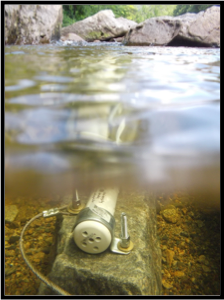 12 |
13 | More background reading on road salt:
14 | - http://des.nh.gov/organization/divisions/water/wmb/was/salt-reduction-initiative/impacts.htm
15 | - http://www.boston.com/news/local-news/2015/01/16/road-salt-where-does-it-come-from-where-does-it-go
16 | - http://news.nationalgeographic.com/news/2014/02/140212-road-salt-shortages-melting-ice-snow-science/
17 | - http://www.wired.com/2015/03/road-salt-polluting-rivers/
18 | - http://science.howstuffworks.com/nature/climate-weather/atmospheric/road-salt.htm
19 |
20 | **Salt water intrustion.** [Salt water intrustion](https://en.wikipedia.org/wiki/Saltwater_intrusion) is increasingly an issue world-wide, as groundwater extraction and sea level rise result in relatively saline waters contaminating fresh water supplies. Assessing and documenting the extent of this problem helps to inform solutions and predict trends.
21 |
22 | **Agriculture.** Irrigation, and other uses of water in agriculture, results in significant increases in the salinity of water, usually rendering it unsafe for drinking. More background:
23 |
24 | - http://www.fao.org/docrep/t0667e/t0667e05.htm
25 |
26 | **Hydraulic Fracturing and pollution.** The materials used in hydraulic fracturing or 'fracking' usually have very high specific conductivity; measuring conductivity of groundwater and surface water in the areas near a fracking operation may provide an indication of the extent of contamination of local water sources by fracking fluid. More info:
27 |
28 | - http://www.fondriest.com/news/tracking-fracking.htm
29 |
30 | ## Basic principles of conductivity measurement
31 |
32 | [To be added -- for now, see references below:]
33 |
34 | - General background here: https://en.wikipedia.org/wiki/Electrical_resistivity_and_conductivity
35 | - http://www2.latech.edu/~dehall/LWTL/ENGR121/notes/3_conductivity_sensor_intro.pdf
36 | - https://www.snowpure.com/docs/FAQ_Conductivity_Thornton.pdf
37 | - Fondriest : http://www.fondriest.com/environmental-measurements/parameters/water-quality/conductivity-salinity-tds/
38 | - http://www.analytical-chemistry.uoc.gr/files/items/6/618/agwgimometria_2.pdf
39 | - http://www.waterboards.ca.gov/water_issues/programs/swamp/docs/cwt/guidance/3130en.pdf
40 | - https://www.pasco.com/support/technical-support/technote/techIDlookup.cfm?TechNoteID=514
41 | - http://www1.udel.edu/pchem/C446/Experiments/exp4.pdf
42 |
43 | ## Characteristics of a good conductivity sensor
44 |
45 |
46 |
47 | In order to make reasonable conductivity measurements with a probe in solution, various electrochemical properties of the system have led researchers and instrumentation designers to devices that take into account the following considerations:
48 |
49 | **Input signal**.
50 |
51 | In order to avoid polarizing the solution being tested, and to minimize the effects of corrosion on the electrodes used in the probe, the input signal into the water should be:
52 |
53 | - alternating current
54 | - with a symmetric oscillation with respect to both electrodes (no net polarization)
55 | - low voltage, significantly below the electrolysis threshold for water (1.1 Volts).
56 |
57 |
12 |
13 | More background reading on road salt:
14 | - http://des.nh.gov/organization/divisions/water/wmb/was/salt-reduction-initiative/impacts.htm
15 | - http://www.boston.com/news/local-news/2015/01/16/road-salt-where-does-it-come-from-where-does-it-go
16 | - http://news.nationalgeographic.com/news/2014/02/140212-road-salt-shortages-melting-ice-snow-science/
17 | - http://www.wired.com/2015/03/road-salt-polluting-rivers/
18 | - http://science.howstuffworks.com/nature/climate-weather/atmospheric/road-salt.htm
19 |
20 | **Salt water intrustion.** [Salt water intrustion](https://en.wikipedia.org/wiki/Saltwater_intrusion) is increasingly an issue world-wide, as groundwater extraction and sea level rise result in relatively saline waters contaminating fresh water supplies. Assessing and documenting the extent of this problem helps to inform solutions and predict trends.
21 |
22 | **Agriculture.** Irrigation, and other uses of water in agriculture, results in significant increases in the salinity of water, usually rendering it unsafe for drinking. More background:
23 |
24 | - http://www.fao.org/docrep/t0667e/t0667e05.htm
25 |
26 | **Hydraulic Fracturing and pollution.** The materials used in hydraulic fracturing or 'fracking' usually have very high specific conductivity; measuring conductivity of groundwater and surface water in the areas near a fracking operation may provide an indication of the extent of contamination of local water sources by fracking fluid. More info:
27 |
28 | - http://www.fondriest.com/news/tracking-fracking.htm
29 |
30 | ## Basic principles of conductivity measurement
31 |
32 | [To be added -- for now, see references below:]
33 |
34 | - General background here: https://en.wikipedia.org/wiki/Electrical_resistivity_and_conductivity
35 | - http://www2.latech.edu/~dehall/LWTL/ENGR121/notes/3_conductivity_sensor_intro.pdf
36 | - https://www.snowpure.com/docs/FAQ_Conductivity_Thornton.pdf
37 | - Fondriest : http://www.fondriest.com/environmental-measurements/parameters/water-quality/conductivity-salinity-tds/
38 | - http://www.analytical-chemistry.uoc.gr/files/items/6/618/agwgimometria_2.pdf
39 | - http://www.waterboards.ca.gov/water_issues/programs/swamp/docs/cwt/guidance/3130en.pdf
40 | - https://www.pasco.com/support/technical-support/technote/techIDlookup.cfm?TechNoteID=514
41 | - http://www1.udel.edu/pchem/C446/Experiments/exp4.pdf
42 |
43 | ## Characteristics of a good conductivity sensor
44 |
45 |
46 |
47 | In order to make reasonable conductivity measurements with a probe in solution, various electrochemical properties of the system have led researchers and instrumentation designers to devices that take into account the following considerations:
48 |
49 | **Input signal**.
50 |
51 | In order to avoid polarizing the solution being tested, and to minimize the effects of corrosion on the electrodes used in the probe, the input signal into the water should be:
52 |
53 | - alternating current
54 | - with a symmetric oscillation with respect to both electrodes (no net polarization)
55 | - low voltage, significantly below the electrolysis threshold for water (1.1 Volts).
56 |
57 | 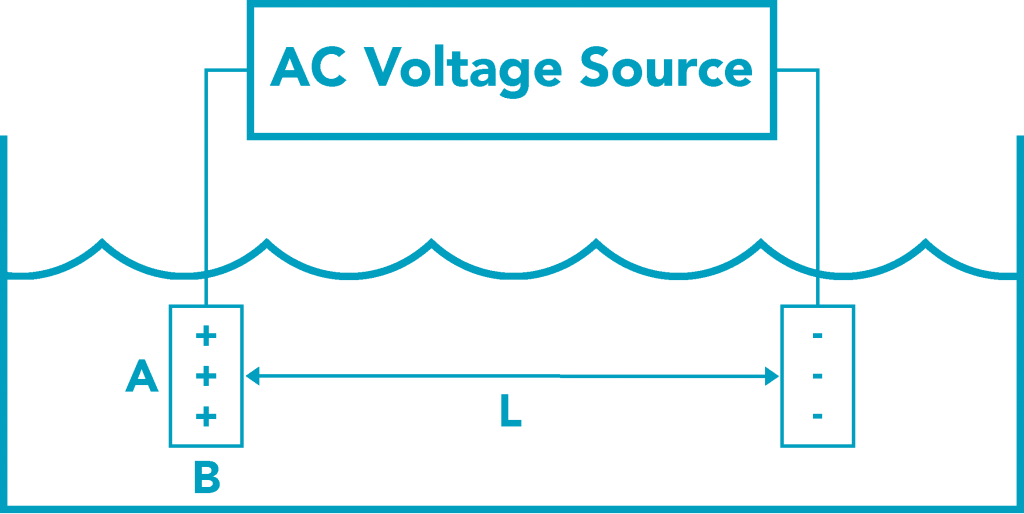 58 |
59 | _Source: http://www.sensorex.com/technical-education/_
60 |
61 | **Probe design.**
62 |
63 | The probe geometry and materials greatly affect the quality of the conductivity measurement. Probes should:
64 |
65 | - Use an electrode material that is less likely to corrode in the solution being tested (stainless steel and platinum are common choices)
66 | - Be arranged in a geometry that minimized 'fringing effects', or stray electric fields that may interact with the rest of the enclosure, or e.g. a beaker of test solution. There are indications in the literature that the fringing problem is **worst** when the individual electrode area (the exposed metal of the electrode) and the spacing between the electrodes is about equal.
67 |
68 | **Fringing effects in two probe designs**. If two probes consisting of 'point source' geometries are used (screws or bolts with only a small, round nub of metal exposed), relatively larger 'fringing fields' are likely to result -- meaning that the electrical measurement being made will be affected by the presence of nearby objects (a beaker wall, for example).
69 |
70 |
58 |
59 | _Source: http://www.sensorex.com/technical-education/_
60 |
61 | **Probe design.**
62 |
63 | The probe geometry and materials greatly affect the quality of the conductivity measurement. Probes should:
64 |
65 | - Use an electrode material that is less likely to corrode in the solution being tested (stainless steel and platinum are common choices)
66 | - Be arranged in a geometry that minimized 'fringing effects', or stray electric fields that may interact with the rest of the enclosure, or e.g. a beaker of test solution. There are indications in the literature that the fringing problem is **worst** when the individual electrode area (the exposed metal of the electrode) and the spacing between the electrodes is about equal.
67 |
68 | **Fringing effects in two probe designs**. If two probes consisting of 'point source' geometries are used (screws or bolts with only a small, round nub of metal exposed), relatively larger 'fringing fields' are likely to result -- meaning that the electrical measurement being made will be affected by the presence of nearby objects (a beaker wall, for example).
69 |
70 | 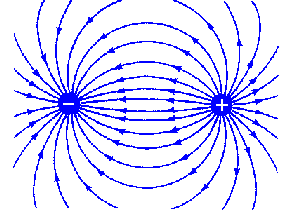 71 |
72 | This effect might not be problematic in the field (in a river, say), but can render calibration on a desktop difficult.
73 |
74 | **'Four probe' measurements** help to mitigate some of these effects by decoupling the input probes from the measurement circuitry -- the input probes may corrode, but this does not affect the measurement. More details on this approach [here](http://www.globalspec.com/learnmore/sensors_transducers_detectors/analytical_sensors/electrodes_conductivity).
75 |
76 |
71 |
72 | This effect might not be problematic in the field (in a river, say), but can render calibration on a desktop difficult.
73 |
74 | **'Four probe' measurements** help to mitigate some of these effects by decoupling the input probes from the measurement circuitry -- the input probes may corrode, but this does not affect the measurement. More details on this approach [here](http://www.globalspec.com/learnmore/sensors_transducers_detectors/analytical_sensors/electrodes_conductivity).
75 |
76 | 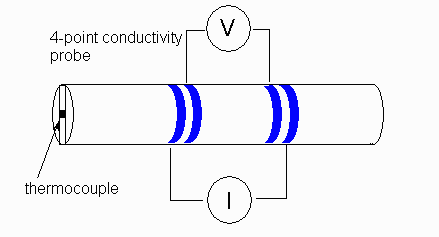 77 | _Source: http://www.globalspec.com/learnmore/sensors_transducers_detectors/analytical_sensors/electrodes_conductivity_
78 |
79 | **Toroidal probe designs** avoid the corrosion issue altogether -- these devices are completely separated from the liquid being tested, and interact with it only via EM fields. More detail [here](http://www.globalspec.com/learnmore/sensors_transducers_detectors/analytical_sensors/electrodes_conductivity).
80 |
81 |
77 | _Source: http://www.globalspec.com/learnmore/sensors_transducers_detectors/analytical_sensors/electrodes_conductivity_
78 |
79 | **Toroidal probe designs** avoid the corrosion issue altogether -- these devices are completely separated from the liquid being tested, and interact with it only via EM fields. More detail [here](http://www.globalspec.com/learnmore/sensors_transducers_detectors/analytical_sensors/electrodes_conductivity).
80 |
81 | 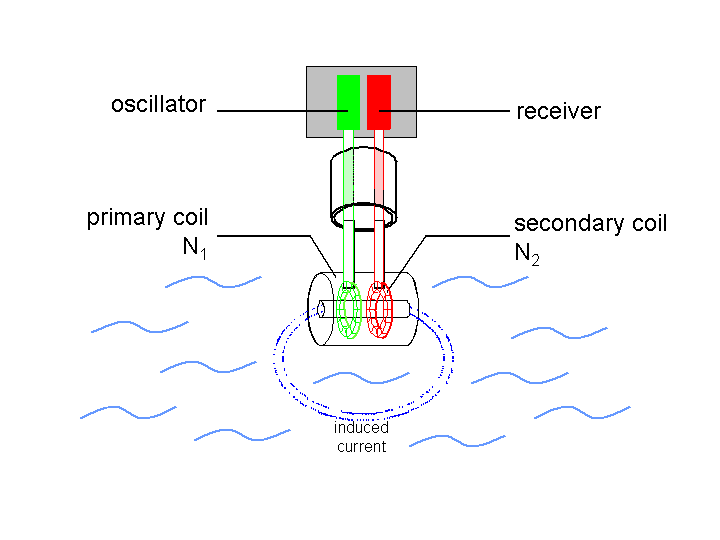 82 | _Source: https://www.ibt.kit.edu/img/content/prozess2_-en_markus_voelker.png_
83 |
84 | **Simple DIY approaches**. The relative advantages of various approaches to probe materials and geometry need to be weighed against the cost and complexity of constructing the probes. The wide availability and durability of PVC has led to several designs using this material (see, for example, [this one](https://publiclab.org/notes/bhickman/05-09-2016/conductivity-and-temperature-meter).
85 |
86 |
82 | _Source: https://www.ibt.kit.edu/img/content/prozess2_-en_markus_voelker.png_
83 |
84 | **Simple DIY approaches**. The relative advantages of various approaches to probe materials and geometry need to be weighed against the cost and complexity of constructing the probes. The wide availability and durability of PVC has led to several designs using this material (see, for example, [this one](https://publiclab.org/notes/bhickman/05-09-2016/conductivity-and-temperature-meter).
85 |
86 | 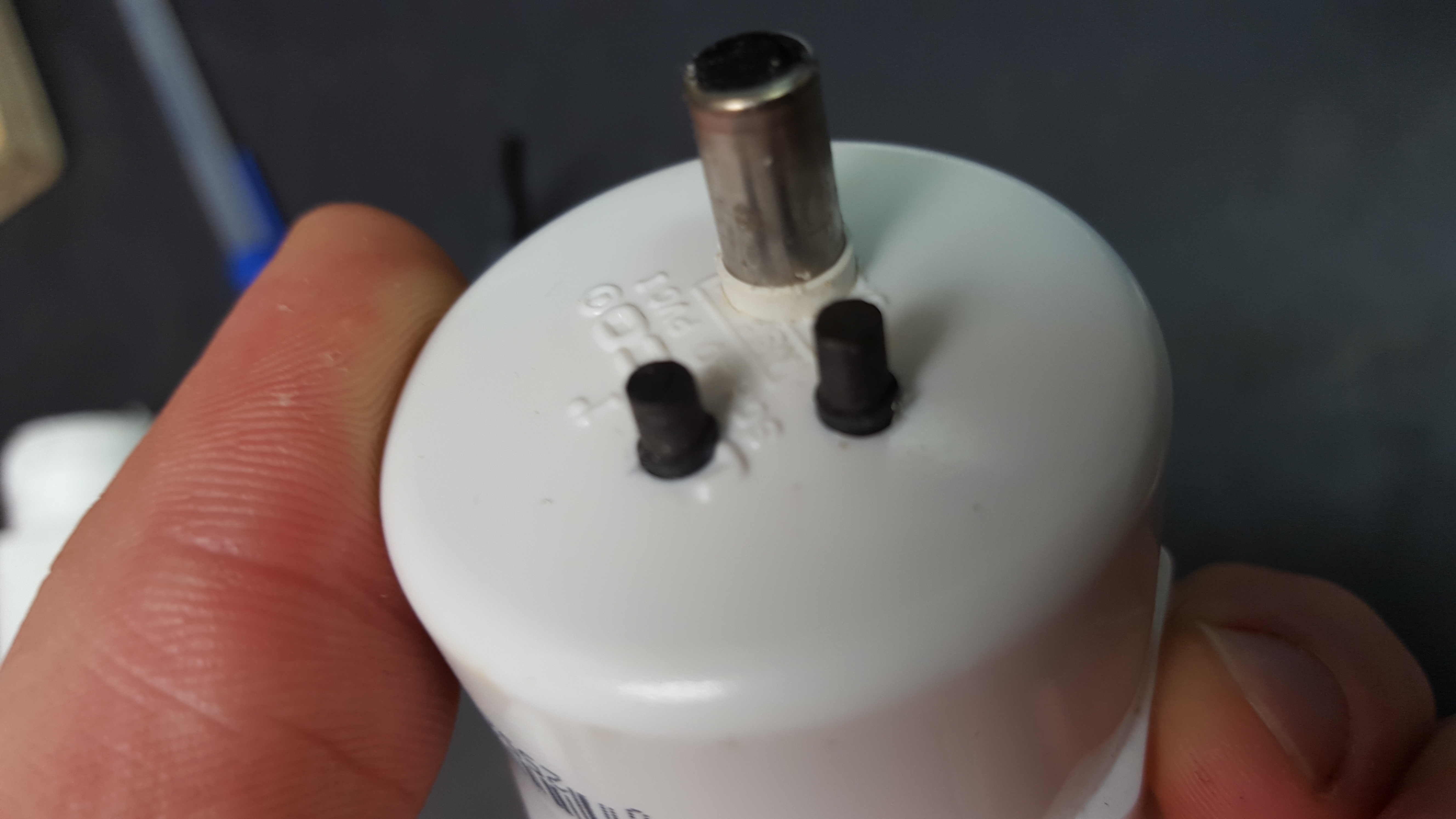 87 |
88 | Plastic bottles, with probes attached either to the screw cap, or to rubber stoppers inserted into the bottle opening, have also been explored (for example, [here](https://publiclab.org/notes/mathew/02-10-2016/riffle-conductivity-caps-and-other-housing-ideas)).
89 |
90 |
87 |
88 | Plastic bottles, with probes attached either to the screw cap, or to rubber stoppers inserted into the bottle opening, have also been explored (for example, [here](https://publiclab.org/notes/mathew/02-10-2016/riffle-conductivity-caps-and-other-housing-ideas)).
89 |
90 | 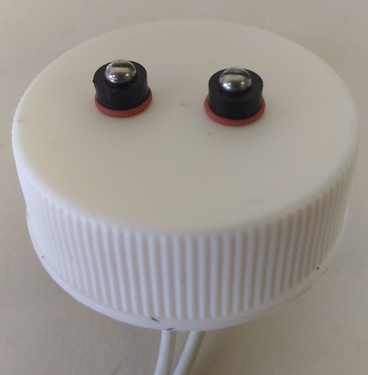 91 |
92 |
91 |
92 | 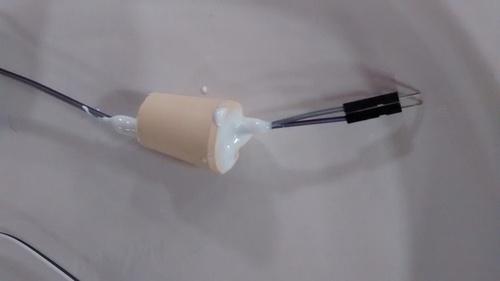 93 |
94 |
93 |
94 | 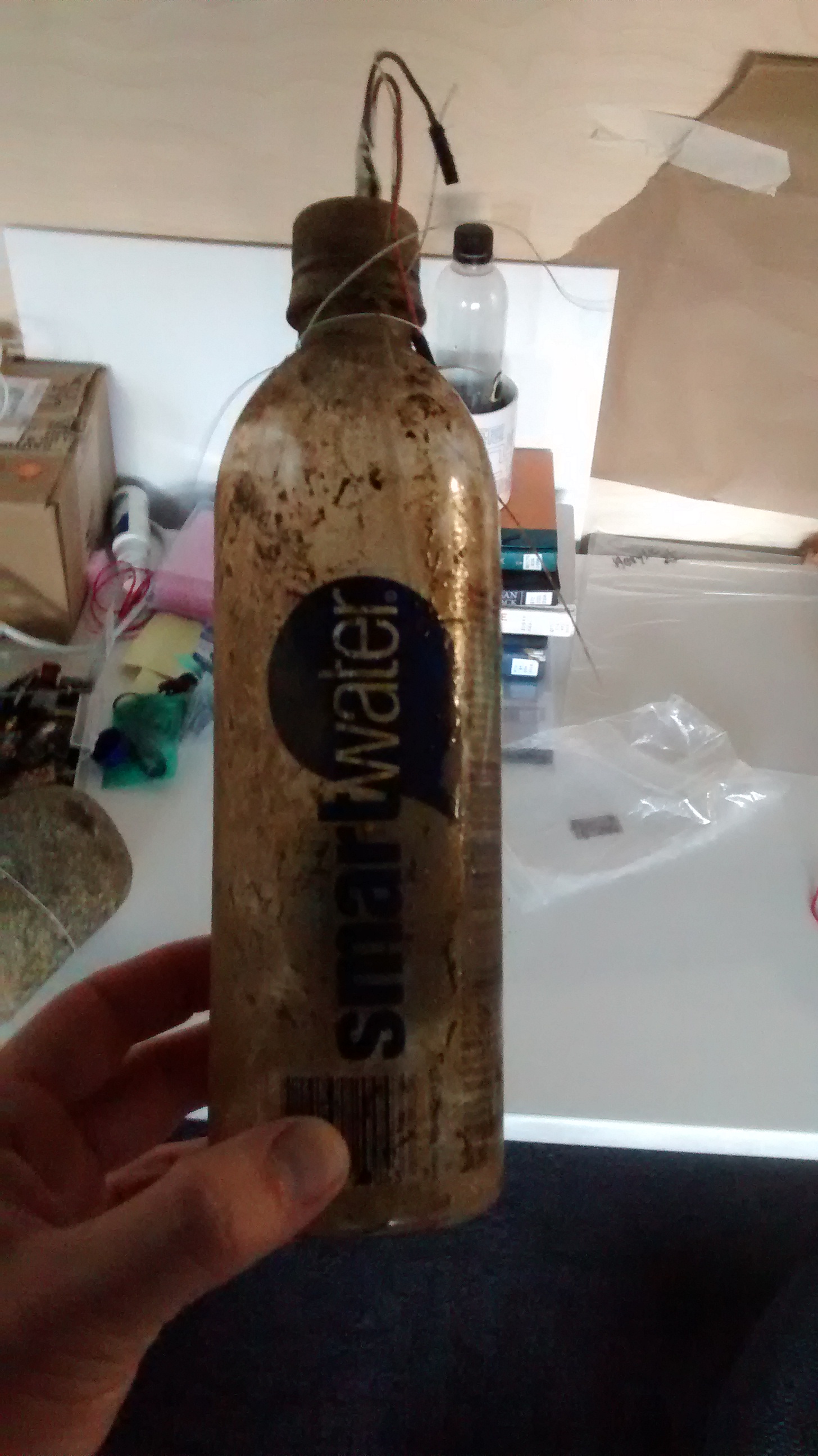 95 |
96 |
97 | **Temperature compensation.**
98 |
99 | Conductivity is affected by temperature:
100 |
101 |
95 |
96 |
97 | **Temperature compensation.**
98 |
99 | Conductivity is affected by temperature:
100 |
101 | 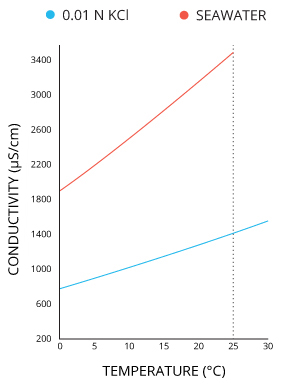 102 |
103 | In order to compare conductivity across liquids at different temperatures, the concept of 'specific conductivity' is used -- that is, the conductivity of the liquid 'if it were at 25 Celsius'. The temperature dependence of conductivity depends on the particular mixture of ions in the solution, and so the correction parameters and equations used for shifting the measured conductivity to the expected value at 25 C need to chosen appropriately for the expected chemical makeup of the solution. For more information, see 'Specific Conductance', [here](http://www.fondriest.com/environmental-measurements/parameters/water-quality/conductivity-salinity-tds/#cond3), and an extended discussion [here](http://www.reagecon.com/pdf/technicalpapers/Effect_of_Temperature_TSP-07_Issue3.pdf).
104 |
105 | Often, the simplest, linear correction for the effect of temperature on conductivity is used:
106 |
107 |
102 |
103 | In order to compare conductivity across liquids at different temperatures, the concept of 'specific conductivity' is used -- that is, the conductivity of the liquid 'if it were at 25 Celsius'. The temperature dependence of conductivity depends on the particular mixture of ions in the solution, and so the correction parameters and equations used for shifting the measured conductivity to the expected value at 25 C need to chosen appropriately for the expected chemical makeup of the solution. For more information, see 'Specific Conductance', [here](http://www.fondriest.com/environmental-measurements/parameters/water-quality/conductivity-salinity-tds/#cond3), and an extended discussion [here](http://www.reagecon.com/pdf/technicalpapers/Effect_of_Temperature_TSP-07_Issue3.pdf).
104 |
105 | Often, the simplest, linear correction for the effect of temperature on conductivity is used:
106 |
107 | 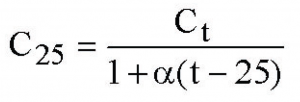 108 |
109 | Here, **t** is the temperature of the sample, **C_25** is the calculated conductivity at 25 C, **C_t** is the measured conductivity at temperature **t**, and **alpha** is a temperature coefficient chosen to be appropriate for the expected ion content of the solution being tested. (For dilute solutions of most salts, alpha = 0.02 is a fairly good approximation; better values can be chosen if more information is known about the content of the solution.)
110 |
111 | ## Calibration techniques
112 |
113 | **Commercial standard solutions.**
114 |
115 | - http://www.davis.com/Product/Oakton_conductivity_solution_2764_S/YX-00653-20?referred_id=3388&gclid=Cj0KEQiArou2BRDcoN_c6NDI3oMBEiQANeix5up7px8eL9rByANeftTaCMyJusFlYSJtDb5ElptPo_AaAiaH8P8HAQ
116 |
117 | **DIY options.**
118 |
119 | - Saline solution
120 | - Soda
121 | - Salt and distilled water
122 |
123 |
108 |
109 | Here, **t** is the temperature of the sample, **C_25** is the calculated conductivity at 25 C, **C_t** is the measured conductivity at temperature **t**, and **alpha** is a temperature coefficient chosen to be appropriate for the expected ion content of the solution being tested. (For dilute solutions of most salts, alpha = 0.02 is a fairly good approximation; better values can be chosen if more information is known about the content of the solution.)
110 |
111 | ## Calibration techniques
112 |
113 | **Commercial standard solutions.**
114 |
115 | - http://www.davis.com/Product/Oakton_conductivity_solution_2764_S/YX-00653-20?referred_id=3388&gclid=Cj0KEQiArou2BRDcoN_c6NDI3oMBEiQANeix5up7px8eL9rByANeftTaCMyJusFlYSJtDb5ElptPo_AaAiaH8P8HAQ
116 |
117 | **DIY options.**
118 |
119 | - Saline solution
120 | - Soda
121 | - Salt and distilled water
122 |
123 | 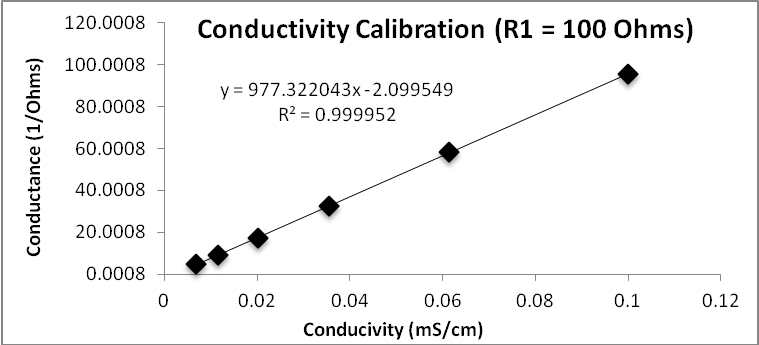 124 |
124 | 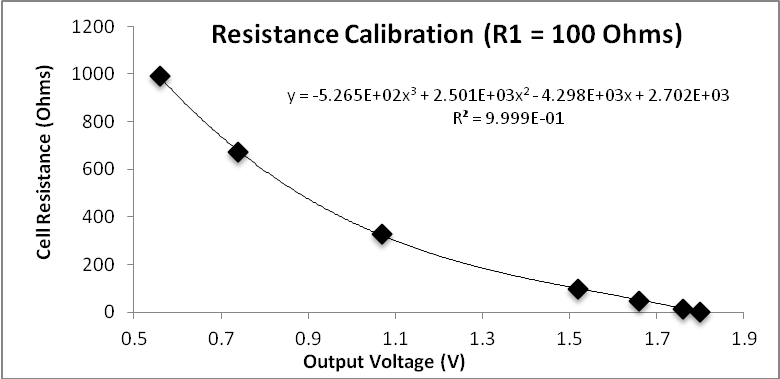 125 |
126 | **Conductivity ranges.**
127 |
128 |
125 |
126 | **Conductivity ranges.**
127 |
128 | 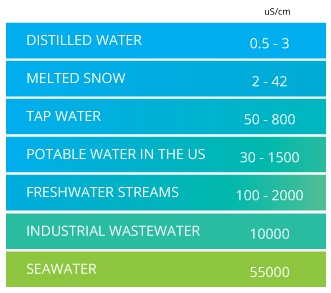 129 |
130 | ## DIY sensor designs
131 |
132 | [TODO:
133 |
134 | - wein bridge oscillator vs. 555 vs. square wave from microcontroller vs sine wave
135 | - describe utility of op-amps
136 | - describe various ways of measuring the resistance -- bridge circuits vs. op-amp voltage divider
137 | ]
138 |
139 | **Ben Gamari.**
140 |
141 | Ref: RIffle design, which includes conductivity sensor.
142 |
143 | **Coqui.**
144 |
145 | Design.
146 | https://publiclab.org/wiki/coqui
147 | https://publiclab.org/notes/donblair/09-30-2014/coqui-bbv1-0
148 |
149 |
129 |
130 | ## DIY sensor designs
131 |
132 | [TODO:
133 |
134 | - wein bridge oscillator vs. 555 vs. square wave from microcontroller vs sine wave
135 | - describe utility of op-amps
136 | - describe various ways of measuring the resistance -- bridge circuits vs. op-amp voltage divider
137 | ]
138 |
139 | **Ben Gamari.**
140 |
141 | Ref: RIffle design, which includes conductivity sensor.
142 |
143 | **Coqui.**
144 |
145 | Design.
146 | https://publiclab.org/wiki/coqui
147 | https://publiclab.org/notes/donblair/09-30-2014/coqui-bbv1-0
148 |
149 | 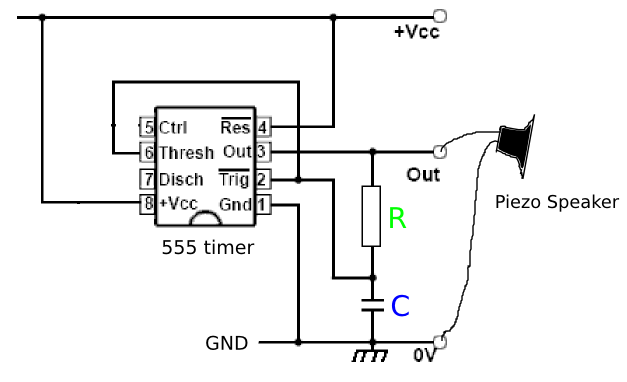 150 |
151 | Problems:
152 |
153 | - https://publiclab.org/notes/donblair/01-07-2016/conductivity-sensing-open-questions
154 |
155 | **Ben Hickman.**
156 |
157 | - https://publiclab.org/notes/JSummers/11-21-2013/conductivity-meter
158 | - https://publiclab.org/notes/bhickman/05-09-2016/conductivity-and-temperature-meter
159 |
160 |
150 |
151 | Problems:
152 |
153 | - https://publiclab.org/notes/donblair/01-07-2016/conductivity-sensing-open-questions
154 |
155 | **Ben Hickman.**
156 |
157 | - https://publiclab.org/notes/JSummers/11-21-2013/conductivity-meter
158 | - https://publiclab.org/notes/bhickman/05-09-2016/conductivity-and-temperature-meter
159 |
160 | 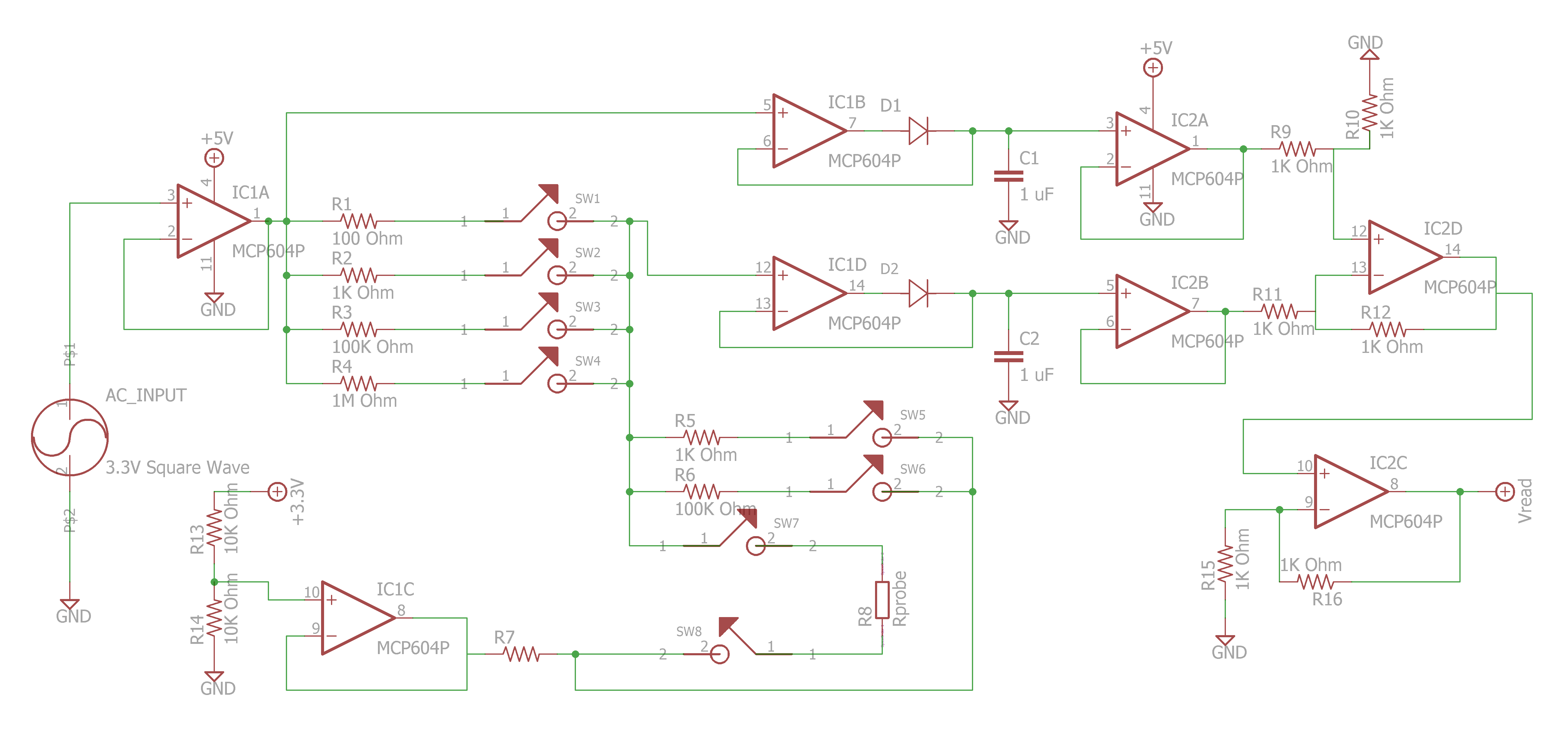 161 |
162 |
161 |
162 | 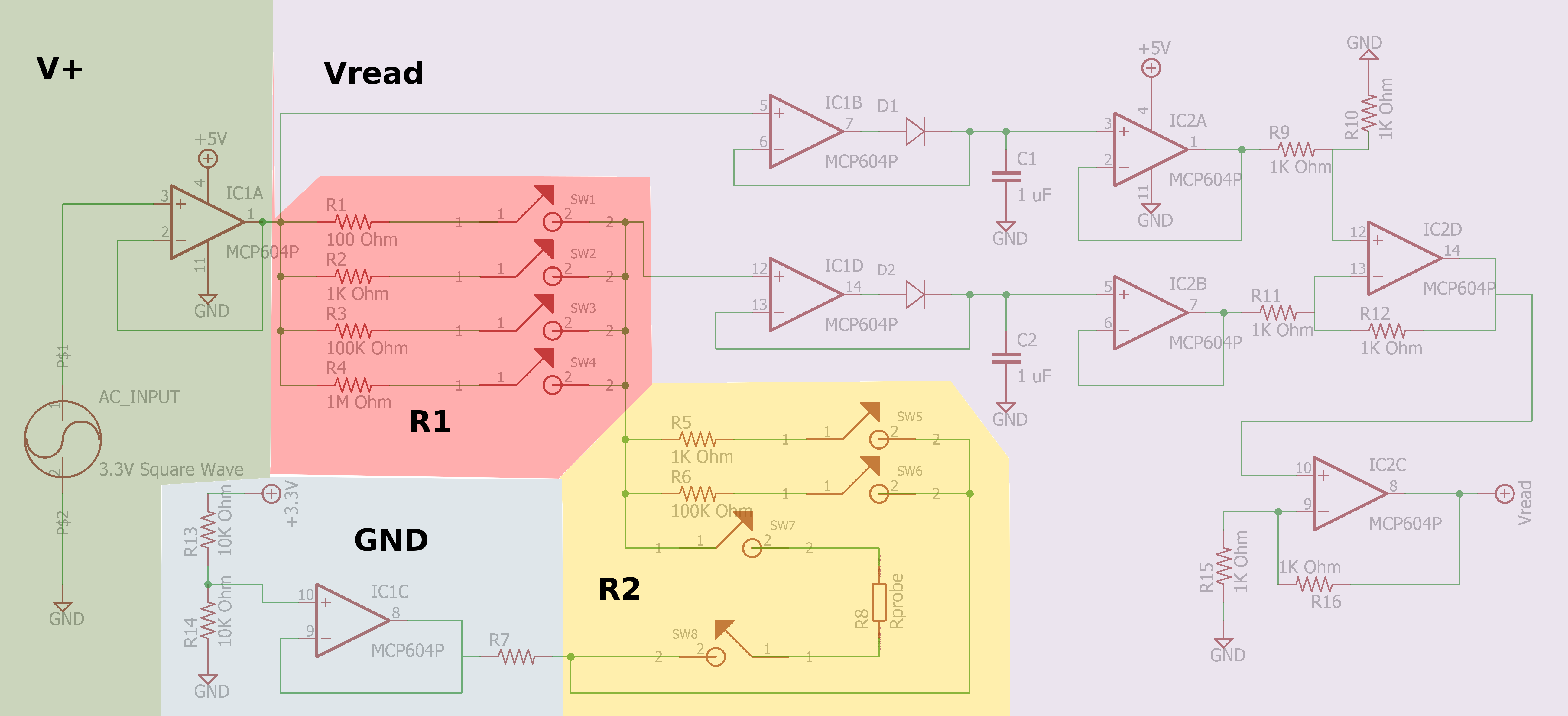 163 |
164 | **Sparky's Widgets.**
165 |
166 | - http://hackaday.com/2014/11/10/accurately-measuring-electrical-conductivity/
167 | - https://github.com/SparkysWidgets/MinieCHW
168 |
169 |
163 |
164 | **Sparky's Widgets.**
165 |
166 | - http://hackaday.com/2014/11/10/accurately-measuring-electrical-conductivity/
167 | - https://github.com/SparkysWidgets/MinieCHW
168 |
169 | 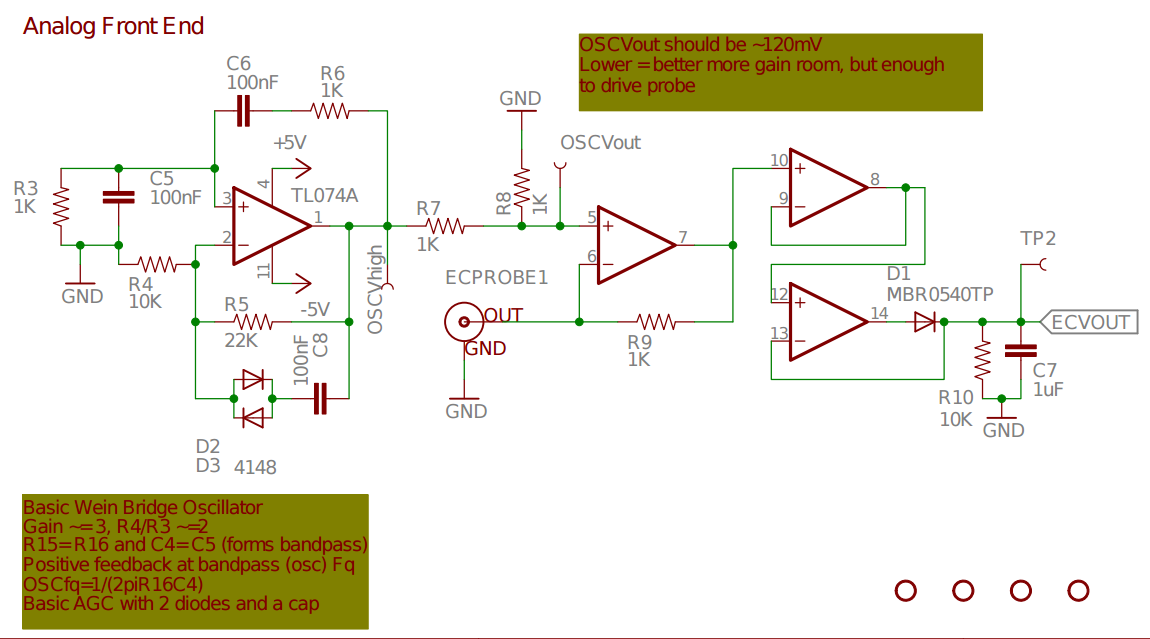 170 |
171 | **openCTD.**
172 |
173 | openCTD project
174 | https://github.com/OceanographyforEveryone/OpenCTD
175 | http://oceanographyforeveryone.com/
176 |
177 | [Atlas Scientific conductivity circuit](http://www.atlas-scientific.com/product_pages/circuits/ezo_ec.html)
178 |
179 |
170 |
171 | **openCTD.**
172 |
173 | openCTD project
174 | https://github.com/OceanographyforEveryone/OpenCTD
175 | http://oceanographyforeveryone.com/
176 |
177 | [Atlas Scientific conductivity circuit](http://www.atlas-scientific.com/product_pages/circuits/ezo_ec.html)
178 |
179 | 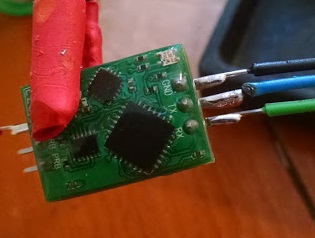 180 |
181 | **Vintage.**
182 |
183 | http://www.ullasmann.eu/Doc/Salt_Concentration_Meter.pdf
184 |
185 |
180 |
181 | **Vintage.**
182 |
183 | http://www.ullasmann.eu/Doc/Salt_Concentration_Meter.pdf
184 |
185 | 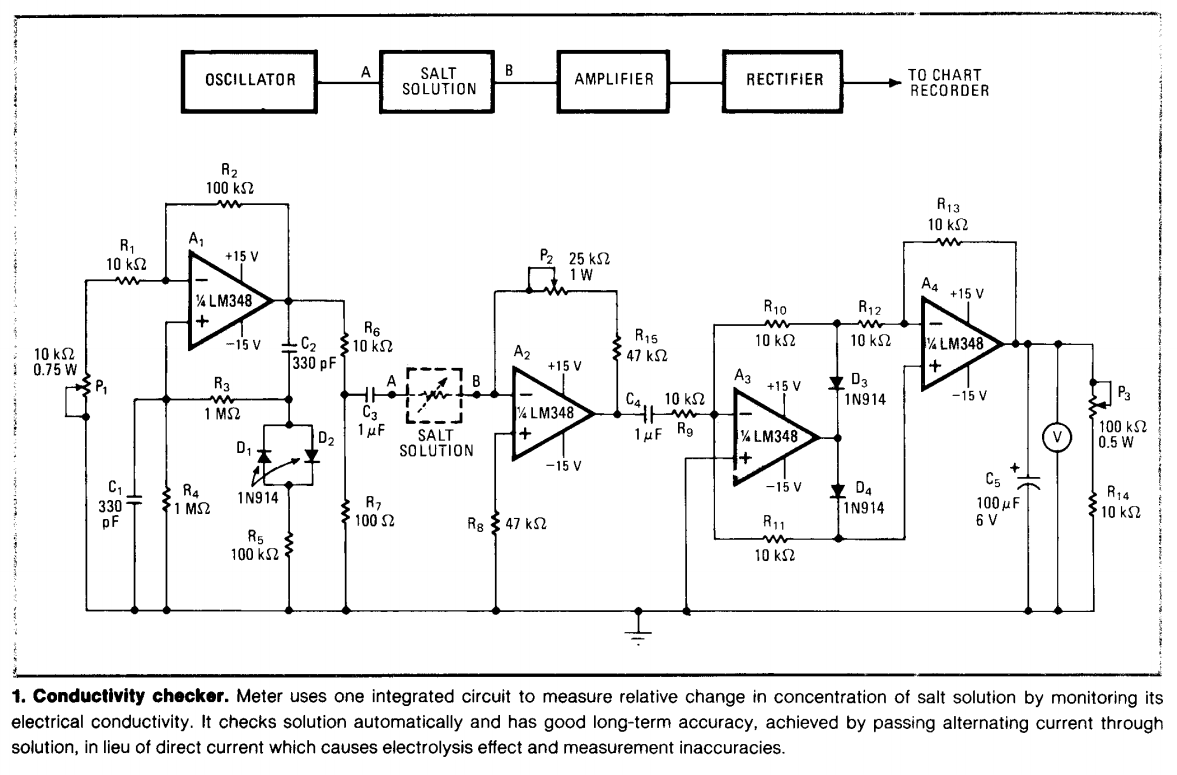 186 |
187 | ## Research directions
188 |
189 |
190 | ## Research Notes on Public Lab
191 |
192 | All research notes tagged 'conductivity':
193 | - https://publiclab.org/tag/conductivity
194 |
195 | 'Coqui' approach:
196 | - https://publiclab.org/wiki/coqui
197 | - https://publiclab.org/wiki/555-conductivity-meter
198 | - https://publiclab.org/notes/donblair/07-11-2014/simple-555-conductivity-meter
199 | - https://publiclab.org/wiki/coqui-a-simple-water-conductivity-sensor
200 | - https://publiclab.org/notes/donblair/01-07-2016/conductivity-sensing-open-questions
201 | - https://publiclab.org/notes/rebeccah/08-29-2016/riffle-device-water-conductivity-sensor
202 | - https://publiclab.org/notes/donblair/09-30-2014/making-a-diy-conductivity-probe-from-a-water-bottle-and-metal-screws
203 |
204 | Jack Summers, Ben Hickman:
205 | - https://publiclab.org/notes/bhickman/05-09-2016/conductivity-and-temperature-meter
206 | - https://publiclab.org/notes/JSummers/11-21-2013/conductivity-meter
207 |
208 | Patrick Hixenbaugh:
209 | - https://publiclab.org/notes/pdhixenbaugh/08-20-2016/planning-for-a-new-riffle-conductivity-circuit
210 |
211 | General:
212 | - https://publiclab.org/notes/markwh/10-29-2014/calibrating-arduino-based-conductivity-meter
213 | - https://publiclab.org/notes/donblair/06-18-2014/using-an-audio-jack-to-assess-conductivity
214 |
215 | ## References
216 |
217 | - http://mediashift.org/2012/04/water-hackathon-aims-to-understand-brooklyns-water-pollution096/
218 |
219 |
220 | ## Guides to conductivity
221 |
222 | - http://www.ott.com/blog/2015/04/measuring-conductivity-of-water-temperature-compensation-and-derivatives/
223 | - http://www.globalspec.com/learnmore/sensors_transducers_detectors/analytical_sensors/electrodes_conductivity
224 | - http://www.tek.com/sites/tek.com/files/media/document/resources/2615%204%20Point%20Probe%20AN.pdf
225 | - http://www2.latech.edu/~dehall/LWTL/ENGR121/notes/3_conductivity_sensor_intro.pdf
226 | - https://www.snowpure.com/docs/FAQ_Conductivity_Thornton.pdf
227 | - Fondriest : http://www.fondriest.com/environmental-measurements/parameters/water-quality/conductivity-salinity-tds/
228 | - http://www.analytical-chemistry.uoc.gr/files/items/6/618/agwgimometria_2.pdf
229 | - http://www.waterboards.ca.gov/water_issues/programs/swamp/docs/cwt/guidance/3130en.pdf
230 | - https://www.pasco.com/support/technical-support/technote/techIDlookup.cfm?TechNoteID=514
231 | - http://www1.udel.edu/pchem/C446/Experiments/exp4.pdf
232 |
233 | ## References for conductivity levels
234 |
235 | - http://www.mbhes.com/conductivity_measurement.htm
236 | - Relationship between conductivity and water quality: http://www.lenntech.com/applications/ultrapure/conductivity/water-conductivity.htm
237 |
238 |
239 |
240 |
--------------------------------------------------------------------------------
186 |
187 | ## Research directions
188 |
189 |
190 | ## Research Notes on Public Lab
191 |
192 | All research notes tagged 'conductivity':
193 | - https://publiclab.org/tag/conductivity
194 |
195 | 'Coqui' approach:
196 | - https://publiclab.org/wiki/coqui
197 | - https://publiclab.org/wiki/555-conductivity-meter
198 | - https://publiclab.org/notes/donblair/07-11-2014/simple-555-conductivity-meter
199 | - https://publiclab.org/wiki/coqui-a-simple-water-conductivity-sensor
200 | - https://publiclab.org/notes/donblair/01-07-2016/conductivity-sensing-open-questions
201 | - https://publiclab.org/notes/rebeccah/08-29-2016/riffle-device-water-conductivity-sensor
202 | - https://publiclab.org/notes/donblair/09-30-2014/making-a-diy-conductivity-probe-from-a-water-bottle-and-metal-screws
203 |
204 | Jack Summers, Ben Hickman:
205 | - https://publiclab.org/notes/bhickman/05-09-2016/conductivity-and-temperature-meter
206 | - https://publiclab.org/notes/JSummers/11-21-2013/conductivity-meter
207 |
208 | Patrick Hixenbaugh:
209 | - https://publiclab.org/notes/pdhixenbaugh/08-20-2016/planning-for-a-new-riffle-conductivity-circuit
210 |
211 | General:
212 | - https://publiclab.org/notes/markwh/10-29-2014/calibrating-arduino-based-conductivity-meter
213 | - https://publiclab.org/notes/donblair/06-18-2014/using-an-audio-jack-to-assess-conductivity
214 |
215 | ## References
216 |
217 | - http://mediashift.org/2012/04/water-hackathon-aims-to-understand-brooklyns-water-pollution096/
218 |
219 |
220 | ## Guides to conductivity
221 |
222 | - http://www.ott.com/blog/2015/04/measuring-conductivity-of-water-temperature-compensation-and-derivatives/
223 | - http://www.globalspec.com/learnmore/sensors_transducers_detectors/analytical_sensors/electrodes_conductivity
224 | - http://www.tek.com/sites/tek.com/files/media/document/resources/2615%204%20Point%20Probe%20AN.pdf
225 | - http://www2.latech.edu/~dehall/LWTL/ENGR121/notes/3_conductivity_sensor_intro.pdf
226 | - https://www.snowpure.com/docs/FAQ_Conductivity_Thornton.pdf
227 | - Fondriest : http://www.fondriest.com/environmental-measurements/parameters/water-quality/conductivity-salinity-tds/
228 | - http://www.analytical-chemistry.uoc.gr/files/items/6/618/agwgimometria_2.pdf
229 | - http://www.waterboards.ca.gov/water_issues/programs/swamp/docs/cwt/guidance/3130en.pdf
230 | - https://www.pasco.com/support/technical-support/technote/techIDlookup.cfm?TechNoteID=514
231 | - http://www1.udel.edu/pchem/C446/Experiments/exp4.pdf
232 |
233 | ## References for conductivity levels
234 |
235 | - http://www.mbhes.com/conductivity_measurement.htm
236 | - Relationship between conductivity and water quality: http://www.lenntech.com/applications/ultrapure/conductivity/water-conductivity.htm
237 |
238 |
239 |
240 |
--------------------------------------------------------------------------------