├── docs
├── design
│ ├── opcode_executor.md
│ ├── eval_frame.md
│ ├── output-restoration.md
│ ├── tracker-and-guard.md
│ ├── stringify-guard.md
│ ├── closure.md
│ └── builtin-dispatcher.md
├── compat
│ └── python311
│ │ ├── index.md
│ │ ├── CALL.md
│ │ └── closure.md
├── notes
│ └── function-and-method.md
├── profiler_introduction.md
└── instructions
│ ├── UNPACK_SEQUENCE.md
│ └── CALL_FUNCTION.md
├── tests
├── error_test_paddle_cast.py
├── test_tensor_slice.py
├── tests_legacy
│ ├── run_all.sh
│ ├── test_generator.py
│ ├── test_symbolic_for.py
│ ├── test_symbolic_fallback.py
│ ├── test_symbolic_infer_meta.py
│ ├── test_resnet50.py
│ ├── error_test_symbolic_load_before_call.py
│ ├── test_symbolic_backward.py
│ ├── test_simple_net.py
│ ├── test_error_cases.py
│ ├── test_optransform_cache.py
│ ├── test_symbolic_fallback_if.py
│ ├── error_test_trace_cache.py
│ ├── test_symbolic_trace.py
│ ├── error_test_sir_call.py
│ ├── test_basic_translation.py
│ ├── error_test_trace_cache.py.zhanfei
│ ├── test_symbolic_nested.py
│ ├── error_test_resnet_with_trace_cache.py
│ ├── test_case_base.py
│ └── test_resnet50_backward.py
├── test_multiple_args.py
├── test_delete_fast.py
├── error_test_guard.py
├── test_13_make_function.py
├── test_error_handling.py
├── extract_errors.py
├── error_test_resnet50.py
├── test_02_store_inplace.py
├── test_09_f_string.py
├── test_str_format.py
├── error_test_general_bytecode.py
├── test_numpy.py
├── test_dup_top.py
├── test_simulate_initialize.py
├── test_01_basic.py
├── test_constant_graph.py
├── test_numpy_var_if.py
├── error_test_jump_inline.py
├── test_execution_base.py
├── run_all.sh
├── test_stack.py
├── test_07_unpack.py
├── test_16_paddle_api.py
├── test_call_object.py
├── test_resnet.py
├── test_tensor_dtype_in_guard.py
├── test_segment_linear.py
├── test_trace_list_arg.py
├── run_all_paddle_ci.sh
├── test_exception.py
├── test_output_restoration.py
├── test_range.py
├── test_20_string.py
├── test_03_tuple.py
├── test_sir_rollback.py
├── test_guard_outputs.py
├── test_17_paddle_layer.py
├── test_18_tensor_method.py
├── test_08_rot.py
├── test_10_build_unpack.py
├── test_guard_user_defined_fn.py
├── test_resnet50_backward.py
├── test_enumerate.py
├── test_cost_model.py
├── test_map.py
├── test_11_jumps.py
├── test_06_call_function.py
├── test_15_slice.py
├── test_inplace_api.py
├── test_break_graph.py
├── test_code_status.py
├── test_21_global.py
└── test_instruction_translator_cache.py
├── sot
├── opcode_translator
│ ├── executor
│ │ ├── __init__.py
│ │ ├── instr_flag.py
│ │ ├── dispatch_functions.py
│ │ ├── variables
│ │ │ └── __init__.py
│ │ └── tracker_viewer.py
│ ├── __init__.py
│ ├── custom_code.py
│ ├── instruction_utils
│ │ ├── __init__.py
│ │ └── opcode_info.py
│ ├── transform.py
│ └── skip_files.py
├── __init__.py
├── psdb.py
├── utils
│ ├── __init__.py
│ ├── exceptions.py
│ ├── code_status.py
│ ├── paddle_api_config.py
│ └── magic_methods.py
├── profiler.py
├── symbolic
│ ├── compile_cache.py
│ └── symbolic_context.py
└── translate.py
├── .gitignore
├── examples
├── trace_basic.py
├── graph_break.py
├── guard.py
└── run_all.sh
├── .github
└── workflows
│ ├── codestyle.yaml
│ ├── unittest.yaml
│ └── paddle_ci.yaml
├── README.md
├── .pre-commit-config.yaml
└── pyproject.toml
/docs/design/opcode_executor.md:
--------------------------------------------------------------------------------
1 |
--------------------------------------------------------------------------------
/tests/error_test_paddle_cast.py:
--------------------------------------------------------------------------------
1 |
--------------------------------------------------------------------------------
/sot/opcode_translator/executor/__init__.py:
--------------------------------------------------------------------------------
1 | from . import variable_dispatch # noqa: F401
2 |
--------------------------------------------------------------------------------
/sot/opcode_translator/__init__.py:
--------------------------------------------------------------------------------
1 | from .transform import eval_frame_callback # noqa: F401
2 |
--------------------------------------------------------------------------------
/.gitignore:
--------------------------------------------------------------------------------
1 | __pycache__
2 | *.sw*
3 | user_tag
4 |
5 | # Editor config
6 | .vscode
7 |
8 | # Environments
9 | venv/
10 | .venv/
11 |
12 | # Build
13 | build/
14 | *.egg-info
15 |
--------------------------------------------------------------------------------
/sot/opcode_translator/custom_code.py:
--------------------------------------------------------------------------------
1 | from __future__ import annotations
2 |
3 | import types
4 | from typing import NamedTuple
5 |
6 |
7 | class CustomCode(NamedTuple):
8 | code: types.CodeType | None
9 | disable_eval_frame: bool
10 |
--------------------------------------------------------------------------------
/sot/__init__.py:
--------------------------------------------------------------------------------
1 | from . import psdb # noqa: F401
2 | from .opcode_translator.breakpoint import ( # noqa: F401
3 | BM,
4 | add_breakpoint,
5 | add_event,
6 | )
7 | from .opcode_translator.skip_files import skip_function # noqa: F401
8 | from .translate import symbolic_translate # noqa: F401
9 |
--------------------------------------------------------------------------------
/docs/compat/python311/index.md:
--------------------------------------------------------------------------------
1 | # Python 3.11 适配
2 |
3 | ## 字段适配
4 |
5 | 指 CodeObject 的字段修改适配,Python 3.11 主要新增了 `co_exceptiontable` 字段,并对 `co_linetable` 进行了一定的修改
6 |
7 | - [`co_linetable`](./co_linetable.md)
8 |
9 | ## 字节码修改适配
10 |
11 | - [CALL 相关字节码](./CALL.md)
12 |
13 | - [closure 相关修改](./closure.md)
14 |
--------------------------------------------------------------------------------
/tests/test_tensor_slice.py:
--------------------------------------------------------------------------------
1 | import unittest
2 |
3 | from test_case_base import TestCaseBase
4 |
5 | import paddle
6 |
7 |
8 | def foo(x: paddle.Tensor):
9 | return x[:, 0]
10 |
11 |
12 | class TestExecutor(TestCaseBase):
13 | def test_tensor_slice(self):
14 | x = paddle.randn((10, 10))
15 | self.assert_results(foo, x)
16 |
17 |
18 | if __name__ == "__main__":
19 | unittest.main()
20 |
--------------------------------------------------------------------------------
/tests/tests_legacy/run_all.sh:
--------------------------------------------------------------------------------
1 | # 遍历目录下的所有 Python 文件
2 | export PYTHONPATH=$PYTHONPATH:../
3 |
4 | for file in ./test_*.py; do
5 | # 检查文件是否为 Python 文件
6 | if [ -f "$file" ]; then
7 | echo Running: PYTHONPATH=$PYTHONPATH" python " $file
8 | # 执行文件
9 | python "$file"
10 | if [ $? -ne 0 ]; then
11 | echo "run $file failed"
12 | exit 1
13 | fi
14 | fi
15 | done
16 |
--------------------------------------------------------------------------------
/tests/tests_legacy/test_generator.py:
--------------------------------------------------------------------------------
1 | import unittest
2 |
3 | from test_case_base import TestCaseBase
4 |
5 |
6 | def gen():
7 | yield from range(10)
8 |
9 |
10 | def case1():
11 | sum = 0
12 | for i in gen():
13 | sum += i
14 | return sum
15 |
16 |
17 | class TestGen(TestCaseBase):
18 | def test_gen(self):
19 | self.assert_results(case1)
20 |
21 |
22 | if __name__ == "__main__":
23 | unittest.main()
24 |
--------------------------------------------------------------------------------
/tests/test_multiple_args.py:
--------------------------------------------------------------------------------
1 | import unittest
2 |
3 | from test_case_base import TestCaseBase
4 |
5 | import paddle
6 |
7 |
8 | def foo(x, y):
9 | ret = x + y
10 | return ret
11 |
12 |
13 | class TestMultipleArgs(TestCaseBase):
14 | def test_multiple_args(self):
15 | x = paddle.to_tensor([1.0])
16 | y = paddle.to_tensor([2.0])
17 | self.assert_results(foo, x, y)
18 |
19 |
20 | if __name__ == "__main__":
21 | unittest.main()
22 |
--------------------------------------------------------------------------------
/tests/test_delete_fast.py:
--------------------------------------------------------------------------------
1 | from __future__ import annotations
2 |
3 | import unittest
4 |
5 | from test_case_base import TestCaseBase
6 |
7 | import paddle
8 |
9 |
10 | def test_delete_fast(a):
11 | a = a + 2
12 | t = a * 3
13 | del t
14 | return a
15 |
16 |
17 | class TestExecutor(TestCaseBase):
18 | def test_simple(self):
19 | a = paddle.to_tensor(1)
20 | self.assert_results(test_delete_fast, a)
21 |
22 |
23 | if __name__ == "__main__":
24 | unittest.main()
25 |
--------------------------------------------------------------------------------
/sot/opcode_translator/executor/instr_flag.py:
--------------------------------------------------------------------------------
1 | # flags for instructions
2 |
3 |
4 | class FORMAT_VALUE_FLAG:
5 | FVC_MASK = 0x3
6 | FVC_NONE = 0x0
7 | FVC_STR = 0x1
8 | FVC_REPR = 0x2
9 | FVC_ASCII = 0x3
10 | FVS_MASK = 0x4
11 | FVS_HAVE_SPEC = 0x4
12 |
13 |
14 | class MAKE_FUNCTION_FLAG:
15 | MF_HAS_CLOSURE = 0x08
16 | MF_HAS_ANNOTATION = 0x04
17 | MF_HAS_KWDEFAULTS = 0x02
18 | MF_HAS_DEFAULTS = 0x01
19 |
20 |
21 | class CALL_FUNCTION_EX_FLAG:
22 | CFE_HAS_KWARGS = 0x01
23 |
--------------------------------------------------------------------------------
/tests/error_test_guard.py:
--------------------------------------------------------------------------------
1 | import unittest
2 |
3 | from test_case_base import TestCaseBase
4 |
5 | import paddle
6 |
7 |
8 | def fn(x):
9 | # now do not support `with xx_guard()`, will fallback to dygraph
10 | with paddle.static.amp.fp16_guard():
11 | out = x + 1
12 | return out
13 |
14 |
15 | class TestGuard(TestCaseBase):
16 | def test_simple(self):
17 | x = paddle.to_tensor(2)
18 | self.assert_results(fn, x)
19 |
20 |
21 | if __name__ == "__main__":
22 | unittest.main()
23 |
--------------------------------------------------------------------------------
/sot/opcode_translator/instruction_utils/__init__.py:
--------------------------------------------------------------------------------
1 | from .instruction_utils import ( # noqa: F401
2 | Instruction,
3 | calc_offset_from_bytecode_offset,
4 | calc_stack_effect,
5 | convert_instruction,
6 | gen_instr,
7 | get_instructions,
8 | instrs_info,
9 | modify_extended_args,
10 | modify_instrs,
11 | modify_vars,
12 | relocate_jump_target,
13 | replace_instr,
14 | reset_offset,
15 | )
16 | from .opcode_analysis import ( # noqa: F401
17 | Space,
18 | analysis_inputs,
19 | analysis_used_names_with_space,
20 | )
21 |
--------------------------------------------------------------------------------
/tests/test_13_make_function.py:
--------------------------------------------------------------------------------
1 | # MAKE_FUNCTION
2 | # CALL_FUNCTION_KW
3 | from __future__ import annotations
4 |
5 | import unittest
6 |
7 | from test_case_base import TestCaseBase
8 |
9 | import paddle
10 |
11 |
12 | def make_fn(x: paddle.Tensor):
13 | def fn(a, b=2, c=3, d=4):
14 | return a + b + c + d
15 |
16 | return fn(1) + fn(2, c=5) + x
17 |
18 |
19 | class TestExecutor(TestCaseBase):
20 | def test_simple(self):
21 | self.assert_results(make_fn, paddle.to_tensor(1))
22 |
23 |
24 | if __name__ == "__main__":
25 | unittest.main()
26 |
--------------------------------------------------------------------------------
/tests/tests_legacy/test_symbolic_for.py:
--------------------------------------------------------------------------------
1 | import unittest
2 |
3 | from test_case_base import TestCaseBase
4 |
5 | import paddle
6 |
7 |
8 | def case1(x):
9 | for i in range(int(x)):
10 | print("yes")
11 | return x
12 |
13 |
14 | def case2(x):
15 | sum = 0
16 | for i in x:
17 | sum += i
18 | return sum
19 |
20 |
21 | class TestFor(TestCaseBase):
22 | def test(self):
23 | self.assert_results(case1, paddle.to_tensor([4]))
24 | self.assert_results(case2, paddle.to_tensor([4.0, 1.0, 2.0, 3.0]))
25 |
26 |
27 | if __name__ == "__main__":
28 | unittest.main()
29 |
--------------------------------------------------------------------------------
/tests/test_error_handling.py:
--------------------------------------------------------------------------------
1 | import unittest
2 |
3 | from test_case_base import TestCaseBase, strict_mode_guard
4 |
5 | import sot
6 |
7 |
8 | def fn_with_try_except():
9 | sot.psdb.breakgraph()
10 | sot.psdb.fallback()
11 | try:
12 | raise ValueError("ValueError")
13 | except ValueError:
14 | print("catch ValueError")
15 | return True
16 |
17 |
18 | class TestErrorHandling(TestCaseBase):
19 | @strict_mode_guard(0)
20 | def test_fn_with_try_except(self):
21 | self.assert_results(fn_with_try_except)
22 |
23 |
24 | if __name__ == "__main__":
25 | unittest.main()
26 |
--------------------------------------------------------------------------------
/tests/extract_errors.py:
--------------------------------------------------------------------------------
1 | import re
2 | import sys
3 |
4 | runtime_error_msg = sys.stdin.read()
5 |
6 | pattern = r'File "?(.*?)"?, line (\d+),.*\n(.*?)\n(.*?)$'
7 | for match in re.finditer(pattern, runtime_error_msg, re.MULTILINE):
8 | file = match.group(1)
9 | if file.startswith("./"):
10 | file = f"tests/{file[2:]}"
11 | line = match.group(2)
12 | error_info = match.group(4)
13 | if "AssertionError" not in error_info:
14 | # error_info = match.group(3) + '\n' + match.group(4)
15 | output = f"::error file={file},line={line}::Error"
16 | print(output)
17 |
--------------------------------------------------------------------------------
/tests/tests_legacy/test_symbolic_fallback.py:
--------------------------------------------------------------------------------
1 | import unittest
2 |
3 | from test_case_base import TestCaseBase
4 |
5 | import paddle
6 |
7 |
8 | def case1(x):
9 | kk = "sdfsdf"
10 | y = 2 + x
11 | ret = paddle.nn.functional.relu(y)
12 | print(y)
13 | print(y.numpy())
14 | print("yes")
15 | print("no")
16 | # for i in range(10):
17 | ret = ret + 2 + x
18 | return ret
19 |
20 |
21 | class TestFallback(TestCaseBase):
22 | def test_bool(self):
23 | x = paddle.to_tensor([1.0])
24 | self.assert_results(case1, x)
25 |
26 |
27 | if __name__ == "__main__":
28 | unittest.main()
29 |
--------------------------------------------------------------------------------
/tests/tests_legacy/test_symbolic_infer_meta.py:
--------------------------------------------------------------------------------
1 | import unittest
2 |
3 | from test_case_base import TestCaseBase
4 |
5 | import paddle
6 | from sot import symbolic_translate
7 |
8 |
9 | def case1(x):
10 | y = 2 + x
11 | y = y + 1
12 | ret = paddle.nn.functional.relu(y)
13 |
14 | assert list(y.meta.shape) == [2]
15 | z = paddle.concat([x, y])
16 | assert list(z.meta.shape) == [4]
17 |
18 |
19 | class TestIf(TestCaseBase):
20 | def test_if_1(self):
21 | x = paddle.to_tensor([1.0, 2.0])
22 | symbolic_translate(case1)(x)
23 |
24 |
25 | if __name__ == "__main__":
26 | unittest.main()
27 |
--------------------------------------------------------------------------------
/tests/error_test_resnet50.py:
--------------------------------------------------------------------------------
1 | import unittest
2 |
3 | from test_case_base import TestCaseBase
4 |
5 | import paddle
6 | from paddle.vision import resnet50
7 |
8 |
9 | class SimpleNet(paddle.nn.Layer):
10 | def __init__(self):
11 | super().__init__()
12 | self.relu = paddle.nn.ReLU()
13 |
14 | def forward(self, x):
15 | x = self.relu(x)
16 | return x
17 |
18 |
19 | class TestNet(TestCaseBase):
20 | def test(self):
21 | image = paddle.rand((1, 3, 255, 255))
22 | net = resnet50()
23 | self.assert_results(net, image)
24 |
25 |
26 | if __name__ == "__main__":
27 | unittest.main()
28 |
--------------------------------------------------------------------------------
/tests/test_02_store_inplace.py:
--------------------------------------------------------------------------------
1 | import unittest
2 |
3 | from test_case_base import TestCaseBase
4 |
5 | import paddle
6 |
7 |
8 | def foo(x: int, y: paddle.Tensor):
9 | x = x + 1
10 | y = y + 1
11 | x += y
12 | return x
13 |
14 |
15 | class TestStoreInplace(TestCaseBase):
16 | def test_simple(self):
17 | self.assert_results(foo, 1, paddle.to_tensor(2))
18 |
19 |
20 | if __name__ == "__main__":
21 | unittest.main()
22 |
23 |
24 | # Instructions:
25 | # LOAD_FAST
26 | # BINARY_ADD
27 | # STORE_FAST (new)
28 | # INPLACE_ADD (new)
29 | # RETURN_VALUE
30 |
31 | # Variables:
32 | # ConstantVariable
33 | # TensorVariable
34 |
--------------------------------------------------------------------------------
/tests/tests_legacy/test_resnet50.py:
--------------------------------------------------------------------------------
1 | import unittest
2 |
3 | from test_case_base import TestCaseBase
4 |
5 | import paddle
6 | from paddle.vision import resnet50
7 |
8 |
9 | class SimpleNet(paddle.nn.Layer):
10 | def __init__(self):
11 | super().__init__()
12 | self.relu = paddle.nn.ReLU()
13 |
14 | def forward(self, x):
15 | x = self.relu(x)
16 | return x
17 |
18 |
19 | class TestNet(TestCaseBase):
20 | def test(self):
21 | image = paddle.rand((1, 3, 255, 255))
22 | net = resnet50()
23 | self.assert_results(net, image)
24 |
25 |
26 | if __name__ == "__main__":
27 | unittest.main()
28 |
--------------------------------------------------------------------------------
/tests/test_09_f_string.py:
--------------------------------------------------------------------------------
1 | # FORMAT_VALUE (new)
2 | # BUILD_STRING (new)
3 | from __future__ import annotations
4 |
5 | import unittest
6 |
7 | from test_case_base import TestCaseBase
8 |
9 | import paddle
10 | from sot.psdb import assert_true
11 |
12 |
13 | def foo(x: paddle.Tensor):
14 | whilespace = 123
15 | hello_world = f"Hello {whilespace} World"
16 | z = assert_true(hello_world == "Hello 123 World")
17 | x = x + 1
18 | return x
19 |
20 |
21 | class TestFString(TestCaseBase):
22 | def test_fstring(self):
23 | self.assert_results(foo, paddle.to_tensor(1))
24 |
25 |
26 | if __name__ == "__main__":
27 | unittest.main()
28 |
--------------------------------------------------------------------------------
/tests/test_str_format.py:
--------------------------------------------------------------------------------
1 | from __future__ import annotations
2 |
3 | import unittest
4 |
5 | from test_case_base import TestCaseBase
6 |
7 |
8 | # copy from python library _distutils_hack/__init__.py
9 | def find_spec(self, fullname, path, target=None):
10 | method_name = 'spec_for_{fullname}'.format(
11 | **{'self': self, 'fullname': fullname}
12 | )
13 | method = getattr(self, method_name, lambda: None)
14 | return method()
15 |
16 |
17 | class TestExecutor(TestCaseBase):
18 | def test_simple(self):
19 | self.assert_results(find_spec, "self", "fullname", "path", None)
20 |
21 |
22 | if __name__ == "__main__":
23 | unittest.main()
24 |
--------------------------------------------------------------------------------
/examples/trace_basic.py:
--------------------------------------------------------------------------------
1 | import numpy as np
2 |
3 | import paddle
4 | from sot.translate import symbolic_translate
5 |
6 |
7 | def foo(x: paddle.Tensor, y: paddle.Tensor):
8 | z = x + y
9 | return z + 1
10 |
11 |
12 | def main():
13 | x = paddle.rand([2, 3])
14 | y = paddle.rand([2, 3])
15 | dygraph_out = foo(x, y)
16 | symbolic_translate_out = symbolic_translate(foo)(x, y)
17 |
18 | print("dygraph_out:", dygraph_out)
19 | print("symbolic_translate_out:", symbolic_translate_out)
20 | np.testing.assert_allclose(
21 | dygraph_out.numpy(), symbolic_translate_out.numpy()
22 | )
23 |
24 |
25 | if __name__ == '__main__':
26 | main()
27 |
--------------------------------------------------------------------------------
/tests/tests_legacy/error_test_symbolic_load_before_call.py:
--------------------------------------------------------------------------------
1 | import unittest
2 |
3 | from test_case_base import TestCaseBase
4 |
5 | import paddle
6 |
7 | # TODO(SigureMo): Fix this test case
8 |
9 |
10 | def nest_func_3(x, y):
11 | a = x + y
12 | b = x * a
13 | z = b + nest_func_2(a)
14 | return z
15 |
16 |
17 | def nest_func_2(z):
18 | print(z)
19 | return z
20 |
21 |
22 | class Test(TestCaseBase):
23 | def test(self):
24 | self.assert_results(
25 | nest_func_3,
26 | paddle.to_tensor([1, 1, 1, 1]),
27 | paddle.to_tensor([2, 3, 4, 5]),
28 | )
29 |
30 |
31 | if __name__ == "__main__":
32 | unittest.main()
33 |
--------------------------------------------------------------------------------
/tests/tests_legacy/test_symbolic_backward.py:
--------------------------------------------------------------------------------
1 | import unittest
2 |
3 | import numpy as np
4 | from test_case_base import TestCaseBase
5 |
6 | import paddle
7 | from sot import symbolic_translate
8 |
9 |
10 | def func(x, y):
11 | return x * y
12 |
13 |
14 | class TestNet(TestCaseBase):
15 | def test(self):
16 | x = paddle.to_tensor([5, 3])
17 | y = paddle.to_tensor([1, 3])
18 | x.stop_gradient = False
19 | self.assert_results(func, x, y)
20 |
21 | ret = symbolic_translate(func)(x, y)
22 | ret.backward()
23 | np.testing.assert_allclose(x.grad.numpy(), [1.0, 3.0])
24 |
25 |
26 | if __name__ == "__main__":
27 | unittest.main()
28 |
--------------------------------------------------------------------------------
/.github/workflows/codestyle.yaml:
--------------------------------------------------------------------------------
1 | name: CodeStyle Check
2 |
3 | on:
4 | push:
5 | branches: [develop]
6 | pull_request:
7 | workflow_dispatch:
8 |
9 | jobs:
10 | Test:
11 | runs-on: ubuntu-latest
12 | name: CodeStyle Check
13 | steps:
14 | - name: Checkout
15 | uses: actions/checkout@v3
16 |
17 | - name: Install python
18 | uses: actions/setup-python@v4
19 | with:
20 | # Run pre-commit on the lowest supported python version
21 | python-version: '3.8'
22 |
23 | - name: Install dependencies
24 | run: |
25 | pip install pre-commit
26 | - name: Precommit Check
27 | run : pre-commit run --all-files
28 |
--------------------------------------------------------------------------------
/tests/tests_legacy/test_simple_net.py:
--------------------------------------------------------------------------------
1 | import unittest
2 |
3 | from test_case_base import TestCaseBase
4 |
5 | import paddle
6 |
7 |
8 | class SimpleNet(paddle.nn.Layer):
9 | def __init__(self):
10 | super().__init__()
11 | self.linear1 = paddle.nn.Linear(10, 3)
12 | self.linear2 = paddle.nn.Linear(3, 1)
13 |
14 | def forward(self, x):
15 | out1 = self.linear1(x)
16 | out2 = self.linear2(out1)
17 | return out1 + out2
18 |
19 |
20 | class TestNet(TestCaseBase):
21 | def test(self):
22 | inp = paddle.rand((10,))
23 | net = SimpleNet()
24 | self.assert_results(net, inp)
25 |
26 |
27 | if __name__ == "__main__":
28 | unittest.main()
29 |
--------------------------------------------------------------------------------
/tests/error_test_general_bytecode.py:
--------------------------------------------------------------------------------
1 | import dis
2 | import unittest
3 |
4 | from test_case_base import TestCaseBase
5 |
6 |
7 | def func():
8 | return True is True is not False
9 |
10 |
11 | def func2(x):
12 | # TODO(@xiaojian): SIR not used by output.
13 | y = x + 1
14 | return True is True is not False
15 |
16 |
17 | def func3():
18 | i = 0
19 |
20 | def inner():
21 | return i + 1
22 |
23 | return inner()
24 |
25 |
26 | class TestExecutor(TestCaseBase):
27 | def test_simple(self):
28 | self.assert_results(func3)
29 | # self.assert_results(func2, paddle.to_tensor(1.0))
30 |
31 |
32 | dis.dis(func3)
33 |
34 | if __name__ == "__main__":
35 | unittest.main()
36 |
--------------------------------------------------------------------------------
/tests/tests_legacy/test_error_cases.py:
--------------------------------------------------------------------------------
1 | import unittest
2 |
3 | from test_case_base import TestCaseBase
4 |
5 | import paddle
6 |
7 |
8 | def case_list_comp(x):
9 | def add_one(x):
10 | return x + 1
11 |
12 | ret = [add_one(x) for x in x]
13 | return ret
14 |
15 |
16 | def case_map_structure(x):
17 | def add_one(x):
18 | return x + 1
19 |
20 | ret = paddle.utils.map_structure(add_one, x)
21 | return ret
22 |
23 |
24 | class Test(TestCaseBase):
25 | def test(self):
26 | self.assert_results(case_list_comp, paddle.to_tensor([1, 2, 4, 3]))
27 | self.assert_results(case_map_structure, paddle.to_tensor([1, 2, 4, 3]))
28 |
29 |
30 | if __name__ == "__main__":
31 | unittest.main()
32 |
--------------------------------------------------------------------------------
/tests/tests_legacy/test_optransform_cache.py:
--------------------------------------------------------------------------------
1 | import unittest
2 |
3 | from test_case_base import TestCaseBase
4 |
5 | import paddle
6 | from sot import symbolic_translate
7 | from sot.opcode_translator.instruction_translator import OpcodeExecutorCache
8 |
9 |
10 | def case1(x):
11 | for i in range(int(x)):
12 | print("yes")
13 | return x
14 |
15 |
16 | class TestFor(TestCaseBase):
17 | def test(self):
18 | symbolic_translate(case1)(paddle.to_tensor([4]))
19 | symbolic_translate(case1)(paddle.to_tensor([4]))
20 | symbolic_translate(case1)(paddle.to_tensor([4]))
21 | assert OpcodeExecutorCache().hit_num == 2, "cache hit num should be 2"
22 |
23 |
24 | if __name__ == "__main__":
25 | unittest.main()
26 |
--------------------------------------------------------------------------------
/examples/graph_break.py:
--------------------------------------------------------------------------------
1 | import numpy as np
2 |
3 | import paddle
4 | from sot.translate import symbolic_translate
5 |
6 |
7 | def foo(cond: paddle.Tensor, x: paddle.Tensor):
8 | x += 1
9 | if cond:
10 | x += 1
11 | else:
12 | x -= 1
13 | return x
14 |
15 |
16 | def main():
17 | cond = paddle.to_tensor(True)
18 | x = paddle.to_tensor(0)
19 | dygraph_out = foo(cond, x)
20 | symbolic_translate_out = symbolic_translate(foo)(cond, x)
21 |
22 | print("dygraph_out:", dygraph_out)
23 | print("symbolic_translate_out:", symbolic_translate_out)
24 | np.testing.assert_allclose(
25 | dygraph_out.numpy(), symbolic_translate_out.numpy()
26 | )
27 |
28 |
29 | if __name__ == '__main__':
30 | main()
31 |
--------------------------------------------------------------------------------
/tests/tests_legacy/test_symbolic_fallback_if.py:
--------------------------------------------------------------------------------
1 | import unittest
2 |
3 | from test_case_base import TestCaseBase
4 |
5 | import paddle
6 |
7 |
8 | def case1(cond, x):
9 | cond = 2 + cond
10 | if cond:
11 | print("yes")
12 | x = x + 4
13 | else:
14 | print("no")
15 | x = x - 4
16 | ret = paddle.nn.functional.relu(x)
17 | return ret
18 |
19 |
20 | class TestIf(TestCaseBase):
21 | def test_if_1(self):
22 | self.assert_results(
23 | case1, paddle.to_tensor([4.0]), paddle.to_tensor([4.0])
24 | )
25 | self.assert_results(
26 | case1, paddle.to_tensor([-2.0]), paddle.to_tensor([4.0])
27 | )
28 |
29 |
30 | if __name__ == "__main__":
31 | unittest.main()
32 |
--------------------------------------------------------------------------------
/tests/test_numpy.py:
--------------------------------------------------------------------------------
1 | import unittest
2 |
3 | import numpy as np
4 | from test_case_base import TestCaseBase, strict_mode_guard
5 |
6 | import paddle
7 |
8 |
9 | def foo(x, y):
10 | ret = x + y
11 | return ret
12 |
13 |
14 | class TestNumpy(TestCaseBase):
15 | def test_tensor_add_numpy_number(self):
16 | x = paddle.to_tensor([1.0])
17 | y = np.int64(2)
18 | self.assert_results(foo, x, y)
19 | self.assert_results(foo, y, x)
20 |
21 | @strict_mode_guard(0)
22 | def test_tensor_add_numpy_array(self):
23 | x = paddle.to_tensor([1.0])
24 | y = np.array(2.0)
25 | self.assert_results(foo, x, y)
26 | self.assert_results(foo, y, x)
27 |
28 |
29 | if __name__ == "__main__":
30 | unittest.main()
31 |
--------------------------------------------------------------------------------
/examples/guard.py:
--------------------------------------------------------------------------------
1 | import paddle
2 | from sot.translate import symbolic_translate
3 |
4 |
5 | def foo(x: paddle.Tensor, y: paddle.Tensor, z: paddle.Tensor):
6 | a = x + y
7 | a *= x
8 | return a, z
9 |
10 |
11 | def main():
12 | a = paddle.rand([1])
13 | b = paddle.rand([2, 3])
14 | c = paddle.rand([4])
15 | d = paddle.rand([5, 6])
16 | e = paddle.rand([])
17 | sym_foo = symbolic_translate(foo)
18 | dygraph_out = foo(a, b, c)
19 | symbolic_translate_out = sym_foo(a, b, c)
20 |
21 | print("dygraph_out:", dygraph_out)
22 | print("symbolic_translate_out:", symbolic_translate_out)
23 |
24 | # cache hit
25 | sym_foo(a, b, d)
26 |
27 | # cache miss
28 | sym_foo(e, b, c)
29 |
30 |
31 | if __name__ == '__main__':
32 | main()
33 |
--------------------------------------------------------------------------------
/examples/run_all.sh:
--------------------------------------------------------------------------------
1 | # 遍历目录下的所有 Python 文件
2 | export PYTHONPATH=$PYTHONPATH:../
3 | export STRICT_MODE=1
4 | export MIN_GRAPH_SIZE=-1
5 |
6 | for file in ./*.py; do
7 | # 检查文件是否为 Python 文件
8 | if [ -f "$file" ]; then
9 | if [[ -n "$GITHUB_ACTIONS" ]]; then
10 | echo ::group::example Running: LOG_LEVEL=3 PYTHONPATH=$PYTHONPATH " STRICT_MODE=1 python " $file
11 | else
12 | echo Running: LOG_LEVEL=3 PYTHONPATH=$PYTHONPATH " STRICT_MODE=1 python " $file
13 | fi
14 | # 执行文件
15 | python "$file"
16 | if [ $? -ne 0 ]; then
17 | echo "run $file failed"
18 | exit 1
19 | fi
20 | if [[ -n "$GITHUB_ACTIONS" ]]; then
21 | echo "::endgroup::"
22 | fi
23 | fi
24 | done
25 |
--------------------------------------------------------------------------------
/tests/tests_legacy/error_test_trace_cache.py:
--------------------------------------------------------------------------------
1 | import unittest
2 |
3 | import paddle
4 | from sot import symbolic_translate
5 | from sot.proxy_tensor import cache_and_return, frame_enter, frame_leave
6 |
7 |
8 | class A:
9 | def __init__(self, x):
10 | self.x = x
11 |
12 |
13 | def sum_2(l):
14 | if frame_enter("func1", (l)):
15 | print("hit cache")
16 | return cache_and_return("func1", (l))
17 | ret = l[0] + l[1]
18 | frame_leave(ret)
19 | return ret
20 |
21 |
22 | class TestCaseName(unittest.TestCase):
23 | def test_return_callable(self):
24 | x = paddle.to_tensor([1.0])
25 | y = paddle.to_tensor([2.0])
26 | ret = symbolic_translate(sum_2)([x, y])
27 | print(ret)
28 |
29 |
30 | if __name__ == "__main__":
31 | unittest.main()
32 |
--------------------------------------------------------------------------------
/tests/tests_legacy/test_symbolic_trace.py:
--------------------------------------------------------------------------------
1 | import unittest
2 |
3 | from test_case_base import TestCaseBase
4 |
5 | import paddle
6 |
7 |
8 | def case1(x):
9 | y = 2 + x
10 | ret = paddle.nn.functional.relu(y)
11 | print("yes")
12 | print("no")
13 | # for i in range(10):
14 | ret = ret + 2 + x
15 | return ret
16 |
17 |
18 | def case2(x):
19 | y = x + 2
20 | ret = paddle.nn.functional.relu(y)
21 | for i in range(10):
22 | ret = ret + 2 + x
23 | return ret
24 |
25 |
26 | class TestIf(TestCaseBase):
27 | def test_if_1(self):
28 | x = paddle.to_tensor([1.0])
29 | self.assert_results(case1, paddle.to_tensor([1.0]))
30 | self.assert_results(case2, paddle.to_tensor([1.0]))
31 |
32 |
33 | if __name__ == "__main__":
34 | unittest.main()
35 |
--------------------------------------------------------------------------------
/tests/tests_legacy/error_test_sir_call.py:
--------------------------------------------------------------------------------
1 | import unittest
2 |
3 | import paddle
4 | from sot import symbolic_translate
5 | from sot.trace_cache_entrance import cache_and_return, frame_enter, frame_leave
6 |
7 |
8 | def sum(x, y):
9 | if frame_enter("sum", (x, y)):
10 | return cache_and_return("sum", (x, y))
11 | ret = x + y
12 | frame_leave("sum", (ret))
13 | return ret
14 |
15 |
16 | def main(x, y):
17 | ret = sum(x, x)
18 | ret2 = sum(x, y)
19 | return ret2
20 |
21 |
22 | class TestCaseName(unittest.TestCase):
23 | def test_return_callable(self):
24 | x = paddle.to_tensor([1.0])
25 | y = paddle.to_tensor([2.0])
26 | ret = symbolic_translate(main)(x, y)
27 | assert ret.item() == 3.0, "Should be 4.0"
28 |
29 |
30 | if __name__ == "__main__":
31 | unittest.main()
32 |
--------------------------------------------------------------------------------
/tests/test_dup_top.py:
--------------------------------------------------------------------------------
1 | from __future__ import annotations
2 |
3 | import unittest
4 |
5 | from test_case_base import TestCaseBase
6 |
7 | import paddle
8 |
9 |
10 | def func_dup_top_1():
11 | return True == True != False
12 |
13 |
14 | def func_dup_top_2(x):
15 | y = x + 1
16 | return True == True != False
17 |
18 |
19 | def func_dup_top_two(x: list[paddle.Tensor]):
20 | x[0] += x[1]
21 | return x
22 |
23 |
24 | class TestDupTop(TestCaseBase):
25 | def test_dup_top(self):
26 | self.assert_results(func_dup_top_1)
27 | self.assert_results(func_dup_top_2, paddle.to_tensor(1.0))
28 | # TODO: fix this after we support side effect
29 | # self.assert_results(
30 | # func_dup_top_two, [paddle.to_tensor(1.0), paddle.to_tensor(2.0)]
31 | # )
32 |
33 |
34 | if __name__ == "__main__":
35 | unittest.main()
36 |
--------------------------------------------------------------------------------
/tests/test_simulate_initialize.py:
--------------------------------------------------------------------------------
1 | import unittest
2 |
3 | from test_case_base import TestCaseBase
4 |
5 | import paddle
6 | from paddle import nn
7 | from sot import symbolic_translate
8 |
9 |
10 | class A:
11 | def __init__(self, vals):
12 | vals.append(1)
13 |
14 |
15 | def foo(x, y):
16 | out = nn.Softmax()(paddle.to_tensor([x, y], dtype="float32"))
17 | return out
18 |
19 |
20 | def bar(x):
21 | a = A(x)
22 | t = paddle.to_tensor(x)
23 | return t.mean()
24 |
25 |
26 | class TestInit(TestCaseBase):
27 | def test_init_paddle_layer(self):
28 | self.assert_results(foo, 1, 2)
29 |
30 | def test_init_python_object(self):
31 | sot_output = symbolic_translate(bar)([1.0, 2.0])
32 | dyn_output = bar([1.0, 2.0])
33 | self.assert_nest_match(sot_output, dyn_output)
34 |
35 |
36 | if __name__ == "__main__":
37 | unittest.main()
38 |
--------------------------------------------------------------------------------
/docs/notes/function-and-method.md:
--------------------------------------------------------------------------------
1 | # 函数和方法
2 |
3 | ## method 与 bind
4 |
5 | 什么是 function 就不必说了,这里说明一下 method 和 function 的区别
6 |
7 | 简单来说,method 就是 function 的第一个位置 bind 一个 object(即 self),其行为上有点类似用 partial 绑定了第一个参数的 function
8 |
9 | ```python
10 | class A:
11 | def b(self, x):
12 | return x
13 |
14 | a = A()
15 | a.b(1)
16 |
17 | # equivalent to
18 | A.b(a, 1)
19 |
20 | # it is like
21 | partial_b = partial(A.b, a) # bind a to the first position
22 | partial_b(1)
23 | ```
24 |
25 | 注意 `a.b(a)` 和 `A.b(a, 1)` 是完全等价的,这里 `A.b` 是一个 function,也称 unbound method,而 `a.b` 则是一个 bound method,根据名字也能看出来,就是 bind 了 self 的 method
26 |
27 | ## method 与 descriptor
28 |
29 | method 的实际是利用了 descriptor,比如
30 |
31 | ```python
32 | A.b.__get__(a, A)
33 |
34 | # equivalent to
35 | a.b
36 | ```
37 |
38 | 由于 `A.b` 是一个 descriptor,因此在其实例获取属性 `b` 时,自然会调用 `A.b.__get__`,在此时便会将原来的 function 和 object 绑定在一起,获得一个 bound method
39 |
--------------------------------------------------------------------------------
/tests/test_01_basic.py:
--------------------------------------------------------------------------------
1 | import unittest
2 |
3 | from test_case_base import TestCaseBase, strict_mode_guard
4 |
5 | import paddle
6 |
7 |
8 | def foo(x: int, y: paddle.Tensor):
9 | return x + y
10 |
11 |
12 | class TestExecutor(TestCaseBase):
13 | def test_simple(self):
14 | self.assert_results(foo, 1, paddle.to_tensor(2))
15 |
16 |
17 | def numpy_add(x, y):
18 | out = paddle.to_tensor(x.numpy() + y.numpy())
19 | return out
20 |
21 |
22 | class TestNumpyAdd(TestCaseBase):
23 | @strict_mode_guard(0)
24 | def test_numpy_add(self):
25 | x = paddle.to_tensor([2])
26 | y = paddle.to_tensor([3])
27 | self.assert_results(numpy_add, x, y)
28 |
29 |
30 | if __name__ == "__main__":
31 | unittest.main()
32 |
33 |
34 | # Instructions:
35 | # LOAD_FAST
36 | # BINARY_ADD
37 | # RETURN_VALUE
38 |
39 | # Variables:
40 | # ConstantVariable
41 | # TensorVariable
42 |
--------------------------------------------------------------------------------
/sot/opcode_translator/executor/dispatch_functions.py:
--------------------------------------------------------------------------------
1 | # This file stores the customed function that will be called by the dispatch mechanism.
2 |
3 | from ...utils import BreakGraphError, FallbackError
4 |
5 |
6 | def raise_break_graph_fn(*args, **kwarg):
7 | raise BreakGraphError("raise by raise_break_graph_fn.")
8 |
9 |
10 | def raise_not_implement_fn(*args, **kwarg):
11 | raise FallbackError("raise by raise_break_graph_fn.")
12 |
13 |
14 | # just a function for operator.in
15 | def operator_in(left, right):
16 | return left in right
17 |
18 |
19 | def operator_not_in(left, right):
20 | return left not in right
21 |
22 |
23 | def operator_exception_match(left, right):
24 | pass
25 |
26 |
27 | def operator_BAD(left, right):
28 | pass
29 |
30 |
31 | def operator_is_none(val):
32 | pass
33 |
34 |
35 | def operator_is_not_none(val):
36 | pass
37 |
38 |
39 | def tensor_numel(x):
40 | pass
41 |
--------------------------------------------------------------------------------
/docs/design/eval_frame.md:
--------------------------------------------------------------------------------
1 | # Eval Frame 设计和实现
2 |
3 | ## 疑难问题定位和分析
4 |
5 | ### Generator Early Return Causes `System Error`
6 |
7 | 待完善,可以见如流知识库
8 |
9 | ### Resnet 支持后出现 segement fault
10 |
11 | - [x] 果然是 stacksize 的问题
12 |
13 | 初步定位,发现第一个Step的翻译过程已经走完,出现问题的环节应该是 `eval frame` 中的第二步。
14 |
15 | #### 如何查找线索?
16 |
17 | 面临的第一个问题是,如何寻找到定位问题的线索。eval frame 中没有对应的 log 可以查看,所以我们很难进行定位那里出现了问题,但是因为 Python 的独立编译过,所以可以很方便的在Pytho中打印出我们需要的变量。
18 |
19 | 所以我们有如下两个探索方式:
20 |
21 | 1. 在 Eval frame 中进行日志探索。
22 |
23 | 2. 在 Python 源码中插入信息搜集的点。
24 |
25 | 理论上,有了上述两个方法,我们可以找到一切问题。包含 segment 错误。
26 |
27 | #### 定位 segment fault 位置
28 |
29 | segment fault 问题的首要任务就是找到错误的地点。才可以逐渐分析出错误原因。
30 |
31 | **没有跑到动转静组网**: 首先需要明确,segment fault 位置在 `CALL_FUNCTION` 字节码之前。
32 |
33 | ```python
34 | import os
35 | os.main
36 | ```
37 |
38 | int main
39 |
40 |
41 | #### 问题猜测
42 |
43 | - [x] 果然是这个stacksize的问题!!
44 |
45 | 这个问题是否与 eval frame 中的 stack size 有关系,因为stack size不够大,导致栈溢出了。这样的解释也是比较合理的。
46 |
--------------------------------------------------------------------------------
/tests/test_constant_graph.py:
--------------------------------------------------------------------------------
1 | # New Supported Instructions:
2 | # BUILD_MAP (new)
3 | # BUILD_CONST_KEY_MAP (new)
4 |
5 | import unittest
6 |
7 | from test_case_base import TestCaseBase
8 |
9 | import paddle
10 |
11 |
12 | def func_1(format_str, tensor):
13 | str = format_str.format(xx=12)
14 | a = "{xx} = 12".format
15 | ttt = f"{10} = 12"
16 | a(xx=12)
17 | tensor = tensor + 1
18 | return str, tensor
19 |
20 |
21 | def func_2(format_str, tensor):
22 | str = format_str % 10
23 | tensor = tensor + 1
24 | return str, tensor
25 |
26 |
27 | class TestConstantGraph(TestCaseBase):
28 | def test_case_1(self):
29 | x = "{xx} is xx"
30 | tensor = paddle.to_tensor(1)
31 | self.assert_results(func_1, x, tensor)
32 |
33 | def test_case_2(self):
34 | x = "%s is xx"
35 | tensor = paddle.to_tensor(1)
36 | self.assert_results(func_2, x, tensor)
37 |
38 |
39 | if __name__ == "__main__":
40 | unittest.main()
41 |
--------------------------------------------------------------------------------
/tests/test_numpy_var_if.py:
--------------------------------------------------------------------------------
1 | import os
2 | import unittest
3 |
4 | import numpy as np
5 | from test_case_base import TestCaseBase
6 |
7 | import paddle
8 | from sot.psdb import check_no_breakgraph, check_no_fallback
9 |
10 | os.environ['MIN_GRAPH_SIZE'] = '-1'
11 |
12 |
13 | @check_no_breakgraph
14 | @check_no_fallback
15 | def forward(x, y):
16 | if x == 0:
17 | return y + 2
18 | else:
19 | return y * 2
20 |
21 |
22 | @check_no_breakgraph
23 | @check_no_fallback
24 | def forward2(x, y):
25 | if x == x: # numpy == numpy
26 | return y + 2
27 | else:
28 | return y * 2
29 |
30 |
31 | class TestJumpWithNumpy(TestCaseBase):
32 | def test_jump(self):
33 | self.assert_results(forward, np.array([1]), paddle.to_tensor(2))
34 | self.assert_results(forward, np.array([0]), paddle.to_tensor(2))
35 | self.assert_results(forward2, np.array([0]), paddle.to_tensor(2))
36 |
37 |
38 | if __name__ == "__main__":
39 | unittest.main()
40 |
--------------------------------------------------------------------------------
/README.md:
--------------------------------------------------------------------------------
1 | # PaddleSOT
2 |
3 | **Paddle** **S**ymbolic **O**pcode **T**ranslator.
4 |
5 | PaddleSOT 是一个 Opcode-Based 的动转静孵化项目,借助 Symbolic Opcode Translator(简称:SOT)在运行时将 PaddlePaddle 动态图组网代码转换为静态图组网代码,具体设计参见:[PaddleSOT 项目介绍](https://github.com/PaddlePaddle/community/tree/master/pfcc/paddle-code-reading/symbolic_opcode_translator)
6 |
7 | > **Note**
8 | >
9 | > PaddleSOT 代码目前已经迁移到 Paddle 主框架 repo,请前往 [`Paddle/python/paddle/jit/sot`](https://github.com/PaddlePaddle/Paddle/tree/develop/python/paddle/jit/sot) 访问最新代码
10 |
11 | ## Install
12 |
13 | ```bash
14 | git clone https://github.com/PaddlePaddle/PaddleSOT.git
15 | cd PaddleSOT/
16 | pip install -e .
17 | ```
18 |
19 | 此外由于我们有部分特性依赖于最新的 PaddlePaddle,因此你需要安装 Nightly build 版本的 PaddlePaddle,你可以在[官网安装页面](https://www.paddlepaddle.org.cn/install/quick?docurl=/documentation/docs/zh/develop/install/pip/linux-pip.html)根据自己的平台找到相应的安装方式
20 |
21 | ## Usage
22 |
23 | 你可以通过运行 `examples/` 下的示例来了解 PaddleSOT 的使用方法。
24 |
25 | ```bash
26 | python examples/trace_basic.py
27 | ```
28 |
29 | ## Contributing
30 |
31 | 请参考 [PaddleSOT 贡献指南](./CONTRIBUTING.md)
32 |
--------------------------------------------------------------------------------
/tests/error_test_jump_inline.py:
--------------------------------------------------------------------------------
1 | from __future__ import annotations
2 |
3 | import unittest
4 |
5 | from test_case_base import TestCaseBase
6 |
7 | import paddle
8 |
9 |
10 | def pop_jump_if_false(x: bool, y: paddle.Tensor):
11 | if x:
12 | y += 1
13 | else:
14 | y -= 1
15 | return y
16 |
17 |
18 | def outer_function(x, y):
19 | m = y + 2
20 | ret = pop_jump_if_false(x, m)
21 | ret = ret * 2
22 | return ret
23 |
24 |
25 | a = paddle.to_tensor(1)
26 | b = paddle.to_tensor(2)
27 | c = paddle.to_tensor(3)
28 | d = paddle.to_tensor(4)
29 |
30 |
31 | true_tensor = paddle.to_tensor(True)
32 | false_tensor = paddle.to_tensor(False)
33 |
34 |
35 | class TestExecutor(TestCaseBase):
36 | def test_simple(self):
37 | self.assert_results(outer_function, True, a)
38 | self.assert_results(outer_function, False, a)
39 |
40 | def test_fallback(self):
41 | self.assert_results(outer_function, true_tensor, a)
42 | self.assert_results(outer_function, false_tensor, a)
43 |
44 |
45 | if __name__ == "__main__":
46 | unittest.main()
47 |
--------------------------------------------------------------------------------
/tests/test_execution_base.py:
--------------------------------------------------------------------------------
1 | import unittest
2 |
3 | from test_case_base import TestCaseBase
4 |
5 | import paddle
6 | from paddle.static import BuildStrategy
7 | from sot import symbolic_translate
8 |
9 |
10 | def func(x, y):
11 | ret = 2 * x
12 | ret = paddle.nn.functional.relu(ret)
13 | ret = ret + y
14 | return ret
15 |
16 |
17 | def simple(x):
18 | ret = 2 * x
19 | return ret
20 |
21 |
22 | class TestExecutor(TestCaseBase):
23 | def test_simple(self):
24 | x = paddle.to_tensor([1.0])
25 | y = paddle.to_tensor([2.0])
26 | self.assert_results(simple, x)
27 | self.assert_results(simple, y)
28 |
29 |
30 | def foo(x):
31 | out = x + 1
32 | out = out * 2
33 | out = paddle.nn.functional.relu(out)
34 | return out
35 |
36 |
37 | class TestBackend(TestCaseBase):
38 | def test_backend(self):
39 | x = paddle.randn([2, 3])
40 | dy_out = foo(x)
41 | sot_out = symbolic_translate(
42 | foo, build_strategy=BuildStrategy(), backend='CINN'
43 | )(x)
44 | self.assert_nest_match(dy_out, sot_out)
45 |
46 |
47 | if __name__ == "__main__":
48 | unittest.main()
49 |
--------------------------------------------------------------------------------
/.pre-commit-config.yaml:
--------------------------------------------------------------------------------
1 | # Exclude all third-party libraries and auto-generated files globally
2 | repos:
3 | # Common hooks
4 | - repo: https://github.com/pre-commit/pre-commit-hooks
5 | rev: v4.4.0
6 | hooks:
7 | - id: check-added-large-files
8 | - id: check-merge-conflict
9 | - id: check-symlinks
10 | - id: detect-private-key
11 | - id: end-of-file-fixer
12 | - id: trailing-whitespace
13 | - repo: https://github.com/Lucas-C/pre-commit-hooks.git
14 | rev: v1.5.1
15 | hooks:
16 | - id: remove-crlf
17 | - id: remove-tabs
18 | name: Tabs remover (Python)
19 | files: (.*\.(py|bzl)|BUILD|.*\.BUILD|WORKSPACE)$
20 | args: [--whitespaces-count, '4']
21 | # For Python files
22 | - repo: https://github.com/psf/black.git
23 | rev: 23.3.0
24 | hooks:
25 | - id: black
26 | files: (.*\.(py|pyi|bzl)|BUILD|.*\.BUILD|WORKSPACE)$
27 | - repo: https://github.com/pycqa/isort
28 | rev: 5.11.5
29 | hooks:
30 | - id: isort
31 | - repo: https://github.com/astral-sh/ruff-pre-commit
32 | rev: v0.0.289
33 | hooks:
34 | - id: ruff
35 | args: [--fix, --exit-non-zero-on-fix, --no-cache]
36 |
--------------------------------------------------------------------------------
/sot/psdb.py:
--------------------------------------------------------------------------------
1 | from __future__ import annotations
2 |
3 | import builtins
4 | import types
5 | from typing import TYPE_CHECKING, Callable
6 |
7 | if TYPE_CHECKING:
8 | from typing import TypeVar
9 |
10 | from typing_extensions import ParamSpec
11 |
12 | T = TypeVar("T")
13 | P = ParamSpec("P")
14 |
15 | NO_BREAKGRAPH_CODES: set[types.CodeType] = set()
16 | NO_FALLBACK_CODES: set[types.CodeType] = set()
17 |
18 |
19 | def assert_true(input: bool):
20 | assert input
21 |
22 |
23 | def print(*args, **kwargs):
24 | builtins.print("[Dygraph]", *args, **kwargs)
25 |
26 |
27 | def breakpoint():
28 | import paddle
29 |
30 | old = paddle.framework.core.set_eval_frame(None)
31 | builtins.breakpoint()
32 | paddle.framework.core.set_eval_frame(old)
33 |
34 |
35 | def check_no_breakgraph(fn: Callable[P, T]) -> Callable[P, T]:
36 | NO_BREAKGRAPH_CODES.add(fn.__code__)
37 | return fn
38 |
39 |
40 | def breakgraph():
41 | pass
42 |
43 |
44 | def check_no_fallback(fn: Callable[P, T]) -> Callable[P, T]:
45 | NO_FALLBACK_CODES.add(fn.__code__)
46 | return fn
47 |
48 |
49 | def fallback():
50 | pass
51 |
52 |
53 | def in_sot():
54 | return False
55 |
--------------------------------------------------------------------------------
/tests/run_all.sh:
--------------------------------------------------------------------------------
1 | # 遍历目录下的所有 python 文件
2 | export PYTHONPATH=$PYTHONPATH:../
3 | export STRICT_MODE=1
4 | export COST_MODEL=False
5 | export MIN_GRAPH_SIZE=0
6 |
7 | failed_tests=()
8 |
9 | for file in ./test_*.py; do
10 | # 检查文件是否为 python 文件
11 | if [ -f "$file" ]; then
12 | if [[ -n "$GITHUB_ACTIONS" ]]; then
13 | echo ::group::Running: PYTHONPATH=$PYTHONPATH " STRICT_MODE=1 python " $file
14 | else
15 | echo Running: PYTHONPATH=$PYTHONPATH " STRICT_MODE=1 python " $file
16 | fi
17 | # 执行文件
18 | python_output=$(python $file 2>&1)
19 |
20 | if [ $? -ne 0 ]; then
21 | echo "run $file failed"
22 | failed_tests+=("$file")
23 | if [[ -n "$GITHUB_ACTIONS" ]]; then
24 | echo -e "$python_output" | python ./extract_errors.py
25 | fi
26 | echo -e "$python_output"
27 | fi
28 | if [[ -n "$GITHUB_ACTIONS" ]]; then
29 | echo "::endgroup::"
30 | fi
31 | fi
32 | done
33 |
34 | if [ ${#failed_tests[@]} -ne 0 ]; then
35 | echo "failed tests file:"
36 | for failed_test in "${failed_tests[@]}"; do
37 | echo "$failed_test"
38 | done
39 | exit 1
40 | fi
41 |
--------------------------------------------------------------------------------
/tests/tests_legacy/test_basic_translation.py:
--------------------------------------------------------------------------------
1 | import unittest
2 |
3 | import paddle
4 | from sot import symbolic_translate
5 | from sot.proxy_tensor import ProxyTensor
6 |
7 |
8 | def _ret_func():
9 | def inner():
10 | print("inner called")
11 | return paddle.to_tensor([1, 2, 3])
12 |
13 | return inner
14 |
15 |
16 | def return_callable():
17 | retval = _ret_func()()
18 | assert isinstance(retval, ProxyTensor)
19 |
20 |
21 | def _ret_tuple():
22 | print("i am called")
23 | return 1, 2, paddle.to_tensor([1, 2, 3])
24 |
25 |
26 | def return_tuple():
27 | a, b, c = _ret_tuple()
28 | print(a, b, c)
29 | assert isinstance(c, ProxyTensor)
30 |
31 |
32 | def val_in_container():
33 | mylist = [0, [_ret_tuple, 0], 1, 2, 3]
34 | a, b, c = mylist[1][0]()
35 | assert isinstance(c, ProxyTensor)
36 |
37 |
38 | class TestCaseName(unittest.TestCase):
39 | def test_return_callable(self):
40 | symbolic_translate(return_callable)()
41 |
42 | def test_return_tuple(self):
43 | symbolic_translate(return_tuple)()
44 |
45 | def test_val_in_container(self):
46 | symbolic_translate(val_in_container)()
47 |
48 |
49 | if __name__ == "__main__":
50 | unittest.main()
51 |
--------------------------------------------------------------------------------
/sot/utils/__init__.py:
--------------------------------------------------------------------------------
1 | from .code_status import CodeStatus # noqa: F401
2 | from .exceptions import ( # noqa: F401
3 | BreakGraphError,
4 | FallbackError,
5 | InnerError,
6 | inner_error_default_handler,
7 | )
8 | from .magic_methods import magic_method_builtin_dispatch # noqa: F401
9 | from .paddle_api_config import ( # noqa: F401
10 | is_break_graph_tensor_methods,
11 | is_inplace_api,
12 | paddle_tensor_methods,
13 | )
14 | from .utils import ( # noqa: F401
15 | Cache,
16 | GraphLogger,
17 | NameGenerator,
18 | OrderedSet,
19 | ResumeFnNameFactory,
20 | Singleton,
21 | SotUndefinedVar,
22 | StepInfoManager,
23 | StepState,
24 | cost_model,
25 | count_if,
26 | current_tmp_name_records,
27 | execute_time,
28 | flatten_extend,
29 | get_unbound_method,
30 | hashable,
31 | in_paddle_module,
32 | is_break_graph_api,
33 | is_builtin_fn,
34 | is_clean_code,
35 | is_paddle_api,
36 | is_strict_mode,
37 | list_contain_by_id,
38 | list_find_index_by_id,
39 | log,
40 | log_do,
41 | map_if,
42 | map_if_extend,
43 | meta_str,
44 | min_graph_size,
45 | no_eval_frame,
46 | show_trackers,
47 | tmp_name_guard,
48 | )
49 |
--------------------------------------------------------------------------------
/.github/workflows/unittest.yaml:
--------------------------------------------------------------------------------
1 | name: UnitTest
2 |
3 | on:
4 | push:
5 | branches: [develop]
6 | pull_request:
7 | workflow_dispatch:
8 |
9 | jobs:
10 | Test:
11 | strategy:
12 | fail-fast: false
13 | matrix:
14 | os: [ubuntu-latest]
15 | python-version: ['3.8', '3.9', '3.10', '3.11']
16 | runs-on: ${{ matrix.os }}
17 | name: python ${{ matrix.python-version }} unittests
18 | steps:
19 | - name: Checkout
20 | uses: actions/checkout@v3
21 |
22 | - name: Install python
23 | uses: actions/setup-python@v4
24 | with:
25 | python-version: ${{ matrix.python-version }}
26 |
27 | - name: Install dependencies
28 | run: |
29 | python -m pip install paddlepaddle==0.0.0 -f https://www.paddlepaddle.org.cn/whl/linux/cpu-mkl/develop.html
30 | pip install -e ".[dev]"
31 |
32 | - name: Run unit tests
33 | working-directory: ./tests/
34 | run: |
35 | bash run_all.sh
36 |
37 | - name: Run examples
38 | working-directory: ./examples/
39 | run: |
40 | bash run_all.sh
41 |
42 | - name: Run xdoctest
43 | working-directory: ./
44 | run: |
45 | xdoctest sot
46 |
--------------------------------------------------------------------------------
/sot/opcode_translator/executor/variables/__init__.py:
--------------------------------------------------------------------------------
1 | from .base import ( # noqa: F401
2 | ConstTypes,
3 | VariableBase,
4 | VariableFactory,
5 | find_traceable_vars,
6 | map_variables,
7 | )
8 | from .basic import ( # noqa: F401
9 | CellVariable,
10 | ConstantVariable,
11 | DataVariable,
12 | DygraphTracerVariable,
13 | FunctionGlobalVariable,
14 | GlobalVariable,
15 | ModuleVariable,
16 | NullVariable,
17 | NumpyVariable,
18 | ObjectVariable,
19 | SliceVariable,
20 | TensorVariable,
21 | )
22 | from .callable import ( # noqa: F401
23 | BuiltinVariable,
24 | CallableVariable,
25 | ClassVariable,
26 | ContainerLayerVariable,
27 | FunctionVariable,
28 | LayerVariable,
29 | MethodVariable,
30 | PaddleApiVariable,
31 | PaddleLayerVariable,
32 | UserDefinedFunctionVariable,
33 | UserDefinedGeneratorVariable,
34 | UserDefinedLayerVariable,
35 | )
36 | from .container import ( # noqa: F401
37 | ContainerVariable,
38 | DictVariable,
39 | ListVariable,
40 | RangeVariable,
41 | TupleVariable,
42 | )
43 | from .iter import ( # noqa: F401
44 | EnumerateVariable,
45 | IterVariable,
46 | MapVariable,
47 | SequenceIterVariable,
48 | UserDefinedIterVariable,
49 | )
50 |
--------------------------------------------------------------------------------
/docs/profiler_introduction.md:
--------------------------------------------------------------------------------
1 | ## 链接:
2 | https://github.com/feifei-111/json2flame
3 |
4 |
5 | ## Event:
6 |
7 | Event 应该在 SOT 代码中进行标注,当运行指定代码时触发。
8 |
9 | ### 注册方式:
10 | 1. 使用 EventGuard
11 | 2. 使用 event_register 装饰器
12 | 3. 使用 event_start 和 event_end 函数
13 |
14 |
15 | ### Event 的参数:
16 | 1. event_name 用于标识 Event 的类型
17 | 2. event_level 类似于 log_level 的机制, 默认为 0
18 |
19 | ### 示例
20 | ```py
21 | # 使用 Guard,执行 Guard 内的代码视为一个 Event
22 | with EventGuard("add_1"):
23 | x += 1
24 |
25 | # 使用装饰器, 调用该函数视为一个 Event
26 | @event_register("add_2")
27 | def add_2(x):
28 | x += 2
29 | add_2(x)
30 |
31 | # 使用函数,在 event_start 和 event_end 之间的代码视为一个 Event
32 | new_event = event_start("add_3")
33 | x += 3
34 | event_end(new_event)
35 | ```
36 |
37 |
38 | ## Profiler:
39 |
40 | Profiler 是一个事件观测者,与事件是否发生无关。
41 | 如果事件发生了,但是没有观测者,那么事件也不会被记录。
42 |
43 | ### 创建 Profiler 的方法:
44 | 1. 构造 SotProfiler 类型实例
45 | 2. 使用 ProfilerGuard
46 |
47 | 构造Profiler时可以传入 outpath 指定输出路径
48 |
49 | ### 使用方法:
50 | 需要通过 enable 和 disable 接口来开关 profiler
51 | enable 能够接受一个 tag 参数 (一个 string,如果开关多次,可以在输出信息中进行区分, 默认为 "Main")
52 |
53 | ```py
54 | profiler = SotProfiler()
55 | profiler.enable()
56 |
57 | net(data)
58 |
59 | # 可以调用 profiler.disable() 关闭,也可以等它析构时自动关闭
60 |
61 | ############################
62 | # 也可以用 guard 形式进行监控
63 | with ProfilerGuard():
64 | net(data)
65 | ```
66 |
--------------------------------------------------------------------------------
/sot/opcode_translator/instruction_utils/opcode_info.py:
--------------------------------------------------------------------------------
1 | import sys
2 | from enum import Enum
3 |
4 | import opcode
5 |
6 | REL_JUMP = {opcode.opname[x] for x in opcode.hasjrel}
7 | REL_BWD_JUMP = {opname for opname in REL_JUMP if "BACKWARD" in opname}
8 | REL_FWD_JUMP = REL_JUMP - REL_BWD_JUMP
9 | ABS_JUMP = {opcode.opname[x] for x in opcode.hasjabs}
10 | HAS_LOCAL = {opcode.opname[x] for x in opcode.haslocal}
11 | HAS_FREE = {opcode.opname[x] for x in opcode.hasfree}
12 | ALL_JUMP = REL_JUMP | ABS_JUMP
13 | UNCONDITIONAL_JUMP = {"JUMP_ABSOLUTE", "JUMP_FORWARD"}
14 | if sys.version_info >= (3, 11):
15 | UNCONDITIONAL_JUMP.add("JUMP_BACKWARD")
16 |
17 |
18 | class JumpDirection(Enum):
19 | FORWARD = "FORWARD"
20 | BACKWARD = "BACKWARD"
21 |
22 |
23 | class PopJumpCond(Enum):
24 | FALSE = "FALSE"
25 | TRUE = "TRUE"
26 | NONE = "NONE"
27 | NOT_NONE = "NOT_NONE"
28 |
29 |
30 | # Cache for some opcodes, it's for Python 3.11+
31 | # https://github.com/python/cpython/blob/3.11/Include/internal/pycore_opcode.h#L41-L53
32 | PYOPCODE_CACHE_SIZE = {
33 | "BINARY_SUBSCR": 4,
34 | "STORE_SUBSCR": 1,
35 | "UNPACK_SEQUENCE": 1,
36 | "STORE_ATTR": 4,
37 | "LOAD_ATTR": 4,
38 | "COMPARE_OP": 2,
39 | "LOAD_GLOBAL": 5,
40 | "BINARY_OP": 1,
41 | "LOAD_METHOD": 10,
42 | "PRECALL": 1,
43 | "CALL": 4,
44 | }
45 |
--------------------------------------------------------------------------------
/tests/test_stack.py:
--------------------------------------------------------------------------------
1 | import unittest
2 |
3 | from sot.opcode_translator.executor.variable_stack import VariableStack
4 |
5 |
6 | class TestVariableStack(unittest.TestCase):
7 | def test_basic(self):
8 | stack = VariableStack([1, 2, 3])
9 | self.assertEqual(str(stack), "[1, 2, 3]")
10 | self.assertEqual(len(stack), 3)
11 | self.assertEqual(str(stack.copy()), str(stack))
12 |
13 | def test_peek(self):
14 | stack = VariableStack([1, 2, 3])
15 | self.assertEqual(stack.peek(), 3)
16 | self.assertEqual(stack.top, 3)
17 | self.assertEqual(stack.peek(1), 3)
18 | stack.peek[1] = 4
19 | stack.peek[2] = 3
20 | self.assertEqual(stack.peek[1], 4)
21 | self.assertEqual(stack.peek[:1], [4])
22 | self.assertEqual(stack.peek[:2], [3, 4])
23 | stack.top = 5
24 | self.assertEqual(stack.peek[:2], [3, 5])
25 |
26 | def test_push_pop(self):
27 | stack = VariableStack()
28 | stack.push(1)
29 | stack.push(2)
30 | self.assertEqual(stack.pop(), 2)
31 | self.assertEqual(stack.pop(), 1)
32 |
33 | def test_pop_n(self):
34 | stack = VariableStack([1, 2, 3, 4])
35 | self.assertEqual(stack.pop_n(2), [3, 4])
36 | self.assertEqual(stack.pop_n(2), [1, 2])
37 |
38 |
39 | if __name__ == "__main__":
40 | unittest.main()
41 |
--------------------------------------------------------------------------------
/tests/tests_legacy/error_test_trace_cache.py.zhanfei:
--------------------------------------------------------------------------------
1 | import unittest
2 | import paddle
3 | from sot import symbolic_translate
4 | from sot.trace_cache_entrance import frame_enter, frame_leave, cache_and_return
5 |
6 | hit_num = 0
7 |
8 | def case1(x):
9 | x = func1(x) # cache SIR
10 | x, z = func2(x, "ok") # cache SIR
11 | x = x + 5
12 | x = func1(x) # hit cache
13 | x, z = func2(x, "ok") # hit cache
14 | x, z = func2(x, "no") # cache SIR
15 | return x
16 |
17 | def func1(x):
18 | if frame_enter("func1", (x)):
19 | global hit_num
20 | hit_num += 0
21 | return cache_and_return("func1", (x))
22 | ret = x + 2
23 | frame_leave("func1", (ret))
24 | return ret
25 |
26 | def func2(x, string):
27 | if frame_enter("func2", (x, string)):
28 | global hit_num
29 | hit_num += 0
30 | return cache_and_return("func2", (x, string))
31 | x = x * 2
32 | frame_leave("func2", (x, string))
33 | return x, string
34 |
35 |
36 | class TestCaseName(unittest.TestCase):
37 | def test_return_callable(self):
38 | global hit_num
39 | hit_num = 0
40 | x = paddle.to_tensor([1.0])
41 | ret = symbolic_translate(case1)(x)
42 | assert hit_num == 2, "hit_num should be 2, but got {}".format(hit_num)
43 |
44 | if __name__ == "__main__":
45 | unittest.main()
46 |
--------------------------------------------------------------------------------
/tests/test_07_unpack.py:
--------------------------------------------------------------------------------
1 | # New Supported Instructions:
2 | # UNPACK_SEQUENCE (new)
3 |
4 | from __future__ import annotations
5 |
6 | import unittest
7 |
8 | from test_case_base import TestCaseBase
9 |
10 | import paddle
11 |
12 |
13 | def unpack_tuple(x: tuple[int, paddle.Tensor]):
14 | y, z = x
15 | return z + 1
16 |
17 |
18 | def unpack_tensor(x: paddle.Tensor):
19 | a, b = x
20 | return (a, b)
21 |
22 |
23 | def unpack_ex_tuple(x: tuple[int, int, paddle.Tensor]):
24 | *y, z = x
25 | return z + 1
26 |
27 |
28 | def unpack_ex_tensor(x: paddle.Tensor):
29 | a, b, *c = x
30 | return (a, b)
31 |
32 |
33 | def unpack_ex_tensor_2(x: paddle.Tensor):
34 | a, *b, c, d = x
35 | return (a, c)
36 |
37 |
38 | class TestUnpack(TestCaseBase):
39 | def test_unpack_tuple(self):
40 | self.assert_results(unpack_tuple, (1, paddle.to_tensor(2)))
41 |
42 | def test_unpack_tensor(self):
43 | self.assert_results(unpack_tensor, paddle.to_tensor([2, 3]))
44 |
45 | def test_unpack_ex_tuple(self):
46 | self.assert_results(unpack_ex_tuple, (1, 1, paddle.to_tensor(2)))
47 |
48 | def test_unpack_ex_tensor(self):
49 | self.assert_results(unpack_ex_tensor, paddle.to_tensor([2, 3, 3, 3]))
50 |
51 | def test_unpack_ex_tensor_2(self):
52 | self.assert_results(unpack_ex_tensor_2, paddle.to_tensor([2, 3, 3, 3]))
53 |
54 |
55 | if __name__ == "__main__":
56 | unittest.main()
57 |
--------------------------------------------------------------------------------
/sot/utils/exceptions.py:
--------------------------------------------------------------------------------
1 | import traceback
2 |
3 |
4 | class SotErrorBase(Exception):
5 | def __init__(self, *args, **kwargs):
6 | super().__init__(*args, **kwargs)
7 | from ..opcode_translator.breakpoint import BreakpointManager
8 |
9 | BreakpointManager().on_event(f"{self.__class__.__name__}")
10 |
11 | def print(self):
12 | lines = traceback.format_tb(self.__traceback__)
13 | print("".join(lines))
14 |
15 |
16 | class InnerError(SotErrorBase):
17 | pass
18 |
19 |
20 | class HasNoAttributeError(InnerError):
21 | pass
22 |
23 |
24 | class FallbackError(SotErrorBase):
25 | def __init__(self, msg, disable_eval_frame=False):
26 | super().__init__(msg)
27 | self.disable_eval_frame = disable_eval_frame
28 |
29 |
30 | # raise in inline function call strategy.
31 | class BreakGraphError(SotErrorBase):
32 | pass
33 |
34 |
35 | def inner_error_default_handler(func, message_fn):
36 | """Wrap function and an error handling function and throw an InnerError."""
37 |
38 | def impl(*args, **kwargs):
39 | try:
40 | return func(*args, **kwargs)
41 | except Exception as e:
42 | message = message_fn(*args, **kwargs)
43 | origin_exception_message = "\n".join(
44 | traceback.format_exception(type(e), e, e.__traceback__)
45 | )
46 | raise InnerError(
47 | f"{message}.\nOrigin Exception is: \n {origin_exception_message}"
48 | ) from e
49 |
50 | return impl
51 |
--------------------------------------------------------------------------------
/tests/tests_legacy/test_symbolic_nested.py:
--------------------------------------------------------------------------------
1 | import unittest
2 |
3 | from test_case_base import TestCaseBase
4 |
5 | import paddle
6 |
7 |
8 | def add_one(x):
9 | ret = x + 1
10 | tmp = x + 2
11 | print(ret)
12 | return tmp
13 |
14 |
15 | def case1(x):
16 | y = x + 1
17 | x = add_one(x)
18 | return x + y
19 |
20 |
21 | def nest_func_3(x, y):
22 | a = x + y
23 | b = x * a
24 | c = nest_func_2(x, y, a)
25 | print(a)
26 | nest_func_2(x, y, a)
27 | z = b * x + c
28 | return z
29 |
30 |
31 | def nest_func_2(x, y, z):
32 | a = x * 2
33 | a = nest_func_1(a)
34 | print(z)
35 | b = a + y
36 | b = nest_func_1(b)
37 | return b + z
38 |
39 |
40 | def nest_func_1(x):
41 | x += 1
42 | print(x)
43 | return x + 1
44 |
45 |
46 | def case2(x, y, z):
47 | a = x + y
48 | x = nest_func_3(z, a)
49 | z += a
50 | a = nest_func_3(z, a)
51 | return a
52 |
53 |
54 | def case_map(x):
55 | def add_one(x):
56 | return x + 1
57 |
58 | ret = list(map(add_one, x))
59 | return ret
60 |
61 |
62 | class Test(TestCaseBase):
63 | def test(self):
64 | self.assert_results(case1, paddle.to_tensor([1, 1, 1, 1]))
65 | self.assert_results(
66 | case2,
67 | paddle.to_tensor([1, 1, 1, 1]),
68 | paddle.to_tensor([2, 3, 4, 5]),
69 | paddle.to_tensor([6, 7, 8, 9]),
70 | )
71 | self.assert_results(case_map, paddle.to_tensor([1, 1, 1, 1]))
72 |
73 |
74 | if __name__ == "__main__":
75 | unittest.main()
76 |
--------------------------------------------------------------------------------
/tests/test_16_paddle_api.py:
--------------------------------------------------------------------------------
1 | import unittest
2 |
3 | from test_case_base import TestCaseBase
4 |
5 | import paddle
6 | from paddle.nn.functional import relu
7 |
8 |
9 | def paddle_api_method_call(x: paddle.Tensor):
10 | m = x + 2
11 | m = paddle.nn.functional.relu(m)
12 | return m
13 |
14 |
15 | def paddle_api_function_call(x: paddle.Tensor):
16 | m = x + 2
17 | m = relu(m)
18 | return m
19 |
20 |
21 | def paddle_api_function_call_concat(
22 | x: paddle.Tensor, y: paddle.Tensor, axis: int
23 | ):
24 | return paddle.concat([x, y], axis=axis)
25 |
26 |
27 | class TestPaddleApiCall(TestCaseBase):
28 | def test_paddle_api_method_call(self):
29 | self.assert_results(paddle_api_method_call, paddle.to_tensor(2.0))
30 | self.assert_results(paddle_api_method_call, paddle.to_tensor(-5.0))
31 | self.assert_results(paddle_api_method_call, paddle.to_tensor(0.0))
32 |
33 | def test_paddle_api_function_call(self):
34 | self.assert_results(paddle_api_function_call, paddle.to_tensor(2.0))
35 | self.assert_results(paddle_api_function_call, paddle.to_tensor(-5.0))
36 | self.assert_results(paddle_api_function_call, paddle.to_tensor(0.0))
37 |
38 | def test_paddle_api_function_call_concat(self):
39 | a = paddle.to_tensor([[1, 2], [3, 4]])
40 | b = paddle.to_tensor([[5, 6], [7, 8]])
41 | self.assert_results(paddle_api_function_call_concat, a, b, 0)
42 | self.assert_results(paddle_api_function_call_concat, a, b, 1)
43 |
44 |
45 | if __name__ == "__main__":
46 | unittest.main()
47 |
--------------------------------------------------------------------------------
/tests/test_call_object.py:
--------------------------------------------------------------------------------
1 | import unittest
2 |
3 | from test_case_base import TestCaseBase
4 |
5 | import paddle
6 |
7 | patched = lambda self, x: x * self.a
8 |
9 | patched2 = lambda self, x: x * self.a + 3
10 |
11 |
12 | class A:
13 | def __init__(self, a):
14 | self.a = a
15 |
16 | def __call__(self, x):
17 | return self.add(x)
18 |
19 | def add(self, x):
20 | return x + self.a
21 |
22 | multi = patched
23 |
24 |
25 | class B:
26 | def __init__(self, a):
27 | self.a = A(a)
28 |
29 | def __call__(self, x, func):
30 | return getattr(self.a, func)(x)
31 |
32 | def self_call(self, x, func):
33 | return getattr(self.a, func)(self.a, x)
34 |
35 |
36 | def foo_1(a, x):
37 | return a(x)
38 |
39 |
40 | def foo_2(a, x):
41 | return a.multi(x)
42 |
43 |
44 | def foo_3(b, x):
45 | return b(x, "multi")
46 |
47 |
48 | def foo_4(b, x):
49 | return b(x, "add")
50 |
51 |
52 | def foo_5(b, x):
53 | return b.self_call(x, "multi")
54 |
55 |
56 | class TestExecutor(TestCaseBase):
57 | def test_simple(self):
58 | c = B(13)
59 | c.a.multi = patched2
60 | self.assert_results(foo_1, A(13), paddle.to_tensor(2))
61 | self.assert_results(foo_2, A(13), paddle.to_tensor(2))
62 | self.assert_results(foo_3, B(13), paddle.to_tensor(2))
63 | self.assert_results(foo_4, B(13), paddle.to_tensor(2))
64 | self.assert_results(foo_5, c, paddle.to_tensor(2))
65 | self.assert_results(foo_4, c, paddle.to_tensor(2))
66 |
67 |
68 | if __name__ == "__main__":
69 | unittest.main()
70 |
--------------------------------------------------------------------------------
/docs/design/output-restoration.md:
--------------------------------------------------------------------------------
1 | # 输出恢复机制
2 |
3 | ## 为什么需要恢复输出
4 |
5 | 比如对于一个需要转换的函数 `foo`,我们转换后的函数主要包含了以下几部分:
6 |
7 | 1. LOAD 编译后的 SIR 函数
8 | 2. LOAD SIR 函数的输入
9 | 3. CALL_FUNCTION,此时 SIR 函数的输出放在栈上
10 | 4. UNPACK_SEQUENCE 将 SIR 函数各个输出元素 unpack 到栈上
11 | 5. 循环遍历所有输出 Tensor,STORE 各个 Tensor 到 `f_locals`
12 | 6. LOAD `foo` 函数的输出
13 | 7. Side Effect 的处理
14 | 8. RETURN_VALUE
15 |
16 | 在拥有输出恢复机制以前,我们是没有 4、5、6 步的,这就要求用户的 `foo` 函数只能返回 Tensor,这样 CALL_FUNCTION 的输出就是在栈上的,所以直接 RETURN_VALUE 就可以了。
17 |
18 | 但实际上用户函数是多种多样的,我们不能假设用户的输出一定是一个 Tensor,这就需要我们在 CALL_FUNCTION 之后,通过输出恢复机制来将输出恢复到栈上,之后再 RETURN_VALUE。
19 |
20 | ## 恢复输出的实现方式
21 |
22 | ### 输出恢复的出发点
23 |
24 | 输出恢复机制与输入恢复机制很相似,都是从一些源头开始逐渐构建得到的,有一点稍微不同的是,输入恢复是从 frame 的初始状态出发的,而输出恢复则相对于输入恢复多了一个从 SIR 输出结果出发的可能。
25 |
26 | 比如对于如下代码:
27 |
28 | ```python
29 | def foo(x: paddle.Tensor):
30 | return x
31 | ```
32 |
33 | 这里的 `x` 是没有参加组网的,完全可以直接通过其 tracker 索引到并从 frame 中直接恢复。
34 |
35 | 而对于下面的代码:
36 |
37 | ```python
38 | def foo(x: paddle.Tensor):
39 | return x + 1
40 | ```
41 |
42 | 这里的 `x` 参加了组网,所以这个 `x` 应该从 SIR 的输出中恢复。
43 |
44 | 这样对于输出恢复机制,相对于输入恢复机制,我们只需要额外实现一个从 SIR 输出结果恢复的机制即可。
45 |
46 | ### 从 SIR 输出结果出发的恢复方式
47 |
48 | 为了能够恢复从 SIR 输出结果中恢复,我们只需要在 CALL_FUNCTION 结束以后先将各个输出结果 Tensor STORE 到 `f_locals` 中,比如 `f_locals["___SIR_out_var_0"]`、`f_locals["___SIR_out_var_1"]`,这样之后需要恢复 SIR 中的输出的时候,只需要从 `f_locals` 里 LOAD 回来即可
49 |
50 | ### 容器类型的恢复
51 |
52 | ```python
53 | def foo(x: paddle.Tensor, y: paddle.Tensor, z: int):
54 | a = x + 1
55 | b = z + 1
56 | l = [1, a, b, y]
57 | return l
58 | ```
59 |
60 | 最终输出是一个 `ListVariable`,对于这种情况,我们可以递归地处理:
61 |
62 | - 循环 LOAD 各个元素到栈上
63 | - BUILD_LIST
64 |
65 | 这样就可以得到最终的输出。
66 |
--------------------------------------------------------------------------------
/tests/test_resnet.py:
--------------------------------------------------------------------------------
1 | import unittest
2 |
3 | from test_case_base import (
4 | TestCaseBase,
5 | test_instruction_translator_cache_context,
6 | )
7 |
8 | import paddle
9 | from paddle.vision.models.resnet import resnet18
10 |
11 |
12 | def resnet_call(x: paddle.Tensor, net: paddle.nn.Layer):
13 | return net(x)
14 |
15 |
16 | class TestResNet(TestCaseBase):
17 | def test_resnet_eval(self):
18 | x = paddle.rand((10, 3, 224, 224))
19 | net = resnet18(pretrained=False)
20 | net.eval()
21 | with test_instruction_translator_cache_context() as ctx:
22 | self.assert_results(resnet_call, x, net)
23 | self.assertEqual(ctx.translate_count, 1)
24 | self.assert_results(resnet_call, x, net) # cache hit
25 | self.assertEqual(ctx.translate_count, 1)
26 | net.train()
27 | self.assert_results(resnet_call, x, net) # cache miss
28 | self.assertEqual(ctx.translate_count, 2)
29 |
30 | def test_resnet_train(self):
31 | x = paddle.rand((10, 3, 224, 224))
32 | net = resnet18(pretrained=False)
33 | net.train()
34 | with test_instruction_translator_cache_context() as ctx:
35 | self.assert_results(resnet_call, x, net)
36 | self.assertEqual(ctx.translate_count, 1)
37 | self.assert_results(resnet_call, x, net) # cache hit
38 | self.assertEqual(ctx.translate_count, 1)
39 | net.eval()
40 | self.assert_results(resnet_call, x, net) # cache miss
41 | self.assertEqual(ctx.translate_count, 2)
42 |
43 |
44 | if __name__ == "__main__":
45 | unittest.main()
46 |
--------------------------------------------------------------------------------
/sot/profiler.py:
--------------------------------------------------------------------------------
1 | import os
2 | from contextlib import contextmanager
3 | from functools import wraps
4 |
5 | from paddle.framework import core
6 |
7 | _event_level = int(os.environ.get("EVENT_LEVEL", "-1"))
8 |
9 |
10 | class SotProfiler:
11 | def __enter__(self):
12 | self.enable()
13 |
14 | def __exit__(self, exc_type, exc_val, exc_tb):
15 | self.disable()
16 |
17 | def enable(self, tag=None):
18 | core.nvprof_start()
19 | core.nvprof_enable_record_event()
20 |
21 | def disable(self):
22 | core.nvprof_stop()
23 |
24 |
25 | @contextmanager
26 | def EventGuard(event_name, event_level=0):
27 | try:
28 | global _event_level
29 | need_pop = False
30 | if _event_level >= event_level:
31 | core.nvprof_nvtx_push(event_name)
32 | need_pop = True
33 | yield
34 | finally:
35 | if need_pop:
36 | core.nvprof_nvtx_pop()
37 |
38 |
39 | if _event_level == -1:
40 |
41 | @contextmanager
42 | def _EmptyEventGuard(event_name, event_level=0):
43 | yield
44 |
45 | EventGuard = _EmptyEventGuard # noqa: F811
46 |
47 |
48 | def event_register(event_name, event_level=0):
49 | def event_wrapper(func):
50 | @wraps(func)
51 | def call_with_event(*args, **kwargs):
52 | with EventGuard(event_name, event_level=0):
53 | return func(*args, **kwargs)
54 |
55 | return call_with_event
56 |
57 | def do_nothing(func):
58 | return func
59 |
60 | global _event_level
61 | if _event_level >= event_level:
62 | return event_wrapper
63 | else:
64 | return do_nothing
65 |
--------------------------------------------------------------------------------
/tests/test_tensor_dtype_in_guard.py:
--------------------------------------------------------------------------------
1 | import unittest
2 |
3 | from test_case_base import (
4 | TestCaseBase,
5 | test_instruction_translator_cache_context,
6 | )
7 |
8 | import paddle
9 | import sot
10 |
11 |
12 | def foo(x, y):
13 | if x.dtype == paddle.float32:
14 | out = x + y
15 | else:
16 | out = x - y
17 | return out
18 |
19 |
20 | @sot.skip_function
21 | def dtype_in_guard(x, y):
22 | with paddle.amp.auto_cast(level='O2'):
23 | for i in range(10):
24 | z = foo(x, y)
25 | x = z
26 | return x
27 |
28 |
29 | def bar(x, y):
30 | if x == paddle.float32:
31 | return y + 1
32 | else:
33 | return y - 1
34 |
35 |
36 | @sot.skip_function
37 | def dtype_as_input(x, y):
38 | with paddle.amp.auto_cast(level='O2'):
39 | for i in range(10):
40 | z = bar(x, y)
41 | y = z
42 | return y
43 |
44 |
45 | class TestDtypeInGuard(TestCaseBase):
46 | def test_dtype_in_guard(self):
47 | with test_instruction_translator_cache_context() as ctx:
48 | x = paddle.to_tensor([2], dtype="float32")
49 | y = paddle.to_tensor([3], dtype="float32")
50 | self.assert_results(dtype_in_guard, x, y)
51 | self.assertEqual(ctx.translate_count, 1)
52 |
53 | def test_input_dtype_in_guard(self):
54 | with test_instruction_translator_cache_context() as ctx:
55 | x = paddle.float32
56 | y = paddle.to_tensor([3], dtype="float32")
57 | self.assert_results(dtype_as_input, x, y)
58 | self.assertEqual(ctx.translate_count, 1)
59 |
60 |
61 | if __name__ == "__main__":
62 | unittest.main()
63 |
--------------------------------------------------------------------------------
/tests/test_segment_linear.py:
--------------------------------------------------------------------------------
1 | import unittest
2 |
3 | from test_case_base import TestCaseBase
4 |
5 | import paddle
6 | import sot
7 | from paddle import nn
8 |
9 |
10 | class Head(nn.Layer):
11 | def __init__(self):
12 | super().__init__()
13 | self.head = nn.Linear(10, 150)
14 |
15 | def forward(self, x, patch_embed_size):
16 | masks = self.head(x)
17 | # [b, (h w), c] -> [b, c, h, w]
18 | h, w = patch_embed_size[0], patch_embed_size[1]
19 | masks = masks.reshape((1, h, w, paddle.shape(masks)[-1]))
20 | masks = masks.transpose((0, 3, 1, 2))
21 | return masks
22 |
23 |
24 | class SimpleNet(nn.Layer):
25 | def __init__(self):
26 | super().__init__()
27 | self.tmp = nn.Linear(1, 1024 * 10)
28 | self.tmp2 = nn.Linear(1, 1 * 10 * 32 * 32)
29 | self.head = Head()
30 |
31 | def getshape(self, x):
32 | x = self.tmp2(x.mean().reshape([1])).reshape([1, 10, 32, 32])
33 | x = paddle.shape(x)
34 | return x
35 |
36 | def forward(self, x):
37 | shape = self.getshape(x)
38 | feat = self.tmp(x.mean().reshape([1])).reshape([1, 1024, 10])
39 | logits = self.head(feat, shape[2:])
40 | return logits
41 |
42 |
43 | class TestExecutor(TestCaseBase):
44 | def test_simple(self):
45 | sot.skip_function(SimpleNet.forward)
46 | x = paddle.randn((1, 8, 8))
47 | net = SimpleNet()
48 | net = paddle.jit.to_static(
49 | net
50 | ) # dont make effect. we need fetch sot PR in paddle.
51 | loss = net(x)
52 | loss = loss.sum()
53 | loss.backward()
54 |
55 |
56 | if __name__ == "__main__":
57 | unittest.main()
58 |
--------------------------------------------------------------------------------
/tests/test_trace_list_arg.py:
--------------------------------------------------------------------------------
1 | from __future__ import annotations
2 |
3 | import unittest
4 |
5 | from test_case_base import (
6 | TestCaseBase,
7 | test_instruction_translator_cache_context,
8 | )
9 |
10 | import paddle
11 |
12 |
13 | def foo(x: list[paddle.Tensor], y: list[paddle.Tensor]):
14 | return x[0] + y[0]
15 |
16 |
17 | def bar(x: list[paddle.Tensor], y: int, z: int):
18 | return x[y + z] + 1
19 |
20 |
21 | class TestTraceListArg(TestCaseBase):
22 | def test_foo(self):
23 | a = paddle.to_tensor(1)
24 | b = paddle.to_tensor(2)
25 | c = paddle.to_tensor([3, 4])
26 |
27 | with test_instruction_translator_cache_context() as cache:
28 | self.assert_results(foo, [a], [b])
29 | self.assertEqual(cache.translate_count, 1)
30 | self.assert_results(foo, [b], [a]) # Cache hit
31 | self.assertEqual(cache.translate_count, 1)
32 | self.assert_results(foo, [a], [c]) # Cache miss
33 | self.assertEqual(cache.translate_count, 2)
34 |
35 | def test_bar(self):
36 | a = [paddle.to_tensor(1), paddle.to_tensor(2), paddle.to_tensor(3)]
37 | b = [paddle.to_tensor([2, 3]), paddle.to_tensor(4), paddle.to_tensor(5)]
38 |
39 | with test_instruction_translator_cache_context() as cache:
40 | self.assert_results(bar, a, 1, 1)
41 | self.assertEqual(cache.translate_count, 1)
42 | self.assert_results(bar, a, 2, 0) # Cache miss
43 | self.assertEqual(cache.translate_count, 2)
44 | self.assert_results(bar, b, 1, 1) # Cache hit
45 | self.assertEqual(cache.translate_count, 2)
46 |
47 |
48 | if __name__ == "__main__":
49 | unittest.main()
50 |
--------------------------------------------------------------------------------
/tests/run_all_paddle_ci.sh:
--------------------------------------------------------------------------------
1 | export STRICT_MODE=0
2 | export ENABLE_SOT=True
3 | export ENABLE_FALL_BACK=True
4 | export COST_MODEL=False
5 | export MIN_GRAPH_SIZE=0
6 |
7 | PADDLE_TEST_BASE=./Paddle/test/dygraph_to_static
8 | failed_tests=()
9 | disabled_tests=(
10 | ${PADDLE_TEST_BASE}/test_lac.py # disabled by paddle
11 | ${PADDLE_TEST_BASE}/test_sentiment.py # disabled unitcase by paddle
12 | ${PADDLE_TEST_BASE}/test_pylayer.py # This ut cannot directly run
13 | ${PADDLE_TEST_BASE}/test_build_strategy.py # test it on Paddle CI only
14 | ${PADDLE_TEST_BASE}/test_resnet.py # test it on Paddle CI only
15 | ${PADDLE_TEST_BASE}/test_resnet_v2.py # test it on Paddle CI only
16 | )
17 |
18 | for file in ${PADDLE_TEST_BASE}/*.py; do
19 | # 检查文件是否为 Python 文件
20 | if [[ -f "$file" && ! "${disabled_tests[@]}" =~ "$file" ]]; then
21 | if [[ -n "$GITHUB_ACTIONS" ]]; then
22 | echo ::group::Running: PYTHONPATH=$PYTHONPATH " STRICT_MODE=${STRICT_MODE} python " $file
23 | else
24 | echo Running: PYTHONPATH=$PYTHONPATH " STRICT_MODE=${STRICT_MODE} python " $file
25 | fi
26 | # 执行文件
27 | # python "$file" 2>&1 >>/home/data/output.txt
28 | python -u "$file"
29 | if [ $? -ne 0 ]; then
30 | echo "run $file failed"
31 | failed_tests+=("$file")
32 | else
33 | echo "run $file success"
34 | fi
35 | if [[ -n "$GITHUB_ACTIONS" ]]; then
36 | echo "::endgroup::"
37 | fi
38 | fi
39 | done
40 |
41 | if [ ${#failed_tests[@]} -ne 0 ]; then
42 | echo "failed tests file:"
43 | for failed_test in "${failed_tests[@]}"; do
44 | echo "$failed_test"
45 | done
46 | exit 1
47 | fi
48 |
--------------------------------------------------------------------------------
/tests/test_exception.py:
--------------------------------------------------------------------------------
1 | from __future__ import annotations
2 |
3 | import re
4 | import unittest
5 |
6 | import paddle
7 | from sot import symbolic_translate
8 |
9 |
10 | def case1(x):
11 | return n # noqa: F821
12 |
13 |
14 | def case2(x):
15 | x = x + 1
16 | return x @ x
17 |
18 |
19 | def case3(x):
20 | y = x.undefined_attr
21 | return y
22 |
23 |
24 | def case4_inner(x):
25 | y = x * 2
26 | print()
27 | y = y + 1
28 | return y.undefined_attr
29 |
30 |
31 | def case4(x):
32 | return case4_inner(x)
33 |
34 |
35 | def case5_inner3(x):
36 | x += 1
37 | print(x)
38 | z = x + 1
39 | return z
40 |
41 |
42 | def case5_inner2(x):
43 | x += 1
44 | z = case5_inner3(1 / 0)
45 | return z + 1
46 |
47 |
48 | def case5_inner1(x):
49 | return case5_inner2(x)
50 |
51 |
52 | def case5(x):
53 | y = case5_inner3(x)
54 | return case5_inner1(y) + 1
55 |
56 |
57 | class TestException(unittest.TestCase):
58 | def catch_error(self, func, inputs, error_lines: int | list[int]):
59 | if isinstance(error_lines, int):
60 | error_lines = [error_lines]
61 | try:
62 | symbolic_translate(func)(inputs)
63 | except Exception as e:
64 | match_results = re.compile(r'File ".*", line (\d+)').findall(str(e))
65 | match_results = list(map(int, match_results))
66 | assert (
67 | match_results == error_lines
68 | ), f"{match_results} is not equal {error_lines}"
69 |
70 | def test_all_case(self):
71 | self.catch_error(case1, paddle.rand([2, 1]), 11)
72 | # TODO: support runtime error, such as x[111], x@x
73 | # self.catch_error(case2, paddle.rand([2, 1]), 16)
74 | self.catch_error(case3, paddle.rand([2, 1]), 20)
75 | self.catch_error(case4, paddle.rand([2, 1]), 28)
76 | self.catch_error(case5, paddle.rand([3, 1]), [54, 49, 44])
77 |
78 |
79 | if __name__ == "__main__":
80 | unittest.main()
81 |
--------------------------------------------------------------------------------
/tests/test_output_restoration.py:
--------------------------------------------------------------------------------
1 | from __future__ import annotations
2 |
3 | import unittest
4 |
5 | from test_case_base import TestCaseBase
6 |
7 | import paddle
8 |
9 |
10 | def output_identity(x):
11 | return x
12 |
13 |
14 | def output_const():
15 | return 42
16 |
17 |
18 | def output_list(x: paddle.Tensor, y: paddle.Tensor, z: int):
19 | a = x + 1
20 | b = z + 1
21 | l = [1, a, b, y]
22 | return l
23 |
24 |
25 | def output_dict(x: paddle.Tensor, y: paddle.Tensor, z: int):
26 | a = x + 1
27 | b = z + 1
28 | l = {1: a, b: y}
29 | return l
30 |
31 |
32 | def output_dict_const_key(x: paddle.Tensor, y: paddle.Tensor, z: int):
33 | a = x + 1
34 | b = z + 1
35 | l = {1: a, 2: y}
36 | return l
37 |
38 |
39 | def output_nest_struct(x: paddle.Tensor, y: paddle.Tensor, z: int):
40 | a = x + y + z
41 | b = z + 1
42 | l = [1 + 1, (z, a), [b]]
43 | return l
44 |
45 |
46 | class TestOutputRestoration(TestCaseBase):
47 | def test_output_identity(self):
48 | self.assert_results(output_identity, 1)
49 | self.assert_results(output_identity, 2)
50 | self.assert_results(output_identity, paddle.to_tensor(1))
51 |
52 | def test_output_const(self):
53 | self.assert_results(output_const)
54 |
55 | def test_output_list(self):
56 | a = paddle.to_tensor(1)
57 | b = paddle.to_tensor(2)
58 |
59 | self.assert_results(output_list, a, b, 3)
60 |
61 | def test_output_dict(self):
62 | a = paddle.to_tensor(1)
63 | b = paddle.to_tensor(2)
64 |
65 | self.assert_results(output_dict, a, b, 3)
66 |
67 | def test_output_dict_const_key(self):
68 | a = paddle.to_tensor(2)
69 | b = paddle.to_tensor(3)
70 |
71 | self.assert_results(output_dict_const_key, a, b, 4)
72 |
73 | def test_output_nest_struct(self):
74 | a = paddle.to_tensor(1)
75 | b = paddle.to_tensor(2)
76 |
77 | self.assert_results(output_nest_struct, a, b, 3)
78 |
79 |
80 | if __name__ == "__main__":
81 | unittest.main()
82 |
--------------------------------------------------------------------------------
/tests/test_range.py:
--------------------------------------------------------------------------------
1 | import unittest
2 |
3 | from test_case_base import TestCaseBase
4 |
5 | import paddle
6 |
7 |
8 | def test_range_1(stop: int):
9 | return range(stop)
10 |
11 |
12 | def test_range_2(start: int, stop: int):
13 | return range(start, stop)
14 |
15 |
16 | def test_range_3(start: int, stop: int, step: int):
17 | return range(start, stop, step)
18 |
19 |
20 | def test_range_4(stop: int, index: int):
21 | return range(stop)[index]
22 |
23 |
24 | def test_range_5(stop: int):
25 | return list(range(stop))
26 |
27 |
28 | def test_range_6(stop: int, index: int):
29 | return list(range(stop))[index]
30 |
31 |
32 | def test_range_7(index: int, tensor: paddle.Tensor):
33 | return list(range(len(tensor.shape)))[index]
34 |
35 |
36 | def test_range_8(stop: int):
37 | sum = 0
38 | for i in range(stop):
39 | sum += i
40 | return sum
41 |
42 |
43 | def test_range_9(stop: int, tensor: paddle.Tensor):
44 | for i in range(stop):
45 | tensor += i
46 | return tensor
47 |
48 |
49 | def test_range_10(stop: int, tensor: paddle.Tensor):
50 | for i in range(stop):
51 | for j in range(stop + 1):
52 | tensor += j
53 | return tensor
54 |
55 |
56 | class TestExecutor(TestCaseBase):
57 | def test_cases(self):
58 | start = 3
59 | stop = 10
60 | step = 2
61 | index = 1
62 | tensor = paddle.randn((10, 10))
63 |
64 | self.assert_results(test_range_1, stop)
65 | self.assert_results(test_range_2, start, stop)
66 | self.assert_results(test_range_3, start, stop, step)
67 | self.assert_results(test_range_4, stop, index)
68 | self.assert_results(test_range_5, stop)
69 | self.assert_results(test_range_6, stop, index)
70 | self.assert_results(test_range_7, index, tensor)
71 | self.assert_results(test_range_8, stop)
72 |
73 | self.assert_results(test_range_9, stop, paddle.randn((10,)))
74 | self.assert_results(test_range_10, stop, paddle.randn((10,)))
75 |
76 |
77 | if __name__ == "__main__":
78 | unittest.main()
79 |
--------------------------------------------------------------------------------
/docs/instructions/UNPACK_SEQUENCE.md:
--------------------------------------------------------------------------------
1 | # UNPACK_SEQUENCE
2 |
3 | ## 1. python3.8 的 UNPACK_SEQUENCE
4 |
5 | 1. 只处理三种情况:list,tuple,iterator
6 | 2. 从右向左入栈,即最终 list[0] 在栈顶 (iter是第一次 next 的返回值在栈顶)
7 |
8 | ```cc
9 | case TARGET(UNPACK_SEQUENCE): {
10 | PREDICTED(UNPACK_SEQUENCE);
11 | PyObject *seq = POP(), *item, **items;
12 | if (PyTuple_CheckExact(seq) &&
13 | PyTuple_GET_SIZE(seq) == oparg) {
14 | items = ((PyTupleObject *)seq)->ob_item;
15 | while (oparg--) {
16 | item = items[oparg];
17 | Py_INCREF(item);
18 | PUSH(item);
19 | }
20 | } else if (PyList_CheckExact(seq) &&
21 | PyList_GET_SIZE(seq) == oparg) {
22 | items = ((PyListObject *)seq)->ob_item;
23 | while (oparg--) {
24 | item = items[oparg];
25 | Py_INCREF(item);
26 | PUSH(item);
27 | }
28 | } else if (unpack_iterable(tstate, seq, oparg, -1,
29 | stack_pointer + oparg)) {
30 | STACK_GROW(oparg);
31 | } else {
32 | /* unpack_iterable() raised an exception */
33 | Py_DECREF(seq);
34 | goto error;
35 | }
36 | Py_DECREF(seq);
37 | DISPATCH();
38 | }
39 | ```
40 |
41 |
42 |
43 | ## 2. 遇到的问题
44 |
45 | 从 iterator 中 unpack 出来的元素,其 source 是什么?
46 |
47 |
48 |
49 | ## 3. torch 的做法
50 |
51 | 在 torch 中 unpack 的逻辑是和 Varaible 绑定的(作为成员方法)
52 |
53 | 只支持:
54 |
55 | 1. const
56 | 2. dict
57 | 3. list (BaseListVariable,RangeVariable,SizeVariable,ListIteratorVariable)
58 | - tuple 也在这个文件,但是它的 iterator 也不能 unpack (应该说根本没有 TupleIteratorVariable)
59 | - SizeVairable 是 TupleVariable 的子类
60 | 4. nn_module
61 | 5. tensor
62 |
63 | 对于迭代器类型,只支持 ListIterator,所以并没有实现 unpack iterator
64 | 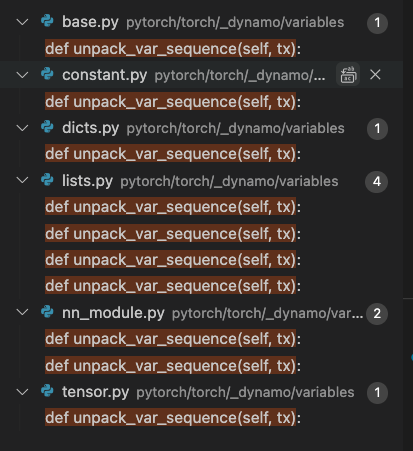
65 |
--------------------------------------------------------------------------------
/tests/test_20_string.py:
--------------------------------------------------------------------------------
1 | from __future__ import annotations
2 |
3 | import unittest
4 |
5 | from test_case_base import TestCaseBase
6 |
7 | import paddle
8 | from sot.psdb import assert_true, check_no_breakgraph
9 |
10 |
11 | def string_format(x: paddle.Tensor):
12 | whilespace = 123
13 | hello_world = f"Hello {whilespace} World"
14 | z = assert_true(hello_world == "Hello 123 World")
15 | hello_world2 = f"Hello {whilespace}{whilespace} World"
16 | z = assert_true(hello_world2 == "Hello 123123 World")
17 | hello_world_lower = "Hello World".lower()
18 | z = assert_true(hello_world_lower == "hello world")
19 | return x + 1
20 |
21 |
22 | def string_lower(x: paddle.Tensor):
23 | hello_world_lower = "Hello World".lower()
24 | z = assert_true(hello_world_lower == "hello world")
25 | return x + 1
26 |
27 |
28 | @check_no_breakgraph
29 | def str_startswith():
30 | s = "Hello World"
31 | a1 = s.startswith("Hello")
32 | a2 = s.startswith("World")
33 | a3 = s.startswith("Hello World")
34 | a4 = s.startswith("Hello World!")
35 | a5 = s.startswith("Hello", 5)
36 | a6 = s.startswith("Hello", 1, 4)
37 | a7 = s.startswith("Hello", 0, 11)
38 | return (a1, a2, a3, a4, a5, a6, a7)
39 |
40 |
41 | @check_no_breakgraph
42 | def str_endswith():
43 | s = "Hello World"
44 | a1 = s.endswith("Hello")
45 | a2 = s.endswith("World")
46 | a3 = s.endswith("Hello World")
47 | a4 = s.endswith("Hello World!")
48 | a5 = s.endswith("Hello", 5)
49 | a6 = s.endswith("Hello", 0, 4)
50 | a7 = s.endswith("Hello", 1, 11)
51 | return (a1, a2, a3, a4, a5, a6, a7)
52 |
53 |
54 | class TestExecutor(TestCaseBase):
55 | def test_string_format(self):
56 | self.assert_results(string_format, paddle.to_tensor(1))
57 |
58 | def test_string_lower(self):
59 | self.assert_results(string_lower, paddle.to_tensor(1))
60 |
61 | def test_str_startswith(self):
62 | self.assert_results(str_startswith)
63 |
64 | def test_str_endswith(self):
65 | self.assert_results(str_endswith)
66 |
67 |
68 | if __name__ == "__main__":
69 | unittest.main()
70 |
--------------------------------------------------------------------------------
/tests/test_03_tuple.py:
--------------------------------------------------------------------------------
1 | # New Supported Instructions:
2 | # BUILD_TUPLE
3 | # BINARY_SUBSCR
4 |
5 | from __future__ import annotations
6 |
7 | import unittest
8 |
9 | from test_case_base import TestCaseBase
10 |
11 | import paddle
12 | from sot.psdb import check_no_breakgraph
13 |
14 |
15 | @check_no_breakgraph
16 | def build_tuple(x: int, y: paddle.Tensor):
17 | x = (x, y)
18 | return x[1] + 1
19 |
20 |
21 | @check_no_breakgraph
22 | def build_tuple_with_slice_subscript(x: int, y: paddle.Tensor):
23 | z = (x, y, 3, 4)
24 | return z[0:5:1]
25 |
26 |
27 | @check_no_breakgraph
28 | def build_tuple_with_int_subscript(x: int, y: paddle.Tensor):
29 | z = (x, y)
30 | return z[0]
31 |
32 |
33 | @check_no_breakgraph
34 | def tuple_count_int(x: int, y: paddle.Tensor):
35 | z = (x, x, 2, 1)
36 | return z.count(x)
37 |
38 |
39 | def tuple_count_tensor(x: paddle.Tensor, y: tuple[paddle.Tensor]):
40 | return y.count(x)
41 |
42 |
43 | @check_no_breakgraph
44 | def tuple_index_int(x: int, y: paddle.Tensor):
45 | z = (x, y, x, y, y)
46 | return z.index(x)
47 |
48 |
49 | def tuple_index_tensor(x: paddle.Tensor, y: tuple[paddle.Tensor]):
50 | return y.index(x)
51 |
52 |
53 | class TestBuildTuple(TestCaseBase):
54 | def test_build_tuple(self):
55 | self.assert_results(build_tuple, 1, paddle.to_tensor(2))
56 | self.assert_results(
57 | build_tuple_with_slice_subscript, 1, paddle.to_tensor(2)
58 | )
59 | self.assert_results(
60 | build_tuple_with_int_subscript, 1, paddle.to_tensor(2)
61 | )
62 |
63 |
64 | class TestTupleMethods(TestCaseBase):
65 | def test_tuple_methods_int(self):
66 | self.assert_results(tuple_count_int, 1, paddle.to_tensor(2))
67 | self.assert_results(tuple_index_int, 1, paddle.to_tensor(2))
68 |
69 | def test_tuple_methods_tensor(self):
70 | a = paddle.to_tensor(1)
71 | b = paddle.to_tensor(2)
72 | self.assert_results(tuple_count_tensor, a, (a, b, a, b))
73 | self.assert_results(tuple_index_tensor, b, (b, b, b, a))
74 |
75 |
76 | if __name__ == "__main__":
77 | unittest.main()
78 |
--------------------------------------------------------------------------------
/tests/test_sir_rollback.py:
--------------------------------------------------------------------------------
1 | from __future__ import annotations
2 |
3 | import inspect
4 | import operator
5 | import unittest
6 |
7 | from test_case_base import TestCaseBase
8 |
9 | import paddle
10 | from sot.opcode_translator.executor.function_graph import FunctionGraph
11 | from sot.opcode_translator.executor.tracker import DanglingTracker, LocalTracker
12 | from sot.opcode_translator.executor.variables import (
13 | BuiltinVariable,
14 | VariableFactory,
15 | )
16 |
17 |
18 | def compute(x, y):
19 | ret = BuiltinVariable(operator.add, x.graph, DanglingTracker())(x, y)
20 | return BuiltinVariable(operator.mul, x.graph, DanglingTracker())(ret, x)
21 |
22 |
23 | def try_add(x, y):
24 | return BuiltinVariable(operator.add, x.graph, DanglingTracker())(x, y)
25 |
26 |
27 | class TestRollback(TestCaseBase):
28 | def test_rollback(self):
29 | frame = inspect.currentframe()
30 | graph = FunctionGraph(frame)
31 | a = paddle.to_tensor(1.0)
32 | b = paddle.to_tensor(2.0)
33 | a = VariableFactory().from_value(a, graph, LocalTracker("a"))
34 | b = VariableFactory().from_value(b, graph, LocalTracker("b"))
35 | out = compute(a, b)
36 | original_length = len(graph.sir_ctx.TOS.statements)
37 | memo = graph.save_memo()
38 | try_add(out, out)
39 |
40 | assert len(graph.sir_ctx.TOS.statements) != len(
41 | memo.stmt_ir.statements
42 | ), "After add, we must statement IR."
43 | graph.restore_memo(memo)
44 |
45 | assert len(graph.sir_ctx.TOS.statements) == original_length
46 |
47 |
48 | def fn_with_side_effects_inner(x, y):
49 | x[0] += 10
50 | x[1] += 20
51 | x[2] -= 10
52 | print(y) # print will cause breakgraph
53 | return
54 |
55 |
56 | def fn_with_side_effects(x, y):
57 | x[0] += 1
58 | fn_with_side_effects_inner(x, y)
59 | return x[0] + y
60 |
61 |
62 | class TestSideEffectRollback(TestCaseBase):
63 | def test_side_effect_rollback(self):
64 | self.assert_results_with_side_effects(
65 | fn_with_side_effects, [1, 2, 3], paddle.to_tensor(42)
66 | )
67 |
68 |
69 | if __name__ == "__main__":
70 | unittest.main()
71 |
--------------------------------------------------------------------------------
/tests/test_guard_outputs.py:
--------------------------------------------------------------------------------
1 | from __future__ import annotations
2 |
3 | import unittest
4 |
5 | from test_case_base import (
6 | TestCaseBase,
7 | test_instruction_translator_cache_context,
8 | )
9 |
10 | import paddle
11 |
12 |
13 | def non_operator_related_fn(x: int, y: int):
14 | return x + y
15 |
16 |
17 | def partial_non_operator_related_fn(x: paddle.Tensor, y: paddle.Tensor, z: int):
18 | a = x + y
19 | return [a, z + z]
20 |
21 |
22 | def guard_inputs(x: int, y: int, z: int):
23 | return x + y + z
24 |
25 |
26 | class TestGuardOutputs(TestCaseBase):
27 | def test_non_operator_related_fn(self):
28 | with test_instruction_translator_cache_context() as ctx:
29 | self.assert_results(non_operator_related_fn, 1, 2)
30 | self.assertEqual(ctx.translate_count, 1)
31 | self.assert_results(non_operator_related_fn, 3, 4)
32 | self.assertEqual(ctx.translate_count, 2)
33 |
34 | def test_partial_non_operator_related_fn(self):
35 | with test_instruction_translator_cache_context() as ctx:
36 | self.assert_results(
37 | partial_non_operator_related_fn,
38 | paddle.to_tensor(1),
39 | paddle.to_tensor(2),
40 | 3,
41 | )
42 | self.assertEqual(ctx.translate_count, 1)
43 | self.assert_results(
44 | partial_non_operator_related_fn,
45 | paddle.to_tensor(4),
46 | paddle.to_tensor(5),
47 | 6,
48 | )
49 | self.assertEqual(ctx.translate_count, 2)
50 |
51 | def test_guard_inputs(self):
52 | with test_instruction_translator_cache_context() as ctx:
53 | self.assert_results(guard_inputs, 1, 2, 3)
54 | self.assertEqual(ctx.translate_count, 1)
55 | self.assert_results(guard_inputs, 0, 2, 3)
56 | self.assertEqual(ctx.translate_count, 2)
57 | self.assert_results(guard_inputs, 1, 0, 3)
58 | self.assertEqual(ctx.translate_count, 3)
59 | self.assert_results(guard_inputs, 1, 2, 0)
60 | self.assertEqual(ctx.translate_count, 4)
61 |
62 |
63 | if __name__ == "__main__":
64 | unittest.main()
65 |
--------------------------------------------------------------------------------
/tests/test_17_paddle_layer.py:
--------------------------------------------------------------------------------
1 | import unittest
2 |
3 | from test_case_base import TestCaseBase
4 |
5 | import paddle
6 |
7 |
8 | class SimpleNet(paddle.nn.Layer):
9 | def __init__(self):
10 | super().__init__()
11 | self.linear1 = paddle.nn.Linear(10, 1)
12 |
13 | def forward(self, x):
14 | out1 = self.linear1(x)
15 | return out1
16 |
17 |
18 | class SimpleNet_bound(paddle.nn.Layer):
19 | def __init__(self):
20 | super().__init__()
21 | self.linear1 = paddle.nn.Linear(10, 1)
22 |
23 | def add(self, x):
24 | return x + 1
25 |
26 | def forward(self, x):
27 | x = self.add(x)
28 | out1 = self.linear1(x)
29 | return out1
30 |
31 |
32 | def net_call(x: paddle.Tensor, net):
33 | return net(x)
34 |
35 |
36 | def net_call_passed_by_user(x: paddle.Tensor, net_forward):
37 | return net_forward(x)
38 |
39 |
40 | class SimpleNetWithSequenital(paddle.nn.Layer):
41 | def __init__(self):
42 | super().__init__()
43 | self.seq = paddle.nn.Sequential(
44 | paddle.nn.Linear(10, 10),
45 | paddle.nn.Linear(10, 10),
46 | paddle.nn.Linear(10, 1),
47 | )
48 |
49 | def forward(self, x):
50 | out1 = self.seq(x)
51 | return out1
52 |
53 |
54 | class TestLayer(TestCaseBase):
55 | def test_layer(self):
56 | x = paddle.rand((10,))
57 | y = paddle.rand((10, 10))
58 | net = SimpleNet()
59 | self.assert_results(net_call, x, net)
60 | self.assert_results(net_call, y, net)
61 | self.assert_results(net_call_passed_by_user, x, net.forward)
62 |
63 | def test_layer_with_sequential(self):
64 | x = paddle.rand((10,))
65 | y = paddle.rand((10, 10))
66 | net = SimpleNetWithSequenital()
67 | self.assert_results(net_call, x, net)
68 | self.assert_results(net_call, y, net)
69 | self.assert_results(net_call_passed_by_user, x, net.forward)
70 |
71 | def test_bound(self):
72 | x = paddle.rand((10,))
73 | y = paddle.rand((10, 10))
74 | net = SimpleNet_bound()
75 | self.assert_results(net_call, x, net)
76 | self.assert_results(net_call, y, net)
77 |
78 |
79 | if __name__ == "__main__":
80 | unittest.main()
81 |
--------------------------------------------------------------------------------
/tests/test_18_tensor_method.py:
--------------------------------------------------------------------------------
1 | import unittest
2 |
3 | from test_case_base import TestCaseBase
4 |
5 | import paddle
6 |
7 |
8 | def tensor_method_call_1(x: paddle.Tensor):
9 | y = x + 1
10 | return y.mean()
11 |
12 |
13 | def tensor_method_call_2(a: paddle.Tensor, b: paddle.Tensor):
14 | c = a.add(b)
15 | d = c.multiply(a)
16 | e = d.subtract(b)
17 | f = e.divide(a)
18 | g = f.pow(2) + f.abs().sqrt()
19 | h = (g.abs() + 1).log() - (g / g.max()).exp()
20 | i = h.sin() + h.cos()
21 | return i
22 |
23 |
24 | def tensor_method_passed_by_user(a: paddle.Tensor, func: paddle.Tensor):
25 | return func(a)
26 |
27 |
28 | def tensor_method_property(a: paddle.Tensor, b: paddle.Tensor):
29 | return (
30 | a.name,
31 | str(a.place),
32 | a.persistable,
33 | a.dtype,
34 | a.type,
35 | a.is_tensor(),
36 | a.clear_gradient(),
37 | a @ b.T + len(a.shape) + b.size + a.ndim + a.dim() + a.rank(),
38 | )
39 |
40 |
41 | def middle_tensor_name(a: paddle.Tensor, b: paddle.Tensor):
42 | c = a + b
43 | return c.name
44 |
45 |
46 | class TestTensorMethod(TestCaseBase):
47 | def test_tensor_method_1(self):
48 | x = paddle.rand([10])
49 | y = paddle.rand([2, 4, 6])
50 | self.assert_results(tensor_method_call_1, x)
51 | self.assert_results(tensor_method_call_1, y)
52 |
53 | def test_tensor_method_2(self):
54 | x = paddle.rand([42])
55 | y = paddle.rand([42])
56 | self.assert_results(tensor_method_call_2, x, y)
57 |
58 | def test_tensor_method_passed_by_user(self):
59 | x = paddle.rand([42])
60 | y = paddle.rand([42])
61 | self.assert_results(tensor_method_passed_by_user, x, y.add)
62 |
63 | def test_tensor_method_property(self):
64 | x = paddle.rand([42, 24], dtype='float64')
65 | y = paddle.rand([42, 24], dtype='float32')
66 | self.assert_results(tensor_method_property, x, y)
67 |
68 | @unittest.skip("TODO: dynamic tensor name is different")
69 | def test_middle_tensor_name(self):
70 | x = paddle.rand([42, 24])
71 | y = paddle.rand([42, 24])
72 | self.assert_results(middle_tensor_name, x, y)
73 |
74 |
75 | if __name__ == "__main__":
76 | unittest.main()
77 |
--------------------------------------------------------------------------------
/sot/utils/code_status.py:
--------------------------------------------------------------------------------
1 | import inspect
2 | from enum import Enum
3 |
4 | import paddle
5 |
6 | from .utils import Singleton, log
7 |
8 |
9 | class CodeState(Enum):
10 | UNKNOW = 1
11 | WITH_GRAPH = 2
12 | WITHOUT_GRAPH = 3
13 |
14 |
15 | class CodeInfo:
16 | def __init__(self):
17 | self.state = CodeState.UNKNOW
18 | self.counter = 0
19 |
20 | def __repr__(self):
21 | return f"state: {self.state}, counter: {self.counter}"
22 |
23 |
24 | @Singleton
25 | class CodeStatus:
26 | WITH_GRAPH_API = [
27 | paddle.nn.Layer.__call__.__code__,
28 | paddle.nn.Layer._dygraph_call_func.__code__,
29 | ]
30 |
31 | def __init__(self):
32 | self.code_map = {}
33 | self.setup_code_map()
34 |
35 | def setup_code_map(self):
36 | for code in self.WITH_GRAPH_API:
37 | info = CodeInfo()
38 | info.state = CodeState.WITH_GRAPH
39 | self.code_map[code] = info
40 |
41 | def clear(self):
42 | self.code_map.clear()
43 | self.setup_code_map()
44 |
45 | def is_code_without_graph(self, code):
46 | if code not in self.code_map:
47 | info = CodeInfo()
48 | self.code_map[code] = info
49 | else:
50 | info = self.code_map[code]
51 |
52 | if info.state == CodeState.WITHOUT_GRAPH:
53 | return True
54 | if info.state == CodeState.UNKNOW:
55 | info.counter += 1
56 | if info.counter >= 10:
57 | log(
58 | 3,
59 | f"[CodeStatus] Switch state to WITHOUT_GRAPH for {code}\n",
60 | )
61 | info.state = CodeState.WITHOUT_GRAPH
62 | return False
63 |
64 | def trace_back_frames(self):
65 | frame = inspect.currentframe()
66 | while frame.f_back is not None:
67 | frame = frame.f_back
68 | code = frame.f_code
69 | if code in self.code_map:
70 | info = self.code_map[code]
71 | if info.state != CodeState.WITH_GRAPH:
72 | log(
73 | 3,
74 | f"[CodeStatus] Switch state to WITH_GRAPH for {code}\n",
75 | )
76 | info.state = CodeState.WITH_GRAPH
77 |
--------------------------------------------------------------------------------
/tests/test_08_rot.py:
--------------------------------------------------------------------------------
1 | from __future__ import annotations
2 |
3 | import unittest
4 |
5 | from test_case_base import TestCaseBase
6 |
7 | import paddle
8 |
9 |
10 | def rot_two_return_a(a: paddle.Tensor, b: paddle.Tensor):
11 | b, a = a, b
12 | return a + 1
13 |
14 |
15 | def rot_two_return_b(a: paddle.Tensor, b: paddle.Tensor):
16 | b, a = a, b
17 | return b + 2
18 |
19 |
20 | def rot_three_return_a(a: paddle.Tensor, b: paddle.Tensor, c: paddle.Tensor):
21 | a, b, c = c, b, a
22 | return a + 1
23 |
24 |
25 | def rot_three_return_b(a: paddle.Tensor, b: paddle.Tensor, c: paddle.Tensor):
26 | a, b, c = c, b, a
27 | return b + 1
28 |
29 |
30 | def rot_three_return_c(a: paddle.Tensor, b: paddle.Tensor, c: paddle.Tensor):
31 | a, b, c = c, b, a
32 | return c + 1
33 |
34 |
35 | def rot_four_return_a(
36 | a: paddle.Tensor, b: paddle.Tensor, c: paddle.Tensor, d: paddle.Tensor
37 | ):
38 | a, b, c, d = d, c, b, a
39 | return a + 1
40 |
41 |
42 | def rot_four_return_b(
43 | a: paddle.Tensor, b: paddle.Tensor, c: paddle.Tensor, d: paddle.Tensor
44 | ):
45 | a, b, c, d = d, c, b, a
46 | return b + 1
47 |
48 |
49 | def rot_four_return_c(
50 | a: paddle.Tensor, b: paddle.Tensor, c: paddle.Tensor, d: paddle.Tensor
51 | ):
52 | a, b, c, d = d, c, b, a
53 | return c + 1
54 |
55 |
56 | def rot_four_return_d(
57 | a: paddle.Tensor, b: paddle.Tensor, c: paddle.Tensor, d: paddle.Tensor
58 | ):
59 | a, b, c, d = d, c, b, a
60 | return d + 1
61 |
62 |
63 | class TestExecutor(TestCaseBase):
64 | def test_simple(self):
65 | a = paddle.to_tensor(1)
66 | b = paddle.to_tensor(2)
67 | c = paddle.to_tensor(3)
68 | d = paddle.to_tensor(4)
69 | self.assert_results(rot_two_return_a, a, b)
70 | self.assert_results(rot_two_return_b, a, b)
71 |
72 | self.assert_results(rot_three_return_a, a, b, c)
73 | self.assert_results(rot_three_return_b, a, b, c)
74 | self.assert_results(rot_three_return_c, a, b, c)
75 |
76 | self.assert_results(rot_four_return_a, a, b, c, d)
77 | self.assert_results(rot_four_return_b, a, b, c, d)
78 | self.assert_results(rot_four_return_c, a, b, c, d)
79 | self.assert_results(rot_four_return_d, a, b, c, d)
80 |
81 |
82 | if __name__ == "__main__":
83 | unittest.main()
84 |
--------------------------------------------------------------------------------
/tests/test_10_build_unpack.py:
--------------------------------------------------------------------------------
1 | # BUILD_TUPLE_UNPACK (new)
2 | # BUILD_LIST_UNPACK (new)
3 | # BUILD_TUPLE_UNPACK_WITH_CALL (new)
4 | # CALL_FUNCTION_EX (new)
5 | # BUILD_MAP_UNPACK (new)
6 | # LIST_EXTEND (new)
7 | # LIST_TO_TUPLE (new)
8 | # DICT_UPDATE (new)
9 | # DICT_MERGE (new)
10 |
11 | from __future__ import annotations
12 |
13 | import unittest
14 |
15 | from test_case_base import TestCaseBase
16 |
17 | import paddle
18 |
19 |
20 | def build_tuple_unpack(x: tuple[paddle.Tensor], y: tuple[paddle.Tensor]):
21 | z = (*x, *y)
22 |
23 | return z[0] + 1
24 |
25 |
26 | def build_list_unpack(x: list[paddle.Tensor], y: list[paddle.Tensor]):
27 | z = [*x, *y]
28 | return z[0] + 1
29 |
30 |
31 | def build_tuple_unpack_with_call(
32 | x: tuple[paddle.Tensor], y: tuple[paddle.Tensor]
33 | ):
34 | z = build_tuple_unpack_with_call_inner(*x, *y)
35 | return z[0] + 1
36 |
37 |
38 | def build_tuple_unpack_with_call_inner(
39 | a: paddle.Tensor, b: paddle.Tensor, c: paddle.Tensor, d: paddle.Tensor
40 | ):
41 | z = (a, b, c, d)
42 | return z
43 |
44 |
45 | def build_map_unpack(x: dict[str, paddle.Tensor], y: dict[str, paddle.Tensor]):
46 | z = {**x, **y}
47 | return z["a"] + 1
48 |
49 |
50 | def build_map_unpack_with_call_inner(
51 | a: paddle.Tensor, b: paddle.Tensor, c: paddle.Tensor, d: paddle.Tensor
52 | ):
53 | z = {"a": a, "b": b, "c": c, "d": d}
54 | return z
55 |
56 |
57 | def build_map_unpack_with_call(
58 | x: dict[str, paddle.Tensor], y: dict[str, paddle.Tensor]
59 | ):
60 | z = build_map_unpack_with_call_inner(**x, **y)
61 | return z["a"] + 1
62 |
63 |
64 | class TestExecutor(TestCaseBase):
65 | def test_simple(self):
66 | a = paddle.to_tensor(1)
67 | b = paddle.to_tensor(2)
68 | c = paddle.to_tensor(3)
69 | d = paddle.to_tensor(4)
70 |
71 | self.assert_results(build_tuple_unpack, (a, b), (c, d))
72 | self.assert_results(build_list_unpack, [a, b], [c, d])
73 | self.assert_results(build_tuple_unpack_with_call, (a, b), (c, d))
74 | self.assert_results(
75 | build_map_unpack, {"a": a, "b": b}, {"c": c, "d": d}
76 | )
77 | self.assert_results(
78 | build_map_unpack_with_call, {"a": a, "b": b}, {"c": c, "d": d}
79 | )
80 |
81 |
82 | if __name__ == "__main__":
83 | unittest.main()
84 |
--------------------------------------------------------------------------------
/pyproject.toml:
--------------------------------------------------------------------------------
1 | [build-system]
2 | requires = ["setuptools>=61.0.0"]
3 | build-backend = "setuptools.build_meta"
4 |
5 | [project]
6 | name = "PaddleSOT"
7 | version = "0.0.1a0"
8 | description = "A Bytecode level Implementation of Symbolic OpCode Translator For PaddlePaddle"
9 | readme = "README.md"
10 | requires-python = ">=3.7,<3.12"
11 | authors = [
12 | {name = "PaddlePaddle", email = "Paddle-better@baidu.com"},
13 | ]
14 | keywords = ["Framework", "Deep Learning", "JIT"]
15 | license = { file = "LICENSE" }
16 | classifiers = [
17 | "License :: OSI Approved :: Apache Software License",
18 | "Programming Language :: Python :: 3",
19 | "Programming Language :: Python :: 3.8",
20 | "Programming Language :: Python :: 3.9",
21 | "Programming Language :: Python :: 3.10",
22 | "Programming Language :: Python :: 3.11",
23 | "Programming Language :: Python :: Implementation :: CPython",
24 | "Operating System :: OS Independent",
25 | ]
26 |
27 | [project.optional-dependencies]
28 | dev = [
29 | "xdoctest"
30 | ]
31 | paddle-test = [
32 | "opencv-python",
33 | "scipy",
34 | "pyyaml",
35 | "gym==0.26.2",
36 | ]
37 |
38 | [tool.setuptools.packages]
39 | find = {}
40 |
41 | [tool.black]
42 | line-length = 80
43 | skip-string-normalization = true
44 |
45 | [tool.isort]
46 | profile = "black"
47 | line_length = 80
48 | known_first_party = ["paddle", "sot"]
49 |
50 | [tool.ruff]
51 | target-version = "py37"
52 | select = [
53 | # Pycodestyle
54 | "E",
55 | "W",
56 |
57 | # Pyflakes
58 | "F",
59 |
60 | # Comprehensions
61 | "C4",
62 |
63 | # Pyupgrade
64 | "UP",
65 |
66 | # Bugbear
67 | "B002",
68 | "B003",
69 | "B004",
70 | "B009",
71 | "B010",
72 | "B011",
73 | "B012",
74 | "B013",
75 | "B014",
76 | "B015",
77 | "B016",
78 | "B017",
79 | "B018",
80 | "B019",
81 | "B020",
82 | "B021",
83 | "B022",
84 | "B025",
85 | "B029",
86 | "B032",
87 |
88 | # Pylint
89 | "PLE",
90 | "PLC0414",
91 | "PLC3002",
92 | "PLR0206",
93 | "PLR0402",
94 | ]
95 | ignore = [
96 | "E402",
97 | "E501",
98 | "E722",
99 | "E731",
100 | "E741",
101 | "F841",
102 | "UP015",
103 | "UP038",
104 | ]
105 |
106 | [tool.ruff.per-file-ignores]
107 | "tests/test_dup_top.py" = ["E712"]
108 |
--------------------------------------------------------------------------------
/tests/test_guard_user_defined_fn.py:
--------------------------------------------------------------------------------
1 | from __future__ import annotations
2 |
3 | import unittest
4 |
5 | from test_case_base import (
6 | TestCaseBase,
7 | test_instruction_translator_cache_context,
8 | )
9 |
10 | import paddle
11 |
12 |
13 | def test_guard_fn(fn, inp):
14 | if fn is None:
15 | return 0
16 | else:
17 | return fn(inp)
18 |
19 |
20 | class TestGuardOutputs(TestCaseBase):
21 | def test_non_operator_related_fn(self):
22 | with test_instruction_translator_cache_context() as ctx:
23 | self.assert_results(
24 | test_guard_fn,
25 | paddle.nn.functional.relu,
26 | paddle.to_tensor([1.0, -1.0]),
27 | )
28 | self.assertEqual(ctx.translate_count, 1)
29 | self.assert_results(
30 | test_guard_fn,
31 | paddle.nn.functional.gelu,
32 | paddle.to_tensor([1.0, -1.0]),
33 | )
34 | self.assertEqual(ctx.translate_count, 2)
35 | self.assert_results(
36 | test_guard_fn,
37 | paddle.nn.functional.relu,
38 | paddle.to_tensor([-1.0, -1.0]),
39 | )
40 | self.assertEqual(ctx.translate_count, 2)
41 | self.assert_results(
42 | test_guard_fn, None, paddle.to_tensor([-1.0, -1.0])
43 | )
44 | self.assertEqual(ctx.translate_count, 3)
45 |
46 | deleted_cnt = 0
47 |
48 | class Callable:
49 | def __call__(self, var):
50 | return paddle.nn.functional.relu(var)
51 |
52 | def __del__(self):
53 | nonlocal deleted_cnt
54 | deleted_cnt += 1
55 |
56 | fn1 = Callable()
57 | fn2 = Callable()
58 | with test_instruction_translator_cache_context() as ctx:
59 | self.assert_results(
60 | test_guard_fn, fn1, paddle.to_tensor([1.0, -1.0])
61 | )
62 | self.assertEqual(ctx.translate_count, 1)
63 | self.assert_results(
64 | test_guard_fn, fn2, paddle.to_tensor([1.0, -1.0])
65 | )
66 | self.assertEqual(ctx.translate_count, 2)
67 | self.assert_results(
68 | test_guard_fn, fn2, paddle.to_tensor([1.0, -1.0])
69 | )
70 | self.assertEqual(ctx.translate_count, 2)
71 |
72 |
73 | if __name__ == "__main__":
74 | unittest.main()
75 |
--------------------------------------------------------------------------------
/tests/tests_legacy/error_test_resnet_with_trace_cache.py:
--------------------------------------------------------------------------------
1 | import os
2 |
3 | os.environ["FLAGS_cudnn_deterministic"] = "True"
4 |
5 | import random
6 | import unittest
7 | from types import MethodType
8 |
9 | import numpy as np
10 | from numpy.testing import assert_array_equal
11 |
12 | import paddle
13 | from paddle.vision import resnet50
14 | from sot import symbolic_translate
15 | from sot.symbolic.compile_cache import CompileSIRCache
16 | from sot.trace_cache_entrance import trace_cache
17 | from sot.utils.utils import execute_time
18 |
19 |
20 | @trace_cache
21 | def forward_with_cache(self, x):
22 | x = self.conv1(x)
23 | x = self.bn1(x)
24 | x = self.relu(x)
25 | x = self.maxpool(x)
26 | x = self.layer1(x)
27 | x = self.layer2(x)
28 | x = self.layer3(x)
29 | x = self.layer4(x)
30 | if self.with_pool:
31 | x = self.avgpool(x)
32 | if self.num_classes > 0:
33 | x = paddle.flatten(x, 1)
34 | x = self.fc(x)
35 | return x
36 |
37 |
38 | def run_dygraph_optimizer(inp, to_static):
39 | """dygraph train + SGD optimizer"""
40 | paddle.seed(2021)
41 | np.random.seed(2021)
42 | random.seed(2021)
43 | net = resnet50()
44 | if to_static:
45 | net.forward = MethodType(forward_with_cache, net)
46 | net.forward = symbolic_translate(net.forward)
47 | # net = paddle.jit.to_static(net)
48 | optimizer = paddle.optimizer.SGD(
49 | learning_rate=0.03, parameters=net.parameters()
50 | )
51 | for i in range(5):
52 | optimizer.clear_grad()
53 | loss = execute_time(net)(inp)
54 | loss.backward()
55 | optimizer.step()
56 | print("===============================================")
57 | return loss
58 |
59 |
60 | class TestBackward(unittest.TestCase):
61 | def test(self):
62 | # TODO(xiongkun) add cache to speedup !
63 | paddle.seed(2021)
64 | np.random.seed(2021)
65 | random.seed(2021)
66 | inp = paddle.rand((3, 3, 255, 255))
67 | out1 = run_dygraph_optimizer(inp, True)[0].numpy()
68 | out2 = run_dygraph_optimizer(inp, False)[0].numpy()
69 | assert_array_equal(
70 | out1, out2, "Not Equal in dygraph and static graph", True
71 | )
72 | assert (
73 | CompileSIRCache().hit_num == 4
74 | ), f"CompileSIRCache hit_num should be 4, but{CompileSIRCache().hit_num}"
75 |
76 |
77 | if __name__ == "__main__":
78 | unittest.main()
79 |
--------------------------------------------------------------------------------
/.github/workflows/paddle_ci.yaml:
--------------------------------------------------------------------------------
1 | name: PaddleDy2staicTests
2 |
3 | on:
4 | push:
5 | branches: [develop]
6 | pull_request:
7 | workflow_dispatch:
8 |
9 | jobs:
10 | Test:
11 | strategy:
12 | fail-fast: false
13 | matrix:
14 | os: [ubuntu-latest]
15 | python-version: ['3.8', '3.9', '3.10', '3.11']
16 | runs-on: ${{ matrix.os }}
17 | name: python ${{ matrix.python-version }} dy2st unittests
18 | steps:
19 | - name: Checkout
20 | uses: actions/checkout@v3
21 |
22 | # RAM too small, Related link: https://github.com/actions/runner-images/discussions/7188
23 | - name: Increase swapfile
24 | run: |
25 | sudo swapoff -a
26 | sudo fallocate -l 8G /swapfile
27 | sudo chmod 600 /swapfile
28 | sudo mkswap /swapfile
29 | sudo swapon /swapfile
30 | sudo swapon --show
31 |
32 | - name: Install python
33 | uses: actions/setup-python@v4
34 | with:
35 | python-version: ${{ matrix.python-version }}
36 |
37 | - name: Install dependencies
38 | run: |
39 | python -m pip install paddlepaddle==0.0.0 -f https://www.paddlepaddle.org.cn/whl/linux/cpu-mkl/develop.html
40 | pip install ".[paddle-test]"
41 |
42 | - uses: actions/cache@v3
43 | with:
44 | path: |
45 | ~/.cache/paddle
46 | key: ${{ runner.os }}-${{ matrix.python-version }}-paddle-cache-v1
47 |
48 | - name: Paddle run check
49 | run: |
50 | python -c "import paddle; paddle.utils.run_check()"
51 |
52 | - name: Clone paddle tests
53 | working-directory: ./tests/
54 | run: |
55 | git clone https://github.com/PaddlePaddle/Paddle
56 | cd Paddle
57 | PADDLE_COMMIT_HASH=`python -c "import paddle; import sys; sys.stdout.write(paddle.version.commit)"`
58 | echo -e "paddle commit hash: \x1b[32m${PADDLE_COMMIT_HASH}\x1b[0m"
59 | git checkout ${PADDLE_COMMIT_HASH}
60 | # skip new ir tests
61 | sed -i "s/@test_with_new_ir/@unittest.skip('skip new ir test')/g" `grep -rl "@test_with_new_ir" test/dygraph_to_static`
62 | sed -i "s/@test_and_compare_with_new_ir/# @test_and_compare_with_new_ir/g" `grep -rl "@test_and_compare_with_new_ir" test/dygraph_to_static`
63 |
64 | - name: Run unit tests
65 | working-directory: ./tests/
66 | run: |
67 | bash ./run_all_paddle_ci.sh
68 |
--------------------------------------------------------------------------------
/docs/design/tracker-and-guard.md:
--------------------------------------------------------------------------------
1 | # Guard 收集机制
2 |
3 | ## 为什么需要 Guard?
4 |
5 | 在整个实现过程中,我们需要对用户函数的原始字节码转换成转换后的字节码,但如果每次运行都完整地转写全部字节码只会导致性能的浪费,也无法实现 JIT 的效果,因此我们需要一个缓存机制,来复用已经转换后的字节码。
6 |
7 | 但并不是说任何字节码成功转换一次后都是可以复用的,因为我们的字节码变换操作是通过模拟执行得到的,而模拟执行的起点是 Eval Frame 的初始状态,主要就是函数的输入,对于不同的输入,我们得到的字节码转换结果是可能不同的,因此我们需要有一个机制来判断转换后的字节码是否有效。
8 |
9 | 由于转换的过程与输入是强相关的,在函数 Eval Frame 初始阶段,我们可以从 `frame` 中拿到函数的输入,之后我们只需要通过 `guard` 来判断一个已经缓存的字节码是否有效即可,即 `guard(frame)`,如果结果是 `True`,则认为缓存命中。
10 |
11 | guard 签名如下:
12 |
13 | ```python
14 | Guard = Callable[[types.FrameType], bool]
15 | ```
16 |
17 | ## Guard 的收集机制
18 |
19 | 在模拟执行过程中,我们会根据字节码执行不同的操作,每一个字节码都会对应一个操作,如果我们将整个操作的链条构建起来,形成一个 DAG,就可以在任何时刻追踪到我们需要的 Guard。
20 |
21 | 我们使用 Tracker 来承载追踪操作的功能,Tracker 的 `inputs` 会持有其相关输入的 Variable,该 Tracker 将会由输出的 Variable 持有,相关数据结构如下:
22 |
23 | ```python
24 | class VariableBase:
25 | tracker: Tracker
26 |
27 | class Tracker:
28 | inputs: list[VariableBase]
29 | ```
30 |
31 | 比如对于如下的代码
32 |
33 | ```python
34 | def foo(a: list[Tensor], b: int, c: int):
35 | d = a[b]
36 | e = d + c
37 | return e
38 | ```
39 |
40 | 最终构建的 Python 端 DAG 如下:
41 |
42 |
43 |  44 |
44 |
45 |
46 | 有了 DAG 之后,我们只需要从需要的结点出发,找到全部需要的结点,并按照拓扑序收集一下即可~
47 |
48 | ## DummyTracker
49 |
50 | 上图中可以看到有 DummyTracker,而 DummyTracker 相关的路径也标成了虚线,那么什么情况需要 DummyTracker 呢?
51 |
52 | 对于 LocalTracker、GetItemTracker 来说,除去 Guard 的收集,有很重要的一点是,我们可以通过这些 Tracker 还原从 frame 初始状态出发,获取这些值的方法,这包括了如下两点:
53 |
54 | - 在生成函数的字节码前,需要将输入 LOAD 到栈上,我们需要根据 Tracker 来生成 LOAD 这些输入的字节码
55 | - 在调用 Guard 时,需要根据 Tracker 来索引到新的 Frame 里的相同变量的值,这样才能进行 Guard 的判断(`new_value == old_value`)
56 |
57 | 我们可以将这种索引机制称为 Source,而大多数中间结点是经过计算得到的,我们并不需要去还原这些中间结点,比如 `c = a + b`,`c` 是由 `BINARY_ADD` 构建得到的,我们的 Source 只需要分别索引 `a` 和 `b` 的来源,而我们的 Guard 也只需要分别 Guard 住 `a` 和 `b` 即可。
58 |
59 | 因此对于这种中间结点,我们只需要知道它是由什么构建得到即可,即只需要知道 inputs 是什么,对于这些结点,我们使用 DummyTracker 来作为连接结点,DummyTracker 不会承担 Source 的索引功能,只会承担 DAG 的连接功能,以便 Guard 的收集。
60 |
61 | ## Guard 收集的短路机制
62 |
63 | 对于如下的 case
64 |
65 | ```python
66 | def foo(x):
67 | if x < 4:
68 | ...
69 | else:
70 | ...
71 |
72 | foo(9)
73 | foo(10)
74 | ```
75 |
76 | 如果我们的 Guard 收集机制是遍历全部结点的话,会强制 Guard 住 `x == 9`,所以第二次调用 `foo(10)` 时会 cache miss。
77 |
78 | 为了减少 cache miss 的概率,我们增加了一个短路机制,当一个 Tracker 的所有输入都不是 DummyTracker 时,可以认为从该 Tracker 上所获得的 Guard 会从其 inputs 所获得的更加精准,就不需要再从其 inputs 收集 Guard 了,可以大大降低重新编译的概率。
79 |
--------------------------------------------------------------------------------
/tests/tests_legacy/test_case_base.py:
--------------------------------------------------------------------------------
1 | import inspect
2 | import unittest
3 |
4 | import numpy as np
5 |
6 | import paddle
7 | from sot import symbolic_translate
8 | from sot.proxy_tensor import ProxyTensorContext
9 | from sot.utils import is_proxy_tensor, no_eval_frame
10 |
11 |
12 | class TestCaseBase(unittest.TestCase):
13 | def assert_results(self, func, *inputs):
14 | sym_output = symbolic_translate(func)(*inputs)
15 | paddle_output = func(*inputs)
16 | np.testing.assert_allclose(sym_output, paddle_output)
17 |
18 |
19 | @no_eval_frame
20 | def check_live_vars(live_vars, dead_vars):
21 | current_frame = inspect.currentframe()
22 | assert current_frame is not None
23 |
24 | no_eval_frame_func_frame = current_frame.f_back
25 | assert no_eval_frame_func_frame is not None
26 | assert no_eval_frame_func_frame.f_code.co_name == "no_eval_frame_func"
27 |
28 | test_case_func_frame = no_eval_frame_func_frame.f_back
29 | assert test_case_func_frame is not None
30 |
31 | runtime_live_proxy_tensors = set(
32 | ProxyTensorContext().runtime_proxy_tensor_to_name.keys()
33 | )
34 | runtime_live_eager_tensors = set(
35 | ProxyTensorContext().tensor_to_proxy_tensor.keys()
36 | )
37 |
38 | for live_var in live_vars:
39 | assert live_var in test_case_func_frame.f_locals
40 | local_var = test_case_func_frame.f_locals[live_var]
41 | if is_proxy_tensor(local_var):
42 | proxy_tensor_id = id(local_var)
43 | assert (
44 | proxy_tensor_id in runtime_live_proxy_tensors
45 | ), f"{live_var} ({local_var.name}) is not live"
46 | elif isinstance(local_var, paddle.Tensor):
47 | eager_tensor_id = id(local_var)
48 | assert (
49 | eager_tensor_id in runtime_live_eager_tensors
50 | ), f"{live_var} ({local_var.name}) is not live"
51 |
52 | for dead_var in dead_vars:
53 | assert dead_var in test_case_func_frame.f_locals
54 | local_var = test_case_func_frame.f_locals[dead_var]
55 | print(dead_var, local_var)
56 | if is_proxy_tensor(local_var):
57 | proxy_tensor_id = id(local_var)
58 | assert (
59 | proxy_tensor_id not in runtime_live_proxy_tensors
60 | ), f"{dead_var} ({local_var.name}) is live"
61 | elif isinstance(local_var, paddle.Tensor):
62 | eager_tensor_id = id(local_var)
63 | assert (
64 | eager_tensor_id not in runtime_live_eager_tensors
65 | ), f"{dead_var} ({local_var.name}) is live"
66 |
--------------------------------------------------------------------------------
/sot/utils/paddle_api_config.py:
--------------------------------------------------------------------------------
1 | import inspect
2 |
3 | import paddle
4 |
5 |
6 | def is_inplace_api(func):
7 | inplace_apis = {paddle.static.setitem}
8 | return func in inplace_apis
9 |
10 |
11 | def get_tensor_methods():
12 | return [
13 | member_name
14 | for member_name, member in inspect.getmembers(paddle.static.Variable)
15 | if inspect.isfunction(member)
16 | ]
17 |
18 |
19 | def get_paddle_api():
20 | modules = [
21 | paddle,
22 | paddle.nn.functional,
23 | paddle.linalg,
24 | paddle.signal,
25 | paddle.fft,
26 | paddle.vision.ops,
27 | ]
28 | special_paddle_apis = [paddle.tensor.fill_constant]
29 | non_operator_related_apis = [
30 | paddle.in_dynamic_mode,
31 | paddle.save,
32 | paddle.load,
33 | paddle.get_cuda_rng_state,
34 | paddle.set_rng_state,
35 | paddle.set_cuda_rng_state,
36 | paddle.get_rng_state,
37 | paddle.set_default_dtype,
38 | paddle.check_shape,
39 | paddle.summary,
40 | paddle.finfo,
41 | paddle.iinfo,
42 | paddle.enable_static,
43 | paddle.disable_static,
44 | paddle.is_grad_enabled,
45 | ]
46 | # TODO: users should not call static_apis, but we need to use, so add static_apis here temporary
47 | static_apis = [paddle.static.setitem, paddle.static.accuracy]
48 | paddle_api_list = []
49 | for module in modules:
50 | for fn_name in getattr(module, "__all__", []):
51 | fn = getattr(module, fn_name)
52 | if inspect.isfunction(fn):
53 | paddle_api_list.append(fn)
54 | return list(
55 | set(special_paddle_apis)
56 | | set(static_apis)
57 | | set(paddle_api_list) - set(non_operator_related_apis)
58 | )
59 |
60 |
61 | paddle_tensor_methods = get_tensor_methods()
62 | paddle_api_list = get_paddle_api()
63 |
64 | # TODO(Aurelius84): It seems that we use it to judge 'in_paddle_module()'.
65 | # Bug what does 'is_paddle_module' really means? Is all paddle.xx sub module
66 | # considered as paddle module?
67 | paddle_api_module_prefix = {
68 | "paddle.nn.functional",
69 | "paddle.nn.layer.activation",
70 | }
71 |
72 | break_graph_set = set()
73 |
74 |
75 | break_graph_tensor_method = {
76 | 'register_hook',
77 | 'numpy',
78 | 'clear_gradient',
79 | # TODO: Browse all possible functions and make prior judgments.
80 | }
81 |
82 |
83 | def is_break_graph_tensor_methods(method_name):
84 | return method_name in break_graph_tensor_method
85 |
86 |
87 | def add_break_graph_apis(apis: list):
88 | break_graph_set.update(apis)
89 |
--------------------------------------------------------------------------------
/tests/tests_legacy/test_resnet50_backward.py:
--------------------------------------------------------------------------------
1 | import os
2 |
3 | os.environ["FLAGS_cudnn_deterministic"] = "True"
4 |
5 | import random
6 | import unittest
7 |
8 | import numpy as np
9 | from numpy.testing import assert_array_equal
10 |
11 | import paddle
12 | from paddle.vision import resnet50
13 | from sot import symbolic_translate
14 | from sot.utils.utils import execute_time
15 |
16 |
17 | def resnet_call(net: paddle.nn.Layer, x: paddle.Tensor):
18 | return net(x)
19 |
20 |
21 | def run_dygraph_optimizer(inp):
22 | """dygraph train + SGD optimizer"""
23 | paddle.seed(2021)
24 | np.random.seed(2021)
25 | random.seed(2021)
26 | net = resnet50()
27 | optimizer = paddle.optimizer.SGD(
28 | learning_rate=0.03, parameters=net.parameters()
29 | )
30 | for i in range(5):
31 | optimizer.clear_grad()
32 | loss = execute_time(net)(inp)
33 | loss.backward()
34 | optimizer.step()
35 | return loss
36 |
37 |
38 | def run_symbolic_optimizer(inp):
39 | """dygraph train + SGD optimizer"""
40 | paddle.seed(2021)
41 | np.random.seed(2021)
42 | random.seed(2021)
43 | net = resnet50()
44 | net_wrapper = symbolic_translate(resnet_call)
45 | optimizer = paddle.optimizer.SGD(
46 | learning_rate=0.03, parameters=net.parameters()
47 | )
48 | for i in range(5):
49 | optimizer.clear_grad()
50 | loss = execute_time(net_wrapper)(net, inp)
51 | loss.backward()
52 | optimizer.step()
53 | return loss
54 |
55 |
56 | def run_to_static_optimizer(inp):
57 | """dygraph train + SGD optimizer"""
58 | paddle.seed(2021)
59 | np.random.seed(2021)
60 | random.seed(2021)
61 | net = resnet50()
62 | net = paddle.jit.to_static(net)
63 | optimizer = paddle.optimizer.SGD(
64 | learning_rate=0.03, parameters=net.parameters()
65 | )
66 | for i in range(5):
67 | optimizer.clear_grad()
68 | loss = execute_time(net)(inp)
69 | loss.backward()
70 | optimizer.step()
71 | return loss
72 |
73 |
74 | class TestBackward(unittest.TestCase):
75 | def test(self):
76 | # TODO(xiongkun) add cache to speedup !
77 | paddle.seed(2021)
78 | np.random.seed(2021)
79 | random.seed(2021)
80 | inp = paddle.rand((3, 3, 255, 255))
81 | print("Start Run SymbolicTranslate:")
82 | out2 = run_symbolic_optimizer(inp)[0].numpy()
83 | print("Start Run Dygraph:")
84 | out1 = run_dygraph_optimizer(inp)[0].numpy()
85 | print("Start Run To Static:")
86 | out1 = run_to_static_optimizer(inp)[0].numpy()
87 | assert_array_equal(
88 | out1, out2, "Not Equal in dygraph and static graph", True
89 | )
90 |
91 |
92 | if __name__ == "__main__":
93 | unittest.main()
94 |
--------------------------------------------------------------------------------
/tests/test_resnet50_backward.py:
--------------------------------------------------------------------------------
1 | import os
2 |
3 | os.environ["FLAGS_cudnn_deterministic"] = "True"
4 |
5 | import random
6 | import unittest
7 |
8 | import numpy as np
9 | from numpy.testing import assert_array_equal
10 |
11 | import paddle
12 | from paddle.vision import resnet50
13 | from sot import symbolic_translate
14 | from sot.utils.utils import execute_time
15 |
16 |
17 | def resnet_call(net: paddle.nn.Layer, x: paddle.Tensor):
18 | return net(x)
19 |
20 |
21 | def run_dygraph_optimizer(inp):
22 | """dygraph train + SGD optimizer"""
23 | paddle.seed(2021)
24 | np.random.seed(2021)
25 | random.seed(2021)
26 | net = resnet50()
27 | optimizer = paddle.optimizer.SGD(
28 | learning_rate=0.03, parameters=net.parameters()
29 | )
30 | for i in range(5):
31 | optimizer.clear_grad()
32 | loss = execute_time(net)(inp)
33 | loss.backward()
34 | optimizer.step()
35 | return loss
36 |
37 |
38 | def run_symbolic_optimizer(inp):
39 | """dygraph train + SGD optimizer"""
40 | paddle.seed(2021)
41 | np.random.seed(2021)
42 | random.seed(2021)
43 | net = resnet50()
44 | net_wrapper = symbolic_translate(resnet_call)
45 | optimizer = paddle.optimizer.SGD(
46 | learning_rate=0.03, parameters=net.parameters()
47 | )
48 | for i in range(5):
49 | optimizer.clear_grad()
50 | loss = execute_time(net_wrapper)(net, inp)
51 | loss.backward()
52 | optimizer.step()
53 | return loss
54 |
55 |
56 | def run_to_static_optimizer(inp):
57 | """dygraph train + SGD optimizer"""
58 | paddle.seed(2021)
59 | np.random.seed(2021)
60 | random.seed(2021)
61 | net = resnet50()
62 | net = paddle.jit.to_static(net, enable_fallback=False)
63 | optimizer = paddle.optimizer.SGD(
64 | learning_rate=0.03, parameters=net.parameters()
65 | )
66 | for i in range(5):
67 | optimizer.clear_grad()
68 | loss = execute_time(net)(inp)
69 | loss.backward()
70 | optimizer.step()
71 | return loss
72 |
73 |
74 | class TestBackward(unittest.TestCase):
75 | def test(self):
76 | # TODO(xiongkun) add cache to speedup !
77 | paddle.seed(2021)
78 | np.random.seed(2021)
79 | random.seed(2021)
80 | inp = paddle.rand((3, 3, 255, 255))
81 | print("Start Run SymbolicTranslate:")
82 | out2 = run_symbolic_optimizer(inp)[0].numpy()
83 | print("Start Run Dygraph:")
84 | out1 = run_dygraph_optimizer(inp)[0].numpy()
85 | print("Start Run To Static:")
86 | out1 = run_to_static_optimizer(inp)[0].numpy()
87 | assert_array_equal(
88 | out1, out2, "Not Equal in dygraph and static graph", True
89 | )
90 |
91 |
92 | if __name__ == "__main__":
93 | unittest.main()
94 |
--------------------------------------------------------------------------------
/tests/test_enumerate.py:
--------------------------------------------------------------------------------
1 | import unittest
2 |
3 | from test_case_base import TestCaseBase, strict_mode_guard
4 |
5 | import paddle
6 |
7 |
8 | def test_enumerate_1(x: int, y: int):
9 | for id, val in enumerate(range(x)):
10 | if id % 2 == 0:
11 | y += val
12 | return y
13 |
14 |
15 | def test_enumerate_2(x: list):
16 | return list(enumerate(x))
17 |
18 |
19 | def test_enumerate_3(x: list):
20 | return tuple(enumerate(x))
21 |
22 |
23 | def test_enumerate_4(x: paddle.Tensor):
24 | sum = 0
25 | for idx, val in enumerate(x):
26 | sum += val
27 | return sum
28 |
29 |
30 | # TODO(zmh): support range for tensor
31 | def test_enumerate_5(x: paddle.Tensor):
32 | sum = 0
33 |
34 | for idx, val in enumerate(x):
35 | for i in range(val):
36 | sum += val
37 | return sum
38 |
39 |
40 | def test_enumerate_6(x: paddle.Tensor):
41 | sum = 0
42 |
43 | for idx, val in enumerate(x):
44 | for i in range(idx):
45 | sum += val
46 | return sum
47 |
48 |
49 | def test_enumerate_7(x: paddle.Tensor):
50 | sum = 0
51 | x = x.flatten()
52 | for idx, val in enumerate(x):
53 | sum += val
54 | return sum
55 |
56 |
57 | # TODO(zmh): support -1
58 | def test_enumerate_8(x: paddle.Tensor):
59 | sum = 0
60 | x = paddle.nonzero(x, as_tuple=False)
61 | for idx, val in enumerate(x):
62 | sum += val
63 | return sum
64 |
65 |
66 | def test_enumerate_10(layer_list, x):
67 | sum = 0
68 | for idx, layer in enumerate(layer_list):
69 | sum += layer(x)
70 | return sum
71 |
72 |
73 | class TestExecutor(TestCaseBase):
74 | def test_cases(self):
75 | x = 8
76 | y = 5
77 | ty = paddle.randn((10, 10))
78 | layer_list = paddle.nn.LayerList(
79 | [paddle.nn.Linear(10, 10) for _ in range(3)]
80 | )
81 |
82 | self.assert_results(test_enumerate_1, x, y)
83 | self.assert_results(test_enumerate_2, [2, 4, 6, 8, 10])
84 | self.assert_results(test_enumerate_3, [2, 4, 6, 8, 10])
85 |
86 | self.assert_results(test_enumerate_4, ty)
87 | # TODO(zmh): support range for tensor
88 |
89 | with strict_mode_guard(0):
90 | self.assert_results(test_enumerate_5, paddle.to_tensor([1, 2, 3]))
91 | self.assert_results(test_enumerate_6, paddle.to_tensor([1, 2, 3]))
92 | self.assert_results(test_enumerate_7, ty)
93 | # TODO(zmh): support -1
94 |
95 | with strict_mode_guard(0):
96 | self.assert_results(test_enumerate_8, ty)
97 |
98 | self.assert_results(test_enumerate_10, layer_list, paddle.randn((10,)))
99 |
100 |
101 | if __name__ == "__main__":
102 | unittest.main()
103 |
--------------------------------------------------------------------------------
/docs/design/stringify-guard.md:
--------------------------------------------------------------------------------
1 | # 字符串化 Guard
2 |
3 | ## Guard 原设计及其遇到的问题
4 |
5 | 我们的原来的 Guard 设计是,每个子 Guard 都是一个 lambda 函数,签名如下:
6 |
7 | ```python
8 | Guard = Callable[[types.FrameType], bool]
9 | ```
10 |
11 | 在 Guard 收集时,我们可以通过 `compose_guards` 来整合成一个总 Guard,这个总 Guard 也是一个 lambda 函数,它的实现非常简单,就是多个 Guard 的 `and` 串联:
12 |
13 | ```python
14 | def compose_guards(guards: list[Guard]) -> Guard:
15 | def composed_guard_fn(frame: types.FrameType) -> bool:
16 | ret = True
17 | for guard in guards:
18 | ret = ret and guard(frame)
19 | return ret
20 |
21 | return composed_guard_fn
22 | ```
23 |
24 | 这个设计在正确性上没有太大问题,但是经测试发现,该设计会造成非常大的性能开销。我们分别测试了将总 Guard 直接设置为 `lambda _: True` 和每个 子 Guard 设置为 `lambda _: True`,后者比前者仅仅多了函数调用逻辑,不过我们发现后者仍然会比前者多出不少的性能开销,这很好理解,因为每个子 Guard 都需要一次函数调用,函数调用的开销是非常大的。
25 |
26 | ## 字符串化 Guard 的设计
27 |
28 | 为了避免 Guard 中的函数调用性能开销,我们将每个子 Guard 表示为字符串,在最后汇总的时候使用 `eval` 来生成一个 lambda 函数,这样最后的总 Guard 只是一个函数调用,没有了多个函数调用的开销。
29 |
30 | 为了能够让每个 Guard 都字符串化,Guard 中所使用的 `trace_value_from_frame` 也需要字符串化。
31 |
32 | 另外,对于 lambda 函数来说,可利用闭包来捕获自由变量,但字符串是没有这一能力的,为了能够让字符串化的 Guard 也能够捕获自由变量,我们需要在字符串化的同时,将自由变量一并保存下来,因此子 Guard 和 `trace_value_from_frame` 不仅会返回字符串,还会返回自由变量 dict。为了方便管理,将该数据结构命名为 `StringifyExpression`:
33 |
34 | ```python
35 | @dataclass
36 | class StringifyExpression:
37 | expr: str
38 | free_vars: dict[str, Any]
39 | ```
40 |
41 | 比如编写 BuiltinTracker 时,对比如下:
42 |
43 | ```diff
44 | class BuiltinTracker:
45 | def trace_value_from_frame(self):
46 | - return lambda frame: builtins.__dict__[self.name]
47 | + return StringifyExpression(
48 | + f"builtins.__dict__[{self.name}]", {"builtins": builtins}
49 | + )
50 | ```
51 |
52 | 这里 `builtins` 是一个本应通过闭包捕获的自由变量,在字符串化后,通过 `free_vars` 字段来保存。
53 |
54 | Variable 和 Tracker 相关函数变化成如下:
55 |
56 | ```python
57 | class VariableBase:
58 | def make_stringify_guard(self) -> StringifyExpression:
59 | ...
60 |
61 | class Tracker:
62 | def trace_value_from_frame(self) -> StringifyExpression:
63 | ...
64 | ```
65 |
66 | 最终合并后的总 Guard 签名不变,仍然是 `Guard`:
67 |
68 | ```python
69 | Guard = Callable[[types.FrameType], bool]
70 |
71 | def make_guard(stringify_guards: list[StringifyExpression]) -> Guard:
72 | num_guards = len(stringify_guards)
73 | if not num_guards:
74 | return lambda frame: True
75 | union_guard_expr = reduce(lambda x, y: x & y, stringify_guards)
76 | guard_string = f"lambda frame: {union_guard_expr.expr}"
77 | guard = eval(
78 | guard_string,
79 | union_guard_expr.free_vars,
80 | )
81 | log(3, f"[Guard]: {guard_string}\n")
82 | assert callable(guard), "guard must be callable."
83 |
84 | return guard
85 | ```
86 |
87 | 实现也很简单,就是字符串上的 `and` 拼接(`reduce` 函数里使用重载后的 `&`),之后 `eval` 并传入自由变量即可。
88 |
89 | ## 字符串化 Guard 书写的注意点
90 |
91 | 1. 应注意捕获自由变量,字符串无法自动捕获自由变量
92 | 2. 应注意字符串化前后的比较逻辑可能有所不同
93 | 3. 应注意尽可能将计算在「编译时」就计算好,编码在 Guard 字符串中,而不是传到运行时再进行计算,尽可能降低运行时开销
94 |
--------------------------------------------------------------------------------
/tests/test_cost_model.py:
--------------------------------------------------------------------------------
1 | import time
2 | import unittest
3 |
4 | from test_case_base import TestCaseBase, cost_model_guard
5 |
6 | import paddle
7 | from sot import psdb, symbolic_translate
8 | from sot.utils import StepInfoManager, StepState
9 |
10 |
11 | def dyn_fast(x, net, iter_):
12 | for i in iter_:
13 | x = net(x)
14 | return x
15 |
16 |
17 | def sot_fast_with_single_graph(x, net):
18 | if not psdb.in_sot():
19 | time.sleep(0.1)
20 | return x + 1
21 |
22 |
23 | def sot_fast_with_multi_graph(x, net):
24 | if not psdb.in_sot():
25 | time.sleep(0.1)
26 | x = x + 1
27 | psdb.breakgraph()
28 | x = x + 2
29 | return x
30 |
31 |
32 | class Net(paddle.nn.Layer):
33 | def __init__(self):
34 | super().__init__()
35 | self.linear = paddle.nn.Linear(10, 10)
36 |
37 | def forward(self, x):
38 | if not psdb.in_sot():
39 | time.sleep(0.1)
40 | x = x / 3
41 | x = x + 5
42 | x = self.linear(x)
43 | return x
44 |
45 |
46 | class TestCostModel(TestCaseBase):
47 | @cost_model_guard("True")
48 | def test_dyn_fast(self):
49 | x = paddle.rand([10])
50 | net = paddle.nn.Linear(10, 10)
51 | sot_fn = symbolic_translate(dyn_fast)
52 | for i in range(60):
53 | sot_fn(x, net, iter(range(10)))
54 |
55 | state = StepInfoManager().step_record[dyn_fast.__code__].state
56 | assert state == StepState.RUN_DYN
57 |
58 | @cost_model_guard("True")
59 | def test_sot_fast_with_multi_graph(self):
60 | x = paddle.rand([10])
61 | net = paddle.nn.Linear(10, 10)
62 | sot_fn = symbolic_translate(sot_fast_with_multi_graph)
63 | for i in range(30):
64 | sot_fn(x, net)
65 |
66 | state = (
67 | StepInfoManager()
68 | .step_record[sot_fast_with_multi_graph.__code__]
69 | .state
70 | )
71 | assert state == StepState.RUN_SOT
72 |
73 | @cost_model_guard("True")
74 | def test_sot_fast_with_single_graph(self):
75 | x = paddle.rand([10])
76 | net = paddle.nn.Linear(10, 10)
77 | for i in range(30):
78 | symbolic_translate(sot_fast_with_single_graph)(x, net)
79 |
80 | state = (
81 | StepInfoManager()
82 | .step_record[sot_fast_with_single_graph.__code__]
83 | .state
84 | )
85 | assert state == StepState.RUN_SOT
86 |
87 | @cost_model_guard("True")
88 | def test_net(self):
89 | x = paddle.rand([10])
90 | net = Net()
91 | net = paddle.jit.to_static(net, enable_fallback=True)
92 | for i in range(30):
93 | x = net(x)
94 |
95 | state = StepInfoManager().step_record[Net.forward.__code__].state
96 | assert state == StepState.RUN_SOT
97 |
98 |
99 | if __name__ == "__main__":
100 | unittest.main()
101 |
--------------------------------------------------------------------------------
/tests/test_map.py:
--------------------------------------------------------------------------------
1 | from __future__ import annotations
2 |
3 | import unittest
4 | from typing import Iterable
5 |
6 | from test_case_base import TestCaseBase, strict_mode_guard
7 |
8 | import sot
9 | from sot.psdb import check_no_breakgraph
10 |
11 |
12 | def double_num(num: float | int):
13 | return num * 2
14 |
15 |
16 | def double_num_with_breakgraph(num: float | int):
17 | sot.psdb.breakgraph()
18 | return num * 2
19 |
20 |
21 | @check_no_breakgraph
22 | def test_map_list(x: list):
23 | return list(map(double_num, x))
24 |
25 |
26 | @check_no_breakgraph
27 | def test_map_list_comprehension(x: list):
28 | return [i for i in map(double_num, x)] # noqa: C416
29 |
30 |
31 | @check_no_breakgraph
32 | def test_map_tuple(x: tuple):
33 | return tuple(map(double_num, x))
34 |
35 |
36 | @check_no_breakgraph
37 | def test_map_tuple_comprehension(x: tuple):
38 | return [i for i in map(double_num, x)] # noqa: C416
39 |
40 |
41 | @check_no_breakgraph
42 | def test_map_range(x: Iterable):
43 | return list(map(double_num, x))
44 |
45 |
46 | @check_no_breakgraph
47 | def test_map_range_comprehension(x: Iterable):
48 | return [i for i in map(double_num, x)] # noqa: C416
49 |
50 |
51 | def add_dict_prefix(key: str):
52 | return f"dict_{key}"
53 |
54 |
55 | @check_no_breakgraph
56 | def test_map_dict(x: dict):
57 | return list(map(add_dict_prefix, x))
58 |
59 |
60 | @check_no_breakgraph
61 | def test_map_dict_comprehension(x: dict):
62 | return [i for i in map(add_dict_prefix, x)] # noqa: C416
63 |
64 |
65 | def test_map_list_with_breakgraph(x: list):
66 | return list(map(double_num_with_breakgraph, x))
67 |
68 |
69 | @check_no_breakgraph
70 | def test_map_unpack(x: list):
71 | a, b, c, d = map(double_num, x)
72 | return a, b, c, d
73 |
74 |
75 | @check_no_breakgraph
76 | def test_map_for_loop(x: list):
77 | res = 0
78 | for i in map(double_num, x):
79 | res += i
80 | return res
81 |
82 |
83 | class TestMap(TestCaseBase):
84 | def test_map(self):
85 | self.assert_results(test_map_list, [1, 2, 3, 4])
86 | self.assert_results(test_map_tuple, (1, 2, 3, 4))
87 | self.assert_results(test_map_range, range(5))
88 | self.assert_results(test_map_dict, {"a": 1, "b": 2, "c": 3})
89 |
90 | def test_map_comprehension(self):
91 | self.assert_results(test_map_list_comprehension, [1, 2, 3, 4])
92 | self.assert_results(test_map_tuple_comprehension, (1, 2, 3, 4))
93 | self.assert_results(test_map_range_comprehension, range(5))
94 | self.assert_results(
95 | test_map_dict_comprehension, {"a": 1, "b": 2, "c": 3}
96 | )
97 |
98 | def test_map_with_breakgraph(self):
99 | with strict_mode_guard(0):
100 | self.assert_results(test_map_list_with_breakgraph, [1, 2, 3, 4])
101 |
102 | def test_map_unpack(self):
103 | self.assert_results(test_map_unpack, [1, 2, 3, 4])
104 |
105 | def test_map_for_loop(self):
106 | self.assert_results(test_map_for_loop, [7, 8, 9, 10])
107 |
108 |
109 | if __name__ == "__main__":
110 | unittest.main()
111 |
--------------------------------------------------------------------------------
/docs/compat/python311/CALL.md:
--------------------------------------------------------------------------------
1 | # CALL 相关字节码适配
2 |
3 | ## CALL 相关字节码
4 |
5 | 函数调用主要涉及 LOAD 和 CALL 两类字节码,在 Python 3.10 及之前(以下简称 Python 3.10)和 Python 3.11 Python 生成的字节码发生了变化
6 |
7 | 在 Python 3.10,对于 function call 和 method call 会生成两种不同的 LOAD + CALL 字节码,而在 Python 3.11 将 CALL 进行了统一,具体如下
8 |
9 | | code | `b(1)` | `a.b(1)` |
10 | |-|-|-|
11 | | 3.10 | `LOAD_GLOBAL`
-
`CALL_FUNCTION` | `LOAD_METHOD`
-
`CALL_METHOD` |
12 | | 3.11 | `PUSH_NULL`
`LOAD_GLOBAL`
-
`PRECALL`
`CALL` | `LOAD_METHOD`
-
`PRECALL`
`CALL` |
13 |
14 | > **Note**
15 | >
16 | > - function call 指 `b(1)` 这种形式,method call 指 `a.b(1)` 这种形式,注意后者虽然是 method call,但 `a.b` 不一定是 method,也可能只是普通的 function,比如 `paddle.abs`,在编译时时我们无法知道它具体的类型,只是从语法结构上我们会认为其是 method call,要注意语法形式上的 function call 和 method call 以及运行时 function 和 method 的区别,后者区别见 [函数和方法](../../notes/function-and-method.md)
17 | > - 实际使用 dis 在 Python 3.11 下 `b(1)` 的字节码会发现字节码是 `LOAD_GLOBAL 1 (NULL + b)`,而其实际上只是 `PUSH_NULL` + `LOAD_GLOBAL` 字节码序列经过一个 pass 优化后的结果(见 [cpython 3.11 compile.c - optimize_basic_block](https://github.com/python/cpython/blob/3.11/Python/compile.c#L9034-L9040)),实际上等价于 `PUSH_NULL` + `LOAD_GLOBAL`
18 | > - 注意 `LOAD_GLOBAL` 只是其中一种 LOAD 指令而已,实际上该处可能是 `LOAD_FAST` 等指令
19 |
20 | ## Python 3.10 相关字节码的行为
21 |
22 | 在 Python 3.10,CALL 有两种,一种是 `CALL_FUNCTION`,简单来说就是把栈上的函数取出来直接 CALL,其往往会搭配 `LOAD_GLOBAL` 等 LOAD 指令
23 |
24 | 另一种是 `CALL_METHOD`,其往往会搭配 `LOAD_METHOD`,因为在运行时才能知道它具体是 function 还是 method,因此在 `LOAD_METHOD` 时候会根据情况来判断具体向栈上放什么元素,相关源码见 [cpython 3.10 ceval.c - LOAD_METHOD](https://github.com/python/cpython/blob/3.10/Python/ceval.c#L4122-L4157),具体如下:
25 |
26 | - 如果是 method,那么向栈上放
27 |
28 | ```
29 | meth | self | arg1 | ... | argN
30 | ```
31 |
32 | - 如果是 function,那么向栈上放
33 |
34 | ```
35 | NULL | meth | arg1 | ... | argN
36 | ```
37 |
38 | 两者的栈布局是完全不同的
39 |
40 | `CALL_METHOD` 时,则会根据栈的布局来判断这是一个 function 还是 method,相关源码见 [cpython 3.10 ceval.c - CALL_METHOD](https://github.com/python/cpython/blob/3.10/Python/ceval.c#L4159-L4207)
41 |
42 | 其实就是看 `-oparg-2` 位置是不是 `NULL` 而已,如果是就认为其是一个 function,否则认为其是一个 method
43 |
44 | ## Python 3.11 相关字节码的行为
45 |
46 | Python 3.10 为两种语法形式生成了不同的 CALL 字节码,Python 3.11 则是将两者进行了统一,统一生成字节码 `PRECALL` + `CALL`,其实就是将 `CALL_METHOD` 拆成两部分,`PRECALL` 用于根据栈的布局来判断是 function 还是 method,如果是 function 布局,但其实际上是一个 method,就将其调整成 method 布局,之后 `CALL` 会进行函数调用,具体代码见 [cpython 3.11 ceval.c - PRECALL](https://github.com/python/cpython/blob/3.11/Python/ceval.c#L4657-L4701)
47 |
48 | 那么「如果是 function 布局,但其实际上是一个 method,就将其调整成 method 布局」是指什么呢?
49 |
50 | 对于 `LOAD_GLOBAL` + `PRECALL` + `CALL` 的 function call 布局,`LOAD_GLOBAL` 可能 `LOAD` 任何对象,当然可能其本身就已经是一个 method 了,比如函数作为一个参数传入
51 |
52 | ```python
53 | def foo(method, x):
54 | method(x)
55 | ```
56 |
57 | 这里 method 是通过 `LOAD_FAST`(和 `LOAD_GLOBAL` 是同一类)LOAD 到栈上的,在 CALL 的时候其栈布局必然是 function call 的布局,但其实际上是一个 method,在这种情况下 `PRECALL` 便会调整其布局,将其变为 method call 布局
58 |
59 | 在 `PRECALL` 之后,通过栈的布局是否是 method call 布局就可以完全确定调用对象是否是 method 了,`CALL` 时对 method 对象的处理是统一的,即 `A.b(a, *args)`,在 Python 3.10 之前,通过 method call 形式 LOAD 到栈上的 method 同样是 `A.b(a, *args)` 调用的,而通过 function call 形式 LOAD 到栈上的 method(`a.b`)则是直接 `a.b(*args)` 调用的
60 |
61 | 不过 `LOAD_GLOBAL` 和 `LOAD_METHOD` 在处理 function 时是有一点差别的,就是 `LOAD_METHOD` 在处理 function 时会先 push 一个 `NULL` 到栈上,为了能够完全统一两者,在遇到 function call 形式时,编译时在生成 `LOAD_GLOBAL` 之前会先插入一条 `PUSH_NULL`,这样两者就一致了~
62 |
--------------------------------------------------------------------------------
/tests/test_11_jumps.py:
--------------------------------------------------------------------------------
1 | from __future__ import annotations
2 |
3 | import unittest
4 |
5 | from test_case_base import TestCaseBase
6 |
7 | import paddle
8 | from sot.psdb import check_no_breakgraph
9 |
10 |
11 | @check_no_breakgraph
12 | def pop_jump_if_false(x: bool, y: paddle.Tensor):
13 | if x:
14 | y += 1
15 | else:
16 | y -= 1
17 | return y
18 |
19 |
20 | @check_no_breakgraph
21 | def pop_jump_if_true(x: bool, y: bool, z: paddle.Tensor):
22 | return (x or y) and z
23 |
24 |
25 | @check_no_breakgraph
26 | def jump_if_false_or_pop(x: bool, y: paddle.Tensor):
27 | return x and (y + 1)
28 |
29 |
30 | @check_no_breakgraph
31 | def jump_if_true_or_pop(x: bool, y: paddle.Tensor):
32 | return x or (y + 1)
33 |
34 |
35 | @check_no_breakgraph
36 | def jump_absolute(x: int, y: paddle.Tensor):
37 | while x > 0:
38 | y += 1
39 | x -= 1
40 | return y
41 |
42 |
43 | @check_no_breakgraph
44 | def pop_jump_if_none(x: bool, y: paddle.Tensor):
45 | if x is not None:
46 | y += 1
47 | else:
48 | y -= 1
49 | return y
50 |
51 |
52 | @check_no_breakgraph
53 | def pop_jump_if_not_none(x: bool, y: paddle.Tensor):
54 | if x is None:
55 | y += 1
56 | else:
57 | y -= 1
58 | return y
59 |
60 |
61 | a = paddle.to_tensor(1)
62 | b = paddle.to_tensor(2)
63 | c = paddle.to_tensor(3)
64 | d = paddle.to_tensor(4)
65 |
66 | true_tensor = paddle.to_tensor(True)
67 | false_tensor = paddle.to_tensor(False)
68 |
69 |
70 | class TestExecutor(TestCaseBase):
71 | def test_simple(self):
72 | self.assert_results(jump_absolute, 5, a)
73 |
74 | self.assert_results(pop_jump_if_false, True, a)
75 | self.assert_results(pop_jump_if_false, False, a)
76 | self.assert_results(jump_if_false_or_pop, True, a)
77 | self.assert_results(jump_if_false_or_pop, False, a)
78 | self.assert_results(jump_if_true_or_pop, True, a)
79 | self.assert_results(jump_if_true_or_pop, False, a)
80 | self.assert_results(pop_jump_if_true, True, False, a)
81 | self.assert_results(pop_jump_if_true, False, False, a)
82 |
83 | self.assert_results(pop_jump_if_none, None, a)
84 | self.assert_results(pop_jump_if_none, True, a)
85 | self.assert_results(pop_jump_if_not_none, None, a)
86 | self.assert_results(pop_jump_if_not_none, True, a)
87 |
88 | def test_breakgraph(self):
89 | self.assert_results(pop_jump_if_false, true_tensor, a)
90 | self.assert_results(jump_if_false_or_pop, true_tensor, a)
91 | self.assert_results(jump_if_true_or_pop, false_tensor, a)
92 | self.assert_results(pop_jump_if_true, true_tensor, false_tensor, a)
93 | self.assert_results(jump_absolute, 5, a)
94 | self.assert_results(pop_jump_if_false, false_tensor, a)
95 | self.assert_results(jump_if_false_or_pop, false_tensor, a)
96 | self.assert_results(jump_if_true_or_pop, false_tensor, a)
97 | self.assert_results(pop_jump_if_true, true_tensor, false_tensor, a)
98 |
99 | self.assert_results(pop_jump_if_none, true_tensor, a)
100 | self.assert_results(pop_jump_if_not_none, true_tensor, a)
101 |
102 |
103 | if __name__ == "__main__":
104 | unittest.main()
105 |
--------------------------------------------------------------------------------
/tests/test_06_call_function.py:
--------------------------------------------------------------------------------
1 | import unittest
2 |
3 | from test_case_base import TestCaseBase
4 |
5 | import paddle
6 |
7 |
8 | def add(x, y):
9 | return x + y
10 |
11 |
12 | def sub(x, y):
13 | return x - y
14 |
15 |
16 | def foo_1(x: paddle.Tensor):
17 | m = x + 1
18 | y = add(m * 3, m * 2)
19 | return y
20 |
21 |
22 | def foo_2(x: paddle.Tensor):
23 | m = x + 1
24 | y = sub(m * 3, m * 2)
25 | return y
26 |
27 |
28 | def foo_3(x: paddle.Tensor):
29 | m = x + 1
30 | y = sub(m * 3, m * 2)
31 | y = sub(y, y)
32 | y = sub(y, y)
33 | return y
34 |
35 |
36 | def nest_2(x):
37 | return x + 1
38 |
39 |
40 | def nest_1(x):
41 | return (x - 1) * 2
42 |
43 |
44 | def foo_4(x: paddle.Tensor):
45 | m = x + 1
46 | m = nest_1(m)
47 | return m
48 |
49 |
50 | def fn_with_varargs_and_kwargs(x, *args, **kwargs):
51 | return (
52 | x
53 | + args[0]
54 | + args[1]
55 | - args[2]
56 | + kwargs['a'] * kwargs['b'] / kwargs['c']
57 | )
58 |
59 |
60 | def foo_5(x: paddle.Tensor):
61 | m = x + 1
62 | m = fn_with_varargs_and_kwargs(
63 | m, x + 1, x + 2, x + 3, a=x + 4, b=x + 5, c=x + 6
64 | )
65 | return m
66 |
67 |
68 | def fn_with_default_value(x, y=1, z=2):
69 | return x + y + z
70 |
71 |
72 | def foo_6(x: paddle.Tensor):
73 | m = x + 1
74 | m = fn_with_default_value(m, m + 10)
75 | m = fn_with_default_value(m + 42)
76 | return m
77 |
78 |
79 | def fn_with_default_value_and_varargs_kwargs(x, y=1, *args, **kwargs):
80 | return x + y + args[0] + kwargs['a']
81 |
82 |
83 | def foo_7(x: paddle.Tensor):
84 | m = x + 1
85 | m = fn_with_default_value_and_varargs_kwargs(m, m + 1, m + 2, a=m + 3)
86 | return m
87 |
88 |
89 | def fn_with_default_value_and_varargs_kwargs_kwonly_1(
90 | x, y=1, *args, z, **kwargs
91 | ):
92 | return x + y + args[0] + kwargs['a'] + z
93 |
94 |
95 | def fn_with_default_value_and_varargs_kwargs_kwonly_2(
96 | x, y=1, *args, z=10, **kwargs
97 | ):
98 | return x + y + args[0] + kwargs['a'] + z
99 |
100 |
101 | def foo_8(x: paddle.Tensor):
102 | m = x + 1
103 | m = fn_with_default_value_and_varargs_kwargs_kwonly_1(
104 | m, m + 1, m + 2, a=m + 3, z=m + 4
105 | )
106 | m = fn_with_default_value_and_varargs_kwargs_kwonly_2(
107 | m, m + 1, m + 2, a=m + 3
108 | )
109 | return m
110 |
111 |
112 | class TestCall(TestCaseBase):
113 | def test_call1(self):
114 | self.assert_results(foo_1, paddle.to_tensor(2))
115 |
116 | def test_call2(self):
117 | self.assert_results(foo_2, paddle.to_tensor(3))
118 |
119 | def test_call3(self):
120 | self.assert_results(foo_3, paddle.to_tensor(4))
121 |
122 | def test_call4(self):
123 | self.assert_results(foo_4, paddle.to_tensor(5))
124 |
125 | def test_call5(self):
126 | self.assert_results(foo_5, paddle.to_tensor(6))
127 |
128 | def test_call6(self):
129 | self.assert_results(foo_6, paddle.to_tensor(7))
130 |
131 | def test_call7(self):
132 | self.assert_results(foo_7, paddle.to_tensor(8))
133 |
134 | def test_call8(self):
135 | self.assert_results(foo_8, paddle.to_tensor(9))
136 |
137 |
138 | if __name__ == "__main__":
139 | unittest.main()
140 |
--------------------------------------------------------------------------------
/sot/opcode_translator/executor/tracker_viewer.py:
--------------------------------------------------------------------------------
1 | from __future__ import annotations
2 |
3 | import queue
4 | from typing import TYPE_CHECKING
5 |
6 | from .tracker import DummyTracker
7 | from .variables import VariableBase
8 |
9 | SIR_GRAPH_CLUSTER_NAME = "cluster_sir_part"
10 |
11 | if TYPE_CHECKING:
12 | import graphviz
13 |
14 |
15 | def try_import_graphviz():
16 | try:
17 | import graphviz
18 |
19 | return graphviz
20 | except ImportError:
21 | return None
22 |
23 |
24 | def draw_variable(graph: graphviz.Digraph, var: VariableBase):
25 | """
26 | Draw and colour a node in the graph.
27 |
28 | Args:
29 | graph (graphviz.Digraph): The graph to draw the variable.
30 | var (VariableBase): The variable to draw.
31 |
32 | Returns:
33 | None
34 | """
35 | # Draw Variable
36 | graph.attr('node', shape='oval', style="filled", fillcolor='aliceblue')
37 | graph.attr('edge', style='solid')
38 | graph.node(var.id, str(var))
39 |
40 | # Draw Tracker
41 | tracker = var.tracker
42 | graph.attr('node', shape='rect', style='filled', fillcolor='beige')
43 | if isinstance(tracker, DummyTracker):
44 | graph.attr('edge', style='dashed')
45 | graph.attr('node', shape='rect', style='filled', fillcolor='goldenrod')
46 | graph.node(tracker.id, str(tracker))
47 |
48 | # Draw edge (Tracker -> Variable)
49 | graph.edge(tracker.id, var.id)
50 |
51 | # Draw edge (Tracker inputs -> Tracker)
52 | graph.attr('node', shape='oval', style="filled", fillcolor='cadetblue')
53 | graph.attr('edge', style='solid')
54 | for input in tracker.inputs:
55 | graph.edge(input.id, tracker.id)
56 |
57 |
58 | def view_tracker(
59 | root_variables: list[VariableBase], filename: str, format: str
60 | ):
61 | """
62 | Generates a graph visualization starting from the given root variables and save it to the given file.
63 |
64 | Args:
65 | root_variables (list[VariableBase]): The root variables to start the visualization from.
66 | filename (str): The name of the file used to save the results of the visualisation.
67 | format (str): The format (e.g., `pdf`, `png` and 'svg' etc.) of the file to save the visualization to.
68 |
69 | Returns:
70 | None
71 | """
72 | # TODO(SigureMo):
73 | # 1. Colorize the trackers
74 | # 2. Highlight the user specific node, to speedup debug process
75 | graphviz = try_import_graphviz()
76 | if graphviz is None:
77 | print("Cannot import graphviz, please install it first.")
78 | return
79 |
80 | graph = graphviz.Digraph("graph", filename=filename, format=format)
81 | visited = set()
82 | var_queue = queue.Queue()
83 | for var in root_variables:
84 | var_queue.put(var)
85 |
86 | while not var_queue.empty():
87 | var = var_queue.get()
88 | if var.id in visited:
89 | continue
90 | visited.add(var.id)
91 | if isinstance(var.tracker, DummyTracker):
92 | with graph.subgraph(name=SIR_GRAPH_CLUSTER_NAME) as sir_part:
93 | sir_part.attr(color='green')
94 | draw_variable(sir_part, var)
95 | else:
96 | draw_variable(graph, var)
97 | for input in var.tracker.inputs:
98 | if input not in var_queue.queue:
99 | var_queue.put(input)
100 |
101 | graph.render(view=False)
102 |
--------------------------------------------------------------------------------
/docs/design/closure.md:
--------------------------------------------------------------------------------
1 | # Closure Implementation
2 |
3 | ## Closure Example in Python
4 |
5 | 以下是对一个闭包函数的处理的demo,以及它对应的字节码 :
6 |
7 | ```python
8 | import dis
9 |
10 | def func():
11 | free_x = 1
12 | free_y = 2
13 |
14 | def local(y):
15 | return y + free_x + free_y
16 | return local(1)
17 |
18 | dis.dis(func)
19 | ```
20 |
21 | ```text
22 | 4 0 LOAD_CONST 1 (1)
23 | 2 STORE_DEREF 0 (free_x)
24 |
25 | 5 4 LOAD_CONST 2 (2)
26 | 6 STORE_DEREF 1 (free_y)
27 |
28 | 7 8 LOAD_CLOSURE 0 (free_x)
29 | 10 LOAD_CLOSURE 1 (free_y)
30 | 12 BUILD_TUPLE 2
31 | 14 LOAD_CONST 3 ()
32 | 16 LOAD_CONST 4 ('func..local')
33 | 18 MAKE_FUNCTION 8 (closure)
34 | 20 STORE_FAST 0 (local)
35 |
36 | 9 22 LOAD_FAST 0 (local)
37 | 24 LOAD_CONST 1 (1)
38 | 26 CALL_FUNCTION 1
39 | 28 RETURN_VALUE
40 |
41 | Disassembly of :
42 | 8 0 LOAD_FAST 0 (y)
43 | 2 LOAD_DEREF 0 (free_x)
44 | 4 BINARY_ADD
45 | 6 LOAD_DEREF 1 (free_y)
46 | 8 BINARY_ADD
47 | 10 RETURN_VALUE
48 |
49 | ```
50 |
51 | 上述字节码可以先进行猜测:一切闭包都是通过额外的字节码进行构建的。
52 |
53 | - STORE_DEREF : 将TOS存储到cell中
54 |
55 | - LOAD_CLOSURE:将Cell构建为闭包
56 |
57 | - LOAD_DEREF:将CELL中的值读取出来
58 |
59 | ## Closure Implementation Bytecode overview in Python
60 |
61 | 在Python3.8中,闭包是通过字节码实现的,与Closure相关的字节码有如下几个:
62 |
63 | | ByteCode | 功能 |
64 | | ------------- | ------- |
65 | | LOAD_CLOSURE | N |
66 | | LOAD_DEREF | N |
67 | | LOAD_CLASSDEREF | N |
68 | | STORE_DEREF | N |
69 | | DELETE_DEREF | N |
70 |
71 |
72 | ## Closure bytecode implementation in detail
73 |
74 |
75 | ```python
76 | case TARGET(LOAD_CLOSURE): {
77 | PyObject *cell = freevars[oparg];
78 | Py_INCREF(cell);
79 | PUSH(cell);
80 | DISPATCH();
81 | }
82 | ```
83 |
84 |
85 | ```python
86 | case TARGET(LOAD_DEREF): {
87 | PyObject *cell = freevars[oparg];
88 | PyObject *value = PyCell_GET(cell);
89 | if (value == NULL) {
90 | format_exc_unbound(tstate, co, oparg);
91 | goto error;
92 | }
93 | Py_INCREF(value);
94 | PUSH(value);
95 | DISPATCH();
96 | }
97 | ```
98 |
99 | ```python
100 | case TARGET(STORE_DEREF): {
101 | PyObject *v = POP();
102 | PyObject *cell = freevars[oparg];
103 | PyObject *oldobj = PyCell_GET(cell);
104 | PyCell_SET(cell, v);
105 | Py_XDECREF(oldobj);
106 | DISPATCH();
107 | }
108 | ```
109 |
110 | ## Conclusion:the implementation of python in detail。
111 |
112 | 对闭包进行总结,弄明白他的整体的工作方式。
113 |
114 | 首先是外层函数给inner函数准备闭包环境:CELLs,外层函数遇到 STORE_DEREF 指令就会将栈顶元素压入到freevars准备好的CELLS中。然后每个CELL中可以存储一个python obj,存储完毕之后会对old存储的对象进行减引用。
115 |
116 | > Notes: freevars 的定义如下,指代 `freevars = f->f_localsplus + co->co_nlocals;`
117 |
--------------------------------------------------------------------------------
/sot/opcode_translator/transform.py:
--------------------------------------------------------------------------------
1 | from __future__ import annotations
2 |
3 | import dis
4 | import sys
5 | from functools import partial
6 |
7 | from ..profiler import EventGuard
8 | from ..utils import CodeStatus, log, log_do
9 | from .custom_code import CustomCode
10 | from .executor.executor_cache import OpcodeExecutorCache
11 | from .skip_files import need_skip
12 |
13 |
14 | def print_locals(frame):
15 | local_key = [
16 | key for key in frame.f_locals.keys() if not key.startswith("__")
17 | ]
18 | print(
19 | f"[eval_frame_callback] {frame.f_code.co_name} with locals {local_key}"
20 | )
21 | print(
22 | f"[eval_frame_callback] {' ' * len(frame.f_code.co_name)} with cellvars + freevars: {frame.f_code.co_cellvars + frame.f_code.co_freevars}"
23 | )
24 |
25 | def convert_obj(obj):
26 | import paddle
27 |
28 | if isinstance(obj, paddle.Tensor):
29 | return "Tensor(" + str(obj.shape) + ")"
30 | if isinstance(obj, list):
31 | return [convert_obj(i) for i in obj]
32 | return obj
33 |
34 | for key in local_key:
35 | print(
36 | f"[eval_frame_callback] {' ' * len(frame.f_code.co_name)} {key} = {convert_obj(frame.f_locals[key])}"
37 | )
38 |
39 |
40 | def eval_frame_callback(frame, **kwargs) -> CustomCode:
41 | with EventGuard(
42 | f"eval_frame_callback: {frame.f_code.co_name}", event_level=2
43 | ):
44 | # is generator
45 | if frame.f_code.co_flags & 0x20 > 0:
46 | return CustomCode(None, True)
47 |
48 | # NOTE(SigureMo): Temporary fallback when code has exception handling.
49 | if sys.version_info >= (3, 11) and frame.f_code.co_exceptiontable:
50 | log(
51 | 3,
52 | f"[eval_frame_callback] {frame.f_code} has co_exceptiontable\n",
53 | )
54 | return CustomCode(None, False)
55 |
56 | if need_skip(frame):
57 | log(3, f"[eval_frame_callback] skip {frame.f_code}\n")
58 | custom_code = CustomCode(None, False)
59 | new_code = frame.f_code
60 | else:
61 | log(
62 | 2, f"[eval_frame_callback] start to translate: {frame.f_code}\n"
63 | )
64 | log_do(4, partial(print_locals, frame))
65 |
66 | log(3, f"[transform] OriginCode: {frame.f_code.co_name}\n")
67 | log_do(3, lambda: dis.dis(frame.f_code))
68 |
69 | custom_code = OpcodeExecutorCache()(frame, **kwargs)
70 |
71 | if custom_code.code is None:
72 | log(
73 | 3,
74 | "[transform] NewCode (same as origin code): "
75 | + frame.f_code.co_name
76 | + "\n",
77 | )
78 | new_code = frame.f_code
79 | else:
80 | log(
81 | 3,
82 | "[transform] NewCode: " + custom_code.code.co_name + "\n",
83 | )
84 | log_do(3, lambda: dis.dis(custom_code.code))
85 | new_code = custom_code.code
86 |
87 | # just check those codes which need open eval_frame
88 | if (
89 | custom_code.disable_eval_frame is False
90 | and CodeStatus().is_code_without_graph(new_code)
91 | ):
92 | log(
93 | 3,
94 | "[eval_frame_callback] Code has no graph, block it.\n",
95 | )
96 | return CustomCode(None, True)
97 |
98 | return custom_code
99 |
--------------------------------------------------------------------------------
/tests/test_15_slice.py:
--------------------------------------------------------------------------------
1 | # BUILD_SLICE (new)
2 |
3 | from __future__ import annotations
4 |
5 | import unittest
6 |
7 | from test_case_base import TestCaseBase
8 |
9 | import paddle
10 | from sot.psdb import check_no_breakgraph
11 |
12 |
13 | def build_list_slice(x: list, y: paddle.Tensor):
14 | x[2:4] = [0, 1]
15 | return x[0] + y
16 |
17 |
18 | def build_list_slice_with_step(x: list, y: paddle.Tensor):
19 | x[1:5:2] = [0, 1]
20 | return x[0] + y
21 |
22 |
23 | def build_tuple_slice(x: list, y: paddle.Tensor):
24 | x[2:4] = (0, 1)
25 | return x[0] + y
26 |
27 |
28 | def build_tuple_slice_with_step(x: list, y: paddle.Tensor):
29 | x[1:5:2] = (0, 1)
30 | return x[0] + y
31 |
32 |
33 | def tensor_subscript_ellipsis(x: paddle.Tensor, y: paddle.Tensor):
34 | return x[...] + y[...]
35 |
36 |
37 | @check_no_breakgraph
38 | def tensor_subscript_tensor(x: paddle.Tensor):
39 | d0, d1 = paddle.shape(x)
40 | return x[: d0 // 2, d1 // 2 : d1]
41 |
42 |
43 | class TestSlice(TestCaseBase):
44 | def test_simple(self):
45 | x = list(range(10))
46 | y = paddle.arange(10)
47 | self.assert_results_with_side_effects(build_list_slice, x, y)
48 | self.assert_results_with_side_effects(build_list_slice_with_step, x, y)
49 | self.assert_results_with_side_effects(build_tuple_slice, x, y)
50 | self.assert_results_with_side_effects(build_tuple_slice_with_step, x, y)
51 |
52 |
53 | class MyLayer(paddle.nn.Layer):
54 | def __init__(self):
55 | super().__init__()
56 | self.linears = paddle.nn.LayerList(
57 | [paddle.nn.Linear(10, 10) for i in range(10)]
58 | )
59 |
60 | def forward(self, x):
61 | for i, l in enumerate(self.linears):
62 | x = self.linears[i // 2](x) + l(x)
63 | return x
64 |
65 |
66 | def layer_list_slice(layer, x):
67 | out = layer(x)
68 | return out
69 |
70 |
71 | class TestLayerList(TestCaseBase):
72 | def test_layer_list_slice(self):
73 | layer = MyLayer()
74 | x = paddle.randn([5, 10])
75 | self.assert_results(layer_list_slice, layer, x)
76 |
77 |
78 | def tensor_slice(x: paddle.Tensor):
79 | return x[1, 1, 1] + 1
80 |
81 |
82 | class TestTensorSlice(TestCaseBase):
83 | def test_tensor_slice(self):
84 | x = paddle.randn([4, 3, 10])
85 | self.assert_results(tensor_slice, x)
86 |
87 |
88 | class TestTensorEllipsis(TestCaseBase):
89 | def test_tensor_subscript_ellipsis(self):
90 | x = paddle.rand((10,))
91 | y = paddle.rand((10, 10))
92 | self.assert_results(tensor_subscript_ellipsis, x, y)
93 |
94 |
95 | class TestTensorSubscriptTensor(TestCaseBase):
96 | def test_tensor_subscript_tensor(self):
97 | x = paddle.rand((10, 10))
98 | self.assert_results(tensor_subscript_tensor, x)
99 |
100 |
101 | class LayerListNet(paddle.nn.Layer):
102 | def __init__(self) -> None:
103 | super().__init__()
104 | self.layer_list = paddle.nn.LayerList(
105 | [paddle.nn.Linear(5, 5), paddle.nn.Linear(5, 5)]
106 | )
107 |
108 | def forward(self, x):
109 | out = self.layer_list[0](x)
110 | for layer in self.layer_list[1:]:
111 | out = layer(out)
112 | return out
113 |
114 |
115 | class TestLayerListSlice(TestCaseBase):
116 | def test_layer_list_slice(self):
117 | x = paddle.randn([2, 5])
118 | net = LayerListNet()
119 | self.assert_results(layer_list_slice, net, x)
120 |
121 |
122 | if __name__ == "__main__":
123 | unittest.main()
124 |
--------------------------------------------------------------------------------
/tests/test_inplace_api.py:
--------------------------------------------------------------------------------
1 | import unittest
2 |
3 | from test_case_base import TestCaseBase
4 |
5 | import paddle
6 | from sot import symbolic_translate
7 |
8 |
9 | def simple(x, y):
10 | x[0] = 3.0
11 | z = [y]
12 | y[1] = 5.0
13 | return x[0] + x[1] + z[0][1] + y[0] + y[1]
14 |
15 |
16 | def inplace_in_if(x, y, z):
17 | if z:
18 | x[0] = 3.0
19 | z = [y]
20 | y[1] = 5.0
21 | ret = x[0] + x[1] + z[0][1] + y[0] + y[1]
22 | return ret
23 | else:
24 | return None
25 |
26 |
27 | def inplace_in_if_fallback(x, y, z):
28 | if z > 0:
29 | x[0] = 3.0
30 | z = [y]
31 | y[1] = 5.0
32 | ret = x[0] + x[1] + z[0][1] + y[0] + y[1]
33 | return ret
34 | else:
35 | return None
36 |
37 |
38 | def inplace_in_loop(x, y):
39 | ret = 0
40 | for i in range(10):
41 | x[0] = 1
42 | z = [y]
43 | y[1] = 2 * i + 1
44 | ret += x[0] + x[1] + z[0][1] + y[0] + y[1]
45 | return ret
46 |
47 |
48 | def inplace_in_loop_fallback(x, y, it):
49 | ret = 0
50 | for i in it:
51 | x[0] = 1
52 | z = [y]
53 | y[1] = 2 * i + 1
54 | ret += x[0] + x[1] + z[0][1] + y[0] + y[1]
55 | return ret
56 |
57 |
58 | def inplace_case_0(x):
59 | x[:] = 1.0
60 | return x
61 |
62 |
63 | def inplace_case_1(x):
64 | x[0][0, 0::2] = 1.0
65 | return x
66 |
67 |
68 | def inplace_case_2(x):
69 | t = x[0]
70 | t[:, 0::2] = t[:, 0::2] * 0
71 | t[:, 1::2] = t[:, 1::2] + 2
72 | return x
73 |
74 |
75 | class TestExecutor(TestCaseBase):
76 | def test_case(self):
77 | self.assert_results(inplace_case_0, paddle.randn((1, 4)))
78 | self.assert_results(inplace_case_1, [paddle.randn((1, 4))])
79 | self.assert_results(inplace_case_2, [paddle.randn((1, 4))])
80 |
81 | def test_backward(self):
82 | @symbolic_translate
83 | def func(x):
84 | m = x * 2
85 | n = x * 3
86 | y = m
87 | y[:] = n
88 | return y
89 |
90 | x = paddle.ones((1, 4)) * 4
91 | x.stop_gradient = False
92 | y = func(x)
93 | y.sum().backward()
94 | assert (x.grad.numpy() == 3).all()
95 |
96 | def test_simple(self):
97 | self.assert_results(
98 | simple, paddle.to_tensor([1.0, 2.0]), paddle.to_tensor([3.0, 4.0])
99 | )
100 |
101 | def test_if(self):
102 | self.assert_results(
103 | inplace_in_if,
104 | paddle.to_tensor([1.0, 2.0]),
105 | paddle.to_tensor([3.0, 4.0]),
106 | True,
107 | )
108 | self.assert_results(
109 | inplace_in_if_fallback,
110 | paddle.to_tensor([1.0, 2.0]),
111 | paddle.to_tensor([3.0, 4.0]),
112 | paddle.to_tensor(1),
113 | )
114 |
115 | def test_loop(self):
116 | self.assert_results(
117 | inplace_in_loop,
118 | paddle.to_tensor([1.0, 2.0]),
119 | paddle.to_tensor([3.0, 4.0]),
120 | )
121 |
122 | a = range(10)
123 | sym_output = symbolic_translate(inplace_in_loop_fallback)(
124 | paddle.to_tensor([1.0, 2.0]), paddle.to_tensor([3.0, 4.0]), iter(a)
125 | )
126 | paddle_output = inplace_in_loop_fallback(
127 | paddle.to_tensor([1.0, 2.0]), paddle.to_tensor([3.0, 4.0]), iter(a)
128 | )
129 | self.assert_nest_match(sym_output, paddle_output)
130 |
131 |
132 | if __name__ == "__main__":
133 | unittest.main()
134 |
--------------------------------------------------------------------------------
/tests/test_break_graph.py:
--------------------------------------------------------------------------------
1 | import unittest
2 |
3 | import numpy as np
4 | from test_case_base import TestCaseBase
5 |
6 | import paddle
7 | from sot.utils.paddle_api_config import add_break_graph_apis
8 |
9 |
10 | def ifelse_func(x, y):
11 | if x > 0:
12 | y = y + 1
13 | else:
14 | y = y + 2
15 | return y
16 |
17 |
18 | class TestIfElse(TestCaseBase):
19 | def test_simple(self):
20 | x = paddle.to_tensor([1.0])
21 | y = paddle.to_tensor([2.0])
22 | self.assert_results(ifelse_func, x, y)
23 |
24 |
25 | def multi_output(x: paddle.Tensor):
26 | m = x + 1
27 | if x > 0:
28 | return m
29 | else:
30 | return 2 * m
31 |
32 |
33 | class TestExecutor(TestCaseBase):
34 | def test_simple(self):
35 | x = paddle.to_tensor(2)
36 | self.assert_results(multi_output, x)
37 | x = paddle.to_tensor(-2)
38 | self.assert_results(multi_output, x)
39 |
40 |
41 | def print_break_graph(x, y):
42 | z = x + y
43 | print(x, z)
44 | out = y * z * 2
45 | return out
46 |
47 |
48 | class TestPrint(TestCaseBase):
49 | def test_simple(self):
50 | x = paddle.to_tensor(2)
51 | y = paddle.to_tensor(3)
52 | self.assert_results(print_break_graph, x, y)
53 |
54 |
55 | def to_tensor_break_graph(x, y):
56 | z = x + y
57 | out = y * paddle.to_tensor(2) * z
58 | return out
59 |
60 |
61 | class TestToTensor(TestCaseBase):
62 | def test_simple(self):
63 | add_break_graph_apis([paddle.to_tensor])
64 | x = paddle.to_tensor(2)
65 | y = paddle.to_tensor(3)
66 | self.assert_results(to_tensor_break_graph, x, y)
67 |
68 |
69 | def tensor_clear_gradient(x):
70 | x = paddle.to_tensor(x)
71 | x.clear_gradient()
72 | return x
73 |
74 |
75 | class TestBreakGraphInResumeFn(TestCaseBase):
76 | def test_simple(self):
77 | x = paddle.to_tensor(2)
78 | self.assert_results(tensor_clear_gradient, x)
79 |
80 |
81 | def inner_fn(a, b, c, d):
82 | return a + b * c - d
83 |
84 |
85 | def multi_stack_args(a, b, c):
86 | out = inner_fn(a, b, c, paddle.to_tensor(4))
87 | return out
88 |
89 |
90 | class TestMultiStackArgs(TestCaseBase):
91 | def test_simple(self):
92 | a = paddle.to_tensor(1)
93 | b = paddle.to_tensor(2)
94 | c = paddle.to_tensor(3)
95 | self.assert_results(multi_stack_args, a, b, c)
96 |
97 |
98 | def break_graph_in_call_method(x):
99 | out = paddle.nn.functional.relu(paddle.to_tensor([4.0]))
100 | return x + out
101 |
102 |
103 | def numpy_break_graph():
104 | a = paddle.to_tensor([1, 2])
105 | b = np.sum(a.numpy())
106 | print(b)
107 | return b
108 |
109 |
110 | class TestBreakGraphInCallMethod(TestCaseBase):
111 | def test_simple(self):
112 | x = paddle.to_tensor([1.0])
113 | break_graph_in_call_method(x)
114 | x = paddle.to_tensor([2.0])
115 | break_graph_in_call_method(x)
116 |
117 | x = paddle.to_tensor([3.0])
118 | self.assert_results(break_graph_in_call_method, x)
119 |
120 | def test_numpy(self):
121 | self.assert_results(numpy_break_graph)
122 |
123 |
124 | def test_break_graph_repeat(x):
125 | out = paddle.to_tensor(
126 | paddle.to_tensor(paddle.to_tensor(paddle.to_tensor([1.0])))
127 | )
128 | return x + out
129 |
130 |
131 | class TestBreakGraphRepeat(TestCaseBase):
132 | def test_simple(self):
133 | x = paddle.to_tensor([1.0])
134 | test_break_graph_repeat(x)
135 | x = paddle.to_tensor([2.0])
136 | test_break_graph_repeat(x)
137 |
138 | x = paddle.to_tensor([3.0])
139 | self.assert_results(test_break_graph_repeat, x)
140 |
141 |
142 | if __name__ == "__main__":
143 | unittest.main()
144 |
--------------------------------------------------------------------------------
/docs/compat/python311/closure.md:
--------------------------------------------------------------------------------
1 | # Closure 适配
2 |
3 |
4 | ## Python 中的闭包示例
5 |
6 | 以下是在新版本中闭包函数处理的demo,以及它对应的字节码 :
7 |
8 | ```python
9 | import dis
10 |
11 | def func():
12 | free_x = 1
13 | free_y = 2
14 |
15 | def local(y):
16 | return y + free_x + free_y
17 | return local(1)
18 |
19 | dis.dis(func)
20 | ```
21 |
22 | ```bash
23 | 0 MAKE_CELL 1 (free_x)
24 | 2 MAKE_CELL 2 (free_y)
25 |
26 | 9 4 RESUME 0
27 |
28 | 10 6 LOAD_CONST 1 (1)
29 | 8 STORE_DEREF 1 (free_x)
30 |
31 | 11 10 LOAD_CONST 2 (2)
32 | 12 STORE_DEREF 2 (free_y)
33 |
34 | 13 14 LOAD_CLOSURE 1 (free_x)
35 | 16 LOAD_CLOSURE 2 (free_y)
36 | 18 BUILD_TUPLE 2
37 | 20 LOAD_CONST 3 ()
38 | 22 MAKE_FUNCTION 8 (closure)
39 | 24 STORE_FAST 0 (local)
40 |
41 | 15 26 PUSH_NULL
42 | 28 LOAD_FAST 0 (local)
43 | 30 LOAD_CONST 1 (1)
44 | 32 PRECALL 1
45 | 36 CALL 1
46 | 46 RETURN_VALUE
47 |
48 | Disassembly of :
49 | 0 COPY_FREE_VARS 2
50 |
51 | 13 2 RESUME 0
52 |
53 | 14 4 LOAD_FAST 0 (y)
54 | 6 LOAD_DEREF 1 (free_x)
55 | 8 BINARY_OP 0 (+)
56 | 12 LOAD_DEREF 2 (free_y)
57 | 14 BINARY_OP 0 (+)
58 | 18 RETURN_VALUE
59 | ```
60 |
61 | ## 新版本中对字节码的改动:
62 |
63 | ### 首先是语义上的改动
64 |
65 | LOAD_CLOSURE: 新版本不再是`co_cellvars + co_freevars`长度偏移量, 而是`LOAD_FAST`的一个别名
66 |
67 | LOAD_DEREF: 加载包含在 locals 中的元素
68 |
69 | STORE_DEREF: 存储 TOS 到 locals 中
70 |
71 | ### 新增字节码
72 |
73 | MAKE_CELL: 如果元素不存在于 locals 则从 co_freevars 和 co_cellvars 中加载
74 |
75 | COPY_FREE_VARS: 复制 co_freevars 和 co_cellvars 中的元素到 locals
76 |
77 | ## 分析
78 |
79 | 从字节码上的改动来看,在 python3.11 中, 闭包将数据存储在 locals 中,而不是 cell 中,这样做的好处是可以减少一次间接寻址,提高性能。
80 |
81 | ## 实现
82 |
83 | LOAD_CLOSURE: 作为`LOAD_FAST`的别名,所以直接调用
84 |
85 | LOAD_DEREF: 改为从 `self._locals` 中加载元素到 TOS 中
86 |
87 | STORE_DEREF: 改为存储 TOS 到 `self._locals` 中
88 |
89 | MAKE_CELL: 从 `self._cells` 中加载元素到 `self._locals`
90 |
91 | COPY_FREE_VARS(闭包内部字节码): 从 `self._code.co_freevars` 拿到 key 在 `self._cells` 中找到元素存储到 `self._locals`
92 |
93 | ## codegen
94 |
95 | ```bash
96 | [transform] NewCode: #foo_af1a0
97 | 9 0 MAKE_CELL 0 (x) # 在此处生成存储字节码,将元素存储至 locals
98 | 2 MAKE_CELL 1 (y)
99 | 4 MAKE_CELL 5 (z)
100 | 6 RESUME 0
101 | 8 LOAD_GLOBAL 1 (NULL + paddle_set_eval_frame_fn)
102 | ...
103 | 104 POP_TOP
104 | 106 RETURN_VALUE
105 |
106 | Disassembly of :
107 | 0 COPY_FREE_VARS 3 # 在此处生成拷贝字节码,将数据拷贝至闭包内部调用
108 |
109 | 12 2 RESUME 0
110 |
111 | 13 4 LOAD_FAST 0 (a)
112 | ...
113 | 30 RETURN_VALUE
114 |
115 | ```
116 |
117 |
118 | ## 单测
119 |
120 | 新增一项之前未覆盖情况
121 |
122 | ```python
123 | def create_closure():
124 | x = 1
125 |
126 | def closure():
127 | return x + 1
128 |
129 | return closure
130 | ```
131 |
132 | ## 其他更改
133 |
134 | 此次升级还依赖于 eval frame 修改,相关适配链接:[#57490](https://github.com/PaddlePaddle/Paddle/pull/57490)、[#57653](https://github.com/PaddlePaddle/Paddle/pull/57653)
135 |
--------------------------------------------------------------------------------
/docs/design/builtin-dispatcher.md:
--------------------------------------------------------------------------------
1 | # Builtin 函数派发机制
2 |
3 | ## 什么是 BuiltinVariable?
4 |
5 | 什么是 BuiltinVariable 呢?最开始我们以为 BuiltinVariable 应该就是 builtin 这个 namespace 里的各种变量,比如 `int`、`abs` 等等这些不需要 import 就可以直接使用的变量,但是实际上这一角色已经由 BuiltinTracker 承担了,BuiltinVariable 就和 BuiltinTracker 定位重复了。
6 |
7 | 对于现有的其他 CallableVariable,每一个 Variable 的定位都很清晰,实现方式也很清晰,比如以 UserDefinedFunctionVariable 为代表的 inline call 方式、以 PaddleApiVariable 为代表的组网方式、以及部分需要子图打断的 API。但是 BuiltinVariable 不是这样的,对于大多数 builtin 函数,在 Python 执行时会去调用对应的 magic method,比如 `len` 会调用 `__len__`,此时执行的效果是与变量类型强相关的,比如用户重载了一个自定义对象的 `__len__`,此时应该去尝试 inline call,因为用户的代码中包含各种各样的情况,而部分对象的 `__len__` 不是写在 Python 端的,此时我们应该去模拟其执行效果。
8 |
9 | 另外值得注意的是,Python 会认为不在 Python 端定义的、没有字节码的函数的类型为 `types.BuiltinFunctionType`,这样 BuiltinVariable 的定位已经很清晰了,即**没有字节码,无法通过字节码来模拟执行的函数**。
10 |
11 | ## 为什么需要派发机制
12 |
13 | 如果无法直接模拟字节码的话,我们在模拟执行时要怎么做呢?起初我们直接利用 Python 的派发机制,在 Variable 上重载 magic method,实现自动派发:
14 |
15 | ```python
16 | class BuiltinVariable:
17 | def call_function(self, *args: VariableBase, **kwargs: VariableBase):
18 | self.value(*args, **kwargs)
19 | ```
20 |
21 | 但这样问题很明显,比如其实 Python 对部分 magic method 输出是有强制类型检查的,比如 `__bool__` 强制是 bool 类型、`__len__` 强制是 int 类型。而按照上述的实现,我们应该返回的是 VariableBase,这就导致部分 magic method 是无法复用 Python 内建的派发机制的。另一方面,也因为很多 Variable 还没有实现相应的 magic method 而报错。
22 |
23 | 为了避免这些问题,我们添加了一个类似 magic method 的派发机制,来将 BuiltinVariable 的调用转发某一个具体的函数上,这个派发机制会去尝试匹配参数的类型,如果找不到匹配的参数类型,就会尝试从类上获取相应的 magic method 来 inline call,如果仍然找不到,则会产生一个 BreakGraphError 来打断子图。
24 |
25 | ## 派发机制的实现和使用方式
26 |
27 | 派发机制的本质是对参数类型进行匹配,对于一个函数,我们会有多种允许的类型签名(Pattern)以及对应的 handler,而在调用这个函数的时候,我们会根据参数类型来派发到相应的 handler 上,主体代码如下:
28 |
29 | ```python
30 | class Pattern:
31 | type_strings: Args[str]
32 | kwtype_strings: Kwargs[str]
33 |
34 | def __init__(
35 | self,
36 | *types: str,
37 | **kwtypes: str,
38 | ):
39 | self.type_strings = types
40 | self.kwtype_strings = kwtypes
41 |
42 | class Dispatcher:
43 | handlers: dict[
44 | Callable[..., Any], list[tuple[Pattern, Callable[..., Any]]]
45 | ] = {}
46 |
47 | @classmethod
48 | def register(
49 | cls,
50 | fn: Callable[..., Any],
51 | types: tuple[str, ...],
52 | kwtypes: dict[str, str],
53 | handler: Callable[..., Any],
54 | ):
55 | if fn not in cls.handlers:
56 | cls.handlers[fn] = []
57 | cls.handlers[fn].append((Pattern(*types, **kwtypes), handler))
58 |
59 | @classmethod
60 | def dispatch(
61 | cls, fn: Callable[..., Any], *args: Any, **kwargs: Any
62 | ) -> Callable[..., Any] | None:
63 | if fn not in cls.handlers:
64 | return None
65 | for pattern, handler in cls.handlers[fn]:
66 | if pattern.match_inputs(*args, **kwargs):
67 | return handler
68 | return None
69 | ```
70 |
71 | 这样,我们只需要调用 Dispatcher 将函数签名和 handler 注册到 Dispatcher 上即可:
72 |
73 | ```python
74 | Dispatcher.register(
75 | len,
76 | ("ContainerVariable",),
77 | {},
78 | lambda var: var.len(),
79 | )
80 | ```
81 |
82 | 为了方便使用,我们还提供了一个装饰器的模式:
83 |
84 |
85 | ```python
86 | if TYPE_CHECKING:
87 | from .variables import ContainerVariable
88 |
89 | @Dispatcher.register_decorator(len)
90 | def dispatch_len(var: ContainerVariable):
91 | return var.len()
92 | ```
93 |
94 | 对于一些复杂的函数,是比较推荐装饰器模式的。
95 |
96 | ## 利用派发机制简化现有代码
97 |
98 | 在实现派发机制之前,我们在很多地方会有重复的代码,比如 Python 的 `a.b` 和 `getattr(a, "b")` 是等价的,但是字节码层面是完全不同的,前者是 `LOAD_ATTR`,后者则是 `CALL_FUNCTION`,此前我们也是各自实现的。
99 |
100 | 在实现了派发机制之后,我们完全可以利用派发机制来实现 `LOAD_ATTR`:
101 |
102 | ```python
103 | @call_break_graph_decorator(push_n=1)
104 | def LOAD_ATTR(self, instr):
105 | attr_name = instr.argval
106 | obj = self.pop()
107 | self.push(
108 | BuiltinVariable(
109 | getattr, graph=self._graph, tracker=DanglingTracker()
110 | )(obj, attr_name)
111 | )
112 | ```
113 |
114 | 这样可以极大的简化代码,降低维护成本。
115 |
116 | > **Note**
117 | >
118 | > 我们现在代码中仍然有很多地方使用了旧的派发机制(利用 Python magic method 直接派发),这些将在之后逐步替换
119 |
--------------------------------------------------------------------------------
/sot/opcode_translator/skip_files.py:
--------------------------------------------------------------------------------
1 | import abc
2 | import codecs
3 | import collections
4 | import contextlib
5 | import copy
6 | import copyreg
7 | import dataclasses
8 | import distutils
9 | import enum
10 | import functools
11 | import importlib
12 | import inspect
13 | import linecache
14 | import logging
15 | import multiprocessing
16 | import operator
17 | import os
18 | import posixpath
19 | import random
20 | import re
21 | import selectors
22 | import signal
23 | import sys
24 | import tempfile
25 | import threading
26 | import tokenize
27 | import traceback
28 | import types
29 | import typing
30 | import unittest
31 | import uuid
32 | import warnings
33 | import weakref
34 |
35 | import _collections_abc
36 | import _weakrefset
37 | import decorator
38 | import google.protobuf
39 | import numpy
40 | import setuptools
41 |
42 | import paddle
43 |
44 | from ..utils import log
45 |
46 | NEED_SKIP_THIRD_PARTIY_MODULES = {
47 | abc,
48 | collections,
49 | contextlib,
50 | copy,
51 | copyreg,
52 | dataclasses,
53 | enum,
54 | functools,
55 | google.protobuf,
56 | importlib,
57 | inspect,
58 | linecache,
59 | logging,
60 | multiprocessing,
61 | numpy,
62 | operator,
63 | os,
64 | posixpath,
65 | random,
66 | re,
67 | selectors,
68 | signal,
69 | tempfile,
70 | threading,
71 | tokenize,
72 | traceback,
73 | types,
74 | typing,
75 | unittest,
76 | weakref,
77 | _collections_abc,
78 | _weakrefset,
79 | decorator,
80 | codecs,
81 | uuid,
82 | setuptools,
83 | distutils,
84 | warnings,
85 | }
86 |
87 | if sys.version_info < (3, 11):
88 | import sre_compile
89 | import sre_parse
90 |
91 | NEED_SKIP_THIRD_PARTIY_MODULES.add(sre_compile)
92 | NEED_SKIP_THIRD_PARTIY_MODULES.add(sre_parse)
93 |
94 |
95 | def _strip_init_py(s):
96 | return re.sub(r"__init__.py$", "", s)
97 |
98 |
99 | def _module_dir(m: types.ModuleType):
100 | return _strip_init_py(m.__file__)
101 |
102 |
103 | skip_file_names = {_module_dir(m) for m in NEED_SKIP_THIRD_PARTIY_MODULES}
104 |
105 |
106 | sot_path = os.path.dirname(__file__).rpartition("/")[0] + "/"
107 | paddle_path = sys.modules["paddle"].__file__.rpartition("/")[0] + "/"
108 |
109 | skip_file_names.add(sot_path)
110 | skip_file_names.add(paddle_path)
111 | skip_file_names.add(
112 | "")
115 |
116 | skip_file_name_re = re.compile(
117 | f"^({'|'.join(map(re.escape, skip_file_names))})"
118 | )
119 |
120 | customed_skip_code = set()
121 |
122 | no_skip_code = {paddle.nn.Sequential.forward.__code__}
123 |
124 |
125 | def need_skip_path(filepath: str) -> bool:
126 | """
127 | Check if the file should be skipped and not transcribed.
128 |
129 | Args:
130 | filepath: The path of the file to check.
131 |
132 | Returns:
133 | bool: True if the file should be skipped.
134 | """
135 | if not filepath.startswith("<"):
136 | filepath = os.path.abspath(filepath)
137 | return bool(skip_file_name_re.match(filepath))
138 |
139 |
140 | def skip_function(function):
141 | customed_skip_code.add(function.__code__)
142 | return function
143 |
144 |
145 | def need_skip(frame):
146 | pycode = frame.f_code
147 | if pycode in no_skip_code:
148 | return False
149 | if pycode in customed_skip_code:
150 | log(3, f"Skip frame by code: {pycode}\n")
151 | return True
152 | filename = pycode.co_filename
153 | if sys.version_info >= (3, 11) and filename.startswith(" 0.0057
64 | with EventGuard("FallbackWrapper: call partial_program"):
65 | outputs = self.partial_program(*args, **kwargs)
66 |
67 | clear_eager_tensor_name(outputs)
68 | log_do(
69 | 1,
70 | lambda: GraphLogger().add_subgraph(
71 | self.concrete_program.main_program
72 | ),
73 | )
74 | log_do(
75 | 4,
76 | lambda: print("[CompileCache] run sir forward success."),
77 | )
78 | return outputs
79 |
80 |
81 | @Singleton
82 | class CompileSIRCache(Cache):
83 | """
84 | Cache the compiled function of SIR
85 | """
86 |
87 | def __init__(self):
88 | super().__init__(weak=False)
89 |
90 | def key_fn(self, context: SymbolicTraceContext, sir_name: str, **kwargs):
91 | """
92 | generate a hash key for a SIR
93 |
94 | Args:
95 | context: The context to compile
96 | sir_name: The name of the sir to compile
97 | build_strategy: The build strategy to compile
98 |
99 | Returns:
100 | The hash key of the SIR
101 | """
102 | sir = context.get_sir(sir_name)
103 | # NOTE(dev): Is str(sir) a heavy opearation ?
104 | hash_key = hash(str(sir))
105 | return hash_key
106 |
107 | def value_fn(self, context: SymbolicTraceContext, sir_name: str, **kwargs):
108 | """
109 | Generate static graph function
110 |
111 | Args:
112 | context: The context to compile
113 | sir_name: The name of the sir to compile
114 | build_strategy: The build strategy to compile
115 |
116 | Returns:
117 | The static graph function
118 | """
119 | build_strategy = kwargs.get("build_strategy", None)
120 | backend = kwargs.get("backend", None)
121 | return FallbackWrapper(
122 | paddle.jit.to_static(
123 | compile_sir(context, sir_name),
124 | build_strategy=build_strategy,
125 | backend=backend,
126 | enable_fallback=False,
127 | ),
128 | context.get_sir(sir_name),
129 | )
130 |
--------------------------------------------------------------------------------
/sot/translate.py:
--------------------------------------------------------------------------------
1 | from __future__ import annotations
2 |
3 | import os
4 | from typing import TYPE_CHECKING, Callable, TypeVar
5 |
6 | import paddle
7 |
8 | from .opcode_translator import eval_frame_callback
9 | from .utils import GraphLogger, StepInfoManager, StepState, log_do
10 |
11 | if TYPE_CHECKING:
12 | from typing_extensions import ParamSpec
13 |
14 | P = ParamSpec("P")
15 | R = TypeVar("R")
16 |
17 | # Temporarily set the default log level to 2 to get more information in CI log.
18 | os.environ["LOG_LEVEL"] = os.getenv("LOG_LEVEL", "2")
19 |
20 |
21 | def symbolic_translate(fn: Callable[P, R], **kwargs) -> Callable[P, R]:
22 | """
23 | This function is the entry point of PaddleSOT. It sets eval_frame_callback before input
24 | function to achieve Opcode-level translation. The translation process depends on the
25 | simulation execution, in which information will be collected, especially the network
26 | code. After the simulation execution is completed, the network code will be compiled
27 | into a static graph Program to improve performance.
28 |
29 | Args:
30 | fn: The input function.
31 |
32 | Returns:
33 | Callable, The wrapped function.
34 |
35 | Examples:
36 | >>> # doctest: +SKIP("Cound not get source code of function foo."")
37 | >>> import paddle
38 | >>> import numpy as np
39 | >>> from sot.translate import symbolic_translate
40 | >>> def foo(cond: paddle.Tensor, x: paddle.Tensor):
41 | ... x += 1
42 | ... if cond:
43 | ... x += 1
44 | ... else:
45 | ... x -= 1
46 | ... return x
47 | >>> symbolic_translate_foo = symbolic_translate(foo)
48 | >>> # For the true branch, the output is 2.
49 | >>> cond = paddle.to_tensor(True)
50 | >>> x = paddle.to_tensor(0)
51 | >>> dygraph_out = foo(cond, x)
52 | >>> symbolic_translate_out = symbolic_translate_foo(cond, x)
53 | >>> dygraph_out
54 | Tensor(shape=[], dtype=int64, place=Place(cpu), stop_gradient=True,
55 | 2)
56 | >>> symbolic_translate_out
57 | Tensor(shape=[], dtype=int64, place=Place(cpu), stop_gradient=True,
58 | 2)
59 | >>> np.testing.assert_allclose(
60 | ... dygraph_out.numpy(), symbolic_translate_out.numpy()
61 | ... )
62 | >>> # For the false branch, the output is 0.
63 | >>> cond = paddle.to_tensor(False)
64 | >>> dygraph_out = foo(cond, x)
65 | >>> symbolic_translate_out = symbolic_translate_foo(cond, x)
66 | >>> dygraph_out
67 | Tensor(shape=[], dtype=int64, place=Place(cpu), stop_gradient=True,
68 | 0)
69 | >>> symbolic_translate_out
70 | Tensor(shape=[], dtype=int64, place=Place(cpu), stop_gradient=True,
71 | 0)
72 | >>> np.testing.assert_allclose(
73 | ... dygraph_out.numpy(), symbolic_translate_out.numpy()
74 | ... )
75 |
76 | """
77 |
78 | def callback(frame):
79 | return eval_frame_callback(frame, **kwargs)
80 |
81 | def impl_sot(*args: P.args, **kwargs: P.kwargs) -> R:
82 | assert hasattr(
83 | fn, "__code__"
84 | ), "Target function doesn't have code for simulating."
85 | StepInfoManager().sot_step()
86 | GraphLogger().clear()
87 | paddle.framework.core.set_eval_frame(callback)
88 | try:
89 | outs = fn(*args, **kwargs)
90 | except Exception as e:
91 | raise e
92 | finally:
93 | paddle.framework.core.set_eval_frame(None)
94 |
95 | log_do(1, lambda: GraphLogger().print_info())
96 | return outs
97 |
98 | def impl_dynamic(*args: P.args, **kwargs: P.kwargs) -> R:
99 | outs = fn(*args, **kwargs)
100 | return outs
101 |
102 | def impl(*args: P.args, **kwargs: P.kwargs) -> R:
103 | with StepInfoManager().step_guard(fn.__code__):
104 | state = StepInfoManager().current_state
105 |
106 | if state == StepState.RUN_SOT:
107 | return impl_sot(*args, **kwargs)
108 | elif state == StepState.RUN_DYN:
109 | return impl_dynamic(*args, **kwargs)
110 | elif state == StepState.COLLECT_INFO:
111 | return StepInfoManager().collect_info(
112 | impl_dynamic, impl_sot, *args, **kwargs
113 | )
114 |
115 | return impl
116 |
--------------------------------------------------------------------------------
/sot/utils/magic_methods.py:
--------------------------------------------------------------------------------
1 | from __future__ import annotations
2 |
3 | import operator
4 | from dataclasses import dataclass
5 | from typing import TYPE_CHECKING, Any, Callable
6 |
7 | from .utils import hashable
8 |
9 | if TYPE_CHECKING:
10 | BinaryOp = Callable[[Any, Any], Any]
11 | UnaryOp = Callable[[Any], Any]
12 |
13 |
14 | INPLACE_BINARY_OPS_TO_MAGIC_NAMES: dict[BinaryOp, tuple[str, BinaryOp]] = {
15 | # inplace op fn: (magic name, non-inplace op fn)
16 | operator.iadd: ("__iadd__", operator.add),
17 | operator.iand: ("__iand__", operator.and_),
18 | operator.iconcat: ("__iconcat__", operator.concat),
19 | operator.ifloordiv: ("__ifloordiv__", operator.floordiv),
20 | operator.ilshift: ("__ilshift__", operator.lshift),
21 | operator.imatmul: ("__imatmul__", operator.matmul),
22 | operator.imod: ("__imod__", operator.mod),
23 | operator.imul: ("__imul__", operator.mul),
24 | operator.ior: ("__ior__", operator.or_),
25 | operator.ipow: ("__ipow__", operator.pow),
26 | operator.irshift: ("__irshift__", operator.rshift),
27 | operator.isub: ("__isub__", operator.sub),
28 | operator.itruediv: ("__itruediv__", operator.truediv),
29 | operator.ixor: ("__ixor__", operator.xor),
30 | }
31 |
32 | NON_INPLACE_BINARY_OPS_TO_MAGIC_NAMES: dict[
33 | BinaryOp, tuple[str, str | None]
34 | ] = {
35 | # op fn: (magic name, reverse magic name)
36 | operator.add: ("__add__", "__radd__"),
37 | operator.and_: ("__and__", "__rand__"),
38 | operator.contains: ("__contains__", None),
39 | operator.delitem: ("__delitem__", None),
40 | operator.eq: ("__eq__", "__eq__"),
41 | operator.floordiv: ("__floordiv__", "__rfloordiv__"),
42 | operator.ge: ("__ge__", "__le__"),
43 | operator.getitem: ("__getitem__", None),
44 | operator.gt: ("__gt__", "__lt__"),
45 | operator.le: ("__le__", "__ge__"),
46 | operator.lshift: ("__lshift__", "__rlshift__"),
47 | operator.lt: ("__lt__", "__gt__"),
48 | operator.matmul: ("__matmul__", "__rmatmul__"),
49 | operator.mod: ("__mod__", "__rmod__"),
50 | operator.mul: ("__mul__", "__rmul__"),
51 | operator.ne: ("__ne__", "__ne__"),
52 | operator.or_: ("__or__", "__ror__"),
53 | operator.pow: ("__pow__", "__rpow__"),
54 | operator.rshift: ("__rshift__", "__rrshift__"),
55 | operator.sub: ("__sub__", "__rsub__"),
56 | operator.truediv: ("__truediv__", "__rtruediv__"),
57 | operator.xor: ("__xor__", "__rxor__"),
58 | }
59 |
60 | UNARY_OPS_TO_MAGIC_NAMES: dict[UnaryOp, str] = {
61 | operator.neg: "__neg__",
62 | operator.invert: "__invert__",
63 | operator.pos: "__pos__",
64 | operator.abs: "__abs__",
65 | operator.index: "__index__",
66 | operator.inv: "__inv__",
67 | operator.invert: "__invert__",
68 | operator.not_: "__not__",
69 | operator.pos: "__pos__",
70 | operator.truth: "__bool__",
71 | bool: "__bool__",
72 | abs: "__abs__",
73 | float: "__float__",
74 | len: "__len__",
75 | int: "__int__",
76 | }
77 | # TODO(SigureMo): support any, all, sum
78 |
79 |
80 | INPLACE_BINARY_OPS = set(INPLACE_BINARY_OPS_TO_MAGIC_NAMES.keys())
81 | NON_INPLACE_BINARY_OPS = set(NON_INPLACE_BINARY_OPS_TO_MAGIC_NAMES.keys())
82 | BINARY_OPS = INPLACE_BINARY_OPS | NON_INPLACE_BINARY_OPS
83 | UNARY_OPS = set(UNARY_OPS_TO_MAGIC_NAMES.keys())
84 |
85 |
86 | @dataclass
87 | class MagicMethod:
88 | name: str
89 | is_inplace: bool = False
90 | is_reverse: bool = False
91 |
92 |
93 | def magic_method_builtin_dispatch(fn: BinaryOp | UnaryOp) -> list[MagicMethod]:
94 | if not hashable(fn):
95 | return []
96 | if fn in INPLACE_BINARY_OPS:
97 | inplace_magic_name, non_inplace_op = INPLACE_BINARY_OPS_TO_MAGIC_NAMES[
98 | fn
99 | ]
100 | return [
101 | MagicMethod(inplace_magic_name, is_inplace=True)
102 | ] + magic_method_builtin_dispatch(non_inplace_op)
103 | elif fn in NON_INPLACE_BINARY_OPS:
104 | magic_name, reverse_magic_name = NON_INPLACE_BINARY_OPS_TO_MAGIC_NAMES[
105 | fn
106 | ]
107 | magic_methods = [MagicMethod(magic_name)]
108 | if reverse_magic_name is not None:
109 | magic_methods.append(
110 | MagicMethod(reverse_magic_name, is_reverse=True)
111 | )
112 | return magic_methods
113 | elif fn in UNARY_OPS:
114 | magic_name = UNARY_OPS_TO_MAGIC_NAMES[fn]
115 | return [MagicMethod(magic_name)]
116 | return []
117 |
--------------------------------------------------------------------------------
/tests/test_code_status.py:
--------------------------------------------------------------------------------
1 | import unittest
2 |
3 | from test_case_base import TestCaseBase, strict_mode_guard
4 |
5 | import paddle
6 | import sot
7 | from sot.opcode_translator.skip_files import skip_function
8 | from sot.utils.code_status import CodeState, CodeStatus
9 |
10 |
11 | class SimpleNet1(paddle.nn.Layer):
12 | def __init__(self):
13 | super().__init__()
14 | self.layers = paddle.nn.LayerList(
15 | [paddle.nn.Linear(10, 10) for _ in range(30)]
16 | )
17 |
18 | def forward(self, x):
19 | for i in range(len(self.layers)):
20 | sot.psdb.breakgraph()
21 | x = self.layers[i](x)
22 | x = self.layers[i](x)
23 | x = self.layers[i](x)
24 | x = self.layers[i](x)
25 | return x
26 |
27 |
28 | class SimpleNet2(paddle.nn.Layer):
29 | def __init__(self):
30 | super().__init__()
31 | self.layers = paddle.nn.LayerList(
32 | [paddle.nn.Linear(10, 10) for _ in range(30)]
33 | )
34 |
35 | def forward(self, x):
36 | sot.psdb.fallback()
37 | for i in range(len(self.layers)):
38 | x = self.layers[i](x)
39 | x = self.layers[i](x)
40 | x = self.layers[i](x)
41 | x = self.layers[i](x)
42 | return x
43 |
44 |
45 | def run_net(net, x):
46 | for i in range(20):
47 | x = net(x)
48 | return x
49 |
50 |
51 | class TestCodeInfo(TestCaseBase):
52 | def test_case_1(self):
53 | CodeStatus().clear()
54 | net = SimpleNet1()
55 | inp = paddle.rand((10, 10))
56 | self.assert_results(run_net, net, inp)
57 | code_map = CodeStatus().code_map
58 | states = []
59 | for k, v in code_map.items():
60 | if k.co_name.startswith("#") or k.co_name.startswith("$"):
61 | states.append(v)
62 | elif k in CodeStatus().WITH_GRAPH_API:
63 | assert v.state == CodeState.WITH_GRAPH
64 | else:
65 | assert v.state == CodeState.WITHOUT_GRAPH
66 | # run_net, forward, loop body, resumed part2 in loop body
67 | assert len([v for v in states if v.state == CodeState.WITH_GRAPH]) == 4
68 | # resumed part1 in loop body
69 | assert (
70 | len([v for v in states if v.state == CodeState.WITHOUT_GRAPH]) == 1
71 | )
72 |
73 | def test_case_2(self):
74 | with strict_mode_guard(0):
75 | CodeStatus().clear()
76 | net = SimpleNet2()
77 | inp = paddle.rand((10, 10))
78 | self.assert_results(run_net, net, inp)
79 | code_map = CodeStatus().code_map
80 | states = []
81 | for k, v in code_map.items():
82 | if k.co_name.startswith("#") or k.co_name.startswith("$"):
83 | states.append(v)
84 | elif k in CodeStatus().WITH_GRAPH_API:
85 | assert v.state == CodeState.WITH_GRAPH
86 | else:
87 | assert v.state == CodeState.WITHOUT_GRAPH
88 | # no graph found because fallback (paddle api will not enter simulate)
89 | assert (
90 | len([v for v in states if v.state == CodeState.WITH_GRAPH]) == 0
91 | )
92 |
93 |
94 | def no_skip_func_0(x):
95 | return x + 1
96 |
97 |
98 | def skipped_func_0():
99 | pass
100 |
101 |
102 | def skipped_func_1(x):
103 | return x + 1
104 |
105 |
106 | def skipped_func_2(x):
107 | return no_skip_func_0(x)
108 |
109 |
110 | def call_skipped_func_0(x):
111 | for i in range(15):
112 | skipped_func_0()
113 | x = skipped_func_1(x)
114 | x = skipped_func_2(x)
115 | return x
116 |
117 |
118 | skip_function(skipped_func_0)
119 | skip_function(skipped_func_1)
120 | skip_function(skipped_func_2)
121 | skip_function(call_skipped_func_0)
122 |
123 |
124 | class TestDisableSkippedFrame(TestCaseBase):
125 | def test_case_0(self):
126 | CodeStatus().clear()
127 | x = paddle.to_tensor([1])
128 | self.assert_results(call_skipped_func_0, x)
129 | code_map = CodeStatus().code_map
130 | assert (
131 | code_map[skipped_func_0.__code__].state == CodeState.WITHOUT_GRAPH
132 | )
133 | assert (
134 | code_map[skipped_func_1.__code__].state == CodeState.WITHOUT_GRAPH
135 | )
136 | assert code_map[skipped_func_2.__code__].state == CodeState.WITH_GRAPH
137 |
138 |
139 | if __name__ == "__main__":
140 | unittest.main()
141 |
--------------------------------------------------------------------------------
/tests/test_21_global.py:
--------------------------------------------------------------------------------
1 | from __future__ import annotations
2 |
3 | import unittest
4 |
5 | from test_case_base import TestCaseBase
6 |
7 | import paddle
8 | import sot
9 |
10 | global_x = 1
11 | global_y = paddle.to_tensor(2)
12 | global_z = None
13 | global_del_val = 1
14 | global_dict = {}
15 | global_list = [1, 2]
16 | global_inline = 0
17 |
18 |
19 | def global_func_int():
20 | global global_x
21 | global_x = global_x + 1
22 | return global_x
23 |
24 |
25 | def global_func_int_add():
26 | global global_x
27 | global_x = global_x + global_x
28 | return global_x + global_x
29 |
30 |
31 | def global_func_tensor_int_add(tensor_y: paddle.Tensor):
32 | global global_x
33 | global_x += 1
34 | return global_x + tensor_y
35 |
36 |
37 | def global_multiple_update():
38 | global global_x
39 | global_x = 999
40 | global_x = 888
41 | global_x = 777
42 | return global_x - 1
43 |
44 |
45 | def global_func_tensor():
46 | global global_y
47 | global_y = global_y + global_y
48 | return global_y
49 |
50 |
51 | def global_func_tensor_add():
52 | global global_y
53 | global_y = global_y + global_y
54 | return global_y + global_y
55 |
56 |
57 | def global_func():
58 | global global_x
59 | global global_y
60 | global global_z
61 |
62 | global_z = global_x + global_y
63 | return global_z
64 |
65 |
66 | def global_del_global():
67 | global global_del_val
68 |
69 | del global_del_val
70 |
71 |
72 | def global_func_dict():
73 | global global_dict
74 | global_dict["key"] = "value"
75 | global_dict.update({"test_key1": "test_value2"})
76 | return global_dict
77 |
78 |
79 | def global_func_control1():
80 | global global_dict
81 | if "key" in global_dict:
82 | del global_dict["key"]
83 | return global_dict
84 |
85 |
86 | def global_func_control2():
87 | global global_list
88 | for i in range(len(global_list)):
89 | global_list[i] = global_list[i] + 1
90 | return global_list
91 |
92 |
93 | def global_func_inline_inner_1():
94 | global global_inline
95 | global_func_inline_inner_2()
96 | global_inline += 1
97 |
98 |
99 | def global_func_inline_inner_2():
100 | global global_inline
101 | global_inline += 1
102 |
103 |
104 | def global_func_inline():
105 | global_func_inline_inner_1()
106 | global global_inline
107 | return global_inline
108 |
109 |
110 | class TestGlobal(TestCaseBase):
111 | def test_global_func_int(self):
112 | global global_x
113 | self.assert_results_with_global_check(global_func_int, ["global_x"])
114 | global_x += 1
115 | self.assert_results_with_global_check(global_func_int, ["global_x"])
116 | self.assert_results_with_global_check(global_func_int_add, ["global_x"])
117 |
118 | def test_global_multiple_update(self):
119 | self.assert_results_with_global_check(
120 | global_multiple_update, ["global_x"]
121 | )
122 |
123 | def test_global_func_tensor_int_add(self):
124 | self.assert_results_with_global_check(
125 | global_func_tensor_int_add, ["global_x"], paddle.to_tensor(1)
126 | )
127 |
128 | def test_global_func_tensor(self):
129 | self.assert_results_with_global_check(global_func_tensor, ["global_y"])
130 | self.assert_results_with_global_check(
131 | global_func_tensor_add, ["global_y"]
132 | )
133 |
134 | def test_global_func(self):
135 | self.assert_results_with_global_check(global_func, ["global_z"])
136 | self.assertIn("global_del_val", global_del_global.__globals__)
137 | sot.symbolic_translate(global_del_global)()
138 | self.assertNotIn("global_del_val", global_del_global.__globals__)
139 |
140 | def test_global_func_dict(self):
141 | self.assert_results_with_global_check(global_func_dict, ["global_dict"])
142 | self.assert_results_with_global_check(
143 | global_func_control1, ["global_dict"]
144 | )
145 |
146 | def test_global_func_list(self):
147 | self.assert_results_with_global_check(
148 | global_func_control2, ["global_list"]
149 | )
150 |
151 | def test_global_func_inline(self):
152 | global global_inline
153 | global_inline = 0
154 | sot.symbolic_translate(global_func_inline)()
155 | self.assertEqual(global_inline, 2)
156 | sot.symbolic_translate(global_func_inline)()
157 | self.assertEqual(global_inline, 4)
158 |
159 |
160 | if __name__ == "__main__":
161 | unittest.main()
162 |
--------------------------------------------------------------------------------
/sot/symbolic/symbolic_context.py:
--------------------------------------------------------------------------------
1 | from __future__ import annotations
2 |
3 | from ..utils import log
4 | from .compile_cache import CompileSIRCache
5 | from .statement_ir import (
6 | ApiStatement,
7 | CallStatement,
8 | LayerStatement,
9 | MethodStatement,
10 | StatementIR,
11 | StatementIRFactory,
12 | Symbol,
13 | )
14 |
15 |
16 | class SymbolicTraceContext:
17 | """
18 | SymbolicTraceContext is a context manager, which is used to record the symbolic trace.
19 |
20 | """
21 |
22 | def __init__(self):
23 | self.reset()
24 |
25 | def reset(self):
26 | """
27 | Reset the context.
28 | """
29 |
30 | # TODO(dev): StatementIRFactory is a singleton, but SymbolicTraceContext is not.
31 | # whether will two different SymbolicTraceContext objects be conflict ?
32 | self.statement_factory = StatementIRFactory()
33 | self.sir_stack = [self.statement_factory.create()]
34 |
35 | @property
36 | def TOS(self):
37 | """
38 | The top SIR of sir_stack.
39 |
40 | Returns:
41 | StatementIR: the top of stack.
42 | """
43 |
44 | return self.sir_stack[-1]
45 |
46 | def call_SIR(self, sirname, inputs, outputs, stacks):
47 | """
48 | Call a SIR, which is a subgraph.
49 | """
50 |
51 | stmt = CallStatement(sirname, inputs, outputs, stacks)
52 | self.TOS.add_statement(stmt)
53 |
54 | def call_API(self, api, inputs, outputs, stacks):
55 | """
56 | Call a paddle api.
57 | """
58 |
59 | assert callable(api), "call_API must receive a paddle api."
60 | stmt = ApiStatement(api, inputs, outputs, stacks)
61 | self.TOS.add_statement(stmt)
62 |
63 | def call_METHOD(self, method_name, inputs, outputs, stacks):
64 | """
65 | Call a method of a api. The API here can be python or Paddle
66 | """
67 | assert isinstance(
68 | method_name, str
69 | ), "call_METHOD must method api name. string."
70 | assert isinstance(
71 | inputs[0][0], Symbol
72 | ), "call_METHOD must first augument must be Symbol Variable."
73 | stmt = MethodStatement(method_name, inputs, outputs, stacks)
74 | self.TOS.add_statement(stmt)
75 |
76 | def call_LAYER(self, layer, inputs, outputs, stacks):
77 | """
78 | Call a layer of a api.
79 | """
80 | stmt = LayerStatement(layer, inputs, outputs, stacks)
81 | self.TOS.add_statement(stmt)
82 |
83 | def get_sir(self, name: str):
84 | """
85 | Get a SIR from statement_factory.
86 |
87 | Args:
88 | name (str): the name of SIR.
89 |
90 | Returns:
91 | StatementIR: the SIR.
92 | """
93 | return self.statement_factory[name]
94 |
95 | def reset_TOS(self):
96 | """
97 | Reset the TOS.
98 | """
99 | self.sir_stack.pop()
100 | self.sir_stack.append(self.statement_factory.create())
101 |
102 | def replace_TOS(self, sir):
103 | """
104 | Use deepcopyed sir to replace the TOS.
105 | This function will update statment_factory.
106 | """
107 | self.sir_stack.pop()
108 | self.sir_stack.append(sir)
109 | self.statement_factory.update(sir)
110 |
111 | def compile_do_nothing(self, ret_vals):
112 | """
113 | Return a dummy function, which will return an empty list.
114 |
115 | Args:
116 | ret_vals (list[Symbol]): the return values of the function.
117 | """
118 |
119 | def dummy_func(*args, **kwargs):
120 | return []
121 |
122 | # return None function
123 | dummy_stmt_ir = StatementIR("dummy_func")
124 | dummy_stmt_ir.outputs = []
125 | dummy_stmt_ir.inputs = []
126 | return dummy_func, dummy_stmt_ir
127 |
128 | def compile_fn(self, ret_vals, **kwargs):
129 | """
130 | start compile and return the python function, which must can be to_static without errors.
131 | """
132 | cur_sir: StatementIR = self.TOS
133 | # step0: if no statement, return a dummy function
134 | if len(cur_sir.statements) == 0:
135 | return self.compile_do_nothing(ret_vals)
136 | # step1: analyse sir inputs and outputs
137 | cur_sir.inputs = cur_sir.analyse_inputs()
138 | # TODO: output analysis
139 | cur_sir.outputs = ret_vals
140 | log(2, "start subgraph compile and execution.\n")
141 | log(2, self.TOS, "\n")
142 | # step2: call compile_sir and get python function, third cache is triggered here.
143 | static_func = CompileSIRCache()(self, cur_sir.name, **kwargs)
144 | # step3: GC and reset TOS
145 | # self.reset_TOS()
146 |
147 | return static_func, cur_sir
148 |
--------------------------------------------------------------------------------
/docs/instructions/CALL_FUNCTION.md:
--------------------------------------------------------------------------------
1 | ## CallFunction 支持
2 |
3 | ### 两个选择
4 |
5 | 1. 使用自己模拟的 Frame 构建, Frame 传参等操作。
6 |
7 | 2. 使用 Eval Frame 的机制,但是构造不同的 eval frame 函数。
8 |
9 | 优缺点对比:
10 |
11 | | 两个CallFunction方案对比 | 优点 | 缺点 |
12 | | ------------- | ------------- | ------- |
13 | | 模拟Frame | 完全自己控制 | 1. 得自己处理Globals、Locals等逻辑
2. 完备性无法保证,魔法函数难以追踪 |
14 | | 复用EvalFrame | 不用处理调用前的准备细节 | 完备性、依赖eval frame的3个模式的完备性 N |
15 |
16 | 两个都依赖的:
17 |
18 | 1. 他们都需要区分 `组网模式` 和 `内部callback模式` 的区别。
19 |
20 |
21 | ### 尝试:直接复用Python的函数调用: Frame准备逻辑
22 |
23 | 可以直接复用 Frame 的准备逻辑,这个逻辑如果复用,那么我们直接在 OpExecutor 过程中 运行 call function 即可。
24 |
25 | 1. call function 的话,什么时候 func 进行融合,什么时候不进行融合 ?
26 |
27 | ### 总结:三种 Eval Frame 方案
28 |
29 | | 方案类别 | 模拟执行 | 真实执行 |
30 | | ------------- | ------------- | ------- |
31 | | 组网模式 | Y | Y |
32 | | 内部CallFunction | Y | N |
33 | | 动态图fallback模式 | N | Y |
34 |
35 |
36 | ### 问题:复用EvalFrame方案是否会有调用问题 ?
37 |
38 | 希望在模拟时直接调用 call function 函数,闭包、globals 等是否会有问题。
39 |
40 | ```python
41 | def func():
42 | bar()
43 | ```
44 |
45 | 这里的 bar 的 globals 如果和 func 不一样,我们在 eval frame 里面对 bar 进行了调用,是否一定和原来代码执行相同?
46 |
47 |
48 | ### 似乎 eval frame 方案是没问题的
49 |
50 | 任务拆分 -- 代码实现一波:
51 |
52 | 1. eval frame 模式 2 的准备和开发 。
53 |
54 | 2. call function 时进行 return value 的区分 。
55 |
56 | 3. opcode executor 的分类,子类方式来重载某些字节码的实现。比如 return value,组网行为。
57 |
58 | 4. eval frame 如何获取当前是初始frame,还是sub frame,如何给上层的 frame 返回值捏
59 |
60 | 5. SIR 组网阶段是分开组网还是同用同一个?
61 |
62 | ### SIR 如何实现 fallback 时回退?对FunctionGraph Copy 一份?
63 |
64 |
65 |
66 | ## 竞品调研
67 |
68 | ### Dynamo 选择了『Frame 模拟操作』
69 |
70 | 1. Dynamo 会将每个 function type 包装为 SkipFileVariable 或者是 UserFunctionVariable
71 |
72 | 2. 如果是一个用户的函数,那么会进行 inline 的链接。即使用了*模拟Frame的调用方式*。
73 | ``` python
74 | def inline_user_function_return(self, fn, args, kwargs):
75 | """
76 | A call to some user defined function by inlining it.
77 | """
78 | state = self.copy_graphstate()
79 | try:
80 | result = InliningInstructionTranslator.inline_call(self, fn, args, kwargs)
81 | self.output.guards.update(fn.guards)
82 | return result
83 | except Exception:
84 | self.restore_graphstate(state)
85 | raise
86 | ```
87 | 可以看到上述代码也是进行了Graph的恢复行为,这个其实和我想的差不多。
88 |
89 | 3. 如果中间出现了任何的异常,都会触发当前 Graph 的独立成组。将每个 Function 当做是一个 sub graph 来进行调用。
90 |
91 |
92 | ### 需要考虑的:
93 |
94 | 1. code 可以是一个 generator 类型
95 |
96 | 2. 传参等操作可以很好的处理吗?globals准备、locals 的准备、闭包的准备。
97 |
98 | ### Call Function 的参数传递 :Frame 的准备
99 |
100 | 好像也不复杂。
101 |
102 |
103 | ## 版本适配工作
104 |
105 | CPython 中对 code 的实现有如下的代码:
106 |
107 |
108 | ## PaddleSOT 实现
109 |
110 | 目前 PaddleSOT 也是使用 inline call 的方式来实现的。因为 eval frame 的实现参数传递比较复杂。而模拟只需要处理前面和后面的参数传递部分即可。
111 |
112 | 在 paddle 的实现中,一共有多个组件来实现 inline call 的子图融合,主要包含下面几个部分:
113 |
114 | - InlineExecutor: 包含字节码差异行为的实现
115 |
116 | - FunctionGlobalTracker 的引入
117 |
118 | - Function graph 回滚机制
119 |
120 | - Bytecode Force Fallback 机制
121 |
122 | ### InlineCallExecutor
123 |
124 | 在原来的 OpcodeExecutor的基础上引入了inline call的executor,专门用来对子函数的SIR进行融合。主要的算法流图如下:
125 |
126 | 如果 father 调用了 child 函数,那么会有如下的流程图:
127 |
128 | ```mermaid
129 | graph TD
130 | A[CALL_FUNCTION调用] --> B[搜集参数,fn variable传递给新的InlineExecutor]
131 | B --> C[调用 InlineExecutor::_prepare_env, 准备globals, locals等环境]
132 | C --> D(存储当前的SIR状态)
133 | D --> E[调用 InlineExecutor::run 函数, 进行SIR的融合]
134 | E --> F{run是否可以成功run}
135 | F --> | Y | G[将run返回的Variable放到father的stack作为TOS]
136 | H --> I[触发Non Jump Fallback]
137 | F --> | N | H[回退SIR,FunctionGraph等的状态]
138 | G --> J[继续father函数的下一条字节码]
139 | I --> K[结束]
140 |
141 | ```
142 |
143 |
144 |
145 | ##### 部分指令的区别
146 |
147 | InlineCallExecutor 与 OpcodeExecutor 存在某些指令上的区别。目前是通过类继承重写来实现的差异表示,当前已知的差异有如下几点。
148 |
149 | | ByteCodeName | OpcodeExecutor | InlineCallExecutor |
150 | | ------------- | ------------- | ------- |
151 | | RETURN_VALUE | Y | N |
152 | | JUMP fallback | Y | N |
153 |
154 |
155 | ### FunctionGlobalTracker (Motivation)
156 |
157 | 这个Case可以比较好的让大家理解 Tracker 的主要机制,什么时候需要引入新的 Tracker等。
158 |
159 |
160 |
161 | ### Function graph 回滚机制 (Motivation)
162 |
163 | ### Bytecode Force Fallback (Motivation)
164 |
165 |
166 | ## Tasks and Todos
167 |
168 | - [x] InlineExecutor
169 |
170 | - [x] RETURN_VALUE 区别:组网返回 vs 值返回
171 |
172 | - [x] 出现子图fallback情况: fallback vs SIR回滚
173 |
174 |
175 | - [x] prepare_virtual_env 函数的实现
176 |
177 | - [x] globals, locals, const
178 |
179 | - [x] prepare_closure 闭包函数的实现
180 |
181 | - [ ] 闭包支持
182 |
183 |
184 | - [x] 额外的 Tracker
185 |
186 | - [x] FunctionGlobalTracker
187 |
188 |
189 | - [ ] SIR save_memo 机制和 restore_memo 机制
190 |
--------------------------------------------------------------------------------
/tests/test_instruction_translator_cache.py:
--------------------------------------------------------------------------------
1 | from __future__ import annotations
2 |
3 | import inspect
4 | import random
5 | import types
6 | import unittest
7 | from unittest.mock import patch
8 |
9 | from test_case_base import (
10 | TestCaseBase,
11 | test_instruction_translator_cache_context,
12 | )
13 |
14 | from sot.opcode_translator.custom_code import CustomCode
15 | from sot.opcode_translator.executor.executor_cache import OpcodeExecutorCache
16 |
17 |
18 | def fake_frames() -> (
19 | tuple[
20 | types.FrameType,
21 | types.FrameType,
22 | types.FrameType,
23 | types.FrameType,
24 | types.FrameType,
25 | ]
26 | ):
27 | def fake_inner_fn_1():
28 | frame = inspect.currentframe()
29 | assert frame is not None
30 | return frame
31 |
32 | def fake_inner_fn_2():
33 | frame = inspect.currentframe()
34 | assert frame is not None
35 | return frame
36 |
37 | def fake_inner_fn_3():
38 | frame = inspect.currentframe()
39 | assert frame is not None
40 | return frame
41 |
42 | def fake_inner_fn_4():
43 | frame = inspect.currentframe()
44 | assert frame is not None
45 | return frame
46 |
47 | def fake_inner_fn_5():
48 | frame = inspect.currentframe()
49 | assert frame is not None
50 | return frame
51 |
52 | return (
53 | fake_inner_fn_1(),
54 | fake_inner_fn_2(),
55 | fake_inner_fn_3(),
56 | fake_inner_fn_4(),
57 | fake_inner_fn_5(),
58 | )
59 |
60 |
61 | (
62 | FRAME_1,
63 | FRAME_2,
64 | FRAME_3,
65 | FRAME_4,
66 | FRAME_5,
67 | ) = fake_frames()
68 |
69 |
70 | def mock_start_translate(frame: types.FrameType, **kwargs):
71 | translate_map = {
72 | FRAME_1: (CustomCode(FRAME_2.f_code, False), lambda frame: True),
73 | FRAME_3: (
74 | CustomCode(FRAME_4.f_code, False),
75 | lambda frame: False,
76 | ), # Always re-compile
77 | FRAME_5: (CustomCode(None, False), lambda frame: True),
78 | }
79 | return translate_map[frame]
80 |
81 |
82 | class TestOpcodeExecutorCache(unittest.TestCase):
83 | def reset(self):
84 | global translate_count
85 | translate_count = 0
86 | OpcodeExecutorCache().clear()
87 |
88 | @patch(
89 | "sot.opcode_translator.executor.executor_cache.start_translate",
90 | mock_start_translate,
91 | )
92 | def test_cache_hit(self):
93 | with test_instruction_translator_cache_context() as ctx:
94 | translated_code_1 = OpcodeExecutorCache()(FRAME_1)
95 | assert translated_code_1 is not None
96 | self.assertEqual(translated_code_1.code, FRAME_2.f_code)
97 | self.assertEqual(ctx.translate_count, 1)
98 | # cache hit
99 | translated_code_2 = OpcodeExecutorCache()(FRAME_1)
100 | assert translated_code_2 is not None
101 | self.assertEqual(translated_code_2.code, FRAME_2.f_code)
102 | self.assertEqual(ctx.translate_count, 1)
103 |
104 | @patch(
105 | "sot.opcode_translator.executor.executor_cache.start_translate",
106 | mock_start_translate,
107 | )
108 | def test_cache_miss_due_to_unknown_code(self):
109 | with test_instruction_translator_cache_context() as ctx:
110 | translated_code_1 = OpcodeExecutorCache()(FRAME_1)
111 | assert translated_code_1 is not None
112 | self.assertEqual(translated_code_1.code, FRAME_2.f_code)
113 | self.assertEqual(ctx.translate_count, 1)
114 | # cache miss
115 | translated_code_2 = OpcodeExecutorCache()(FRAME_3)
116 | assert translated_code_2 is not None
117 | self.assertEqual(translated_code_2.code, FRAME_4.f_code)
118 | self.assertEqual(ctx.translate_count, 2)
119 |
120 | @patch(
121 | "sot.opcode_translator.executor.executor_cache.start_translate",
122 | mock_start_translate,
123 | )
124 | def test_cache_miss_due_to_check_failed(self):
125 | with test_instruction_translator_cache_context() as ctx:
126 | translated_code_1 = OpcodeExecutorCache()(FRAME_3)
127 | assert translated_code_1 is not None
128 | self.assertEqual(translated_code_1.code, FRAME_4.f_code)
129 | self.assertEqual(ctx.translate_count, 1)
130 | # cache miss
131 | translated_code_2 = OpcodeExecutorCache()(FRAME_3)
132 | assert translated_code_2 is not None
133 | self.assertEqual(translated_code_2.code, FRAME_4.f_code)
134 | self.assertEqual(ctx.translate_count, 2)
135 |
136 |
137 | def foo(x):
138 | return x + 1
139 |
140 |
141 | class TestCacheExceedLimit(TestCaseBase):
142 | def test_cache_exceed_limit(self):
143 | for _ in range(30):
144 | input = random.random()
145 | self.assert_results(foo, input)
146 |
147 |
148 | if __name__ == '__main__':
149 | unittest.main()
150 |
--------------------------------------------------------------------------------