├── trainers
├── __init__.py
└── face_trainer.py
├── third_part
└── PerceptualSimilarity
│ ├── util
│ ├── __init__.py
│ ├── html.py
│ ├── visualizer.py
│ └── util.py
│ ├── models
│ ├── __init__.py
│ ├── models.py
│ ├── base_model.py
│ ├── pretrained_networks.py
│ ├── networks_basic.py
│ └── dist_model.py
│ └── weights
│ ├── v0.0
│ ├── vgg.pth
│ ├── alex.pth
│ └── squeeze.pth
│ └── v0.1
│ ├── vgg.pth
│ ├── alex.pth
│ └── squeeze.pth
├── demo_images
├── expression.mat
├── id10010#Fi21gDronE4#001686#002204_00079.jpg
├── id10068#vqs1ZvoJ4XY#010464#010913_00138.jpg
├── id10071#A2bWI0qrkd8#001409#001652_00256.jpg
├── id10132#n-lR9XWz8g4#002588#002752_00104.jpg
├── id10137#LRQHZEBlcKo#001256#001586_00380.jpg
├── id10145#RlXVj2MlnnE#007232#007344_00052.jpg
├── id10318#nXC2Ne90r2M#002586#002690_00107.jpg
├── id10593#cY3-UkuZhJM#007714#007874_00186.jpg
├── id11180#i33msR57ahw#003483#003609_00096.jpg
├── id11244#8KU6g7NB-L0#011007#011129_00104.jpg
└── id11248#QdBQTHX55yI#021933#022196_00274.jpg
├── .gitmodules
├── scripts
├── download_weights.sh
├── download_demo_dataset.sh
├── inference_options.py
├── extract_kp_videos.py
├── coeff_detector.py
├── face_recon_images.py
├── face_recon_videos.py
└── prepare_vox_lmdb.py
├── util
├── cudnn.py
├── logging.py
├── flow_util.py
├── init_weight.py
├── distributed.py
├── io.py
├── lpips.py
├── trainer.py
├── meters.py
└── misc.py
├── DatasetHelper.md
├── requirements.txt
├── config
├── face.yaml
└── face_demo.yaml
├── data
├── __init__.py
├── image_dataset.py
├── vox_video_dataset.py
└── vox_dataset.py
├── train.py
├── generators
├── face_model.py
└── base_function.py
├── inference.py
├── intuitive_control.py
├── README.md
└── config.py
/trainers/__init__.py:
--------------------------------------------------------------------------------
1 |
--------------------------------------------------------------------------------
/third_part/PerceptualSimilarity/util/__init__.py:
--------------------------------------------------------------------------------
1 |
--------------------------------------------------------------------------------
/third_part/PerceptualSimilarity/models/__init__.py:
--------------------------------------------------------------------------------
1 |
--------------------------------------------------------------------------------
/demo_images/expression.mat:
--------------------------------------------------------------------------------
https://raw.githubusercontent.com/RenYurui/PIRender/HEAD/demo_images/expression.mat
--------------------------------------------------------------------------------
/.gitmodules:
--------------------------------------------------------------------------------
1 | [submodule "Deep3DFaceRecon_pytorch"]
2 | path = Deep3DFaceRecon_pytorch
3 | url = https://github.com/sicxu/Deep3DFaceRecon_pytorch
4 |
--------------------------------------------------------------------------------
/third_part/PerceptualSimilarity/weights/v0.0/vgg.pth:
--------------------------------------------------------------------------------
https://raw.githubusercontent.com/RenYurui/PIRender/HEAD/third_part/PerceptualSimilarity/weights/v0.0/vgg.pth
--------------------------------------------------------------------------------
/third_part/PerceptualSimilarity/weights/v0.1/vgg.pth:
--------------------------------------------------------------------------------
https://raw.githubusercontent.com/RenYurui/PIRender/HEAD/third_part/PerceptualSimilarity/weights/v0.1/vgg.pth
--------------------------------------------------------------------------------
/demo_images/id10010#Fi21gDronE4#001686#002204_00079.jpg:
--------------------------------------------------------------------------------
https://raw.githubusercontent.com/RenYurui/PIRender/HEAD/demo_images/id10010#Fi21gDronE4#001686#002204_00079.jpg
--------------------------------------------------------------------------------
/demo_images/id10068#vqs1ZvoJ4XY#010464#010913_00138.jpg:
--------------------------------------------------------------------------------
https://raw.githubusercontent.com/RenYurui/PIRender/HEAD/demo_images/id10068#vqs1ZvoJ4XY#010464#010913_00138.jpg
--------------------------------------------------------------------------------
/demo_images/id10071#A2bWI0qrkd8#001409#001652_00256.jpg:
--------------------------------------------------------------------------------
https://raw.githubusercontent.com/RenYurui/PIRender/HEAD/demo_images/id10071#A2bWI0qrkd8#001409#001652_00256.jpg
--------------------------------------------------------------------------------
/demo_images/id10132#n-lR9XWz8g4#002588#002752_00104.jpg:
--------------------------------------------------------------------------------
https://raw.githubusercontent.com/RenYurui/PIRender/HEAD/demo_images/id10132#n-lR9XWz8g4#002588#002752_00104.jpg
--------------------------------------------------------------------------------
/demo_images/id10137#LRQHZEBlcKo#001256#001586_00380.jpg:
--------------------------------------------------------------------------------
https://raw.githubusercontent.com/RenYurui/PIRender/HEAD/demo_images/id10137#LRQHZEBlcKo#001256#001586_00380.jpg
--------------------------------------------------------------------------------
/demo_images/id10145#RlXVj2MlnnE#007232#007344_00052.jpg:
--------------------------------------------------------------------------------
https://raw.githubusercontent.com/RenYurui/PIRender/HEAD/demo_images/id10145#RlXVj2MlnnE#007232#007344_00052.jpg
--------------------------------------------------------------------------------
/demo_images/id10318#nXC2Ne90r2M#002586#002690_00107.jpg:
--------------------------------------------------------------------------------
https://raw.githubusercontent.com/RenYurui/PIRender/HEAD/demo_images/id10318#nXC2Ne90r2M#002586#002690_00107.jpg
--------------------------------------------------------------------------------
/demo_images/id10593#cY3-UkuZhJM#007714#007874_00186.jpg:
--------------------------------------------------------------------------------
https://raw.githubusercontent.com/RenYurui/PIRender/HEAD/demo_images/id10593#cY3-UkuZhJM#007714#007874_00186.jpg
--------------------------------------------------------------------------------
/demo_images/id11180#i33msR57ahw#003483#003609_00096.jpg:
--------------------------------------------------------------------------------
https://raw.githubusercontent.com/RenYurui/PIRender/HEAD/demo_images/id11180#i33msR57ahw#003483#003609_00096.jpg
--------------------------------------------------------------------------------
/demo_images/id11244#8KU6g7NB-L0#011007#011129_00104.jpg:
--------------------------------------------------------------------------------
https://raw.githubusercontent.com/RenYurui/PIRender/HEAD/demo_images/id11244#8KU6g7NB-L0#011007#011129_00104.jpg
--------------------------------------------------------------------------------
/demo_images/id11248#QdBQTHX55yI#021933#022196_00274.jpg:
--------------------------------------------------------------------------------
https://raw.githubusercontent.com/RenYurui/PIRender/HEAD/demo_images/id11248#QdBQTHX55yI#021933#022196_00274.jpg
--------------------------------------------------------------------------------
/third_part/PerceptualSimilarity/weights/v0.0/alex.pth:
--------------------------------------------------------------------------------
https://raw.githubusercontent.com/RenYurui/PIRender/HEAD/third_part/PerceptualSimilarity/weights/v0.0/alex.pth
--------------------------------------------------------------------------------
/third_part/PerceptualSimilarity/weights/v0.1/alex.pth:
--------------------------------------------------------------------------------
https://raw.githubusercontent.com/RenYurui/PIRender/HEAD/third_part/PerceptualSimilarity/weights/v0.1/alex.pth
--------------------------------------------------------------------------------
/third_part/PerceptualSimilarity/weights/v0.0/squeeze.pth:
--------------------------------------------------------------------------------
https://raw.githubusercontent.com/RenYurui/PIRender/HEAD/third_part/PerceptualSimilarity/weights/v0.0/squeeze.pth
--------------------------------------------------------------------------------
/third_part/PerceptualSimilarity/weights/v0.1/squeeze.pth:
--------------------------------------------------------------------------------
https://raw.githubusercontent.com/RenYurui/PIRender/HEAD/third_part/PerceptualSimilarity/weights/v0.1/squeeze.pth
--------------------------------------------------------------------------------
/scripts/download_weights.sh:
--------------------------------------------------------------------------------
1 | gdown https://drive.google.com/uc?id=1-0xOf6g58OmtKtEWJlU3VlnfRqPN9Uq7
2 | unzip -x ./face.zip
3 | mkdir ./result
4 | mv face ./result
5 | rm face.zip
6 |
--------------------------------------------------------------------------------
/scripts/download_demo_dataset.sh:
--------------------------------------------------------------------------------
1 | gdown https://drive.google.com/uc?id=1ruuLw5-0fpm6EREexPn3I_UQPmkrBoq9
2 | unzip -x ./vox_lmdb_demo.zip
3 | mkdir ./dataset
4 | mv vox_lmdb_demo ./dataset
5 |
--------------------------------------------------------------------------------
/third_part/PerceptualSimilarity/models/models.py:
--------------------------------------------------------------------------------
1 | from __future__ import absolute_import
2 |
3 | def create_model(opt):
4 | model = None
5 | print(opt.model)
6 | from .siam_model import *
7 | model = DistModel()
8 | model.initialize(opt, opt.batchSize, )
9 | print("model [%s] was created" % (model.name()))
10 | return model
11 |
12 |
--------------------------------------------------------------------------------
/util/cudnn.py:
--------------------------------------------------------------------------------
1 | import torch.backends.cudnn as cudnn
2 |
3 | from util.distributed import master_only_print as print
4 |
5 |
6 | def init_cudnn(deterministic, benchmark):
7 | r"""Initialize the cudnn module. The two things to consider is whether to
8 | use cudnn benchmark and whether to use cudnn deterministic. If cudnn
9 | benchmark is set, then the cudnn deterministic is automatically false.
10 |
11 | Args:
12 | deterministic (bool): Whether to use cudnn deterministic.
13 | benchmark (bool): Whether to use cudnn benchmark.
14 | """
15 | cudnn.deterministic = deterministic
16 | cudnn.benchmark = benchmark
17 | print('cudnn benchmark: {}'.format(benchmark))
18 | print('cudnn deterministic: {}'.format(deterministic))
19 |
--------------------------------------------------------------------------------
/scripts/inference_options.py:
--------------------------------------------------------------------------------
1 | from .base_options import BaseOptions
2 |
3 |
4 | class InferenceOptions(BaseOptions):
5 | """This class includes test options.
6 |
7 | It also includes shared options defined in BaseOptions.
8 | """
9 |
10 | def initialize(self, parser):
11 | parser = BaseOptions.initialize(self, parser) # define shared options
12 | parser.add_argument('--phase', type=str, default='test', help='train, val, test, etc')
13 | parser.add_argument('--dataset_mode', type=str, default=None, help='chooses how datasets are loaded. [None | flist]')
14 |
15 | parser.add_argument('--input_dir', type=str, help='the folder of the input files')
16 | parser.add_argument('--keypoint_dir', type=str, help='the folder of the keypoint files')
17 | parser.add_argument('--output_dir', type=str, default='mp4', help='the output dir to save the extracted coefficients')
18 | parser.add_argument('--save_split_files', action='store_true', help='save split files or not')
19 | parser.add_argument('--inference_batch_size', type=int, default=8)
20 |
21 | # Dropout and Batchnorm has different behavior during training and test.
22 | self.isTrain = False
23 | return parser
24 |
--------------------------------------------------------------------------------
/DatasetHelper.md:
--------------------------------------------------------------------------------
1 | ### Extract 3DMM Coefficients for Videos
2 |
3 | We provide scripts for extracting 3dmm coefficients for videos by using [DeepFaceRecon_pytorch](https://github.com/sicxu/Deep3DFaceRecon_pytorch/tree/73d491102af6731bded9ae6b3cc7466c3b2e9e48).
4 |
5 | 1. Follow the instructions of their repo to build the environment of DeepFaceRecon.
6 |
7 | 2. Copy the provided scrips to the folder `Deep3DFaceRecon_pytorch`.
8 |
9 | ```bash
10 | cp scripts/face_recon_videos.py ./Deep3DFaceRecon_pytorch
11 | cp scripts/extract_kp_videos.py ./Deep3DFaceRecon_pytorch
12 | cp scripts/coeff_detector.py ./Deep3DFaceRecon_pytorch
13 | cp scripts/inference_options.py ./Deep3DFaceRecon_pytorch/options
14 |
15 | cd Deep3DFaceRecon_pytorch
16 | ```
17 |
18 | 3. Extract facial landmarks from videos.
19 |
20 | ```bash
21 | python extract_kp_videos.py \
22 | --input_dir path_to_viodes \
23 | --output_dir path_to_keypoint \
24 | --device_ids 0,1,2,3 \
25 | --workers 12
26 | ```
27 |
28 | 4. Extract coefficients for videos
29 |
30 | ```bash
31 | python face_recon_videos.py \
32 | --input_dir path_to_videos \
33 | --keypoint_dir path_to_keypoint \
34 | --output_dir output_dir \
35 | --inference_batch_size 100 \
36 | --name=model_name \
37 | --epoch=20 \
38 | --model facerecon
39 | ```
40 |
41 |
42 |
43 |
44 |
45 |
--------------------------------------------------------------------------------
/requirements.txt:
--------------------------------------------------------------------------------
1 | absl-py==0.13.0
2 | backcall==0.2.0
3 | cachetools==4.2.2
4 | certifi==2021.5.30
5 | charset-normalizer==2.0.6
6 | cycler==0.10.0
7 | dataclasses==0.8
8 | decorator==4.4.2
9 | filelock==3.0.12
10 | gdown==3.13.1
11 | google-auth==1.35.0
12 | google-auth-oauthlib==0.4.6
13 | grpcio==1.40.0
14 | idna==3.2
15 | imageio==2.9.0
16 | importlib-metadata==4.8.1
17 | ipython==7.16.1
18 | ipython-genutils==0.2.0
19 | jedi==0.18.0
20 | kiwisolver==1.3.1
21 | lmdb==1.2.1
22 | Markdown==3.3.4
23 | matplotlib==3.3.4
24 | mkl-fft==1.3.0
25 | mkl-random==1.1.1
26 | mkl-service==2.3.0
27 | networkx==2.5.1
28 | numpy==1.19.2
29 | oauthlib==3.1.1
30 | olefile==0.46
31 | opencv-python==4.5.3.56
32 | parso==0.8.2
33 | pexpect==4.8.0
34 | pickleshare==0.7.5
35 | Pillow==8.3.1
36 | pip==21.2.2
37 | prompt-toolkit==3.0.20
38 | protobuf==3.18.0
39 | ptyprocess==0.7.0
40 | pyasn1==0.4.8
41 | pyasn1-modules==0.2.8
42 | Pygments==2.10.0
43 | pyparsing==2.4.7
44 | PySocks==1.7.1
45 | python-dateutil==2.8.2
46 | PyWavelets==1.1.1
47 | PyYAML==5.4.1
48 | requests==2.26.0
49 | requests-oauthlib==1.3.0
50 | rsa==4.7.2
51 | scikit-image==0.17.2
52 | scipy==1.5.4
53 | setuptools==58.0.4
54 | six==1.16.0
55 | tensorboard==2.6.0
56 | tensorboard-data-server==0.6.1
57 | tensorboard-plugin-wit==1.8.0
58 | tifffile==2020.9.3
59 | torch==1.7.1
60 | torchvision==0.8.2
61 | tqdm==4.62.2
62 | traitlets==4.3.3
63 | typing-extensions==3.10.0.2
64 | urllib3==1.26.6
65 | wcwidth==0.2.5
66 | Werkzeug==2.0.1
67 | wheel==0.37.0
68 | zipp==3.5.0
69 |
--------------------------------------------------------------------------------
/util/logging.py:
--------------------------------------------------------------------------------
1 | import os
2 | import datetime
3 |
4 | from util.meters import set_summary_writer
5 | from util.distributed import master_only_print as print
6 | from util.distributed import master_only
7 |
8 | def get_date_uid():
9 | """Generate a unique id based on date.
10 | Returns:
11 | str: Return uid string, e.g. '20171122171307111552'.
12 | """
13 | return str(datetime.datetime.now().strftime("%Y_%m%d_%H%M_%S"))
14 |
15 |
16 | def init_logging(opt):
17 | date_uid = get_date_uid()
18 | if opt.name is not None:
19 | logdir = os.path.join(opt.checkpoints_dir, opt.name)
20 | else:
21 | logdir = os.path.join(opt.checkpoints_dir, date_uid)
22 | opt.logdir = logdir
23 | return date_uid, logdir
24 |
25 | @master_only
26 | def make_logging_dir(logdir, date_uid):
27 | r"""Create the logging directory
28 |
29 | Args:
30 | logdir (str): Log directory name
31 | """
32 |
33 |
34 | print('Make folder {}'.format(logdir))
35 | os.makedirs(logdir, exist_ok=True)
36 | tensorboard_dir = os.path.join(logdir, 'tensorboard')
37 | image_dir = os.path.join(logdir, 'image')
38 | eval_dir = os.path.join(logdir, 'evaluation')
39 | os.makedirs(tensorboard_dir, exist_ok=True)
40 | os.makedirs(image_dir, exist_ok=True)
41 | os.makedirs(eval_dir, exist_ok=True)
42 |
43 | set_summary_writer(tensorboard_dir)
44 | loss_log_name = os.path.join(logdir, 'loss_log.txt')
45 | with open(loss_log_name, "a") as log_file:
46 | log_file.write('================ Training Loss (%s) ================\n' % date_uid)
47 |
--------------------------------------------------------------------------------
/third_part/PerceptualSimilarity/models/base_model.py:
--------------------------------------------------------------------------------
1 | import os
2 | import torch
3 | from torch.autograd import Variable
4 | from pdb import set_trace as st
5 | from IPython import embed
6 |
7 | class BaseModel():
8 | def __init__(self):
9 | pass;
10 |
11 | def name(self):
12 | return 'BaseModel'
13 |
14 | def initialize(self, use_gpu=True):
15 | self.use_gpu = use_gpu
16 | self.Tensor = torch.cuda.FloatTensor if self.use_gpu else torch.Tensor
17 | # self.save_dir = os.path.join(opt.checkpoints_dir, opt.name)
18 |
19 | def forward(self):
20 | pass
21 |
22 | def get_image_paths(self):
23 | pass
24 |
25 | def optimize_parameters(self):
26 | pass
27 |
28 | def get_current_visuals(self):
29 | return self.input
30 |
31 | def get_current_errors(self):
32 | return {}
33 |
34 | def save(self, label):
35 | pass
36 |
37 | # helper saving function that can be used by subclasses
38 | def save_network(self, network, path, network_label, epoch_label):
39 | save_filename = '%s_net_%s.pth' % (epoch_label, network_label)
40 | save_path = os.path.join(path, save_filename)
41 | torch.save(network.state_dict(), save_path)
42 |
43 | # helper loading function that can be used by subclasses
44 | def load_network(self, network, network_label, epoch_label):
45 | # embed()
46 | save_filename = '%s_net_%s.pth' % (epoch_label, network_label)
47 | save_path = os.path.join(self.save_dir, save_filename)
48 | print('Loading network from %s'%save_path)
49 | network.load_state_dict(torch.load(save_path))
50 |
51 | def update_learning_rate():
52 | pass
53 |
54 | def get_image_paths(self):
55 | return self.image_paths
56 |
57 | def save_done(self, flag=False):
58 | np.save(os.path.join(self.save_dir, 'done_flag'),flag)
59 | np.savetxt(os.path.join(self.save_dir, 'done_flag'),[flag,],fmt='%i')
60 |
61 |
--------------------------------------------------------------------------------
/util/flow_util.py:
--------------------------------------------------------------------------------
1 | import torch
2 |
3 | def convert_flow_to_deformation(flow):
4 | r"""convert flow fields to deformations.
5 |
6 | Args:
7 | flow (tensor): Flow field obtained by the model
8 | Returns:
9 | deformation (tensor): The deformation used for warpping
10 | """
11 | b,c,h,w = flow.shape
12 | flow_norm = 2 * torch.cat([flow[:,:1,...]/(w-1),flow[:,1:,...]/(h-1)], 1)
13 | grid = make_coordinate_grid(flow)
14 | deformation = grid + flow_norm.permute(0,2,3,1)
15 | return deformation
16 |
17 | def make_coordinate_grid(flow):
18 | r"""obtain coordinate grid with the same size as the flow filed.
19 |
20 | Args:
21 | flow (tensor): Flow field obtained by the model
22 | Returns:
23 | grid (tensor): The grid with the same size as the input flow
24 | """
25 | b,c,h,w = flow.shape
26 |
27 | x = torch.arange(w).to(flow)
28 | y = torch.arange(h).to(flow)
29 |
30 | x = (2 * (x / (w - 1)) - 1)
31 | y = (2 * (y / (h - 1)) - 1)
32 |
33 | yy = y.view(-1, 1).repeat(1, w)
34 | xx = x.view(1, -1).repeat(h, 1)
35 |
36 | meshed = torch.cat([xx.unsqueeze_(2), yy.unsqueeze_(2)], 2)
37 | meshed = meshed.expand(b, -1, -1, -1)
38 | return meshed
39 |
40 |
41 | def warp_image(source_image, deformation):
42 | r"""warp the input image according to the deformation
43 |
44 | Args:
45 | source_image (tensor): source images to be warpped
46 | deformation (tensor): deformations used to warp the images; value in range (-1, 1)
47 | Returns:
48 | output (tensor): the warpped images
49 | """
50 | _, h_old, w_old, _ = deformation.shape
51 | _, _, h, w = source_image.shape
52 | if h_old != h or w_old != w:
53 | deformation = deformation.permute(0, 3, 1, 2)
54 | deformation = torch.nn.functional.interpolate(deformation, size=(h, w), mode='bilinear')
55 | deformation = deformation.permute(0, 2, 3, 1)
56 | return torch.nn.functional.grid_sample(source_image, deformation)
--------------------------------------------------------------------------------
/config/face.yaml:
--------------------------------------------------------------------------------
1 | # How often do you want to log the training stats.
2 | # network_list:
3 | # gen: gen_optimizer
4 | # dis: dis_optimizer
5 |
6 | distributed: True
7 | image_to_tensorboard: True
8 | snapshot_save_iter: 40000
9 | snapshot_save_epoch: 20
10 | snapshot_save_start_iter: 20000
11 | snapshot_save_start_epoch: 10
12 | image_save_iter: 1000
13 | max_epoch: 200
14 | logging_iter: 100
15 | results_dir: ./eval_results
16 |
17 | gen_optimizer:
18 | type: adam
19 | lr: 0.0001
20 | adam_beta1: 0.5
21 | adam_beta2: 0.999
22 | lr_policy:
23 | iteration_mode: True
24 | type: step
25 | step_size: 300000
26 | gamma: 0.2
27 |
28 | trainer:
29 | type: trainers.face_trainer::FaceTrainer
30 | pretrain_warp_iteration: 200000
31 | loss_weight:
32 | weight_perceptual_warp: 2.5
33 | weight_perceptual_final: 4
34 | vgg_param_warp:
35 | network: vgg19
36 | layers: ['relu_1_1', 'relu_2_1', 'relu_3_1', 'relu_4_1', 'relu_5_1']
37 | use_style_loss: False
38 | num_scales: 4
39 | vgg_param_final:
40 | network: vgg19
41 | layers: ['relu_1_1', 'relu_2_1', 'relu_3_1', 'relu_4_1', 'relu_5_1']
42 | use_style_loss: True
43 | num_scales: 4
44 | style_to_perceptual: 250
45 | init:
46 | type: 'normal'
47 | gain: 0.02
48 | gen:
49 | type: generators.face_model::FaceGenerator
50 | param:
51 | mapping_net:
52 | coeff_nc: 73
53 | descriptor_nc: 256
54 | layer: 3
55 | warpping_net:
56 | encoder_layer: 5
57 | decoder_layer: 3
58 | base_nc: 32
59 | editing_net:
60 | layer: 3
61 | num_res_blocks: 2
62 | base_nc: 64
63 | common:
64 | image_nc: 3
65 | descriptor_nc: 256
66 | max_nc: 256
67 | use_spect: False
68 |
69 |
70 | # Data options.
71 | data:
72 | type: data.vox_dataset::VoxDataset
73 | path: ./dataset/vox_lmdb
74 | resolution: 256
75 | semantic_radius: 13
76 | train:
77 | batch_size: 5
78 | distributed: True
79 | val:
80 | batch_size: 8
81 | distributed: True
82 |
83 |
84 |
--------------------------------------------------------------------------------
/config/face_demo.yaml:
--------------------------------------------------------------------------------
1 | # How often do you want to log the training stats.
2 | # network_list:
3 | # gen: gen_optimizer
4 | # dis: dis_optimizer
5 |
6 | distributed: True
7 | image_to_tensorboard: True
8 | snapshot_save_iter: 40000
9 | snapshot_save_epoch: 20
10 | snapshot_save_start_iter: 20000
11 | snapshot_save_start_epoch: 10
12 | image_save_iter: 1000
13 | max_epoch: 200
14 | logging_iter: 100
15 | results_dir: ./eval_results
16 |
17 | gen_optimizer:
18 | type: adam
19 | lr: 0.0001
20 | adam_beta1: 0.5
21 | adam_beta2: 0.999
22 | lr_policy:
23 | iteration_mode: True
24 | type: step
25 | step_size: 300000
26 | gamma: 0.2
27 |
28 | trainer:
29 | type: trainers.face_trainer::FaceTrainer
30 | pretrain_warp_iteration: 200000
31 | loss_weight:
32 | weight_perceptual_warp: 2.5
33 | weight_perceptual_final: 4
34 | vgg_param_warp:
35 | network: vgg19
36 | layers: ['relu_1_1', 'relu_2_1', 'relu_3_1', 'relu_4_1', 'relu_5_1']
37 | use_style_loss: False
38 | num_scales: 4
39 | vgg_param_final:
40 | network: vgg19
41 | layers: ['relu_1_1', 'relu_2_1', 'relu_3_1', 'relu_4_1', 'relu_5_1']
42 | use_style_loss: True
43 | num_scales: 4
44 | style_to_perceptual: 250
45 | init:
46 | type: 'normal'
47 | gain: 0.02
48 | gen:
49 | type: generators.face_model::FaceGenerator
50 | param:
51 | mapping_net:
52 | coeff_nc: 73
53 | descriptor_nc: 256
54 | layer: 3
55 | warpping_net:
56 | encoder_layer: 5
57 | decoder_layer: 3
58 | base_nc: 32
59 | editing_net:
60 | layer: 3
61 | num_res_blocks: 2
62 | base_nc: 64
63 | common:
64 | image_nc: 3
65 | descriptor_nc: 256
66 | max_nc: 256
67 | use_spect: False
68 |
69 |
70 | # Data options.
71 | data:
72 | type: data.vox_dataset::VoxDataset
73 | path: ./dataset/vox_lmdb_demo
74 | resolution: 256
75 | semantic_radius: 13
76 | train:
77 | batch_size: 5
78 | distributed: True
79 | val:
80 | batch_size: 8
81 | distributed: True
82 |
83 |
84 |
--------------------------------------------------------------------------------
/third_part/PerceptualSimilarity/util/html.py:
--------------------------------------------------------------------------------
1 | import dominate
2 | from dominate.tags import *
3 | import os
4 |
5 |
6 | class HTML:
7 | def __init__(self, web_dir, title, image_subdir='', reflesh=0):
8 | self.title = title
9 | self.web_dir = web_dir
10 | # self.img_dir = os.path.join(self.web_dir, )
11 | self.img_subdir = image_subdir
12 | self.img_dir = os.path.join(self.web_dir, image_subdir)
13 | if not os.path.exists(self.web_dir):
14 | os.makedirs(self.web_dir)
15 | if not os.path.exists(self.img_dir):
16 | os.makedirs(self.img_dir)
17 | # print(self.img_dir)
18 |
19 | self.doc = dominate.document(title=title)
20 | if reflesh > 0:
21 | with self.doc.head:
22 | meta(http_equiv="reflesh", content=str(reflesh))
23 |
24 | def get_image_dir(self):
25 | return self.img_dir
26 |
27 | def add_header(self, str):
28 | with self.doc:
29 | h3(str)
30 |
31 | def add_table(self, border=1):
32 | self.t = table(border=border, style="table-layout: fixed;")
33 | self.doc.add(self.t)
34 |
35 | def add_images(self, ims, txts, links, width=400):
36 | self.add_table()
37 | with self.t:
38 | with tr():
39 | for im, txt, link in zip(ims, txts, links):
40 | with td(style="word-wrap: break-word;", halign="center", valign="top"):
41 | with p():
42 | with a(href=os.path.join(link)):
43 | img(style="width:%dpx" % width, src=os.path.join(im))
44 | br()
45 | p(txt)
46 |
47 | def save(self,file='index'):
48 | html_file = '%s/%s.html' % (self.web_dir,file)
49 | f = open(html_file, 'wt')
50 | f.write(self.doc.render())
51 | f.close()
52 |
53 |
54 | if __name__ == '__main__':
55 | html = HTML('web/', 'test_html')
56 | html.add_header('hello world')
57 |
58 | ims = []
59 | txts = []
60 | links = []
61 | for n in range(4):
62 | ims.append('image_%d.png' % n)
63 | txts.append('text_%d' % n)
64 | links.append('image_%d.png' % n)
65 | html.add_images(ims, txts, links)
66 | html.save()
67 |
--------------------------------------------------------------------------------
/data/__init__.py:
--------------------------------------------------------------------------------
1 | import importlib
2 |
3 | import torch.utils.data
4 | from util.distributed import master_only_print as print
5 |
6 | def find_dataset_using_name(dataset_name):
7 | dataset_filename = dataset_name
8 | module, target = dataset_name.split('::')
9 | datasetlib = importlib.import_module(module)
10 | dataset = None
11 | for name, cls in datasetlib.__dict__.items():
12 | if name == target:
13 | dataset = cls
14 |
15 | if dataset is None:
16 | raise ValueError("In %s.py, there should be a class "
17 | "with class name that matches %s in lowercase." %
18 | (dataset_filename, target))
19 |
20 | return dataset
21 |
22 |
23 | def get_option_setter(dataset_name):
24 | dataset_class = find_dataset_using_name(dataset_name)
25 | return dataset_class.modify_commandline_options
26 |
27 |
28 | def create_dataloader(opt, is_inference):
29 | dataset = find_dataset_using_name(opt.type)
30 | instance = dataset(opt, is_inference)
31 | phase = 'val' if is_inference else 'training'
32 | batch_size = opt.val.batch_size if is_inference else opt.train.batch_size
33 | print("%s dataset [%s] of size %d was created" %
34 | (phase, opt.type, len(instance)))
35 | dataloader = torch.utils.data.DataLoader(
36 | instance,
37 | batch_size=batch_size,
38 | sampler=data_sampler(instance, shuffle=not is_inference, distributed=opt.train.distributed),
39 | drop_last=not is_inference,
40 | num_workers=getattr(opt, 'num_workers', 0),
41 | )
42 |
43 | return dataloader
44 |
45 |
46 | def data_sampler(dataset, shuffle, distributed):
47 | if distributed:
48 | return torch.utils.data.distributed.DistributedSampler(dataset, shuffle=shuffle)
49 | if shuffle:
50 | return torch.utils.data.RandomSampler(dataset)
51 | else:
52 | return torch.utils.data.SequentialSampler(dataset)
53 |
54 |
55 | def get_dataloader(opt, is_inference=False):
56 | dataset = create_dataloader(opt, is_inference=is_inference)
57 | return dataset
58 |
59 |
60 | def get_train_val_dataloader(opt):
61 | val_dataset = create_dataloader(opt, is_inference=True)
62 | train_dataset = create_dataloader(opt, is_inference=False)
63 | return val_dataset, train_dataset
64 |
--------------------------------------------------------------------------------
/util/init_weight.py:
--------------------------------------------------------------------------------
1 | from torch.nn import init
2 |
3 |
4 | def weights_init(init_type='normal', gain=0.02, bias=None):
5 | r"""Initialize weights in the network.
6 |
7 | Args:
8 | init_type (str): The name of the initialization scheme.
9 | gain (float): The parameter that is required for the initialization
10 | scheme.
11 | bias (object): If not ``None``, specifies the initialization parameter
12 | for bias.
13 |
14 | Returns:
15 | (obj): init function to be applied.
16 | """
17 |
18 | def init_func(m):
19 | r"""Init function
20 |
21 | Args:
22 | m: module to be weight initialized.
23 | """
24 | class_name = m.__class__.__name__
25 | if hasattr(m, 'weight') and (
26 | class_name.find('Conv') != -1 or
27 | class_name.find('Linear') != -1 or
28 | class_name.find('Embedding') != -1):
29 | if init_type == 'normal':
30 | init.normal_(m.weight.data, 0.0, gain)
31 | elif init_type == 'xavier':
32 | init.xavier_normal_(m.weight.data, gain=gain)
33 | elif init_type == 'xavier_uniform':
34 | init.xavier_uniform_(m.weight.data, gain=1.0)
35 | elif init_type == 'kaiming':
36 | init.kaiming_normal_(m.weight.data, a=0, mode='fan_in')
37 | elif init_type == 'orthogonal':
38 | init.orthogonal_(m.weight.data, gain=gain)
39 | elif init_type == 'none':
40 | m.reset_parameters()
41 | else:
42 | raise NotImplementedError(
43 | 'initialization method [%s] is '
44 | 'not implemented' % init_type)
45 | if hasattr(m, 'bias') and m.bias is not None:
46 | if bias is not None:
47 | bias_type = getattr(bias, 'type', 'normal')
48 | if bias_type == 'normal':
49 | bias_gain = getattr(bias, 'gain', 0.5)
50 | init.normal_(m.bias.data, 0.0, bias_gain)
51 | else:
52 | raise NotImplementedError(
53 | 'initialization method [%s] is '
54 | 'not implemented' % bias_type)
55 | else:
56 | init.constant_(m.bias.data, 0.0)
57 | return init_func
58 |
--------------------------------------------------------------------------------
/util/distributed.py:
--------------------------------------------------------------------------------
1 | import functools
2 |
3 | import torch
4 | import torch.distributed as dist
5 |
6 | def init_dist(local_rank, backend='nccl', **kwargs):
7 | r"""Initialize distributed training"""
8 | if dist.is_available():
9 | if dist.is_initialized():
10 | return torch.cuda.current_device()
11 | torch.cuda.set_device(local_rank)
12 | dist.init_process_group(backend=backend, init_method='env://', **kwargs)
13 |
14 |
15 | def get_rank():
16 | r"""Get rank of the thread."""
17 | rank = 0
18 | if dist.is_available():
19 | if dist.is_initialized():
20 | rank = dist.get_rank()
21 | return rank
22 |
23 |
24 | def get_world_size():
25 | r"""Get world size. How many GPUs are available in this job."""
26 | world_size = 1
27 | if dist.is_available():
28 | if dist.is_initialized():
29 | world_size = dist.get_world_size()
30 | return world_size
31 |
32 |
33 | def master_only(func):
34 | r"""Apply this function only to the master GPU."""
35 | @functools.wraps(func)
36 | def wrapper(*args, **kwargs):
37 | r"""Simple function wrapper for the master function"""
38 | if get_rank() == 0:
39 | return func(*args, **kwargs)
40 | else:
41 | return None
42 | return wrapper
43 |
44 |
45 | def is_master():
46 | r"""check if current process is the master"""
47 | return get_rank() == 0
48 |
49 |
50 | @master_only
51 | def master_only_print(*args):
52 | r"""master-only print"""
53 | print(*args)
54 |
55 |
56 | def dist_reduce_tensor(tensor):
57 | r""" Reduce to rank 0 """
58 | world_size = get_world_size()
59 | if world_size < 2:
60 | return tensor
61 | with torch.no_grad():
62 | dist.reduce(tensor, dst=0)
63 | if get_rank() == 0:
64 | tensor /= world_size
65 | return tensor
66 |
67 |
68 | def dist_all_reduce_tensor(tensor):
69 | r""" Reduce to all ranks """
70 | world_size = get_world_size()
71 | if world_size < 2:
72 | return tensor
73 | with torch.no_grad():
74 | dist.all_reduce(tensor)
75 | tensor.div_(world_size)
76 | return tensor
77 |
78 |
79 | def dist_all_gather_tensor(tensor):
80 | r""" gather to all ranks """
81 | world_size = get_world_size()
82 | if world_size < 2:
83 | return [tensor]
84 | tensor_list = [
85 | torch.ones_like(tensor) for _ in range(dist.get_world_size())]
86 | with torch.no_grad():
87 | dist.all_gather(tensor_list, tensor)
88 | return tensor_list
89 |
--------------------------------------------------------------------------------
/data/image_dataset.py:
--------------------------------------------------------------------------------
1 | import os
2 | import glob
3 | import time
4 | import numpy as np
5 | from PIL import Image
6 |
7 | import torch
8 | import torchvision.transforms.functional as F
9 |
10 |
11 |
12 | class ImageDataset():
13 | def __init__(self, opt, input_name):
14 | self.opt = opt
15 | self.IMAGEEXT = ['png', 'jpg']
16 | self.input_image_list, self.coeff_list = self.obtain_inputs(input_name)
17 | self.index = -1
18 | # load image dataset opt
19 | self.resolution = opt.resolution
20 | self.semantic_radius = opt.semantic_radius
21 |
22 | def next_image(self):
23 | self.index += 1
24 | image_name = self.input_image_list[self.index]
25 | coeff_name = self.coeff_list[self.index]
26 | img = Image.open(image_name)
27 | input_image = self.trans_image(img)
28 |
29 | coeff_3dmm = np.loadtxt(coeff_name).astype(np.float32)
30 | coeff_3dmm = self.transform_semantic(coeff_3dmm)
31 |
32 | return {
33 | 'source_image': input_image[None],
34 | 'target_semantics': coeff_3dmm[None],
35 | 'name': os.path.splitext(os.path.basename(image_name))[0]
36 | }
37 |
38 | def obtain_inputs(self, root):
39 | filenames = list()
40 |
41 | IMAGE_EXTENSIONS_LOWERCASE = {'jpg', 'png', 'jpeg', 'webp'}
42 | IMAGE_EXTENSIONS = IMAGE_EXTENSIONS_LOWERCASE.union({f.upper() for f in IMAGE_EXTENSIONS_LOWERCASE})
43 | extensions = IMAGE_EXTENSIONS
44 |
45 | for ext in extensions:
46 | filenames += glob.glob(f'{root}/*.{ext}', recursive=True)
47 | filenames = sorted(filenames)
48 | coeffnames = sorted(glob.glob(f'{root}/*_3dmm_coeff.txt'))
49 |
50 | return filenames, coeffnames
51 |
52 | def transform_semantic(self, semantic):
53 | semantic = semantic[None].repeat(self.semantic_radius*2+1, 0)
54 | ex_coeff = semantic[:,80:144] #expression
55 | angles = semantic[:,224:227] #euler angles for pose
56 | translation = semantic[:,254:257] #translation
57 | crop = semantic[:,259:262] #crop param
58 |
59 | coeff_3dmm = np.concatenate([ex_coeff, angles, translation, crop], 1)
60 | return torch.Tensor(coeff_3dmm).permute(1,0)
61 |
62 | def trans_image(self, image):
63 | image = F.resize(
64 | image, size=self.resolution, interpolation=Image.BICUBIC)
65 | image = F.to_tensor(image)
66 | image = F.normalize(image, mean=(0.5, 0.5, 0.5), std=(0.5, 0.5, 0.5))
67 | return image
68 |
69 | def __len__(self):
70 | return len(self.input_image_list)
71 |
72 |
73 |
--------------------------------------------------------------------------------
/train.py:
--------------------------------------------------------------------------------
1 | import argparse
2 |
3 | import data as Dataset
4 | from config import Config
5 | from util.logging import init_logging, make_logging_dir
6 | from util.trainer import get_model_optimizer_and_scheduler, set_random_seed, get_trainer
7 | from util.distributed import init_dist
8 | from util.distributed import master_only_print as print
9 |
10 |
11 | def parse_args():
12 | parser = argparse.ArgumentParser(description='Training')
13 | parser.add_argument('--config', default='./config/face.yaml')
14 | parser.add_argument('--name', default=None)
15 | parser.add_argument('--checkpoints_dir', default='result',
16 | help='Dir for saving logs and models.')
17 | parser.add_argument('--seed', type=int, default=0, help='Random seed.')
18 | parser.add_argument('--which_iter', type=int, default=None)
19 | parser.add_argument('--no_resume', action='store_true')
20 | parser.add_argument('--local_rank', type=int, default=0)
21 | parser.add_argument('--single_gpu', action='store_true')
22 | parser.add_argument('--debug', action='store_true')
23 |
24 | args = parser.parse_args()
25 | return args
26 |
27 |
28 | if __name__ == '__main__':
29 | # get training options
30 | args = parse_args()
31 | set_random_seed(args.seed)
32 | opt = Config(args.config, args, is_train=True)
33 |
34 | if not args.single_gpu:
35 | opt.local_rank = args.local_rank
36 | init_dist(opt.local_rank)
37 | opt.device = opt.local_rank
38 |
39 | # create a visualizer
40 | date_uid, logdir = init_logging(opt)
41 | opt.logdir = logdir
42 | make_logging_dir(logdir, date_uid)
43 | # create a dataset
44 | val_dataset, train_dataset = Dataset.get_train_val_dataloader(opt.data)
45 |
46 | # create a model
47 | net_G, net_G_ema, opt_G, sch_G \
48 | = get_model_optimizer_and_scheduler(opt)
49 |
50 | trainer = get_trainer(opt, net_G, net_G_ema, opt_G, sch_G, train_dataset)
51 |
52 | current_epoch, current_iteration = trainer.load_checkpoint(opt, args.which_iter)
53 | # training flag
54 | max_epoch = opt.max_epoch
55 |
56 | if args.debug:
57 | trainer.test_everything(train_dataset, val_dataset, current_epoch, current_iteration)
58 | exit()
59 | # Start training.
60 | for epoch in range(current_epoch, opt.max_epoch):
61 | print('Epoch {} ...'.format(epoch))
62 | if not args.single_gpu:
63 | train_dataset.sampler.set_epoch(current_epoch)
64 | trainer.start_of_epoch(current_epoch)
65 | for it, data in enumerate(train_dataset):
66 | data = trainer.start_of_iteration(data, current_iteration)
67 | trainer.optimize_parameters(data)
68 | current_iteration += 1
69 | trainer.end_of_iteration(data, current_epoch, current_iteration)
70 |
71 | if current_iteration >= opt.max_iter:
72 | print('Done with training!!!')
73 | break
74 | current_epoch += 1
75 | trainer.end_of_epoch(data, val_dataset, current_epoch, current_iteration)
76 |
--------------------------------------------------------------------------------
/scripts/extract_kp_videos.py:
--------------------------------------------------------------------------------
1 | import os
2 | import cv2
3 | import time
4 | import glob
5 | import argparse
6 | import face_alignment
7 | import numpy as np
8 | from PIL import Image
9 | from tqdm import tqdm
10 | from itertools import cycle
11 |
12 | from torch.multiprocessing import Pool, Process, set_start_method
13 |
14 | class KeypointExtractor():
15 | def __init__(self):
16 | self.detector = face_alignment.FaceAlignment(face_alignment.LandmarksType._2D)
17 |
18 | def extract_keypoint(self, images, name=None):
19 | if isinstance(images, list):
20 | keypoints = []
21 | for image in images:
22 | current_kp = self.extract_keypoint(image)
23 | if np.mean(current_kp) == -1 and keypoints:
24 | keypoints.append(keypoints[-1])
25 | else:
26 | keypoints.append(current_kp[None])
27 |
28 | keypoints = np.concatenate(keypoints, 0)
29 | np.savetxt(os.path.splitext(name)[0]+'.txt', keypoints.reshape(-1))
30 | return keypoints
31 | else:
32 | while True:
33 | try:
34 | keypoints = self.detector.get_landmarks_from_image(np.array(images))[0]
35 | break
36 | except RuntimeError as e:
37 | if str(e).startswith('CUDA'):
38 | print("Warning: out of memory, sleep for 1s")
39 | time.sleep(1)
40 | else:
41 | print(e)
42 | break
43 | except TypeError:
44 | print('No face detected in this image')
45 | shape = [68, 2]
46 | keypoints = -1. * np.ones(shape)
47 | break
48 | if name is not None:
49 | np.savetxt(os.path.splitext(name)[0]+'.txt', keypoints.reshape(-1))
50 | return keypoints
51 |
52 | def read_video(filename):
53 | frames = []
54 | cap = cv2.VideoCapture(filename)
55 | while cap.isOpened():
56 | ret, frame = cap.read()
57 | if ret:
58 | frame = cv2.cvtColor(frame, cv2.COLOR_BGR2RGB)
59 | frame = Image.fromarray(frame)
60 | frames.append(frame)
61 | else:
62 | break
63 | cap.release()
64 | return frames
65 |
66 | def run(data):
67 | filename, opt, device = data
68 | os.environ['CUDA_VISIBLE_DEVICES'] = device
69 | kp_extractor = KeypointExtractor()
70 | images = read_video(filename)
71 | name = filename.split('/')[-2:]
72 | os.makedirs(os.path.join(opt.output_dir, name[-2]), exist_ok=True)
73 | kp_extractor.extract_keypoint(
74 | images,
75 | name=os.path.join(opt.output_dir, name[-2], name[-1])
76 | )
77 |
78 | if __name__ == '__main__':
79 | set_start_method('spawn')
80 | parser = argparse.ArgumentParser(formatter_class=argparse.ArgumentDefaultsHelpFormatter)
81 | parser.add_argument('--input_dir', type=str, help='the folder of the input files')
82 | parser.add_argument('--output_dir', type=str, help='the folder of the output files')
83 | parser.add_argument('--device_ids', type=str, default='0,1')
84 | parser.add_argument('--workers', type=int, default=4)
85 |
86 | opt = parser.parse_args()
87 | filenames = list()
88 | VIDEO_EXTENSIONS_LOWERCASE = {'mp4'}
89 | VIDEO_EXTENSIONS = VIDEO_EXTENSIONS_LOWERCASE.union({f.upper() for f in VIDEO_EXTENSIONS_LOWERCASE})
90 | extensions = VIDEO_EXTENSIONS
91 | for ext in extensions:
92 | filenames = sorted(glob.glob(f'{opt.input_dir}/**/*.{ext}'))
93 | print('Total number of videos:', len(filenames))
94 | pool = Pool(opt.workers)
95 | args_list = cycle([opt])
96 | device_ids = opt.device_ids.split(",")
97 | device_ids = cycle(device_ids)
98 | for data in tqdm(pool.imap_unordered(run, zip(filenames, args_list, device_ids))):
99 | None
100 |
--------------------------------------------------------------------------------
/util/io.py:
--------------------------------------------------------------------------------
1 | import os
2 |
3 | import requests
4 | import torch.distributed as dist
5 | import torchvision.utils
6 |
7 | from util.distributed import is_master
8 |
9 |
10 | def save_pilimage_in_jpeg(fullname, output_img):
11 | r"""Save PIL Image to JPEG.
12 |
13 | Args:
14 | fullname (str): Full save path.
15 | output_img (PIL Image): Image to be saved.
16 | """
17 | dirname = os.path.dirname(fullname)
18 | os.makedirs(dirname, exist_ok=True)
19 | output_img.save(fullname, 'JPEG', quality=99)
20 |
21 |
22 | def save_intermediate_training_results(
23 | visualization_images, logdir, current_epoch, current_iteration):
24 | r"""Save intermediate training results for debugging purpose.
25 |
26 | Args:
27 | visualization_images (tensor): Image where pixel values are in [-1, 1].
28 | logdir (str): Where to save the image.
29 | current_epoch (int): Current training epoch.
30 | current_iteration (int): Current training iteration.
31 | """
32 | visualization_images = (visualization_images + 1) / 2
33 | output_filename = os.path.join(
34 | logdir, 'images',
35 | 'epoch_{:05}iteration{:09}.jpg'.format(
36 | current_epoch, current_iteration))
37 | print('Save output images to {}'.format(output_filename))
38 | os.makedirs(os.path.dirname(output_filename), exist_ok=True)
39 | image_grid = torchvision.utils.make_grid(
40 | visualization_images.data, nrow=1, padding=0, normalize=False)
41 | torchvision.utils.save_image(image_grid, output_filename, nrow=1)
42 |
43 |
44 | def download_file_from_google_drive(file_id, destination):
45 | r"""Download a file from the google drive by using the file ID.
46 |
47 | Args:
48 | file_id: Google drive file ID
49 | destination: Path to save the file.
50 |
51 | Returns:
52 |
53 | """
54 | URL = "https://docs.google.com/uc?export=download"
55 | session = requests.Session()
56 | response = session.get(URL, params={'id': file_id}, stream=True)
57 | token = get_confirm_token(response)
58 | if token:
59 | params = {'id': file_id, 'confirm': token}
60 | response = session.get(URL, params=params, stream=True)
61 | save_response_content(response, destination)
62 |
63 |
64 | def get_confirm_token(response):
65 | r"""Get confirm token
66 |
67 | Args:
68 | response: Check if the file exists.
69 |
70 | Returns:
71 |
72 | """
73 | for key, value in response.cookies.items():
74 | if key.startswith('download_warning'):
75 | return value
76 | return None
77 |
78 |
79 | def save_response_content(response, destination):
80 | r"""Save response content
81 |
82 | Args:
83 | response:
84 | destination: Path to save the file.
85 |
86 | Returns:
87 |
88 | """
89 | chunk_size = 32768
90 | with open(destination, "wb") as f:
91 | for chunk in response.iter_content(chunk_size):
92 | if chunk:
93 | f.write(chunk)
94 |
95 |
96 | def get_checkpoint(checkpoint_path, url=''):
97 | r"""Get the checkpoint path. If it does not exist yet, download it from
98 | the url.
99 |
100 | Args:
101 | checkpoint_path (str): Checkpoint path.
102 | url (str): URL to download checkpoint.
103 | Returns:
104 | (str): Full checkpoint path.
105 | """
106 | if 'TORCH_HOME' not in os.environ:
107 | os.environ['TORCH_HOME'] = os.getcwd()
108 | save_dir = os.path.join(os.environ['TORCH_HOME'], 'checkpoints')
109 | os.makedirs(save_dir, exist_ok=True)
110 | full_checkpoint_path = os.path.join(save_dir, checkpoint_path)
111 | if not os.path.exists(full_checkpoint_path):
112 | os.makedirs(os.path.dirname(full_checkpoint_path), exist_ok=True)
113 | if is_master():
114 | print('Download {}'.format(url))
115 | download_file_from_google_drive(url, full_checkpoint_path)
116 | if dist.is_available() and dist.is_initialized():
117 | dist.barrier()
118 | return full_checkpoint_path
119 |
--------------------------------------------------------------------------------
/scripts/coeff_detector.py:
--------------------------------------------------------------------------------
1 | import os
2 | import glob
3 | import numpy as np
4 | from os import makedirs, name
5 | from PIL import Image
6 | from tqdm import tqdm
7 |
8 | import torch
9 | import torch.nn as nn
10 |
11 | from options.inference_options import InferenceOptions
12 | from models import create_model
13 | from util.preprocess import align_img
14 | from util.load_mats import load_lm3d
15 | from extract_kp_videos import KeypointExtractor
16 |
17 |
18 | class CoeffDetector(nn.Module):
19 | def __init__(self, opt):
20 | super().__init__()
21 |
22 | self.model = create_model(opt)
23 | self.model.setup(opt)
24 | self.model.device = 'cuda'
25 | self.model.parallelize()
26 | self.model.eval()
27 |
28 | self.lm3d_std = load_lm3d(opt.bfm_folder)
29 |
30 | def forward(self, img, lm):
31 |
32 | img, trans_params = self.image_transform(img, lm)
33 |
34 | data_input = {
35 | 'imgs': img[None],
36 | }
37 | self.model.set_input(data_input)
38 | self.model.test()
39 | pred_coeff = {key:self.model.pred_coeffs_dict[key].cpu().numpy() for key in self.model.pred_coeffs_dict}
40 | pred_coeff = np.concatenate([
41 | pred_coeff['id'],
42 | pred_coeff['exp'],
43 | pred_coeff['tex'],
44 | pred_coeff['angle'],
45 | pred_coeff['gamma'],
46 | pred_coeff['trans'],
47 | trans_params[None],
48 | ], 1)
49 |
50 | return {'coeff_3dmm':pred_coeff,
51 | 'crop_img': Image.fromarray((img.cpu().permute(1, 2, 0).numpy()*255).astype(np.uint8))}
52 |
53 | def image_transform(self, images, lm):
54 | """
55 | param:
56 | images: -- PIL image
57 | lm: -- numpy array
58 | """
59 | W,H = images.size
60 | if np.mean(lm) == -1:
61 | lm = (self.lm3d_std[:, :2]+1)/2.
62 | lm = np.concatenate(
63 | [lm[:, :1]*W, lm[:, 1:2]*H], 1
64 | )
65 | else:
66 | lm[:, -1] = H - 1 - lm[:, -1]
67 |
68 | trans_params, img, lm, _ = align_img(images, lm, self.lm3d_std)
69 | img = torch.tensor(np.array(img)/255., dtype=torch.float32).permute(2, 0, 1)
70 | trans_params = np.array([float(item) for item in np.hsplit(trans_params, 5)])
71 | trans_params = torch.tensor(trans_params.astype(np.float32))
72 | return img, trans_params
73 |
74 | def get_data_path(root, keypoint_root):
75 | filenames = list()
76 | keypoint_filenames = list()
77 |
78 | IMAGE_EXTENSIONS_LOWERCASE = {'jpg', 'png', 'jpeg', 'webp'}
79 | IMAGE_EXTENSIONS = IMAGE_EXTENSIONS_LOWERCASE.union({f.upper() for f in IMAGE_EXTENSIONS_LOWERCASE})
80 | extensions = IMAGE_EXTENSIONS
81 |
82 | for ext in extensions:
83 | filenames += glob.glob(f'{root}/*.{ext}', recursive=True)
84 | filenames = sorted(filenames)
85 | for filename in filenames:
86 | name = os.path.splitext(os.path.basename(filename))[0]
87 | keypoint_filenames.append(
88 | os.path.join(keypoint_root, name + '.txt')
89 | )
90 | return filenames, keypoint_filenames
91 |
92 |
93 | if __name__ == "__main__":
94 | opt = InferenceOptions().parse()
95 | coeff_detector = CoeffDetector(opt)
96 | kp_extractor = KeypointExtractor()
97 | image_names, keypoint_names = get_data_path(opt.input_dir, opt.keypoint_dir)
98 | makedirs(opt.keypoint_dir, exist_ok=True)
99 | makedirs(opt.output_dir, exist_ok=True)
100 |
101 | for image_name, keypoint_name in tqdm(zip(image_names, keypoint_names)):
102 | image = Image.open(image_name)
103 | if not os.path.isfile(keypoint_name):
104 | lm = kp_extractor.extract_keypoint(image, keypoint_name)
105 | else:
106 | lm = np.loadtxt(keypoint_name).astype(np.float32)
107 | lm = lm.reshape([-1, 2])
108 | predicted = coeff_detector(image, lm)
109 | name = os.path.splitext(os.path.basename(image_name))[0]
110 | np.savetxt(
111 | "{}/{}_3dmm_coeff.txt".format(opt.output_dir, name),
112 | predicted['coeff_3dmm'].reshape(-1))
113 |
114 |
115 |
116 |
117 |
118 |
--------------------------------------------------------------------------------
/util/lpips.py:
--------------------------------------------------------------------------------
1 | import os
2 | import glob
3 | import numpy as np
4 | from imageio import imread
5 |
6 | import torch
7 |
8 | from third_part.PerceptualSimilarity.models import dist_model as dm
9 |
10 | def get_image_list(flist):
11 | if isinstance(flist, list):
12 | return flist
13 |
14 | # flist: image file path, image directory path, text file flist path
15 | if isinstance(flist, str):
16 | if os.path.isdir(flist):
17 | flist = list(glob.glob(flist + '/*.jpg')) + list(glob.glob(flist + '/*.png'))
18 | flist.sort()
19 | return flist
20 |
21 | if os.path.isfile(flist):
22 | try:
23 | return np.genfromtxt(flist, dtype=np.str)
24 | except:
25 | return [flist]
26 | print('can not read files from %s return empty list'%flist)
27 | return []
28 |
29 | def preprocess_path_for_deform_task(gt_path, distorted_path):
30 | distorted_image_list = sorted(get_image_list(distorted_path))
31 | gt_list=[]
32 | distorated_list=[]
33 |
34 | for distorted_image in distorted_image_list:
35 | image = os.path.basename(distorted_image)
36 | image = image.split('_2_')[-1]
37 | image = image.split('_vis')[0] +'.jpg'
38 | gt_image = os.path.join(gt_path, image)
39 | if not os.path.isfile(gt_image):
40 | gt_image = gt_image.replace('.jpg', '.png')
41 | gt_list.append(gt_image)
42 | distorated_list.append(distorted_image)
43 | return gt_list, distorated_list
44 |
45 | class LPIPS():
46 | def __init__(self, use_gpu=True):
47 | self.model = dm.DistModel()
48 | self.model.initialize(model='net-lin', net='alex', use_gpu=use_gpu)
49 | self.use_gpu=use_gpu
50 |
51 | def __call__(self, image_1, image_2):
52 | """
53 | image_1: images with size (n, 3, w, h) with value [-1, 1]
54 | image_2: images with size (n, 3, w, h) with value [-1, 1]
55 | """
56 | result = self.model.forward(image_1, image_2)
57 | return result
58 |
59 | def calculate_from_disk(self, gt_path, distorted_path, batch_size=64, verbose=False, for_deformation=True):
60 | # if sort:
61 | if for_deformation:
62 | files_1, files_2 = preprocess_path_for_deform_task(gt_path, distorted_path)
63 | else:
64 | files_1 = sorted(get_image_list(gt_path))
65 | files_2 = sorted(get_image_list(distorted_path))
66 |
67 | new_files_1, new_files_2 = [], []
68 | for item1,item2 in zip(files_1, files_2):
69 | if os.path.isfile(item1) and os.path.isfile(item2):
70 | new_files_1.append(item1)
71 | new_files_2.append(item2)
72 | else:
73 | print(item2)
74 | imgs_1 = np.array([imread(str(fn)).astype(np.float32)/127.5-1 for fn in new_files_1])
75 | imgs_2 = np.array([imread(str(fn)).astype(np.float32)/127.5-1 for fn in new_files_2])
76 |
77 | # Bring images to shape (B, 3, H, W)
78 | imgs_1 = imgs_1.transpose((0, 3, 1, 2))
79 | imgs_2 = imgs_2.transpose((0, 3, 1, 2))
80 |
81 | result=[]
82 |
83 |
84 | d0 = imgs_1.shape[0]
85 | if batch_size > d0:
86 | print(('Warning: batch size is bigger than the data size. '
87 | 'Setting batch size to data size'))
88 | batch_size = d0
89 |
90 | n_batches = d0 // batch_size
91 | n_used_imgs = n_batches * batch_size
92 |
93 | # imgs_1_arr = np.empty((n_used_imgs, self.dims))
94 | # imgs_2_arr = np.empty((n_used_imgs, self.dims))
95 | for i in range(n_batches):
96 | if verbose:
97 | print('\rPropagating batch %d/%d' % (i + 1, n_batches))
98 | # end='', flush=True)
99 | start = i * batch_size
100 | end = start + batch_size
101 |
102 | img_1_batch = torch.from_numpy(imgs_1[start:end]).type(torch.FloatTensor)
103 | img_2_batch = torch.from_numpy(imgs_2[start:end]).type(torch.FloatTensor)
104 |
105 | if self.use_gpu:
106 | img_1_batch = img_1_batch.cuda()
107 | img_2_batch = img_2_batch.cuda()
108 |
109 |
110 | result.append(self.model.forward(img_1_batch, img_2_batch))
111 |
112 |
113 | distance = np.average(result)
114 | print('lpips: %.3f'%distance)
115 | return distance
--------------------------------------------------------------------------------
/util/trainer.py:
--------------------------------------------------------------------------------
1 | import random
2 | import importlib
3 | import numpy as np
4 |
5 | import torch
6 | import torch.nn as nn
7 | from torch.optim import Adam, lr_scheduler
8 |
9 | from util.distributed import master_only_print as print
10 | from util.init_weight import weights_init
11 |
12 | def accumulate(model1, model2, decay=0.999):
13 | par1 = dict(model1.named_parameters())
14 | par2 = dict(model2.named_parameters())
15 |
16 | for k in par1.keys():
17 | par1[k].data.mul_(decay).add_(par2[k].data, alpha=1 - decay)
18 |
19 | def set_random_seed(seed):
20 | r"""Set random seeds for everything.
21 |
22 | Args:
23 | seed (int): Random seed.
24 | by_rank (bool):
25 | """
26 | random.seed(seed)
27 | np.random.seed(seed)
28 | torch.manual_seed(seed)
29 | torch.cuda.manual_seed(seed)
30 | torch.cuda.manual_seed_all(seed)
31 |
32 |
33 |
34 | def get_trainer(opt, net_G, net_G_ema, opt_G, sch_G, train_dataset):
35 | module, trainer_name = opt.trainer.type.split('::')
36 |
37 | trainer_lib = importlib.import_module(module)
38 | trainer_class = getattr(trainer_lib, trainer_name)
39 | trainer = trainer_class(opt, net_G, net_G_ema, opt_G, sch_G, train_dataset)
40 | return trainer
41 |
42 | def get_model_optimizer_and_scheduler(opt):
43 | gen_module, gen_network_name = opt.gen.type.split('::')
44 | lib = importlib.import_module(gen_module)
45 | network = getattr(lib, gen_network_name)
46 | net_G = network(**opt.gen.param).to(opt.device)
47 | init_bias = getattr(opt.trainer.init, 'bias', None)
48 | net_G.apply(weights_init(
49 | opt.trainer.init.type, opt.trainer.init.gain, init_bias))
50 |
51 | net_G_ema = network(**opt.gen.param).to(opt.device)
52 | net_G_ema.eval()
53 | accumulate(net_G_ema, net_G, 0)
54 | print('net [{}] parameter count: {:,}'.format(
55 | 'net_G', _calculate_model_size(net_G)))
56 | print('Initialize net_G weights using '
57 | 'type: {} gain: {}'.format(opt.trainer.init.type,
58 | opt.trainer.init.gain))
59 |
60 |
61 | opt_G = get_optimizer(opt.gen_optimizer, net_G)
62 |
63 | if opt.distributed:
64 | net_G = nn.parallel.DistributedDataParallel(
65 | net_G,
66 | device_ids=[opt.local_rank],
67 | output_device=opt.local_rank,
68 | broadcast_buffers=False,
69 | find_unused_parameters=True,
70 | )
71 |
72 | # Scheduler
73 | sch_G = get_scheduler(opt.gen_optimizer, opt_G)
74 | return net_G, net_G_ema, opt_G, sch_G
75 |
76 |
77 | def _calculate_model_size(model):
78 | r"""Calculate number of parameters in a PyTorch network.
79 |
80 | Args:
81 | model (obj): PyTorch network.
82 |
83 | Returns:
84 | (int): Number of parameters.
85 | """
86 | return sum(p.numel() for p in model.parameters() if p.requires_grad)
87 |
88 |
89 | def get_scheduler(opt_opt, opt):
90 | """Return the scheduler object.
91 |
92 | Args:
93 | opt_opt (obj): Config for the specific optimization module (gen/dis).
94 | opt (obj): PyTorch optimizer object.
95 |
96 | Returns:
97 | (obj): Scheduler
98 | """
99 | if opt_opt.lr_policy.type == 'step':
100 | scheduler = lr_scheduler.StepLR(
101 | opt,
102 | step_size=opt_opt.lr_policy.step_size,
103 | gamma=opt_opt.lr_policy.gamma)
104 | elif opt_opt.lr_policy.type == 'constant':
105 | scheduler = lr_scheduler.LambdaLR(opt, lambda x: 1)
106 | else:
107 | return NotImplementedError('Learning rate policy {} not implemented.'.
108 | format(opt_opt.lr_policy.type))
109 | return scheduler
110 |
111 |
112 | def get_optimizer(opt_opt, net):
113 | return get_optimizer_for_params(opt_opt, net.parameters())
114 |
115 |
116 | def get_optimizer_for_params(opt_opt, params):
117 | r"""Return the scheduler object.
118 |
119 | Args:
120 | opt_opt (obj): Config for the specific optimization module (gen/dis).
121 | params (obj): Parameters to be trained by the parameters.
122 |
123 | Returns:
124 | (obj): Optimizer
125 | """
126 | # We will use fuse optimizers by default.
127 | if opt_opt.type == 'adam':
128 | opt = Adam(params,
129 | lr=opt_opt.lr,
130 | betas=(opt_opt.adam_beta1, opt_opt.adam_beta2))
131 | else:
132 | raise NotImplementedError(
133 | 'Optimizer {} is not yet implemented.'.format(opt_opt.type))
134 | return opt
135 |
136 |
137 |
--------------------------------------------------------------------------------
/generators/face_model.py:
--------------------------------------------------------------------------------
1 | import functools
2 | import numpy as np
3 |
4 | import torch
5 | import torch.nn as nn
6 | import torch.nn.functional as F
7 |
8 | from util import flow_util
9 | from generators.base_function import LayerNorm2d, ADAINHourglass, FineEncoder, FineDecoder
10 |
11 | class FaceGenerator(nn.Module):
12 | def __init__(
13 | self,
14 | mapping_net,
15 | warpping_net,
16 | editing_net,
17 | common
18 | ):
19 | super(FaceGenerator, self).__init__()
20 | self.mapping_net = MappingNet(**mapping_net)
21 | self.warpping_net = WarpingNet(**warpping_net, **common)
22 | self.editing_net = EditingNet(**editing_net, **common)
23 |
24 | def forward(
25 | self,
26 | input_image,
27 | driving_source,
28 | stage=None
29 | ):
30 | if stage == 'warp':
31 | descriptor = self.mapping_net(driving_source)
32 | output = self.warpping_net(input_image, descriptor)
33 | else:
34 | descriptor = self.mapping_net(driving_source)
35 | output = self.warpping_net(input_image, descriptor)
36 | output['fake_image'] = self.editing_net(input_image, output['warp_image'], descriptor)
37 | return output
38 |
39 | class MappingNet(nn.Module):
40 | def __init__(self, coeff_nc, descriptor_nc, layer):
41 | super( MappingNet, self).__init__()
42 |
43 | self.layer = layer
44 | nonlinearity = nn.LeakyReLU(0.1)
45 |
46 | self.first = nn.Sequential(
47 | torch.nn.Conv1d(coeff_nc, descriptor_nc, kernel_size=7, padding=0, bias=True))
48 |
49 | for i in range(layer):
50 | net = nn.Sequential(nonlinearity,
51 | torch.nn.Conv1d(descriptor_nc, descriptor_nc, kernel_size=3, padding=0, dilation=3))
52 | setattr(self, 'encoder' + str(i), net)
53 |
54 | self.pooling = nn.AdaptiveAvgPool1d(1)
55 | self.output_nc = descriptor_nc
56 |
57 | def forward(self, input_3dmm):
58 | out = self.first(input_3dmm)
59 | for i in range(self.layer):
60 | model = getattr(self, 'encoder' + str(i))
61 | out = model(out) + out[:,:,3:-3]
62 | out = self.pooling(out)
63 | return out
64 |
65 | class WarpingNet(nn.Module):
66 | def __init__(
67 | self,
68 | image_nc,
69 | descriptor_nc,
70 | base_nc,
71 | max_nc,
72 | encoder_layer,
73 | decoder_layer,
74 | use_spect
75 | ):
76 | super( WarpingNet, self).__init__()
77 |
78 | nonlinearity = nn.LeakyReLU(0.1)
79 | norm_layer = functools.partial(LayerNorm2d, affine=True)
80 | kwargs = {'nonlinearity':nonlinearity, 'use_spect':use_spect}
81 |
82 | self.descriptor_nc = descriptor_nc
83 | self.hourglass = ADAINHourglass(image_nc, self.descriptor_nc, base_nc,
84 | max_nc, encoder_layer, decoder_layer, **kwargs)
85 |
86 | self.flow_out = nn.Sequential(norm_layer(self.hourglass.output_nc),
87 | nonlinearity,
88 | nn.Conv2d(self.hourglass.output_nc, 2, kernel_size=7, stride=1, padding=3))
89 |
90 | self.pool = nn.AdaptiveAvgPool2d(1)
91 |
92 | def forward(self, input_image, descriptor):
93 | final_output={}
94 | output = self.hourglass(input_image, descriptor)
95 | final_output['flow_field'] = self.flow_out(output)
96 |
97 | deformation = flow_util.convert_flow_to_deformation(final_output['flow_field'])
98 | final_output['warp_image'] = flow_util.warp_image(input_image, deformation)
99 | return final_output
100 |
101 |
102 | class EditingNet(nn.Module):
103 | def __init__(
104 | self,
105 | image_nc,
106 | descriptor_nc,
107 | layer,
108 | base_nc,
109 | max_nc,
110 | num_res_blocks,
111 | use_spect):
112 | super(EditingNet, self).__init__()
113 |
114 | nonlinearity = nn.LeakyReLU(0.1)
115 | norm_layer = functools.partial(LayerNorm2d, affine=True)
116 | kwargs = {'norm_layer':norm_layer, 'nonlinearity':nonlinearity, 'use_spect':use_spect}
117 | self.descriptor_nc = descriptor_nc
118 |
119 | # encoder part
120 | self.encoder = FineEncoder(image_nc*2, base_nc, max_nc, layer, **kwargs)
121 | self.decoder = FineDecoder(image_nc, self.descriptor_nc, base_nc, max_nc, layer, num_res_blocks, **kwargs)
122 |
123 | def forward(self, input_image, warp_image, descriptor):
124 | x = torch.cat([input_image, warp_image], 1)
125 | x = self.encoder(x)
126 | gen_image = self.decoder(x, descriptor)
127 | return gen_image
128 |
--------------------------------------------------------------------------------
/inference.py:
--------------------------------------------------------------------------------
1 | import os
2 | import cv2
3 | import lmdb
4 | import math
5 | import argparse
6 | import numpy as np
7 | from io import BytesIO
8 | from PIL import Image
9 |
10 | import torch
11 | import torchvision.transforms.functional as F
12 | import torchvision.transforms as transforms
13 |
14 | from util.logging import init_logging, make_logging_dir
15 | from util.distributed import init_dist
16 | from util.trainer import get_model_optimizer_and_scheduler, set_random_seed, get_trainer
17 | from util.distributed import master_only_print as print
18 | from data.vox_video_dataset import VoxVideoDataset
19 | from config import Config
20 |
21 |
22 | def parse_args():
23 | parser = argparse.ArgumentParser(description='Training')
24 | parser.add_argument('--config', default='./config/face.yaml')
25 | parser.add_argument('--name', default=None)
26 | parser.add_argument('--checkpoints_dir', default='result',
27 | help='Dir for saving logs and models.')
28 | parser.add_argument('--seed', type=int, default=0, help='Random seed.')
29 | parser.add_argument('--cross_id', action='store_true')
30 | parser.add_argument('--which_iter', type=int, default=None)
31 | parser.add_argument('--no_resume', action='store_true')
32 | parser.add_argument('--local_rank', type=int, default=0)
33 | parser.add_argument('--single_gpu', action='store_true')
34 | parser.add_argument('--output_dir', type=str)
35 |
36 |
37 | args = parser.parse_args()
38 | return args
39 |
40 | def write2video(results_dir, *video_list):
41 | cat_video=None
42 |
43 | for video in video_list:
44 | video_numpy = video[:,:3,:,:].cpu().float().detach().numpy()
45 | video_numpy = (np.transpose(video_numpy, (0, 2, 3, 1)) + 1) / 2.0 * 255.0
46 | video_numpy = video_numpy.astype(np.uint8)
47 | cat_video = np.concatenate([cat_video, video_numpy], 2) if cat_video is not None else video_numpy
48 |
49 | image_array=[]
50 | for i in range(cat_video.shape[0]):
51 | image_array.append(cat_video[i])
52 |
53 | out_name = results_dir+'.mp4'
54 | _, height, width, layers = cat_video.shape
55 | size = (width,height)
56 | out = cv2.VideoWriter(out_name, cv2.VideoWriter_fourcc(*'mp4v'), 15, size)
57 |
58 | for i in range(len(image_array)):
59 | out.write(image_array[i][:,:,::-1])
60 | out.release()
61 |
62 | if __name__ == '__main__':
63 | args = parse_args()
64 | set_random_seed(args.seed)
65 | opt = Config(args.config, args, is_train=False)
66 |
67 | if not args.single_gpu:
68 | opt.local_rank = args.local_rank
69 | init_dist(opt.local_rank)
70 | opt.device = torch.cuda.current_device()
71 | # create a visualizer
72 | date_uid, logdir = init_logging(opt)
73 | opt.logdir = logdir
74 | make_logging_dir(logdir, date_uid)
75 |
76 | # create a model
77 | net_G, net_G_ema, opt_G, sch_G \
78 | = get_model_optimizer_and_scheduler(opt)
79 |
80 | trainer = get_trainer(opt, net_G, net_G_ema, \
81 | opt_G, sch_G, None)
82 |
83 | current_epoch, current_iteration = trainer.load_checkpoint(
84 | opt, args.which_iter)
85 | net_G = trainer.net_G_ema.eval()
86 |
87 | output_dir = os.path.join(
88 | args.output_dir,
89 | 'epoch_{:05}_iteration_{:09}'.format(current_epoch, current_iteration)
90 | )
91 | os.makedirs(output_dir, exist_ok=True)
92 | opt.data.cross_id = args.cross_id
93 | dataset = VoxVideoDataset(opt.data, is_inference=True)
94 | with torch.no_grad():
95 | for video_index in range(dataset.__len__()):
96 | data = dataset.load_next_video()
97 | input_source = data['source_image'][None].cuda()
98 | name = data['video_name']
99 |
100 | output_images, gt_images, warp_images = [],[],[]
101 | for frame_index in range(len(data['target_semantics'])):
102 | target_semantic = data['target_semantics'][frame_index][None].cuda()
103 | output_dict = net_G(input_source, target_semantic)
104 | output_images.append(
105 | output_dict['fake_image'].cpu().clamp_(-1, 1)
106 | )
107 | warp_images.append(
108 | output_dict['warp_image'].cpu().clamp_(-1, 1)
109 | )
110 | gt_images.append(
111 | data['target_image'][frame_index][None]
112 | )
113 |
114 | gen_images = torch.cat(output_images, 0)
115 | gt_images = torch.cat(gt_images, 0)
116 | warp_images = torch.cat(warp_images, 0)
117 |
118 | write2video("{}/{}".format(output_dir, name), gt_images, warp_images, gen_images)
119 | print("write results to video {}/{}".format(output_dir, name))
120 |
121 |
--------------------------------------------------------------------------------
/data/vox_video_dataset.py:
--------------------------------------------------------------------------------
1 | import os
2 | import lmdb
3 | import random
4 | import collections
5 | import numpy as np
6 | from PIL import Image
7 | from io import BytesIO
8 |
9 | import torch
10 |
11 | from data.vox_dataset import VoxDataset
12 | from data.vox_dataset import format_for_lmdb
13 |
14 | class VoxVideoDataset(VoxDataset):
15 | def __init__(self, opt, is_inference):
16 | super(VoxVideoDataset, self).__init__(opt, is_inference)
17 | self.video_index = -1
18 | self.cross_id = opt.cross_id
19 | # whether normalize the crop parameters when performing cross_id reenactments
20 | # set it as "True" always brings better performance
21 | self.norm_crop_param = True
22 |
23 | def __len__(self):
24 | return len(self.video_items)
25 |
26 | def load_next_video(self):
27 | data={}
28 | self.video_index += 1
29 | video_item = self.video_items[self.video_index]
30 | source_video_item = self.random_video(video_item) if self.cross_id else video_item
31 |
32 | with self.env.begin(write=False) as txn:
33 | key = format_for_lmdb(source_video_item['video_name'], 0)
34 | img_bytes_1 = txn.get(key)
35 | img1 = Image.open(BytesIO(img_bytes_1))
36 | data['source_image'] = self.transform(img1)
37 |
38 | semantics_key = format_for_lmdb(video_item['video_name'], 'coeff_3dmm')
39 | semantics_numpy = np.frombuffer(txn.get(semantics_key), dtype=np.float32)
40 | semantics_numpy = semantics_numpy.reshape((video_item['num_frame'],-1))
41 | if self.cross_id and self.norm_crop_param:
42 | semantics_source_key = format_for_lmdb(source_video_item['video_name'], 'coeff_3dmm')
43 | semantics_source_numpy = np.frombuffer(txn.get(semantics_source_key), dtype=np.float32)
44 | semantic_source_numpy = semantics_source_numpy.reshape((source_video_item['num_frame'],-1))[0:1]
45 | crop_norm_ratio = self.find_crop_norm_ratio(semantic_source_numpy, semantics_numpy)
46 | else:
47 | crop_norm_ratio = None
48 |
49 | data['target_image'], data['target_semantics'] = [], []
50 | for frame_index in range(video_item['num_frame']):
51 | key = format_for_lmdb(video_item['video_name'], frame_index)
52 | img_bytes_1 = txn.get(key)
53 | img1 = Image.open(BytesIO(img_bytes_1))
54 | data['target_image'].append(self.transform(img1))
55 | data['target_semantics'].append(
56 | self.transform_semantic(semantics_numpy, frame_index, crop_norm_ratio)
57 | )
58 | data['video_name'] = self.obtain_name(video_item['video_name'], source_video_item['video_name'])
59 | return data
60 |
61 | def random_video(self, target_video_item):
62 | target_person_id = target_video_item['person_id']
63 | assert len(self.person_ids) > 1
64 | source_person_id = np.random.choice(self.person_ids)
65 | if source_person_id == target_person_id:
66 | source_person_id = np.random.choice(self.person_ids)
67 | source_video_index = np.random.choice(self.idx_by_person_id[source_person_id])
68 | source_video_item = self.video_items[source_video_index]
69 | return source_video_item
70 |
71 | def find_crop_norm_ratio(self, source_coeff, target_coeffs):
72 | alpha = 0.3
73 | exp_diff = np.mean(np.abs(target_coeffs[:,80:144] - source_coeff[:,80:144]), 1)
74 | angle_diff = np.mean(np.abs(target_coeffs[:,224:227] - source_coeff[:,224:227]), 1)
75 | index = np.argmin(alpha*exp_diff + (1-alpha)*angle_diff)
76 | crop_norm_ratio = source_coeff[:,-3] / target_coeffs[index:index+1, -3]
77 | return crop_norm_ratio
78 |
79 | def transform_semantic(self, semantic, frame_index, crop_norm_ratio):
80 | index = self.obtain_seq_index(frame_index, semantic.shape[0])
81 | coeff_3dmm = semantic[index,...]
82 | # id_coeff = coeff_3dmm[:,:80] #identity
83 | ex_coeff = coeff_3dmm[:,80:144] #expression
84 | # tex_coeff = coeff_3dmm[:,144:224] #texture
85 | angles = coeff_3dmm[:,224:227] #euler angles for pose
86 | # gamma = coeff_3dmm[:,227:254] #lighting
87 | translation = coeff_3dmm[:,254:257] #translation
88 | crop = coeff_3dmm[:,257:300] #crop param
89 |
90 | if self.cross_id and self.norm_crop_param:
91 | crop[:, -3] = crop[:, -3] * crop_norm_ratio
92 |
93 | coeff_3dmm = np.concatenate([ex_coeff, angles, translation, crop], 1)
94 | return torch.Tensor(coeff_3dmm).permute(1,0)
95 |
96 | def obtain_name(self, target_name, source_name):
97 | if not self.cross_id:
98 | return target_name
99 | else:
100 | source_name = os.path.splitext(os.path.basename(source_name))[0]
101 | return source_name+'_to_'+target_name
--------------------------------------------------------------------------------
/util/meters.py:
--------------------------------------------------------------------------------
1 | import math
2 |
3 | import torch
4 | from torch.utils.tensorboard import SummaryWriter
5 | from torch.utils.tensorboard.summary import hparams
6 |
7 |
8 | from util.distributed import master_only
9 | from util.distributed import master_only_print as print
10 |
11 | LOG_WRITER = None
12 | LOG_DIR = None
13 |
14 |
15 | @torch.no_grad()
16 | def sn_reshape_weight_to_matrix(weight):
17 | r"""Reshape weight to obtain the matrix form.
18 |
19 | Args:
20 | weight (Parameters): pytorch layer parameter tensor.
21 | """
22 | weight_mat = weight
23 | height = weight_mat.size(0)
24 | return weight_mat.reshape(height, -1)
25 |
26 |
27 | @torch.no_grad()
28 | def get_weight_stats(mod, cfg, loss_id):
29 | r"""Get weight state
30 |
31 | Args:
32 | mod: Pytorch module
33 | cfg: Configuration object
34 | loss_id: Needed when using AMP.
35 | """
36 | loss_scale = 1.0
37 | if cfg.trainer.amp == 'O1' or cfg.trainer.amp == 'O2':
38 | # AMP rescales the gradient so we have to undo it.
39 | loss_scale = amp._amp_state.loss_scalers[loss_id].loss_scale()
40 | if mod.weight_orig.grad is not None:
41 | grad_norm = mod.weight_orig.grad.data.norm().item() / float(loss_scale)
42 | else:
43 | grad_norm = 0.
44 | weight_norm = mod.weight_orig.data.norm().item()
45 | weight_mat = sn_reshape_weight_to_matrix(mod.weight_orig)
46 | sigma = torch.sum(mod.weight_u * torch.mv(weight_mat, mod.weight_v))
47 | return grad_norm, weight_norm, sigma
48 |
49 |
50 | @master_only
51 | def set_summary_writer(log_dir):
52 | r"""Set summary writer
53 |
54 | Args:
55 | log_dir (str): Log directory.
56 | """
57 | global LOG_DIR, LOG_WRITER
58 | LOG_DIR = log_dir
59 | LOG_WRITER = SummaryWriter(log_dir=log_dir)
60 |
61 |
62 | @master_only
63 | def write_summary(name, summary, step, hist=False):
64 | """Utility function for write summary to log_writer.
65 | """
66 | global LOG_WRITER
67 | lw = LOG_WRITER
68 | if lw is None:
69 | raise Exception("Log writer not set.")
70 | if hist:
71 | lw.add_histogram(name, summary, step)
72 | else:
73 | lw.add_scalar(name, summary, step)
74 |
75 |
76 | @master_only
77 | def add_hparams(hparam_dict=None, metric_dict=None):
78 | r"""Add a set of hyperparameters to be compared in tensorboard.
79 |
80 | Args:
81 | hparam_dict (dictionary): Each key-value pair in the dictionary is the
82 | name of the hyper parameter and it's corresponding value.
83 | The type of the value can be one of `bool`, `string`, `float`,
84 | `int`, or `None`.
85 | metric_dict (dictionary): Each key-value pair in the dictionary is the
86 | name of the metric and it's corresponding value. Note that the key
87 | used here should be unique in the tensorboard record. Otherwise the
88 | value you added by `add_scalar` will be displayed in hparam plugin.
89 | In most cases, this is unwanted.
90 | """
91 | if type(hparam_dict) is not dict or type(metric_dict) is not dict:
92 | raise TypeError('hparam_dict and metric_dict should be dictionary.')
93 | global LOG_WRITER
94 | lw = LOG_WRITER
95 |
96 | exp, ssi, sei = hparams(hparam_dict, metric_dict)
97 |
98 | lw.file_writer.add_summary(exp)
99 | lw.file_writer.add_summary(ssi)
100 | lw.file_writer.add_summary(sei)
101 |
102 |
103 | class Meter(object):
104 | """Meter is to keep track of statistics along steps.
105 | Meters write values for purpose like printing average values.
106 | Meters can be flushed to log files (i.e. TensorBoard for now)
107 | regularly.
108 |
109 | Args:
110 | name (str): the name of meter
111 | """
112 |
113 | @master_only
114 | def __init__(self, name):
115 | self.name = name
116 | self.values = []
117 |
118 | @master_only
119 | def reset(self):
120 | r"""Reset the meter values"""
121 | self.values = []
122 |
123 | @master_only
124 | def write(self, value):
125 | r"""Record the value"""
126 | self.values.append(value)
127 |
128 | @master_only
129 | def flush(self, step):
130 | r"""Write the value in the tensorboard.
131 |
132 | Args:
133 | step (int): Epoch or iteration number.
134 | """
135 | if not all(math.isfinite(x) for x in self.values):
136 | print("meter {} contained a nan or inf.".format(self.name))
137 | filtered_values = list(filter(lambda x: math.isfinite(x), self.values))
138 | if float(len(filtered_values)) != 0:
139 | value = float(sum(filtered_values)) / float(len(filtered_values))
140 | write_summary(self.name, value, step)
141 | self.reset()
142 |
143 | @master_only
144 | def write_image(self, img_grid, step):
145 | r"""Write the value in the tensorboard.
146 |
147 | Args:
148 | img_grid:
149 | step (int): Epoch or iteration number.
150 | """
151 | global LOG_WRITER
152 | lw = LOG_WRITER
153 | if lw is None:
154 | raise Exception("Log writer not set.")
155 | lw.add_image("Visualizations", img_grid, step)
156 |
--------------------------------------------------------------------------------
/data/vox_dataset.py:
--------------------------------------------------------------------------------
1 | import os
2 | import lmdb
3 | import random
4 | import collections
5 | import numpy as np
6 | from PIL import Image
7 | from io import BytesIO
8 |
9 | import torch
10 | from torch.utils.data import Dataset
11 | from torchvision import transforms
12 |
13 | def format_for_lmdb(*args):
14 | key_parts = []
15 | for arg in args:
16 | if isinstance(arg, int):
17 | arg = str(arg).zfill(7)
18 | key_parts.append(arg)
19 | return '-'.join(key_parts).encode('utf-8')
20 |
21 | class VoxDataset(Dataset):
22 | def __init__(self, opt, is_inference):
23 | path = opt.path
24 | self.env = lmdb.open(
25 | os.path.join(path, str(opt.resolution)),
26 | max_readers=32,
27 | readonly=True,
28 | lock=False,
29 | readahead=False,
30 | meminit=False,
31 | )
32 |
33 | if not self.env:
34 | raise IOError('Cannot open lmdb dataset', path)
35 | list_file = "test_list.txt" if is_inference else "train_list.txt"
36 | list_file = os.path.join(path, list_file)
37 | with open(list_file, 'r') as f:
38 | lines = f.readlines()
39 | videos = [line.replace('\n', '') for line in lines]
40 |
41 | self.resolution = opt.resolution
42 | self.semantic_radius = opt.semantic_radius
43 | self.video_items, self.person_ids = self.get_video_index(videos)
44 | self.idx_by_person_id = self.group_by_key(self.video_items, key='person_id')
45 | self.person_ids = self.person_ids * 100
46 |
47 | self.transform = transforms.Compose(
48 | [
49 | transforms.ToTensor(),
50 | transforms.Normalize((0.5, 0.5, 0.5), (0.5, 0.5, 0.5), inplace=True),
51 | ])
52 |
53 | def get_video_index(self, videos):
54 | video_items = []
55 | for video in videos:
56 | video_items.append(self.Video_Item(video))
57 |
58 | person_ids = sorted(list({video.split('#')[0] for video in videos}))
59 |
60 | return video_items, person_ids
61 |
62 | def group_by_key(self, video_list, key):
63 | return_dict = collections.defaultdict(list)
64 | for index, video_item in enumerate(video_list):
65 | return_dict[video_item[key]].append(index)
66 | return return_dict
67 |
68 | def Video_Item(self, video_name):
69 | video_item = {}
70 | video_item['video_name'] = video_name
71 | video_item['person_id'] = video_name.split('#')[0]
72 | with self.env.begin(write=False) as txn:
73 | key = format_for_lmdb(video_item['video_name'], 'length')
74 | length = int(txn.get(key).decode('utf-8'))
75 | video_item['num_frame'] = length
76 |
77 | return video_item
78 |
79 | def __len__(self):
80 | return len(self.person_ids)
81 |
82 | def __getitem__(self, index):
83 | data={}
84 | person_id = self.person_ids[index]
85 | video_item = self.video_items[random.choices(self.idx_by_person_id[person_id], k=1)[0]]
86 | frame_source, frame_target = self.random_select_frames(video_item)
87 |
88 | with self.env.begin(write=False) as txn:
89 | key = format_for_lmdb(video_item['video_name'], frame_source)
90 | img_bytes_1 = txn.get(key)
91 | key = format_for_lmdb(video_item['video_name'], frame_target)
92 | img_bytes_2 = txn.get(key)
93 | semantics_key = format_for_lmdb(video_item['video_name'], 'coeff_3dmm')
94 | semantics_numpy = np.frombuffer(txn.get(semantics_key), dtype=np.float32)
95 | semantics_numpy = semantics_numpy.reshape((video_item['num_frame'],-1))
96 |
97 | img1 = Image.open(BytesIO(img_bytes_1))
98 | data['source_image'] = self.transform(img1)
99 |
100 | img2 = Image.open(BytesIO(img_bytes_2))
101 | data['target_image'] = self.transform(img2)
102 |
103 | data['target_semantics'] = self.transform_semantic(semantics_numpy, frame_target)
104 | data['source_semantics'] = self.transform_semantic(semantics_numpy, frame_source)
105 |
106 | return data
107 |
108 | def random_select_frames(self, video_item):
109 | num_frame = video_item['num_frame']
110 | frame_idx = random.choices(list(range(num_frame)), k=2)
111 | return frame_idx[0], frame_idx[1]
112 |
113 | def transform_semantic(self, semantic, frame_index):
114 | index = self.obtain_seq_index(frame_index, semantic.shape[0])
115 | coeff_3dmm = semantic[index,...]
116 | # id_coeff = coeff_3dmm[:,:80] #identity
117 | ex_coeff = coeff_3dmm[:,80:144] #expression
118 | # tex_coeff = coeff_3dmm[:,144:224] #texture
119 | angles = coeff_3dmm[:,224:227] #euler angles for pose
120 | # gamma = coeff_3dmm[:,227:254] #lighting
121 | translation = coeff_3dmm[:,254:257] #translation
122 | crop = coeff_3dmm[:,257:260] #crop param
123 |
124 | coeff_3dmm = np.concatenate([ex_coeff, angles, translation, crop], 1)
125 | return torch.Tensor(coeff_3dmm).permute(1,0)
126 |
127 | def obtain_seq_index(self, index, num_frames):
128 | seq = list(range(index-self.semantic_radius, index+self.semantic_radius+1))
129 | seq = [ min(max(item, 0), num_frames-1) for item in seq ]
130 | return seq
131 |
132 |
133 |
134 |
--------------------------------------------------------------------------------
/scripts/face_recon_images.py:
--------------------------------------------------------------------------------
1 | import os
2 | import glob
3 | import numpy as np
4 | from PIL import Image
5 | from tqdm import tqdm
6 | from scipy.io import savemat
7 |
8 | import torch
9 |
10 | from models import create_model
11 | from options.inference_options import InferenceOptions
12 | from util.preprocess import align_img
13 | from util.load_mats import load_lm3d
14 | from util.util import tensor2im, save_image
15 |
16 |
17 | def get_data_path(root, keypoint_root):
18 | filenames = list()
19 | keypoint_filenames = list()
20 |
21 | IMAGE_EXTENSIONS_LOWERCASE = {'jpg', 'png', 'jpeg', 'webp'}
22 | IMAGE_EXTENSIONS = IMAGE_EXTENSIONS_LOWERCASE.union({f.upper() for f in IMAGE_EXTENSIONS_LOWERCASE})
23 | extensions = IMAGE_EXTENSIONS
24 |
25 | for ext in extensions:
26 | filenames += glob.glob(f'{root}/*.{ext}', recursive=True)
27 | filenames = sorted(filenames)
28 | for filename in filenames:
29 | name = os.path.splitext(os.path.basename(filename))[0]
30 | keypoint_filenames.append(
31 | os.path.join(keypoint_root, name + '.txt')
32 | )
33 | return filenames, keypoint_filenames
34 |
35 |
36 | class ImagePathDataset(torch.utils.data.Dataset):
37 | def __init__(self, filenames, txt_filenames, bfm_folder):
38 | self.filenames = filenames
39 | self.txt_filenames = txt_filenames
40 | self.lm3d_std = load_lm3d(bfm_folder)
41 |
42 | def __len__(self):
43 | return len(self.filenames)
44 |
45 | def __getitem__(self, i):
46 | filename = self.filenames[i]
47 | txt_filename = self.txt_filenames[i]
48 | imgs, _, trans_params = self.read_data(filename, txt_filename)
49 | return {
50 | 'imgs':imgs,
51 | 'trans_param':trans_params,
52 | 'filename': filename
53 | }
54 |
55 | def image_transform(self, images, lm):
56 | W,H = images.size
57 | if np.mean(lm) == -1:
58 | lm = (self.lm3d_std[:, :2]+1)/2.
59 | lm = np.concatenate(
60 | [lm[:, :1]*W, lm[:, 1:2]*H], 1
61 | )
62 | else:
63 | lm[:, -1] = H - 1 - lm[:, -1]
64 |
65 | trans_params, img, lm, _ = align_img(images, lm, self.lm3d_std)
66 | img = torch.tensor(np.array(img)/255., dtype=torch.float32).permute(2, 0, 1)
67 | lm = torch.tensor(lm)
68 | trans_params = np.array([float(item) for item in np.hsplit(trans_params, 5)])
69 | trans_params = torch.tensor(trans_params.astype(np.float32))
70 | return img, lm, trans_params
71 |
72 | def read_data(self, filename, txt_filename):
73 | images = Image.open(filename).convert('RGB')
74 | lm = np.loadtxt(txt_filename).astype(np.float32)
75 | lm = lm.reshape([-1, 2])
76 | imgs, lms, trans_params = self.image_transform(images, lm)
77 | return imgs, lms, trans_params
78 |
79 |
80 | def main(opt, model):
81 | import torch.multiprocessing
82 | torch.multiprocessing.set_sharing_strategy('file_system')
83 | filenames, keypoint_filenames = get_data_path(opt.input_dir, opt.keypoint_dir)
84 |
85 | dataset = ImagePathDataset(filenames, keypoint_filenames, opt.bfm_folder)
86 | dataloader = torch.utils.data.DataLoader(
87 | dataset,
88 | batch_size=opt.inference_batch_size,
89 | shuffle=False,
90 | drop_last=False,
91 | num_workers=8,
92 | )
93 | pred_coeffs, pred_trans_params = [], []
94 | print('nums of images:', dataset.__len__())
95 | for iteration, data in tqdm(enumerate(dataloader)):
96 | data_input = {
97 | 'imgs': data['imgs'],
98 | }
99 |
100 | model.set_input(data_input)
101 | model.test()
102 | pred_coeff = {key:model.pred_coeffs_dict[key].cpu().numpy() for key in model.pred_coeffs_dict}
103 | pred_coeff = np.concatenate([
104 | pred_coeff['id'],
105 | pred_coeff['exp'],
106 | pred_coeff['tex'],
107 | pred_coeff['angle'],
108 | pred_coeff['gamma'],
109 | pred_coeff['trans']], 1)
110 | pred_coeffs.append(pred_coeff)
111 | trans_param = data['trans_param'].cpu().numpy()
112 | pred_trans_params.append(trans_param)
113 | if opt.save_split_files:
114 | for index, filename in enumerate(data['filename']):
115 | basename = os.path.splitext(os.path.basename(filename))[0]
116 | output_path = os.path.join(opt.output_dir, basename+'.mat')
117 | savemat(
118 | output_path,
119 | {'coeff':pred_coeff[index],
120 | 'transform_params':trans_param[index]}
121 | )
122 | # visuals = model.get_current_visuals() # get image results
123 | # for name in visuals:
124 | # images = visuals[name]
125 | # for i in range(images.shape[0]):
126 | # image_numpy = tensor2im(images[i])
127 | # save_image(image_numpy, os.path.basename(data['filename'][i])+'.png')
128 |
129 | pred_coeffs = np.concatenate(pred_coeffs, 0)
130 | pred_trans_params = np.concatenate(pred_trans_params, 0)
131 | savemat(os.path.join(opt.output_dir, 'ffhq.mat'), {'coeff':pred_coeffs, 'transform_params':pred_trans_params})
132 |
133 |
134 | if __name__ == '__main__':
135 | opt = InferenceOptions().parse() # get test options
136 | model = create_model(opt)
137 | model.setup(opt)
138 | model.device = 'cuda:0'
139 | model.parallelize()
140 | model.eval()
141 | lm3d_std = load_lm3d(opt.bfm_folder)
142 | main(opt, model)
143 |
144 |
145 |
--------------------------------------------------------------------------------
/intuitive_control.py:
--------------------------------------------------------------------------------
1 | import os
2 | import math
3 | import argparse
4 | import numpy as np
5 | from scipy.io import savemat,loadmat
6 |
7 | import torch
8 | import torchvision.transforms.functional as F
9 | import torchvision.transforms as transforms
10 |
11 | from config import Config
12 | from util.logging import init_logging, make_logging_dir
13 | from util.distributed import init_dist
14 | from util.trainer import get_model_optimizer_and_scheduler, set_random_seed, get_trainer
15 | from util.distributed import master_only_print as print
16 | from data.image_dataset import ImageDataset
17 | from inference import write2video
18 |
19 |
20 | def parse_args():
21 | parser = argparse.ArgumentParser(description='Training')
22 | parser.add_argument('--config', default='./config/face.yaml')
23 | parser.add_argument('--name', default=None)
24 | parser.add_argument('--checkpoints_dir', default='result',
25 | help='Dir for saving logs and models.')
26 | parser.add_argument('--seed', type=int, default=0, help='Random seed.')
27 | parser.add_argument('--which_iter', type=int, default=None)
28 | parser.add_argument('--no_resume', action='store_true')
29 | parser.add_argument('--input_name', type=str)
30 | parser.add_argument('--local_rank', type=int, default=0)
31 | parser.add_argument('--single_gpu', action='store_true')
32 | parser.add_argument('--output_dir', type=str)
33 |
34 | args = parser.parse_args()
35 | return args
36 |
37 | def get_control(input_name):
38 | control_dict = {}
39 | control_dict['rotation_center'] = torch.tensor([0,0,0,0,0,0.45])
40 | control_dict['rotation_left_x'] = torch.tensor([0,0,math.pi/10,0,0,0.45])
41 | control_dict['rotation_right_x'] = torch.tensor([0,0,-math.pi/10,0,0,0.45])
42 |
43 | control_dict['rotation_left_y'] = torch.tensor([math.pi/10,0,0,0,0,0.45])
44 | control_dict['rotation_right_y'] = torch.tensor([-math.pi/10,0,0,0,0,0.45])
45 |
46 | control_dict['rotation_left_z'] = torch.tensor([0,math.pi/8,0,0,0,0.45])
47 | control_dict['rotation_right_z'] = torch.tensor([0,-math.pi/8,0,0,0,0.45])
48 |
49 | expession = loadmat('{}/expression.mat'.format(input_name))
50 |
51 | for item in ['expression_center', 'expression_mouth', 'expression_eyebrow', 'expression_eyes']:
52 | control_dict[item] = torch.tensor(expession[item])[0]
53 |
54 | sort_rot_control = [
55 | 'rotation_left_x', 'rotation_center',
56 | 'rotation_right_x', 'rotation_center',
57 | 'rotation_left_y', 'rotation_center',
58 | 'rotation_right_y', 'rotation_center',
59 | 'rotation_left_z', 'rotation_center',
60 | 'rotation_right_z', 'rotation_center'
61 | ]
62 |
63 | sort_exp_control = [
64 | 'expression_center', 'expression_mouth',
65 | 'expression_center', 'expression_eyebrow',
66 | 'expression_center', 'expression_eyes',
67 | ]
68 | return control_dict, sort_rot_control, sort_exp_control
69 |
70 | if __name__ == '__main__':
71 | args = parse_args()
72 | set_random_seed(args.seed)
73 | opt = Config(args.config, args, is_train=False)
74 |
75 | if not args.single_gpu:
76 | opt.local_rank = args.local_rank
77 | init_dist(opt.local_rank)
78 | opt.device = torch.cuda.current_device()
79 |
80 | # create a visualizer
81 | date_uid, logdir = init_logging(opt)
82 | opt.logdir = logdir
83 | make_logging_dir(logdir, date_uid)
84 |
85 | # create a model
86 | net_G, net_G_ema, opt_G, sch_G \
87 | = get_model_optimizer_and_scheduler(opt)
88 |
89 | trainer = get_trainer(opt, net_G, net_G_ema, \
90 | opt_G, sch_G, None)
91 |
92 | current_epoch, current_iteration = trainer.load_checkpoint(
93 | opt, args.which_iter)
94 | net_G = trainer.net_G_ema.eval()
95 |
96 | output_dir = os.path.join(
97 | args.output_dir,
98 | 'epoch_{:05}_iteration_{:09}'.format(current_epoch, current_iteration)
99 | )
100 |
101 | os.makedirs(output_dir, exist_ok=True)
102 | image_dataset = ImageDataset(opt.data, args.input_name)
103 |
104 | control_dict, sort_rot_control, sort_exp_control = get_control(args.input_name)
105 | for _ in range(image_dataset.__len__()):
106 | with torch.no_grad():
107 | data = image_dataset.next_image()
108 | num = 10
109 | output_images = []
110 | # rotation control
111 | current = control_dict['rotation_center']
112 | for control in sort_rot_control:
113 | for i in range(num):
114 | rotation = (control_dict[control]-current)*i/(num-1)+current
115 | data['target_semantics'][:, 64:70, :] = rotation[None, :, None]
116 | output_dict = net_G(data['source_image'].cuda(), data['target_semantics'].cuda())
117 | output_images.append(
118 | output_dict['fake_image'].cpu().clamp_(-1, 1)
119 | )
120 | current = rotation
121 |
122 | # expression control
123 | current = data['target_semantics'][0, :64, 0]
124 | for control in sort_exp_control:
125 | for i in range(num):
126 | expression = (control_dict[control]-current)*i/(num-1)+current
127 | data['target_semantics'][:, :64, :] = expression[None, :, None]
128 | output_dict = net_G(data['source_image'].cuda(), data['target_semantics'].cuda())
129 | output_images.append(
130 | output_dict['fake_image'].cpu().clamp_(-1, 1)
131 | )
132 | current = expression
133 | output_images = torch.cat(output_images, 0)
134 | print('write results to file {}/{}'.format(output_dir, data['name']))
135 | write2video('{}/{}'.format(output_dir, data['name']), output_images)
136 |
137 |
--------------------------------------------------------------------------------
/scripts/face_recon_videos.py:
--------------------------------------------------------------------------------
1 | import os
2 | import cv2
3 | import glob
4 | import numpy as np
5 | from PIL import Image
6 | from tqdm import tqdm
7 | from scipy.io import savemat
8 |
9 | import torch
10 |
11 | from models import create_model
12 | from options.inference_options import InferenceOptions
13 | from util.preprocess import align_img
14 | from util.load_mats import load_lm3d
15 | from util.util import mkdirs, tensor2im, save_image
16 |
17 |
18 | def get_data_path(root, keypoint_root):
19 | filenames = list()
20 | keypoint_filenames = list()
21 |
22 | VIDEO_EXTENSIONS_LOWERCASE = {'mp4'}
23 | VIDEO_EXTENSIONS = VIDEO_EXTENSIONS_LOWERCASE.union({f.upper() for f in VIDEO_EXTENSIONS_LOWERCASE})
24 | extensions = VIDEO_EXTENSIONS
25 |
26 | for ext in extensions:
27 | filenames += glob.glob(f'{root}/**/*.{ext}', recursive=True)
28 | filenames = sorted(filenames)
29 | keypoint_filenames = sorted(glob.glob(f'{keypoint_root}/**/*.txt', recursive=True))
30 | assert len(filenames) == len(keypoint_filenames)
31 |
32 | return filenames, keypoint_filenames
33 |
34 | class VideoPathDataset(torch.utils.data.Dataset):
35 | def __init__(self, filenames, txt_filenames, bfm_folder):
36 | self.filenames = filenames
37 | self.txt_filenames = txt_filenames
38 | self.lm3d_std = load_lm3d(bfm_folder)
39 |
40 | def __len__(self):
41 | return len(self.filenames)
42 |
43 | def __getitem__(self, index):
44 | filename = self.filenames[index]
45 | txt_filename = self.txt_filenames[index]
46 | frames = self.read_video(filename)
47 | lm = np.loadtxt(txt_filename).astype(np.float32)
48 | lm = lm.reshape([len(frames), -1, 2])
49 | out_images, out_trans_params = list(), list()
50 | for i in range(len(frames)):
51 | out_img, _, out_trans_param \
52 | = self.image_transform(frames[i], lm[i])
53 | out_images.append(out_img[None])
54 | out_trans_params.append(out_trans_param[None])
55 | return {
56 | 'imgs': torch.cat(out_images, 0),
57 | 'trans_param':torch.cat(out_trans_params, 0),
58 | 'filename': filename
59 | }
60 |
61 | def read_video(self, filename):
62 | frames = list()
63 | cap = cv2.VideoCapture(filename)
64 | while cap.isOpened():
65 | ret, frame = cap.read()
66 | if ret:
67 | frame = cv2.cvtColor(frame, cv2.COLOR_BGR2RGB)
68 | frame = Image.fromarray(frame)
69 | frames.append(frame)
70 | else:
71 | break
72 | cap.release()
73 | return frames
74 |
75 | def image_transform(self, images, lm):
76 | W,H = images.size
77 | if np.mean(lm) == -1:
78 | lm = (self.lm3d_std[:, :2]+1)/2.
79 | lm = np.concatenate(
80 | [lm[:, :1]*W, lm[:, 1:2]*H], 1
81 | )
82 | else:
83 | lm[:, -1] = H - 1 - lm[:, -1]
84 |
85 | trans_params, img, lm, _ = align_img(images, lm, self.lm3d_std)
86 | img = torch.tensor(np.array(img)/255., dtype=torch.float32).permute(2, 0, 1)
87 | lm = torch.tensor(lm)
88 | trans_params = np.array([float(item) for item in np.hsplit(trans_params, 5)])
89 | trans_params = torch.tensor(trans_params.astype(np.float32))
90 | return img, lm, trans_params
91 |
92 | def main(opt, model):
93 | import torch.multiprocessing
94 | torch.multiprocessing.set_sharing_strategy('file_system')
95 | filenames, keypoint_filenames = get_data_path(opt.input_dir, opt.keypoint_dir)
96 | dataset = VideoPathDataset(filenames, keypoint_filenames, opt.bfm_folder)
97 | dataloader = torch.utils.data.DataLoader(
98 | dataset,
99 | batch_size=1, # can noly set to one here!
100 | shuffle=False,
101 | drop_last=False,
102 | num_workers=8,
103 | )
104 | batch_size = opt.inference_batch_size
105 | for data in tqdm(dataloader):
106 | num_batch = data['imgs'][0].shape[0] // batch_size + 1
107 | pred_coeffs = list()
108 | for index in range(num_batch):
109 | data_input = {
110 | 'imgs': data['imgs'][0,index*batch_size:(index+1)*batch_size],
111 | }
112 | model.set_input(data_input)
113 | model.test()
114 | pred_coeff = {key:model.pred_coeffs_dict[key].cpu().numpy() for key in model.pred_coeffs_dict}
115 | pred_coeff = np.concatenate([
116 | pred_coeff['id'],
117 | pred_coeff['exp'],
118 | pred_coeff['tex'],
119 | pred_coeff['angle'],
120 | pred_coeff['gamma'],
121 | pred_coeff['trans']], 1)
122 | pred_coeffs.append(pred_coeff)
123 | visuals = model.get_current_visuals() # get image results
124 | if False: # debug
125 | for name in visuals:
126 | images = visuals[name]
127 | for i in range(images.shape[0]):
128 | image_numpy = tensor2im(images[i])
129 | save_image(
130 | image_numpy,
131 | os.path.join(
132 | opt.output_dir,
133 | os.path.basename(data['filename'][0])+str(i).zfill(5)+'.jpg')
134 | )
135 | exit()
136 |
137 | pred_coeffs = np.concatenate(pred_coeffs, 0)
138 | pred_trans_params = data['trans_param'][0].cpu().numpy()
139 | name = data['filename'][0].split('/')[-2:]
140 | name[-1] = os.path.splitext(name[-1])[0] + '.mat'
141 | os.makedirs(os.path.join(opt.output_dir, name[-2]), exist_ok=True)
142 | savemat(
143 | os.path.join(opt.output_dir, name[-2], name[-1]),
144 | {'coeff':pred_coeffs, 'transform_params':pred_trans_params}
145 | )
146 |
147 | if __name__ == '__main__':
148 | opt = InferenceOptions().parse() # get test options
149 | model = create_model(opt)
150 | model.setup(opt)
151 | model.device = 'cuda:0'
152 | model.parallelize()
153 | model.eval()
154 |
155 | main(opt, model)
156 |
157 |
158 |
--------------------------------------------------------------------------------
/trainers/face_trainer.py:
--------------------------------------------------------------------------------
1 | import math
2 |
3 | import torch
4 |
5 | from trainers.base import BaseTrainer
6 | from util.trainer import accumulate, get_optimizer
7 | from loss.perceptual import PerceptualLoss
8 |
9 | class FaceTrainer(BaseTrainer):
10 | r"""Initialize lambda model trainer.
11 |
12 | Args:
13 | cfg (obj): Global configuration.
14 | net_G (obj): Generator network.
15 | opt_G (obj): Optimizer for the generator network.
16 | sch_G (obj): Scheduler for the generator optimizer.
17 | train_data_loader (obj): Train data loader.
18 | val_data_loader (obj): Validation data loader.
19 | """
20 |
21 | def __init__(self, opt, net_G, opt_G, sch_G,
22 | train_data_loader, val_data_loader=None):
23 | super(FaceTrainer, self).__init__(opt, net_G, opt_G, sch_G, train_data_loader, val_data_loader)
24 | self.accum = 0.5 ** (32 / (10 * 1000))
25 | self.log_size = int(math.log(opt.data.resolution, 2))
26 |
27 | def _init_loss(self, opt):
28 | self._assign_criteria(
29 | 'perceptual_warp',
30 | PerceptualLoss(
31 | network=opt.trainer.vgg_param_warp.network,
32 | layers=opt.trainer.vgg_param_warp.layers,
33 | num_scales=getattr(opt.trainer.vgg_param_warp, 'num_scales', 1),
34 | use_style_loss=getattr(opt.trainer.vgg_param_warp, 'use_style_loss', False),
35 | weight_style_to_perceptual=getattr(opt.trainer.vgg_param_warp, 'style_to_perceptual', 0)
36 | ).to('cuda'),
37 | opt.trainer.loss_weight.weight_perceptual_warp)
38 |
39 | self._assign_criteria(
40 | 'perceptual_final',
41 | PerceptualLoss(
42 | network=opt.trainer.vgg_param_final.network,
43 | layers=opt.trainer.vgg_param_final.layers,
44 | num_scales=getattr(opt.trainer.vgg_param_final, 'num_scales', 1),
45 | use_style_loss=getattr(opt.trainer.vgg_param_final, 'use_style_loss', False),
46 | weight_style_to_perceptual=getattr(opt.trainer.vgg_param_final, 'style_to_perceptual', 0)
47 | ).to('cuda'),
48 | opt.trainer.loss_weight.weight_perceptual_final)
49 |
50 | def _assign_criteria(self, name, criterion, weight):
51 | self.criteria[name] = criterion
52 | self.weights[name] = weight
53 |
54 | def optimize_parameters(self, data):
55 | self.gen_losses = {}
56 | source_image, target_image = data['source_image'], data['target_image']
57 | source_semantic, target_semantic = data['source_semantics'], data['target_semantics']
58 |
59 | input_image = torch.cat((source_image, target_image), 0)
60 | input_semantic = torch.cat((target_semantic, source_semantic), 0)
61 | gt_image = torch.cat((target_image, source_image), 0)
62 |
63 | output_dict = self.net_G(input_image, input_semantic, self.training_stage)
64 |
65 | if self.training_stage == 'gen':
66 | fake_img = output_dict['fake_image']
67 | warp_img = output_dict['warp_image']
68 | self.gen_losses["perceptual_final"] = self.criteria['perceptual_final'](fake_img, gt_image)
69 | self.gen_losses["perceptual_warp"] = self.criteria['perceptual_warp'](warp_img, gt_image)
70 | else:
71 | warp_img = output_dict['warp_image']
72 | self.gen_losses["perceptual_warp"] = self.criteria['perceptual_warp'](warp_img, gt_image)
73 |
74 | total_loss = 0
75 | for key in self.gen_losses:
76 | self.gen_losses[key] = self.gen_losses[key] * self.weights[key]
77 | total_loss += self.gen_losses[key]
78 |
79 | self.gen_losses['total_loss'] = total_loss
80 |
81 | self.net_G.zero_grad()
82 | total_loss.backward()
83 | self.opt_G.step()
84 |
85 | accumulate(self.net_G_ema, self.net_G_module, self.accum)
86 |
87 | def _start_of_iteration(self, data, current_iteration):
88 | self.training_stage = 'gen' if current_iteration >= self.opt.trainer.pretrain_warp_iteration else 'warp'
89 | if current_iteration == self.opt.trainer.pretrain_warp_iteration:
90 | self.reset_trainer()
91 | return data
92 |
93 | def reset_trainer(self):
94 | self.opt_G = get_optimizer(self.opt.gen_optimizer, self.net_G.module)
95 |
96 | def _get_visualizations(self, data):
97 | source_image, target_image = data['source_image'], data['target_image']
98 | source_semantic, target_semantic = data['source_semantics'], data['target_semantics']
99 |
100 | input_image = torch.cat((source_image, target_image), 0)
101 | input_semantic = torch.cat((target_semantic, source_semantic), 0)
102 | with torch.no_grad():
103 | self.net_G_ema.eval()
104 | output_dict = self.net_G_ema(
105 | input_image, input_semantic, self.training_stage
106 | )
107 | if self.training_stage == 'gen':
108 | fake_img = torch.cat([output_dict['warp_image'], output_dict['fake_image']], 3)
109 | else:
110 | fake_img = output_dict['warp_image']
111 |
112 | fake_source, fake_target = torch.chunk(fake_img, 2, dim=0)
113 | sample_source = torch.cat([source_image, fake_source, target_image], 3)
114 | sample_target = torch.cat([target_image, fake_target, source_image], 3)
115 | sample = torch.cat([sample_source, sample_target], 2)
116 | sample = torch.cat(torch.chunk(sample, sample.size(0), 0)[:3], 2)
117 | return sample
118 |
119 | def test(self, data_loader, output_dir, current_iteration=-1):
120 | pass
121 |
122 | def _compute_metrics(self, data, current_iteration):
123 | if self.training_stage == 'gen':
124 | source_image, target_image = data['source_image'], data['target_image']
125 | source_semantic, target_semantic = data['source_semantics'], data['target_semantics']
126 |
127 | input_image = torch.cat((source_image, target_image), 0)
128 | input_semantic = torch.cat((target_semantic, source_semantic), 0)
129 | gt_image = torch.cat((target_image, source_image), 0)
130 | metrics = {}
131 | with torch.no_grad():
132 | self.net_G_ema.eval()
133 | output_dict = self.net_G_ema(
134 | input_image, input_semantic, self.training_stage
135 | )
136 | fake_image = output_dict['fake_image']
137 | metrics['lpips'] = self.lpips(fake_image, gt_image).mean()
138 | return metrics
--------------------------------------------------------------------------------
/scripts/prepare_vox_lmdb.py:
--------------------------------------------------------------------------------
1 | import os
2 | import cv2
3 | import lmdb
4 | import argparse
5 | import multiprocessing
6 | import numpy as np
7 |
8 | from glob import glob
9 | from io import BytesIO
10 | from tqdm import tqdm
11 | from PIL import Image
12 | from scipy.io import loadmat
13 | from torchvision.transforms import functional as trans_fn
14 |
15 | def format_for_lmdb(*args):
16 | key_parts = []
17 | for arg in args:
18 | if isinstance(arg, int):
19 | arg = str(arg).zfill(7)
20 | key_parts.append(arg)
21 | return '-'.join(key_parts).encode('utf-8')
22 |
23 | class Resizer:
24 | def __init__(self, size, kp_root, coeff_3dmm_root, img_format):
25 | self.size = size
26 | self.kp_root = kp_root
27 | self.coeff_3dmm_root = coeff_3dmm_root
28 | self.img_format = img_format
29 |
30 | def get_resized_bytes(self, img, img_format='jpeg'):
31 | img = trans_fn.resize(img, (self.size, self.size), interpolation=Image.BICUBIC)
32 | buf = BytesIO()
33 | img.save(buf, format=img_format)
34 | img_bytes = buf.getvalue()
35 | return img_bytes
36 |
37 | def prepare(self, filename):
38 | frames = {'img':[], 'kp':None, 'coeff_3dmm':None}
39 | cap = cv2.VideoCapture(filename)
40 | while cap.isOpened():
41 | ret, frame = cap.read()
42 | if ret:
43 | frame = cv2.cvtColor(frame, cv2.COLOR_BGR2RGB)
44 | img_pil = Image.fromarray(frame)
45 | img_bytes = self.get_resized_bytes(img_pil, self.img_format)
46 | frames['img'].append(img_bytes)
47 | else:
48 | break
49 | cap.release()
50 | video_name = os.path.splitext(os.path.basename(filename))[0]
51 | keypoint_byte = get_others(self.kp_root, video_name, 'keypoint')
52 | coeff_3dmm_byte = get_others(self.coeff_3dmm_root, video_name, 'coeff_3dmm')
53 | frames['kp'] = keypoint_byte
54 | frames['coeff_3dmm'] = coeff_3dmm_byte
55 | return frames
56 |
57 | def __call__(self, index_filename):
58 | index, filename = index_filename
59 | result = self.prepare(filename)
60 | return index, result, filename
61 |
62 | def get_others(root, video_name, data_type):
63 | if root is None:
64 | return
65 | else:
66 | assert data_type in ('keypoint', 'coeff_3dmm')
67 | if os.path.isfile(os.path.join(root, 'train', video_name+'.mat')):
68 | file_path = os.path.join(root, 'train', video_name+'.mat')
69 | else:
70 | file_path = os.path.join(root, 'test', video_name+'.mat')
71 |
72 | if data_type == 'keypoint':
73 | return_byte = convert_kp(file_path)
74 | else:
75 | return_byte = convert_3dmm(file_path)
76 | return return_byte
77 |
78 | def convert_kp(file_path):
79 | file_mat = loadmat(file_path)
80 | kp_byte = file_mat['landmark'].tobytes()
81 | return kp_byte
82 |
83 | def convert_3dmm(file_path):
84 | file_mat = loadmat(file_path)
85 | coeff_3dmm = file_mat['coeff']
86 | crop_param = file_mat['transform_params']
87 | _, _, ratio, t0, t1 = np.hsplit(crop_param.astype(np.float32), 5)
88 | crop_param = np.concatenate([ratio, t0, t1], 1)
89 | coeff_3dmm_cat = np.concatenate([coeff_3dmm, crop_param], 1)
90 | coeff_3dmm_byte = coeff_3dmm_cat.tobytes()
91 | return coeff_3dmm_byte
92 |
93 |
94 | def prepare_data(path, keypoint_path, coeff_3dmm_path, out, n_worker, sizes, chunksize, img_format):
95 | filenames = list()
96 | VIDEO_EXTENSIONS_LOWERCASE = {'mp4'}
97 | VIDEO_EXTENSIONS = VIDEO_EXTENSIONS_LOWERCASE.union({f.upper() for f in VIDEO_EXTENSIONS_LOWERCASE})
98 | extensions = VIDEO_EXTENSIONS
99 | for ext in extensions:
100 | filenames += glob(f'{path}/**/*.{ext}', recursive=True)
101 | train_video, test_video = [], []
102 | for item in filenames:
103 | if "/train/" in item:
104 | train_video.append(item)
105 | else:
106 | test_video.append(item)
107 | print(len(train_video), len(test_video))
108 | with open(os.path.join(out, 'train_list.txt'),'w') as f:
109 | for item in train_video:
110 | item = os.path.splitext(os.path.basename(item))[0]
111 | f.write(item + '\n')
112 |
113 | with open(os.path.join(out, 'test_list.txt'),'w') as f:
114 | for item in test_video:
115 | item = os.path.splitext(os.path.basename(item))[0]
116 | f.write(item + '\n')
117 |
118 |
119 | filenames = sorted(filenames)
120 | total = len(filenames)
121 | os.makedirs(out, exist_ok=True)
122 | for size in sizes:
123 | lmdb_path = os.path.join(out, str(size))
124 | with lmdb.open(lmdb_path, map_size=1024 ** 4, readahead=False) as env:
125 | with env.begin(write=True) as txn:
126 | txn.put(format_for_lmdb('length'), format_for_lmdb(total))
127 | resizer = Resizer(size, keypoint_path, coeff_3dmm_path, img_format)
128 | with multiprocessing.Pool(n_worker) as pool:
129 | for idx, result, filename in tqdm(
130 | pool.imap_unordered(resizer, enumerate(filenames), chunksize=chunksize),
131 | total=total):
132 | filename = os.path.basename(filename)
133 | video_name = os.path.splitext(filename)[0]
134 | txn.put(format_for_lmdb(video_name, 'length'), format_for_lmdb(len(result['img'])))
135 |
136 | for frame_idx, frame in enumerate(result['img']):
137 | txn.put(format_for_lmdb(video_name, frame_idx), frame)
138 |
139 | if result['kp']:
140 | txn.put(format_for_lmdb(video_name, 'keypoint'), result['kp'])
141 | if result['coeff_3dmm']:
142 | txn.put(format_for_lmdb(video_name, 'coeff_3dmm'), result['coeff_3dmm'])
143 |
144 |
145 | if __name__ == '__main__':
146 | parser = argparse.ArgumentParser(formatter_class=argparse.ArgumentDefaultsHelpFormatter)
147 | parser.add_argument('--path', type=str, help='a path to input directiory')
148 | parser.add_argument('--keypoint_path', type=str, help='a path to output directory', default=None)
149 | parser.add_argument('--coeff_3dmm_path', type=str, help='a path to output directory', default=None)
150 | parser.add_argument('--out', type=str, help='a path to output directory')
151 | parser.add_argument('--sizes', type=int, nargs='+', default=(256,))
152 | parser.add_argument('--n_worker', type=int, help='number of worker processes', default=8)
153 | parser.add_argument('--chunksize', type=int, help='approximate chunksize for each worker', default=10)
154 | parser.add_argument('--img_format', type=str, default='jpeg')
155 | args = parser.parse_args()
156 | prepare_data(**vars(args))
--------------------------------------------------------------------------------
/third_part/PerceptualSimilarity/models/pretrained_networks.py:
--------------------------------------------------------------------------------
1 | from collections import namedtuple
2 | import torch
3 | from torchvision import models
4 | from IPython import embed
5 |
6 | class squeezenet(torch.nn.Module):
7 | def __init__(self, requires_grad=False, pretrained=True):
8 | super(squeezenet, self).__init__()
9 | pretrained_features = models.squeezenet1_1(pretrained=pretrained).features
10 | self.slice1 = torch.nn.Sequential()
11 | self.slice2 = torch.nn.Sequential()
12 | self.slice3 = torch.nn.Sequential()
13 | self.slice4 = torch.nn.Sequential()
14 | self.slice5 = torch.nn.Sequential()
15 | self.slice6 = torch.nn.Sequential()
16 | self.slice7 = torch.nn.Sequential()
17 | self.N_slices = 7
18 | for x in range(2):
19 | self.slice1.add_module(str(x), pretrained_features[x])
20 | for x in range(2,5):
21 | self.slice2.add_module(str(x), pretrained_features[x])
22 | for x in range(5, 8):
23 | self.slice3.add_module(str(x), pretrained_features[x])
24 | for x in range(8, 10):
25 | self.slice4.add_module(str(x), pretrained_features[x])
26 | for x in range(10, 11):
27 | self.slice5.add_module(str(x), pretrained_features[x])
28 | for x in range(11, 12):
29 | self.slice6.add_module(str(x), pretrained_features[x])
30 | for x in range(12, 13):
31 | self.slice7.add_module(str(x), pretrained_features[x])
32 | if not requires_grad:
33 | for param in self.parameters():
34 | param.requires_grad = False
35 |
36 | def forward(self, X):
37 | h = self.slice1(X)
38 | h_relu1 = h
39 | h = self.slice2(h)
40 | h_relu2 = h
41 | h = self.slice3(h)
42 | h_relu3 = h
43 | h = self.slice4(h)
44 | h_relu4 = h
45 | h = self.slice5(h)
46 | h_relu5 = h
47 | h = self.slice6(h)
48 | h_relu6 = h
49 | h = self.slice7(h)
50 | h_relu7 = h
51 | vgg_outputs = namedtuple("SqueezeOutputs", ['relu1','relu2','relu3','relu4','relu5','relu6','relu7'])
52 | out = vgg_outputs(h_relu1,h_relu2,h_relu3,h_relu4,h_relu5,h_relu6,h_relu7)
53 |
54 | return out
55 |
56 |
57 | class alexnet(torch.nn.Module):
58 | def __init__(self, requires_grad=False, pretrained=True):
59 | super(alexnet, self).__init__()
60 | alexnet_pretrained_features = models.alexnet(pretrained=pretrained).features
61 | self.slice1 = torch.nn.Sequential()
62 | self.slice2 = torch.nn.Sequential()
63 | self.slice3 = torch.nn.Sequential()
64 | self.slice4 = torch.nn.Sequential()
65 | self.slice5 = torch.nn.Sequential()
66 | self.N_slices = 5
67 | for x in range(2):
68 | self.slice1.add_module(str(x), alexnet_pretrained_features[x])
69 | for x in range(2, 5):
70 | self.slice2.add_module(str(x), alexnet_pretrained_features[x])
71 | for x in range(5, 8):
72 | self.slice3.add_module(str(x), alexnet_pretrained_features[x])
73 | for x in range(8, 10):
74 | self.slice4.add_module(str(x), alexnet_pretrained_features[x])
75 | for x in range(10, 12):
76 | self.slice5.add_module(str(x), alexnet_pretrained_features[x])
77 | if not requires_grad:
78 | for param in self.parameters():
79 | param.requires_grad = False
80 |
81 | def forward(self, X):
82 | h = self.slice1(X)
83 | h_relu1 = h
84 | h = self.slice2(h)
85 | h_relu2 = h
86 | h = self.slice3(h)
87 | h_relu3 = h
88 | h = self.slice4(h)
89 | h_relu4 = h
90 | h = self.slice5(h)
91 | h_relu5 = h
92 | alexnet_outputs = namedtuple("AlexnetOutputs", ['relu1', 'relu2', 'relu3', 'relu4', 'relu5'])
93 | out = alexnet_outputs(h_relu1, h_relu2, h_relu3, h_relu4, h_relu5)
94 |
95 | return out
96 |
97 | class vgg16(torch.nn.Module):
98 | def __init__(self, requires_grad=False, pretrained=True):
99 | super(vgg16, self).__init__()
100 | vgg_pretrained_features = models.vgg16(pretrained=pretrained).features
101 | self.slice1 = torch.nn.Sequential()
102 | self.slice2 = torch.nn.Sequential()
103 | self.slice3 = torch.nn.Sequential()
104 | self.slice4 = torch.nn.Sequential()
105 | self.slice5 = torch.nn.Sequential()
106 | self.N_slices = 5
107 | for x in range(4):
108 | self.slice1.add_module(str(x), vgg_pretrained_features[x])
109 | for x in range(4, 9):
110 | self.slice2.add_module(str(x), vgg_pretrained_features[x])
111 | for x in range(9, 16):
112 | self.slice3.add_module(str(x), vgg_pretrained_features[x])
113 | for x in range(16, 23):
114 | self.slice4.add_module(str(x), vgg_pretrained_features[x])
115 | for x in range(23, 30):
116 | self.slice5.add_module(str(x), vgg_pretrained_features[x])
117 | if not requires_grad:
118 | for param in self.parameters():
119 | param.requires_grad = False
120 |
121 | def forward(self, X):
122 | h = self.slice1(X)
123 | h_relu1_2 = h
124 | h = self.slice2(h)
125 | h_relu2_2 = h
126 | h = self.slice3(h)
127 | h_relu3_3 = h
128 | h = self.slice4(h)
129 | h_relu4_3 = h
130 | h = self.slice5(h)
131 | h_relu5_3 = h
132 | vgg_outputs = namedtuple("VggOutputs", ['relu1_2', 'relu2_2', 'relu3_3', 'relu4_3', 'relu5_3'])
133 | out = vgg_outputs(h_relu1_2, h_relu2_2, h_relu3_3, h_relu4_3, h_relu5_3)
134 |
135 | return out
136 |
137 |
138 |
139 | class resnet(torch.nn.Module):
140 | def __init__(self, requires_grad=False, pretrained=True, num=18):
141 | super(resnet, self).__init__()
142 | if(num==18):
143 | self.net = models.resnet18(pretrained=pretrained)
144 | elif(num==34):
145 | self.net = models.resnet34(pretrained=pretrained)
146 | elif(num==50):
147 | self.net = models.resnet50(pretrained=pretrained)
148 | elif(num==101):
149 | self.net = models.resnet101(pretrained=pretrained)
150 | elif(num==152):
151 | self.net = models.resnet152(pretrained=pretrained)
152 | self.N_slices = 5
153 |
154 | self.conv1 = self.net.conv1
155 | self.bn1 = self.net.bn1
156 | self.relu = self.net.relu
157 | self.maxpool = self.net.maxpool
158 | self.layer1 = self.net.layer1
159 | self.layer2 = self.net.layer2
160 | self.layer3 = self.net.layer3
161 | self.layer4 = self.net.layer4
162 |
163 | def forward(self, X):
164 | h = self.conv1(X)
165 | h = self.bn1(h)
166 | h = self.relu(h)
167 | h_relu1 = h
168 | h = self.maxpool(h)
169 | h = self.layer1(h)
170 | h_conv2 = h
171 | h = self.layer2(h)
172 | h_conv3 = h
173 | h = self.layer3(h)
174 | h_conv4 = h
175 | h = self.layer4(h)
176 | h_conv5 = h
177 |
178 | outputs = namedtuple("Outputs", ['relu1','conv2','conv3','conv4','conv5'])
179 | out = outputs(h_relu1, h_conv2, h_conv3, h_conv4, h_conv5)
180 |
181 | return out
182 |
--------------------------------------------------------------------------------
/util/misc.py:
--------------------------------------------------------------------------------
1 | """Miscellaneous utils."""
2 | from collections import OrderedDict
3 |
4 | import numpy as np
5 | import torch
6 | import torch.nn.functional as F
7 | from scipy.stats import truncnorm
8 | from torch._six import container_abcs, string_classes
9 |
10 |
11 | def split_labels(labels, label_lengths):
12 | r"""Split concatenated labels into their parts.
13 |
14 | Args:
15 | labels (torch.Tensor): Labels obtained through concatenation.
16 | label_lengths (OrderedDict): Containing order of labels & their lengths.
17 |
18 | Returns:
19 |
20 | """
21 | assert isinstance(label_lengths, OrderedDict)
22 | start = 0
23 | outputs = {}
24 | for data_type, length in label_lengths.items():
25 | end = start + length
26 | if labels.dim() == 5:
27 | outputs[data_type] = labels[:, :, start:end]
28 | elif labels.dim() == 4:
29 | outputs[data_type] = labels[:, start:end]
30 | elif labels.dim() == 3:
31 | outputs[data_type] = labels[start:end]
32 | start = end
33 | return outputs
34 |
35 |
36 | def requires_grad(model, require=True):
37 | r""" Set a model to require gradient or not.
38 |
39 | Args:
40 | model (nn.Module): Neural network model.
41 | require (bool): Whether the network requires gradient or not.
42 |
43 | Returns:
44 |
45 | """
46 | for p in model.parameters():
47 | p.requires_grad = require
48 |
49 |
50 | def to_device(data, device):
51 | r"""Move all tensors inside data to device.
52 |
53 | Args:
54 | data (dict, list, or tensor): Input data.
55 | device (str): 'cpu' or 'cuda'.
56 | """
57 | assert device in ['cpu', 'cuda']
58 | if isinstance(data, torch.Tensor):
59 | data = data.to(torch.device(device))
60 | return data
61 | elif isinstance(data, container_abcs.Mapping):
62 | return {key: to_device(data[key], device) for key in data}
63 | elif isinstance(data, container_abcs.Sequence) and \
64 | not isinstance(data, string_classes):
65 | return [to_device(d, device) for d in data]
66 | else:
67 | return data
68 |
69 |
70 | def to_cuda(data):
71 | r"""Move all tensors inside data to gpu.
72 |
73 | Args:
74 | data (dict, list, or tensor): Input data.
75 | """
76 | return to_device(data, 'cuda')
77 |
78 |
79 | def to_cpu(data):
80 | r"""Move all tensors inside data to cpu.
81 |
82 | Args:
83 | data (dict, list, or tensor): Input data.
84 | """
85 | return to_device(data, 'cpu')
86 |
87 |
88 | def to_half(data):
89 | r"""Move all floats to half.
90 |
91 | Args:
92 | data (dict, list or tensor): Input data.
93 | """
94 | if isinstance(data, torch.Tensor) and torch.is_floating_point(data):
95 | data = data.half()
96 | return data
97 | elif isinstance(data, container_abcs.Mapping):
98 | return {key: to_half(data[key]) for key in data}
99 | elif isinstance(data, container_abcs.Sequence) and \
100 | not isinstance(data, string_classes):
101 | return [to_half(d) for d in data]
102 | else:
103 | return data
104 |
105 |
106 | def to_float(data):
107 | r"""Move all halfs to float.
108 |
109 | Args:
110 | data (dict, list or tensor): Input data.
111 | """
112 | if isinstance(data, torch.Tensor) and torch.is_floating_point(data):
113 | data = data.float()
114 | return data
115 | elif isinstance(data, container_abcs.Mapping):
116 | return {key: to_float(data[key]) for key in data}
117 | elif isinstance(data, container_abcs.Sequence) and \
118 | not isinstance(data, string_classes):
119 | return [to_float(d) for d in data]
120 | else:
121 | return data
122 |
123 |
124 | def get_and_setattr(cfg, name, default):
125 | r"""Get attribute with default choice. If attribute does not exist, set it
126 | using the default value.
127 |
128 | Args:
129 | cfg (obj) : Config options.
130 | name (str) : Attribute name.
131 | default (obj) : Default attribute.
132 |
133 | Returns:
134 | (obj) : Desired attribute.
135 | """
136 | if not hasattr(cfg, name) or name not in cfg.__dict__:
137 | setattr(cfg, name, default)
138 | return getattr(cfg, name)
139 |
140 |
141 | def get_nested_attr(cfg, attr_name, default):
142 | r"""Iteratively try to get the attribute from cfg. If not found, return
143 | default.
144 |
145 | Args:
146 | cfg (obj): Config file.
147 | attr_name (str): Attribute name (e.g. XXX.YYY.ZZZ).
148 | default (obj): Default return value for the attribute.
149 |
150 | Returns:
151 | (obj): Attribute value.
152 | """
153 | names = attr_name.split('.')
154 | atr = cfg
155 | for name in names:
156 | if not hasattr(atr, name):
157 | return default
158 | atr = getattr(atr, name)
159 | return atr
160 |
161 |
162 | def gradient_norm(model):
163 | r"""Return the gradient norm of model.
164 |
165 | Args:
166 | model (PyTorch module): Your network.
167 |
168 | """
169 | total_norm = 0
170 | for p in model.parameters():
171 | if p.grad is not None:
172 | param_norm = p.grad.norm(2)
173 | total_norm += param_norm.item() ** 2
174 | return total_norm ** (1. / 2)
175 |
176 |
177 | def random_shift(x, offset=0.05, mode='bilinear', padding_mode='reflection'):
178 | r"""Randomly shift the input tensor.
179 |
180 | Args:
181 | x (4D tensor): The input batch of images.
182 | offset (int): The maximum offset ratio that is between [0, 1].
183 | The maximum shift is offset * image_size for each direction.
184 | mode (str): The resample mode for 'F.grid_sample'.
185 | padding_mode (str): The padding mode for 'F.grid_sample'.
186 |
187 | Returns:
188 | x (4D tensor) : The randomly shifted image.
189 | """
190 | assert x.dim() == 4, "Input must be a 4D tensor."
191 | batch_size = x.size(0)
192 | theta = torch.eye(2, 3, device=x.device).unsqueeze(0).repeat(
193 | batch_size, 1, 1)
194 | theta[:, :, 2] = 2 * offset * torch.rand(batch_size, 2) - offset
195 | grid = F.affine_grid(theta, x.size())
196 | x = F.grid_sample(x, grid, mode=mode, padding_mode=padding_mode)
197 | return x
198 |
199 |
200 | def truncated_gaussian(threshold, size, seed=None, device=None):
201 | r"""Apply the truncated gaussian trick to trade diversity for quality
202 |
203 | Args:
204 | threshold (float): Truncation threshold.
205 | size (list of integer): Tensor size.
206 | seed (int): Random seed.
207 | device:
208 | """
209 | state = None if seed is None else np.random.RandomState(seed)
210 | values = truncnorm.rvs(-threshold, threshold,
211 | size=size, random_state=state)
212 | return torch.tensor(values, device=device).float()
213 |
214 |
215 | def apply_imagenet_normalization(input):
216 | r"""Normalize using ImageNet mean and std.
217 |
218 | Args:
219 | input (4D tensor NxCxHxW): The input images, assuming to be [-1, 1].
220 |
221 | Returns:
222 | Normalized inputs using the ImageNet normalization.
223 | """
224 | # normalize the input back to [0, 1]
225 | normalized_input = (input + 1) / 2
226 | # normalize the input using the ImageNet mean and std
227 | mean = normalized_input.new_tensor([0.485, 0.456, 0.406]).view(1, 3, 1, 1)
228 | std = normalized_input.new_tensor([0.229, 0.224, 0.225]).view(1, 3, 1, 1)
229 | output = (normalized_input - mean) / std
230 | return output
231 |
--------------------------------------------------------------------------------
/README.md:
--------------------------------------------------------------------------------
1 |
2 |
3 | Website
4 | |
5 | ArXiv
6 | |
7 | Get Start
8 | |
9 | Video
10 |
11 |
12 |
13 |
14 | # PIRenderer
15 |
16 | The source code of the ICCV2021 paper "[PIRenderer: Controllable Portrait Image Generation via Semantic Neural Rendering](https://arxiv.org/abs/2109.08379)" (ICCV2021)
17 |
18 | The proposed **PIRenderer** can synthesis portrait images by intuitively controlling the face motions with fully disentangled 3DMM parameters. This model can be applied to tasks such as:
19 |
20 | * **Intuitive Portrait Image Editing**
21 |
22 |
23 | 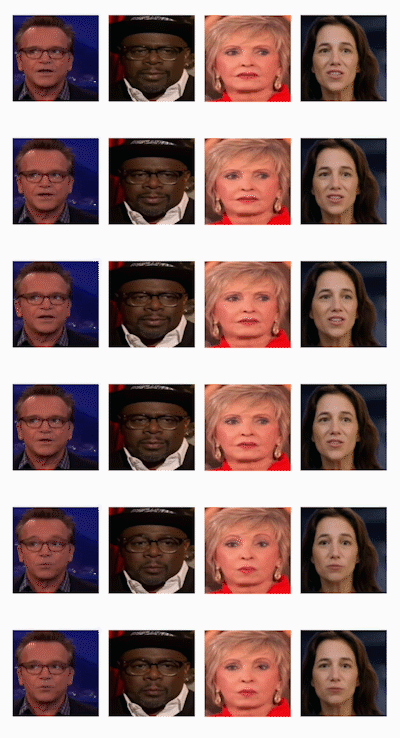 24 |
24 |
25 |
26 | Intuitive Portrait Image Control
27 |
28 |
29 |  30 |
30 |
31 |
32 | Pose & Expression Alignment
33 |
34 |
35 |
36 | * **Motion Imitation**
37 |
38 |  39 |
39 |
40 |
41 | Same & Corss-identity Reenactment
42 |
43 |
44 | * **Audio-Driven Facial Reenactment**
45 |
46 |
47 | 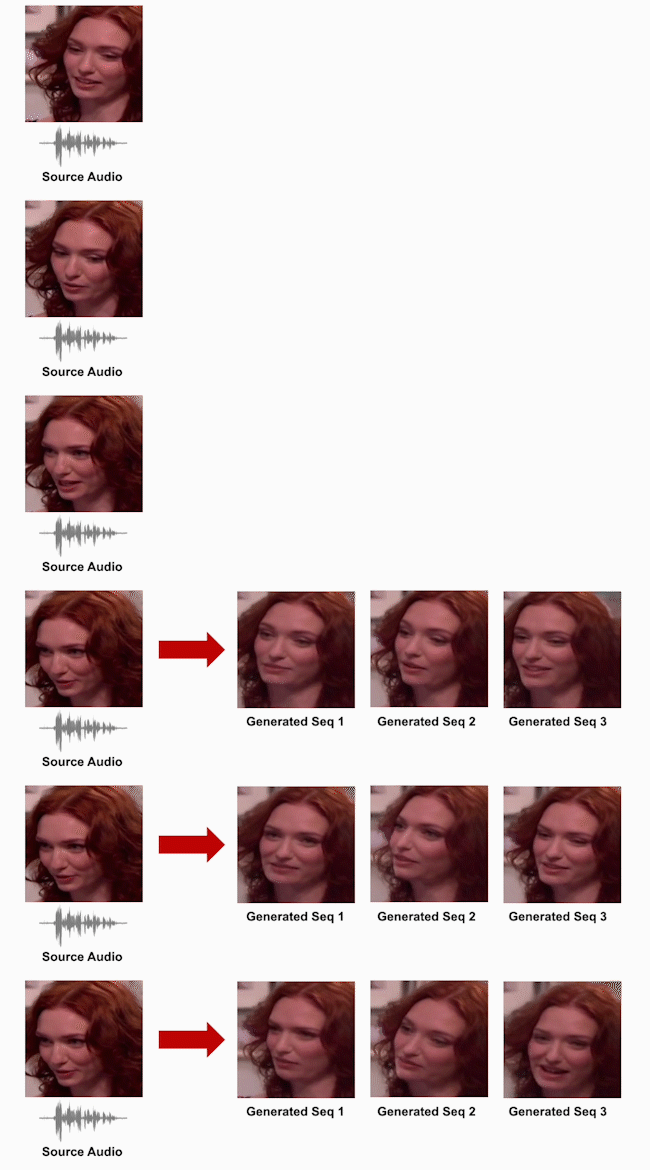 48 |
48 |
49 |
50 | Audio-Driven Reenactment
51 |
52 |
53 | ## News
54 |
55 | * 2021.9.20 Code for PyTorch is available!
56 |
57 |
58 |
59 | ## Colab Demo
60 |
61 | Coming soon
62 |
63 |
64 | ## Get Start
65 |
66 | ### 1). Installation
67 |
68 | #### Requirements
69 |
70 | * Python 3
71 | * PyTorch 1.7.1
72 | * CUDA 10.2
73 |
74 | #### Conda Installation
75 |
76 | ```bash
77 | # 1. Create a conda virtual environment.
78 | conda create -n PIRenderer python=3.6
79 | conda activate PIRenderer
80 | conda install -c pytorch pytorch=1.7.1 torchvision cudatoolkit=10.2
81 |
82 | # 2. Install other dependencies
83 | pip install -r requirements.txt
84 | ```
85 |
86 | ### 2). Dataset
87 |
88 | We train our model using the [VoxCeleb](https://arxiv.org/abs/1706.08612). You can download the demo dataset for inference or prepare the dataset for training and testing.
89 |
90 | #### Download the demo dataset
91 |
92 | The demo dataset contains all 514 test videos. You can download the dataset with the following code:
93 |
94 | ```bash
95 | ./scripts/download_demo_dataset.sh
96 | ```
97 |
98 | Or you can choose to download the resources with these links:
99 |
100 | [Google Driven](https://drive.google.com/drive/folders/16Yn2r46b4cV6ZozOH6a8SdFz_iG7BQk1?usp=sharing) & [BaiDu Driven](https://pan.baidu.com/s/1e615bBHvM4Wz-2snk-86Xw) with extraction passwords ”p9ab“
101 |
102 | Then unzip and save the files to `./dataset`
103 |
104 | #### Prepare the dataset
105 |
106 | 1. The dataset is preprocessed follow the method used in [First-Order](https://github.com/AliaksandrSiarohin/video-preprocessing). You can follow the instructions in their repo to download and crop videos for training and testing.
107 |
108 | 2. After obtaining the VoxCeleb videos, we extract 3DMM parameters using [Deep3DFaceReconstruction](https://github.com/microsoft/Deep3DFaceReconstruction).
109 |
110 | The folder are with format as:
111 |
112 | ```
113 | ${DATASET_ROOT_FOLDER}
114 | └───path_to_videos
115 | └───train
116 | └───xxx.mp4
117 | └───xxx.mp4
118 | ...
119 | └───test
120 | └───xxx.mp4
121 | └───xxx.mp4
122 | ...
123 | └───path_to_3dmm_coeff
124 | └───train
125 | └───xxx.mat
126 | └───xxx.mat
127 | ...
128 | └───test
129 | └───xxx.mat
130 | └───xxx.mat
131 | ...
132 | ```
133 |
134 | **News**: We provide Scripts for extracting 3dmm coeffs from videos. Please check the [DatasetHelper](./DatasetHelper.md) for more details.
135 |
136 | 3. We save the video and 3DMM parameters in a lmdb file. Please run the following code to do this
137 |
138 | ```bash
139 | python scripts/prepare_vox_lmdb.py \
140 | --path path_to_videos \
141 | --coeff_3dmm_path path_to_3dmm_coeff \
142 | --out path_to_output_dir
143 | ```
144 |
145 | ### 3). Training and Inference
146 |
147 | #### Inference
148 |
149 | The trained weights can be downloaded by running the following code:
150 |
151 | ```bash
152 | ./scripts/download_weights.sh
153 | ```
154 |
155 | Or you can choose to download the resources with these links:
156 |
157 | [Google Driven](https://drive.google.com/file/d/1-0xOf6g58OmtKtEWJlU3VlnfRqPN9Uq7/view?usp=sharing) & [Baidu Driven](https://pan.baidu.com/s/18B3xfKMXnm4tOqlFSB8ntg) with extraction passwards "4sy1".
158 |
159 | Then unzip and save the files to `./result/face`.
160 |
161 | **Reenactment**
162 |
163 | Run the demo for face reenactment:
164 |
165 | ```bash
166 | # same identity
167 | python -m torch.distributed.launch --nproc_per_node=1 --master_port 12345 inference.py \
168 | --config ./config/face_demo.yaml \
169 | --name face \
170 | --no_resume \
171 | --output_dir ./vox_result/face_reenactment
172 |
173 | # cross identity
174 | python -m torch.distributed.launch --nproc_per_node=1 --master_port 12345 inference.py \
175 | --config ./config/face_demo.yaml \
176 | --name face \
177 | --no_resume \
178 | --output_dir ./vox_result/face_reenactment_cross \
179 | --cross_id
180 | ```
181 |
182 | The output results are saved at `./vox_result/face_reenactment` and `./vox_result/face_reenactment_cross`
183 |
184 | **Intuitive Control**
185 |
186 | Our model can generate results by providing intuitive controlling coefficients.
187 | We provide the following code for this task. Please note that you need to build the environment of [DeepFaceRecon](https://github.com/sicxu/Deep3DFaceRecon_pytorch/tree/73d491102af6731bded9ae6b3cc7466c3b2e9e48) first.
188 |
189 | ```bash
190 | # 1. Copy the provided scrips to the folder `Deep3DFaceRecon_pytorch`.
191 | cp scripts/face_recon_videos.py ./Deep3DFaceRecon_pytorch
192 | cp scripts/extract_kp_videos.py ./Deep3DFaceRecon_pytorch
193 | cp scripts/coeff_detector.py ./Deep3DFaceRecon_pytorch
194 | cp scripts/inference_options.py ./Deep3DFaceRecon_pytorch/options
195 |
196 | cd Deep3DFaceRecon_pytorch
197 |
198 | # 2. Extracte the 3dmm coefficients of the demo images.
199 | python coeff_detector.py \
200 | --input_dir ../demo_images \
201 | --keypoint_dir ../demo_images \
202 | --output_dir ../demo_images \
203 | --name=model_name \
204 | --epoch=20 \
205 | --model facerecon
206 |
207 | # 3. control the source image with our model
208 | cd ..
209 | python -m torch.distributed.launch --nproc_per_node=1 --master_port 12345 intuitive_control.py \
210 | --config ./config/face_demo.yaml \
211 | --name face \
212 | --no_resume \
213 | --output_dir ./vox_result/face_intuitive \
214 | --input_name ./demo_images
215 | ```
216 |
217 |
218 | #### Train
219 |
220 | Our model can be trained with the following code
221 |
222 | ```bash
223 | python -m torch.distributed.launch --nproc_per_node=4 --master_port 12345 train.py \
224 | --config ./config/face.yaml \
225 | --name face
226 | ```
227 |
228 |
229 | ## Citation
230 |
231 | If you find this code is helpful, please cite our paper
232 |
233 | ```tex
234 | @misc{ren2021pirenderer,
235 | title={PIRenderer: Controllable Portrait Image Generation via Semantic Neural Rendering},
236 | author={Yurui Ren and Ge Li and Yuanqi Chen and Thomas H. Li and Shan Liu},
237 | year={2021},
238 | eprint={2109.08379},
239 | archivePrefix={arXiv},
240 | primaryClass={cs.CV}
241 | }
242 | ```
243 |
244 | ## Acknowledgement
245 |
246 | We build our project base on [imaginaire](https://github.com/NVlabs/imaginaire). Some dataset preprocessing methods are derived from [video-preprocessing](https://github.com/AliaksandrSiarohin/video-preprocessing).
247 |
248 |
--------------------------------------------------------------------------------
/config.py:
--------------------------------------------------------------------------------
1 | import collections
2 | import functools
3 | import os
4 | import re
5 |
6 | import yaml
7 | from util.distributed import master_only_print as print
8 |
9 |
10 | class AttrDict(dict):
11 | """Dict as attribute trick."""
12 |
13 | def __init__(self, *args, **kwargs):
14 | super(AttrDict, self).__init__(*args, **kwargs)
15 | self.__dict__ = self
16 | for key, value in self.__dict__.items():
17 | if isinstance(value, dict):
18 | self.__dict__[key] = AttrDict(value)
19 | elif isinstance(value, (list, tuple)):
20 | if isinstance(value[0], dict):
21 | self.__dict__[key] = [AttrDict(item) for item in value]
22 | else:
23 | self.__dict__[key] = value
24 |
25 | def yaml(self):
26 | """Convert object to yaml dict and return."""
27 | yaml_dict = {}
28 | for key, value in self.__dict__.items():
29 | if isinstance(value, AttrDict):
30 | yaml_dict[key] = value.yaml()
31 | elif isinstance(value, list):
32 | if isinstance(value[0], AttrDict):
33 | new_l = []
34 | for item in value:
35 | new_l.append(item.yaml())
36 | yaml_dict[key] = new_l
37 | else:
38 | yaml_dict[key] = value
39 | else:
40 | yaml_dict[key] = value
41 | return yaml_dict
42 |
43 | def __repr__(self):
44 | """Print all variables."""
45 | ret_str = []
46 | for key, value in self.__dict__.items():
47 | if isinstance(value, AttrDict):
48 | ret_str.append('{}:'.format(key))
49 | child_ret_str = value.__repr__().split('\n')
50 | for item in child_ret_str:
51 | ret_str.append(' ' + item)
52 | elif isinstance(value, list):
53 | if isinstance(value[0], AttrDict):
54 | ret_str.append('{}:'.format(key))
55 | for item in value:
56 | # Treat as AttrDict above.
57 | child_ret_str = item.__repr__().split('\n')
58 | for item in child_ret_str:
59 | ret_str.append(' ' + item)
60 | else:
61 | ret_str.append('{}: {}'.format(key, value))
62 | else:
63 | ret_str.append('{}: {}'.format(key, value))
64 | return '\n'.join(ret_str)
65 |
66 |
67 | class Config(AttrDict):
68 | r"""Configuration class. This should include every human specifiable
69 | hyperparameter values for your training."""
70 |
71 | def __init__(self, filename=None, args=None, verbose=False, is_train=True):
72 | super(Config, self).__init__()
73 | # Set default parameters.
74 | # Logging.
75 |
76 | large_number = 1000000000
77 | self.snapshot_save_iter = large_number
78 | self.snapshot_save_epoch = large_number
79 | self.snapshot_save_start_iter = 0
80 | self.snapshot_save_start_epoch = 0
81 | self.image_save_iter = large_number
82 | self.eval_epoch = large_number
83 | self.start_eval_epoch = large_number
84 | self.eval_epoch = large_number
85 | self.max_epoch = large_number
86 | self.max_iter = large_number
87 | self.logging_iter = 100
88 | self.image_to_tensorboard=False
89 | self.which_iter = args.which_iter
90 | self.resume = not args.no_resume
91 |
92 |
93 | self.checkpoints_dir = args.checkpoints_dir
94 | self.name = args.name
95 | self.phase = 'train' if is_train else 'test'
96 |
97 | # Networks.
98 | self.gen = AttrDict(type='generators.dummy')
99 | self.dis = AttrDict(type='discriminators.dummy')
100 |
101 | # Optimizers.
102 | self.gen_optimizer = AttrDict(type='adam',
103 | lr=0.0001,
104 | adam_beta1=0.0,
105 | adam_beta2=0.999,
106 | eps=1e-8,
107 | lr_policy=AttrDict(iteration_mode=False,
108 | type='step',
109 | step_size=large_number,
110 | gamma=1))
111 | self.dis_optimizer = AttrDict(type='adam',
112 | lr=0.0001,
113 | adam_beta1=0.0,
114 | adam_beta2=0.999,
115 | eps=1e-8,
116 | lr_policy=AttrDict(iteration_mode=False,
117 | type='step',
118 | step_size=large_number,
119 | gamma=1))
120 | # Data.
121 | self.data = AttrDict(name='dummy',
122 | type='datasets.images',
123 | num_workers=0)
124 | self.test_data = AttrDict(name='dummy',
125 | type='datasets.images',
126 | num_workers=0,
127 | test=AttrDict(is_lmdb=False,
128 | roots='',
129 | batch_size=1))
130 | self.trainer = AttrDict(
131 | model_average=False,
132 | model_average_beta=0.9999,
133 | model_average_start_iteration=1000,
134 | model_average_batch_norm_estimation_iteration=30,
135 | model_average_remove_sn=True,
136 | image_to_tensorboard=False,
137 | hparam_to_tensorboard=False,
138 | distributed_data_parallel='pytorch',
139 | delay_allreduce=True,
140 | gan_relativistic=False,
141 | gen_step=1,
142 | dis_step=1)
143 |
144 | # # Cudnn.
145 | self.cudnn = AttrDict(deterministic=False,
146 | benchmark=True)
147 |
148 | # Others.
149 | self.pretrained_weight = ''
150 | self.inference_args = AttrDict()
151 |
152 |
153 | # Update with given configurations.
154 | assert os.path.exists(filename), 'File {} not exist.'.format(filename)
155 | loader = yaml.SafeLoader
156 | loader.add_implicit_resolver(
157 | u'tag:yaml.org,2002:float',
158 | re.compile(u'''^(?:
159 | [-+]?(?:[0-9][0-9_]*)\\.[0-9_]*(?:[eE][-+]?[0-9]+)?
160 | |[-+]?(?:[0-9][0-9_]*)(?:[eE][-+]?[0-9]+)
161 | |\\.[0-9_]+(?:[eE][-+][0-9]+)?
162 | |[-+]?[0-9][0-9_]*(?::[0-5]?[0-9])+\\.[0-9_]*
163 | |[-+]?\\.(?:inf|Inf|INF)
164 | |\\.(?:nan|NaN|NAN))$''', re.X),
165 | list(u'-+0123456789.'))
166 | try:
167 | with open(filename, 'r') as f:
168 | cfg_dict = yaml.load(f, Loader=loader)
169 | except EnvironmentError:
170 | print('Please check the file with name of "%s"', filename)
171 | recursive_update(self, cfg_dict)
172 |
173 | # Put common opts in both gen and dis.
174 | if 'common' in cfg_dict:
175 | self.common = AttrDict(**cfg_dict['common'])
176 | self.gen.common = self.common
177 | self.dis.common = self.common
178 |
179 |
180 | if verbose:
181 | print(' config '.center(80, '-'))
182 | print(self.__repr__())
183 | print(''.center(80, '-'))
184 |
185 |
186 | def rsetattr(obj, attr, val):
187 | """Recursively find object and set value"""
188 | pre, _, post = attr.rpartition('.')
189 | return setattr(rgetattr(obj, pre) if pre else obj, post, val)
190 |
191 |
192 | def rgetattr(obj, attr, *args):
193 | """Recursively find object and return value"""
194 |
195 | def _getattr(obj, attr):
196 | r"""Get attribute."""
197 | return getattr(obj, attr, *args)
198 |
199 | return functools.reduce(_getattr, [obj] + attr.split('.'))
200 |
201 |
202 | def recursive_update(d, u):
203 | """Recursively update AttrDict d with AttrDict u"""
204 | for key, value in u.items():
205 | if isinstance(value, collections.abc.Mapping):
206 | d.__dict__[key] = recursive_update(d.get(key, AttrDict({})), value)
207 | elif isinstance(value, (list, tuple)):
208 | if isinstance(value[0], dict):
209 | d.__dict__[key] = [AttrDict(item) for item in value]
210 | else:
211 | d.__dict__[key] = value
212 | else:
213 | d.__dict__[key] = value
214 | return d
215 |
--------------------------------------------------------------------------------
/third_part/PerceptualSimilarity/util/visualizer.py:
--------------------------------------------------------------------------------
1 | import numpy as np
2 | import os
3 | import time
4 | from . import util
5 | from . import html
6 | # from pdb import set_trace as st
7 | import matplotlib.pyplot as plt
8 | import math
9 | # from IPython import embed
10 |
11 | def zoom_to_res(img,res=256,order=0,axis=0):
12 | # img 3xXxX
13 | from scipy.ndimage import zoom
14 | zoom_factor = res/img.shape[1]
15 | if(axis==0):
16 | return zoom(img,[1,zoom_factor,zoom_factor],order=order)
17 | elif(axis==2):
18 | return zoom(img,[zoom_factor,zoom_factor,1],order=order)
19 |
20 | class Visualizer():
21 | def __init__(self, opt):
22 | # self.opt = opt
23 | self.display_id = opt.display_id
24 | # self.use_html = opt.is_train and not opt.no_html
25 | self.win_size = opt.display_winsize
26 | self.name = opt.name
27 | self.display_cnt = 0 # display_current_results counter
28 | self.display_cnt_high = 0
29 | self.use_html = opt.use_html
30 |
31 | if self.display_id > 0:
32 | import visdom
33 | self.vis = visdom.Visdom(port = opt.display_port)
34 |
35 | self.web_dir = os.path.join(opt.checkpoints_dir, opt.name, 'web')
36 | util.mkdirs([self.web_dir,])
37 | if self.use_html:
38 | self.img_dir = os.path.join(self.web_dir, 'images')
39 | print('create web directory %s...' % self.web_dir)
40 | util.mkdirs([self.img_dir,])
41 |
42 | # |visuals|: dictionary of images to display or save
43 | def display_current_results(self, visuals, epoch, nrows=None, res=256):
44 | if self.display_id > 0: # show images in the browser
45 | title = self.name
46 | if(nrows is None):
47 | nrows = int(math.ceil(len(visuals.items()) / 2.0))
48 | images = []
49 | idx = 0
50 | for label, image_numpy in visuals.items():
51 | title += " | " if idx % nrows == 0 else ", "
52 | title += label
53 | img = image_numpy.transpose([2, 0, 1])
54 | img = zoom_to_res(img,res=res,order=0)
55 | images.append(img)
56 | idx += 1
57 | if len(visuals.items()) % 2 != 0:
58 | white_image = np.ones_like(image_numpy.transpose([2, 0, 1]))*255
59 | white_image = zoom_to_res(white_image,res=res,order=0)
60 | images.append(white_image)
61 | self.vis.images(images, nrow=nrows, win=self.display_id + 1,
62 | opts=dict(title=title))
63 |
64 | if self.use_html: # save images to a html file
65 | for label, image_numpy in visuals.items():
66 | img_path = os.path.join(self.img_dir, 'epoch%.3d_cnt%.6d_%s.png' % (epoch, self.display_cnt, label))
67 | util.save_image(zoom_to_res(image_numpy, res=res, axis=2), img_path)
68 |
69 | self.display_cnt += 1
70 | self.display_cnt_high = np.maximum(self.display_cnt_high, self.display_cnt)
71 |
72 | # update website
73 | webpage = html.HTML(self.web_dir, 'Experiment name = %s' % self.name, reflesh=1)
74 | for n in range(epoch, 0, -1):
75 | webpage.add_header('epoch [%d]' % n)
76 | if(n==epoch):
77 | high = self.display_cnt
78 | else:
79 | high = self.display_cnt_high
80 | for c in range(high-1,-1,-1):
81 | ims = []
82 | txts = []
83 | links = []
84 |
85 | for label, image_numpy in visuals.items():
86 | img_path = 'epoch%.3d_cnt%.6d_%s.png' % (n, c, label)
87 | ims.append(os.path.join('images',img_path))
88 | txts.append(label)
89 | links.append(os.path.join('images',img_path))
90 | webpage.add_images(ims, txts, links, width=self.win_size)
91 | webpage.save()
92 |
93 | # save errors into a directory
94 | def plot_current_errors_save(self, epoch, counter_ratio, opt, errors,keys='+ALL',name='loss', to_plot=False):
95 | if not hasattr(self, 'plot_data'):
96 | self.plot_data = {'X':[],'Y':[], 'legend':list(errors.keys())}
97 | self.plot_data['X'].append(epoch + counter_ratio)
98 | self.plot_data['Y'].append([errors[k] for k in self.plot_data['legend']])
99 |
100 | # embed()
101 | if(keys=='+ALL'):
102 | plot_keys = self.plot_data['legend']
103 | else:
104 | plot_keys = keys
105 |
106 | if(to_plot):
107 | (f,ax) = plt.subplots(1,1)
108 | for (k,kname) in enumerate(plot_keys):
109 | kk = np.where(np.array(self.plot_data['legend'])==kname)[0][0]
110 | x = self.plot_data['X']
111 | y = np.array(self.plot_data['Y'])[:,kk]
112 | if(to_plot):
113 | ax.plot(x, y, 'o-', label=kname)
114 | np.save(os.path.join(self.web_dir,'%s_x')%kname,x)
115 | np.save(os.path.join(self.web_dir,'%s_y')%kname,y)
116 |
117 | if(to_plot):
118 | plt.legend(loc=0,fontsize='small')
119 | plt.xlabel('epoch')
120 | plt.ylabel('Value')
121 | f.savefig(os.path.join(self.web_dir,'%s.png'%name))
122 | f.clf()
123 | plt.close()
124 |
125 | # errors: dictionary of error labels and values
126 | def plot_current_errors(self, epoch, counter_ratio, opt, errors):
127 | if not hasattr(self, 'plot_data'):
128 | self.plot_data = {'X':[],'Y':[], 'legend':list(errors.keys())}
129 | self.plot_data['X'].append(epoch + counter_ratio)
130 | self.plot_data['Y'].append([errors[k] for k in self.plot_data['legend']])
131 | self.vis.line(
132 | X=np.stack([np.array(self.plot_data['X'])]*len(self.plot_data['legend']),1),
133 | Y=np.array(self.plot_data['Y']),
134 | opts={
135 | 'title': self.name + ' loss over time',
136 | 'legend': self.plot_data['legend'],
137 | 'xlabel': 'epoch',
138 | 'ylabel': 'loss'},
139 | win=self.display_id)
140 |
141 | # errors: same format as |errors| of plotCurrentErrors
142 | def print_current_errors(self, epoch, i, errors, t, t2=-1, t2o=-1, fid=None):
143 | message = '(ep: %d, it: %d, t: %.3f[s], ept: %.2f/%.2f[h]) ' % (epoch, i, t, t2o, t2)
144 | message += (', ').join(['%s: %.3f' % (k, v) for k, v in errors.items()])
145 |
146 | print(message)
147 | if(fid is not None):
148 | fid.write('%s\n'%message)
149 |
150 |
151 | # save image to the disk
152 | def save_images_simple(self, webpage, images, names, in_txts, prefix='', res=256):
153 | image_dir = webpage.get_image_dir()
154 | ims = []
155 | txts = []
156 | links = []
157 |
158 | for name, image_numpy, txt in zip(names, images, in_txts):
159 | image_name = '%s_%s.png' % (prefix, name)
160 | save_path = os.path.join(image_dir, image_name)
161 | if(res is not None):
162 | util.save_image(zoom_to_res(image_numpy,res=res,axis=2), save_path)
163 | else:
164 | util.save_image(image_numpy, save_path)
165 |
166 | ims.append(os.path.join(webpage.img_subdir,image_name))
167 | # txts.append(name)
168 | txts.append(txt)
169 | links.append(os.path.join(webpage.img_subdir,image_name))
170 | # embed()
171 | webpage.add_images(ims, txts, links, width=self.win_size)
172 |
173 | # save image to the disk
174 | def save_images(self, webpage, images, names, image_path, title=''):
175 | image_dir = webpage.get_image_dir()
176 | # short_path = ntpath.basename(image_path)
177 | # name = os.path.splitext(short_path)[0]
178 | # name = short_path
179 | # webpage.add_header('%s, %s' % (name, title))
180 | ims = []
181 | txts = []
182 | links = []
183 |
184 | for label, image_numpy in zip(names, images):
185 | image_name = '%s.jpg' % (label,)
186 | save_path = os.path.join(image_dir, image_name)
187 | util.save_image(image_numpy, save_path)
188 |
189 | ims.append(image_name)
190 | txts.append(label)
191 | links.append(image_name)
192 | webpage.add_images(ims, txts, links, width=self.win_size)
193 |
194 | # save image to the disk
195 | # def save_images(self, webpage, visuals, image_path, short=False):
196 | # image_dir = webpage.get_image_dir()
197 | # if short:
198 | # short_path = ntpath.basename(image_path)
199 | # name = os.path.splitext(short_path)[0]
200 | # else:
201 | # name = image_path
202 |
203 | # webpage.add_header(name)
204 | # ims = []
205 | # txts = []
206 | # links = []
207 |
208 | # for label, image_numpy in visuals.items():
209 | # image_name = '%s_%s.png' % (name, label)
210 | # save_path = os.path.join(image_dir, image_name)
211 | # util.save_image(image_numpy, save_path)
212 |
213 | # ims.append(image_name)
214 | # txts.append(label)
215 | # links.append(image_name)
216 | # webpage.add_images(ims, txts, links, width=self.win_size)
217 |
--------------------------------------------------------------------------------
/third_part/PerceptualSimilarity/models/networks_basic.py:
--------------------------------------------------------------------------------
1 |
2 | from __future__ import absolute_import
3 |
4 | import sys
5 | sys.path.append('..')
6 | sys.path.append('.')
7 | import torch
8 | import torch.nn as nn
9 | import torch.nn.init as init
10 | from torch.autograd import Variable
11 | import numpy as np
12 | from pdb import set_trace as st
13 | from skimage import color
14 | from IPython import embed
15 | from . import pretrained_networks as pn
16 |
17 | # from .PerceptualSimilarity.util import util
18 | from ..util import util
19 |
20 | # Off-the-shelf deep network
21 | class PNet(nn.Module):
22 | '''Pre-trained network with all channels equally weighted by default'''
23 | def __init__(self, pnet_type='vgg', pnet_rand=False, use_gpu=True):
24 | super(PNet, self).__init__()
25 |
26 | self.use_gpu = use_gpu
27 |
28 | self.pnet_type = pnet_type
29 | self.pnet_rand = pnet_rand
30 |
31 | self.shift = torch.autograd.Variable(torch.Tensor([-.030, -.088, -.188]).view(1,3,1,1))
32 | self.scale = torch.autograd.Variable(torch.Tensor([.458, .448, .450]).view(1,3,1,1))
33 |
34 | if(self.pnet_type in ['vgg','vgg16']):
35 | self.net = pn.vgg16(pretrained=not self.pnet_rand,requires_grad=False)
36 | elif(self.pnet_type=='alex'):
37 | self.net = pn.alexnet(pretrained=not self.pnet_rand,requires_grad=False)
38 | elif(self.pnet_type[:-2]=='resnet'):
39 | self.net = pn.resnet(pretrained=not self.pnet_rand,requires_grad=False, num=int(self.pnet_type[-2:]))
40 | elif(self.pnet_type=='squeeze'):
41 | self.net = pn.squeezenet(pretrained=not self.pnet_rand,requires_grad=False)
42 |
43 | self.L = self.net.N_slices
44 |
45 | if(use_gpu):
46 | self.net.cuda()
47 | self.shift = self.shift.cuda()
48 | self.scale = self.scale.cuda()
49 |
50 | def forward(self, in0, in1, retPerLayer=False):
51 | in0_sc = (in0 - self.shift.expand_as(in0))/self.scale.expand_as(in0)
52 | in1_sc = (in1 - self.shift.expand_as(in0))/self.scale.expand_as(in0)
53 |
54 | outs0 = self.net.forward(in0_sc)
55 | outs1 = self.net.forward(in1_sc)
56 |
57 | if(retPerLayer):
58 | all_scores = []
59 | for (kk,out0) in enumerate(outs0):
60 | cur_score = (1.-util.cos_sim(outs0[kk],outs1[kk]))
61 | if(kk==0):
62 | val = 1.*cur_score
63 | else:
64 | # val = val + self.lambda_feat_layers[kk]*cur_score
65 | val = val + cur_score
66 | if(retPerLayer):
67 | all_scores+=[cur_score]
68 |
69 | if(retPerLayer):
70 | return (val, all_scores)
71 | else:
72 | return val
73 |
74 | # Learned perceptual metric
75 | class PNetLin(nn.Module):
76 | def __init__(self, pnet_type='vgg', pnet_rand=False, pnet_tune=False, use_dropout=True, use_gpu=True, spatial=False, version='0.1'):
77 | super(PNetLin, self).__init__()
78 |
79 | self.use_gpu = use_gpu
80 | self.pnet_type = pnet_type
81 | self.pnet_tune = pnet_tune
82 | self.pnet_rand = pnet_rand
83 | self.spatial = spatial
84 | self.version = version
85 |
86 | if(self.pnet_type in ['vgg','vgg16']):
87 | net_type = pn.vgg16
88 | self.chns = [64,128,256,512,512]
89 | elif(self.pnet_type=='alex'):
90 | net_type = pn.alexnet
91 | self.chns = [64,192,384,256,256]
92 | elif(self.pnet_type=='squeeze'):
93 | net_type = pn.squeezenet
94 | self.chns = [64,128,256,384,384,512,512]
95 |
96 | if(self.pnet_tune):
97 | self.net = net_type(pretrained=not self.pnet_rand,requires_grad=True)
98 | else:
99 | self.net = [net_type(pretrained=not self.pnet_rand,requires_grad=False),]
100 |
101 | self.lin0 = NetLinLayer(self.chns[0],use_dropout=use_dropout)
102 | self.lin1 = NetLinLayer(self.chns[1],use_dropout=use_dropout)
103 | self.lin2 = NetLinLayer(self.chns[2],use_dropout=use_dropout)
104 | self.lin3 = NetLinLayer(self.chns[3],use_dropout=use_dropout)
105 | self.lin4 = NetLinLayer(self.chns[4],use_dropout=use_dropout)
106 | self.lins = [self.lin0,self.lin1,self.lin2,self.lin3,self.lin4]
107 | if(self.pnet_type=='squeeze'): # 7 layers for squeezenet
108 | self.lin5 = NetLinLayer(self.chns[5],use_dropout=use_dropout)
109 | self.lin6 = NetLinLayer(self.chns[6],use_dropout=use_dropout)
110 | self.lins+=[self.lin5,self.lin6]
111 |
112 | self.shift = torch.autograd.Variable(torch.Tensor([-.030, -.088, -.188]).view(1,3,1,1))
113 | self.scale = torch.autograd.Variable(torch.Tensor([.458, .448, .450]).view(1,3,1,1))
114 |
115 | if(use_gpu):
116 | if(self.pnet_tune):
117 | self.net.cuda()
118 | else:
119 | self.net[0].cuda()
120 | self.shift = self.shift.cuda()
121 | self.scale = self.scale.cuda()
122 | self.lin0.cuda()
123 | self.lin1.cuda()
124 | self.lin2.cuda()
125 | self.lin3.cuda()
126 | self.lin4.cuda()
127 | if(self.pnet_type=='squeeze'):
128 | self.lin5.cuda()
129 | self.lin6.cuda()
130 |
131 | def forward(self, in0, in1):
132 | in0_sc = (in0 - self.shift.expand_as(in0))/self.scale.expand_as(in0)
133 | in1_sc = (in1 - self.shift.expand_as(in0))/self.scale.expand_as(in0)
134 |
135 | if(self.version=='0.0'):
136 | # v0.0 - original release had a bug, where input was not scaled
137 | in0_input = in0
138 | in1_input = in1
139 | else:
140 | # v0.1
141 | in0_input = in0_sc
142 | in1_input = in1_sc
143 |
144 | if(self.pnet_tune):
145 | outs0 = self.net.forward(in0_input)
146 | outs1 = self.net.forward(in1_input)
147 | else:
148 | outs0 = self.net[0].forward(in0_input)
149 | outs1 = self.net[0].forward(in1_input)
150 |
151 | feats0 = {}
152 | feats1 = {}
153 | diffs = [0]*len(outs0)
154 |
155 | for (kk,out0) in enumerate(outs0):
156 | feats0[kk] = util.normalize_tensor(outs0[kk])
157 | feats1[kk] = util.normalize_tensor(outs1[kk])
158 | diffs[kk] = (feats0[kk]-feats1[kk])**2
159 |
160 | if self.spatial:
161 | lin_models = [self.lin0, self.lin1, self.lin2, self.lin3, self.lin4]
162 | if(self.pnet_type=='squeeze'):
163 | lin_models.extend([self.lin5, self.lin6])
164 | res = [lin_models[kk].model(diffs[kk]) for kk in range(len(diffs))]
165 | return res
166 |
167 | val = torch.mean(torch.mean(self.lin0.model(diffs[0]),dim=3),dim=2)
168 | val = val + torch.mean(torch.mean(self.lin1.model(diffs[1]),dim=3),dim=2)
169 | val = val + torch.mean(torch.mean(self.lin2.model(diffs[2]),dim=3),dim=2)
170 | val = val + torch.mean(torch.mean(self.lin3.model(diffs[3]),dim=3),dim=2)
171 | val = val + torch.mean(torch.mean(self.lin4.model(diffs[4]),dim=3),dim=2)
172 | if(self.pnet_type=='squeeze'):
173 | val = val + torch.mean(torch.mean(self.lin5.model(diffs[5]),dim=3),dim=2)
174 | val = val + torch.mean(torch.mean(self.lin6.model(diffs[6]),dim=3),dim=2)
175 |
176 | val = val.view(val.size()[0],val.size()[1],1,1)
177 |
178 | return val
179 |
180 | class Dist2LogitLayer(nn.Module):
181 | ''' takes 2 distances, puts through fc layers, spits out value between [0,1] (if use_sigmoid is True) '''
182 | def __init__(self, chn_mid=32,use_sigmoid=True):
183 | super(Dist2LogitLayer, self).__init__()
184 | layers = [nn.Conv2d(5, chn_mid, 1, stride=1, padding=0, bias=True),]
185 | layers += [nn.LeakyReLU(0.2,True),]
186 | layers += [nn.Conv2d(chn_mid, chn_mid, 1, stride=1, padding=0, bias=True),]
187 | layers += [nn.LeakyReLU(0.2,True),]
188 | layers += [nn.Conv2d(chn_mid, 1, 1, stride=1, padding=0, bias=True),]
189 | if(use_sigmoid):
190 | layers += [nn.Sigmoid(),]
191 | self.model = nn.Sequential(*layers)
192 |
193 | def forward(self,d0,d1,eps=0.1):
194 | return self.model.forward(torch.cat((d0,d1,d0-d1,d0/(d1+eps),d1/(d0+eps)),dim=1))
195 |
196 | class BCERankingLoss(nn.Module):
197 | def __init__(self, use_gpu=True, chn_mid=32):
198 | super(BCERankingLoss, self).__init__()
199 | self.use_gpu = use_gpu
200 | self.net = Dist2LogitLayer(chn_mid=chn_mid)
201 | self.parameters = list(self.net.parameters())
202 | self.loss = torch.nn.BCELoss()
203 | self.model = nn.Sequential(*[self.net])
204 |
205 | if(self.use_gpu):
206 | self.net.cuda()
207 |
208 | def forward(self, d0, d1, judge):
209 | per = (judge+1.)/2.
210 | if(self.use_gpu):
211 | per = per.cuda()
212 | self.logit = self.net.forward(d0,d1)
213 | return self.loss(self.logit, per)
214 |
215 | class NetLinLayer(nn.Module):
216 | ''' A single linear layer which does a 1x1 conv '''
217 | def __init__(self, chn_in, chn_out=1, use_dropout=False):
218 | super(NetLinLayer, self).__init__()
219 |
220 | layers = [nn.Dropout(),] if(use_dropout) else []
221 | layers += [nn.Conv2d(chn_in, chn_out, 1, stride=1, padding=0, bias=False),]
222 | self.model = nn.Sequential(*layers)
223 |
224 |
225 | # L2, DSSIM metrics
226 | class FakeNet(nn.Module):
227 | def __init__(self, use_gpu=True, colorspace='Lab'):
228 | super(FakeNet, self).__init__()
229 | self.use_gpu = use_gpu
230 | self.colorspace=colorspace
231 |
232 | class L2(FakeNet):
233 |
234 | def forward(self, in0, in1):
235 | assert(in0.size()[0]==1) # currently only supports batchSize 1
236 |
237 | if(self.colorspace=='RGB'):
238 | (N,C,X,Y) = in0.size()
239 | value = torch.mean(torch.mean(torch.mean((in0-in1)**2,dim=1).view(N,1,X,Y),dim=2).view(N,1,1,Y),dim=3).view(N)
240 | return value
241 | elif(self.colorspace=='Lab'):
242 | value = util.l2(util.tensor2np(util.tensor2tensorlab(in0.data,to_norm=False)),
243 | util.tensor2np(util.tensor2tensorlab(in1.data,to_norm=False)), range=100.).astype('float')
244 | ret_var = Variable( torch.Tensor((value,) ) )
245 | if(self.use_gpu):
246 | ret_var = ret_var.cuda()
247 | return ret_var
248 |
249 | class DSSIM(FakeNet):
250 |
251 | def forward(self, in0, in1):
252 | assert(in0.size()[0]==1) # currently only supports batchSize 1
253 |
254 | if(self.colorspace=='RGB'):
255 | value = util.dssim(1.*util.tensor2im(in0.data), 1.*util.tensor2im(in1.data), range=255.).astype('float')
256 | elif(self.colorspace=='Lab'):
257 | value = util.dssim(util.tensor2np(util.tensor2tensorlab(in0.data,to_norm=False)),
258 | util.tensor2np(util.tensor2tensorlab(in1.data,to_norm=False)), range=100.).astype('float')
259 | ret_var = Variable( torch.Tensor((value,) ) )
260 | if(self.use_gpu):
261 | ret_var = ret_var.cuda()
262 | return ret_var
263 |
264 | def print_network(net):
265 | num_params = 0
266 | for param in net.parameters():
267 | num_params += param.numel()
268 | print('Network',net)
269 | print('Total number of parameters: %d' % num_params)
270 |
--------------------------------------------------------------------------------
/third_part/PerceptualSimilarity/models/dist_model.py:
--------------------------------------------------------------------------------
1 |
2 | from __future__ import absolute_import
3 |
4 | import sys
5 | sys.path.append('..')
6 | sys.path.append('.')
7 | import numpy as np
8 | import torch
9 | from torch import nn
10 | import os
11 | from collections import OrderedDict
12 | from torch.autograd import Variable
13 | import itertools
14 | from .base_model import BaseModel
15 | from scipy.ndimage import zoom
16 | import fractions
17 | import functools
18 | import skimage.transform
19 | from IPython import embed
20 |
21 | from . import networks_basic as networks
22 | from third_part.PerceptualSimilarity.util import util
23 | # from util import util
24 |
25 | class DistModel(BaseModel):
26 | def name(self):
27 | return self.model_name
28 |
29 | def initialize(self, model='net-lin', net='alex', pnet_rand=False, pnet_tune=False, model_path=None, colorspace='Lab', use_gpu=True, printNet=False, spatial=False, spatial_shape=None, spatial_order=1, spatial_factor=None, is_train=False, lr=.0001, beta1=0.5, version='0.1'):
30 | '''
31 | INPUTS
32 | model - ['net-lin'] for linearly calibrated network
33 | ['net'] for off-the-shelf network
34 | ['L2'] for L2 distance in Lab colorspace
35 | ['SSIM'] for ssim in RGB colorspace
36 | net - ['squeeze','alex','vgg']
37 | model_path - if None, will look in weights/[NET_NAME].pth
38 | colorspace - ['Lab','RGB'] colorspace to use for L2 and SSIM
39 | use_gpu - bool - whether or not to use a GPU
40 | printNet - bool - whether or not to print network architecture out
41 | spatial - bool - whether to output an array containing varying distances across spatial dimensions
42 | spatial_shape - if given, output spatial shape. if None then spatial shape is determined automatically via spatial_factor (see below).
43 | spatial_factor - if given, specifies upsampling factor relative to the largest spatial extent of a convolutional layer. if None then resized to size of input images.
44 | spatial_order - spline order of filter for upsampling in spatial mode, by default 1 (bilinear).
45 | is_train - bool - [True] for training mode
46 | lr - float - initial learning rate
47 | beta1 - float - initial momentum term for adam
48 | version - 0.1 for latest, 0.0 was original
49 | '''
50 | BaseModel.initialize(self, use_gpu=use_gpu)
51 |
52 | self.model = model
53 | self.net = net
54 | self.use_gpu = use_gpu
55 | self.is_train = is_train
56 | self.spatial = spatial
57 | self.spatial_shape = spatial_shape
58 | self.spatial_order = spatial_order
59 | self.spatial_factor = spatial_factor
60 |
61 | self.model_name = '%s [%s]'%(model,net)
62 | if(self.model == 'net-lin'): # pretrained net + linear layer
63 | self.net = networks.PNetLin(use_gpu=use_gpu,pnet_rand=pnet_rand, pnet_tune=pnet_tune, pnet_type=net,use_dropout=True,spatial=spatial,version=version)
64 | kw = {}
65 | if not use_gpu:
66 | kw['map_location'] = 'cpu'
67 | if(model_path is None):
68 | import inspect
69 | # model_path = './PerceptualSimilarity/weights/v%s/%s.pth'%(version,net)
70 | model_path = os.path.abspath(os.path.join(inspect.getfile(self.initialize), '..', '..', 'weights/v%s/%s.pth'%(version,net)))
71 |
72 | if(not is_train):
73 | print('Loading model from: %s'%model_path)
74 | self.net.load_state_dict(torch.load(model_path, map_location=lambda storage, loc: storage))
75 |
76 | elif(self.model=='net'): # pretrained network
77 | assert not self.spatial, 'spatial argument not supported yet for uncalibrated networks'
78 | self.net = networks.PNet(use_gpu=use_gpu,pnet_type=net)
79 | self.is_fake_net = True
80 | elif(self.model in ['L2','l2']):
81 | self.net = networks.L2(use_gpu=use_gpu,colorspace=colorspace) # not really a network, only for testing
82 | self.model_name = 'L2'
83 | elif(self.model in ['DSSIM','dssim','SSIM','ssim']):
84 | self.net = networks.DSSIM(use_gpu=use_gpu,colorspace=colorspace)
85 | self.model_name = 'SSIM'
86 | else:
87 | raise ValueError("Model [%s] not recognized." % self.model)
88 |
89 | self.parameters = list(self.net.parameters())
90 |
91 | if self.is_train: # training mode
92 | # extra network on top to go from distances (d0,d1) => predicted human judgment (h*)
93 | self.rankLoss = networks.BCERankingLoss(use_gpu=use_gpu)
94 | self.parameters+=self.rankLoss.parameters
95 | self.lr = lr
96 | self.old_lr = lr
97 | self.optimizer_net = torch.optim.Adam(self.parameters, lr=lr, betas=(beta1, 0.999))
98 | else: # test mode
99 | self.net.eval()
100 |
101 | if(printNet):
102 | print('---------- Networks initialized -------------')
103 | networks.print_network(self.net)
104 | print('-----------------------------------------------')
105 |
106 | def forward_pair(self,in1,in2,retPerLayer=False):
107 | if(retPerLayer):
108 | return self.net.forward(in1,in2, retPerLayer=True)
109 | else:
110 | return self.net.forward(in1,in2)
111 |
112 | def forward(self, in0, in1, retNumpy=True):
113 | ''' Function computes the distance between image patches in0 and in1
114 | INPUTS
115 | in0, in1 - torch.Tensor object of shape Nx3xXxY - image patch scaled to [-1,1]
116 | retNumpy - [False] to return as torch.Tensor, [True] to return as numpy array
117 | OUTPUT
118 | computed distances between in0 and in1
119 | '''
120 |
121 | self.input_ref = in0
122 | self.input_p0 = in1
123 |
124 | if(self.use_gpu):
125 | self.input_ref = self.input_ref.cuda()
126 | self.input_p0 = self.input_p0.cuda()
127 |
128 | self.var_ref = Variable(self.input_ref,requires_grad=True)
129 | self.var_p0 = Variable(self.input_p0,requires_grad=True)
130 |
131 | self.d0 = self.forward_pair(self.var_ref, self.var_p0)
132 | self.loss_total = self.d0
133 |
134 | def convert_output(d0):
135 | if(retNumpy):
136 | ans = d0.cpu().data.numpy()
137 | if not self.spatial:
138 | ans = ans.flatten()
139 | else:
140 | assert(ans.shape[0] == 1 and len(ans.shape) == 4)
141 | return ans[0,...].transpose([1, 2, 0]) # Reshape to usual numpy image format: (height, width, channels)
142 | return ans
143 | else:
144 | return d0
145 |
146 | if self.spatial:
147 | L = [convert_output(x) for x in self.d0]
148 | spatial_shape = self.spatial_shape
149 | if spatial_shape is None:
150 | if(self.spatial_factor is None):
151 | spatial_shape = (in0.size()[2],in0.size()[3])
152 | else:
153 | spatial_shape = (max([x.shape[0] for x in L])*self.spatial_factor, max([x.shape[1] for x in L])*self.spatial_factor)
154 |
155 | L = [skimage.transform.resize(x, spatial_shape, order=self.spatial_order, mode='edge') for x in L]
156 |
157 | L = np.mean(np.concatenate(L, 2) * len(L), 2)
158 | return L
159 | else:
160 | return convert_output(self.d0)
161 |
162 | # ***** TRAINING FUNCTIONS *****
163 | def optimize_parameters(self):
164 | self.forward_train()
165 | self.optimizer_net.zero_grad()
166 | self.backward_train()
167 | self.optimizer_net.step()
168 | self.clamp_weights()
169 |
170 | def clamp_weights(self):
171 | for module in self.net.modules():
172 | if(hasattr(module, 'weight') and module.kernel_size==(1,1)):
173 | module.weight.data = torch.clamp(module.weight.data,min=0)
174 |
175 | def set_input(self, data):
176 | self.input_ref = data['ref']
177 | self.input_p0 = data['p0']
178 | self.input_p1 = data['p1']
179 | self.input_judge = data['judge']
180 |
181 | if(self.use_gpu):
182 | self.input_ref = self.input_ref.cuda()
183 | self.input_p0 = self.input_p0.cuda()
184 | self.input_p1 = self.input_p1.cuda()
185 | self.input_judge = self.input_judge.cuda()
186 |
187 | self.var_ref = Variable(self.input_ref,requires_grad=True)
188 | self.var_p0 = Variable(self.input_p0,requires_grad=True)
189 | self.var_p1 = Variable(self.input_p1,requires_grad=True)
190 |
191 | def forward_train(self): # run forward pass
192 | self.d0 = self.forward_pair(self.var_ref, self.var_p0)
193 | self.d1 = self.forward_pair(self.var_ref, self.var_p1)
194 | self.acc_r = self.compute_accuracy(self.d0,self.d1,self.input_judge)
195 |
196 | # var_judge
197 | self.var_judge = Variable(1.*self.input_judge).view(self.d0.size())
198 |
199 | self.loss_total = self.rankLoss.forward(self.d0, self.d1, self.var_judge*2.-1.)
200 | return self.loss_total
201 |
202 | def backward_train(self):
203 | torch.mean(self.loss_total).backward()
204 |
205 | def compute_accuracy(self,d0,d1,judge):
206 | ''' d0, d1 are Variables, judge is a Tensor '''
207 | d1_lt_d0 = (d1 %f' % (type,self.old_lr, lr))
247 | self.old_lr = lr
248 |
249 |
250 |
251 | def score_2afc_dataset(data_loader,func):
252 | ''' Function computes Two Alternative Forced Choice (2AFC) score using
253 | distance function 'func' in dataset 'data_loader'
254 | INPUTS
255 | data_loader - CustomDatasetDataLoader object - contains a TwoAFCDataset inside
256 | func - callable distance function - calling d=func(in0,in1) should take 2
257 | pytorch tensors with shape Nx3xXxY, and return numpy array of length N
258 | OUTPUTS
259 | [0] - 2AFC score in [0,1], fraction of time func agrees with human evaluators
260 | [1] - dictionary with following elements
261 | d0s,d1s - N arrays containing distances between reference patch to perturbed patches
262 | gts - N array in [0,1], preferred patch selected by human evaluators
263 | (closer to "0" for left patch p0, "1" for right patch p1,
264 | "0.6" means 60pct people preferred right patch, 40pct preferred left)
265 | scores - N array in [0,1], corresponding to what percentage function agreed with humans
266 | CONSTS
267 | N - number of test triplets in data_loader
268 | '''
269 |
270 | d0s = []
271 | d1s = []
272 | gts = []
273 |
274 | # bar = pb.ProgressBar(max_value=data_loader.load_data().__len__())
275 | for (i,data) in enumerate(data_loader.load_data()):
276 | d0s+=func(data['ref'],data['p0']).tolist()
277 | d1s+=func(data['ref'],data['p1']).tolist()
278 | gts+=data['judge'].cpu().numpy().flatten().tolist()
279 | # bar.update(i)
280 |
281 | d0s = np.array(d0s)
282 | d1s = np.array(d1s)
283 | gts = np.array(gts)
284 | scores = (d0s 0:
158 | mean = mean / count
159 | print(name)
160 | print(mean)
161 |
162 | def grab_patch(img_in, P, yy, xx):
163 | return img_in[yy:yy+P,xx:xx+P,:]
164 |
165 | def load_image(path):
166 | if(path[-3:] == 'dng'):
167 | import rawpy
168 | with rawpy.imread(path) as raw:
169 | img = raw.postprocess()
170 | # img = plt.imread(path)
171 | elif(path[-3:]=='bmp' or path[-3:]=='jpg' or path[-3:]=='png'):
172 | import cv2
173 | return cv2.imread(path)[:,:,::-1]
174 | else:
175 | img = (255*plt.imread(path)[:,:,:3]).astype('uint8')
176 |
177 | return img
178 |
179 |
180 | def resize_image(img, max_size=256):
181 | [Y, X] = img.shape[:2]
182 |
183 | # resize
184 | max_dim = max([Y, X])
185 | zoom_factor = 1. * max_size / max_dim
186 | img = zoom(img, [zoom_factor, zoom_factor, 1])
187 |
188 | return img
189 |
190 | def resize_image_zoom(img, zoom_factor=1., order=3):
191 | if(zoom_factor==1):
192 | return img
193 | else:
194 | return zoom(img, [zoom_factor, zoom_factor, 1], order=order)
195 |
196 | def save_image(image_numpy, image_path, ):
197 | image_pil = Image.fromarray(image_numpy)
198 | image_pil.save(image_path)
199 |
200 |
201 | def prep_display_image(img, dtype='uint8'):
202 | if(dtype == 'uint8'):
203 | return np.clip(img, 0, 255).astype('uint8')
204 | else:
205 | return np.clip(img, 0, 1.)
206 |
207 |
208 | def info(object, spacing=10, collapse=1):
209 | """Print methods and doc strings.
210 | Takes module, class, list, dictionary, or string."""
211 | methodList = [
212 | e for e in dir(object) if isinstance(
213 | getattr(
214 | object,
215 | e),
216 | collections.Callable)]
217 | processFunc = collapse and (lambda s: " ".join(s.split())) or (lambda s: s)
218 | print("\n".join(["%s %s" %
219 | (method.ljust(spacing),
220 | processFunc(str(getattr(object, method).__doc__)))
221 | for method in methodList]))
222 |
223 |
224 | def varname(p):
225 | for line in inspect.getframeinfo(inspect.currentframe().f_back)[3]:
226 | m = re.search(r'\bvarname\s*\(\s*([A-Za-z_][A-Za-z0-9_]*)\s*\)', line)
227 | if m:
228 | return m.group(1)
229 |
230 |
231 | def print_numpy(x, val=True, shp=False):
232 | x = x.astype(np.float64)
233 | if shp:
234 | print('shape,', x.shape)
235 | if val:
236 | x = x.flatten()
237 | print(
238 | 'mean = %3.3f, min = %3.3f, max = %3.3f, median = %3.3f, std=%3.3f' %
239 | (np.mean(x), np.min(x), np.max(x), np.median(x), np.std(x)))
240 |
241 |
242 | def mkdirs(paths):
243 | if isinstance(paths, list) and not isinstance(paths, str):
244 | for path in paths:
245 | mkdir(path)
246 | else:
247 | mkdir(paths)
248 |
249 |
250 | def mkdir(path):
251 | if not os.path.exists(path):
252 | os.makedirs(path)
253 |
254 |
255 | def rgb2lab(input):
256 | from skimage import color
257 | return color.rgb2lab(input / 255.)
258 |
259 |
260 | def montage(
261 | imgs,
262 | PAD=5,
263 | RATIO=16 / 9.,
264 | EXTRA_PAD=(
265 | False,
266 | False),
267 | MM=-1,
268 | NN=-1,
269 | primeDir=0,
270 | verbose=False,
271 | returnGridPos=False,
272 | backClr=np.array(
273 | (0,
274 | 0,
275 | 0))):
276 | # INPUTS
277 | # imgs YxXxMxN or YxXxN
278 | # PAD scalar number of pixels in between
279 | # RATIO scalar target ratio of cols/rows
280 | # MM scalar # rows, if specified, overrides RATIO
281 | # NN scalar # columns, if specified, overrides RATIO
282 | # primeDir scalar 0 for top-to-bottom, 1 for left-to-right
283 | # OUTPUTS
284 | # mont_imgs MM*Y x NN*X x M big image with everything montaged
285 | # def montage(imgs, PAD=5, RATIO=16/9., MM=-1, NN=-1, primeDir=0,
286 | # verbose=False, forceFloat=False):
287 | if(imgs.ndim == 3):
288 | toExp = True
289 | imgs = imgs[:, :, np.newaxis, :]
290 | else:
291 | toExp = False
292 |
293 | Y = imgs.shape[0]
294 | X = imgs.shape[1]
295 | M = imgs.shape[2]
296 | N = imgs.shape[3]
297 |
298 | PADS = np.array((PAD))
299 | if(PADS.flatten().size == 1):
300 | PADY = PADS
301 | PADX = PADS
302 | else:
303 | PADY = PADS[0]
304 | PADX = PADS[1]
305 |
306 | if(MM == -1 and NN == -1):
307 | NN = np.ceil(np.sqrt(1.0 * N * RATIO))
308 | MM = np.ceil(1.0 * N / NN)
309 | NN = np.ceil(1.0 * N / MM)
310 | elif(MM == -1):
311 | MM = np.ceil(1.0 * N / NN)
312 | elif(NN == -1):
313 | NN = np.ceil(1.0 * N / MM)
314 |
315 | if(primeDir == 0): # write top-to-bottom
316 | [grid_mm, grid_nn] = np.meshgrid(
317 | np.arange(MM, dtype='uint'), np.arange(NN, dtype='uint'))
318 | elif(primeDir == 1): # write left-to-right
319 | [grid_nn, grid_mm] = np.meshgrid(
320 | np.arange(NN, dtype='uint'), np.arange(MM, dtype='uint'))
321 |
322 | grid_mm = np.uint(grid_mm.flatten()[0:N])
323 | grid_nn = np.uint(grid_nn.flatten()[0:N])
324 |
325 | EXTRA_PADY = EXTRA_PAD[0] * PADY
326 | EXTRA_PADX = EXTRA_PAD[0] * PADX
327 |
328 | # mont_imgs = np.zeros(((Y+PAD)*MM-PAD, (X+PAD)*NN-PAD, M), dtype=use_dtype)
329 | mont_imgs = np.zeros(
330 | (np.uint(
331 | (Y + PADY) * MM - PADY + EXTRA_PADY),
332 | np.uint(
333 | (X + PADX) * NN - PADX + EXTRA_PADX),
334 | M),
335 | dtype=imgs.dtype)
336 | mont_imgs = mont_imgs + \
337 | backClr.flatten()[np.newaxis, np.newaxis, :].astype(mont_imgs.dtype)
338 |
339 | for ii in np.random.permutation(N):
340 | # print imgs[:,:,:,ii].shape
341 | # mont_imgs[grid_mm[ii]*(Y+PAD):(grid_mm[ii]*(Y+PAD)+Y), grid_nn[ii]*(X+PAD):(grid_nn[ii]*(X+PAD)+X),:]
342 | mont_imgs[np.uint(grid_mm[ii] *
343 | (Y +
344 | PADY)):np.uint((grid_mm[ii] *
345 | (Y +
346 | PADY) +
347 | Y)), np.uint(grid_nn[ii] *
348 | (X +
349 | PADX)):np.uint((grid_nn[ii] *
350 | (X +
351 | PADX) +
352 | X)), :] = imgs[:, :, :, ii]
353 |
354 | if(M == 1):
355 | imgs = imgs.reshape(imgs.shape[0], imgs.shape[1], imgs.shape[3])
356 |
357 | if(toExp):
358 | mont_imgs = mont_imgs[:, :, 0]
359 |
360 | if(returnGridPos):
361 | # return (mont_imgs,np.concatenate((grid_mm[:,:,np.newaxis]*(Y+PAD),
362 | # grid_nn[:,:,np.newaxis]*(X+PAD)),axis=2))
363 | return (mont_imgs, np.concatenate(
364 | (grid_mm[:, np.newaxis] * (Y + PADY), grid_nn[:, np.newaxis] * (X + PADX)), axis=1))
365 | # return (mont_imgs, (grid_mm,grid_nn))
366 | else:
367 | return mont_imgs
368 |
369 | class zeroClipper(object):
370 | def __init__(self, frequency=1):
371 | self.frequency = frequency
372 |
373 | def __call__(self, module):
374 | embed()
375 | if hasattr(module, 'weight'):
376 | # module.weight.data = torch.max(module.weight.data, 0)
377 | module.weight.data = torch.max(module.weight.data, 0) + 100
378 |
379 | def flatten_nested_list(nested_list):
380 | # only works for list of list
381 | accum = []
382 | for sublist in nested_list:
383 | for item in sublist:
384 | accum.append(item)
385 | return accum
386 |
387 | def read_file(in_path,list_lines=False):
388 | agg_str = ''
389 | f = open(in_path,'r')
390 | cur_line = f.readline()
391 | while(cur_line!=''):
392 | agg_str+=cur_line
393 | cur_line = f.readline()
394 | f.close()
395 | if(list_lines==False):
396 | return agg_str.replace('\n','')
397 | else:
398 | line_list = agg_str.split('\n')
399 | ret_list = []
400 | for item in line_list:
401 | if(item!=''):
402 | ret_list.append(item)
403 | return ret_list
404 |
405 | def read_csv_file_as_text(in_path):
406 | agg_str = []
407 | f = open(in_path,'r')
408 | cur_line = f.readline()
409 | while(cur_line!=''):
410 | agg_str.append(cur_line)
411 | cur_line = f.readline()
412 | f.close()
413 | return agg_str
414 |
415 | def random_swap(obj0,obj1):
416 | if(np.random.rand() < .5):
417 | return (obj0,obj1,0)
418 | else:
419 | return (obj1,obj0,1)
420 |
421 | def voc_ap(rec, prec, use_07_metric=False):
422 | """ ap = voc_ap(rec, prec, [use_07_metric])
423 | Compute VOC AP given precision and recall.
424 | If use_07_metric is true, uses the
425 | VOC 07 11 point method (default:False).
426 | """
427 | if use_07_metric:
428 | # 11 point metric
429 | ap = 0.
430 | for t in np.arange(0., 1.1, 0.1):
431 | if np.sum(rec >= t) == 0:
432 | p = 0
433 | else:
434 | p = np.max(prec[rec >= t])
435 | ap = ap + p / 11.
436 | else:
437 | # correct AP calculation
438 | # first append sentinel values at the end
439 | mrec = np.concatenate(([0.], rec, [1.]))
440 | mpre = np.concatenate(([0.], prec, [0.]))
441 |
442 | # compute the precision envelope
443 | for i in range(mpre.size - 1, 0, -1):
444 | mpre[i - 1] = np.maximum(mpre[i - 1], mpre[i])
445 |
446 | # to calculate area under PR curve, look for points
447 | # where X axis (recall) changes value
448 | i = np.where(mrec[1:] != mrec[:-1])[0]
449 |
450 | # and sum (\Delta recall) * prec
451 | ap = np.sum((mrec[i + 1] - mrec[i]) * mpre[i + 1])
452 | return ap
453 |
--------------------------------------------------------------------------------
/generators/base_function.py:
--------------------------------------------------------------------------------
1 | import sys
2 | import math
3 |
4 | import torch
5 | from torch import nn
6 | from torch.nn import functional as F
7 | from torch.autograd import Function
8 | from torch.nn.utils.spectral_norm import spectral_norm as SpectralNorm
9 |
10 |
11 | class LayerNorm2d(nn.Module):
12 | def __init__(self, n_out, affine=True):
13 | super(LayerNorm2d, self).__init__()
14 | self.n_out = n_out
15 | self.affine = affine
16 |
17 | if self.affine:
18 | self.weight = nn.Parameter(torch.ones(n_out, 1, 1))
19 | self.bias = nn.Parameter(torch.zeros(n_out, 1, 1))
20 |
21 | def forward(self, x):
22 | normalized_shape = x.size()[1:]
23 | if self.affine:
24 | return F.layer_norm(x, normalized_shape, \
25 | self.weight.expand(normalized_shape),
26 | self.bias.expand(normalized_shape))
27 |
28 | else:
29 | return F.layer_norm(x, normalized_shape)
30 |
31 | class ADAINHourglass(nn.Module):
32 | def __init__(self, image_nc, pose_nc, ngf, img_f, encoder_layers, decoder_layers, nonlinearity, use_spect):
33 | super(ADAINHourglass, self).__init__()
34 | self.encoder = ADAINEncoder(image_nc, pose_nc, ngf, img_f, encoder_layers, nonlinearity, use_spect)
35 | self.decoder = ADAINDecoder(pose_nc, ngf, img_f, encoder_layers, decoder_layers, True, nonlinearity, use_spect)
36 | self.output_nc = self.decoder.output_nc
37 |
38 | def forward(self, x, z):
39 | return self.decoder(self.encoder(x, z), z)
40 |
41 |
42 |
43 | class ADAINEncoder(nn.Module):
44 | def __init__(self, image_nc, pose_nc, ngf, img_f, layers, nonlinearity=nn.LeakyReLU(), use_spect=False):
45 | super(ADAINEncoder, self).__init__()
46 | self.layers = layers
47 | self.input_layer = nn.Conv2d(image_nc, ngf, kernel_size=7, stride=1, padding=3)
48 | for i in range(layers):
49 | in_channels = min(ngf * (2**i), img_f)
50 | out_channels = min(ngf *(2**(i+1)), img_f)
51 | model = ADAINEncoderBlock(in_channels, out_channels, pose_nc, nonlinearity, use_spect)
52 | setattr(self, 'encoder' + str(i), model)
53 | self.output_nc = out_channels
54 |
55 | def forward(self, x, z):
56 | out = self.input_layer(x)
57 | out_list = [out]
58 | for i in range(self.layers):
59 | model = getattr(self, 'encoder' + str(i))
60 | out = model(out, z)
61 | out_list.append(out)
62 | return out_list
63 |
64 | class ADAINDecoder(nn.Module):
65 | """docstring for ADAINDecoder"""
66 | def __init__(self, pose_nc, ngf, img_f, encoder_layers, decoder_layers, skip_connect=True,
67 | nonlinearity=nn.LeakyReLU(), use_spect=False):
68 |
69 | super(ADAINDecoder, self).__init__()
70 | self.encoder_layers = encoder_layers
71 | self.decoder_layers = decoder_layers
72 | self.skip_connect = skip_connect
73 | use_transpose = True
74 |
75 | for i in range(encoder_layers-decoder_layers, encoder_layers)[::-1]:
76 | in_channels = min(ngf * (2**(i+1)), img_f)
77 | in_channels = in_channels*2 if i != (encoder_layers-1) and self.skip_connect else in_channels
78 | out_channels = min(ngf * (2**i), img_f)
79 | model = ADAINDecoderBlock(in_channels, out_channels, out_channels, pose_nc, use_transpose, nonlinearity, use_spect)
80 | setattr(self, 'decoder' + str(i), model)
81 |
82 | self.output_nc = out_channels*2 if self.skip_connect else out_channels
83 |
84 | def forward(self, x, z):
85 | out = x.pop() if self.skip_connect else x
86 | for i in range(self.encoder_layers-self.decoder_layers, self.encoder_layers)[::-1]:
87 | model = getattr(self, 'decoder' + str(i))
88 | out = model(out, z)
89 | out = torch.cat([out, x.pop()], 1) if self.skip_connect else out
90 | return out
91 |
92 | class ADAINEncoderBlock(nn.Module):
93 | def __init__(self, input_nc, output_nc, feature_nc, nonlinearity=nn.LeakyReLU(), use_spect=False):
94 | super(ADAINEncoderBlock, self).__init__()
95 | kwargs_down = {'kernel_size': 4, 'stride': 2, 'padding': 1}
96 | kwargs_fine = {'kernel_size': 3, 'stride': 1, 'padding': 1}
97 |
98 | self.conv_0 = spectral_norm(nn.Conv2d(input_nc, output_nc, **kwargs_down), use_spect)
99 | self.conv_1 = spectral_norm(nn.Conv2d(output_nc, output_nc, **kwargs_fine), use_spect)
100 |
101 |
102 | self.norm_0 = ADAIN(input_nc, feature_nc)
103 | self.norm_1 = ADAIN(output_nc, feature_nc)
104 | self.actvn = nonlinearity
105 |
106 | def forward(self, x, z):
107 | x = self.conv_0(self.actvn(self.norm_0(x, z)))
108 | x = self.conv_1(self.actvn(self.norm_1(x, z)))
109 | return x
110 |
111 | class ADAINDecoderBlock(nn.Module):
112 | def __init__(self, input_nc, output_nc, hidden_nc, feature_nc, use_transpose=True, nonlinearity=nn.LeakyReLU(), use_spect=False):
113 | super(ADAINDecoderBlock, self).__init__()
114 | # Attributes
115 | self.actvn = nonlinearity
116 | hidden_nc = min(input_nc, output_nc) if hidden_nc is None else hidden_nc
117 |
118 | kwargs_fine = {'kernel_size':3, 'stride':1, 'padding':1}
119 | if use_transpose:
120 | kwargs_up = {'kernel_size':3, 'stride':2, 'padding':1, 'output_padding':1}
121 | else:
122 | kwargs_up = {'kernel_size':3, 'stride':1, 'padding':1}
123 |
124 | # create conv layers
125 | self.conv_0 = spectral_norm(nn.Conv2d(input_nc, hidden_nc, **kwargs_fine), use_spect)
126 | if use_transpose:
127 | self.conv_1 = spectral_norm(nn.ConvTranspose2d(hidden_nc, output_nc, **kwargs_up), use_spect)
128 | self.conv_s = spectral_norm(nn.ConvTranspose2d(input_nc, output_nc, **kwargs_up), use_spect)
129 | else:
130 | self.conv_1 = nn.Sequential(spectral_norm(nn.Conv2d(hidden_nc, output_nc, **kwargs_up), use_spect),
131 | nn.Upsample(scale_factor=2))
132 | self.conv_s = nn.Sequential(spectral_norm(nn.Conv2d(input_nc, output_nc, **kwargs_up), use_spect),
133 | nn.Upsample(scale_factor=2))
134 | # define normalization layers
135 | self.norm_0 = ADAIN(input_nc, feature_nc)
136 | self.norm_1 = ADAIN(hidden_nc, feature_nc)
137 | self.norm_s = ADAIN(input_nc, feature_nc)
138 |
139 | def forward(self, x, z):
140 | x_s = self.shortcut(x, z)
141 | dx = self.conv_0(self.actvn(self.norm_0(x, z)))
142 | dx = self.conv_1(self.actvn(self.norm_1(dx, z)))
143 | out = x_s + dx
144 | return out
145 |
146 | def shortcut(self, x, z):
147 | x_s = self.conv_s(self.actvn(self.norm_s(x, z)))
148 | return x_s
149 |
150 |
151 | def spectral_norm(module, use_spect=True):
152 | """use spectral normal layer to stable the training process"""
153 | if use_spect:
154 | return SpectralNorm(module)
155 | else:
156 | return module
157 |
158 |
159 | class ADAIN(nn.Module):
160 | def __init__(self, norm_nc, feature_nc):
161 | super().__init__()
162 |
163 | self.param_free_norm = nn.InstanceNorm2d(norm_nc, affine=False)
164 |
165 | nhidden = 128
166 | use_bias=True
167 |
168 | self.mlp_shared = nn.Sequential(
169 | nn.Linear(feature_nc, nhidden, bias=use_bias),
170 | nn.ReLU()
171 | )
172 | self.mlp_gamma = nn.Linear(nhidden, norm_nc, bias=use_bias)
173 | self.mlp_beta = nn.Linear(nhidden, norm_nc, bias=use_bias)
174 |
175 | def forward(self, x, feature):
176 |
177 | # Part 1. generate parameter-free normalized activations
178 | normalized = self.param_free_norm(x)
179 |
180 | # Part 2. produce scaling and bias conditioned on feature
181 | feature = feature.view(feature.size(0), -1)
182 | actv = self.mlp_shared(feature)
183 | gamma = self.mlp_gamma(actv)
184 | beta = self.mlp_beta(actv)
185 |
186 | # apply scale and bias
187 | gamma = gamma.view(*gamma.size()[:2], 1,1)
188 | beta = beta.view(*beta.size()[:2], 1,1)
189 | out = normalized * (1 + gamma) + beta
190 | return out
191 |
192 |
193 | class FineEncoder(nn.Module):
194 | """docstring for Encoder"""
195 | def __init__(self, image_nc, ngf, img_f, layers, norm_layer=nn.BatchNorm2d, nonlinearity=nn.LeakyReLU(), use_spect=False):
196 | super(FineEncoder, self).__init__()
197 | self.layers = layers
198 | self.first = FirstBlock2d(image_nc, ngf, norm_layer, nonlinearity, use_spect)
199 | for i in range(layers):
200 | in_channels = min(ngf*(2**i), img_f)
201 | out_channels = min(ngf*(2**(i+1)), img_f)
202 | model = DownBlock2d(in_channels, out_channels, norm_layer, nonlinearity, use_spect)
203 | setattr(self, 'down' + str(i), model)
204 | self.output_nc = out_channels
205 |
206 | def forward(self, x):
207 | x = self.first(x)
208 | out=[x]
209 | for i in range(self.layers):
210 | model = getattr(self, 'down'+str(i))
211 | x = model(x)
212 | out.append(x)
213 | return out
214 |
215 | class FineDecoder(nn.Module):
216 | """docstring for FineDecoder"""
217 | def __init__(self, image_nc, feature_nc, ngf, img_f, layers, num_block, norm_layer=nn.BatchNorm2d, nonlinearity=nn.LeakyReLU(), use_spect=False):
218 | super(FineDecoder, self).__init__()
219 | self.layers = layers
220 | for i in range(layers)[::-1]:
221 | in_channels = min(ngf*(2**(i+1)), img_f)
222 | out_channels = min(ngf*(2**i), img_f)
223 | up = UpBlock2d(in_channels, out_channels, norm_layer, nonlinearity, use_spect)
224 | res = FineADAINResBlocks(num_block, in_channels, feature_nc, norm_layer, nonlinearity, use_spect)
225 | jump = Jump(out_channels, norm_layer, nonlinearity, use_spect)
226 |
227 | setattr(self, 'up' + str(i), up)
228 | setattr(self, 'res' + str(i), res)
229 | setattr(self, 'jump' + str(i), jump)
230 |
231 | self.final = FinalBlock2d(out_channels, image_nc, use_spect, 'tanh')
232 |
233 | self.output_nc = out_channels
234 |
235 | def forward(self, x, z):
236 | out = x.pop()
237 | for i in range(self.layers)[::-1]:
238 | res_model = getattr(self, 'res' + str(i))
239 | up_model = getattr(self, 'up' + str(i))
240 | jump_model = getattr(self, 'jump' + str(i))
241 | out = res_model(out, z)
242 | out = up_model(out)
243 | out = jump_model(x.pop()) + out
244 | out_image = self.final(out)
245 | return out_image
246 |
247 | class FirstBlock2d(nn.Module):
248 | """
249 | Downsampling block for use in encoder.
250 | """
251 | def __init__(self, input_nc, output_nc, norm_layer=nn.BatchNorm2d, nonlinearity=nn.LeakyReLU(), use_spect=False):
252 | super(FirstBlock2d, self).__init__()
253 | kwargs = {'kernel_size': 7, 'stride': 1, 'padding': 3}
254 | conv = spectral_norm(nn.Conv2d(input_nc, output_nc, **kwargs), use_spect)
255 |
256 | if type(norm_layer) == type(None):
257 | self.model = nn.Sequential(conv, nonlinearity)
258 | else:
259 | self.model = nn.Sequential(conv, norm_layer(output_nc), nonlinearity)
260 |
261 |
262 | def forward(self, x):
263 | out = self.model(x)
264 | return out
265 |
266 | class DownBlock2d(nn.Module):
267 | def __init__(self, input_nc, output_nc, norm_layer=nn.BatchNorm2d, nonlinearity=nn.LeakyReLU(), use_spect=False):
268 | super(DownBlock2d, self).__init__()
269 |
270 |
271 | kwargs = {'kernel_size': 3, 'stride': 1, 'padding': 1}
272 | conv = spectral_norm(nn.Conv2d(input_nc, output_nc, **kwargs), use_spect)
273 | pool = nn.AvgPool2d(kernel_size=(2, 2))
274 |
275 | if type(norm_layer) == type(None):
276 | self.model = nn.Sequential(conv, nonlinearity, pool)
277 | else:
278 | self.model = nn.Sequential(conv, norm_layer(output_nc), nonlinearity, pool)
279 |
280 | def forward(self, x):
281 | out = self.model(x)
282 | return out
283 |
284 | class UpBlock2d(nn.Module):
285 | def __init__(self, input_nc, output_nc, norm_layer=nn.BatchNorm2d, nonlinearity=nn.LeakyReLU(), use_spect=False):
286 | super(UpBlock2d, self).__init__()
287 | kwargs = {'kernel_size': 3, 'stride': 1, 'padding': 1}
288 | conv = spectral_norm(nn.Conv2d(input_nc, output_nc, **kwargs), use_spect)
289 | if type(norm_layer) == type(None):
290 | self.model = nn.Sequential(conv, nonlinearity)
291 | else:
292 | self.model = nn.Sequential(conv, norm_layer(output_nc), nonlinearity)
293 |
294 | def forward(self, x):
295 | out = self.model(F.interpolate(x, scale_factor=2))
296 | return out
297 |
298 | class FineADAINResBlocks(nn.Module):
299 | def __init__(self, num_block, input_nc, feature_nc, norm_layer=nn.BatchNorm2d, nonlinearity=nn.LeakyReLU(), use_spect=False):
300 | super(FineADAINResBlocks, self).__init__()
301 | self.num_block = num_block
302 | for i in range(num_block):
303 | model = FineADAINResBlock2d(input_nc, feature_nc, norm_layer, nonlinearity, use_spect)
304 | setattr(self, 'res'+str(i), model)
305 |
306 | def forward(self, x, z):
307 | for i in range(self.num_block):
308 | model = getattr(self, 'res'+str(i))
309 | x = model(x, z)
310 | return x
311 |
312 | class Jump(nn.Module):
313 | def __init__(self, input_nc, norm_layer=nn.BatchNorm2d, nonlinearity=nn.LeakyReLU(), use_spect=False):
314 | super(Jump, self).__init__()
315 | kwargs = {'kernel_size': 3, 'stride': 1, 'padding': 1}
316 | conv = spectral_norm(nn.Conv2d(input_nc, input_nc, **kwargs), use_spect)
317 |
318 | if type(norm_layer) == type(None):
319 | self.model = nn.Sequential(conv, nonlinearity)
320 | else:
321 | self.model = nn.Sequential(conv, norm_layer(input_nc), nonlinearity)
322 |
323 | def forward(self, x):
324 | out = self.model(x)
325 | return out
326 |
327 | class FineADAINResBlock2d(nn.Module):
328 | """
329 | Define an Residual block for different types
330 | """
331 | def __init__(self, input_nc, feature_nc, norm_layer=nn.BatchNorm2d, nonlinearity=nn.LeakyReLU(), use_spect=False):
332 | super(FineADAINResBlock2d, self).__init__()
333 |
334 | kwargs = {'kernel_size': 3, 'stride': 1, 'padding': 1}
335 |
336 | self.conv1 = spectral_norm(nn.Conv2d(input_nc, input_nc, **kwargs), use_spect)
337 | self.conv2 = spectral_norm(nn.Conv2d(input_nc, input_nc, **kwargs), use_spect)
338 | self.norm1 = ADAIN(input_nc, feature_nc)
339 | self.norm2 = ADAIN(input_nc, feature_nc)
340 |
341 | self.actvn = nonlinearity
342 |
343 |
344 | def forward(self, x, z):
345 | dx = self.actvn(self.norm1(self.conv1(x), z))
346 | dx = self.norm2(self.conv2(x), z)
347 | out = dx + x
348 | return out
349 |
350 | class FinalBlock2d(nn.Module):
351 | """
352 | Define the output layer
353 | """
354 | def __init__(self, input_nc, output_nc, use_spect=False, tanh_or_sigmoid='tanh'):
355 | super(FinalBlock2d, self).__init__()
356 |
357 | kwargs = {'kernel_size': 7, 'stride': 1, 'padding':3}
358 | conv = spectral_norm(nn.Conv2d(input_nc, output_nc, **kwargs), use_spect)
359 |
360 | if tanh_or_sigmoid == 'sigmoid':
361 | out_nonlinearity = nn.Sigmoid()
362 | else:
363 | out_nonlinearity = nn.Tanh()
364 |
365 | self.model = nn.Sequential(conv, out_nonlinearity)
366 | def forward(self, x):
367 | out = self.model(x)
368 | return out
--------------------------------------------------------------------------------