 3 |
3 |
2 |
3 |
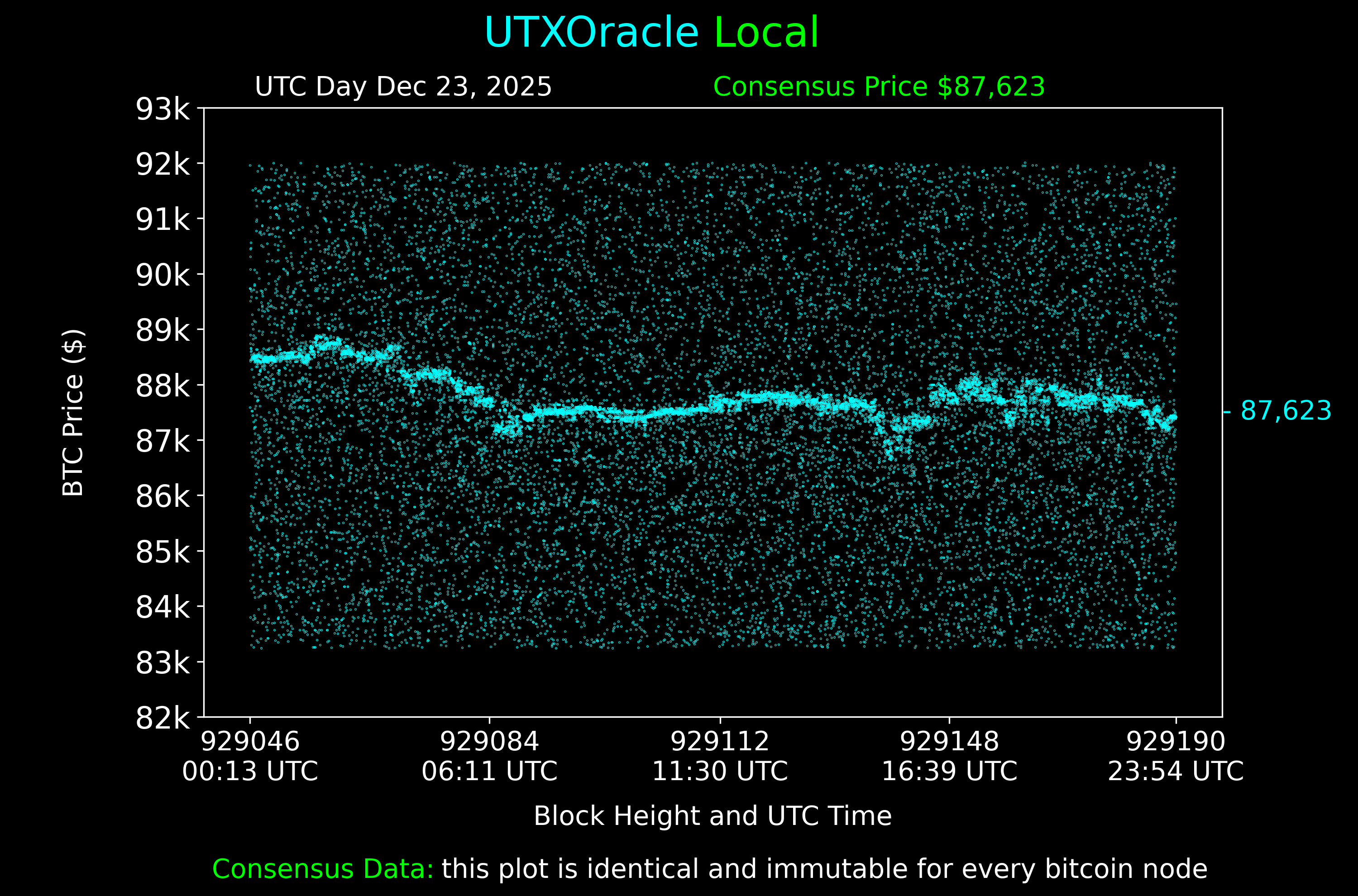
87 | Signal from noise. 88 |
89 | -------------------------------------------------------------------------------- /LICENSE: -------------------------------------------------------------------------------- 1 | UTXOracle License 2 | 3 | Version 1.0 — May 2025 4 | 5 | This is a custom license written specifically for the UTXOracle project. It 6 | reflects the unique nature of Bitcoin data: namely, that long-term confirmed 7 | data can achieve consensus across nodes, while real-time or mempool-based data 8 | inherently cannot. This license is designed to: 9 | 10 | - Encourage wide, free use of UTXOracle for consensus-compatible purposes; 11 | - Prevent confusion or misuse of the term "UTXOracle" for outputs not derived 12 | from consensus logic; 13 | - Retain commercial and naming rights for live-streamed or real-time products. 14 | 15 | This license is not OSI-approved, but it is written in good faith to balance 16 | decentralization, reproducibility, and responsible innovation. 17 | 18 | Section 1: Definitions 19 | 20 | “UTXOracle Local” refers to the open-source software made available by the 21 | author for calculating the 24-hour average confirmed price and the recent 22 | 144-block window price using confirmed Bitcoin transactions. 23 | 24 | “Consensus-Compatible Use” means: 25 | - Running UTXOracle Local to generate the daily average confirmed block price 26 | (“UTXOracle Consensus Price”), or 27 | - Running UTXOracle Local to generate the price from the most recent 144 28 | confirmed blocks (“UTXOracle Block Window Price”), 29 | - Without modifying the filtering or averaging logic that produces those prices. 30 | 31 | “Live or Real-Time Use” means: 32 | - Using mempool data, 33 | - Using data from fewer than 6 confirmations at the chain tip, 34 | - Generating prices that update faster than once per confirmed block, 35 | - Producing streamed or pushed data outputs (APIs, trading bots, etc.). 36 | 37 | “The Author” refers to the creator and copyright holder of UTXOracle, reachable 38 | via Twitter.com or x.com at @SteveSimple. 39 | 40 | Section 2: Permissions (Consensus-Compatible Use) 41 | 42 | 1. You are free to use, modify, distribute, and run UTXOracle Local for 43 | Consensus-Compatible Use without cost. 44 | 2. You may adapt UTXOracle Local to fit your local environment (e.g., paths, 45 | dependencies, node RPC settings) as long as you do not alter the price-filtering 46 | or averaging logic. 47 | 3. You may publish or share visualizations or outputs of UTXOracle Local for 48 | educational, analytical, or public benefit purposes. 49 | 4. If you are using UTXOracle Local unmodified to generate the 24-hour average 50 | or the 144-block window price, you must refer to these outputs by their 51 | canonical names: 52 | - “UTXOracle Consensus Price” for the 24-hour average from confirmed blocks 53 | - “UTXOracle Block Window Price” for the average from the most recent 144 54 | confirmed blocks 55 | 5. You may not relabel or rebrand these outputs using alternative names when the 56 | original UTXOracle code remains unmodified for price logic. 57 | 6. You may not use the UTXOracle Consensus Price or UTXOracle Block Window Price 58 | for commercial purposes, including but not limited to financial services, paid 59 | dashboards, or subscription-based products, without prior written permission 60 | from the Author. 61 | 7. Commercial third-party node applications may integrate UTXOracle Consensus and 62 | Block Window Prices into their products so long as: 63 | - The integration adheres to all other conditions in this Section, 64 | - The price logic is unmodified, 65 | - The outputs are clearly labeled with the canonical names. 66 | - A link to the UTXOracle Live stream is included in the display. 67 | 8. Any redistribution of the UTXOracle code must retain this license in its 68 | entirety, including this Section and all usage restrictions. 69 | 9. Consensus-Compatible Use includes automated or repeated execution of UTXOracle 70 | Local logic to recalculate the UTXOracle Block Window Price on each new 71 | confirmed block, provided that: 72 | - Only confirmed blocks are used, 73 | - The logic remains unmodified, 74 | - The outputs are labeled with their canonical names. 75 | 76 | Section 3: Restrictions on Naming and Representation 77 | 78 | 1. If you modify the price logic (e.g., change filtering thresholds, averaging 79 | methods, or block selection rules), you must not use the following terms to 80 | describe your output: 81 | - “UTXOracle Consensus Price” 82 | - “UTXOracle Block Window Price” 83 | - Any term incorporating “UTXOracle” to describe the price output 84 | 2. These terms are reserved exclusively for outputs derived from unmodified 85 | consensus-compatible logic as defined by the Author. 86 | 3. You may not use the UTXOracle name, logo, or associated branding for any fork 87 | or derivative project without written permission. 88 | 89 | Section 4: Prohibited Use (Live or Commercial Streaming) 90 | 91 | 1. You may not use UTXOracle (in whole or in part), or any derivative of it, to: 92 | - Generate or stream a live or real-time price feed; 93 | - Provide price updates more frequent than once per block; 94 | - Operate a trading bot, financial API, or trading-related product; 95 | - Offer a public-facing service under the name UTXOracle. 96 | 2. These use cases are reserved exclusively for the Author under the name: 97 | - “UTXOracle Live” 98 | - “UTXOracle Live Price” 99 | - “Live On-Chain Price” 100 | 3. To discuss licensing for live or commercial usage, contact the Author. 101 | 102 | Section 5: Trademark and Branding 103 | 104 | The following terms are being claimed as trademarks by the Author: 105 | - UTXOracle 106 | - UTXOracle Consensus Price 107 | - UTXOracle Block Window Price 108 | - UTXOracle Live 109 | - UTXOracle Live Price 110 | - Live On-Chain Price 111 | 112 | Use of these names, phrases, or related branding in public-facing products or 113 | services is strictly prohibited without explicit written permission. 114 | 115 | Section 6: No Warranty 116 | 117 | This software is provided “as is,” without warranty of any kind. The Author shall 118 | not be liable for any claims, damages, or losses resulting from its use. -------------------------------------------------------------------------------- /archive/v7/UTXOracle.py: -------------------------------------------------------------------------------- 1 | 2 | ############################################################################### 3 | 4 | # Introduction) This is UTXOracle.py 5 | 6 | ############################################################################### 7 | 8 | 9 | # This python program estimates the daily USD price of bitcoin using only 10 | # your bitcoin Core full node. It will work even while you are disconnected 11 | # from the internet because it only reads blocks from your machine. It does not 12 | # save files, write cookies, or access any wallet information. It only reads 13 | # blocks, analyzes output patterns, and estimates a daily average a USD 14 | # price of bitcoin. The call to your node is the standard "bitcoin-cli". The 15 | # date and price ranges expected to work for this version are from 2020-7-26 16 | # and from $10,000 to $100,000 17 | 18 | print("UTXOracle version 7\n") 19 | 20 | 21 | ############################################################################### 22 | 23 | # Quick Start 24 | 25 | ############################################################################### 26 | 27 | 28 | # 1. Make sure you have python3 and bitcoin-cli installed 29 | # 2. Make sure "server = 1" is in bitcoin.conf 30 | # 3. Run this file as "python3 UTXOracle.py" 31 | 32 | # If this isn't working for you, you'll likely need to explore the 33 | # bitcon-cli configuration options below: 34 | 35 | 36 | # configuration options for bitcoin-cli 37 | datadir = "" 38 | rpcuser = "" 39 | rpcpassword = "" 40 | rpcookiefile = "" 41 | rpcconnect = "" 42 | rpcport = "" 43 | conf = "" 44 | 45 | 46 | #add the configuration options to the bitcoin-cli call 47 | bitcoin_cli_options = [] 48 | if datadir != "": 49 | bitcoin_cli_options.append('-datadir='+ datadir) 50 | if rpcuser != "": 51 | bitcoin_cli_options.append("-rpcuser="+ rpcuser) 52 | if rpcpassword != "": 53 | bitcoin_cli_options.append("-rpcpassword="+ rpcpassword) 54 | if rpcookiefile != "": 55 | bitcoin_cli_options.append("-rpcookiefile="+ rpcookiefile) 56 | if rpcconnect != "": 57 | bitcoin_cli_options.append("-rpcconnect="+ rpcconnect) 58 | if rpcport != "": 59 | bitcoin_cli_options.append("-rpcport="+ rpcport) 60 | if conf != "": 61 | bitcoin_cli_options.append("-conf="+ conf) 62 | 63 | 64 | 65 | 66 | 67 | 68 | 69 | 70 | ############################################################################### 71 | 72 | # Part 1) Defining a shortcut function to call your node 73 | 74 | ############################################################################### 75 | 76 | # Here we define define a shortcut (a function) for calling the node as we do 77 | # this many times through out the program. The function will return the 78 | # answer it gets from your node with the "command" that you asked it for. 79 | # If we don't get an answer, the problem is likely that you don't have 80 | # sever=1 in your bitcoin conf file. 81 | 82 | 83 | 84 | import subprocess #a built in python library for sending command line commands 85 | def Ask_Node(command): 86 | 87 | # 'bitcoin-cli' is how the command window calls your node so 88 | # it needs to be the first word in any request for data from the node 89 | # other options are added if given 90 | for o in bitcoin_cli_options: 91 | command.insert(0,o) 92 | command.insert(0,"bitcoin-cli") 93 | 94 | # get the answer from the node and return it to the program 95 | answer = None 96 | try: #python try is used when we need to deal with errors after 97 | answer = subprocess.check_output(command) 98 | except Exception as e: 99 | # something went wrong while getting the answer 100 | print("Error connecting to your node. Trouble shooting steps:\n") 101 | print("\t 1) Make sure bitcoin-cli is working. Try command 'bitcoin-cli getblockcount'") 102 | print("\t 2) Make sure config file bitcoin.conf has server=1") 103 | print("\t 3) Explore the bitcoin-cli options in UTXOracle.py (line 38)") 104 | print("\nThe command was:"+str(command)) 105 | print("\nThe error from bitcoin-cli was:\n") 106 | print(e) 107 | exit() 108 | 109 | # answer received, return this answer to the program 110 | return answer 111 | 112 | 113 | 114 | 115 | 116 | 117 | 118 | 119 | 120 | 121 | 122 | 123 | ############################################################################### 124 | 125 | # Part 2) Get the latest block from the node 126 | 127 | ############################################################################### 128 | 129 | # The first request to the node is to ask it how many blocks it has. This 130 | # let's us know the maximum possible day for which we can request a 131 | # btc price estimate. The time information of blocks is listed in the block 132 | # header, so we ask for the header only when we just need to know the time. 133 | 134 | 135 | #get current block height from local node and exit if connection not made 136 | block_count_b = Ask_Node(['getblockcount']) 137 | block_count = int(block_count_b) #convert text to integer 138 | 139 | #get block header from current block height 140 | block_hash_b = Ask_Node(['getblockhash',block_count_b]) 141 | block_header_b = Ask_Node(['getblockheader',block_hash_b[:64],'true']) 142 | import json #a built in tool for deciphering lists of embedded lists 143 | block_header = json.loads(block_header_b) 144 | 145 | #get the date and time of the current block height 146 | from datetime import datetime, timezone #built in tools for dates/times 147 | latest_time_in_seconds = block_header['time'] 148 | time_datetime = datetime.fromtimestamp(latest_time_in_seconds,tz=timezone.utc) 149 | 150 | #get the date/time of utc midnight on the latest day 151 | latest_year = int(time_datetime.strftime("%Y")) 152 | latest_month = int(time_datetime.strftime("%m")) 153 | latest_day = int(time_datetime.strftime("%d")) 154 | latest_utc_midnight = datetime(latest_year,latest_month,latest_day,0,0,0,tzinfo=timezone.utc) 155 | 156 | #assign the day before as the latest possible price date 157 | seconds_in_a_day = 60*60*24 158 | yesterday_seconds = latest_time_in_seconds - seconds_in_a_day 159 | latest_price_day = datetime.fromtimestamp(yesterday_seconds,tz=timezone.utc) 160 | latest_price_date = latest_price_day.strftime("%Y-%m-%d") 161 | 162 | 163 | # tell the user that a connection has been made and state the lastest price date 164 | print("Connected to local noode at block #:\t"+str(block_count)) 165 | print("Latest available price date is: \t"+latest_price_date) 166 | print("Earliest available price date is:\t2020-07-26 (full node)") 167 | 168 | 169 | 170 | 171 | 172 | 173 | 174 | 175 | 176 | 177 | 178 | 179 | 180 | 181 | 182 | ############################################################################### 183 | 184 | # Part 3) Ask for the desired date to estimate the price 185 | 186 | ############################################################################### 187 | 188 | 189 | #use python input to get date from the user 190 | date_entered = input("\nEnter date in YYYY-MM-DD (or 'q' to quit):") 191 | 192 | # quit if desired 193 | if date_entered == 'q': 194 | exit() 195 | 196 | #check to see if this is a good date 197 | try: 198 | year = int(date_entered.split('-')[0]) 199 | month = int(date_entered.split('-')[1]) 200 | day = int(date_entered.split('-')[2]) 201 | 202 | #make sure this date is less than the max date 203 | datetime_entered = datetime(year,month,day,0,0,0,tzinfo=timezone.utc) 204 | if datetime_entered.timestamp() >= latest_utc_midnight.timestamp(): 205 | print("\nThe date entered is not before the current date, please try again") 206 | exit() 207 | 208 | #make sure this date is after the min date 209 | july_26_2020 = datetime(2020,7,26,0,0,0,tzinfo=timezone.utc) 210 | if datetime_entered.timestamp() < july_26_2020.timestamp(): 211 | print("\nThe date entered is before 2020-07-26, please try again") 212 | exit() 213 | 214 | except: 215 | print("\nError interpreting date. Likely not entered in format YYYY-MM-DD") 216 | print("Please try again\n") 217 | exit() 218 | 219 | #get the seconds and printable date string of date entered 220 | price_day_seconds = int(datetime_entered.timestamp()) 221 | price_day_date_utc = datetime_entered.strftime("%B %d, %Y") 222 | 223 | 224 | 225 | 226 | 227 | 228 | 229 | 230 | 231 | 232 | 233 | 234 | 235 | 236 | 237 | 238 | 239 | ############################################################################## 240 | 241 | # Part 4) Hunt through blocks to find the first block on the target day 242 | 243 | ############################################################################## 244 | 245 | # This section would be unnecessary if bitcoin Core blocks were organized by time 246 | # instead of by block height. There's no way to ask bitcoin Core for a block at a 247 | # specific time. Instead one must ask for a block, look at it's time, then estimate 248 | # the number of blocks to jump for the next guess. Rinse and repeat. 249 | 250 | 251 | #first estimate of the block height of the price day 252 | seconds_since_price_day = latest_time_in_seconds - price_day_seconds 253 | blocks_ago_estimate = round(144*float(seconds_since_price_day)/float(seconds_in_a_day)) 254 | price_day_block_estimate = block_count - blocks_ago_estimate 255 | 256 | #check the time of the price day block estimate 257 | block_hash_b = Ask_Node(['getblockhash',str(price_day_block_estimate)]) 258 | block_header_b = Ask_Node(['getblockheader',block_hash_b[:64],'true']) 259 | block_header = json.loads(block_header_b) 260 | time_in_seconds = block_header['time'] 261 | 262 | #get new block estimate from the seconds difference using 144 blocks per day 263 | seconds_difference = time_in_seconds - price_day_seconds 264 | block_jump_estimate = round(144*float(seconds_difference)/float(seconds_in_a_day)) 265 | 266 | #iterate above process until it oscillates around the correct block 267 | last_estimate = 0 268 | last_last_estimate = 0 269 | while block_jump_estimate >6 and block_jump_estimate != last_last_estimate: 270 | 271 | #when we osciallate around the correct block, last_last_estimate = block_jump_estimate 272 | last_last_estimate = last_estimate 273 | last_estimate = block_jump_estimate 274 | 275 | #get block header or new estimate 276 | price_day_block_estimate = price_day_block_estimate-block_jump_estimate 277 | block_hash_b = Ask_Node(['getblockhash',str(price_day_block_estimate)]) 278 | block_header_b = Ask_Node(['getblockheader',block_hash_b[:64],'true']) 279 | block_header = json.loads(block_header_b) 280 | 281 | #check time of new block and get new block jump estimate 282 | time_in_seconds = block_header['time'] 283 | seconds_difference = time_in_seconds - price_day_seconds 284 | block_jump_estimate = round(144*float(seconds_difference)/float(seconds_in_a_day)) 285 | 286 | #the oscillation may be over multiple blocks so we add/subtract single blocks 287 | #to ensure we have exactly the first block of the target day 288 | if time_in_seconds > price_day_seconds: 289 | 290 | # if the estimate was after price day look at earlier blocks 291 | while time_in_seconds > price_day_seconds: 292 | 293 | #decrement the block by one, read new block header, check time 294 | price_day_block_estimate = price_day_block_estimate-1 295 | block_hash_b = Ask_Node(['getblockhash',str(price_day_block_estimate)]) 296 | block_header_b = Ask_Node(['getblockheader',block_hash_b[:64],'true']) 297 | block_header = json.loads(block_header_b) 298 | time_in_seconds = block_header['time'] 299 | 300 | #the guess is now perfectly the first block before midnight 301 | price_day_block_estimate = price_day_block_estimate + 1 302 | 303 | # if the estimate was before price day look for later blocks 304 | elif time_in_seconds < price_day_seconds: 305 | 306 | while time_in_seconds < price_day_seconds: 307 | 308 | #increment the block by one, read new block header, check time 309 | price_day_block_estimate = price_day_block_estimate+1 310 | block_hash_b = Ask_Node(['getblockhash',str(price_day_block_estimate)]) 311 | block_header_b = Ask_Node(['getblockheader',block_hash_b[:64],'true']) 312 | block_header = json.loads(block_header_b) 313 | time_in_seconds = block_header['time'] 314 | 315 | #assign the estimate as the price day block since it is correct now 316 | price_day_block = price_day_block_estimate 317 | 318 | 319 | 320 | 321 | 322 | 323 | 324 | 325 | 326 | 327 | 328 | 329 | ############################################################################## 330 | 331 | # Part 5) Build the container to hold the output amounts bell curve 332 | 333 | ############################################################################## 334 | 335 | # In pure math a bell curve can be perfectly smooth. But to make a bell curve 336 | # from a sample of data, one must specifiy a series of buckets, or bins, and then 337 | # count how many samples are in each bin. If the bin size is too large, say just one 338 | # large bin, a bell curve can't appear because it will have only one bar. The bell 339 | # curve also doesn't appear if the bin size is too small because then there will 340 | # only be one sample in each bin and we'd fail to have a distribution of bin heights. 341 | 342 | # Although several bin sizes would work, I have found over many years, that 200 bins 343 | # for every 10x of bitcoin amounts works very well. We use 'every 10x' because just 344 | # like a long term bitcoin price chart, viewing output amounts in log scale provides 345 | # a more comprehensive and detailed overview of the amounts being analyzed. 346 | 347 | 348 | # Define the maximum and minimum values (in log10) of btc amounts to use 349 | first_bin_value = -6 350 | last_bin_value = 6 #python -1 means last in list 351 | range_bin_values = last_bin_value - first_bin_value 352 | 353 | # create a list of output_bell_curve_bins and add zero sats as the first bin 354 | output_bell_curve_bins = [0.0] #a decimal tells python the list will contain decimals 355 | 356 | # calculate btc amounts of 200 samples in every 10x from 100 sats (1e-6 btc) to 100k (1e5) btc 357 | for exponent in range(-6,6): #python range uses 'less than' for the big number 358 | 359 | #add 200 bin_width increments in this 10x to the list 360 | for b in range(0,200): 361 | 362 | bin_value = 10 ** (exponent + b/200) 363 | output_bell_curve_bins.append(bin_value) 364 | 365 | # Create a list the same size as the bell curve to keep the count of the bins 366 | number_of_bins = len(output_bell_curve_bins) 367 | output_bell_curve_bin_counts = [] 368 | for n in range(0,number_of_bins): 369 | output_bell_curve_bin_counts.append(float(0.0)) 370 | 371 | 372 | 373 | 374 | 375 | 376 | 377 | 378 | 379 | 380 | 381 | 382 | 383 | 384 | 385 | 386 | 387 | ############################################################################## 388 | 389 | # Part 6) Get all output amounts from all block on target day 390 | 391 | ############################################################################## 392 | 393 | # This section of the program will take the most time as it requests all 394 | # all blocks from Core on the price day. It readers every transaction (tx) 395 | # from those blocks and places each tx output value into the bell curve 396 | 397 | 398 | 399 | 400 | from math import log10 #built in math functions needed logarithms 401 | 402 | #print header line of update table 403 | print("\nReading all blocks on "+price_day_date_utc+"...") 404 | print("\nThis will take a few minutes (~144 blocks)...") 405 | print("\nHeight\tTime(utc)\t\tTime(32bit)\t\t Completion %") 406 | 407 | #get the full data of the first target day block from the node 408 | block_height=price_day_block 409 | block_hash_b = Ask_Node(['getblockhash',str(block_height)]) 410 | block_b = Ask_Node(['getblock',block_hash_b[:64],'2']) 411 | block = json.loads(block_b) 412 | 413 | #get the time of the first block 414 | time_in_seconds = int(block['time']) 415 | time_datetime = datetime.fromtimestamp(time_in_seconds,tz=timezone.utc) 416 | time_utc = time_datetime.strftime("%H:%M:%S") 417 | hour_of_day = int(time_datetime.strftime("%H")) 418 | minute_of_hour = float(time_datetime.strftime("%M")) 419 | day_of_month = int(time_datetime.strftime("%d")) 420 | target_day_of_month = day_of_month 421 | time_32bit = f"{time_in_seconds & 0b11111111111111111111111111111111:32b}" 422 | 423 | 424 | #read in blocks until we get a block on the day after the target day 425 | while target_day_of_month == day_of_month: 426 | 427 | #get progress estimate 428 | progress_estimate = 100.0*(hour_of_day+minute_of_hour/60)/24.0 429 | 430 | #print progress update 431 | print(str(block_height)+"\t"+time_utc+"\t"+time_32bit+"\t"+f"{progress_estimate:.2f}"+"%") 432 | 433 | #go through all the txs in the block which are stored in a list called 'tx' 434 | for tx in block['tx']: 435 | 436 | #txs have more than one output which are stored in a list called 'vout' 437 | outputs = tx['vout'] 438 | 439 | #go through all outputs in the tx 440 | for output in outputs: 441 | 442 | #the bitcoin output amount is called 'value' in Core, add this to the list 443 | amount = float(output['value']) 444 | 445 | #tiny and huge amounts aren't used by the USD price finder 446 | if 1e-6 < amount < 1e6: 447 | 448 | #take the log 449 | amount_log = log10(amount) 450 | 451 | #find the right output amount bin to increment 452 | percent_in_range = (amount_log-first_bin_value)/range_bin_values 453 | bin_number_est = int(percent_in_range * number_of_bins) 454 | 455 | #search for the exact right bin (won't be less than) 456 | while output_bell_curve_bins[bin_number_est] <= amount: 457 | bin_number_est += 1 458 | bin_number = bin_number_est - 1 459 | 460 | #increment the output bin 461 | output_bell_curve_bin_counts[bin_number] += 1.0 #+= means increment 462 | 463 | 464 | #get the full data of the next block 465 | block_height = block_height + 1 466 | block_hash_b = Ask_Node(['getblockhash',str(block_height)]) 467 | block_b = Ask_Node(['getblock',block_hash_b[:64],'2']) 468 | block = json.loads(block_b) 469 | 470 | #get the time of the next block 471 | time_in_seconds = int(block['time']) 472 | time_datetime = datetime.fromtimestamp(time_in_seconds,tz=timezone.utc) 473 | time_utc = time_datetime.strftime("%H:%M:%S") 474 | day_of_month = int(time_datetime.strftime("%d")) 475 | minute_of_hour = float(time_datetime.strftime("%M")) 476 | hour_of_day = int(time_datetime.strftime("%H")) 477 | time_32bit = f"{time_in_seconds & 0b11111111111111111111111111111111:32b}" 478 | 479 | 480 | 481 | 482 | 483 | 484 | 485 | 486 | 487 | 488 | 489 | 490 | 491 | 492 | 493 | 494 | ############################################################################## 495 | 496 | # Part 7) Remove non-usd related output amounts from the bell curve 497 | 498 | ############################################################################## 499 | 500 | 501 | 502 | # This sectoins aims to remove non-usd denominated samples from the bell curve 503 | # of outputs. The two primary steps are to remove very large/small outputs 504 | # and then to remove round btc amounts. We don't set the round btc amounts 505 | # to zero because if the USD price of bitcoin is also round, then round 506 | # btc amounts will co-align with round usd amounts. There are many ways to deal 507 | # with this. One way we've found to work is to smooth over the round btc amounts 508 | # using the neighboring amounts in the bell curve. The last step is to normalize 509 | # the bell curve. Normalizing is done by dividing the entire curve by the sum 510 | # of the curve, and then removing extreme values. 511 | 512 | 513 | #remove ouputs below 10k sat (increased from 1k sat in v6) 514 | for n in range(0,401): 515 | output_bell_curve_bin_counts[n]=0 516 | 517 | #remove outputs above ten btc 518 | for n in range(1601,number_of_bins): 519 | output_bell_curve_bin_counts[n]=0 520 | 521 | #create a list of round btc bin numbers 522 | round_btc_bins = [ 523 | 201, # 1k sats 524 | 401, # 10k 525 | 461, # 20k 526 | 496, # 30k 527 | 540, # 50k 528 | 601, # 100k 529 | 661, # 200k 530 | 696, # 300k 531 | 740, # 500k 532 | 801, # 0.01 btc 533 | 861, # 0.02 534 | 896, # 0.03 535 | 940, # 0.04 536 | 1001, # 0.1 537 | 1061, # 0.2 538 | 1096, # 0.3 539 | 1140, # 0.5 540 | 1201 # 1 btc 541 | ] 542 | 543 | #smooth over the round btc amounts 544 | for r in round_btc_bins: 545 | amount_above = output_bell_curve_bin_counts[r+1] 546 | amount_below = output_bell_curve_bin_counts[r-1] 547 | output_bell_curve_bin_counts[r] = .5*(amount_above+amount_below) 548 | 549 | 550 | #get the sum of the curve 551 | curve_sum = 0.0 552 | for n in range(201,1601): 553 | curve_sum += output_bell_curve_bin_counts[n] 554 | 555 | #normalize the curve by dividing by it's sum and removing extreme values 556 | for n in range(201,1601): 557 | output_bell_curve_bin_counts[n] /= curve_sum 558 | 559 | #remove extremes (the iterative process mentioned below found 0.008 to work) 560 | if output_bell_curve_bin_counts[n] > 0.008: 561 | output_bell_curve_bin_counts[n] = 0.008 562 | 563 | 564 | 565 | 566 | 567 | 568 | 569 | 570 | 571 | 572 | 573 | 574 | 575 | 576 | ############################################################################## 577 | 578 | # Part 8) Construct the USD price finder stencil 579 | 580 | ############################################################################## 581 | 582 | # We now have a bell curve of outputs which should contain round USD outputs 583 | # as it's prominent features. To expose these prominent features even more, 584 | # and estimate a usd price, we slide a stencil over the bell curve and look 585 | # for where the slide location is maximized. There are several stencil designs 586 | # and maximization strategies which could accomplish this. The one used here 587 | # is a stencil whose locations and heights have been found using the averages of 588 | # running this algorithm iteratively over the years 2020-2023. The stencil is 589 | # centered around 0.01 btc = $10,00 as this was the easiest mark to identify. 590 | # The result of this process has produced the following stencil design: 591 | 592 | 593 | # create an empty stencil the same size as the bell curve 594 | round_usd_stencil = [] 595 | for n in range(0,number_of_bins): 596 | round_usd_stencil.append(0.0) 597 | 598 | # fill the round usd stencil with the values found by the process mentioned above 599 | round_usd_stencil[401] = 0.0005957955691168063 # $1 600 | round_usd_stencil[402] = 0.0004454790662303128 # (next one for tx/atm fees) 601 | round_usd_stencil[429] = 0.0001763099393598914 # $1.50 602 | round_usd_stencil[430] = 0.0001851801497144573 603 | round_usd_stencil[461] = 0.0006205616481885794 # $2 604 | round_usd_stencil[462] = 0.0005985696860584984 605 | round_usd_stencil[496] = 0.0006919505728046619 # $3 606 | round_usd_stencil[497] = 0.0008912933078342840 607 | round_usd_stencil[540] = 0.0009372916238804205 # $5 608 | round_usd_stencil[541] = 0.0017125522985034724 # (larger needed range for fees) 609 | round_usd_stencil[600] = 0.0021702347223143030 610 | round_usd_stencil[601] = 0.0037018622326411380 # $10 611 | round_usd_stencil[602] = 0.0027322168706743802 612 | round_usd_stencil[603] = 0.0016268322583097678 # (larger needed range for fees) 613 | round_usd_stencil[604] = 0.0012601953416497664 614 | round_usd_stencil[661] = 0.0041425242880295460 # $20 615 | round_usd_stencil[662] = 0.0039247767475640830 616 | round_usd_stencil[696] = 0.0032399441632017228 # $30 617 | round_usd_stencil[697] = 0.0037112959007355585 618 | round_usd_stencil[740] = 0.0049921908828370000 # $50 619 | round_usd_stencil[741] = 0.0070636869018197105 620 | round_usd_stencil[801] = 0.0080000000000000000 # $100 621 | round_usd_stencil[802] = 0.0065431388282424440 # (larger needed range for fees) 622 | round_usd_stencil[803] = 0.0044279509203361735 623 | round_usd_stencil[861] = 0.0046132440551747015 # $200 624 | round_usd_stencil[862] = 0.0043647851395531140 625 | round_usd_stencil[896] = 0.0031980892880846567 # $300 626 | round_usd_stencil[897] = 0.0034237641632481910 627 | round_usd_stencil[939] = 0.0025995335505435034 # $500 628 | round_usd_stencil[940] = 0.0032631930982226645 # (larger needed range for fees) 629 | round_usd_stencil[941] = 0.0042753262790881080 630 | round_usd_stencil[1001] =0.0037699501474772350 # $1,000 631 | round_usd_stencil[1002] =0.0030872891064215764 # (larger needed range for fees) 632 | round_usd_stencil[1003] =0.0023237040836798163 633 | round_usd_stencil[1061] =0.0023671764210889895 # $2,000 634 | round_usd_stencil[1062] =0.0020106877104798474 635 | round_usd_stencil[1140] =0.0009099214128654502 # $3,000 636 | round_usd_stencil[1141] =0.0012008546799361498 637 | round_usd_stencil[1201] =0.0007862586076341524 # $10,000 638 | round_usd_stencil[1202] =0.0006900048077192579 639 | 640 | 641 | 642 | 643 | 644 | 645 | 646 | 647 | 648 | 649 | 650 | 651 | 652 | ############################################################################## 653 | 654 | # Part 9) Slide the stencil over the output bell curve to find the best fit 655 | 656 | ############################################################################## 657 | 658 | # This is the final step. We slide the stencil over the bell curve and see 659 | # where it fits the best. The best fit location and it's neighbor are used 660 | # in a weighted average to estimate the best fit USD price 661 | 662 | 663 | # set up scores for sliding the stencil 664 | best_slide = 0 665 | best_slide_score = 0.0 666 | total_score = 0.0 667 | number_of_scores = 0 668 | 669 | #upper and lower limits for sliding the stencil 670 | min_slide = -200 671 | max_slide = 200 672 | 673 | #slide the stencil and calculate slide score 674 | for slide in range(min_slide,max_slide): 675 | 676 | #shift the bell curve by the slide 677 | shifted_curve = output_bell_curve_bin_counts[201+slide:1401+slide] 678 | 679 | #score the shift by multiplying the curve by the stencil 680 | slide_score = 0.0 681 | for n in range(0,len(shifted_curve)): 682 | slide_score += shifted_curve[n]*round_usd_stencil[n+201] 683 | 684 | # increment total and number of scores 685 | total_score += slide_score 686 | number_of_scores += 1 687 | 688 | # see if this score is the best so far 689 | if slide_score > best_slide_score: 690 | best_slide_score = slide_score 691 | best_slide = slide 692 | 693 | # estimate the usd price of the best slide 694 | usd100_in_btc_best = output_bell_curve_bins[801+best_slide] 695 | btc_in_usd_best = 100/(usd100_in_btc_best) 696 | 697 | #find best slide neighbor up 698 | neighbor_up = output_bell_curve_bin_counts[201+best_slide+1:1401+best_slide+1] 699 | neighbor_up_score = 0.0 700 | for n in range(0,len(neighbor_up)): 701 | neighbor_up_score += neighbor_up[n]*round_usd_stencil[n+201] 702 | 703 | #find best slide neighbor down 704 | neighbor_down = output_bell_curve_bin_counts[201+best_slide-1:1401+best_slide-1] 705 | neighbor_down_score = 0.0 706 | for n in range(0,len(neighbor_down)): 707 | neighbor_down_score += neighbor_down[n]*round_usd_stencil[n+201] 708 | 709 | #get best neighbor 710 | best_neighbor = +1 711 | neighbor_score = neighbor_up_score 712 | if neighbor_down_score > neighbor_up_score: 713 | best_neighbor = -1 714 | neighbor_score = neighbor_down_score 715 | 716 | #get best neighbor usd price 717 | usd100_in_btc_2nd = output_bell_curve_bins[801+best_slide+best_neighbor] 718 | btc_in_usd_2nd = 100/(usd100_in_btc_2nd) 719 | 720 | #weight average the two usd price estimates 721 | avg_score = total_score/number_of_scores 722 | a1 = best_slide_score - avg_score 723 | a2 = abs(neighbor_score - avg_score) #theoretically possible to be negative 724 | w1 = a1/(a1+a2) 725 | w2 = a2/(a1+a2) 726 | price_estimate = int(w1*btc_in_usd_best + w2*btc_in_usd_2nd) 727 | 728 | #report the price estimate 729 | print("\nThe "+price_day_date_utc+" btc price estimate is: $" + f'{price_estimate:,}') 730 | 731 | 732 | 733 | 734 | 735 | 736 | 737 | 738 | 739 | 740 | 741 | 742 | 743 | 744 | -------------------------------------------------------------------------------- /archive/v8/UTXOracle.py: -------------------------------------------------------------------------------- 1 | 2 | 3 | 4 | 5 | ######################################################################################### 6 | # # 7 | # /$$ /$$ /$$$$$$$$ /$$ /$$ /$$$$$$ /$$ # 8 | # | $$ | $$|__ $$__/| $$ / $$ /$$__ $$ | $$ # 9 | # | $$ | $$ | $$ | $$/ $$/| $$ \ $$ /$$$$$$ /$$$$$$ /$$$$$$$| $$ /$$$$$$ # 10 | # | $$ | $$ | $$ \ $$$$/ | $$ | $$ /$$__ $$|____ $$ /$$_____/| $$ /$$__ $$ # 11 | # | $$ | $$ | $$ >$$ $$ | $$ | $$| $$ \__/ /$$$$$$$| $$ | $$| $$$$$$$$ # 12 | # | $$ | $$ | $$ /$$/\ $$| $$ | $$| $$ /$$__ $$| $$ | $$| $$_____/ # 13 | # | $$$$$$/ | $$ | $$ \ $$| $$$$$$/| $$ | $$$$$$$| $$$$$$$| $$| $$$$$$$ # 14 | # \______/ |__/ |__/ |__/ \______/ |__/ \_______/ \_______/|__/ \_______/ # 15 | # # 16 | ######################################################################################### 17 | # Version 8 - The Smooth Slider 18 | 19 | 20 | 21 | # UTXOracle is a decentralized alternative to estimating the USD price of bitcoin. 22 | # Instead of relying on prices given by an exchange, UTXOracle determines the price 23 | # by analyzing patterns of on-chain transactions. It connects only to a bitcoin 24 | # node and no other outside sources. It works even with wifi turned off because 25 | # there are no api or internet communications. Every individual who independently 26 | # runs this code will produce identical price estimates because even though the algorithm 27 | # is statistical in nature, both the code and input data are identical. 28 | # There are no AI or machine learning aspects to this project because black-box style algorithms 29 | # can create conflicts of interest amongst parties using the price to settle contracts. 30 | # Every step of the algorithm is fully deterministic, human understandable, and 31 | # thoroughly documented in the code below. 32 | 33 | # This document is divided following sections: 34 | 35 | # Quick Start) Run it right now 36 | # Introduction) Background and general description of UTXOracle 37 | # Part 1) Create a way to talk to your node 38 | # Part 2) Get the latest block from the node 39 | # Part 3) Ask the user for a price estimate date (the target date) 40 | # Part 4) Hunt through blocks to find the first block on the target day 41 | # Part 5) Build the container to hold the output amounts bell curve 42 | # Part 6) Get all output amounts from all blocks on the target day 43 | # Part 7) Remove non-usd related outputs from the bell curve 44 | # Part 8) Construct the USD price finder stencils 45 | # Part 9) Estimate the price using the best fit stencil slide 46 | 47 | 48 | 49 | ############################################################################### 50 | 51 | # Quick Start 52 | 53 | ############################################################################### 54 | 55 | 56 | # 1. Make sure you have python3 and bitcoin-cli installed 57 | # 2. Make sure "server = 1" is in bitcoin.conf 58 | # 3. Run this file as "python3 UTXOracle.py" 59 | 60 | # If this doesn't work, try filling in your bitcon-cli configuration options: 61 | 62 | 63 | # (Optional) configuration options for bitcoin-cli 64 | datadir = "" 65 | rpcuser = "" 66 | rpcpassword = "" 67 | rpccookiefile = "" 68 | rpcconnect = "" 69 | rpcport = "" 70 | conf = "" 71 | 72 | 73 | 74 | 75 | 76 | 77 | 78 | ############################################################################### 79 | 80 | # Introduction to the code 81 | 82 | ############################################################################### 83 | 84 | 85 | # The code that follows is written in a minimalistic style to maximize readability over 86 | # efficiency. It is self contained in (this) single file and 87 | # defines only one function call so that it can be read top to bottom like reading a paper. 88 | # The same code is sometimes repeated instead of defining a function for the 89 | # purpose of flow and continuity. There are no dependencies other than standard python 90 | # imports because third party libraries improve efficiency at the cost of requiring 91 | # the user to download and install third party libraries. 92 | 93 | # Historical testing of the Oracle shows prices that are accurate within the variance 94 | # seen by different bitcoin exchanges themselves. The date and price ranges expected to work 95 | # for this version (version 8) are from 2023-12-15 to present and from $5k to $500k. 96 | # The previous version of the code (version 7) worked flawlessly from 2020 to 2024 before 97 | # ordinal related transactions dramatically changed the character of on-chain output patterns. 98 | # 99 | # If obvious errors are seen in the current version, it will become apparent to everyone 100 | # (as everyone will get the same result) and a new version will be released. New versions 101 | # will not be released for slight accuracy improvements as these kinds of releases could be 102 | # used to manipulate contract settlements using the Oracle. 103 | 104 | # A basic understanding of how UTXOracle works is as follows: 105 | 106 | # Take a day's distribution of bitcoin transaction amounts 107 | # 108 | # * * * 109 | # * * * * 110 | # * * * * 111 | # * * * * * 112 | # * * * * * * 113 | # * * * * * * * * 114 | # * * * * * * * 115 | # * * * 116 | # * 117 | # 10k sats 0.01 btc 1 btc 10btc 118 | 119 | # Create a smooth stencil to align broadly with a typical output day 120 | # 121 | # * * 122 | # * * 123 | # * * 124 | # * * 125 | # * * 126 | # * * 127 | # * * 128 | # * * 129 | # 10k sats 0.01 btc 1 btc 10btc 130 | 131 | # Create a spike stencil that fine tunes the alignment on popular usd amounts 132 | # 133 | # * 134 | # * * 135 | # * * 136 | # * * * * 137 | # * * * * * * 138 | # * * * * * * * 139 | # * * * * * * * * * 140 | # * * * * * * * * * 141 | # $1 $10 $20 $50 $100 $500 $1k $2k $10k 142 | # 143 | # Slide the smooth and spike stencil over the output data and look for the best fit 144 | 145 | 146 | 147 | 148 | 149 | 150 | 151 | 152 | 153 | 154 | 155 | ############################################################################### 156 | 157 | # Part 1) Create a way to talk to your node 158 | 159 | ############################################################################### 160 | 161 | # We begin by defining a shortcut for calling the node. We do this repeatedly 162 | # throughout the program so it's better to define a function once and call it 163 | # whenever we need it instead of copy and pasting the same code several times. 164 | # The function asks the node a question and returns the answer to the algorithm 165 | # where it is needed. If you get an error in this function, the problem is 166 | # likely that you don't have server=1 in your bitcoin conf file. 167 | 168 | 169 | #first we add any node connections options specified by the user above 170 | bitcoin_cli_options = [] 171 | if datadir != "": 172 | bitcoin_cli_options.append('-datadir='+ datadir) 173 | if rpcuser != "": 174 | bitcoin_cli_options.append("-rpcuser="+ rpcuser) 175 | if rpcpassword != "": 176 | bitcoin_cli_options.append("-rpcpassword="+ rpcpassword) 177 | if rpccookiefile != "": 178 | bitcoin_cli_options.append("-rpcookiefile="+ rpccookiefile) 179 | if rpcconnect != "": 180 | bitcoin_cli_options.append("-rpcconnect="+ rpcconnect) 181 | if rpcport != "": 182 | bitcoin_cli_options.append("-rpcport="+ rpcport) 183 | if conf != "": 184 | bitcoin_cli_options.append("-conf="+ conf) 185 | 186 | 187 | #import built in python libraries for system commands 188 | import subprocess, sys 189 | 190 | # now define the function 191 | def Ask_Node(command): 192 | 193 | #Here "command" can be any question that your node understands 194 | 195 | #We add to the command any configurations options given by the user 196 | for o in bitcoin_cli_options: 197 | command.insert(0,o) 198 | 199 | #Use Core's default "bitcoin-cli" method of node communication 200 | command.insert(0,"bitcoin-cli") 201 | 202 | # get the answer from the node and return it to the program 203 | answer = None 204 | try: #python try is used when we need to deal with errors after 205 | answer = subprocess.check_output(command) 206 | except Exception as e: 207 | # something went wrong while getting the answer 208 | print("Error connecting to your node. Troubleshooting steps:\n") 209 | print("\t 1) Make sure bitcoin-cli is working. Try command 'bitcoin-cli getblockcount'") 210 | print("\t 2) Make sure config file bitcoin.conf has server=1") 211 | print("\t 3) Explore the bitcoin-cli options at the top of UTXOracle.py") 212 | print("\nThe command was:"+str(command)) 213 | print("\nThe error from bitcoin-cli was:\n") 214 | print(e) 215 | sys.exit() 216 | 217 | # answer received, return this answer to the program 218 | return answer 219 | 220 | 221 | 222 | 223 | 224 | 225 | 226 | 227 | ############################################################################### 228 | 229 | # Part 2) Get the latest block from the node 230 | 231 | ############################################################################### 232 | 233 | # The first request to the node is to ask it how many blocks it has. This 234 | # lets us know the maximum possible day for which we can request a 235 | # btc price estimate. The time information of blocks is listed in the block 236 | # header, so we ask for the header only when we just need to know the time. 237 | 238 | #import built in tools for dates/times and json style lists 239 | from datetime import datetime, timezone, timedelta 240 | import json 241 | 242 | #get current block height from local node and exit if connection not made 243 | block_count_b = Ask_Node(['getblockcount']) 244 | block_count = int(block_count_b) #convert text to integer 245 | 246 | #get block header from current block height 247 | block_hash_b = Ask_Node(['getblockhash',block_count_b]) 248 | block_header_b = Ask_Node(['getblockheader',block_hash_b[:64],'true']) 249 | block_header = json.loads(block_header_b) 250 | 251 | #get the date and time of the current block height 252 | latest_time_in_seconds = block_header['time'] 253 | time_datetime = datetime.fromtimestamp(latest_time_in_seconds,tz=timezone.utc) 254 | 255 | #get the date/time of utc midnight on the latest day 256 | latest_year = int(time_datetime.strftime("%Y")) 257 | latest_month = int(time_datetime.strftime("%m")) 258 | latest_day = int(time_datetime.strftime("%d")) 259 | latest_utc_midnight = datetime(latest_year,latest_month,latest_day,0,0,0,tzinfo=timezone.utc) 260 | 261 | #assign the day before as the latest possible price date 262 | seconds_in_a_day = 60*60*24 263 | yesterday_seconds = latest_time_in_seconds - seconds_in_a_day 264 | latest_price_day = datetime.fromtimestamp(yesterday_seconds,tz=timezone.utc) 265 | latest_price_date = latest_price_day.strftime("%Y-%m-%d") 266 | 267 | 268 | # tell the user that a connection has been made and state the lastest price date 269 | print("UTXOracle version 8") 270 | print("\nConnected to local noode at block #:\t"+str(block_count)) 271 | print("Latest available price date:\t\t"+latest_price_date+" (pruned node ok)") 272 | print("Earliest available price date:\t\t2023-12-15 (requires full node)") 273 | 274 | 275 | 276 | 277 | 278 | 279 | 280 | 281 | ############################################################################### 282 | 283 | # Part 3) Ask the user for the desired date to estimate the price 284 | 285 | ############################################################################### 286 | 287 | # In this section we ask the user for a date and make sure that date is in the 288 | # acceptable range for this version. 289 | 290 | 291 | date_entered = input("\nEnter date in YYYY-MM-DD format\nor Enter 'q' to quit "+ \ 292 | "\nor press ENTER for the most recent price:") 293 | 294 | # quit if desired 295 | if date_entered == 'q': 296 | sys.exit() 297 | 298 | # run latest day if hit enter 299 | elif (date_entered == ""): 300 | datetime_entered = latest_utc_midnight + timedelta(days=-1) 301 | 302 | #user entered a specific date 303 | else: 304 | 305 | #check to see if this is a good date 306 | try: 307 | year = int(date_entered.split('-')[0]) 308 | month = int(date_entered.split('-')[1]) 309 | day = int(date_entered.split('-')[2]) 310 | 311 | #make sure this date is less than the max date 312 | datetime_entered = datetime(year,month,day,0,0,0,tzinfo=timezone.utc) 313 | if datetime_entered.timestamp() > latest_utc_midnight.timestamp(): 314 | print("\nThe date entered is not before the current date, please try again") 315 | sys.exit() 316 | 317 | #make sure this date is after the min date 318 | dec_15_2023 = datetime(2023,12,15,0,0,0,tzinfo=timezone.utc) 319 | if datetime_entered.timestamp() < dec_15_2023.timestamp(): 320 | print("\nThe date entered is before 2023-12-15, please try again") 321 | sys.exit() 322 | 323 | except: 324 | print("\nError interpreting date. Please try again. Make sure format is YYYY-MM-DD") 325 | sys.exit() 326 | 327 | 328 | #get the seconds and printable date string of date entered 329 | price_day_seconds = int(datetime_entered.timestamp()) 330 | price_day_date_utc = datetime_entered.strftime("%B %d, %Y") 331 | 332 | 333 | print("\n\n######## Starting Price Estimate ########") 334 | 335 | 336 | 337 | 338 | 339 | 340 | 341 | ############################################################################## 342 | 343 | # Part 4) Hunt through blocks to find the first block on the target day 344 | 345 | ############################################################################## 346 | 347 | # Now that we have the target day we need to find which blocks were mined on this day. 348 | # This would be easy if bitcoin Core blocks were organized by time 349 | # instead of by block height. However there's no way to ask bitcoin Core for a block at a 350 | # specific time. Instead one must ask for a block, look at it's time, then estimate 351 | # the number of blocks to jump for the next guess. So we use this 352 | # guess and check method to find all blocks on the target day. 353 | 354 | 355 | #first estimate of the block height of the price day 356 | seconds_since_price_day = latest_time_in_seconds - price_day_seconds 357 | blocks_ago_estimate = round(144*float(seconds_since_price_day)/float(seconds_in_a_day)) 358 | price_day_block_estimate = block_count - blocks_ago_estimate 359 | 360 | #check the time of the price day block estimate 361 | block_hash_b = Ask_Node(['getblockhash',str(price_day_block_estimate)]) 362 | block_header_b = Ask_Node(['getblockheader',block_hash_b[:64],'true']) 363 | block_header = json.loads(block_header_b) 364 | time_in_seconds = block_header['time'] 365 | 366 | #get new block estimate from the seconds difference using 144 blocks per day 367 | seconds_difference = time_in_seconds - price_day_seconds 368 | block_jump_estimate = round(144*float(seconds_difference)/float(seconds_in_a_day)) 369 | 370 | #iterate above process until it oscillates around the correct block 371 | last_estimate = 0 372 | last_last_estimate = 0 373 | while block_jump_estimate >6 and block_jump_estimate != last_last_estimate: 374 | 375 | #when we oscillate around the correct block, last_last_estimate = block_jump_estimate 376 | last_last_estimate = last_estimate 377 | last_estimate = block_jump_estimate 378 | 379 | #get block header or new estimate 380 | price_day_block_estimate = price_day_block_estimate-block_jump_estimate 381 | block_hash_b = Ask_Node(['getblockhash',str(price_day_block_estimate)]) 382 | block_header_b = Ask_Node(['getblockheader',block_hash_b[:64],'true']) 383 | block_header = json.loads(block_header_b) 384 | 385 | #check time of new block and get new block jump estimate 386 | time_in_seconds = block_header['time'] 387 | seconds_difference = time_in_seconds - price_day_seconds 388 | block_jump_estimate = round(144*float(seconds_difference)/float(seconds_in_a_day)) 389 | 390 | #the oscillation may be over multiple blocks so we add/subtract single blocks 391 | #to ensure we have exactly the first block of the target day 392 | if time_in_seconds > price_day_seconds: 393 | 394 | # if the estimate was after price day look at earlier blocks 395 | while time_in_seconds > price_day_seconds: 396 | 397 | #decrement the block by one, read new block header, check time 398 | price_day_block_estimate = price_day_block_estimate-1 399 | block_hash_b = Ask_Node(['getblockhash',str(price_day_block_estimate)]) 400 | block_header_b = Ask_Node(['getblockheader',block_hash_b[:64],'true']) 401 | block_header = json.loads(block_header_b) 402 | time_in_seconds = block_header['time'] 403 | 404 | #the guess is now perfectly the first block before midnight 405 | price_day_block_estimate = price_day_block_estimate + 1 406 | 407 | # if the estimate was before price day look for later blocks 408 | elif time_in_seconds < price_day_seconds: 409 | 410 | while time_in_seconds < price_day_seconds: 411 | 412 | #increment the block by one, read new block header, check time 413 | price_day_block_estimate = price_day_block_estimate+1 414 | block_hash_b = Ask_Node(['getblockhash',str(price_day_block_estimate)]) 415 | block_header_b = Ask_Node(['getblockheader',block_hash_b[:64],'true']) 416 | block_header = json.loads(block_header_b) 417 | time_in_seconds = block_header['time'] 418 | 419 | #assign the estimate as the price day block since it is correct now 420 | price_day_block = price_day_block_estimate 421 | 422 | 423 | 424 | 425 | 426 | 427 | 428 | 429 | ############################################################################## 430 | 431 | # Part 5) Build the container to hold the output amounts bell curve 432 | 433 | ############################################################################## 434 | 435 | # We're almost ready to read in block data but first we must construct the 436 | # containers which will hold the distribution of transaction output amounts. 437 | # In pure math a bell curve can be perfectly smooth. But to make a bell curve 438 | # from a sample of data, one must specify a series of buckets, or bins, and then 439 | # count how many samples are in each bin. If the bin size is too large, say just one 440 | # large bin, a bell curve can't appear because it will have only one bar. The bell 441 | # curve also doesn't appear if the bin size is too small because then there will 442 | # only be one sample in each bin and we'd fail to have a distribution of bin heights. 443 | # Although several bin sizes would work, I have found over many years, that 200 bins 444 | # for every 10x of bitcoin amounts works very well. We use 'every 10x' because just 445 | # like a long term bitcoin price chart, viewing output amounts in log scale provides 446 | # a more comprehensive and detailed overview of the amounts being analyzed. 447 | 448 | 449 | # Define the maximum and minimum values (in log10) of btc amounts to use 450 | first_bin_value = -6 451 | last_bin_value = 6 #python -1 means last in list 452 | range_bin_values = last_bin_value - first_bin_value 453 | 454 | # create a list of output_bell_curve_bins and add zero sats as the first bin 455 | output_bell_curve_bins = [0.0] #a decimal tells python the list will contain decimals 456 | 457 | # calculate btc amounts of 200 samples in every 10x from 100 sats (1e-6 btc) to 100k (1e5) btc 458 | for exponent in range(-6,6): #python range uses 'less than' for the big number 459 | 460 | #add 200 bin_width increments in this 10x to the list 461 | for b in range(0,200): 462 | 463 | bin_value = 10 ** (exponent + b/200) 464 | output_bell_curve_bins.append(bin_value) 465 | 466 | # Create a list the same size as the bell curve to keep the count of the bins 467 | number_of_bins = len(output_bell_curve_bins) 468 | output_bell_curve_bin_counts = [] 469 | for n in range(0,number_of_bins): 470 | output_bell_curve_bin_counts.append(float(0.0)) 471 | 472 | 473 | 474 | 475 | 476 | 477 | 478 | 479 | 480 | ############################################################################## 481 | 482 | # Part 6) Get all output amounts from all block on target day 483 | 484 | ############################################################################## 485 | 486 | # This section of the program will take the most time as it requests all 487 | # blocks from Core on the price day. It readers every transaction (tx) 488 | # from those blocks and places each tx output value into the bell curve. 489 | # New in version 8 are filters that disallow the following types of transactions 490 | # as they have been found to be unlikely to be round p2p usd transactions: coinbase, 491 | # greater than 5 inputs, greater than 2 outputs, only one output, has op_return, 492 | # has witness data > 500 bytes, and has an input created on the same day. 493 | 494 | 495 | 496 | from math import log10 #built in math functions needed logarithms 497 | 498 | #print header line of update table 499 | print("\nReading all blocks on "+price_day_date_utc+"...") 500 | print("This will take a few minutes (~144 blocks)...") 501 | print("\nBlock Height\t Block Time(utc)\t\t\tCompletion %") 502 | 503 | #get the full data of the first target day block from the node 504 | block_height=price_day_block 505 | block_hash_b = Ask_Node(['getblockhash',str(block_height)]) 506 | block_b = Ask_Node(['getblock',block_hash_b[:64],'2']) 507 | block = json.loads(block_b) 508 | 509 | #get the time of the first block 510 | time_in_seconds = int(block['time']) 511 | time_datetime = datetime.fromtimestamp(time_in_seconds,tz=timezone.utc) 512 | time_utc = time_datetime.strftime(" %Y-%m-%d %H:%M:%S") 513 | hour_of_day = int(time_datetime.strftime("%H")) 514 | minute_of_hour = float(time_datetime.strftime("%M")) 515 | day_of_month = int(time_datetime.strftime("%d")) 516 | target_day_of_month = day_of_month 517 | 518 | # start a list of unique txids using python's "set" variable type 519 | todays_txids = set() 520 | 521 | 522 | #read in blocks until we get a block on the day after the target day 523 | while target_day_of_month == day_of_month: 524 | 525 | #get progress estimate 526 | progress_estimate = 100.0*(hour_of_day+minute_of_hour/60)/24.0 527 | print(str(block_height)+"\t\t"+time_utc+"\t\t"+f"{progress_estimate:.2f}"+"%") 528 | 529 | #go through all the txs in the block which are stored in a list called 'tx' 530 | for tx in block['tx']: 531 | 532 | #add txid to todays txids list 533 | todays_txids.add(tx['txid'][-8:]) #-8 because the tx is unique with only 8 characters 534 | 535 | #txs have more than one input which are stored in a list called 'vin' 536 | inputs = tx['vin'] 537 | 538 | #txs have more than one output which are stored in a list called 'vout' 539 | outputs = tx['vout'] 540 | 541 | #check for coinbase tx 542 | if "coinbase" in inputs[0]: 543 | continue #continue means skip the rest of this transaction 544 | 545 | #check for many inputs 546 | if len(inputs) > 5: 547 | continue 548 | 549 | #check for one outputs 550 | if len(outputs) < 2: 551 | continue 552 | 553 | #check for many outputs 554 | if len(outputs) > 2: 555 | continue 556 | 557 | #check for opreturn 558 | has_op_return = False 559 | for output in outputs: 560 | script_pub_key = output.get("scriptPubKey", {}) 561 | if script_pub_key.get("type") == "nulldata" or "OP_RETURN" in script_pub_key.get("asm", ""): 562 | has_op_return = True 563 | break 564 | if has_op_return: 565 | continue 566 | 567 | #go through all inputs s in the tx 568 | has_sameday_input = False 569 | has_big_witness = False 570 | for inpt in inputs: 571 | 572 | #look for same day inputs 573 | if 'txid' in inpt and inpt['txid'][-8:] in todays_txids: 574 | has_sameday_input = True 575 | break 576 | 577 | #look for large witness data (> 500 bytes) 578 | if "txinwitness" in inpt: 579 | for witness in inpt["txinwitness"]: 580 | if len(witness) > 500: 581 | has_big_witness = True 582 | break 583 | 584 | #break out of input loop if sameday input of big witness 585 | if has_sameday_input or has_big_witness: 586 | break 587 | 588 | #skip the rest of this tx if sameday input of big witness 589 | if has_sameday_input or has_big_witness: 590 | continue 591 | 592 | 593 | #go through all outputs in the tx and add the value to the bell curve 594 | for output in outputs: 595 | 596 | #the bitcoin output amount is called 'value' in Core, add this to the list 597 | amount = float(output['value']) 598 | 599 | #tiny and huge amounts aren't used by the USD price finder 600 | if 1e-5 < amount < 1e5: 601 | 602 | #take the log 603 | amount_log = log10(amount) 604 | 605 | #find the right output amount bin to increment 606 | percent_in_range = (amount_log-first_bin_value)/range_bin_values 607 | bin_number_est = int(percent_in_range * number_of_bins) 608 | 609 | #search for the exact right bin (won't be less than) 610 | while output_bell_curve_bins[bin_number_est] <= amount: 611 | bin_number_est += 1 612 | bin_number = bin_number_est - 1 613 | 614 | #add this output to the bell curve 615 | output_bell_curve_bin_counts[bin_number] += 1.0 #+= means increment 616 | 617 | 618 | #get the full data of the next block 619 | block_height = block_height + 1 620 | block_hash_b = Ask_Node(['getblockhash',str(block_height)]) 621 | block_b = Ask_Node(['getblock',block_hash_b[:64],'2']) 622 | block = json.loads(block_b) 623 | 624 | #get the time of the next block 625 | time_in_seconds = int(block['time']) 626 | time_datetime = datetime.fromtimestamp(time_in_seconds,tz=timezone.utc) 627 | time_utc = time_datetime.strftime(" %Y-%m-%d %H:%M:%S") 628 | day_of_month = int(time_datetime.strftime("%d")) 629 | minute_of_hour = float(time_datetime.strftime("%M")) 630 | hour_of_day = int(time_datetime.strftime("%H")) 631 | 632 | 633 | 634 | 635 | 636 | 637 | 638 | 639 | ############################################################################## 640 | 641 | # Part 7) Remove non-usd related outputs from the bell curve 642 | 643 | ############################################################################## 644 | 645 | # This section aims to remove non-usd denominated samples from the bell curve 646 | # of outputs. The two primary steps are to remove very large/small outputs 647 | # and then to remove round btc amounts. We don't set the round btc amounts 648 | # to zero because if the USD price of bitcoin is also round, then round 649 | # btc amounts will co-align with round usd amounts. There are many ways to deal 650 | # with this. One way we've found to work is to smooth over the round btc amounts 651 | # using the neighboring amounts in the bell curve. The last step is to normalize 652 | # the bell curve. Normalizing is done by dividing the entire curve by the sum 653 | # of the curve. This is done because it's more convenient for signal processing 654 | # procedures if the sum of the signal integrates to one. 655 | 656 | 657 | #remove outputs below 10k sat (increased from 1k sat in v6) 658 | for n in range(0,201): 659 | output_bell_curve_bin_counts[n]=0 660 | 661 | #remove outputs above ten btc 662 | for n in range(1601,len(output_bell_curve_bin_counts)): 663 | output_bell_curve_bin_counts[n]=0 664 | 665 | #create a list of round btc bin numbers 666 | round_btc_bins = [ 667 | 201, # 1k sats 668 | 401, # 10k 669 | 461, # 20k 670 | 496, # 30k 671 | 540, # 50k 672 | 601, # 100k 673 | 661, # 200k 674 | 696, # 300k 675 | 740, # 500k 676 | 801, # 0.01 btc 677 | 861, # 0.02 678 | 896, # 0.03 679 | 940, # 0.04 680 | 1001, # 0.1 681 | 1061, # 0.2 682 | 1096, # 0.3 683 | 1140, # 0.5 684 | 1201 # 1 btc 685 | ] 686 | 687 | #smooth over the round btc amounts 688 | for r in round_btc_bins: 689 | amount_above = output_bell_curve_bin_counts[r+1] 690 | amount_below = output_bell_curve_bin_counts[r-1] 691 | output_bell_curve_bin_counts[r] = .5*(amount_above+amount_below) 692 | 693 | 694 | #get the sum of the curve 695 | curve_sum = 0.0 696 | for n in range(201,1601): 697 | curve_sum += output_bell_curve_bin_counts[n] 698 | 699 | #normalize the curve by dividing by it's sum and removing extreme values 700 | for n in range(201,1601): 701 | output_bell_curve_bin_counts[n] /= curve_sum 702 | 703 | #remove extremes (0.008 chosen by historical testing) 704 | if output_bell_curve_bin_counts[n] > 0.008: 705 | output_bell_curve_bin_counts[n] = 0.008 706 | 707 | 708 | 709 | 710 | 711 | 712 | 713 | 714 | 715 | ############################################################################## 716 | 717 | # Part 8) Construct the USD price finder stencils 718 | 719 | ############################################################################## 720 | 721 | # We now have a bell curve of outputs which should contain round USD outputs 722 | # as it's prominent features. To expose these prominent features more, 723 | # and estimate a usd price, we slide two types of stencils over the bell curve and look 724 | # for where the slide location is maximized. There are several stencil designs 725 | # and maximization strategies which could accomplish this. The one used here 726 | # is to have one smooth stencil that finds the general shape of a typical output 727 | # distribution day, and a spike stencil which narrows in on exact locations 728 | # of the round USD amounts. Both the smooth and spike stenciled have been created 729 | # by an iterative process of manually sliding together round USD spikes in 730 | # output distribtutions over every day from 2020 to 2024, and then taking the average 731 | # general shape and round usd spike values over that period. 732 | 733 | # Load the average smooth stencil to align broadly with a typical output day 734 | # 735 | # * * 736 | # * * 737 | # * * 738 | # * * 739 | # * * 740 | # * * 741 | # * * 742 | # * * 743 | # 10k sats 0.01 btc 1 btc 10btc 744 | 745 | # Parameters 746 | num_elements = 803 747 | mean = 411 #(num_elements - 1) / 2 # Center of the array 748 | std_dev = 201 749 | 750 | smooth_stencil = [] 751 | for x in range(num_elements): 752 | exp_part = -((x - mean) ** 2) / (2 * (std_dev ** 2)) 753 | smooth_stencil.append( (.00150 * 2.718281828459045 ** exp_part) + (.0000005 * x) ) 754 | 755 | 756 | # Load the average spike stencil that fine tunes the alignment on popular usd amounts 757 | # 758 | # * 759 | # * * 760 | # * * 761 | # * * * * 762 | # * * * * * * 763 | # * * * * * * * 764 | # * * * * * * * * * 765 | # * * * * * * * * * 766 | # $1 $10 $20 $50 $100 $500 $1k $2k $10k 767 | 768 | spike_stencil = [] 769 | for n in range(0,803): 770 | spike_stencil.append(0.0) 771 | 772 | #round usd bin location #popularity #usd amount 773 | spike_stencil[40] = 0.001300198324984352 # $1 774 | spike_stencil[141]= 0.001676746949820743 # $5 775 | spike_stencil[201]= 0.003468805546942046 # $10 776 | spike_stencil[202]= 0.001991977522512513 # 777 | spike_stencil[236]= 0.001905066647961839 # $15 778 | spike_stencil[261]= 0.003341772718156079 # $20 779 | spike_stencil[262]= 0.002588902624584287 # 780 | spike_stencil[296]= 0.002577893841190244 # $30 781 | spike_stencil[297]= 0.002733728814200412 # 782 | spike_stencil[340]= 0.003076117748975647 # $50 783 | spike_stencil[341]= 0.005613067550103145 # 784 | spike_stencil[342]= 0.003088253178535568 # 785 | spike_stencil[400]= 0.002918457489366139 # $100 786 | spike_stencil[401]= 0.006174500465286022 # 787 | spike_stencil[402]= 0.004417068070043504 # 788 | spike_stencil[403]= 0.002628663628020371 # 789 | spike_stencil[436]= 0.002858828161543839 # $150 790 | spike_stencil[461]= 0.004097463611984264 # $200 791 | spike_stencil[462]= 0.003345917406120509 # 792 | spike_stencil[496]= 0.002521467726855856 # $300 793 | spike_stencil[497]= 0.002784125730361008 # 794 | spike_stencil[541]= 0.003792850444811335 # $500 795 | spike_stencil[601]= 0.003688240815848247 # $1000 796 | spike_stencil[602]= 0.002392400117402263 # 797 | spike_stencil[636]= 0.001280993059008106 # $1500 798 | spike_stencil[661]= 0.001654665137536031 # $2000 799 | spike_stencil[662]= 0.001395501347054946 # 800 | spike_stencil[741]= 0.001154279140906312 # $5000 801 | spike_stencil[801]= 0.000832244504868709 # $10000 802 | 803 | 804 | 805 | 806 | 807 | 808 | 809 | ############################################################################## 810 | 811 | # Part 9) Part 9) Estimate the price using the best fit stencil slide 812 | 813 | ############################################################################## 814 | 815 | # This is the concluding step. We slide the stencil over the bell curve and see 816 | # where it fits the best. The best fit location and it's neighbor are used 817 | # in a weighted average to estimate the best fit USD price 818 | 819 | 820 | # set up scores for sliding the stencil 821 | best_slide = 0 822 | best_slide_score = 0 823 | total_score = 0 824 | 825 | #weighting of the smooth and spike slide scores 826 | smooth_weight = 0.65 827 | spike_weight = 1 828 | 829 | #establish the center slide such that if zero slide then 0.001 btc is $100 ($100k price) 830 | center_p001 = 601 # 601 is where 0.001 btc is in the output bell curve 831 | left_p001 = center_p001 - int((len(spike_stencil) +1)/2) 832 | right_p001 = center_p001 + int((len(spike_stencil) +1)/2) 833 | 834 | #upper and lower limits for sliding the stencil 835 | min_slide = -141 # $500k 836 | max_slide = 201 # $5k 837 | 838 | #slide the stencil and calculate slide score 839 | for slide in range(min_slide,max_slide): 840 | 841 | #shift the bell curve by the slide 842 | shifted_curve = output_bell_curve_bin_counts[left_p001+slide:right_p001+slide] 843 | 844 | #score the smoothslide by multiplying the curve by the stencil 845 | slide_score_smooth = 0.0 846 | for n in range(0,len(smooth_stencil)): 847 | slide_score_smooth += shifted_curve[n]*smooth_stencil[n] 848 | 849 | #score the spiky slide by multiplying the curve by the stencil 850 | slide_score = 0.0 851 | for n in range(0,len(spike_stencil)): 852 | slide_score += shifted_curve[n]*spike_stencil[n] 853 | 854 | # add the spike and smooth slide scores, neglect smooth slide over wrong regions 855 | if slide < 150: 856 | slide_score = slide_score + slide_score_smooth*.65 857 | 858 | # see if this score is the best so far 859 | if slide_score > best_slide_score: 860 | best_slide_score = slide_score 861 | best_slide = slide 862 | 863 | # increment the total score 864 | total_score += slide_score 865 | 866 | # estimate the usd price of the best slide 867 | usd100_in_btc_best = output_bell_curve_bins[center_p001+best_slide] 868 | btc_in_usd_best = 100/(usd100_in_btc_best) 869 | 870 | #find best slide neighbor up 871 | neighbor_up = output_bell_curve_bin_counts[left_p001+best_slide+1:right_p001+best_slide+1] 872 | neighbor_up_score = 0.0 873 | for n in range(0,len(spike_stencil)): 874 | neighbor_up_score += neighbor_up[n]*spike_stencil[n] 875 | 876 | #find best slide neighbor down 877 | neighbor_down = output_bell_curve_bin_counts[left_p001+best_slide-1:right_p001+best_slide-1] 878 | neighbor_down_score = 0.0 879 | for n in range(0,len(spike_stencil)): 880 | neighbor_down_score += neighbor_down[n]*spike_stencil[n] 881 | 882 | #get best neighbor 883 | best_neighbor = +1 884 | neighbor_score = neighbor_up_score 885 | if neighbor_down_score > neighbor_up_score: 886 | best_neighbor = -1 887 | neighbor_score = neighbor_down_score 888 | 889 | #get best neighbor usd price 890 | usd100_in_btc_2nd = output_bell_curve_bins[center_p001+best_slide+best_neighbor] 891 | btc_in_usd_2nd = 100/(usd100_in_btc_2nd) 892 | 893 | #weight average the two usd price estimates 894 | avg_score = total_score/len(range(min_slide,max_slide)) 895 | a1 = best_slide_score - avg_score 896 | a2 = abs(neighbor_score - avg_score) 897 | w1 = a1/(a1+a2) 898 | w2 = a2/(a1+a2) 899 | price_estimate = int(w1*btc_in_usd_best + w2*btc_in_usd_2nd) 900 | 901 | # Finally, report the price estimate 902 | print("\nThe "+price_day_date_utc+" btc price estimate is: $" + f'{price_estimate:,}') 903 | 904 | 905 | 906 | 907 | 908 | 909 | 910 | ############################################################################## 911 | 912 | # License 913 | 914 | ############################################################################## 915 | 916 | # This software is free to use, modify and distribute for non-financial gain purposes, 917 | # so long as the full license is included with any use or redistribution. 918 | 919 | # Any use of this software for financial gain, including but not limited to 920 | # commercial applications, paid services, or monetized redistribution, requires 921 | # the expressed written consent of the author (@SteveSimple on x.com). 922 | 923 | 924 | -------------------------------------------------------------------------------- /archive/start9/start9/UTXOracle.py: -------------------------------------------------------------------------------- 1 | 2 | ######################################################################################### 3 | # # 4 | # /$$ /$$ /$$$$$$$$ /$$ /$$ /$$$$$$ /$$ # 5 | # | $$ | $$|__ $$__/| $$ / $$ /$$__ $$ | $$ # 6 | # | $$ | $$ | $$ | $$/ $$/| $$ \ $$ /$$$$$$ /$$$$$$ /$$$$$$$| $$ /$$$$$$ # 7 | # | $$ | $$ | $$ \ $$$$/ | $$ | $$ /$$__ $$|____ $$ /$$_____/| $$ /$$__ $$ # 8 | # | $$ | $$ | $$ >$$ $$ | $$ | $$| $$ \__/ /$$$$$$$| $$ | $$| $$$$$$$$ # 9 | # | $$ | $$ | $$ /$$/\ $$| $$ | $$| $$ /$$__ $$| $$ | $$| $$_____/ # 10 | # | $$$$$$/ | $$ | $$ \ $$| $$$$$$/| $$ | $$$$$$$| $$$$$$$| $$| $$$$$$$ # 11 | # \______/ |__/ |__/ |__/ \______/ |__/ \_______/ \_______/|__/ \_______/ # 12 | # # 13 | ######################################################################################### 14 | # Start 9 implementation 15 | 16 | 17 | # set platform dependent data paths and clear terminal 18 | import platform 19 | import os 20 | data_dir = [] 21 | system = platform.system() 22 | if system == "Darwin": # macOS 23 | data_dir = os.path.expanduser("~/Library/Application Support/Bitcoin") 24 | #os.system('clear') 25 | elif system == "Windows": 26 | data_dir = os.path.join(os.environ.get("APPDATA", ""), "Bitcoin") 27 | #os.system('cls') 28 | else: # Linux or others 29 | data_dir = os.path.expanduser("~/.bitcoin") 30 | #os.system('clear') 31 | 32 | # initialize variables for blocks and dates 33 | date_entered = "" 34 | date_mode = True 35 | block_mode = False 36 | block_start_num = 0 37 | block_finish_num = 0 38 | block_nums_needed = [] 39 | block_hashes_needed = [] 40 | block_times_needed = [] 41 | 42 | #print help text for the user if needed 43 | import sys 44 | def print_help(): 45 | help_text = """ 46 | Usage: python script.py [options] 47 | 48 | Options: 49 | -h Show this help message 50 | -d YYYY/MM/DD Specify a UTC date to evaluate 51 | -p /path/to/dir Specify the data directory for blk files 52 | -rb Use last 144 recent blocks instead of date mode 53 | """ 54 | print(help_text) 55 | sys.exit(0) 56 | 57 | #did use ask for help 58 | if "-h" in sys.argv: 59 | print_help() 60 | 61 | #did user specify a date? 62 | if "-d" in sys.argv: 63 | h_index = sys.argv.index("-d") 64 | if h_index + 1 < len(sys.argv): 65 | date_entered = sys.argv[h_index + 1] 66 | 67 | #did user specify a data path? 68 | if "-p" in sys.argv: 69 | d_index = sys.argv.index("-p") 70 | if d_index + 1 < len(sys.argv): 71 | data_dir = sys.argv[d_index + 1] 72 | 73 | #did user specify blocks instead of a date? 74 | if "-rb" in sys.argv: 75 | date_mode = False 76 | block_mode = True 77 | 78 | # Look for bitcoin.conf or bitcoin_rw.conf 79 | conf_path = None 80 | conf_candidates = ["bitcoin.conf", "bitcoin_rw.conf"] 81 | for fname in conf_candidates: 82 | path = os.path.join(data_dir, fname) 83 | if os.path.exists(path): 84 | conf_path = path 85 | break 86 | if not conf_path: 87 | print(f"Invalid Bitcoin data directory: {data_dir}") 88 | print("Expected to find 'bitcoin.conf' or 'bitcoin_rw.conf' in this directory.") 89 | sys.exit(1) 90 | 91 | # Parse the conf file 92 | conf_settings = {} 93 | with open(conf_path, 'r') as f: 94 | for line in f: 95 | line = line.strip() 96 | if not line or line.startswith("#"): 97 | continue 98 | if "=" in line: 99 | key, value = line.split("=", 1) 100 | conf_settings[key.strip()] = value.strip().strip('"') 101 | 102 | # Set blocks directory 103 | blocks_dir = os.path.expanduser(conf_settings.get("blocksdir", os.path.join(data_dir, "blocks"))) 104 | 105 | # Prepare RPC parameters 106 | rpc_user = conf_settings.get("rpcuser") 107 | rpc_password = conf_settings.get("rpcpassword") 108 | cookie_path = conf_settings.get("rpccookiefile", os.path.join(data_dir, ".cookie")) 109 | rpc_host = conf_settings.get("rpcconnect", "127.0.0.1") 110 | rpc_port = int(conf_settings.get("rpcport", "8332")) 111 | 112 | # Prepare bitcoin-cli fallback options (if needed elsewhere) 113 | bitcoin_cli_options = [] 114 | if rpc_user and rpc_password: 115 | bitcoin_cli_options.append(f"-rpcuser={rpc_user}") 116 | bitcoin_cli_options.append(f"-rpcpassword={rpc_password}") 117 | else: 118 | if os.path.exists(cookie_path): 119 | bitcoin_cli_options.append(f"-rpccookiefile={cookie_path}") 120 | 121 | if rpc_host: 122 | bitcoin_cli_options.append(f"-rpcconnect={rpc_host}") 123 | if "rpcport" in conf_settings: 124 | bitcoin_cli_options.append(f"-rpcport={conf_settings['rpcport']}") 125 | 126 | 127 | 128 | ############################################################################### 129 | 130 | # Part 1) Create a way to talk to your node 131 | 132 | ############################################################################### 133 | 134 | # Here we define a shortcut for calling the node. We do this repeatedly 135 | # throughout the program so it's better to define a function once and call it 136 | # whenever we need it instead of copy and pasting the same code several times. 137 | # The function asks the node a question and returns the answer to the algorithm 138 | # where it is needed. If you get an error in this function, the problem is 139 | # likely that you don't have server=1 in your bitcoin conf file. 140 | 141 | print("\nCurrent operation \t\t\t\tTotal Completion",flush=True) 142 | print("\nConnecting to node...",flush=True) 143 | print("0%..", end="",flush=True) 144 | 145 | # define the node communication function 146 | import http.client 147 | import json 148 | import base64 149 | 150 | def Ask_Node(command, cred_creation): 151 | method = command[0] 152 | params = command[1:] 153 | 154 | # Handle authentication 155 | rpc_u = rpc_user 156 | rpc_p = rpc_password 157 | 158 | if not rpc_u or not rpc_p: 159 | try: 160 | with open(cookie_path, "r") as f: 161 | cookie = f.read().strip() 162 | rpc_u, rpc_p = cookie.split(":", 1) 163 | except Exception as e: 164 | print("Error reading .cookie file for RPC authentication.") 165 | print("Details:", e) 166 | sys.exit(1) 167 | 168 | # Prepare JSON-RPC payload 169 | payload = json.dumps({ 170 | "jsonrpc": "1.0", 171 | "id": "utxoracle", 172 | "method": method, 173 | "params": params 174 | }) 175 | 176 | # Basic auth header 177 | auth_header = base64.b64encode(f"{rpc_u}:{rpc_p}".encode()).decode() 178 | headers = { 179 | "Content-Type": "application/json", 180 | "Authorization": f"Basic {auth_header}" 181 | } 182 | 183 | try: 184 | conn = http.client.HTTPConnection(rpc_host, rpc_port) 185 | conn.request("POST", "/", payload, headers) 186 | response = conn.getresponse() 187 | if response.status != 200: 188 | raise Exception(f"HTTP error {response.status} {response.reason}") 189 | raw_data = response.read() 190 | conn.close() 191 | 192 | # Extract result and mimic `subprocess.check_output` return (as bytes) 193 | parsed = json.loads(raw_data) 194 | if parsed.get("error"): 195 | raise Exception(parsed["error"]) 196 | result = parsed["result"] 197 | if isinstance(result, (dict, list)): 198 | return json.dumps(result, indent=2).encode() # pretty-print like CLI 199 | else: 200 | return str(result).encode() 201 | 202 | except Exception as e: 203 | if not cred_creation: 204 | print("Error connecting to your node via RPC. Troubleshooting steps:\n") 205 | print("\t1) Ensure bitcoind or bitcoin-qt is running with server=1.") 206 | print("\t2) Check rpcuser/rpcpassword or .cookie.") 207 | print("\t3) Verify RPC port/host settings.") 208 | print("\nThe attempted RPC method was:", method) 209 | print("Parameters:", params) 210 | print("\nThe error was:\n", e) 211 | sys.exit(1) 212 | 213 | 214 | 215 | 216 | 217 | 218 | ############################################################################### 219 | 220 | # Part 2) Get the latest block from the node 221 | 222 | ############################################################################### 223 | 224 | # The first request to the node is to ask it how many blocks it has. This 225 | # lets us know the maximum possible day for which we can request a 226 | # btc price estimate. The time information of blocks is listed in the block 227 | # header, so we ask for the header only when we just need to know the time. 228 | 229 | #import built in tools for dates/times and json style lists 230 | from datetime import datetime, timezone, timedelta 231 | 232 | #get current block height from local node and exit if connection not made 233 | print("20%..", end="",flush=True) 234 | Ask_Node(['getblockcount'], True) #create RPC creds if necessary 235 | block_count_b = Ask_Node(['getblockcount'], False) 236 | print("40%..", end="",flush=True) 237 | block_count = int(block_count_b) #convert text to integer 238 | block_count_consensus = block_count-6 239 | 240 | #get block header from current block height 241 | #block_hash = Ask_Node(['getblockhash', str(block_count_consensus)]).decode().strip() 242 | block_hash = Ask_Node(['getblockhash',block_count_consensus], False).decode().strip() 243 | print("60%..", end="",flush=True) 244 | block_header_b = Ask_Node(['getblockheader', block_hash, True], False) 245 | block_header = json.loads(block_header_b) 246 | print("80%..", end="",flush=True) 247 | 248 | 249 | #get the date and time of the current block height 250 | latest_time_in_seconds = block_header['time'] 251 | time_datetime = datetime.fromtimestamp(latest_time_in_seconds,tz=timezone.utc) 252 | 253 | #get the date/time of utc midnight on the latest day 254 | latest_year = int(time_datetime.strftime("%Y")) 255 | latest_month = int(time_datetime.strftime("%m")) 256 | latest_day = int(time_datetime.strftime("%d")) 257 | latest_utc_midnight = datetime(latest_year,latest_month,latest_day,0,0,0,tzinfo=timezone.utc) 258 | 259 | #assign the day before as the latest possible price date 260 | seconds_in_a_day = 60*60*24 261 | yesterday_seconds = latest_time_in_seconds - seconds_in_a_day 262 | latest_price_day = datetime.fromtimestamp(yesterday_seconds,tz=timezone.utc) 263 | latest_price_date = latest_price_day.strftime("%Y-%m-%d") 264 | print("100%", end="",flush=True) 265 | 266 | #print completion update 267 | print("\t\t\t5% done",flush=True) 268 | 269 | 270 | 271 | ############################################################################### 272 | 273 | # Part 3) Check that the date entered is an acceptable date 274 | 275 | ############################################################################### 276 | 277 | # In this section make sure that the date requested is in the 278 | # acceptable range for this version. This section is not used if user 279 | # specificed block numbers instead of a date 280 | 281 | if date_mode: 282 | 283 | # run latest day if hit enter 284 | if (date_entered == ""): 285 | datetime_entered = latest_utc_midnight + timedelta(days=-1) 286 | 287 | #user entered a specific date 288 | else: 289 | 290 | #check to see if this is a good date 291 | try: 292 | year = int(date_entered.split('/')[0]) 293 | month = int(date_entered.split('/')[1]) 294 | day = int(date_entered.split('/')[2]) 295 | 296 | #make sure this date is less than the max date 297 | datetime_entered = datetime(year,month,day,0,0,0,tzinfo=timezone.utc) 298 | if datetime_entered.timestamp() >= latest_utc_midnight.timestamp(): 299 | print("\nDate is after the latest avaiable. We need 6 blocks after UTC midnight.") 300 | print("Run UTXOracle.py -rb for the most recent blocks") 301 | 302 | sys.exit() 303 | 304 | #make sure this date is after the min date 305 | dec_15_2023 = datetime(2023,12,15,0,0,0,tzinfo=timezone.utc) 306 | if datetime_entered.timestamp() < dec_15_2023.timestamp(): 307 | print("\nThe date entered is before 2023-12-15, please try again") 308 | sys.exit() 309 | 310 | except: 311 | print("\nError interpreting date. Please try again. Make sure format is YYYY/MM/DD") 312 | sys.exit() 313 | 314 | 315 | #get the seconds and printable date string of date entered 316 | price_day_seconds = int(datetime_entered.timestamp()) 317 | price_day_date_utc = datetime_entered.strftime("%b %d, %Y") 318 | price_date_dash = datetime_entered.strftime("%Y-%m-%d") 319 | 320 | 321 | 322 | 323 | 324 | ############################################################################## 325 | 326 | # Part 4) Find the all blocks on the target day or in block height range requested 327 | 328 | ############################################################################## 329 | 330 | # Now that we have the target day we need to find which blocks were mined on this day. 331 | # This would be easy if bitcoin blocks were organized by time 332 | # instead of by block height. However there's no way to ask bitcoin for a block at a 333 | # specific time. Instead one must ask for a block, look at it's time, then estimate 334 | # the number of blocks to jump for the next guess. So we use this 335 | # guess and check method to find all blocks on the target day. 336 | 337 | #define a shortcut for getting the block time from the block number 338 | def get_block_time(height): 339 | block_hash_b = Ask_Node(['getblockhash',height], False) 340 | #block_header_b = Ask_Node(['getblockheader',block_hash_b[:64],True]) 341 | block_header_b = Ask_Node(['getblockheader', block_hash_b.decode().strip(), True], False) 342 | 343 | block_header = json.loads(block_header_b) 344 | return(block_header['time'], block_hash_b[:64].decode()) 345 | 346 | #define a shortcut for getting the day of money from a time in seconds 347 | def get_day_of_month(time_in_seconds): 348 | time_datetime = datetime.fromtimestamp(time_in_seconds,tz=timezone.utc) 349 | return(int(time_datetime.strftime("%d"))) 350 | 351 | #if block mode add the blocks and hashes to a list 352 | if block_mode: 353 | 354 | print("\nFinding the last 144 blocks",flush=True) 355 | 356 | #get the last block number of the day 357 | block_finish_num = block_count 358 | block_start_num = block_finish_num - 144 359 | 360 | #append needed block nums and hashes needed 361 | block_num = block_start_num 362 | time_in_seconds, hash_end = get_block_time(block_start_num) 363 | print_every = 0 364 | while block_num < block_finish_num: 365 | 366 | #print update 367 | if (block_num-block_start_num)/144*100 > print_every and print_every < 100: 368 | print(str(print_every)+"%..",end="",flush=True) 369 | print_every += 20 370 | block_nums_needed.append(block_num) 371 | block_hashes_needed.append(hash_end) 372 | block_times_needed.append(time_in_seconds) 373 | block_num += 1 374 | time_in_seconds, hash_end = get_block_time(block_num) 375 | 376 | print("100%\t\t\t25% done",flush=True) 377 | 378 | #if date mode search for all the blocks on this day 379 | elif date_mode: 380 | 381 | print("\nFinding first blocks on "+datetime_entered.strftime("%b %d, %Y"),flush=True) 382 | print("0%..",end="", flush=True) 383 | #first estimate of the block height of the price day 384 | seconds_since_price_day = latest_time_in_seconds - price_day_seconds 385 | blocks_ago_estimate = round(144*float(seconds_since_price_day)/float(seconds_in_a_day)) 386 | price_day_block_estimate = block_count_consensus - blocks_ago_estimate 387 | 388 | #check the time of the price day block estimate 389 | time_in_seconds, hash_end = get_block_time(price_day_block_estimate) 390 | 391 | #get new block estimate from the seconds difference using 144 blocks per day 392 | print("20%..",end="",flush=True) 393 | seconds_difference = time_in_seconds - price_day_seconds 394 | block_jump_estimate = round(144*float(seconds_difference)/float(seconds_in_a_day)) 395 | 396 | #iterate above process until it oscillates around the correct block 397 | last_estimate = 0 398 | last_last_estimate = 0 399 | 400 | print("40%..",end="",flush=True) 401 | while block_jump_estimate >6 and block_jump_estimate != last_last_estimate: 402 | 403 | #when we oscillate around the correct block, last_last_estimate = block_jump_estimate 404 | last_last_estimate = last_estimate 405 | last_estimate = block_jump_estimate 406 | 407 | #get block header or new estimate 408 | price_day_block_estimate = price_day_block_estimate-block_jump_estimate 409 | 410 | #check time of new block and get new block jump estimate 411 | time_in_seconds, hash_end = get_block_time(price_day_block_estimate) 412 | seconds_difference = time_in_seconds - price_day_seconds 413 | block_jump_estimate = round(144*float(seconds_difference)/float(seconds_in_a_day)) 414 | 415 | print("60%..",end="",flush=True) 416 | #the oscillation may be over multiple blocks so we add/subtract single blocks 417 | #to ensure we have exactly the first block of the target day 418 | if time_in_seconds > price_day_seconds: 419 | 420 | # if the estimate was after price day look at earlier blocks 421 | while time_in_seconds > price_day_seconds: 422 | 423 | #decrement the block by one, read new block header, check time 424 | price_day_block_estimate = price_day_block_estimate-1 425 | time_in_seconds, hash_end = get_block_time(price_day_block_estimate) 426 | 427 | #the guess is now perfectly the first block before midnight 428 | price_day_block_estimate = price_day_block_estimate + 1 429 | 430 | # if the estimate was before price day look for later blocks 431 | elif time_in_seconds < price_day_seconds: 432 | 433 | while time_in_seconds < price_day_seconds: 434 | 435 | #increment the block by one, read new block header, check time 436 | price_day_block_estimate = price_day_block_estimate+1 437 | time_in_seconds, hash_end = get_block_time(price_day_block_estimate) 438 | 439 | print("80%..",end="",flush=True) 440 | #assign the estimate as the price day block since it is correct now 441 | price_day_block = price_day_block_estimate 442 | 443 | #get the day of the month 444 | time_in_seconds, hash_start = get_block_time(price_day_block) 445 | day1 = get_day_of_month(time_in_seconds) 446 | 447 | #get the last block number of the day 448 | price_day_block_end = price_day_block 449 | time_in_seconds, hash_end = get_block_time(price_day_block_end) 450 | day2 = get_day_of_month(time_in_seconds) 451 | 452 | print("100%\t\t\t25% done",flush=True) 453 | print("\nFinding last blocks on "+datetime_entered.strftime("%b %d, %Y"),flush=True) 454 | 455 | #load block nums and hashes needed 456 | block_num = 0 457 | print_next = 0 458 | while day1 == day2: 459 | 460 | #print progress update 461 | block_num+=1 462 | if block_num/144 * 100 > print_next: 463 | if print_next < 100: 464 | print(str(print_next)+"%..",end="",flush=True) 465 | print_next +=20 466 | 467 | #append needed block 468 | block_nums_needed.append(price_day_block_end) 469 | block_hashes_needed.append(hash_end) 470 | block_times_needed.append(time_in_seconds) 471 | price_day_block_end += 1 #assume 30+ blocks this day 472 | time_in_seconds, hash_end = get_block_time(price_day_block_end) 473 | day2 = get_day_of_month(time_in_seconds) 474 | 475 | #complete print update status 476 | while print_next<100: 477 | print(str(print_next)+"%..",end="",flush=True) 478 | print_next +=20 479 | 480 | #set start and end block numbers 481 | block_start_num = price_day_block 482 | block_finish_num = price_day_block_end 483 | 484 | print("100%\t\t\t50% done",flush=True) 485 | 486 | 487 | 488 | 489 | 490 | 491 | ############################################################################## 492 | 493 | # Part 5) Build the container to hold the output amounts bell curve 494 | 495 | ############################################################################## 496 | 497 | # We're almost ready to read in block data but first we must construct the 498 | # containers which will hold the distribution of transaction output amounts. 499 | # In pure math a bell curve can be perfectly smooth. But to make a bell curve 500 | # from a sample of data, one must specify a series of buckets, or bins, and then 501 | # count how many samples are in each bin. If the bin size is too large, say just one 502 | # large bin, a bell curve can't appear because it will have only one bar. The bell 503 | # curve also doesn't appear if the bin size is too small because then there will 504 | # only be one sample in each bin and we'd fail to have a distribution of bin heights. 505 | # Although several bin sizes would work, I have found over many years, that 200 bins 506 | # for every 10x of bitcoin amounts works very well. We use 'every 10x' because just 507 | # like a long term bitcoin price chart, viewing output amounts in log scale provides 508 | # a more comprehensive and detailed overview of the amounts being analyzed. 509 | 510 | # Define the maximum and minimum values (in log10) of btc amounts to use 511 | first_bin_value = -6 512 | last_bin_value = 6 #python -1 means last in list 513 | range_bin_values = last_bin_value - first_bin_value 514 | 515 | # create a list of output_bell_curve_bins and add zero sats as the first bin 516 | output_bell_curve_bins = [0.0] #a decimal tells python the list will contain decimals 517 | 518 | # calculate btc amounts of 200 samples in every 10x from 100 sats (1e-6 btc) to 100k (1e5) btc 519 | for exponent in range(-6,6): #python range uses 'less than' for the big number 520 | 521 | #add 200 bin_width increments in this 10x to the list 522 | for b in range(0,200): 523 | 524 | bin_value = 10 ** (exponent + b/200) 525 | output_bell_curve_bins.append(bin_value) 526 | 527 | # Create a list the same size as the bell curve to keep the count of the bins 528 | number_of_bins = len(output_bell_curve_bins) 529 | output_bell_curve_bin_counts = [] 530 | for n in range(0,number_of_bins): 531 | output_bell_curve_bin_counts.append(float(0.0)) 532 | 533 | 534 | 535 | 536 | 537 | ############################################################################## 538 | 539 | # Part 6) Get all output amounts from all block on target day 540 | 541 | ############################################################################## 542 | 543 | # This section of the program will take the most time as it requests all 544 | # blocks from the node on the price day. It readers every transaction (tx) 545 | # from those blocks and places each tx output value into the bell curve. 546 | # New in version 8 are filters that disallow the following types of transactions 547 | # as they have been found to be unlikely to be round p2p usd transactions: coinbase, 548 | # greater than 5 inputs, greater than 2 outputs, only one output, has op_return, 549 | # has witness data > 500 bytes, and has an input created on the same day. 550 | 551 | print("\nLoading every transaction from every block",flush=True) 552 | 553 | 554 | 555 | # #initialize output lists and variables 556 | from struct import unpack 557 | import binascii 558 | todays_txids = set() 559 | raw_outputs = [] 560 | block_heights_dec = [] 561 | block_times_dec = [] 562 | print_next = 0 563 | block_num = 0 564 | 565 | 566 | #shortcut for reading bytes of data from the block file 567 | import struct 568 | from math import log10 569 | import hashlib 570 | def read_varint(f): 571 | i = f.read(1) 572 | if not i: 573 | return 0 574 | i = i[0] 575 | if i < 0xfd: 576 | return i 577 | elif i == 0xfd: 578 | val = struct.unpack("