├── MANIFEST.in
├── requirements.txt
├── .gitattributes
├── xontrib
└── history_encrypt
│ ├── base64.py
│ ├── fernet.py
│ └── __init__.py
├── .github
├── workflows
│ ├── push_test.yml
│ └── python-publish.yml
└── FUNDING.yml
├── LICENSE
├── setup.py
├── .gitignore
└── README.md
/MANIFEST.in:
--------------------------------------------------------------------------------
1 | include LICENSE
2 |
--------------------------------------------------------------------------------
/requirements.txt:
--------------------------------------------------------------------------------
1 | xonsh
2 | cryptography
3 | ujson
--------------------------------------------------------------------------------
/.gitattributes:
--------------------------------------------------------------------------------
1 | *.xsh text linguist-language=Python
2 |
--------------------------------------------------------------------------------
/xontrib/history_encrypt/base64.py:
--------------------------------------------------------------------------------
1 | from base64 import b64decode, b64encode
2 |
3 | base64_key = None
4 |
5 | def base64_encode(message: bytes) -> bytes:
6 | return b64encode(message)
7 |
8 | def base64_decode(token: bytes) -> bytes:
9 | return b64decode(token)
--------------------------------------------------------------------------------
/.github/workflows/push_test.yml:
--------------------------------------------------------------------------------
1 | name: Test
2 |
3 | on: push
4 |
5 | jobs:
6 | deploy:
7 | runs-on: ubuntu-latest
8 | steps:
9 | - uses: actions/checkout@v2
10 | - name: Set up Python
11 | uses: actions/setup-python@v2
12 | with:
13 | python-version: '3.8'
14 | - name: Install xonsh
15 | run: pip install xonsh
16 | - name: Install xontrib
17 | run: pip install .
18 | - name: Test
19 | run: xonsh -c 'xontrib load history_encrypt'
20 |
--------------------------------------------------------------------------------
/xontrib/history_encrypt/fernet.py:
--------------------------------------------------------------------------------
1 | from cryptography.fernet import Fernet
2 |
3 | def fernet_key():
4 | print('[xontrib-history-encrypt] Enter the key or press enter to create new: ', end='')
5 | key = input()
6 | if not key.strip():
7 | key = Fernet.generate_key()
8 | print('[xontrib-history-encrypt] Save the key and use it next time:', key.decode())
9 | return key
10 |
11 | def fernet_encrypt(message: bytes, key: bytes) -> bytes:
12 | return Fernet(key).encrypt(message)
13 |
14 | def fernet_decrypt(token: bytes, key: bytes) -> bytes:
15 | return Fernet(key).decrypt(token)
16 |
--------------------------------------------------------------------------------
/.github/FUNDING.yml:
--------------------------------------------------------------------------------
1 |
2 | # These are supported funding model platforms
3 |
4 | #github: # Replace with up to 4 GitHub Sponsors-enabled usernames e.g., [user1, user2]
5 | #patreon: xonssh # Replace with a single Patreon username
6 | #open_collective: # Replace with a single Open Collective username
7 | #ko_fi: # Replace with a single Ko-fi username
8 | #tidelift: # Replace with a single Tidelift platform-name/package-name e.g., npm/babel
9 | #community_bridge: # Replace with a single Community Bridge project-name e.g., cloud-foundry
10 | #liberapay: # Replace with a single Liberapay username
11 | #issuehunt: # Replace with a single IssueHunt username
12 | #otechie: # Replace with a single Otechie username
13 | custom: ['https://github.com/anki-code', 'https://www.buymeacoffee.com/xxh', 'https://github.com/xonsh/xonsh#the-xonsh-shell-community']
14 |
15 |
--------------------------------------------------------------------------------
/.github/workflows/python-publish.yml:
--------------------------------------------------------------------------------
1 | # This workflow will upload a Python Package using Twine when a release is created
2 | # For more information see: https://help.github.com/en/actions/language-and-framework-guides/using-python-with-github-actions#publishing-to-package-registries
3 |
4 | name: Upload Python Package
5 |
6 | on:
7 | release:
8 | types: [created]
9 |
10 | jobs:
11 | deploy:
12 |
13 | runs-on: ubuntu-latest
14 |
15 | steps:
16 | - uses: actions/checkout@v2
17 | - name: Set up Python
18 | uses: actions/setup-python@v2
19 | with:
20 | python-version: '3.x'
21 | - name: Install dependencies
22 | run: |
23 | python -m pip install --upgrade pip
24 | pip install setuptools wheel twine
25 | - name: Build and publish
26 | env:
27 | TWINE_USERNAME: ${{ secrets.PYPI_USERNAME }}
28 | TWINE_PASSWORD: ${{ secrets.PYPI_PASSWORD }}
29 | run: |
30 | python setup.py sdist bdist_wheel
31 | twine upload dist/*
32 |
--------------------------------------------------------------------------------
/LICENSE:
--------------------------------------------------------------------------------
1 | MIT License
2 |
3 | Copyright (c) 2021, anki-code
4 |
5 | Permission is hereby granted, free of charge, to any person obtaining a copy
6 | of this software and associated documentation files (the "Software"), to deal
7 | in the Software without restriction, including without limitation the rights
8 | to use, copy, modify, merge, publish, distribute, sublicense, and/or sell
9 | copies of the Software, and to permit persons to whom the Software is
10 | furnished to do so, subject to the following conditions:
11 |
12 | The above copyright notice and this permission notice shall be included in all
13 | copies or substantial portions of the Software.
14 |
15 | THE SOFTWARE IS PROVIDED "AS IS", WITHOUT WARRANTY OF ANY KIND, EXPRESS OR
16 | IMPLIED, INCLUDING BUT NOT LIMITED TO THE WARRANTIES OF MERCHANTABILITY,
17 | FITNESS FOR A PARTICULAR PURPOSE AND NONINFRINGEMENT. IN NO EVENT SHALL THE
18 | AUTHORS OR COPYRIGHT HOLDERS BE LIABLE FOR ANY CLAIM, DAMAGES OR OTHER
19 | LIABILITY, WHETHER IN AN ACTION OF CONTRACT, TORT OR OTHERWISE, ARISING FROM,
20 | OUT OF OR IN CONNECTION WITH THE SOFTWARE OR THE USE OR OTHER DEALINGS IN THE
21 | SOFTWARE.
22 |
--------------------------------------------------------------------------------
/setup.py:
--------------------------------------------------------------------------------
1 | #!/usr/bin/env python
2 | import setuptools
3 |
4 | try:
5 | with open('README.md', 'r', encoding='utf-8') as fh:
6 | long_description = fh.read()
7 | except (IOError, OSError):
8 | long_description = ''
9 |
10 | setuptools.setup(
11 | name='xontrib-history-encrypt',
12 | version='0.0.9',
13 | license='MIT',
14 | author='anki-code',
15 | author_email='no@no.no',
16 | description="History backend that can encrypt the xonsh shell commands history.",
17 | long_description=long_description,
18 | long_description_content_type='text/markdown',
19 | python_requires='>=3.6',
20 | install_requires=['xonsh', 'cryptography', 'ujson'],
21 | packages=['xontrib', 'xontrib.history_encrypt'],
22 | package_dir={'xontrib': 'xontrib'},
23 | package_data={'xontrib': ['*.py']},
24 | platforms='any',
25 | url='https://github.com/anki-code/xontrib-history-encrypt',
26 | project_urls={
27 | "Documentation": "https://github.com/anki-code/xontrib-history-encrypt/blob/master/README.md",
28 | "Code": "https://github.com/anki-code/xontrib-history-encrypt",
29 | "Issue tracker": "https://github.com/anki-code/xontrib-history-encrypt/issues",
30 | },
31 | classifiers=[
32 | "Programming Language :: Python :: 3",
33 | "Programming Language :: Python :: 3.6",
34 | "Programming Language :: Python :: 3.7",
35 | "Programming Language :: Python :: 3.8",
36 | "Programming Language :: Python :: 3.9",
37 | "License :: OSI Approved :: MIT License",
38 | "Operating System :: OS Independent",
39 | "Topic :: System :: Shells",
40 | "Topic :: System :: System Shells",
41 | "Topic :: Terminals",
42 | ]
43 | )
44 |
--------------------------------------------------------------------------------
/.gitignore:
--------------------------------------------------------------------------------
1 | # Byte-compiled / optimized / DLL files
2 | __pycache__/
3 | *.py[cod]
4 | *$py.class
5 |
6 | # C extensions
7 | *.so
8 |
9 | # Distribution / packaging
10 | .Python
11 | build/
12 | develop-eggs/
13 | dist/
14 | downloads/
15 | eggs/
16 | .eggs/
17 | lib/
18 | lib64/
19 | parts/
20 | sdist/
21 | var/
22 | wheels/
23 | pip-wheel-metadata/
24 | share/python-wheels/
25 | *.egg-info/
26 | .installed.cfg
27 | *.egg
28 | MANIFEST
29 |
30 | # PyInstaller
31 | # Usually these files are written by a python script from a template
32 | # before PyInstaller builds the exe, so as to inject date/other infos into it.
33 | *.manifest
34 | *.spec
35 |
36 | # Installer logs
37 | pip-log.txt
38 | pip-delete-this-directory.txt
39 |
40 | # Unit test / coverage reports
41 | htmlcov/
42 | .tox/
43 | .nox/
44 | .coverage
45 | .coverage.*
46 | .cache
47 | nosetests.xml
48 | coverage.xml
49 | *.cover
50 | *.py,cover
51 | .hypothesis/
52 | .pytest_cache/
53 |
54 | # Translations
55 | *.mo
56 | *.pot
57 |
58 | # Django stuff:
59 | *.log
60 | local_settings.py
61 | db.sqlite3
62 | db.sqlite3-journal
63 |
64 | # Flask stuff:
65 | instance/
66 | .webassets-cache
67 |
68 | # Scrapy stuff:
69 | .scrapy
70 |
71 | # Sphinx documentation
72 | docs/_build/
73 |
74 | # PyBuilder
75 | target/
76 |
77 | # Jupyter Notebook
78 | .ipynb_checkpoints
79 |
80 | # IPython
81 | profile_default/
82 | ipython_config.py
83 |
84 | # pyenv
85 | .python-version
86 |
87 | # pipenv
88 | # According to pypa/pipenv#598, it is recommended to include Pipfile.lock in version control.
89 | # However, in case of collaboration, if having platform-specific dependencies or dependencies
90 | # having no cross-platform support, pipenv may install dependencies that don't work, or not
91 | # install all needed dependencies.
92 | #Pipfile.lock
93 |
94 | # PEP 582; used by e.g. github.com/David-OConnor/pyflow
95 | __pypackages__/
96 |
97 | # Celery stuff
98 | celerybeat-schedule
99 | celerybeat.pid
100 |
101 | # SageMath parsed files
102 | *.sage.py
103 |
104 | # Environments
105 | .env
106 | .venv
107 | env/
108 | venv/
109 | ENV/
110 | env.bak/
111 | venv.bak/
112 |
113 | # Spyder project settings
114 | .spyderproject
115 | .spyproject
116 |
117 | # Rope project settings
118 | .ropeproject
119 |
120 | # mkdocs documentation
121 | /site
122 |
123 | # mypy
124 | .mypy_cache/
125 | .dmypy.json
126 | dmypy.json
127 |
128 | # Pyre type checker
129 | .pyre/
130 |
--------------------------------------------------------------------------------
/README.md:
--------------------------------------------------------------------------------
1 |
2 | The xonsh shell history backend that encrypt the commands history file
to prevent leaking sensitive data.
3 |
4 | 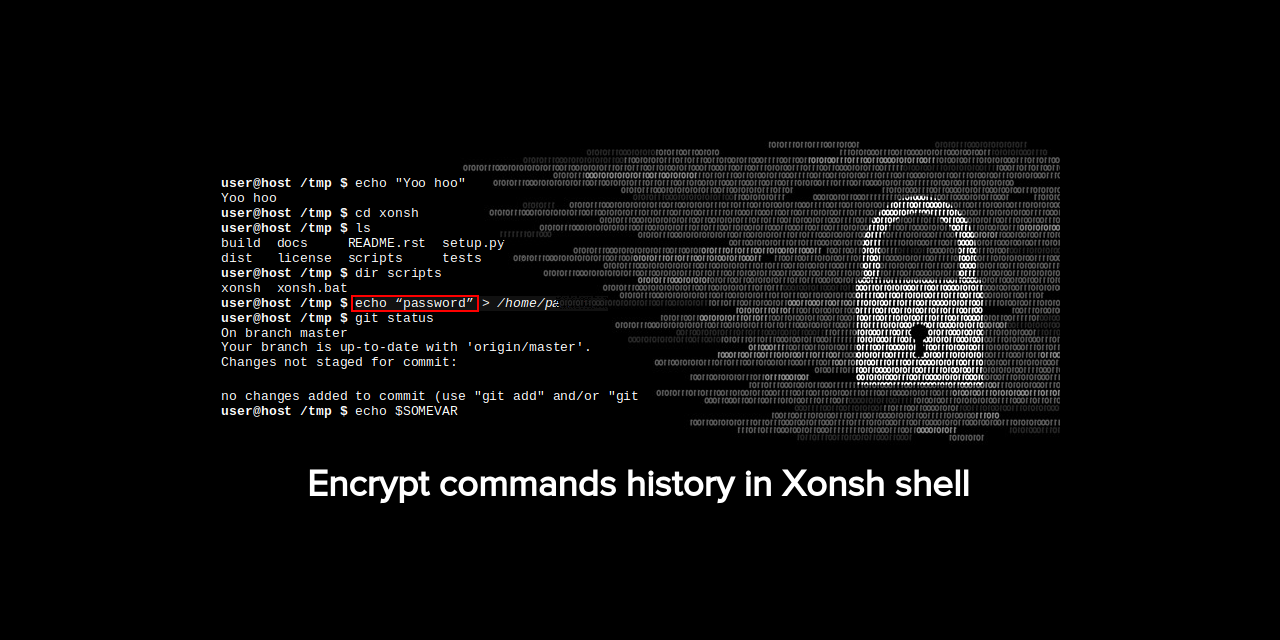 5 |
5 |
6 |
7 |
8 | If you like the idea click ⭐ on the repo and tweet.
9 |
10 |
11 |
12 | ## Installation
13 |
14 | To install use pip:
15 |
16 | ```bash
17 | xpip install xontrib-history-encrypt
18 | # or: xpip install -U git+https://github.com/anki-code/xontrib-history-encrypt
19 | ```
20 |
21 | ## Usage: supported encryption
22 |
23 | ### Base64 (default)
24 |
25 | *Protection level: no protection.*
26 |
27 | Base64 is not the real encrypter and implemented as fast way to encode history file and for education reasons.
28 | It can save you from the massive scanning the file system for keywords (i.e. password, key)
29 | as well as reading the history file by not experienced user. But it can be decoded in five minutes by the professional.
30 |
31 | ```python
32 | # Add to xonsh RC file
33 | $XONSH_HISTORY_ENCRYPTOR = 'base64'
34 | xontrib load history_encrypt
35 | ```
36 |
37 | ### Fernet
38 |
39 | *Protection level: high.*
40 |
41 | The implementation of [Fernet](https://cryptography.io/en/latest/fernet.html) (AES CBC + HMAC) that was strongly
42 | recommended on [stackoverflow](https://stackoverflow.com/a/55147077). On first start it generates a key that you
43 | should save in secure place. Than you can use this key to decrypt the history.
44 |
45 | ```python
46 | # Add to xonsh RC file
47 | $XONSH_HISTORY_ENCRYPTOR = 'fernet'
48 | xontrib load history_encrypt
49 | ```
50 |
51 | ### Dummy
52 |
53 | *Protection level: super high.*
54 |
55 | The best encryption of the data when there is no the data. The dummy encryptor stores command only in the memory during
56 | the session without saving it on the disk. After the end of the session the commands will be lost.
57 |
58 | ```python
59 | # Add to xonsh RC file
60 | $XONSH_HISTORY_ENCRYPTOR = 'dummy'
61 | xontrib load history_encrypt
62 | ```
63 |
64 | ### Custom
65 |
66 | *Protection level: all in your hands.*
67 |
68 | To create custom encryptor you should implement three functions: key getter function, encryptor and decryptor.
69 |
70 | ```python
71 | # Add to xonsh RC file
72 | $XONSH_HISTORY_ENCRYPTOR = {
73 | 'key': lambda: input('[xontrib-history-encrypt] Enter any key just for fun: '),
74 | 'enc': lambda data, key=None: data[::-1], # just flip the string
75 | 'dec': lambda data, key=None: data[::-1] # flip the string back
76 | }
77 | xontrib load history_encrypt
78 | ```
79 |
80 | After debugging you can add your encryptor to the `history_encrypt` directory of the xontrib by PR.
81 |
82 | ## Common use case
83 |
84 | 1. You're on the public/shared/opened server where you have xonsh and bash.
85 | 2. Install the xontrib and create your RC-file from bash:
86 | ```python
87 | pip install xontrib-history-encrypt
88 | mkdir -p ~/.local/share/xonsh/
89 | echo -e '$XONSH_HISTORY_ENCRYPTOR = "fernet"\nxontrib load history_encrypt' > ~/.local/share/xonsh/rc
90 | ```
91 | 3. Run xonsh with RC-file then get the key and remember the key:
92 | ```python
93 | xonsh --rc ~/.local/share/xonsh/rc
94 | # Enter the key or press enter to create new:
95 | # Save the key and use it next time: CFB5kAfD3BgdpQHJxmKb
96 | ```
97 | 4. Next time run xonsh with RC and key:
98 | ```python
99 | xonsh --rc ~/.local/share/xonsh/rc
100 | # Enter the key or press enter to create new: CFB5kAfD3BgdpQHJxmKb
101 | ```
102 |
103 | ## What should I know?
104 |
105 | ### How to check the backend is working
106 |
107 | ```bash
108 | history info
109 | # backend: xontrib-history-encrypt
110 | # sessionid: 374eedc9-fc94-4d27-9ab7-ebd5a5c87d12
111 | # filename: /home/user/.local/share/xonsh/xonsh-history-encrypt.txt
112 | # commands: 1
113 | ```
114 |
115 | ### Some points about the backend
116 |
117 | * At start the backend read and decrypt all commands and this could take time. Basically we assume that you will use the xontrib on your servers and haven't so big history.
118 |
119 | * The commands are stored in the memory and flush to the disk at the exit from the shell. If the shell has crash there is no flushing to the disk and commands will be lost. Use `history flush` command if you plan to run something experimental.
120 |
121 | * The backend has minimal history management support in comparing with json or sqlite backends and you can find the lack of features.
122 |
123 | If you want to improve something from the list PRs are welcome!
124 |
125 | ## Credits
126 |
127 | * This package is the part of [ergopack](https://github.com/anki-code/xontrib-ergopack) - the pack of ergonomic xontribs.
128 | * This package was created with [xontrib cookiecutter template](https://github.com/xonsh/xontrib-cookiecutter).
129 |
--------------------------------------------------------------------------------
/xontrib/history_encrypt/__init__.py:
--------------------------------------------------------------------------------
1 | """The xonsh shell history backend that encrypt the commands history file to prevent leaking sensitive data. """
2 |
3 | import os
4 | import sys
5 | import uuid
6 | import builtins
7 |
8 | try:
9 | import ujson as json
10 | except ImportError:
11 | import json # type: ignore
12 |
13 | from xonsh.history.base import History
14 |
15 | class XontribHistoryEncrypt(History):
16 |
17 | def __init__(self, filename=None, sessionid=None, **kwargs):
18 | self.debug = __xonsh__.env.get('XONSH_HISTORY_ENCRYPT_DEBUG', False)
19 | self.lock = False
20 |
21 | self.tqdm = lambda a: a
22 | if self.debug:
23 | try:
24 | from tqdm import tqdm
25 | self.tqdm = tqdm
26 | except:
27 | pass
28 |
29 | encryptor = __xonsh__.env.get('XONSH_HISTORY_ENCRYPTOR', 'base64')
30 | if type(encryptor) is dict:
31 | self.key = encryptor['key']
32 | self.enc = encryptor['enc']
33 | self.dec = encryptor['dec']
34 | elif type(encryptor) is str:
35 | if encryptor == 'disabled':
36 | self.key = None
37 | self.enc = lambda data, key=None: data
38 | self.dec = lambda data, key=None: data
39 | elif encryptor == 'base64':
40 | from xontrib.history_encrypt.base64 import base64_encode, base64_decode
41 | self.key = None
42 | self.enc = lambda data, key=None: base64_encode(data.encode()).decode()
43 | self.dec = lambda data, key=None: base64_decode(data.encode()).decode()
44 | elif encryptor == 'fernet':
45 | from xontrib.history_encrypt.fernet import fernet_key, fernet_encrypt, fernet_decrypt
46 | self.key = fernet_key
47 | self.enc = lambda data, key: fernet_encrypt(data.encode(), key).decode()
48 | self.dec = lambda data, key: fernet_decrypt(data.encode(), key).decode()
49 | else:
50 | printx(f"{{RED}}[xontrib-history-encrypt] Wrong encryptor name '{encryptor}'! History will not be loaded and saved.{{RESET}}")
51 | self.lock = True
52 | else:
53 | printx('{RED}[xontrib-history-encrypt] Wrong encryptor type! History will not be loaded and saved.{RESET}')
54 | self.lock = True
55 |
56 | if not self.lock:
57 | self.key = self.key() if callable(self.key) else self.key
58 |
59 | self.sessionid = uuid.uuid4() if sessionid is None else sessionid
60 | self.buffer = []
61 | self.gc = None
62 |
63 | if filename is None:
64 | data_dir = builtins.__xonsh__.env.get("XONSH_DATA_DIR")
65 | data_dir = os.path.expanduser(data_dir)
66 | filename_env = __xonsh__.env.get('XONSH_HISTORY_ENCRYPT_FILE', os.path.join(data_dir, 'xontrib-history-encrypt-data.txt'))
67 | self.filename = filename_env
68 | else:
69 | self.filename = filename
70 |
71 | self.inps = None
72 | self.rtns = None
73 | self.tss = None
74 | self.outs = None
75 | self.last_cmd_rtn = None
76 | self.last_cmd_out = None
77 | self.hist_size = None
78 | self.hist_units = None
79 | self.remember_history = True
80 |
81 | def append(self, data):
82 | self.buffer.append(data)
83 |
84 | def items(self, newest_first=False):
85 | if self.lock:
86 | return []
87 |
88 | if os.path.exists(self.filename):
89 | data = []
90 | first_line = True
91 | with self.tqdm(open(self.filename, 'r')) as file:
92 | for line in file:
93 | line = line.rstrip()
94 | if first_line:
95 | try:
96 | crypt_mark = self.dec(line, self.key)
97 | assert crypt_mark.isdigit()
98 | except:
99 | printx("{YELLOW}The crypted history file is not matching with crypto algorithm or the key.{RESET}")
100 | printx(f"{{YELLOW}}Change the encryption algorithm or the key or remove the history file.{{RESET}}")
101 | printx(f"{{YELLOW}}History file: {self.filename}{{RESET}}")
102 | printx(f"{{RED}}History has not loaded and will not be saved!{{RESET}}")
103 | self.lock = True
104 | return []
105 | first_line = False
106 | continue
107 | data.append(json.loads(self.dec(line, self.key)))
108 | return reversed(data) if newest_first else data
109 | return []
110 |
111 | def all_items(self, newest_first=False):
112 | return self.items(newest_first)
113 |
114 | def flush(self, **kwargs):
115 | if self.lock:
116 | return
117 |
118 | if not os.path.exists(self.filename):
119 | with open(self.filename, 'w') as file:
120 | from datetime import datetime
121 | file.write(self.enc(datetime.now().strftime("%Y%m%d%H%M%S"), self.key) + os.linesep)
122 |
123 | try:
124 | os.chmod(self.filename, 0o600)
125 | except Exception as e:
126 | if self.debug:
127 | print(f'Exception while setting permissions to {self.filename}: {e}', file=sys.stderr)
128 | pass
129 |
130 | with open(self.filename, 'a') as file:
131 | for data in self.buffer:
132 | if 'out' in data:
133 | del data['out']
134 | file.write(self.enc(json.dumps(data), self.key) + os.linesep)
135 | self.buffer = []
136 |
137 | def info(self):
138 | data = {}
139 | data["backend"] = "xontrib-history-encrypt"
140 | if self.lock:
141 | data["locked"] = "YES! Current session history will not be saved."
142 | data["sessionid"] = str(self.sessionid)
143 | data["filename"] = self.filename
144 | data["commands"] = len(self.buffer)
145 | return data
146 |
147 |
148 |
149 | encryptor = __xonsh__.env.get('XONSH_HISTORY_ENCRYPTOR', 'base64')
150 |
151 | if encryptor == 'dummy':
152 | from xonsh.history.dummy import DummyHistory
153 | __xonsh__.env['XONSH_HISTORY_BACKEND'] = DummyHistory
154 | else:
155 | __xonsh__.env['XONSH_HISTORY_BACKEND'] = XontribHistoryEncrypt
156 |
--------------------------------------------------------------------------------