2 |  3 |
3 |
4 |
3 | 5 |
6 |  7 |
7 |  8 |
8 |  9 |
9 |  10 |
10 |  11 |
11 |
12 |
13 | > [!IMPORTANT]
14 | > t.viz() has been deprecated. Please use tensorhue.viz(t) instead.
15 |
16 | > [!NOTE]
17 | > TensorHue is currently in alpha. We appreciate any feedback!
18 |
19 | # TensorHue - tensors, visualized
20 |
21 | TensorHue is a Python library that allows you to visualize tensors right in your console, making understanding and debugging tensor contents easier.
22 |
23 | You can use it with your favorite tensor processing libraries, such as PyTorch, JAX, and TensorFlow, and a large set of related libraries, including Numpy, Pillow, torchvision, and more.
24 |
25 | TensorHue automagically detects which kind of tensor you are visualizing and adjusts accordingly:
26 |
27 |
7 |
8 |
9 |
10 |
11 |
28 | 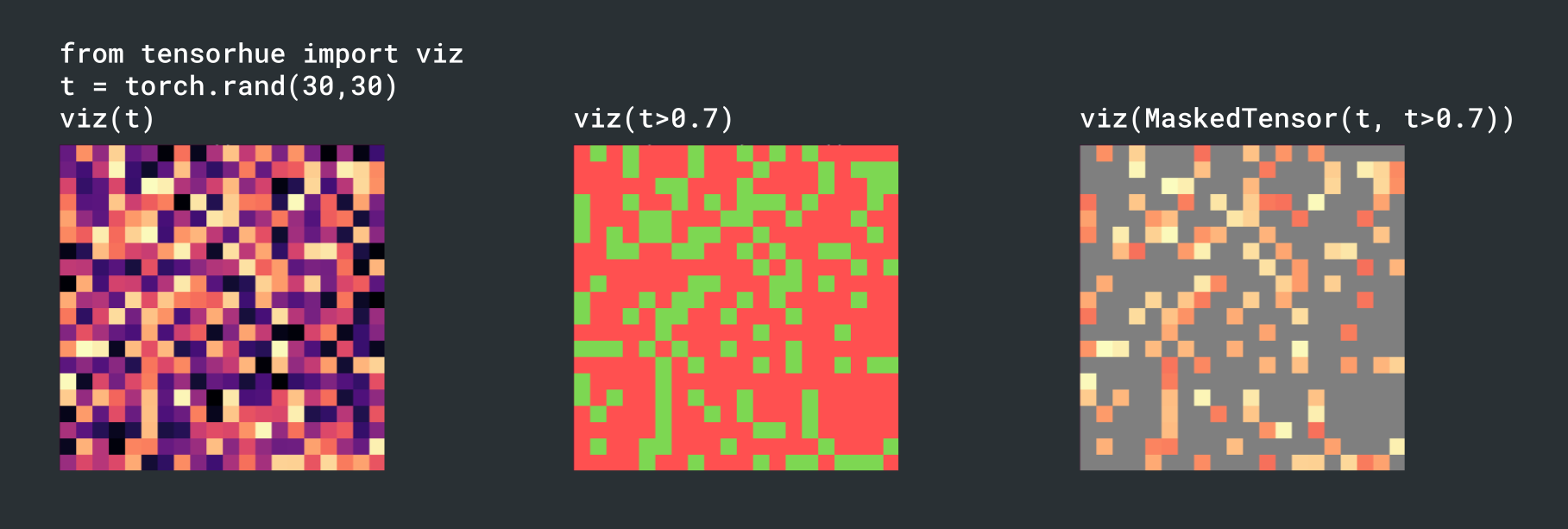 29 |
29 |
30 |
31 | ## Getting started
32 |
33 | Install TensorHue with pip:
34 |
35 | ```bash
36 | pip install tensorhue
37 | ```
38 |
39 | Using TensorHue is easy, simply import TensorHue together with the library of your choice:
40 |
41 | ```python
42 | import torch
43 | import tensorhue
44 | ```
45 |
46 | Or, alternatively:
47 |
48 | ```python
49 | from tensorhue import viz
50 | ```
51 |
52 | That's it! You can now visualize any tensor by calling .viz() on it in your Python console:
53 |
54 | ```python
55 | t = torch.rand(20,20)
56 | tensorhue.viz(t) ✅
57 | ```
58 |
59 | ## Images
60 |
61 | Pillow images can be visualized in RGB and other color modes:
62 |
63 | ```python
64 | from torchvision.datasets import CIFAR10
65 | dataset = CIFAR10('.', dowload=True)
66 | img = dataset[0][0]
67 | tensorhue.viz(img) ✅
68 | ```
69 |
70 |
29 |
71 | 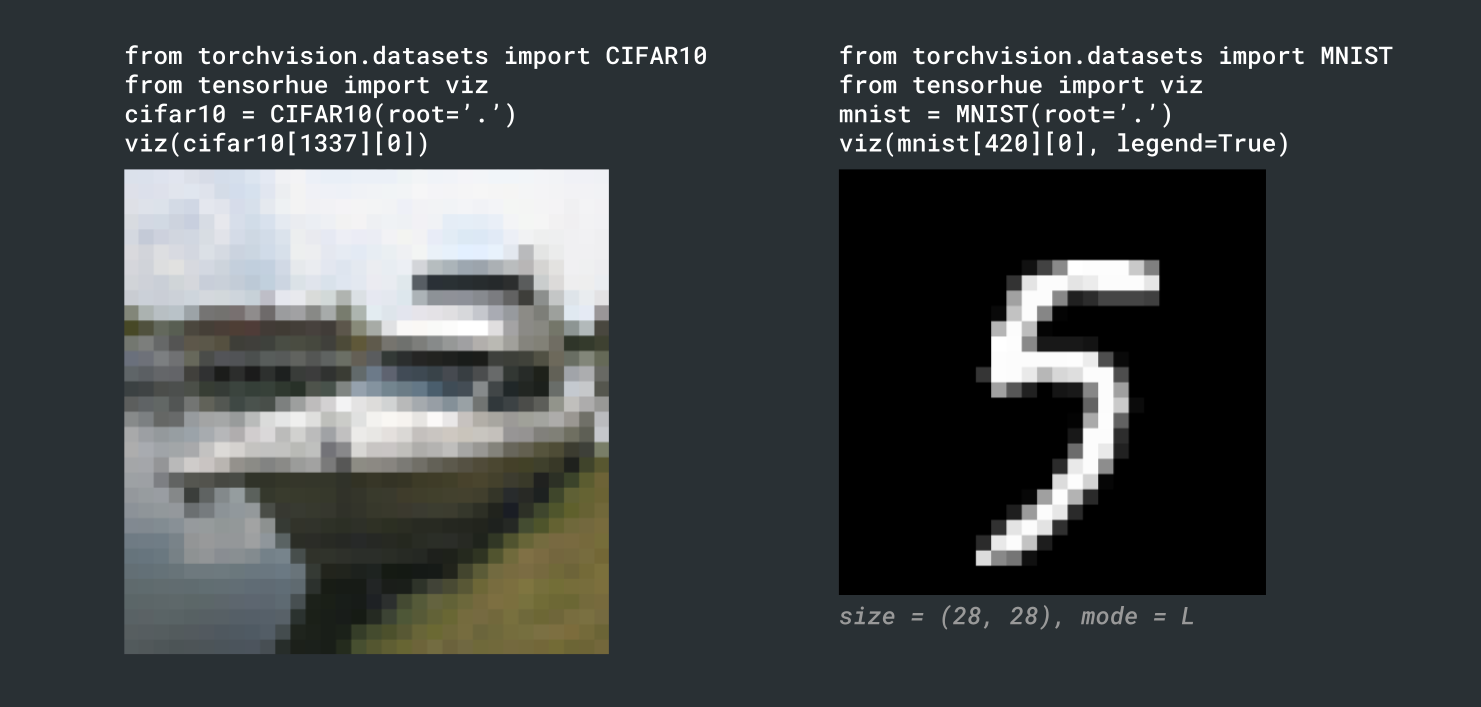 72 |
72 |
73 |
74 | By default, images get downscaled to the size of your terminal, but you can make them even smaller if you want:
75 |
76 | ```python
77 | tensorhue.viz(img, max_size=(40,40)) ✅
78 | ```
79 |
80 | ## Custom colors
81 |
82 | You can pass along your own ColorScheme when visualizing a specific tensor:
83 |
84 | ```python
85 | from tensorhue import ColorScheme
86 | from matplotlib import colormaps
87 |
88 | cs = ColorScheme(colormap=colormaps['inferno'],
89 | true_color=(255,255,255),
90 | false_color=(0,0,0))
91 | tensorhue.viz(t, colorscheme=cs) ✅
92 | ```
93 |
94 | Alternatively, you can overwrite the default ColorScheme:
95 |
96 |
97 | ```python
98 | tensorhue.set_printoptions(colorscheme=cs)
99 | ```
100 |
101 | ## Advanced colormaps and normalization
102 |
103 | By default, TensorHue normalizes numerical values between 0 and 1 and then applies the matplotlib colormap. If you want to use diverging colormaps such as `coolwarm` or `bwr` and the value 0 to be mapped to the middle of the colormap, you need to specify the normalizer, e.g. `matplotlib.colors.CenteredNorm`:
104 |
105 | ```python
106 | from matplotlib.colors import CenteredNorm
107 | cs = ColorScheme(colormap=colormaps['bwr'],
108 | normalize=CenteredNorm(vcenter=0))
109 | tensorhue.viz(t, colorscheme=cs) ✅
110 | ```
111 |
112 | You can also specify the normalization range manually, for example when you want to visualize a confusion matrix where colors should be mapped to the range [0, 1], but the actual values of the tensor are in the range [0.12, 0.73]:
113 |
114 | ```
115 | tensorhue.viz(conf_matrix, vmin=0, vmax=1, scale=3)
116 | ```
117 |
118 |
72 |
119 |  120 |
120 |
121 |
122 | The `scale` parameter scales up the 'pixels' of the tensor so that small tensors are easier to view.
123 |
--------------------------------------------------------------------------------
/tests/test_viz.py:
--------------------------------------------------------------------------------
1 | import os
2 | import pytest
3 | import torch
4 | import jax.numpy as jnp
5 | import tensorflow as tf
6 | import numpy as np
7 | from PIL import Image
8 | from tensorhue.viz import viz
9 | from tensorhue.converters import _tensor_to_numpy_torch, _tensor_to_numpy_jax, _tensor_to_numpy_tensorflow
10 |
11 |
12 | @pytest.mark.parametrize(
13 | "tensor",
14 | [
15 | np.ones(10),
16 | _tensor_to_numpy_torch(torch.ones(10)),
17 | _tensor_to_numpy_jax(jnp.ones(10)),
18 | _tensor_to_numpy_tensorflow(tf.ones(10)),
19 | ],
20 | )
21 | def test_1d_tensor(tensor, capsys):
22 | viz(tensor)
23 | captured = capsys.readouterr()
24 | out = captured.out.rstrip("\n")
25 | assert len(out.split("\n")) == 2
26 | assert out.count("▀") == 10
27 | assert out.split("\n")[-1] == f"shape = {tensor.shape}"
28 |
29 |
30 | @pytest.mark.parametrize(
31 | "tensor",
32 | [
33 | np.ones((10, 10)),
34 | _tensor_to_numpy_torch(torch.ones(10, 10)),
35 | _tensor_to_numpy_jax(jnp.ones((10, 10))),
36 | _tensor_to_numpy_tensorflow(tf.ones((10, 10))),
37 | ],
38 | )
39 | def test_2d_tensor(tensor, capsys):
40 | viz(tensor)
41 | captured = capsys.readouterr()
42 | out = captured.out.rstrip("\n")
43 | assert len(out.split("\n")) == 6
44 | assert out.count("▀") == 100 / 2
45 | assert out.split("\n")[-1] == f"shape = {tensor.shape}"
46 |
47 |
48 | @pytest.mark.parametrize(
49 | "tensor",
50 | [
51 | np.ones(200),
52 | _tensor_to_numpy_torch(torch.ones(200)),
53 | _tensor_to_numpy_jax(jnp.ones(200)),
54 | _tensor_to_numpy_tensorflow(tf.ones(200)),
55 | ],
56 | )
57 | def test_1d_tensor_too_wide(tensor, capsys):
58 | viz(tensor)
59 | captured = capsys.readouterr()
60 | out = captured.out.rstrip("\n")
61 | assert out.count(" ··· ") == 1
62 | assert out.count("▀") == 95
63 | assert out.split("\n")[-1] == f"shape = {tensor.shape}"
64 |
65 |
66 | @pytest.mark.parametrize(
67 | "tensor",
68 | [
69 | np.ones((10, 200)),
70 | _tensor_to_numpy_torch(torch.ones(10, 200)),
71 | _tensor_to_numpy_jax(jnp.ones((10, 200))),
72 | _tensor_to_numpy_tensorflow(tf.ones((10, 200))),
73 | ],
74 | )
75 | def test_2d_tensor_too_wide(tensor, capsys):
76 | viz(tensor)
77 | captured = capsys.readouterr()
78 | out = captured.out.rstrip("\n")
79 | assert out.count(" ··· ") == 5
80 | assert out.count("▀") == 950 / 2
81 | assert out.split("\n")[-1] == f"shape = {tensor.shape}"
82 |
83 |
84 | @pytest.mark.parametrize(
85 | "tensor",
86 | [
87 | np.ones(10),
88 | _tensor_to_numpy_torch(torch.ones(10)),
89 | _tensor_to_numpy_jax(jnp.ones(10)),
90 | _tensor_to_numpy_tensorflow(tf.ones(10)),
91 | ],
92 | )
93 | def test_no_legend(tensor, capsys):
94 | viz(tensor, legend=False)
95 | captured = capsys.readouterr()
96 | out = captured.out.rstrip("\n")
97 | assert len(out.split("\n")) == 1
98 | assert out.count("▀") == 10
99 |
100 |
101 | @pytest.mark.parametrize("scale", [1, 2, 4, 8])
102 | def test_scale(scale, capsys):
103 | tensor = np.ones((4, 4))
104 | viz(tensor, scale=scale)
105 | captured = capsys.readouterr()
106 | out = captured.out.rstrip("\n")
107 | assert out.count("▀") == (8 * (scale**2))
108 |
109 |
110 | @pytest.mark.parametrize("image_filename", os.listdir("./tests/test_resources/"))
111 | @pytest.mark.parametrize("thumbnail", [True, False])
112 | def test_viz_image(image_filename, thumbnail, capsys):
113 | filepath = "./tests/test_resources/" + image_filename
114 | image = Image.open(filepath)
115 | viz(image, thumbnail=thumbnail)
116 | captured = capsys.readouterr()
117 | out = captured.out.rstrip("\n")
118 | assert out.count(" ··· ") == (0 if thumbnail else 300)
119 | assert len(out.split("\n")) == (100 if thumbnail else 600)
120 | assert out.count("▀") == (5000 if thumbnail else 28500)
121 |
122 |
123 | @pytest.mark.parametrize("thumbnail", [True, False])
124 | def test_viz_image_legend(thumbnail, capsys):
125 | filepath = "./tests/test_resources/test_image_rgba.png"
126 | image = Image.open(filepath)
127 | viz(image, legend=True, thumbnail=thumbnail)
128 | captured = capsys.readouterr()
129 | out = captured.out.rstrip("\n")
130 | assert out.split("\n")[-1] == "size = (600, 600), mode = RGBA"
131 |
--------------------------------------------------------------------------------
/tensorhue/colors.py:
--------------------------------------------------------------------------------
1 | from __future__ import annotations
2 | import warnings
3 |
4 | from rich.color_triplet import ColorTriplet
5 | from matplotlib import colormaps
6 | from matplotlib.colors import Colormap, Normalize, CenteredNorm
7 | import numpy as np
8 |
9 |
10 | COLORS = {
11 | "masked": ColorTriplet(127, 127, 127), # medium grey
12 | "default_dark": ColorTriplet(64, 17, 159), # dark purple
13 | "default_medium": ColorTriplet(255, 55, 140), # pink
14 | "default_bright": ColorTriplet(255, 210, 240), # light rose
15 | "true": ColorTriplet(125, 215, 82), # green
16 | "false": ColorTriplet(255, 80, 80), # red
17 | "accessible_true": ColorTriplet(255, 255, 255), # TODO
18 | "accessible_false": ColorTriplet(0, 0, 0), # TODO
19 | "black": ColorTriplet(0, 0, 0), # black
20 | "white": ColorTriplet(255, 255, 255), # white
21 | }
22 |
23 |
24 | class ColorScheme:
25 | def __init__(
26 | self,
27 | colormap: Colormap = colormaps["magma"],
28 | normalize: Normalize = Normalize(),
29 | masked_color: ColorTriplet = COLORS["masked"],
30 | true_color: ColorTriplet = COLORS["true"],
31 | false_color: ColorTriplet = COLORS["false"],
32 | inf_color: ColorTriplet = COLORS["white"],
33 | ninf_color: ColorTriplet = COLORS["black"],
34 | ):
35 | self._colormap = colormap
36 | self.normalize = normalize
37 | self._masked_color = masked_color
38 | self.true_color = true_color
39 | self.false_color = false_color
40 | self._inf_color = inf_color
41 | self._ninf_color = ninf_color
42 |
43 | self.colormap.set_extremes(
44 | bad=self.masked_color.normalized, under=self.ninf_color.normalized, over=self.inf_color.normalized
45 | )
46 |
47 | @property
48 | def colormap(self):
49 | return self._colormap
50 |
51 | @colormap.setter
52 | def colormap(self, value):
53 | self._colormap = value
54 | self._colormap.set_extremes(
55 | bad=self._masked_color.normalized, under=self._ninf_color.normalized, over=self._inf_color.normalized
56 | )
57 |
58 | @property
59 | def masked_color(self):
60 | return self._masked_color
61 |
62 | @masked_color.setter
63 | def masked_color(self, value):
64 | self._masked_color = value
65 | self._colormap.set_bad(value.normalized)
66 |
67 | @property
68 | def inf_color(self):
69 | return self._inf_color
70 |
71 | @inf_color.setter
72 | def inf_color(self, value):
73 | self._inf_color = value
74 | self._colormap.set_over(value.normalized)
75 |
76 | @property
77 | def ninf_color(self):
78 | return self._ninf_color
79 |
80 | @ninf_color.setter
81 | def ninf_color(self, value):
82 | self._ninf_color = value
83 | self._colormap.set_under(value.normalized)
84 |
85 | def __call__(self, data: np.ndarray, **kwargs) -> np.ndarray:
86 | if data.dtype == "bool":
87 | true_values = np.array(self.true_color, dtype=np.uint8)
88 | false_values = np.array(self.false_color, dtype=np.uint8)
89 | return np.where(data[..., np.newaxis], true_values, false_values)
90 | data_noinf = np.where(np.isinf(data), np.nan, data)
91 | if "vmin" not in kwargs:
92 | vmin = np.nanmin(data_noinf)
93 | else:
94 | vmin = float(kwargs["vmin"])
95 | if "vmax" not in kwargs:
96 | vmax = np.nanmax(data_noinf)
97 | else:
98 | vmax = float(kwargs["vmax"])
99 | if isinstance(self.normalize, CenteredNorm):
100 | vcenter = self.normalize.vcenter
101 | diff_vmin = vmin - vcenter
102 | diff_vmax = vmax - vcenter
103 | max_abs_diff = max(abs(diff_vmin), abs(diff_vmax))
104 | vmin = vcenter - max_abs_diff
105 | vmax = vcenter + max_abs_diff
106 | if "vmin" in kwargs and "vmax" in kwargs:
107 | warnings.warn(
108 | f"You shouldn't specify both 'vmin' and 'vmax' when using CenteredNorm. 'vmin' and 'vmax' must be symmetric around 'vcenter' and are thus inferred from a single value. Using: vmin={vmin}, vcenter={vcenter}, vmax={vmax}."
109 | )
110 | self.normalize.vmin = vmin
111 | self.normalize.vmax = vmax
112 | return self.colormap(self.normalize(data), bytes=True)
113 |
114 | def __repr__(self):
115 | return (
116 | f"ColorScheme(\n"
117 | f" colormap={self._colormap},\n"
118 | f" normalize={self.normalize},\n"
119 | f" masked_color={self._masked_color},\n"
120 | f" true_color={self.true_color},\n"
121 | f" false_color={self.false_color},\n"
122 | f" inf_color={self._inf_color},\n"
123 | f" ninf_color={self._ninf_color}\n"
124 | f")"
125 | )
126 |
--------------------------------------------------------------------------------
/tensorhue/converters.py:
--------------------------------------------------------------------------------
1 | from __future__ import annotations
2 | import warnings
3 | import numpy as np
4 |
5 |
6 | def tensor_to_numpy(tensor, **kwargs) -> np.ndarray:
7 | """
8 | Converts a tensor of unknown type to a numpy array.
9 |
10 | Args:
11 | tensor (Any): The tensor to be converted.
12 | **kwargs: Additional keyword arguments that are passed to the underlying converter functions.
13 |
14 | Returns:
15 | The converted numpy array.
16 | """
17 | mro_strings = mro_to_strings(tensor.__class__.__mro__)
18 |
19 | if "numpy.ndarray" in mro_strings:
20 | return tensor
21 | if "torch.Tensor" in mro_strings:
22 | return _tensor_to_numpy_torch(tensor, **kwargs)
23 | if "tensorflow.python.types.core.Tensor" in mro_strings:
24 | return _tensor_to_numpy_tensorflow(tensor, **kwargs)
25 | if "jaxlib.xla_extension.DeviceArray" in mro_strings:
26 | return _tensor_to_numpy_jax(tensor, **kwargs)
27 | if "PIL.Image.Image" in mro_strings:
28 | return _tensor_to_numpy_pillow(tensor, **kwargs)
29 | raise NotImplementedError(
30 | f"Conversion of tensor of type {type(tensor)} is not supported. Please raise an issue of you think this is a bug or should be implemented."
31 | )
32 |
33 |
34 | def mro_to_strings(mro) -> list[str]:
35 | """
36 | Converts the __mro__ of a class to a list of module.class_name strings.
37 |
38 | Args:
39 | mro (tuple[type]): The __mro__ to be converted.
40 |
41 | Returns:
42 | The converted list of strings.
43 | """
44 | return [f"{c.__module__}.{c.__name__}" for c in mro]
45 |
46 |
47 | def _tensor_to_numpy_torch(tensor) -> np.ndarray:
48 | if tensor.__class__.__name__ == "MaskedTensor": # hacky - but we shouldn't import torch here
49 | return np.ma.masked_array(tensor.get_data(), ~tensor.get_mask())
50 | try: # pylint: disable=duplicate-code
51 | return tensor.numpy()
52 | except RuntimeError as e:
53 | raise NotImplementedError(
54 | f"{e}: It looks like tensors of type {type(tensor)} cannot be converted to numpy arrays out-of-the-box. Raise an issue if you need to visualize them."
55 | ) from e
56 | except Exception as e:
57 | raise RuntimeError(
58 | f"An unexpected error occurred while converting tensor of type {type(tensor)} to numpy array: {e}"
59 | ) from e
60 |
61 |
62 | def _tensor_to_numpy_tensorflow(tensor) -> np.ndarray:
63 | if tensor.__class__.__name__ == "RaggedTensor": # hacky - but we shouldn't import torch here
64 | warnings.warn(
65 | "Tensorflow RaggedTensors are currently converted to dense tensors by filling with the value 0. Values that are actually 0 and filled-in values will appear indistinguishable. This behavior will change in the future."
66 | )
67 | return _tensor_to_numpy_tensorflow(tensor.to_tensor())
68 | if tensor.__class__.__name__ == "SparseTensor":
69 | raise ValueError("Tensorflow SparseTensors are not yet supported by TensorHue.")
70 | try: # pylint: disable=duplicate-code
71 | return tensor.numpy()
72 | except RuntimeError as e:
73 | raise NotImplementedError(
74 | f"{e}: It looks like tensors of type {type(tensor)} cannot be converted to numpy arrays out-of-the-box. Raise an issue if you need to visualize them."
75 | ) from e
76 | except Exception as e:
77 | raise RuntimeError(
78 | f"An unexpected error occurred while converting tensor of type {type(tensor)} to numpy array: {e}"
79 | ) from e
80 |
81 |
82 | def _tensor_to_numpy_jax(tensor) -> np.ndarray:
83 | not_implemented = {"ShapedArray", "UnshapedArray", "AbstractArray"}
84 | if {c.__name__ for c in tensor.__class__.__mro__}.intersection(
85 | not_implemented
86 | ): # hacky - but we shouldn't import jax here
87 | raise NotImplementedError(
88 | f"Jax arrays of type {tensor.__class__.__name__} cannot be visualized. Raise an issue if you believe this is wrong."
89 | )
90 | try:
91 | array = np.asarray(tensor)
92 | if array.dtype == "object":
93 | raise RuntimeError("Got non-visualizable dtype 'object'.")
94 | return array
95 | except RuntimeError as e:
96 | raise NotImplementedError(
97 | f"{e}: It looks like JAX arrays of type {type(tensor)} cannot be converted to numpy arrays out-of-the-box. Raise an issue if you need to visualize them."
98 | ) from e
99 | except Exception as e:
100 | raise RuntimeError(
101 | f"An unexpected error occurred while converting tensor of type {type(tensor)} to numpy array: {e}"
102 | ) from e
103 |
104 |
105 | def _tensor_to_numpy_pillow(image, thumbnail, max_size) -> np.ndarray:
106 | try:
107 | image = image.convert("RGB")
108 | except Exception as e:
109 | raise ValueError("Could not convert image from mode '{mode}' to 'RGB'.") from e
110 |
111 | if thumbnail:
112 | image.thumbnail(max_size)
113 |
114 | array = np.array(image)
115 | assert array.dtype == "uint8"
116 |
117 | return array
118 |
--------------------------------------------------------------------------------
/tensorhue/viz.py:
--------------------------------------------------------------------------------
1 | from __future__ import annotations # backwards type hint compatability for Python 3.7 and 3.8
2 | import os
3 | import sys
4 | import warnings
5 | from rich.console import Console
6 | import numpy as np
7 | from tensorhue.colors import ColorScheme
8 | from tensorhue._print_opts import PRINT_OPTS
9 | from tensorhue.converters import tensor_to_numpy, mro_to_strings
10 |
11 |
12 | def viz(tensor, **kwargs):
13 | try:
14 | mro_strings = mro_to_strings(tensor.__class__.__mro__)
15 | if "PIL.Image.Image" in mro_strings:
16 | _viz_image(tensor, **kwargs)
17 | else:
18 | _viz(tensor, **kwargs)
19 | except Exception as e:
20 | raise NotImplementedError(
21 | f"TensorHue currently does not support type {type(tensor)}. Please raise an issue if you want to visualize them.."
22 | ) from e
23 |
24 |
25 | def _viz(tensor, colorscheme: ColorScheme = None, legend: bool = True, scale: int = 1, **kwargs):
26 | """
27 | Prints a tensor using colored Unicode art representation.
28 |
29 | Args:
30 | tensor (Any): The tensor to be visualized.
31 | colorscheme (ColorScheme, optional): The color scheme to use.
32 | Defaults to None, which means the global default color scheme is used.
33 | legend (bool, optional): Whether or not to include legend information (like the shape)
34 | scale (int, optional): Scales the size of the entire tensor up, making the unicode 'pixels' larger.
35 | **kwargs: Additional keyword arguments that are passed to the underlying viz function (vmin or vmax)
36 | """
37 | if not isinstance(scale, int):
38 | raise ValueError("scale must be an integer.")
39 |
40 | if colorscheme is None:
41 | colorscheme = PRINT_OPTS.colorscheme
42 |
43 | np_array = tensor_to_numpy(tensor)
44 | shape = np_array.shape
45 | ndim = np_array.ndim
46 |
47 | if ndim == 1:
48 | np_array = np_array[np.newaxis, :]
49 | elif ndim > 2:
50 | raise NotImplementedError(
51 | "Visualization of tensors with more than 2 dimensions is under development. Please slice them for now."
52 | )
53 |
54 | np_array = np.repeat(np.repeat(np_array, scale, axis=1), scale, axis=0)
55 |
56 | result_lines = _viz_2d(np_array, colorscheme, **kwargs)
57 |
58 | if legend:
59 | result_lines.append(f"[italic]shape = {shape}[/]")
60 |
61 | c = Console(log_path=False, record=False)
62 | c.print("\n".join(result_lines))
63 |
64 |
65 | def _viz_2d(array_2d: np.ndarray, colorscheme: ColorScheme = None, **kwargs) -> list[str]:
66 | """
67 | Constructs a list of rich-compatible strings out of a 2D numpy array.
68 |
69 | Args:
70 | array_2d (np.ndarray): The 2-dimensional numpy array (or 3-dimensional if the values are already RGB).
71 | colorscheme (ColorScheme): The color scheme to use. If None, the array must be 3-dimensional (already RGB values).
72 | **kwargs: Additional keyword arguments that are passed to the underlying viz function (vmin or vmax)
73 | """
74 | terminal_width = get_terminal_size().columns
75 | shape = array_2d.shape
76 |
77 | if shape[1] > terminal_width:
78 | slice_left = (terminal_width - 5) // 2
79 | slice_right = slice_left + (terminal_width - 5) % 2
80 | if colorscheme is not None:
81 | colors_right = colorscheme(array_2d[:, -slice_right:])[..., :3]
82 | else:
83 | assert (
84 | array_2d.ndim == 3 and array_2d.shape[-1] == 3
85 | ), "Array shape must be 3-dimensional (*, *, 3) when colorscheme=None."
86 | colors_right = array_2d[:, -slice_right:, :]
87 | else:
88 | slice_left = shape[1]
89 | slice_right = colors_right = False
90 |
91 | if colorscheme is not None:
92 | colors_left = colorscheme(array_2d[:, :slice_left], **kwargs)[..., :3]
93 | else:
94 | assert (
95 | array_2d.ndim == 3 and array_2d.shape[-1] == 3
96 | ), "Array shape must be 3-dimensional (*, *, 3) when colorscheme=None."
97 | colors_left = array_2d[:, :slice_left, :]
98 |
99 | result_lines = _construct_unicode_string(colors_left, colors_right)
100 |
101 | return result_lines
102 |
103 |
104 | def _construct_unicode_string(colors_left: np.ndarray, colors_right: np.ndarray) -> str:
105 | result_lines = [""]
106 |
107 | for y in range(0, colors_left.shape[0] - 1, 2):
108 | for x in range(colors_left.shape[1]):
109 | result_lines[
110 | -1
111 | ] += f"[rgb({colors_left[y, x, 0]},{colors_left[y, x, 1]},{colors_left[y, x, 2]}) on rgb({colors_left[y+1, x, 0]},{colors_left[y+1, x, 1]},{colors_left[y+1, x, 2]})]▀[/]"
112 | if isinstance(colors_right, np.ndarray):
113 | result_lines[-1] += " ··· "
114 | for x in range(colors_right.shape[1]):
115 | result_lines[
116 | -1
117 | ] += f"[rgb({colors_right[y, x, 0]},{colors_right[y, x, 1]},{colors_right[y, x, 2]}) on rgb({colors_right[y+1, x, 0]},{colors_right[y+1, x, 1]},{colors_right[y+1, x, 2]})]▀[/]"
118 | result_lines.append("")
119 |
120 | if colors_left.shape[0] % 2 == 1:
121 | for x in range(colors_left.shape[1]):
122 | result_lines[-1] += f"[rgb({colors_left[-1, x, 0]},{colors_left[-1, x, 1]},{colors_left[-1, x, 2]})]▀[/]"
123 | if isinstance(colors_right, np.ndarray):
124 | result_lines[-1] += " ··· "
125 | for x in range(colors_right.shape[1]):
126 | result_lines[
127 | -1
128 | ] += f"[rgb({colors_right[-1, x, 0]},{colors_right[-1, x, 1]},{colors_right[-1, x, 2]})]▀[/]"
129 | else:
130 | result_lines = result_lines[:-1]
131 |
132 | return result_lines
133 |
134 |
135 | def _viz_image(image, legend: bool = False, thumbnail: bool = True, max_size: tuple[int, int] = None):
136 | """
137 | A special case of _viz that does not use the ColorScheme but instead treats the tensor as RGB or greyscale values directly.
138 |
139 | Args:
140 | image (PIL.Image.Image): The image to visualize
141 | legend (bool, optional): Whether or not to include legend information (like the shape)
142 | thumbnail (bool, optional): Scales down the image size to a thumbnail that fits into the terminal window
143 | max_size (tuple[int, int], optional): The maximum size (width, height) to which the image gets downsized to. Only used if thumbnail=True.
144 | """
145 |
146 | raise_max_size_warning = max_size and not thumbnail
147 |
148 | size = image.size
149 | mode = image.mode
150 | if max_size is None:
151 | terminal_size = get_terminal_size()
152 | else:
153 | terminal_size = os.terminal_size(max_size)
154 | max_size = (terminal_size.columns, (terminal_size.lines - 1) * 2)
155 | image = tensor_to_numpy(image, thumbnail=thumbnail, max_size=max_size)
156 |
157 | result_lines = _viz_2d(image)
158 |
159 | if legend:
160 | result_lines.append(f"[italic]size = {size}[/], [italic]mode = {mode}[/]")
161 |
162 | c = Console(log_path=False, record=False)
163 | c.print("\n".join(result_lines))
164 |
165 | if raise_max_size_warning:
166 | warnings.warn(
167 | "You specified a max_size, but set thumbnail to False. Your max_size will be ignored unless thumbnail=True."
168 | )
169 |
170 |
171 | def get_terminal_size(default_width: int = 100, default_height: int = 70) -> os.terminal_size:
172 | """
173 | Returns the terminal size if the standard output is connected to a terminal. Otherwise, returns the defined default size.
174 |
175 | Args:
176 | default_width (int, optional): The default width to use if there is no terminal connected.
177 | default_height (int, optional): The default height to use if there is no terminal connected.
178 | """
179 | if sys.stdout.isatty():
180 | try:
181 | return os.get_terminal_size()
182 | except OSError:
183 | return os.terminal_size((default_width, default_height))
184 | else:
185 | return os.terminal_size((default_width, default_height))
186 |
--------------------------------------------------------------------------------
/.pylintrc:
--------------------------------------------------------------------------------
1 | [MAIN]
2 |
3 | # Specify a configuration file.
4 | #rcfile=
5 |
6 | # Python code to execute, usually for sys.path manipulation such as
7 | # pygtk.require().
8 | #init-hook=
9 |
10 | # Files or directories to be skipped. They should be base names, not
11 | # paths.
12 | ignore=CVS
13 |
14 | # Add files or directories matching the regex patterns to the ignore-list. The
15 | # regex matches against paths and can be in Posix or Windows format.
16 | ignore-paths=
17 |
18 | # Files or directories matching the regex patterns are skipped. The regex
19 | # matches against base names, not paths.
20 | ignore-patterns=^\.#
21 |
22 | # Pickle collected data for later comparisons.
23 | persistent=yes
24 |
25 | # List of plugins (as comma separated values of python modules names) to load,
26 | # usually to register additional checkers.
27 | load-plugins=
28 | pylint.extensions.check_elif,
29 | pylint.extensions.bad_builtin,
30 | pylint.extensions.docparams,
31 | pylint.extensions.for_any_all,
32 | pylint.extensions.set_membership,
33 | pylint.extensions.code_style,
34 | pylint.extensions.overlapping_exceptions,
35 | pylint.extensions.typing,
36 | pylint.extensions.redefined_variable_type,
37 | pylint.extensions.comparison_placement,
38 | pylint.extensions.mccabe,
39 |
40 | # Use multiple processes to speed up Pylint. Specifying 0 will auto-detect the
41 | # number of processors available to use.
42 | jobs=0
43 |
44 | # When enabled, pylint would attempt to guess common misconfiguration and emit
45 | # user-friendly hints instead of false-positive error messages.
46 | suggestion-mode=yes
47 |
48 | # Allow loading of arbitrary C extensions. Extensions are imported into the
49 | # active Python interpreter and may run arbitrary code.
50 | unsafe-load-any-extension=no
51 |
52 | # A comma-separated list of package or module names from where C extensions may
53 | # be loaded. Extensions are loading into the active Python interpreter and may
54 | # run arbitrary code
55 | extension-pkg-allow-list=
56 |
57 | # Minimum supported python version
58 | py-version = 3.7.2
59 |
60 | # Control the amount of potential inferred values when inferring a single
61 | # object. This can help the performance when dealing with large functions or
62 | # complex, nested conditions.
63 | limit-inference-results=100
64 |
65 | # Specify a score threshold to be exceeded before program exits with error.
66 | fail-under=10.0
67 |
68 | # Return non-zero exit code if any of these messages/categories are detected,
69 | # even if score is above --fail-under value. Syntax same as enable. Messages
70 | # specified are enabled, while categories only check already-enabled messages.
71 | fail-on=
72 |
73 |
74 | [MESSAGES CONTROL]
75 |
76 | # Only show warnings with the listed confidence levels. Leave empty to show
77 | # all. Valid levels: HIGH, INFERENCE, INFERENCE_FAILURE, UNDEFINED
78 | # confidence=
79 |
80 | # Enable the message, report, category or checker with the given id(s). You can
81 | # either give multiple identifier separated by comma (,) or put this option
82 | # multiple time (only on the command line, not in the configuration file where
83 | # it should appear only once). See also the "--disable" option for examples.
84 | enable=
85 | use-symbolic-message-instead,
86 | useless-suppression,
87 |
88 | # Disable the message, report, category or checker with the given id(s). You
89 | # can either give multiple identifiers separated by comma (,) or put this
90 | # option multiple times (only on the command line, not in the configuration
91 | # file where it should appear only once).You can also use "--disable=all" to
92 | # disable everything first and then re-enable specific checks. For example, if
93 | # you want to run only the similarities checker, you can use "--disable=all
94 | # --enable=similarities". If you want to run only the classes checker, but have
95 | # no Warning level messages displayed, use"--disable=all --enable=classes
96 | # --disable=W"
97 |
98 | disable=
99 | attribute-defined-outside-init,
100 | invalid-name,
101 | missing-docstring,
102 | protected-access,
103 | too-few-public-methods,
104 | # handled by black
105 | format,
106 | # We anticipate #3512 where it will become optional
107 | fixme,
108 | cyclic-import,
109 | import-error,
110 |
111 |
112 | [REPORTS]
113 |
114 | # Set the output format. Available formats are text, parseable, colorized, msvs
115 | # (visual studio) and html. You can also give a reporter class, eg
116 | # mypackage.mymodule.MyReporterClass.
117 | output-format=text
118 |
119 | # Tells whether to display a full report or only the messages
120 | reports=no
121 |
122 | # Python expression which should return a note less than 10 (10 is the highest
123 | # note). You have access to the variables 'fatal', 'error', 'warning', 'refactor', 'convention'
124 | # and 'info', which contain the number of messages in each category, as
125 | # well as 'statement', which is the total number of statements analyzed. This
126 | # score is used by the global evaluation report (RP0004).
127 | evaluation=max(0, 0 if fatal else 10.0 - ((float(5 * error + warning + refactor + convention) / statement) * 10))
128 |
129 | # Template used to display messages. This is a python new-style format string
130 | # used to format the message information. See doc for all details
131 | #msg-template=
132 |
133 | # Activate the evaluation score.
134 | score=yes
135 |
136 |
137 | [LOGGING]
138 |
139 | # Logging modules to check that the string format arguments are in logging
140 | # function parameter format
141 | logging-modules=logging
142 |
143 | # The type of string formatting that logging methods do. `old` means using %
144 | # formatting, `new` is for `{}` formatting.
145 | logging-format-style=old
146 |
147 |
148 | [MISCELLANEOUS]
149 |
150 | # List of note tags to take in consideration, separated by a comma.
151 | notes=FIXME,XXX,TODO
152 |
153 | # Regular expression of note tags to take in consideration.
154 | #notes-rgx=
155 |
156 |
157 | [SIMILARITIES]
158 |
159 | # Minimum lines number of a similarity.
160 | min-similarity-lines=6
161 |
162 | # Ignore comments when computing similarities.
163 | ignore-comments=yes
164 |
165 | # Ignore docstrings when computing similarities.
166 | ignore-docstrings=yes
167 |
168 | # Ignore imports when computing similarities.
169 | ignore-imports=yes
170 |
171 | # Signatures are removed from the similarity computation
172 | ignore-signatures=yes
173 |
174 |
175 | [VARIABLES]
176 |
177 | # Tells whether we should check for unused import in __init__ files.
178 | init-import=no
179 |
180 | # A regular expression matching the name of dummy variables (i.e. expectedly
181 | # not used).
182 | dummy-variables-rgx=_$|dummy
183 |
184 | # List of additional names supposed to be defined in builtins. Remember that
185 | # you should avoid defining new builtins when possible.
186 | additional-builtins=
187 |
188 | # List of strings which can identify a callback function by name. A callback
189 | # name must start or end with one of those strings.
190 | callbacks=cb_,_cb
191 |
192 | # Tells whether unused global variables should be treated as a violation.
193 | allow-global-unused-variables=yes
194 |
195 | # List of names allowed to shadow builtins
196 | allowed-redefined-builtins=
197 |
198 | # Argument names that match this expression will be ignored. Default to name
199 | # with leading underscore.
200 | ignored-argument-names=_.*
201 |
202 | # List of qualified module names which can have objects that can redefine
203 | # builtins.
204 | redefining-builtins-modules=six.moves,past.builtins,future.builtins,builtins,io
205 |
206 |
207 | [FORMAT]
208 |
209 | # Maximum number of characters on a single line.
210 | max-line-length=120
211 |
212 | # Regexp for a line that is allowed to be longer than the limit.
213 | ignore-long-lines=^\s*(# )??$
214 |
215 | # Allow the body of an if to be on the same line as the test if there is no
216 | # else.
217 | single-line-if-stmt=no
218 |
219 | # Allow the body of a class to be on the same line as the declaration if body
220 | # contains single statement.
221 | single-line-class-stmt=no
222 |
223 | # Maximum number of lines in a module
224 | max-module-lines=1000
225 |
226 | # String used as indentation unit. This is usually " " (4 spaces) or "\t" (1
227 | # tab).
228 | indent-string=' '
229 |
230 | # Number of spaces of indent required inside a hanging or continued line.
231 | indent-after-paren=4
232 |
233 | # Expected format of line ending, e.g. empty (any line ending), LF or CRLF.
234 | expected-line-ending-format=
235 |
236 |
237 | [BASIC]
238 |
239 | # Good variable names which should always be accepted, separated by a comma
240 | good-names=i,j,k,ex,Run,_
241 |
242 | # Good variable names regexes, separated by a comma. If names match any regex,
243 | # they will always be accepted
244 | good-names-rgxs=
245 |
246 | # Bad variable names which should always be refused, separated by a comma
247 | bad-names=foo,bar,baz,toto,tutu,tata
248 |
249 | # Bad variable names regexes, separated by a comma. If names match any regex,
250 | # they will always be refused
251 | bad-names-rgxs=
252 |
253 | # Colon-delimited sets of names that determine each other's naming style when
254 | # the name regexes allow several styles.
255 | name-group=
256 |
257 | # Include a hint for the correct naming format with invalid-name
258 | include-naming-hint=no
259 |
260 | # Naming style matching correct function names.
261 | function-naming-style=snake_case
262 |
263 | # Regular expression matching correct function names
264 | function-rgx=[a-z_][a-z0-9_]{2,30}$
265 |
266 | # Naming style matching correct variable names.
267 | variable-naming-style=snake_case
268 |
269 | # Regular expression matching correct variable names
270 | variable-rgx=[a-z_][a-z0-9_]{2,30}$
271 |
272 | # Naming style matching correct constant names.
273 | const-naming-style=UPPER_CASE
274 |
275 | # Regular expression matching correct constant names
276 | const-rgx=(([A-Z_][A-Z0-9_]*)|(__.*__))$
277 |
278 | # Naming style matching correct attribute names.
279 | attr-naming-style=snake_case
280 |
281 | # Regular expression matching correct attribute names
282 | attr-rgx=[a-z_][a-z0-9_]{2,}$
283 |
284 | # Naming style matching correct argument names.
285 | argument-naming-style=snake_case
286 |
287 | # Regular expression matching correct argument names
288 | argument-rgx=[a-z_][a-z0-9_]{2,30}$
289 |
290 | # Naming style matching correct class attribute names.
291 | class-attribute-naming-style=any
292 |
293 | # Regular expression matching correct class attribute names
294 | class-attribute-rgx=([A-Za-z_][A-Za-z0-9_]{2,30}|(__.*__))$
295 |
296 | # Naming style matching correct class constant names.
297 | class-const-naming-style=UPPER_CASE
298 |
299 | # Regular expression matching correct class constant names. Overrides class-
300 | # const-naming-style.
301 | #class-const-rgx=
302 |
303 | # Naming style matching correct inline iteration names.
304 | inlinevar-naming-style=any
305 |
306 | # Regular expression matching correct inline iteration names
307 | inlinevar-rgx=[A-Za-z_][A-Za-z0-9_]*$
308 |
309 | # Naming style matching correct class names.
310 | class-naming-style=PascalCase
311 |
312 | # Regular expression matching correct class names
313 | class-rgx=[A-Z_][a-zA-Z0-9]+$
314 |
315 |
316 | # Naming style matching correct module names.
317 | module-naming-style=snake_case
318 |
319 | # Regular expression matching correct module names
320 | module-rgx=(([a-z_][a-z0-9_]*)|([A-Z][a-zA-Z0-9]+))$
321 |
322 |
323 | # Naming style matching correct method names.
324 | method-naming-style=snake_case
325 |
326 | # Regular expression matching correct method names
327 | method-rgx=[a-z_][a-z0-9_]{2,}$
328 |
329 | # Regular expression which can overwrite the naming style set by typevar-naming-style.
330 | #typevar-rgx=
331 |
332 | # Regular expression which should only match function or class names that do
333 | # not require a docstring. Use ^(?!__init__$)_ to also check __init__.
334 | no-docstring-rgx=__.*__
335 |
336 | # Minimum line length for functions/classes that require docstrings, shorter
337 | # ones are exempt.
338 | docstring-min-length=-1
339 |
340 | # List of decorators that define properties, such as abc.abstractproperty.
341 | property-classes=abc.abstractproperty
342 |
343 |
344 | [TYPECHECK]
345 |
346 | # Regex pattern to define which classes are considered mixins if ignore-mixin-
347 | # members is set to 'yes'
348 | mixin-class-rgx=.*MixIn
349 |
350 | # List of module names for which member attributes should not be checked
351 | # (useful for modules/projects where namespaces are manipulated during runtime
352 | # and thus existing member attributes cannot be deduced by static analysis). It
353 | # supports qualified module names, as well as Unix pattern matching.
354 | ignored-modules=
355 |
356 | # List of class names for which member attributes should not be checked (useful
357 | # for classes with dynamically set attributes). This supports the use of
358 | # qualified names.
359 | ignored-classes=SQLObject, optparse.Values, thread._local, _thread._local
360 |
361 | # List of members which are set dynamically and missed by pylint inference
362 | # system, and so shouldn't trigger E1101 when accessed. Python regular
363 | # expressions are accepted.
364 | generated-members=REQUEST,acl_users,aq_parent,argparse.Namespace
365 |
366 | # List of decorators that create context managers from functions, such as
367 | # contextlib.contextmanager.
368 | contextmanager-decorators=contextlib.contextmanager
369 |
370 | # Tells whether to warn about missing members when the owner of the attribute
371 | # is inferred to be None.
372 | ignore-none=yes
373 |
374 | # This flag controls whether pylint should warn about no-member and similar
375 | # checks whenever an opaque object is returned when inferring. The inference
376 | # can return multiple potential results while evaluating a Python object, but
377 | # some branches might not be evaluated, which results in partial inference. In
378 | # that case, it might be useful to still emit no-member and other checks for
379 | # the rest of the inferred objects.
380 | ignore-on-opaque-inference=yes
381 |
382 | # Show a hint with possible names when a member name was not found. The aspect
383 | # of finding the hint is based on edit distance.
384 | missing-member-hint=yes
385 |
386 | # The minimum edit distance a name should have in order to be considered a
387 | # similar match for a missing member name.
388 | missing-member-hint-distance=1
389 |
390 | # The total number of similar names that should be taken in consideration when
391 | # showing a hint for a missing member.
392 | missing-member-max-choices=1
393 |
394 | [SPELLING]
395 |
396 | # Spelling dictionary name. Available dictionaries: none. To make it working
397 | # install python-enchant package.
398 | spelling-dict=
399 |
400 | # List of comma separated words that should not be checked.
401 | spelling-ignore-words=
402 |
403 | # List of comma separated words that should be considered directives if they
404 | # appear and the beginning of a comment and should not be checked.
405 | spelling-ignore-comment-directives=fmt: on,fmt: off,noqa:,noqa,nosec,isort:skip,mypy:,pragma:,# noinspection
406 |
407 | # A path to a file that contains private dictionary; one word per line.
408 | spelling-private-dict-file=.pyenchant_pylint_custom_dict.txt
409 |
410 | # Tells whether to store unknown words to indicated private dictionary in
411 | # --spelling-private-dict-file option instead of raising a message.
412 | spelling-store-unknown-words=no
413 |
414 | # Limits count of emitted suggestions for spelling mistakes.
415 | max-spelling-suggestions=2
416 |
417 |
418 | [DESIGN]
419 |
420 | # Maximum number of arguments for function / method
421 | max-args=10
422 |
423 | # Maximum number of locals for function / method body
424 | max-locals=25
425 |
426 | # Maximum number of return / yield for function / method body
427 | max-returns=11
428 |
429 | # Maximum number of branch for function / method body
430 | max-branches=27
431 |
432 | # Maximum number of statements in function / method body
433 | max-statements=100
434 |
435 | # Maximum number of parents for a class (see R0901).
436 | max-parents=7
437 |
438 | # List of qualified class names to ignore when counting class parents (see R0901).
439 | ignored-parents=
440 |
441 | # Maximum number of attributes for a class (see R0902).
442 | max-attributes=11
443 |
444 | # Minimum number of public methods for a class (see R0903).
445 | min-public-methods=2
446 |
447 | # Maximum number of public methods for a class (see R0904).
448 | max-public-methods=25
449 |
450 | # Maximum number of boolean expressions in an if statement (see R0916).
451 | max-bool-expr=5
452 |
453 | # List of regular expressions of class ancestor names to
454 | # ignore when counting public methods (see R0903).
455 | exclude-too-few-public-methods=
456 |
457 | max-complexity=10
458 |
459 | [CLASSES]
460 |
461 | # List of method names used to declare (i.e. assign) instance attributes.
462 | defining-attr-methods=__init__,__new__,setUp,__post_init__
463 |
464 | # List of valid names for the first argument in a class method.
465 | valid-classmethod-first-arg=cls
466 |
467 | # List of valid names for the first argument in a metaclass class method.
468 | valid-metaclass-classmethod-first-arg=mcs
469 |
470 | # List of member names, which should be excluded from the protected access
471 | # warning.
472 | exclude-protected=_asdict,_fields,_replace,_source,_make
473 |
474 | # Warn about protected attribute access inside special methods
475 | check-protected-access-in-special-methods=no
476 |
477 | [IMPORTS]
478 |
479 | # List of modules that can be imported at any level, not just the top level
480 | # one.
481 | allow-any-import-level=
482 |
483 | # Allow wildcard imports from modules that define __all__.
484 | allow-wildcard-with-all=no
485 |
486 | # Analyse import fallback blocks. This can be used to support both Python 2 and
487 | # 3 compatible code, which means that the block might have code that exists
488 | # only in one or another interpreter, leading to false positives when analysed.
489 | analyse-fallback-blocks=no
490 |
491 | # Deprecated modules which should not be used, separated by a comma
492 | deprecated-modules=regsub,TERMIOS,Bastion,rexec
493 |
494 | # Create a graph of every (i.e. internal and external) dependencies in the
495 | # given file (report RP0402 must not be disabled)
496 | import-graph=
497 |
498 | # Create a graph of external dependencies in the given file (report RP0402 must
499 | # not be disabled)
500 | ext-import-graph=
501 |
502 | # Create a graph of internal dependencies in the given file (report RP0402 must
503 | # not be disabled)
504 | int-import-graph=
505 |
506 | # Force import order to recognize a module as part of the standard
507 | # compatibility libraries.
508 | known-standard-library=
509 |
510 | # Force import order to recognize a module as part of a third party library.
511 | known-third-party=enchant
512 |
513 | # Couples of modules and preferred modules, separated by a comma.
514 | preferred-modules=
515 |
516 |
517 | [EXCEPTIONS]
518 |
519 | # Exceptions that will emit a warning when being caught. Defaults to
520 | # "Exception"
521 | overgeneral-exceptions=builtins.Exception
522 |
523 |
524 | [TYPING]
525 |
526 | # Set to ``no`` if the app / library does **NOT** need to support runtime
527 | # introspection of type annotations. If you use type annotations
528 | # **exclusively** for type checking of an application, you're probably fine.
529 | # For libraries, evaluate if some users what to access the type hints at
530 | # runtime first, e.g., through ``typing.get_type_hints``. Applies to Python
531 | # versions 3.7 - 3.9
532 | runtime-typing = no
533 |
534 |
535 | [DEPRECATED_BUILTINS]
536 |
537 | # List of builtins function names that should not be used, separated by a comma
538 | bad-functions=map,input
539 |
540 |
541 | [REFACTORING]
542 |
543 | # Maximum number of nested blocks for function / method body
544 | max-nested-blocks=5
545 |
546 | # Complete name of functions that never returns. When checking for
547 | # inconsistent-return-statements if a never returning function is called then
548 | # it will be considered as an explicit return statement and no message will be
549 | # printed.
550 | never-returning-functions=sys.exit,argparse.parse_error
551 |
552 |
553 | [STRING]
554 |
555 | # This flag controls whether inconsistent-quotes generates a warning when the
556 | # character used as a quote delimiter is used inconsistently within a module.
557 | check-quote-consistency=no
558 |
559 | # This flag controls whether the implicit-str-concat should generate a warning
560 | # on implicit string concatenation in sequences defined over several lines.
561 | check-str-concat-over-line-jumps=no
562 |
563 |
564 | [CODE_STYLE]
565 |
566 | # Max line length for which to sill emit suggestions. Used to prevent optional
567 | # suggestions which would get split by a code formatter (e.g., black). Will
568 | # default to the setting for ``max-line-length``.
569 | #max-line-length-suggestions=
570 |
--------------------------------------------------------------------------------
120 |