├── .npmignore
├── test
├── line.png
├── index.js
└── index.html
├── package.json
├── index.js
└── README.md
/.npmignore:
--------------------------------------------------------------------------------
1 | *.png
--------------------------------------------------------------------------------
/test/line.png:
--------------------------------------------------------------------------------
https://raw.githubusercontent.com/fefeding/ema-timeout/HEAD/test/line.png
--------------------------------------------------------------------------------
/test/index.js:
--------------------------------------------------------------------------------
1 |
2 | const ema = require('../index.js').create({
3 | Tavg: 60,
4 | Thwm: 250,
5 | Tmax: 500,
6 | N: 90
7 | });
8 |
9 | for(var i=0;i<100;i++) {
10 | var a = Math.random() * 200;
11 | var e = ema.update(a);
12 | var t = ema.get();
13 | console.log(a, e, t);
14 | }
15 |
16 | for(var i=0;i<100;i++) {
17 | var a = Math.random() * 200 + 500;
18 | var e = ema.update(a);
19 | var t = ema.get();
20 | console.log(a, e, t);
21 | }
--------------------------------------------------------------------------------
/package.json:
--------------------------------------------------------------------------------
1 | {
2 | "name": "ema-timeout",
3 | "version": "1.0.3",
4 | "description": "通过ema算法动态计算延时时间",
5 | "main": "index.js",
6 | "scripts": {
7 | "test": "node ./test/index.js"
8 | },
9 | "repository": {
10 | "type": "git",
11 | "url": "git+https://github.com/jiamao/ema-timeout.git"
12 | },
13 | "keywords": [
14 | "ema",
15 | "动态超时"
16 | ],
17 | "author": "jiamao",
18 | "license": "MIT",
19 | "bugs": {
20 | "url": "https://github.com/jiamao/ema-timeout/issues"
21 | },
22 | "homepage": "https://github.com/jiamao/ema-timeout#readme"
23 | }
24 |
--------------------------------------------------------------------------------
/index.js:
--------------------------------------------------------------------------------
1 |
2 | /**
3 | * 创建EMA算法对象
4 | * 适应循环执行,程序大部分在等待响应,有柔性处理
5 | *
6 | * @param {Object} options 格式 {
7 | * Tavg: 最低响应时间, 一般用平均响应时间替代 (ms)
8 | * Thwm:超时时间限制, 确保最坏的时候,所有请求能处理。正常时正确处理的成功率满足需求。 (ms)
9 | * Tmax: 最大弹性时间 (ms)
10 | * N: 平滑指数,越小表示平无值越受最近值的影响,太大则对异常响应较慢
11 | * }
12 | */
13 | exports.create = function(options) {
14 | options = Object.assign({
15 | Tavg: 60,
16 | Thwm: 250,
17 | Tmax: 500,
18 | N: 80
19 | }, options);
20 |
21 | return {
22 | options: options,
23 | ema: 0, // 当前ema值
24 | r: 2/(options.N + 1), // 平滑指数
25 | /**
26 | * 更新最近延时时间 , 计算当前ema
27 | * @param {*} x 当前延时时间 (ms)
28 | */
29 | update: function(x) {
30 | var ema = x * this.r + this.ema * (1 - this.r);
31 | return this.ema = ema;
32 | },
33 | /**
34 | * 获取当前延时时间 (ms)
35 | * @returns {Number} 延时时间(ms)
36 | */
37 | get: function() {
38 | var tdto = 0; // 当前延时间间
39 | // EMA <= Tavg, 这种情况EMA评估值比Tavg还要少,按耗时越少,给的延时越多的原则来计算,当前给的延时时间为Tmax。
40 | if(this.ema <= this.options.Tavg) tdto = this.options.Tmax;
41 | // EMA >= Thwm, 这种情况下,网络抖动比较严重,直接把延时限制在Thwm上,加快失败,方便进行柔性处理。
42 | else if(this.ema >= this.options.Thwm) {
43 | tdto = this.options.Thwm;
44 | }
45 | // EMA > Tavg, 这种情况EMA估值已经大于平均延时,此时启用动态延时计算
46 | else {
47 | var p = (this.options.Thwm - this.ema) / (this.options.Thwm - this.options.Tavg); // 平无表现相对限制的偏移比例,相当于弹性
48 | tdto = this.options.Thwm + p * (this.options.Tmax - this.options.Thwm);
49 | }
50 | return Math.abs(tdto);
51 | }
52 | }
53 | }
--------------------------------------------------------------------------------
/README.md:
--------------------------------------------------------------------------------
1 |
2 | # ema超时算法
3 |
4 | [![NPM version][npm-image]][npm-url]
5 | [![npm download][download-image]][download-url]
6 |
7 | [npm-image]: https://img.shields.io/npm/v/ema-timeout.svg?style=flat-square
8 | [npm-url]: https://npmjs.org/package/ema-timeout
9 | [download-image]: https://img.shields.io/npm/dm/ema-timeout.svg?style=flat-square
10 | [download-url]: https://npmjs.org/package/ema-timeout
11 |
12 | EMA算法本身是多用于金融行业的,是一种基于增加期望的模型。算法的主要思想是综合利用历史上积累到的数据,预测下一个周期内的期望。我们参考了标准的EMA算法,得到了符合互联网业务特点的用于超时控制的EMA算法。具体的思想主要是引入“平均效应”的概念,用平均响应时间代替固定超时时间,只要平均响应时间没有超时即可,而不是要求每次都不能超时。主要几点:总体情况不能超标;平均情况表现越好,弹性越大;平均情况表现越差,弹性越小。这里的弹性指的是允许毛刺情况的最大响应时间。
13 |
14 | - 数据效果展示:[https://jiamao.github.io/ema-timeout/test/index.html](https://jiamao.github.io/ema-timeout/test/index.html)
15 | 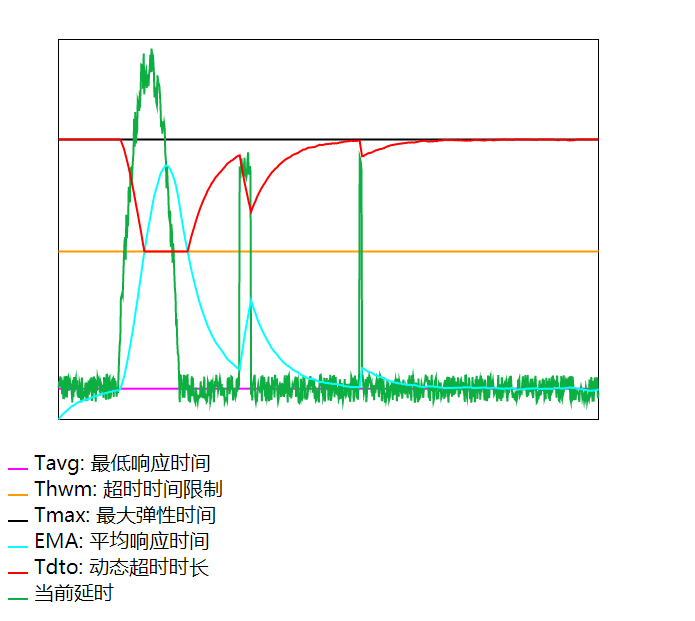
16 |
17 | ## Install
18 |
19 | ```bash
20 | $ npm i ema-timeout --save
21 | ```
22 |
23 | ## Usage
24 |
25 | ```js
26 | const ema = require('ema-timeout');
27 |
28 | // 因为每个cgi有可能不一样,根据自身业务需求考虑是否要为每个接口create不同的ema计算
29 | const options = {
30 | Tavg: 55, // 最低响应时间, 一般用平均响应时间替代
31 | Thwm: 300, // 超时时间限制, 确保最坏的时候,所有请求能处理。正常时正确处理的成功率满足需求。
32 | Tmax: 500, // 最大弹性时间
33 | N: 90 // 平滑指数,越小表示平均值越受最近值的影响,太大则对异常响应较慢
34 | };
35 | const emaObj = ema.create(options);
36 |
37 | ```
38 | ```js
39 | const start = Date.now();
40 | let tdto = emaObj.get(); // 获取当前超时设置时间
41 |
42 | // 请求接口指定超时时间
43 | // 这里是你业务请求逻辑
44 | try {
45 | const result = await request({
46 | timeout: tdto
47 | });// 请求接口
48 |
49 | emaObj.update(Date.now() - start); // 这里是更新当前接口延时时间,以备计算后续超时
50 | }
51 | catch(e) {
52 | // 把异常指定为最大超时,这样更好的反应接口健康情况
53 | emaObj.update(Math.max(Date.now() - start, options.Tmax));
54 | }
55 |
56 | ```
57 |
58 | ## 适用条件
59 |
60 | 固定业务逻辑,循环执行,如FastCGI/S++。
61 |
62 | 程序大部分时间在等待响应,而不是CPU计算或处理I/O中断。
63 |
64 | 服务是串行处理模式,容易受异常、慢请求阻塞。
65 |
66 | 响应时间不宜波动过大。
67 |
68 | 可以接受有损服务。
69 |
70 | ## License
71 |
72 | [MIT](LICENSE)
73 |
--------------------------------------------------------------------------------
/test/index.html:
--------------------------------------------------------------------------------
1 |
2 |
3 |
4 |
5 | ema数据
6 |
7 |
8 |
9 |
10 |
11 |
12 |
13 |
67 |
68 |
69 |
70 |
71 |
Tavg: 最低响应时间
72 |
Thwm: 超时时间限制
73 |
Tmax: 最大弹性时间
74 |
EMA: 平均响应时间
75 |
Tdto: 动态超时时长
76 |
当前延时
77 |