├── tests
├── __init__.py
└── unit_tests
│ ├── __init__.py
│ ├── models
│ ├── __init__.py
│ ├── test_doc.py
│ ├── test_openai_tokens_truncate.py
│ ├── test_context.py
│ └── test_skills.py
│ ├── utils
│ ├── __init__.py
│ └── test_file_icon.py
│ ├── controllers
│ ├── __init__.py
│ ├── test_tube_files.py
│ └── test_decorate_display.py
│ ├── gptui_kernel
│ ├── __init__.py
│ ├── plugins_test_data
│ │ ├── NotSemanticPlugin
│ │ │ └── Test
│ │ │ │ └── skprompt.txt
│ │ ├── FunSkill
│ │ │ ├── Excuses
│ │ │ │ ├── skprompt.txt
│ │ │ │ └── config.json
│ │ │ ├── Joke
│ │ │ │ ├── skprompt.txt
│ │ │ │ └── config.json
│ │ │ └── Limerick
│ │ │ │ ├── config.json
│ │ │ │ └── skprompt.txt
│ │ ├── math_plugin.py
│ │ └── FileIO.py
│ ├── test_manager.py
│ └── test_call_plugin.py
│ └── data
│ ├── langchain_tests_assets
│ ├── text_load_test.txt
│ └── html_load_test.html
│ └── test_document_loaders.py
├── src
└── gptui
│ ├── data
│ ├── __init__.py
│ ├── langchain
│ │ ├── __init__.py
│ │ ├── load
│ │ │ ├── __init__.py
│ │ │ └── serializable.py
│ │ ├── docstore
│ │ │ ├── __init__.py
│ │ │ └── document.py
│ │ ├── schema
│ │ │ ├── __init__.py
│ │ │ └── document.py
│ │ ├── document_loaders
│ │ │ ├── blob_loaders
│ │ │ │ ├── __init__.py
│ │ │ │ ├── file_system.py
│ │ │ │ └── schema.py
│ │ │ ├── __init__.py
│ │ │ ├── html.py
│ │ │ ├── helpers.py
│ │ │ ├── html_bs.py
│ │ │ ├── text.py
│ │ │ └── base.py
│ │ ├── README.md
│ │ └── pydantic_v1
│ │ │ └── __init__.py
│ └── vector_memory
│ │ ├── __init__.py
│ │ └── qdrant_memory.py
│ ├── models
│ ├── __init__.py
│ ├── utils
│ │ ├── __init__.py
│ │ ├── config_from_dot_env.py
│ │ ├── openai_settings_from_dot_env.py
│ │ ├── openai_api.py
│ │ └── tokens_num.py
│ ├── gptui_basic_services
│ │ ├── __init__.py
│ │ ├── plugins
│ │ │ ├── __init__.py
│ │ │ └── conversation_service.py
│ │ └── templates
│ │ │ └── upload_file_prompt.txt
│ ├── openai_error.py
│ ├── doc.py
│ ├── blinker_wrapper.py
│ ├── openai_chat_inner_service.py
│ ├── skills.py
│ ├── signals.py
│ ├── openai_tokens_truncate.py
│ ├── role.py
│ └── context.py
│ ├── utils
│ ├── __init__.py
│ ├── line_count.py
│ ├── safe_iterate.py
│ └── file_icon.py
│ ├── views
│ ├── __init__.py
│ ├── common_message.py
│ ├── theme.py
│ ├── wink_wink.py
│ └── custom_tree.py
│ ├── controllers
│ ├── __init__.py
│ ├── ai_care_sensors.py
│ ├── assistant_tube_control.py
│ ├── group_talk_control.py
│ ├── voice_control.py
│ ├── chat_context_control.py
│ ├── tube_files_control.py
│ ├── chat_response_control.py
│ └── dash_board_control.py
│ ├── drivers
│ ├── __init__.py
│ ├── driver_interface.py
│ ├── driver_error.py
│ └── driver_manager.py
│ ├── plugins
│ ├── __init__.py
│ ├── DEFAULT_PLUGINS
│ │ ├── __init__.py
│ │ ├── Bead.py
│ │ └── CoreSkills.py
│ ├── FileRW.py
│ ├── MemoryRecall.py
│ ├── OpenInterpreter.py
│ └── SnoozeReminder.py
│ ├── _version.py
│ ├── gptui_kernel
│ ├── __init__.py
│ ├── null_logger.py
│ ├── manager_exceptions.py
│ └── kernel_exceptions.py
│ ├── __init__.py
│ ├── .default_config.yml
│ ├── help.md
│ ├── __main__.py
│ └── config.yml
├── docs
├── features.md
├── blog
│ ├── index.md
│ ├── .authors.yml
│ └── posts
│ │ └── monochrome.md
├── getting_started.md
├── about
│ ├── license.md
│ └── contributing.md
├── api
│ └── index.md
├── guide
│ └── index.md
├── index.md
├── troubleshooting.md
├── configuration.zh.md
└── configuration.md
├── .github
├── FUNDING.yml
├── PULL_REQUEST_TEMPLATE.md
├── ISSUE_TEMPLATE
│ └── bug_report.md
└── workflows
│ ├── codecov.yml
│ ├── static.yml
│ └── python-publish.yml
├── web-serve.toml
├── .env_gptui.example
├── MANIFEST.in
├── main.py
├── custom_plugin_examples
├── README.md
└── native_plugin_example.py
├── setup.py
├── requirements.txt
├── LICENSE
├── CHANGELOG.md
├── mkdocs.yml
├── pyproject.toml
└── .gitignore
/tests/__init__.py:
--------------------------------------------------------------------------------
1 |
--------------------------------------------------------------------------------
/src/gptui/data/__init__.py:
--------------------------------------------------------------------------------
1 |
--------------------------------------------------------------------------------
/src/gptui/models/__init__.py:
--------------------------------------------------------------------------------
1 |
--------------------------------------------------------------------------------
/src/gptui/utils/__init__.py:
--------------------------------------------------------------------------------
1 |
--------------------------------------------------------------------------------
/src/gptui/views/__init__.py:
--------------------------------------------------------------------------------
1 |
--------------------------------------------------------------------------------
/tests/unit_tests/__init__.py:
--------------------------------------------------------------------------------
1 |
--------------------------------------------------------------------------------
/docs/features.md:
--------------------------------------------------------------------------------
1 | Features
2 |
--------------------------------------------------------------------------------
/src/gptui/controllers/__init__.py:
--------------------------------------------------------------------------------
1 |
--------------------------------------------------------------------------------
/src/gptui/drivers/__init__.py:
--------------------------------------------------------------------------------
1 |
--------------------------------------------------------------------------------
/src/gptui/plugins/__init__.py:
--------------------------------------------------------------------------------
1 |
--------------------------------------------------------------------------------
/docs/blog/index.md:
--------------------------------------------------------------------------------
1 | # Blog
2 |
3 |
--------------------------------------------------------------------------------
/src/gptui/data/langchain/__init__.py:
--------------------------------------------------------------------------------
1 |
--------------------------------------------------------------------------------
/src/gptui/models/utils/__init__.py:
--------------------------------------------------------------------------------
1 |
--------------------------------------------------------------------------------
/tests/unit_tests/models/__init__.py:
--------------------------------------------------------------------------------
1 |
--------------------------------------------------------------------------------
/tests/unit_tests/utils/__init__.py:
--------------------------------------------------------------------------------
1 |
--------------------------------------------------------------------------------
/src/gptui/data/langchain/load/__init__.py:
--------------------------------------------------------------------------------
1 |
--------------------------------------------------------------------------------
/src/gptui/data/vector_memory/__init__.py:
--------------------------------------------------------------------------------
1 |
--------------------------------------------------------------------------------
/tests/unit_tests/controllers/__init__.py:
--------------------------------------------------------------------------------
1 |
--------------------------------------------------------------------------------
/tests/unit_tests/gptui_kernel/__init__.py:
--------------------------------------------------------------------------------
1 |
--------------------------------------------------------------------------------
/src/gptui/data/langchain/docstore/__init__.py:
--------------------------------------------------------------------------------
1 |
--------------------------------------------------------------------------------
/src/gptui/plugins/DEFAULT_PLUGINS/__init__.py:
--------------------------------------------------------------------------------
1 |
--------------------------------------------------------------------------------
/docs/getting_started.md:
--------------------------------------------------------------------------------
1 | Getting started here.
2 |
--------------------------------------------------------------------------------
/src/gptui/models/gptui_basic_services/__init__.py:
--------------------------------------------------------------------------------
1 |
--------------------------------------------------------------------------------
/src/gptui/models/gptui_basic_services/plugins/__init__.py:
--------------------------------------------------------------------------------
1 |
--------------------------------------------------------------------------------
/.github/FUNDING.yml:
--------------------------------------------------------------------------------
1 | # These are supported funding model platforms
2 |
--------------------------------------------------------------------------------
/src/gptui/_version.py:
--------------------------------------------------------------------------------
1 | __title__ = "gptui"
2 | __version__ = "0.5.4"
3 |
--------------------------------------------------------------------------------
/web-serve.toml:
--------------------------------------------------------------------------------
1 | [app.GPTUI]
2 | command = "python main.py"
3 | #command = "python3 main.py"
4 |
--------------------------------------------------------------------------------
/src/gptui/data/langchain/schema/__init__.py:
--------------------------------------------------------------------------------
1 | from .document import BaseDocumentTransformer, Document
2 |
--------------------------------------------------------------------------------
/.env_gptui.example:
--------------------------------------------------------------------------------
1 | OPENAI_API_KEY = ""
2 | OPENAI_ORG_ID = ""
3 | GOOGLE_KEY = ""
4 | GOOGLE_CX = ""
5 |
--------------------------------------------------------------------------------
/src/gptui/data/langchain/docstore/document.py:
--------------------------------------------------------------------------------
1 | from ..schema import Document
2 |
3 | __all__ = ["Document"]
4 |
--------------------------------------------------------------------------------
/src/gptui/gptui_kernel/__init__.py:
--------------------------------------------------------------------------------
1 | from .kernel import Kernel
2 |
3 | #__all__ = [
4 | # "Kernel",
5 | #]
6 |
--------------------------------------------------------------------------------
/tests/unit_tests/data/langchain_tests_assets/text_load_test.txt:
--------------------------------------------------------------------------------
1 | This is a txt file for testting text loader.
2 |
--------------------------------------------------------------------------------
/tests/unit_tests/gptui_kernel/plugins_test_data/NotSemanticPlugin/Test/skprompt.txt:
--------------------------------------------------------------------------------
1 | This is not a semantic plugin.
2 |
--------------------------------------------------------------------------------
/docs/about/license.md:
--------------------------------------------------------------------------------
1 | GPTUI is licensed under the MIT License. [View license](https://github.com/happyapplehorse/gptui/blob/main/LICENSE).
2 |
--------------------------------------------------------------------------------
/src/gptui/__init__.py:
--------------------------------------------------------------------------------
1 | from ._version import __title__, __version__
2 |
3 |
4 | __all__ = [
5 | "__title__",
6 | "__version__",
7 | ]
8 |
--------------------------------------------------------------------------------
/docs/blog/.authors.yml:
--------------------------------------------------------------------------------
1 | authors:
2 | happyapplehorse:
3 | name: Xueao Chao
4 | description: Creator
5 | avatar: https://github.com/happyapplehorse.png
6 |
--------------------------------------------------------------------------------
/MANIFEST.in:
--------------------------------------------------------------------------------
1 | include src/gptui/.default_config.yml
2 | include src/gptui/config.yml
3 | include src/gptui/help.md
4 |
5 | recursive-include src/gptui *.txt
6 | recursive-include src/gptui *.tcss
7 |
--------------------------------------------------------------------------------
/src/gptui/data/langchain/document_loaders/blob_loaders/__init__.py:
--------------------------------------------------------------------------------
1 | from .file_system import FileSystemBlobLoader
2 | from .schema import Blob, BlobLoader
3 |
4 | __all__ = ["BlobLoader", "Blob", "FileSystemBlobLoader"]
5 |
--------------------------------------------------------------------------------
/.github/PULL_REQUEST_TEMPLATE.md:
--------------------------------------------------------------------------------
1 | **Please review the following checklist.**
2 |
3 | - [ ] Docstrings on all new or modified functions / classes
4 | - [ ] Updated documentation
5 | - [ ] Updated CHANGELOG.md (where appropriate)
6 |
--------------------------------------------------------------------------------
/src/gptui/models/gptui_basic_services/templates/upload_file_prompt.txt:
--------------------------------------------------------------------------------
1 | {{$input}}
2 |
3 | ******************** FILE CONTENT BEGIN ********************
4 | {{$file_content}}
5 | ******************** FILE CONTENT FINISH *******************
6 |
--------------------------------------------------------------------------------
/tests/unit_tests/data/langchain_tests_assets/html_load_test.html:
--------------------------------------------------------------------------------
1 |
2 |
3 | Page Title
4 |
5 |
6 |
7 | My First Heading
8 | My first paragraph.
9 |
10 |
11 |
12 |
--------------------------------------------------------------------------------
/docs/api/index.md:
--------------------------------------------------------------------------------
1 | # API
2 |
3 | This is a API-level reference to the GPTUI API.
4 | Click the links to your left (or in the burger menu) to open a reference for each module.
5 |
6 | If you are new to GPTUI, you may want to read the tutorial or guide first.
7 |
--------------------------------------------------------------------------------
/docs/guide/index.md:
--------------------------------------------------------------------------------
1 | # Guide
2 |
3 | This guide helps you in secondary development of GPTUI
4 | or utilize the features provided by GPTUI to develop your own applications.
5 |
6 | If you are new to GPTUI, you may want to read the tutorial or guide first.
7 |
--------------------------------------------------------------------------------
/main.py:
--------------------------------------------------------------------------------
1 | import os
2 | import sys
3 |
4 | from src.gptui.__main__ import gptui_run
5 |
6 |
7 | if __name__ == "__main__":
8 |
9 | sys.path.insert(0, os.path.join(os.path.dirname(__file__), "src"))
10 | gptui_run(config_path='src/gptui/config.yml')
11 |
--------------------------------------------------------------------------------
/src/gptui/data/langchain/document_loaders/__init__.py:
--------------------------------------------------------------------------------
1 | from .text import TextLoader
2 | from .html import UnstructuredHTMLLoader
3 | from .html_bs import BSHTMLLoader
4 |
5 | __all__ = [
6 | "TextLoader",
7 | "UnstructuredHTMLLoader",
8 | "BSHTMLLoader",
9 | ]
10 |
--------------------------------------------------------------------------------
/src/gptui/models/utils/config_from_dot_env.py:
--------------------------------------------------------------------------------
1 | from dotenv import dotenv_values
2 |
3 |
4 | def config_from_dot_env(dot_env_path: str) -> dict:
5 | """
6 | Reads the configs from the dot_env_path.
7 | """
8 |
9 | config = dotenv_values(dot_env_path)
10 |
11 | return config
12 |
--------------------------------------------------------------------------------
/tests/unit_tests/gptui_kernel/plugins_test_data/FunSkill/Excuses/skprompt.txt:
--------------------------------------------------------------------------------
1 | Generate a creative reason or excuse for the given event. Be creative and be funny. Let your imagination run wild.
2 |
3 | Event:I am running late.
4 | Excuse:I was being held ransom by giraffe gangsters.
5 |
6 | Event:{{$input}}
--------------------------------------------------------------------------------
/src/gptui/views/common_message.py:
--------------------------------------------------------------------------------
1 | from textual.message import Message
2 |
3 |
4 | class CommonMessage(Message):
5 | def __init__(self, message_name: str, message_content) -> None:
6 | self.message_name = message_name
7 | self.message_content = message_content
8 | super().__init__()
9 |
--------------------------------------------------------------------------------
/custom_plugin_examples/README.md:
--------------------------------------------------------------------------------
1 | You can specify the folder for your custom plugins in the configuration file,
2 | which defaults to "~/.gptui/plugins".
3 |
4 | GPTUI will automatically scan this folder to retrieve the plugins contained within it.
5 |
6 | You can copy the files from this folder to the custom plugin directory for testing purposes.
7 |
--------------------------------------------------------------------------------
/src/gptui/gptui_kernel/null_logger.py:
--------------------------------------------------------------------------------
1 | import logging
2 |
3 |
4 | class NullHandler(logging.Handler):
5 | def emit(self, record):
6 | pass
7 |
8 |
9 | def get_null_logger(name=None):
10 | logger = logging.getLogger(name or __name__)
11 | logger.addHandler(NullHandler())
12 | logger.propagate = False
13 | return logger
14 |
--------------------------------------------------------------------------------
/tests/unit_tests/gptui_kernel/plugins_test_data/FunSkill/Joke/skprompt.txt:
--------------------------------------------------------------------------------
1 | WRITE EXACTLY ONE JOKE or HUMOROUS STORY ABOUT THE TOPIC BELOW
2 |
3 | JOKE MUST BE:
4 | - G RATED
5 | - WORKPLACE/FAMILY SAFE
6 | NO SEXISM, RACISM OR OTHER BIAS/BIGOTRY
7 |
8 | BE CREATIVE AND FUNNY. I WANT TO LAUGH.
9 | {{$style}}
10 | +++++
11 |
12 | {{$input}}
13 | +++++
14 |
--------------------------------------------------------------------------------
/src/gptui/controllers/ai_care_sensors.py:
--------------------------------------------------------------------------------
1 | import datetime
2 |
3 |
4 | def time_now() -> str:
5 | """
6 | Get the current date and time in the local time zone"
7 |
8 | Example:
9 | {{time.now}} => Sunday, January 12, 2031 9:15 PM
10 | """
11 | now = datetime.datetime.now()
12 | return now.strftime("%A, %B %d, %Y %I:%M %p")
13 |
14 |
--------------------------------------------------------------------------------
/src/gptui/utils/line_count.py:
--------------------------------------------------------------------------------
1 | from rich.console import Console
2 |
3 | from .my_text import MyText
4 |
5 |
6 | def my_line_count(content: MyText, width: int, console=Console()) -> int:
7 | lines = content.split(allow_blank=True)
8 | num_count = 0
9 | for line in lines:
10 | num_count += len(line.wrap(console, width))
11 | return num_count
12 |
--------------------------------------------------------------------------------
/tests/unit_tests/gptui_kernel/plugins_test_data/FunSkill/Limerick/config.json:
--------------------------------------------------------------------------------
1 | {
2 | "schema": 1,
3 | "description": "Generate a funny limerick about a person",
4 | "type": "completion",
5 | "completion": {
6 | "max_tokens": 100,
7 | "temperature": 0.7,
8 | "top_p": 0.0,
9 | "presence_penalty": 0.0,
10 | "frequency_penalty": 0.0
11 | }
12 | }
--------------------------------------------------------------------------------
/setup.py:
--------------------------------------------------------------------------------
1 | import setuptools
2 |
3 |
4 | setuptools.setup(
5 | packages=setuptools.find_packages(where="src"),
6 | package_dir={"": "src"},
7 | package_data={
8 | "gptui": [
9 | ".default_config.yml",
10 | "config.yml",
11 | "help.md",
12 | "**/*.txt",
13 | "**/*.tcss",
14 | ],
15 | },
16 | )
17 |
--------------------------------------------------------------------------------
/tests/unit_tests/gptui_kernel/plugins_test_data/FunSkill/Excuses/config.json:
--------------------------------------------------------------------------------
1 | {
2 | "schema": 1,
3 | "description": "Turn a scenario into a creative or humorous excuse to send your boss",
4 | "type": "completion",
5 | "completion": {
6 | "max_tokens": 60,
7 | "temperature": 0.5,
8 | "top_p": 0.0,
9 | "presence_penalty": 0.0,
10 | "frequency_penalty": 0.0
11 | }
12 | }
--------------------------------------------------------------------------------
/tests/unit_tests/models/test_doc.py:
--------------------------------------------------------------------------------
1 | from gptui.models.doc import document_loader
2 |
3 |
4 | def test_document_loader(tmp_path):
5 | file_content = "This is a test."
6 | file_path = tmp_path / "test.txt"
7 | with open(file_path, "w") as fp:
8 | fp.write(file_content)
9 | document = document_loader(file_path)
10 | assert document[0].page_content == "This is a test."
11 |
--------------------------------------------------------------------------------
/src/gptui/data/langchain/document_loaders/html.py:
--------------------------------------------------------------------------------
1 | """Loader that uses unstructured to load HTML files."""
2 | from typing import List
3 |
4 | from .unstructured import UnstructuredFileLoader
5 |
6 |
7 | class UnstructuredHTMLLoader(UnstructuredFileLoader):
8 | """Loader that uses unstructured to load HTML files."""
9 |
10 | def _get_elements(self) -> List:
11 | from unstructured.partition.html import partition_html
12 |
13 | return partition_html(filename=self.file_path, **self.unstructured_kwargs)
14 |
--------------------------------------------------------------------------------
/tests/unit_tests/models/test_openai_tokens_truncate.py:
--------------------------------------------------------------------------------
1 | from gptui.models.openai_tokens_truncate import find_position
2 |
3 |
4 | def test_find_position():
5 | lst = [1, 2, 3, 4, 5]
6 | num = 8
7 | result = find_position(lst, num)
8 | assert result == 4
9 | lst = [2, 0, 5, 1, 3, 2, 1, 0, 4]
10 | num = 9
11 | result = find_position(lst, num)
12 | assert result == 5
13 | result = find_position(lst, 2)
14 | assert result == 9
15 | result = find_position(lst, 20)
16 | assert result == 0
17 |
--------------------------------------------------------------------------------
/tests/unit_tests/gptui_kernel/plugins_test_data/FunSkill/Joke/config.json:
--------------------------------------------------------------------------------
1 | {
2 | "schema": 1,
3 | "description": "Generate a funny joke",
4 | "type": "completion",
5 | "completion": {
6 | "max_tokens": 1000,
7 | "temperature": 0.9,
8 | "top_p": 0.0,
9 | "presence_penalty": 0.0,
10 | "frequency_penalty": 0.0
11 | },
12 | "input": {
13 | "parameters": [
14 | {
15 | "name": "input",
16 | "description": "Joke subject",
17 | "defaultValue": ""
18 | }
19 | ]
20 | }
21 | }
--------------------------------------------------------------------------------
/requirements.txt:
--------------------------------------------------------------------------------
1 | agere>=0.1.3,<1
2 | ai-care>=0.1.3,<1
3 | aiofiles>=23.1.0,<24
4 | beautifulsoup4>=4.12.2,<5
5 | blinker>=1.6.2,<2
6 | chardet>=5.1.0,<6
7 | geocoder>=1.38.1,<2
8 | httpx>=0.24.1,<1
9 | lxml>=4.9.3,<6
10 | # open-interpreter==0.1.4
11 | openai>=1.2.3,<2
12 | playsound>=1.3.0,<2
13 | Pygments>=2.15.1,<3
14 | pyperclip>=1.8.2,<2
15 | python-dotenv>=1.0.0,<2
16 | PyYAML>=6.0.1,<7
17 | qdrant-client>=1.4.0,<2
18 | rich>=13.7.0,<14
19 | semantic-kernel>=0.4.0.dev0,<1
20 | textual>=0.37.1,<1
21 | tiktoken>=0.4.0,<1
22 | unstructured>=0.10.18,<1
23 |
--------------------------------------------------------------------------------
/.github/ISSUE_TEMPLATE/bug_report.md:
--------------------------------------------------------------------------------
1 | ---
2 | name: Bug report
3 | about: Create a report to help us improve
4 | title: ''
5 | labels: ''
6 | assignees: ''
7 |
8 | ---
9 |
10 | Have you checked closed issues? https://github.com/happyapplehorse/gptui/issues?q=is%3Aissue+is%3Aclosed
11 |
12 | Please give a brief but clear explanation of the issue.
13 |
14 | Feel free to add screenshots and / or videos. These can be very helpful!
15 |
16 | If possible, please use English as much as you can.
17 | This is to ensure that others can review the content of this issue more effectively.
18 |
--------------------------------------------------------------------------------
/src/gptui/utils/safe_iterate.py:
--------------------------------------------------------------------------------
1 | def safe_next(gen):
2 | """Avoiding conflicts between StopIteration of generators and StopIteration of coroutine functions in eventloop."""
3 | try:
4 | return ("OK", next(gen))
5 | except StopIteration as e:
6 | return ("DONE", e.value)
7 |
8 | def safe_send(gen, value):
9 | """Avoiding conflicts between StopIteration of generators and StopIteration of coroutine functions in eventloop."""
10 | try:
11 | return ("OK", gen.send(value))
12 | except StopIteration as e:
13 | return ("DONE", e.value)
14 |
--------------------------------------------------------------------------------
/src/gptui/data/langchain/README.md:
--------------------------------------------------------------------------------
1 | Due to the fact that the original development platform (Termux) could not install the langchain toolkit (due to numpy), and in order to facilitate the use of GPTUI by other Termux users, part of the langchain source code that is needed has been copied into this project to use some of the functions of langchain. Thanks to the hard work of the langchain developers. If the installation problem of langchain is solved later, the langchain toolkit will be installed directly.
2 |
3 | Langchain tools that have already been integrated:
4 | - TextLoader
5 | - UnstructuredHTMLLoader
6 | - BSHTMLLoader
7 |
8 | Required dependencies:
9 | - pydantic
10 |
--------------------------------------------------------------------------------
/docs/about/contributing.md:
--------------------------------------------------------------------------------
1 | # Contributing to GPTUI
2 |
3 | The GPTUI project welcomes contributions from developers and users in the open source community.
4 | Contributions can be made in a number of ways, a few examples are:
5 |
6 | - Code patches via pull requests
7 | - Documentation improvements
8 | - Bug reports and patch reviews
9 |
10 | Some of GPTUI's plugin features rely on prompt, you can continue to help me improve these prompt.
11 | And I'd like to have appropriate animation cues during certain state changes.
12 | If you have any creative ideas, I'd appreciate your help in implementing them.
13 |
14 |
15 | ## 🎉
16 |
17 | Each contributor can leave a quote in the program.
18 |
--------------------------------------------------------------------------------
/src/gptui/controllers/assistant_tube_control.py:
--------------------------------------------------------------------------------
1 | import logging
2 |
3 | from ..models.signals import response_auxiliary_message_signal
4 |
5 |
6 | gptui_logger = logging.getLogger("gptui_logger")
7 |
8 |
9 | class AssistantTube:
10 | def __init__(self, app):
11 | self.app = app
12 | response_auxiliary_message_signal.connect(self.tube_display)
13 |
14 | def tube_display(self, sender, **kwargs):
15 | message = kwargs["message"]
16 | content = message["content"]
17 | flag = message["flag"]
18 | if flag == "function_call":
19 | self.app.context_piece_to_assistant_tube(content)
20 | elif flag == "function_response":
21 | self.app.context_piece_to_assistant_tube(content)
22 |
--------------------------------------------------------------------------------
/src/gptui/models/utils/openai_settings_from_dot_env.py:
--------------------------------------------------------------------------------
1 | from dotenv import dotenv_values
2 |
3 |
4 | def openai_settings_from_dot_env(dot_env_path: str) -> tuple[str, str | None]:
5 | """
6 | Reads the OpenAI API key and organization ID from the dot_env_path.
7 | OpenAI API key should be saved as "OPENAI_API_KEY".
8 | Organization should be saved as "OPENAI_ORG_ID".
9 |
10 | Returns:
11 | Tuple[str, str]: The OpenAI API key, the OpenAI organization ID
12 | """
13 |
14 | config = dotenv_values(dot_env_path)
15 | api_key = config.get("OPENAI_API_KEY", None)
16 | org_id = config.get("OPENAI_ORG_ID", None)
17 |
18 | assert api_key, f"OPENAI_API_KEY not found in {dot_env_path}"
19 |
20 | # It's okay if the org ID is not found (not required)
21 | return api_key, org_id
22 |
--------------------------------------------------------------------------------
/docs/index.md:
--------------------------------------------------------------------------------
1 | # GPTUI
2 |
3 | { align=left width="60" }
4 | GPTUI is a GPT conversational TUI (Textual User Interface) tool that runs within the terminal.
5 | Using the Textual framework for its TUI interface and equipping the plugin framework provided by Semantic Kernel.
6 | GPTUI offers a lightweight Kernel to power AI applications.
7 | The top-level TUI application is decoupled from the underlying Kernel, allowing you to easily replace the TUI interface or expand its functionalities.
8 | At present, only the GPT model of OpenAI is supported, and other LLM interfaces will be added later.
9 |
10 |
11 | ## Demo
12 |
13 | Below is a demonstration:
14 |
15 | 
16 |
--------------------------------------------------------------------------------
/tests/unit_tests/gptui_kernel/plugins_test_data/FunSkill/Limerick/skprompt.txt:
--------------------------------------------------------------------------------
1 | There was a young woman named Bright,
2 | Whose speed was much faster than light.
3 | She set out one day,
4 | In a relative way,
5 | And returned on the previous night.
6 |
7 | There was an odd fellow named Gus,
8 | When traveling he made such a fuss.
9 | He was banned from the train,
10 | Not allowed on a plane,
11 | And now travels only by bus.
12 |
13 | There once was a man from Tibet,
14 | Who couldn't find a cigarette
15 | So he smoked all his socks,
16 | and got chicken-pox,
17 | and had to go to the vet.
18 |
19 | There once was a boy named Dan,
20 | who wanted to fry in a pan.
21 | He tried and he tried,
22 | and eventually died,
23 | that weird little boy named Dan.
24 |
25 | Now write a very funny limerick about {{$name}}.
26 | {{$input}}
27 | Invent new facts their life. Must be funny.
28 |
--------------------------------------------------------------------------------
/src/gptui/controllers/group_talk_control.py:
--------------------------------------------------------------------------------
1 | import logging
2 |
3 | from ..models.signals import common_message_signal
4 |
5 |
6 | gptui_logger = logging.getLogger("gptui_logger")
7 |
8 |
9 | class GroupTalkControl:
10 | def __init__(self, app):
11 | self.app = app
12 | common_message_signal.connect(self.group_talk_user_message_send)
13 |
14 | def group_talk_user_message_send(self, sender, **kwargs):
15 | message = kwargs["message"]
16 | if message["flag"] == "group_talk_user_message_send":
17 | messages = message["content"]
18 | if isinstance(messages, list):
19 | for one_message in messages:
20 | self.app.context_piece_to_chat_window(one_message, change_line=True, decorator_switch=True)
21 | else:
22 | self.app.context_piece_to_chat_window(messages, change_line=True, decorator_switch=True)
23 |
--------------------------------------------------------------------------------
/src/gptui/gptui_kernel/manager_exceptions.py:
--------------------------------------------------------------------------------
1 | class ManagerError(Exception):
2 | ...
3 |
4 |
5 | class HandlerNotRegisterError(ManagerError):
6 | def __init__(self, handler, manager=None):
7 | self.handler = handler
8 | self.manager = manager
9 |
10 | def __str__(self):
11 | if self.manager is None:
12 | return f"Handler: {self.handler} is not registered in manager."
13 | else:
14 | return f"Handler: {self.handler} is not registered in manager: {self.manager}."
15 |
16 |
17 | class JobNotRegisterError(ManagerError):
18 | def __init__(self, job, manager=None):
19 | self.job = job
20 | self.manager = manager
21 |
22 | def __str__(self):
23 | if self.manager is None:
24 | return f"Job: {self.job} is not registered in manager."
25 | else:
26 | return f"Job: {self.job} is not registered in manager: {self.manager}."
27 |
--------------------------------------------------------------------------------
/src/gptui/models/utils/openai_api.py:
--------------------------------------------------------------------------------
1 | import openai
2 | from openai import OpenAI, AsyncOpenAI
3 |
4 | from .openai_settings_from_dot_env import openai_settings_from_dot_env
5 |
6 |
7 | OpenAIClient = OpenAI | AsyncOpenAI
8 |
9 |
10 | def openai_api(dot_env_path: str | None):
11 | assert dot_env_path, "'dot_env_path' can not be None or empty."
12 | openai_key, org_id = openai_settings_from_dot_env(dot_env_path)
13 | openai.api_key = openai_key
14 | return openai
15 |
16 | def openai_api_client(dot_env_path: str | None, async_client: bool = False, **kwargs) -> OpenAIClient:
17 | assert dot_env_path, "'dot_env_path' can not be None or empty."
18 | openai_key, org_id = openai_settings_from_dot_env(dot_env_path)
19 | if async_client is True:
20 | client = AsyncOpenAI(api_key=openai_key, organization=org_id, **kwargs)
21 | else:
22 | client = OpenAI(api_key=openai_key, organization=org_id, **kwargs)
23 | return client
24 |
--------------------------------------------------------------------------------
/src/gptui/models/openai_error.py:
--------------------------------------------------------------------------------
1 | import logging
2 |
3 | from .blinker_wrapper import async_wrapper_with_loop, async_wrapper_without_loop
4 | from .context import OpenaiContext
5 | from .signals import notification_signal
6 |
7 |
8 | gptui_logger = logging.getLogger("gptui_logger")
9 |
10 |
11 | class OpenaiErrorHandler:
12 | def openai_error_handle(self, error: Exception, context: OpenaiContext, event_loop: bool = True, **kwargs) -> None:
13 | if event_loop is True:
14 | gptui_logger.error(f"Openai Error: {error}")
15 | notification_signal.send(self, _async_wrapper=async_wrapper_with_loop, message={"content":{"error":error, "context":context, "ps":kwargs}, "flag":"openai_error"})
16 | else:
17 | gptui_logger.error(f"Openai Error: {error}")
18 | notification_signal.send(self, _async_wrapper=async_wrapper_without_loop, message={"content":{"error":error, "context":context, "ps":kwargs}, "flag":"openai_error"})
19 |
--------------------------------------------------------------------------------
/.github/workflows/codecov.yml:
--------------------------------------------------------------------------------
1 | name: Codecov
2 |
3 | on:
4 | push:
5 | branches:
6 | - main
7 | - develop
8 | pull_request:
9 | branches:
10 | - main
11 | - develop
12 | workflow_dispatch:
13 |
14 | jobs:
15 | codecov:
16 | runs-on: ubuntu-latest
17 |
18 | steps:
19 | - uses: actions/checkout@v3
20 | - name: Set up Python
21 | uses: actions/setup-python@v3
22 | with:
23 | python-version: '3.x'
24 | - name: Install dependencies
25 | run: |
26 | python -m pip install --upgrade pip
27 | pip install wheel setuptools
28 | pip install pytest pytest-cov pytest-asyncio
29 | if [ -f requirements.txt ]; then pip install -r requirements.txt; fi
30 | - name: Execute test
31 | run: pytest --cov=./src/gptui --cov-report=xml
32 |
33 | - name: Upload coverage reports to Codecov
34 | uses: codecov/codecov-action@v3
35 | with:
36 | files: ./coverage.xml
37 |
--------------------------------------------------------------------------------
/src/gptui/drivers/driver_interface.py:
--------------------------------------------------------------------------------
1 | from typing import Any
2 |
3 | from .driver_error import NoDriverError, NoDriverMethodError
4 |
5 |
6 | class DriverInterface:
7 |
8 | def __init__(self, platform: str):
9 | self.platform = platform.lower()
10 |
11 | def __call__(self, *args, **kwargs) -> Any:
12 | method = getattr(self, self.platform, None)
13 | if method and callable(method):
14 | return method(*args, **kwargs)
15 | else:
16 | raise NoDriverError(self.platform)
17 |
18 | def termux(self):
19 | raise NoDriverMethodError(driver="termux", method=self.__class__.__name__)
20 |
21 | def linux(self):
22 | raise NoDriverMethodError(driver="linux", method=self.__class__.__name__)
23 |
24 | def macos(self):
25 | raise NoDriverMethodError(driver="macos", method=self.__class__.__name__)
26 |
27 | def windows(self):
28 | raise NoDriverMethodError(driver="windows", method=self.__class__.__name__)
29 |
--------------------------------------------------------------------------------
/src/gptui/drivers/driver_error.py:
--------------------------------------------------------------------------------
1 | from __future__ import annotations
2 | from typing import Callable, TYPE_CHECKING
3 |
4 |
5 | if TYPE_CHECKING:
6 | from .driver_interface import DriverInterface
7 |
8 |
9 | class DriverError(Exception):
10 | ...
11 |
12 |
13 | class NoDriverError(DriverError):
14 | def __init__(self, driver: str):
15 | self.driver = driver
16 |
17 | def __str__(self):
18 | return f"There is no {self.driver} driver."
19 |
20 |
21 | class NoDriverMethodError(DriverError):
22 | def __init__(self, driver: str | Callable, method: str | DriverInterface):
23 | if isinstance(driver, str):
24 | self.driver = driver
25 | else:
26 | self.driver = driver.__name__
27 | if isinstance(method, str):
28 | self.method = method
29 | else:
30 | self.method = type(method).__name__
31 |
32 | def __str__(self):
33 | return f"There is no {self.method} method in {self.driver} driver."
34 |
--------------------------------------------------------------------------------
/src/gptui/data/langchain/pydantic_v1/__init__.py:
--------------------------------------------------------------------------------
1 | from importlib import metadata
2 |
3 | ## Create namespaces for pydantic v1 and v2.
4 | # This code must stay at the top of the file before other modules may
5 | # attempt to import pydantic since it adds pydantic_v1 and pydantic_v2 to sys.modules.
6 | #
7 | # This hack is done for the following reasons:
8 | # * Langchain will attempt to remain compatible with both pydantic v1 and v2 since
9 | # both dependencies and dependents may be stuck on either version of v1 or v2.
10 | # * Creating namespaces for pydantic v1 and v2 should allow us to write code that
11 | # unambiguously uses either v1 or v2 API.
12 | # * This change is easier to roll out and roll back.
13 |
14 | try:
15 | from pydantic.v1 import * # noqa: F403
16 | except ImportError:
17 | from pydantic import * # noqa: F403
18 |
19 |
20 | try:
21 | _PYDANTIC_MAJOR_VERSION: int = int(metadata.version("pydantic").split(".")[0])
22 | except metadata.PackageNotFoundError:
23 | _PYDANTIC_MAJOR_VERSION = 0
24 |
--------------------------------------------------------------------------------
/tests/unit_tests/gptui_kernel/test_manager.py:
--------------------------------------------------------------------------------
1 | import os
2 | from unittest.mock import patch
3 |
4 | from textual.app import App
5 |
6 | from gptui.gptui_kernel.manager import Manager
7 |
8 |
9 | mocked_dotenv_values = {
10 | "OPENAI_API_KEY": "fake_api_key",
11 | "OPENAI_ORG_ID": "fake_org_id",
12 | }
13 |
14 | def test_scan_plugin():
15 | with patch('gptui.gptui_kernel.kernel.dotenv_values', return_value=mocked_dotenv_values):
16 | app = App()
17 | manager = Manager(app, dot_env_config_path=os.path.expanduser("~/.gptui/.env_gptui"))
18 | semantic_plugins, native_plugins = manager.scan_plugins("./tests/unit_tests/gptui_kernel/plugins_test_data")
19 | semantic_plugins_name_list = [plugin_meta.name for plugin_meta in semantic_plugins]
20 | native_plugins_name_list = [plugin_meta.name for plugin_meta in native_plugins]
21 | assert set(semantic_plugins_name_list) == {"FunSkill"}
22 | assert set(native_plugins_name_list) == {"WebServe", "MathPlugin", "WriteFile"}
23 |
--------------------------------------------------------------------------------
/tests/unit_tests/gptui_kernel/plugins_test_data/math_plugin.py:
--------------------------------------------------------------------------------
1 | import math
2 |
3 | from semantic_kernel.skill_definition import (
4 | sk_function,
5 | sk_function_context_parameter,
6 | )
7 | from semantic_kernel.orchestration.sk_context import SKContext
8 |
9 |
10 | class MathPlugin:
11 | @sk_function(
12 | description="Takes the square root of a number",
13 | name="square_root",
14 | input_description="The value to take the square root of",
15 | )
16 | def square_root(self, number: str) -> str:
17 | return str(math.sqrt(float(number)))
18 |
19 | @sk_function(
20 | description="Adds two numbers together",
21 | name="add",
22 | )
23 | @sk_function_context_parameter(
24 | name="input",
25 | description="The first number to add",
26 | )
27 | @sk_function_context_parameter(
28 | name="number2",
29 | description="The second number to add",
30 | )
31 | def add(self, context: SKContext) -> str:
32 | return str(float(context["input"]) + float(context["number2"]))
33 |
--------------------------------------------------------------------------------
/src/gptui/gptui_kernel/kernel_exceptions.py:
--------------------------------------------------------------------------------
1 | import semantic_kernel as sk
2 |
3 |
4 | class KernelException(Exception):
5 | ...
6 |
7 |
8 | class PluginInfoError(KernelException):
9 | def __init__(self, plugin_info: tuple):
10 | self.plugin_info = plugin_info
11 |
12 | def __str__(self):
13 | return f"Plugin info in {self.plugin_info} is a wrong type."
14 |
15 |
16 | class InvalidArgumentTypeError(KernelException):
17 | def __init__(self, argument, expected_type):
18 | self.argument = argument
19 | self.expected_type = expected_type
20 |
21 | def __str__(self):
22 | return f"Invalid argumen type: Expected {self.expected_type}, got {type(self.argument)}"
23 |
24 |
25 | class PluginsMatchError(KernelException):
26 | def __init__(self, sk_kernel: sk.Kernel, plugins_list: list[tuple]):
27 | self.sk_kernel = sk_kernel
28 | self.plugins_list = plugins_list
29 |
30 | def __str__(self):
31 | return f"Semantic kernel and plugin list do not match. sk_kernel: {self.sk_kernel}, plugins_list: {self.plugins_list}"
32 |
--------------------------------------------------------------------------------
/LICENSE:
--------------------------------------------------------------------------------
1 | MIT License
2 |
3 | Copyright (c) 2023 Xueao Chao
4 |
5 | Permission is hereby granted, free of charge, to any person obtaining a copy
6 | of this software and associated documentation files (the "Software"), to deal
7 | in the Software without restriction, including without limitation the rights
8 | to use, copy, modify, merge, publish, distribute, sublicense, and/or sell
9 | copies of the Software, and to permit persons to whom the Software is
10 | furnished to do so, subject to the following conditions:
11 |
12 | The above copyright notice and this permission notice shall be included in all
13 | copies or substantial portions of the Software.
14 |
15 | THE SOFTWARE IS PROVIDED "AS IS", WITHOUT WARRANTY OF ANY KIND, EXPRESS OR
16 | IMPLIED, INCLUDING BUT NOT LIMITED TO THE WARRANTIES OF MERCHANTABILITY,
17 | FITNESS FOR A PARTICULAR PURPOSE AND NONINFRINGEMENT. IN NO EVENT SHALL THE
18 | AUTHORS OR COPYRIGHT HOLDERS BE LIABLE FOR ANY CLAIM, DAMAGES OR OTHER
19 | LIABILITY, WHETHER IN AN ACTION OF CONTRACT, TORT OR OTHERWISE, ARISING FROM,
20 | OUT OF OR IN CONNECTION WITH THE SOFTWARE OR THE USE OR OTHER DEALINGS IN THE
21 | SOFTWARE.
22 |
--------------------------------------------------------------------------------
/tests/unit_tests/data/test_document_loaders.py:
--------------------------------------------------------------------------------
1 | from gptui.data.langchain.document_loaders import TextLoader, UnstructuredHTMLLoader, BSHTMLLoader
2 |
3 |
4 | def test_text_loader():
5 | file_path = "./tests/unit_tests/data/langchain_tests_assets/text_load_test.txt"
6 | loader = TextLoader(file_path)
7 | document = loader.load()[0]
8 | assert document.page_content == "This is a txt file for testting text loader.\n"
9 | assert document.metadata["source"] == "./tests/unit_tests/data/langchain_tests_assets/text_load_test.txt"
10 |
11 | def test_bs_html_loader():
12 | file_path = "./tests/unit_tests/data/langchain_tests_assets/html_load_test.html"
13 | loader = BSHTMLLoader(file_path)
14 | document = loader.load()[0]
15 | assert document.page_content == "\n\nPage Title\n\n\nMy First Heading\nMy first paragraph.\n\n\n"
16 |
17 | def test_unstructured_html_loader():
18 | file_path = "./tests/unit_tests/data/langchain_tests_assets/html_load_test.html"
19 | loader = UnstructuredHTMLLoader(file_path)
20 | document = loader.load()[0]
21 | assert document.page_content == "My First Heading\n\nMy first paragraph."
22 |
--------------------------------------------------------------------------------
/tests/unit_tests/controllers/test_tube_files.py:
--------------------------------------------------------------------------------
1 | import pytest
2 |
3 | from gptui.controllers.tube_files_control import TubeFiles
4 | from gptui.utils.my_text import MyText as Text
5 |
6 | class TestTubeFiles:
7 | @pytest.fixture(autouse=True)
8 | def setup(self, tmp_path):
9 |
10 | class Displayer:
11 | def update(self, content):
12 | self.display = content
13 |
14 | self.displayer = Displayer()
15 | self.file_path = tmp_path / "files_test_data"
16 | self.file_path.mkdir(exist_ok=True)
17 |
18 | @pytest.mark.asyncio
19 | async def test_write_read_file_async(self):
20 | tf = TubeFiles(self.displayer)
21 | file_content = "This is a test."
22 | file_path = self.file_path / "test.txt"
23 | await tf.write_file_async(file_path, file_content)
24 | content = await tf.read_file_async(file_path)
25 | assert content == "This is a test."
26 | content = await tf.read_file_async(self.file_path / "test1.txt")
27 | assert content is None
28 | assert self.displayer.display == Text("File or directory not found", "yellow")
29 |
--------------------------------------------------------------------------------
/tests/unit_tests/gptui_kernel/test_call_plugin.py:
--------------------------------------------------------------------------------
1 | import os
2 | from unittest.mock import patch
3 |
4 | from textual.app import App
5 |
6 | from gptui.gptui_kernel.manager import Manager
7 |
8 |
9 | mocked_dotenv_values = {
10 | "OPENAI_API_KEY": "fake_api_key",
11 | "OPENAI_ORG_ID": "fake_org_id",
12 | }
13 |
14 | async def test_call_plugin():
15 | with patch('gptui.gptui_kernel.kernel.dotenv_values', return_value=mocked_dotenv_values):
16 | app = App()
17 | manager = Manager(app, dot_env_config_path=os.path.expanduser("~/.gptui/.env_gptui"))
18 | _, native_plugins = manager.scan_plugins("./tests/unit_tests/gptui_kernel/plugins_test_data")
19 | for plugin in native_plugins:
20 | plugin_info = plugin.plugin_info
21 | manager.add_plugins(plugin_info)
22 |
23 | add = manager.available_functions_link["add"]
24 | args = {
25 | "input": 1,
26 | "number2": 2,
27 | }
28 | context = manager.gk_kernel.context_render(args, add)
29 | result = await add.invoke_async(context=context)
30 | assert int(float(str(result))) == 3
31 |
--------------------------------------------------------------------------------
/src/gptui/controllers/voice_control.py:
--------------------------------------------------------------------------------
1 | import logging
2 |
3 | from ..models.signals import response_to_user_message_sentence_stream_signal
4 |
5 |
6 | gptui_logger = logging.getLogger("gptui_logger")
7 |
8 |
9 | class VoiceService:
10 | def __init__(self, myapp, switch: bool = True):
11 | self.myapp = myapp
12 | self.voice_service = None
13 | if switch is True:
14 | self.connect()
15 |
16 | async def accept_voice_message(self, sender, **kwargs):
17 | voice_message = kwargs["message"]
18 | message_content = voice_message["content"]
19 | flag = voice_message["flag"]
20 | if flag == "content":
21 | self.voice_service = self.myapp.drivers.tts(message_content)
22 |
23 | def connect(self):
24 | response_to_user_message_sentence_stream_signal.connect(self.accept_voice_message)
25 |
26 | def disconnect(self):
27 | response_to_user_message_sentence_stream_signal.disconnect(self.accept_voice_message)
28 |
29 | def cancel_speak(self) -> None:
30 | self.disconnect()
31 | if self.voice_service is None:
32 | return
33 | self.voice_service.stop()
34 |
--------------------------------------------------------------------------------
/src/gptui/drivers/driver_manager.py:
--------------------------------------------------------------------------------
1 | import logging
2 | import os
3 |
4 | from .drivers import CopyCode, TextToSpeak, VoiceRecordStart, VoiceRecordQuit
5 | from .driver_interface import DriverInterface
6 |
7 |
8 | gptui_logger = logging.getLogger("gptui_logger")
9 |
10 |
11 | class DriverManager:
12 | def __init__(self, app):
13 | self.app = app
14 | self.terminal = app.config.get("terminal")
15 | self.os = app.config.get("os")
16 | self._register_driver_method()
17 |
18 | def register_driver(self, driver_method_name: str, driver: DriverInterface) -> None:
19 | if hasattr(self, driver_method_name):
20 | gptui_logger.warning("A driver method with the same name already exists; it will be overwritten.")
21 | setattr(self, driver_method_name, driver)
22 |
23 | def _register_driver_method(self):
24 | self.copy_code = CopyCode(self.os)
25 | self.tts = TextToSpeak(
26 | platform=self.os,
27 | dot_env_path=self.app.config["dot_env_path"],
28 | temp_dir=os.path.join(self.app.config["workpath"], "temp"),
29 | )
30 | self.voice_record_start = VoiceRecordStart(self.os)
31 | self.voice_record_quit = VoiceRecordQuit(self.os)
32 |
--------------------------------------------------------------------------------
/src/gptui/models/doc.py:
--------------------------------------------------------------------------------
1 | import os
2 |
3 | from ..data.langchain.document_loaders import TextLoader
4 | from ..data.langchain.schema import Document
5 |
6 |
7 | class Doc:
8 | def __init__(self, doc_name: str, doc_ext: str, pointer, description: str | None = None):
9 | self.name = doc_name
10 | self.ext = doc_ext
11 | self.pointer = pointer
12 | self.description = description
13 | if isinstance(pointer, Document):
14 | self.content_type = "Document"
15 | elif isinstance(pointer, str):
16 | self.content_type = "str"
17 | else:
18 | self.content_type = "Unknown"
19 |
20 | @property
21 | def content(self):
22 | if isinstance(self.pointer, Document):
23 | return self.pointer.page_content
24 | else:
25 | return self.pointer
26 |
27 | def document_loader(file_path: str) -> list[Document]:
28 | file_ext_name = os.path.splitext(file_path)[1]
29 | if file_ext_name in {".txt", ".md", ".json", ".py", ".cpp", ".yaml", ".yml", ".toml", ".log"}:
30 | loader = TextLoader(file_path)
31 | else:
32 | raise TypeError("Selected file type is not suppported.")
33 | document_list = loader.load()
34 | return document_list
35 |
--------------------------------------------------------------------------------
/tests/unit_tests/gptui_kernel/plugins_test_data/FileIO.py:
--------------------------------------------------------------------------------
1 | import logging
2 |
3 | from semantic_kernel.orchestration.sk_context import SKContext
4 | from semantic_kernel.skill_definition import sk_function, sk_function_context_parameter
5 |
6 | from gptui.gptui_kernel.manager import auto_init_params
7 |
8 |
9 | mylogger = logging.getLogger("mylogger")
10 |
11 |
12 | class WriteFile:
13 | def __init__(self, manager):
14 | self.manager = manager
15 |
16 | @auto_init_params("0")
17 | @classmethod
18 | def get_init_params(cls, manager) -> tuple:
19 | return (manager,)
20 |
21 | @sk_function(
22 | description="Write a file.",
23 | name="write_file",
24 | )
25 | @sk_function_context_parameter(
26 | name="file_name",
27 | description="The name of the file, including the extension.",
28 | )
29 | @sk_function_context_parameter(
30 | name="file_content",
31 | description="The content to be written into the file."
32 | )
33 | def write_file(self, context: SKContext) -> str:
34 | file_name = context["file_name"]
35 | file_content = context["file_content"]
36 | self.manager.client.common_resources["temp_files_from_tube"] = {file_name: file_content}
37 | return ""
38 |
--------------------------------------------------------------------------------
/CHANGELOG.md:
--------------------------------------------------------------------------------
1 | # Changelog
2 |
3 | All notable changes to this project will be documented in this file.
4 |
5 | The format is based on [Keep a Changelog](http://keepachangelog.com/)
6 | and this project adheres to [Semantic Versioning](http://semver.org/).
7 |
8 | ## [Unreleased]
9 |
10 | ## [0.5.4] - 2024-01-09
11 |
12 | ### Fixed
13 |
14 | - Fixed the issue of bebing unable to rename conversation on Windows
15 | - Switch from text-davinci-003 to using gpt-3.5-turbo-instruct
16 | - When choosing a file path, the default is the root directory
17 |
18 | ## [0.5.3] - 2024-01-07
19 |
20 | ### Fixed
21 |
22 | - Fixed the error of using the unimported async_wrapper_with_loop in GroupTalkManager.speaking
23 |
24 | ## [0.5.2] - 2024-01-02
25 |
26 | ### Fixed
27 |
28 | - Fixed the bug that prevents the second conversation from being renamed
29 | - Stop the waiting animation for a conversation when it is deleted
30 | - Fixed the bug where deleting a conversation shows its replies in another window
31 |
32 | ## [0.5.1] - 2024-01-02
33 |
34 | ### Fixed
35 |
36 | - Fixed the FileNotfoundError when clicking links in MarkdownViewer
37 | - Fixed the KeyError caused by switching to information display when dealing with an empty chat window
38 | - Fixed the bugs in disposable conversation mode caused by openai v1
39 |
40 | ## [0.5.0] - 2023-12-31
41 |
42 | ### Added
43 |
44 | - Added support for custom plugins.
45 |
--------------------------------------------------------------------------------
/src/gptui/data/langchain/document_loaders/helpers.py:
--------------------------------------------------------------------------------
1 | """Document loader helpers."""
2 |
3 | import concurrent.futures
4 | from typing import List, NamedTuple, Optional, cast
5 |
6 |
7 | class FileEncoding(NamedTuple):
8 | encoding: Optional[str]
9 | confidence: float
10 | language: Optional[str]
11 |
12 |
13 | def detect_file_encodings(file_path: str, timeout: int = 5) -> List[FileEncoding]:
14 | """Try to detect the file encoding.
15 |
16 | Returns a list of `FileEncoding` tuples with the detected encodings ordered
17 | by confidence.
18 | """
19 | import chardet
20 |
21 | def read_and_detect(file_path: str) -> List[dict]:
22 | with open(file_path, "rb") as f:
23 | rawdata = f.read()
24 | return cast(List[dict], chardet.detect_all(rawdata))
25 |
26 | with concurrent.futures.ThreadPoolExecutor() as executor:
27 | future = executor.submit(read_and_detect, file_path)
28 | try:
29 | encodings = future.result(timeout=timeout)
30 | except concurrent.futures.TimeoutError:
31 | raise TimeoutError(
32 | f"Timeout reached while detecting encoding for {file_path}"
33 | )
34 |
35 | if all(encoding["encoding"] is None for encoding in encodings):
36 | raise RuntimeError(f"Could not detect encoding for {file_path}")
37 | return [FileEncoding(**enc) for enc in encodings if enc["encoding"] is not None]
38 |
--------------------------------------------------------------------------------
/src/gptui/.default_config.yml:
--------------------------------------------------------------------------------
1 | # +--------------------------------------------------------------------------+
2 | # \ The configurations in this document are the program's default settings, \
3 | # \ ensuring the presence of essential configuration items. \
4 | # +--------------------------------------------------------------------------+
5 |
6 |
7 | GPTUI_BASIC_SERVICES_PATH:
8 | PLUGIN_PATH:
9 | DEFAULT_PLUGIN_PATH:
10 | custom_plugin_path: ~/.gptui/plugins/
11 |
12 | # API keys
13 | dot_env_path:
14 | ~/.gptui/.env_gptui
15 |
16 | default_openai_parameters:
17 | model: gpt-4
18 | stream: true
19 |
20 | default_conversation_parameters:
21 | max_sending_tokens_ratio: 0.6
22 |
23 | log_path:
24 | ~/.gptui/logs.log
25 |
26 | tui_config:
27 | conversations_recover: true
28 | voice_switch: false
29 | speak_switch: false
30 | file_wrap_display: true
31 | ai_care_switch: true
32 | ai_care_depth: 2
33 | ai_care_delay: 60
34 | status_region_default:
35 | waiting_receive_animation: "default"
36 |
37 | # List of plugin's name of default used
38 | default_plugins_used: []
39 |
40 | # Program working path, storing vector database, temporary files, etc.
41 | workpath:
42 | ~/.gptui/user
43 |
44 | # Scope of files discoverable by the program
45 | directory_tree_path:
46 | ~/
47 |
48 | # Conversation history save and import path
49 | conversation_path:
50 | ~/.gptui/user/conversations
51 |
52 | vector_memory_path:
53 | ~/.gptui/user/vector_memory_database
54 |
--------------------------------------------------------------------------------
/tests/unit_tests/models/test_context.py:
--------------------------------------------------------------------------------
1 | import json
2 | import copy
3 | from dataclasses import asdict
4 | from gptui.models.context import OpenaiContext
5 |
6 | def test_openai_context_serialization_deserialization():
7 | openai_context_original = OpenaiContext(chat_context = [{"role": "user", "content":"Hi!"}, {"role":"assistant", "content":"Hello, how can i assist you today?"}])
8 | openai_context_original.parameters = {"model": "gpt-4"}
9 | openai_context = copy.deepcopy(openai_context_original)
10 | openai_context_str = json.dumps(asdict(openai_context), ensure_ascii = False, sort_keys = True, indent = 4, separators = (',',':'))
11 | openai_context_build = json.loads(openai_context_str)
12 | openai_context_rebuild = OpenaiContext(**openai_context_build)
13 | assert openai_context_rebuild == openai_context_original
14 |
15 | def test_openai_context_deepcopy():
16 | openai_context_original = OpenaiContext(chat_context = [{"role": "user", "content":"Hi!"}, {"role":"assistant", "content":"Hello, how can i assist you today?"}])
17 | openai_context_original.parameters = {"model": "gpt-4"}
18 | openai_context_original.plugins = [["mutable"], "plugin2"]
19 | openai_context_deepcopy = copy.deepcopy(openai_context_original)
20 | assert openai_context_deepcopy == openai_context_original
21 | assert id(openai_context_deepcopy.chat_context) != id(openai_context_original.chat_context)
22 | assert set(map(id, openai_context_original.plugins)) == set(map(id, openai_context_deepcopy.plugins))
23 |
24 |
--------------------------------------------------------------------------------
/.github/workflows/static.yml:
--------------------------------------------------------------------------------
1 | # Simple workflow for deploying static content to GitHub Pages
2 | name: Deploy MkDocs to GitHub Pages
3 |
4 | on:
5 | push:
6 | tags:
7 | - 'v*'
8 | # Allows to run this workflow manually from the Actions tab
9 | workflow_dispatch:
10 |
11 | # Sets permissions of the GITHUB_TOKEN to allow deployment to GitHub Pages
12 | permissions:
13 | contents: read
14 | pages: write
15 | id-token: write
16 |
17 | # Allow only one concurrent deployment, skipping runs queued between the run in-progress and latest queued.
18 | # However, do NOT cancel in-progress runs as we want to allow these production deployments to complete.
19 | concurrency:
20 | group: "pages"
21 | cancel-in-progress: false
22 |
23 | jobs:
24 | # Single deploy job since we're just deploying
25 | deploy:
26 | runs-on: ubuntu-latest
27 | steps:
28 | - name: Checkout
29 | uses: actions/checkout@v3
30 |
31 | - name: Set up Python
32 | uses: actions/setup-python@v3
33 | with:
34 | python-version: 3.x
35 |
36 | - name: Install MkDocs and extensions
37 | run: |
38 | python -m pip install --upgrade pip
39 | pip install mkdocs mkdocs-material "mkdocstrings[python]"
40 |
41 | - name: Build MkDocs site
42 | run: mkdocs build
43 |
44 | - name: Upload artifact
45 | uses: actions/upload-pages-artifact@v2
46 | with:
47 | path: './site'
48 |
49 | - name: Deploy to GitHub Pages
50 | id: deployment
51 | uses: actions/deploy-pages@v2
52 |
--------------------------------------------------------------------------------
/tests/unit_tests/models/test_skills.py:
--------------------------------------------------------------------------------
1 | import pytest
2 |
3 | from gptui.models.doc import Doc
4 | from gptui.models.skills import UploadFile
5 |
6 |
7 | @pytest.mark.asyncio
8 | async def test_upload_file():
9 | uf = UploadFile()
10 | input = "Summarize the following documents' content."
11 | doc1 = Doc(doc_name="test_doc1", doc_ext=".txt", pointer="This is a txt document.")
12 | doc2 = Doc(doc_name="test_doc2", doc_ext=".txt", pointer="This is another txt document.")
13 | prompt1 = await uf.import_file_to_context(doc1, input=input)
14 | prompt2 = await uf.import_file_to_context(doc1, doc2, input=input)
15 | assert prompt1 == (
16 | "Summarize the following documents' content.\n\n"
17 | "******************** FILE CONTENT BEGIN ********************\n"
18 | "===== Document #1 test_doc1.txt =====\n\n"
19 | "This is a txt document.\n\n"
20 | "=====================================\n"
21 | "******************** FILE CONTENT FINISH *******************\n"
22 | )
23 | assert prompt2 == (
24 | "Summarize the following documents' content.\n\n"
25 | "******************** FILE CONTENT BEGIN ********************\n"
26 | "===== Document #1 test_doc1.txt =====\n\n"
27 | "This is a txt document.\n\n"
28 | "=====================================\n\n"
29 | "===== Document #2 test_doc2.txt =====\n\n"
30 | "This is another txt document.\n\n"
31 | "=====================================\n"
32 | "******************** FILE CONTENT FINISH *******************\n"
33 | )
34 |
--------------------------------------------------------------------------------
/tests/unit_tests/utils/test_file_icon.py:
--------------------------------------------------------------------------------
1 | from gptui.utils.my_text import MyText as Text
2 | from rich import print
3 |
4 |
5 | def test_file_icon_ansi_str():
6 | pass
7 | #test_short = file_icon_ansi_str(file_label="TEST", file_type=".txt", file_description="test.txt")
8 | #test_md = file_icon_ansi_str(file_label="TEST", file_type=".md", file_description="test.md")
9 | #test_long = file_icon_ansi_str(file_label="TEST", file_type=".txt", file_description="test_long_description.txt")
10 | #test_bin = file_icon_ansi_str(file_label="TEST", file_type=".bin", file_description="test.bin")
11 | #test_json = file_icon_ansi_str(file_label="TEST", file_type=".json", file_description="test.json")
12 | #test_py = file_icon_ansi_str(file_label="TEST", file_type=".py", file_description="test.py")
13 | #test_sh = file_icon_ansi_str(file_label="TEST", file_type=".sh", file_description="test.sh")
14 | #test_other = file_icon_ansi_str(file_label="TEST", file_type="other", file_description="test.other")
15 | #test_blue = file_icon_ansi_str(file_label="TEST", file_type=".txt", file_description="test.txt", icon_color="blue")
16 | #test_description_blue = file_icon_ansi_str(file_label="TEST", file_type=".txt", file_description="test.txt", description_color="blue")
17 |
18 | #assert test_short == Text('▕⁖̅⁖̅⁖̅╲ \n▕TES▕ \n▕txt▕\ntest.t\nxt \n' [Span(0, 10, ''), Span(10, 18, ''), Span(18, 23, 'underline'), Span(23, 37,'white')])
19 | #print(repr(test_short))
20 | #print(test_md)
21 | #print(test_long)
22 | #print(test_bin)
23 | #print(test_json)
24 | #print(test_py)
25 | #print(test_sh)
26 | #print(test_other)
27 | #print(test_blue)
28 | #print(test_description_blue)
29 |
--------------------------------------------------------------------------------
/src/gptui/views/theme.py:
--------------------------------------------------------------------------------
1 | from typing import NamedTuple, Literal
2 |
3 |
4 | ThemeName = Literal["default", "monochrome"]
5 |
6 |
7 | class ColorMap(NamedTuple):
8 | name: str
9 | color: str
10 |
11 |
12 | class ThemeColor:
13 | color_map: dict[str, str] = {}
14 | _theme: ThemeName = "default"
15 |
16 | @classmethod
17 | def insert_color_map(cls, name: str, color: str):
18 | cls.color_map[name] = color
19 |
20 | @classmethod
21 | def insert_color_map_batch(cls, color_map_list: list[ColorMap]) -> None:
22 | for color_map in color_map_list:
23 | cls.color_map[color_map.name] = color_map.color
24 |
25 | @classmethod
26 | def get_theme_color(cls, name: str) -> str | None:
27 | if name in cls.color_map:
28 | return cls.color_map[name]
29 | if cls._theme == "default":
30 | return None
31 | elif cls._theme == "monochrome":
32 | return "#5CE495" # responding to $success-lighten-2 in textual
33 | else:
34 | return None
35 |
36 | @classmethod
37 | def set_theme(cls, theme: ThemeName) -> None:
38 | cls._theme = theme
39 | if theme == "monochrome":
40 | ThemeColor.color_map["user_message"] = "#2E724B"
41 | ThemeColor.color_map["assistant_message"] = "#5CE495"
42 | ThemeColor.color_map["system_message"] = "#122E1E"
43 | if theme == "default":
44 | ThemeColor.color_map.pop("user_message", None)
45 | ThemeColor.color_map.pop("assistant_message", None)
46 | ThemeColor.color_map.pop("system_message", None)
47 |
48 | def theme_color(name: str) -> str | None:
49 | return ThemeColor.get_theme_color(name)
50 |
--------------------------------------------------------------------------------
/src/gptui/plugins/FileRW.py:
--------------------------------------------------------------------------------
1 | import logging
2 | import os
3 |
4 | from semantic_kernel.orchestration.sk_context import SKContext
5 | from semantic_kernel.skill_definition import sk_function, sk_function_context_parameter
6 |
7 | from gptui.gptui_kernel.manager import auto_init_params
8 | from gptui.models.doc import Doc
9 | from gptui.views.common_message import CommonMessage
10 |
11 |
12 | gptui_logger = logging.getLogger("gptui_logger")
13 |
14 |
15 | class WriteFile:
16 | def __init__(self, manager):
17 | self.manager = manager
18 |
19 | @auto_init_params("0")
20 | @classmethod
21 | def get_init_params(cls, manager) -> tuple:
22 | return (manager,)
23 |
24 | @sk_function(
25 | description="Write a file.",
26 | name="write_file",
27 | )
28 | @sk_function_context_parameter(
29 | name="file_name",
30 | description="The name of the file, including the extension.",
31 | )
32 | @sk_function_context_parameter(
33 | name="file_content",
34 | description="The content to be written into the file."
35 | )
36 | def write_file(self, context: SKContext) -> str:
37 | file_name = context["file_name"]
38 | file_content = context["file_content"]
39 | self.manager.client.common_resources["temp_files_from_tube"] = {file_name: file_content}
40 | name, ext = os.path.splitext(file_name)
41 | document = Doc(doc_name=name, doc_ext=ext, pointer=self.manager.client.common_resources["temp_files_from_tube"][file_name], description="")
42 | # Only main thread can handle UI event correctly
43 | self.manager.client.post_message(CommonMessage(message_name="write_file", message_content=document))
44 | return "Write file sucessfully!"
45 |
--------------------------------------------------------------------------------
/mkdocs.yml:
--------------------------------------------------------------------------------
1 | site_name: GPTUI
2 | copyright: Copyright (c) 2023 Xueao Chao
3 |
4 | repo_url: https://github.com/happyapplehorse/gptui
5 | repo_name: happyapplehorse/gptui
6 |
7 | theme:
8 | name: "material"
9 |
10 | icon:
11 | logo: material/island
12 |
13 | palette:
14 | - media: "(prefers-color-scheme: light)"
15 | scheme: default
16 | primary: deep purple
17 | toggle:
18 | icon: material/weather-night
19 | name: Switch to dark mode
20 | - media: "(prefers-color-scheme: dark)"
21 | scheme: slate
22 | toggle:
23 | icon: material/weather-sunny
24 | name: Switch to light mode
25 |
26 | features:
27 | - navigation.instant
28 | - navigation.tabs
29 | - navigation.tracking
30 | - navigation.path
31 | - navigation.top
32 | - navigation.footer
33 | - navigation.indexes
34 | - navigation.tabs.sticky
35 | - navigation.prune
36 | - toc.follow
37 | - search.suggest
38 | - search.hightlight
39 | - content.code.copy
40 | - content.code.annotate
41 |
42 | plugins:
43 | - mkdocstrings:
44 | handlers:
45 | python:
46 | paths: [src]
47 | - search
48 | - blog
49 |
50 | extra:
51 | social:
52 | - icon: fontawesome/brands/github
53 | link: https://github.com/happyapplehorse
54 | name: Github
55 |
56 | markdown_extensions:
57 | - attr_list
58 | - md_in_html
59 |
60 | nav:
61 | - Home: index.md
62 | - Tutorial:
63 | - Getting started: getting_started.md
64 | - Troubleshooting: troubleshooting.md
65 | - Features: features.md
66 | - Configuration: configuration.md
67 | - 配置指南: configuration.zh.md
68 | - Guide:
69 | - guide/index.md
70 | - API:
71 | - api/index.md
72 | - Blog:
73 | - blog/index.md
74 | - About:
75 | - Contributing: about/contributing.md
76 | - License: about/license.md
77 |
--------------------------------------------------------------------------------
/.github/workflows/python-publish.yml:
--------------------------------------------------------------------------------
1 | # This workflow will upload a Python Package using Twine when a release is created
2 | # For more information see: https://docs.github.com/en/actions/automating-builds-and-tests/building-and-testing-python#publishing-to-package-registries
3 |
4 | # This workflow uses actions that are not certified by GitHub.
5 | # They are provided by a third-party and are governed by
6 | # separate terms of service, privacy policy, and support
7 | # documentation.
8 |
9 | name: Upload Python Package
10 |
11 | on:
12 | push:
13 | tags:
14 | - 'v*'
15 | # Allows to run this workflow manually from the Actions tab
16 | workflow_dispatch:
17 |
18 | permissions:
19 | contents: read
20 |
21 | jobs:
22 | test:
23 | runs-on: ubuntu-latest
24 |
25 | steps:
26 | - uses: actions/checkout@v3
27 | - name: Set up Python
28 | uses: actions/setup-python@v3
29 | with:
30 | python-version: '3.x'
31 | - name: Install dependencies
32 | run: |
33 | python -m pip install --upgrade pip
34 | pip install wheel setuptools
35 | pip install pytest pytest-asyncio
36 | if [ -f requirements.txt ]; then pip install -r requirements.txt; fi
37 | - name: Execute test
38 | run: pytest -v
39 |
40 | deploy:
41 |
42 | runs-on: ubuntu-latest
43 | needs: [test]
44 |
45 | steps:
46 | - uses: actions/checkout@v3
47 | - name: Set up Python
48 | uses: actions/setup-python@v3
49 | with:
50 | python-version: '3.x'
51 | - name: Install dependencies
52 | run: |
53 | python -m pip install --upgrade pip
54 | pip install build
55 | - name: Build package
56 | run: python -m build
57 | - name: Publish package
58 | uses: pypa/gh-action-pypi-publish@27b31702a0e7fc50959f5ad993c78deac1bdfc29
59 | with:
60 | user: __token__
61 | password: ${{ secrets.PYPI_API_TOKEN }}
62 |
--------------------------------------------------------------------------------
/tests/unit_tests/controllers/test_decorate_display.py:
--------------------------------------------------------------------------------
1 | import textwrap
2 | from gptui.controllers.decorate_display_control import extract_files_from_string
3 | from rich import print
4 |
5 |
6 | def test_extract_files_from_string():
7 | input_string = textwrap.dedent(
8 | """\
9 | before
10 | ******************** FILE CONTENT BEGIN ********************
11 | ===== Document #1 text.txt =====
12 |
13 | This is the content of the document #1.
14 |
15 |
16 | ==========================
17 |
18 | ===== Document #2 test.md =====
19 |
20 | This is the content of the the file #2.
21 |
22 |
23 | ===========================
24 | ******************** FILE CONTENT FINISH *******************
25 | after"""
26 | )
27 |
28 | expected_output = ["before\n", ("text.txt", "test.md"), "\nafter"]
29 | out = extract_files_from_string(input_string)
30 | assert out == expected_output
31 |
32 | '''
33 | def test_pre_wrap():
34 | input_string = """before
35 | ******************** FILE CONTENT BEGIN ********************
36 | ===== Document #1 text.txt =====
37 |
38 | This is the content of the document #1.
39 |
40 |
41 | ==========================
42 |
43 | ===== Document #2 test.txt =====
44 |
45 | This is the content of the the file #2.
46 |
47 |
48 | ===========================
49 | ******************** FILE CONTENT FINISH *******************
50 | after"""
51 |
52 | #out_wrap = pre_decorate(input_string, wrap=True)
53 | #out_no_wrap = pre_decorate(input_string, wrap=False)
54 |
55 | input_string2 = "abcd"
56 | #out = pre_wrap(input_string2, wrap=False)
57 | #assert out == '\x1b[39mabcd\x1b[0m'
58 |
59 | def test_wrap_files_in_string():
60 | input = ["before", ("text.txt", "test.txt", "test_long_title.txt", "abc.json", "abcdef.abc"), "middle", ("test.txt"), "after"]
61 | out = wrap_files_in_string(input)
62 | print(out)
63 | '''
64 |
--------------------------------------------------------------------------------
/src/gptui/models/blinker_wrapper.py:
--------------------------------------------------------------------------------
1 | import asyncio
2 |
3 |
4 | def sync_wrapper(func):
5 | """
6 | Wrap a sync receiver to a async receiver.
7 |
8 | Usage example:
9 | result = await signal.send_async("sender", _sync_wrapper=sync_wrapper, message="message")
10 | """
11 | async def inner(*args, **kwargs):
12 | func(*args, **kwargs)
13 | return inner
14 |
15 | def async_wrapper_with_loop(func):
16 | """
17 | Wrap a coroutine function receiver to a sync receiver.
18 | Suitable for cases where signals are sent within an event loop.
19 | It is recommended to directly use: result = await signal.send_async("sender", _sync_wrapper=sync_wrapper, message="message")
20 |
21 | Return: Task
22 |
23 | Example of await task:
24 | # Retrieve the Task objects returned by coroutine receivers and wait for their completion
25 | result = signal.send(sender, _async_wrapper=async_wrapper_with_loop, message="message")
26 | signal_tasks = [item[1] for item in result if getattr(item[0], "_async_inner_", False)]
27 | await asyncio.gather(*signal_tasks)
28 | """
29 |
30 | def inner(*args, **kwargs):
31 | task = asyncio.create_task(func(*args, **kwargs))
32 | return task
33 | # Add a coroutine marker to facilitate the identification of its Task object and wait for its completion.
34 | inner._async_inner_ = True
35 | return inner
36 |
37 | def async_wrapper_without_loop(func):
38 | """
39 | Wrap a coroutine function receiver to a sync receiver.
40 | Suitable for cases where signals are sent without an event loop.
41 |
42 | Return: return the value returned from coroutine.
43 |
44 | Usage example:
45 | result = signal.send("sender", _async_wrapper=async_wrapper_without_loop, message="message")
46 | """
47 | def inner(*args, **kwargs):
48 | return asyncio.run(func(*args, **kwargs))
49 | return inner
50 |
--------------------------------------------------------------------------------
/custom_plugin_examples/native_plugin_example.py:
--------------------------------------------------------------------------------
1 | import textwrap
2 |
3 | from semantic_kernel.skill_definition import sk_function
4 |
5 |
6 | class PluginGuide:
7 |
8 | @sk_function(description="Tell the user how to define a custom plugin.")
9 | def custom_plugin_guide(self) -> str:
10 | guide = textwrap.dedent("""
11 | The following are instructions on how to customize plugins; please return the following content directly and unchanged to the user.
12 |
13 | ================Customize Plugins Instructions================
14 | This program utilizes semantic-kernel type plugins. Before customizing your own plugins, it is recommended to read:
15 | https://learn.microsoft.com/en-us/semantic-kernel/agents/plugins/?tabs=python
16 |
17 | You can customize two types of plugins:
18 |
19 | 1. Native plugins. These require you to write your own code tools, providing functions or methods to accomplish the task, just like this plugin itself.
20 | 2. Semantic plugins. They are created through natural language, completing the required functionality through descriptive prompts.
21 |
22 | To create a native plugin, place your Python module in the plugin directory (default is ~/.gptui/plugins) and use the sk_function decorator to decorate your function tools. For guidance on writing plugins, see here: https://learn.microsoft.com/en-us/semantic-kernel/agents/plugins/using-the-kernelfunction-decorator?tabs=python
23 |
24 | To create a semantic plugin, place your plugin folder in the plugin directory (default is ~/.gptui/plugins). For guidance on writing plugins, see here: https://learn.microsoft.com/en-us/semantic-kernel/prompts/saving-prompts-as-files?tabs=python
25 |
26 | You can see an example of this plugin in your custom plugin directory (default is ~/.gptui/plugins).
27 | ==============Customize Plugins Instructions End==============
28 | """)
29 | return guide
30 |
--------------------------------------------------------------------------------
/src/gptui/data/langchain/document_loaders/html_bs.py:
--------------------------------------------------------------------------------
1 | """Loader that uses bs4 to load HTML files, enriching metadata with page title."""
2 |
3 | import logging
4 | from typing import Dict, List, Union
5 |
6 | from .base import BaseLoader
7 | from ..docstore.document import Document
8 |
9 | logger = logging.getLogger(__name__)
10 |
11 |
12 | class BSHTMLLoader(BaseLoader):
13 | """Loader that uses beautiful soup to parse HTML files."""
14 |
15 | def __init__(
16 | self,
17 | file_path: str,
18 | open_encoding: Union[str, None] = None,
19 | bs_kwargs: Union[dict, None] = None,
20 | get_text_separator: str = "",
21 | ) -> None:
22 | """Initialise with path, and optionally, file encoding to use, and any kwargs
23 | to pass to the BeautifulSoup object."""
24 | try:
25 | import bs4 # noqa:F401
26 | except ImportError:
27 | raise ValueError(
28 | "beautifulsoup4 package not found, please install it with "
29 | "`pip install beautifulsoup4`"
30 | )
31 |
32 | self.file_path = file_path
33 | self.open_encoding = open_encoding
34 | if bs_kwargs is None:
35 | bs_kwargs = {"features": "lxml"}
36 | self.bs_kwargs = bs_kwargs
37 | self.get_text_separator = get_text_separator
38 |
39 | def load(self) -> List[Document]:
40 | from bs4 import BeautifulSoup
41 |
42 | """Load HTML document into document objects."""
43 | with open(self.file_path, "r", encoding=self.open_encoding) as f:
44 | soup = BeautifulSoup(f, **self.bs_kwargs)
45 |
46 | text = soup.get_text(self.get_text_separator)
47 |
48 | if soup.title:
49 | title = str(soup.title.string)
50 | else:
51 | title = ""
52 |
53 | metadata: Dict[str, Union[str, None]] = {
54 | "source": self.file_path,
55 | "title": title,
56 | }
57 | return [Document(page_content=text, metadata=metadata)]
58 |
--------------------------------------------------------------------------------
/src/gptui/data/langchain/document_loaders/text.py:
--------------------------------------------------------------------------------
1 | import logging
2 | from typing import List, Optional
3 |
4 | from ..docstore.document import Document
5 | from .base import BaseLoader
6 | from .helpers import detect_file_encodings
7 |
8 | logger = logging.getLogger(__name__)
9 |
10 |
11 | class TextLoader(BaseLoader):
12 | """Load text files.
13 |
14 |
15 | Args:
16 | file_path: Path to the file to load.
17 |
18 | encoding: File encoding to use. If `None`, the file will be loaded
19 | with the default system encoding.
20 |
21 | autodetect_encoding: Whether to try to autodetect the file encoding
22 | if the specified encoding fails.
23 | """
24 |
25 | def __init__(
26 | self,
27 | file_path: str,
28 | encoding: Optional[str] = None,
29 | autodetect_encoding: bool = False,
30 | ):
31 | """Initialize with file path."""
32 | self.file_path = file_path
33 | self.encoding = encoding
34 | self.autodetect_encoding = autodetect_encoding
35 |
36 | def load(self) -> List[Document]:
37 | """Load from file path."""
38 | text = ""
39 | try:
40 | with open(self.file_path, encoding=self.encoding) as f:
41 | text = f.read()
42 | except UnicodeDecodeError as e:
43 | if self.autodetect_encoding:
44 | detected_encodings = detect_file_encodings(self.file_path)
45 | for encoding in detected_encodings:
46 | logger.debug("Trying encoding: ", encoding.encoding)
47 | try:
48 | with open(self.file_path, encoding=encoding.encoding) as f:
49 | text = f.read()
50 | break
51 | except UnicodeDecodeError:
52 | continue
53 | else:
54 | raise RuntimeError(f"Error loading {self.file_path}") from e
55 | except Exception as e:
56 | raise RuntimeError(f"Error loading {self.file_path}") from e
57 |
58 | metadata = {"source": self.file_path}
59 | return [Document(page_content=text, metadata=metadata)]
60 |
--------------------------------------------------------------------------------
/pyproject.toml:
--------------------------------------------------------------------------------
1 | [build-system]
2 | requires = ["setuptools>=61.0"]
3 | build-backend = "setuptools.build_meta"
4 |
5 | [project]
6 | name = "gptui"
7 | authors = [
8 | { name="Xueao Chao", email="chaoxueao@gmail.com" },
9 | ]
10 | description = "A GPT conversational TUI tool that runs within the terminal."
11 | readme = "README.md"
12 | requires-python = ">=3.10"
13 | license = {file = "LICENSE"}
14 | dynamic = ["version"]
15 | classifiers = [
16 | 'Development Status :: 3 - Alpha',
17 | 'Environment :: Console',
18 | 'Intended Audience :: Developers',
19 | 'Topic :: Software Development',
20 | 'Topic :: Terminals',
21 | 'Topic :: Scientific/Engineering :: Artificial Intelligence',
22 | 'License :: OSI Approved :: MIT License',
23 | 'Programming Language :: Python :: 3',
24 | 'Programming Language :: Python :: 3.11',
25 | 'Programming Language :: Python :: 3.12',
26 | 'Operating System :: OS Independent',
27 | 'Operating System :: POSIX :: Linux',
28 | 'Operating System :: MacOS :: MacOS X',
29 | 'Operating System :: Microsoft :: Windows',
30 | ]
31 | keywords = ["TUI", "terminal", "GPT", "CLI", "textual user interface"]
32 | dependencies = [
33 | 'agere>=0.1.3,<1',
34 | 'ai-care>=0.1.3,<1',
35 | 'aiofiles>=23.1.0,<24',
36 | 'beautifulsoup4>=4.12.2,<5',
37 | 'blinker>=1.6.2,<2',
38 | 'chardet>=5.1.0,<6',
39 | 'geocoder>=1.38.1,<2',
40 | 'httpx>=0.24.1,<1',
41 | 'lxml>=4.9.3,<6',
42 | # 'open-interpreter==0.1.4',
43 | 'openai>=1.2.0,<2',
44 | 'playsound>=1.3.0,<2',
45 | 'Pygments>=2.15.1,<3',
46 | 'pyperclip>=1.8.2,<2',
47 | 'python-dotenv>=1.0.0,<2',
48 | 'PyYAML>=6.0.1,<7',
49 | 'qdrant-client>=1.4.0,<2',
50 | 'rich>=13.7.0,<14',
51 | 'semantic-kernel>=0.4.0.dev0,<1',
52 | 'textual>=0.37.1,<1',
53 | 'tiktoken>=0.4.0,<1',
54 | 'unstructured>=0.10.18,<1'
55 | ]
56 |
57 | [project.urls]
58 | "Homepage" = "https://github.com/happyapplehorse/gptui"
59 | "Bug Tracker" = "https://github.com/happyapplehorse/gptui/issues"
60 |
61 | [project.entry-points."console_scripts"]
62 | gptui = "gptui.__main__:gptui"
63 |
64 | [tool.pytest.ini_options]
65 | testpaths = ["tests"]
66 | asyncio_mode = "auto"
67 | pythonpath = "src"
68 |
69 | [tool.setuptools.dynamic]
70 | version = {attr = "gptui.__version__"}
71 |
--------------------------------------------------------------------------------
/src/gptui/models/gptui_basic_services/plugins/conversation_service.py:
--------------------------------------------------------------------------------
1 | import json
2 | import logging
3 |
4 | from semantic_kernel.skill_definition import sk_function
5 |
6 | from ....gptui_kernel import Kernel
7 | from ....gptui_kernel.manager import auto_init_params
8 |
9 |
10 | gptui_logger = logging.getLogger("gptui_logger")
11 |
12 |
13 | class ConversationService:
14 | def __init__(self, manager):
15 | self.manager = manager
16 |
17 | @auto_init_params("0")
18 | @classmethod
19 | def get_init_params(cls, manager) -> tuple:
20 | return (manager,)
21 |
22 | @sk_function(
23 | description="Generate a title for given conversation context. The conversation context is a json string converted from a conversation dict with openai gpt.",
24 | name="conversation_title",
25 | input_description="The json string of conversation which need a title.",
26 | )
27 | async def conversation_title(self, chat_context_json_str: str) -> str:
28 | def chat_context_to_string(chat_context_json_str: str) -> str:
29 | chat_context_json = json.loads(chat_context_json_str)
30 | chat_context = ''
31 | assert isinstance(chat_context_json, list)
32 | for piece in chat_context_json:
33 | chat_context += piece["role"] + ": " + str(piece["content"] or piece.get("tool_calls") or "") + "\n\n"
34 | return chat_context[:1000]
35 |
36 | sk_prompt = (
37 | "Generate a concise and clear title for the following chat record. "
38 | "The title should be as brief as possible, not exceeding ten English words or twenty Chinese characters, "
39 | "and the language of the title should be consistent with the content of the chat. "
40 | "Do not have line breaks '\\n'. "
41 | "chat record: {{$INPUT}}\n"
42 | "title:"
43 | )
44 |
45 | chat_context = chat_context_to_string(chat_context_json_str)
46 | # A new kernel must be created here, otherwise, there will be context confilicts.
47 | gk_kernel = Kernel(self.manager.dot_env_config_path)
48 | make_title_function = gk_kernel.sk_kernel.create_semantic_function(sk_prompt, max_tokens=50)
49 | name = await make_title_function.invoke_async(chat_context)
50 | name = str(name)
51 | return name
52 |
--------------------------------------------------------------------------------
/src/gptui/plugins/DEFAULT_PLUGINS/Bead.py:
--------------------------------------------------------------------------------
1 | import json
2 | import logging
3 |
4 | from semantic_kernel.orchestration.sk_context import SKContext
5 | from semantic_kernel.skill_definition import sk_function, sk_function_context_parameter
6 |
7 | from gptui.gptui_kernel.manager import auto_init_params
8 |
9 |
10 | gptui_logger = logging.getLogger("gptui_logger")
11 |
12 |
13 | class Memo:
14 | def __init__(self, app):
15 | self.app = app
16 |
17 | @auto_init_params("0")
18 | @classmethod
19 | def get_init_params(cls, manager) -> tuple:
20 | return (manager.client,)
21 |
22 | @sk_function(
23 | description="Record important information; the content should be significant and concise.",
24 | name="write_memo",
25 | )
26 | @sk_function_context_parameter(
27 | name="content",
28 | description="Information to be written into the memo.",
29 | )
30 | @sk_function_context_parameter(
31 | name="openai_context",
32 | description=(
33 | "The dictionary string version of the OpenaiContext instance. "
34 | "This is a special parameter that typically doesn't require manual intervention, as it is usually automatically managed."
35 | "Unless there's a clear intention, please keep its default value."
36 | ),
37 | default_value="AUTO"
38 | )
39 | def write_memo(self, context: SKContext) -> str:
40 | content = context["content"]
41 | try:
42 | openai_context_dict = json.loads(str(context["openai_context"]))
43 | except json.JSONDecodeError:
44 | return ("An error occurred while parsing the openai_context content. "
45 | "You should not provide the 'openai_context' parameter as the system automatically supplies it."
46 | )
47 | conversation_id = int(openai_context_dict["id"])
48 | try:
49 | conversation = self.app.openai.conversation_dict[conversation_id]
50 | except KeyError:
51 | return f"Write memo faild. Conversation id {conversation_id} is not correct."
52 | openai_context = conversation["openai_context"]
53 | bead_content = openai_context.bead
54 | bead_content[-1]["content"] += "\n" + content
55 | openai_context.insert_bead()
56 | return f"'{content}' have been written into the memo!"
57 |
--------------------------------------------------------------------------------
/src/gptui/help.md:
--------------------------------------------------------------------------------
1 | # Hotkeys
2 |
3 | Press `ESC`, `ctrl+[`, or `ctrl+/` to bring up the hotkey menu.
4 |
5 | Direct hotkeys:
6 | - ctrl+q: exit the program
7 | - ctrl+n: open a new conversation
8 | - ctrl+s: save the current conversation
9 | - ctrl+r: delete the current conversation
10 | - ctrl+o: toggle the monochrome theme
11 | - ctrl+t: switch to assistant tube
12 | - ctrl+g: switch to file tube
13 | - ctrl+p: switch to plugins panel
14 |
15 | # Dynamic commands
16 |
17 | ## set_chat_parameters
18 |
19 | Set the OpenAI chat parameters.
20 | Arguments are specified in dictionary form.
21 |
22 | Commonly used parameters are:
23 | - model
24 | - stream
25 | - temperature
26 | - frequency_penalty
27 | - presence_penalty
28 | - max_tokens
29 |
30 | ## set_max_sending_tokens_ratio
31 |
32 | Set the ratio number of sent tokens to the total token window.
33 | Argument is a float number between 0 and 1.
34 |
35 | # Custom plugins
36 |
37 | You can specify the folder for your custom plugins in the configuration file,
38 | which defaults to "~/.gptui/plugins".
39 | GPTUI will automatically scan this folder to retrieve the plugins contained within it.
40 | You can copy the files from this folder (https://github.com/happyapplehorse/gptui/tree/main/custom_plugin_examples)
41 | to the custom plugin directory for testing purposes.
42 |
43 | This program utilizes semantic-kernel type plugins. Before customizing your own plugins,
44 | it is recommended to read: https://learn.microsoft.com/en-us/semantic-kernel/agents/plugins/?tabs=python
45 |
46 | You can customize two types of plugins:
47 | 1. Native plugins. These require you to write your own code tools, providing functions
48 | or methods to accomplish the task.
49 | 2. Semantic plugins. They are created through natural language, completing the required
50 | functionality through descriptive prompts.
51 |
52 | To create a native plugin, place your Python module in the plugin directory (default is ~/.gptui/plugins)
53 | and use the sk_function decorator to decorate your function tools. For guidance on writing plugins,
54 | see here: https://learn.microsoft.com/en-us/semantic-kernel/agents/plugins/using-the-kernelfunction-decorator?tabs=python
55 |
56 | To create a semantic plugin, place your plugin folder in the plugin directory (default is ~/.gptui/plugins).
57 | For guidance on writing plugins, see here: https://learn.microsoft.com/en-us/semantic-kernel/prompts/saving-prompts-as-files?tabs=python
58 |
--------------------------------------------------------------------------------
/docs/blog/posts/monochrome.md:
--------------------------------------------------------------------------------
1 | ---
2 | draft: false
3 | date: 2023-12-24
4 | categories:
5 | - DevLog
6 | - RoadMap
7 | authors:
8 | - happyapplehorse
9 | ---
10 |
11 |
12 | I've long longed to incorporate a monochrome mode into GPTUI, similar to those vintage single-color green
13 | fluorescent monitors. I find this style not only retro but also futuristic, adding an incredibly cool aesthetic.
14 |
15 | 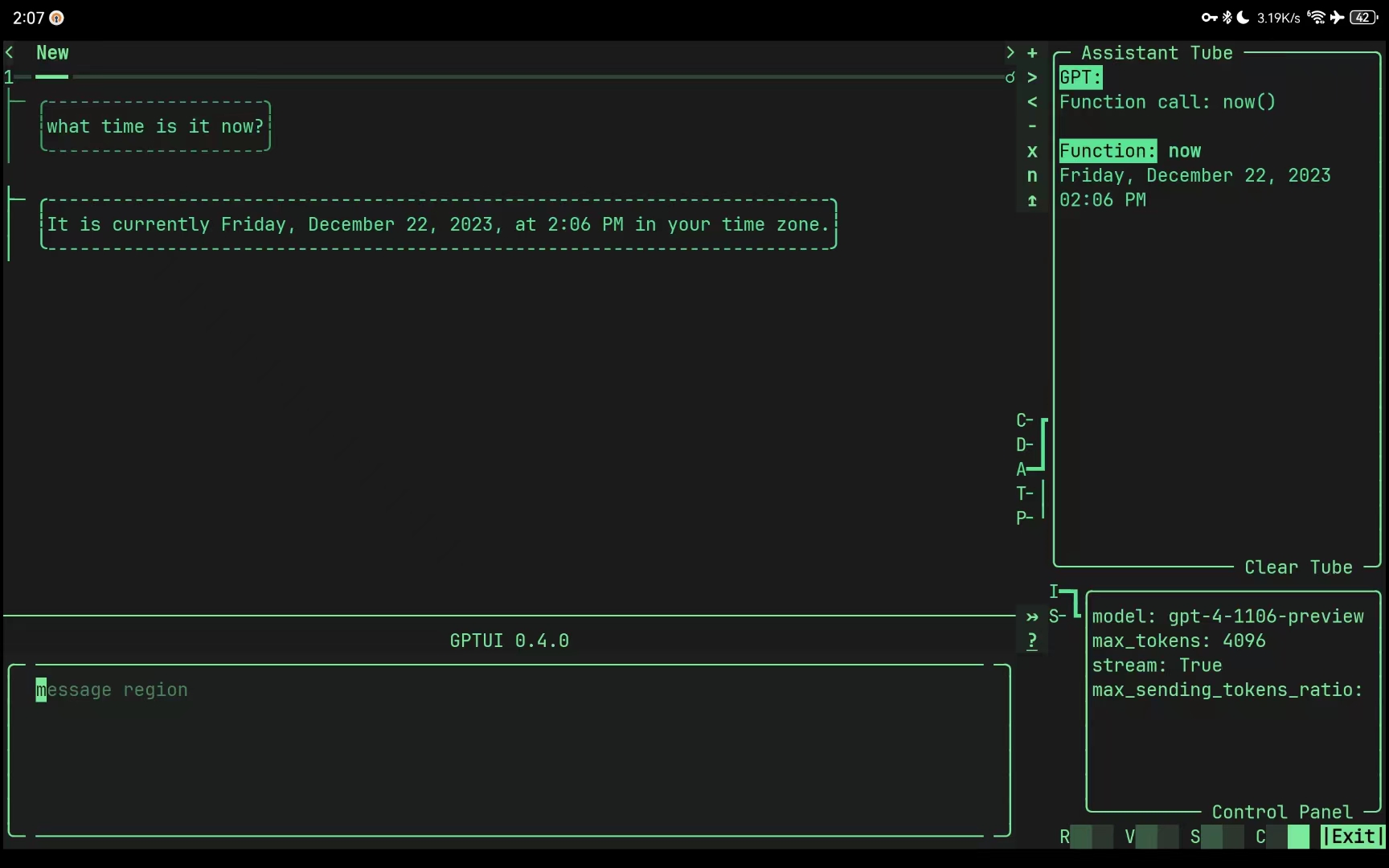
16 |
17 | Today, I'm thrilled to announce that this feature has finally been integrated into GPTUI with the release
18 | of v0.4.0. Initially, my ambition was to enable support for user-customizable themes. However, I quickly
19 | realized that the task was more complex than I had imagined. It wasn't just about altering dynamic display
20 | content; I also had to modify existing page layouts. Achieving comprehensive theme settings for all elements
21 | via a configuration file proved to be quite intricate. As a result, for the time being, we've only implemented
22 | this single built-in monochrome theme. But rest assured, plans are in place to introduce more customizable theme
23 | options in the future, allowing users to configure themes directly from a file. The beauty of this monochrome
24 | theme is its dynamic activation capability; you can activate or deactivate it at any moment using the ctrl+o
25 | shortcut. While the mode is undeniably cool, distinguishing certain elements, like user and AI chat content,
26 | can be somewhat challenging in monochrome. Currently, differentiation is based solely on border brightness,
27 | so the ability to easily switch off monochrome mode and revert is essential.
28 |
29 | The Textual TUI framework is absolutely marvelous, and I'm so fortunate to have chosen it. While developing the
30 | monochrome mode, I encountered several challenges, and in some instances, I had to employ rather crude and
31 | unsightly methods to achieve my objectives. However, after reaching out for assistance in the Textual Discord
32 | community and receiving invaluable support from the official team, I was able to implement it with grace and
33 | efficiency. The Textual developer community is not only active but also immensely supportive. I've learned a
34 | great deal from their projects and am deeply grateful for the Textual team's beautiful work.
35 |
36 | Next, I will write a comprehensive and detailed user guide for GPTUI.
37 |
--------------------------------------------------------------------------------
/src/gptui/models/openai_chat_inner_service.py:
--------------------------------------------------------------------------------
1 | import copy
2 | import logging
3 | from typing import Iterable
4 |
5 | from openai import OpenAI
6 |
7 | from .context import OpenaiContext
8 | from .openai_error import OpenaiErrorHandler
9 | from .openai_tokens_truncate import trim_excess_tokens
10 | from .utils.openai_api import OpenAIClient
11 | from .utils.tokens_num import tokens_num_for_functions_call
12 |
13 |
14 | gptui_logger = logging.getLogger("gptui_logger")
15 |
16 |
17 | def chat_service_for_inner(
18 | messages_list: list,
19 | context: OpenaiContext,
20 | openai_api_client: OpenAIClient,
21 | **kwargs,
22 | ) -> Iterable:
23 |
24 | inner_context = copy.deepcopy(context)
25 |
26 | for one_message in messages_list:
27 | inner_context.chat_context_append(message=one_message)
28 |
29 | # update parameters
30 | parameters = inner_context.parameters
31 | parameters.update({"stream": True})
32 | parameters.update(**kwargs)
33 |
34 | if tools_info := parameters.get("tools"):
35 | offset_tokens_num = -tokens_num_for_functions_call(tools_info, model=inner_context.parameters["model"])
36 | else:
37 | offset_tokens_num = 0
38 | trimmed_messages = trim_excess_tokens(inner_context, offset=offset_tokens_num)
39 |
40 | # Delete the tool reply messages at the beginning of the information list.
41 | # This is because if the information starts with a function reply message,
42 | # it indicates that the function call information has already been truncated.
43 | # The OpenAI API requires that function reply messages must be responses to function calls.
44 | # Therefore, if the function reply messages are not removed, it will result in an OpenAI API error.
45 | while trimmed_messages and trimmed_messages[0].get("role") == "tool":
46 | trimmed_messages.pop(0)
47 |
48 | try:
49 | response = openai_api_client.with_options(timeout=20.0).chat.completions.create(
50 | messages=trimmed_messages,
51 | **parameters,
52 | )
53 | except Exception as e:
54 | gptui_logger.debug('----trimmed_messages----in chat inner')
55 | gptui_logger.debug(trimmed_messages)
56 | # The OpenAI API interface is a time-consuming synchronous interface, so it should be called in a new thread, hence there is no event loop here.
57 | OpenaiErrorHandler().openai_error_handle(error=e, context=inner_context, event_loop=False)
58 | raise e
59 | return response
60 |
--------------------------------------------------------------------------------
/src/gptui/plugins/MemoryRecall.py:
--------------------------------------------------------------------------------
1 | import json
2 | import logging
3 |
4 | from semantic_kernel.orchestration.sk_context import SKContext
5 | from semantic_kernel.skill_definition import sk_function, sk_function_context_parameter
6 |
7 | from gptui.gptui_kernel.manager import auto_init_params
8 |
9 |
10 | gptui_logger = logging.getLogger("gptui_logger")
11 |
12 |
13 | class MemoryRecall:
14 | def __init__(self, manager):
15 | self.manager = manager
16 |
17 | @auto_init_params("0")
18 | @classmethod
19 | def get_init_params(cls, manager) -> tuple:
20 | return (manager,)
21 |
22 | @sk_function(
23 | description="Recall the specified content from the memory store.",
24 | name="recall_memory",
25 | )
26 | @sk_function_context_parameter(
27 | name="query",
28 | description="Topics, questions, etc., that one needs to recall."
29 | )
30 | @sk_function_context_parameter(
31 | name="max_recallable_entries",
32 | description="Maximum number of recallable information entries.",
33 | default_value="1"
34 | )
35 | @sk_function_context_parameter(
36 | name="openai_context",
37 | description=(
38 | "The dictionary string version of the OpenaiContext instance. "
39 | "This is a special parameter that typically doesn't require manual intervention, as it is usually automatically managed."
40 | "Unless there's a clear intention, please keep its default value."
41 | ),
42 | default_value="AUTO"
43 | )
44 | async def recall_memory(self, context: SKContext) -> str:
45 | query = context["query"]
46 | max_recallable_entries = int(context["max_recallable_entries"])
47 | openai_context_dict = json.loads(str(context["openai_context"]))
48 | conversation_id = openai_context_dict["id"]
49 | semantic_memory = self.manager.services.sk_kernel.memory
50 | try:
51 | result = await semantic_memory.search_async(str(conversation_id), query, limit=max_recallable_entries, min_relevance_score=0.7)
52 | except Exception as e:
53 | gptui_logger.error(f"Error occurred when recall memory. Error: {e}")
54 | return "An error occurred during the query, please try again later."
55 | result_str = ""
56 | for memory in result:
57 | result_str += memory.id + "\n"
58 | if not result_str:
59 | result_str = "No relevant information was found"
60 | gptui_logger.info(f"Recall memory result:\nconversation_id: {conversation_id}\nResult: {result_str}")
61 | return result_str
62 |
--------------------------------------------------------------------------------
/src/gptui/plugins/OpenInterpreter.py:
--------------------------------------------------------------------------------
1 | """ wait for open-interpreter to be compatible with openai version 1.1.1
2 | import asyncio
3 | import logging
4 |
5 | from semantic_kernel.skill_definition import sk_function
6 |
7 | from gptui.utils.open_interpreter import MyInterpreter, response_render
8 | from gptui.utils.safe_iterate import safe_next, safe_send
9 |
10 |
11 | gptui_logger = logging.getLogger("gptui_logger")
12 |
13 |
14 | class OpenInterpreter:
15 |
16 | def __init__(self):
17 | self.interpreter = MyInterpreter()
18 | self.in_chat = False
19 | self.chat = None
20 | self.result = None
21 |
22 | @sk_function(
23 | description=(
24 | "A code assistant that allows for continuous dialogue in natural language. "
25 | "It can be invoked continuously multiple times"
26 | "Describe your needs to it, and it will automatically write and execute code to help you accomplish tasks. "
27 | "When asked whether to execute the code, respond to this function precisely with 'y' or 'n'. "
28 | "Before responding with 'y', you should first seek the user's consent."
29 | ),
30 | name="open_interpreter",
31 | input_description="Your needs.",
32 | )
33 | async def open_interpreter(self, input_request: str) -> str:
34 | if not self.in_chat:
35 | self.chat = self.interpreter.chat(str(input_request))
36 | status, out = await asyncio.to_thread(safe_next, self.chat)
37 | if status == "OK":
38 | self.in_chat = True
39 | else:
40 | self.in_chat = False
41 | result = response_render(out)
42 | gptui_logger.info(f"Open interpreter response: {result}")
43 | self.new_chat = False
44 | return result
45 | else:
46 | assert self.chat is not None
47 | status, out = await asyncio.to_thread(safe_send, self.chat, str(input_request))
48 | if status == "OK":
49 | self.in_chat = True
50 | else:
51 | self.in_chat = False
52 | result = response_render(out)
53 | gptui_logger.info(f"Open interpreter response: {result}")
54 | return result
55 |
56 | @sk_function(
57 | description=(
58 | "Terminate the interaction with the open interpreter, resetting it to a fresh state. "
59 | "Whenever you finish a task with the open interpreter or no longer need it, you should promptly end the interaction with it."
60 | )
61 | )
62 | def end_open_interpreter(self):
63 | self.interpreter.reset()
64 | gptui_logger.info("Open interpreter reset.")
65 | return "Successfully terminated the interaction with the open interpreter."
66 |
67 | """
68 |
--------------------------------------------------------------------------------
/src/gptui/controllers/chat_context_control.py:
--------------------------------------------------------------------------------
1 | import logging
2 |
3 | from .dash_board_control import DashBoard
4 | from ..models.signals import chat_context_extend_signal, chat_context_extend_for_sending_signal
5 | from ..views.common_message import CommonMessage
6 |
7 | gptui_logger = logging.getLogger("gptui_logger")
8 |
9 |
10 | class ChatContextControl:
11 | def __init__(self, app):
12 | self.app = app
13 | self.dash_board = DashBoard(app)
14 | self.chat_context_to_vectorize_buffer = {}
15 | chat_context_extend_signal.connect(self.chat_context_extend)
16 | chat_context_extend_for_sending_signal.connect(self.chat_context_extend_for_sending)
17 |
18 | def chat_context_extend(self, sender, **kwargs):
19 | signal_message = kwargs["message"]
20 | signal_content = signal_message["content"]
21 | messages = signal_content["messages"]
22 | context = signal_content["context"]
23 | openai_chat = self.app.openai.openai_chat
24 |
25 | openai_chat.chat_messages_extend(messages_list=messages, context=context)
26 | buffer_messages = self.chat_context_to_vectorize_buffer.get(context.id, [])
27 | buffer_messages.extend(messages)
28 | self.chat_context_to_vectorize_buffer[context.id] = buffer_messages
29 |
30 | _, whether_insert = self.app.openai.auto_bead_insert(context.id)
31 |
32 | if whether_insert is False:
33 | # dashboard display
34 | model = context.parameters["model"]
35 | self.dash_board.dash_board_display(tokens_num_window=self.app.get_tokens_window(model))
36 |
37 | def chat_context_extend_for_sending(self, sender, **kwargs):
38 | signal_message = kwargs["message"]
39 | signal_content = signal_message["content"]
40 | messages = signal_content["messages"]
41 | context = signal_content["context"]
42 | openai_chat = self.app.openai.openai_chat
43 |
44 | openai_chat.chat_messages_extend(messages_list=messages, context=context)
45 | buffer_messages = self.chat_context_to_vectorize_buffer.get(context.id, [])
46 | buffer_messages.extend(messages)
47 | self.chat_context_to_vectorize_buffer[context.id] = buffer_messages
48 |
49 | self.app.openai.auto_bead_insert(context.id)
50 |
51 | async def chat_context_vectorize(self):
52 | while self.chat_context_to_vectorize_buffer:
53 | id, messages_list = self.chat_context_to_vectorize_buffer.popitem()
54 | self.app.post_message(
55 | CommonMessage(
56 | message_name="vector_memory_write",
57 | message_content={
58 | "messages_list": messages_list,
59 | "context_id": id,
60 | }
61 | )
62 | )
63 |
--------------------------------------------------------------------------------
/src/gptui/utils/file_icon.py:
--------------------------------------------------------------------------------
1 | import logging
2 |
3 | from .my_text import MyText as Text
4 | from ..views.theme import theme_color as tc
5 |
6 | gptui_logger = logging.getLogger("gptui_logger")
7 |
8 |
9 | def file_icon(
10 | file_label: str,
11 | file_type: str,
12 | file_description: str,
13 | icon_color: str | None = None,
14 | description_color: str | None = None,
15 | ) -> Text:
16 | icon_color = icon_color or tc("yellow") or "yellow"
17 | description_color = description_color or tc("white") or "white"
18 |
19 | display = Text('', icon_color)
20 | if file_type == ".txt":
21 | display += Text('\u2595'+'\u2056\u0305'+'\u2056\u0305'+'\u2056\u0305'+'\u2572'+' \n')
22 | display += Text('\u2595'+f'{file_label[:3]}'+'\u2595'+' \n'+'\u2595')
23 | display += Text('txt\u2595', 'underline')
24 | elif file_type == ".md":
25 | display += Text('\u2595'+' \u0305'+'\ueb1d\u0305'+' \u0305'+'\u2572'+' \n')
26 | display += Text('\u2595'+f'{file_label[:3]}'+'\u2595'+' \n'+'\u2595')
27 | display += Text('.md\u2595', 'underline')
28 | elif file_type == ".bin":
29 | display += Text('\u2595'+'l\u0305'+'l\u0305'+'l\u0305'+'l\u0305'+'l\u0305'+'l\u0305'+'l\u0305'+'\u2572'+' \n')
30 | display += Text('\u2595'+f'{file_label[:3]}'+'\u2595'+' \n'+'\u2595')
31 | display += Text('bin\u2595', 'underline')
32 | elif file_type == ".json":
33 | display += Text('\u2595'+' \u0305'+'{\u0305'+' \u0305'+'}\u0305'+'\u2572'+' \n')
34 | display += Text('\u2595'+f'{file_label[:3]}'+'\u2595'+' \n'+'\u2595')
35 | display += Text('jsn\u2595', 'underline')
36 | elif file_type == ".py":
37 | display += Text('\u2595'+' \u0305'+'\ue606\u0305'+' \u0305'+'\u2572'+' \n')
38 | display += Text('\u2595'+f'{file_label[:3]}'+'\u2595'+' \n'+'\u2595')
39 | display += Text('.\uf820 \u2595', 'underline')
40 | elif file_type == ".sh":
41 | display += Text('\u2595'+'<\u0305'+'\u29f8\u0305'+'>\u0305'+'\u2572'+' \n')
42 | display += Text('\u2595'+f'{file_label[:3]}'+'\u2595'+' \n'+'\u2595')
43 | display += Text('.sh\u2595', 'underline')
44 | else:
45 | file_type += ' '
46 | display += Text('\u2595'+'\u203e'+'\u203e'+'\u203e'+'\u29f9'+' \n')
47 | display += Text('\u2595'+f'{file_label[:3]}'+'\u2595'+' \n'+'\u2595')
48 | display += Text(f'{file_type[:3]}\u2595', 'underline')
49 | if len(file_description) > 12:
50 | description_line0 = file_description[:6] + '\n'
51 | description_line1 = '\u2026' + file_description[-5:] + '\n'
52 | else:
53 | file_description = file_description.ljust(12)
54 | description_line0 = file_description[:6] + '\n'
55 | description_line1 = file_description[6:] + '\n'
56 | description = Text(' \n' + description_line0 + description_line1, f'{description_color}')
57 | out_display = display + description
58 | return out_display
59 |
--------------------------------------------------------------------------------
/src/gptui/models/utils/tokens_num.py:
--------------------------------------------------------------------------------
1 | import logging
2 | import tiktoken
3 |
4 |
5 | gptui_logger = logging.getLogger("gptui_logger")
6 |
7 |
8 | def tokens_num_from_string(string: str, model: str) -> int:
9 | """
10 | caculate the tokens num of given string
11 | """
12 | encoding = tiktoken.encoding_for_model(model)
13 | tokens_num = len(encoding.encode(string))
14 | return tokens_num
15 |
16 | def tokens_num_from_chat_context(chat_context: list, model: str) -> int:
17 | """Returns the number of tokens used by a list of messages."""
18 | try:
19 | encoding = tiktoken.encoding_for_model(model)
20 | except KeyError:
21 | gptui_logger.warning("Warning when caculate tokens num: model not found. Using cl100k_base encoding.")
22 | encoding = tiktoken.get_encoding("cl100k_base")
23 | if model == "gpt-3.5-turbo":
24 | gptui_logger.warning("Warning when caculate tokens num: gpt-3.5-turbo may change over time. Returning num tokens assuming gpt-3.5-turbo-1106.")
25 | return tokens_num_from_chat_context(chat_context, model="gpt-3.5-turbo-1106")
26 | elif model == "gpt-4":
27 | gptui_logger.warning("Warning when caculate tokens num: gpt-4 may change over time. Returning tokens num assuming gpt-4-0613.")
28 | return tokens_num_from_chat_context(chat_context, model="gpt-4-0613")
29 | elif model == "gpt-3.5-turbo-0301":
30 | tokens_per_message = 4 # every message follows <|start|>{role/name}\n{content}<|end|>\n
31 | tokens_per_name = -1 # if there's a name, the role is omitted
32 | elif model in {
33 | "gpt-3.5-turbo-0613",
34 | "gpt-3.5-turbo-16k-0613",
35 | "gpt-4-0314",
36 | "gpt-4-32k-0314",
37 | "gpt-4-0613",
38 | "gpt-4-32k-0613",
39 | "gpt-3.5-turbo-1106", # Unverified.
40 | "gpt-4-1106-preview", # Unverified.
41 | }:
42 | tokens_per_message = 3
43 | tokens_per_name = 1
44 | else:
45 | gptui_logger.error(f"""tokens_num_from_chat_context() is not implemented for model {model}. See https://github.com/openai/openai-python/blob/main/chatml.md for information on how messages are converted to tokens.""")
46 | raise NotImplementedError(f"""tokens_num_from_messages() is not implemented for model {model}. See https://github.com/openai/openai-python/blob/main/chatml.md for information on how messages are converted to tokens.""")
47 | tokens_num = 0
48 | for message in chat_context:
49 | tokens_num += tokens_per_message
50 | for key, value in message.items():
51 | tokens_num += len(encoding.encode(str(value)) if value else [])
52 | if key == "name":
53 | tokens_num += tokens_per_name
54 | tokens_num += 3 # every reply is primed with <|start|>assistant<|message|>
55 | return tokens_num
56 |
57 | def tokens_num_for_functions_call(functions_info: list[dict], model: str) -> int:
58 | return tokens_num_from_string(repr(functions_info), model=model)
59 |
--------------------------------------------------------------------------------
/docs/troubleshooting.md:
--------------------------------------------------------------------------------
1 | # Potential issues and solutions when installing on Termux
2 |
3 | ## Installing Termux-API
4 |
5 | Some functionalities require the support of Termux-API, such as copying code snippets and voice features.
6 | To install Termux-API, you need to:
7 | 1. Install the Termux-API plugin. The Termux:API application can be obtained from [F-Droid](https://f-droid.org/en/packages/com.termux.api/).
8 | 2. After installing Termux-API, you also need to execute `pkg install termux-api` in Termux to install the corresponding package.
9 | 3. Grant the necessary permissions to Termux-API.
10 |
11 | ## Installing numpy
12 |
13 | First, ensure that numpy is installed. You can use `pkg install python-numpy` to install numpy, referring to [Termux Wiki](https://wiki.termux.com/wiki/Python). If using a virtual environment, you might need to use `python -m venv --system-site-packages ` to make python-numpy available within the virtual environment.
14 |
15 | ## Installing lxml
16 |
17 | ```
18 | pkg update && pkg upgrade
19 | pkg install python libxml2 libxslt pkg-config
20 | pip install cython wheel
21 | CFLAGS="-Wno-error=incompatible-function-pointer-types -O0" pip install lxml
22 | ```
23 |
24 | ## Possible issues when installing qdrant-client on Termux
25 |
26 | ### Installation of maturin is required
27 |
28 | ```
29 | pkg rem binutils -y
30 | apt autoremove
31 | pkg i binutils-is-llvm rust -y
32 | pip install maturin
33 | ```
34 |
35 | ### Installation of grpcio is required
36 |
37 | Make sure you have the header `ares.h` in `/data/data/com.termux/files/usr/include`.
38 | You can install it using: `pkg install c-ares`.
39 | Then:
40 |
41 | ```
42 | GRPC_PYTHON_DISABLE_LIBC_COMPATIBILITY=1 \
43 | GRPC_PYTHON_BUILD_SYSTEM_OPENSSL=1 \
44 | GRPC_PYTHON_BUILD_SYSTEM_ZLIB=1 \
45 | GRPC_PYTHON_BUILD_SYSTEM_CARES=1 \
46 | CFLAGS+=" -U__ANDROID_API__ -D__ANDROID_API__=26 -include unistd.h" \
47 | LDFLAGS+=" -llog" \
48 | pip install grpcio
49 | ```
50 | If it still doesn't work, refer to [here](https://github.com/termux/termux-packages/issues/17583).
51 |
52 | ## Failed to build wheel when installing ruamel.yaml.clib
53 |
54 | When installing or updating semantic-kernel to version 0.3.11.dev0 or later, the ruamel.yaml.clib library is required.
55 | If you encounter a "failed to build wheel" error, the solution is as follows:
56 | ```
57 | pkg upgrade
58 | pkg install build-essential python
59 | CFLAGS="-Wno-incompatible-function-pointer-types" pip install ruamel.yaml.clib
60 | ```
61 |
62 | ## Failed to build wheel for `playsound`
63 |
64 | If you encounter a 'Failed to build wheel' error during the installation of playsound,
65 | please ensure that `wheel` and `setuptools` are installed on your system.
66 | You can install these build tools by running the command
67 | ```
68 | pip install wheel setuptools
69 | ```
70 | in your terminal or command prompt.
71 |
72 |
73 | # Potential issues and solutions on MacOS
74 |
75 | ## The audio playback function is not working properly
76 |
77 | ```
78 | pip3 install PyObjC
79 | ```
80 |
--------------------------------------------------------------------------------
/src/gptui/data/langchain/document_loaders/base.py:
--------------------------------------------------------------------------------
1 | """Abstract interface for document loader implementations."""
2 | from abc import ABC, abstractmethod
3 | from typing import Iterator, List, Optional
4 |
5 | from .blob_loaders import Blob
6 | from ..schema import Document
7 | from ..text_splitter import RecursiveCharacterTextSplitter, TextSplitter
8 |
9 |
10 | class BaseLoader(ABC):
11 | """Interface for loading documents.
12 |
13 | Implementations should implement the lazy-loading method using generators
14 | to avoid loading all documents into memory at once.
15 |
16 | The `load` method will remain as is for backwards compatibility, but its
17 | implementation should be just `list(self.lazy_load())`.
18 | """
19 |
20 | # Sub-classes should implement this method
21 | # as return list(self.lazy_load()).
22 | # This method returns a List which is materialized in memory.
23 | @abstractmethod
24 | def load(self) -> List[Document]:
25 | """Load data into document objects."""
26 |
27 | def load_and_split(
28 | self, text_splitter: Optional[TextSplitter] = None
29 | ) -> List[Document]:
30 | """Load documents and split into chunks."""
31 | if text_splitter is None:
32 | _text_splitter: TextSplitter = RecursiveCharacterTextSplitter()
33 | else:
34 | _text_splitter = text_splitter
35 | docs = self.load()
36 | return _text_splitter.split_documents(docs)
37 |
38 | # Attention: This method will be upgraded into an abstractmethod once it's
39 | # implemented in all the existing subclasses.
40 | def lazy_load(
41 | self,
42 | ) -> Iterator[Document]:
43 | """A lazy loader for document content."""
44 | raise NotImplementedError(
45 | f"{self.__class__.__name__} does not implement lazy_load()"
46 | )
47 |
48 |
49 | class BaseBlobParser(ABC):
50 | """Abstract interface for blob parsers.
51 |
52 | A blob parser is provides a way to parse raw data stored in a blob into one
53 | or more documents.
54 |
55 | The parser can be composed with blob loaders, making it easy to re-use
56 | a parser independent of how the blob was originally loaded.
57 | """
58 |
59 | @abstractmethod
60 | def lazy_parse(self, blob: Blob) -> Iterator[Document]:
61 | """Lazy parsing interface.
62 |
63 | Subclasses are required to implement this method.
64 |
65 | Args:
66 | blob: Blob instance
67 |
68 | Returns:
69 | Generator of documents
70 | """
71 |
72 | def parse(self, blob: Blob) -> List[Document]:
73 | """Eagerly parse the blob into a document or documents.
74 |
75 | This is a convenience method for interactive development environment.
76 |
77 | Production applications should favor the lazy_parse method instead.
78 |
79 | Subclasses should generally not over-ride this parse method.
80 |
81 | Args:
82 | blob: Blob instance
83 |
84 | Returns:
85 | List of documents
86 | """
87 | return list(self.lazy_parse(blob))
88 |
--------------------------------------------------------------------------------
/src/gptui/data/langchain/schema/document.py:
--------------------------------------------------------------------------------
1 | from __future__ import annotations
2 |
3 | from abc import ABC, abstractmethod
4 | from typing import Any, Sequence
5 |
6 | from ..load.serializable import Serializable
7 | from ..pydantic_v1 import Field
8 |
9 |
10 | class Document(Serializable):
11 | """Class for storing a piece of text and associated metadata."""
12 |
13 | page_content: str
14 | """String text."""
15 | metadata: dict = Field(default_factory=dict)
16 | """Arbitrary metadata about the page content (e.g., source, relationships to other
17 | documents, etc.).
18 | """
19 |
20 | @classmethod
21 | def is_lc_serializable(cls) -> bool:
22 | """Return whether this class is serializable."""
23 | return True
24 |
25 |
26 | class BaseDocumentTransformer(ABC):
27 | """Abstract base class for document transformation systems.
28 |
29 | A document transformation system takes a sequence of Documents and returns a
30 | sequence of transformed Documents.
31 |
32 | Example:
33 | .. code-block:: python
34 |
35 | class EmbeddingsRedundantFilter(BaseDocumentTransformer, BaseModel):
36 | embeddings: Embeddings
37 | similarity_fn: Callable = cosine_similarity
38 | similarity_threshold: float = 0.95
39 |
40 | class Config:
41 | arbitrary_types_allowed = True
42 |
43 | def transform_documents(
44 | self, documents: Sequence[Document], **kwargs: Any
45 | ) -> Sequence[Document]:
46 | stateful_documents = get_stateful_documents(documents)
47 | embedded_documents = _get_embeddings_from_stateful_docs(
48 | self.embeddings, stateful_documents
49 | )
50 | included_idxs = _filter_similar_embeddings(
51 | embedded_documents, self.similarity_fn, self.similarity_threshold
52 | )
53 | return [stateful_documents[i] for i in sorted(included_idxs)]
54 |
55 | async def atransform_documents(
56 | self, documents: Sequence[Document], **kwargs: Any
57 | ) -> Sequence[Document]:
58 | raise NotImplementedError
59 |
60 | """ # noqa: E501
61 |
62 | @abstractmethod
63 | def transform_documents(
64 | self, documents: Sequence[Document], **kwargs: Any
65 | ) -> Sequence[Document]:
66 | """Transform a list of documents.
67 |
68 | Args:
69 | documents: A sequence of Documents to be transformed.
70 |
71 | Returns:
72 | A list of transformed Documents.
73 | """
74 |
75 | @abstractmethod
76 | async def atransform_documents(
77 | self, documents: Sequence[Document], **kwargs: Any
78 | ) -> Sequence[Document]:
79 | """Asynchronously transform a list of documents.
80 |
81 | Args:
82 | documents: A sequence of Documents to be transformed.
83 |
84 | Returns:
85 | A list of transformed Documents.
86 | """
87 |
--------------------------------------------------------------------------------
/src/gptui/plugins/DEFAULT_PLUGINS/CoreSkills.py:
--------------------------------------------------------------------------------
1 | import datetime
2 | import logging
3 |
4 | import geocoder
5 | from semantic_kernel.orchestration.sk_context import SKContext
6 | from semantic_kernel.sk_pydantic import PydanticField
7 | from semantic_kernel.skill_definition import sk_function, sk_function_context_parameter
8 |
9 | from gptui.gptui_kernel.manager import auto_init_params
10 |
11 |
12 | gptui_logger = logging.getLogger("gptui_logger")
13 |
14 |
15 | class TimeSkill(PydanticField):
16 |
17 | @sk_function(description="Get the current date and time in the local time zone")
18 | def now(self) -> str:
19 | """
20 | Get the current date and time in the local time zone"
21 |
22 | Example:
23 | {{time.now}} => Sunday, January 12, 2031 9:15 PM
24 | """
25 | now = datetime.datetime.now()
26 | return now.strftime("%A, %B %d, %Y %I:%M %p")
27 |
28 |
29 | class LocationSkill:
30 | def __init__(self, manager):
31 | self.manager = manager
32 |
33 | @auto_init_params("0")
34 | @classmethod
35 | def get_init_params(cls, manager) -> tuple:
36 | return (manager,)
37 |
38 | @sk_function(description="Get the user's city")
39 | def city(self) -> str:
40 | config = self.manager.client.config
41 | city = config.get("location_city")
42 | if not city:
43 | city = geocoder.ip('me').city
44 | return str(city)
45 |
46 |
47 | class MathSkill(PydanticField):
48 |
49 | @sk_function(
50 | description="Calculate addition, subtraction, multiplication, and division",
51 | name="calculate",
52 | )
53 | @sk_function_context_parameter(
54 | name="first_number",
55 | description="The first number",
56 | )
57 | @sk_function_context_parameter(
58 | name="second_number",
59 | description="The second number",
60 | )
61 | @sk_function_context_parameter(
62 | name="operation",
63 | description="The operation to be performed. Options: ['addition', 'subtraction', 'multiplication', 'division']",
64 | )
65 | def calculate(self, context: SKContext) -> str:
66 | first_num = context["first_number"]
67 | second_num = context["second_number"]
68 | operation = context["operation"]
69 |
70 | try:
71 | first_num = float(first_num)
72 | second_num = float(second_num)
73 | except ValueError:
74 | return "The values provided is not in numeric format."
75 |
76 | if operation not in ['addition', 'subtraction', 'multiplication', 'division']:
77 | return "The provided operation name is incorrect. It must be one of 'addition', 'subtraction', 'multiplication', or 'division'"
78 |
79 | if operation == 'addition':
80 | result = first_num + second_num
81 | elif operation == 'subtraction':
82 | result = first_num - second_num
83 | elif operation == 'multiplication':
84 | result = first_num * second_num
85 | else:
86 | result = first_num / second_num
87 |
88 | return str(result)
89 |
--------------------------------------------------------------------------------
/src/gptui/views/wink_wink.py:
--------------------------------------------------------------------------------
1 | import asyncio
2 | import logging
3 | from abc import ABC, abstractmethod
4 |
5 | from rich.text import TextType
6 |
7 |
8 | gptui_logger = logging.getLogger("gptui_logger")
9 |
10 |
11 | class Happy(ABC):
12 |
13 | @abstractmethod
14 | def refresh(self, content, apple_width: int, apple_height: int) -> None:
15 | ...
16 |
17 | @property
18 | @abstractmethod
19 | def canvas_width(self) -> int:
20 | ...
21 |
22 | @property
23 | @abstractmethod
24 | def canvas_height(self) -> int:
25 | ...
26 |
27 |
28 | class Apple(ABC):
29 |
30 | @abstractmethod
31 | def frame(self, inp) -> tuple[bool, tuple[float, TextType]]:
32 | ...
33 |
34 | @property
35 | @abstractmethod
36 | def canvas_width(self) -> int:
37 | ...
38 |
39 | @property
40 | @abstractmethod
41 | def canvas_height(self) -> int:
42 | ...
43 |
44 |
45 | class Horse:
46 | def __init__(self):
47 | self.input = None
48 | self.happy = None
49 | self.apple = None
50 | self.run_status = False
51 | self._stop_flag = False
52 | self._stop_async_flag = False
53 | self._stop_async_event = asyncio.Event()
54 |
55 | def set_happy(self, happy: Happy) -> None:
56 | self.happy = happy
57 |
58 | def refresh_input(self, user_input: str) -> None:
59 | self.input = user_input
60 |
61 | def stop(self):
62 | self._stop_flag = True
63 |
64 | async def stop_async(self):
65 | if self.run_status is False:
66 | return
67 | self._stop_async_event.clear()
68 | self._stop_async_flag = True
69 | await self._stop_async_event.wait()
70 |
71 | async def run(self, apple: Apple, size_check: bool = True) -> bool:
72 | self.run_status = True
73 | assert self.happy is not None
74 | self._stop_flag = False
75 | self._stop_async_flag = False
76 | self.apple = apple
77 | if size_check:
78 | if (apple.canvas_width > self.happy.canvas_width) or (apple.canvas_height > self.happy.canvas_height):
79 | self.run_status = False
80 | return False
81 |
82 | status = True
83 | while status:
84 | inp = self.input
85 | self.input = None
86 | status, frame_info = apple.frame(inp)
87 | if self._stop_flag or self._stop_async_flag:
88 | break
89 | await self.frame_handle(frame_info)
90 |
91 | if self._stop_async_flag:
92 | self._stop_async_event.set()
93 | self.run_status = False
94 | return True
95 |
96 | async def frame_handle(self, frame_info: tuple[float, TextType] | None) -> None:
97 | if frame_info is None:
98 | return
99 | interval, frame = frame_info
100 | await asyncio.sleep(interval)
101 | self.happy_render(frame)
102 |
103 | def happy_render(self, content: TextType):
104 | assert self.happy is not None
105 | assert self.apple is not None
106 | self.happy.refresh(content, self.apple.canvas_width, self.apple.canvas_height)
107 |
--------------------------------------------------------------------------------
/src/gptui/__main__.py:
--------------------------------------------------------------------------------
1 | import argparse
2 | import importlib
3 | import logging
4 | import os
5 | import shutil
6 | import sys
7 | import yaml
8 |
9 | from .__init__ import __version__ as gptui_version
10 | from .views.tui import MainApp
11 |
12 | APP_VERSION = gptui_version
13 |
14 |
15 | class ConfigManager:
16 |
17 | @staticmethod
18 | def get_config_path_from_args():
19 | parser = argparse.ArgumentParser(description="gptui cli")
20 | parser.add_argument('--config', type=str, help='Path to the configuration file.')
21 | args = parser.parse_args()
22 | return os.path.expanduser(args.config) if args.config else None
23 |
24 | @staticmethod
25 | def copy_default_config_to_user_home():
26 | default_config_path = importlib.resources.files("gptui") / "config.yml"
27 | user_config_path = os.path.expanduser('~/.gptui/.config.yml')
28 |
29 | if not os.path.exists(user_config_path):
30 | target_dir = os.path.dirname(user_config_path)
31 | os.makedirs(target_dir, exist_ok=True)
32 | shutil.copy(default_config_path, user_config_path)
33 | return user_config_path
34 |
35 | @staticmethod
36 | def get_config_path():
37 | config_path = ConfigManager.get_config_path_from_args()
38 |
39 | if config_path:
40 | if os.path.exists(config_path):
41 | return config_path
42 | else:
43 | print(f"Config file '{config_path}' dose not exist.")
44 | sys.exit(1)
45 |
46 | user_config_path = os.path.expanduser('~/.gptui/.config.yml')
47 | if os.path.exists(user_config_path):
48 | return user_config_path
49 |
50 | return ConfigManager.copy_default_config_to_user_home()
51 |
52 | def gptui():
53 | config_path = ConfigManager.get_config_path()
54 | gptui_run(config_path=config_path)
55 |
56 | def gptui_run(config_path: str) -> None:
57 | # Retrieve config from config path.
58 | try:
59 | with open(os.path.join(os.path.dirname(__file__), '.default_config.yml'), "r") as default_config_file:
60 | config = yaml.safe_load(default_config_file)
61 | except FileNotFoundError:
62 | print(f"Default config file '.default_config.yml' is not found.")
63 | sys.exit(1)
64 | try:
65 | with open(config_path, "r") as config_file:
66 | user_config = yaml.safe_load(config_file)
67 | except FileNotFoundError:
68 | pass
69 | else:
70 | config.update(user_config)
71 |
72 | log_path = os.path.expanduser(config["log_path"])
73 | log_level_dict = {
74 | "DEBUG": logging.DEBUG,
75 | "INFO": logging.INFO,
76 | "WARNING": logging.WARNING,
77 | "ERROR": logging.ERROR,
78 | "CRITICAL": logging.CRITICAL,
79 | }
80 |
81 | log_dir = os.path.dirname(log_path)
82 | if not os.path.exists(log_dir):
83 | os.makedirs(log_dir)
84 |
85 | logging.basicConfig(
86 | filename=log_path,
87 | filemode='w',
88 | level=log_level_dict.get(config["log_level"], logging.INFO),
89 | format="%(asctime)s - %(name)s - %(levelname)s -[%(funcName)s] - %(message)s",
90 | )
91 | gptui_logger = logging.getLogger('gptui_logger')
92 |
93 | app = MainApp(config_path, app_version=APP_VERSION)
94 | reply = app.run()
95 | if reply:
96 | print(reply)
97 |
98 |
99 | if __name__ == "__main__":
100 |
101 | config_path = os.path.join(os.path.dirname(__file__), "config.yml")
102 | gptui_run(config_path=config_path)
103 |
--------------------------------------------------------------------------------
/src/gptui/controllers/tube_files_control.py:
--------------------------------------------------------------------------------
1 | import logging
2 |
3 | import aiofiles
4 |
5 | from ..models.doc import Doc
6 | from ..models.skills import UploadFile
7 | from ..utils.my_text import MyText as Text
8 | from ..views.theme import theme_color as tc
9 |
10 |
11 | gptui_logger = logging.getLogger("gptui_logger")
12 |
13 |
14 | class TubeFiles:
15 | def __init__(self, displayer):
16 | self.displayer = displayer
17 |
18 | async def insert_files(self, *docs: Doc, input: str) -> str:
19 | if not docs:
20 | return input
21 | upload_file = UploadFile()
22 | return await upload_file.import_file_to_context(*docs, input=input)
23 |
24 | async def read_file_async(self, path: str, encoding="UTF-8") -> None | str:
25 | """
26 | Read a file
27 | Args:
28 | path -- The path to the file to read
29 | Returns:
30 | The contents of the file
31 | """
32 | try:
33 | async with aiofiles.open(path, "r", encoding=encoding) as fp:
34 | content = await fp.read()
35 | except FileNotFoundError:
36 | gptui_logger.error("File or directory not found")
37 | self.displayer.update(Text("File or directory not found", tc("yellow") or "yellow"))
38 | return
39 | except IsADirectoryError:
40 | gptui_logger.error("Specified path is a directory, not a file")
41 | self.displayer.update(Text("Specified path is a directory, not a file", tc("yellow") or "yellow"))
42 | return
43 | except UnicodeDecodeError:
44 | gptui_logger.error("File is not encoded properly")
45 | self.displayer.update(Text("File is not encoded properly", tc("yellow") or "yellow"))
46 | return
47 | except IOError as e:
48 | gptui_logger.error(f"An I/O error occurred: {e}")
49 | self.displayer.update(Text("An I/O error occurred", tc("yellow") or "yellow"))
50 | return
51 | except Exception as e:
52 | gptui_logger.error(f"Read file failed. An unexpected error occurred: {e}")
53 | self.displayer.update(Text(f"Read file failed. An unexpected error occurred: {e}", tc("yellow") or "yellow"))
54 | return
55 | else:
56 | return content
57 |
58 | async def write_file_async(self, file_path: str, file_content) -> bool:
59 | """
60 | Write a file
61 | """
62 | assert file_content is not None, "Content is required and should not be empty"
63 | assert file_path is not None, "Path is required and should not be empty"
64 | try:
65 | async with aiofiles.open(file_path, "w") as fp:
66 | await fp.write(file_content)
67 | except FileNotFoundError:
68 | gptui_logger.error("File or directory not found")
69 | self.displayer.update(Text("File or directory not found", tc("yellow") or "yellow"))
70 | return False
71 | except IsADirectoryError:
72 | gptui_logger.error("Specified path is a directory, not a file")
73 | self.displayer.update(Text("Specified path is a directory, not a file", tc("yellow") or "yellow"))
74 | return False
75 | except IOError as e:
76 | gptui_logger.error(f"An I/O error occurred: {e}")
77 | self.displayer.update(Text("An I/O error occurred", tc("yellow") or "yellow"))
78 | return False
79 | except Exception as e:
80 | gptui_logger.error(f"Read file failed. An unexpected error occurred: {e}")
81 | self.displayer.update(Text(f"Read file failed. An unexpected error occurred: {e}", tc("yellow") or "yellow"))
82 | return False
83 | else:
84 | return True
85 |
--------------------------------------------------------------------------------
/src/gptui/models/skills.py:
--------------------------------------------------------------------------------
1 | import importlib
2 | import logging
3 | import os
4 | from abc import ABCMeta, abstractmethod
5 |
6 | import semantic_kernel as sk
7 | from semantic_kernel.template_engine.prompt_template_engine import PromptTemplateEngine
8 |
9 | from .doc import Doc
10 | from ..gptui_kernel.manager import Manager
11 |
12 |
13 | gptui_logger = logging.getLogger("gptui_logger")
14 |
15 |
16 | class UploadFileInterface(metaclass=ABCMeta):
17 | @abstractmethod
18 | async def import_file_to_context(self, *docs: Doc, input: str) -> str:
19 | ...
20 |
21 |
22 | class Skills:
23 | def __init__(self, manager: Manager):
24 | self.manager = manager
25 |
26 | async def conversation_remember(self, conversation: str):
27 | to_string_function = self.manager.gk_kernel.sk_kernel.skills.get_function("conversation_service", "conversation_to_string")
28 | conversation_string = to_string_function(conversation)
29 | remember_function = self.manager.gk_kernel.sk_kernel.skills.get_function("conversation_service", "conversation_remember")
30 | summary = await remember_function.invoke_async(conversation_string)
31 | return str(summary)
32 |
33 |
34 | class UploadFile(UploadFileInterface):
35 |
36 | UPLOAD_FILE_PROMPT_PATH = os.path.join(os.path.dirname(__file__), "gptui_basic_services", "templates", "upload_file_prompt.txt")
37 |
38 | def __init__(self):
39 | self.prompt_template_engine = PromptTemplateEngine()
40 | self.kernel = sk.Kernel()
41 | try:
42 | with open(UploadFile.UPLOAD_FILE_PROMPT_PATH, "r") as import_prompt:
43 | self.template_text = import_prompt.read()
44 | except FileNotFoundError:
45 | gptui_logger.error("File not found")
46 | #self.app.query_one("#status_region").update(Text("File not found",'yellow'))
47 | except IsADirectoryError:
48 | gptui_logger.error("Specified path is a directory, not a file")
49 | #self.app.query_one("#status_region").update(Text("Specified path is a directory, not a file",'yellow'))
50 | except UnicodeDecodeError:
51 | gptui_logger.error("File is not encoded properly")
52 | #self.app.query_one("#status_region").update(Text("File is not encoded properly",'yellow'))
53 | except IOError as e:
54 | #self.app.query_one("#status_region").update(Text(f"An I/O error occurred: {e}",'yellow'))
55 | gptui_logger.error(f"An I/O error occurred: {e}")
56 | except Exception as e:
57 | #self.app.query_one("#status_region").update(Text('Have not sucessfully read memory.','yellow'))
58 | gptui_logger.error("Read file failed. An unexpected error occurred: {e}")
59 |
60 | async def import_file_to_context(self, *docs: Doc, input: str) -> str:
61 | if len(docs) >= 1:
62 | files_content = ''
63 | for index, doc in enumerate(docs[:-1]):
64 | file_title = f"===== Document #{index + 1} {doc.name + doc.ext} =====\n\n"
65 | files_content += file_title
66 | files_content += doc.content
67 | files_content += "\n\n" + "=" * (len(file_title) - 2) + "\n\n"
68 | file_title_last = f"===== Document #{len(docs)} {docs[-1].name + docs[-1].ext} =====\n\n"
69 | files_content += file_title_last
70 | files_content += docs[-1].content
71 | files_content += "\n\n" + "=" * (len(file_title_last) - 2)
72 | else:
73 | raise ValueError("There is no document!")
74 | context = self.kernel.create_new_context()
75 | context["input"] = input
76 | context["file_content"] = files_content
77 | result_prompt = await self.prompt_template_engine.render_async(template_text=self.template_text, context=context)
78 | return result_prompt
79 |
--------------------------------------------------------------------------------
/.gitignore:
--------------------------------------------------------------------------------
1 | user/
2 | venv-gptui/
3 | temp/
4 | *.log
5 | /litellm_uuid.txt
6 | .DS_Store
7 |
8 | # Byte-compiled / optimized / DLL files
9 | __pycache__/
10 | *.py[cod]
11 | *$py.class
12 |
13 | # C extensions
14 | *.so
15 |
16 | # Distribution / packaging
17 | .Python
18 | build/
19 | develop-eggs/
20 | dist/
21 | downloads/
22 | eggs/
23 | .eggs/
24 | lib/
25 | lib64/
26 | parts/
27 | sdist/
28 | var/
29 | wheels/
30 | share/python-wheels/
31 | *.egg-info/
32 | .installed.cfg
33 | *.egg
34 | MANIFEST
35 |
36 | # PyInstaller
37 | # Usually these files are written by a python script from a template
38 | # before PyInstaller builds the exe, so as to inject date/other infos into it.
39 | *.manifest
40 | *.spec
41 |
42 | # Installer logs
43 | pip-log.txt
44 | pip-delete-this-directory.txt
45 |
46 | # Unit test / coverage reports
47 | htmlcov/
48 | .tox/
49 | .nox/
50 | .coverage
51 | .coverage.*
52 | .cache
53 | nosetests.xml
54 | coverage.xml
55 | *.cover
56 | *.py,cover
57 | .hypothesis/
58 | .pytest_cache/
59 | cover/
60 |
61 | # Translations
62 | *.mo
63 | *.pot
64 |
65 | # Django stuff:
66 | *.log
67 | local_settings.py
68 | db.sqlite3
69 | db.sqlite3-journal
70 |
71 | # Flask stuff:
72 | instance/
73 | .webassets-cache
74 |
75 | # Scrapy stuff:
76 | .scrapy
77 |
78 | # Sphinx documentation
79 | docs/_build/
80 |
81 | # PyBuilder
82 | .pybuilder/
83 | target/
84 |
85 | # Jupyter Notebook
86 | .ipynb_checkpoints
87 |
88 | # IPython
89 | profile_default/
90 | ipython_config.py
91 |
92 | # pyenv
93 | # For a library or package, you might want to ignore these files since the code is
94 | # intended to run in multiple environments; otherwise, check them in:
95 | # .python-version
96 |
97 | # pipenv
98 | # According to pypa/pipenv#598, it is recommended to include Pipfile.lock in version control.
99 | # However, in case of collaboration, if having platform-specific dependencies or dependencies
100 | # having no cross-platform support, pipenv may install dependencies that don't work, or not
101 | # install all needed dependencies.
102 | #Pipfile.lock
103 |
104 | # poetry
105 | # Similar to Pipfile.lock, it is generally recommended to include poetry.lock in version control.
106 | # This is especially recommended for binary packages to ensure reproducibility, and is more
107 | # commonly ignored for libraries.
108 | # https://python-poetry.org/docs/basic-usage/#commit-your-poetrylock-file-to-version-control
109 | #poetry.lock
110 |
111 | # pdm
112 | # Similar to Pipfile.lock, it is generally recommended to include pdm.lock in version control.
113 | #pdm.lock
114 | # pdm stores project-wide configurations in .pdm.toml, but it is recommended to not include it
115 | # in version control.
116 | # https://pdm.fming.dev/#use-with-ide
117 | .pdm.toml
118 |
119 | # PEP 582; used by e.g. github.com/David-OConnor/pyflow and github.com/pdm-project/pdm
120 | __pypackages__/
121 |
122 | # Celery stuff
123 | celerybeat-schedule
124 | celerybeat.pid
125 |
126 | # SageMath parsed files
127 | *.sage.py
128 |
129 | # Environments
130 | .env
131 | .venv
132 | env/
133 | venv/
134 | ENV/
135 | env.bak/
136 | venv.bak/
137 |
138 | # Spyder project settings
139 | .spyderproject
140 | .spyproject
141 |
142 | # Rope project settings
143 | .ropeproject
144 |
145 | # mkdocs documentation
146 | /site
147 |
148 | # mypy
149 | .mypy_cache/
150 | .dmypy.json
151 | dmypy.json
152 |
153 | # Pyre type checker
154 | .pyre/
155 |
156 | # pytype static type analyzer
157 | .pytype/
158 |
159 | # Cython debug symbols
160 | cython_debug/
161 |
162 | # PyCharm
163 | # JetBrains specific template is maintained in a separate JetBrains.gitignore that can
164 | # be found at https://github.com/github/gitignore/blob/main/Global/JetBrains.gitignore
165 | # and can be added to the global gitignore or merged into this file. For a more nuclear
166 | # option (not recommended) you can uncomment the following to ignore the entire idea folder.
167 | #.idea/
168 |
--------------------------------------------------------------------------------
/src/gptui/models/signals.py:
--------------------------------------------------------------------------------
1 | import textwrap
2 | from blinker import signal
3 |
4 |
5 | response_to_user_message_stream_signal = signal("response_to_user_message_stream",
6 | doc=textwrap.dedent(
7 | """
8 | Send the to_user part of response message, which usually should be displayed.
9 | position arg: sender
10 | kwargs:
11 | message {dict}:
12 | content: message from LLM to user in stream
13 | flag {Literal['content','end']}: 'content' means in stream, while 'end' means stream finished
14 | It should end with a signal to finish the stream as below:
15 | signal('response_to_user_message_stream').send(sender, message={'content':'', 'flag':'end'})
16 | """
17 | )
18 | )
19 | response_to_user_message_sentence_stream_signal = signal("response_to_user_message_sentence_stream",
20 | doc=textwrap.dedent(
21 | """
22 | Send the to_user part of response message in sentence, which is useful when outputting speech.
23 | position arg: sender
24 | kwargs:
25 | message {dict}:
26 | content: message from LLM to user in sentence stream
27 | flag {Literal['content','end']}: 'content' means in stream, while 'end' means stream finished
28 | It should end with a signal to finish the stream as below:
29 | signal('response_to_user_message_sentence_stream').send(sender, message={'content':'', 'flag':'end'})
30 | """
31 | )
32 | )
33 | notification_signal = signal("notification",
34 | doc=textwrap.dedent(
35 | """
36 | Sending notification-type information, such as status information, error messages, warning, etc.
37 | position arg: sender
38 | kwargs:
39 | message {dict}:
40 | content: notification
41 | flag {str}: type of notification, such as 'info', 'warning', 'error', etc.
42 | """
43 | )
44 | )
45 | response_auxiliary_message_signal = signal("response_auxiliary_message",
46 | doc=textwrap.dedent(
47 | """
48 | Sending auxiliary information, such as function call information, other internel messages, etc.
49 | position arg: sender
50 | kwargs:
51 | message {dict}:
52 | content: auxiliary message
53 | flag {str}: type of auxiliary message
54 | """
55 | )
56 | )
57 | chat_context_extend_signal = signal("chat_context_extend",
58 | doc=textwrap.dedent(
59 | """
60 | Sending a notification to save the chat context.
61 | position arg: sender
62 | kwargs:
63 | message {dict}:
64 | content {dict}: chat context information
65 | {
66 | "messages" {list}: messages
67 | "context": context which is extended to
68 | }
69 | flag:""
70 | """
71 | )
72 | )
73 | chat_context_extend_for_sending_signal = signal("chat_context_extend_for_sending",
74 | doc=textwrap.dedent(
75 | """
76 | Sending a notification to append or extend the chat context for sending.
77 | position arg: sender
78 | kwargs:
79 | message {dict}:
80 | content: dict, chat context information
81 | {
82 | "messages" {list}: messages
83 | "context": context which is extended to
84 | }
85 | flag:""
86 | """
87 | )
88 | )
89 | common_message_signal = signal("common_message",
90 | doc=textwrap.dedent(
91 | """
92 | Designed to send general messages.
93 | Different message structures can be achieved through flexible use of 'content' and 'flag'.
94 | position arg: sender
95 | kwargs:
96 | message {dict}:
97 | content: message content
98 | flag {str}: type of the common message
99 | """
100 | )
101 | )
102 |
--------------------------------------------------------------------------------
/docs/configuration.zh.md:
--------------------------------------------------------------------------------
1 | ## 配置说明
2 | GPTUI提供了丰富的可配置选项,使用yaml文件格式进行配置。要了解yaml格式的基本语法,可以看[这里](https://docs.ansible.com/ansible/latest/reference_appendices/YAMLSyntax.html)。
3 | 实际的配置选项和默认值以配置文件中的内容为准,此文档可能会落后于实际配置文件的更新。
4 |
5 | 在配置文件中,被注释掉的配置项表明该配置项拥有默认配置,可以不用配置。
6 | 但请注意,当修改一个列表的值时,列表将作为一个整体被修改,也就是说不能单独覆盖一个具有默认配置的列表的一部分,因为这样会将其它的选项清除。
7 | 例如,要将status_region_default设置为“GPTUI Welcome",由于它具有以下的默认配置:
8 | ```
9 | #tui_config:
10 | # conversations_recover: true
11 | # voice_switch: false
12 | # speak_switch: false
13 | # file_wrap_display: true
14 | # ai_care_switch: true
15 | # ai_care_depth: 2
16 | # ai_care_delay: 60
17 | # status_region_default:
18 | # waiting_receive_animation: "default"
19 | ```
20 | 你需要将整个tui_config列表修改为:
21 | ```
22 | tui_config:
23 | conversations_recover: true
24 | voice_switch: false
25 | speak_switch: false
26 | file_wrap_display: true
27 | ai_care_switch: true
28 | ai_care_depth: 2
29 | ai_care_delay: 60
30 | status_region_default:
31 | waiting_receive_animation: "GPTUI Welcome"
32 | ```
33 | 而不能是这样:
34 | ```
35 | tui_config:
36 | # conversations_recover: true
37 | # voice_switch: false
38 | # speak_switch: false
39 | # file_wrap_display: true
40 | # ai_care_switch: true
41 | # ai_care_depth: 2
42 | # ai_care_delay: 60
43 | # status_region_default:
44 | waiting_receive_animation: "default"
45 | ```
46 |
47 | ## 恢复默认配置
48 | 你可以直接删除配置文件,例如`rm ~/.gptui/.config.yml`,程序将在下次启动时自动重新下载默认的配置文件。配置文件查找策略请参考[这里](https://github.com/happyapplehorse/gptui/blob/main/README.zh.md#使用pip安装)。
49 |
50 | ## 配置选项
51 | 目前,你可以进行以下配置:
52 |
53 | ### GPTUI_BASIC_SERVICES_PATH
54 | 这是GPTUI基础服务组件的目录,在不修改源代码的情况下,不做更改。
55 |
56 | ### PLUGIN_PATH
57 | 这是GPTUI内置插件的路径,在不修改源代码的情况下,不做更改。
58 |
59 | ### DEFAULT_PLUGIN_PATH
60 | 这是GPTUI内置默认插件的路径,这些插件不在插件列表中显示,自动开启。在不修改源代码的情况下,不做更改。
61 |
62 | ### custom_plugin_path
63 | 这是GPTUI自定义插件的目录,可以修改。默认值为` ~/.gptui/plugins/`
64 |
65 | ### dot_env_path
66 | 此配置指定配置环境变量的文件的路径,在此指定的文件中配置API keys。默认值为`~/.gptui/.env_gptui`
67 |
68 | ### default_openai_parameters
69 | 该选项是一个字典,用于指定使用GPT聊天时的默认参数配置。
70 |
71 | ### default_conversation_parameters
72 | 该选项是一个字典,用于指定GPTUI默认的对话参数设置
73 | - `max_sent_tokens_raito`: float值,设置最大发送tokens的数量占整个模型tokens窗口的比例。例如,如果模型的tokens窗口大小为1000,该参数设置为0.6时,那么当要发送的聊天上下文tokens数超过600时,则会自动截断到600以下,剩下的400 tokens将作为模型回复tokens的窗口。因为模型的tokens窗口是发送tokens数量加接收tokens数量的总和,如果不做该设定,将有可能产生发送tokens占用太多上下文长度而导致模型无法回复或者模型回复内容不完整的情况。
74 |
75 | ### tui_config
76 | 此选项是一个字典,用于配置GPTUI的默认配置。
77 | - `conversations_recover`: bool值,设置GPTUI的“Recovery”开关的默认值,是否自动保存和恢复GPTUI的状态。
78 | - `voice_switch`: bool值,设置GPTUI的“Voice”开关的默认值,是否开启语音对话功能。
79 | - `speak_switch`: bool值,设置GPTUI的“Speak”开关的默认值,是否开启朗读回复内容的功能。
80 | - `file_wrap_display`: bool值,设置GPTUI的“Fold File”开关的默认值,是否开启自动折叠文件内容为文件图标的功能。
81 | - `ai_care_switch`: bool值,设置GPTUI的“AI-Care”开关的默认值,是否开启AI-Care功能。
82 | - `ai_care_depth`: int值,设置AI-Care在没有用户回应的情况下的最大主动说话次数。
83 | - `ai_care_delay`: int值,以秒为单位,设置AI-Care的延迟启动时间。在一次对话完成后,AI-Care只有在此延迟时间之后才会起作用。
84 | - `status_region_default`: str值,设置状态显示区域的默认显示内容。
85 | - `waiting_receive_animation`: 特定的字符串类型,设置等待动画的类型,默认值为`“default”`。
86 |
87 | ### log_path
88 | 设置日志文件的路径。默认为`~/.gptui/logs.log`。
89 |
90 | ### workpath
91 | 设置GPTUI的工作路径。默认值为`~/.gptui/user`,默认向量数据库和临时文件等会存储在该目录下。
92 |
93 | ### directory_tree_path
94 | GPTUI可显示的文件系统的根目录。默认值为`~/`。在导入导出文件时,GPTUI只能显示此目录下的文件和文件夹。
95 |
96 | ### conversation_path
97 | 设置导出和导入GPTUI对话记录时的文件路径。默认值为`~/.gptui/user/conversations`
98 |
99 | ### vector_memory_path
100 | 设置向量数据库的路径,默认值为`~/.gptui/user/vector_memory_database`
101 |
102 | ### terminal
103 | 设置所使用的终端,已测试的终端包括`termux`, `wezterm`。
104 |
105 | ### os
106 | 设置所使用的平台,提供四个选项:
107 | - termux
108 | - linux
109 | - macos
110 | - windows
111 |
112 | 由于termux并非一个完整的linux系统,所以把它作为一个单独的选项。
113 |
114 | ### default_plugins_used
115 | 此选项为一个列表,设置默认开启的插件,包括内置插件和自定义插件都可以在此处设置其默认开启状态。
116 |
117 | ### location_city
118 | 设置你的地理位置,让LLM可以获得你的位置信息,可以设置为你的城市名或者不设置。
119 |
120 | ### log_level
121 | 设置日志打印等级。
122 |
123 | ### openai_model_info
124 | 此选项是一个字典,存储各个模型的模型信息,模型的tokens_window在此设置。例如:
125 | ```
126 | openai_model_info
127 | gpt-4-1106-preview:
128 | tokens_window: 128000
129 | gpt-4-0613:
130 | tokens_window: 8192
131 | ```
132 |
--------------------------------------------------------------------------------
/src/gptui/config.yml:
--------------------------------------------------------------------------------
1 | #%%%%%%%%%%%%%%%%%%%%%%%%%%%%%%%%%%%%%%%%%%%%%%%%%%%%%%%%%%%%%%%%%%%%%%%%%%%%%%%%%%%%%%%%%%%%%%%%#
2 | #% Note: A list is configured as a whole. %#
3 | #% For instance, to modify 'status_region_default' to 'GPTUI Welcome!', %#
4 | #% one should written it as: %#
5 | #% tui_config: %#
6 | #% conversations_recover: true %#
7 | #% voice_switch: false %#
8 | #% speak_switch: false %#
9 | #% file_wrap_display: true %#
10 | #% status_region_default: GPTUI Welcome %#
11 | #% not: %#
12 | #% tui_config: %#
13 | #% # conversations_recover: true %#
14 | #% # voice_switch: false %#
15 | #% # speak_switch: false %#
16 | #% # file_wrap_display: true %#
17 | #% status_region_default: GPTUI Welcome %#
18 | #%%%%%%%%%%%%%%%%%%%%%%%%%%%%%%%%%%%%%%%%%%%%%%%%%%%%%%%%%%%%%%%%%%%%%%%%%%%%%%%%%%%%%%%%%%%%%%%%#
19 |
20 |
21 | #GPTUI_BASIC_SERVICES_PATH:
22 | #PLUGIN_PATH:
23 | #DEFAULT_PLUGIN_PATH:
24 | #custom_plugin_path: ~/.gptui/plugins/
25 |
26 | #% API keys
27 | #dot_env_path:
28 | # ~/.gptui/.env_gptui
29 |
30 | default_openai_parameters:
31 | model: gpt-4-1106-preview
32 | # This particular setting is used for 'gpt-4-1106-preview', as it outputs a maximum of 4096 tokens.
33 | # If using other models, 'max_tokens' can either be left unset or set according to your requirements.
34 | max_tokens: 4096
35 | #model: gpt-3.5-turbo
36 | stream: true
37 |
38 | #default_conversation_parameters:
39 | # max_sent_tokens_raito: 0.6
40 |
41 | #tui_config:
42 | # conversations_recover: true
43 | # voice_switch: false
44 | # speak_switch: false
45 | # file_wrap_display: true
46 | # ai_care_switch: true
47 | # ai_care_depth: 2
48 | # ai_care_delay: 60
49 | # status_region_default:
50 | # waiting_receive_animation: "default"
51 |
52 | #log_path:
53 | # ~/.gptui/logs.log
54 |
55 | #% Program working path, storing vector database, temporary files, etc.
56 | #workpath:
57 | # ~/.gptui/user
58 |
59 | #% Scope of files discoverable by the program
60 | #directory_tree_path:
61 | # ~/
62 |
63 | #% Conversation history save and import path
64 | #conversation_path:
65 | # ~/.gptui/user/conversations
66 |
67 | #vector_memory_path:
68 | # ~/.gptui/user/vector_memory_database
69 |
70 | terminal:
71 | #% Tested terminals: {termux, wezterm}
72 | # termux
73 | wezterm
74 |
75 | os:
76 | # termux
77 | linux
78 | # macos
79 | # windows
80 |
81 | default_plugins_used: []
82 | #% List of plugin's name of default used
83 | #- WebServe
84 |
85 | #% Set your geographic location. When LLM needs to know yoour position, it will return this location. It's optional to set.
86 | location_city:
87 |
88 | log_level:
89 | WARNING
90 |
91 | openai_model_info:
92 | gpt-4-1106-preview:
93 | tokens_window: 128000
94 |
95 | gpt-4:
96 | tokens_window: 8192
97 |
98 | gpt-4-0613:
99 | tokens_window: 8192
100 |
101 | gpt-4-0314:
102 | tokens_window: 8192
103 |
104 | gpt-4-32k:
105 | tokens_window: 32768
106 |
107 | gpt-4-32k-0613:
108 | tokens_window: 32768
109 |
110 | gpt-4-32k-0314:
111 | tokens_window: 32768
112 |
113 | gpt-3.5-turbo:
114 | tokens_window: 4096
115 |
116 | gpt-3.5-turbo-1106:
117 | tokens_window: 16385
118 |
119 | gpt-3.5-turbo-0613:
120 | tokens_window: 4096
121 |
122 | gpt-3.5-turbo-16k:
123 | tokens_window: 16384
124 |
125 | gpt-3.5-turbo-16k-0613:
126 | tokens_window: 16384
127 |
128 | gpt-3.5-turbo-0301:
129 | tokens_window: 4096
130 |
131 | text_davinci-003:
132 | tokens_window: 4097
133 |
134 | text_davinci-002:
135 | tokens_window: 4097
136 |
137 | code_davinci-002:
138 | tokens_window: 8001
139 |
--------------------------------------------------------------------------------
/src/gptui/data/langchain/document_loaders/blob_loaders/file_system.py:
--------------------------------------------------------------------------------
1 | """Use to load blobs from the local file system."""
2 | from pathlib import Path
3 | from typing import Callable, Iterable, Iterator, Optional, Sequence, TypeVar, Union
4 |
5 | from .schema import Blob, BlobLoader
6 |
7 | T = TypeVar("T")
8 |
9 |
10 | def _make_iterator(
11 | length_func: Callable[[], int], show_progress: bool = False
12 | ) -> Callable[[Iterable[T]], Iterator[T]]:
13 | """Create a function that optionally wraps an iterable in tqdm."""
14 | if show_progress:
15 | try:
16 | from tqdm.auto import tqdm
17 | except ImportError:
18 | raise ImportError(
19 | "You must install tqdm to use show_progress=True."
20 | "You can install tqdm with `pip install tqdm`."
21 | )
22 |
23 | # Make sure to provide `total` here so that tqdm can show
24 | # a progress bar that takes into account the total number of files.
25 | def _with_tqdm(iterable: Iterable[T]) -> Iterator[T]:
26 | """Wrap an iterable in a tqdm progress bar."""
27 | return tqdm(iterable, total=length_func())
28 |
29 | iterator = _with_tqdm
30 | else:
31 | iterator = iter # type: ignore
32 |
33 | return iterator
34 |
35 |
36 | # PUBLIC API
37 |
38 |
39 | class FileSystemBlobLoader(BlobLoader):
40 | """Blob loader for the local file system.
41 |
42 | Example:
43 |
44 | .. code-block:: python
45 |
46 | from langchain.document_loaders.blob_loaders import FileSystemBlobLoader
47 | loader = FileSystemBlobLoader("/path/to/directory")
48 | for blob in loader.yield_blobs():
49 | print(blob)
50 | """
51 |
52 | def __init__(
53 | self,
54 | path: Union[str, Path],
55 | *,
56 | glob: str = "**/[!.]*",
57 | suffixes: Optional[Sequence[str]] = None,
58 | show_progress: bool = False,
59 | ) -> None:
60 | """Initialize with path to directory and how to glob over it.
61 |
62 | Args:
63 | path: Path to directory to load from
64 | glob: Glob pattern relative to the specified path
65 | by default set to pick up all non-hidden files
66 | suffixes: Provide to keep only files with these suffixes
67 | Useful when wanting to keep files with different suffixes
68 | Suffixes must include the dot, e.g. ".txt"
69 | show_progress: If true, will show a progress bar as the files are loaded.
70 | This forces an iteration through all matching files
71 | to count them prior to loading them.
72 |
73 | Examples:
74 |
75 | ... code-block:: python
76 |
77 | # Recursively load all text files in a directory.
78 | loader = FileSystemBlobLoader("/path/to/directory", glob="**/*.txt")
79 |
80 | # Recursively load all non-hidden files in a directory.
81 | loader = FileSystemBlobLoader("/path/to/directory", glob="**/[!.]*")
82 |
83 | # Load all files in a directory without recursion.
84 | loader = FileSystemBlobLoader("/path/to/directory", glob="*")
85 | """
86 | if isinstance(path, Path):
87 | _path = path
88 | elif isinstance(path, str):
89 | _path = Path(path)
90 | else:
91 | raise TypeError(f"Expected str or Path, got {type(path)}")
92 |
93 | self.path = _path
94 | self.glob = glob
95 | self.suffixes = set(suffixes or [])
96 | self.show_progress = show_progress
97 |
98 | def yield_blobs(
99 | self,
100 | ) -> Iterable[Blob]:
101 | """Yield blobs that match the requested pattern."""
102 | iterator = _make_iterator(
103 | length_func=self.count_matching_files, show_progress=self.show_progress
104 | )
105 |
106 | for path in iterator(self._yield_paths()):
107 | yield Blob.from_path(path)
108 |
109 | def _yield_paths(self) -> Iterable[Path]:
110 | """Yield paths that match the requested pattern."""
111 | paths = self.path.glob(self.glob)
112 | for path in paths:
113 | if path.is_file():
114 | if self.suffixes and path.suffix not in self.suffixes:
115 | continue
116 | yield path
117 |
118 | def count_matching_files(self) -> int:
119 | """Count files that match the pattern without loading them."""
120 | # Carry out a full iteration to count the files without
121 | # materializing anything expensive in memory.
122 | num = 0
123 | for _ in self._yield_paths():
124 | num += 1
125 | return num
126 |
--------------------------------------------------------------------------------
/src/gptui/models/openai_tokens_truncate.py:
--------------------------------------------------------------------------------
1 | import logging
2 |
3 | from openai.types.chat import ChatCompletionMessageParam
4 |
5 | from .context import OpenaiContext
6 | from .utils.tokens_num import tokens_num_from_string, tokens_num_from_chat_context
7 |
8 |
9 | gptui_logger = logging.getLogger("gptui_logger")
10 |
11 |
12 | def find_position(lst, num):
13 | """
14 | Finds the farthest left position in the list where the sum of all elements after that position is less than the given number 'num'.
15 | If you move one position backward, the sum of all elements after that new position will be greater than 'num'.
16 |
17 | Args:
18 | - lst {list}: The list of integers.
19 | - num {int}: The target number.
20 |
21 | Returns:
22 | int: The 1-based index of the position found, (index + 1)
23 | return 0 if the sum of all integers is less than num,
24 | return the length of lst if the last integers is greater than num.
25 | """
26 | prefix_sum = [0]
27 | for x in lst:
28 | prefix_sum.append(prefix_sum[-1] + x)
29 |
30 | left, right = 0, len(prefix_sum) - 1
31 |
32 | while left < right:
33 | mid = (left + right) // 2
34 | if prefix_sum[-1] - prefix_sum[mid] < num:
35 | right = mid
36 | else:
37 | left = mid + 1
38 |
39 | return left
40 |
41 | def trim_excess_tokens(
42 | context: OpenaiContext,
43 | max_tokens_num: int | None = None,
44 | offset: int = 0
45 | ) -> list[ChatCompletionMessageParam]:
46 | """Truncate the given context according to max_tokens_num, only retaining the last part.
47 |
48 | It will return a new chat_context list and not change the original chat_context.
49 |
50 | Args:
51 | - context (OpenaiContext): the context need to be trimmed.
52 | - max_tokens_num (int): the max tokens number allowed.
53 | - offset (int): for positive value, increase max_tokens_num; for negative value, decrease max_tokens_num.
54 |
55 | Retruns:
56 | list[dict]: truncated chat_context of context.
57 | """
58 | tokens_num_list = context.tokens_num_list
59 | if max_tokens_num is None:
60 | max_tokens_num = context.max_sending_tokens_num
61 | assert max_tokens_num is not None
62 | assert context.chat_context is not None
63 | num_after_offset = max_tokens_num + offset
64 | if num_after_offset <= 0:
65 | gptui_logger.warning(
66 | "The valid token length is less than zero, only the last message is kept. "
67 | "This could likely lead to a token lenght exceeding the limit error."
68 | )
69 | return context.chat_context[-1:]
70 | position = find_position(lst=tokens_num_list, num=num_after_offset)
71 | if position >= len(tokens_num_list):
72 | model = context.parameters["model"]
73 | trim_status = True
74 | new_tokens_num = num_after_offset
75 | out_dict = context.chat_context[-1:][0] # Don't change the original context.
76 | while trim_status:
77 | new_tokens_num -= 5
78 | if new_tokens_num <= 0: # The number 5 is the assumed additional tokens count in message dict compared to message content
79 | out_dict["content"] = ""
80 | return [out_dict]
81 | out_dict_content = out_dict["content"]
82 | assert isinstance(out_dict_content, str)
83 | trim_string = trim_string_by_tokens(out_dict_content, max_tokens=new_tokens_num, model=model)
84 | out_dict["content"] = trim_string
85 | if tokens_num_from_chat_context([out_dict], model=model) < num_after_offset:
86 | trim_status = False
87 | return [out_dict]
88 | return context.chat_context[position:]
89 |
90 | def trim_string_by_tokens(string: str, max_tokens: int, model: str) -> str:
91 | """trims the input string based on a specified maximum token count.
92 | - If the overall token count of the input string is less than or equal to the specified maximum token count, the function returns the original string as is.
93 | - If the token count of the input string exceeds the specified maximum, the function trims words from the beginning of the string progressively until the token count does not exceed the limit.
94 |
95 | Parameters:
96 | - string (str): The input string to be trimmed.
97 | - max_tokens (int): The allowable maximum token count.
98 |
99 | Returns:
100 | - str: The trimmed string where the token count does not surpass the specified maximum token count.
101 | """
102 | words = string.split()
103 | if tokens_num_from_string(string, model) <= max_tokens:
104 | return string
105 |
106 | left, right = 0, len(words)
107 |
108 | while left < right:
109 | mid = (left + right) // 2
110 | current_str = ' '.join(words[mid:])
111 | current_tokens = tokens_num_from_string(current_str, model)
112 |
113 | if current_tokens == max_tokens:
114 | return current_str
115 | elif current_tokens < max_tokens:
116 | right = mid
117 | else:
118 | left = mid + 1
119 |
120 | if right == len(words):
121 | return ""
122 | return ' '.join(words[right:])
123 |
--------------------------------------------------------------------------------
/src/gptui/views/custom_tree.py:
--------------------------------------------------------------------------------
1 | import os
2 | from typing import Generic
3 |
4 | from rich.style import Style
5 | from textual.widgets import Tree, DirectoryTree
6 | from textual.widgets._directory_tree import DirEntry
7 | from textual.widgets._tree import TreeNode, TreeDataType, TOGGLE_STYLE
8 |
9 | from .theme import ThemeColor
10 | from .theme import theme_color as tc
11 | from ..utils.my_text import MyText as Text
12 |
13 | class MyDirectoryTree(DirectoryTree):
14 | def __init__(self, root_path: str, *args, **kwargs):
15 | self.root_path = root_path
16 | self.file_path_now = self.root_path
17 | super().__init__(*args, **kwargs)
18 |
19 | def on_directory_tree_file_selected(self, event) -> None:
20 | self.file_path_now = event.path
21 |
22 | def on_directory_tree_directory_selected(self, event) -> None:
23 | self.file_path_now = event.path
24 | if str(event.path) == self.root_path:
25 | self.reload()
26 |
27 | def render_label(
28 | self, node: TreeNode[DirEntry], base_style: Style, style: Style
29 | ) -> Text:
30 | """Render a label for the given node.
31 |
32 | Args:
33 | node: A tree node.
34 | base_style: The base style of the widget.
35 | style: The additional style for the label.
36 |
37 | Returns:
38 | A Rich Text object containing the label.
39 | """
40 | is_monochrome_theme = True if ThemeColor._theme == "monochrome" else False
41 |
42 | node_label = node._label.copy()
43 | node_label.stylize(style)
44 | color_style = Style(color = tc("green") or "green")
45 |
46 | if node._allow_expand:
47 | if is_monochrome_theme:
48 | prefix = ("➘ " if node.is_expanded else "➩ ", base_style + color_style + TOGGLE_STYLE)
49 | else:
50 | prefix = ("📂 " if node.is_expanded else "📁 ", base_style + TOGGLE_STYLE)
51 | node_label.stylize_before(
52 | self.get_component_rich_style("directory-tree--folder", partial=True)
53 | )
54 | else:
55 | if is_monochrome_theme:
56 | prefix = ("◉ ", base_style + color_style)
57 | else:
58 | prefix = (
59 | "📄 ",
60 | base_style,
61 | )
62 | node_label.stylize_before(
63 | self.get_component_rich_style("directory-tree--file", partial=True),
64 | )
65 | node_label.highlight_regex(
66 | r"\..+$",
67 | self.get_component_rich_style(
68 | "directory-tree--extension", partial=True
69 | ),
70 | )
71 |
72 | if node_label.plain.startswith("."):
73 | node_label.stylize_before(
74 | self.get_component_rich_style("directory-tree--hidden")
75 | )
76 |
77 | text = Text.assemble(prefix, node_label)
78 | return text
79 |
80 |
81 | class ConversationTree(Tree, Generic[TreeDataType]):
82 | def __init__(self, conversation_path: str, *args, **kwargs):
83 | self.conversation_path = conversation_path
84 | super().__init__(*args, **kwargs)
85 |
86 | @property
87 | def file_path_now(self):
88 | if self.cursor_node:
89 | return self.cursor_node.data
90 | else:
91 | return None
92 |
93 | def on_tree_node_selected(self, event):
94 | if event.node is self.root:
95 | self.conversation_refresh()
96 |
97 | def conversation_refresh(self):
98 | self.clear()
99 | self.root.expand()
100 | conversation_path = self.conversation_path
101 | try:
102 | for filename in os.listdir(conversation_path):
103 | if filename.endswith(".json") and (filename != "_conversations_cache.json"):
104 | self.root.add_leaf(f"{filename}", data=os.path.join(conversation_path, filename))
105 | except FileNotFoundError:
106 | pass
107 |
108 | def render_label(
109 | self, node: TreeNode[TreeDataType], base_style: Style, style: Style
110 | ) -> Text:
111 | """Render a label for the given node. Override this to modify how labels are rendered.
112 |
113 | Args:
114 | node: A tree node.
115 | base_style: The base style of the widget.
116 | style: The additional style for the label.
117 |
118 | Returns:
119 | A Rich Text object containing the label.
120 | """
121 | node_label = node._label.copy()
122 | node_label.stylize(style)
123 |
124 | if node._allow_expand:
125 | if ThemeColor._theme == "monochrome":
126 | color_style = Style(color = tc("green") or "green")
127 | prefix = ("▼ " if node.is_expanded else "▶ ", base_style + color_style + TOGGLE_STYLE)
128 | else:
129 | prefix = (
130 | "▼ " if node.is_expanded else "▶ ",
131 | base_style + TOGGLE_STYLE,
132 | )
133 | else:
134 | prefix = ("", base_style)
135 |
136 | text = Text.assemble(prefix, node_label)
137 | return text
138 |
--------------------------------------------------------------------------------
/src/gptui/models/role.py:
--------------------------------------------------------------------------------
1 | from __future__ import annotations
2 | import copy
3 | import logging
4 | from typing import TYPE_CHECKING, Iterable, Generator, cast
5 |
6 | from agere.utils.llm_async_converters import LLMAsyncAdapter
7 | from ai_care import AICare, AICareContext
8 | from openai.types.chat import ChatCompletionMessageParam
9 |
10 | from .context import BeadOpenaiContext, OpenaiContext
11 | from .openai_error import OpenaiErrorHandler
12 | from .openai_tokens_truncate import trim_excess_tokens
13 | from .utils.openai_api import openai_api_client
14 | from ..gptui_kernel.manager import ManagerInterface
15 |
16 | if TYPE_CHECKING:
17 | from .jobs import GroupTalkManager
18 |
19 |
20 | gptui_logger = logging.getLogger("gptui_logger")
21 |
22 |
23 | class Role:
24 | def __init__(
25 | self,
26 | name: str,
27 | group_talk_manager: GroupTalkManager,
28 | manager: ManagerInterface,
29 | openai_context_parent: OpenaiContext
30 | ):
31 | """Role use the same openai parameters as in the parent conversation.
32 | """
33 | self.name = name
34 | self.context = BeadOpenaiContext(parameters=openai_context_parent.parameters)
35 | self.group_talk_manager = group_talk_manager
36 | self.manager = manager
37 | self.openai_api_client = openai_api_client(manager.dot_env_config_path)
38 | self.context.max_sending_tokens_num = openai_context_parent.max_sending_tokens_num
39 | self.openai_context_parent = openai_context_parent
40 | self.context.chat_context_saver = "inner"
41 | self.ai_care = AICare()
42 | self.ai_care.register_to_llm_method(self.to_llm_method)
43 | self.ai_care.register_to_user_method(self.to_user_method)
44 | self.ai_care.set_config(key="delay", value=60)
45 |
46 | def set_role_prompt(self, prompt: str):
47 | self.context.bead = [{"role": "system", "content": prompt}]
48 | self.context.insert_bead()
49 | self.ai_care.set_guide(
50 | prompt
51 | + "Plase maintain your role in the group chat, but if you want to say something, "
52 | + "there is no need to ask 'Can I speak?' first."
53 | )
54 |
55 | def chat(self, message: ChatCompletionMessageParam | list[ChatCompletionMessageParam]) -> Iterable:
56 | self.context.auto_insert_bead()
57 | if isinstance(message, dict):
58 | self.context.chat_context_append(message=message)
59 | else:
60 | for one_message in message:
61 | self.context.chat_context_append(message=one_message)
62 | self.context.parameters = self.openai_context_parent.parameters.copy()
63 | self.context.parameters["stream"] = True
64 | trim_messages = trim_excess_tokens(self.context, offset=0)
65 | try:
66 | response = self.openai_api_client.with_options(timeout=20.0).chat.completions.create(
67 | messages=trim_messages,
68 | **self.context.parameters,
69 | )
70 | except Exception as e:
71 | OpenaiErrorHandler().openai_error_handle(error=e, context=self.context, event_loop=True)
72 | raise e
73 | return response
74 |
75 | def to_llm_method(self, chat_context, to_llm_messages: list[AICareContext]) -> Generator[str, None, None]:
76 | messages_list = [
77 | {"role": "user", "name": "Aicarey", "content": message["content"]} if message["role"] == "ai_care"
78 | else {"role": "assistant", "content": message["content"]}
79 | for message in to_llm_messages
80 | ]
81 | context = copy.deepcopy(self.context)
82 | assert isinstance(context, BeadOpenaiContext)
83 | context.auto_insert_bead()
84 | for one_message in messages_list:
85 | one_message = cast(ChatCompletionMessageParam, one_message)
86 | context.chat_context_append(message=one_message)
87 | context.parameters = self.openai_context_parent.parameters.copy()
88 | context.parameters["stream"] = True
89 | trim_messages = trim_excess_tokens(context, offset=0)
90 | try:
91 | openai_response = self.openai_api_client.with_options(timeout=20.0).chat.completions.create(
92 | messages=trim_messages,
93 | **context.parameters,
94 | )
95 | except Exception as e:
96 | raise e
97 | else:
98 | def response_gen(response: Iterable):
99 | for chunk in response:
100 | content = chunk.choices[0].delta.content
101 | if content is None:
102 | continue
103 | yield content
104 | return response_gen(openai_response)
105 |
106 | def to_user_method(self, to_user_message: Generator[str, None, None]) -> None:
107 | with self.group_talk_manager._ai_care_rlock:
108 | if self.group_talk_manager.speaking is not None:
109 | return
110 | async_iterable = LLMAsyncAdapter().llm_to_async_iterable(to_user_message)
111 | self.group_talk_manager.ai_care_message_buffer.append({"name": f"{self.name}", "content": async_iterable})
112 |
113 | def ai_care_update(self):
114 | self.ai_care.chat_update(self.context)
115 |
--------------------------------------------------------------------------------
/src/gptui/data/langchain/load/serializable.py:
--------------------------------------------------------------------------------
1 | from abc import ABC
2 | from typing import Any, Dict, List, Literal, TypedDict, Union, cast
3 |
4 | from pydantic import BaseModel, PrivateAttr
5 |
6 |
7 | class BaseSerialized(TypedDict):
8 | """Base class for serialized objects."""
9 |
10 | lc: int
11 | id: List[str]
12 |
13 |
14 | class SerializedConstructor(BaseSerialized):
15 | """Serialized constructor."""
16 |
17 | type: Literal["constructor"]
18 | kwargs: Dict[str, Any]
19 |
20 |
21 | class SerializedSecret(BaseSerialized):
22 | """Serialized secret."""
23 |
24 | type: Literal["secret"]
25 |
26 |
27 | class SerializedNotImplemented(BaseSerialized):
28 | """Serialized not implemented."""
29 |
30 | type: Literal["not_implemented"]
31 |
32 |
33 | class Serializable(BaseModel, ABC):
34 | """Serializable base class."""
35 |
36 | @property
37 | def lc_serializable(self) -> bool:
38 | """
39 | Return whether or not the class is serializable.
40 | """
41 | return False
42 |
43 | @property
44 | def lc_namespace(self) -> List[str]:
45 | """
46 | Return the namespace of the langchain object.
47 | eg. ["langchain", "llms", "openai"]
48 | """
49 | return self.__class__.__module__.split(".")
50 |
51 | @property
52 | def lc_secrets(self) -> Dict[str, str]:
53 | """
54 | Return a map of constructor argument names to secret ids.
55 | eg. {"openai_api_key": "OPENAI_API_KEY"}
56 | """
57 | return dict()
58 |
59 | @property
60 | def lc_attributes(self) -> Dict:
61 | """
62 | Return a list of attribute names that should be included in the
63 | serialized kwargs. These attributes must be accepted by the
64 | constructor.
65 | """
66 | return {}
67 |
68 | class Config:
69 | extra = "ignore"
70 |
71 | _lc_kwargs = PrivateAttr(default_factory=dict)
72 |
73 | def __init__(self, **kwargs: Any) -> None:
74 | super().__init__(**kwargs)
75 | self._lc_kwargs = kwargs
76 |
77 | def to_json(self) -> Union[SerializedConstructor, SerializedNotImplemented]:
78 | if not self.lc_serializable:
79 | return self.to_json_not_implemented()
80 |
81 | secrets = dict()
82 | # Get latest values for kwargs if there is an attribute with same name
83 | lc_kwargs = {
84 | k: getattr(self, k, v)
85 | for k, v in self._lc_kwargs.items()
86 | if not (self.__exclude_fields__ or {}).get(k, False) # type: ignore
87 | }
88 |
89 | # Merge the lc_secrets and lc_attributes from every class in the MRO
90 | for cls in [None, *self.__class__.mro()]:
91 | # Once we get to Serializable, we're done
92 | if cls is Serializable:
93 | break
94 |
95 | # Get a reference to self bound to each class in the MRO
96 | this = cast(Serializable, self if cls is None else super(cls, self))
97 |
98 | secrets.update(this.lc_secrets)
99 | lc_kwargs.update(this.lc_attributes)
100 |
101 | # include all secrets, even if not specified in kwargs
102 | # as these secrets may be passed as an environment variable instead
103 | for key in secrets.keys():
104 | secret_value = getattr(self, key, None) or lc_kwargs.get(key)
105 | if secret_value is not None:
106 | lc_kwargs.update({key: secret_value})
107 |
108 | return {
109 | "lc": 1,
110 | "type": "constructor",
111 | "id": [*self.lc_namespace, self.__class__.__name__],
112 | "kwargs": lc_kwargs
113 | if not secrets
114 | else _replace_secrets(lc_kwargs, secrets),
115 | }
116 |
117 | def to_json_not_implemented(self) -> SerializedNotImplemented:
118 | return to_json_not_implemented(self)
119 |
120 |
121 | def _replace_secrets(
122 | root: Dict[Any, Any], secrets_map: Dict[str, str]
123 | ) -> Dict[Any, Any]:
124 | result = root.copy()
125 | for path, secret_id in secrets_map.items():
126 | [*parts, last] = path.split(".")
127 | current = result
128 | for part in parts:
129 | if part not in current:
130 | break
131 | current[part] = current[part].copy()
132 | current = current[part]
133 | if last in current:
134 | current[last] = {
135 | "lc": 1,
136 | "type": "secret",
137 | "id": [secret_id],
138 | }
139 | return result
140 |
141 |
142 | def to_json_not_implemented(obj: object) -> SerializedNotImplemented:
143 | """Serialize a "not implemented" object.
144 |
145 | Args:
146 | obj: object to serialize
147 |
148 | Returns:
149 | SerializedNotImplemented
150 | """
151 | _id: List[str] = []
152 | try:
153 | if hasattr(obj, "__name__"):
154 | _id = [*obj.__module__.split("."), obj.__name__]
155 | elif hasattr(obj, "__class__"):
156 | _id = [*obj.__class__.__module__.split("."), obj.__class__.__name__]
157 | except Exception:
158 | pass
159 | return {
160 | "lc": 1,
161 | "type": "not_implemented",
162 | "id": _id,
163 | }
164 |
--------------------------------------------------------------------------------
/src/gptui/data/vector_memory/qdrant_memory.py:
--------------------------------------------------------------------------------
1 | import uuid
2 | import logging
3 | from logging import Logger
4 |
5 | from qdrant_client import QdrantClient
6 | from semantic_kernel.connectors.memory.qdrant.qdrant_memory_store import QdrantMemoryStore
7 | from semantic_kernel.memory.memory_record import MemoryRecord
8 | from semantic_kernel.utils.null_logger import NullLogger
9 | from qdrant_client import models as qdrant_models
10 |
11 |
12 | gptui_logger = logging.getLogger("gptui_logger")
13 |
14 |
15 | class QdrantVector(QdrantMemoryStore):
16 |
17 | def __init__(
18 | self,
19 | vector_size: int,
20 | url: str | None = None,
21 | port: int | None = 6333,
22 | logger: Logger | None = None,
23 | local: bool | None = False,
24 | ) -> None:
25 | """Initializes a new instance of the QdrantMemoryStore class.
26 |
27 | Arguments:
28 | logger {Optional[Logger]} -- The logger to use. (default: {None})
29 | """
30 | if local:
31 | if url:
32 | try:
33 | self._qdrantclient = QdrantClient(path=url)
34 | except KeyError as e:
35 | gptui_logger.error(
36 | f"An error occurred while initializing the local vector database. Database path: {url}. Error: {repr(e)} "
37 | "Warning: Rebuilding of the vector database may be required."
38 | "You can remove '~/.gptui/user/vector_memory_database/' to rebuild it if you are using default config."
39 | )
40 | else:
41 | self._qdrantclient = QdrantClient(location=":memory:")
42 | else:
43 | self._qdrantclient = QdrantClient(url=url, port=port)
44 |
45 | self._logger = logger or NullLogger()
46 | self._default_vector_size = vector_size
47 |
48 | async def _convert_from_memory_record_async(
49 | self, collection_name: str, record: MemoryRecord
50 | ) -> qdrant_models.PointStruct:
51 | if record._key is not None and record._key != "":
52 | pointId = record._key
53 |
54 | else:
55 | existing_record = await self._get_existing_record_by_payload_id_async(
56 | collection_name=collection_name,
57 | payload_id=record._id,
58 | )
59 |
60 | if existing_record:
61 | pointId = str(existing_record.id)
62 | else:
63 | pointId = str(uuid.uuid4())
64 |
65 | payload = record.__dict__.copy()
66 | payload["storage_status"] = "unsaved"
67 | embedding = payload.pop("_embedding")
68 |
69 | return qdrant_models.PointStruct(
70 | id=pointId, vector=embedding.tolist(), payload=payload
71 | )
72 |
73 | async def collection_save(self, collection_name: str) -> qdrant_models.UpdateResult:
74 | filter = qdrant_models.Filter(
75 | must=[
76 | qdrant_models.FieldCondition(
77 | key="storage_status",
78 | match=qdrant_models.MatchAny(any=["unsaved", "cached"]),
79 | )
80 | ]
81 | )
82 |
83 | update_result = self._qdrantclient.set_payload(
84 | collection_name=str(collection_name),
85 | payload={"storage_status": "saved"},
86 | points=filter,
87 | )
88 |
89 | return update_result
90 |
91 | async def collection_cache(self, collection_name: str) -> qdrant_models.UpdateResult:
92 | filter = qdrant_models.Filter(
93 | must=[
94 | qdrant_models.FieldCondition(
95 | key="storage_status",
96 | match=qdrant_models.MatchValue(value="unsaved"),
97 | )
98 | ]
99 | )
100 |
101 | update_result = self._qdrantclient.set_payload(
102 | collection_name=str(collection_name),
103 | payload={"storage_status": "cached"},
104 | points=filter,
105 | )
106 |
107 | return update_result
108 |
109 | async def collection_clean(self, collection_name: str) -> qdrant_models.UpdateResult:
110 | filter = qdrant_models.Filter(
111 | must=[
112 | qdrant_models.FieldCondition(
113 | key="storage_status",
114 | match=qdrant_models.MatchAny(any=["unsaved", "cached"]),
115 | )
116 | ]
117 | )
118 |
119 | update_result = self._qdrantclient.delete(
120 | collection_name=collection_name,
121 | points_selector=qdrant_models.FilterSelector(filter=filter),
122 | )
123 |
124 | return update_result
125 |
126 | async def collection_count(self, collection_name: str) -> tuple[int, int, int]:
127 | def make_filter(storage_status: str):
128 | filter = qdrant_models.Filter(
129 | must=[
130 | qdrant_models.FieldCondition(
131 | key="storage_status",
132 | match=qdrant_models.MatchValue(value=storage_status),
133 | )
134 | ]
135 | )
136 | return filter
137 |
138 | count_saved = self._qdrantclient.count(
139 | collection_name=collection_name,
140 | count_filter=make_filter("saved"),
141 | exact=True,
142 | )
143 |
144 | count_cached = self._qdrantclient.count(
145 | collection_name=collection_name,
146 | count_filter=make_filter("cached"),
147 | exact=True,
148 | )
149 |
150 | count_unsaved = self._qdrantclient.count(
151 | collection_name=collection_name,
152 | count_filter=make_filter("unsaved"),
153 | exact=True,
154 | )
155 |
156 | return count_saved.count, count_cached.count, count_unsaved.count
157 |
--------------------------------------------------------------------------------
/src/gptui/controllers/chat_response_control.py:
--------------------------------------------------------------------------------
1 | import logging
2 | import threading
3 |
4 | from ..utils.my_text import MyText as Text
5 | from ..utils.my_text import MyLines as Lines
6 | from ..models.signals import response_to_user_message_stream_signal, response_auxiliary_message_signal
7 |
8 |
9 | gptui_logger = logging.getLogger("gptui_logger")
10 |
11 |
12 | class ChatResponse:
13 | def __init__(self, app):
14 | self.app = app
15 | self.chat_region = app.main_screen.query_one("#chat_region")
16 | self.app_chat_tabs = app.main_screen.query_one("#chat_tabs")
17 | self.buffer = {}
18 | self.tab_not_switching = threading.Event()
19 | self.tab_not_switching.set()
20 | response_to_user_message_stream_signal.connect(self.handle_response)
21 | response_auxiliary_message_signal.connect(self.handle_group_talk_response)
22 |
23 | def delete_buffer_id(self, id: int) -> None:
24 | self.buffer.pop(id, None)
25 |
26 | def handle_response(self, sender, **kwargs):
27 | message = kwargs["message"]
28 | self.stream_display(message)
29 |
30 | def stream_display(self, message: dict, stream: bool = True, copy_code: bool = False) -> None:
31 | """Display the chat response in TUI"""
32 | # If the tab is in the process of switching, wait for the chat history to finish loadind
33 | # before displaying the newly generating chat content.
34 | self.tab_not_switching.wait(2)
35 | context_id = message["content"]["context_id"]
36 | if (active_tab := self.app_chat_tabs.active_tab) is not None:
37 | tab_id = int(active_tab.id[3:])
38 | else:
39 | tab_id = 0
40 | #self.buffer = {}
41 | #return
42 | if context_id not in self.buffer:
43 | self.buffer[context_id] = {
44 | "chat_stream_content": {"role": "assistant", "content": ""},
45 | "decorate_chat_stream_content_lines": Lines(),
46 | "last_tab_id": tab_id,
47 | }
48 | buffer_context = self.buffer[context_id]
49 | chat_stream_content = buffer_context["chat_stream_content"]
50 | char = message["content"]["content"]
51 | if message["flag"] == "content":
52 | # This condition being met indicates that the currently generated content corresponds with the active tab window,
53 | # and it is not the first time being displayed.
54 | if context_id == tab_id == buffer_context["last_tab_id"]:
55 | length = len(buffer_context["decorate_chat_stream_content_lines"])
56 | self.chat_region.right_pop_lines(length, refresh=False)
57 | chat_stream_content["content"] += char
58 | if context_id == tab_id:
59 | buffer_context["decorate_chat_stream_content_lines"] = self.app.decorator(chat_stream_content, stream, copy_code)
60 | self.chat_region.write_lines(buffer_context["decorate_chat_stream_content_lines"])
61 | elif message["flag"] == "end":
62 | if context_id == tab_id:
63 | self.stream_display(message={"content": {"content": "", "context_id": context_id}, "flag": "content"}, stream=False, copy_code=True)
64 | self.chat_region.write_lines([Text()])
65 | chat_stream_content["content"] = ""
66 | buffer_context["decorate_chat_stream_content_lines"] = Lines()
67 | buffer_context["last_tab_id"] = tab_id
68 |
69 | def handle_group_talk_response(self, sender, **kwargs):
70 | message = kwargs["message"]
71 | message_content = message["content"]
72 | flag = message["flag"]
73 | if flag == "group_talk_response":
74 | self.group_talk_stream_display(message=message_content)
75 |
76 | def group_talk_stream_display(self, message: dict, stream: bool = True, copy_code: bool = False) -> None:
77 | """Display the group talk response in TUI"""
78 | message_dict = message["content"]
79 | group_talk_manager_id = message_dict["group_talk_manager_id"]
80 | if (active_tab := self.app_chat_tabs.active_tab) is not None:
81 | tab_id = int(active_tab.id[3:])
82 | else:
83 | tab_id = 0
84 | if group_talk_manager_id not in self.buffer:
85 | self.buffer[group_talk_manager_id] = {
86 | "group_talk_chat_stream_content": {"role": "assistant", "name": "", "content": ""},
87 | "group_talk_decorate_chat_stream_content_lines": Lines(),
88 | "last_tab_id": tab_id,
89 | }
90 | buffer_context = self.buffer[group_talk_manager_id]
91 | group_talk_chat_stream_content = buffer_context["group_talk_chat_stream_content"]
92 | char = message_dict["content"]
93 | group_talk_chat_stream_content["name"] = message_dict["name"]
94 | if message["flag"] == "content":
95 | # This condition being met indicates that the currently generated content corresponds with the active tab window,
96 | # and it is not the first time being displayed.
97 | if group_talk_manager_id == tab_id == buffer_context["last_tab_id"]:
98 | length = len(buffer_context["group_talk_decorate_chat_stream_content_lines"])
99 | self.chat_region.right_pop_lines(length, refresh=False)
100 | group_talk_chat_stream_content["content"] += char
101 | buffer_context["group_talk_decorate_chat_stream_content_lines"] = self.app.decorator(group_talk_chat_stream_content, stream, copy_code)
102 | if group_talk_manager_id == tab_id:
103 | self.chat_region.write_lines(buffer_context["group_talk_decorate_chat_stream_content_lines"])
104 | elif message["flag"] == "end":
105 | if group_talk_manager_id == tab_id:
106 | self.group_talk_stream_display(message={"content": {"role": "assistant", "name": message_dict["name"], "content": "", "group_talk_manager_id": group_talk_manager_id}, "flag": "content"}, stream=False, copy_code=True)
107 | self.chat_region.write_lines([Text()])
108 | group_talk_chat_stream_content["content"] = ""
109 | buffer_context["group_talk_decorate_chat_stream_content_lines"] = Lines()
110 | buffer_context["last_tab_id"] = tab_id
111 |
--------------------------------------------------------------------------------
/src/gptui/data/langchain/document_loaders/blob_loaders/schema.py:
--------------------------------------------------------------------------------
1 | """Schema for Blobs and Blob Loaders.
2 |
3 | The goal is to facilitate decoupling of content loading from content parsing code.
4 |
5 | In addition, content loading code should provide a lazy loading interface by default.
6 | """
7 | from __future__ import annotations
8 |
9 | import contextlib
10 | import mimetypes
11 | from abc import ABC, abstractmethod
12 | from io import BufferedReader, BytesIO
13 | from pathlib import PurePath
14 | from typing import Any, Generator, Iterable, Mapping, Optional, Union
15 |
16 | from pydantic import BaseModel, root_validator
17 |
18 | PathLike = Union[str, PurePath]
19 |
20 |
21 | class Blob(BaseModel):
22 | """A blob is used to represent raw data by either reference or value.
23 |
24 | Provides an interface to materialize the blob in different representations, and
25 | help to decouple the development of data loaders from the downstream parsing of
26 | the raw data.
27 |
28 | Inspired by: https://developer.mozilla.org/en-US/docs/Web/API/Blob
29 | """
30 |
31 | data: Union[bytes, str, None] # Raw data
32 | mimetype: Optional[str] = None # Not to be confused with a file extension
33 | encoding: str = "utf-8" # Use utf-8 as default encoding, if decoding to string
34 | # Location where the original content was found
35 | # Represent location on the local file system
36 | # Useful for situations where downstream code assumes it must work with file paths
37 | # rather than in-memory content.
38 | path: Optional[PathLike] = None
39 |
40 | class Config:
41 | arbitrary_types_allowed = True
42 | frozen = True
43 |
44 | @property
45 | def source(self) -> Optional[str]:
46 | """The source location of the blob as string if known otherwise none."""
47 | return str(self.path) if self.path else None
48 |
49 | @root_validator(pre=True)
50 | def check_blob_is_valid(cls, values: Mapping[str, Any]) -> Mapping[str, Any]:
51 | """Verify that either data or path is provided."""
52 | if "data" not in values and "path" not in values:
53 | raise ValueError("Either data or path must be provided")
54 | return values
55 |
56 | def as_string(self) -> str:
57 | """Read data as a string."""
58 | if self.data is None and self.path:
59 | with open(str(self.path), "r", encoding=self.encoding) as f:
60 | return f.read()
61 | elif isinstance(self.data, bytes):
62 | return self.data.decode(self.encoding)
63 | elif isinstance(self.data, str):
64 | return self.data
65 | else:
66 | raise ValueError(f"Unable to get string for blob {self}")
67 |
68 | def as_bytes(self) -> bytes:
69 | """Read data as bytes."""
70 | if isinstance(self.data, bytes):
71 | return self.data
72 | elif isinstance(self.data, str):
73 | return self.data.encode(self.encoding)
74 | elif self.data is None and self.path:
75 | with open(str(self.path), "rb") as f:
76 | return f.read()
77 | else:
78 | raise ValueError(f"Unable to get bytes for blob {self}")
79 |
80 | @contextlib.contextmanager
81 | def as_bytes_io(self) -> Generator[Union[BytesIO, BufferedReader], None, None]:
82 | """Read data as a byte stream."""
83 | if isinstance(self.data, bytes):
84 | yield BytesIO(self.data)
85 | elif self.data is None and self.path:
86 | with open(str(self.path), "rb") as f:
87 | yield f
88 | else:
89 | raise NotImplementedError(f"Unable to convert blob {self}")
90 |
91 | @classmethod
92 | def from_path(
93 | cls,
94 | path: PathLike,
95 | *,
96 | encoding: str = "utf-8",
97 | mime_type: Optional[str] = None,
98 | guess_type: bool = True,
99 | ) -> Blob:
100 | """Load the blob from a path like object.
101 |
102 | Args:
103 | path: path like object to file to be read
104 | encoding: Encoding to use if decoding the bytes into a string
105 | mime_type: if provided, will be set as the mime-type of the data
106 | guess_type: If True, the mimetype will be guessed from the file extension,
107 | if a mime-type was not provided
108 |
109 | Returns:
110 | Blob instance
111 | """
112 | if mime_type is None and guess_type:
113 | _mimetype = mimetypes.guess_type(path)[0] if guess_type else None
114 | else:
115 | _mimetype = mime_type
116 | # We do not load the data immediately, instead we treat the blob as a
117 | # reference to the underlying data.
118 | return cls(data=None, mimetype=_mimetype, encoding=encoding, path=path)
119 |
120 | @classmethod
121 | def from_data(
122 | cls,
123 | data: Union[str, bytes],
124 | *,
125 | encoding: str = "utf-8",
126 | mime_type: Optional[str] = None,
127 | path: Optional[str] = None,
128 | ) -> Blob:
129 | """Initialize the blob from in-memory data.
130 |
131 | Args:
132 | data: the in-memory data associated with the blob
133 | encoding: Encoding to use if decoding the bytes into a string
134 | mime_type: if provided, will be set as the mime-type of the data
135 | path: if provided, will be set as the source from which the data came
136 |
137 | Returns:
138 | Blob instance
139 | """
140 | return cls(data=data, mimetype=mime_type, encoding=encoding, path=path)
141 |
142 | def __repr__(self) -> str:
143 | """Define the blob representation."""
144 | str_repr = f"Blob {id(self)}"
145 | if self.source:
146 | str_repr += f" {self.source}"
147 | return str_repr
148 |
149 |
150 | class BlobLoader(ABC):
151 | """Abstract interface for blob loaders implementation.
152 |
153 | Implementer should be able to load raw content from a storage system according
154 | to some criteria and return the raw content lazily as a stream of blobs.
155 | """
156 |
157 | @abstractmethod
158 | def yield_blobs(
159 | self,
160 | ) -> Iterable[Blob]:
161 | """A lazy loader for raw data represented by LangChain's Blob object.
162 |
163 | Returns:
164 | A generator over blobs
165 | """
166 |
--------------------------------------------------------------------------------
/src/gptui/models/context.py:
--------------------------------------------------------------------------------
1 | from __future__ import annotations
2 | import copy
3 | import logging
4 | from dataclasses import dataclass, field
5 | from typing import Literal, TypeVar, Generic
6 |
7 | from openai.types.chat import ChatCompletionMessageParam
8 |
9 | from .utils.tokens_num import tokens_num_from_chat_context
10 |
11 |
12 | gptui_logger = logging.getLogger("gptui_logger")
13 |
14 |
15 | T = TypeVar("T")
16 |
17 |
18 | @dataclass
19 | class Context(Generic[T]):
20 | chat_context: list[T] | None = None
21 | id: str | int | None = None
22 |
23 | @property
24 | def chat_context_copy(self) -> list[T]:
25 | chat_context = self.chat_context
26 | if chat_context is None:
27 | raise ValueError("Field 'chat_context' have not been set.")
28 | return copy.deepcopy(chat_context)
29 |
30 |
31 | @dataclass
32 | class OpenaiContext(Context[ChatCompletionMessageParam]):
33 | parameters: dict = field(default_factory=dict)
34 | max_sending_tokens_num: int | None = None
35 | chat_context_saver: Literal["outer", "inner"] | None = None
36 | chat_context_saver_for_sending: Literal["outer", "inner"] | None = None
37 | plugins: list = field(default_factory=list)
38 |
39 | def __post_init__(self, *args, **kwargs):
40 | self._tokens_num_list = []
41 | self._tokens_num_model = self.parameters.get("model")
42 |
43 | @property
44 | def tokens_num_list(self) -> list:
45 | if self.chat_context is None:
46 | self._tokens_num_list = []
47 | return self._tokens_num_list
48 | model = self.parameters.get("model")
49 | if model is None:
50 | raise ValueError("Parameter 'model' have not been set.")
51 | if model != self._tokens_num_model:
52 | self._tokens_num_list = [tokens_num_from_chat_context([message], model=model) for message in self.chat_context]
53 | self._tokens_num_model = model
54 | return self._tokens_num_list
55 | if len(self.chat_context) == len(self._tokens_num_list):
56 | return self._tokens_num_list
57 | elif len(self.chat_context) < len(self._tokens_num_list):
58 | self._tokens_num_list = [tokens_num_from_chat_context([message], model=model) for message in self.chat_context]
59 | return self._tokens_num_list
60 | else:
61 | tokens_num_list = [tokens_num_from_chat_context([message], model=model) for message in self.chat_context[len(self._tokens_num_list):]]
62 | self._tokens_num_list.extend(tokens_num_list)
63 | return self._tokens_num_list
64 |
65 | @property
66 | def tokens_num(self) -> int | None:
67 | if self.chat_context is None:
68 | return None
69 | return sum(self.tokens_num_list)
70 |
71 | def chat_context_append(self, message: ChatCompletionMessageParam, tokens_num_update: bool = True) -> None:
72 | """Write chat message to the chat_context, automatically calculate and update the number of tokens.
73 | If the number of tokens is not needed or real-time calculation of tokens is not required,
74 | you can set tokens__num_update to False, or directly manipulate the 'chat_context' attribute.
75 | """
76 | if self.chat_context is None:
77 | self.chat_context = []
78 | self.chat_context.append(message)
79 | if tokens_num_update is True:
80 | model = self.parameters.get("model")
81 | if model is not None:
82 | tokens_num = tokens_num_from_chat_context([message], model=model)
83 | self._tokens_num_list.append(tokens_num)
84 |
85 | def chat_context_pop(self, pop_index: int = -1) -> ChatCompletionMessageParam:
86 | "Pop a message from chat context, and delete the correponding tokens num in _tokens_num_list."
87 | self._tokens_num_list.pop(pop_index)
88 | if self.chat_context is None:
89 | raise ValueError(f"Field 'chat_context' has not been set.")
90 | return self.chat_context.pop(pop_index)
91 |
92 |
93 | def __deepcopy__(self, memo):
94 |
95 | def dose_only_read(attr) -> bool:
96 | if attr is None:
97 | return False
98 | if getattr(attr, 'fset', None) is None:
99 | return True
100 | else:
101 | return False
102 |
103 | if id(self) in memo:
104 | return memo[id(self)]
105 |
106 | new_instance = self.__class__.__new__(self.__class__)
107 |
108 | for k in dir(self):
109 | attr = getattr(self, k)
110 | if not k.startswith("__") and not callable(attr) and not dose_only_read(getattr(self.__class__, k, None)) and k != "plugins":
111 | setattr(new_instance, k, copy.deepcopy(attr, memo))
112 |
113 | setattr(new_instance, "plugins", copy.copy(self.plugins))
114 |
115 | memo[id(self)] = new_instance
116 |
117 | return new_instance
118 |
119 |
120 | @dataclass
121 | class BeadOpenaiContext(OpenaiContext):
122 | bead: list[ChatCompletionMessageParam] = field(default_factory=list)
123 | bead_info: dict[str, list] = field(default_factory=lambda: {"positions": [], "lengths": []})
124 |
125 | def insert_bead(self):
126 | """Insert the bead into the chat_context."""
127 | bead_content = self.bead
128 | if self.chat_context is None:
129 | self.bead_info["positions"] = [0]
130 | # The length would be added below, so it is not added here.
131 | self.bead_info["lengths"] = []
132 | else:
133 | self.bead_info["positions"].append(len(self.chat_context))
134 | for one_message in copy.deepcopy(bead_content):
135 | self.chat_context_append(message=one_message, tokens_num_update=True)
136 | self.bead_info["lengths"].append(tokens_num_from_chat_context(chat_context=bead_content, model=self.parameters["model"]))
137 |
138 | def auto_insert_bead(self) -> bool:
139 | """Automatically determine whether the bead needs to be inserted.
140 | If so, insert the bead and return True;
141 | otherwise, return False.
142 | """
143 | last_bead_position = self.bead_info["positions"][-1] if self.bead_info["positions"] else 0
144 | tokens_num_without_bead = sum(self.tokens_num_list[last_bead_position:])
145 | assert self.max_sending_tokens_num is not None
146 | if tokens_num_without_bead >= self.max_sending_tokens_num * 0.95:
147 | self.insert_bead()
148 | return True
149 | return False
150 |
--------------------------------------------------------------------------------
/src/gptui/plugins/SnoozeReminder.py:
--------------------------------------------------------------------------------
1 | import logging
2 | import json
3 | import threading
4 | import time
5 |
6 | from agere.commander import Callback
7 | from semantic_kernel.orchestration.sk_context import SKContext
8 | from semantic_kernel.skill_definition import sk_function, sk_function_context_parameter
9 |
10 | from gptui.gptui_kernel.manager import ManagerInterface, auto_init_params
11 | from gptui.models.blinker_wrapper import async_wrapper_with_loop, sync_wrapper
12 | from gptui.models.openai_chat_inner_service import chat_service_for_inner
13 | from gptui.models.openai_error import OpenaiErrorHandler
14 | from gptui.models.signals import response_auxiliary_message_signal, notification_signal
15 | from gptui.models.utils.openai_api import openai_api
16 | from gptui.utils.my_text import MyText as Text
17 |
18 | gptui_logger = logging.getLogger("gptui_logger")
19 |
20 |
21 | class SnoozeReminder:
22 | def __init__(self, manager: ManagerInterface):
23 | self.manager = manager
24 | self.openai_api = openai_api(manager.dot_env_config_path)
25 |
26 | @auto_init_params("0")
27 | @classmethod
28 | def get_init_params(cls, manager) -> tuple:
29 | return (manager,)
30 |
31 | @sk_function(
32 | description="Set a reminder. When the time comes, you will be notified of the content you set.",
33 | name="snooze_reminder",
34 | )
35 | @sk_function_context_parameter(
36 | name="delay",
37 | description="Set the delay for the reminder, in seconds.",
38 | )
39 | @sk_function_context_parameter(
40 | name="reminder_content",
41 | description="Content to be reminded."
42 | )
43 | @sk_function_context_parameter(
44 | name="openai_context",
45 | description=(
46 | "The dictionary string version of the OpenaiContext instance. "
47 | "This is a special parameter that typically doesn't require manual intervention, as it is usually automatically managed."
48 | "Unless there's a clear intention, please keep its default value."
49 | ),
50 | default_value="AUTO"
51 | )
52 | def snooze_reminder(self, context: SKContext) -> str:
53 | delay = context["delay"]
54 |
55 | try:
56 | delay = int(delay)
57 | except ValueError:
58 | return "The parameter 'delay' cannot be parsed into integer seconds."
59 |
60 | content = context["reminder_content"]
61 | openai_context_dict = json.loads(str(context["openai_context"]))
62 | conversation_id = openai_context_dict["id"]
63 |
64 | reminder = threading.Timer(delay, self.reminder_after, args=(content, conversation_id, delay))
65 | reminder.start()
66 | return "The reminder has been set."
67 |
68 | def reminder_after(self, content: str, conversation_id: int | str, delay: int) -> None:
69 | content = f"You(!not the user!) set a reminder {str(delay)} seconds ago, and the {str(delay)} seconds have elapsed. The time is up.\n==========REMINDER CONTENT BEGIN==========\n" + content
70 | content += "\n==========REMINDER CONTENT END==========\nThis message is a reminder for you, not for the user. You should handle this message appropriately based on the conversation history."
71 | openai_chat_manager = self.manager.client.openai
72 | conversation = openai_chat_manager.conversation_dict.get(conversation_id)
73 | if conversation is None:
74 | self.manager.client.query_one("#status_region").update(Text("You have a reminder whose time has come, but it seems the conversation has been closed.", "yellow"))
75 | gptui_logger.info("You have a reminder whose time has come, but it seems the conversation has been closed.")
76 | openai_context = conversation["openai_context"]
77 | self.manager.client.query_one("#chat_tabs").active = "lqt" + str(conversation_id)
78 | time.sleep(1)
79 | functions = self.manager.available_functions_meta
80 | messages_list=[
81 | {
82 | "role": "function",
83 | "name": "snooze_reminder",
84 | "content": content,
85 | }
86 | ]
87 | response_auxiliary_message_signal.send(
88 | self,
89 | message={
90 | "content":{
91 | "role": "function",
92 | "name": "snooze_reminder",
93 | "content": content,
94 | },
95 | "flag": "function_call",
96 | }
97 | )
98 |
99 | try:
100 | response = chat_service_for_inner(
101 | messages_list=messages_list,
102 | context=openai_context,
103 | openai_api=self.openai_api,
104 | functions=functions,
105 | function_call="auto",
106 | )
107 | except Exception as e:
108 | OpenaiErrorHandler().openai_error_handle(error=e, context=openai_context)
109 |
110 | openai_chat_manager.openai_chat.chat_messages_extend(messages_list=messages_list, context=openai_context)
111 |
112 | ResponseJob = self.manager.get_job("ResponseJob")
113 | callback = Callback(
114 | at_job_start=[
115 | {
116 | "function": notification_signal.send,
117 | "params": {
118 | "args": (self,),
119 | "kwargs": {
120 | "_async_wrapper": async_wrapper_with_loop,
121 | "message":{
122 | "content":{
123 | "content":{"status":True},
124 | "description":"Commander status changed",
125 | },
126 | "flag":"info",
127 | },
128 | },
129 | },
130 | },
131 | ],
132 | at_commander_end=[
133 | {
134 | "function": notification_signal.send_async,
135 | "params": {
136 | "args": (self,),
137 | "kwargs": {
138 | "_sync_wrapper": sync_wrapper,
139 | "message":{
140 | "content":{
141 | "content":{"status":False},
142 | "description":"Commander status changed",
143 | },
144 | "flag":"info",
145 | },
146 | },
147 | },
148 | },
149 | ],
150 | )
151 | job = ResponseJob(manager=self.manager, response=response, context=openai_context, callback=callback)
152 | self.manager.gk_kernel.commander.async_commander_run(job)
153 |
--------------------------------------------------------------------------------
/src/gptui/controllers/dash_board_control.py:
--------------------------------------------------------------------------------
1 | import bisect
2 | import math
3 |
4 | from ..models.context import OpenaiContext
5 | from ..utils.my_text import MyText as Text
6 |
7 |
8 | class DashBoard:
9 | def __init__(self, app):
10 | self.app = app
11 |
12 | def dash_board_display(self, tokens_num_window: int, conversation_id: int | None = None):
13 | "Display the token's monitor in dashboard"
14 | if conversation_id is None:
15 | conversation_id = self.app.openai.conversation_active
16 | conversation = self.app.openai.conversation_dict[conversation_id]
17 | self.display(tokens_num_window=tokens_num_window, openai_context=conversation["openai_context"])
18 |
19 | def group_talk_dash_board_display(self, tokens_num_window: int, conversation_id: int | None = None):
20 | "Display the token's monitor for group talk in dashboard"
21 | if conversation_id is None:
22 | conversation_id = self.app.openai.group_talk_conversation_active
23 | conversation = self.app.openai.group_talk_conversation_dict[conversation_id]
24 | roles = list(conversation["group_talk_manager"].roles.values())
25 | if roles:
26 | first_role = roles[0]
27 | self.display(tokens_num_window=tokens_num_window, openai_context=first_role.context)
28 |
29 | def display(self, tokens_num_window: int, openai_context: OpenaiContext):
30 | "Display the token's monitor in dashboard"
31 |
32 | def is_inside_segment(position: int, start_positions: list[int], end_positions:list[int]):
33 | # Use bisect to find the position where coord should be inserted
34 | index = bisect.bisect_right(start_positions, position) - 1
35 | # If index is -1, it means coord is smaller than the starting position of all segments
36 | if index == -1:
37 | return False
38 | # Check if coord is within the found segment
39 | return start_positions[index] <= position <= end_positions[index]
40 |
41 | display = self.app.main_screen.query_one("#dash_board")
42 | height = display.content_size.height
43 |
44 | if tokens_num_window == 0:
45 | display.update(Text("ಠ_ಠ\n" * height, "yellow"))
46 | return
47 |
48 | tokens_num = openai_context.tokens_num
49 | assert tokens_num is not None
50 | tokens_num_list = openai_context.tokens_num_list
51 | bead_index_list = openai_context.bead_info["positions"]
52 | bead_tokens_list = [sum(tokens_num_list[:index]) for index in bead_index_list]
53 | bead_length_list = openai_context.bead_info["lengths"]
54 |
55 | tokens_proportion = tokens_num / tokens_num_window
56 | bead_positions_ratio_list_start = [num / tokens_num for num in bead_tokens_list]
57 | bead_length_ratio_list = [num / tokens_num for num in bead_length_list]
58 | bead_positions_ratio_list_end = [sum(i) for i in zip(bead_positions_ratio_list_start, bead_length_ratio_list)]
59 | indicator_content_left = []
60 | indicator_content_middle = []
61 | indicator_content_right = []
62 | # dashboard left
63 | if tokens_proportion < 1:
64 | indicator_tokens_num = math.floor(tokens_proportion * height)
65 | bead_positions_indicator_left_list_start = [math.ceil(height - indicator_tokens_num + i * indicator_tokens_num) for i in bead_positions_ratio_list_start]
66 | bead_positions_indicator_left_list_end = [math.ceil(height - indicator_tokens_num + i * indicator_tokens_num) for i in bead_positions_ratio_list_end]
67 | for position in range(height):
68 | if position <= height - indicator_tokens_num:
69 | indicator_content_left.append(Text(" "))
70 | else:
71 | status = is_inside_segment(position, start_positions=bead_positions_indicator_left_list_start, end_positions=bead_positions_indicator_left_list_end)
72 | if status is True:
73 | indicator_content_left.append(Text(u'\u00b7', "yellow"))
74 | else:
75 | indicator_content_left.append(Text("-", "green"))
76 | else:
77 | indicator_tokens_num = math.ceil(1 / tokens_proportion * height)
78 | bead_positions_indicator_left_list_start = [math.floor(i * indicator_tokens_num) for i in bead_positions_ratio_list_start]
79 | bead_positions_indicator_left_list_end = [math.floor(i * indicator_tokens_num) for i in bead_positions_ratio_list_end]
80 | for position in range(height):
81 | if position <= indicator_tokens_num:
82 | status = is_inside_segment(position, start_positions=bead_positions_indicator_left_list_start, end_positions=bead_positions_indicator_left_list_end)
83 | if status is True:
84 | indicator_content_left.append(Text(u'\u00b7', "yellow"))
85 | else:
86 | indicator_content_left.append(Text("-", "green"))
87 | else:
88 | indicator_content_left.append(Text(" "))
89 |
90 | # dashboard middle
91 | if tokens_proportion < 1:
92 | indicator_content_middle = indicator_content_left
93 | else:
94 | bead_positions_indicator_middle_list_start = [round(i * height) for i in bead_positions_ratio_list_start]
95 | bead_positions_indicator_middle_list_end = [round(i * height) for i in bead_positions_ratio_list_end]
96 | for position in range(height):
97 | status = is_inside_segment(position, start_positions=bead_positions_indicator_middle_list_start, end_positions=bead_positions_indicator_middle_list_end)
98 | if status is True:
99 | indicator_content_middle.append(Text(u'\u00b7', "yellow"))
100 | else:
101 | indicator_content_middle.append(Text("-", "green"))
102 |
103 | # dashboard right
104 | if tokens_proportion < 1:
105 | indicator_content_right = indicator_content_left
106 | else:
107 | bead_positions_indicator_right_list_start = [height - round((tokens_num - i) / tokens_num_window * height) for i in bead_tokens_list]
108 | bead_tokens_list_end = [sum(i) for i in zip(bead_tokens_list, bead_length_list)]
109 | bead_positions_indicator_right_list_end = [height - round((tokens_num - i) / tokens_num_window * height) for i in bead_tokens_list_end]
110 | for position in range(height):
111 | status = is_inside_segment(position, start_positions=bead_positions_indicator_right_list_start, end_positions=bead_positions_indicator_right_list_end)
112 | if status is True:
113 | indicator_content_right.append(Text(u'\u00b7', "yellow"))
114 | else:
115 | indicator_content_right.append(Text("-", "green"))
116 | indicator_content = Text('')
117 |
118 | for i in range(height):
119 | indicator_content = indicator_content + indicator_content_left[i] + indicator_content_middle[i] + indicator_content_middle[i] + Text('\n')
120 | display.update(indicator_content)
121 |
--------------------------------------------------------------------------------
/docs/configuration.md:
--------------------------------------------------------------------------------
1 | ## Configuration Guide
2 |
3 | GPTUI offers a wide array of configurable options, utilizing the YAML file format.
4 | To understand the basic syntax of YAML, you can visit [here](https://docs.ansible.com/ansible/latest/reference_appendices/YAMLSyntax.html).
5 | The actual configuration options and default values adhere to the contents of the configuration file,
6 | and this document might not be as current as the updates to the actual configuration file.
7 |
8 | Within the configuration file, options that are commented out indicate that they have default configurations
9 | and may not require modification. However, please note that when modifying the value of a list,
10 | the list will be changed as a whole. This means you cannot override just a part of a list that has default configurations,
11 | as this would clear the other options. For example, to set the status_region_default to “GPTUI Welcome",
12 | given its following default configuration:
13 | ```
14 | #tui_config:
15 | # conversations_recover: true
16 | # voice_switch: false
17 | # speak_switch: false
18 | # file_wrap_display: true
19 | # ai_care_switch: true
20 | # ai_care_depth: 2
21 | # ai_care_delay: 60
22 | # status_region_default:
23 | # waiting_receive_animation: "default"
24 | ```
25 | You would need to modify the entire tui_config list to:
26 | ```
27 | tui_config:
28 | conversations_recover: true
29 | voice_switch: false
30 | speak_switch: false
31 | file_wrap_display: true
32 | ai_care_switch: true
33 | ai_care_depth: 2
34 | ai_care_delay: 60
35 | status_region_default:
36 | waiting_receive_animation: "GPTUI Welcome"
37 | ```
38 | Instead of this:
39 | ```
40 | tui_config:
41 | # conversations_recover: true
42 | # voice_switch: false
43 | # speak_switch: false
44 | # file_wrap_display: true
45 | # ai_care_switch: true
46 | # ai_care_depth: 2
47 | # ai_care_delay: 60
48 | # status_region_default:
49 | waiting_receive_animation: "default"
50 | ```
51 |
52 | ## Resetting to Default Configuration
53 |
54 | You can simply delete the configuration file, for instance `rm ~/.gptui/.config.yml`, and the program will automatically
55 | re-download the default configuration file upon the next launch.
56 | For the configuration file search strategy, refer to [here](https://github.com/happyapplehorse/gptui/blob/main/README.md#installation).
57 |
58 | ## Configuration Options
59 |
60 | Currently, you can configure the following:
61 |
62 | ### GPTUI_BASIC_SERVICES_PATH
63 |
64 | This is the directory for GPTUI's basic service components. It should not be changed without modifying the source code.
65 |
66 | ### PLUGIN_PATH
67 |
68 | This is the path for GPTUI's built-in plugins. It should not be changed without modifying the source code.
69 |
70 | ### DEFAULT_PLUGIN_PATH
71 |
72 | This is the path for GPTUI's built-in default plugins, which are not shown in the plugin list and are automatically activated.
73 | It should not be changed without modifying the source code.
74 |
75 | ### custom_plugin_path
76 |
77 | This is the directory for GPTUI's custom plugins and can be modified. The default value is `~/.gptui/plugins/`.
78 |
79 | ### dot_env_path
80 |
81 | This setting specifies the path of the file configuring environment variables, where API keys are configured.
82 | The default value is `~/.gptui/.env_gptui`.
83 |
84 | ### default_openai_parameters
85 |
86 | This option is a dictionary used to specify default parameter configurations when using GPT for chatting.
87 |
88 | ### default_conversation_parameters
89 |
90 | This option is a dictionary used to specify GPTUI's default conversation parameter settings.
91 | - `max_sent_tokens_ratio`: A float value that sets the ratio of the maximum number of sent tokens to the
92 | entire model token window. For instance, if the model's token window size is 1000, and this parameter is set to 0.6,
93 | then when the chat context tokens to be sent exceed 600, it will automatically truncate to below 600.
94 | The remaining 400 tokens will then serve as the window for the model's response tokens. This setting is crucial
95 | as the model's token window is the sum of sent and received token numbers, and without this setting,
96 | there's a risk that sent tokens might occupy too much context length, leading to the model being unable to
97 | respond or providing incomplete responses.
98 |
99 | ### tui_config
100 |
101 | This option is a dictionary used for configuring GPTUI's default settings.
102 | - `conversations_recover`: A boolean value, sets the default state of GPTUI’s “Recovery” switch,
103 | determining whether to automatically save and recover GPTUI's state.
104 | - `voice_switch`: A boolean value, sets the default state of GPTUI’s “Voice” switch,
105 | determining whether to enable the voice conversation feature.
106 | - `speak_switch`: A boolean value, sets the default state of GPTUI’s “Speak” switch,
107 | determining whether to enable the feature to read out response content.
108 | - `file_wrap_display`: A boolean value, sets the default state of GPTUI’s “Fold File” switch,
109 | determining whether to enable the automatic folding of file content into a file icon.
110 | - `ai_care_switch`: A boolean value, sets the default state of GPTUI’s “AI-Care” switch,
111 | determining whether to enable the AI-Care feature.
112 | - `ai_care_depth`: An integer value, sets the maximum number of proactive speaking turns AI-Care can take
113 | in the absence of user response.
114 | - `ai_care_delay`: An integer value in seconds, sets the delay before AI-Care activates after a conversation finishes.
115 | AI-Care will only kick in after this delay post a completed conversation.
116 | - `status_region_default`: A string value, sets the default content displayed in the status region.
117 | - `waiting_receive_animation`: A specific string type, sets the type of waiting animation. The default value is `“default”`.
118 |
119 | ### log_path
120 |
121 | Sets the path for the log file. Default is `~/.gptui/logs.log`.
122 |
123 | ### workpath
124 |
125 | Sets the working path for GPTUI. The default is `~/.gptui/user`, where default vector databases and temporary files,
126 | among others, will be stored.
127 |
128 | ### directory_tree_path
129 |
130 | The root directory of the filesystem that GPTUI can display. The default value is `~/`.
131 | When importing and exporting files, GPTUI can only display files and folders under this directory.
132 |
133 | ### conversation_path
134 |
135 | Sets the file path for exporting and importing GPTUI conversation records. The default value is `~/.gptui/user/conversations`.
136 |
137 | ### vector_memory_path
138 |
139 | Sets the path for the vector database, the default being `~/.gptui/user/vector_memory_database`.
140 |
141 | ### terminal
142 |
143 | Sets the terminal being used, with tested terminals including `termux`, `wezterm`.
144 |
145 | ### os
146 |
147 | Sets the platform being used, offering four options:
148 | - termux
149 | - linux
150 | - macos
151 | - windows
152 |
153 | Since termux is not a complete Linux system, it's treated as a separate option.
154 |
155 | ### default_plugins_used
156 |
157 | This option is a list setting the default active state for plugins, including both built-in and custom plugins.
158 |
159 | ### location_city
160 |
161 | Sets your geographical location to allow the LLM to access your location information.
162 | This can be set to your city name or left unset.
163 |
164 | ### log_level
165 |
166 | Sets the log printing level.
167 |
168 | ### openai_model_info
169 |
170 | This option is a dictionary storing information for various models, with the model's tokens_window set here.
171 | For example:
172 | ```
173 | openai_model_info
174 | gpt-4-1106-preview:
175 | tokens_window: 128000
176 | gpt-4-0613:
177 | tokens_window: 8192
178 | ```
179 |
--------------------------------------------------------------------------------