├── BY-NC-SA.pdf
├── .gitignore
├── mybibtex.bib
├── .github
└── workflows
│ ├── pull_request_check.yml
│ ├── generate_release_pdf.yml
│ └── dev_branch_check.yml
├── README.md
├── chapter4.tex
├── hmcpset.cls
├── chapter8.tex
├── Solution_to_Algebra_Chapter_0.tex
├── chapter6.tex
├── chapter5.tex
├── LICENSE
├── chapter7.tex
└── chapter1.tex
/BY-NC-SA.pdf:
--------------------------------------------------------------------------------
https://raw.githubusercontent.com/hooyuser/Solution-to-Algebra-Chapter-0/HEAD/BY-NC-SA.pdf
--------------------------------------------------------------------------------
/.gitignore:
--------------------------------------------------------------------------------
1 | *.aux
2 | *.log
3 | *.out
4 | *.synctex.gz
5 | *.toc
6 | *.thm
7 | .history/*
8 | *.synctex(busy)
9 |
10 | Solution_to_Algebra_Chapter_0.pdf
--------------------------------------------------------------------------------
/mybibtex.bib:
--------------------------------------------------------------------------------
1 | @book{aluffi2009algebra,
2 | title={Algebra: chapter 0},
3 | author={Aluffi, Paolo},
4 | volume={104},
5 | year={2009},
6 | publisher={American Mathematical Soc.}
7 | }
8 |
9 |
10 |
--------------------------------------------------------------------------------
/.github/workflows/pull_request_check.yml:
--------------------------------------------------------------------------------
1 | name: Pull Request Check
2 | on: [pull_request, workflow_dispatch]
3 | jobs:
4 | build_latex:
5 | runs-on: ubuntu-latest
6 | steps:
7 | - name: Set up Git repository
8 | uses: actions/checkout@v4
9 | - name: Compile LaTeX document
10 | uses: xu-cheng/latex-action@v2
11 | with:
12 | root_file: Solution_to_Algebra_Chapter_0.tex
13 |
--------------------------------------------------------------------------------
/.github/workflows/generate_release_pdf.yml:
--------------------------------------------------------------------------------
1 | name: Generate Release PDF
2 |
3 | on:
4 | push:
5 | branches:
6 | - master
7 | paths-ignore:
8 | - '**.md'
9 | - '.gitignore'
10 | pull_request:
11 | branches:
12 | - master
13 | paths-ignore:
14 | - '**.md'
15 | - '.gitignore'
16 | workflow_dispatch:
17 |
18 | jobs:
19 | release_pdf:
20 | uses: hooyuser/pdf-ci-templates/.github/workflows/latex-pdf-release.yml@main
21 | with:
22 | TEX_FILE_NAME: Solution_to_Algebra_Chapter_0
23 |
--------------------------------------------------------------------------------
/.github/workflows/dev_branch_check.yml:
--------------------------------------------------------------------------------
1 | name: Dev Branch Check
2 | on:
3 | push:
4 | branches:
5 | - dev
6 | paths-ignore:
7 | - '.github/**'
8 | - '.gitignore'
9 | - '**.md'
10 | env:
11 | TEX_FILE_NAME: Solution_to_Algebra_Chapter_0
12 | jobs:
13 | build_latex:
14 | runs-on: ubuntu-latest
15 | steps:
16 | - name: Set up Git repository
17 | uses: actions/checkout@v2
18 | - name: Compile LaTeX document
19 | uses: xu-cheng/latex-action@v2
20 | with:
21 | root_file: ${{ env.TEX_FILE_NAME }}.tex
22 |
--------------------------------------------------------------------------------
/README.md:
--------------------------------------------------------------------------------
1 | # Solution to Algebra Chapter 0
2 | 
3 | 
4 |
5 | **Preview Here**: [Solution to Algebra, Chapter 0.pdf](https://hooyuser.github.io/Solution-to-Algebra-Chapter-0/Solution_to_Algebra_Chapter_0.pdf)
6 |
7 | **Download Here**: [Solution to Algebra, Chapter 0.pdf](https://github.com/hooyuser/Solution-to-Algebra-Chapter-0/releases/latest/download/Solution_to_Algebra_Chapter_0.pdf)
8 |
9 | This is a solution manual for Paolo Aluffi's **ALGEBRA, Chapter 0**, a textbook that introduces abstract algebra using the language of categories.
10 | I find this approach to be particularly appealing. So I'm enthusiastic to share my solutions to the exercises in this book for others to reference.
11 |
12 | As a beginner, I'm trying to make my proof explict and detailed, but unfortunately it seems verbose and tedious sometimes.
13 | Anyway, I would appreciate it if you can point out my mistakes, big or small.
14 |
15 |
16 |
Project Growth
17 |
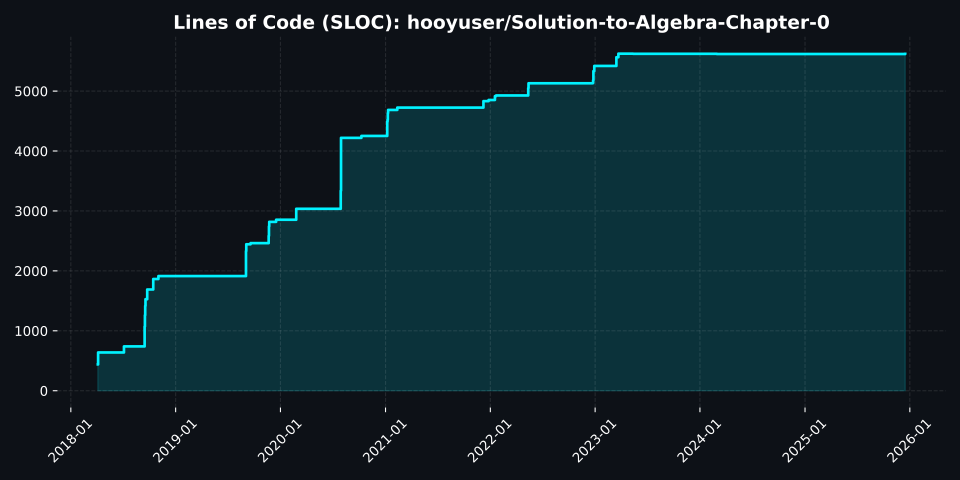
18 |
Tracking Lines of Code over time
19 |
20 |
--------------------------------------------------------------------------------
/chapter4.tex:
--------------------------------------------------------------------------------
1 | \section{Chapter IV.\hspace{0.2em} Groups, second encounter}
2 | \subsection{\textsection1. The conjugation action}
3 | \begin{problem}[1.1]
4 | $\triangleright$ Let $p$ be a prime integer, let $G$ be a $p$-group, and let $S$ be a set such that $|S| \not \equiv 0 \bmod p .$ If $G$ acts on $S,$ prove that the action must have fixed points. $[\S 1.1$ $\S 2.3]$
5 | \end{problem}
6 | \begin{solution}
7 | let $Z$ be the fixed-point set of the action. We have
8 | \[
9 | |Z| \equiv|S| \quad \bmod p.
10 | \]
11 | Since $|S| \not \equiv 0 \bmod p$, there must be $|Z|\ne0$, which implies the action must have fixed points.
12 | \end{solution}
13 |
14 | \begin{problem}[1.2]
15 | Find the center of $D_{2 n}$. (The answer depends on the parity of $n$. You have actually done this already: \hyperlink{Exercise II.2.7}{Exercise II.2.7}. This time, use a presentation.)
16 | \end{problem}
17 | \begin{solution}
18 | \[
19 | D_{2n}=\left\langle r, s \mid r^{n}=s^{2}=(sr)^{2}=e\right\rangle
20 | \]
21 | It is clear that $r^is^j\in Z(D_{2n})$ if and only if $r^is^j$ commutes with $r$ and $s$. That is,
22 | \[
23 | (r^is^j)r=r(r^is^j)\iff s^jr=rs^j\iff j=0
24 | \]
25 | and
26 | \[
27 | (r^is^j)s=s(r^is^j)\iff r^is=sr^i\iff i=0\text{ or }n.
28 | \]
29 | Therefore,
30 | \[
31 | Z(D_{2n})=\{e,r^n\}.
32 | \]
33 | \end{solution}
34 |
35 | \begin{problem}[1.4]
36 | $\triangleright$ Let $G$ be a group, and let $N$ be a subgroup of $Z(G)$. Prove that $N$ is normal in $G .[\S 2.2]$
37 | \end{problem}
38 | \begin{solution}
39 | Since for all $g\in G$, $a\in N$,
40 | \[
41 | gag^{-1}=agg^{-1}=a\in N,
42 | \]
43 | we see $N$ is normal in $G$.
44 |
45 | \end{solution}
46 |
47 |
48 | \begin{problem}[1.5]
49 | $\triangleright$ Let $G$ be a group. Prove that $G / Z(G)$ is isomorphic to the group $\operatorname{Inn}(G)$ of inner automorphisms of $G .$ (Cf. \hyperlink{Exercise II.4.8}{Exercise II.4.8}.) Then prove Lemma 1.5 again by using the result of \hyperlink{Exercise II.6.7}{Exercise II.6.7}. $[\S 1.2]$
50 | \end{problem}
51 | \begin{solution}
52 | Define
53 | \begin{align*}
54 | f:G/Z(G)&\longrightarrow \operatorname{Inn}(G)\\
55 | gZ(G)&\longmapsto (\gamma_g:a\longmapsto gag^{-1}).
56 | \end{align*}
57 | We can check that $f$ is a homomorphism
58 | \[
59 | f(g_1g_2Z(G))=\gamma_{g_1g_2}=\gamma_{g_1}\gamma_{g_2}=f(g_1Z(G))f(g_2Z(G)).
60 | \]
61 | Since
62 | \[
63 | gZ(G)\in\ker f\iff \gamma_g=\mathrm{id}_G\iff\forall a\in G, gag^{-1}=a\iff g\in Z(G),
64 | \]
65 | we have
66 | \[
67 | \ker f=Z(G),
68 | \]
69 | which means $f$ is injective. It is clear that $f$ is surjective. Thus we show $f$ is an isomorphism and $G / Z(G)\cong\operatorname{Inn}(G)$.
70 |
71 |
72 | \end{solution}
73 |
74 | \begin{problem}[1.6]
75 | $\triangleright$ Let $p, q$ be prime integers, and let $G$ be a group of order $p q .$ Prove that either $G$ is commutative, or the center of $G$ is trivial. Conclude (using Corollary 1.9$)$ that every group of order $p^{2}$, for a prime $p$, is commutative. $[\S 1.3]$
76 | \end{problem}
77 | \begin{solution}
78 | Since $Z(G)\operatorname{\triangleleft} G$, it follows that $|Z(G)|\in\{1,p,q,pq\}$. Suppose $|Z(G)|=p\text{ or }q$, we have $|G/Z(G)|=p\text{ or }q$. Since groups of prime orders are cyclic, $G/Z(G)$ is cyclic. According to Lemma 1.5, it implies $G / Z(G)=\{e_G\}$, which yields a contradiction. Hence $|Z(G)|=1\text{ or }pq$, that is,
79 | \[
80 | Z(G)=\{e_G\}\text{ or }G.
81 | \]
82 | Therefore, we prove that either $G$ is commutative, or the center of $G$ is trivial.
83 |
84 | Let $G$ be a group of order $p^{2}$. According to Corollary 1.9, the center of the nontrivial $p$-group $G$ is nontrivial. Therefore, $G$ must be commutative.
85 |
86 | \end{solution}
--------------------------------------------------------------------------------
/hmcpset.cls:
--------------------------------------------------------------------------------
1 | % HMC Math dept HW class file
2 | % v0.04 by Eric J. Malm, 10 Mar 2005
3 | %%% IDENTIFICATION --------------------------------------------------------
4 | \NeedsTeXFormat{LaTeX2e}[1995/01/01]
5 | \ProvidesClass{hmcpset}
6 | [2005/03/10 v0.04 HMC Math Dept problem set class]
7 |
8 | %%% INITIAL CODE ----------------------------------------------------------
9 |
10 | % test whether the document is being compiled with PDFTeX
11 | \RequirePackage{ifpdf}
12 |
13 |
14 | %%% DECLARATION OF OPTIONS ------------------------------------------------
15 | %% Header Options: header*, no header
16 | \newif\ifhmcpset@header
17 |
18 | % no header block in upper right hand corner
19 | \DeclareOption{noheader}{%
20 | \hmcpset@headerfalse%
21 | }
22 |
23 | % do print header block
24 | \DeclareOption{header}{%
25 | \hmcpset@headertrue%
26 | }
27 |
28 | %% Font Options: palatino*, cm
29 | \newif\ifhmcpset@palatino
30 |
31 | % use palatino fonts
32 | %\DeclareOption{palatino}{%
33 | % \hmcpset@palatinotrue%
34 | %}
35 |
36 | % use compuer modern fonts
37 | \DeclareOption{cm}{%
38 | \hmcpset@palatinofalse%
39 | }
40 |
41 | %% Problem Boxing: boxed*, unboxed
42 | \newif\ifhmcpset@boxed
43 |
44 | % box problem statements
45 | \DeclareOption{boxed}{%
46 | \hmcpset@boxedtrue%
47 | }
48 |
49 | % don't box problem statements
50 | \DeclareOption{unboxed}{%
51 | \hmcpset@boxedfalse%
52 | }
53 |
54 | % pass remaining options to article class
55 | \DeclareOption*{\PassOptionsToClass{\CurrentOption}{article}}
56 |
57 | %%% EXECUTION OF OPTIONS --------------------------------------------------
58 | %% default to:
59 | % including header,
60 | % loading mathpazo package for palatino fonts,
61 | % boxing problem statements
62 | \ExecuteOptions{header,palatino,boxed}
63 |
64 | \ProcessOptions
65 |
66 | %%% PACKAGE LOADING -------------------------------------------------------
67 | %% based on std article class
68 | \LoadClass{article}
69 |
70 |
71 | %% Font loading: Palatino text/math fonts
72 | \ifhmcpset@palatino
73 | \RequirePackage{mathpazo}
74 | \fi
75 |
76 | %% AMSLaTeX math environments and symbols
77 | \RequirePackage{amsmath}
78 | \RequirePackage{amssymb}
79 |
80 | %% boxed minipage for boxed problem environment
81 | \RequirePackage{boxedminipage}
82 |
83 | %%% MAIN CODE -------------------------------------------------------------
84 | %% Tell dvips/pdflatex correct page size
85 | \ifpdf
86 | \AtBeginDocument{%
87 | \setlength{\pdfpageheight}{\paperheight}%
88 | \setlength{\pdfpagewidth}{\paperwidth}%
89 | }
90 | \else
91 | \AtBeginDvi{\special{papersize=\the\paperwidth,\the\paperheight}}%
92 | \fi
93 |
94 |
95 | %% Problem set environments
96 | % boxed problem environment
97 | \newenvironment{problem}[1][]{%
98 | \ifhmcpset@boxed\def\hmcpset@probenv{boxed}\else\def\hmcpset@probenv{}\fi%
99 | \bigskip% put space before problem statement box %
100 | \noindent\begin{\hmcpset@probenv minipage}{\columnwidth}%
101 | \def\@tempa{#1}%
102 | \ifx\@tempa\empty\else%
103 | \hmcpset@probformat{#1}\hspace{0.5em}%
104 | \fi%
105 | }{%
106 | \end{\hmcpset@probenv minipage}%
107 | }
108 | % display optional argument to problem in bold
109 | \let\hmcpset@probformat\textbf
110 |
111 | % solution environment with endmark and optional argument
112 | \newenvironment{solution}[1][]{%
113 | \begin{trivlist}%
114 | \def\@tempa{#1}%
115 | \ifx\@tempa\empty%
116 | \item[]%
117 | \else%
118 | \item[\hskip\labelsep\relax #1]%
119 | \fi%
120 | }{%
121 | \mbox{}\penalty10000\hfill\hmcpset@endmark%
122 | \end{trivlist}%
123 | }
124 |
125 | % default endmark is small black square
126 | \def\hmcpset@endmark{\ensuremath{\scriptscriptstyle\blacksquare}}
127 |
128 | %% Problem set list, for top of document
129 | \newcommand{\problemlist}[1]{\begin{center}\large\sffamily{#1}\end{center}}
130 |
131 | %% commands for upper-right id header block
132 | \newcommand{\headerblock}{%
133 | \begin{flushright}
134 | \mbox{\hmcpset@name}\protect\\
135 | \mbox{\hmcpset@assignment}\protect\\
136 | \hmcpset@updatedate%
137 | \ifx\hmcpset@extraline\empty\else\protect\\\hmcpset@extraline\fi%
138 | \end{flushright}%
139 | }
140 |
141 | % put id header block at start of document
142 | \ifhmcpset@header\AtBeginDocument{\headerblock}\fi
143 |
144 | % internal state for headerblock
145 | \def\hmcpset@name{}
146 | \def\hmcpset@assignment{}
147 | \def\hmcpset@updatedate{}
148 | \def\hmcpset@extraline{}
149 |
150 | % commands to set header block info
151 | \newcommand{\name}[1]{\def\hmcpset@name{#1}}
152 |
153 | \newcommand{\assignment}[1]{\def\hmcpset@assignment{#1}}
154 | \newcommand{\updatedate}[1]{\def\hmcpset@updatedate{#1}}
155 | \newcommand{\extraline}[1]{\def\hmcpset@extraline{#1}}
156 |
--------------------------------------------------------------------------------
/chapter8.tex:
--------------------------------------------------------------------------------
1 | \section{Chapter VIII.\hspace{0.2em} Linear Algebra, reprise}
2 | \subsection{\textsection1. Preliminaries, reprise}
3 | \begin{problem}[1.1]
4 | Let $\mathscr{F}: \mathsf{C} \rightarrow \mathsf{D}$ be a covariant functor, and assume that both $\mathsf{C}$ and $\mathsf{D}$ have products. Prove that for all objects $A, B$ of $C$, there is a unique morphism $\mathscr{F}(A \times B) \rightarrow \mathscr{F}(A) \times \mathscr{F}(B)$ such that the relevant diagram involving natural projections commutes.
5 |
6 | \hspace*{2em}If $D$ has coproducts (denoted II) and $\mathscr{G}: C \rightarrow D$ is contravariant, prove that there is a unique morphism $\mathscr{G}(A)\amalg\mathscr{G}(B) \rightarrow \mathscr{G}(A \amalg B)$ (again, such that an appropriate diagram commutes).
7 | \end{problem}
8 | \begin{solution}
9 | According to the universal property of $\mathscr{F}(A \times B)$ in $\mathsf{D}$, we have
10 | \[\xymatrix{
11 | &\mathscr{F}(A \times B)
12 | \ar@{->}[d]_{\exists !}
13 | \ar@{->}[rd]^{\mathscr{F}(\pi_{\mathsf{C}_2})}
14 | \ar@{->}[ld]_{\mathscr{F}(\pi_{\mathsf{C}_1})}
15 | & \\
16 | \mathscr{F}(A)
17 | &\mathscr{F}(A) \times \mathscr{F}(B)
18 | \ar@{->}[l]^{\pi_{\mathsf{D}_1}\hspace{1.2em}}
19 | \ar@{->}[r]_{\hspace{1.5em}\pi_{\mathsf{D}_2}}
20 | &\mathscr{F}(B)
21 | }\]
22 | Similarly, according to the universal property of $\mathscr{G}(A)\amalg\mathscr{G}(B)$ in $\mathsf{D}$, we have
23 | \[\xymatrix{
24 | &\mathscr{G}(A \amalg B)
25 | & \\
26 | \mathscr{G}(A)
27 | \ar@{->}[ru]^{\mathscr{G}(i_{\mathsf{C}_2})}
28 | \ar@{->}[r]_{i_{\mathsf{D}_1}\hspace{1.5em}}
29 | &\mathscr{G}(A) \amalg \mathscr{G}(B)
30 | \ar@{->}[u]^{\exists !}
31 | &\mathscr{G}(B)
32 | \ar@{->}[lu]_{\mathscr{G}(i_{\mathsf{C}_1})}
33 | \ar@{->}[l]^{\hspace{2em}i_{\mathsf{D}_2}}
34 | }\]
35 | \end{solution}
36 |
37 | \begin{problem}[1.2]
38 | $\triangleright$ Let $\mathscr{F}: \mathsf{C} \rightarrow \mathsf{D}$ be a fully faithful functor. If $A, B$ are objects in $\mathsf{C}$, prove that $A \cong B$ in $\mathsf{C}$ if and only if $\mathscr{F}(A) \cong \mathscr{F}(B)$ in $\mathsf{D}$. [\S1.3]
39 | \end{problem}
40 | \begin{solution}
41 | If $A \cong B$ in $\mathsf{C}$ , then there exists $f:A\to B$ and $g:B\to A$ such that $f\circ g=\mathrm{id}_B$ and $g\circ f=\mathrm{id}_A$. Since $\mathscr{F}$ is a functor, we have $\mathscr{F}(f)\circ\mathscr{F}(g)=\mathrm{id}_{\mathscr{F}(B)}$
42 | and $\mathscr{F}(g)\circ\mathscr{F}(f)=\mathrm{id}_{\mathscr{F}(A)}$. Hence $\mathscr{F}(A) \cong \mathscr{F}(B)$ in $\mathsf{D}$.
43 |
44 | If $\mathscr{F}(A) \cong \mathscr{F}(B)$ in $\mathsf{D}$, there exists $f':\mathscr{F}(A)\to\mathscr{F}(B)$ and $g':\mathscr{F}(B)\to\mathscr{F}(A)$ such that $f'\circ g'=\mathrm{id}_{\mathscr{F}(B)}$ and $g'\circ f'=\mathrm{id}_{\mathscr{F}(A)}$. Since $\mathscr{F}$ is fully faithful, there exists $f:A\to B$ and $g:B\to A$ such that $\mathscr{F}(f)=f'$ and $\mathscr{F}(g)=g'$. Now we have
45 | \begin{align*}
46 | \mathscr{F}\left(f\circ g\right)&=\mathscr{F}(f)\circ\mathscr{F}(g)=f'\circ g'=\mathrm{id}_{\mathscr{F}(B)},\\
47 | \mathscr{F}\left(g\circ f\right)&=\mathscr{F}(g)\circ\mathscr{F}(f)=g'\circ f'=\mathrm{id}_{\mathscr{F}(A)},
48 | \end{align*}
49 | which implies $f\circ g=\mathrm{id}_B$ and $g\circ f=\mathrm{id}_A$. Hence $A \cong B$ in $\mathsf{C}$.
50 | \end{solution}
51 |
52 |
53 | \begin{problem}[1.3]
54 | Recall (\S II.1) that a group $G$ may be thought of as a groupoid $\mathsf{G}$ with a single object. Prove that defining the action of $G$ on an object of a category $\mathsf{C}$ is equivalent to defining a functor $\mathsf{G} \rightarrow \mathsf{C}$.
55 | \end{problem}
56 | \begin{solution}
57 | Suppose a group $G$ acts on an object $B$ of a category $\mathsf{C}$ and $\mathsf{G}$ is the groupoid with a single object $A$ with $\mathrm{End}_{\mathsf{G}}(A)=G$ . Then the functor $\mathsf{G} \rightarrow \mathsf{C}$ is defined by $\mathsf{G}(A) \rightarrow B$ and $\mathsf{G}(g) \rightarrow g$ for all $g \in G$.
58 |
59 | Conversely, suppose $\mathsf{G}$ is a groupoid with a single object $A$ and $F:\mathsf{G} \rightarrow \mathsf{C}$ is a functor that maps $A$ to $B$ in $\mathsf{C}$. Then the group action on $B$ is defined by
60 | \begin{align*}
61 | \mathrm{Aut}_{\mathsf{G}}(A) &\longrightarrow \mathrm{Aut}_{\mathsf{C}}(B),\\
62 | g &\longmapsto F(g).
63 | \end{align*}
64 | \end{solution}
65 |
66 |
67 | \begin{problem}[1.4]
68 | $\neg$ Let $R$ be a commutative ring, and let $S \subseteq R$ be a multiplicative subset in the sense of \hyperlink{Exercise V.4.7}{Exercise V.4.7} . Prove that `localization is a functor': associating with every $R$-module $M$ the localization $S^{-1} M$ (\hyperlink{Exercise V.4.8}{Exercise V.4.8}) and with every $R$-module homomorphism $\varphi: M \rightarrow N$ the naturally induced homomorphism $S^{-1} M \rightarrow S^{-1} N$ defines a covariant functor from the category of $R$-modules to the category of $S^{-1} R$ modules. [1.25]
69 | \end{problem}
70 | \begin{solution}
71 |
72 | The functor $\mathscr{F}: R\text{-}\mathsf{Mod} \rightarrow S^{-1} R\text{-}\mathsf{Mod}$ is defined as follows:
73 | \begin{itemize}
74 | \item object mapping: $M \mapsto S^{-1} M$;
75 | \item morphism mapping $\varphi\mapsto F(\varphi)$ is given by the following commutative diagram
76 | \[\xymatrix{
77 | S^{-1}M
78 | \ar@{-->}[r]^{\mathscr{F}(\varphi)} & S^{-1}N\\
79 | M \ar[u]^{\ell}\ar[r]_{\varphi} & N \ar[u]^{\ell}
80 | }\]
81 | \end{itemize}
82 | We can check that $\mathscr{F}$ is a functor by checking the functoriality of $\mathscr{F}$
83 | \begin{align*}
84 | \mathscr{F}\left(\varphi\circ\varphi'\right)&=\mathscr{F}(\varphi)\circ\mathscr{F}(\varphi'),
85 | \end{align*}
86 | which can be derived from the following commutative diagram.
87 | \[\xymatrix{
88 | S^{-1}M
89 | \ar@{-->}[r]^{\mathscr{F}(\varphi)} & S^{-1}N\ar@{-->}[r]^{\mathscr{F}(\varphi')}& S^{-1}L\\
90 | M \ar[u]^{\ell}\ar[r]_{\varphi} & N \ar[u]^{\ell}\ar[r]_{\varphi'}& L \ar[u]^{\ell}
91 | }\]
92 |
93 | \end{solution}
--------------------------------------------------------------------------------
/Solution_to_Algebra_Chapter_0.tex:
--------------------------------------------------------------------------------
1 | % Compile with PdfLaTeX
2 | \documentclass[12pt,letterpaper,boxed]{hmcpset}
3 |
4 | % set 1-inch margins in the document
5 | \usepackage[margin=1in]{geometry}
6 |
7 | % include this if you want to import graphics files with /includegraphics
8 | \usepackage{enumerate}
9 | \usepackage{graphicx}
10 | \usepackage{amsmath,amssymb,amsthm}
11 | \usepackage[all]{xy}
12 |
13 | \usepackage{fancyhdr}
14 | \pagestyle{fancy}
15 | \fancyhf{}
16 | \rhead{}
17 | \lhead{\small\leftmark}
18 | \rfoot{-\hspace{4pt}\thepage\hspace{4pt}- }
19 |
20 | \usepackage[usenames,dvipsnames]{color}
21 | \usepackage{xcolor}
22 | \definecolor{myRoyalBlue}{RGB}{50,60,150}
23 | \definecolor{myGreen}{RGB}{45,100,45}
24 | \usepackage[colorlinks,linkcolor=myRoyalBlue,urlcolor=myGreen,citecolor=BurntOrange]{hyperref}
25 | \usepackage{mathrsfs}
26 | \usepackage{cancel}
27 | \usepackage{cite}
28 | \usepackage{setspace}
29 | \usepackage{tikz}
30 | \usepackage{tikz-cd}
31 |
32 |
33 | \usepackage{mathtools}
34 | \DeclarePairedDelimiter\ceil{\lceil}{\rceil}
35 | \DeclarePairedDelimiter\floor{\lfloor}{\rfloor}
36 |
37 | \renewcommand{\baselinestretch}{1.05}
38 | \renewcommand\appendix{\setcounter{secnumdepth}{-2}}
39 |
40 | \newcommand{\Obj}{\mathrm{Obj}}
41 | \newcommand{\Hom}{\mathrm{Hom}}
42 | \newcommand{\GL}{\mathrm{GL}}
43 | \newcommand{\SL}{\mathrm{SL}}
44 | \newcommand{\Aut}{\mathrm{Aut}}
45 | \newcommand{\Inn}{\mathrm{Inn}}
46 | \newcommand{\im}{\mathrm{im}\hspace{1.5pt}}
47 | \newcommand{\Grp}{\mathsf{Grp}}
48 | \newcommand{\Set}{\mathsf{Set}}
49 | \newcommand{\Ab}{\mathsf{Ab}}
50 | \newcommand{\Mod}{\mathsf{Mod}}
51 | \newcommand{\R}{\mathbb{R}}
52 | \newcommand{\C}{\mathbb{C}}
53 | \newcommand{\Q}{\mathbb{Q}}
54 | \newcommand{\Z}{\mathbb{Z}}
55 | \newcommand{\N}{\mathbb{N}}
56 | \newcommand{\id}{\mathrm{id}}
57 | \newcommand{\from}{\leftarrow}
58 |
59 | \newcommand{\set}[1]{\left\{\,#1\,\right\}}
60 | \newcommand{\abs}[1]{\left|#1\right|}
61 | \newcommand{\quotuniv}[1]{\overline{#1}}
62 | \newcommand{\quot}[2]{#1/\!\!#2\,\,}
63 | \newcommand{\quotntws}[2]{#1/\!\!#2}
64 |
65 | \newcommand{\inv}[1]{#1^{-1}}
66 | \newcommand{\cycl}[1]{\mathbb{Z}/#1\mathbb{Z}}
67 |
68 | \DeclareMathOperator{\lcm}{lcm}
69 |
70 | % info for header block in upper right hand corner
71 |
72 | \begin{document}
73 | \thispagestyle{empty}
74 | \vspace{-5em}
75 | \rightline{Hooy}
76 | \rightline{\today}
77 | %\name{Hooy}
78 | %\updatedate{\vspace*{1pt}\today}
79 | \vspace*{1.5em}
80 | \problemlist{\textbf{\LARGE Algebra, Chapter 0}\\\vspace*{0.6em}By Paolo Aluffi}
81 |
82 | \tableofcontents
83 | \thispagestyle{empty}
84 | \appendix
85 |
86 | \newpage
87 | \thispagestyle{empty}
88 | \section*{Notation for Problems}
89 | $\vartriangleright$: those problems that are directly referenced from the text.\\
90 |
91 | \noindent $\neg$: those problems that are referenced from other
92 | problems.\\
93 |
94 | \noindent [\textsection II.8.1]: related to the text in II.8.1 (Chapter II Section 8 Subsection 1).\\
95 |
96 | \noindent [II.8.10]: related to the Definition/Example/Proposition/Lemma/Corollary/Claim 8.10 in Chapter II (the 10th Definition/Example/Proposition/Lemma/Corollary/Claim in Chapter II Section 8).
97 |
98 | \section*{Acknoledgement}
99 | It is kind of Shane Creighton-Young to share his solutions to Paolo Aluffi's ``Algebra: Chapter 0"\cite{aluffi2009algebra} on the Github website \href{https://github.com/srcreigh/aluffi}{\texttt{https://github.com/srcreigh/aluffi}}. He takes the credit for some parts of the first two chapters of this manuscript.
100 |
101 | \section*{Contact}
102 | Github:
103 | \href{https://github.com/hooyuser/Solution-to-Algebra-Chapter-0}{\texttt{https://github.com/hooyuser/Solution-to-Algebra-Chapter-0}}
104 |
105 | \noindent E-mail: \href{mailto:hooyuser@outlook.com}{\texttt{hooyuser@outlook.com}}
106 |
107 |
108 | \section*{License}
109 | This work is licensed under a \href{http://creativecommons.org/licenses/by-nc-sa/4.0/}{Creative Commons Attribution-NonCommercial-ShareAlike 4.0 International License}.
110 | \vfill
111 | \begin{figure}[h]
112 | \centering\includegraphics[width=0.38\textwidth]{./BY-NC-SA}
113 | \end{figure}
114 |
115 | \newpage
116 | \include{chapter1.tex}
117 |
118 | \newpage
119 | \include{chapter2.tex}
120 |
121 | \newpage
122 | \include{chapter3.tex}
123 |
124 | \newpage
125 | \include{chapter4.tex}
126 |
127 | \newpage
128 | \include{chapter5.tex}
129 |
130 | \newpage
131 | \include{chapter6.tex}
132 |
133 | \newpage
134 | \include{chapter7.tex}
135 |
136 | \newpage
137 | \include{chapter8.tex}
138 |
139 | \newpage
140 | \section{Appendix}
141 | \hypertarget{Lemma II.1}{}
142 | \textbf{Lemma II.1} (von Dyck)
143 | Given a presentation $(A|\mathscr{R})=F(A)/R$, where $A$ is the set of generators, $\mathscr{R}\in F(A)$ is the set of relators and $R$ is the smallest normal subgroup of $F(A)$ containing $\mathscr{R}$. Define inclusion mapping $i:A\to F(A)$ and projection $\pi:F(A)\to F(A)/R$. If $f$ is a mapping from $A$ to a group $G$, and every relations in $\mathscr{R}$ holds in $G$ via $f$, that is, $\mathscr{R}\subset\ker\varphi$ where $\varphi$ is the unique homomorphism induced by the universal property of free group, then there exists a unique homomorphism $\psi:F(A)/R\to G$ such that $f=\psi\circ\pi\circ i$. If $G$ is generated by $f(A)$, then $\psi$ is surjective.
144 | \[\xymatrix{
145 | F(A)/R\ar@{-->}[rd]^{\exists!\psi}\\
146 | F(A)\ar@{-->}[r]^{\varphi}\ar[u]^{\pi} &G\\
147 | A\ar[ru]_{f}\ar[u]^{i}&
148 | }\]
149 | \textbf{Proof of the lemma.} Since $R$ is the smallest normal subgroup of $F(A)$ containing $\mathscr{R}$ and the normal subgroup $\ker\varphi$ contains $\mathscr{R}$, we must have $R\subset\ker\varphi$. Then according to Theorem 7.12, there exists a unique homomorphism $\psi:F(A)/R\to G$ such that $\varphi=\psi\circ\pi$, which means the whole diagram commutes. If there exists a homomorphism $\zeta:F(A)/R\to G$ such that $f=\zeta\circ\pi\circ i$, then we have $\varphi\circ i=\zeta\circ\pi\circ i$, which implies $\varphi(t)= \zeta(\pi(t))$ for all $t\in A$. Note that a homomorphism defined on $F(A)$ can be specified only by its valuation on the set of generators $A$, we can assert that $\varphi=\zeta\circ\pi$. Since there exists a unique homomorphism $\psi:F(A)/R\to G$ such that $\varphi=\psi\circ\pi$, we have $\zeta=\psi$. Thus we show that there exists a unique homomorphism $\psi:F(A)/R\to G$ such that $f=\psi\circ\pi\circ i$.
150 |
151 | Moreover, if $G$ is generated by $f(A)$, then $\mathrm{im}\psi=G$, since $f(A)=\psi(\pi( i(A)))\subset\mathrm{im}\psi$ implies $G\subset\mathrm{im}\psi$.\hfill$\lrcorner$
152 |
153 |
154 | \newpage
155 |
156 | \bibliographystyle{plain}
157 | \bibliography{mybibtex}
158 | \end{document}
159 |
--------------------------------------------------------------------------------
/chapter6.tex:
--------------------------------------------------------------------------------
1 | \section{Chapter VI.\hspace{0.2em} Linear algebra}
2 | \subsection{\textsection1. Free modules revisited}
3 | \hypertarget{Exercise VI.1.1}{}
4 | \begin{problem}[1.1]
5 | $\neg$ Prove that $\mathbb{R}$ and $\mathbb{C}$ are isomorphic as $\mathbb{Q}$-vector spaces. (In particular, $(\mathbb{R},+$ ) and $(\mathbb{C},+)$ are isomorphic as groups.) [II.4.4]
6 | \end{problem}
7 | \begin{solution}
8 | The $\mathbb{Q}$-vector space $\mathbb{R}$ is a free $\mathbb{Q}$-module, it adimits a basis $B$. We can show that $B$ is a infinite set by showing that for any positive integer $n$, there exists a linearly independent subset $B_n$ such that $|B_n|=n$. An example is $B_n=\left\{1,\pi,\cdots,\pi^n\right\}$, given the fact that $\pi$ is trascendent over $\mathbb{Q}$. Let
9 | \begin{align*}
10 | B'=B\bigcup \left\{bi\mid b\in B\right\}.
11 | \end{align*}
12 | Then we see $B'$ is a basis of $\mathbb{C}$ and $|B'|=|B|$. Therefore, $\mathbb{R}$ and $\mathbb{C}$ are isomorphic as $\mathbb{Q}$-vector spaces.
13 | \end{solution}
14 |
15 | \hypertarget{Exercise VI.1.4}{}
16 | \begin{problem}[1.4]
17 | Let $V$ be a vector space over a field $k$. A \emph{Lie bracket} on $V$ is an operation
18 | $[\cdot, \cdot]: V \times V \rightarrow V$ such that
19 | \begin{itemize}
20 | \item $(\forall u, v, w \in V),(\forall a, b \in k)$,
21 | $$
22 | [a u+b v, w]=a[u, w]+b[v, w], \quad[w, a u+b v]=a[w, u]+b[w, v],
23 | $$
24 | \item $(\forall v \in V),[v, v]=0$,
25 | \item and $(\forall u, v, w \in V),[[u, v], w]+[[v, w], u]+[[w, u], v]=0$.
26 | \end{itemize}
27 | (This axiom is called the \emph{Jacobi identity}.) A vector space endowed with a Lie bracket is called a \emph{Lie algebra}. Define a category of Lie algebras over a given field. Prove the following:
28 | \begin{itemize}
29 | \item In a Lie algebra $V,[u, v]=-[v, u]$ for all $u, v \in V$.
30 | \item If $V$ is a $k$-algebra (Definition III.5.7), then $[v, w]:=v w-w v$ defines a Lie bracket on $V$, so that $V$ is a Lie algebra in a natural way.
31 | \item This makes $\mathfrak{g l}_n(\mathbb{R}), \mathfrak{g l}_n(\mathbb{C})$ into Lie algebras. The sets listed in Exercise III.1.4 are all Lie algebras, with respect to a Lie bracket induced from $\mathfrak{g l}$.
32 | \item $\mathfrak{s u}{ }_2(\mathbb{C})$ and $\mathfrak{s o}_3(\mathbb{R})$ are isomorphic as Lie algebras over $\mathbb{R}$.
33 | \end{itemize}
34 | \end{problem}
35 | \begin{solution}
36 |
37 | \end{solution}
38 |
39 | \begin{problem}[1.5]
40 | $\triangleright$ Let $R$ be an integral domain. Prove or disprove the following:
41 | \begin{itemize}
42 | \item Every linearly independent subset of a free $R$-module may be completed to a basis.
43 | \item Every generating subset of a free $R$-module contains a basis.
44 | \end{itemize}
45 | [\S 1.3]
46 | \end{problem}
47 | \begin{solution}
48 | \begin{itemize}
49 | \item False. Given the $\mathbb{Z}$-module $\mathbb{Z}$, $\left\{2\right\}$ is a linearly independent subset of $\mathbb{Z}$, but it cannot be completed to a basis because the dimension of $\mathbb{Z}$ is $1$.
50 | \item False. Given the $\mathbb{Z}$-module $\mathbb{Z}$, $\left\{2, 3\right\}$ is a generating subset of $\mathbb{Z}$, but it does not contain a basis because neither $\left\{2\right\}$ and $\left\{3\right\}$ can generate $\mathbb{Z}$.
51 | \end{itemize}
52 | \end{solution}
53 |
54 | \subsection{\textsection4. Presentations and resolutions}
55 | \begin{problem}[4.1]
56 | $\triangleright$ Prove that if $R$ is an integral domain and $M$ is an $R$-module, then $\operatorname{Tor}(M)$ is a submodule of $M$. Give an example showing that the hypothesis that $R$ is an integral domain is necessary. $[\S 4.1]$
57 | \end{problem}
58 | \begin{solution}
59 | Given any $m_1,m_2\in\operatorname{Tor}(M)$, we can suppose there exist $r_1,r_2\in R$ such that $r_1m_1=0(r_1\ne0)$ and $r_2m_2=0(r_2\ne0)$. Since $R$ is an integral domain, we have $r_1r_2\ne0$. Thus, there exist nonzero element $r_1r_2\in R$ such that
60 | $$
61 | r_1r_2(m_1+m_2)=r_2(r_1m_1)+r_1(r_2m_2)=0,
62 | $$
63 | which implies $m_1+m_2\in\operatorname{Tor}(M)$.
64 |
65 | Given any $r\in R$, $m\in\operatorname{Tor}(M)$, we can suppose
66 | \[
67 | r_0m=0
68 | \]
69 | where $r_0\in R$ and $r_0\ne0$. Thus we have
70 | \[
71 | r_0(rm)=r(r_0m)=0,
72 | \]
73 | which implies $rm\in\operatorname{Tor}(M)$. Therefore, we show that $\operatorname{Tor}(M)$ is a submodule of $M$.
74 |
75 | $\mathbb{Z}/6\mathbb{Z}$ is not an integral domain and $\mathbb{Z}/6\mathbb{Z}$ is a $\mathbb{Z}/6\mathbb{Z}$-module. Since
76 | \[
77 | \operatorname{Tor}(\mathbb{Z}/6\mathbb{Z})=\{[0]_6,[2]_6,[3]_6\},
78 | \]
79 | we have $[2]_6+[3]_6=[5]_6\notin \operatorname{Tor}(\mathbb{Z}/6\mathbb{Z})$, which implies $\operatorname{Tor}(\mathbb{Z}/6\mathbb{Z})$ is not a submodule of $\mathbb{Z}/6\mathbb{Z}
80 | ++$.
81 | \end{solution}
82 |
83 |
84 |
85 |
86 |
87 | \begin{problem}[4.4]
88 | $\triangleright$ Let $R$ be a commutative ring, and $M$ an $R$-module.
89 | \begin{itemize}
90 | \item Prove that $\operatorname{Ann}(M)$ is an ideal of $R$.
91 | \item If $R$ is an integral domain and $M$ is finitely generated, prove that $M$ is torsion if and only if $\operatorname{Ann}(M) \neq 0$.
92 | \item Give an example of a torsion module $M$ over an integral domain, such that $\operatorname{Ann}(M)=0 .$ (Of course this example cannot be finitely generated!)
93 | \end{itemize}
94 | $[\S 4.2, \S 5.3]$
95 | \end{problem}
96 | \begin{solution}
97 | \begin{itemize}
98 | \item $\operatorname{Ann}(M)$ is defined as
99 | \[
100 | \operatorname{Ann}(M)=\{r \in R \mid \forall m \in M, r m=0\}.
101 | \]
102 | Given any $r_1,r_2\in\operatorname{Ann}(M)$, we have
103 | \[
104 | \forall m\in M, (r_1+r_2)m=r_1m+r_2m=0,
105 | \]
106 | which implies $r_1+r_2\in\operatorname{Ann}(M)$.
107 |
108 | Given any $r\in R$, $s\in\operatorname{Ann}(M)$, we have
109 | \[
110 | \forall m\in M, (rs)m=r(sm)=0,
111 | \]
112 | which implies $rs\in\operatorname{Ann}(M)$.
113 | \item If $\operatorname{Ann}(M) \neq 0$, there exists nonzero $r\in R$ such that and $rm=0$ for any $m\in M$, which implies $M$ is a torsion module.
114 |
115 | Assume that $M$ is torsion and is generated by $\{m_1,m_2,\cdots,m_n\}$. There exist nonzero elements $r_1,r_2,\cdots,r_n\in R$ such that
116 | \[
117 | r_1m_1=r_2m_2=\cdots=r_nm_n=0.
118 | \]
119 | Let $r_0=r_1r_2\cdots r_n$. Since $R$ is an integral domain, $r_0\ne0$. Given any $m\in M$, we have
120 | \[
121 | m=k_1m_1+k_2m_2+\cdots+k_nm_n
122 | \]
123 | and
124 | \[
125 | r_0m=k_1r_2\cdots r_n(r_1m_1)+\cdots+k_nr_1\cdots r_{n-1} (r_nm_n)=0.
126 | \]
127 | Thus we show $r_0\in\operatorname{Ann}(M)$ and $\operatorname{Ann}(M)\ne0$.
128 | \item $\mathbb{Q}/\mathbb{Z}$ is a module over the integral domain $\mathbb{Z}$. Since
129 | \[
130 | \forall \left[\frac{p}{q}\right]\in \mathbb{Q}/\mathbb{Z},\ \exists q\in\mathbb{Z},\ q\left[\frac{p}{q}\right]=[0],
131 | \]
132 | we see $\mathbb{Q}/\mathbb{Z}$ is a torsion module. If $r\in\operatorname{Ann}(M)$, then for all $q\in\mathbb{Z}$,
133 | \[
134 | r\left[\frac{1}{q}\right]=0\iff q|r\implies r=0\text{ or } r\ge q.
135 | \]
136 | Therefore, there must be $r=0$, which means $\operatorname{Ann}(M)=0$.
137 |
138 | \end{itemize}
139 | \end{solution}
--------------------------------------------------------------------------------
/chapter5.tex:
--------------------------------------------------------------------------------
1 | \section{Chapter V.\hspace{0.2em} Irreducibility and factorization in integral domains}
2 | \subsection{\textsection1. Chain conditions and existence of factorizations}
3 | Remember that in this section all rings are taken to be \emph{commutative}.
4 |
5 | \hypertarget{Exercise V.1.1}{}
6 | \begin{problem}[1.1]
7 | $\triangleright$ Let $R$ be a Noetherian ring, and let $I$ be an ideal of $R$. Prove that $R / I$ is a Noetherian ring. [\textsection1.1]
8 | \end{problem}
9 | \begin{solution}
10 | Let $\pi:R\to R / I$ be the projection. According to \hyperlink{Exercise III.4.2}{Exercise III.4.2}, the homomorphic image of the Noetherian ring $R$ is Noetherian. That is, $\pi(R)=R / I$ is Noetherian.
11 | \end{solution}
12 |
13 | \begin{problem}[1.2]
14 | Prove that if $R[x]$ is Noetherian, so is $R$. (This is a `converse' to Hilbert's basis theorem.)
15 | \end{problem}
16 | \begin{solution}
17 | According to \hyperlink{Exercise V.1.1}{Exercise V.1.1}, $R[x]$ is Noetherian implies $R\left[x\right]/\left(x\right)$ is Noetherian. Since in \hyperlink{Exercise III.4.12}{Exercise III.4.12} we have shown that
18 | \[
19 | R\cong R\left[x\right]/\left(x\right),
20 | \]
21 | we see $R$ is Noetherian.
22 | \end{solution}
23 |
24 | \subsection{\textsection4. Unique factorization in polynomial rings}
25 | \hypertarget{Exercise V.4.7}{}
26 | \begin{problem}[4.7]
27 | $\triangleright$ A subset $S$ of a commutative ring $R$ is a \emph{multiplicative subset} (or \emph{multiplicatively closed}) if (i) $1 \in S$ and (ii) $s, t \in S \Longrightarrow s t \in S$. Define a relation on the set of pairs $(a, s)$ with $a \in R, s \in S$ as follows:
28 | $$
29 | (a, s) \sim\left(a^{\prime}, s^{\prime}\right) \Longleftrightarrow(\exists t \in S), t\left(s^{\prime} a-s a^{\prime}\right)=0 .
30 | $$
31 | Note that if $R$ is an integral domain and $S=R \backslash\{0\}$, then $S$ is a multiplicative subset, and the relation agrees with the relation introduced in $\S 4.2$.
32 | \begin{itemize}
33 | \item Prove that the relation $\sim$ is an equivalence relation.
34 | \item Denote by $\frac{a}{s}$ the equivalence class of $(a, s)$, and define the same operations $+$, $\cdot$ on such `fractions' as the ones introduced in the special case of $\S 4.2$. Prove that these operations are well-defined.
35 | \item The set $S^{-1} R$ of fractions, endowed with the operations $+$, $\cdot$ is the \emph{localization} of $R$ at the multiplicative subset $S$. Prove that $S^{-1} R$ is a commutative ring and that the function $a \mapsto \frac{a}{1}$ defines a ring homomorphism $\ell: R \rightarrow S^{-1} R$.
36 | \item Prove that $\ell(s)$ is invertible for every $s \in S$.
37 | \item Prove that $R \rightarrow S^{-1} R$ is initial among ring homomorphisms $f: R \rightarrow R^{\prime}$ such that $f(s)$ is invertible in $R^{\prime}$ for every $s \in S$.
38 | \item Prove that $S^{-1} R$ is an integral domain if $R$ is an integral domain.
39 | \item Prove that $S^{-1} R$ is the zero-ring if and only if $0 \in S$.
40 | \end{itemize}
41 | $[4.8,4.9,4.11,4.15$, VII.2.16, VIII.1.4, VIII.2.5, VIII.2.6, VIII.2.12, §IX.9.1]
42 | \end{problem}
43 | \begin{solution}
44 | \begin{itemize}
45 | \item Reflexivity.
46 | \begin{align*}
47 | 1(sa-sa)=0\implies (a,s)\sim(a,s).
48 | \end{align*}
49 | Symmetry.
50 | \begin{align*}
51 | &(a, s) \sim\left(a^{\prime}, s^{\prime}\right) \Longleftrightarrow\left(\exists t \in S\right), t\left(s^{\prime} a-s a^{\prime}\right)=0 \\
52 | \iff& (\exists t \in S), t\left(s a^{\prime}-s^{\prime} a\right)=0\iff \left(a^{\prime}, s^{\prime}\right) \sim (a, s).
53 | \end{align*}
54 | Transitivity.
55 | \begin{align*}
56 | &(a, s) \sim\left(a^{\prime}, s^{\prime}\right) ,\left(a^{\prime}, s^{\prime}\right) \sim \left(a'', s''\right)\\
57 | \implies &\left(\exists t_1,t_2 \in S\right), t_1\left(s^{\prime} a-s a^{\prime}\right)=t_2\left(s'' a'-s' a''\right)=0 \\
58 | \implies & (\exists t_1t_2s' \in S), t_1t_2s'\left(s'' a-s a''\right)=(t_2s'')(t_1s'a)-(t_1s)(t_2s'a'')\\
59 | &\hspace{13.25em}=(t_2s'')(t_1sa')-(t_1s')(t_2s'' a')\\
60 | &\hspace{13.25em}=0\\
61 | \implies & (a, s)\sim \left(a'', s''\right) .
62 | \end{align*}
63 | \item Define
64 | \begin{align*}
65 | \frac{a_1}{s_1}+\frac{a_2}{s_2}&=\frac{a_1s_2+a_2s_1}{s_1s_2},\qquad \frac{a_1}{s_1}\cdot\frac{a_2}{s_2}=\frac{a_1a_2}{s_1s_2}.
66 | \end{align*}
67 | If $\frac{a_1}{s_1} = \frac{a_1^\prime}{s_1^\prime}$, then there exists $t\in S$ such that $ts_1^\prime a_1= ts_1 a_1^\prime$. Hence
68 | \begin{align*}
69 | &\;t(s_1^\prime s_2)(a_1s_2+a_2s_1)-t(s_1s_2)(a_1^\prime s_2+a_2s_1^\prime)\\
70 | =&\;t\left(s_1^\prime s_2a_1s_2+s_1^\prime s_2a_2s_1-s_1s_2a_1^\prime s_2-s_1s_2a_2s_1^\prime\right)\\
71 | =&\;t\left(s_1^\prime s_2a_1s_2+s_1^\prime s_2a_2s_1-s_1^\prime s_2a_1 s_2-s_1^\prime s_2a_2s_1\right)a\\
72 | =&\;0,
73 | \end{align*}
74 | which implies
75 | \begin{align*}
76 | \frac{a_1}{s_1}+\frac{a_2}{s_2}=\frac{a_1s_2+a_2s_1}{s_1s_2}= \frac{a_1^\prime s_2+a_2s_1^\prime}{s_1^\prime s_2}=\frac{a_1^\prime}{s_1^\prime}+\frac{a_2}{s_2}.
77 | \end{align*}
78 | If $\frac{a_2}{s_2} = \frac{a_2^\prime}{s_2^\prime}$, in a similar way, we can prove
79 | \begin{align*}
80 | \frac{a_1}{s_1}+\frac{a_2}{s_2}=\frac{a_1s_2+a_2s_1}{s_1s_2}= \frac{a_1s_2^\prime+a_2^\prime s_1}{s_1s_2^\prime}=\frac{a_1}{s_1}+\frac{a_2^\prime}{s_2^\prime}.
81 | \end{align*}
82 | Therefore, $+$ is well-defined.
83 |
84 | If $\frac{a_1}{s_1} = \frac{a_1^\prime}{s_1^\prime}$ and $\frac{a_2}{s_2} = \frac{a_2^\prime}{s_2^\prime}$, then there exists $t_1,t_2\in S$ such that $t_1s_1^\prime a_1= t_1s_1 a_1^\prime$ and $t_2s_2^\prime a_2= t_2s_2 a_2^\prime$. Hence we have
85 | \begin{align*}
86 | (t_1t_2)(s_1^\prime s_2^\prime a_1a_2 - s_1 s_2 a_1^\prime a_2^\prime)&=(t_1s_1^\prime a_1 )( t_2s_2^\prime a_2) -(t_1 s_1a_1^\prime ) (t_2s_2a_2^\prime )\\
87 | &=(t_1s_1 a_1^\prime )( t_2s_2 a_2^\prime) -(t_1 s_1a_1^\prime ) (t_2s_2a_2^\prime )\\
88 | &=0,
89 | \end{align*}
90 | which implies
91 | \begin{align*}
92 | \frac{a_1}{s_1}\cdot \frac{a_2}{s_2}=\frac{a_1a_2}{s_1s_2}= \frac{a_1^\prime a_2^\prime}{s_1^\prime s_2^\prime}=\frac{a_1^\prime}{s_1^\prime}\cdot \frac{a_2^\prime}{s_2^\prime}.
93 | \end{align*}
94 | Therefore, $\cdot$ is well-defined.
95 | \item It is straightforward to check that $S^{-1} R$ is a commutative ring. Define
96 | \begin{align*}
97 | \ell: R &\longrightarrow S^{-1} R\\
98 | a &\longmapsto \frac{a}{1}.
99 | \end{align*}
100 | Then
101 | \begin{align*}
102 | \ell(a+b)&=\frac{a+b}{1}=\frac{a}{1}+\frac{b}{1}= \ell(a)+\ell(b),\\
103 | \ell(ab)&=\frac{ab}{1}=\frac{a}{1}\cdot\frac{b}{1}=\ell(a)\ell(b).
104 | \end{align*}
105 | Hence $\ell$ is a ring homomorphism.
106 | \item Since
107 | \begin{align*}
108 | \frac{\ell(s)}{1}\frac{1}{s}=\frac{\ell(s)}{s}=\frac{s}{s}=\frac{1}{1},
109 | \end{align*}
110 | $\ell(s)$ is invertible in $S^{-1}R$ for every $s \in S$.
111 | \item
112 | \[\xymatrix{
113 | S^{-1}R
114 | \ar@{-->}[r]^{g} & R'\\
115 | R\ar[ru]_{f}\ar[u]^{\ell} &
116 | }\]
117 | Suppose $f: R \rightarrow R^{\prime}$ is a ring homomorphism such that $f(s)$ is invertible in $R^{\prime}$ for every $s \in S$. Define
118 | \begin{align*}
119 | g: S^{-1}R &\longrightarrow R^{\prime}\\
120 | \frac{a}{s} &\longmapsto f(s)^{-1}f(a).
121 | \end{align*}
122 | We can check that $g$ is a ring homomorphism as follows:
123 | \begin{align*}
124 | g\left(\frac{a_1}{s_1}+\frac{a_2}{s_2}\right)&=g\left(\frac{s_1a_2+s_2a_1}{s_1s_2}\right)\\
125 | &=f(s_1s_2)^{-1}f(s_1a_2+s_2a_1)\\
126 | &=f(s_1)^{-1}f(s_2)^{-1}f(s_1)f(a_2)+f(s_1)^{-1}f(s_2)^{-1}f(s_2)f(a_1)\\
127 | &=f(s_1)^{-1}f(a_1)+f(s_2)^{-1}f(a_2)\\
128 | &=g\left(\frac{a_1}{s_1}\right)+g\left(\frac{a_2}{s_2}\right),
129 | \end{align*}
130 | \begin{align*}
131 | g\left(\frac{a_1}{s_1}\cdot \frac{a_2}{s_2}\right)&=g\left(\frac{a_1a_2}{s_1s_2}\right)\\
132 | &=f(s_1s_2)^{-1}f(a_1a_2)\\
133 | &=f(s_1)^{-1}f(a_1)f(s_2)^{-1}f(a_2)\\
134 | &=g\left(\frac{a_1}{s_1}\right) g\left(\frac{a_2}{s_2}\right),
135 | \end{align*}
136 | \begin{align*}
137 | g\left(\frac{1}{1}\right)&=f(1)^{-1}f(1)=1.
138 | \end{align*}
139 | Since
140 | \begin{align*}
141 | g(\ell(a))&=g\left(\frac{a}{1}\right)=f(1)^{-1}f(a)=f(a),
142 | \end{align*}
143 | we see $g$ gives a commutative diagram.
144 |
145 | Suppose $g'$ is another ring homomorphism such that $g'\circ \ell=f$. Then we have
146 | \begin{align*}
147 | g'\left(\frac{a}{s}\right)&= g'\left(\frac{1}{s}\frac{a}{1}\right)\\
148 | &=g'\left(\frac{1}{s}\right)g'\left(\frac{a}{1}\right)\\
149 | &= \left(g'\left(\frac{s}{1}\right)\right)^{-1}g'\left(\frac{a}{1}\right)\\
150 | &=f(s)^{-1}f(a)\\
151 | &=g\left(\frac{a}{s}\right),
152 | \end{align*}
153 | which implies $g=g'$. Therefore, $\ell:R \rightarrow S^{-1} R$ is initial among ring homomorphisms $f: R \rightarrow R^{\prime}$ such that $f(s)$ is invertible in $R^{\prime}$ for every $s \in S$.
154 | \item If $R$ is an integral domain, then for any $\frac{a_1}{s_1}, \frac{a_2}{s_2} \in S^{-1} R$, we have
155 | \begin{align*}
156 | \frac{a_1}{s_1}\cdot\frac{a_2}{s_2}=\frac{a_1a_2}{s_1s_2}=\frac{0}{1}\implies a_1a_2=0\implies a_1=0\text{ or }a_2=0.
157 | \end{align*}
158 | That means $S^{-1} R$ is an integral domain.
159 | \item If $0 \in S$, then for any $a,a'\in R$, $s,s' \in S$, there exists $0\in S$ such that $0(s'a-sa')=0$. Therefore, $S^{-1} R$ only contains 1 element, which implies $S^{-1} R$ is a zero-ring.
160 | \end{itemize}
161 | \end{solution}
162 |
163 | \hypertarget{Exercise V.4.8}{}
164 | \begin{problem}[4.8]
165 | $\neg$ Let $S$ be a multiplicative subset of a commutative ring $R$, as in \hyperlink{Exercise V.4.7}{Exercise V.4.7}. For every $R$-module $M$, define a relation $\sim$ on the set of pairs $(m, s)$, where $m \in M$ and $s \in S$:
166 | $$
167 | (m, s) \sim\left(m^{\prime}, s^{\prime}\right) \Longleftrightarrow(\exists t \in S), t\left(s^{\prime} m-s m^{\prime}\right)=0 .
168 | $$
169 | Prove that this is an equivalence relation, and define an $S^{-1} R$-module structure on the set $S^{-1} M$ of equivalence classes, compatible with the $R$-module structure on $M$. The module $S^{-1} M$ is the localization of $M$ at $S$. [4.9, 4.11, 4.14, VIII.1.4, VIII.2.5, VIII.2.6]
170 | \end{problem}
171 | \begin{solution}
172 | We can check that $\sim$ is an equivalence relation as follows:\\
173 | Reflexivity.
174 | \begin{align*}
175 | (\exists 1 \in S), 1\cdot\left(s m-s m\right)=0\implies (m, s) \sim\left(m, s\right).
176 | \end{align*}
177 | Symmetry.
178 | \begin{align*}
179 | &(m, s) \sim\left(m^{\prime}, s^{\prime}\right) \Longleftrightarrow\left(\exists t \in S\right), t\left(s^{\prime} m-s a^{\prime}\right)=0 \\
180 | \iff& (\exists t \in S), t\left(sm^{\prime}-s^{\prime} m\right)=0\iff \left(m^{\prime}, s^{\prime}\right) \sim (m, s).
181 | \end{align*}
182 | Transitivity.
183 | \begin{align*}
184 | &(m, s) \sim\left(m^{\prime}, s^{\prime}\right) ,\left(m^{\prime}, s^{\prime}\right) \sim \left(m'', s''\right)\\
185 | \implies &\left(\exists t_1,t_2 \in S\right), t_1\left(s^{\prime} m-s m^{\prime}\right)=t_2\left(s'' m'-s' m''\right)=0 \\
186 | \implies & (\exists t_1t_2s' \in S), t_1t_2s'\left(s'' m-s m''\right)=(t_2s'')(t_1s'm)-(t_1s)(t_2s'm'')\\
187 | &\hspace{13.25em}=(t_2s'')(t_1sm')-(t_1s')(t_2s'' m')\\
188 | &\hspace{13.25em}=0\\
189 | \implies & (m, s)\sim \left(m'', s''\right) .
190 | \end{align*}
191 | Denote by $\frac{m}{s}$ the equivalence class of $(m, s)$. The addtion of $S^{-1} M$ is defined as follows:
192 | \begin{align*}
193 | \frac{m_1}{s_1}+\frac{m_2}{s_2}&=\frac{s_2m_1+s_1m_2}{s_1s_2}.
194 | \end{align*}
195 | We can show that the addition is well-defined and makes $S^{-1} M$ an abelian group.\\
196 | Define the scalar multiplication of $S^{-1}R$ on $S^{-1} M$ as follows:
197 | \begin{align*}
198 | \frac{a}{s_1}\cdot\frac{m}{s_2}&=\frac{am}{s_1s_2}.
199 | \end{align*}
200 | We can show that the scalar multiplication is well-defined as follows:
201 | \begin{align*}
202 | &\frac{a}{s_1}=\frac{a'}{s_1'},\frac{m}{s_2}=\frac{m'}{s_2'}\\
203 | \implies& (\exists t_1,t_2 \in S), t_1\left(s_1a^{\prime}-s_1^{\prime} a\right)=0,t_2\left(s_2m^{\prime}-s_2^{\prime} m\right)=0\\
204 | \implies& (\exists t_1t_2 \in S), t_1t_2\left(s_1's_2'am-s_1s_2a^{\prime}m^{\prime}\right)=0\\
205 | \implies& \frac{am}{s_1s_2}=\frac{a'm'}{s_1's_2'}.
206 | \end{align*}
207 | We can check that the scalar multiplication is compatible with the addition as follows:
208 | \begin{align*}
209 | \frac{a}{s_1}\left(\frac{m_1}{s_2}+\frac{m_2}{s_3}\right)&= \frac{a}{s_1}\frac{s_3m_2+s_2m_1}{s_2s_3}=\frac{as_3m_2+as_2m_1}{s_1s_2s_3}=\frac{am_1}{s_1s_2}+\frac{am_2}{s_1s_3}=\frac{a}{s_1}\frac{m_1}{s_2}+\frac{a}{s_1}\frac{m_2}{s_3},\\
210 | \left(\frac{a_1}{s_1}+\frac{a_2}{s_2}\right)\frac{m}{s_3}&=\frac{s_2a_1+s_1a_2}{s_1s_2}\frac{m}{s_3}=\frac{s_2a_1m+s_1a_2m}{s_1s_2s_3}=\frac{a_1m}{s_1s_3}+\frac{a_2m}{s_2s_3}=\frac{a_1}{s_1}\frac{m}{s_3}+\frac{a_2}{s_2}\frac{m}{s_3},\\
211 | \left(\frac{a_1}{s_1}\frac{a_2}{s_2}\right)\frac{m}{s_3}&=\frac{a_1a_2}{s_1s_2}\frac{m}{s_3}=\frac{(a_1a_2)m}{(s_1s_2)s_3}=\frac{a_1(a_2m)}{s_1(s_2s_3)}=\frac{a_1}{s_1}\frac{a_2m}{s_2s_3}=\frac{a_1}{s_1}\left(\frac{a_2}{s_2}\frac{m}{s_3}\right),\\
212 | \frac{1}{1}\frac{m}{s}&=\frac{1m}{1s}=\frac{m}{s}.
213 | \end{align*}
214 | \end{solution}
215 |
216 |
217 |
218 |
219 |
220 |
221 |
222 |
223 |
224 |
225 |
226 |
227 |
228 |
229 |
230 |
231 |
232 |
233 |
--------------------------------------------------------------------------------
/LICENSE:
--------------------------------------------------------------------------------
1 | Attribution-NonCommercial-ShareAlike 4.0 International
2 |
3 | =======================================================================
4 |
5 | Creative Commons Corporation ("Creative Commons") is not a law firm and
6 | does not provide legal services or legal advice. Distribution of
7 | Creative Commons public licenses does not create a lawyer-client or
8 | other relationship. Creative Commons makes its licenses and related
9 | information available on an "as-is" basis. Creative Commons gives no
10 | warranties regarding its licenses, any material licensed under their
11 | terms and conditions, or any related information. Creative Commons
12 | disclaims all liability for damages resulting from their use to the
13 | fullest extent possible.
14 |
15 | Using Creative Commons Public Licenses
16 |
17 | Creative Commons public licenses provide a standard set of terms and
18 | conditions that creators and other rights holders may use to share
19 | original works of authorship and other material subject to copyright
20 | and certain other rights specified in the public license below. The
21 | following considerations are for informational purposes only, are not
22 | exhaustive, and do not form part of our licenses.
23 |
24 | Considerations for licensors: Our public licenses are
25 | intended for use by those authorized to give the public
26 | permission to use material in ways otherwise restricted by
27 | copyright and certain other rights. Our licenses are
28 | irrevocable. Licensors should read and understand the terms
29 | and conditions of the license they choose before applying it.
30 | Licensors should also secure all rights necessary before
31 | applying our licenses so that the public can reuse the
32 | material as expected. Licensors should clearly mark any
33 | material not subject to the license. This includes other CC-
34 | licensed material, or material used under an exception or
35 | limitation to copyright. More considerations for licensors:
36 | wiki.creativecommons.org/Considerations_for_licensors
37 |
38 | Considerations for the public: By using one of our public
39 | licenses, a licensor grants the public permission to use the
40 | licensed material under specified terms and conditions. If
41 | the licensor's permission is not necessary for any reason--for
42 | example, because of any applicable exception or limitation to
43 | copyright--then that use is not regulated by the license. Our
44 | licenses grant only permissions under copyright and certain
45 | other rights that a licensor has authority to grant. Use of
46 | the licensed material may still be restricted for other
47 | reasons, including because others have copyright or other
48 | rights in the material. A licensor may make special requests,
49 | such as asking that all changes be marked or described.
50 | Although not required by our licenses, you are encouraged to
51 | respect those requests where reasonable. More_considerations
52 | for the public:
53 | wiki.creativecommons.org/Considerations_for_licensees
54 |
55 | =======================================================================
56 |
57 | Creative Commons Attribution-NonCommercial-ShareAlike 4.0 International
58 | Public License
59 |
60 | By exercising the Licensed Rights (defined below), You accept and agree
61 | to be bound by the terms and conditions of this Creative Commons
62 | Attribution-NonCommercial-ShareAlike 4.0 International Public License
63 | ("Public License"). To the extent this Public License may be
64 | interpreted as a contract, You are granted the Licensed Rights in
65 | consideration of Your acceptance of these terms and conditions, and the
66 | Licensor grants You such rights in consideration of benefits the
67 | Licensor receives from making the Licensed Material available under
68 | these terms and conditions.
69 |
70 |
71 | Section 1 -- Definitions.
72 |
73 | a. Adapted Material means material subject to Copyright and Similar
74 | Rights that is derived from or based upon the Licensed Material
75 | and in which the Licensed Material is translated, altered,
76 | arranged, transformed, or otherwise modified in a manner requiring
77 | permission under the Copyright and Similar Rights held by the
78 | Licensor. For purposes of this Public License, where the Licensed
79 | Material is a musical work, performance, or sound recording,
80 | Adapted Material is always produced where the Licensed Material is
81 | synched in timed relation with a moving image.
82 |
83 | b. Adapter's License means the license You apply to Your Copyright
84 | and Similar Rights in Your contributions to Adapted Material in
85 | accordance with the terms and conditions of this Public License.
86 |
87 | c. BY-NC-SA Compatible License means a license listed at
88 | creativecommons.org/compatiblelicenses, approved by Creative
89 | Commons as essentially the equivalent of this Public License.
90 |
91 | d. Copyright and Similar Rights means copyright and/or similar rights
92 | closely related to copyright including, without limitation,
93 | performance, broadcast, sound recording, and Sui Generis Database
94 | Rights, without regard to how the rights are labeled or
95 | categorized. For purposes of this Public License, the rights
96 | specified in Section 2(b)(1)-(2) are not Copyright and Similar
97 | Rights.
98 |
99 | e. Effective Technological Measures means those measures that, in the
100 | absence of proper authority, may not be circumvented under laws
101 | fulfilling obligations under Article 11 of the WIPO Copyright
102 | Treaty adopted on December 20, 1996, and/or similar international
103 | agreements.
104 |
105 | f. Exceptions and Limitations means fair use, fair dealing, and/or
106 | any other exception or limitation to Copyright and Similar Rights
107 | that applies to Your use of the Licensed Material.
108 |
109 | g. License Elements means the license attributes listed in the name
110 | of a Creative Commons Public License. The License Elements of this
111 | Public License are Attribution, NonCommercial, and ShareAlike.
112 |
113 | h. Licensed Material means the artistic or literary work, database,
114 | or other material to which the Licensor applied this Public
115 | License.
116 |
117 | i. Licensed Rights means the rights granted to You subject to the
118 | terms and conditions of this Public License, which are limited to
119 | all Copyright and Similar Rights that apply to Your use of the
120 | Licensed Material and that the Licensor has authority to license.
121 |
122 | j. Licensor means the individual(s) or entity(ies) granting rights
123 | under this Public License.
124 |
125 | k. NonCommercial means not primarily intended for or directed towards
126 | commercial advantage or monetary compensation. For purposes of
127 | this Public License, the exchange of the Licensed Material for
128 | other material subject to Copyright and Similar Rights by digital
129 | file-sharing or similar means is NonCommercial provided there is
130 | no payment of monetary compensation in connection with the
131 | exchange.
132 |
133 | l. Share means to provide material to the public by any means or
134 | process that requires permission under the Licensed Rights, such
135 | as reproduction, public display, public performance, distribution,
136 | dissemination, communication, or importation, and to make material
137 | available to the public including in ways that members of the
138 | public may access the material from a place and at a time
139 | individually chosen by them.
140 |
141 | m. Sui Generis Database Rights means rights other than copyright
142 | resulting from Directive 96/9/EC of the European Parliament and of
143 | the Council of 11 March 1996 on the legal protection of databases,
144 | as amended and/or succeeded, as well as other essentially
145 | equivalent rights anywhere in the world.
146 |
147 | n. You means the individual or entity exercising the Licensed Rights
148 | under this Public License. Your has a corresponding meaning.
149 |
150 |
151 | Section 2 -- Scope.
152 |
153 | a. License grant.
154 |
155 | 1. Subject to the terms and conditions of this Public License,
156 | the Licensor hereby grants You a worldwide, royalty-free,
157 | non-sublicensable, non-exclusive, irrevocable license to
158 | exercise the Licensed Rights in the Licensed Material to:
159 |
160 | a. reproduce and Share the Licensed Material, in whole or
161 | in part, for NonCommercial purposes only; and
162 |
163 | b. produce, reproduce, and Share Adapted Material for
164 | NonCommercial purposes only.
165 |
166 | 2. Exceptions and Limitations. For the avoidance of doubt, where
167 | Exceptions and Limitations apply to Your use, this Public
168 | License does not apply, and You do not need to comply with
169 | its terms and conditions.
170 |
171 | 3. Term. The term of this Public License is specified in Section
172 | 6(a).
173 |
174 | 4. Media and formats; technical modifications allowed. The
175 | Licensor authorizes You to exercise the Licensed Rights in
176 | all media and formats whether now known or hereafter created,
177 | and to make technical modifications necessary to do so. The
178 | Licensor waives and/or agrees not to assert any right or
179 | authority to forbid You from making technical modifications
180 | necessary to exercise the Licensed Rights, including
181 | technical modifications necessary to circumvent Effective
182 | Technological Measures. For purposes of this Public License,
183 | simply making modifications authorized by this Section 2(a)
184 | (4) never produces Adapted Material.
185 |
186 | 5. Downstream recipients.
187 |
188 | a. Offer from the Licensor -- Licensed Material. Every
189 | recipient of the Licensed Material automatically
190 | receives an offer from the Licensor to exercise the
191 | Licensed Rights under the terms and conditions of this
192 | Public License.
193 |
194 | b. Additional offer from the Licensor -- Adapted Material.
195 | Every recipient of Adapted Material from You
196 | automatically receives an offer from the Licensor to
197 | exercise the Licensed Rights in the Adapted Material
198 | under the conditions of the Adapter's License You apply.
199 |
200 | c. No downstream restrictions. You may not offer or impose
201 | any additional or different terms or conditions on, or
202 | apply any Effective Technological Measures to, the
203 | Licensed Material if doing so restricts exercise of the
204 | Licensed Rights by any recipient of the Licensed
205 | Material.
206 |
207 | 6. No endorsement. Nothing in this Public License constitutes or
208 | may be construed as permission to assert or imply that You
209 | are, or that Your use of the Licensed Material is, connected
210 | with, or sponsored, endorsed, or granted official status by,
211 | the Licensor or others designated to receive attribution as
212 | provided in Section 3(a)(1)(A)(i).
213 |
214 | b. Other rights.
215 |
216 | 1. Moral rights, such as the right of integrity, are not
217 | licensed under this Public License, nor are publicity,
218 | privacy, and/or other similar personality rights; however, to
219 | the extent possible, the Licensor waives and/or agrees not to
220 | assert any such rights held by the Licensor to the limited
221 | extent necessary to allow You to exercise the Licensed
222 | Rights, but not otherwise.
223 |
224 | 2. Patent and trademark rights are not licensed under this
225 | Public License.
226 |
227 | 3. To the extent possible, the Licensor waives any right to
228 | collect royalties from You for the exercise of the Licensed
229 | Rights, whether directly or through a collecting society
230 | under any voluntary or waivable statutory or compulsory
231 | licensing scheme. In all other cases the Licensor expressly
232 | reserves any right to collect such royalties, including when
233 | the Licensed Material is used other than for NonCommercial
234 | purposes.
235 |
236 |
237 | Section 3 -- License Conditions.
238 |
239 | Your exercise of the Licensed Rights is expressly made subject to the
240 | following conditions.
241 |
242 | a. Attribution.
243 |
244 | 1. If You Share the Licensed Material (including in modified
245 | form), You must:
246 |
247 | a. retain the following if it is supplied by the Licensor
248 | with the Licensed Material:
249 |
250 | i. identification of the creator(s) of the Licensed
251 | Material and any others designated to receive
252 | attribution, in any reasonable manner requested by
253 | the Licensor (including by pseudonym if
254 | designated);
255 |
256 | ii. a copyright notice;
257 |
258 | iii. a notice that refers to this Public License;
259 |
260 | iv. a notice that refers to the disclaimer of
261 | warranties;
262 |
263 | v. a URI or hyperlink to the Licensed Material to the
264 | extent reasonably practicable;
265 |
266 | b. indicate if You modified the Licensed Material and
267 | retain an indication of any previous modifications; and
268 |
269 | c. indicate the Licensed Material is licensed under this
270 | Public License, and include the text of, or the URI or
271 | hyperlink to, this Public License.
272 |
273 | 2. You may satisfy the conditions in Section 3(a)(1) in any
274 | reasonable manner based on the medium, means, and context in
275 | which You Share the Licensed Material. For example, it may be
276 | reasonable to satisfy the conditions by providing a URI or
277 | hyperlink to a resource that includes the required
278 | information.
279 | 3. If requested by the Licensor, You must remove any of the
280 | information required by Section 3(a)(1)(A) to the extent
281 | reasonably practicable.
282 |
283 | b. ShareAlike.
284 |
285 | In addition to the conditions in Section 3(a), if You Share
286 | Adapted Material You produce, the following conditions also apply.
287 |
288 | 1. The Adapter's License You apply must be a Creative Commons
289 | license with the same License Elements, this version or
290 | later, or a BY-NC-SA Compatible License.
291 |
292 | 2. You must include the text of, or the URI or hyperlink to, the
293 | Adapter's License You apply. You may satisfy this condition
294 | in any reasonable manner based on the medium, means, and
295 | context in which You Share Adapted Material.
296 |
297 | 3. You may not offer or impose any additional or different terms
298 | or conditions on, or apply any Effective Technological
299 | Measures to, Adapted Material that restrict exercise of the
300 | rights granted under the Adapter's License You apply.
301 |
302 |
303 | Section 4 -- Sui Generis Database Rights.
304 |
305 | Where the Licensed Rights include Sui Generis Database Rights that
306 | apply to Your use of the Licensed Material:
307 |
308 | a. for the avoidance of doubt, Section 2(a)(1) grants You the right
309 | to extract, reuse, reproduce, and Share all or a substantial
310 | portion of the contents of the database for NonCommercial purposes
311 | only;
312 |
313 | b. if You include all or a substantial portion of the database
314 | contents in a database in which You have Sui Generis Database
315 | Rights, then the database in which You have Sui Generis Database
316 | Rights (but not its individual contents) is Adapted Material,
317 | including for purposes of Section 3(b); and
318 |
319 | c. You must comply with the conditions in Section 3(a) if You Share
320 | all or a substantial portion of the contents of the database.
321 |
322 | For the avoidance of doubt, this Section 4 supplements and does not
323 | replace Your obligations under this Public License where the Licensed
324 | Rights include other Copyright and Similar Rights.
325 |
326 |
327 | Section 5 -- Disclaimer of Warranties and Limitation of Liability.
328 |
329 | a. UNLESS OTHERWISE SEPARATELY UNDERTAKEN BY THE LICENSOR, TO THE
330 | EXTENT POSSIBLE, THE LICENSOR OFFERS THE LICENSED MATERIAL AS-IS
331 | AND AS-AVAILABLE, AND MAKES NO REPRESENTATIONS OR WARRANTIES OF
332 | ANY KIND CONCERNING THE LICENSED MATERIAL, WHETHER EXPRESS,
333 | IMPLIED, STATUTORY, OR OTHER. THIS INCLUDES, WITHOUT LIMITATION,
334 | WARRANTIES OF TITLE, MERCHANTABILITY, FITNESS FOR A PARTICULAR
335 | PURPOSE, NON-INFRINGEMENT, ABSENCE OF LATENT OR OTHER DEFECTS,
336 | ACCURACY, OR THE PRESENCE OR ABSENCE OF ERRORS, WHETHER OR NOT
337 | KNOWN OR DISCOVERABLE. WHERE DISCLAIMERS OF WARRANTIES ARE NOT
338 | ALLOWED IN FULL OR IN PART, THIS DISCLAIMER MAY NOT APPLY TO YOU.
339 |
340 | b. TO THE EXTENT POSSIBLE, IN NO EVENT WILL THE LICENSOR BE LIABLE
341 | TO YOU ON ANY LEGAL THEORY (INCLUDING, WITHOUT LIMITATION,
342 | NEGLIGENCE) OR OTHERWISE FOR ANY DIRECT, SPECIAL, INDIRECT,
343 | INCIDENTAL, CONSEQUENTIAL, PUNITIVE, EXEMPLARY, OR OTHER LOSSES,
344 | COSTS, EXPENSES, OR DAMAGES ARISING OUT OF THIS PUBLIC LICENSE OR
345 | USE OF THE LICENSED MATERIAL, EVEN IF THE LICENSOR HAS BEEN
346 | ADVISED OF THE POSSIBILITY OF SUCH LOSSES, COSTS, EXPENSES, OR
347 | DAMAGES. WHERE A LIMITATION OF LIABILITY IS NOT ALLOWED IN FULL OR
348 | IN PART, THIS LIMITATION MAY NOT APPLY TO YOU.
349 |
350 | c. The disclaimer of warranties and limitation of liability provided
351 | above shall be interpreted in a manner that, to the extent
352 | possible, most closely approximates an absolute disclaimer and
353 | waiver of all liability.
354 |
355 |
356 | Section 6 -- Term and Termination.
357 |
358 | a. This Public License applies for the term of the Copyright and
359 | Similar Rights licensed here. However, if You fail to comply with
360 | this Public License, then Your rights under this Public License
361 | terminate automatically.
362 |
363 | b. Where Your right to use the Licensed Material has terminated under
364 | Section 6(a), it reinstates:
365 |
366 | 1. automatically as of the date the violation is cured, provided
367 | it is cured within 30 days of Your discovery of the
368 | violation; or
369 |
370 | 2. upon express reinstatement by the Licensor.
371 |
372 | For the avoidance of doubt, this Section 6(b) does not affect any
373 | right the Licensor may have to seek remedies for Your violations
374 | of this Public License.
375 |
376 | c. For the avoidance of doubt, the Licensor may also offer the
377 | Licensed Material under separate terms or conditions or stop
378 | distributing the Licensed Material at any time; however, doing so
379 | will not terminate this Public License.
380 |
381 | d. Sections 1, 5, 6, 7, and 8 survive termination of this Public
382 | License.
383 |
384 |
385 | Section 7 -- Other Terms and Conditions.
386 |
387 | a. The Licensor shall not be bound by any additional or different
388 | terms or conditions communicated by You unless expressly agreed.
389 |
390 | b. Any arrangements, understandings, or agreements regarding the
391 | Licensed Material not stated herein are separate from and
392 | independent of the terms and conditions of this Public License.
393 |
394 |
395 | Section 8 -- Interpretation.
396 |
397 | a. For the avoidance of doubt, this Public License does not, and
398 | shall not be interpreted to, reduce, limit, restrict, or impose
399 | conditions on any use of the Licensed Material that could lawfully
400 | be made without permission under this Public License.
401 |
402 | b. To the extent possible, if any provision of this Public License is
403 | deemed unenforceable, it shall be automatically reformed to the
404 | minimum extent necessary to make it enforceable. If the provision
405 | cannot be reformed, it shall be severed from this Public License
406 | without affecting the enforceability of the remaining terms and
407 | conditions.
408 |
409 | c. No term or condition of this Public License will be waived and no
410 | failure to comply consented to unless expressly agreed to by the
411 | Licensor.
412 |
413 | d. Nothing in this Public License constitutes or may be interpreted
414 | as a limitation upon, or waiver of, any privileges and immunities
415 | that apply to the Licensor or You, including from the legal
416 | processes of any jurisdiction or authority.
417 |
418 | =======================================================================
419 |
420 | Creative Commons is not a party to its public
421 | licenses. Notwithstanding, Creative Commons may elect to apply one of
422 | its public licenses to material it publishes and in those instances
423 | will be considered the “Licensor.” The text of the Creative Commons
424 | public licenses is dedicated to the public domain under the CC0 Public
425 | Domain Dedication. Except for the limited purpose of indicating that
426 | material is shared under a Creative Commons public license or as
427 | otherwise permitted by the Creative Commons policies published at
428 | creativecommons.org/policies, Creative Commons does not authorize the
429 | use of the trademark "Creative Commons" or any other trademark or logo
430 | of Creative Commons without its prior written consent including,
431 | without limitation, in connection with any unauthorized modifications
432 | to any of its public licenses or any other arrangements,
433 | understandings, or agreements concerning use of licensed material. For
434 | the avoidance of doubt, this paragraph does not form part of the
435 | public licenses.
436 |
437 | Creative Commons may be contacted at creativecommons.org.
438 |
--------------------------------------------------------------------------------
/chapter7.tex:
--------------------------------------------------------------------------------
1 | \section{Chapter VII.\hspace{0.2em} Fields}
2 | \subsection{\textsection1. Field extensions, I}
3 | \begin{problem}[1.1]
4 | $\triangleright$ Prove that if $k \subseteq K$ is a field extension, then $\mathrm{char}\,k=\mathrm{char}\,K$. Prove that the category $\mathsf{Fld}$ has no initial object. $[\S 1.1]$
5 | \end{problem}
6 | \begin{solution}
7 | Since $\mathbb{Z}$ is initial in $\mathsf{Ring}$, we have unique ring homomorphisms $i_k: \mathbb{Z} \rightarrow k$ and $i_K: \mathbb{Z} \rightarrow K$. Note that the inclusion $j:k\rightarrow K$ is a ring homomorphism, we have $i_K=j\circ i_k$. Since
8 | \[
9 | \ker i_K=\ker(j\circ i_k)=i_{k}^{-1}(\ker j)=i_{k}^{-1}(\{0\})=\ker i_k,
10 | \]
11 | we have $\mathrm{char}\,k=\mathrm{char}\,K$. If there exists one initial object $A$ in $\mathsf{Fld}$, all the objects in $\mathsf{Fld}$ will have the same characteristic as $A$. This contradicts with the fact that $\mathrm{char}\,{\mathbb{Z}}_2 \ne \mathrm{char}\,\mathbb{Z}_3$.
12 | \end{solution}
13 |
14 | \begin{problem}[1.3]
15 | $\triangleright$ Let $k \subseteq F$ be a field extension, and let $\alpha \in F .$ Prove that the field $k(\alpha)$ consists of all the elements of $F$ which may be written as rational functions in $\alpha$, with coefficients in $k$. Why does this not give (in general) an onto homomorphism $k(t) \rightarrow k(\alpha) ?[\S 1.2, \S 1.3]$
16 | \end{problem}
17 | \begin{solution}
18 | Since $k(\alpha)$ is smallest subfield of $F$ containing both $k$ and $\alpha$, for any $g(t)\in k(t)$ we have $g(\alpha)\in k(\alpha)$. Thus we can define the evaluation mapping
19 | \begin{align*}
20 | \mathrm{ev}_{\alpha}:k(t) &\longrightarrow k(\alpha)\\
21 | g(t)&\longmapsto g(\alpha).
22 | \end{align*}
23 | It is clear to see $\mathrm{ev}_{\alpha}(k(t))\subseteq k(\alpha)$ and $k(\alpha)\subseteq \mathrm{ev}_{\alpha}(k(t))$, which means $k(\alpha)= \mathrm{ev}_{\alpha}(k(t))$.
24 | If $\mathrm{ev}_{\alpha}:k(t) \rightarrow k(\alpha)$ is an onto field homomorphism, then $\mathrm{ev}_{\alpha}$ must be a field isomorphism. If we consider the simple extension $\mathbb{Q}\subseteq\mathbb{Q}(\sqrt{2})$, we will find that
25 | \[
26 | \mathrm{ev}_{\sqrt{2}}(0)=\mathrm{ev}_{\sqrt{2}}(t^2-1)=0,
27 | \]
28 | which contradicts the fact that $\mathrm{ev}_{\sqrt{2}}$ is an isomorphism.
29 | \end{solution}
30 |
31 |
32 | \begin{problem}[1.4]
33 | Let $k \subseteq k(\alpha)$ be a simple extension, with $\alpha$ transcendental over $k$. Let $E$ be a subfield of $k(\alpha)$ properly containing $k$. Prove that $k(\alpha)$ is a finite extension of $E$.
34 | \end{problem}
35 | \begin{solution}
36 | The field extension $E\subseteq k(\alpha)$ is finitely generated because $E(\alpha)= k(\alpha)$. Since $E$ be a subfield of $k(\alpha)$ properly containing $k$, we can suppose that there exist $f,g\in k[t]$ such that $g\ne0$, $\deg f>0$ and
37 | \[
38 | \frac{f(\alpha)}{g(\alpha)}\in E.
39 | \]
40 | Then let
41 | \[
42 | h(t)=f(t)-\frac{f(\alpha)}{g(\alpha)}g(t)\in E[t].
43 | \]
44 | It is immediate that $h(\alpha)=0$, which means $\alpha$ is algebraic over $E$. Thus we show that $E\subseteq E(\alpha)$ is a finite extension, or equivalently $k(\alpha)$ is a finite extension of $E$.
45 | \end{solution}
46 |
47 | \begin{problem}[1.5]
48 | $\triangleright$ (Cf. Example 1.4.)
49 | \begin{itemize}
50 | \item Prove that there is exactly one subfield of $\mathbb{R}$ isomorphic to $\mathbb{Q}[t] /\left(t^{2}-2\right)$.
51 | \item Prove that there are exactly three subfields of $\mathbb{C}$ isomorphic to $\mathbb{Q}[t] /\left(t^{3}-2\right)$.
52 | \end{itemize}
53 | From a `topological' point of view, one of these copies of $\mathbb{Q}[t] /\left(t^{3}-2\right)$ looks very different from the other two: it is not dense in $\mathbb{C}$, but the others are. $[\S 1.2]$
54 | \end{problem}
55 | \begin{solution}
56 | \begin{itemize}
57 | \item We will show that $\mathbb{Q}(\sqrt{2})$ is the unique subfield of $\mathbb{R}$ isomorphic to $\mathbb{Q}[t] /\left(t^{2}-2\right)$.
58 |
59 | First we assert that $\mathbb{Q}[t] /\left(t^{2}-2\right)\cong\mathbb{Q}(\sqrt{2})$. To prove this, notice that $\mathbb{Q}[t]$ is a PID and $t^2-2$ is irreducible over $\mathbb{Q}[t]$, which implies $\left(t^{2}-2\right)$ is a maximal ideal of $\mathbb{Q}[t]$ and $\mathbb{Q}[t] /\left(t^{2}-2\right)$ is a field. Then we can check that
60 | \begin{align*}
61 | \varphi:\mathbb{Q}[t] /\left(t^{2}-2\right)&\longrightarrow \mathbb{Q}(\sqrt{2}) \\
62 | p(t)+(t^2-2)&\longmapsto p(\sqrt{2})
63 | \end{align*}
64 | is an isomorphism.
65 |
66 | Suppose that $F$ is a subfield of $\mathbb{R}$ and $\psi:\mathbb{Q}[t] /\left(t^{2}-2\right)\to F$ is an isomorphism. Let $\bar{t}=t+(t^2-2)\in \mathbb{Q}[t] /\left(t^{2}-2\right)$. Since $\psi(\bar{t})\in F\subseteq\mathbb{R}$, we have
67 | \[
68 | \psi\left(\bar{t}\right)^2-2=\psi\left(\overline{t}^2-2\right)=0\implies \psi(\bar{t})=\sqrt{2}\text{ or }-\sqrt{2}\implies \mathbb{Q}(\sqrt{2})\subseteq F.
69 | \]
70 | For any $x\in F$, there exists $g=q_1t+q_2+\left(t^{2}-2\right)\in\mathbb{Q}[t] /\left(t^{2}-2\right)$ such that $\psi(g)=x$, where $q_1,q_2\in\mathbb{Q}$. If $q_1=0$, we have
71 | \[
72 | x-q_2=\psi(g-q_2)=0\implies x=q_2\in \mathbb{Q}(\sqrt{2}).
73 | \]
74 | If $q_1\ne0$, we have
75 | \[
76 | (x-q_2)^2-2q_1^2=\psi((g-q_2)^2-2q_1^2)=\psi(q_1^2t^2-2q_1^2+(t^2-2))=0,
77 | \]
78 | which implies $x=\pm q_1\sqrt{2}+q_2\in \mathbb{Q}(\sqrt{2})$. Thus we have $F\subseteq\mathbb{Q}(\sqrt{2})$. Therefore $F=\mathbb{Q}(\sqrt{2})$, which guarantees the uniqueness of $\mathbb{Q}(\sqrt{2})$.
79 | \item We can show that
80 | \begin{align*}
81 | \mathbb{Q}(\sqrt[3]{2}),\mathbb{Q}\left(\frac{-1+\sqrt{3}i}{2}\sqrt[3]{2}\right),\mathbb{Q}\left(\frac{-1-\sqrt{3}i}{2}\sqrt[3]{2}\right)
82 | \end{align*}
83 | are all isomorphic to $\mathbb{Q}[t] /\left(t^{3}-2\right)$. $\mathbb{Q}(\sqrt[3]{2})$ is not dense in $\mathbb{C}$.
84 | \end{itemize}
85 | \end{solution}
86 |
87 | \begin{problem}[1.6]
88 | $\triangleright$ Let $k \subseteq F$ be a field extension, and let $f(x) \in k[x]$ be a polynomial. Prove that $\operatorname{Aut}_{k}(F)$ acts on the set of roots of $f(x)$ contained in $F$. Provide examples showing that this action need not be transitive or faithful. [\S1.2, \S1.3]
89 | \end{problem}
90 | \begin{solution}
91 | Let $S_f$ be the set of roots of $f(x)$ contained in $F$. Note that for any $\sigma\in\operatorname{Aut}_{k}(F)$ and any $\alpha\in S_f$, $\sigma$ can be extend to $F[x]$ and $\sigma(f)=f$. Since
92 | \[
93 | f(\sigma(\alpha))=\sigma(f)(\sigma(\alpha))=\sigma(f(\alpha))=\sigma(0)=0\implies\sigma(\alpha)\in S_f,
94 | \]
95 | we can define the mapping
96 | \begin{align*}
97 | \cdot:\operatorname{Aut}_{k}(F)\times S_f &\longrightarrow S_f\\
98 | (\sigma, \alpha) &\longmapsto \sigma\cdot\alpha:=\sigma(\alpha).
99 | \end{align*}
100 | Since for any $\sigma_1,\sigma_2\in\operatorname{Aut}_{k}(F)$ and any root $\alpha$ of $f(x)$,
101 | \[
102 | \sigma_1\cdot(\sigma_2\cdot\alpha)=\sigma_1\cdot\sigma_2(\alpha)=\sigma_1(\sigma_2(\alpha))=(\sigma_1\circ\sigma_2)(\alpha)=(\sigma_1\circ\sigma_2)\cdot\alpha,
103 | \]
104 | we see that $\operatorname{Aut}_{k}(F)$ acts on the set of roots of $f(x)$ contained in $F$.
105 | \end{solution}
106 |
107 |
108 | \hypertarget{Exercise VII.1.7}{}
109 | \begin{problem}[1.7]
110 | Let $k \subseteq F$ be a field extension, and let $\alpha \in F$ be algebraic over $k$.
111 | \begin{itemize}
112 | \item Suppose $p(x) \in k[x]$ is an irreducible monic polynomial such that $p(\alpha)=0$; prove that $p(x)$ is the minimal polynomial of $\alpha$ over $k$, in the sense of Proposition 1.3.
113 | \item Let $f(x) \in k[x]$. Prove that $f(\alpha)=0$ if and only if $p(x) \mid f(x)$.
114 | \item Show that the minimal polynomial of $\alpha$ is the minimal polynomial of a certain $k$-linear transformation of $F$, in the sense of Definition $\mathrm{VI}.6.12$.
115 | \end{itemize}
116 | \end{problem}
117 | \begin{solution}
118 | \begin{itemize}
119 | \item Suppose $q(x)$ is the minimal polynomial of $\alpha$ over $k$. Since $\deg q(x)\le \deg p(x)$, we have Euclidean division in the Euclidean domain $k[x]$ as follows
120 | \[
121 | p(x) = m(x)q(x) + r(x),\quad \deg r(x)<\deg q(x).
122 | \]
123 | Taking $x=\alpha$, there must be $r(\alpha)=0$. Since $q(x)$ is the minimal polynomial, we can assert $r(x)=0$ and accordingly $q(x)\mid p(x)$. The irreducibility of $p(x)$ means $p(x) = q(x)$.
124 | \item It is clear that $p(x) \mid f(x)\implies f(\alpha)=p(\alpha)h(\alpha)=0$. To show $f(\alpha)=0\implies p(x) \mid f(x)$, we can just follow the same procedure as the first problem.
125 | \item Suppose $p(x) \in k[x]$ is the minimal polynomial of $\alpha$. We can easily check that
126 | \begin{align*}
127 | T_\alpha:F&\longrightarrow F,\\
128 | m&\longmapsto\alpha m
129 | \end{align*}
130 | is a $k$-linear transformation. Since for any $m\in F$,
131 | \begin{align*}
132 | p(T_\alpha)(m)&=c_0+c_1T_\alpha m+c_2T_\alpha^2 m+\cdots+c_nT_\alpha^n m\\
133 | &=c_0+c_1\alpha m+c_2\alpha^2 m+\cdots+c_n\alpha^n m\\
134 | &=\left(c_0+c_1\alpha +c_2\alpha^2 +\cdots+c_n\alpha^n\right) m=0,
135 | \end{align*}
136 | we have $p(T_\alpha)=0$. Since $p(x)$ is an irreducible monic polynomial, $p(x)$ is exactly the minimal polynomial of $T_\alpha$.
137 | \end{itemize}
138 | \end{solution}
139 |
140 | \begin{problem}[1.8]
141 | $\neg$ Let $f(x) \in k[x]$ be a polynomial over a field $k$ of degree $d$, and let $\alpha_{1}, \ldots, \alpha_{d}$ be the roots of $f(x)$ in an extension of $k$ where the polynomial factors completely. For a subset $I \subseteq\{1, \ldots, d\}$, denote by $\alpha_{I}$ the sum $\sum_{i \in I} \alpha_{i}$. Assume that $\alpha_{I} \in k$ only for $I=\emptyset$ and $I=\{1, \ldots, d\}$. Prove that $f(x)$ is irreducible over $k$. [7.14]
142 | \end{problem}
143 | \begin{solution}
144 | Suppose $f(x)=(x-\alpha_1)\cdots(x-\alpha_d)$ is reducible over $k$ and $g(x)=\prod_{i\in I} (x-\alpha_{i})\in k[x]$ is a factor of $f$, where $I\subsetneq \{1, \ldots, d\}$. Note the coefficient of the $n-1$-th degree term of $g(x)$ is
145 | \[
146 | -\sum_{i \in I} \alpha_{i}\notin k.
147 | \]
148 | We derive a contradiction. Hence we can conclude that $f(x)$ is irreducible over $k$.
149 | \end{solution}
150 |
151 | \begin{problem}[1.10]
152 | $\neg$ Let $k$ be a field. Prove that the ring of square $n \times n$ matrices $\mathcal{M}_{n}(k)$ contains an isomorphic copy of every extension of $k$ of degree $\leq n$. (Hint: If $k \subseteq F$ is an extension of degree $n$ and $\alpha \in F$, then `multiplication by $\alpha$' is a $k$-linear transformation of $F$.) [5.20]
153 | \end{problem}
154 | \begin{solution}
155 | Suppose $k\subseteq F$ is an extension of degree $n$ and $\alpha \in F$, then
156 | \begin{align*}
157 | T_\alpha:F&\longrightarrow F,\\
158 | m&\longmapsto\alpha m
159 | \end{align*}
160 | is a $k$-linear transformation of $F$, which is isomorphic to a matrix $A_{T_\alpha}\in \mathcal{M}_{n}(k)$ in $\mathsf{Vect}_k$. What is left to do is to show that $A_{T_{\alpha+\beta}}=A_{T_{\alpha}}+A_{T_{\beta}}$, $A_{T_{\alpha\beta}}=A_{T_{\alpha}}A_{T_{\beta}}$ and $A_{T_{1_F}}=I_{n\times n}$, which amounts to $T_{\alpha\beta}=T_{\alpha}+T_{\beta}$, $T_{\alpha\beta}=T_{\alpha}T_{\beta}$ and $T_{1_F}=\mathrm{id}_F$. The verification is straightforward.
161 | \end{solution}
162 |
163 | \hypertarget{Exercise VII.1.11}{}
164 | \begin{problem}[1.11]
165 | $\neg$ Let $k \subseteq F$ be a finite field extension, and let $p(x)$ be the characteristic polynomial of the $k$-linear transformation of $F$ given by multiplication by $\alpha$. Prove that $p(\alpha)=0$.
166 |
167 | \hspace{2em}This gives an effective way to find a polynomial satisfied by an element of an extension. Use it to find a polynomial satisfied by $\sqrt{2}+\sqrt{3}$ over $\mathbb{Q}$, and compare this method with the one used in Example 1.19. [1.12]
168 | \end{problem}
169 | \begin{solution}
170 | In \hyperlink{Exercise VII.1.7}{Exercise VII.1.7} we show that the minimal polynomial of $\alpha$ coincides with the minimal polynomial of $T_\alpha$. Denote the minimal polynomial as $f(x)$. Then we have $f(\alpha)=0$ and $f(x)\mid p(x)$, which implies $p(\alpha)=0$.
171 |
172 | Consider the field extension $\mathbb{Q}\subseteq\mathbb{Q}(\sqrt{2},\sqrt{3})$ and the algebraic element $\alpha=\sqrt{2}+\sqrt{3}$. Since $1, \sqrt{2}, \sqrt{3}, \sqrt{6}$ is a basis of $\mathbb{Q}(\sqrt{2},\sqrt{3})$, we can represent the linear transformation by a matrix $A$ as follows
173 | \begin{align*}
174 | &\hspace{15pt}\left(T_\alpha 1,T_\alpha\sqrt{2},T_\alpha\sqrt{3},T_\alpha\sqrt{6}\right)\\
175 | &=\left(\sqrt{2}+\sqrt{3},2+\sqrt{6},3+\sqrt{6},3\sqrt{2}+2\sqrt{3}\right)\\
176 | &=\left(1,\sqrt{2},\sqrt{3},\sqrt{6}\right)
177 | \begin{pmatrix}
178 | 0&2&3&0\\
179 | 1&0&0&3\\
180 | 1&0&0&2\\
181 | 0&1&1&0
182 | \end{pmatrix}\\
183 | &=\left(1,\sqrt{2},\sqrt{3},\sqrt{6}\right)A.
184 | \end{align*}
185 | The characteristic polynomial of $A$ is
186 | \[
187 | p(x)=\det(xI-A)=x^4-10x^2+1.
188 | \]
189 | \end{solution}
190 |
191 | \hypertarget{Exercise VII.1.12}{}
192 | \begin{problem}[1.12]
193 | $\neg$ Let $k \subseteq F$ be a finite field extension, and let $\alpha \in F$. The norm of $\alpha$, $N_{k \subseteq F}(\alpha)$, is the determinant of the linear transformation of $F$ given by multiplication by $\alpha$ (cf. \hyperlink{Exercise VII.1.11}{Exercise VII.1.11}, Definition VI.6.4).
194 | Prove that the norm is multiplicative: for $\alpha, \beta \in F$,
195 | $$
196 | N_{k \subseteq F}(\alpha \beta)=N_{k \subseteq F}(\alpha) N_{k \subseteq F}(\beta) .
197 | $$
198 | Compute the norm of a complex number viewed as an element of the extension $\mathbb{R} \subseteq \mathbb{C}$ (and marvel at the excellent choice of terminology). Do the same for elements of an extension $\mathbb{Q}(\sqrt{d})$ of $\mathbb{Q}$, where $d$ is an integer that is not a square, and compare the result with \hyperlink{Exercise III.4.10}{Exercise III.4.10}. [1.13, 1.14, 1.15, 4.19, 6.18, VIII.1.5]
199 | \end{problem}
200 | \begin{solution}
201 | consider the field extension $\mathbb{R} \subseteq \mathbb{C}$ and a complex number $w=a+bi\in \mathbb{C}$. Given a basis $1$, $i$ of $\mathbb{C}$, denote the matrix representation of the linear transformation $F:z\mapsto wz$ as $A$. Then we have
202 | \begin{align*}
203 | &\hspace{15pt}\left(F(1),F(i)\right)\\
204 | &=\left(a+bi,-b+ai\right)\\
205 | &=\left(1,i\right)
206 | \begin{pmatrix}
207 | a&-b\\
208 | b&a\\
209 | \end{pmatrix}\\
210 | &=\left(1,i\right)A.
211 | \end{align*}
212 | The norm $N_{\mathbb{R} \subseteq \mathbb{C}}(w)=\det(A)=a^2+b^2$.
213 |
214 | consider the field extension $\mathbb{Q} \subseteq \mathbb{Q}\left(\sqrt{d}\right)$ and a number $c=a+b\sqrt{d}\in \mathbb{Q}\left(\sqrt{d}\right)$. Given a basis $1$, $\sqrt{d}$ of $ \mathbb{Q}\left(\sqrt{d}\right)$, denote the matrix representation of the linear transformation $F:x\mapsto cx$ as $B$. Then we have
215 | \begin{align*}
216 | &\hspace{15pt}\left(F(1),F\left(\sqrt{d}\right)\right)\\
217 | &=\left(a+b\sqrt{d},bd+a\sqrt{d}\right)\\
218 | &=\left(1,\sqrt{d}\right)
219 | \begin{pmatrix}
220 | a&bd\\
221 | b&a\\
222 | \end{pmatrix}\\
223 | &=\left(1,\sqrt{d}\right)B.
224 | \end{align*}
225 | The norm $N_{\mathbb{Q} \subseteq \mathbb{Q}(\sqrt{d})}(c)=\det(B)=a^2-db^2$.
226 |
227 | \end{solution}
228 |
229 | \hypertarget{Exercise VII.1.13}{}
230 | \begin{problem}[1.13]
231 | $\neg$ Define the trace $\operatorname{tr}_{k \subseteq F}(\alpha)$ of an element $\alpha$ of a finite extension $F$ of a field $k$ by following the lead of \hyperlink{Exercise VII.1.12}{Exercise VII.1.12}. Prove that the trace is additive:
232 | $$
233 | \operatorname{tr}_{k \subseteq F}(\alpha+\beta)=\operatorname{tr}_{k \subseteq F}(\alpha)+\operatorname{tr}_{k \subseteq F}(\beta)
234 | $$
235 | for $\alpha, \beta \in F$. Compute the trace of an element of an extension $\mathbb{Q} \subseteq \mathbb{Q}(\sqrt{d})$, for $d$ an integer that is not a square. [1.14, 1.15, 4.19, VIII.1.5]
236 | \end{problem}
237 | \begin{solution}
238 | Given $c=a+b\sqrt{d}\in \mathbb{Q}\left(\sqrt{d}\right)$, the trace $\mathrm{tr}_{\mathbb{Q} \subseteq \mathbb{Q}(\sqrt{d})}(c)=\operatorname{tr}(B)=2a$.
239 | \end{solution}
240 |
241 | \begin{problem}[1.14]
242 | $\neg$ Let $k \subseteq k(\alpha)$ be a simple algebraic extension, and let $x^{d}+a_{d-1} x^{d-1}+\cdots+a_{0}$ be the minimal polynomial of $\alpha$ over $k$. Prove that
243 | $$
244 | \operatorname{tr}_{k \subseteq k(\alpha)}(\alpha)=-a_{d-1} \quad \text { and } \quad N_{k \subseteq k(\alpha)}(\alpha)=(-1)^{d} a_{0} .
245 | $$
246 | (Cf. \hyperlink{Exercise VII.1.12}{Exercise VII.1.12} and \hyperlink{Exercise VII.1.13}{Exercise VII.1.13}). [4.19]
247 | \end{problem}
248 | \begin{solution}
249 | Since $p(x)=x^{d}+a_{d-1} x^{d-1}+\cdots+a_{0}$ is the minimal polynomial of $\alpha$, we see $1,\alpha,\cdots,\alpha^{d-1}$ is the basis of the $k$-vector space $k(\alpha)$ and
250 | \begin{align*}
251 | p(\alpha)=\alpha^{d}+a_{d-1} \alpha^{d-1}+\cdots+a_{0}=0
252 | \end{align*}
253 | The matrix representation of the linear map $F:z\mapsto \alpha z$ is
254 | \begin{align*}
255 | &\hspace{15pt}\left(F(1),F\left(\alpha\right),\cdots,F\left(\alpha^{d-1}\right)\right)\\
256 | &=\left(1,\alpha,\alpha^2,\cdots,\alpha^{d-1}\right)
257 | \begin{pmatrix}
258 | 0&0&0&\cdots&0&-a_0\\
259 | 1&0&0&\cdots&0&-a_1\\
260 | 0&1&0&\cdots&0&-a_2\\
261 | \vdots&\vdots&\vdots&&\vdots&\vdots\\
262 | 0&0&0&\cdots&0&-a_{d-2}\\
263 | 0&0&0&\cdots&1&-a_{d-1}
264 | \end{pmatrix}\\
265 | &=\left(1,\alpha\right)A.
266 | \end{align*}
267 | Thus we have
268 | \begin{align*}
269 | \operatorname{tr}_{k \subseteq k(\alpha)}(\alpha)=\operatorname{tr}(A)=-a_{d-1}
270 | \end{align*}
271 | and
272 | \begin{align*}
273 | N_{k \subseteq k(\alpha)}(\alpha)=\det(A)=(-1)^{d-1} (-a_{0})= (-1)^{d} a_{0}.
274 | \end{align*}
275 | \end{solution}
276 |
277 |
278 | \begin{problem}[1.16]
279 | $\triangleright$ Let $k \subseteq L \subseteq F$ be fields, and let $\alpha \in F$. If $k \subseteq k(\alpha)$ is a finite extension, then $L \subseteq L(\alpha)$ is finite and $[L(\alpha): L] \leq[k(\alpha): k]$. [§1.3]
280 | \end{problem}
281 | \begin{solution}
282 | Since $k \subseteq k(\alpha)$ is a finite extension, it is a simple algebraic extension and there exists a minimal polynomial $p(t)$ of $\alpha$ over $k$. Since $p(t)$ can be seen as a polynomial in $L$ and $p(\alpha)=0$, we have $L \subseteq L(\alpha)$ is finite. Since the degree of the minimal polynomial of $\alpha$ over $L$ is not greater than the degree of $p(t)$, we have $[L(\alpha): L] \leq[k(\alpha): k]$.
283 | \end{solution}
284 |
285 | \begin{problem}[1.20]
286 | Let $p$ be a prime integer, and let $\alpha=\sqrt[p]{2} \in \mathbb{R}$. Let $g(x) \in \mathbb{Q}[x]$ be any nonconstant polynomial of degree $ 1$; so $a\diamond b$ and
127 | $b\diamond c$, but not $a\diamond c$.
128 |
129 | When we try to build a partition of $\mathbb{Z}$ using $\diamond$, we get
130 | "equivalence classes" that are not disjoint. For example, $[2]_{\diamond} =
131 | \{1,2,3\}$, but $[3]_{\diamond} = \{2,3,4\}$. Hence $\mathscr{P}_{\diamond}$ is
132 | not a partition of $\mathbb{Z}$.
133 | \end{solution}
134 |
135 | \hypertarget{Exercise I.1.6}{}
136 | \begin{problem}[1.6]
137 | Define a relation $\sim$ on the set $\mathbb{R}$ of real numbers, by setting $a\sim b\iff b-a \in\mathbb{Z}$. Prove that this is an equivalence relation, and find a \textquoteleft compelling' description for $\mathbb{R}/\sim$. Do the same for the relation $\approx$ on the plane $\mathbb{R}\times\mathbb{R}$ defined by declaring $(a_1, a_2)\approx(b_1, b_2)\iff b_1-a_1 \in\mathbb{Z}$ and $b_2-a_2 \in\mathbb{Z}$. [\textsection II.8.1, II.8.10]
138 | \end{problem}
139 | \begin{solution}
140 | Suppose $a,b,c\in\mathbb{R}$. We have that $a-a=0\in\mathbb{Z}$, so $\sim$ is reflexive. If $a\sim b$, then $b-a=k$ for some $k\in\mathbb{Z}$, so $a-b=-k\in\mathbb{Z}$, hence $b\sim a$. So $\sim$ is symmetric. Now, suppose that $a\sim b$ and $b\sim c$, in particular that $b-a=k\in\mathbb{Z}$ and $c-b=l\in\mathbb{Z}$. Then $c-a=(c-b) + (b-a) = l+k\in\mathbb{Z}$, so $a\sim c$. So $\sim$ is transitive.
141 |
142 | An equivalence class $[a]_{\sim}\in\mathbb{R}\,/\!\sim$ is the set of integers $\mathbb{Z}$ transposed by some real number $\epsilon\in[0,1)$. That is, for every set $X\in\mathbb{R}\,/\!\sim$, there is a real number $\epsilon\in[0,1)$ such that every $x\in X$ is of the form $k+\epsilon$ for some integer $k$.
143 |
144 | Now we will show that $\approx$ is an equivalence relation over $\mathbb{R}\times\mathbb{R}$. Supposing $a_1,a_2\in\mathbb{R}\times\mathbb{R}$, we have $a_1-a_1=a_2-a_2=0\in\mathbb{Z}$, so $(a_1,a_2)\approx(a_1,a_2)$. If we also suppose that $b_1,b_2,c_1,c_2\in\mathbb{R}\times\mathbb{R}$, then symmetry and transitivity can be shown as well: $(a_1,a_2)\approx(b_1,b_2)\implies b_1-a_1=k$ for some integer $k$ and $b_2-a_2=l$ for some integer $l$, hence $a_1-b_1=-k\in\mathbb{Z}$ and $a_2-b_2=-l\in\mathbb{Z}$, so
145 | $(b_1,b_2)\approx(a_1,a_2)$; also if $(a_1,a_2)\approx(b_1,b_2)$ and $(b_1,b_2)\approx(c_1,c_2)$, then
146 | $(b_1,b_2)-(a_1,a_2)=(k_1,k_2)\in\mathbb{Z}\times\mathbb{Z}$ as well as $(c_1,c_2)-(b_1,b_2)=(l_1,l_2)\in\mathbb{Z}\times\mathbb{Z}$, so $(c_1,c_2) - (a_1,a_2) = (c_1,c_2) - (b_1,b_2) + (b_1,b_2) - (a_1,a_2) = (k_1+l_1, k_2+l_2\in\mathbb{Z}\times\mathbb{Z}$. Thus $\approx$ is an equivalence relation.
147 |
148 | The interpretation of $\approx$ is similar to $\sim$. An equivalence class $X\in\mathbb{R}\times\mathbb{R}\,/\approx$ is just the 2-dimensional integer lattice $\mathbb{Z}\times\mathbb{Z}$ transposed by some pair of values $(\epsilon_1,\epsilon_2)\in[0,1)\times[0,1)$.
149 |
150 | Imaginatively, $\mathbb{R}/\sim$ can be viewed as a ring of length 1 by bending the real line $\mathbb{R}$ and gluing the points in the same equivalence class. And $\mathbb{R}\times\mathbb{R}/\approx$ can be viewed as a torus in a similar way.
151 | \end{solution}
152 |
153 |
154 |
155 |
156 |
157 | \subsection{\textsection2. Functions between sets}
158 |
159 | \begin{problem}[2.1]
160 | How many different bijections are there between a set $S$ with $n$ elements
161 | and itself? [\textsection II.2.1]
162 | \end{problem}
163 | \begin{solution}
164 | A function $f:S\to S$ is a graph $\Gamma_f\subseteq S\times S$. Since $f$ is
165 | bijective, then for all $y\in S$ there exists a unique $x\in S$ such that
166 | $(x,y)\in\Gamma_f$. We can see that $\abs{\Gamma_f} = n$. Since each $x$ must be
167 | unique, all the elements $x\in S$ must be present in the first component of
168 | exactly one pair in $\Gamma_f$. Furthermore, if we order the elements $(x,y)$ in
169 | $\Gamma_f$ by the first component, we can see that $\Gamma_f$ is just a
170 | permutation on the $n$ elements in $S$. For example, for $S=\{1,2,3\}$ one such
171 | $\Gamma_f$ is:
172 | %
173 | \[ \set{ (1,3), (2,2), (3,1) } \]
174 | %
175 | Since $\abs{S} = n$, the number of permutations of $S$ is $n!$. Hence there are $n!$ different bijections between $S$ and itself.
176 | \end{solution}
177 |
178 |
179 | % Problem 2.2
180 | \begin{problem}[2.2]
181 | $\rhd$ Prove statement (2) in Proposition 2.1. You may assume that given a
182 | family of disjoint subsets of a set, there is a way to choose one element in
183 | each member of the family. [\S2.5, V3.3]
184 |
185 |
186 | \end{problem}
187 | \begin{quote}
188 | \textbf{Proposition 2.1.} Assume $A\neq\varnothing$, and let $f:A\to
189 | B$ be a function. Then
190 |
191 | (1) $f$ has a left-inverse if and only if $f$ is injective; and \\
192 | (2) $f$ has a right-inverse if and only if $f$ is surjective.
193 | \end{quote}
194 | \begin{solution}
195 |
196 | Let $A\neq\varnothing$ and suppose $f:A\to B$ is a function.
197 |
198 | ($\implies$) Suppose there exists a function $g$ that is a right-inverse of $f$.
199 | Then $f\circ g = \id_B$. Let $b\in B$. We have that $f(g(b)) = b$, so there
200 | exists an $a = g(b)$ such that $f(a) = b$. Hence $f$ is surjective.
201 |
202 | ($\impliedby$) Suppose that $f$ is surjective. We want to construct a function
203 | $g:B\to A$ such that $f(g(b)) = b$ for all $b\in B$. Since $f$ is surjective,
204 | for all $b\in B$ there is an $a\in A$ such that $f(a) = b$. For each $b\in B$
205 | construct a set $\Lambda_b$ of such pairs:
206 | %
207 | \[ \Lambda_b = \set{ (a,b) \mid a \in A, f(a) = b } \]
208 | %
209 | Note that $\Lambda_b$ is non-empty for all $b\in B$. So that we can choose one
210 | pair $(a,b)$ ($a$ not necessarily unique) from each set in $\Lambda =
211 | \set{\Lambda_b\mid b\in B}$ to define $g:B\to A$:
212 | %
213 | \[ g(b) = a, \text{ where $a$ is in some $(a,b)\in\Lambda_b$} \]
214 | %
215 | Now, $g$ is a right-inverse of $f$. To show this, let $b\in B$. Since $f$ in
216 | surjective, $g$ has been defined such that when $a=g(b)$, $f(a)=b$, so we get
217 | that $f(g(b)) = (f\circ g)(b) = b$, thus $g$ is a right-inverse of $f$.
218 | \end{solution}
219 |
220 |
221 | % Problem 2.3
222 | \begin{problem}[2.3]
223 | Prove that the inverse of a bijection is a bijection and that the
224 | composition of two bijections is a bijection.
225 | \end{problem}
226 |
227 | \begin{enumerate}
228 | \item Suppose $f:A\to B$ is a bijection, and that $f^{-1}:B\to A$ is its inverse.
229 | We have that $f\circ f^{-1} = \id_B$ and $f^{-1}\circ f = \id_A$. Hence $f$ is
230 | the left- and right-inverse of $f^{-1}$, so $f^{-1}$ must be a bijection.
231 |
232 | \item Let $f:B\to C$ and $g:A\to B$ be bijections, and consider $f\circ g$. To
233 | show that $f$ is injective, let $a, a'\in A$ such that $(f\circ g)(a) = (f\circ
234 | g)(a')$. Since $f$ is a bijection, $f(g(a)) = f(g(a')) \implies g(a) = g(a')$.
235 | Also, since $g$ is a bijection, $g(a) = g(a') \implies a=a'$. Hence $f\circ g$
236 | is injective. Now, let $c\in C$. Since $f$ is surjective, there is a $b\in B$
237 | such that $f(b) = c$. Also, since $g$ is surjective, there is an $a\in A$ such
238 | that $g(a) = b$; this means that there is an $a\in A$ such that $(f\circ g)(a) =
239 | c$. So $f\circ g$ is bijective.
240 | \end{enumerate}
241 |
242 |
243 | % Problem 2.4
244 | \begin{problem}[2.4]
245 | $\rhd$ Prove that `isomorphism' is an equivalence relation (on any set
246 | of sets.) [\S4.1]
247 | \end{problem}
248 |
249 | \begin{solution}
250 | Let $S$ be a set. Then $\id_S$ is a bijection from $S$ to itself, so $S\cong S$.
251 | Let $T$ be another set with $S\cong T$, i.e. that there exists a bijection
252 | $f:S\to T$. Since $f$ is a bijection, it has an inverse $f^{-1}:T\to S$, so
253 | $T\cong S$. Finally, let $U$ also be a set, and assume that there exists
254 | bijections $f:S\to T$ and $g:T\to U$, i.e. that $S\cong T$ and $T\cong U$. From
255 | exercise \textbf{I.2.3} we know that the composition of bijections is itself a
256 | bijection. This means that $g\circ f: S\to U$ is a bijection, so $S\cong U$.
257 | Hence $\cong$ is an equivalence relation.
258 | \end{solution}
259 |
260 |
261 | % Problem 2.5
262 | \begin{problem}[2.5]
263 | $\rhd$ Formulate a notion of \textit{epimorphism}, in the style
264 | of the notion of \textit{monomorphism} seen in \S 2.6, and prove a result
265 | analogous to Proposition 2.3, for epimorphisms and surjections.
266 | \end{problem}
267 |
268 | \begin{solution}
269 | A function $f:A\to B$ is an \textit{epimorphism} if and only if for all sets $Z$
270 | and all functions $\beta',\beta'':B\to Z$, if $\beta'\circ f = \beta''\circ f$,
271 | then $\beta' = \beta''$. Now we will show that $f$ is a surjection if and only if
272 | it is an epimorphism.
273 |
274 | ($\implies$) Suppose that $f:A\to B$ is surjective. Let $Z$ be a set and
275 | $\beta',\beta'':B\to Z$ be functions such that $\beta'\circ f = \beta''\circ f$.
276 | We need to show that $\beta' = \beta''$. Let $b\in B$. Since $f$ is surjective,
277 | there exists an $a\in A$ such that $f(a) = b$. Then $\beta'(b) = \beta'(f(a)) =
278 | (\beta'\circ f)(a) = (\beta''\circ f)(a) = \beta''(f(a)) = \beta''(b)$. Since
279 | $b\in B$ was arbitrary, $\beta' = \beta''$. Hence $f$ is an epimorphism.
280 |
281 | ($\impliedby$) Suppose that $f$ is an epimorphism. We need to show that $f$ is
282 | surjective. Let $Z = \{0,1\}$ be a two-element set. Define $\beta':B\to Z$ by
283 | $\beta'(b) = \begin{cases} 0 & \text{if } b\in \im(f) \\ 1 & \text{if } b\notin
284 | \im(f) \end{cases}$ and define $\beta'':B\to Z$ by $\beta''(b) = 0$ for all $b\in
285 | B$. Note that for any $a\in A$, we have $f(a)\in\im(f)$, so $\beta'(f(a)) = 0 =
286 | \beta''(f(a))$. Thus $\beta'\circ f = \beta''\circ f$. Since $f$ is an
287 | epimorphism, we have $\beta' = \beta''$. This means that $\beta'(b) = 0$ for all
288 | $b\in B$, which implies that $b\in\im(f)$ for all $b\in B$. Therefore $\im(f) =
289 | B$, so $f$ is surjective.
290 | \end{solution}
291 |
292 |
293 | % Problem 2.6
294 | \begin{problem}[2.6]
295 | With notation as in Example 2.4, explain how any function $f:A\to B$ determines
296 | a section of $\pi_A$.
297 | \end{problem}
298 |
299 | \begin{solution}
300 | Let $f:A\to B$ and let $\pi_A:A\times B\to A$ be such that $\pi_A(a,b) = a$ for
301 | all $(a,b)\in A\times B$. Construct $g:A\to A\times B$ defined as $g(a) = (a,
302 | f(a))$ for all $a\in A$. The function $g$ can be thought of as `determined by'
303 | $f$. Now, since $(\pi_A\circ g)(a) = \pi_A(g(a)) = \pi_A(a, f(a)) = a$ for all
304 | $a\in A$, $g$ is a right inverse of $\pi_A$, i.e. $g$ is a section of $\pi_A$ as
305 | required.
306 | \end{solution}
307 |
308 |
309 | % Problem 2.7
310 | \begin{problem}[2.7]
311 | Let $f:A\to B$ be any function. Prove that the graph $\Gamma_f$ of $f$ is
312 | isomorphic to $A$.
313 | \end{problem}
314 |
315 | \begin{solution}
316 | Recall that sets $\Gamma_A$ and $A$ are \textit{isomorphic}, written
317 | $\Gamma_A\cong A$, if and only if there exists a bijection $g:\Gamma_A\to A$.
318 | Let's construct such a function $g$, defined to be $g(a,b) = a$. Keep in mind
319 | that here $(a,b)\in\Gamma_f\subseteq A\times B$.
320 |
321 | Let $(a',b'),(a'',b'')\in\Gamma_f$ such that $g(a',b') = g(a'',b'')$. For
322 | contradiction, suppose that $(a',b')\neq (a'',b'')$. Since $g(a',b') = a' = a''
323 | = g(a'',b'')$, it must be that $b'\neq b''$. However, this would mean that both
324 | $(a',b')$ and $(a',b'')$ are in $\Gamma_f$; this would mean that $f(a') = b'
325 | \neq b'' = f(a')$, which is impossible since $f$ is a function. Hence $g$ is
326 | injective.
327 |
328 | Let $a'\in A$. Since $f$ is a well-defined function with $A$ as its domain,
329 | there must exists a pair $(a',b')\in\Gamma_f$ for some $b'\in B$, in particular
330 | that $g(a',b') = a'$; thus $g$ is surjective, so it is a bijection.
331 | \end{solution}
332 |
333 |
334 | % Problem 2.8.
335 | \begin{problem}[2.8]
336 | Describe as explicitly as you can all terms in the canonical decomposition (cf.
337 | \S2.8) of the function $\mathbb{R}\to\mathbb{C}$ defined by $r\mapsto e^{2\pi
338 | ir}$. (This exercise matches one previously. Which one?)
339 | \end{problem}
340 |
341 | \begin{solution}
342 | Let $f:\mathbb{R}\to\mathbb{C}$ be as above. The first piece in the canonical
343 | decomposition is the equivalence relation $\sim$ defined as $x \sim x' \iff f(x) =
344 | f(x')$, i.e. $[x]_{\sim}$ is the set of all elements in $\mathbb{R}$ that get
345 | mapped to the same element in $\mathbb{C}$ by $f$ as $x$.
346 |
347 | The second piece is the set $\mathscr{P}_{\sim}$. This set is the set of all
348 | equivalence classes of $\mathbb{R}$ over equality up to $f$. Note that, since
349 | $f(x) = e^{2\pi i x} = \cos(2\pi x) + i\sin(2\pi x)$, $f$ is periodic with
350 | period $1$. That is, $f(x) = e^{2\pi i x} = e^{2\pi i x + 2\pi} = e^{2\pi i (x +
351 | 1)} = f(x+1)$. In other words, we can write $\mathscr{P}_{\sim}$ as,
352 | %
353 | \[ \mathscr{P}_{\sim} = \set{\set{r + k\mid k\in\mathbb{Z}}\mid
354 | r\in[0,1)\subseteq\mathbb{R}}, \]
355 | %
356 | and it is here when we notice uncanny similarities to \hyperlink{Exercise I.1.6}{Exercise I.1.6}
357 | where $x\sim y$, for $x,y\in\mathbb{R}$, if and only if $x-y\in\mathbb{Z}$, in
358 | which we could have written $\mathscr{P}_{\sim}$ in the same way.
359 |
360 | Now we will explain the mysterious $\tilde{f}:\mathscr{P}_{\sim}\to\im f$. This
361 | function is taking each \textit{equivalence class} $[x]_{\sim}$ over the reals
362 | w.r.t. $\sim$ and mapping it to the element in $\mathbb{C}$ that $f$ maps each
363 | element $x'\in[x]_{\sim}$ to; indeed, since $x\sim x'$ is true for
364 | $x,x'\in\mathbb{R}$ if and only if $f(x)=f(x')$, we can see that for any
365 | $x\in\mathbb{R}$, for all $x'\in[x]_{\sim}$, there exists a $c\in\mathbb{C}$
366 | such that $f(x') = c$. To illustrate with the equivalence class over
367 | $\mathbb{R}$ w.r.t. $\sim$ corresponding to the element $0\in\mathbb{R}$, we
368 | have $[0]_{\sim} = \set{\dots, -2, -1, 0, 1, 2, \dots}$. We can see that
369 | $e^{-4\pi i} = e^{-2\pi i} = e^{0\pi i} = 1 = e^{2\pi i} = e^{4\pi i}$, etc; so
370 | the function would map $[0]_{\sim}\mapsto1\in\mathbb{C}$, and so on.
371 | Furthermore, we can see that $\tilde{f}$ is surjective, since for $y$ to be in
372 | $\im f$ is to say that there is an $x\in\mathbb{R}$ such that $f(x) = y$; so
373 | there must be an equivalence class $[x]_{\sim}$ which is mapped to $y$ by
374 | $\tilde{f}$.
375 |
376 | Finally, the simple map from $\im f\to\mathbb{C}$ that simply takes $c\mapsto
377 | c$. This can be thought of as a potential ``expansion'' of the domain of
378 | $\tilde{f}$. It is obviously injective, since (trivially) $c\neq c'\implies
379 | c\neq c'$. However, it may not be surjective: for example, $2\in\mathbb{C}$ is
380 | not in $\im f$ as it is defined above.
381 | \end{solution}
382 |
383 |
384 | % Problem 2.9
385 | \hypertarget{Exercise I.2.9}{}
386 | \begin{problem}[2.9]
387 | $\rhd$ Show that if $A'\cong A''$ and $B'\cong B''$, and further
388 | $A'\cap B'=\varnothing$ and $A''\cap B''=\varnothing$, then $A'\cup B'\cong A''\cup
389 | B''$. Conclude that the operation $A\amalg B$ is well-defined up to
390 | \textit{isomorphism} (cf. \S2.9) [\S2.9, 5.7]
391 | \end{problem}
392 |
393 | \begin{solution}
394 | Let $A',A'',B',B''$ be sets as described above. Since $A'\cong A''$ and $B'\cong
395 | B''$, we know there exists respective bijections $f:A'\to A''$ and $g:B'\to
396 | B''$. Now, we wish to show that $A'\cup B'\cong A''\cup B''$. Define a function
397 | $h:A'\cup B'\to A''\cup B''$ such that $h(x) = f(x)$ if $x\in A'$ and $g(x)$ if
398 | $x\in B'$.
399 |
400 | We will now show that $h$ is a bijection. Let $y\in A''\cup B''$. Then, since
401 | $A''\cap B''=\varnothing$, either $y\in A''$ or $y\in B''$. Without loss of
402 | generality suppose that $y\in A''$. Then, since $f:A'\to A''$ is a bijection, it
403 | is \textit{surjective}, so there exists an $x\in A'\subseteq A'\cup B'$ such
404 | that $h(x) = f(x) = y$. So $h$ is surjective. Now, suppose that $x\neq x'$, for
405 | $x,x'\in A'\cup B'$. If $x,x'\in A'$, then since $f$ is injective and $h(x) =
406 | f(x)$ for all $x\in A'$, then $h(x)\neq h(x')$. Similarly for if $x,x'\in B'$.
407 | Now, without loss of generality if $x\in A'$ and $x'\in B'$, then $h(x) = f(x)
408 | \neq g(x') = h(x')$ since $A''\cap B''=\varnothing$. Hence $h$ is a bijection, so
409 | $A'\cup B'\cong A''\cup B''$.
410 |
411 | Since these constructions of $A',A'',B',B''$ correspond to creating ``copies''
412 | of sets $A$ and $B$ for use in the disjoint union operation, we have that
413 | disjoint union is a well-defined function \textit{up to isomorphism}. In
414 | particular, since $\cong$ is an equivalence relation, we can consider $\amalg$
415 | to be well-defined from $\mathscr{P}_{\cong}$ to $A'\cup B'$.
416 | \end{solution}
417 |
418 |
419 | % Problem 2.10
420 | \hypertarget{Exercise I.2.10}{}
421 | \begin{problem}[2.10]
422 | $\rhd$ Show that if $A$ and $B$ are finite sets, then $\abs{B^A} =
423 | \abs{B}^{\abs{A}}$. [\S2.1, 2.11, I.4.1]
424 | \end{problem}
425 |
426 | \begin{solution}
427 | Let $A$ and $B$ be sets with $\abs{A}=n$ and $\abs{B}=m$, with $n,m$ being
428 | non-negative integers. Recall that $B^A$ denotes the set of functions $f:A\to
429 | B$. Now, if $A=B=\varnothing$ or $A=\varnothing$ and $\abs{B}=1$, we get one
430 | function, the empty function $\Gamma_f = \varnothing$, and $0^0 = 1^0 = 1$. If
431 | $\abs{A} = \abs{B} = 1$, then we get the singleton function
432 | $\Gamma_f=\{(a,b)\}$, and $1^1 = 1$. If $A\neq\varnothing$ and $B=\varnothing$, then
433 | no well-defined function can exist from $A$ to $B$ since there will be no value
434 | for the elements in $A$ to take; this explains $\abs{B^A} = \abs{B}^{\abs{A}} =
435 | 0^{\abs{A}} = 0$.
436 |
437 | Suppose that $B\neq\varnothing$ and $B$ is finite. We will show inductively that
438 | $\abs{B^A} = \abs{B}^{\abs{A}}$. First, suppose that $\abs{A} = 1$. Then there
439 | are exactly $\abs{B}$ functions from $A$ to $B$: if $B=\set{b_1,b_2,\dots,b_m}$,
440 | then the functions are $\{(a,b_1)\}, \{(a,b_2)\}$, etc. Hence $\abs{B^A} =
441 | \abs{B}^{\abs{A}} = \abs{B}$. Now, fix $k\geq 2$, and assume that $\abs{B^A} =
442 | \abs{B}^{\abs{A}}$ for all sets $A$ such that $\abs{A}=k-1$. Suppose that
443 | $\abs{A}=k$. Let $a\in A$. (We can do this since $\abs{A}=k\geq 2$.) Then, by
444 | the inductive hypothesis, since $\abs{A\backslash\{a\}}=k-1$,
445 | $\abs{B^{(A\backslash\{a\})}} = \abs{B}^{\abs{A}-1}$. Let $F$ be the set of
446 | functions from $A\backslash\{a\}$ to $B$. Then, for each of those functions
447 | $f\in F$, there is $\abs{B}$ ``choices'' of where to assign $a$: one choice for
448 | each element in $B$. Hence, $\abs{B^A} = \abs{B}\abs{B}^{\abs{A}-1} =
449 | \abs{B}^{\abs{A}}$ as required.
450 | \end{solution}
451 |
452 |
453 | % Problem 2.11
454 | \begin{problem}[2.11]
455 | $\rhd$ In view of Exercise 2.10, it is not unreasonable to use $2^A$ to denote
456 | the set of functions from an arbitrary set $A$ to a set with $2$ elements (say
457 | $\{0,1\}$). Prove that there is a bijection between $2^A$ and the \textit{power
458 | set} of $A$ (cf. \S1.2). [\S1.2, III.2.3]
459 | \end{problem}
460 |
461 | \begin{solution}
462 | Let $S = \{0,1\}$, and consider $f:\mathcal{P}(A)\to 2^A$, defined as
463 | %
464 | \[ f(X) = \set{(a,1) \text{ if $a\in X$, and }(a,0) \text{ otherwise}} \]
465 | %
466 | We will show that $f$ is bijective. Let $g\in 2^A$. Then $f$ is a
467 | function from $A$ to $S$. Let $A_1 = \set{a\in A\mid g(a) = 1}$. Then $A_1$ is a
468 | set such that $A_1\in\mathcal{P}(A)$, and $f(A_1)=g$. Hence $f$ is surjective.
469 |
470 | Now, suppose that $X,Y\subseteq A$ and $f(X) = f(Y)$. Then, for all $a\in A$,
471 | $a\in X \iff f(X)(a) = 1 \iff f(Y)(a) = 1 \iff a\in Y$. Hence $f$ is injective,
472 | so $2^A\cong\mathcal{P}(A)$.
473 | \end{solution}
474 |
475 | \subsection{\textsection3. Categories}
476 | \hypertarget{Exercise I.3.1}{}
477 | \begin{problem}[3.1]
478 | Let $\mathsf{C}$ be a category. Consider a structure $\mathsf{C}^{op}$ with:
479 | \begin{itemize}
480 | \item $\Obj(\mathsf{C}^{op}) := \Obj(\mathsf{C})$;
481 | \item for $A$, $B$ objects of $\mathsf{C}^{op}$ (hence, objects of $\mathsf{C}$), $\Hom_{\mathsf{C}^{op}} (A,B) := \Hom_\mathsf{C}(B,A)$
482 | \end{itemize}
483 | Show how to make this into a category (that is, define composition of morphisms
484 | in $\mathsf{C}^{op}$ and verify the properties listed in \textsection3.1).
485 | Intuitively, the `opposite' category $\mathsf{C}^{op}$ is simply obtained by `reversing all the
486 | arrows' in C. [5.1, \textsection VIII.1.1, \textsection IX.1.2, IX.1.10]
487 | \end{problem}
488 | \begin{solution}
489 | \begin{itemize}
490 | \item For every object $A$ of $\mathsf{C}$, there exists one identity morphism $1_A\in\Hom_\mathsf{C}(A,A)$. Since $\Obj(\mathsf{C}^{op}) := \Obj(\mathsf{C})$ and $\Hom_{\mathsf{C}^{op}} (A,A) := \Hom_\mathsf{C}(A,A)$, for every object $A$ of $\mathsf{C}^{op}$, the identity on $A$ coincides with $1_A\in\mathsf{C}$.
491 | \item For $A$, $B$, $C$ objects of $\mathsf{C}^{op}$ and $f\in\Hom_{\mathsf{C}^{op}} (A,B)=\Hom_\mathsf{C}(B,A)$, $g\in\Hom_{\mathsf{C}^{op}} (B,C)=\Hom_\mathsf{C}(C,B)$, the composition laws in $\mathsf{C}$ determines a morphism $f*g$ in $\Hom_{\mathsf{C}} (C,A)$, which deduces the composition defined on $\mathsf{C}^{op}$:
492 | \[
493 | \begin{aligned}
494 | \Hom_{\mathsf{C}^{op}} (A,B)\times\Hom_{\mathsf{C}^{op}} (B,C)&\longrightarrow \Hom_{\mathsf{C}^{op}} (A,C)\\
495 | (f,g)&\longmapsto g\circ f:=f*g
496 | \end{aligned}
497 | \]
498 | \item Associativity. If $f\in\Hom_{\mathsf{C}^{op}} (A,B)$, $g\in\Hom_{\mathsf{C}^{op}} (B,C)$, $h\in\Hom_{\mathsf{C}^{op}} (C,D)$, then
499 | \[
500 | f\circ(g\circ h)=f\circ(h*g)=(h*g)*f=h*(g*f)=(g*f)\circ h=(f\circ g)\circ h.
501 | \]
502 | \item Identity. For all $f\in\Hom_{\mathsf{C}^{op}} (A,B)$, we have
503 | \[
504 | f\circ 1_A=1_A*f=f,\quad 1_B\circ f=f*1_B=f.
505 | \]
506 | \end{itemize}
507 | Thus we get the full construction of $\mathsf{C}^{op}$.
508 | \end{solution}
509 |
510 | % Problem 3.2
511 | \begin{problem}[3.2]
512 | If $A$ is a finite set, how large is $\mathrm{End}_{\mathsf{Set}}(A)$?
513 | \end{problem}
514 | \begin{solution}
515 | The set $\mathrm{End}_{\mathsf{Set}}(A)$ is the set of functions $f:A\to A$.
516 | Since $A$ is finite, write $\abs{A} = n$ for some $n\in\mathbb{Z}$. By \hyperlink{Exercise I.2.10}{Exercise I.2.10}, we know that $\abs{A^A} = \abs{A}^{\abs{A}} = n^n$. So the the set
517 | $\mathrm{End}_{\mathsf{Set}}(A)$ has size $n^n$.
518 | \end{solution}
519 |
520 |
521 |
522 | \begin{problem}[3.3]
523 | $\vartriangleright$ Formulate precisely what it means to say that $1_a$ is an identity with respect to composition in Example 3.3, and prove this assertion. [\textsection3.2]
524 | \end{problem}
525 | \begin{solution}
526 | Suppose $S$ is a set, and $\sim$ is a relation on $S$ satisfying the reflexive and transitive property. Then we can encode this data into a category $\mathsf{C}$:
527 | \begin{itemize}
528 | \item Objects: the elements of $S$;
529 | \item Morphisms: if $a, b$ are objects (that is: if $a, b \in S$) then let $\Hom(a, b)$ be the set consisting of the element $(a, b) \in S \times S$ if $a \sim b$, and $\Hom(a, b) = \varnothing$.
530 | otherwise.
531 | \end{itemize}
532 | Given the composition of two morphisms
533 | \begin{align*}
534 | \Hom_\mathsf{C}(A,B) \times\Hom_\mathsf{C}(B,C)&\longrightarrow\Hom_\mathsf{C}(A,C)\\
535 | (a,b)\circ(b,c)&\longmapsto(a,c)
536 | \end{align*}
537 | we are asked to check $1_a = (a, a)$ is an identity with respect
538 | to this composition.
539 | \end{solution}
540 |
541 | % Problem 3.4
542 | \begin{problem}[3.4]
543 | Can we define a category in the style of Example 3.3 using the relation $<$ on
544 | the set $\mathbb{Z}$?
545 | \end{problem}
546 | \begin{solution}
547 | No, we can't. This is because $<$ isn't reflexive: $x\not