14 | This is an example app of authentication using Firebase in an Ionic 3 app. 15 |
16 |{{user.name}}
16 |{{user.description}}
17 |Mobile
22 |23 | {{user.phoneNumber}} 24 |
25 |29 | {{user.email}} 30 |
31 |Auth Provider
34 |35 | {{user.provider}} 36 |
37 |7 | Sign In with Firebase 8 |
9 | 49 | 50 | 56 |11 | Sign Up with Firebase 12 |
13 | 53 | 54 | 60 |
5 | 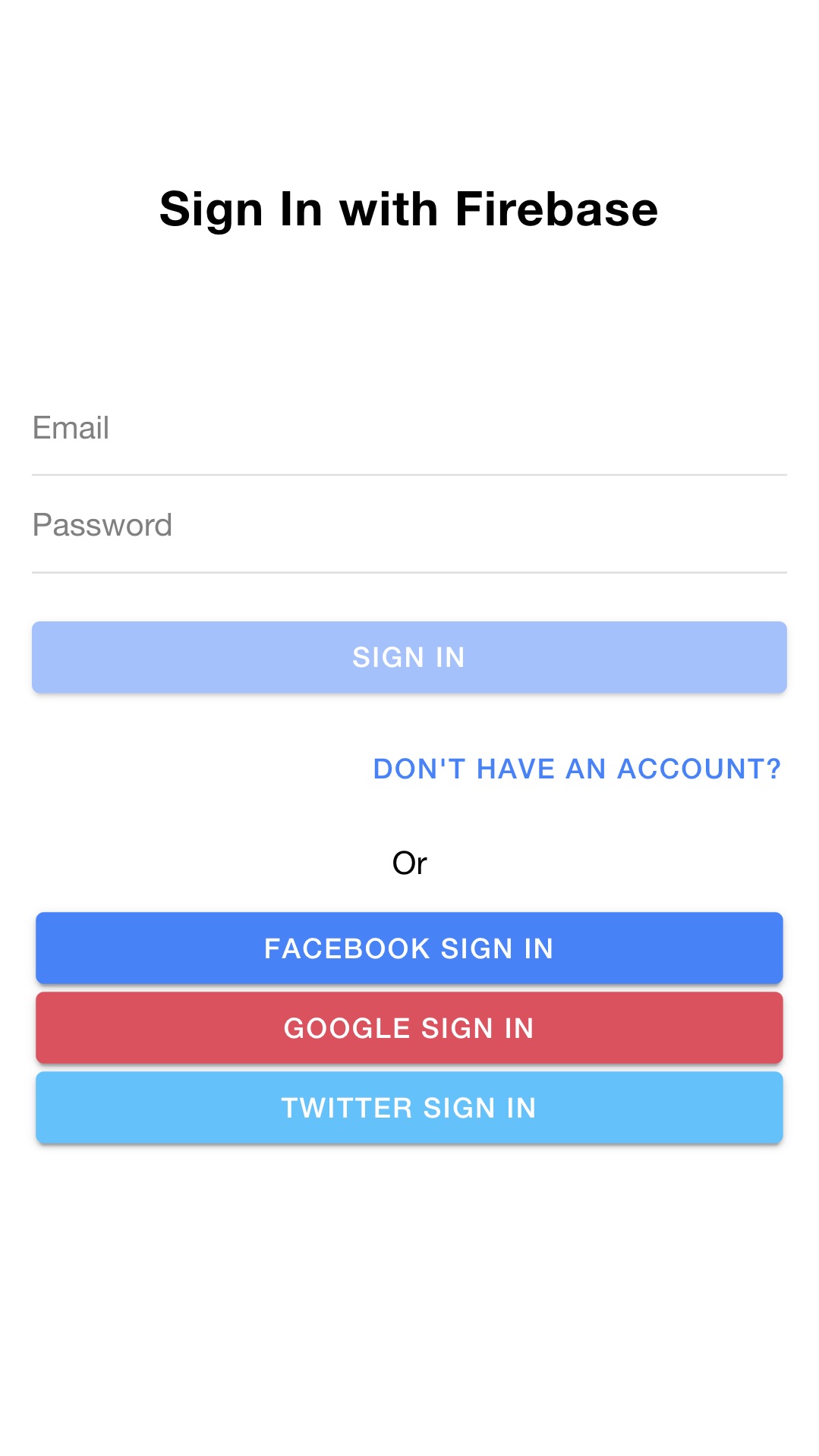 6 |
6 | 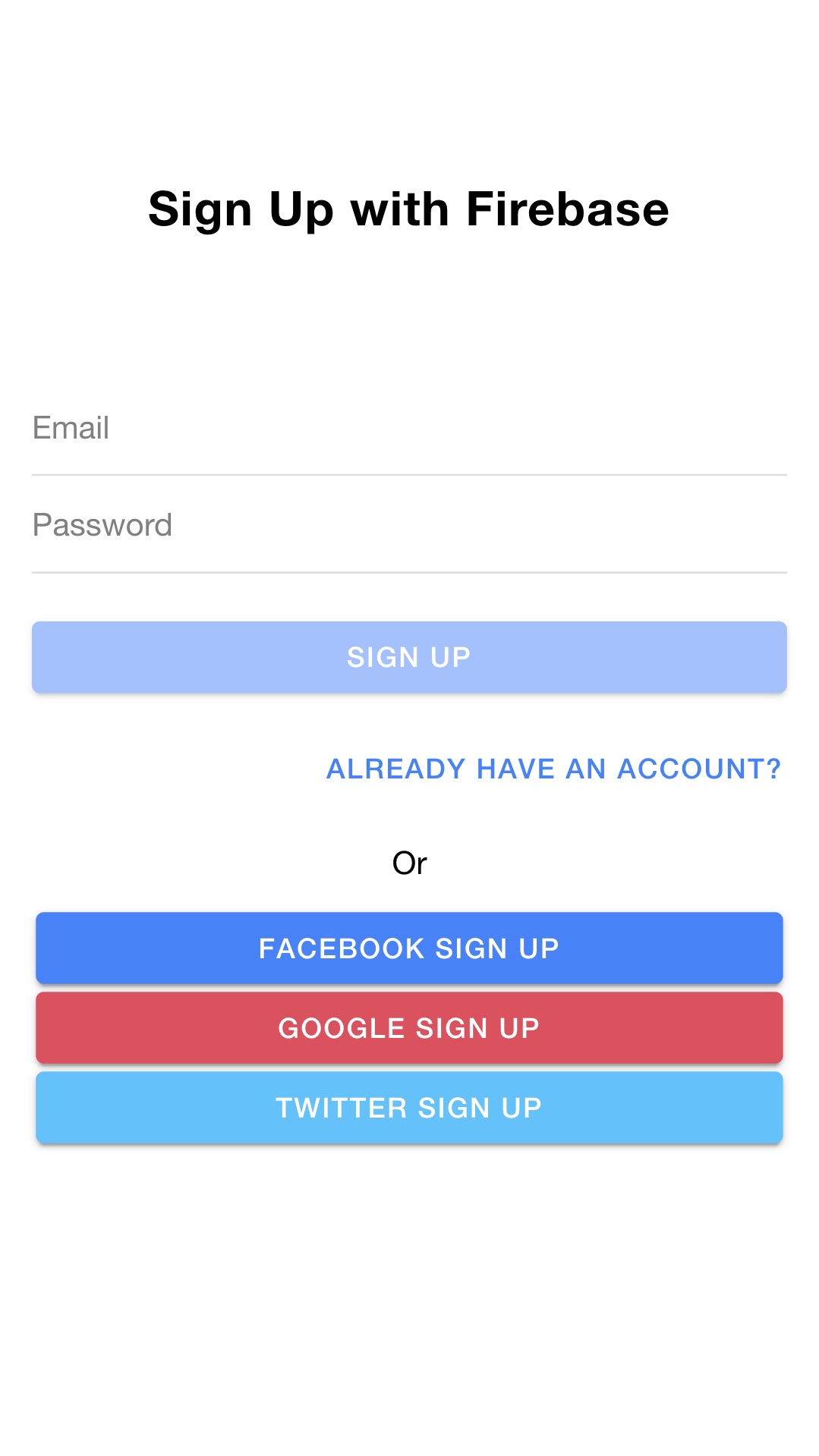 7 |
7 | 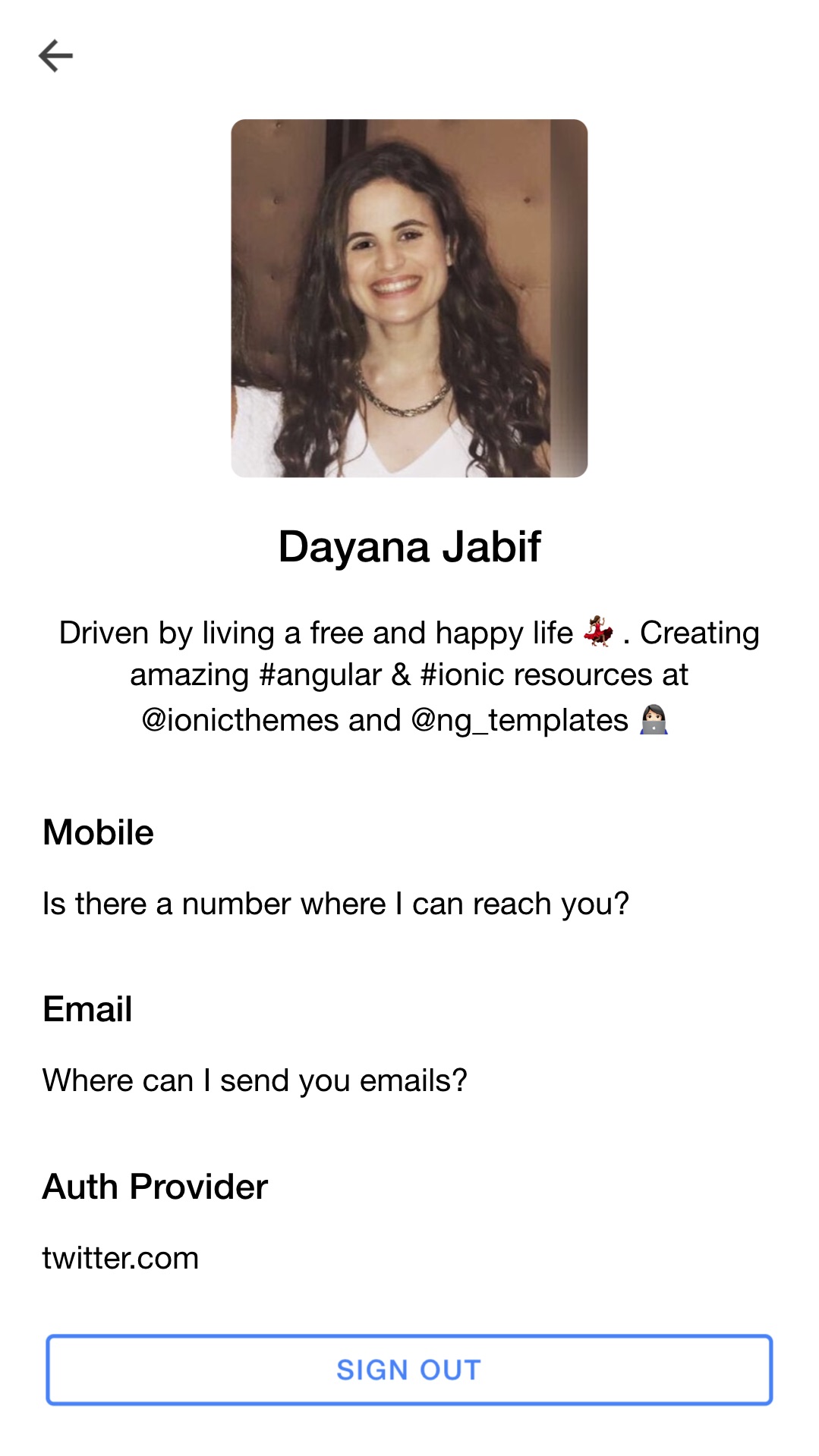 8 |
8 |
9 |
10 | ## About this ionic demo
11 | This repo is the code of an Ionic 5 starter app that we created as part of the post: **[Ionic Firebase Authentication Tutorial](https://ionicthemes.com/tutorials/about/firebase-authentication-in-ionic-framework-apps). In this post we explain how to perform Social Sign In with Firebase from an Ionic application.**
12 |
13 | Most apps need to know the identity of the user who is using it. Knowing a user's identity allows an app to securely save user data in the cloud and provide a personalized experience across all of the user's devices.
14 |
15 | In this Ionic + Firebase tutorial you will learn how to create an Ionic Framework Application with Firebase Authentication. We will show you how to configure both the Firebase and the Ionic 5 App to enable authentication with social providers such as Google, Facebook and Twitter and also with Email and Password.
16 |
17 | As an example we built this Ionic Framework application that allows users to log in and log out using all of the above mentioned authentication options. Once they log in, they will see a profile page with their basic profile info taken from the authentication provider.
18 |
19 | Read the complete post in https://ionicthemes.com/tutorials/about/firebase-authentication-in-ionic-framework-apps.
20 |
21 | ### Ionic Firebase Starter
22 | This repo is a simple ionic 5 starter app with three pages:
23 | - Sign In
24 | - Sign Up
25 | - Profile
26 |
27 | Find more Ionic tutorials and starter apps in https://ionicthemes.com
28 |
29 | ### Demo
30 | - [Online demo](https://ionic5-firebase-authentication.web.app)
31 |
32 | ## Install this Ionic 5 Firebase App
33 | ```
34 | npm install
35 | ```
36 | ### Browse the app
37 | ```
38 | ionic serve
39 | ```
40 |
41 | ### Get a premium Ionic 5 Starter App with Firebase Integration
42 | If you want a ready-made example of how to use Firebase Authentication in Ionic 5 with Capacitor configurations for iOS and Android, check [Ionic 5 Full Starter App PRO](https://ionicthemes.com/product/ionic5-full-starter-app-pro-version). We spent many hours configuring and testing everything so that you don't have to.
43 |
44 | This template has more than 100 carefully designed views and components, it will help you grasp the best practices and new concepts of Ionic 5.
45 |
46 | It also includes a very complete integration with Firebase which includes:
47 | - Firebase Authentication with different providers:
48 | - Facebook sign in
49 | - Twitter sign in
50 | - Google sign in
51 | - Email/Password sign in
52 | - This implementation works in all environments: web, PWA, mobile apps with Capacitor.
53 | - Firebase CRUD
54 | - Firebase queries
55 |
56 |
6 |
7 |
8 |  57 |
--------------------------------------------------------------------------------
/tslint.json:
--------------------------------------------------------------------------------
1 | {
2 | "extends": "tslint:recommended",
3 | "rulesDirectory": [
4 | "codelyzer"
5 | ],
6 | "rules": {
7 | "align": {
8 | "options": [
9 | "parameters",
10 | "statements"
11 | ]
12 | },
13 | "array-type": false,
14 | "arrow-parens": false,
15 | "arrow-return-shorthand": true,
16 | "curly": true,
17 | "deprecation": {
18 | "severity": "warn"
19 | },
20 | "eofline": true,
21 | "import-blacklist": [
22 | true,
23 | "rxjs/Rx"
24 | ],
25 | "import-spacing": true,
26 | "indent": {
27 | "options": [
28 | "spaces"
29 | ]
30 | },
31 | "interface-name": false,
32 | "max-classes-per-file": false,
33 | "max-line-length": [
34 | true,
35 | 140
36 | ],
37 | "member-access": false,
38 | "member-ordering": [
39 | true,
40 | {
41 | "order": [
42 | "static-field",
43 | "instance-field",
44 | "static-method",
45 | "instance-method"
46 | ]
47 | }
48 | ],
49 | "no-consecutive-blank-lines": false,
50 | "no-console": [
51 | true,
52 | "debug",
53 | "info",
54 | "time",
55 | "timeEnd",
56 | "trace"
57 | ],
58 | "no-empty": false,
59 | "no-inferrable-types": [
60 | true,
61 | "ignore-params"
62 | ],
63 | "no-non-null-assertion": true,
64 | "no-redundant-jsdoc": true,
65 | "no-switch-case-fall-through": true,
66 | "no-var-requires": false,
67 | "object-literal-key-quotes": [
68 | true,
69 | "as-needed"
70 | ],
71 | "object-literal-sort-keys": false,
72 | "ordered-imports": false,
73 | "quotemark": [
74 | true,
75 | "single"
76 | ],
77 | "semicolon": {
78 | "options": [
79 | "always"
80 | ]
81 | },
82 | "space-before-function-paren": {
83 | "options": {
84 | "anonymous": "never",
85 | "asyncArrow": "always",
86 | "constructor": "never",
87 | "method": "never",
88 | "named": "never"
89 | }
90 | },
91 | "trailing-comma": false,
92 | "no-output-on-prefix": true,
93 | "no-inputs-metadata-property": true,
94 | "no-host-metadata-property": true,
95 | "no-input-rename": true,
96 | "no-output-rename": true,
97 | "typedef-whitespace": {
98 | "options": [
99 | {
100 | "call-signature": "nospace",
101 | "index-signature": "nospace",
102 | "parameter": "nospace",
103 | "property-declaration": "nospace",
104 | "variable-declaration": "nospace"
105 | },
106 | {
107 | "call-signature": "onespace",
108 | "index-signature": "onespace",
109 | "parameter": "onespace",
110 | "property-declaration": "onespace",
111 | "variable-declaration": "onespace"
112 | }
113 | ]
114 | },
115 | "use-lifecycle-interface": true,
116 | "use-pipe-transform-interface": true,
117 | "one-variable-per-declaration": false,
118 | "component-class-suffix": [true, "Page", "Component"],
119 | "directive-class-suffix": true,
120 | "directive-selector": [
121 | true,
122 | "attribute",
123 | "app",
124 | "camelCase"
125 | ],
126 | "component-selector": [
127 | true,
128 | "element",
129 | "app",
130 | "page",
131 | "kebab-case"
132 | ]
133 | , "variable-name": {
134 | "options": [
135 | "ban-keywords",
136 | "check-format",
137 | "allow-pascal-case"
138 | ]
139 | },
140 | "whitespace": {
141 | "options": [
142 | "check-branch",
143 | "check-decl",
144 | "check-operator",
145 | "check-separator",
146 | "check-type",
147 | "check-typecast"
148 | ]
149 | }
150 | }
151 | }
152 |
--------------------------------------------------------------------------------
/src/app/sign-up/sign-up.page.ts:
--------------------------------------------------------------------------------
1 | import { Component, NgZone } from '@angular/core';
2 | import { AngularFireAuth } from '@angular/fire/auth';
3 | import { Router } from '@angular/router';
4 | import { FormGroup, FormControl, Validators } from '@angular/forms';
5 | import { FirebaseAuthService } from '../firebase-auth.service';
6 | import { Subscription } from 'rxjs';
7 |
8 | @Component({
9 | selector: 'app-sign-up',
10 | templateUrl: './sign-up.page.html',
11 | styleUrls: ['./sign-up.page.scss'],
12 | })
13 | export class SignUpPage {
14 | signUpForm: FormGroup;
15 | submitError: string;
16 | authRedirectResult: Subscription;
17 |
18 | validation_messages = {
19 | 'email': [
20 | { type: 'required', message: 'Email is required.' },
21 | { type: 'pattern', message: 'Enter a valid email.' }
22 | ],
23 | 'password': [
24 | { type: 'required', message: 'Password is required.' },
25 | { type: 'minlength', message: 'Password must be at least 6 characters long.' }
26 | ]
27 | };
28 |
29 | constructor(
30 | public angularFire: AngularFireAuth,
31 | public router: Router,
32 | private ngZone: NgZone,
33 | private authService: FirebaseAuthService
34 | ) {
35 | this.signUpForm = new FormGroup({
36 | 'email': new FormControl('', Validators.compose([
37 | Validators.required,
38 | Validators.pattern('^[a-zA-Z0-9_.+-]+@[a-zA-Z0-9-]+.[a-zA-Z0-9-.]+$')
39 | ])),
40 | 'password': new FormControl('', Validators.compose([
41 | Validators.minLength(6),
42 | Validators.required
43 | ]))
44 | });
45 | // Get firebase authentication redirect result invoken when using signInWithRedirect()
46 | // signInWithRedirect() is only used when client is in web but not desktop
47 | this.authRedirectResult = this.authService.getRedirectResult()
48 | .subscribe(result => {
49 | if (result.user) {
50 | this.redirectLoggedUserToProfilePage();
51 | } else if (result.error) {
52 | this.submitError = result.error;
53 | }
54 | });
55 | }
56 |
57 | // Once the auth provider finished the authentication flow, and the auth redirect completes,
58 | // redirect the user to the profile page
59 | redirectLoggedUserToProfilePage() {
60 | // As we are calling the Angular router navigation inside a subscribe method, the navigation will be triggered outside Angular zone.
61 | // That's why we need to wrap the router navigation call inside an ngZone wrapper
62 | this.ngZone.run(() => {
63 | this.router.navigate(['profile']);
64 | });
65 | }
66 |
67 | signUpWithEmail() {
68 | this.authService.signUpWithEmail(this.signUpForm.value['email'], this.signUpForm.value['password'])
69 | .then(user => {
70 | // navigate to user profile
71 | this.redirectLoggedUserToProfilePage();
72 | })
73 | .catch(error => {
74 | this.submitError = error.message;
75 | });
76 | }
77 |
78 | facebookSignUp() {
79 | this.authService.signInWithFacebook()
80 | .then((result: any) => {
81 | if (result.additionalUserInfo) {
82 | this.authService.setProviderAdditionalInfo(result.additionalUserInfo.profile);
83 | }
84 | // This gives you a Facebook Access Token. You can use it to access the Facebook API.
85 | // const token = result.credential.accessToken;
86 | // The signed-in user info is in result.user;
87 | this.redirectLoggedUserToProfilePage();
88 | }).catch((error) => {
89 | // Handle Errors here.
90 | console.log(error);
91 | });
92 | }
93 |
94 | googleSignUp() {
95 | this.authService.signInWithGoogle()
96 | .then((result: any) => {
97 | if (result.additionalUserInfo) {
98 | this.authService.setProviderAdditionalInfo(result.additionalUserInfo.profile);
99 | }
100 | // This gives you a Google Access Token. You can use it to access the Google API.
101 | // const token = result.credential.accessToken;
102 | // The signed-in user info is in result.user;
103 | this.redirectLoggedUserToProfilePage();
104 | }).catch((error) => {
105 | // Handle Errors here.
106 | console.log(error);
107 | });
108 | }
109 |
110 | twitterSignUp() {
111 | this.authService.signInWithTwitter()
112 | .then((result: any) => {
113 | if (result.additionalUserInfo) {
114 | this.authService.setProviderAdditionalInfo(result.additionalUserInfo.profile);
115 | }
116 | // This gives you a Twitter Access Token. You can use it to access the Twitter API.
117 | // const token = result.credential.accessToken;
118 | // The signed-in user info is in result.user;
119 | this.redirectLoggedUserToProfilePage();
120 | }).catch((error) => {
121 | // Handle Errors here.
122 | console.log(error);
123 | });
124 | }
125 | }
126 |
--------------------------------------------------------------------------------
/src/app/sign-in/sign-in.page.ts:
--------------------------------------------------------------------------------
1 | import { Component, NgZone } from '@angular/core';
2 | import { AngularFireAuth } from '@angular/fire/auth';
3 | import { FormGroup, FormControl, Validators } from '@angular/forms';
4 | import { Router } from '@angular/router';
5 | import { FirebaseAuthService } from '../firebase-auth.service';
6 | import { Subscription } from 'rxjs';
7 |
8 | @Component({
9 | selector: 'app-sign-in',
10 | templateUrl: 'sign-in.page.html',
11 | styleUrls: ['sign-in.page.scss'],
12 | })
13 | export class SignInPage {
14 | signInForm: FormGroup;
15 | submitError: string;
16 | authRedirectResult: Subscription;
17 |
18 | validation_messages = {
19 | 'email': [
20 | { type: 'required', message: 'Email is required.' },
21 | { type: 'pattern', message: 'Enter a valid email.' }
22 | ],
23 | 'password': [
24 | { type: 'required', message: 'Password is required.' },
25 | { type: 'minlength', message: 'Password must be at least 6 characters long.' }
26 | ]
27 | };
28 |
29 | constructor(
30 | public angularFire: AngularFireAuth,
31 | public router: Router,
32 | private ngZone: NgZone,
33 | private authService: FirebaseAuthService
34 | ) {
35 | this.signInForm = new FormGroup({
36 | 'email': new FormControl('', Validators.compose([
37 | Validators.required,
38 | Validators.pattern('^[a-zA-Z0-9_.+-]+@[a-zA-Z0-9-]+.[a-zA-Z0-9-.]+$')
39 | ])),
40 | 'password': new FormControl('', Validators.compose([
41 | Validators.minLength(6),
42 | Validators.required
43 | ]))
44 | });
45 |
46 | // Get firebase authentication redirect result invoken when using signInWithRedirect()
47 | // signInWithRedirect() is only used when client is in web but not desktop
48 | this.authRedirectResult = this.authService.getRedirectResult()
49 | .subscribe(result => {
50 | if (result.user) {
51 | this.redirectLoggedUserToProfilePage();
52 | } else if (result.error) {
53 | this.submitError = result.error;
54 | }
55 | });
56 | }
57 |
58 | // Once the auth provider finished the authentication flow, and the auth redirect completes,
59 | // redirect the user to the profile page
60 | redirectLoggedUserToProfilePage() {
61 | // As we are calling the Angular router navigation inside a subscribe method, the navigation will be triggered outside Angular zone.
62 | // That's why we need to wrap the router navigation call inside an ngZone wrapper
63 | this.ngZone.run(() => {
64 | this.router.navigate(['profile']);
65 | });
66 | }
67 |
68 | signInWithEmail() {
69 | this.authService.signInWithEmail(this.signInForm.value['email'], this.signInForm.value['password'])
70 | .then(user => {
71 | // navigate to user profile
72 | this.redirectLoggedUserToProfilePage();
73 | })
74 | .catch(error => {
75 | this.submitError = error.message;
76 | });
77 | }
78 |
79 | facebookSignIn() {
80 | this.authService.signInWithFacebook()
81 | .then((result: any) => {
82 | if (result.additionalUserInfo) {
83 | this.authService.setProviderAdditionalInfo(result.additionalUserInfo.profile);
84 | }
85 | // This gives you a Facebook Access Token. You can use it to access the Facebook API.
86 | // const token = result.credential.accessToken;
87 | // The signed-in user info is in result.user;
88 | this.redirectLoggedUserToProfilePage();
89 | }).catch((error) => {
90 | // Handle Errors here.
91 | console.log(error);
92 | });
93 | }
94 |
95 | googleSignIn() {
96 | this.authService.signInWithGoogle()
97 | .then((result: any) => {
98 | if (result.additionalUserInfo) {
99 | this.authService.setProviderAdditionalInfo(result.additionalUserInfo.profile);
100 | }
101 | // This gives you a Google Access Token. You can use it to access the Google API.
102 | // const token = result.credential.accessToken;
103 | // The signed-in user info is in result.user;
104 | this.redirectLoggedUserToProfilePage();
105 | }).catch((error) => {
106 | // Handle Errors here.
107 | console.log(error);
108 | });
109 | }
110 |
111 | twitterSignIn() {
112 | this.authService.signInWithTwitter()
113 | .then((result: any) => {
114 | if (result.additionalUserInfo) {
115 | this.authService.setProviderAdditionalInfo(result.additionalUserInfo.profile);
116 | }
117 | // This gives you a Twitter Access Token. You can use it to access the Twitter API.
118 | // const token = result.credential.accessToken;
119 | // The signed-in user info is in result.user;
120 | this.redirectLoggedUserToProfilePage();
121 | }).catch((error) => {
122 | // Handle Errors here.
123 | console.log(error);
124 | });
125 | }
126 | }
127 |
--------------------------------------------------------------------------------
/src/app/firebase-auth.service.ts:
--------------------------------------------------------------------------------
1 | import { Injectable } from '@angular/core';
2 | import { AngularFireAuth } from '@angular/fire/auth';
3 | import { Observable, Subject, from } from 'rxjs';
4 | import { Platform } from '@ionic/angular';
5 | import { User, auth } from 'firebase/app';
6 | import { ProfileModel } from './profile/profile.model';
7 | import { filter, map, take } from 'rxjs/operators';
8 |
9 | @Injectable()
10 | export class FirebaseAuthService {
11 |
12 | currentUser: User;
13 | userProviderAdditionalInfo: any;
14 | redirectResult: Subject
57 |
--------------------------------------------------------------------------------
/tslint.json:
--------------------------------------------------------------------------------
1 | {
2 | "extends": "tslint:recommended",
3 | "rulesDirectory": [
4 | "codelyzer"
5 | ],
6 | "rules": {
7 | "align": {
8 | "options": [
9 | "parameters",
10 | "statements"
11 | ]
12 | },
13 | "array-type": false,
14 | "arrow-parens": false,
15 | "arrow-return-shorthand": true,
16 | "curly": true,
17 | "deprecation": {
18 | "severity": "warn"
19 | },
20 | "eofline": true,
21 | "import-blacklist": [
22 | true,
23 | "rxjs/Rx"
24 | ],
25 | "import-spacing": true,
26 | "indent": {
27 | "options": [
28 | "spaces"
29 | ]
30 | },
31 | "interface-name": false,
32 | "max-classes-per-file": false,
33 | "max-line-length": [
34 | true,
35 | 140
36 | ],
37 | "member-access": false,
38 | "member-ordering": [
39 | true,
40 | {
41 | "order": [
42 | "static-field",
43 | "instance-field",
44 | "static-method",
45 | "instance-method"
46 | ]
47 | }
48 | ],
49 | "no-consecutive-blank-lines": false,
50 | "no-console": [
51 | true,
52 | "debug",
53 | "info",
54 | "time",
55 | "timeEnd",
56 | "trace"
57 | ],
58 | "no-empty": false,
59 | "no-inferrable-types": [
60 | true,
61 | "ignore-params"
62 | ],
63 | "no-non-null-assertion": true,
64 | "no-redundant-jsdoc": true,
65 | "no-switch-case-fall-through": true,
66 | "no-var-requires": false,
67 | "object-literal-key-quotes": [
68 | true,
69 | "as-needed"
70 | ],
71 | "object-literal-sort-keys": false,
72 | "ordered-imports": false,
73 | "quotemark": [
74 | true,
75 | "single"
76 | ],
77 | "semicolon": {
78 | "options": [
79 | "always"
80 | ]
81 | },
82 | "space-before-function-paren": {
83 | "options": {
84 | "anonymous": "never",
85 | "asyncArrow": "always",
86 | "constructor": "never",
87 | "method": "never",
88 | "named": "never"
89 | }
90 | },
91 | "trailing-comma": false,
92 | "no-output-on-prefix": true,
93 | "no-inputs-metadata-property": true,
94 | "no-host-metadata-property": true,
95 | "no-input-rename": true,
96 | "no-output-rename": true,
97 | "typedef-whitespace": {
98 | "options": [
99 | {
100 | "call-signature": "nospace",
101 | "index-signature": "nospace",
102 | "parameter": "nospace",
103 | "property-declaration": "nospace",
104 | "variable-declaration": "nospace"
105 | },
106 | {
107 | "call-signature": "onespace",
108 | "index-signature": "onespace",
109 | "parameter": "onespace",
110 | "property-declaration": "onespace",
111 | "variable-declaration": "onespace"
112 | }
113 | ]
114 | },
115 | "use-lifecycle-interface": true,
116 | "use-pipe-transform-interface": true,
117 | "one-variable-per-declaration": false,
118 | "component-class-suffix": [true, "Page", "Component"],
119 | "directive-class-suffix": true,
120 | "directive-selector": [
121 | true,
122 | "attribute",
123 | "app",
124 | "camelCase"
125 | ],
126 | "component-selector": [
127 | true,
128 | "element",
129 | "app",
130 | "page",
131 | "kebab-case"
132 | ]
133 | , "variable-name": {
134 | "options": [
135 | "ban-keywords",
136 | "check-format",
137 | "allow-pascal-case"
138 | ]
139 | },
140 | "whitespace": {
141 | "options": [
142 | "check-branch",
143 | "check-decl",
144 | "check-operator",
145 | "check-separator",
146 | "check-type",
147 | "check-typecast"
148 | ]
149 | }
150 | }
151 | }
152 |
--------------------------------------------------------------------------------
/src/app/sign-up/sign-up.page.ts:
--------------------------------------------------------------------------------
1 | import { Component, NgZone } from '@angular/core';
2 | import { AngularFireAuth } from '@angular/fire/auth';
3 | import { Router } from '@angular/router';
4 | import { FormGroup, FormControl, Validators } from '@angular/forms';
5 | import { FirebaseAuthService } from '../firebase-auth.service';
6 | import { Subscription } from 'rxjs';
7 |
8 | @Component({
9 | selector: 'app-sign-up',
10 | templateUrl: './sign-up.page.html',
11 | styleUrls: ['./sign-up.page.scss'],
12 | })
13 | export class SignUpPage {
14 | signUpForm: FormGroup;
15 | submitError: string;
16 | authRedirectResult: Subscription;
17 |
18 | validation_messages = {
19 | 'email': [
20 | { type: 'required', message: 'Email is required.' },
21 | { type: 'pattern', message: 'Enter a valid email.' }
22 | ],
23 | 'password': [
24 | { type: 'required', message: 'Password is required.' },
25 | { type: 'minlength', message: 'Password must be at least 6 characters long.' }
26 | ]
27 | };
28 |
29 | constructor(
30 | public angularFire: AngularFireAuth,
31 | public router: Router,
32 | private ngZone: NgZone,
33 | private authService: FirebaseAuthService
34 | ) {
35 | this.signUpForm = new FormGroup({
36 | 'email': new FormControl('', Validators.compose([
37 | Validators.required,
38 | Validators.pattern('^[a-zA-Z0-9_.+-]+@[a-zA-Z0-9-]+.[a-zA-Z0-9-.]+$')
39 | ])),
40 | 'password': new FormControl('', Validators.compose([
41 | Validators.minLength(6),
42 | Validators.required
43 | ]))
44 | });
45 | // Get firebase authentication redirect result invoken when using signInWithRedirect()
46 | // signInWithRedirect() is only used when client is in web but not desktop
47 | this.authRedirectResult = this.authService.getRedirectResult()
48 | .subscribe(result => {
49 | if (result.user) {
50 | this.redirectLoggedUserToProfilePage();
51 | } else if (result.error) {
52 | this.submitError = result.error;
53 | }
54 | });
55 | }
56 |
57 | // Once the auth provider finished the authentication flow, and the auth redirect completes,
58 | // redirect the user to the profile page
59 | redirectLoggedUserToProfilePage() {
60 | // As we are calling the Angular router navigation inside a subscribe method, the navigation will be triggered outside Angular zone.
61 | // That's why we need to wrap the router navigation call inside an ngZone wrapper
62 | this.ngZone.run(() => {
63 | this.router.navigate(['profile']);
64 | });
65 | }
66 |
67 | signUpWithEmail() {
68 | this.authService.signUpWithEmail(this.signUpForm.value['email'], this.signUpForm.value['password'])
69 | .then(user => {
70 | // navigate to user profile
71 | this.redirectLoggedUserToProfilePage();
72 | })
73 | .catch(error => {
74 | this.submitError = error.message;
75 | });
76 | }
77 |
78 | facebookSignUp() {
79 | this.authService.signInWithFacebook()
80 | .then((result: any) => {
81 | if (result.additionalUserInfo) {
82 | this.authService.setProviderAdditionalInfo(result.additionalUserInfo.profile);
83 | }
84 | // This gives you a Facebook Access Token. You can use it to access the Facebook API.
85 | // const token = result.credential.accessToken;
86 | // The signed-in user info is in result.user;
87 | this.redirectLoggedUserToProfilePage();
88 | }).catch((error) => {
89 | // Handle Errors here.
90 | console.log(error);
91 | });
92 | }
93 |
94 | googleSignUp() {
95 | this.authService.signInWithGoogle()
96 | .then((result: any) => {
97 | if (result.additionalUserInfo) {
98 | this.authService.setProviderAdditionalInfo(result.additionalUserInfo.profile);
99 | }
100 | // This gives you a Google Access Token. You can use it to access the Google API.
101 | // const token = result.credential.accessToken;
102 | // The signed-in user info is in result.user;
103 | this.redirectLoggedUserToProfilePage();
104 | }).catch((error) => {
105 | // Handle Errors here.
106 | console.log(error);
107 | });
108 | }
109 |
110 | twitterSignUp() {
111 | this.authService.signInWithTwitter()
112 | .then((result: any) => {
113 | if (result.additionalUserInfo) {
114 | this.authService.setProviderAdditionalInfo(result.additionalUserInfo.profile);
115 | }
116 | // This gives you a Twitter Access Token. You can use it to access the Twitter API.
117 | // const token = result.credential.accessToken;
118 | // The signed-in user info is in result.user;
119 | this.redirectLoggedUserToProfilePage();
120 | }).catch((error) => {
121 | // Handle Errors here.
122 | console.log(error);
123 | });
124 | }
125 | }
126 |
--------------------------------------------------------------------------------
/src/app/sign-in/sign-in.page.ts:
--------------------------------------------------------------------------------
1 | import { Component, NgZone } from '@angular/core';
2 | import { AngularFireAuth } from '@angular/fire/auth';
3 | import { FormGroup, FormControl, Validators } from '@angular/forms';
4 | import { Router } from '@angular/router';
5 | import { FirebaseAuthService } from '../firebase-auth.service';
6 | import { Subscription } from 'rxjs';
7 |
8 | @Component({
9 | selector: 'app-sign-in',
10 | templateUrl: 'sign-in.page.html',
11 | styleUrls: ['sign-in.page.scss'],
12 | })
13 | export class SignInPage {
14 | signInForm: FormGroup;
15 | submitError: string;
16 | authRedirectResult: Subscription;
17 |
18 | validation_messages = {
19 | 'email': [
20 | { type: 'required', message: 'Email is required.' },
21 | { type: 'pattern', message: 'Enter a valid email.' }
22 | ],
23 | 'password': [
24 | { type: 'required', message: 'Password is required.' },
25 | { type: 'minlength', message: 'Password must be at least 6 characters long.' }
26 | ]
27 | };
28 |
29 | constructor(
30 | public angularFire: AngularFireAuth,
31 | public router: Router,
32 | private ngZone: NgZone,
33 | private authService: FirebaseAuthService
34 | ) {
35 | this.signInForm = new FormGroup({
36 | 'email': new FormControl('', Validators.compose([
37 | Validators.required,
38 | Validators.pattern('^[a-zA-Z0-9_.+-]+@[a-zA-Z0-9-]+.[a-zA-Z0-9-.]+$')
39 | ])),
40 | 'password': new FormControl('', Validators.compose([
41 | Validators.minLength(6),
42 | Validators.required
43 | ]))
44 | });
45 |
46 | // Get firebase authentication redirect result invoken when using signInWithRedirect()
47 | // signInWithRedirect() is only used when client is in web but not desktop
48 | this.authRedirectResult = this.authService.getRedirectResult()
49 | .subscribe(result => {
50 | if (result.user) {
51 | this.redirectLoggedUserToProfilePage();
52 | } else if (result.error) {
53 | this.submitError = result.error;
54 | }
55 | });
56 | }
57 |
58 | // Once the auth provider finished the authentication flow, and the auth redirect completes,
59 | // redirect the user to the profile page
60 | redirectLoggedUserToProfilePage() {
61 | // As we are calling the Angular router navigation inside a subscribe method, the navigation will be triggered outside Angular zone.
62 | // That's why we need to wrap the router navigation call inside an ngZone wrapper
63 | this.ngZone.run(() => {
64 | this.router.navigate(['profile']);
65 | });
66 | }
67 |
68 | signInWithEmail() {
69 | this.authService.signInWithEmail(this.signInForm.value['email'], this.signInForm.value['password'])
70 | .then(user => {
71 | // navigate to user profile
72 | this.redirectLoggedUserToProfilePage();
73 | })
74 | .catch(error => {
75 | this.submitError = error.message;
76 | });
77 | }
78 |
79 | facebookSignIn() {
80 | this.authService.signInWithFacebook()
81 | .then((result: any) => {
82 | if (result.additionalUserInfo) {
83 | this.authService.setProviderAdditionalInfo(result.additionalUserInfo.profile);
84 | }
85 | // This gives you a Facebook Access Token. You can use it to access the Facebook API.
86 | // const token = result.credential.accessToken;
87 | // The signed-in user info is in result.user;
88 | this.redirectLoggedUserToProfilePage();
89 | }).catch((error) => {
90 | // Handle Errors here.
91 | console.log(error);
92 | });
93 | }
94 |
95 | googleSignIn() {
96 | this.authService.signInWithGoogle()
97 | .then((result: any) => {
98 | if (result.additionalUserInfo) {
99 | this.authService.setProviderAdditionalInfo(result.additionalUserInfo.profile);
100 | }
101 | // This gives you a Google Access Token. You can use it to access the Google API.
102 | // const token = result.credential.accessToken;
103 | // The signed-in user info is in result.user;
104 | this.redirectLoggedUserToProfilePage();
105 | }).catch((error) => {
106 | // Handle Errors here.
107 | console.log(error);
108 | });
109 | }
110 |
111 | twitterSignIn() {
112 | this.authService.signInWithTwitter()
113 | .then((result: any) => {
114 | if (result.additionalUserInfo) {
115 | this.authService.setProviderAdditionalInfo(result.additionalUserInfo.profile);
116 | }
117 | // This gives you a Twitter Access Token. You can use it to access the Twitter API.
118 | // const token = result.credential.accessToken;
119 | // The signed-in user info is in result.user;
120 | this.redirectLoggedUserToProfilePage();
121 | }).catch((error) => {
122 | // Handle Errors here.
123 | console.log(error);
124 | });
125 | }
126 | }
127 |
--------------------------------------------------------------------------------
/src/app/firebase-auth.service.ts:
--------------------------------------------------------------------------------
1 | import { Injectable } from '@angular/core';
2 | import { AngularFireAuth } from '@angular/fire/auth';
3 | import { Observable, Subject, from } from 'rxjs';
4 | import { Platform } from '@ionic/angular';
5 | import { User, auth } from 'firebase/app';
6 | import { ProfileModel } from './profile/profile.model';
7 | import { filter, map, take } from 'rxjs/operators';
8 |
9 | @Injectable()
10 | export class FirebaseAuthService {
11 |
12 | currentUser: User;
13 | userProviderAdditionalInfo: any;
14 | redirectResult: Subject