8 |
9 |
10 |
11 |
12 |
13 |
14 |
27 | OPTIONS:
28 | -d, --delim Set delimiter, defaults to newline
29 | -I, --replvar Set variable name to be used in eval, defaults to $
30 | ARGS:
31 | `;
32 | /* eslint-enable max-len */
33 |
34 | export type XevalFunc = (v: string) => void;
35 |
36 | export interface XevalOptions {
37 | delimiter?: string;
38 | }
39 |
40 | const DEFAULT_DELIMITER = "\n";
41 |
42 | export async function xeval(
43 | reader: Reader,
44 | xevalFunc: XevalFunc,
45 | { delimiter = DEFAULT_DELIMITER }: XevalOptions = {}
46 | ): Promise {
47 | for await (const chunk of readStringDelim(reader, delimiter)) {
48 | // Ignore empty chunks.
49 | if (chunk.length > 0) {
50 | await xevalFunc(chunk);
51 | }
52 | }
53 | }
54 |
55 | async function main(): Promise {
56 | const parsedArgs = parse(args, {
57 | boolean: ["help"],
58 | string: ["delim", "replvar"],
59 | alias: {
60 | delim: ["d"],
61 | replvar: ["I"],
62 | help: ["h"],
63 | },
64 | default: {
65 | delim: DEFAULT_DELIMITER,
66 | replvar: "$",
67 | },
68 | });
69 | if (parsedArgs._.length != 1) {
70 | console.error(HELP_MSG);
71 | console.log(parsedArgs._);
72 | exit(1);
73 | }
74 | if (parsedArgs.help) {
75 | return console.log(HELP_MSG);
76 | }
77 |
78 | const delimiter = parsedArgs.delim;
79 | const replVar = parsedArgs.replvar;
80 | const code = parsedArgs._[0];
81 |
82 | // new AsyncFunction()'s error message for this particular case isn't great.
83 | if (!replVar.match(/^[_$A-z][_$A-z0-9]*$/)) {
84 | console.error(`Bad replvar identifier: "${replVar}"`);
85 | exit(1);
86 | }
87 |
88 | const xEvalFunc = new AsyncFunction(replVar, code);
89 |
90 | await xeval(stdin, xEvalFunc, { delimiter });
91 | }
92 |
93 | if (import.meta.main) {
94 | main();
95 | }
96 |
--------------------------------------------------------------------------------
/site/index.tsx:
--------------------------------------------------------------------------------
1 | import { React } from '../mod.ts'
2 |
3 | const style = `
4 | h2 {
5 | font-weight: normal;
6 | }
7 | .main_article {
8 | width: 960px;
9 | max-width: 960px;
10 | padding-bottom: 0;
11 | }
12 | .cards {
13 | display: flex;
14 | justify-content: center;
15 | margin: 3rem -1rem 0 -1rem;
16 | padding-top: 1rem;
17 | border-top: 1px solid var(--color-border);
18 | }
19 | .cards > div {
20 | width: 20rem;
21 | padding: 0 1rem;
22 | }
23 | .cards ul {
24 | color: var(--color-text-muted);
25 | }
26 | .btn {
27 | padding: 0.5rem 1rem;
28 | margin: 0 1rem;
29 | border: 0;
30 | cursor: pointer;
31 | opacity: 0.9;
32 | font-size: 14px;
33 | text-decoration: none;
34 | background-color: var(--color-border);
35 | color: var(--color-text);
36 | }
37 | .btn:hover {
38 | text-decoration: none;
39 | }
40 | .btn-primary {
41 | background-color: var(--color-primary);
42 | color: var(--color-background);
43 | }
44 | .btn:hover {
45 | opacity: 1;
46 | }
47 | @media screen and (max-width: 44rem) {
48 | h2 {
49 | text-align: center;
50 | }
51 | .cards {
52 | flex-direction: column;
53 | }
54 | .cards > div {
55 | width: 100vw;
56 | }
57 | .cards ul {
58 | text-align: center;
59 | padding-left: 0;
60 | list-style: none;
61 | }
62 | pre {
63 | margin-left: -1rem;
64 | margin-right: -1rem;
65 | }
66 | }
67 | `
68 |
69 | const IndexPage = () => (
70 | <>
71 |
72 |
73 |
81 | Deno 钻研之术
82 |
83 |
91 | 循序渐进学 Deno & 先易后难补 Node & 面向未来的 Deno Web 应用开发
92 |
93 |
100 |
101 | 开始阅读
102 |
103 |
104 | 源码仓库
105 |
106 |
107 |
108 |
109 |
110 | 原创文章
111 |
112 | - 融合了笔者的大量思考。
113 | - 本书、笔者和读者一起成长。
114 | - 友好的交流环境。
115 |
116 |
117 |
118 | 内容丰富
119 |
120 | - 从多方位建设
Deno 生态。
121 | -
122 | 内容包括但不局限于
Deno Node React Rust 等众多技术要点。
123 |
124 | - 收录各种翻译文章、授权转载文章。
125 |
126 |
127 |
128 | 长期维护
129 |
130 | - 来源于一份对持续深入地掌握前沿技术的渴望。
131 | - 基于
Pagic 静态网站生成器,构建长期的网站技术支持。
132 | - 野心,不止于此。
133 |
134 |
135 |
136 | 推荐你的 Deno 文章?快来一起建设吧
137 |
142 |
154 |
155 | )
156 |
157 | export default IndexPage
158 |
--------------------------------------------------------------------------------
/site/articles/document/deno-cli-handbook.md:
--------------------------------------------------------------------------------
1 | # Deno CLI 通用手册
2 |
3 | > 更新到了 v1.22.2
4 |
5 | ## 通读命令行基本信息
6 |
7 | ### deno --help, help
8 |
9 | 了解一个命令的最快速实用的方法就是直接阅读其帮助文档,每行帮助信息都是简短且关键的介绍,不难理解和翻译。终端输入如下命令(help 或 --help 用来打印全局帮助信息或给定子命令的帮助信息):
10 |
11 | ```bash
12 | $ deno --help
13 | ```
14 |
15 | 从而获得 Deno 的基本帮助信息:
16 |
17 | - deno 1.2.2(2020-08-01 发布)
18 | - 一个安全的 JavaScript 和 TypeScript 运行时
19 | - 文档:[https://deno.land/manual](https://deno.land/manual)
20 | - 模块:[https://deno.land/std/](https://deno.land/std/) [https://deno.land/x/](https://deno.land/x/)
21 | - Bugs:[https://github.com/denoland/deno/issues](https://github.com/denoland/deno/issues)
22 | - 使用方式:deno [选项] [子命令]
23 |
24 | ```bash
25 | # 以 REPL 模式启动:
26 | $ deno
27 | # 执行一个脚本:
28 | $ deno run https://deno.land/std/examples/welcome.ts
29 | # 在 Shell 中执行一段代码:
30 | $ deno eval "console.log(30933 + 404)"
31 | ```
32 |
33 | ### 汇总 26 个通用指令
34 |
35 | 结合 deno --help 中出现的选项以及通常也会在 14 个内置工具包的帮助信息中看到的选项,将通用指令整理在这里做一个通览(只要某指令被使用两次及以上便视为通用指令,几乎涵盖了所有):
36 |
37 | - P.S:在纠结到底称为“参数”还是“选项”还是“指令”的时候,差点选了“参数”,最后选择了“指令”。
38 |
39 | > 注:以下表格整理了好几小时,如果能帮到你,别忘记多多点赞哟。挖个坑:以后可以绘制出一个思维导图来。同时,如果哪里有差错,欢迎在评论区 Github 仓库 issues 里留言哈。
40 |
41 | | 序号 | 选项 | 哪些工具可以使用? | 用途 |
42 | | --- | --- | --- | --- |
43 | | 01 | -h, --help | 全部 | 打印帮助信息 |
44 | | 02 | -L, --log-level | 全部 | 设置日志级别 [可能的值: debug, info] |
45 | | 03 | -q, --quiet | 全部 | 禁止诊断输出;默认情况下,子命令会将可读性友好的诊断消息打印到 stderr;如果设置了这个标志,则将这些消息限制为 errors |
46 | | 04 | -A, --allow-all | run, install, test | 允许所有权限,这将禁用所有安全限制 |
47 | | 05 | --allow-env | run, install, test | 允许环境访问,例如读取和设置环境变量 |
48 | | 06 | --allow-hrtime | run, install, test | 允许高精度时间测量,高精度时间能够在计时攻击和特征识别中使用 |
49 | | 07 | --allow-net= | run, install, test | 允许网络访问。可以指定一系列用逗号分隔的域名,来提供域名白名单 |
50 | | 08 | --allow-plugin | run, install, test | 允许加载插件。请注意:这目前是一个不稳定功能 |
51 | | 09 | --allow-read= | run, install, test | 允许读取文件系统。可以指定一系列用逗号分隔的目录或文件,来提供文件系统白名单。 |
52 | | 10 | --allow-run | run, install, test | 允许运行子进程。请注意,子进程不在沙箱中运行,因此没有与 deno 进程相同的安全限制,请谨慎使用 |
53 | | 11 | --allow-write= | run, install, test | 允许写入文件系统。您可以指定一系列用逗号分隔的目录或文件,来提供文件系统白名单 |
54 | | 12 | --cert | run, install, bundle, chche, eval, info, test, upgrade, repl | 从 PEM 编码的文件中加载证书颁发机构 |
55 | | 13 | -c, --config | run, install, budle, cache, test | 读取 tsconfig.json 配置文件 |
56 | | 14 | --unstable | run, install, bundle, cache, doc, eval, fmt, info, lint, test, types, repl | 开启不稳定的 APIs 支持 |
57 | | 15 | --inspect= | run, eval, test, repl | 激活监听器 主机:端口 (默认: 127.0.0.1:9229) |
58 | | 16 | --inspect-brk= | run, eval, test, repl | 在 主机:端口 上激活监听器,并在用户脚本启动时中断 |
59 | | 17 | --v8-flags= | run, eval, test, repl | 设置 V8 命令行选项。帮助: --v8-flags=--help |
60 | | 18 | --cached-only | run, test | 要求远程依赖项已经被缓存 |
61 | | 19 | -r, --reload= | run, cache, doc, test | 重新加载源代码缓存(重新编译TypeScript)。重新加载全部/仅标准模块/特定模块 |
62 | | 20 | --lock | run, bundle, cache, test | 检查指定的锁文件 |
63 | | 21 | --lock-write | run, bundle, cache, test | 写入锁文件,和 --lock 一起使用 |
64 | | 22 | --no-check | run, cache, info, test | 禁用 TypeScript 的类型检查,这会大大减少程序的启动时间 |
65 | | 23 | --no-remote | run, cache, test | 不解析远程模块 |
66 | | 24 | --seed | run, test | Math.random() 种子 |
67 | | 25 | --importmap | run, install, bundle, test | 不稳定:读取 import map 文件 |
68 | | 26 | --json | doc, info | 以 JSON 格式输出文档 |
69 |
70 | 具体通用指令会在“通读 Deno 通用指令”章节进行深入了解。
71 |
72 | ### 汇总 14 个内置工具包
73 |
74 | 帮助信息中初步介绍了这 14 个内置工具(为了强调每个工具的独立性,这些工具暂时都翻译为“xx 器”):
75 |
76 | | 序号 | 名称 | 命令 | 功能 |
77 | | --- | --- | --- | --- |
78 | | 01 | 运行器 | deno run | 运行指定文件名或 URL 程序。 使用“-”作为文件名从标准输入中读取 |
79 | | 02 | 脚本安装器 | deno install | 将脚本安装为可执行文件 |
80 | | 03 | 打包器 | deno bundle | 将模块和依赖项打包到单个文件中 |
81 | | 04 | 缓存器 | deno cache | 缓存依赖 |
82 | | 05 | 文档生成器 | deno doc | 显示某模块的文档 |
83 | | 06 | 执行器 | deno eval | 执行一段脚本 |
84 | | 07 | 格式化器 | deno fmt | 格式化源文件 |
85 | | 08 | 依赖检查器 | deno info | 显示有关缓存的信息或与源文件相关的信息 |
86 | | 09 | 规范器 | deno lint | 规范化源文件 |
87 | | 10 | 测试器 | deno test | 执行测试 |
88 | | 11 | 类型器 | deno types | 打印运行时 TypeScript 声明 |
89 | | 12 | 补全器 | deno completions | 生成 Shell 补全信息 |
90 | | 13 | 升级器 | deno upgrade | 将 Deno 可执行文件升级到给定版本 |
91 | | 14 | REPL 器 | deo repl | 读取/执行/打印/循环 |
92 |
93 | 具体工具会在“通读 Deno 内置工具包”章节进行深入了解。
94 |
95 | ### 汇总 6 个基本环境变量
96 |
97 | 帮助信息里初步介绍了这 6 个环境变量:
98 |
99 | | 序号 | 变量名 | 用途 | 备注 |
100 | | --- | --- | --- | --- |
101 | | 01 | DENO_DIR | 设置缓存目录 | |
102 | | 02 | DENO_INSTALL_ROOT | 设置 Deno 安装的软件包输入目录 | 默认为 $HOME/.deno/bin |
103 | | 03 | NO_COLOR | 设置禁止使用颜色 | |
104 | | 04 | DENO_CERT | 从 PEM 编码的文件加载证书颁发机构 | |
105 | | 05 | HTTP_PROXY | HTTP 请求的代理地址 | 模块 downloads 和 fetch |
106 | | 06 | HTTPS_PROXY | HTTPS 请求的代理地址 | 模块 downloads 和 fetch |
107 |
108 | 具体基本环境变量会在“通读 Deno 环境变量”章节进行深入了解。
109 |
--------------------------------------------------------------------------------
/pagic.config.tsx:
--------------------------------------------------------------------------------
1 | // @deno-types="https://deno.land/x/pagic@v0.9.1/src/types/react/v16.13.1/react.d.ts"
2 | import React from 'https://dev.jspm.io/react@16.13.1'
3 |
4 | export default {
5 | srcDir: 'site',
6 | theme: 'docs',
7 | plugins: ['sidebar', 'prev_next', 'gitalk', 'ga'],
8 | title: 'Deno 钻研之术',
9 | description: '循序渐进学 Deno & 先易后难补 Node & 面向未来的 Deno Web 应用开发。',
10 | github: 'https://github.com/hylerrix/deno-tutorial',
11 | head: (),
12 | nav: [
13 | { text: '文章', link: '/articles/' },
14 | {
15 | text: '打赏一下!!',
16 | link: 'http://qiniu.ningo.cloud/hylerrix/reward-alipay.png',
17 | target: '_blank',
18 | popover: (
19 | <>
20 |  21 |
21 |  22 |
23 | )
24 | },
25 | { text: '资源', target: '_blank', link: 'https://github.com/hylerrix/awesome-deno-cn' },
26 | { text: '镜像', target: '_blank', link: 'http://tutorial.deno.js.cn' },
27 | { text: 'Deno 双周刊', target: '_blank', link: 'https://github.com/hylerrix/deno-feedly' },
28 | { text: '持续添加中...', target: '_blank', link: 'https://github.com/hylerrix' },
29 | {
30 | text: '凝果屋',
31 | link: 'https://github.com/ningowood',
32 | target: '_blank',
33 | popover: (
34 |
22 |
23 | )
24 | },
25 | { text: '资源', target: '_blank', link: 'https://github.com/hylerrix/awesome-deno-cn' },
26 | { text: '镜像', target: '_blank', link: 'http://tutorial.deno.js.cn' },
27 | { text: 'Deno 双周刊', target: '_blank', link: 'https://github.com/hylerrix/deno-feedly' },
28 | { text: '持续添加中...', target: '_blank', link: 'https://github.com/hylerrix' },
29 | {
30 | text: '凝果屋',
31 | link: 'https://github.com/ningowood',
32 | target: '_blank',
33 | popover: (
34 |  35 | )
36 | },
37 | { text: '关于', target: '_blank', link: 'https://github.com/hylerrix' },
38 | ],
39 | sidebar: {
40 | '/articles/': [
41 | 'articles/README.md',
42 | {
43 | link: 'articles/document/README.md',
44 | title: '文档篇',
45 | children: [
46 | 'articles/document/deno-version-handbook.md',
47 | 'articles/document/deno-cli-handbook.md',
48 | 'articles/document/deno-translation-dictionary.md',
49 | ],
50 | },
51 | {
52 | link: 'articles/basic/README.md',
53 | title: '基础篇',
54 | children: [
55 | 'articles/basic/install-and-hello-world.md',
56 | ],
57 | },
58 | {
59 | link: 'articles/architecture/README.md',
60 | title: '架构篇',
61 | children: [
62 | {
63 | link: 'articles/architecture/cli/README.md',
64 | title: '探索 CLI',
65 | children: [
66 | 'articles/architecture/cli/deno-cli-v1-function.md'
67 | ],
68 | },
69 | ],
70 | },
71 | // {
72 | // link: 'articles/frontend/README.md',
73 | // title: '前端篇',
74 | // children: [],
75 | // },
76 | // {
77 | // link: 'articles/backend/README.md',
78 | // title: '后端篇',
79 | // children: [],
80 | // },
81 | {
82 | link: 'articles/ecology/README.md',
83 | title: '生态篇',
84 | children: [
85 | 'articles/ecology/awesome-deno-cn.md'
86 | ],
87 | },
88 | // {
89 | // link: 'articles/language/README.md',
90 | // title: '语言篇',
91 | // children: [],
92 | // },
93 | {
94 | link: 'articles/node/README.md',
95 | title: 'Node 篇',
96 | children: [
97 | 'articles/node/create-react-app-intro.md',
98 | 'articles/node/javascript-toolchain-rome.md',
99 | ],
100 | },
101 | {
102 | link: 'articles/official/README.md',
103 | title: '官方篇',
104 | children: [
105 | 'articles/official/thoroughgoing-deno-in-2020.md',
106 | ],
107 | },
108 | {
109 | link: 'articles/translation/README.md',
110 | title: '翻译篇',
111 | children: [
112 | 'articles/translation/the-deno-handbook.md',
113 | 'articles/translation/deno-chat-app.md',
114 | 'articles/translation/from-node-to-deno.md',
115 | 'articles/translation/deno-oak-todo-api.md',
116 | 'articles/translation/deno-oak-mysql.md',
117 | 'articles/translation/why-deno-wrong.md',
118 | ],
119 | },
120 | // {
121 | // link: 'articles/forward/README.md',
122 | // title: '转载篇',
123 | // children: [],
124 | // },
125 | 'articles/THANKS.md',
126 | ],
127 | },
128 | tools: {
129 | editOnGithub: true,
130 | backToTop: true
131 | },
132 | gitalk: {
133 | clientID: '60180eea2c09238f8998',
134 | clientSecret: 'e9ea0ff6555185eda28eff4dfd4b755b1764abf3',
135 | repo: 'deno-tutorial',
136 | owner: 'hylerrix',
137 | admin: ['hylerrix'],
138 | pagerDirection: 'first'
139 | },
140 | ga: {
141 | id: 'UA-169223577-1'
142 | },
143 | port: 8011
144 | }
145 |
--------------------------------------------------------------------------------
/site/articles/document/deno-version-handbook.md:
--------------------------------------------------------------------------------
1 | # Deno 版本历史概览
2 |
3 | ## v0.x
4 |
5 | | 序号 | 发布日期 | Deno | 标准库 | 关键字 |
6 | | --- | --- | --- | --- | --- |
7 | | 0001 | 2018-08-18 | v0.0.1 | | |
8 | | 0002 | 2018-08-21 | v0.0.2 | | |
9 | | 0003 | 2018-08-23 | v0.0.3 | | |
10 | | 0004 | 2018-08-23 | v0.1.0 | | |
11 | | 0005 | 2018-08-28 | v0.1.1 | | |
12 | | 0006 | 2018-08-31 | v0.1.2 | | |
13 | | 0007 | 2018-09-06 | v0.1.3 | | |
14 | | 0008 | 2018-09-13 | v0.1.4 | | |
15 | | 0009 | 2018-09-22 | v0.1.5 | | |
16 | | 0010 | 2018-09-30 | v0.1.6 | | |
17 | | 0011 | 2018-10-04 | v0.1.7 | | |
18 | | 0012 | 2018-10-13 | v0.1.8 | | |
19 | | 0013 | 2018-10-21 | v0.1.9 | | |
20 | | 0014 | 2018-10-27 | v0.1.10 | | |
21 | | 0015 | 2018-11-06 | v0.1.11 | | |
22 | | 0016 | 2018-11-13 | v0.1.12 | | |
23 | | 0017 | 2018-11-16 | v0.2.0 | | |
24 | | 0018 | 2018-12-01 | v0.2.1 | | |
25 | | 0019 | 2018-12-08 | v0.2.2 | | |
26 | | 0020 | 2018-12-15 | v0.2.3 | | |
27 | | 0021 | 2018-12-24 | v0.2.4 | | |
28 | | 0022 | 2019-01-02 | v0.2.5 | | |
29 | | 0023 | 2019-01-08 | v0.2.6 | | |
30 | | 0024 | 2019-01-15 | v0.2.7 | | |
31 | | 0025 | 2019-01-20 | v0.2.8 | | |
32 | | 0026 | 2019-01-30 | v0.2.9 | | |
33 | | 0027 | 2019-02-03 | v0.2.10 | | |
34 | | 0028 | 2019-02-09 | v0.2.11 | | |
35 | | 0029 | 2019-02-19 | v0.3.0 | | |
36 | | 0030 | 2019-02-28 | v0.3.1 | | |
37 | | 0031 | 2019-03-07 | v0.3.2 | | |
38 | | 0032 | 2019-03-14 | v0.3.3 | | |
39 | | 0033 | 2019-03-21 | v0.3.4 | | |
40 | | 0034 | 2019-03-29 | v0.3.5 | | |
41 | | 0035 | 2019-04-04 | v0.3.6 | | |
42 | | 0036 | 2019-04-12 | v0.3.7 | | |
43 | | 0037 | 2019-04-19 | v0.3.8 | | |
44 | | 0038 | 2019-04-25 | v0.3.9 | | |
45 | | 0039 | 2019-04-26 | v0.3.10 | | |
46 | | 0040 | 2019-05-04 | v0.3.11 | | |
47 | | 0041 | 2019-05-04 | v0.4.0 | | |
48 | | 0042 | 2019-05-12 | v0.5.0 | | |
49 | | 0043 | 2019-05-21 | v0.6.0 | | |
50 | | 0044 | 2019-05-30 | v0.7.0 | | |
51 | | 0045 | 2019-06-09 | v0.8.0 | | |
52 | | 0046 | 2019-06-16 | v0.9.0 | | |
53 | | 0047 | 2019-06-25 | v0.10.0 | | |
54 | | 0048 | 2019-07-08 | v0.11.0 | | |
55 | | 0049 | 2019-07-17 | v0.12.0 | | |
56 | | 0050 | 2019-08-01 | v0.13.0 | | |
57 | | 0051 | 2019-08-09 | v0.14.0 | | |
58 | | 0052 | 2019-08-14 | v0.15.0 | | |
59 | | 0053 | 2019-08-23 | v0.16.0 | | |
60 | | 0054 | 2019-09-05 | v0.17.0 | | |
61 | | 0055 | 2019-09-14 | v0.18.0 | | |
62 | | 0056 | 2019-09-25 | v0.19.0 | | |
63 | | 0057 | 2019-10-08 | v0.20.0 | | |
64 | | 0058 | 2019-10-20 | v0.21.0 | | |
65 | | 0059 | 2019-10-29 | v0.22.0 | | |
66 | | 0060 | 2019-11-05 | v0.23.0 | | |
67 | | 0061 | 2019-11-15 | v0.24.0 | | |
68 | | 0062 | 2019-11-27 | v0.25.0 | | |
69 | | 0063 | 2019-12-06 | v0.26.0 | | |
70 | | 0064 | 2019-12-19 | v0.27.0 | | |
71 | | 0065 | 2020-01-02 | v0.28.0 | | |
72 | | 0066 | 2020-01-03 | v0.28.1 | | |
73 | | 0067 | 2020-01-10 | v0.29.0 | | |
74 | | 0068 | 2020-01-18 | v0.30.0 | | |
75 | | 0069 | 2020-01-22 | v0.30.1 | | |
76 | | 0070 | 2020-01-25 | v0.31.0 | | |
77 | | 0071 | 2020-02-03 | v0.32.0 | | |
78 | | 0072 | 2020-02-14 | v0.33.0 | | |
79 | | 0073 | 2020-02-20 | v0.34.0 | v0.34.0 | |
80 | | 0074 | 2020-02-29 | v0.35.0 | v0.35.0 | |
81 | | 0075 | 2020-03-12 | v0.36.0 | v0.36.0 | |
82 | | 0076 | 2020-03-24 | v0.37.0 | v0.37.0 | |
83 | | 0077 | 2020-03-24 | v0.37.1 | | |
84 | | 0078 | 2020-03-29 | v0.38.0 | v0.38.0 | |
85 | | 0079 | 2020-04-04 | v0.39.0 | v0.39.0 | |
86 | | 0080 | 2020-04-09 | v0.40.0 | v0.40.0 | |
87 | | 0081 | 2020-04-16 | v0.41.0 | v0.41.0 | |
88 | | 0082 | 2020-04-30 | v0.42.0 | v0.42.0 | |
89 |
90 | ## v1.x
91 |
92 | | 序号 | 发布日期 | Deno | 标准库 | 关键字 |
93 | | --- | --- | --- | --- | --- |
94 | | 0101 | 2020-05-05 | v1.0.0-rc1 | | |
95 | | 0102 | 2020-05-09 | | 0.50.0 | |
96 | | 0103 | 2020-05-10 | v1.0.0-rc2 | | |
97 | | 0104 | 2020-05-12 | v1.0.0-rc3 | | |
98 | | 0105 | 2020-05-14 | v1.0.0 | v0.51.0 | |
99 | | 0106 | 2020-05-21 | v1.0.1 | v0.52.0 | |
100 | | 0107 | 2020-05-23 | v1.0.2 | v0.53.0 | |
101 | | 0108 | 2020-05-30 | v1.0.3 | v0.54.0 | |
102 | | 0109 | 2020-06-02 | v1.0.4 | v0.55.0 | |
103 | | 0110 | 2020-06-04 | v1.0.5 | v0.56.0 | |
104 | | 0111 | 2020-06-13 | v1.1.0 | v0.57.0 | |
105 | | 0112 | 2020-06-20 | v1.1.1 | v0.58.0 | |
106 | | 0113 | 2020-06-27 | v1.1.2 | v0.59.0 | |
107 | | 0114 | 2020-07-04 | v1.1.3 | v0.60.0 | |
108 | | 0115 | 2020-07-13 | v1.2.0 | v0.61.0 | |
109 | | 0116 | 2020-07-24 | v1.2.1 | v0.62.0 | |
110 | | 0117 | 2020-08-01 | v1.2.2 | v0.63.0 | |
111 | | 0118 | 2020-08-09 | v1.2.3 | v0.64.0 | |
112 | | 0119 | 2020-08-14 | v1.3.0 | v0.65.0 | |
113 | | 0120 | 2020-08-21 | v1.3.1 | v0.66.0 | |
114 | | 0121 | 2020-08-29 | v1.3.2 | v0.67.0 | |
115 | | 0122 | 2020-09-04 | v1.3.3 | v0.68.0 | |
116 | | 0123 | 2020-09-13 | v1.4.0 | v0.69.0 | |
117 | | 0124 | 2020-09-19 | v1.4.1 | v0.70.0 | |
118 | | 0125 | 2020-09-25 | v1.4.2 | v0.71.0 | |
119 | | 0126 | 2020-10-02 | v1.4.3 | v0.72.0 | |
120 | | 0127 | 2020-10-03 | v1.4.4 | v0.73.0 | |
121 | | 0128 | 2020-10-08 | v1.4.5 | v0.74.0 | |
122 | | 0129 | 2020-10-10 | v1.4.6 | | |
123 | | 0130 | 2020-10-27 | v1.5.0 | v0.75.0 | |
124 | | 0131 | 2020-10-31 | v1.5.1 | v0.76.0 | |
125 | | 0132 | 2020-11-09 | v1.5.2 | v0.77.0 | |
126 | | 0133 | 2020-11-16 | v1.5.3 | v0.78.0 | |
127 | | 0134 | 2020-11-23 | v1.5.4 | v0.79.0 | |
128 | | 0135 | 2020-12-08 | v1.6.0 | v0.80.0 | |
129 | | 0136 | 2020-12-15 | v1.6.1 | v0.81.0 | |
130 | | 0137 | 2020-12-22 | v1.6.2 | v0.82.0 | |
131 | | 0138 | 2020-12-30 | v1.6.3 | v0.83.0 | |
132 | | 0139 | 2021-01-19 | v1.7.0 | v0.84.0 | |
133 | | | | | | |
134 |
--------------------------------------------------------------------------------
/site/articles/README.md:
--------------------------------------------------------------------------------
1 | # Deno 钻研之术
2 |
3 |
4 |
5 |
6 | [](#contributors-)
7 |
8 |
9 | > :sauropod: 长期更新的《Deno 钻研之术》!循序渐进学 Deno & 先易后难补 Node & 面向未来的 Deno Web 应用开发。
10 |
11 | 
12 |
13 | > 《Deno 钻研之术》的配套仓库:[独家 Awesome Deno 资源清单](https://github.com/hylerrix/awesome-deno-cn),构造 Deno 资源全图谱。
14 |
15 | Deno 钻研之术官方网站:[https://deno-tutorial.js.org](https://deno-tutorial.js.org)。基于 [Pagic](https://github.com/xcatliu/pagic) 构建。
16 |
17 | ## 目录
18 |
19 | 目前规划的章节目录如下。
20 |
21 | * 基础篇:循序渐进学 Deno 基础知识;
22 | * 标准库篇:深入标准库的内部世界;
23 | * CLI 篇:探索 CLI 命令行的知识;
24 | * Web 篇:打造 Web 开发基石;
25 | * Node 篇:先易后难补 Node 知识,探索与 Deno 的异与同;
26 | * Rust 篇:探索 Deno 底层有关 Rust 的更多知识;
27 | * 前端篇:探索 Deno Web 前端应用开发的方式;
28 | * 后端篇:探索 Deno Web 后端应用开发的方式;
29 | * 架构篇:深入到 Deno 底层读 V8,学架构;
30 | * 生态篇:介绍 Deno 生态的相关内容;
31 | * 翻译篇:翻译优质的、授权的英文一手博文。
32 |
33 | 目前本仓库的文件结构如下。
34 |
35 | ```
36 | .
37 | ├── LICENSE
38 | ├── README.md
39 | ├── articles # 分为多种章节
40 | ├── demos # 收录各大优良 Demo,来源不止于官方
41 | │ ├── community # 社区 Demo
42 | │ ├── ningowood # 自研 Demo
43 | │ └── scattered # 零散 Demo
44 | └── translations # 收录自己或和小伙伴们一起翻译的优质文章
45 | ```
46 |
47 | 本仓库工作流大致如下。
48 |
49 | * `main` 分支:作为核心提供稳定版本,我直接工作在这里;
50 | * `Github Flow`:有兴趣的开发者 fork 后一起来 PR;
51 | * `Git Flow`:开放权限给和我一起翻译、一起写作的小伙伴(其实没怎么用);
52 | * `develop` 分支:用来对整个子分支进行统一管理;
53 | * `trans/${name}-${user}` 分支:某 user 用来翻译某篇授权 name文章;
54 | * `write/${name}-${user}` 分支:某 user 用来某篇 name 文章的写作。
55 |
56 | 本仓库的[开发日志](./.ningowood/timeline.md)。
57 |
58 | ## 文章
59 |
60 | 《Deno 钻研之术》文章内容重点维护在该项目中,以下列表内容根据发布时间排序。写作序号思路为:随心而动!
61 |
62 | |序号|文章名|发布时间|所属章节|备注|
63 | |-|-|-|-|-|
64 | |001|[Hello, 从多样化安装到简单实战](https://deno-tutorial.js.org/articles/basic/install-and-hello-world.html)|2020-05-13|基础篇|Deno v1.0 正式发布之日|
65 | |002|[Awesome Deno 中文资源全图谱](https://deno-tutorial.js.org/articles/ecology/awesome-deno-cn.html)|2020-05-22|生态篇||
66 | |003|:heart: [从 CLI 指令通读 Deno v1.x 全特性](https://juejin.im/post/6857058738046861320)|2020-08-04|CLI 篇|掘金征文|
67 | |...|...|...|...|...|
68 |
69 | 这里将 Node 篇抽离出来单独排序,记录在纯 Node 社区里的游玩过程(Deno 和 Node 同时提到的文章不会在这里)。
70 |
71 | |序号|文章名|发布时间|备注|
72 | |-|-|-|-|
73 | |001|[深入浅出 Create React App](https://deno-tutorial.js.org/articles/node/create-react-app-intro.html)|2020-01-10||
74 | |002|[欲取代绝大多 JavaScript 工具链?Rome 尝鲜](https://deno-tutorial.js.org/articles/node/javascript-toolchain-rome.html)|2020-04-10||
75 | |...|...|...|...|
76 |
77 | 这里将翻译篇抽离出来单独排序,争取得到更多的授权翻译,还有欢迎你 issues/群里 推荐高质量的文章甚至一起翻译!
78 |
79 | |序号|文章名|原文发布时间|翻译发布时间|备注|
80 | |-|-|-|-|-|
81 | |001|[Deno 入门手册:附大量 TypeScript 代码实例](https://deno-tutorial.js.org/translations/the-deno-handbook.html)|2020-05-12|2020-05-18|其它译者:[@YunKou](http://github.com/yunkou)|
82 | |002|[Deno + WebSockets 打造聊天室应用](https://deno-tutorial.js.org/translations/deno-chat-app.html)|2020-05-10|2020-05-25||
83 | |003|[从 Node 到 Deno:探索各大主流库替代方案](https://deno-tutorial.js.org/translations/from-node-to-deno.html)|2020-05-17|2020-06-04|其它译者:[@YunKou](http://github.com/yunkou)|
84 | |004|[Deno + Oak 构建酷炫的 Todo API](https://deno-tutorial.js.org/translations/deno-oak-todo-api.html)|2020-05-29|2020-06-15||
85 | |005|[Deno + Oak 连接 MySQL 实战教程](https://deno-tutorial.js.org/translations/deno-oak-mysql.html)|2020-06-07|2020-07-06||
86 | |...|...|...|...|...|
87 |
88 | 同时更新在如下第三方平台:
89 |
90 | * [微信](https://mp.weixin.qq.com/s/Eg2atcxZPpIfgqdAd73imQ):公众号 @ningowood。
91 | * [知乎](https://zhuanlan.zhihu.com/deno-tutorial)。
92 | * [掘金](https://juejin.im/user/57e9fc052e958a0054509825/posts)。
93 | * [语雀](https://www.yuque.com/ningowood/beginning/record)。
94 |
95 | ## 构建
96 |
97 | 使用 [Pagic](https://github.com/xcatliu/pagic) 构建:
98 |
99 | ```bash
100 | # Deno v1 之前的直接运行,Pagic v0.9.1 -> Deno v1.3.3
101 | $ deno run --unstable --allow-read --allow-write --allow-net --allow-env https://deno.land/x/pagic@v0.9.1/mod.ts build --serve --watch
102 | # Deno v1 后的先安装再执行(暂时跑不通)
103 | $ deno install --unstable --allow-read --allow-write --allow-net --name=pagic https://deno.land/x/pagic/mod.ts
104 | $ ~/.deno/bin/pagic build --serve --watch
105 | ```
106 |
107 | ## 贡献者 ✨
108 |
109 | 感谢如下贡献者的贡献(按贡献顺序排名)([emoji key](https://allcontributors.org/docs/en/emoji-key)):
110 |
111 |
112 |
113 |
114 |
35 | )
36 | },
37 | { text: '关于', target: '_blank', link: 'https://github.com/hylerrix' },
38 | ],
39 | sidebar: {
40 | '/articles/': [
41 | 'articles/README.md',
42 | {
43 | link: 'articles/document/README.md',
44 | title: '文档篇',
45 | children: [
46 | 'articles/document/deno-version-handbook.md',
47 | 'articles/document/deno-cli-handbook.md',
48 | 'articles/document/deno-translation-dictionary.md',
49 | ],
50 | },
51 | {
52 | link: 'articles/basic/README.md',
53 | title: '基础篇',
54 | children: [
55 | 'articles/basic/install-and-hello-world.md',
56 | ],
57 | },
58 | {
59 | link: 'articles/architecture/README.md',
60 | title: '架构篇',
61 | children: [
62 | {
63 | link: 'articles/architecture/cli/README.md',
64 | title: '探索 CLI',
65 | children: [
66 | 'articles/architecture/cli/deno-cli-v1-function.md'
67 | ],
68 | },
69 | ],
70 | },
71 | // {
72 | // link: 'articles/frontend/README.md',
73 | // title: '前端篇',
74 | // children: [],
75 | // },
76 | // {
77 | // link: 'articles/backend/README.md',
78 | // title: '后端篇',
79 | // children: [],
80 | // },
81 | {
82 | link: 'articles/ecology/README.md',
83 | title: '生态篇',
84 | children: [
85 | 'articles/ecology/awesome-deno-cn.md'
86 | ],
87 | },
88 | // {
89 | // link: 'articles/language/README.md',
90 | // title: '语言篇',
91 | // children: [],
92 | // },
93 | {
94 | link: 'articles/node/README.md',
95 | title: 'Node 篇',
96 | children: [
97 | 'articles/node/create-react-app-intro.md',
98 | 'articles/node/javascript-toolchain-rome.md',
99 | ],
100 | },
101 | {
102 | link: 'articles/official/README.md',
103 | title: '官方篇',
104 | children: [
105 | 'articles/official/thoroughgoing-deno-in-2020.md',
106 | ],
107 | },
108 | {
109 | link: 'articles/translation/README.md',
110 | title: '翻译篇',
111 | children: [
112 | 'articles/translation/the-deno-handbook.md',
113 | 'articles/translation/deno-chat-app.md',
114 | 'articles/translation/from-node-to-deno.md',
115 | 'articles/translation/deno-oak-todo-api.md',
116 | 'articles/translation/deno-oak-mysql.md',
117 | 'articles/translation/why-deno-wrong.md',
118 | ],
119 | },
120 | // {
121 | // link: 'articles/forward/README.md',
122 | // title: '转载篇',
123 | // children: [],
124 | // },
125 | 'articles/THANKS.md',
126 | ],
127 | },
128 | tools: {
129 | editOnGithub: true,
130 | backToTop: true
131 | },
132 | gitalk: {
133 | clientID: '60180eea2c09238f8998',
134 | clientSecret: 'e9ea0ff6555185eda28eff4dfd4b755b1764abf3',
135 | repo: 'deno-tutorial',
136 | owner: 'hylerrix',
137 | admin: ['hylerrix'],
138 | pagerDirection: 'first'
139 | },
140 | ga: {
141 | id: 'UA-169223577-1'
142 | },
143 | port: 8011
144 | }
145 |
--------------------------------------------------------------------------------
/site/articles/document/deno-version-handbook.md:
--------------------------------------------------------------------------------
1 | # Deno 版本历史概览
2 |
3 | ## v0.x
4 |
5 | | 序号 | 发布日期 | Deno | 标准库 | 关键字 |
6 | | --- | --- | --- | --- | --- |
7 | | 0001 | 2018-08-18 | v0.0.1 | | |
8 | | 0002 | 2018-08-21 | v0.0.2 | | |
9 | | 0003 | 2018-08-23 | v0.0.3 | | |
10 | | 0004 | 2018-08-23 | v0.1.0 | | |
11 | | 0005 | 2018-08-28 | v0.1.1 | | |
12 | | 0006 | 2018-08-31 | v0.1.2 | | |
13 | | 0007 | 2018-09-06 | v0.1.3 | | |
14 | | 0008 | 2018-09-13 | v0.1.4 | | |
15 | | 0009 | 2018-09-22 | v0.1.5 | | |
16 | | 0010 | 2018-09-30 | v0.1.6 | | |
17 | | 0011 | 2018-10-04 | v0.1.7 | | |
18 | | 0012 | 2018-10-13 | v0.1.8 | | |
19 | | 0013 | 2018-10-21 | v0.1.9 | | |
20 | | 0014 | 2018-10-27 | v0.1.10 | | |
21 | | 0015 | 2018-11-06 | v0.1.11 | | |
22 | | 0016 | 2018-11-13 | v0.1.12 | | |
23 | | 0017 | 2018-11-16 | v0.2.0 | | |
24 | | 0018 | 2018-12-01 | v0.2.1 | | |
25 | | 0019 | 2018-12-08 | v0.2.2 | | |
26 | | 0020 | 2018-12-15 | v0.2.3 | | |
27 | | 0021 | 2018-12-24 | v0.2.4 | | |
28 | | 0022 | 2019-01-02 | v0.2.5 | | |
29 | | 0023 | 2019-01-08 | v0.2.6 | | |
30 | | 0024 | 2019-01-15 | v0.2.7 | | |
31 | | 0025 | 2019-01-20 | v0.2.8 | | |
32 | | 0026 | 2019-01-30 | v0.2.9 | | |
33 | | 0027 | 2019-02-03 | v0.2.10 | | |
34 | | 0028 | 2019-02-09 | v0.2.11 | | |
35 | | 0029 | 2019-02-19 | v0.3.0 | | |
36 | | 0030 | 2019-02-28 | v0.3.1 | | |
37 | | 0031 | 2019-03-07 | v0.3.2 | | |
38 | | 0032 | 2019-03-14 | v0.3.3 | | |
39 | | 0033 | 2019-03-21 | v0.3.4 | | |
40 | | 0034 | 2019-03-29 | v0.3.5 | | |
41 | | 0035 | 2019-04-04 | v0.3.6 | | |
42 | | 0036 | 2019-04-12 | v0.3.7 | | |
43 | | 0037 | 2019-04-19 | v0.3.8 | | |
44 | | 0038 | 2019-04-25 | v0.3.9 | | |
45 | | 0039 | 2019-04-26 | v0.3.10 | | |
46 | | 0040 | 2019-05-04 | v0.3.11 | | |
47 | | 0041 | 2019-05-04 | v0.4.0 | | |
48 | | 0042 | 2019-05-12 | v0.5.0 | | |
49 | | 0043 | 2019-05-21 | v0.6.0 | | |
50 | | 0044 | 2019-05-30 | v0.7.0 | | |
51 | | 0045 | 2019-06-09 | v0.8.0 | | |
52 | | 0046 | 2019-06-16 | v0.9.0 | | |
53 | | 0047 | 2019-06-25 | v0.10.0 | | |
54 | | 0048 | 2019-07-08 | v0.11.0 | | |
55 | | 0049 | 2019-07-17 | v0.12.0 | | |
56 | | 0050 | 2019-08-01 | v0.13.0 | | |
57 | | 0051 | 2019-08-09 | v0.14.0 | | |
58 | | 0052 | 2019-08-14 | v0.15.0 | | |
59 | | 0053 | 2019-08-23 | v0.16.0 | | |
60 | | 0054 | 2019-09-05 | v0.17.0 | | |
61 | | 0055 | 2019-09-14 | v0.18.0 | | |
62 | | 0056 | 2019-09-25 | v0.19.0 | | |
63 | | 0057 | 2019-10-08 | v0.20.0 | | |
64 | | 0058 | 2019-10-20 | v0.21.0 | | |
65 | | 0059 | 2019-10-29 | v0.22.0 | | |
66 | | 0060 | 2019-11-05 | v0.23.0 | | |
67 | | 0061 | 2019-11-15 | v0.24.0 | | |
68 | | 0062 | 2019-11-27 | v0.25.0 | | |
69 | | 0063 | 2019-12-06 | v0.26.0 | | |
70 | | 0064 | 2019-12-19 | v0.27.0 | | |
71 | | 0065 | 2020-01-02 | v0.28.0 | | |
72 | | 0066 | 2020-01-03 | v0.28.1 | | |
73 | | 0067 | 2020-01-10 | v0.29.0 | | |
74 | | 0068 | 2020-01-18 | v0.30.0 | | |
75 | | 0069 | 2020-01-22 | v0.30.1 | | |
76 | | 0070 | 2020-01-25 | v0.31.0 | | |
77 | | 0071 | 2020-02-03 | v0.32.0 | | |
78 | | 0072 | 2020-02-14 | v0.33.0 | | |
79 | | 0073 | 2020-02-20 | v0.34.0 | v0.34.0 | |
80 | | 0074 | 2020-02-29 | v0.35.0 | v0.35.0 | |
81 | | 0075 | 2020-03-12 | v0.36.0 | v0.36.0 | |
82 | | 0076 | 2020-03-24 | v0.37.0 | v0.37.0 | |
83 | | 0077 | 2020-03-24 | v0.37.1 | | |
84 | | 0078 | 2020-03-29 | v0.38.0 | v0.38.0 | |
85 | | 0079 | 2020-04-04 | v0.39.0 | v0.39.0 | |
86 | | 0080 | 2020-04-09 | v0.40.0 | v0.40.0 | |
87 | | 0081 | 2020-04-16 | v0.41.0 | v0.41.0 | |
88 | | 0082 | 2020-04-30 | v0.42.0 | v0.42.0 | |
89 |
90 | ## v1.x
91 |
92 | | 序号 | 发布日期 | Deno | 标准库 | 关键字 |
93 | | --- | --- | --- | --- | --- |
94 | | 0101 | 2020-05-05 | v1.0.0-rc1 | | |
95 | | 0102 | 2020-05-09 | | 0.50.0 | |
96 | | 0103 | 2020-05-10 | v1.0.0-rc2 | | |
97 | | 0104 | 2020-05-12 | v1.0.0-rc3 | | |
98 | | 0105 | 2020-05-14 | v1.0.0 | v0.51.0 | |
99 | | 0106 | 2020-05-21 | v1.0.1 | v0.52.0 | |
100 | | 0107 | 2020-05-23 | v1.0.2 | v0.53.0 | |
101 | | 0108 | 2020-05-30 | v1.0.3 | v0.54.0 | |
102 | | 0109 | 2020-06-02 | v1.0.4 | v0.55.0 | |
103 | | 0110 | 2020-06-04 | v1.0.5 | v0.56.0 | |
104 | | 0111 | 2020-06-13 | v1.1.0 | v0.57.0 | |
105 | | 0112 | 2020-06-20 | v1.1.1 | v0.58.0 | |
106 | | 0113 | 2020-06-27 | v1.1.2 | v0.59.0 | |
107 | | 0114 | 2020-07-04 | v1.1.3 | v0.60.0 | |
108 | | 0115 | 2020-07-13 | v1.2.0 | v0.61.0 | |
109 | | 0116 | 2020-07-24 | v1.2.1 | v0.62.0 | |
110 | | 0117 | 2020-08-01 | v1.2.2 | v0.63.0 | |
111 | | 0118 | 2020-08-09 | v1.2.3 | v0.64.0 | |
112 | | 0119 | 2020-08-14 | v1.3.0 | v0.65.0 | |
113 | | 0120 | 2020-08-21 | v1.3.1 | v0.66.0 | |
114 | | 0121 | 2020-08-29 | v1.3.2 | v0.67.0 | |
115 | | 0122 | 2020-09-04 | v1.3.3 | v0.68.0 | |
116 | | 0123 | 2020-09-13 | v1.4.0 | v0.69.0 | |
117 | | 0124 | 2020-09-19 | v1.4.1 | v0.70.0 | |
118 | | 0125 | 2020-09-25 | v1.4.2 | v0.71.0 | |
119 | | 0126 | 2020-10-02 | v1.4.3 | v0.72.0 | |
120 | | 0127 | 2020-10-03 | v1.4.4 | v0.73.0 | |
121 | | 0128 | 2020-10-08 | v1.4.5 | v0.74.0 | |
122 | | 0129 | 2020-10-10 | v1.4.6 | | |
123 | | 0130 | 2020-10-27 | v1.5.0 | v0.75.0 | |
124 | | 0131 | 2020-10-31 | v1.5.1 | v0.76.0 | |
125 | | 0132 | 2020-11-09 | v1.5.2 | v0.77.0 | |
126 | | 0133 | 2020-11-16 | v1.5.3 | v0.78.0 | |
127 | | 0134 | 2020-11-23 | v1.5.4 | v0.79.0 | |
128 | | 0135 | 2020-12-08 | v1.6.0 | v0.80.0 | |
129 | | 0136 | 2020-12-15 | v1.6.1 | v0.81.0 | |
130 | | 0137 | 2020-12-22 | v1.6.2 | v0.82.0 | |
131 | | 0138 | 2020-12-30 | v1.6.3 | v0.83.0 | |
132 | | 0139 | 2021-01-19 | v1.7.0 | v0.84.0 | |
133 | | | | | | |
134 |
--------------------------------------------------------------------------------
/site/articles/README.md:
--------------------------------------------------------------------------------
1 | # Deno 钻研之术
2 |
3 |
4 |
5 |
6 | [](#contributors-)
7 |
8 |
9 | > :sauropod: 长期更新的《Deno 钻研之术》!循序渐进学 Deno & 先易后难补 Node & 面向未来的 Deno Web 应用开发。
10 |
11 | 
12 |
13 | > 《Deno 钻研之术》的配套仓库:[独家 Awesome Deno 资源清单](https://github.com/hylerrix/awesome-deno-cn),构造 Deno 资源全图谱。
14 |
15 | Deno 钻研之术官方网站:[https://deno-tutorial.js.org](https://deno-tutorial.js.org)。基于 [Pagic](https://github.com/xcatliu/pagic) 构建。
16 |
17 | ## 目录
18 |
19 | 目前规划的章节目录如下。
20 |
21 | * 基础篇:循序渐进学 Deno 基础知识;
22 | * 标准库篇:深入标准库的内部世界;
23 | * CLI 篇:探索 CLI 命令行的知识;
24 | * Web 篇:打造 Web 开发基石;
25 | * Node 篇:先易后难补 Node 知识,探索与 Deno 的异与同;
26 | * Rust 篇:探索 Deno 底层有关 Rust 的更多知识;
27 | * 前端篇:探索 Deno Web 前端应用开发的方式;
28 | * 后端篇:探索 Deno Web 后端应用开发的方式;
29 | * 架构篇:深入到 Deno 底层读 V8,学架构;
30 | * 生态篇:介绍 Deno 生态的相关内容;
31 | * 翻译篇:翻译优质的、授权的英文一手博文。
32 |
33 | 目前本仓库的文件结构如下。
34 |
35 | ```
36 | .
37 | ├── LICENSE
38 | ├── README.md
39 | ├── articles # 分为多种章节
40 | ├── demos # 收录各大优良 Demo,来源不止于官方
41 | │ ├── community # 社区 Demo
42 | │ ├── ningowood # 自研 Demo
43 | │ └── scattered # 零散 Demo
44 | └── translations # 收录自己或和小伙伴们一起翻译的优质文章
45 | ```
46 |
47 | 本仓库工作流大致如下。
48 |
49 | * `main` 分支:作为核心提供稳定版本,我直接工作在这里;
50 | * `Github Flow`:有兴趣的开发者 fork 后一起来 PR;
51 | * `Git Flow`:开放权限给和我一起翻译、一起写作的小伙伴(其实没怎么用);
52 | * `develop` 分支:用来对整个子分支进行统一管理;
53 | * `trans/${name}-${user}` 分支:某 user 用来翻译某篇授权 name文章;
54 | * `write/${name}-${user}` 分支:某 user 用来某篇 name 文章的写作。
55 |
56 | 本仓库的[开发日志](./.ningowood/timeline.md)。
57 |
58 | ## 文章
59 |
60 | 《Deno 钻研之术》文章内容重点维护在该项目中,以下列表内容根据发布时间排序。写作序号思路为:随心而动!
61 |
62 | |序号|文章名|发布时间|所属章节|备注|
63 | |-|-|-|-|-|
64 | |001|[Hello, 从多样化安装到简单实战](https://deno-tutorial.js.org/articles/basic/install-and-hello-world.html)|2020-05-13|基础篇|Deno v1.0 正式发布之日|
65 | |002|[Awesome Deno 中文资源全图谱](https://deno-tutorial.js.org/articles/ecology/awesome-deno-cn.html)|2020-05-22|生态篇||
66 | |003|:heart: [从 CLI 指令通读 Deno v1.x 全特性](https://juejin.im/post/6857058738046861320)|2020-08-04|CLI 篇|掘金征文|
67 | |...|...|...|...|...|
68 |
69 | 这里将 Node 篇抽离出来单独排序,记录在纯 Node 社区里的游玩过程(Deno 和 Node 同时提到的文章不会在这里)。
70 |
71 | |序号|文章名|发布时间|备注|
72 | |-|-|-|-|
73 | |001|[深入浅出 Create React App](https://deno-tutorial.js.org/articles/node/create-react-app-intro.html)|2020-01-10||
74 | |002|[欲取代绝大多 JavaScript 工具链?Rome 尝鲜](https://deno-tutorial.js.org/articles/node/javascript-toolchain-rome.html)|2020-04-10||
75 | |...|...|...|...|
76 |
77 | 这里将翻译篇抽离出来单独排序,争取得到更多的授权翻译,还有欢迎你 issues/群里 推荐高质量的文章甚至一起翻译!
78 |
79 | |序号|文章名|原文发布时间|翻译发布时间|备注|
80 | |-|-|-|-|-|
81 | |001|[Deno 入门手册:附大量 TypeScript 代码实例](https://deno-tutorial.js.org/translations/the-deno-handbook.html)|2020-05-12|2020-05-18|其它译者:[@YunKou](http://github.com/yunkou)|
82 | |002|[Deno + WebSockets 打造聊天室应用](https://deno-tutorial.js.org/translations/deno-chat-app.html)|2020-05-10|2020-05-25||
83 | |003|[从 Node 到 Deno:探索各大主流库替代方案](https://deno-tutorial.js.org/translations/from-node-to-deno.html)|2020-05-17|2020-06-04|其它译者:[@YunKou](http://github.com/yunkou)|
84 | |004|[Deno + Oak 构建酷炫的 Todo API](https://deno-tutorial.js.org/translations/deno-oak-todo-api.html)|2020-05-29|2020-06-15||
85 | |005|[Deno + Oak 连接 MySQL 实战教程](https://deno-tutorial.js.org/translations/deno-oak-mysql.html)|2020-06-07|2020-07-06||
86 | |...|...|...|...|...|
87 |
88 | 同时更新在如下第三方平台:
89 |
90 | * [微信](https://mp.weixin.qq.com/s/Eg2atcxZPpIfgqdAd73imQ):公众号 @ningowood。
91 | * [知乎](https://zhuanlan.zhihu.com/deno-tutorial)。
92 | * [掘金](https://juejin.im/user/57e9fc052e958a0054509825/posts)。
93 | * [语雀](https://www.yuque.com/ningowood/beginning/record)。
94 |
95 | ## 构建
96 |
97 | 使用 [Pagic](https://github.com/xcatliu/pagic) 构建:
98 |
99 | ```bash
100 | # Deno v1 之前的直接运行,Pagic v0.9.1 -> Deno v1.3.3
101 | $ deno run --unstable --allow-read --allow-write --allow-net --allow-env https://deno.land/x/pagic@v0.9.1/mod.ts build --serve --watch
102 | # Deno v1 后的先安装再执行(暂时跑不通)
103 | $ deno install --unstable --allow-read --allow-write --allow-net --name=pagic https://deno.land/x/pagic/mod.ts
104 | $ ~/.deno/bin/pagic build --serve --watch
105 | ```
106 |
107 | ## 贡献者 ✨
108 |
109 | 感谢如下贡献者的贡献(按贡献顺序排名)([emoji key](https://allcontributors.org/docs/en/emoji-key)):
110 |
111 |
112 |
113 |
114 |
115 |
116 | 
hylerrix
🤔
imcoddy
📖
xcatliu
🚇
迷渡
🚇
YuHui
📖
122 |
123 |
124 |
125 |
126 |
127 |
128 | 本项目贡献者列表遵循 [all-contributors](https://github.com/all-contributors/all-contributors) 规范。欢迎你的参与!
129 |
130 | ## 订阅
131 |
132 | 本项目文档内容均采用 [CC-BY-SA-4.0] 协议进行共享,欢迎 Star, Watch 本仓库,或订阅下方微信公众号及时交流。
133 |
134 | > 打赏支持一下吧
135 |
136 | 
137 |
--------------------------------------------------------------------------------
/README.md:
--------------------------------------------------------------------------------
1 | # Deno 钻研之术
2 |
3 |
4 | [](#contributors-)
5 |
6 |
7 | > :sauropod: 长期更新的《Deno 钻研之术》!循序渐进学 Deno & 先易后难补 Node & 面向未来的 Deno Web 应用开发。
8 |
9 | 
10 |
11 | Deno 钻研之术官方网站:[https://deno-tutorial.js.org](https://deno-tutorial.js.org)。基于 [Pagic](https://github.com/xcatliu/pagic) 构建。
12 |
13 | 号外:《Deno 钻研之术》的生态仓库请查收!
14 |
15 | * [deno-tutorial](https://github.com/hylerrix/deno-tutorial):核心仓库,电子书集中地,围绕 Deno 全生态的各种原创/翻译文章。
16 | * [deno-feedly](https://github.com/hylerrix/deno-feedly):Deno 双周刊,中英双语每两周地汇总 Deno 动态,2021 开年之作。
17 | * [deno-algorithm](https://github.com/hylerrix/deno-algorithm):想在 Deno 上用 TypeScript 刷 LeetCode 算法?或许可以看看这个(才开源不久,刷一定的题后再宣传)。
18 | * [awesome-deno-cn](https://github.com/hylerrix/awesome-deno-cn):见名知意,中文社区下的 Deno 资源全图谱,求 PR。
19 |
20 | ## 目录
21 |
22 | 目前规划的章节目录如下。
23 |
24 | * 基础篇:循序渐进学 Deno 基础知识;
25 | * 标准库篇:深入标准库的内部世界;
26 | * CLI 篇:探索 CLI 命令行的知识;
27 | * Web 篇:打造 Web 开发基石;
28 | * Node 篇:先易后难补 Node 知识,探索与 Deno 的异与同;
29 | * Rust 篇:探索 Deno 底层有关 Rust 的更多知识;
30 | * 前端篇:探索 Deno Web 前端应用开发的方式;
31 | * 后端篇:探索 Deno Web 后端应用开发的方式;
32 | * 架构篇:深入到 Deno 底层读 V8,学架构;
33 | * 生态篇:介绍 Deno 生态的相关内容;
34 | * 翻译篇:翻译优质的、授权的英文一手博文。
35 | * 以及更多
36 |
37 | 目前本仓库的文件结构如下。
38 |
39 | ```
40 | .
41 | ├── LICENSE
42 | ├── README.md
43 | ├── articles # 分为多种章节
44 | ├── demos # 收录各大优良 Demo,来源不止于官方
45 | │ ├── community # 社区 Demo
46 | │ ├── ningowood # 自研 Demo
47 | │ └── scattered # 零散 Demo
48 | └── translations # 收录自己或和小伙伴们一起翻译的优质文章
49 | ```
50 |
51 | 本仓库工作流大致如下。
52 |
53 | * `main` 分支:作为核心提供稳定版本,我直接工作在这里;
54 | * `Github Flow`:有兴趣的开发者 fork 后一起来 PR;
55 | * `Git Flow`:开放权限给和我一起翻译、一起写作的小伙伴(其实没怎么用);
56 | * `develop` 分支:用来对整个子分支进行统一管理;
57 | * `trans/${name}-${user}` 分支:某 user 用来翻译某篇授权 name文章;
58 | * `write/${name}-${user}` 分支:某 user 用来某篇 name 文章的写作。
59 |
60 | 本仓库的[开发日志](./.ningowood/timeline.md)。
61 |
62 | ## 文章
63 |
64 | 《Deno 钻研之术》文章内容重点维护在该项目中,以下列表内容根据发布时间排序。写作序号思路为:随心而动!
65 |
66 | |序号|文章名|发布时间|所属章节|备注|
67 | |-|-|-|-|-|
68 | |001|[Hello, 从多样化安装到简单实战](https://deno-tutorial.js.org/articles/basic/install-and-hello-world.html)|2020-05-13|基础篇|Deno v1.0 正式发布之日|
69 | |002|[Awesome Deno 中文资源全图谱](https://deno-tutorial.js.org/articles/ecology/awesome-deno-cn.html)|2020-05-22|生态篇||
70 | |003|:heart: [从 CLI 指令通读 Deno v1.x 全特性](https://juejin.im/post/6857058738046861320)|2020-08-04|CLI 篇|掘金征文|
71 | |...|...|...|...|...|
72 |
73 | 这里将 Node 篇抽离出来单独排序,记录在纯 Node 社区里的游玩过程(Deno 和 Node 同时提到的文章不会在这里)。
74 |
75 | |序号|文章名|发布时间|备注|
76 | |-|-|-|-|
77 | |001|[深入浅出 Create React App](https://deno-tutorial.js.org/articles/node/create-react-app-intro.html)|2020-01-10||
78 | |002|[欲取代绝大多 JavaScript 工具链?Rome 尝鲜](https://deno-tutorial.js.org/articles/node/javascript-toolchain-rome.html)|2020-04-10||
79 | |...|...|...|...|
80 |
81 | 这里将翻译篇抽离出来单独排序,争取得到更多的授权翻译,还有欢迎你 issues/群里 推荐高质量的文章甚至一起翻译!
82 |
83 | |序号|文章名|原文发布时间|翻译发布时间|备注|
84 | |-|-|-|-|-|
85 | |001|[Deno 入门手册:附大量 TypeScript 代码实例](https://deno-tutorial.js.org/articles/translations/the-deno-handbook.html)|2020-05-12|2020-05-18|其它译者:[@YunKou](http://github.com/yunkou)|
86 | |002|[Deno + WebSockets 打造聊天室应用](https://deno-tutorial.js.org/articles/translations/deno-chat-app.html)|2020-05-10|2020-05-25||
87 | |003|[从 Node 到 Deno:探索各大主流库替代方案](https://deno-tutorial.js.org/articles/translations/from-node-to-deno.html)|2020-05-17|2020-06-04|其它译者:[@YunKou](http://github.com/yunkou)|
88 | |004|[Deno + Oak 构建酷炫的 Todo API](https://deno-tutorial.js.org/articles/translations/deno-oak-todo-api.html)|2020-05-29|2020-06-15||
89 | |005|[Deno + Oak 连接 MySQL 实战教程](https://deno-tutorial.js.org/articles/translations/deno-oak-mysql.html)|2020-06-07|2020-07-06||
90 | |006|[为什么我认为 Deno 是一个迈向错误方向的 JavaScript 运行时?](https://deno-tutorial.js.org/articles/translations/why-deno-wrong.html)|2020-06-07|2020-07-06||
91 | |...|...|...|...|...|
92 |
93 | 同时更新在如下第三方平台:
94 |
95 | * [微信](https://mp.weixin.qq.com/s/Eg2atcxZPpIfgqdAd73imQ):公众号 @ningowood。
96 | * [知乎](https://zhuanlan.zhihu.com/deno-tutorial)。
97 | * [掘金](https://juejin.im/user/57e9fc052e958a0054509825/posts)。
98 | * [语雀](https://www.yuque.com/ningowood/beginning/record)。
99 | * ...
100 |
101 | ## 构建
102 |
103 | 使用 [Pagic](https://github.com/xcatliu/pagic) 构建:
104 |
105 | ```bash
106 | # Deno v1 之前的直接运行,Pagic v0.9.1 -> Deno v1.3.3
107 | $ deno run --unstable --allow-read --allow-write --allow-net --allow-env https://deno.land/x/pagic@v0.9.1/mod.ts build --serve --watch
108 | # Deno v1 后的先安装再执行(暂时跑不通)
109 | $ deno install --unstable --allow-read --allow-write --allow-net --name=pagic https://deno.land/x/pagic/mod.ts
110 | $ ~/.deno/bin/pagic build --serve --watch
111 | ```
112 |
113 | ## 贡献者 ✨
114 |
115 | 感谢如下贡献者的贡献(按贡献顺序排名)([emoji key](https://allcontributors.org/docs/en/emoji-key)):
116 |
117 |
118 |
119 |
120 |
121 |
122 |
hylerrix
🤔
imcoddy
📖
xcatliu
🚇
迷渡
🚇
YuHui
📖
128 |
129 |
130 |
131 |
132 |
133 |
134 | 本项目贡献者列表遵循 [all-contributors](https://github.com/all-contributors/all-contributors) 规范。欢迎你的参与!
135 |
136 | ## 订阅
137 |
138 | 本项目文档内容均采用 [CC-BY-SA-4.0] 协议进行共享,欢迎 Star, Watch 本仓库,或订阅下方微信公众号及时交流。
139 |
140 | > 打赏支持一下吧
141 |
142 | 
143 |
--------------------------------------------------------------------------------
/site/articles/translation/why-deno-wrong.md:
--------------------------------------------------------------------------------
1 | # 为什么我认为 Deno 是一个迈向错误方向的 JavaScript 运行时?
2 |
3 | > - 原文地址:[Why I Believe Deno is a Step in the Wrong Direction for JavaScript Runtime Environments](https://www.freecodecamp.org/news/why-deno-is-a-wrong-step-in-the-future/)
4 | > - 原文作者:Mehul Mohan
5 | > - 原文发布时间:2020-05-14
6 | > - 译者:[hylerrix](https://github.com/hylerrix)
7 | > - 备注:本文遵循 [freeCodeCamp 翻译规范](https://github.com/freeCodeCamp/news-translation),同时本文会收录在[《Deno 钻研之术》](https://github.com/hylerrix/deno-tutorial)的翻译篇中。
8 | > - 备注:非营利组织 freeCodeCamp.org 自 2014 年成立以来,以“帮助人们免费学习编程”为使命,创建了大量免费的编程教程,包括交互式课程、视频课程、文章等。线下开发者社区遍布 160 多个国家、2000 多个城市。FCC 正在帮助全球数百万人学习编程,希望让世界上每个人都有机会获得免费的优质的编程教育资源,成为开发者或者运用编程去解决问题。搜索关注微信公众号 “freeCodeCamp”,可了解更多信息。
9 |
10 | 
11 |
12 | ## 译者序
13 |
14 | 在为《[Deno 钻研之术](https://github.com/hylerrix/deno-tutorial)》引入第一篇翻译文章的时候,就看到了这篇文章,那时还觉得驾驭不了,就重点先写了若干篇入门级别的 Deno 文章。
15 |
16 | 转眼到 2021 年,从《[Deno 双周刊](https://github.com/hylerrix/deno-feedly)》第一期继续开启新的一年的 Deno 之旅,于是就回想起了本文,觉得可以通过好好阅读本文及相关后,从另一个角度了解 Deno,翻译就开始了。
17 |
18 | 相比前面对文章的直接翻译外,本文有很多想要记笔记的地方(甚至“大开眼界”的地方),因此独特地开辟本文的“译者序”篇章,来梳理一下原文及其相关视频到底针对 Deno 的另一面,都讲了什么。
19 |
20 | 也正如原文所说,这注定是一篇有争议的文章,从文章中引入的两个视频中的点踩数都微微大于点赞数、其评论区都充满着“火热”的讨论就能看出多个观点的冲撞。原文也存在些过度批评的地方,但是不妨碍下方译文开始后一比一地还原原作者想要表达的观点!
21 |
22 | 所以,原作者 Mehul 在原文以及两个视频中到底想要说 Deno 为什么没那么好?其观点大致梳理如下:
23 |
24 | > 注意:如果想先看原文的话可以跳过阅读并在之后来看这份简单的总结。
25 |
26 | - Deno 和 Node 确实有**竞争关系**,因为你必须在你的下个项目中作出选择。
27 | - Deno 现在所做的**成果并不是很多**,大多特性都可以在 Node 生态中较好地解决掉。
28 | - **URL import** 还是一场灾难。NPM 中已经有很多明星项目“竟然只有一行代码”、“暗中偷窃用户数据”、“注入挖矿代码”、“兼容性出现问题导致很多上游库受影响”等问题,URL import 本身并不能解决这些问题,更没有一个像 Node 一样强壮的社区来保证受人信任的依赖库,也就不会有更多的开发者愿意加入到 Deno 生态中。
29 | - 由于 **TypeScript** 是 JavaScript 的超集,完全可以选择跳过类型验证,此时推荐新手在 Deno 上直接使用 TypeScript 编程坑会很大,很可能会出现一堆 any 类型。在经常性的调试报错下,TypeScript 的学习成本也较高,很容易写出低质量代码。
30 | - **TypeScript** 并不是直接在 Deno 上跑的,其实还是变成了 JavaScript 来跑,何必一定要集成到 Deno 中呢?
31 | - **安全**是一个很难的事情,Deno 宣传自己的“安全沙箱”注定要承担很大的责任。Deno 安全沙箱也没有必要,完全可以用 Docker 等容器或虚拟化技术来支持。同时,真正想搞破坏的脚本也会找到自己的方式来规避安全问题。
32 | - 以当时版本下的 `deno --allow-run` 运行主进程从而开启的子进程能轻松突破安全沙箱的验证来获得更多权限为例,发现 Deno 的“**安全沙箱**”并没有所说的那么安全。
33 | - Deno 没有必要**集成太多工具链**(代码格式化、测试工具、TypeScript 等等)于一体,让各种第三方工具链来一起共建生态的同时,保证 Deno 本身的专注性并提供更友好的插件支持会很好。
34 | - Node 的异步模型**并没有被淘汰**,promise 和事件侦听器模型也没有套题,因此不确定 Deno 将如何解决这些没有被淘汰的问题。
35 | - 未来并不确定会有多少开发者愿意将 npm 中的成熟库逐渐**迁移到 Deno 中**。
36 |
37 | 可以看出,无论你是 Node 开发者还是 Deno 爱好者,这些观点都有很多值得思考的地方。但也有有失偏颇的地方,比如文中将 Deno 说明为编程语言,也将 Deno 只发展了两年多的生态直接和建设了十年的 Node 生态作横向对比——Deno 注定会有自己独特的发展轨迹。
38 |
39 | 最后,原文作者 Mehul 总结了他眼中的 Deno v1.0 的真实面貌:
40 |
41 | > Deno = (大多数情况下)[TypeScript + Node + 正确配置的 Docker 容器 + 单一可执行程序 + <各种各样的小工具> - NPM]
42 |
43 | ## 译文开始
44 |
45 | 目前,我还没有在 Youtube 上找到任何一个像 [codedamn](https://www.youtube.com/codedamn) 一样的频道(超过 10 万名开发者订阅),其对 Deno v1 版本的发布并不感到兴奋。
46 |
47 | 上周,我在我的频道上发布了一个视频,介绍了一些“为什么我认为我们不需要 Deno——另一个基于 V8 和 Node 的 JavaScript 运行时”的原因,这些原因对我来说都很简明扼要。
48 |
49 | 同时通过本文,我可以在视频外拓展阐述更多的原因。但如果你想先看视频,可以看看这个:
50 |
51 | > [为什么 Deno 将会失败 —— Node.js v/s Deno 之我的观点](https://www.youtube.com/watch?v=Uf1md0k6ATs)
52 |
53 | 
54 |
55 | 为了证明我总体上并不是反对 Deno 甚至 JavaScript 本身,我想声明一下:我喜欢 JavaScript 胜过于很多其它的编程技术。我的主要技术栈也只围绕着 JavaScript 展开——Node/React/MongoDB/React Native/NativeScript/Ionic/甚至你能想到的更多相关库。
56 |
57 | 我也是主要用 JavaScript 这一门语言,就让我的 [Youtube 频道](https://www.youtube.com/codedamn)及一个[开发者平台](https://codedamn.com/)的订阅人数达到了 10 万多人。
58 |
59 | 但重要的事情在于,保持公平客观的角度来看到一个事务的两面性很重要。Deno 当然有好的一面,但也有大多数人尚未看到/写文探讨的另一面。一起来看看吧!
60 | _
61 | **_注意:_**_本文注定会是一个有争议性的文章。请先让我们保持礼貌的态度并控制好自己的情绪。如果你能仔细阅读全文直到结尾,然后再说说你的更多想法,那我会备受感激。_
62 | _
63 | _本文底部我会列出我的社交账号,也希望我们能在哪里针对此主题进行更多的良好探讨。_
64 |
65 | ## Deno vs Node:名副其实的竞争关系
66 |
67 | 有很多业内人士都在说:“Deno 和 Node 之间没有任何竞争关系,彼此之间可以学到很多东西”。
68 |
69 | 在某种程度上,我同意这个看法,Node 和 Deno 确实可以互相学习。但是两者间真的没有竞争关系了吗?我完全不同意这关观点。
70 |
71 | 让我们重新看一下 Deno 和 Node 的共同特征:
72 |
73 | 1. 它们都是 JavaScript 的运行时环境;
74 | 1. 它们都可以在可以运行 V8 的任何计算机上运行;
75 | 1. 它们都有 ECMAScript 标准支持;
76 | 1. 它们都在被积极的维护中。
77 |
78 | 如果你这两年都是 Deno 的粉丝,这两年里不选择 Node 而直接用 Deno 作为新项目的技术选型是不可能的。
79 |
80 | 同理,如果你以前从未使用过 TypeScript,并且认为自己想要尝试 Deno,此时你会很难同时用上 NPM 生态中的各种模块。
81 |
82 | 所以:Deno 和 Node 的开发人员目前确实存在分歧——你必须做选择,我想说这是两者为竞争关系的一个很重要的例子。
83 |
84 | ## Deno 到底好在哪里?
85 |
86 | 首先,我需要列举一下 Deno 对自己的宣传中的那些优势,Deno 为什么说自己是更好的运行时:
87 |
88 | 1. 它克服了 Node 的一些缺点;
89 | 1. 它在默认情况下是一个安全的运行时环境;
90 | 1. 它内置 TypeScript 支持;
91 | 1. 它将 Promise 的支持下放到底层;
92 | 1. 它基于 Rust 语言构建(对比与 C++ 之于 Node)。
93 |
94 | 在接下来的章节中,我将一个一个针对上面的每一个属于 Deno 的优点,来看看 Node 可以从中学到什么。我也将会在必要之时探讨,为什么 Deno 还没有那么有意义。
95 |
96 | ## Deno 画蛇添足在了哪些地方?
97 |
98 | 让我们开始拿起 Deno 的独特宣传点(USP,Unique Selling Proposition) 并将它们一一解析:
99 |
100 | ### 默认安全的运行时环境
101 |
102 | 这是 Deno 里很受欢迎的特性,我很惊喜。Deno 直接默认支持一个安全的沙箱环境,除非你明确的选择开启访问文件系统或访问网络等功能权限。
103 |
104 | Deno 这样做是因为它想更加地贴近浏览器。Deno 遵守 ECMAScript 标准这点很不错,但为什么如此热衷于率先贴近浏览器?
105 |
106 | 或许答案是,Deno 想要保持在客户端和服务端上编写的代码之间有良好的兼容性。但 Deno 如此强烈的想要支持浏览器以至于我觉得方向有些偏失、甚至有些过头了。
107 |
108 | Node 虽不支持“安全的运行时”——但经过深思熟虑后,我觉得也有理由支持 Node:
109 |
110 | 1. 众所周知,你不应该在系统上运行不受信任的代码和可执行文件。这就是我们总是选择像 Express 库之于 Node 的原因(而不是随便找个声称自己速度比 Express 快 100 倍的库)。信任来自于社区的大量使用。
111 | 1. 我不知道有任何编程语言像 Deno 这样提供如此的沙箱环境。尽管这个功能可能不错,但似乎应该交由诸如 Docker 这类的容器环境来完成。我相信一个被良好配置的 Docker 环境,相比在沙箱化的 Deno 环境中运行不受信任的 Node 代码来说,能更好的处理不受信任文件的安全性问题。
112 | 1. 沙箱化并没那么容易——我虽然不是网络安全专家,但我觉得某些功能越多,攻击面就可能越大。Deno 承诺提供安全的运行时环境,但我想说安全很难实现。Deno 的承诺带来了巨大的安全责任。世界上最大的企业们为支持它们的安全白帽计划,需要每年为独立开发者和安全公司投入将近数亿美金。因此,Deno 到底会将它们的“安全环境”带向何方?时间会证明一切。
113 |
114 | 所以,Node 可以从 Deno 中学到什么?我想说不会学到太多。Node 或许可以从竞争对手可以引入一些安全环境的标识,但是没有太多意义。如果你想在你的系统上随意运行一些未知代码,则最好克隆一个 C/C++ 仓库并运行 make 命令损害系统。
115 |
116 | > 译者注:上段最后一句话是“If you randomly run arbitrary code on your systems, you might as well clone a C/C++ repo and run a make command over it and get your whole system compromised.”,有些难以翻译,也不容易看出为什么从 Node/Deno 突然跑到了 C/C++,欢迎交流。
117 |
118 | 据我所知,你不能在像 C/C++ 这样的底层语言上来“沙盒化”文件系统或网络访问——这样效率并不高。
119 |
120 | 注意:最近我发现启用 `--allow-run` 标志的 Deno 几乎可以完成任何操作。该视频详细介绍了相关内容:
121 |
122 | > [突破 Deno 的安全沙箱——Deno 并不安全](https://www.youtube.com/watch?v=_lvas914dXI)
123 |
124 | 
125 |
126 | ### 内置支持 TypeScript
127 |
128 | 为 TypeScript 现阶段的进展欢呼,我很高兴 Deno 开箱即用地支持 TypeScript。
129 |
130 | _**注:** 感谢 [@lilasquared ](/lilasquared )指出 Deno 也能开箱即用地运行 `.js` 文件。本文重点强调使用 `.ts` 文件编写代码。Deno 当然可以直接运行 .js 文件。_
131 |
132 | 但是,让我们退一步来说:你知道为什么 JavaScript 和 Node 在全球拥有数以万计的开发人员吗?因为进入这个领域的壁垒几乎为零。JavaScript 是灵活的,可以容许你的诸多错误。而 TypeScript 总会给你一些奇怪的错误。
133 |
134 | 对于生产级的应用程序来说就糟糕了:生产环境上可不需要这些时髦的东西。同时对于学习者来说,JavaScript 是宽容的,纵使你可能会遇到一些 Bug,但也可以很轻松的改正,引用一句话,JavaScript 可以被快速编码并将事情搞定。
135 |
136 | 对于初学者来说,我担心他们如果选择使用 Deno(并被要求使用 TypeScript),因为他们还不了解 TypeScript,想着快速在服务端上跑通代码,我们可能会看到很多这种的代码:
137 |
138 | ```typescript
139 | const httpResponse: any = await getAPIResponse({ myParams })
140 | // ...
141 | const someOtherVariable = something() as any
142 | // ...
143 | any, any, any
144 | ```
145 |
146 | TypeScript 是 JavaScript 的超集。你完全可以无意识间写一段质量很差的 TypeScript 代码,仅仅使用 TypeScript 并不会让你的项目无懈可击。
147 |
148 | 直到你想起来本来就能在 Node 中写 TypeScript 之前,这种体验确实很有趣。我相信现在每个在生产环境中使用 Node 的大型公司都引入了 TypeScript 来编写项目——没有例外。当你处理诸多文件及其依赖关系、处理大量代码时,JavaScript 真的很难拓展。
149 |
150 | TypeScript 是 JavaScript 生态系统中革命性的工具包,更好地同时支持了静态和动态语言。
151 |
152 | 因此 Deno 声明自己会内置 TypeScript 支持。但我想问为什么一定要这样?确实,如果不内置的话,可能需要额外引入 Babel 和 Webpack 来完成这项工作,但这不是一堆第三方工具链围绕身边来共建生态的重要意义吗?我们难道不想增强 DX 吗?
153 |
154 | > 译者注:DX,开发人员体验,是 Developer Experience 的简称。当软件或系统的用户是开发人员时,开发人员体验(DX)就相当于用户体验(UX, User experience design)。
155 |
156 | JavaScript 依然还会是 JavaScript,保持自身的风格。况且,如果 Deno 真的能直接运行 TypeScript(或类似于 TypeScript 的语言),我觉得没什么问题。但事实上,Deno 其实也只是将 TypeScript 代码转换为 JavaScript 代码,并运行它罢了。
157 |
158 | 从这些角度能看出,Deno 似乎是一个 Node 下各种工具的的集成版本,Deno 将一个测试工具、一个代码格式化程序和 TypeScript 等一次性的包括进来。我更喜欢一个精简的编程语言并在合适的时候由我自己添加各种插件——当然,我不能代表所有开发人员,这也只是我的观点。
159 |
160 | 为什么我会在已经有专注于代码格式化的 prettier 库的情况下,依然需要领一个内置的代码格式化工具?为什么要解决这种本身就做的不错的东西?
161 |
162 | 单体架构确实集中起来提供了很多工具,但它也真的很庞大,一个更精简和专注的核心库才能更好的维护和拓展。
163 |
164 | ### Promise 的支持下放到底层
165 |
166 | 和 Node 作为对比,Deno v1 的发布对我来说看不出太多的意义。我非常尊重 Node 和 Deno 的创建者,但是 Node 拥有一些 Deno 所没有的东西——世界各地众多经验丰富的开发人员的支持。
167 |
168 | Node 由近 3000 位开发者贡献力量,并且是异步 I/O 事件处理的引领者。Deno 确实建立在 Rust 之上,并公开了类似 Promise 的的抽象。但是 Node 有 C++,有 3000 名开发人员以及 10 年以上的开发和维护。
169 |
170 | Node 的异步模型并没有被淘汰,promise 和事件侦听器模型也没有被淘汰,因此我不确定 Deno 将如何解决这些并没被淘汰的问题。
171 |
172 | ### 再见了,npm
173 |
174 | 很重要的事情是:Deno 并不支持 NPM。Ryan(Node 和 Deno 的创建者)在为此推广 Go 语言的相关特性。让我想到一些包管理器:
175 |
176 | 1. npm for JS (obviously)
177 | 1. npm 之于 JS(真很明显)
178 | 1. apt-get
179 | 1. composer 之于 PHP
180 | 1. brew 之于 macOS
181 | 1. cargo 之于 Rust(Deno 正是基于 Rust 构建)
182 |
183 | 我认为不使用包管理器来管理是很不好的一步。包管理器能做的太多了:标明版本、编写脚本、管理依赖关系等等。为什么 Deno 不使用 npm 呢?我并不清楚,但这些是我想到的:
184 |
185 | 1. 首先,因为 Deno 需要 TypeScript 生态,但是后者生态更多的是 JavaScript 的。更正:Deno 也能良好的运行 `.js` 文件。
186 | 1. 其次,大量 npm 模块需要要求使用到文件/网络甚至更多的条件,而这些 Deno 都很严格的默认不提供这些权限了。所以你需要在 package.json 里注入大量颇许冗余的“permissions”字段来提供更多权限。然而...Deno 无法和 npm 互相配合,因此也没有 package.json。接下来我们会来看看 Deno 到底如何处理模块系统的。
187 | 1. NPM 模块数量及其庞大甚至臃肿,但这也是 Node 生态的强大生命力所在。想要找一个库来将 tar 文件内容提取到 stream 流中?你可以选择 tar-steram。想要一个数据格式验证库?你可以选择 joi。想要配合 JWT 协同使用?你可以选择 jsonwebtoken。我怀疑得有多久才能让开发者们将他们的各种库变得兼容 Deno 系统?
188 |
189 | Deno 对模块系统采用了一种完全不同的方法。但无论如何,Deno 在尝试以某种方式“修补”现有的 NPM 模块。那么除了尝试在 Docker 容器中“入侵”(hacking around)一个 TS + Node 项目外,我看不到太多使用 Deno 的意义。
190 |
191 | 根据我目前所了解的有关 Deno 的一切,这是 Deno 现在的真实面貌:
192 |
193 | > **Deno** = (大多数情况下)[TypeScript + Node + 正确配置的 Docker 容器 + 单一可执行程序 + <各种各样的小工具> - NPM]
194 |
195 | 搞定!让我们冷静一下,然后听我一下的总结。
196 |
197 | ## 总结
198 |
199 | 我和其它人对 Deno 的出现一样感到兴奋。但当 Deno 准备完全重写 JavaScript 运行时时,我的期望便有所变动。
200 |
201 | Deno 的自动化 TypeScript 文档等诸多不错的特性我没有提到,是因为我希望这篇文章旨在展示 Deno 的另一面。因为 Deno 的优点几乎可以再任何其他 Deno 的文章中找到,所以我需要再次强调硬币的两面性。
202 |
203 | 坦白来说,Deno 看起来为了一些很小的益处承担了巨大的责任和代价,包括转移现有的 NPM 模块和代码库的诸多债务。你同意还是不同意我的这些观点呢?我很期待你的想法。推特联系我 [@mehulmpt](https://twitter.com/mehulmpt) 或 [Instagram](https://instagram.com/mehulmpt) 也可以!
204 |
205 | 祝好!
206 |
207 | > 全文译完,欢迎前往 [@hylerrix/deno-tutorial](https://github.com/hylerrix/deno-tutorial) 仓库点个 star 或 watch。
208 | >
209 | > 《Deno 钻研之术》生态现已支持四大方向的不同仓库,持续共建中...
210 | >
211 | > - [deno-tutorial](https://github.com/hylerrix/deno-tutorial):核心仓库,电子书集中地,围绕 Deno 全生态的各种原创/翻译文章。
212 | > - [deno-feedly](https://github.com/hylerrix/deno-feedly):Deno 双周刊,中英双语每两周地汇总 Deno 动态,2021 开年之作。
213 | > - [deno-algorithm](https://github.com/hylerrix/deno-algorithm):想在 Deno 上用 TypeScript 刷 LeetCode 算法?或许可以看看这个(才开源不久,刷一定的题后再宣传)。
214 | > - [awesome-deno-cn](https://github.com/hylerrix/awesome-deno-cn):见名知意,中文社区下的 Deno 资源全图谱,求 PR。
215 | >
216 | > 以及更多使用 Deno 生态库构建的电子书如 [es-interview](https://github.com/hylerrix/es-interview) (《ECMAScript+ 面试宝典》)等,尽请 follow 好家伙:[Github@hylerrix](https://github.com/hylerrix)
217 |
218 | > 
219 |
--------------------------------------------------------------------------------
/demos/scattered/official-examples/catj.ts:
--------------------------------------------------------------------------------
1 | #!/usr/bin/env -S deno --allow-read
2 | // Ported from: https://github.com/soheilpro/catj
3 | // Copyright (c) 2014 Soheil Rashidi
4 | // Copyright 2018-2020 the Deno authors. All rights reserved. MIT license.
5 |
6 | // Install using `deno install`
7 | // $ deno install --allow-read https://deno.land/std/examples/catj.ts
8 |
9 | /* eslint-disable @typescript-eslint/no-use-before-define */
10 | import { parse } from "../flags/mod.ts";
11 | import * as colors from "../fmt/colors.ts";
12 |
13 | const decoder = new TextDecoder();
14 |
15 | // eslint-disable-next-line @typescript-eslint/no-explicit-any
16 | function isObject(arg: any): arg is object {
17 | return !!arg && arg.constructor === Object;
18 | }
19 |
20 | function isValidIdentifier(value: string): boolean {
21 | // eslint-disable-next-line max-len
22 | return /^(?!(?:do|if|in|for|let|new|try|var|case|else|enum|eval|null|this|true|void|with|break|catch|class|const|false|super|throw|while|yield|delete|export|import|public|return|static|switch|typeof|default|extends|finally|package|private|continue|debugger|function|arguments|interface|protected|implements|instanceof)$)[\x24A-Z\x5Fa-z\xAA\xB5\xBA\xC0-\xD6\xD8-\xF6\xF8-\u02C1\u02C6-\u02D1\u02E0-\u02E4\u02EC\u02EE\u0370-\u0374\u0376\u0377\u037A-\u037D\u0386\u0388-\u038A\u038C\u038E-\u03A1\u03A3-\u03F5\u03F7-\u0481\u048A-\u0527\u0531-\u0556\u0559\u0561-\u0587\u05D0-\u05EA\u05F0-\u05F2\u0620-\u064A\u066E\u066F\u0671-\u06D3\u06D5\u06E5\u06E6\u06EE\u06EF\u06FA-\u06FC\u06FF\u0710\u0712-\u072F\u074D-\u07A5\u07B1\u07CA-\u07EA\u07F4\u07F5\u07FA\u0800-\u0815\u081A\u0824\u0828\u0840-\u0858\u08A0\u08A2-\u08AC\u0904-\u0939\u093D\u0950\u0958-\u0961\u0971-\u0977\u0979-\u097F\u0985-\u098C\u098F\u0990\u0993-\u09A8\u09AA-\u09B0\u09B2\u09B6-\u09B9\u09BD\u09CE\u09DC\u09DD\u09DF-\u09E1\u09F0\u09F1\u0A05-\u0A0A\u0A0F\u0A10\u0A13-\u0A28\u0A2A-\u0A30\u0A32\u0A33\u0A35\u0A36\u0A38\u0A39\u0A59-\u0A5C\u0A5E\u0A72-\u0A74\u0A85-\u0A8D\u0A8F-\u0A91\u0A93-\u0AA8\u0AAA-\u0AB0\u0AB2\u0AB3\u0AB5-\u0AB9\u0ABD\u0AD0\u0AE0\u0AE1\u0B05-\u0B0C\u0B0F\u0B10\u0B13-\u0B28\u0B2A-\u0B30\u0B32\u0B33\u0B35-\u0B39\u0B3D\u0B5C\u0B5D\u0B5F-\u0B61\u0B71\u0B83\u0B85-\u0B8A\u0B8E-\u0B90\u0B92-\u0B95\u0B99\u0B9A\u0B9C\u0B9E\u0B9F\u0BA3\u0BA4\u0BA8-\u0BAA\u0BAE-\u0BB9\u0BD0\u0C05-\u0C0C\u0C0E-\u0C10\u0C12-\u0C28\u0C2A-\u0C33\u0C35-\u0C39\u0C3D\u0C58\u0C59\u0C60\u0C61\u0C85-\u0C8C\u0C8E-\u0C90\u0C92-\u0CA8\u0CAA-\u0CB3\u0CB5-\u0CB9\u0CBD\u0CDE\u0CE0\u0CE1\u0CF1\u0CF2\u0D05-\u0D0C\u0D0E-\u0D10\u0D12-\u0D3A\u0D3D\u0D4E\u0D60\u0D61\u0D7A-\u0D7F\u0D85-\u0D96\u0D9A-\u0DB1\u0DB3-\u0DBB\u0DBD\u0DC0-\u0DC6\u0E01-\u0E30\u0E32\u0E33\u0E40-\u0E46\u0E81\u0E82\u0E84\u0E87\u0E88\u0E8A\u0E8D\u0E94-\u0E97\u0E99-\u0E9F\u0EA1-\u0EA3\u0EA5\u0EA7\u0EAA\u0EAB\u0EAD-\u0EB0\u0EB2\u0EB3\u0EBD\u0EC0-\u0EC4\u0EC6\u0EDC-\u0EDF\u0F00\u0F40-\u0F47\u0F49-\u0F6C\u0F88-\u0F8C\u1000-\u102A\u103F\u1050-\u1055\u105A-\u105D\u1061\u1065\u1066\u106E-\u1070\u1075-\u1081\u108E\u10A0-\u10C5\u10C7\u10CD\u10D0-\u10FA\u10FC-\u1248\u124A-\u124D\u1250-\u1256\u1258\u125A-\u125D\u1260-\u1288\u128A-\u128D\u1290-\u12B0\u12B2-\u12B5\u12B8-\u12BE\u12C0\u12C2-\u12C5\u12C8-\u12D6\u12D8-\u1310\u1312-\u1315\u1318-\u135A\u1380-\u138F\u13A0-\u13F4\u1401-\u166C\u166F-\u167F\u1681-\u169A\u16A0-\u16EA\u16EE-\u16F0\u1700-\u170C\u170E-\u1711\u1720-\u1731\u1740-\u1751\u1760-\u176C\u176E-\u1770\u1780-\u17B3\u17D7\u17DC\u1820-\u1877\u1880-\u18A8\u18AA\u18B0-\u18F5\u1900-\u191C\u1950-\u196D\u1970-\u1974\u1980-\u19AB\u19C1-\u19C7\u1A00-\u1A16\u1A20-\u1A54\u1AA7\u1B05-\u1B33\u1B45-\u1B4B\u1B83-\u1BA0\u1BAE\u1BAF\u1BBA-\u1BE5\u1C00-\u1C23\u1C4D-\u1C4F\u1C5A-\u1C7D\u1CE9-\u1CEC\u1CEE-\u1CF1\u1CF5\u1CF6\u1D00-\u1DBF\u1E00-\u1F15\u1F18-\u1F1D\u1F20-\u1F45\u1F48-\u1F4D\u1F50-\u1F57\u1F59\u1F5B\u1F5D\u1F5F-\u1F7D\u1F80-\u1FB4\u1FB6-\u1FBC\u1FBE\u1FC2-\u1FC4\u1FC6-\u1FCC\u1FD0-\u1FD3\u1FD6-\u1FDB\u1FE0-\u1FEC\u1FF2-\u1FF4\u1FF6-\u1FFC\u2071\u207F\u2090-\u209C\u2102\u2107\u210A-\u2113\u2115\u2119-\u211D\u2124\u2126\u2128\u212A-\u212D\u212F-\u2139\u213C-\u213F\u2145-\u2149\u214E\u2160-\u2188\u2C00-\u2C2E\u2C30-\u2C5E\u2C60-\u2CE4\u2CEB-\u2CEE\u2CF2\u2CF3\u2D00-\u2D25\u2D27\u2D2D\u2D30-\u2D67\u2D6F\u2D80-\u2D96\u2DA0-\u2DA6\u2DA8-\u2DAE\u2DB0-\u2DB6\u2DB8-\u2DBE\u2DC0-\u2DC6\u2DC8-\u2DCE\u2DD0-\u2DD6\u2DD8-\u2DDE\u2E2F\u3005-\u3007\u3021-\u3029\u3031-\u3035\u3038-\u303C\u3041-\u3096\u309D-\u309F\u30A1-\u30FA\u30FC-\u30FF\u3105-\u312D\u3131-\u318E\u31A0-\u31BA\u31F0-\u31FF\u3400-\u4DB5\u4E00-\u9FCC\uA000-\uA48C\uA4D0-\uA4FD\uA500-\uA60C\uA610-\uA61F\uA62A\uA62B\uA640-\uA66E\uA67F-\uA697\uA6A0-\uA6EF\uA717-\uA71F\uA722-\uA788\uA78B-\uA78E\uA790-\uA793\uA7A0-\uA7AA\uA7F8-\uA801\uA803-\uA805\uA807-\uA80A\uA80C-\uA822\uA840-\uA873\uA882-\uA8B3\uA8F2-\uA8F7\uA8FB\uA90A-\uA925\uA930-\uA946\uA960-\uA97C\uA984-\uA9B2\uA9CF\uAA00-\uAA28\uAA40-\uAA42\uAA44-\uAA4B\uAA60-\uAA76\uAA7A\uAA80-\uAAAF\uAAB1\uAAB5\uAAB6\uAAB9-\uAABD\uAAC0\uAAC2\uAADB-\uAADD\uAAE0-\uAAEA\uAAF2-\uAAF4\uAB01-\uAB06\uAB09-\uAB0E\uAB11-\uAB16\uAB20-\uAB26\uAB28-\uAB2E\uABC0-\uABE2\uAC00-\uD7A3\uD7B0-\uD7C6\uD7CB-\uD7FB\uF900-\uFA6D\uFA70-\uFAD9\uFB00-\uFB06\uFB13-\uFB17\uFB1D\uFB1F-\uFB28\uFB2A-\uFB36\uFB38-\uFB3C\uFB3E\uFB40\uFB41\uFB43\uFB44\uFB46-\uFBB1\uFBD3-\uFD3D\uFD50-\uFD8F\uFD92-\uFDC7\uFDF0-\uFDFB\uFE70-\uFE74\uFE76-\uFEFC\uFF21-\uFF3A\uFF41-\uFF5A\uFF66-\uFFBE\uFFC2-\uFFC7\uFFCA-\uFFCF\uFFD2-\uFFD7\uFFDA-\uFFDC][\x240-9A-Z\x5Fa-z\xAA\xB5\xBA\xC0-\xD6\xD8-\xF6\xF8-\u02C1\u02C6-\u02D1\u02E0-\u02E4\u02EC\u02EE\u0300-\u0374\u0376\u0377\u037A-\u037D\u0386\u0388-\u038A\u038C\u038E-\u03A1\u03A3-\u03F5\u03F7-\u0481\u0483-\u0487\u048A-\u0527\u0531-\u0556\u0559\u0561-\u0587\u0591-\u05BD\u05BF\u05C1\u05C2\u05C4\u05C5\u05C7\u05D0-\u05EA\u05F0-\u05F2\u0610-\u061A\u0620-\u0669\u066E-\u06D3\u06D5-\u06DC\u06DF-\u06E8\u06EA-\u06FC\u06FF\u0710-\u074A\u074D-\u07B1\u07C0-\u07F5\u07FA\u0800-\u082D\u0840-\u085B\u08A0\u08A2-\u08AC\u08E4-\u08FE\u0900-\u0963\u0966-\u096F\u0971-\u0977\u0979-\u097F\u0981-\u0983\u0985-\u098C\u098F\u0990\u0993-\u09A8\u09AA-\u09B0\u09B2\u09B6-\u09B9\u09BC-\u09C4\u09C7\u09C8\u09CB-\u09CE\u09D7\u09DC\u09DD\u09DF-\u09E3\u09E6-\u09F1\u0A01-\u0A03\u0A05-\u0A0A\u0A0F\u0A10\u0A13-\u0A28\u0A2A-\u0A30\u0A32\u0A33\u0A35\u0A36\u0A38\u0A39\u0A3C\u0A3E-\u0A42\u0A47\u0A48\u0A4B-\u0A4D\u0A51\u0A59-\u0A5C\u0A5E\u0A66-\u0A75\u0A81-\u0A83\u0A85-\u0A8D\u0A8F-\u0A91\u0A93-\u0AA8\u0AAA-\u0AB0\u0AB2\u0AB3\u0AB5-\u0AB9\u0ABC-\u0AC5\u0AC7-\u0AC9\u0ACB-\u0ACD\u0AD0\u0AE0-\u0AE3\u0AE6-\u0AEF\u0B01-\u0B03\u0B05-\u0B0C\u0B0F\u0B10\u0B13-\u0B28\u0B2A-\u0B30\u0B32\u0B33\u0B35-\u0B39\u0B3C-\u0B44\u0B47\u0B48\u0B4B-\u0B4D\u0B56\u0B57\u0B5C\u0B5D\u0B5F-\u0B63\u0B66-\u0B6F\u0B71\u0B82\u0B83\u0B85-\u0B8A\u0B8E-\u0B90\u0B92-\u0B95\u0B99\u0B9A\u0B9C\u0B9E\u0B9F\u0BA3\u0BA4\u0BA8-\u0BAA\u0BAE-\u0BB9\u0BBE-\u0BC2\u0BC6-\u0BC8\u0BCA-\u0BCD\u0BD0\u0BD7\u0BE6-\u0BEF\u0C01-\u0C03\u0C05-\u0C0C\u0C0E-\u0C10\u0C12-\u0C28\u0C2A-\u0C33\u0C35-\u0C39\u0C3D-\u0C44\u0C46-\u0C48\u0C4A-\u0C4D\u0C55\u0C56\u0C58\u0C59\u0C60-\u0C63\u0C66-\u0C6F\u0C82\u0C83\u0C85-\u0C8C\u0C8E-\u0C90\u0C92-\u0CA8\u0CAA-\u0CB3\u0CB5-\u0CB9\u0CBC-\u0CC4\u0CC6-\u0CC8\u0CCA-\u0CCD\u0CD5\u0CD6\u0CDE\u0CE0-\u0CE3\u0CE6-\u0CEF\u0CF1\u0CF2\u0D02\u0D03\u0D05-\u0D0C\u0D0E-\u0D10\u0D12-\u0D3A\u0D3D-\u0D44\u0D46-\u0D48\u0D4A-\u0D4E\u0D57\u0D60-\u0D63\u0D66-\u0D6F\u0D7A-\u0D7F\u0D82\u0D83\u0D85-\u0D96\u0D9A-\u0DB1\u0DB3-\u0DBB\u0DBD\u0DC0-\u0DC6\u0DCA\u0DCF-\u0DD4\u0DD6\u0DD8-\u0DDF\u0DF2\u0DF3\u0E01-\u0E3A\u0E40-\u0E4E\u0E50-\u0E59\u0E81\u0E82\u0E84\u0E87\u0E88\u0E8A\u0E8D\u0E94-\u0E97\u0E99-\u0E9F\u0EA1-\u0EA3\u0EA5\u0EA7\u0EAA\u0EAB\u0EAD-\u0EB9\u0EBB-\u0EBD\u0EC0-\u0EC4\u0EC6\u0EC8-\u0ECD\u0ED0-\u0ED9\u0EDC-\u0EDF\u0F00\u0F18\u0F19\u0F20-\u0F29\u0F35\u0F37\u0F39\u0F3E-\u0F47\u0F49-\u0F6C\u0F71-\u0F84\u0F86-\u0F97\u0F99-\u0FBC\u0FC6\u1000-\u1049\u1050-\u109D\u10A0-\u10C5\u10C7\u10CD\u10D0-\u10FA\u10FC-\u1248\u124A-\u124D\u1250-\u1256\u1258\u125A-\u125D\u1260-\u1288\u128A-\u128D\u1290-\u12B0\u12B2-\u12B5\u12B8-\u12BE\u12C0\u12C2-\u12C5\u12C8-\u12D6\u12D8-\u1310\u1312-\u1315\u1318-\u135A\u135D-\u135F\u1380-\u138F\u13A0-\u13F4\u1401-\u166C\u166F-\u167F\u1681-\u169A\u16A0-\u16EA\u16EE-\u16F0\u1700-\u170C\u170E-\u1714\u1720-\u1734\u1740-\u1753\u1760-\u176C\u176E-\u1770\u1772\u1773\u1780-\u17D3\u17D7\u17DC\u17DD\u17E0-\u17E9\u180B-\u180D\u1810-\u1819\u1820-\u1877\u1880-\u18AA\u18B0-\u18F5\u1900-\u191C\u1920-\u192B\u1930-\u193B\u1946-\u196D\u1970-\u1974\u1980-\u19AB\u19B0-\u19C9\u19D0-\u19D9\u1A00-\u1A1B\u1A20-\u1A5E\u1A60-\u1A7C\u1A7F-\u1A89\u1A90-\u1A99\u1AA7\u1B00-\u1B4B\u1B50-\u1B59\u1B6B-\u1B73\u1B80-\u1BF3\u1C00-\u1C37\u1C40-\u1C49\u1C4D-\u1C7D\u1CD0-\u1CD2\u1CD4-\u1CF6\u1D00-\u1DE6\u1DFC-\u1F15\u1F18-\u1F1D\u1F20-\u1F45\u1F48-\u1F4D\u1F50-\u1F57\u1F59\u1F5B\u1F5D\u1F5F-\u1F7D\u1F80-\u1FB4\u1FB6-\u1FBC\u1FBE\u1FC2-\u1FC4\u1FC6-\u1FCC\u1FD0-\u1FD3\u1FD6-\u1FDB\u1FE0-\u1FEC\u1FF2-\u1FF4\u1FF6-\u1FFC\u200C\u200D\u203F\u2040\u2054\u2071\u207F\u2090-\u209C\u20D0-\u20DC\u20E1\u20E5-\u20F0\u2102\u2107\u210A-\u2113\u2115\u2119-\u211D\u2124\u2126\u2128\u212A-\u212D\u212F-\u2139\u213C-\u213F\u2145-\u2149\u214E\u2160-\u2188\u2C00-\u2C2E\u2C30-\u2C5E\u2C60-\u2CE4\u2CEB-\u2CF3\u2D00-\u2D25\u2D27\u2D2D\u2D30-\u2D67\u2D6F\u2D7F-\u2D96\u2DA0-\u2DA6\u2DA8-\u2DAE\u2DB0-\u2DB6\u2DB8-\u2DBE\u2DC0-\u2DC6\u2DC8-\u2DCE\u2DD0-\u2DD6\u2DD8-\u2DDE\u2DE0-\u2DFF\u2E2F\u3005-\u3007\u3021-\u302F\u3031-\u3035\u3038-\u303C\u3041-\u3096\u3099\u309A\u309D-\u309F\u30A1-\u30FA\u30FC-\u30FF\u3105-\u312D\u3131-\u318E\u31A0-\u31BA\u31F0-\u31FF\u3400-\u4DB5\u4E00-\u9FCC\uA000-\uA48C\uA4D0-\uA4FD\uA500-\uA60C\uA610-\uA62B\uA640-\uA66F\uA674-\uA67D\uA67F-\uA697\uA69F-\uA6F1\uA717-\uA71F\uA722-\uA788\uA78B-\uA78E\uA790-\uA793\uA7A0-\uA7AA\uA7F8-\uA827\uA840-\uA873\uA880-\uA8C4\uA8D0-\uA8D9\uA8E0-\uA8F7\uA8FB\uA900-\uA92D\uA930-\uA953\uA960-\uA97C\uA980-\uA9C0\uA9CF-\uA9D9\uAA00-\uAA36\uAA40-\uAA4D\uAA50-\uAA59\uAA60-\uAA76\uAA7A\uAA7B\uAA80-\uAAC2\uAADB-\uAADD\uAAE0-\uAAEF\uAAF2-\uAAF6\uAB01-\uAB06\uAB09-\uAB0E\uAB11-\uAB16\uAB20-\uAB26\uAB28-\uAB2E\uABC0-\uABEA\uABEC\uABED\uABF0-\uABF9\uAC00-\uD7A3\uD7B0-\uD7C6\uD7CB-\uD7FB\uF900-\uFA6D\uFA70-\uFAD9\uFB00-\uFB06\uFB13-\uFB17\uFB1D-\uFB28\uFB2A-\uFB36\uFB38-\uFB3C\uFB3E\uFB40\uFB41\uFB43\uFB44\uFB46-\uFBB1\uFBD3-\uFD3D\uFD50-\uFD8F\uFD92-\uFDC7\uFDF0-\uFDFB\uFE00-\uFE0F\uFE20-\uFE26\uFE33\uFE34\uFE4D-\uFE4F\uFE70-\uFE74\uFE76-\uFEFC\uFF10-\uFF19\uFF21-\uFF3A\uFF3F\uFF41-\uFF5A\uFF66-\uFFBE\uFFC2-\uFFC7\uFFCA-\uFFCF\uFFD2-\uFFD7\uFFDA-\uFFDC]*$/.test(
23 | value
24 | );
25 | }
26 |
27 | function printValue(value: unknown, path: string): void {
28 | if (typeof value === "string") {
29 | value = colors.green('"' + value + '"');
30 | } else if (typeof value === "number") {
31 | value = value.toString();
32 | } else if (typeof value === "boolean") {
33 | value = colors.yellow(value.toString());
34 | }
35 |
36 | console.log(path + " = " + value);
37 | }
38 |
39 | // eslint-disable-next-line @typescript-eslint/no-explicit-any
40 | function printObject(obj: { [key: string]: any }, path: string): void {
41 | for (const key of Object.keys(obj)) {
42 | const value = obj[key];
43 | let nodePath = path + colors.cyan(".") + key;
44 |
45 | if (!isValidIdentifier(key)) {
46 | nodePath = (path ? path : colors.cyan(".")) + '["' + key + '"]';
47 | }
48 |
49 | if (Array.isArray(value)) {
50 | printArray(value, nodePath);
51 | } else if (isObject(value)) {
52 | printObject(value, nodePath);
53 | } else {
54 | printValue(value, nodePath);
55 | }
56 | }
57 | }
58 |
59 | function printArray(array: unknown[], path: string): void {
60 | for (const index in array) {
61 | const value = array[index];
62 | const nodePath =
63 | (path ? path : colors.cyan(".")) + "[" + colors.cyan(index) + "]";
64 |
65 | if (Array.isArray(value)) {
66 | printArray(value, nodePath);
67 | } else if (isObject(value)) {
68 | printObject(value as object, nodePath);
69 | } else {
70 | printValue(value, nodePath);
71 | }
72 | }
73 | }
74 |
75 | // eslint-disable-next-line @typescript-eslint/no-explicit-any
76 | function print(data: any): void {
77 | if (Array.isArray(data)) {
78 | printArray(data, "");
79 | } else {
80 | printObject(data, "");
81 | }
82 | }
83 |
84 | if (import.meta.main) {
85 | const parsedArgs = parse(Deno.args);
86 |
87 | if (parsedArgs.h || parsedArgs.help || parsedArgs._.length === 0) {
88 | console.log("Usage: catj [-h|--help] [file...]");
89 | console.log();
90 | console.log("Examples:");
91 | console.log();
92 | console.log("// print file:\n catj file.json");
93 | console.log();
94 | console.log("// print multiple files:\n catj file1.json file2.json");
95 | console.log();
96 | console.log("// print from stdin:\n cat file.json | catj -");
97 | }
98 |
99 | if (parsedArgs._[0] === "-") {
100 | const contents = await Deno.readAll(Deno.stdin);
101 | const json = JSON.parse(decoder.decode(contents));
102 | print(json);
103 | } else {
104 | for (const fileName of parsedArgs._) {
105 | const fileContents = await Deno.readFile(fileName.toString());
106 | const json = JSON.parse(decoder.decode(fileContents));
107 | print(json);
108 | }
109 | }
110 | }
111 |
--------------------------------------------------------------------------------
/site/articles/node/javascript-toolchain-rome.md:
--------------------------------------------------------------------------------
1 | # 欲取代绝大多 JavaScript 工具链?Rome 尝鲜
2 |
3 | 文章缩略图:一个包含希腊斯巴达头盔的罗马项目 Logo
4 |
5 | > 条条大路通 Rome。在 Rome 还没有发布 NPM 正式版之际。我们围绕 JavaScript 工具链为核心点,来看看前往 Rome 的路上都有什么;以及 Rome 本身,意味着什么?
6 |
7 | 二月的最后一天,我在为“[开源爱好者月刊](https://github.com/ningowood/open-source-magazine)”搜寻本月最新的开源项目时,偶遇一个名叫 Rome 的仓库霸榜,眼前着实一亮。“一个实验性的 JavaScript 工具链”、“包括编译器、lint、格式化程序、捆绑器、测试框架等”以及“旨在成为与 JavaScript 源码处理相关的所有功能的综合工具”短短几句话展现了一个宏大的目标。现在,是时候入坑了解一波并在个人能力范围内作一个浅要的分享。
8 |
9 | Rome 由就职于 Facebook 同时是 Babel 和 Yarn 作者的 Sebastian McKenzie 主导开源,开源之前,Rome 基本是他的个人项目,现在 Facebook 愿意付薪水让他潜心开发。截止现在(2020 年 04 月初),Rome 的提交记录已经从 70+ 到 600+,贡献者拓展到了 40+ 位,产生了 30+ issues 和 170+ Pull Request。
10 |
11 | Rome 的 Star 趋势图,发布之初便 3k+ star:
12 |
13 | 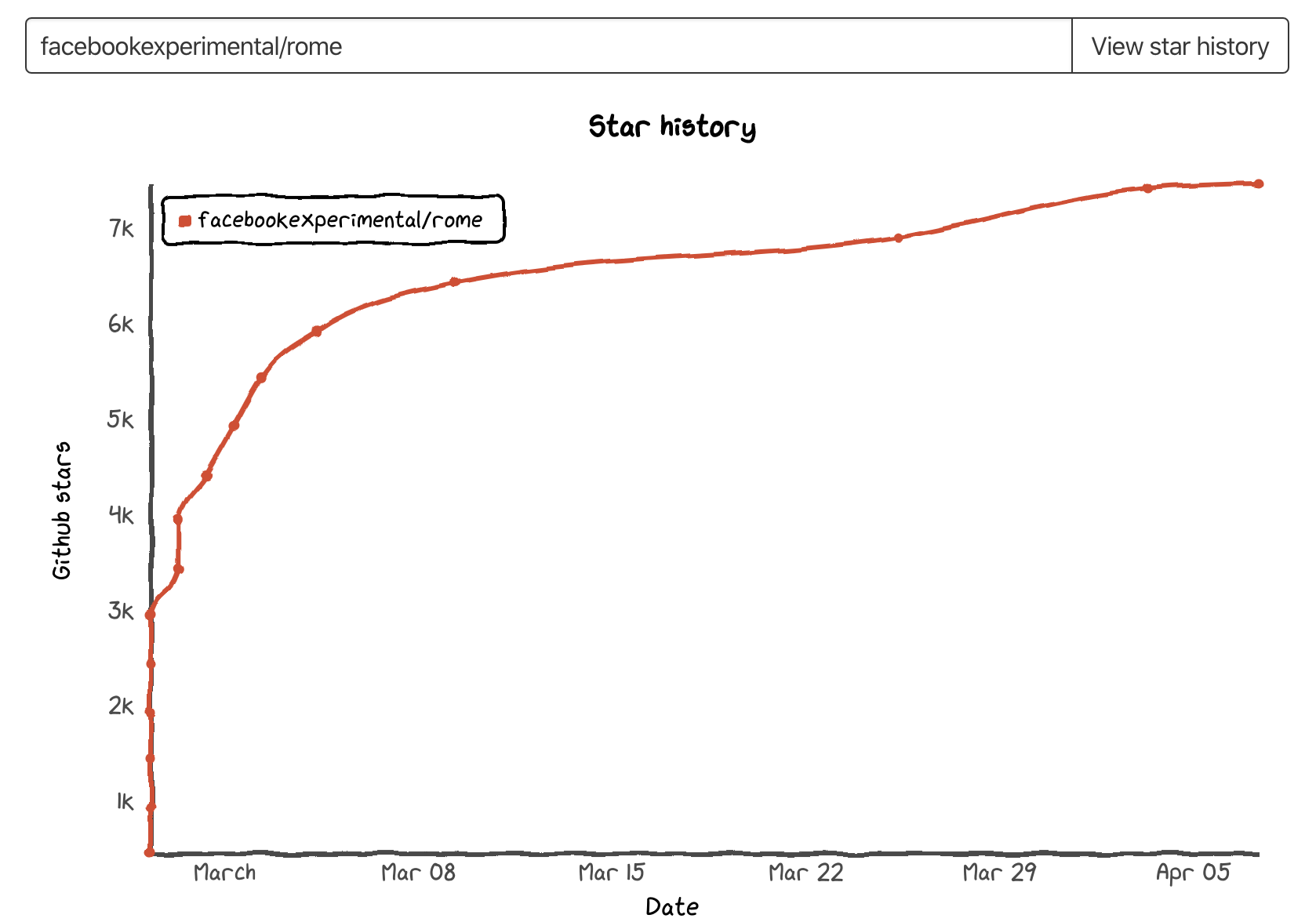
14 |
15 | 此外,或许也能从侧面呼应我曾在月刊第三期中收录的一句关于“创业公司和大公司开源出发点有何不同”的话:大公司可能在一个项目的早期便开源,凭借其号召力希望更多人一起“贡献”迭代,初创团队则会在产品相对成熟的时候再开放,希望尽快吸引用户深度“使用”,注重完善产品在工业环境下的综合表现。
16 |
17 | 正文 & 背景 & 干货开始。
18 |
19 | ## Rome:从个人项目到 Facebook 新开源
20 |
21 | 从官网不难看出,Rome 旨在成为与 JavaScript 源代码处理相关的所有功能的综合工具,其中包括“编译器、Linter、格式化程序、捆绑器、依赖管理器和测试框架”等。Rome 源于对整个项目的扩展范围一致性的渴望。
22 |
23 | 同时,Rome 也来源于 Babel 作者本身对 Babel 的一些不满足而新创,就像 Deno 之于 Node 一样。
24 |
25 | Rome 作者 Sebastian 关于 Rome 的推文集:
26 |
27 | 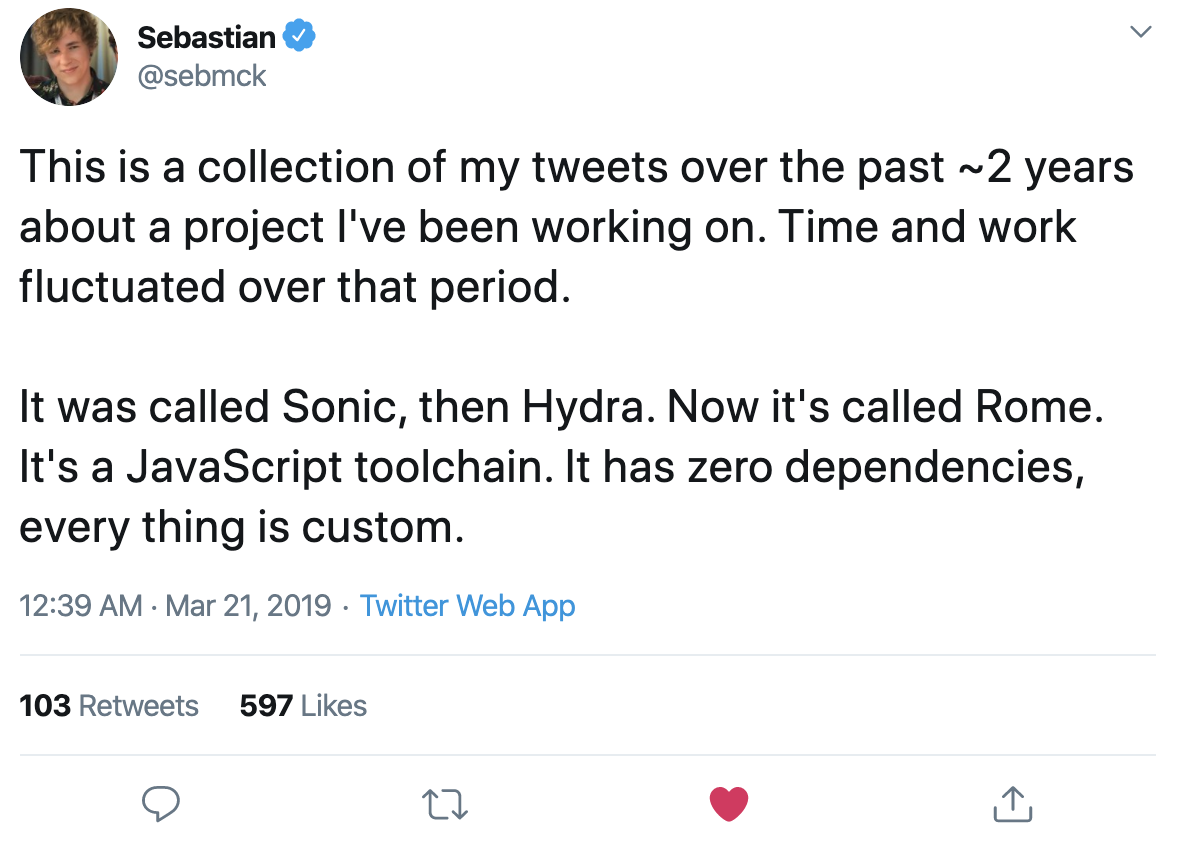
28 |
29 | 本节根据 README.md 和官网首页的介绍,来以问答形式展示 Rome 的背景和想要达到具体目标。
30 |
31 | ### 01、Rome 的一些来源?
32 |
33 | > 在计算机科学中只有两件难事:缓存失效和命名。 ——Phil Karlton
34 |
35 | - 立项来源:由 Babel and Yarn 的作者 Sebastian McKenzie 发起,是 React Native 团队的一个项目。
36 | - 名称来源:因“通向罗马的所有道路”,“罗马不是一天建成”和“在罗马时要像罗马人一样”这样的谚语而得名。 这是指整个项目的扩展范围和对一致性的渴望,它始于一个办公室玩笑。
37 | - Logo 来源:一个古希腊斯巴达头盔。虽然它不是罗马字母,也不太相关,但看起来比 Galea (罗马士兵的头盔)酷。
38 |
39 | ### 02、Rome 的编码架构?
40 |
41 | > 在版本控制系统中,monorepo(单声道存储库的音节缩写)是一种软件开发策略,其中许多项目的代码存储在同一存储库中。 截至 2017 年,这种软件工程实践已有十多年的历史,但直到最近才被命名。——Monorepo,维基百科
42 |
43 | - 完全使用 TypeScript 编写,很少使用松散类型。
44 | - 支持处理 JSX 以及 Flow 和 TypeScript 代码。
45 | - self-hosted,可以自己编译自己。
46 | - 不是现有工具的集合,所有组件都是自定义的,不使用第三方依赖项(对 JavaScript 生态系统进行了重新思考,对整个工具链采用了不依赖第三方库的大胆实现)。
47 | - 是带有内部软件包的 monorepo 架构以便划定代码边界。
48 |
49 | ### 03、Rome 的工作展望?
50 |
51 | - 旨在成为与 JavaScript 源代码处理相关的所有功能的综合工具。
52 | - 目标是替代许多现有的 JavaScript 工具,但也将提供为其他工具提供自身的集成方案,以根据需要随意使用——例如使用 Rome 编译器作为另一个捆绑程序的插件。
53 | - 目前关注的领域是 Linter(用于分析源代码以标记编程错误,bug,样式错误和可疑结构的工具),这是将 Rome 变成最容易使用的工具链的目标里阻力最小的一个环节。
54 |
55 | ## 微栏:回看 JavaScript 工具链
56 |
57 | > 在学习一个工具之前,往往我们应该先去了解这个工具可以用来解决什么样的问题;同样的,当我们遇到一个问题的时候,我们也应该带着这个问题去找工具解决。
58 | > **——**阿里巴巴集团 高级前端工程师 叶俊星
59 |
60 | 成熟的软件项目必然遵循的良好的开发规范,也拥有属于自身独特的软件开发生命周期,编程实践只占整个开发周期的很小一部分。当一个 JavaScript 软件被建立时通常还会遇到哪些需要解决的问题?这便涉及到了 JavaScript 项目的技术选型,而 JavaScript 生态圈的明星项目数不胜数,以下作一个纵览,不涉及各个工具的具体使用方式。
61 |
62 | JavaScript 工具链示意图:
63 |
64 | 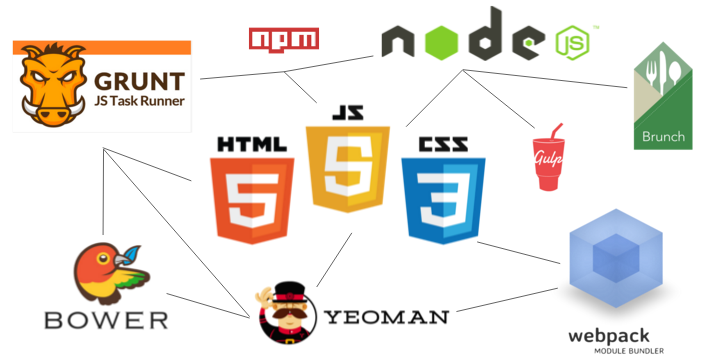
65 |
66 | - **JS 开发环境**?有 V8、Node 甚至是 Deno 等;
67 | - **JS 前端框架**?有 Angular、React、Vue、React Native、jQuery 等;
68 | - **JS 后端框架**?有 Nest、Express、Koa 等;
69 | - **JS 脚手架**?有 Vue CLI、Angular CLI、Create React App、Yeoman 等;
70 | - **JS 转译工具**?有 Babel 等;
71 | - **JS 测试工具**?围绕单元测试、集成测试,有 Mocha、Jasmine、Jest、Karma 等;
72 | - **JS 调试工具**?有 Chrome DevTools/Firebug/Webkit inspector 等各大主流浏览器、VS Code/WebStorm 等各大编辑器/IDE 等;
73 | - **JS 格式规范工具**?有 JSLint、JSHint、ESLint、TSLint 等;
74 | - **JS 接口联调工具**?有 Axios、Fetch 等;
75 | - **JS 包管理器**?有 NPM、Yarn、Bower、PNPM 等;
76 | - **JS 模块加载器**?有 RequireJS、SystemJS、StealJS、ES Module Loader 等;
77 | - **JS 任务管理工具**?Grunt、Gulp、Webpack 监听文件变化,自动执行任务;
78 | - **JS 静态化支持**?有 TypeScript、CoffeeScript、Flow、LiveScript 等;
79 | - **JS 代码后处理工具**?围绕混淆器、缩小器、优化器诸多领域有各种各样的 loader 等;
80 | - **JS 打包工具**?Webpack、Rollup、Parcel、Browserify 等;
81 | - **JS 模板引擎**?有 handlebarsjs、etpl、templatejs 甚至各大前端框架内置的模板语法等;
82 | - **JS 非 Web 框架**?在物联网、区块链、大数据等领域均有相关库支持,本文不涉及。
83 | - **JS 进程管理**?有 Forever、PM2、StrongLoop Process Manager 等;
84 | - **......**?甚至编辑器、IDE、CSS 预处理器、代码托管平台、团队开发模式(纯前端、重后端、前后分离)、WebAssembly、Serverless、JS DevOps 等都可以加到项目的技术选型范围内。
85 |
86 | 因此可以看出,技术选型便是针对能让项目成功运转各个环节寻找相应的解决方案;工作流(Workflow)是所有解决方案融合后的落实流程;而工具链(Toolchain)便是工作流下所有实现方式的汇总,同时一个工具也能代表一个解决方案。
87 |
88 | 简而言之,JavaScript 工具链便是 JavaScript 工程师在开发过程中会用到的一系列工具。
89 |
90 | ## 浅尝初试 Rome (v0.0.52)
91 |
92 | 现在 Rome 并没有直接在 Github 上发布任何版本,但编译后生成的 rome.json 可以看出有一个 v0.0.52 的版本号,处于一个很早期的状态,项目简介也是“一个实验性的 JavaScript 工具链”。
93 |
94 | 想要尝试 Rome,就得从以下步骤逐步展开(由于 Rome 没有发布正式版本,这里无需过多涉及如何整合在 package.json 的脚本中使用等工程化过程)。
95 |
96 | 帝国时代里的罗马大军:
97 |
98 | 
99 |
100 | 本章所有 Demo 均在 [@hylerrix/demos](https://github.com/hylerrix/demos) 的 Rome 文件夹中。
101 |
102 | ### 01、git clone rome
103 |
104 | 既然 Rome 没有正式发布版本,我们也无法直接从 NPM 上直接安装 Rome。现阶段,Rome 提供了本地安装的方式,只需要克隆到本地并本地编译和本地 NPM 安装即可使用。
105 |
106 | > 注:安装 Rome 前请确保本地已正常安装 Node 和 NPM
107 |
108 | ```bash
109 | # 克隆 Rome 项目到本地
110 | $ git clone https://github.com/facebookexperimental/rome
111 | # 命令行进入 Rome 项目
112 | $ cd rome
113 | # 方式一:编译 Rome
114 | $ ./scripts/build-release dist
115 | # 方式二:编译 Rome(Windows 10 的情况下,使用 PowerShell 7)
116 | $ cd rome && node scripts/build-release dist
117 | # 安装编译后的 Rome 到本地全局环境中
118 | $ npm install -g ./dist/
119 | # 现在便可以使用 Rome 了
120 | $ rome # No command specified. Run --help to see available commands.
121 | ```
122 |
123 | ### 02、rome init
124 |
125 | rome init 命令会在当前目录生成一个 rome.json 文件,使用推荐配置会初始化以下内容:
126 |
127 | ```json
128 | {
129 | "version": "^0.0.52",
130 | "lint": {
131 | "enabled": true
132 | }
133 | }
134 | ```
135 |
136 | 该文件告诉 Rome 至少应为 0.0.52 版本,以便与当前项目一起使用。具体使用文档还在开发中。
137 |
138 | ### 03、rome run index.ts
139 |
140 | rome run 命令将运行传递给它的任何文件,通常与项目的主文件一起使用。目前仍在开发中,可能无法正确处理所有源文件。此时我们为测试 rome run 成功运行,建立一个 index.ts 和 api.ts 文件,如下。
141 |
142 | ```javascript
143 | // index.ts
144 | import { getData } from './api'
145 |
146 | async function setData () {
147 | const { success, data } = await getData()
148 | console.log('success:', success)
149 | console.log('data:', data)
150 | }
151 |
152 | await setData()
153 |
154 | // api.ts
155 | export const getData = () => Promise.resolve({
156 | success: true,
157 | data: 'Hello World!'
158 | })
159 | ```
160 |
161 | 此时,运行如下命令便可以成功使用:
162 |
163 | ```bash
164 | $ rome run index.ts
165 | # ℹ Bundling index.ts
166 | # success: true
167 | # data: 'Hello World!'
168 | ```
169 |
170 | ### 04、rome lint index.ts
171 |
172 | 由于我真的不喜欢在 JavaScript 应用里面写分号,这与主流规范有些不同,所以 rome lint 命令刚好派上了用场:rome 默认需要在 JavaScript 语句结尾写分号。同时在 api.ts 中故意不导出一个 interface 且在 index.ts 中故意将其错误导入,重构后的有错误 index.ts 和 api.ts 以及 rome lint 后执行过程如下:
173 |
174 | ```javascript
175 | // 故意错误编写的 index.ts
176 | import { getData } from './api'
177 |
178 | async function setData() {
179 | const {success, data} = await getData()
180 | console.log('success:', success)
181 | console.log('data:', data)
182 | }
183 |
184 | await setData()
185 |
186 | // 故意错误不导出的 api.ts
187 | interface Params {
188 | username: string
189 | token: string
190 | }
191 |
192 | export const getData = (params: Params) => Promise.resolve({
193 | success: true,
194 | data: 'Hello World!'
195 | })
196 | ```
197 |
198 |
199 | ```bash
200 | $ rome lint index.ts
201 | # index.ts lint/pendingFixes ━━━━━━━━━━━━━━━━━━━━━━━━━━━━━━━━━━━━━━━━━━━━━━━━━━━━━━━━━━━━━━━━━━━━━━━━━━━━━━━━━━━━━━━━━━━━━━━━━━━━━━━━━━━━━━━━━━━━━
202 | #
203 | # ✖ Pending fixes
204 | #
205 | # 1 │ + import {getData, Params} from './api.ts';
206 | # │ - import {·getData, Params·} from './api.ts'
207 | # 2 │
208 | # .. │
209 | # 4 │ const param: Params = {
210 | # 5 │ username: 'hylerrix',
211 | # 6 │ + token: 'ningowood',
212 | # 7 │ + };
213 | # 8 │ + const {success, data} = await getData(param);
214 | # 9 │ + console.log('success:', success);
215 | # 10 │ + console.log('data:', data);
216 | # 11 │ }
217 | # 12 │
218 | # 13 │ + await setData();
219 | # 14 │
220 | #
221 | # index.ts:1:18 resolver/unknownExport ━━━━━━━━━━━━━━━━━━━━━━━━━━━━━━━━━━━━━━━━━━━━━━━━━━━━━━━━━━━━━━━━━━━━━━━━━━━━━━━━━━━━━━━━━━━━━━━━━━━━━━━━━━━
222 | #
223 | # ✖ Couldn't find export Params in api.ts
224 | #
225 | # > 1 │ import { getData, Params } from './api.ts'
226 | # │ ^^^^^^
227 | # 2 │
228 | # 3 │ async function setData() {
229 | #
230 | # ℹ However we found a matching local variable in api.ts. Did you forget to export it?
231 | #
232 | # > 1 │ interface Params {
233 | # │ ^^^^^^
234 | # 2 │ username: string
235 | # 3 │ token: string
236 | #
237 | # ━━━━━━━━━━━━━━━━━━━━━━━━━━━━━━━━━━━━━━━━━━━━━━━━━━━━━━━━━━━━━━━━━━━━━━━━━━━━━━━━━━━━━━━━━━━━━━━━━━━━━━━━━━━━━━━━━━━━━━━━━━━━━━━━━━━━━━━━━━━━━━━━━
238 | #
239 | # ℹ Fixes available. Run `rome lint --fix` to apply.
240 | # ✖ Found 2 problems
241 | $ rome lint index.ts --fix
242 | # ......
243 | # ✔ 1 file fixed
244 | # ✖ Found 2 problems
245 | ```
246 |
247 | rome lint 命令在这里提示我们需要加分号并需要在 api.ts 中成功导出 interface。前者可以使用 rome lint index.ts --fix 直接来修理(不会在 api.ts 中添加分号);后者需要手动修理,但是提供了十分完善的友好提示。
248 |
249 | ### 05、rome compile index.ts
250 |
251 | rome compile 命令将使用一组默认转换来编译文件。由于在开发中,当前此命令没有用于指定转换子集的选项。使用这条命令后,输出的结果已经没有了 interface 的存在。
252 |
253 | ```bash
254 | $ rome compile index.ts
255 | # import {getData, Params} from './api';
256 | #
257 | # async function setData() {
258 | # const param = {
259 | # username: 'hylerrix',
260 | # token: 'ningowood',
261 | # };
262 | # const {success, data} = await getData(param);
263 | # console.log('success:', success);
264 | # console.log('data:', data);
265 | # }
266 | #
267 | # await setData();
268 | ```
269 |
270 | ### 06、rome parse index.ts
271 |
272 | rome parse 命令将解析文件并输出格式精美的 AST。
273 |
274 | ```bash
275 | $ rome parse index.ts
276 | # Program {
277 | # comments: Array []
278 | # corrupt: false
279 | # diagnostics: Array []
280 | # directives: Array []
281 | # filename: 'project-rome/index.ts'
282 | # hasHoistedVars: false
283 | # mtime: 1_586_498_633_476.8486
284 | # sourceType: 'module'
285 | # syntax: Array ['ts']
286 | # body: Array [
287 | # ImportDeclaration {
288 | # source: StringLiteral {value: './api'}
289 | # namedSpecifiers: Array [
290 | # ......
291 | ```
292 |
293 | ### 07、Rome 的更多命令
294 |
295 | 除了官网展示的几个命令外,从源码可以看出还有很多内置的命令正在开发,可以从 rome --help 中寻找答案。
296 |
297 | ```bash
298 | # 分析并输出文件的依赖
299 | $ rome analyzeDependencies index.ts
300 | # 把 JavaScript 打包为一个文件
301 | $ rome bundle index.ts dist
302 | # 启动 Web 服务器
303 | $ rome develop
304 | # 计算文件路径
305 | $ rome resolve index.ts
306 | # 安全依赖,运行 Linter 和测试
307 | $ rome ci
308 | # 运行测试
309 | $ rome test
310 | # ...restart/start/status/stop/web
311 | # ...config/publish/run/evict/logs/rage
312 | ```
313 |
314 | ## 参考资料
315 |
316 | - [English] [Rome Github Project](https://github.com/facebookexperimental/rome)
317 | - [English] [Rome, a new JavaScript Toolchain](https://jasonformat.com/rome-javascript-toolchain/)
318 | - [English] [Rome Official Announcement](https://twitter.com/sebmck/status/1232885861135421441)
319 | - [English] [Rome Timeline](https://twitter.com/sebmck/status/1108407803545214977)
320 | - [English] [Facebook Introduces Rome Experimental JavaScript Toolchain](https://www.infoq.com/news/2020/03/rome-experimental-js-toolchain/)
321 | - [English] [01: Sebastian McKenzie on Babel and the Road to Rome - The Babel Podcast](https://podcast.babeljs.io/rome/)
322 | - [前端工具链课(一)—— 包管理工具](https://zhuanlan.zhihu.com/p/23928404)
323 | - [Rome:Facebook 最新 JS 工具上手](https://blog.csdn.net/qiwoo_weekly/article/details/104624223)
324 |
325 | ## 总结 & 订阅
326 |
327 | 经过近几年的蓬勃发展,JavaScript 早已不再局限于“前端开发”的领域中。因此本篇写作的角度并不是仅仅以前端开发为主体探索,而是将 JavaScript 本身抽离出来,这也是自己逐步理清职业发展的一个重要改变。
328 |
329 | 本文通过学习和写作分享对 Rome 进行了简要的了解,但这还仅仅是入门。自己对 Babel 本身并不熟,还有很多学习过程中产生的疑惑都无法现在进行合适的解答,比如“Rome 和 Babel 的具体异同”、“如何看待 Rome 仓库使用 Git 跟踪 Node Modules”、“Rome 替代现有工具或进行集成方案的具体原理”以及“Rome 的打包流程有何特点”等,挖个坑可以一起交流。
330 |
331 | 无论最终是否使用 Rome,能引发对 JavaScript 工具链的重新思考也会很有收获。
332 |
333 | 最后,感谢你的阅读,公众号(@ningowood) 及配套群聊欢迎加入,同时欢迎给如期更新了三期,即将支持线上 UI 界面浏览并提供更多拓展功能的“开源爱好者月刊([@ningowood/open-source-magazine](https://github.com/ningowood/open-source-magazine))”仓库点个 Star 吧!(Github 好久没涨粉丝了,也欢迎关注我~)
334 |
335 | 
336 |
--------------------------------------------------------------------------------
/site/articles/translation/original-articles/why-deno-wrong.md:
--------------------------------------------------------------------------------
1 | # Why I Believe Deno is a Step in the Wrong Direction for JavaScript Runtime Environments
2 |
3 | 
4 |
5 | I haven't found any other developers on YouTube with a channel the size of [codedamn][1] (100K+ subscribers) who are not not "super excited" about the release of Deno.
6 |
7 | Last week, I released a video on my channel stating some reasons (that were pretty clear to me) why I believe we do not need Deno - another runtime environment for JavaScript built on the top of V8 and Node.
8 |
9 | With an article like this, I can add more thoughts and bundle them in a better way than a video. But anyway, if you're interested, here's what I posted:
10 |
11 | To just prove that I'm not against "Deno" and JavaScript in general, I'd like to state something. I love JavaScript more than anything. My primary tech stack involves nothing but JavaScript - Node / React / MongoDB / React Native / NativeScript / Ionic / you name it.
12 |
13 | I built a [100K subscriber YouTube channel][2] and a [developer platform][3] mostly on a single programming language - JavaScript.
14 |
15 | But at the same time, it's important to stay practical and keep a clear head to see both sides of the coin. Deno has a good side, as well as a side which people aren't seeing/writing about yet. I'm going to write my views on the second side. Let's go!
16 |
17 | _**Note:** This is going to be a controversial article. Let's keep it civil and control our emotions. I'd love it if you'd read the full article till the end, and maybe then decide what you think._
18 |
19 | _I have my social media links at the bottom of the article and would love to have a healthy discussion on this topic there._
20 |
21 | ## Deno vs Node - there IS actually competition
22 |
23 | A lot of people in the industry are saying "oh well, there isn't any competition between Deno and Node, there is a lot both can learn from each other".
24 |
25 | To some extent, I agree, there's a lot Node and Deno can learn from each other. But there's no competition? I completely disagree with that.
26 |
27 | Let's look at common features of Deno and Node:
28 |
29 | 1. They're both runtime environments for JavaScript
30 | 2. They both run on any computer where you can run V8
31 | 3. They both have ECMAScript standard support
32 | 4. They're both actively maintained
33 |
34 | If you become a "Deno" fan 2 years down the road, you are never going to choose Node for your next project. It's just not possible.
35 |
36 | Similarly, if you've never worked with TypeScript before, and you think you want to try Deno, but maybe you want to have some NPM modules, you wouldn't choose Deno.
37 |
38 | That's right: there is a division of developers across Deno and Node - I would say that's a very good example of a competitive space.
39 |
40 | ## Why try Deno?
41 |
42 | Firstly, I would like to list some advantages of Deno – what it is and why it pitches itself as a better runtime:
43 |
44 | 1. It overcomes some shortcomings of Node
45 | 2. It's a secure runtime environment by default
46 | 3. It has TypeScript support baked in
47 | 4. It uses promises all the way down
48 | 5. It's built on Rust (vs C++ for Node)
49 |
50 | In the next section, I'll pick all of these points apart one by one and will mention what Node can learn from them. I'll also discuss, wherever necessary, why Deno doesn't make a lot of sense.
51 |
52 | ## Where Deno overdid?
53 |
54 | Let's pick up the USPs of Deno and break them down one by one:
55 |
56 | ### Secure runtime environment by default
57 |
58 | This is the most celebrated feature of Deno, and I'm surprised by it. Deno runs your JavaScript code in a secure sandbox by default - preventing access to file system and network unless you explicitly opt-in.
59 |
60 | Deno does this because it wants to mimic the browser. But why? Why would you want to mimic the browser in the first place? Deno abides by the ECMAScript standard, which is great! But what's with the crazy love of browsers?
61 |
62 | I get it, you want to maintain compatibility between the code written on clients and servers. But it has been so strongly championed by Deno to the point where I believe Deno just went the wrong way with it.
63 |
64 | Node doesn't support "secure runtime" - and after much thinking, I believe there's little reason to support it, either.
65 |
66 | 1. It's a known fact that you should not run untrusted code/executables on your systems. That is the whole point of always opting in for libraries like express for Node, instead of a shady npm module saying it works 100x faster than express. The trust comes from community usage.
67 | 2. I don't know any programming language that supports such sandboxing at its core. While it may be fancy, it just seems like something which should be done by a container environment, like Docker. I would trust a good setup Docker configuration running untrusted Node code all day above running untrusted Node code in a sandboxed Deno environment. Why? Because Docker is a billion-dollar company built around only that one single purpose - sandboxing.
68 | 3. Sandboxing is hard - I'm no cybersecurity guru, but the more features something has, the bigger the attack surface area. Deno promises a secure runtime environment, and I would not say in any way that it could be compromised right away. But I'm merely stating a fact here - Security is hard to implement right. Deno is taking a massive responsibility here. The biggest corporates in the world run their whitehat programs and flush out hundreds of millions of dollars every year to independent individuals and security firms. Where does Deno stand in terms of its truly secure environment? Time will tell.
69 |
70 | So, what can Node learn from Deno about this? I would say not a lot. Node \*might\* want to bring some secure environment flags from their competitors, but I just don't see a point. If you randomly run arbitrary code on your systems, you might as well clone a C/C++ repo and run a make command over it and get your whole system compromised.
71 |
72 | As far as I know, you cannot "sandbox" filesystem or network access on such low-level languages like C/C++ – it's just not efficient.
73 |
74 | Note: Recently I discovered that you can pretty much do everything with Deno with the `--allow-run` flag enabled. This video dives in details:
75 |
76 | ### TypeScript support baked in
77 |
78 | Hurray for TypeScript. I'm truly happy that Deno supports it out of the box.
79 |
80 | _**NOTE:** Thank you @lilasquared for pointing out deno runs `.js` files out of the box too. Please read the further paragraphs keeping in mind we're coding in `.ts` files. Deno works fine with `.js` files too._
81 |
82 | But let's roll back a little. Do you know why JavaScript (and Node) has a trillion developers across the globe? Because the entry barrier is almost nil. JavaScript is flexible and forgives a lot of mistakes - while bringing in some of the weirdest behavior you'd expect from a deterministic computer.
83 |
84 | This is super bad for production-level applications where you want no funky stuff going around. And for learners, it's forgiving - which might frustrate you with nasty bugs sometimes. But also lets people to get away with their mistakes initially. It allows them to "move fast and break things", if I can quote.
85 |
86 | With beginners, I fear that if they opt-in for Deno (which mandates the use of TypeScript), we'll be seeing a lot of code like this because they don't understand TypeScript yet and just want to run JavaScript on the server:
87 |
88 | ```ts
89 | const httpResponse: any = await getAPIResponse({ myParams })
90 | // ...
91 | const someOtherVariable = something() as any
92 | // ...
93 | any, any, any
94 | ```
95 |
96 | TypeScript is a superset of JavaScript. You can write bad TypeScript code too – just using it doesn't make your JavaScript bulletproof.
97 |
98 | It's all fun and good until you realize you can write Node code in TypeScript. I'm certain that every major company using Node in production is writing Node in TypeScript - zero exceptions. JavaScript just isn't scalable at a point when you're dealing with multiple files, multiple dependencies, and a plethora of code.
99 |
100 | TypeScript is a revolutionary toolkit in the JavaScript ecosystem and allows the use of the best of both worlds - static and dynamic language.
101 |
102 | To this end, Deno argues that TypeScript support should be built-in. I would ask why? Sure, you might need babel and webpack to do the job, but isn't that the whole point of having toolkits around? Don't we want to enhance the DX?
103 |
104 | JavaScript is going to remain JavaScript, and if Deno were to run TypeScript (or a language like a TypeScript) directly, I would have had no problem. But it isn't running TypeScript either, it converts your TypeScript code to JavaScript and then runs it.
105 |
106 | For this point, it seems like Deno is a monolithic version of Node that bundles a test toolkit, a code formatter, and TypeScript, all at once. I can't speak for all developers but I would like the core of my programming language to be lean and add other utilities if and when I want.
107 |
108 | Why would I need a built-in tool for code formatting when prettier exists and has the sole purpose of code formatting? Why solve things which are not broken?
109 |
110 | While it is true that monolithic architecture provides a lot of tooling at the same place, it is also true that it is bulky, and a lean core is much easier to maintain and scale.
111 |
112 | ### Promises all the way down
113 |
114 | This point from the Deno 1.0 release didn't really make much sense to me as a distinction. I have all the respect for the creators of Node and Deno. But Node has something which Deno doesn't - experience and backing from a huge variety of developers across the world.
115 |
116 | Node is contributed to by almost 3000 people and is the pioneer in asynchronous I/O handling. Sure, Deno is built on Rust and exposes a similar promise-like abstraction. But Node has got C++, and 3000 developers, and 10 years of work + experiment results.
117 |
118 | Node's asynchronous model is not broken, promises and event listener models are not broken, so I'm unsure how Deno can fix what's not broken.
119 |
120 | ### hasta la vista, npm
121 |
122 | Huge thing. Deno doesn't support NPM. As much as Ryan, the creator or Node and Deno promotes "Go" language in this point, I'd like to mention a few package managers:
123 |
124 | 1. npm for JS (obviously)
125 | 2. apt-get
126 | 3. composer (PHP)
127 | 4. brew (macOS)
128 | 5. cargo (Rust! - The language in which Deno is coded in)
129 |
130 | I just believe it's a wrong move to not use a package manager. They do a lot of things - versioning, running scripts, managing dependency updates, etc. Why Deno won't use npm? I don't know. But here's what I can think about:
131 |
132 | 1. Firstly, because they're JavaScript - and Deno needs TypeScript. **CORRECTION:** Deno **can** work with .js files as well.
133 | 2. Next, a lot of these npm modules would require filesystem/networking/other permissions - which Deno restricts by default. So you need to mess around with some new "permissions" field in package.json. Oops, Deno doesn't work with npm, hence no package.json, let's see how it handles the module system then.
134 | 3. NPM modules are bloated and there are a lot of them, but at the same time, that's the powerhouse of the Node ecosystem. Want a package to extract tar files into a stream? You got it (tar-stream). Want a data validation package? You got it (joi). Want to work with JWT? You got it (jsonwebtoken). I wonder how long it will take for developers to port their packages to a Deno-compatible system?
135 |
136 | Deno has a different approach to module systems altogether. If, in any case, it tries to "patch-in" existing NPM modules somehow, I do not see the point in using Deno apart from just hacking around a TS + Node project inside a Docker container anyway.
137 |
138 | According to what I've learned about Deno so far, here's how it looks:
139 |
140 | > **Deno** \= (mostly) \[TypeScript + Node + Correctly configured docker container + single executable binaries + - NPM\]
141 |
142 | Alright! Let's cool down things a little and let me conclude this article.
143 |
144 | ## Conclusion
145 |
146 | I'm as excited about Deno as everyone else. But when there's a complete rewrite to the JavaScript runtime, I'm expecting big changes.
147 |
148 | Deno includes a bunch of nice features like automatic TypeScript documentation, which I didn't mention because this post aims to show the other side of the coin. You'll find the advantages of Deno in almost every other article, but I believe this is something that needed to be said.
149 |
150 | To be honest, Deno seems like a big undertaking for a small benefit with a huge debt of transferring existing npm modules and codebases. Do you agree or disagree with me? I would like to know your opinions. Tweet/follow me: [**@mehulmpt**][4] and on [**Instagram**][5] too!
151 |
152 | Peace!
153 |
154 | [1]: https://www.youtube.com/codedamn
155 | [2]: https://www.youtube.com/codedamn
156 | [3]: https://codedamn.com/
157 | [4]: https://twitter.com/mehulmpt
158 | [5]: https://instagram.com/mehulmpt
159 |
--------------------------------------------------------------------------------
/site/articles/translation/from-node-to-deno.md:
--------------------------------------------------------------------------------
1 | # 从 Node 到 Deno:探索各大主流库替代方案
2 |
3 | > - 原文地址:[From Node to Deno](https://aralroca.com/blog/from-node-to-deno)
4 | > - 原文作者:Aral Roca
5 | > - 原文发布时间:2020-05-17
6 | > - 译者:[@hylerrix](https://github.com/hylerrix), [@YunKou](http://github.com/yunkou)
7 | > - 备注:本文已获原作者授权,同时本文会收录在[《Deno 钻研之术》](https://github.com/hylerrix/deno-tutorial)的翻译篇中。
8 | > - 备注:本文独立争取授权与翻译的同时,发现 InfoQ 等平台也独立授权翻译,可以作为对比。看来翻译的文章不能积压,要不也会错失风口~
9 |
10 | 
11 |
12 | 上周我发表了一篇关于 Deno 的文章:[《Deno + WebSockets 打造聊天室应用》](https://aralroca.com/blog/learn-deno-chat-app)。在那之后,有很多困惑接踵而至——其中大部分都在思考如何在全新的 Deno 生态中来做 Node.js 上常做的工作。
13 |
14 | 所以我尝试整理一些 Node.js 中常见库在 Deno 下的相关解决方案。在这里我得强调,很多 Node.js 的模块都可以重用,并且没有必要为每个库都重新造一遍轮子。你可以访问 [pika.dev](https://www.pika.dev/about) 来寻找在 Deno 中可以直接使用的 ES 模块。
15 |
16 | > 译者注:《Deno + WebSockets 打造聊天室应用》已经翻译并收录;pika.dev 用来在 Npm 上寻找符合现代 ESM 标准的软件包(更快、更小)。
17 |
18 | **本文的目录如下:**
19 |
20 | - Electron
21 | - Forever / PM2
22 | - Express / Koa
23 | - MongoDB
24 | - PostgresSQL
25 | - MySQL / MariaDB
26 | - Redis
27 | - Nodemon
28 | - Jest、Jasmine、Ava...
29 | - Webpack、Parcel、Rollup...
30 | - Prettier
31 | - NPM Scripts
32 | - Nvm
33 | - Npx
34 | - 在 Docker 上运行
35 | - 作为 Lambda 运行
36 | - 小结
37 |
38 | ## Electron
39 |
40 | 我们可以使用基于 Node.js + `Chromium` 的 Electron 来依托 Web 技术栈创建桌面应用程序。那么我们可以在 Deno 下使用 Electron 吗?或者还有其它更多选择吗?
41 |
42 | 
43 |
44 | 答案是如今的 Electron 还远远不能运行在 Deno 上,我们必须寻找其它的解决方案。自从 Deno 选择用 Rust 语言构建其内核后,我们可以使用 Rust 生态上的 Web View [@Bosop/web-view](https://github.com/Boscop/web-view) 来在 Deno 上运行桌面应用。
45 |
46 | 于是 [@eliassjogreen/deno_webview](https://github.com/eliassjogreen/deno_webview) 应运而生。
47 |
48 | ```typescript
49 | import { WebView } from "https://deno.land/x/webview/mod.ts";
50 |
51 | const sharedOptions = {
52 | width: 400,
53 | height: 200,
54 | resizable: true,
55 | debug: true,
56 | frameless: false,
57 | };
58 |
59 | const webview1 = new WebView({
60 | title: "Multiple deno_webview example",
61 | url: `data:text/html,
62 |
63 |
64 | 1
65 |
66 |
67 | `,
68 | ...sharedOptions,
69 | });
70 |
71 | const webview2 = new WebView({
72 | title: "Multiple deno_webview example",
73 | url: `data:text/html,
74 |
75 |
76 | 2
77 |
78 |
79 | `,
80 | ...sharedOptions,
81 | });
82 |
83 | await Promise.all([webview1.run(), webview2.run()]);
84 | ```
85 |
86 | 
87 |
88 | ## Forever / PM2
89 |
90 | [Forever](https://github.com/foreversd/forever) 和 [PM2](https://github.com/Unitech/pm2) 是用来守护指定脚本其进程的两个 CLI 工具。PM2 相比 Forever 来说功能更为完善,相比还能同时作为负载均衡器。在 Node.js 中这两个工具都很有用,我们可以在 Deno 中也使用它们吗?
91 |
92 | Forever 专为 Node.js 创造,就不用考虑了;而 PM2 可以运行 Node.js 之外的的脚本语言,因此我们可以让 PM2 和 Deno 搭配起来。
93 |
94 | 
95 |
96 | 创建一个 `app.sh` 文件:
97 |
98 | ```bash
99 | #!/bin/bash
100 | deno run -A myCode.ts
101 | ```
102 |
103 | 保存后在当前目录执行(请确保 pm2 已成功安装):
104 |
105 | ```bash
106 | pm2 start ./app.sh
107 | ```
108 |
109 | 
110 |
111 | ## Express / Koa
112 |
113 | [Express](https://github.com/expressjs/express) 和 [Koa](https://github.com/koajs/koa) 以其强大的路由系统和友好的 HTTP 工具库(重定向、缓存等)而闻名于 Node.js 社区。我们可以在 Deno 中使用它们吗?答案是不能...但也有一些替代方案。
114 |
115 | 
116 |
117 | ### HTTP(标准库)
118 |
119 | Deno 内置的 STD 标准库已经涵盖了 `Express` 或 `Koa` 的绝大多数功能:[https://deno.land/std/http/](https://deno.land/std/http/)。
120 |
121 | ```typescript
122 | import { ServerRequest } from "https://deno.land/std/http/server.ts";
123 | import { getCookies } from "https://deno.land/std/http/cookie.ts";
124 |
125 | let request = new ServerRequest();
126 | request.headers = new Headers();
127 | request.headers.set("Cookie", "full=of; tasty=chocolate");
128 |
129 | const cookies = getCookies(request);
130 | console.log("cookies:", cookies);
131 | ```
132 |
133 | 但由于 Deno 内置的 HTTP 标准库其声明路由的方式并不那么吸引人,我们来看看其它的解决方案,如下。
134 |
135 | ### Oak (第三方库)
136 |
137 | 受 Koa 启发,这是目前最优雅的解决方案之一:[https://github.com/oakserver/oak](https://github.com/oakserver/oak)。
138 |
139 | ```typescript
140 | import { Application, } from "https://deno.land/x/oak/mod.ts";
141 |
142 | const app = new Application();
143 |
144 | app.use((ctx) => {
145 | ctx.response.body = "Hello World!";
146 | });
147 |
148 | await app.listen({ port: 8000 });
149 | ```
150 |
151 | ### Abc (第三方库)
152 |
153 | 类似于 `Oak`:[https://deno.land/x/abc](https://deno.land/x/abc)。
154 |
155 | ```typescript
156 | import { Application } from "https://deno.land/x/abc/mod.ts";
157 |
158 | const app = new Application();
159 |
160 | app.static("/static", "assets");
161 |
162 | app.get("/hello", (c) => "Hello!")
163 | .start({ port: 8080 });
164 | ```
165 |
166 | ### Deno-Express(第三方库)
167 |
168 | 也许是最类似于 Express Framework 的替代品:[https://github.com/NMathar/deno-express](https://github.com/NMathar/deno-express)。
169 |
170 | ```typescript
171 | import * as exp from "https://raw.githubusercontent.com/NMathar/deno-express/master/mod.ts";
172 |
173 | const port = 3000;
174 | const app = new exp.App();
175 |
176 | app.use(exp.static_("./public"));
177 | app.use(exp.bodyParser.json());
178 |
179 | app.get("/api/todos", async (req, res) => {
180 | await res.json([{ name: "Buy some milk" }]);
181 | });
182 |
183 | const server = await app.listen(port);
184 | console.log(`app listening on port ${server.port}`);
185 | ```
186 |
187 | ## MongoDB
188 |
189 | [MongoDB](https://github.com/mongodb/mongo) 是一个广受欢迎的文档数据库,具有强大的可扩展性和灵活性。在 JavaScript 生态系统中已经被广泛使用:比如很多像 `MEAN` 或 `MERN` 这样的技术堆栈。
190 |
191 | > 译者注:MEAN = MongoDB(数据库) + Express(后端) + Angular(前端) + Node.js(运行时);MERN 同左,但其中的 R 代表 React。如上技术栈都对 JavaScript 语言极其友好。
192 |
193 | 
194 |
195 | 因此,我们可以让 Deno 和 MongoDB 搭配起来,比如使用这个模块:[https://github.com/manyuanrong/deno_mongo](https://github.com/manyuanrong/deno_mongo)。
196 |
197 | ```typescript
198 | import { init, MongoClient } from "https://deno.land/x/mongo@v0.6.0/mod.ts";
199 |
200 | // Initialize the plugin
201 | await init();
202 |
203 | const client = new MongoClient();
204 | client.connectWithUri("mongodb://localhost:27017");
205 |
206 | const db = client.database("test");
207 | const users = db.collection("users");
208 |
209 | // insert
210 | const insertId = await users.insertOne({
211 | username: "user1",
212 | password: "pass1"
213 | });
214 |
215 | // findOne
216 | const user1 = await users.findOne({ _id: insertId });
217 |
218 | // find
219 | const users = await users.find({ username: { $ne: null } });
220 |
221 | // aggregation
222 | const docs = await users.aggregation([
223 | { $match: { username: "many" } },
224 | { $group: { _id: "$username", total: { $sum: 1 } } }
225 | ]);
226 |
227 | // updateOne
228 | const { matchedCount, modifiedCount, upsertedId } = await users.updateOne(
229 | username: { $ne: null },
230 | { $set: { username: "USERNAME" } }
231 | );
232 |
233 | // deleteOne
234 | const deleteCount = await users.deleteOne({ _id: insertId });
235 | ```
236 |
237 | ## PostgresSQL
238 |
239 | 
240 |
241 | 与 MongoDB 一样,[PostgresSQL](https://github.com/postgres/postgres/) 也有一个 Deno 生态库:[https://github.com/buildondata/deno-postgres。](https://github.com/buildondata/deno-postgres%E3%80%82)
242 |
243 | ```typescript
244 | import { Client } from "https://deno.land/x/postgres/mod.ts";
245 |
246 | const client = new Client({
247 | user: "user",
248 | database: "test",
249 | hostname: "localhost",
250 | port: 5432
251 | });
252 | await client.connect();
253 | const result = await client.query("SELECT * FROM people;");
254 | console.log(result.rows);
255 | await client.end();
256 | ```
257 |
258 | ## MySQL / MariaDB
259 |
260 | 
261 |
262 | 与 `MongoDB` 和 `PostgresSQL` 一样,Deno 生态下也有 [MySQL](https://github.com/mysqljs/mysql)/[MariaDB](https://github.com/mariadb-corporation/mariadb-connector-nodejs) 的相关库:[https://github.com/manyuanrong/deno_mysql](https://github.com/manyuanrong/deno_mysql)。
263 |
264 | ```typescript
265 | import { Client } from "https://deno.land/x/mysql/mod.ts";
266 |
267 | const client = await new Client().connect({
268 | hostname: "127.0.0.1",
269 | username: "root",
270 | db: "dbname",
271 | poolSize: 3, // connection limit
272 | password: "password",
273 | });
274 |
275 | let result = await client.execute(`INSERT INTO users(name) values(?)`, [
276 | "aralroca",
277 | ]);
278 | console.log(result);
279 | // { affectedRows: 1, lastInsertId: 1 }
280 | ```
281 |
282 | ## Redis
283 |
284 | 
285 |
286 | [Redis](https://github.com/NodeRedis/node-redis) 是著名的缓存数据库之一,Deno 下也有相关库:[https://github.com/keroxp/deno-redis](https://github.com/keroxp/deno-redis)。
287 |
288 | ```typescript
289 | import { connect } from "https://denopkg.com/keroxp/deno-redis/mod.ts";
290 |
291 | const redis = await connect({
292 | hostname: "127.0.0.1",
293 | port: 6379
294 | });
295 | const ok = await redis.set("example", "this is an example");
296 | const example = await redis.get("example");
297 | ```
298 |
299 | ## Nodemon
300 |
301 | 
302 |
303 | [Nodemon](https://github.com/remy/nodemon) 在开发环境中监控文件的任何改变,并能自动更新服务器。这使 `node` 下的发更加有趣,无需手动停止并重启服务器来查看应用的变化。那么 Nodemon 可以在 Deno 中使用吗?
304 |
305 | 抱歉,不能...但仍然有另一种选择:Denon:[https://github.com/eliassjogreen/denon](https://github.com/eliassjogreen/denon)。
306 |
307 | 我们可以像是 `deno run` 执行脚本的方式一样使用 `Denon`。
308 |
309 | ```bash
310 | ➜ denon server.ts
311 | ```
312 |
313 | ## Jest、Jasmine、Ava...
314 |
315 | 
316 |
317 | 在 `Node.js` 的生态系统中,有很多不同的测试工具和方法。但直到现在,官方也没有推出一种正式的机制来测试 `Node.js` 代码。
318 |
319 | 在 Deno 中,可以使用官方测试 `std` 库测试:[https://deno.land/std/testing](https://deno.land/std/testing)。
320 |
321 | ```typescript
322 | import { assertStrictEq } from 'https://deno.land/std/testing/asserts.ts'
323 |
324 | Deno.test('My first test', async () => {
325 | assertStrictEq(true, false)
326 | })
327 | ```
328 |
329 | 运行测试:
330 |
331 | ```bash
332 | ➜ deno test
333 | ```
334 |
335 | ## Webpack、Parcel、Rollup...
336 |
337 | 
338 |
339 | Deno 的优势之一是我们可以将 `ESmodules` 与`TypeScript` 一起使用,而无需诸如 [Webpack](https://github.com/webpack/webpack)、[Parcel](https://github.com/parcel-bundler/parcel) 或[Rollup](https://github.com/rollup/rollup) 之类的工具。
340 |
341 | 然而,可能你会想,如果给定一个文件目录,我们是否可以将其统一打包在有一个 JavaScript 文件里,并让其能直接在 Web 上以模块的形式运行。
342 |
343 | 答案是完全可行,我们可以通过 Deno 的 CLI 来实现。因此,不需要第三方的打包工具。
344 |
345 | ```bash
346 | ➜ deno bundle myLib.ts myLib.bundle.js
347 | ```
348 |
349 | 现在可以将其加载到浏览器中了:
350 |
351 | ```html
352 |
355 | ```
356 |
357 | ## Prettier
358 |
359 | 
360 |
361 | 在过去的几年中,[Prettier](https://prettier.io/) 在 JavaScript 生态中已广为人知,因为有了它,我们不必担心格式化文件。
362 |
363 | 事实上 Prettier 也可以在 Deno 上使用,但是没有必要:因为 Deno 有自己内置的格式化程序。
364 |
365 | 您可以使用以下命令格式化文件:
366 |
367 | ```bash
368 | ➜ deno fmt
369 | ```
370 |
371 | ## NPM Scripts
372 |
373 | 
374 |
375 | 我非常怀念的一件事就是曾在 `package.json` 中配置各种命令行脚本。但在 Deno 上,`package.json` 已经不复存在了。
376 |
377 | Deno 上的一个简单的替代方法是使用 `makefile` 技术,用 `make` 命令运行。但如果你怀念 NPM 的语法,Deno 上也有一个 NPM 风格的脚本运行器:[https://github.com/umbopepato/velociraptor](https://github.com/umbopepato/velociraptor)
378 |
379 | 您可以使用脚本定义文件:
380 |
381 | ```yaml
382 | # scripts.yaml
383 | scripts:
384 | start: deno run --allow-net server.ts
385 | test: deno test --allow-net server_test.ts
386 | ```
387 |
388 | 并执行:
389 |
390 | ```bash
391 | ➜ vr run
370 | ```
371 |
372 | ## Prettier
373 |
374 | 
375 |
376 | In the last few years [Prettier](https://prettier.io/) has become quite well known within the JavaScript ecosystem because with it you don't have to worry about formatting the files.
377 |
378 | And the truth is, it can still be used on Deno but it loses its meaning, because Deno has its own formatter.
379 |
380 | You can format your files using this command:
381 |
382 | ```
383 | ➜ deno fmt
384 | ```
385 |
386 | ## NPM Scripts
387 |
388 | 
389 |
390 | With Deno, the `package.json` no longer exists. One of the things I really miss are the scripts that were declared in the `package.json`.
391 |
392 | A simple solution would be to use a `makefile` and execute it with `make`. However, if you miss the npm syntax, there is an npm-style script runner for Deno:
393 |
394 | * https://github.com/umbopepato/velociraptor
395 |
396 | You can define a file with your scripts:
397 |
398 | ```yaml
399 | # scripts.yaml
400 | scripts:
401 | start: deno run --allow-net server.ts
402 | test: deno test --allow-net server_test.ts
403 | ```
404 |
405 | Execute with:
406 |
407 | ```
408 | ➜ vr run
319 |