├── examples
├── perf
│ ├── requirements.txt
│ ├── pub.py
│ └── sub.py
├── sub.py
└── pub.py
├── setup.py
├── README.md
└── pubsub
├── __init__.py
├── common.py
├── server.py
└── client.py
/examples/perf/requirements.txt:
--------------------------------------------------------------------------------
1 | tqdm
2 |
--------------------------------------------------------------------------------
/examples/perf/pub.py:
--------------------------------------------------------------------------------
1 | from pubsub import MessageQueue
2 |
3 |
4 | def main():
5 | m = MessageQueue()
6 | m.connect()
7 | while True:
8 | m.send_message('random', 'My message.')
9 |
10 |
11 | if __name__ == '__main__':
12 | main()
13 |
--------------------------------------------------------------------------------
/examples/perf/sub.py:
--------------------------------------------------------------------------------
1 | import sys
2 |
3 | from tqdm import tqdm
4 |
5 | from pubsub import MessageQueue
6 |
7 | m = MessageQueue()
8 | m.connect()
9 | m.subscribe('random')
10 |
11 | for i in tqdm(range(int(1e6)), desc='Benchmarking', file=sys.stdout, unit_scale=True, unit=' msg'):
12 | m.get_message(timeout=None)
13 |
--------------------------------------------------------------------------------
/setup.py:
--------------------------------------------------------------------------------
1 | from distutils.core import setup
2 |
3 | from setuptools import find_packages
4 |
5 | setup(
6 | name='python-pubsub',
7 | version='1.4.0',
8 | author='Philippe Remy',
9 | packages=find_packages(),
10 | install_requires=[],
11 | entry_points={
12 | 'console_scripts': [
13 | 'start_pubsub_broker=pubsub.server:start',
14 | ],
15 | }
16 | )
17 |
--------------------------------------------------------------------------------
/examples/sub.py:
--------------------------------------------------------------------------------
1 | from pubsub import MessageQueue
2 |
3 | # Start the broker with the command: start_pubsub_broker
4 |
5 | m = MessageQueue()
6 | m.connect()
7 | count = 0
8 | m.subscribe('prime')
9 | m.subscribe('random')
10 | while True:
11 | channel, message = m.get_message(timeout=None)
12 |
13 | if channel in ['prime', 'random']:
14 | count += 1
15 | print(f'RECEIVE {count}: channel: {channel}, message: {message["coremq_string"]}')
16 |
--------------------------------------------------------------------------------
/README.md:
--------------------------------------------------------------------------------
1 | # Python PubSub
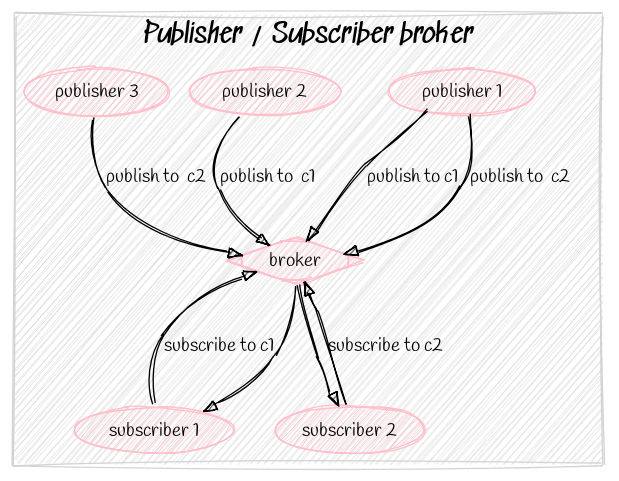
2 | A simple python implementation of a message router with many subscribers and many publishers.
3 |
4 | It can be considered as as fork of the project: [CoreMQ](https://github.com/deejross/coremq).
5 |
6 |
7 |
8 |
9 |
10 | This implementation handles:
11 | - 26K messages per second.
12 | - Latency of around 1ms.
13 | - `TCP_NODELAY` flag activated for latency sensitive applications.
14 | - Many publishers.
15 | - Many subscribers.
16 | - Multiple channels.
17 |
18 | ```
19 | pip install python-pubsub
20 | ```
21 |
22 | Refer to the [examples](examples).
23 |
24 |
--------------------------------------------------------------------------------
/examples/pub.py:
--------------------------------------------------------------------------------
1 | import random
2 |
3 | from pubsub import MessageQueue
4 | from time import sleep
5 | # Start the broker with the command: start_pubsub_broker
6 |
7 |
8 | def prime_numbers():
9 | for num in range(1, 1001):
10 | for i in range(2, num):
11 | if num % i == 0:
12 | break
13 | else:
14 | yield num
15 |
16 |
17 | def main():
18 | m = MessageQueue()
19 | m.connect()
20 | count = 0
21 | print(m.welcome_message)
22 | pub_id = random.randint(0, 1000)
23 | print(f'Publisher ID: {pub_id}.')
24 |
25 | def publish(channel, msg):
26 | nonlocal count
27 | count += 1
28 | msg += f' Publisher Id is [{pub_id}].'
29 | print(f'PUBLISH {count}: {msg}.')
30 | sleep(0.0001)
31 | m.send_message(channel, msg)
32 |
33 | for prime in prime_numbers():
34 | publish('prime', f'Next prime number is [{prime}].')
35 | publish('random', f'Next random number is [{random.randint(0, 10000)}].')
36 |
37 |
38 | if __name__ == '__main__':
39 | main()
40 |
--------------------------------------------------------------------------------
/pubsub/__init__.py:
--------------------------------------------------------------------------------
1 | """
2 | CoreMQ
3 | ------
4 | A pure-Python messaging queue.
5 |
6 | License
7 | -------
8 | The MIT License (MIT)
9 | Copyright (c) 2015 Ross Peoples
10 | Permission is hereby granted, free of charge, to any person obtaining a copy
11 | of this software and associated documentation files (the "Software"), to deal
12 | in the Software without restriction, including without limitation the rights
13 | to use, copy, modify, merge, publish, distribute, sublicense, and/or sell
14 | copies of the Software, and to permit persons to whom the Software is
15 | furnished to do so, subject to the following conditions:
16 | The above copyright notice and this permission notice shall be included in all
17 | copies or substantial portions of the Software.
18 | THE SOFTWARE IS PROVIDED "AS IS", WITHOUT WARRANTY OF ANY KIND, EXPRESS OR
19 | IMPLIED, INCLUDING BUT NOT LIMITED TO THE WARRANTIES OF MERCHANTABILITY,
20 | FITNESS FOR A PARTICULAR PURPOSE AND NONINFRINGEMENT. IN NO EVENT SHALL THE
21 | AUTHORS OR COPYRIGHT HOLDERS BE LIABLE FOR ANY CLAIM, DAMAGES OR OTHER
22 | LIABILITY, WHETHER IN AN ACTION OF CONTRACT, TORT OR OTHERWISE, ARISING FROM,
23 | OUT OF OR IN CONNECTION WITH THE SOFTWARE OR THE USE OR OTHER DEALINGS IN THE
24 | SOFTWARE.
25 | """
26 | from .client import MessageQueue
27 |
--------------------------------------------------------------------------------
/pubsub/common.py:
--------------------------------------------------------------------------------
1 | """
2 | CoreMQ
3 | ------
4 | A pure-Python messaging queue.
5 |
6 | License
7 | -------
8 | The MIT License (MIT)
9 | Copyright (c) 2015 Ross Peoples
10 | Permission is hereby granted, free of charge, to any person obtaining a copy
11 | of this software and associated documentation files (the "Software"), to deal
12 | in the Software without restriction, including without limitation the rights
13 | to use, copy, modify, merge, publish, distribute, sublicense, and/or sell
14 | copies of the Software, and to permit persons to whom the Software is
15 | furnished to do so, subject to the following conditions:
16 | The above copyright notice and this permission notice shall be included in all
17 | copies or substantial portions of the Software.
18 | THE SOFTWARE IS PROVIDED "AS IS", WITHOUT WARRANTY OF ANY KIND, EXPRESS OR
19 | IMPLIED, INCLUDING BUT NOT LIMITED TO THE WARRANTIES OF MERCHANTABILITY,
20 | FITNESS FOR A PARTICULAR PURPOSE AND NONINFRINGEMENT. IN NO EVENT SHALL THE
21 | AUTHORS OR COPYRIGHT HOLDERS BE LIABLE FOR ANY CLAIM, DAMAGES OR OTHER
22 | LIABILITY, WHETHER IN AN ACTION OF CONTRACT, TORT OR OTHERWISE, ARISING FROM,
23 | OUT OF OR IN CONNECTION WITH THE SOFTWARE OR THE USE OR OTHER DEALINGS IN THE
24 | SOFTWARE.
25 | """
26 |
27 | import json
28 | import logging
29 | import os
30 |
31 | str_type = str
32 | from configparser import ConfigParser, NoOptionError, NoSectionError
33 |
34 | loggers = dict()
35 |
36 |
37 | class ConnectionClosed(Exception):
38 | pass
39 |
40 |
41 | class ProtocolError(Exception):
42 | pass
43 |
44 |
45 | class CoreConfigParser(ConfigParser, object):
46 | def get(self, section, option, default=None):
47 | try:
48 | return super(CoreConfigParser, self).get(section, option)
49 | except (NoOptionError, NoSectionError):
50 | return default
51 |
52 |
53 | def construct_message(queue, message):
54 | if not isinstance(queue, str_type):
55 | raise ValueError('Queue name must be a string, not %s' % queue)
56 |
57 | if len(queue) < 1:
58 | raise ValueError('Queue name must be at least one character in length')
59 |
60 | if ' ' in queue:
61 | raise ValueError('Queue name must not contain spaces')
62 |
63 | if isinstance(message, str_type):
64 | message = dict(coremq_string=message)
65 |
66 | if isinstance(message, dict):
67 | message = json.dumps(message)
68 | else:
69 | raise ValueError('Messages should be either a dictionary or a string')
70 |
71 | if len(message) > 99999999: # 100 MB max int that can fit in message header (8 characters, plus two controls)
72 | raise ValueError('Message cannot be 100MB or larger')
73 |
74 | if not isinstance(message, bytes):
75 | message = message.encode('utf-8')
76 |
77 | return ('+%s %s ' % (len(message) + len(queue) + 1, queue)).encode('utf-8') + message
78 |
79 |
80 | def send_message(socket, queue, message):
81 | socket.send(construct_message(queue, message))
82 |
83 |
84 | def get_message(socket, timeout=1):
85 | socket.settimeout(timeout)
86 | data = socket.recv(10).decode('utf-8')
87 | expected_length, data = validate_header(data)
88 |
89 | while len(data) < expected_length:
90 | data += socket.recv(expected_length - len(data)).decode('utf-8')
91 |
92 | if ' ' not in data:
93 | return None, data
94 |
95 | queue, message = data.split(' ', 1)
96 | return queue, json.loads(message)
97 |
98 |
99 | def validate_header(data):
100 | """
101 | Validates that data is in the form of "+5 Hello", with + beginning messages, followed by the length of the
102 | message as an integer, followed by a space, then the message.
103 | :param data: The raw data from the socket
104 | :return: (int, str) - the expected length of the message, the message
105 | """
106 | if not data:
107 | raise ConnectionClosed()
108 |
109 | if data[0] != '+':
110 | raise ProtocolError('Missing beginning +')
111 |
112 | if ' ' not in data:
113 | raise ProtocolError('Missing space after length')
114 |
115 | length, data = data.split(' ', 1)
116 |
117 | try:
118 | length = int(length[1:])
119 | except ValueError:
120 | raise ProtocolError('Length integer must be between + and space')
121 |
122 | return length, data
123 |
124 |
125 | def load_configuration(path=None):
126 | """
127 | Loads configuration for CoreMQ and CoreWS servers
128 | :param path: Optional path for the config file. Defaults to current directory
129 | :return: CoreConfigParser
130 | """
131 | if not path:
132 | path = os.path.join(os.getcwd(), 'coremq.conf')
133 |
134 | c = CoreConfigParser()
135 |
136 | try:
137 | c.read(path)
138 | except:
139 | logging.error('Config file could not be loaded')
140 |
141 | return c
142 |
143 |
144 | def get_logger(config, section, logger_name=None):
145 | """
146 | Configures the Python logging module based on the configuration settings from load_configuration
147 | :param config: The CoreConfigParser instance from load_configuration
148 | :param section: The section where the logging config can be found
149 | :param logger_name: The name of the logger. Uses section by default
150 | :return: Logger
151 | """
152 | logging.basicConfig()
153 |
154 | if section in loggers:
155 | return loggers[section]
156 |
157 | logger = logging.getLogger(section or logger_name)
158 | logger.propagate = False
159 |
160 | log_file = config.get('CoreMQ', 'log_file', 'stdout')
161 | if log_file == 'stdout':
162 | handler = logging.StreamHandler()
163 | else:
164 | handler = logging.FileHandler(log_file)
165 |
166 | log_level = config.get('CoreMQ', 'log_level', 'DEBUG')
167 | logger.setLevel(logging.getLevelName(log_level))
168 |
169 | formatter = logging.Formatter('%(asctime)s - %(name)s - %(levelname)s - %(message)s')
170 | handler.setFormatter(formatter)
171 |
172 | logger.addHandler(handler)
173 | loggers[section] = logger
174 | return logger
175 |
176 |
177 | def comma_string_to_list(s):
178 | """
179 | Takes a line of values, seprated by commas and returns the values in a list, removing any extra whitespacing.
180 | :param s: The string with commas
181 | :return: list
182 | """
183 | if isinstance(s, (list, tuple)):
184 | return s
185 |
186 | result = []
187 | items = s.split(',')
188 | for i in items:
189 | result.append(i.strip())
190 |
191 | return result
192 |
--------------------------------------------------------------------------------
/pubsub/server.py:
--------------------------------------------------------------------------------
1 | """
2 | CoreMQ
3 | ------
4 | A pure-Python messaging queue.
5 |
6 | License
7 | -------
8 | The MIT License (MIT)
9 | Copyright (c) 2015 Ross Peoples
10 | Permission is hereby granted, free of charge, to any person obtaining a copy
11 | of this software and associated documentation files (the "Software"), to deal
12 | in the Software without restriction, including without limitation the rights
13 | to use, copy, modify, merge, publish, distribute, sublicense, and/or sell
14 | copies of the Software, and to permit persons to whom the Software is
15 | furnished to do so, subject to the following conditions:
16 | The above copyright notice and this permission notice shall be included in all
17 | copies or substantial portions of the Software.
18 | THE SOFTWARE IS PROVIDED "AS IS", WITHOUT WARRANTY OF ANY KIND, EXPRESS OR
19 | IMPLIED, INCLUDING BUT NOT LIMITED TO THE WARRANTIES OF MERCHANTABILITY,
20 | FITNESS FOR A PARTICULAR PURPOSE AND NONINFRINGEMENT. IN NO EVENT SHALL THE
21 | AUTHORS OR COPYRIGHT HOLDERS BE LIABLE FOR ANY CLAIM, DAMAGES OR OTHER
22 | LIABILITY, WHETHER IN AN ACTION OF CONTRACT, TORT OR OTHERWISE, ARISING FROM,
23 | OUT OF OR IN CONNECTION WITH THE SOFTWARE OR THE USE OR OTHER DEALINGS IN THE
24 | SOFTWARE.
25 | """
26 | import collections
27 | import signal
28 | import socket
29 | import sys
30 | import time
31 | import traceback
32 | import uuid
33 | from multiprocessing import Process
34 | from socketserver import BaseRequestHandler, ThreadingMixIn, TCPServer
35 |
36 | from pubsub.common import ConnectionClosed, get_message, send_message
37 |
38 | ADDRESS = '127.0.0.1'
39 | PORT = 6747 # spells MSGQ (message queue)
40 |
41 |
42 | class ThreadedTCPServer(ThreadingMixIn, TCPServer):
43 | EXITING = False
44 | PROCESS = None
45 | HISTORY = dict()
46 |
47 |
48 | ThreadedTCPServer.allow_reuse_address = True
49 |
50 |
51 | class TCPRequestHandler(BaseRequestHandler):
52 | connections = dict()
53 |
54 | def handle(self):
55 | conn_id = str(uuid.uuid4())
56 | TCPRequestHandler.connections[conn_id] = dict(handler=self, subscriptions=[conn_id], options=dict())
57 | self.respond(conn_id, 'Welcome!')
58 |
59 | print('Clients connected: %s' % len(TCPRequestHandler.connections))
60 | while True:
61 | try:
62 | queue, message = get_message(self.request)
63 | message['coremq_sender'] = conn_id
64 | message['coremq_sent'] = time.time()
65 |
66 | if 'coremq_subscribe' in message:
67 | self.subscribe(conn_id, message['coremq_subscribe'])
68 | self.respond(conn_id, 'OK: Subscribe successful')
69 | elif 'coremq_unsubscribe' in message:
70 | self.unsubscribe(conn_id, message['coremq_unsubscribe'])
71 | self.respond(conn_id, 'OK: Unsubscribe successful')
72 | elif 'coremq_options' in message:
73 | self.set_options(conn_id, message['coremq_options'])
74 | self.respond(conn_id, 'OK: Options set')
75 | elif 'coremq_gethistory' in message:
76 | self.get_history(conn_id, message['coremq_gethistory'])
77 | else:
78 | self.respond(conn_id, 'OK: Message sent')
79 | self.broadcast(queue, message)
80 | self.store_message(queue, message)
81 |
82 | except socket.timeout:
83 | pass
84 | except (ConnectionClosed, socket.error):
85 | break
86 | except Exception as ex:
87 | self.respond(conn_id, str(ex))
88 | print(conn_id, ex)
89 | traceback.print_exc()
90 |
91 | try:
92 | self.respond(conn_id, 'BYE')
93 | except socket.error:
94 | pass
95 |
96 | if conn_id in TCPRequestHandler.connections:
97 | del TCPRequestHandler.connections[conn_id]
98 |
99 | print('Clients connected: %s' % len(TCPRequestHandler.connections))
100 |
101 | def respond(self, conn_id, text):
102 | send_message(self.request, conn_id, dict(response=text))
103 |
104 | def subscribe(self, conn_id, queues):
105 | if not queues:
106 | return
107 |
108 | if conn_id not in TCPRequestHandler.connections:
109 | return
110 |
111 | if not isinstance(queues, (list, tuple)):
112 | queues = [queues]
113 |
114 | subs = TCPRequestHandler.connections[conn_id]['subscriptions']
115 | for q in queues:
116 | if q not in subs:
117 | subs.append(q)
118 |
119 | def unsubscribe(self, conn_id, queues):
120 | if not queues:
121 | return
122 |
123 | if conn_id not in TCPRequestHandler.connections:
124 | return
125 |
126 | if not isinstance(queues, (list, tuple)):
127 | queues = [queues]
128 |
129 | subs = TCPRequestHandler.connections[conn_id]['subscriptions']
130 | for q in queues:
131 | if q in subs:
132 | subs.remove(q)
133 |
134 | def set_options(self, conn_id, options):
135 | opts = TCPRequestHandler.connections[conn_id]['options']
136 | opts.update(options)
137 |
138 | for key, val in options.items():
139 | if val is None and key in opts:
140 | del opts[key]
141 |
142 | def broadcast(self, queue, message):
143 | for conn_id, d in TCPRequestHandler.connections.items():
144 | if conn_id == message['coremq_sender'] and queue != conn_id and d['options'].get('echo', False) is False:
145 | continue
146 |
147 | if queue in d['subscriptions']:
148 | send_message(d['handler'].request, queue, message)
149 |
150 | def store_message(self, queue, message):
151 | if not queue in ThreadedTCPServer.HISTORY:
152 | ThreadedTCPServer.HISTORY[queue] = collections.deque(maxlen=10)
153 |
154 | ThreadedTCPServer.HISTORY[queue].append(message)
155 |
156 | def get_history(self, conn_id, queues):
157 | result = dict()
158 | for q in queues:
159 | if q in ThreadedTCPServer.HISTORY:
160 | result[q] = list(ThreadedTCPServer.HISTORY[q])
161 |
162 | send_message(self.request, conn_id, dict(response=result))
163 |
164 |
165 | def signal_handler(signal, frame):
166 | print('Shutting down message queue')
167 | ThreadedTCPServer.EXITING = True
168 |
169 |
170 | def message_queue_process():
171 | print('Starting message queue')
172 | server = ThreadedTCPServer((ADDRESS, PORT), TCPRequestHandler)
173 | server.socket.setsockopt(socket.IPPROTO_TCP, socket.TCP_NODELAY, 1)
174 | server.timeout = 1
175 | while not ThreadedTCPServer.EXITING:
176 | server.handle_request()
177 |
178 | print('Message queue stopped')
179 | sys.exit(0)
180 |
181 |
182 | def start():
183 | signal.signal(signal.SIGINT, signal_handler)
184 | signal.signal(signal.SIGTERM, signal_handler)
185 | ThreadedTCPServer.PROCESS = Process(target=message_queue_process)
186 | ThreadedTCPServer.PROCESS.start()
187 |
188 |
189 | if __name__ == '__main__':
190 | start()
191 |
--------------------------------------------------------------------------------
/pubsub/client.py:
--------------------------------------------------------------------------------
1 | """
2 | CoreMQ
3 | ------
4 | A pure-Python messaging queue.
5 |
6 | License
7 | -------
8 | The MIT License (MIT)
9 | Copyright (c) 2015 Ross Peoples
10 | Permission is hereby granted, free of charge, to any person obtaining a copy
11 | of this software and associated documentation files (the "Software"), to deal
12 | in the Software without restriction, including without limitation the rights
13 | to use, copy, modify, merge, publish, distribute, sublicense, and/or sell
14 | copies of the Software, and to permit persons to whom the Software is
15 | furnished to do so, subject to the following conditions:
16 | The above copyright notice and this permission notice shall be included in all
17 | copies or substantial portions of the Software.
18 | THE SOFTWARE IS PROVIDED "AS IS", WITHOUT WARRANTY OF ANY KIND, EXPRESS OR
19 | IMPLIED, INCLUDING BUT NOT LIMITED TO THE WARRANTIES OF MERCHANTABILITY,
20 | FITNESS FOR A PARTICULAR PURPOSE AND NONINFRINGEMENT. IN NO EVENT SHALL THE
21 | AUTHORS OR COPYRIGHT HOLDERS BE LIABLE FOR ANY CLAIM, DAMAGES OR OTHER
22 | LIABILITY, WHETHER IN AN ACTION OF CONTRACT, TORT OR OTHERWISE, ARISING FROM,
23 | OUT OF OR IN CONNECTION WITH THE SOFTWARE OR THE USE OR OTHER DEALINGS IN THE
24 | SOFTWARE.
25 | """
26 |
27 | import socket
28 | from json import JSONDecodeError
29 |
30 | from pubsub.common import get_message, send_message, ProtocolError
31 |
32 |
33 | class MessageQueue(object):
34 | def __init__(self, server='127.0.0.1', port=6747):
35 | self.server = server
36 | self.port = port
37 | self.socket = None
38 | self.connection_id = None
39 | self.welcome_message = None
40 | self.subscriptions = []
41 | self.options = dict()
42 | self.last_message_time = 0
43 |
44 | def connect(self):
45 | if self.socket:
46 | return
47 |
48 | self.socket = socket.socket(socket.AF_INET, socket.SOCK_STREAM)
49 | self.socket.settimeout(30)
50 | self.socket.setsockopt(socket.IPPROTO_TCP, socket.TCP_NODELAY, 1)
51 |
52 | self.socket.connect((self.server, self.port))
53 | self.connection_id, self.welcome_message = get_message(self.socket)
54 |
55 | if self.subscriptions:
56 | self.subscribe(*self.subscriptions)
57 |
58 | if self.options:
59 | self.set_options(**self.options)
60 |
61 | def close(self):
62 | if self.socket:
63 | self.socket.close()
64 | self.socket = None
65 |
66 | def send_message(self, queue, message):
67 | if not self.socket:
68 | self.connect()
69 |
70 | try:
71 | send_message(self.socket, queue, message)
72 | except socket.error:
73 | # attempt to reconnect if there was a connection error
74 | self.close()
75 | self.connect()
76 | send_message(self.socket, queue, message)
77 |
78 | # try:
79 | # return self.get_message()
80 | # except socket.error:
81 | # return None, None
82 |
83 | def get_message(self, timeout=1):
84 | if not self.socket:
85 | self.connect()
86 |
87 | try:
88 | queue, message = get_message(self.socket, timeout=timeout)
89 | except socket.timeout:
90 | return None, None
91 | except socket.error:
92 | # attempt to reconnect if there was a connection error
93 | self.close()
94 | self.connect()
95 | try:
96 | queue, message = get_message(self.socket, timeout=timeout)
97 | except socket.timeout:
98 | return None, None
99 |
100 | if 'response' in message and message['response'] == 'BYE':
101 | self.close()
102 |
103 | return queue, message
104 |
105 | def listen(self, seconds=30):
106 | for i in range(seconds):
107 | m = self.get_message()
108 | if m[0]:
109 | print(m[0], m[1])
110 |
111 | def stress(self, queue, count=10000, wait=0, silent=False):
112 | import time
113 |
114 | start_time = time.time()
115 | for i in range(count):
116 | self.send_message(queue, dict(iteration=i))
117 | if wait:
118 | time.sleep(wait)
119 | end_time = time.time()
120 |
121 | if not silent:
122 | print('Stress results:')
123 | print('Iterations: %s' % count)
124 | print('Forced wait time: %s' % wait)
125 | print('Time taken: %s seconds' % (end_time - start_time))
126 | print('Messages per second: %s' % (float(count) / (end_time - start_time)))
127 |
128 | def get_history(self, *queues):
129 | if not queues:
130 | queues = self.subscriptions
131 |
132 | if not queues:
133 | raise ValueError('Must pass at least one queue name')
134 |
135 | if not isinstance(queues, (list, tuple)):
136 | queues = [queues]
137 |
138 | return self.send_message(self.connection_id, dict(coremq_gethistory=queues))
139 |
140 | def subscribe(self, *queues):
141 | if not queues:
142 | raise ValueError('Must pass at least one queue name')
143 |
144 | if not isinstance(queues, (list, tuple)):
145 | queues = [queues]
146 |
147 | for q in queues:
148 | if q not in self.subscriptions:
149 | self.subscriptions.append(q)
150 |
151 | return self.send_message(self.connection_id, dict(coremq_subscribe=queues))
152 |
153 | def unsubscribe(self, *queues):
154 | if not queues:
155 | raise ValueError('Must pass at least one queue name')
156 |
157 | if not isinstance(queues, (list, tuple)):
158 | queues = [queues]
159 |
160 | for q in queues:
161 | if q in self.subscriptions:
162 | self.subscriptions.remove(q)
163 |
164 | return self.send_message(self.connection_id, dict(coremq_unsubscribe=queues))
165 |
166 | def set_options(self, **options):
167 | self.options.update(options)
168 |
169 | for key, val in options.items():
170 | if val is None and key in self.options:
171 | del self.options[key]
172 |
173 | return self.send_message(self.connection_id, dict(coremq_options=options))
174 |
175 |
176 | def stress_worker(args):
177 | import random
178 | import time
179 | server, port, queue, count, wait, listen_only = args
180 |
181 | time.sleep(random.uniform(0, 1))
182 | m = MessageQueue(server, port)
183 | try:
184 | m.connect()
185 | except:
186 | time.sleep(1)
187 | m.connect()
188 |
189 | if listen_only:
190 | try:
191 | m.subscribe(queue)
192 | messages = 0
193 | null_msg = 0
194 | errors = 0
195 | for i in range(count):
196 | try:
197 | msg = m.get_message(timeout=10)
198 | if msg[0] is not None:
199 | messages += 1
200 | else:
201 | null_msg += 1
202 | if null_msg >= 2:
203 | break
204 | except:
205 | errors += 1
206 | except:
207 | return count, 1
208 |
209 | m.close()
210 |
211 | return count - messages, errors
212 | else:
213 | time.sleep(random.uniform(0, 1))
214 | errors = 0
215 | start_time = time.time()
216 | for i in range(count):
217 | try:
218 | m.send_message(queue, dict(iteration=i + 1))
219 | if wait:
220 | time.sleep(wait)
221 | except:
222 | errors += 1
223 |
224 | end_time = time.time()
225 |
226 | m.close()
227 | return end_time - start_time, float(count) / (end_time - start_time), errors
228 |
229 |
230 | def parallel_stress(server, port, queue, count=1000, wait=0.01, workers=10, listeners=90):
231 | import multiprocessing
232 |
233 | print('Beginning stress test with these settings:')
234 | print('Server: %s' % server)
235 | print('Queue: %s' % queue)
236 | print('Count per worker: %s' % count)
237 | print('Delay between messages: %s' % wait)
238 | print('Number of workers: %s' % workers)
239 | print('Number of listeners: %s' % listeners)
240 | print('')
241 |
242 | pool1 = multiprocessing.Pool(listeners)
243 | pool2 = multiprocessing.Pool(workers)
244 | tasks1 = [(server, port, queue, count, wait, True) for i in range(listeners)]
245 | tasks2 = [(server, port, queue, count, wait, False) for i in range(workers)]
246 |
247 | job1 = pool1.map_async(stress_worker, tasks1)
248 | job2 = pool2.map_async(stress_worker, tasks2)
249 | job1.wait()
250 | job2.wait()
251 | listen_results = job1.get()
252 | worker_results = job2.get()
253 | slowest = 0
254 | fastest = 9999
255 | average_mps = 0
256 | errors = 0
257 | missed = 0
258 |
259 | for t, mps, errs in worker_results:
260 | if t > slowest:
261 | slowest = t
262 |
263 | if t < fastest:
264 | fastest = t
265 |
266 | average_mps += mps
267 | errors += errs
268 |
269 | average_mps /= float(workers)
270 |
271 | for m, errs in listen_results:
272 | missed += m
273 |
274 | print('Test results:')
275 | print('Total count: %s' % (count * workers))
276 | print('Fastest worker: %s seconds' % fastest)
277 | print('Slowest worker: %s seconds' % slowest)
278 | print('Number of errors: %s' % errors)
279 | print('Number of missing messages: %s' % missed)
280 | print('Average messages per second: %s' % average_mps)
281 |
--------------------------------------------------------------------------------