51 |
52 | ## Other Resources
53 |
54 | This library may not meet your needs and if this is this case, consider checking out these other resources:
55 |
56 | - [meshwell](https://github.com/simbilod/meshwell) - GMSH wrapper, with integrated photonics focus.
57 | - [objectgmsh](https://github.com/nemocrys/objectgmsh) - Object oriented Gmsh modeling.
58 | - [optimesh](https://github.com/meshpro/optimesh) - Mesh optimization, mesh smoothing.
59 | - [pandamesh](https://github.com/Deltares/pandamesh) - From geodataframe to mesh.
60 | - [pygalmesh](https://github.com/meshpro/pygalmesh) - A Python interface to CGAL's meshing tools.
61 | - [pygmsh](https://github.com/nschloe/pygmsh) - Gmsh for Python.
62 | - [pyvista-gridder](https://github.com/INTERA-Inc/pyvista-gridder) - Mesh generation using PyVista.
63 |
64 | ## License
65 |
66 | [](https://www.gnu.org/licenses/gpl-3.0)
67 |
68 | This software is published under the [GPLv3 license](https://www.gnu.org/licenses/gpl-3.0.en.html).
69 |
70 | ## Contributions
71 |
72 | Contributions are _very welcome_ .
73 | This project is released with a [Contributor Code of Conduct](CODE_OF_CONDUCT.md).
74 | By participating in this project, We want you to know that you agree to follow its terms.
75 |
76 | ## Star History
77 |
78 | Enjoying scikit-gmsh? Show your support with a [GitHub star](https://github.com/pyvista/scikit-gmsh) — it’s a simple click that means the world to us and helps others discover it, too!
79 |
80 | [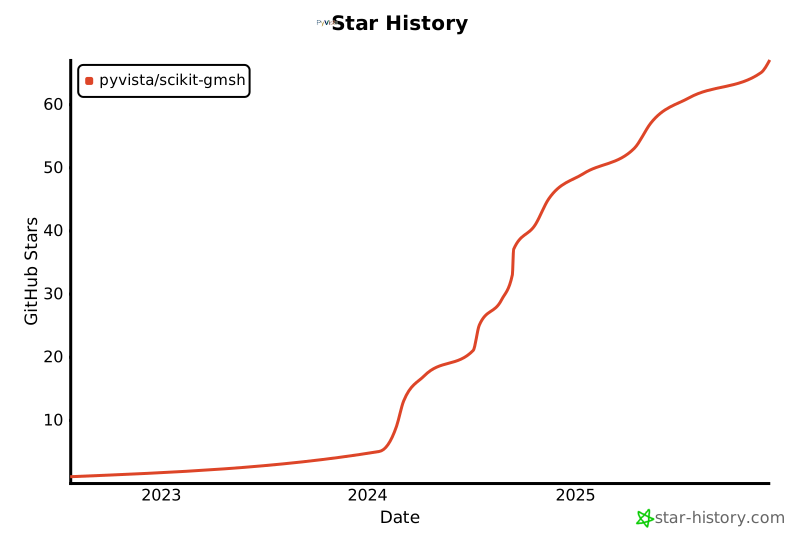](https://star-history.com/#pyvista/scikit-gmsh&Date)
81 |
--------------------------------------------------------------------------------
/docs/conf.py:
--------------------------------------------------------------------------------
1 | """
2 | Configuration file for the Sphinx documentation builder.
3 |
4 | For the full list of built-in configuration values, see the documentation:
5 | https://www.sphinx-doc.org/en/master/usage/configuration.html
6 | """
7 |
8 | from __future__ import annotations
9 |
10 | import datetime
11 | from importlib.metadata import version as get_version
12 | import os
13 | from pathlib import Path
14 |
15 | import pyvista
16 | from pyvista.plotting.utilities.sphinx_gallery import DynamicScraper
17 |
18 | pyvista.set_error_output_file("errors.txt")
19 | pyvista.OFF_SCREEN = True # Not necessary - simply an insurance policy
20 | pyvista.set_plot_theme("document")
21 | pyvista.BUILDING_GALLERY = True
22 | os.environ["PYVISTA_BUILDING_GALLERY"] = "true"
23 |
24 | if os.environ.get("READTHEDOCS") or os.environ.get("CI"):
25 | pyvista.start_xvfb()
26 |
27 | # -- Project information -----------------------------------------------------
28 | # https://www.sphinx-doc.org/en/master/usage/configuration.html#project-information
29 |
30 | project = "scikit-gmsh"
31 | copyright_years = f"2024 - {datetime.datetime.now(datetime.UTC).year}"
32 | copyright = "2024, Tetsuo Koyama" # noqa: A001
33 | author = f"{project} Contributors"
34 | on_rtd = os.environ.get("READTHEDOCS")
35 |
36 | if on_rtd:
37 | # https://www.sphinx-doc.org/en/master/usage/restructuredtext/directives.html#including-content-based-on-tags
38 | # https://www.sphinx-doc.org/en/master/usage/configuration.html#conf-tags
39 | tags.add("on_rtd") # noqa: F821
40 |
41 | # The full version, including alpha/beta/rc tags
42 | release = get_version("scikit-gmsh")
43 | release = release.removesuffix("+dirty")
44 |
45 | # docs src directory
46 | src_dir = Path(__file__).absolute().parent
47 | root_dir = src_dir.parents[1]
48 | package_dir = root_dir / "src"
49 |
50 | # -- General configuration ---------------------------------------------------
51 | # https://www.sphinx-doc.org/en/master/usage/configuration.html#general-configuration
52 |
53 | extensions = ["myst_parser", "pyvista.ext.plot_directive", "pyvista.ext.viewer_directive", "sphinx_design", "sphinx_gallery.gen_gallery"]
54 | templates_path = ["_templates"]
55 | exclude_patterns = ["_build", "Thumbs.db", ".DS_Store"]
56 |
57 |
58 | # -- Options for HTML output -------------------------------------------------
59 | # https://www.sphinx-doc.org/en/master/usage/configuration.html#options-for-html-output
60 |
61 | html_theme = "sphinx_book_theme"
62 | html_logo = "_static/small_logo.svg"
63 |
64 | html_context = {
65 | "github_url": "https://github.com",
66 | "github_user": "pyvista",
67 | "github_repo": "scikit-gmsh",
68 | "github_version": "main",
69 | "doc_path": "docs/src",
70 | }
71 |
72 | html_theme_options = {
73 | "home_page_in_toc": True,
74 | "icon_links": [
75 | {
76 | "name": "GitHub Discussions",
77 | "url": "https://github.com/pyvista/scikit-gmsh/discussions",
78 | "icon": "fa fa-comments fa-fw",
79 | },
80 | {
81 | "name": "GitHub Issues",
82 | "url": "https://github.com/pyvista/scikit-gmsh/issues",
83 | "icon": "fa-brands fa-square-github fa-fw",
84 | },
85 | {
86 | "name": "GitHub Pulls",
87 | "url": "https://github.com/pyvista/scikit-gmsh/pulls",
88 | "icon": "fa-brands fa-github-alt fa-fw",
89 | },
90 | ],
91 | "navigation_with_keys": False,
92 | "path_to_docs": "docs/src",
93 | "repository_branch": "main",
94 | "repository_url": "https://github.com/pyvista/scikit-gmsh",
95 | "show_prev_next": True,
96 | "show_toc_level": 4,
97 | "toc_title": "On this page",
98 | "use_download_button": True,
99 | "use_edit_page_button": False,
100 | "use_fullscreen_button": True,
101 | "use_issues_button": False,
102 | "use_repository_button": True,
103 | "use_sidenotes": True,
104 | "use_source_button": False,
105 | }
106 |
107 | # Add any paths that contain custom static files (such as style sheets) here,
108 | # relative to this directory. They are copied after the builtin static files,
109 | # so a file named "default.css" will overwrite the builtin "default.css".
110 | html_static_path = [
111 | "_static",
112 | ]
113 | html_css_files = [
114 | "style.css",
115 | "theme_overrides.css",
116 | ]
117 |
118 | # -- MyST settings -----------------------------------------------------------
119 |
120 | myst_enable_extensions = [
121 | "amsmath",
122 | "attrs_block",
123 | "attrs_inline",
124 | "colon_fence",
125 | "deflist",
126 | "dollarmath",
127 | "fieldlist",
128 | "html_admonition",
129 | "html_image",
130 | "replacements",
131 | "smartquotes",
132 | "strikethrough",
133 | "substitution",
134 | "tasklist",
135 | ]
136 |
137 | # -- sphinx_gallery settings -------------------------------------------------
138 |
139 | sphinx_gallery_conf = {
140 | "backreferences_dir": None,
141 | "doc_module": "pyvista",
142 | "download_all_examples": False,
143 | "examples_dirs": ["../examples/"],
144 | "filename_pattern": r"\.py",
145 | "first_notebook_cell": ("%matplotlib inline\nfrom pyvista import set_plot_theme\nset_plot_theme('document')\n"),
146 | "gallery_dirs": ["./examples"],
147 | "image_scrapers": (DynamicScraper(), "matplotlib"),
148 | "pypandoc": True,
149 | "remove_config_comments": True,
150 | "reset_modules_order": "both",
151 | }
152 |
--------------------------------------------------------------------------------
/CODE_OF_CONDUCT.md:
--------------------------------------------------------------------------------
1 | # Contributor Covenant Code of Conduct
2 |
3 | ## Our Pledge
4 |
5 | We as members, contributors, and leaders pledge to make participation in our
6 | community a harassment-free experience for everyone, regardless of age, body
7 | size, visible or invisible disability, ethnicity, sex characteristics, gender
8 | identity and expression, level of experience, education, socio-economic status,
9 | nationality, personal appearance, race, caste, color, religion, or sexual
10 | identity and orientation.
11 |
12 | We pledge to act and interact in ways that contribute to an open, welcoming,
13 | diverse, inclusive, and healthy community.
14 |
15 | ## Our Standards
16 |
17 | Examples of behavior that contributes to a positive environment for our
18 | community include:
19 |
20 | - Demonstrating empathy and kindness toward other people
21 | - Being respectful of differing opinions, viewpoints, and experiences
22 | - Giving and gracefully accepting constructive feedback
23 | - Accepting responsibility and apologizing to those affected by our mistakes,
24 | and learning from the experience
25 | - Focusing on what is best not just for us as individuals, but for the overall
26 | community
27 |
28 | Examples of unacceptable behavior include:
29 |
30 | - The use of sexualized language or imagery, and sexual attention or advances of
31 | any kind
32 | - Trolling, insulting or derogatory comments, and personal or political attacks
33 | - Public or private harassment
34 | - Publishing others' private information, such as a physical or email address,
35 | without their explicit permission
36 | - Other conduct which could reasonably be considered inappropriate in a
37 | professional setting
38 |
39 | ## Enforcement Responsibilities
40 |
41 | Community leaders are responsible for clarifying and enforcing our standards of
42 | acceptable behavior and will take appropriate and fair corrective action in
43 | response to any behavior that they deem inappropriate, threatening, offensive,
44 | or harmful.
45 |
46 | Community leaders have the right and responsibility to remove, edit, or reject
47 | comments, commits, code, wiki edits, issues, and other contributions that are
48 | not aligned to this Code of Conduct, and will communicate reasons for moderation
49 | decisions when appropriate.
50 |
51 | ## Scope
52 |
53 | This Code of Conduct applies within all community spaces, and also applies when
54 | an individual is officially representing the community in public spaces.
55 | Examples of representing our community include using an official email address,
56 | posting via an official social media account, or acting as an appointed
57 | representative at an online or offline event.
58 |
59 | ## Enforcement
60 |
61 | Instances of abusive, harassing, or otherwise unacceptable behavior may be
62 | reported to the community leaders responsible for enforcement at
63 | tkoyama010@gmail.com.
64 | All complaints will be reviewed and investigated promptly and fairly.
65 |
66 | All community leaders are obligated to respect the privacy and security of the
67 | reporter of any incident.
68 |
69 | ## Enforcement Guidelines
70 |
71 | Community leaders will follow these Community Impact Guidelines in determining
72 | the consequences for any action they deem in violation of this Code of Conduct:
73 |
74 | ### 1. Correction
75 |
76 | **Community Impact**: Use of inappropriate language or other behavior deemed
77 | unprofessional or unwelcome in the community.
78 |
79 | **Consequence**: A private, written warning from community leaders, providing
80 | clarity around the nature of the violation and an explanation of why the
81 | behavior was inappropriate. A public apology may be requested.
82 |
83 | ### 2. Warning
84 |
85 | **Community Impact**: A violation through a single incident or series of
86 | actions.
87 |
88 | **Consequence**: A warning with consequences for continued behavior. No
89 | interaction with the people involved, including unsolicited interaction with
90 | those enforcing the Code of Conduct, for a specified period of time. This
91 | includes avoiding interactions in community spaces as well as external channels
92 | like social media. Violating these terms may lead to a temporary or permanent
93 | ban.
94 |
95 | ### 3. Temporary Ban
96 |
97 | **Community Impact**: A serious violation of community standards, including
98 | sustained inappropriate behavior.
99 |
100 | **Consequence**: A temporary ban from any sort of interaction or public
101 | communication with the community for a specified period of time. No public or
102 | private interaction with the people involved, including unsolicited interaction
103 | with those enforcing the Code of Conduct, is allowed during this period.
104 | Violating these terms may lead to a permanent ban.
105 |
106 | ### 4. Permanent Ban
107 |
108 | **Community Impact**: Demonstrating a pattern of violation of community
109 | standards, including sustained inappropriate behavior, harassment of an
110 | individual, or aggression toward or disparagement of classes of individuals.
111 |
112 | **Consequence**: A permanent ban from any sort of public interaction within the
113 | community.
114 |
115 | ## Attribution
116 |
117 | This Code of Conduct is adapted from the [Contributor Covenant][homepage],
118 | version 2.1, available at
119 | [https://www.contributor-covenant.org/version/2/1/code_of_conduct.html][v2.1].
120 |
121 | Community Impact Guidelines were inspired by
122 | [Mozilla's code of conduct enforcement ladder][Mozilla CoC].
123 |
124 | For answers to common questions about this code of conduct, see the FAQ at
125 | [https://www.contributor-covenant.org/faq][FAQ]. Translations are available at
126 | [https://www.contributor-covenant.org/translations][translations].
127 |
128 | [homepage]: https://www.contributor-covenant.org
129 | [v2.1]: https://www.contributor-covenant.org/version/2/1/code_of_conduct.html
130 | [Mozilla CoC]: https://github.com/mozilla/diversity
131 | [FAQ]: https://www.contributor-covenant.org/faq
132 | [translations]: https://www.contributor-covenant.org/translations
133 |
--------------------------------------------------------------------------------
/CREDITS:
--------------------------------------------------------------------------------
1 | Gmsh is copyright (C) 1997-2022
2 |
3 | Christophe Geuzaine
4 |
5 |
6 | and
7 |
8 | Jean-Francois Remacle
9 |
10 |
11 | Code contributions to Gmsh have been provided by David Colignon (colormaps),
12 | Emilie Marchandise (old compound geometrical entities), Gaetan Bricteux (Gauss
13 | integration and levelsets), Jacques Lechelle (DIFFPACK export), Jonathan
14 | Lambrechts (mesh size fields, solver, Python wrappers), Jozef Vesely (old Tetgen
15 | integration), Koen Hillewaert (high order elements, generalized periodic
16 | meshes), Laurent Stainier (eigenvalue solvers, tensor display and help with
17 | macOS port), Marc Ume (original list and tree code), Mark van Doesburg (old
18 | OpenCASCADE face connection), Matt Gundry (Plot3d export), Matti Pellikka (cell
19 | complex and homology solver), Nicolas Tardieu (help with Netgen integration),
20 | Pascale Noyret (MED mesh IO), Pierre Badel (root finding and minimization), Ruth
21 | Sabariego (pyramids), Stephen Guzik (old CGNS IO, old partitioning code),
22 | Bastien Gorissen (parallel remote post-processing), Eric Bechet (solver), Gilles
23 | Marckmann (camera and stero mode, X3D export), Ashish Negi (Netgen CAD healing),
24 | Trevor Strickler (hybrid structured mesh coupling with pyramids), Amaury Johnen
25 | (Bezier code, high-order element validity), Benjamin Ruard (old Java wrappers),
26 | Maxime Graulich (iOS/Android port), Francois Henrotte (ONELAB metamodels),
27 | Sebastian Eiser (PGF export), Alexis Salzman (compressed IO), Hang Si (TetGen/BR
28 | boundary recovery code), Fernando Lorenzo (Tochnog export), Larry Price (Gambit
29 | export), Anthony Royer (new partitioning code, MSH4 IO), Darcy Beurle (code
30 | cleanup and performance improvements), Celestin Marot (HXT/tetMesh),
31 | Pierre-Alexandre Beaufort (HXT/reparam), Zhidong Han (LSDYNA export), Ismail
32 | Badia (hierarchical basis functions), Jeremy Theler (X3D export), Thomas
33 | Toulorge (high order mesh optimizer, new CGNS IO), Max Orok (binary PLY), Marek
34 | Wojciechowski (PyPi packaging), Maxence Reberol (automatic transfinite, quad
35 | meshing tools), Michael Ermakov (Gambit export, Fortran API, TransfiniteTri),
36 | Alex Krasner (X3D export), Giannis Nikiteas (Fortran API), Paul Sharp (Radioss
37 | export). See comments in the sources for more information. If we forgot to list
38 | your contributions please send us an email!
39 |
40 | Thanks to the following folks who have contributed by providing fresh ideas on
41 | theoretical or programming topics, who have sent patches, requests for changes
42 | or improvements, or who gave us access to exotic machines for testing Gmsh: Juan
43 | Abanto, Olivier Adam, Guillaume Alleon, Laurent Champaney, Pascal Dupuis,
44 | Patrick Dular, Philippe Geuzaine, Johan Gyselinck, Francois Henrotte, Benoit
45 | Meys, Nicolas Moes, Osamu Nakamura, Chad Schmutzer, Jean-Luc Fl'ejou, Xavier
46 | Dardenne, Christophe Prud'homme, Sebastien Clerc, Jose Miguel Pasini, Philippe
47 | Lussou, Jacques Kools, Bayram Yenikaya, Peter Hornby, Krishna Mohan Gundu,
48 | Christopher Stott, Timmy Schumacher, Carl Osterwisch, Bruno Frackowiak, Philip
49 | Kelleners, Romuald Conty, Renaud Sizaire, Michel Benhamou, Tom De Vuyst, Kris
50 | Van den Abeele, Simon Vun, Simon Corbin, Thomas De-Soza, Marcus Drosson, Antoine
51 | Dechaume, Jose Paulo Moitinho de Almeida, Thomas Pinchard, Corrado Chisari, Axel
52 | Hackbarth, Peter Wainwright, Jiri Hnidek, Thierry Thomas, Konstantinos Poulios,
53 | Laurent Van Miegroet, Shahrokh Ghavamian, Geordie McBain, Jose Paulo Moitinho de
54 | Almeida, Guillaume Demesy, Wendy Merks-Swolfs, Cosmin Stefan Deaconu, Nigel
55 | Nunn, Serban Georgescu, Julien Troufflard, Michele Mocciola, Matthijs Sypkens
56 | Smit, Sauli Ruuska, Romain Boman, Fredrik Ekre, Mark Burton, Max Orok, Paul
57 | Cristini, Isuru Fernando, Jose Paulo Moitinho de Almeida, Sophie Le Bras,
58 | Alberto Escrig, Samy Mukadi, Peter Johnston, Bruno de Sousa Alves, Stefan
59 | Bruens, Luca Verzeroli, Tristan Seidlhofer, Ding Jiaming, Joost Gevaert, Marcus
60 | Calhoun-Lopez, Michel Zou, Sir Sunsheep, Mariano Forti, Walter Steffe, Nico
61 | Schloemer, Simon Tournier, Alexandru Dadalau, Thomas Ulrich, Matthias Diener,
62 | Jamie Border; Kenneth Jansen.
63 |
64 | Special thanks to Bill Spitzak, Michael Sweet, Matthias Melcher, Greg Ercolano
65 | and others for the Fast Light Tool Kit on which Gmsh's GUI is based. See
66 | http://www.fltk.org for more info on this excellent object-oriented,
67 | cross-platform toolkit. Special thanks also to EDF for funding the original
68 | OpenCASCADE and MED integration in 2006-2007. Gmsh development was also
69 | financially supported by the PRACE project funded in part by the EU's Horizon
70 | 2020 Research and Innovation programme (2014-2020) under grant agreement 823767.
71 |
72 | The TetGen/BR code (src/mesh/tetgenBR.{cpp,h}) is copyright (c) 2016 Hang Si,
73 | Weierstrass Institute for Applied Analysis and Stochatics. It is relicensed
74 | under the terms of LICENSE.txt for use in Gmsh thanks to a Software License
75 | Agreement between Weierstrass Institute for Applied Analysis and Stochastics and
76 | GMESH SPRL.
77 |
78 | The AVL tree code (src/common/avl.{cpp,h}) and the YUV image code
79 | (src/graphics/gl2yuv.{cpp,h}) are copyright (C) 1988-1993, 1995 The Regents of
80 | the University of California. Permission to use, copy, modify, and distribute
81 | this software and its documentation for any purpose and without fee is hereby
82 | granted, provided that the above copyright notice appear in all copies and that
83 | both that copyright notice and this permission notice appear in supporting
84 | documentation, and that the name of the University of California not be used in
85 | advertising or publicity pertaining to distribution of the software without
86 | specific, written prior permission. The University of California makes no
87 | representations about the suitability of this software for any purpose. It is
88 | provided "as is" without express or implied warranty.
89 |
90 | The picojson code (src/common/picojson.h) is Copyright 2009-2010 Cybozu Labs,
91 | Inc., Copyright 2011-2014 Kazuho Oku, All rights reserved. Redistribution and
92 | use in source and binary forms, with or without modification, are permitted
93 | provided that the following conditions are met: 1. Redistributions of source
94 | code must retain the above copyright notice, this list of conditions and the
95 | following disclaimer. 2. Redistributions in binary form must reproduce the above
96 | copyright notice, this list of conditions and the following disclaimer in the
97 | documentation and/or other materials provided with the distribution. THIS
98 | SOFTWARE IS PROVIDED BY THE COPYRIGHT HOLDERS AND CONTRIBUTORS "AS IS" AND ANY
99 | EXPRESS OR IMPLIED WARRANTIES, INCLUDING, BUT NOT LIMITED TO, THE IMPLIED
100 | WARRANTIES OF MERCHANTABILITY AND FITNESS FOR A PARTICULAR PURPOSE ARE
101 | DISCLAIMED. IN NO EVENT SHALL THE COPYRIGHT HOLDER OR CONTRIBUTORS BE LIABLE FOR
102 | ANY DIRECT, INDIRECT, INCIDENTAL, SPECIAL, EXEMPLARY, OR CONSEQUENTIAL DAMAGES
103 | (INCLUDING, BUT NOT LIMITED TO, PROCUREMENT OF SUBSTITUTE GOODS OR SERVICES;
104 | LOSS OF USE, DATA, OR PROFITS; OR BUSINESS INTERRUPTION) HOWEVER CAUSED AND ON
105 | ANY THEORY OF LIABILITY, WHETHER IN CONTRACT, STRICT LIABILITY, OR TORT
106 | (INCLUDING NEGLIGENCE OR OTHERWISE) ARISING IN ANY WAY OUT OF THE USE OF THIS
107 | SOFTWARE, EVEN IF ADVISED OF THE POSSIBILITY OF SUCH DAMAGE.
108 |
109 | The nanoflann code (src/numeric/nanoflann.hpp) is Copyright 2008-2009 Marius
110 | Muja, 2008-2009 David G. Lowe, 2011-2016 Jose Luis Blanco. Redistribution and
111 | use in source and binary forms, with or without modification, are permitted
112 | provided that the following conditions are met: 1. Redistributions of source
113 | code must retain the above copyright notice, this list of conditions and the
114 | following disclaimer. 2. Redistributions in binary form must reproduce the
115 | above copyright notice, this list of conditions and the following disclaimer in
116 | the documentation and/or other materials provided with the distribution. THIS
117 | SOFTWARE IS PROVIDED BY THE AUTHOR ``AS IS'' AND ANY EXPRESS OR IMPLIED
118 | WARRANTIES, INCLUDING, BUT NOT LIMITED TO, THE IMPLIED WARRANTIES OF
119 | MERCHANTABILITY AND FITNESS FOR A PARTICULAR PURPOSE ARE DISCLAIMED. IN NO EVENT
120 | SHALL THE AUTHOR BE LIABLE FOR ANY DIRECT, INDIRECT, INCIDENTAL, SPECIAL,
121 | EXEMPLARY, OR CONSEQUENTIAL DAMAGES (INCLUDING, BUT NOT LIMITED TO, PROCUREMENT
122 | OF SUBSTITUTE GOODS OR SERVICES; LOSS OF USE, DATA, OR PROFITS; OR BUSINESS
123 | INTERRUPTION) HOWEVER CAUSED AND ON ANY THEORY OF LIABILITY, WHETHER IN
124 | CONTRACT, STRICT LIABILITY, OR TORT (INCLUDING NEGLIGENCE OR OTHERWISE) ARISING
125 | IN ANY WAY OUT OF THE USE OF THIS SOFTWARE, EVEN IF ADVISED OF THE POSSIBILITY
126 | OF SUCH DAMAGE.
127 |
128 | The trackball code (src/graphics/Trackball.{cpp.h}) is copyright (C) 1993, 1994,
129 | Silicon Graphics, Inc. ALL RIGHTS RESERVED. Permission to use, copy, modify, and
130 | distribute this software for any purpose and without fee is hereby granted,
131 | provided that the above copyright notice appear in all copies and that both the
132 | copyright notice and this permission notice appear in supporting documentation,
133 | and that the name of Silicon Graphics, Inc. not be used in advertising or
134 | publicity pertaining to distribution of the software without specific, written
135 | prior permission.
136 |
137 | The GIF and PPM routines (src/graphics/gl2gif.cpp) are based on code copyright
138 | (C) 1989, 1991, Jef Poskanzer. Permission to use, copy, modify, and distribute
139 | this software and its documentation for any purpose and without fee is hereby
140 | granted, provided that the above copyright notice appear in all copies and that
141 | both that copyright notice and this permission notice appear in supporting
142 | documentation. This software is provided "as is" without express or implied
143 | warranty.
144 |
145 | The colorbar widget (src/fltk/colorbarWindow.cpp) was inspired by code from the
146 | Vis5d program for visualizing five dimensional gridded data sets, copyright (C)
147 | 1990-1995, Bill Hibbard, Brian Paul, Dave Santek, and Andre Battaiola.
148 |
149 | The libOL code (src/common/libol1.{c,h}) is Copyright 2012-2018 - by Loïc
150 | Maréchal / INRIA. This program is a free software. You can redistribute it
151 | and/or modify it under the terms of the MIT License as published by the Open
152 | Source Initiative.
153 |
154 | The Fast & memory efficient hashtable based on robin hood hashing
155 | (src/common/robin_hood.h) is Copyright (c) 2018-2020 Martin Ankerl and is
156 | licensed under the MIT License.
157 |
158 | In addition, this version of Gmsh may contain the following contributed,
159 | optional codes in the contrib/ directory, each governed by their own license:
160 |
161 | * contrib/ANN copyright (C) 1997-2005 University of Maryland and Sunil Arya and
162 | David Mount;
163 |
164 | * contrib/gmm copyright (C) 2002-2008 Yves Renard;
165 |
166 | * contrib/hxt - Copyright (C) 2017-2020 - Universite catholique de Louvain;
167 |
168 | * contrib/kbipack copyright (C) 2005 Saku Suuriniemi;
169 |
170 | * contrib/MathEx based in part on the work of the SSCILIB Library, copyright (C)
171 | 2000-2003 Sadao Massago;
172 |
173 | * contrib/metis written by George Karypis (karypis at cs.umn.edu), copyright (C)
174 | 1995-2013 Regents of the University of Minnesota;
175 |
176 | * contrib/mpeg_encode copyright (c) 1995 The Regents of the University of
177 | California;
178 |
179 | * contrib/Netgen copyright (C) 1994-2004 Joachim Sch"oberl;
180 |
181 | * contrib/bamg from Freefem++ copyright (C) Frederic Hecht;
182 |
183 | * contrib/ALGLIB (C) Sergey Bochkanov (ALGLIB project);
184 |
185 | * contrib/blossom copyright (C) 1995-1997 Bill Cook et al.;
186 |
187 | * contrib/bamg from Freefem++ copyright (C) Frederic Hecht;
188 |
189 | * contrib/voro++ from Voro++ Copyright (c) 2008, The Regents of the University
190 | of California, through Lawrence Berkeley National Laboratory (subject to
191 | receipt of any required approvals from the U.S. Dept. of Energy). All rights
192 | reserved;
193 |
194 | * contrib/zipper from MiniZip - Copyright (c) 1998-2010 - by Gilles Vollant -
195 | version 1.1 64 bits from Mathias Svensson.
196 |
197 | Check the configuration options to see which have been enabled.
198 |
--------------------------------------------------------------------------------
/src/skgmsh/__init__.py:
--------------------------------------------------------------------------------
1 | """scikit-gmsh package for 3D mesh generation."""
2 |
3 | from __future__ import annotations
4 |
5 | import datetime
6 | from typing import TYPE_CHECKING
7 |
8 | import gmsh
9 | import numpy as np
10 | import pyvista as pv
11 | import scooby
12 | import shapely
13 |
14 | if TYPE_CHECKING:
15 | from collections.abc import Sequence
16 |
17 | from numpy.typing import ArrayLike
18 |
19 | INITIAL_MESH_ONLY_2D = 3
20 | FRONTAL_DELAUNAY_2D = 6
21 | DELAUNAY_3D = 1
22 | INITIAL_MESH_ONLY_3D = 3
23 |
24 | SILENT = 0
25 | SIMPLE = 0
26 |
27 | TRUE = 1
28 | FALSE = 0
29 |
30 | now = datetime.datetime.now(tz=datetime.UTC)
31 |
32 | # major, minor, patch
33 | version_info = 0, 4, "dev0"
34 |
35 | # Nice string for the version
36 | __version__ = ".".join(map(str, version_info))
37 |
38 |
39 | class Report(scooby.Report): # type: ignore[misc]
40 | """
41 | Generate an environment package and hardware report.
42 |
43 | Parameters
44 | ----------
45 | ncol : int, default: 3
46 | Number of package-columns in html table; only has effect if
47 | ``mode='HTML'`` or ``mode='html'``.
48 |
49 | text_width : int, default: 80
50 | The text width for non-HTML display modes.
51 |
52 | """
53 |
54 | def __init__(self: Report, ncol: int = 3, text_width: int = 80) -> None: # numpydoc ignore=PR01
55 | """Generate a :class:`scooby.Report` instance."""
56 | # mandatory packages
57 | core: list[str] = [
58 | "matplotlib",
59 | "numpy",
60 | "pooch",
61 | "pyvista",
62 | "scooby",
63 | "vtk",
64 | "gmsh",
65 | "meshio",
66 | "pygmsh",
67 | "pyvista",
68 | ]
69 |
70 | # optional packages
71 | optional: list[str] = [
72 | "imageio",
73 | "pyvistaqt",
74 | "PyQt5",
75 | "IPython",
76 | "colorcet",
77 | "cmocean",
78 | "ipywidgets",
79 | "scipy",
80 | "tqdm",
81 | "jupyterlab",
82 | "pytest_pyvista",
83 | "trame",
84 | "trame_client",
85 | "trame_server",
86 | "trame_vtk",
87 | "trame_vuetify",
88 | "jupyter_server_proxy",
89 | "nest_asyncio",
90 | ]
91 |
92 | extra_meta = [
93 | ("GPU Details", "None"),
94 | ]
95 |
96 | super().__init__(
97 | core=core,
98 | optional=optional,
99 | ncol=ncol,
100 | text_width=text_width,
101 | extra_meta=extra_meta,
102 | )
103 |
104 |
105 | def delaunay_3d(
106 | edge_source: pv.PolyData,
107 | target_sizes: float | Sequence[float] | None = None,
108 | ) -> pv.UnstructuredGrid | None:
109 | """
110 | Delaunay 3D mesh algorithm.
111 |
112 | Parameters
113 | ----------
114 | edge_source : pyvista.PolyData
115 | Specify the source object used to specify constrained
116 | edges and loops. If set, and lines/polygons are defined, a
117 | constrained triangulation is created. The lines/polygons
118 | are assumed to reference points in the input point set
119 | (i.e. point ids are identical in the input and
120 | source).
121 |
122 | target_sizes : float | Sequence[float]
123 | Target mesh size close to the points.
124 |
125 | Returns
126 | -------
127 | pyvista.UnstructuredGrid
128 | Mesh from the 3D delaunay generation.
129 |
130 | Notes
131 | -----
132 | .. versionadded:: 0.2.0
133 |
134 | """
135 | points = edge_source.points
136 | faces = edge_source.irregular_faces
137 |
138 | gmsh.initialize()
139 | if target_sizes is None:
140 | gmsh.option.set_number("Mesh.Algorithm", INITIAL_MESH_ONLY_3D)
141 | gmsh.option.set_number("Mesh.MeshSizeExtendFromBoundary", 0)
142 | gmsh.option.set_number("Mesh.MeshSizeFromPoints", 0)
143 | gmsh.option.set_number("Mesh.MeshSizeFromCurvature", 0)
144 | else:
145 | gmsh.option.set_number("Mesh.Algorithm3D", DELAUNAY_3D)
146 | gmsh.option.set_number("General.Verbosity", SILENT)
147 | gmsh.option.set_number("Mesh.AlgorithmSwitchOnFailure", FALSE)
148 | gmsh.option.set_number("Mesh.RecombinationAlgorithm", SIMPLE)
149 | gmsh.option.set_number("Mesh.RecombineNodeRepositioning", FALSE)
150 |
151 | if target_sizes is None:
152 | target_sizes = 0.0
153 |
154 | if isinstance(target_sizes, float):
155 | target_sizes = [target_sizes] * edge_source.number_of_points
156 |
157 | for i, (point, target_size) in enumerate(zip(points, target_sizes, strict=False)):
158 | id_ = i + 1
159 | gmsh.model.geo.add_point(point[0], point[1], point[2], target_size, id_)
160 |
161 | surface_loop = []
162 | for i, face in enumerate(faces):
163 | curve_tags = []
164 | for j, _ in enumerate(face):
165 | start_tag = face[j - 1] + 1
166 | end_tag = face[j] + 1
167 | curve_tag = gmsh.model.geo.add_line(start_tag, end_tag)
168 | curve_tags.append(curve_tag)
169 | gmsh.model.geo.add_curve_loop(curve_tags, i + 1)
170 | gmsh.model.geo.add_plane_surface([i + 1], i + 1)
171 | surface_loop.append(i + 1)
172 |
173 | gmsh.model.geo.remove_all_duplicates()
174 | gmsh.model.geo.synchronize()
175 |
176 | gmsh.model.geo.add_surface_loop(surface_loop, 1)
177 | gmsh.model.geo.add_volume([1], 1)
178 |
179 | gmsh.model.geo.synchronize()
180 | mesh = generate_mesh(3)
181 |
182 | ind = []
183 | for i, cell in enumerate(mesh.cell):
184 | if cell.type != pv.CellType.TETRA:
185 | ind.append(i)
186 | mesh = mesh.remove_cells(ind)
187 | mesh.clear_data()
188 |
189 | return mesh
190 |
191 |
192 | def frontal_delaunay_2d( # noqa: C901, PLR0912
193 | edge_source: pv.PolyData | shapely.geometry.Polygon,
194 | target_sizes: float | ArrayLike | None = None,
195 | recombine: bool = False, # noqa: FBT001, FBT002
196 | ) -> pv.UnstructuredGrid | None:
197 | """
198 | Frontal-Delaunay 2D mesh algorithm.
199 |
200 | Parameters
201 | ----------
202 | edge_source : pyvista.PolyData | shapely.geometry.Polygon
203 | Specify the source object used to specify constrained
204 | edges and loops. If set, and lines/polygons are defined, a
205 | constrained triangulation is created. The lines/polygons
206 | are assumed to reference points in the input point set
207 | (i.e. point ids are identical in the input and
208 | source).
209 |
210 | target_sizes : float | ArrayLike
211 | Target mesh size close to the points.
212 | Default max size of edge_source in each direction.
213 |
214 | recombine : bool
215 | Recombine the generated mesh into quadrangles.
216 |
217 | Returns
218 | -------
219 | pyvista.UnstructuredGrid
220 | Mesh from the 2D delaunay generation.
221 |
222 | Notes
223 | -----
224 | .. versionadded:: 0.2.0
225 |
226 | """
227 | gmsh.initialize()
228 | if target_sizes is None:
229 | gmsh.option.set_number("Mesh.Algorithm", INITIAL_MESH_ONLY_2D)
230 | gmsh.option.set_number("Mesh.MeshSizeExtendFromBoundary", 0)
231 | gmsh.option.set_number("Mesh.MeshSizeFromPoints", 0)
232 | gmsh.option.set_number("Mesh.MeshSizeFromCurvature", 0)
233 | else:
234 | gmsh.option.set_number("Mesh.Algorithm", FRONTAL_DELAUNAY_2D)
235 | gmsh.option.set_number("General.Verbosity", SILENT)
236 |
237 | if target_sizes is None:
238 | target_sizes = 0.0
239 |
240 | if isinstance(edge_source, shapely.geometry.Polygon):
241 | wire_tags = []
242 |
243 | if isinstance(target_sizes, float):
244 | target_sizes = [target_sizes] * (len(edge_source.interiors) + 1)
245 |
246 | for target_size, linearring in zip(target_sizes, [edge_source.exterior, *list(edge_source.interiors)], strict=False):
247 | sizes = [target_size] * (len(linearring.coords) - 1) if isinstance(target_size, float) else target_size
248 | coords = linearring.coords[:-1].copy()
249 | tags = []
250 | for size, coord in zip(sizes, coords, strict=False):
251 | x, y, z = coord
252 | tags.append(gmsh.model.geo.add_point(x, y, z, size))
253 | curve_tags = []
254 | for i, _ in enumerate(tags):
255 | start_tag = tags[i - 1]
256 | end_tag = tags[i]
257 | curve_tags.append(gmsh.model.geo.add_line(start_tag, end_tag))
258 | wire_tags.append(gmsh.model.geo.add_curve_loop(curve_tags))
259 | gmsh.model.geo.add_plane_surface(wire_tags)
260 | gmsh.model.geo.synchronize()
261 | else:
262 | points = edge_source.points
263 | lines = edge_source.lines
264 |
265 | if isinstance(target_sizes, float):
266 | target_sizes = [target_sizes] * edge_source.number_of_points
267 |
268 | embedded_points = []
269 | for target_size, point in zip(target_sizes, points, strict=False):
270 | embedded_points.append(gmsh.model.geo.add_point(point[0], point[1], point[2], target_size))
271 |
272 | for i in range(lines[0] - 1):
273 | id_ = i + 1
274 | gmsh.model.geo.add_line(lines[i + 1] + 1, lines[i + 2] + 1, id_)
275 |
276 | gmsh.model.geo.add_curve_loop(range(1, lines[0]), 1)
277 | gmsh.model.geo.add_plane_surface([1], 1)
278 | gmsh.model.geo.synchronize()
279 | gmsh.model.mesh.embed(0, embedded_points, 2, 1)
280 |
281 | if recombine:
282 | gmsh.model.mesh.set_recombine(2, 1)
283 |
284 | mesh = generate_mesh(2)
285 |
286 | ind = []
287 | for index, cell in enumerate(mesh.cell):
288 | if cell.type in [pv.CellType.VERTEX, pv.CellType.LINE]:
289 | ind.append(index)
290 |
291 | return mesh.remove_cells(ind)
292 |
293 |
294 | def generate_mesh(dim: int) -> pv.UnstructuredGrid:
295 | """
296 | Generate a mesh of the current model.
297 |
298 | Parameters
299 | ----------
300 | dim : int
301 | Mesh dimension.
302 |
303 | Returns
304 | -------
305 | pyvista.UnstructuredGrid
306 | Generated mesh.
307 |
308 | """
309 | gmsh_to_pyvista_type = {
310 | 1: pv.CellType.LINE,
311 | 2: pv.CellType.TRIANGLE,
312 | 3: pv.CellType.QUAD,
313 | 4: pv.CellType.TETRA,
314 | 5: pv.CellType.HEXAHEDRON,
315 | 6: pv.CellType.WEDGE,
316 | 7: pv.CellType.PYRAMID,
317 | 15: pv.CellType.VERTEX,
318 | }
319 |
320 | try:
321 | gmsh.model.mesh.generate(dim)
322 | node_tags, coord, _ = gmsh.model.mesh.getNodes()
323 | element_types, element_tags, element_node_tags = gmsh.model.mesh.getElements()
324 |
325 | # Points
326 | assert (np.diff(node_tags) > 0).all() # noqa: S101
327 | points = np.reshape(coord, (-1, 3))
328 |
329 | # Cells
330 | cells = {}
331 |
332 | for type_, tags, node_tags in zip(element_types, element_tags, element_node_tags, strict=False):
333 | assert (np.diff(tags) > 0).all() # noqa: S101
334 |
335 | celltype = gmsh_to_pyvista_type[type_]
336 | num_nodes = gmsh.model.mesh.getElementProperties(type_)[3]
337 | cells[celltype] = np.reshape(node_tags, (-1, num_nodes)) - 1
338 |
339 | mesh = pv.UnstructuredGrid(cells, points)
340 |
341 | finally:
342 | gmsh.clear()
343 | gmsh.finalize()
344 |
345 | return mesh
346 |
347 |
348 | class Delaunay2D:
349 | """
350 | Delaunay 2D mesh algorithm.
351 |
352 | Parameters
353 | ----------
354 | edge_source : pyvista.PolyData | shapely.Polygon
355 | Specify the source object used to specify constrained
356 | edges and loops. If set, and lines/polygons are defined, a
357 | constrained triangulation is created. The lines/polygons
358 | are assumed to reference points in the input point set
359 | (i.e. point ids are identical in the input and
360 | source).
361 |
362 | shell : sequence
363 | A sequence of (x, y [,z]) numeric coordinate pairs or triples, or
364 | an array-like with shape (N, 2) or (N, 3).
365 | Also can be a sequence of Point objects.
366 |
367 | holes : sequence
368 | A sequence of objects which satisfy the same requirements as the
369 | shell parameters above.
370 |
371 | cell_size : float | ArrayLike
372 | Meshing constraint at point.
373 |
374 | constrain_edge_size : bool
375 | If True, cell size at points are set to their maximum edge length.
376 |
377 | Notes
378 | -----
379 | .. versionadded:: 0.2.0
380 |
381 | """
382 |
383 | def __init__(
384 | self: Delaunay2D,
385 | *,
386 | edge_source: pv.PolyData | shapely.Polygon | None = None,
387 | shell: Sequence[tuple[int]] | None = None,
388 | holes: Sequence[tuple[int]] | None = None,
389 | cell_size: float | ArrayLike | None = None,
390 | constrain_edge_size: bool = False,
391 | ) -> None:
392 | """Initialize the Delaunay2D class."""
393 | if edge_source is not None:
394 | self._edge_source = edge_source
395 | else:
396 | self._edge_source = shapely.Polygon(shell, holes)
397 |
398 | if constrain_edge_size:
399 | if isinstance(self.edge_source, shapely.Polygon):
400 | cell_size = [self._compute_cell_size_from_points(self.edge_source.exterior.coords)]
401 | cell_size += [self._compute_cell_size_from_points(hole.coords) for hole in self.edge_source.interiors]
402 |
403 | else:
404 | # Only the first line is processed
405 | lines = edge_source.lines
406 | line = lines[1 : lines[0] + 1]
407 | edge_points = edge_source.points[line]
408 | cell_size = self._compute_cell_size_from_points(edge_points)
409 |
410 | self._cell_size = cell_size
411 | self._recombine = False
412 |
413 | @staticmethod
414 | def _compute_cell_size_from_points(points: ArrayLike) -> ArrayLike:
415 | """Compute cell size from points array."""
416 | lengths = np.linalg.norm(np.diff(points, axis=0), axis=-1)
417 | lengths = np.insert(lengths, 0, lengths[-1])
418 |
419 | return np.maximum(lengths[:-1], lengths[1:])
420 |
421 | @property
422 | def edge_source(self: Delaunay2D) -> pv.PolyData | shapely.geometry.Polygon:
423 | """Get the edge source."""
424 | return self._edge_source
425 |
426 | @property
427 | def mesh(self: Delaunay2D) -> pv.PolyData:
428 | """Get the mesh."""
429 | mesh = frontal_delaunay_2d(self._edge_source, target_sizes=self._cell_size, recombine=self._recombine)
430 | return pv.PolyData(mesh.points, mesh.cells)
431 |
432 | @property
433 | def cell_size(self: Delaunay2D) -> float | ArrayLike | None:
434 | """Get the cell_size of the mesh."""
435 | return self._cell_size
436 |
437 | @cell_size.setter
438 | def cell_size(self: Delaunay2D, size: float | ArrayLike | None) -> None:
439 | """Set the cell_size of the mesh."""
440 | self._cell_size = size
441 |
442 | def enable_recombine(self: Delaunay2D) -> None:
443 | """Enable recombination of the mesh."""
444 | self._recombine = True
445 |
446 | def disable_recombine(self: Delaunay2D) -> None:
447 | """Disable recombination of the mesh."""
448 | self._recombine = False
449 |
450 |
451 | class Delaunay3D:
452 | """
453 | Delaunay 3D mesh algorithm.
454 |
455 | Parameters
456 | ----------
457 | edge_source : pyvista.PolyData
458 | Specify the source object used to specify constrained
459 | edges and loops. If set, and lines/polygons are defined, a
460 | constrained triangulation is created. The lines/polygons
461 | are assumed to reference points in the input point set
462 | (i.e. point ids are identical in the input and
463 | source).
464 |
465 | Notes
466 | -----
467 | .. versionadded:: 0.2.0
468 |
469 | """
470 |
471 | def __init__(
472 | self: Delaunay3D,
473 | edge_source: pv.PolyData,
474 | cell_size: float | None = None,
475 | ) -> None:
476 | """Initialize the Delaunay3D class."""
477 | self._edge_source = edge_source
478 | self._cell_size = cell_size
479 |
480 | @property
481 | def edge_source(self: Delaunay3D) -> pv.PolyData:
482 | """Get the edge source."""
483 | return self._edge_source
484 |
485 | @property
486 | def mesh(self: Delaunay3D) -> pv.UnstructuredGrid:
487 | """Get the mesh."""
488 | self._mesh = delaunay_3d(self.edge_source, target_sizes=self.cell_size)
489 | return self._mesh
490 |
491 | @property
492 | def cell_size(self: Delaunay3D) -> float | None:
493 | """Get the cell_size of the mesh."""
494 | return self._cell_size
495 |
496 | @cell_size.setter
497 | def cell_size(self: Delaunay3D, size: int) -> None:
498 | """Set the cell_size of the mesh."""
499 | self._cell_size = size
500 |
--------------------------------------------------------------------------------
/docs/_static/csg_tree/LICENSE:
--------------------------------------------------------------------------------
1 | Attribution-NonCommercial-ShareAlike 4.0 International
2 |
3 | =======================================================================
4 |
5 | Creative Commons Corporation ("Creative Commons") is not a law firm and
6 | does not provide legal services or legal advice. Distribution of
7 | Creative Commons public licenses does not create a lawyer-client or
8 | other relationship. Creative Commons makes its licenses and related
9 | information available on an "as-is" basis. Creative Commons gives no
10 | warranties regarding its licenses, any material licensed under their
11 | terms and conditions, or any related information. Creative Commons
12 | disclaims all liability for damages resulting from their use to the
13 | fullest extent possible.
14 |
15 | Using Creative Commons Public Licenses
16 |
17 | Creative Commons public licenses provide a standard set of terms and
18 | conditions that creators and other rights holders may use to share
19 | original works of authorship and other material subject to copyright
20 | and certain other rights specified in the public license below. The
21 | following considerations are for informational purposes only, are not
22 | exhaustive, and do not form part of our licenses.
23 |
24 | Considerations for licensors: Our public licenses are
25 | intended for use by those authorized to give the public
26 | permission to use material in ways otherwise restricted by
27 | copyright and certain other rights. Our licenses are
28 | irrevocable. Licensors should read and understand the terms
29 | and conditions of the license they choose before applying it.
30 | Licensors should also secure all rights necessary before
31 | applying our licenses so that the public can reuse the
32 | material as expected. Licensors should clearly mark any
33 | material not subject to the license. This includes other CC-
34 | licensed material, or material used under an exception or
35 | limitation to copyright. More considerations for licensors:
36 | wiki.creativecommons.org/Considerations_for_licensors
37 |
38 | Considerations for the public: By using one of our public
39 | licenses, a licensor grants the public permission to use the
40 | licensed material under specified terms and conditions. If
41 | the licensor's permission is not necessary for any reason--for
42 | example, because of any applicable exception or limitation to
43 | copyright--then that use is not regulated by the license. Our
44 | licenses grant only permissions under copyright and certain
45 | other rights that a licensor has authority to grant. Use of
46 | the licensed material may still be restricted for other
47 | reasons, including because others have copyright or other
48 | rights in the material. A licensor may make special requests,
49 | such as asking that all changes be marked or described.
50 | Although not required by our licenses, you are encouraged to
51 | respect those requests where reasonable. More considerations
52 | for the public:
53 | wiki.creativecommons.org/Considerations_for_licensees
54 |
55 | =======================================================================
56 |
57 | Creative Commons Attribution-NonCommercial-ShareAlike 4.0 International
58 | Public License
59 |
60 | By exercising the Licensed Rights (defined below), You accept and agree
61 | to be bound by the terms and conditions of this Creative Commons
62 | Attribution-NonCommercial-ShareAlike 4.0 International Public License
63 | ("Public License"). To the extent this Public License may be
64 | interpreted as a contract, You are granted the Licensed Rights in
65 | consideration of Your acceptance of these terms and conditions, and the
66 | Licensor grants You such rights in consideration of benefits the
67 | Licensor receives from making the Licensed Material available under
68 | these terms and conditions.
69 |
70 |
71 | Section 1 -- Definitions.
72 |
73 | a. Adapted Material means material subject to Copyright and Similar
74 | Rights that is derived from or based upon the Licensed Material
75 | and in which the Licensed Material is translated, altered,
76 | arranged, transformed, or otherwise modified in a manner requiring
77 | permission under the Copyright and Similar Rights held by the
78 | Licensor. For purposes of this Public License, where the Licensed
79 | Material is a musical work, performance, or sound recording,
80 | Adapted Material is always produced where the Licensed Material is
81 | synched in timed relation with a moving image.
82 |
83 | b. Adapter's License means the license You apply to Your Copyright
84 | and Similar Rights in Your contributions to Adapted Material in
85 | accordance with the terms and conditions of this Public License.
86 |
87 | c. BY-NC-SA Compatible License means a license listed at
88 | creativecommons.org/compatiblelicenses, approved by Creative
89 | Commons as essentially the equivalent of this Public License.
90 |
91 | d. Copyright and Similar Rights means copyright and/or similar rights
92 | closely related to copyright including, without limitation,
93 | performance, broadcast, sound recording, and Sui Generis Database
94 | Rights, without regard to how the rights are labeled or
95 | categorized. For purposes of this Public License, the rights
96 | specified in Section 2(b)(1)-(2) are not Copyright and Similar
97 | Rights.
98 |
99 | e. Effective Technological Measures means those measures that, in the
100 | absence of proper authority, may not be circumvented under laws
101 | fulfilling obligations under Article 11 of the WIPO Copyright
102 | Treaty adopted on December 20, 1996, and/or similar international
103 | agreements.
104 |
105 | f. Exceptions and Limitations means fair use, fair dealing, and/or
106 | any other exception or limitation to Copyright and Similar Rights
107 | that applies to Your use of the Licensed Material.
108 |
109 | g. License Elements means the license attributes listed in the name
110 | of a Creative Commons Public License. The License Elements of this
111 | Public License are Attribution, NonCommercial, and ShareAlike.
112 |
113 | h. Licensed Material means the artistic or literary work, database,
114 | or other material to which the Licensor applied this Public
115 | License.
116 |
117 | i. Licensed Rights means the rights granted to You subject to the
118 | terms and conditions of this Public License, which are limited to
119 | all Copyright and Similar Rights that apply to Your use of the
120 | Licensed Material and that the Licensor has authority to license.
121 |
122 | j. Licensor means the individual(s) or entity(ies) granting rights
123 | under this Public License.
124 |
125 | k. NonCommercial means not primarily intended for or directed towards
126 | commercial advantage or monetary compensation. For purposes of
127 | this Public License, the exchange of the Licensed Material for
128 | other material subject to Copyright and Similar Rights by digital
129 | file-sharing or similar means is NonCommercial provided there is
130 | no payment of monetary compensation in connection with the
131 | exchange.
132 |
133 | l. Share means to provide material to the public by any means or
134 | process that requires permission under the Licensed Rights, such
135 | as reproduction, public display, public performance, distribution,
136 | dissemination, communication, or importation, and to make material
137 | available to the public including in ways that members of the
138 | public may access the material from a place and at a time
139 | individually chosen by them.
140 |
141 | m. Sui Generis Database Rights means rights other than copyright
142 | resulting from Directive 96/9/EC of the European Parliament and of
143 | the Council of 11 March 1996 on the legal protection of databases,
144 | as amended and/or succeeded, as well as other essentially
145 | equivalent rights anywhere in the world.
146 |
147 | n. You means the individual or entity exercising the Licensed Rights
148 | under this Public License. Your has a corresponding meaning.
149 |
150 |
151 | Section 2 -- Scope.
152 |
153 | a. License grant.
154 |
155 | 1. Subject to the terms and conditions of this Public License,
156 | the Licensor hereby grants You a worldwide, royalty-free,
157 | non-sublicensable, non-exclusive, irrevocable license to
158 | exercise the Licensed Rights in the Licensed Material to:
159 |
160 | a. reproduce and Share the Licensed Material, in whole or
161 | in part, for NonCommercial purposes only; and
162 |
163 | b. produce, reproduce, and Share Adapted Material for
164 | NonCommercial purposes only.
165 |
166 | 2. Exceptions and Limitations. For the avoidance of doubt, where
167 | Exceptions and Limitations apply to Your use, this Public
168 | License does not apply, and You do not need to comply with
169 | its terms and conditions.
170 |
171 | 3. Term. The term of this Public License is specified in Section
172 | 6(a).
173 |
174 | 4. Media and formats; technical modifications allowed. The
175 | Licensor authorizes You to exercise the Licensed Rights in
176 | all media and formats whether now known or hereafter created,
177 | and to make technical modifications necessary to do so. The
178 | Licensor waives and/or agrees not to assert any right or
179 | authority to forbid You from making technical modifications
180 | necessary to exercise the Licensed Rights, including
181 | technical modifications necessary to circumvent Effective
182 | Technological Measures. For purposes of this Public License,
183 | simply making modifications authorized by this Section 2(a)
184 | (4) never produces Adapted Material.
185 |
186 | 5. Downstream recipients.
187 |
188 | a. Offer from the Licensor -- Licensed Material. Every
189 | recipient of the Licensed Material automatically
190 | receives an offer from the Licensor to exercise the
191 | Licensed Rights under the terms and conditions of this
192 | Public License.
193 |
194 | b. Additional offer from the Licensor -- Adapted Material.
195 | Every recipient of Adapted Material from You
196 | automatically receives an offer from the Licensor to
197 | exercise the Licensed Rights in the Adapted Material
198 | under the conditions of the Adapter's License You apply.
199 |
200 | c. No downstream restrictions. You may not offer or impose
201 | any additional or different terms or conditions on, or
202 | apply any Effective Technological Measures to, the
203 | Licensed Material if doing so restricts exercise of the
204 | Licensed Rights by any recipient of the Licensed
205 | Material.
206 |
207 | 6. No endorsement. Nothing in this Public License constitutes or
208 | may be construed as permission to assert or imply that You
209 | are, or that Your use of the Licensed Material is, connected
210 | with, or sponsored, endorsed, or granted official status by,
211 | the Licensor or others designated to receive attribution as
212 | provided in Section 3(a)(1)(A)(i).
213 |
214 | b. Other rights.
215 |
216 | 1. Moral rights, such as the right of integrity, are not
217 | licensed under this Public License, nor are publicity,
218 | privacy, and/or other similar personality rights; however, to
219 | the extent possible, the Licensor waives and/or agrees not to
220 | assert any such rights held by the Licensor to the limited
221 | extent necessary to allow You to exercise the Licensed
222 | Rights, but not otherwise.
223 |
224 | 2. Patent and trademark rights are not licensed under this
225 | Public License.
226 |
227 | 3. To the extent possible, the Licensor waives any right to
228 | collect royalties from You for the exercise of the Licensed
229 | Rights, whether directly or through a collecting society
230 | under any voluntary or waivable statutory or compulsory
231 | licensing scheme. In all other cases the Licensor expressly
232 | reserves any right to collect such royalties, including when
233 | the Licensed Material is used other than for NonCommercial
234 | purposes.
235 |
236 |
237 | Section 3 -- License Conditions.
238 |
239 | Your exercise of the Licensed Rights is expressly made subject to the
240 | following conditions.
241 |
242 | a. Attribution.
243 |
244 | 1. If You Share the Licensed Material (including in modified
245 | form), You must:
246 |
247 | a. retain the following if it is supplied by the Licensor
248 | with the Licensed Material:
249 |
250 | i. identification of the creator(s) of the Licensed
251 | Material and any others designated to receive
252 | attribution, in any reasonable manner requested by
253 | the Licensor (including by pseudonym if
254 | designated);
255 |
256 | ii. a copyright notice;
257 |
258 | iii. a notice that refers to this Public License;
259 |
260 | iv. a notice that refers to the disclaimer of
261 | warranties;
262 |
263 | v. a URI or hyperlink to the Licensed Material to the
264 | extent reasonably practicable;
265 |
266 | b. indicate if You modified the Licensed Material and
267 | retain an indication of any previous modifications; and
268 |
269 | c. indicate the Licensed Material is licensed under this
270 | Public License, and include the text of, or the URI or
271 | hyperlink to, this Public License.
272 |
273 | 2. You may satisfy the conditions in Section 3(a)(1) in any
274 | reasonable manner based on the medium, means, and context in
275 | which You Share the Licensed Material. For example, it may be
276 | reasonable to satisfy the conditions by providing a URI or
277 | hyperlink to a resource that includes the required
278 | information.
279 | 3. If requested by the Licensor, You must remove any of the
280 | information required by Section 3(a)(1)(A) to the extent
281 | reasonably practicable.
282 |
283 | b. ShareAlike.
284 |
285 | In addition to the conditions in Section 3(a), if You Share
286 | Adapted Material You produce, the following conditions also apply.
287 |
288 | 1. The Adapter's License You apply must be a Creative Commons
289 | license with the same License Elements, this version or
290 | later, or a BY-NC-SA Compatible License.
291 |
292 | 2. You must include the text of, or the URI or hyperlink to, the
293 | Adapter's License You apply. You may satisfy this condition
294 | in any reasonable manner based on the medium, means, and
295 | context in which You Share Adapted Material.
296 |
297 | 3. You may not offer or impose any additional or different terms
298 | or conditions on, or apply any Effective Technological
299 | Measures to, Adapted Material that restrict exercise of the
300 | rights granted under the Adapter's License You apply.
301 |
302 |
303 | Section 4 -- Sui Generis Database Rights.
304 |
305 | Where the Licensed Rights include Sui Generis Database Rights that
306 | apply to Your use of the Licensed Material:
307 |
308 | a. for the avoidance of doubt, Section 2(a)(1) grants You the right
309 | to extract, reuse, reproduce, and Share all or a substantial
310 | portion of the contents of the database for NonCommercial purposes
311 | only;
312 |
313 | b. if You include all or a substantial portion of the database
314 | contents in a database in which You have Sui Generis Database
315 | Rights, then the database in which You have Sui Generis Database
316 | Rights (but not its individual contents) is Adapted Material,
317 | including for purposes of Section 3(b); and
318 |
319 | c. You must comply with the conditions in Section 3(a) if You Share
320 | all or a substantial portion of the contents of the database.
321 |
322 | For the avoidance of doubt, this Section 4 supplements and does not
323 | replace Your obligations under this Public License where the Licensed
324 | Rights include other Copyright and Similar Rights.
325 |
326 |
327 | Section 5 -- Disclaimer of Warranties and Limitation of Liability.
328 |
329 | a. UNLESS OTHERWISE SEPARATELY UNDERTAKEN BY THE LICENSOR, TO THE
330 | EXTENT POSSIBLE, THE LICENSOR OFFERS THE LICENSED MATERIAL AS-IS
331 | AND AS-AVAILABLE, AND MAKES NO REPRESENTATIONS OR WARRANTIES OF
332 | ANY KIND CONCERNING THE LICENSED MATERIAL, WHETHER EXPRESS,
333 | IMPLIED, STATUTORY, OR OTHER. THIS INCLUDES, WITHOUT LIMITATION,
334 | WARRANTIES OF TITLE, MERCHANTABILITY, FITNESS FOR A PARTICULAR
335 | PURPOSE, NON-INFRINGEMENT, ABSENCE OF LATENT OR OTHER DEFECTS,
336 | ACCURACY, OR THE PRESENCE OR ABSENCE OF ERRORS, WHETHER OR NOT
337 | KNOWN OR DISCOVERABLE. WHERE DISCLAIMERS OF WARRANTIES ARE NOT
338 | ALLOWED IN FULL OR IN PART, THIS DISCLAIMER MAY NOT APPLY TO YOU.
339 |
340 | b. TO THE EXTENT POSSIBLE, IN NO EVENT WILL THE LICENSOR BE LIABLE
341 | TO YOU ON ANY LEGAL THEORY (INCLUDING, WITHOUT LIMITATION,
342 | NEGLIGENCE) OR OTHERWISE FOR ANY DIRECT, SPECIAL, INDIRECT,
343 | INCIDENTAL, CONSEQUENTIAL, PUNITIVE, EXEMPLARY, OR OTHER LOSSES,
344 | COSTS, EXPENSES, OR DAMAGES ARISING OUT OF THIS PUBLIC LICENSE OR
345 | USE OF THE LICENSED MATERIAL, EVEN IF THE LICENSOR HAS BEEN
346 | ADVISED OF THE POSSIBILITY OF SUCH LOSSES, COSTS, EXPENSES, OR
347 | DAMAGES. WHERE A LIMITATION OF LIABILITY IS NOT ALLOWED IN FULL OR
348 | IN PART, THIS LIMITATION MAY NOT APPLY TO YOU.
349 |
350 | c. The disclaimer of warranties and limitation of liability provided
351 | above shall be interpreted in a manner that, to the extent
352 | possible, most closely approximates an absolute disclaimer and
353 | waiver of all liability.
354 |
355 |
356 | Section 6 -- Term and Termination.
357 |
358 | a. This Public License applies for the term of the Copyright and
359 | Similar Rights licensed here. However, if You fail to comply with
360 | this Public License, then Your rights under this Public License
361 | terminate automatically.
362 |
363 | b. Where Your right to use the Licensed Material has terminated under
364 | Section 6(a), it reinstates:
365 |
366 | 1. automatically as of the date the violation is cured, provided
367 | it is cured within 30 days of Your discovery of the
368 | violation; or
369 |
370 | 2. upon express reinstatement by the Licensor.
371 |
372 | For the avoidance of doubt, this Section 6(b) does not affect any
373 | right the Licensor may have to seek remedies for Your violations
374 | of this Public License.
375 |
376 | c. For the avoidance of doubt, the Licensor may also offer the
377 | Licensed Material under separate terms or conditions or stop
378 | distributing the Licensed Material at any time; however, doing so
379 | will not terminate this Public License.
380 |
381 | d. Sections 1, 5, 6, 7, and 8 survive termination of this Public
382 | License.
383 |
384 |
385 | Section 7 -- Other Terms and Conditions.
386 |
387 | a. The Licensor shall not be bound by any additional or different
388 | terms or conditions communicated by You unless expressly agreed.
389 |
390 | b. Any arrangements, understandings, or agreements regarding the
391 | Licensed Material not stated herein are separate from and
392 | independent of the terms and conditions of this Public License.
393 |
394 |
395 | Section 8 -- Interpretation.
396 |
397 | a. For the avoidance of doubt, this Public License does not, and
398 | shall not be interpreted to, reduce, limit, restrict, or impose
399 | conditions on any use of the Licensed Material that could lawfully
400 | be made without permission under this Public License.
401 |
402 | b. To the extent possible, if any provision of this Public License is
403 | deemed unenforceable, it shall be automatically reformed to the
404 | minimum extent necessary to make it enforceable. If the provision
405 | cannot be reformed, it shall be severed from this Public License
406 | without affecting the enforceability of the remaining terms and
407 | conditions.
408 |
409 | c. No term or condition of this Public License will be waived and no
410 | failure to comply consented to unless expressly agreed to by the
411 | Licensor.
412 |
413 | d. Nothing in this Public License constitutes or may be interpreted
414 | as a limitation upon, or waiver of, any privileges and immunities
415 | that apply to the Licensor or You, including from the legal
416 | processes of any jurisdiction or authority.
417 |
418 | =======================================================================
419 |
420 | Creative Commons is not a party to its public
421 | licenses. Notwithstanding, Creative Commons may elect to apply one of
422 | its public licenses to material it publishes and in those instances
423 | will be considered the “Licensor.” The text of the Creative Commons
424 | public licenses is dedicated to the public domain under the CC0 Public
425 | Domain Dedication. Except for the limited purpose of indicating that
426 | material is shared under a Creative Commons public license or as
427 | otherwise permitted by the Creative Commons policies published at
428 | creativecommons.org/policies, Creative Commons does not authorize the
429 | use of the trademark "Creative Commons" or any other trademark or logo
430 | of Creative Commons without its prior written consent including,
431 | without limitation, in connection with any unauthorized modifications
432 | to any of its public licenses or any other arrangements,
433 | understandings, or agreements concerning use of licensed material. For
434 | the avoidance of doubt, this paragraph does not form part of the
435 | public licenses.
436 |
437 | Creative Commons may be contacted at creativecommons.org.
438 |
--------------------------------------------------------------------------------
/CONTRIBUTING.md:
--------------------------------------------------------------------------------
1 | # Contributing
2 |
3 | We absolutely welcome contributions and we hope that this guide will
4 | facilitate an understanding of the scikit-gmsh code repository. It is
5 | important to note that the scikit-gmsh software package is maintained on
6 | a volunteer basis and thus we need to foster a community that can
7 | support user questions and develop new features to make this software a
8 | useful tool for all users.
9 |
10 | This page is dedicated to outline where you should start with your
11 | question, concern, feature request, or desire to contribute.
12 |
13 | ## Being Respectful
14 |
15 | [](CODE_OF_CONDUCT.md)
17 |
18 | Please demonstrate empathy and kindness toward other people, other
19 | software, and the communities who have worked diligently to build
20 | (un)related tools.
21 |
22 | Please do not talk down in Pull Requests, Issues, or otherwise in a way
23 | that portrays other people or their works in a negative light.
24 |
25 | ## Cloning the Source Repository
26 |
27 | You can clone the source repository from
28 | and install the latest version
29 | by running:
30 |
31 | ```bash
32 | git clone https://github.com/pyvista/scikit-gmsh.git
33 | cd scikit-gmsh
34 | python -m pip install -e .
35 | ```
36 |
37 | ## Quick Start Development with Codespaces
38 |
39 | [](https://codespaces.new/pyvista/scikit-gmsh)
40 |
41 | A dev container is provided to quickly get started. The default
42 | container comes with the repository code checked out on a branch of your
43 | choice and all scikit-gmsh dependencies including test dependencies
44 | pre-installed. In addition, it uses the [desktop-lite
45 | feature](https://github.com/devcontainers/features/tree/main/src/desktop-lite)
46 | to provide live interaction windows. Follow directions [Connecting to
47 | the
48 | desktop](https://github.com/devcontainers/features/tree/main/src/desktop-lite#connecting-to-the-desktop)
49 | to use the live interaction.
50 |
51 | Alternatively, an offscreen version using OSMesa libraries and
52 | `vtk-osmesa` is available.
53 |
54 | ## Questions
55 |
56 | For general questions about the project, its applications, or about
57 | software usage, please create a discussion in the
58 | [Discussions](https://github.com/pyvista/scikit-gmsh/discussions)
59 | repository where the community can collectively address your questions.
60 |
61 | For critical, high-level project support and engagement, please email
62 | - but please do not use this email for technical
63 | support.
64 |
65 | For all technical conversations, you are welcome to create an issue on
66 | the [Discussions
67 | page](https://github.com/pyvista/scikit-gmsh/discussions) which we will
68 | address promptly. Through posting on the Discussions page, your question
69 | can be addressed by community members with the needed expertise and the
70 | information gained will remain available for other users to find.
71 |
72 | ## Reporting Bugs
73 |
74 | If you stumble across any bugs, crashes, or concerning quirks while
75 | using code distributed here, please report it on the [issues
76 | page](https://github.com/pyvista/scikit-gmsh/issues) with an appropriate
77 | label so we can promptly address it. When reporting an issue, please be
78 | overly descriptive so that we may reproduce it. Whenever possible,
79 | please provide tracebacks, screenshots, and sample files to help us
80 | address the issue.
81 |
82 | ## Feature Requests
83 |
84 | We encourage users to submit ideas for improvements to scikit-gmsh code
85 | base. Please create an issue on the [issues
86 | page](https://github.com/pyvista/scikit-gmsh/issues) with a _Feature
87 | Request_ label to suggest an improvement. Please use a descriptive title
88 | and provide ample background information to help the community implement
89 | that functionality. For example, if you would like a reader for a
90 | specific file format, please provide a link to documentation of that
91 | file format and possibly provide some sample files with screenshots to
92 | work with. We will use the issue thread as a place to discuss and
93 | provide feedback.
94 |
95 | ## Contributing New Code
96 |
97 | If you have an idea for how to improve scikit-gmsh, please first create
98 | an issue as a feature request which we can use as a discussion thread to
99 | work through how to implement the contribution.
100 |
101 | Once you are ready to start coding and develop for scikit-gmsh, please
102 | see the [Development Practices](#development-practices) section for more
103 | details.
104 |
105 | ## Licensing
106 |
107 | All contributed code will be licensed under The GPL-3.0 license found in the
108 | repository. If you did not write the code yourself, it is your
109 | responsibility to ensure that the existing license is compatible and
110 | included in the contributed files or you can obtain permission from the
111 | original author to relicense the code.
112 |
113 | ---
114 |
115 | ## Development Practices
116 |
117 | [](https://github.com/wntrblm/nox)
118 |
119 | This section provides a guide to how we conduct development in the
120 | scikit-gmsh repository. Please follow the practices outlined here when
121 | contributing directly to this repository.
122 |
123 | ### Guidelines
124 |
125 | Through direct access to the Visualization Toolkit (VTK) via direct
126 | array access and intuitive Python properties, we hope to make the entire
127 | VTK library easily accessible to researchers of all disciplines. To
128 | further scikit-gmsh towards being a valuable Python interface to VTK, we
129 | need your help to make it even better.
130 |
131 | If you want to add one or two interesting analysis algorithms as
132 | filters, implement a new plotting routine, or just fix 1-2 typos - your
133 | efforts are welcome.
134 |
135 | There are three general coding paradigms that we believe in:
136 |
137 | 1. **Make it intuitive**. scikit-gmsh's goal is to create an intuitive
138 | and easy to use interface back to the VTK library. Any new features
139 | should have intuitive naming conventions and explicit keyword
140 | arguments for users to make the bulk of the library accessible to
141 | novice users.
142 | 1. **Document everything**. At the least, include a docstring for any
143 | method or class added. Do not describe what you are doing but why
144 | you are doing it and provide a simple example for the new features.
145 | 1. **Keep it tested**. We aim for a high test coverage. See testing for
146 | more details.
147 |
148 | There are two important copyright guidelines:
149 |
150 | 1. Please do not include any data sets for which a license is not
151 | available or commercial use is prohibited. Those can undermine the
152 | license of the whole projects.
153 | 1. Do not use code snippets for which a license is not available (for
154 | example from Stack Overflow) or commercial use is prohibited. Those
155 | can undermine the license of the whole projects.
156 |
157 | Please also take a look at our [Code of
158 | Conduct](https://github.com/pyvista/scikit-gmsh/blob/main/CODE_OF_CONDUCT.md).
159 |
160 | ### Contributing to scikit-gmsh through GitHub
161 |
162 | To submit new code to scikit-gmsh, first fork the [scikit-gmsh GitHub
163 | Repository](https://github.com/pyvista/scikit-gmsh) and then clone the
164 | forked repository to your computer. Then, create a new branch based on
165 | the [Branch Naming Conventions Section](#branch-naming-conventions) in
166 | your local repository.
167 |
168 | Next, add your new feature and commit it locally. Be sure to commit
169 | frequently as it is often helpful to revert to past commits, especially
170 | if your change is complex. Also, be sure to test often. See the [Testing
171 | Section](#testing) below for automating testing.
172 |
173 | When you are ready to submit your code, create a pull request by
174 | following the steps in the [Creating a New Pull Request
175 | section](#creating-a-new-pull-request).
176 |
177 | #### Coding Style
178 |
179 | [](https://github.com/astral-sh/ruff)
180 | [](https://github.com/prettier/prettier)
182 |
183 | We adhere to [PEP 8](https://www.python.org/dev/peps/pep-0008/) wherever
184 | possible, except that line widths are permitted to go beyond 79
185 | characters to a max of 99 characters for code. This should tend to be
186 | the exception rather than the norm. A uniform code style is enforced by
187 | [Ruff](https://github.com/astral-sh/ruff) to prevent energy wasted on style
188 | disagreements.
189 |
190 | As for docstrings, scikit-gmsh follows the `numpydoc` style for its
191 | docstrings. Please also take a look at [Docstrings](#docstrings).
192 |
193 | Outside of PEP 8, when coding please consider [PEP 20 - The Zen of
194 | Python](https://www.python.org/dev/peps/pep-0020/). When in doubt:
195 |
196 | ```python
197 | import this
198 | ```
199 |
200 | scikit-gmsh uses [pre-commit](https://pre-commit.com/) to enforce PEP8
201 | and other styles automatically. Please see the [Style Checking
202 | section](#style-checking) for further details.
203 |
204 | #### Documentation Style
205 |
206 | scikit-gmsh follows the [Google Developer Documentation
207 | Style](https://developers.google.com/style) with the following
208 | exceptions:
209 |
210 | - Allow first person pronouns. These pronouns (for example, \"We\")
211 | refer to \"scikit-gmsh Developers\", which can be anyone who
212 | contributes to scikit-gmsh.
213 | - Future tense is permitted.
214 |
215 | These rules are enforced for all text files (for example, `*.md`,
216 | `*.rst`) and partially enforced for Python source files.
217 |
218 | These rules are enforced through the use of [Vale](https://vale.sh/) via
219 | our GitHub Actions, and you can run Vale locally with:
220 |
221 | ```
222 | pip install vale
223 | vale --config doc/.vale.ini doc scikit-gmsh examples ./*.rst --glob='!*{_build,AUTHORS.rst}*'
224 | ```
225 |
226 | If you are on Linux or macOS, you can run:
227 |
228 | ```
229 | make docstyle
230 | ```
231 |
232 | #### Docstrings
233 |
234 | scikit-gmsh uses Python docstrings to create reference documentation for
235 | our Python APIs. Docstrings are read by developers, interactive Python
236 | users, and readers of our online documentation. This section describes
237 | how to write these docstrings for scikit-gmsh.
238 |
239 | scikit-gmsh follows the `numpydoc` style for its docstrings. Please
240 | follow the [numpydoc Style
241 | Guide](https://numpydoc.readthedocs.io/en/latest/format.html) in all
242 | ways except for the following:
243 |
244 | - Be sure to describe all `Parameters` and `Returns` for all public
245 | methods.
246 | - We strongly encourage you to add an example section. scikit-gmsh is
247 | a visual library, so adding examples that show a plot will really
248 | help users figure out what individual methods do.
249 | - With optional parameters, use `default: ` instead of
250 | `optional` when the parameter has a default value instead of `None`.
251 |
252 | Sample docstring follows:
253 |
254 | ```python
255 | def slice_x(self, x=None, generate_triangles=False):
256 | """Create an orthogonal slice through the dataset in the X direction.
257 |
258 | Parameters
259 | ----------
260 | x : float, optional
261 | The X location of the YZ slice. By default this will be the X center
262 | of the dataset.
263 |
264 | generate_triangles : bool, default: False
265 | If this is enabled, the output will be all triangles. Otherwise the
266 | output will consist of the intersection polygons.
267 |
268 | Returns
269 | -------
270 | skgmsh.PolyData
271 | Sliced dataset.
272 |
273 | Examples
274 | --------
275 | Slice the random hills dataset with one orthogonal plane.
276 |
277 | >>> from skgmsh import examples
278 | >>> hills = examples.load_random_hills()
279 | >>> slices = hills.slice_x(5, generate_triangles=False)
280 | >>> slices.plot(line_width=5)
281 |
282 | See :ref:`slice_example` for more examples using this filter.
283 |
284 | """
285 |
286 | pass # implementation goes here
287 | ```
288 |
289 | Note the following:
290 |
291 | - The parameter definition of `generate_triangles` uses
292 | `default: False`, and does not include the default in the
293 | docstring\'s \"description\" section.
294 | - There is a newline between each parameter. This is different than
295 | `numpydoc`\'s documentation where there are no empty lines between
296 | parameter docstrings.
297 | - This docstring also contains a returns section and an examples
298 | section.
299 | - The returns section does not include the parameter name if the
300 | function has a single return value. Multiple return values (not
301 | shown) should have descriptive parameter names for each returned
302 | value, in the same format as the input parameters.
303 | - The examples section references the \"full example\" in the gallery
304 | if it exists.
305 |
306 | These standards will be enforced using `pre-commit` using
307 | `numpydoc-validate`, with errors being reported as:
308 |
309 | ```text
310 | +-----------------+--------------------------+---------+-------------------------------------------------+
311 | | file | item | check | description |
312 | +=================+==========================+=========+=================================================+
313 | | cells.py:85 | cells.create_mixed_cells | RT05 | Return value description should finish with "." |
314 | +-----------------+--------------------------+---------+-------------------------------------------------+
315 | | cells.py:85 | cells.create_mixed_cells | RT05 | Return value description should finish with "." |
316 | +-----------------+--------------------------+---------+-------------------------------------------------+
317 | | features.py:250 | features.merge | PR09 | Parameter "datasets" description should finish |
318 | | | | | with "." |
319 | +-----------------+--------------------------+---------+-------------------------------------------------+
320 | ```
321 |
322 | If for whatever reason you feel that your function should have an
323 | exception to any of the rules, add an exception to the function either
324 | in the `[tool.numpydoc_validation]` section in `pyproject.toml` or add
325 | an inline comment to exclude a certain check. For example, we do not
326 | enforce documentation strings for setters and skip the GL08 check.
327 |
328 | ```python
329 | @strips.setter
330 | def strips(self, strips): # numpydoc ignore=GL08
331 | if isinstance(strips, CellArray):
332 | self.SetStrips(strips)
333 | else:
334 | self.SetStrips(CellArray(strips))
335 | ```
336 |
337 | See the available validation checks in [numpydoc
338 | Validation](https://numpydoc.readthedocs.io/en/latest/validation.html).
339 |
340 | #### Deprecating Features or other Backwards-Breaking Changes
341 |
342 | When implementing backwards-breaking changes within scikit-gmsh, care
343 | must be taken to give users the chance to adjust to any new changes. Any
344 | non-backwards compatible modifications should proceed through the
345 | following steps:
346 |
347 | 1. Retain the old behavior and issue a `skgmshDeprecationWarning`
348 | indicating the new interface you should use.
349 | 1. Retain the old behavior but raise a
350 | `skgmsh.core.errors.DeprecationError` indicating the new interface
351 | you must use.
352 | 1. Remove the old behavior.
353 |
354 | Whenever possible, scikit-gmsh developers should seek to have at least
355 | three minor versions of backwards compatibility to give users the
356 | ability to update their software and scripts.
357 |
358 | Here\'s an example of a soft deprecation of a function. Note the usage
359 | of both the `skgmshDeprecationWarning` warning and the `.. deprecated`
360 | Sphinx directive.
361 |
362 | ```python
363 | import warnings
364 | from skgmsh.core.errors import skgmshDeprecationWarning
365 |
366 |
367 | def addition(a, b):
368 | """Add two numbers.
369 |
370 | .. deprecated:: 0.37.0
371 | Since scikit-gmsh 0.37.0, you can use :func:`skgmsh.add` instead.
372 |
373 | Parameters
374 | ----------
375 | a : float
376 | First term to add.
377 |
378 | b : float
379 | Second term to add.
380 |
381 | Returns
382 | -------
383 | float
384 | Sum of the two inputs.
385 |
386 | """
387 | # deprecated 0.37.0, convert to error in 0.40.0, remove 0.41.0
388 | warnings.warn(
389 | "`addition` has been deprecated. Use skgmsh.add instead",
390 | skgmshDeprecationWarning,
391 | )
392 | add(a, b)
393 |
394 |
395 | def add(a, b):
396 | """Add two numbers."""
397 |
398 | pass # implementation goes here
399 | ```
400 |
401 | In the above code example, note how a comment is made to convert to an
402 | error in three minor releases and completely remove in the following
403 | minor release. For significant changes, this can be made longer, and for
404 | trivial ones this can be kept short.
405 |
406 | Here\'s an example of adding error test codes that raise deprecation
407 | warning messages.
408 |
409 | ```python
410 | with pytest.warns(skgmshDeprecationWarning):
411 | addition(a, b)
412 | if sg._version.version_info >= (0, 40):
413 | raise RuntimeError("Convert error this function")
414 | if sg._version.version_info >= (0, 41):
415 | raise RuntimeError("Remove this function")
416 | ```
417 |
418 | In the above code example, the old test code raises an error in v0.40
419 | and v0.41. This will prevent us from forgetting to remove deprecations
420 | on version upgrades.
421 |
422 | When adding an additional parameter to an existing method or function,
423 | you are encouraged to use the `.. versionadded` sphinx directive. For
424 | example:
425 |
426 | ```python
427 | def Cube(clean=True):
428 | """Create a cube.
429 |
430 | Parameters
431 | ----------
432 | clean : bool, default: True
433 | Whether to clean the raw points of the mesh.
434 |
435 | .. versionadded:: 0.33.0
436 | """
437 | ```
438 |
439 | #### Branch Naming Conventions
440 |
441 | To streamline development, we have the following requirements for naming
442 | branches. These requirements help the core developers know what kind of
443 | changes any given branch is introducing before looking at the code.
444 |
445 | - `fix/`, `patch/` and `bug/`: any bug fixes, patches, or experimental
446 | changes that are minor
447 | - `feat/`: any changes that introduce a new feature or significant
448 | addition
449 | - `junk/`: for any experimental changes that can be deleted if gone
450 | stale
451 | - `maint/`: for general maintenance of the repository or CI routines
452 | - `doc/`: for any changes only pertaining to documentation
453 | - `no-ci/`: for low impact activity that should NOT trigger the CI
454 | routines
455 | - `testing/`: improvements or changes to testing
456 | - `release/`: releases (see below)
457 | - `breaking-change/`: Changes that break backward compatibility
458 |
459 | #### Testing
460 |
461 | After making changes, please test changes locally before creating a pull
462 | request. The following tests will be executed after any commit or pull
463 | request, so we ask that you perform the following sequence locally to
464 | track down any new issues from your changes.
465 |
466 | To run our comprehensive suite of unit tests, install all the
467 | dependencies listed in `requirements_test.txt` and
468 | `requirements_docs.txt`:
469 |
470 | ```bash
471 | pip install -r requirements_test.txt
472 | pip install -r requirements_docs.txt
473 | ```
474 |
475 | Then, if you have everything installed, you can run the various test
476 | suites.
477 |
478 | ### Unit Testing
479 |
480 | Run the primary test suite and generate coverage report:
481 |
482 | ```bash
483 | python -m pytest -v --cov scikit-gmsh
484 | ```
485 |
486 | Unit testing can take some time, if you wish to speed it up, set the
487 | number of processors with the `-n` flag. This uses `pytest-xdist` to
488 | leverage multiple processes. Example usage:
489 |
490 | ```bash
491 | python -m pytest -n --cov scikit-gmsh
492 | ```
493 |
494 | ### Documentation Testing
495 |
496 | Run all code examples in the docstrings with:
497 |
498 | ```bash
499 | python -m pytest -v --doctest-modules scikit-gmsh
500 | ```
501 |
502 | ### Style Checking
503 |
504 | scikit-gmsh follows PEP8 standard as outlined in the [Coding Style
505 | section](#coding-style) and implements style checking using
506 | [pre-commit](https://pre-commit.com/).
507 |
508 | To ensure your code meets minimum code styling standards, run:
509 |
510 | pip install pre-commit
511 | pre-commit run --all-files
512 |
513 | If you have issues related to `setuptools` when installing `pre-commit`,
514 | see [pre-commit Issue #2178
515 | comment](https://github.com/pre-commit/pre-commit/issues/2178#issuecomment-1002163763)
516 | for a potential resolution.
517 |
518 | You can also install this as a pre-commit hook by running:
519 |
520 | pre-commit install
521 |
522 | This way, it\'s not possible for you to push code that fails the style
523 | checks. For example, each commit automatically checks that you meet the
524 | style requirements:
525 |
526 | $ pre-commit install
527 | $ git commit -m "added my cool feature"
528 | ruff.....................................................................Passed
529 | codespell................................................................Passed
530 |
531 | The actual installation of the environment happens before the first
532 | commit following `pre-commit install`. This will take a bit longer, but
533 | subsequent commits will only trigger the actual style checks.
534 |
535 | Even if you are not in a situation where you are not performing or able
536 | to perform the above tasks, you can comment `pre-commit.ci autofix` on a
537 | pull request to manually trigger auto-fixing.
538 |
539 | ### Notes Regarding Image Regression Testing
540 |
541 | Since scikit-gmsh is primarily a plotting module, it's imperative we
542 | actually check the images that we generate in some sort of regression
543 | testing. In practice, this ends up being quite a bit of work because:
544 |
545 | - OpenGL software vs. hardware rending causes slightly different
546 | images to be rendered.
547 | - We want our CI (which uses a virtual frame buffer) to match our
548 | desktop images (uses hardware acceleration).
549 | - Different OSes render different images.
550 |
551 | As each platform and environment renders different slightly images
552 | relative to Linux (which these images were built from), so running these
553 | tests across all OSes isn't optimal. We need to know if something
554 | fundamental changed with our plotting without actually looking at the
555 | plots (like the docs at dev.scikit-gmsh.com)
556 |
557 | Based on these points, image regression testing only occurs on Linux CI,
558 | and multi-sampling is disabled as that seems to be one of the biggest
559 | difference between software and hardware based rendering.
560 |
561 | Image cache is stored here as `./tests/plotting/image_cache`.
562 |
563 | Image resolution is kept low at 400x400 as we don't want to pollute git
564 | with large images. Small variations between versions and environments
565 | are to be expected, so error \< `IMAGE_REGRESSION_ERROR` is allowable
566 | (and will be logged as a warning) while values over that amount will
567 | trigger an error.
568 |
569 | There are two mechanisms within `pytest` to control image regression
570 | testing, `--reset_image_cache` and `--ignore_image_cache`. For example:
571 |
572 | ```bash
573 | pytest tests/plotting --reset_image_cache
574 | ```
575 |
576 | Running `--reset_image_cache` creates a new image for each test in
577 | `tests/plotting/test_plotting.py` and is not recommended except for
578 | testing or for potentially a major or minor release. You can use
579 | `--ignore_image_cache` if you're running on Linux and want to
580 | temporarily ignore regression testing. Realize that regression testing
581 | will still occur on our CI testing.
582 |
583 | Images are currently only cached from tests in
584 | `tests/plotting/test_plotting.py`. By default, any test that uses
585 | `Plotter.show` will cache images automatically. To skip image caching,
586 | the `verify_image_cache` fixture can be utilized:
587 |
588 | ```python
589 | def test_add_background_image_not_global(verify_image_cache):
590 | verify_image_cache.skip = True # Turn off caching
591 | plotter = skgmsh.Plotter()
592 | plotter.add_mesh(sphere)
593 | plotter.show()
594 | # Turn on caching for further plotting
595 | verify_image_cache.skip = False
596 | ...
597 | ```
598 |
599 | This ensures that immediately before the plotter is closed, the current
600 | render window will be verified against the image in CI. If no image
601 | exists, be sure to add the resulting image with
602 |
603 | ```bash
604 | git add tests/plotting/image_cache/*
605 | ```
606 |
607 | During unit testing, if you get image regression failures and would like
608 | to compare the images generated locally to the regression test suite,
609 | allow [pytest-pyvista](https://pytest.pyvista.org/) to write all new
610 | generated images to a local directory using the `--generated_image_dir`
611 | flag.
612 |
613 | For example, the following writes all images generated by `pytest` to
614 | `debug_images/` for any tests in `tests/plotting` whose function name
615 | has `volume` in it.
616 |
617 | ```bash
618 | pytest tests/plotting/ -k volume --generated_image_dir debug_images
619 | ```
620 |
621 | See [pytest-pyvista](https://pytest.pyvista.org/) for more details.
622 |
623 | ### Building the Documentation
624 |
625 | Build the documentation on Linux or Mac OS with:
626 |
627 | ```bash
628 | make -C doc html
629 | ```
630 |
631 | Build the documentation on Windows with:
632 |
633 | ```winbatch
634 | cd doc
635 | python -msphinx -M html source _build
636 | python -msphinx -M html . _build
637 | ```
638 |
639 | The generated documentation can be found in the `doc/_build/html`
640 | directory.
641 |
642 | The first time you build the documentation locally will take a while as
643 | all the examples need to be built. After the first build, the
644 | documentation should take a fraction of the time.
645 |
646 | To test this locally you need to run a http server in the html directory
647 | with:
648 |
649 | ```bash
650 | make serve-html
651 | ```
652 |
653 | #### Clearing the Local Build
654 |
655 | If you need to clear the locally built documentation, run:
656 |
657 | ```bash
658 | make -C doc clean
659 | ```
660 |
661 | This will clear out everything, including the examples gallery. If you
662 | only want to clear everything except the gallery examples, run:
663 |
664 | ```bash
665 | make -C doc clean-except-examples
666 | ```
667 |
668 | This will clear out the cache without forcing you to rebuild all the
669 | examples.
670 |
671 | #### Parallel Documentation Build
672 |
673 | You can improve your documentation build time on Linux and Mac OS with:
674 |
675 | ```bash
676 | make -C doc phtml
677 | ```
678 |
679 | This effectively invokes `SPHINXOPTS=-j` and can be especially useful
680 | for multi-core computers.
681 |
682 | ### Contributing to the Documentation
683 |
684 | Documentation for scikit-gmsh is generated from three sources:
685 |
686 | - Docstrings from the classes, functions, and modules of `scikit-gmsh`
687 | using
688 | [sphinx.ext.autodoc](https://www.sphinx-doc.org/en/master/usage/extensions/autodoc.html).
689 | - Restructured test from `doc/`
690 | - Gallery examples from `examples/`
691 |
692 | General usage and API descriptions should be placed within `doc/api` and
693 | the docstrings. Full gallery examples should be placed in `examples`.
694 |
695 | #### Adding a New Example
696 |
697 | scikit-gmsh\'s examples come in two formats: basic code snippets
698 | demonstrating the functionality of an individual method or a full
699 | gallery example displaying one or more concepts. Small code samples and
700 | snippets are contained in the `doc/api` directory or within our
701 | documentation strings, while the full gallery examples, meant to be run
702 | as individual downloadable scripts, are contained in the `examples`
703 | directory at the root of this repository.
704 |
705 | To add a fully fledged, standalone example, add your example to the
706 | `examples` directory in the root directory of the [scikit-gmsh
707 | Repository](https://github.com/pyvista/scikit-gmsh/) within one of the
708 | applicable subdirectories. Should none of the existing directories match
709 | the category of your example, create a new directory with a `README.txt`
710 | describing the new category. Additionally, as these examples are built
711 | using the sphinx gallery extension, follow coding guidelines as
712 | established by
713 | [Sphinx-Gallery](https://sphinx-gallery.github.io/stable/index.html).
714 |
715 | For more details see `add_example_example`{.interpreted-text
716 | role="ref"}.
717 |
718 | #### Add a New Example File
719 |
720 | If you have a dataset that you need for your gallery example, add it to
721 | [scikit-gmsh/vtk-data](https://github.com/pyvista/vtk-data/) and follow
722 | the directions there. You will then need to add a new function to
723 | download the dataset `scikit-gmsh/examples/downloads.py`. This might be
724 | as easy as:
725 |
726 | ```python
727 | def download_my_dataset(load=True):
728 | """Download my new dataset."""
729 | return _download_and_read("mydata/my_new_dataset.vtk", load=load)
730 | ```
731 |
732 | Which enables:
733 |
734 | ```
735 | >>> from scikit-gmsh import examples
736 | >>> dataset = examples.download_my_dataset()
737 | ```
738 |
739 | ### Creating a New Pull Request
740 |
741 | Once you have tested your branch locally, create a pull request on
742 | [scikit-gmsh GitHub](https://github.com/pyvista/scikit-gmsh) while
743 | merging to main. This will automatically run continuous integration (CI)
744 | testing and verify your changes will work across several platforms.
745 |
746 | To ensure someone else reviews your code, at least one other member of
747 | the scikit-gmsh contributors group must review and verify your code
748 | meets our community's standards. Once approved, if you have write
749 | permission you may merge the branch. If you don't have write permission,
750 | the reviewer or someone else with write permission will merge the branch
751 | and delete the PR branch.
752 |
753 | Since it may be necessary to merge your branch with the current release
754 | branch (see below), please do not delete your branch if it is a `fix/`
755 | branch.
756 |
757 | ### Branching Model
758 |
759 | This project has a branching model that enables rapid development of
760 | features without sacrificing stability, and closely follows the [Trunk
761 | Based Development](https://trunkbaseddevelopment.com/) approach.
762 |
763 | The main features of our branching model are:
764 |
765 | - The `main` branch is the main development branch. All features,
766 | patches, and other branches should be merged here. While all PRs
767 | should pass all applicable CI checks, this branch may be
768 | functionally unstable as changes might have introduced unintended
769 | side-effects or bugs that were not caught through unit testing.
770 | - There will be one or many `release/` branches based on minor
771 | releases (for example `release/0.24`) which contain a stable version
772 | of the code base that is also reflected on PyPI/. Hotfixes from
773 | `fix/` branches should be merged both to main and to these branches.
774 | When necessary to create a new patch release these release branches
775 | will have their `scikit-gmsh/_version.py` updated and be tagged with
776 | a semantic version (for example `v0.24.1`). This triggers CI to push
777 | to PyPI, and allow us to rapidly push hotfixes for past versions of
778 | `scikit-gmsh` without having to worry about untested features.
779 | - When a minor release candidate is ready, a new `release` branch will
780 | be created from `main` with the next incremented minor version (for
781 | example `release/0.25`), which will be thoroughly tested. When
782 | deemed stable, the release branch will be tagged with the version
783 | (`v0.25.0` in this case), and if necessary merged with main if any
784 | changes were pushed to it. Feature development then continues on
785 | `main` and any hotfixes will now be merged with this release. Older
786 | release branches should not be deleted so they can be patched as
787 | needed.
788 |
789 | #### Minor Release Steps
790 |
791 | Minor releases are feature and bug releases that improve the
792 | functionality and stability of `scikit-gmsh`. Before a minor release is
793 | created the following will occur:
794 |
795 | 1. Create a new branch from the `main` branch with name
796 | `release/MAJOR.MINOR` (for example `release/0.25`).
797 |
798 | 1. Update the development version numbers in `scikit-gmsh/_version.py`
799 | and commit it (for example `0, 26, 'dev0'`). Push the branch to
800 | GitHub and create a new PR for this release that merges it to main.
801 | Development to main should be limited at this point while effort is
802 | focused on the release.
803 |
804 | 1. Locally run all tests as outlined in the [Testing Section](#testing)
805 | and ensure all are passing.
806 |
807 | 1. Locally test and build the documentation with link checking to make
808 | sure no links are outdated. Be sure to run `make clean` to ensure no
809 | results are cached.
810 |
811 | ```bash
812 | cd doc
813 | make clean # deletes the sphinx-gallery cache
814 | make doctest-modules
815 | make html -b linkcheck
816 | ```
817 |
818 | 1. After building the documentation, open the local build and examine
819 | the examples gallery for any obvious issues.
820 |
821 | 1. It is now the responsibility of the `scikit-gmsh` community to
822 | functionally test the new release. It is best to locally install
823 | this branch and use it in production. Any bugs identified should
824 | have their hotfixes pushed to this release branch.
825 |
826 | 1. When the branch is deemed as stable for public release, the PR will
827 | be merged to main. After update the version number in
828 | `release/MAJOR.MINOR` branch, the `release/MAJOR.MINOR` branch will
829 | be tagged with a `vMAJOR.MINOR.0` release. The release branch will
830 | not be deleted. Tag the release with:
831 |
832 | ```bash
833 | git tag v$(python -c "import skgmsh as skg; print(skg.__version__)")
834 | ```
835 |
836 | 1. Please check again that the tag has been created correctly and push
837 | the branch and tag.
838 |
839 | ```bash
840 | git push origin HEAD
841 | git push origin v$(python -c "import skgmsh as skg; print(skg.__version__)")
842 | ```
843 |
844 | 1. Create a list of all changes for the release. It is often helpful to
845 | leverage [GitHub's compare
846 | feature](https://github.com/pyvista/scikit-gmsh/compare) to see the
847 | differences from the last tag and the `main` branch. Be sure to
848 | acknowledge new contributors by their GitHub username and place
849 | mentions where appropriate if a specific contributor is to thank for
850 | a new feature.
851 |
852 | 1. Place your release notes from previous step in the description for
853 | [the new release on
854 | GitHub](https://github.com/pyvista/scikit-gmsh/releases/new).
855 |
856 | 1. Go grab a beer/coffee/water and wait for
857 | [\@regro-cf-autotick-bot](https://github.com/regro/cf-scripts) to
858 | open a pull request on the conda-forge [scikit-gmsh
859 | feedstock](https://github.com/conda-forge/scikit-gmsh-feedstock).
860 | Merge that pull request.
861 |
862 | 1. Announce the new release in the Discussions page and celebrate.
863 |
864 | #### Patch Release Steps
865 |
866 | Patch releases are for critical and important bugfixes that can not or
867 | should not wait until a minor release. The steps for a patch release
868 |
869 | 1. Push the necessary bugfix(es) to the applicable release branch. This
870 | will generally be the latest release branch (for example
871 | `release/0.25`).
872 | 1. Update `scikit-gmsh/_version.py` with the next patch increment (for
873 | example `v0.25.1`), commit it, and open a PR that merge with the
874 | release branch. This gives the `scikit-gmsh` community a chance to
875 | validate and approve the bugfix release. Any additional hotfixes
876 | should be outside of this PR.
877 | 1. When approved, merge with the release branch, but not `main` as
878 | there is no reason to increment the version of the `main` branch.
879 | Then create a tag from the release branch with the applicable
880 | version number (see above for the correct steps).
881 | 1. If deemed necessary, create a release notes page. Also, open the PR
882 | from conda and follow the directions in step 10 in the minor release
883 | section.
884 |
--------------------------------------------------------------------------------
/LICENSE:
--------------------------------------------------------------------------------
1 | GNU GENERAL PUBLIC LICENSE
2 | Version 3, 29 June 2007
3 |
4 | Copyright (C) 2007 Free Software Foundation, Inc.
5 | Everyone is permitted to copy and distribute verbatim copies
6 | of this license document, but changing it is not allowed.
7 |
8 | Preamble
9 |
10 | The GNU General Public License is a free, copyleft license for
11 | software and other kinds of works.
12 |
13 | The licenses for most software and other practical works are designed
14 | to take away your freedom to share and change the works. By contrast,
15 | the GNU General Public License is intended to guarantee your freedom to
16 | share and change all versions of a program--to make sure it remains free
17 | software for all its users. We, the Free Software Foundation, use the
18 | GNU General Public License for most of our software; it applies also to
19 | any other work released this way by its authors. You can apply it to
20 | your programs, too.
21 |
22 | When we speak of free software, we are referring to freedom, not
23 | price. Our General Public Licenses are designed to make sure that you
24 | have the freedom to distribute copies of free software (and charge for
25 | them if you wish), that you receive source code or can get it if you
26 | want it, that you can change the software or use pieces of it in new
27 | free programs, and that you know you can do these things.
28 |
29 | To protect your rights, we need to prevent others from denying you
30 | these rights or asking you to surrender the rights. Therefore, you have
31 | certain responsibilities if you distribute copies of the software, or if
32 | you modify it: responsibilities to respect the freedom of others.
33 |
34 | For example, if you distribute copies of such a program, whether
35 | gratis or for a fee, you must pass on to the recipients the same
36 | freedoms that you received. You must make sure that they, too, receive
37 | or can get the source code. And you must show them these terms so they
38 | know their rights.
39 |
40 | Developers that use the GNU GPL protect your rights with two steps:
41 | (1) assert copyright on the software, and (2) offer you this License
42 | giving you legal permission to copy, distribute and/or modify it.
43 |
44 | For the developers' and authors' protection, the GPL clearly explains
45 | that there is no warranty for this free software. For both users' and
46 | authors' sake, the GPL requires that modified versions be marked as
47 | changed, so that their problems will not be attributed erroneously to
48 | authors of previous versions.
49 |
50 | Some devices are designed to deny users access to install or run
51 | modified versions of the software inside them, although the manufacturer
52 | can do so. This is fundamentally incompatible with the aim of
53 | protecting users' freedom to change the software. The systematic
54 | pattern of such abuse occurs in the area of products for individuals to
55 | use, which is precisely where it is most unacceptable. Therefore, we
56 | have designed this version of the GPL to prohibit the practice for those
57 | products. If such problems arise substantially in other domains, we
58 | stand ready to extend this provision to those domains in future versions
59 | of the GPL, as needed to protect the freedom of users.
60 |
61 | Finally, every program is threatened constantly by software patents.
62 | States should not allow patents to restrict development and use of
63 | software on general-purpose computers, but in those that do, we wish to
64 | avoid the special danger that patents applied to a free program could
65 | make it effectively proprietary. To prevent this, the GPL assures that
66 | patents cannot be used to render the program non-free.
67 |
68 | The precise terms and conditions for copying, distribution and
69 | modification follow.
70 |
71 | TERMS AND CONDITIONS
72 |
73 | 0. Definitions.
74 |
75 | "This License" refers to version 3 of the GNU General Public License.
76 |
77 | "Copyright" also means copyright-like laws that apply to other kinds of
78 | works, such as semiconductor masks.
79 |
80 | "The Program" refers to any copyrightable work licensed under this
81 | License. Each licensee is addressed as "you". "Licensees" and
82 | "recipients" may be individuals or organizations.
83 |
84 | To "modify" a work means to copy from or adapt all or part of the work
85 | in a fashion requiring copyright permission, other than the making of an
86 | exact copy. The resulting work is called a "modified version" of the
87 | earlier work or a work "based on" the earlier work.
88 |
89 | A "covered work" means either the unmodified Program or a work based
90 | on the Program.
91 |
92 | To "propagate" a work means to do anything with it that, without
93 | permission, would make you directly or secondarily liable for
94 | infringement under applicable copyright law, except executing it on a
95 | computer or modifying a private copy. Propagation includes copying,
96 | distribution (with or without modification), making available to the
97 | public, and in some countries other activities as well.
98 |
99 | To "convey" a work means any kind of propagation that enables other
100 | parties to make or receive copies. Mere interaction with a user through
101 | a computer network, with no transfer of a copy, is not conveying.
102 |
103 | An interactive user interface displays "Appropriate Legal Notices"
104 | to the extent that it includes a convenient and prominently visible
105 | feature that (1) displays an appropriate copyright notice, and (2)
106 | tells the user that there is no warranty for the work (except to the
107 | extent that warranties are provided), that licensees may convey the
108 | work under this License, and how to view a copy of this License. If
109 | the interface presents a list of user commands or options, such as a
110 | menu, a prominent item in the list meets this criterion.
111 |
112 | 1. Source Code.
113 |
114 | The "source code" for a work means the preferred form of the work
115 | for making modifications to it. "Object code" means any non-source
116 | form of a work.
117 |
118 | A "Standard Interface" means an interface that either is an official
119 | standard defined by a recognized standards body, or, in the case of
120 | interfaces specified for a particular programming language, one that
121 | is widely used among developers working in that language.
122 |
123 | The "System Libraries" of an executable work include anything, other
124 | than the work as a whole, that (a) is included in the normal form of
125 | packaging a Major Component, but which is not part of that Major
126 | Component, and (b) serves only to enable use of the work with that
127 | Major Component, or to implement a Standard Interface for which an
128 | implementation is available to the public in source code form. A
129 | "Major Component", in this context, means a major essential component
130 | (kernel, window system, and so on) of the specific operating system
131 | (if any) on which the executable work runs, or a compiler used to
132 | produce the work, or an object code interpreter used to run it.
133 |
134 | The "Corresponding Source" for a work in object code form means all
135 | the source code needed to generate, install, and (for an executable
136 | work) run the object code and to modify the work, including scripts to
137 | control those activities. However, it does not include the work's
138 | System Libraries, or general-purpose tools or generally available free
139 | programs which are used unmodified in performing those activities but
140 | which are not part of the work. For example, Corresponding Source
141 | includes interface definition files associated with source files for
142 | the work, and the source code for shared libraries and dynamically
143 | linked subprograms that the work is specifically designed to require,
144 | such as by intimate data communication or control flow between those
145 | subprograms and other parts of the work.
146 |
147 | The Corresponding Source need not include anything that users
148 | can regenerate automatically from other parts of the Corresponding
149 | Source.
150 |
151 | The Corresponding Source for a work in source code form is that
152 | same work.
153 |
154 | 2. Basic Permissions.
155 |
156 | All rights granted under this License are granted for the term of
157 | copyright on the Program, and are irrevocable provided the stated
158 | conditions are met. This License explicitly affirms your unlimited
159 | permission to run the unmodified Program. The output from running a
160 | covered work is covered by this License only if the output, given its
161 | content, constitutes a covered work. This License acknowledges your
162 | rights of fair use or other equivalent, as provided by copyright law.
163 |
164 | You may make, run and propagate covered works that you do not
165 | convey, without conditions so long as your license otherwise remains
166 | in force. You may convey covered works to others for the sole purpose
167 | of having them make modifications exclusively for you, or provide you
168 | with facilities for running those works, provided that you comply with
169 | the terms of this License in conveying all material for which you do
170 | not control copyright. Those thus making or running the covered works
171 | for you must do so exclusively on your behalf, under your direction
172 | and control, on terms that prohibit them from making any copies of
173 | your copyrighted material outside their relationship with you.
174 |
175 | Conveying under any other circumstances is permitted solely under
176 | the conditions stated below. Sublicensing is not allowed; section 10
177 | makes it unnecessary.
178 |
179 | 3. Protecting Users' Legal Rights From Anti-Circumvention Law.
180 |
181 | No covered work shall be deemed part of an effective technological
182 | measure under any applicable law fulfilling obligations under article
183 | 11 of the WIPO copyright treaty adopted on 20 December 1996, or
184 | similar laws prohibiting or restricting circumvention of such
185 | measures.
186 |
187 | When you convey a covered work, you waive any legal power to forbid
188 | circumvention of technological measures to the extent such circumvention
189 | is effected by exercising rights under this License with respect to
190 | the covered work, and you disclaim any intention to limit operation or
191 | modification of the work as a means of enforcing, against the work's
192 | users, your or third parties' legal rights to forbid circumvention of
193 | technological measures.
194 |
195 | 4. Conveying Verbatim Copies.
196 |
197 | You may convey verbatim copies of the Program's source code as you
198 | receive it, in any medium, provided that you conspicuously and
199 | appropriately publish on each copy an appropriate copyright notice;
200 | keep intact all notices stating that this License and any
201 | non-permissive terms added in accord with section 7 apply to the code;
202 | keep intact all notices of the absence of any warranty; and give all
203 | recipients a copy of this License along with the Program.
204 |
205 | You may charge any price or no price for each copy that you convey,
206 | and you may offer support or warranty protection for a fee.
207 |
208 | 5. Conveying Modified Source Versions.
209 |
210 | You may convey a work based on the Program, or the modifications to
211 | produce it from the Program, in the form of source code under the
212 | terms of section 4, provided that you also meet all of these conditions:
213 |
214 | a) The work must carry prominent notices stating that you modified
215 | it, and giving a relevant date.
216 |
217 | b) The work must carry prominent notices stating that it is
218 | released under this License and any conditions added under section
219 | 7. This requirement modifies the requirement in section 4 to
220 | "keep intact all notices".
221 |
222 | c) You must license the entire work, as a whole, under this
223 | License to anyone who comes into possession of a copy. This
224 | License will therefore apply, along with any applicable section 7
225 | additional terms, to the whole of the work, and all its parts,
226 | regardless of how they are packaged. This License gives no
227 | permission to license the work in any other way, but it does not
228 | invalidate such permission if you have separately received it.
229 |
230 | d) If the work has interactive user interfaces, each must display
231 | Appropriate Legal Notices; however, if the Program has interactive
232 | interfaces that do not display Appropriate Legal Notices, your
233 | work need not make them do so.
234 |
235 | A compilation of a covered work with other separate and independent
236 | works, which are not by their nature extensions of the covered work,
237 | and which are not combined with it such as to form a larger program,
238 | in or on a volume of a storage or distribution medium, is called an
239 | "aggregate" if the compilation and its resulting copyright are not
240 | used to limit the access or legal rights of the compilation's users
241 | beyond what the individual works permit. Inclusion of a covered work
242 | in an aggregate does not cause this License to apply to the other
243 | parts of the aggregate.
244 |
245 | 6. Conveying Non-Source Forms.
246 |
247 | You may convey a covered work in object code form under the terms
248 | of sections 4 and 5, provided that you also convey the
249 | machine-readable Corresponding Source under the terms of this License,
250 | in one of these ways:
251 |
252 | a) Convey the object code in, or embodied in, a physical product
253 | (including a physical distribution medium), accompanied by the
254 | Corresponding Source fixed on a durable physical medium
255 | customarily used for software interchange.
256 |
257 | b) Convey the object code in, or embodied in, a physical product
258 | (including a physical distribution medium), accompanied by a
259 | written offer, valid for at least three years and valid for as
260 | long as you offer spare parts or customer support for that product
261 | model, to give anyone who possesses the object code either (1) a
262 | copy of the Corresponding Source for all the software in the
263 | product that is covered by this License, on a durable physical
264 | medium customarily used for software interchange, for a price no
265 | more than your reasonable cost of physically performing this
266 | conveying of source, or (2) access to copy the
267 | Corresponding Source from a network server at no charge.
268 |
269 | c) Convey individual copies of the object code with a copy of the
270 | written offer to provide the Corresponding Source. This
271 | alternative is allowed only occasionally and noncommercially, and
272 | only if you received the object code with such an offer, in accord
273 | with subsection 6b.
274 |
275 | d) Convey the object code by offering access from a designated
276 | place (gratis or for a charge), and offer equivalent access to the
277 | Corresponding Source in the same way through the same place at no
278 | further charge. You need not require recipients to copy the
279 | Corresponding Source along with the object code. If the place to
280 | copy the object code is a network server, the Corresponding Source
281 | may be on a different server (operated by you or a third party)
282 | that supports equivalent copying facilities, provided you maintain
283 | clear directions next to the object code saying where to find the
284 | Corresponding Source. Regardless of what server hosts the
285 | Corresponding Source, you remain obligated to ensure that it is
286 | available for as long as needed to satisfy these requirements.
287 |
288 | e) Convey the object code using peer-to-peer transmission, provided
289 | you inform other peers where the object code and Corresponding
290 | Source of the work are being offered to the general public at no
291 | charge under subsection 6d.
292 |
293 | A separable portion of the object code, whose source code is excluded
294 | from the Corresponding Source as a System Library, need not be
295 | included in conveying the object code work.
296 |
297 | A "User Product" is either (1) a "consumer product", which means any
298 | tangible personal property which is normally used for personal, family,
299 | or household purposes, or (2) anything designed or sold for incorporation
300 | into a dwelling. In determining whether a product is a consumer product,
301 | doubtful cases shall be resolved in favor of coverage. For a particular
302 | product received by a particular user, "normally used" refers to a
303 | typical or common use of that class of product, regardless of the status
304 | of the particular user or of the way in which the particular user
305 | actually uses, or expects or is expected to use, the product. A product
306 | is a consumer product regardless of whether the product has substantial
307 | commercial, industrial or non-consumer uses, unless such uses represent
308 | the only significant mode of use of the product.
309 |
310 | "Installation Information" for a User Product means any methods,
311 | procedures, authorization keys, or other information required to install
312 | and execute modified versions of a covered work in that User Product from
313 | a modified version of its Corresponding Source. The information must
314 | suffice to ensure that the continued functioning of the modified object
315 | code is in no case prevented or interfered with solely because
316 | modification has been made.
317 |
318 | If you convey an object code work under this section in, or with, or
319 | specifically for use in, a User Product, and the conveying occurs as
320 | part of a transaction in which the right of possession and use of the
321 | User Product is transferred to the recipient in perpetuity or for a
322 | fixed term (regardless of how the transaction is characterized), the
323 | Corresponding Source conveyed under this section must be accompanied
324 | by the Installation Information. But this requirement does not apply
325 | if neither you nor any third party retains the ability to install
326 | modified object code on the User Product (for example, the work has
327 | been installed in ROM).
328 |
329 | The requirement to provide Installation Information does not include a
330 | requirement to continue to provide support service, warranty, or updates
331 | for a work that has been modified or installed by the recipient, or for
332 | the User Product in which it has been modified or installed. Access to a
333 | network may be denied when the modification itself materially and
334 | adversely affects the operation of the network or violates the rules and
335 | protocols for communication across the network.
336 |
337 | Corresponding Source conveyed, and Installation Information provided,
338 | in accord with this section must be in a format that is publicly
339 | documented (and with an implementation available to the public in
340 | source code form), and must require no special password or key for
341 | unpacking, reading or copying.
342 |
343 | 7. Additional Terms.
344 |
345 | "Additional permissions" are terms that supplement the terms of this
346 | License by making exceptions from one or more of its conditions.
347 | Additional permissions that are applicable to the entire Program shall
348 | be treated as though they were included in this License, to the extent
349 | that they are valid under applicable law. If additional permissions
350 | apply only to part of the Program, that part may be used separately
351 | under those permissions, but the entire Program remains governed by
352 | this License without regard to the additional permissions.
353 |
354 | When you convey a copy of a covered work, you may at your option
355 | remove any additional permissions from that copy, or from any part of
356 | it. (Additional permissions may be written to require their own
357 | removal in certain cases when you modify the work.) You may place
358 | additional permissions on material, added by you to a covered work,
359 | for which you have or can give appropriate copyright permission.
360 |
361 | Notwithstanding any other provision of this License, for material you
362 | add to a covered work, you may (if authorized by the copyright holders of
363 | that material) supplement the terms of this License with terms:
364 |
365 | a) Disclaiming warranty or limiting liability differently from the
366 | terms of sections 15 and 16 of this License; or
367 |
368 | b) Requiring preservation of specified reasonable legal notices or
369 | author attributions in that material or in the Appropriate Legal
370 | Notices displayed by works containing it; or
371 |
372 | c) Prohibiting misrepresentation of the origin of that material, or
373 | requiring that modified versions of such material be marked in
374 | reasonable ways as different from the original version; or
375 |
376 | d) Limiting the use for publicity purposes of names of licensors or
377 | authors of the material; or
378 |
379 | e) Declining to grant rights under trademark law for use of some
380 | trade names, trademarks, or service marks; or
381 |
382 | f) Requiring indemnification of licensors and authors of that
383 | material by anyone who conveys the material (or modified versions of
384 | it) with contractual assumptions of liability to the recipient, for
385 | any liability that these contractual assumptions directly impose on
386 | those licensors and authors.
387 |
388 | All other non-permissive additional terms are considered "further
389 | restrictions" within the meaning of section 10. If the Program as you
390 | received it, or any part of it, contains a notice stating that it is
391 | governed by this License along with a term that is a further
392 | restriction, you may remove that term. If a license document contains
393 | a further restriction but permits relicensing or conveying under this
394 | License, you may add to a covered work material governed by the terms
395 | of that license document, provided that the further restriction does
396 | not survive such relicensing or conveying.
397 |
398 | If you add terms to a covered work in accord with this section, you
399 | must place, in the relevant source files, a statement of the
400 | additional terms that apply to those files, or a notice indicating
401 | where to find the applicable terms.
402 |
403 | Additional terms, permissive or non-permissive, may be stated in the
404 | form of a separately written license, or stated as exceptions;
405 | the above requirements apply either way.
406 |
407 | 8. Termination.
408 |
409 | You may not propagate or modify a covered work except as expressly
410 | provided under this License. Any attempt otherwise to propagate or
411 | modify it is void, and will automatically terminate your rights under
412 | this License (including any patent licenses granted under the third
413 | paragraph of section 11).
414 |
415 | However, if you cease all violation of this License, then your
416 | license from a particular copyright holder is reinstated (a)
417 | provisionally, unless and until the copyright holder explicitly and
418 | finally terminates your license, and (b) permanently, if the copyright
419 | holder fails to notify you of the violation by some reasonable means
420 | prior to 60 days after the cessation.
421 |
422 | Moreover, your license from a particular copyright holder is
423 | reinstated permanently if the copyright holder notifies you of the
424 | violation by some reasonable means, this is the first time you have
425 | received notice of violation of this License (for any work) from that
426 | copyright holder, and you cure the violation prior to 30 days after
427 | your receipt of the notice.
428 |
429 | Termination of your rights under this section does not terminate the
430 | licenses of parties who have received copies or rights from you under
431 | this License. If your rights have been terminated and not permanently
432 | reinstated, you do not qualify to receive new licenses for the same
433 | material under section 10.
434 |
435 | 9. Acceptance Not Required for Having Copies.
436 |
437 | You are not required to accept this License in order to receive or
438 | run a copy of the Program. Ancillary propagation of a covered work
439 | occurring solely as a consequence of using peer-to-peer transmission
440 | to receive a copy likewise does not require acceptance. However,
441 | nothing other than this License grants you permission to propagate or
442 | modify any covered work. These actions infringe copyright if you do
443 | not accept this License. Therefore, by modifying or propagating a
444 | covered work, you indicate your acceptance of this License to do so.
445 |
446 | 10. Automatic Licensing of Downstream Recipients.
447 |
448 | Each time you convey a covered work, the recipient automatically
449 | receives a license from the original licensors, to run, modify and
450 | propagate that work, subject to this License. You are not responsible
451 | for enforcing compliance by third parties with this License.
452 |
453 | An "entity transaction" is a transaction transferring control of an
454 | organization, or substantially all assets of one, or subdividing an
455 | organization, or merging organizations. If propagation of a covered
456 | work results from an entity transaction, each party to that
457 | transaction who receives a copy of the work also receives whatever
458 | licenses to the work the party's predecessor in interest had or could
459 | give under the previous paragraph, plus a right to possession of the
460 | Corresponding Source of the work from the predecessor in interest, if
461 | the predecessor has it or can get it with reasonable efforts.
462 |
463 | You may not impose any further restrictions on the exercise of the
464 | rights granted or affirmed under this License. For example, you may
465 | not impose a license fee, royalty, or other charge for exercise of
466 | rights granted under this License, and you may not initiate litigation
467 | (including a cross-claim or counterclaim in a lawsuit) alleging that
468 | any patent claim is infringed by making, using, selling, offering for
469 | sale, or importing the Program or any portion of it.
470 |
471 | 11. Patents.
472 |
473 | A "contributor" is a copyright holder who authorizes use under this
474 | License of the Program or a work on which the Program is based. The
475 | work thus licensed is called the contributor's "contributor version".
476 |
477 | A contributor's "essential patent claims" are all patent claims
478 | owned or controlled by the contributor, whether already acquired or
479 | hereafter acquired, that would be infringed by some manner, permitted
480 | by this License, of making, using, or selling its contributor version,
481 | but do not include claims that would be infringed only as a
482 | consequence of further modification of the contributor version. For
483 | purposes of this definition, "control" includes the right to grant
484 | patent sublicenses in a manner consistent with the requirements of
485 | this License.
486 |
487 | Each contributor grants you a non-exclusive, worldwide, royalty-free
488 | patent license under the contributor's essential patent claims, to
489 | make, use, sell, offer for sale, import and otherwise run, modify and
490 | propagate the contents of its contributor version.
491 |
492 | In the following three paragraphs, a "patent license" is any express
493 | agreement or commitment, however denominated, not to enforce a patent
494 | (such as an express permission to practice a patent or covenant not to
495 | sue for patent infringement). To "grant" such a patent license to a
496 | party means to make such an agreement or commitment not to enforce a
497 | patent against the party.
498 |
499 | If you convey a covered work, knowingly relying on a patent license,
500 | and the Corresponding Source of the work is not available for anyone
501 | to copy, free of charge and under the terms of this License, through a
502 | publicly available network server or other readily accessible means,
503 | then you must either (1) cause the Corresponding Source to be so
504 | available, or (2) arrange to deprive yourself of the benefit of the
505 | patent license for this particular work, or (3) arrange, in a manner
506 | consistent with the requirements of this License, to extend the patent
507 | license to downstream recipients. "Knowingly relying" means you have
508 | actual knowledge that, but for the patent license, your conveying the
509 | covered work in a country, or your recipient's use of the covered work
510 | in a country, would infringe one or more identifiable patents in that
511 | country that you have reason to believe are valid.
512 |
513 | If, pursuant to or in connection with a single transaction or
514 | arrangement, you convey, or propagate by procuring conveyance of, a
515 | covered work, and grant a patent license to some of the parties
516 | receiving the covered work authorizing them to use, propagate, modify
517 | or convey a specific copy of the covered work, then the patent license
518 | you grant is automatically extended to all recipients of the covered
519 | work and works based on it.
520 |
521 | A patent license is "discriminatory" if it does not include within
522 | the scope of its coverage, prohibits the exercise of, or is
523 | conditioned on the non-exercise of one or more of the rights that are
524 | specifically granted under this License. You may not convey a covered
525 | work if you are a party to an arrangement with a third party that is
526 | in the business of distributing software, under which you make payment
527 | to the third party based on the extent of your activity of conveying
528 | the work, and under which the third party grants, to any of the
529 | parties who would receive the covered work from you, a discriminatory
530 | patent license (a) in connection with copies of the covered work
531 | conveyed by you (or copies made from those copies), or (b) primarily
532 | for and in connection with specific products or compilations that
533 | contain the covered work, unless you entered into that arrangement,
534 | or that patent license was granted, prior to 28 March 2007.
535 |
536 | Nothing in this License shall be construed as excluding or limiting
537 | any implied license or other defenses to infringement that may
538 | otherwise be available to you under applicable patent law.
539 |
540 | 12. No Surrender of Others' Freedom.
541 |
542 | If conditions are imposed on you (whether by court order, agreement or
543 | otherwise) that contradict the conditions of this License, they do not
544 | excuse you from the conditions of this License. If you cannot convey a
545 | covered work so as to satisfy simultaneously your obligations under this
546 | License and any other pertinent obligations, then as a consequence you may
547 | not convey it at all. For example, if you agree to terms that obligate you
548 | to collect a royalty for further conveying from those to whom you convey
549 | the Program, the only way you could satisfy both those terms and this
550 | License would be to refrain entirely from conveying the Program.
551 |
552 | 13. Use with the GNU Affero General Public License.
553 |
554 | Notwithstanding any other provision of this License, you have
555 | permission to link or combine any covered work with a work licensed
556 | under version 3 of the GNU Affero General Public License into a single
557 | combined work, and to convey the resulting work. The terms of this
558 | License will continue to apply to the part which is the covered work,
559 | but the special requirements of the GNU Affero General Public License,
560 | section 13, concerning interaction through a network will apply to the
561 | combination as such.
562 |
563 | 14. Revised Versions of this License.
564 |
565 | The Free Software Foundation may publish revised and/or new versions of
566 | the GNU General Public License from time to time. Such new versions will
567 | be similar in spirit to the present version, but may differ in detail to
568 | address new problems or concerns.
569 |
570 | Each version is given a distinguishing version number. If the
571 | Program specifies that a certain numbered version of the GNU General
572 | Public License "or any later version" applies to it, you have the
573 | option of following the terms and conditions either of that numbered
574 | version or of any later version published by the Free Software
575 | Foundation. If the Program does not specify a version number of the
576 | GNU General Public License, you may choose any version ever published
577 | by the Free Software Foundation.
578 |
579 | If the Program specifies that a proxy can decide which future
580 | versions of the GNU General Public License can be used, that proxy's
581 | public statement of acceptance of a version permanently authorizes you
582 | to choose that version for the Program.
583 |
584 | Later license versions may give you additional or different
585 | permissions. However, no additional obligations are imposed on any
586 | author or copyright holder as a result of your choosing to follow a
587 | later version.
588 |
589 | 15. Disclaimer of Warranty.
590 |
591 | THERE IS NO WARRANTY FOR THE PROGRAM, TO THE EXTENT PERMITTED BY
592 | APPLICABLE LAW. EXCEPT WHEN OTHERWISE STATED IN WRITING THE COPYRIGHT
593 | HOLDERS AND/OR OTHER PARTIES PROVIDE THE PROGRAM "AS IS" WITHOUT WARRANTY
594 | OF ANY KIND, EITHER EXPRESSED OR IMPLIED, INCLUDING, BUT NOT LIMITED TO,
595 | THE IMPLIED WARRANTIES OF MERCHANTABILITY AND FITNESS FOR A PARTICULAR
596 | PURPOSE. THE ENTIRE RISK AS TO THE QUALITY AND PERFORMANCE OF THE PROGRAM
597 | IS WITH YOU. SHOULD THE PROGRAM PROVE DEFECTIVE, YOU ASSUME THE COST OF
598 | ALL NECESSARY SERVICING, REPAIR OR CORRECTION.
599 |
600 | 16. Limitation of Liability.
601 |
602 | IN NO EVENT UNLESS REQUIRED BY APPLICABLE LAW OR AGREED TO IN WRITING
603 | WILL ANY COPYRIGHT HOLDER, OR ANY OTHER PARTY WHO MODIFIES AND/OR CONVEYS
604 | THE PROGRAM AS PERMITTED ABOVE, BE LIABLE TO YOU FOR DAMAGES, INCLUDING ANY
605 | GENERAL, SPECIAL, INCIDENTAL OR CONSEQUENTIAL DAMAGES ARISING OUT OF THE
606 | USE OR INABILITY TO USE THE PROGRAM (INCLUDING BUT NOT LIMITED TO LOSS OF
607 | DATA OR DATA BEING RENDERED INACCURATE OR LOSSES SUSTAINED BY YOU OR THIRD
608 | PARTIES OR A FAILURE OF THE PROGRAM TO OPERATE WITH ANY OTHER PROGRAMS),
609 | EVEN IF SUCH HOLDER OR OTHER PARTY HAS BEEN ADVISED OF THE POSSIBILITY OF
610 | SUCH DAMAGES.
611 |
612 | 17. Interpretation of Sections 15 and 16.
613 |
614 | If the disclaimer of warranty and limitation of liability provided
615 | above cannot be given local legal effect according to their terms,
616 | reviewing courts shall apply local law that most closely approximates
617 | an absolute waiver of all civil liability in connection with the
618 | Program, unless a warranty or assumption of liability accompanies a
619 | copy of the Program in return for a fee.
620 |
621 | END OF TERMS AND CONDITIONS
622 |
623 | How to Apply These Terms to Your New Programs
624 |
625 | If you develop a new program, and you want it to be of the greatest
626 | possible use to the public, the best way to achieve this is to make it
627 | free software which everyone can redistribute and change under these terms.
628 |
629 | To do so, attach the following notices to the program. It is safest
630 | to attach them to the start of each source file to most effectively
631 | state the exclusion of warranty; and each file should have at least
632 | the "copyright" line and a pointer to where the full notice is found.
633 |
634 |
635 | Copyright (C)
636 |
637 | This program is free software: you can redistribute it and/or modify
638 | it under the terms of the GNU General Public License as published by
639 | the Free Software Foundation, either version 3 of the License, or
640 | (at your option) any later version.
641 |
642 | This program is distributed in the hope that it will be useful,
643 | but WITHOUT ANY WARRANTY; without even the implied warranty of
644 | MERCHANTABILITY or FITNESS FOR A PARTICULAR PURPOSE. See the
645 | GNU General Public License for more details.
646 |
647 | You should have received a copy of the GNU General Public License
648 | along with this program. If not, see .
649 |
650 | Also add information on how to contact you by electronic and paper mail.
651 |
652 | If the program does terminal interaction, make it output a short
653 | notice like this when it starts in an interactive mode:
654 |
655 | Copyright (C)
656 | This program comes with ABSOLUTELY NO WARRANTY; for details type `show w'.
657 | This is free software, and you are welcome to redistribute it
658 | under certain conditions; type `show c' for details.
659 |
660 | The hypothetical commands `show w' and `show c' should show the appropriate
661 | parts of the General Public License. Of course, your program's commands
662 | might be different; for a GUI interface, you would use an "about box".
663 |
664 | You should also get your employer (if you work as a programmer) or school,
665 | if any, to sign a "copyright disclaimer" for the program, if necessary.
666 | For more information on this, and how to apply and follow the GNU GPL, see
667 | .
668 |
669 | The GNU General Public License does not permit incorporating your program
670 | into proprietary programs. If your program is a subroutine library, you
671 | may consider it more useful to permit linking proprietary applications with
672 | the library. If this is what you want to do, use the GNU Lesser General
673 | Public License instead of this License. But first, please read
674 | .
675 |
--------------------------------------------------------------------------------


 6 |
6 |  43 |
44 |
45 |
43 |
44 |
45 |  46 |
47 |
48 |
46 |
47 |
48 |  49 |
50 |
49 |
50 |