├── src
├── MLSD
│ ├── mlsd-typeahead.md
│ ├── ml-system-design.pdf
│ ├── mlsd-preprocessing.md
│ ├── mlsd-prediction.md
│ ├── mlsd-modeling-popular-archs.md
│ ├── mlsd-template.md
│ ├── mlsd_obj_detection.md
│ ├── mlsd-feature-eng.md
│ ├── mlsd-mm-video-search.md
│ ├── mlsd-pymk.md
│ ├── mlsd-event-recom.md
│ ├── mlsd-harmful-content.md
│ ├── mlsd-image-search.md
│ ├── ml-comapnies.md
│ ├── mlsd-metrics.md
│ ├── mlsd-ads-ranking.md
│ ├── mlsd-newsfeed.md
│ ├── mlsd-search.md
│ ├── mlsd-video-recom.md
│ ├── mlsd-game-recom.md
│ └── mlsd-av.md
├── MLC
│ ├── notebooks
│ │ ├── softmax.ipynb
│ │ ├── linear_regression_md.ipynb
│ │ ├── perceptron.ipynb
│ │ ├── logistic_regression_md.ipynb
│ │ ├── k_nearest_neighbors.ipynb
│ │ ├── convolution.ipynb
│ │ ├── svm.ipynb
│ │ ├── k_means_2.ipynb
│ │ ├── decision_tree.ipynb
│ │ ├── .test.ipynb
│ │ └── k_means.ipynb
│ └── ml-coding.md
├── imgs
│ ├── cover.png
│ ├── components.png
│ └── MLI-Book-Cover.png
├── behavior.md
├── ml-depth.md
├── lc-coding.md
└── ml-fundamental.md
├── .DS_Store
├── .gitignore
├── LICENSE
└── README.md
/src/MLSD/mlsd-typeahead.md:
--------------------------------------------------------------------------------
1 |
--------------------------------------------------------------------------------
/src/MLC/notebooks/softmax.ipynb:
--------------------------------------------------------------------------------
1 |
--------------------------------------------------------------------------------
/.DS_Store:
--------------------------------------------------------------------------------
https://raw.githubusercontent.com/rohanmistry231/Machine-Learning-Interviews/main/.DS_Store
--------------------------------------------------------------------------------
/.gitignore:
--------------------------------------------------------------------------------
1 | .DS_Store
2 | .ipynb_checkpoints
3 | .vscode/*
4 | .gitignore
5 | src/.*
6 | src/*/.*
7 |
8 |
--------------------------------------------------------------------------------
/src/imgs/cover.png:
--------------------------------------------------------------------------------
https://raw.githubusercontent.com/rohanmistry231/Machine-Learning-Interviews/main/src/imgs/cover.png
--------------------------------------------------------------------------------
/src/imgs/components.png:
--------------------------------------------------------------------------------
https://raw.githubusercontent.com/rohanmistry231/Machine-Learning-Interviews/main/src/imgs/components.png
--------------------------------------------------------------------------------
/src/imgs/MLI-Book-Cover.png:
--------------------------------------------------------------------------------
https://raw.githubusercontent.com/rohanmistry231/Machine-Learning-Interviews/main/src/imgs/MLI-Book-Cover.png
--------------------------------------------------------------------------------
/src/MLSD/ml-system-design.pdf:
--------------------------------------------------------------------------------
https://raw.githubusercontent.com/rohanmistry231/Machine-Learning-Interviews/main/src/MLSD/ml-system-design.pdf
--------------------------------------------------------------------------------
/src/behavior.md:
--------------------------------------------------------------------------------
1 | # Behavioral Interviews
2 |
3 | ## STAR Method
4 | [How to Answer Common Situational Interview Questions](https://www.interviewkickstart.com/career-advice/situational-scenario-based-interview-questions-answers)
--------------------------------------------------------------------------------
/src/MLSD/mlsd-preprocessing.md:
--------------------------------------------------------------------------------
1 | ## Preprocessing Text:
2 |
3 | * ### Normalization -> Tokenization [Pre-Tokenization -> Tokenizer Model -> Post-processing] -> Token to ids (lookup table, hashing)
4 | ## Preprocessing Images:
5 |
6 | ## Preprocessing Videos:
7 | Decode frames -> sample frames -> Resize -> Scale, normalize
8 |
9 |
--------------------------------------------------------------------------------
/src/MLSD/mlsd-prediction.md:
--------------------------------------------------------------------------------
1 | # Prediction Service
2 |
3 | ## Embedding Generation
4 |
5 | ## Indexing Service
6 |
7 | - Index text, image, video by their embeddings
8 | - provides and keeps updating a look up table
9 | - index new items upon arrival
10 | - pros: efficient search by NN service
11 | - cons: memory usage
12 | - optimization techniques
13 |
14 |
15 | ## Nearest Neighbor Service
16 |
17 | - Approximate Nearest Neighbors (ANN)
18 | - Tree-based ANN
19 | - Locality-sensitive hashing (LSH)
20 | - Clustering based
--------------------------------------------------------------------------------
/src/MLSD/mlsd-modeling-popular-archs.md:
--------------------------------------------------------------------------------
1 |
2 | # Popular Neural Network Architectures
3 |
4 | * ## Two stage funnel architecture
5 | * candidate generation + ranking
6 |
7 | * ## Two-tower architecture
8 |
9 | * ## Wide and deep learning
10 |
11 | * ## Deep cross network
12 |
13 | * ## Multi-task learning
14 |
15 | * ## Transformers
16 |
17 | * ## Encoder, Decoder, Encoder-decoder
18 |
19 | * ## Knowledge Distillation (student-teacher network)
20 |
21 | * ## Contrastive Learning
22 |
23 | * ## NLP
24 |
25 | * BERT, T5, GPT
26 |
27 | * ## Computer Vision
28 |
29 | * Object detectors (single stage, two-stage)
30 | * Vision Transformer
31 |
--------------------------------------------------------------------------------
/src/ml-depth.md:
--------------------------------------------------------------------------------
1 | #
11 |
13 |
14 |
15 |
16 | This repo aims to serve as a guide to prepare for **Machine Learning (AI) Engineering** interviews for relevant roles at big tech companies (in particular FAANG). It has compiled based on the author's personal experience and notes from his own interview preparation, when he received offers from Meta (ML Specialist), Google (ML Engineer), Amazon (Applied Scientist), Apple (Applied Scientist), and Roku (ML Engineer).
17 |
18 | The following components are the most commonly used interview modules for technical ML roles at different companies. We will go through them one by one and share how one can prepare:
19 |
20 |
21 |
22 |
23 | |Chapter | Content|
24 | |---| --- |
25 | | Chapter 1 | [General Coding (Algos and Data Structures)](src/lc-coding.md) |
26 | | Chapter 2 | [ML Coding](src/MLC/ml-coding.md) |
27 | | Chapter 3 | [ML System Design (Updated in 2023)](src/MLSD/ml-system-design.md)|
28 | | Chapter 4 | [ML Fundamentals/Breadth](src/ml-fundamental.md)|
29 | | Chapter 5 | [Behavioral](src/behavior.md)|
30 | | | |
31 |
32 |
33 |
34 | Notes:
35 |
36 | * At the time I'm putting these notes together, machine learning interviews at different companies do not follow a unique structure unlike software engineering interviews. However, I found some of the components very similar to each other, although under different naming.
37 |
38 | * The guide here is mostly focused on *Machine Learning Engineer* (and Applied Scientist) roles at big companies. Although relevant roles such as "Data Science" or "ML research scientist" have different structures in interviews, some of the modules reviewed here can be still useful. For more understanding about different technical roles within ML umbrella you can refer to [Link]
39 |
40 | * As a supplementary resource, you can also refer to my [Production Level Deep Learning](https://github.com/alirezadir/Production-Level-Deep-Learning) repo for further insights on how to design deep learning systems for production.
41 |
42 |
43 |
44 | # Contribution
45 | * Feedback and contribution are very welcome :blush:
46 | **If you'd like to contribute**, please make a pull request with your suggested changes).
47 |
--------------------------------------------------------------------------------
/src/MLSD/mlsd-feature-eng.md:
--------------------------------------------------------------------------------
1 |
2 | # Feature preprocessing
3 |
4 | ## Text preprocessing
5 | normalization -> tokenization -> token to ids
6 | * normalization
7 | * tokenization
8 | * Word tokenization
9 | * Subword tokenization
10 | * Character tokenization
11 | * token to ids
12 | * lookup table
13 | * Hashing
14 |
15 |
16 | ## Text encoders:
17 | Text -> Vector (Embeddings)
18 | Two approaches:
19 | - Statistical
20 | - BoW: converts documents into word frequency vectors, ignoring word order and grammar
21 | - TF-IDF: evaluates the importance of a word (term) in a document relative to a collection of documents. It is calculated as the product of two components:
22 |
23 | - Term Frequency (TF): This component measures how frequently a term occurs in a specific document and is calculated as the ratio of the number of times a term appears in a document (denoted as "term_count") to the total number of terms in that document (denoted as "total_terms"). The formula for TF is:
24 |
25 | TF(t, d) = \frac{\text{term_count}}{\text{total_terms}}
26 |
27 | - Inverse Document Frequency (IDF): This component measures the rarity of a term across the entire collection of documents and is calculated as the logarithm of the ratio of the total number of documents in the collection (denoted as "total_documents") to the number of documents containing the term (denoted as "document_frequency"). The formula for IDF is:
28 |
29 | IDF(t) = \log\left(\frac{\text{total_documents}}{\text{document_frequency}}\right)
30 |
31 | The final TF-IDF score for a term "t" in a document "d" is obtained by multiplying the TF and IDF components:
32 | TF-IDF(t,d)=TF(t,d)×IDF(t)
33 |
34 | - ML encoders
35 | - Embedding (look up) layer: a trainable layer that converts categorical inputs, such as words or IDs, into continuous-valued vectors, allowing the network to learn meaningful representations of these inputs during training.
36 | - Word2Vec: based on shallow neural networks and consists of two main approaches: Continuous Bag of Words (CBOW) and Skip-gram.
37 |
38 | - CBOW (Continuous Bag of Words):
39 |
40 | In CBOW, the model predicts a target word based on the context words (words that surround it) within a fixed window.
41 | It learns to generate the target word by taking the average of the embeddings of the context words.
42 | CBOW is computationally efficient and works well for smaller datasets.
43 | - Skip-gram:
44 |
45 | In Skip-gram, the model predicts the context words (surrounding words) given a target word.
46 | It learns to capture the relationships between the target word and its context words.
47 | Skip-gram is particularly effective for capturing fine-grained semantic relationships and works well with large datasets.
48 |
49 | Both CBOW and Skip-gram use shallow neural networks to learn word embeddings. The resulting word vectors are dense and continuous, making them suitable for various NLP tasks, such as sentiment analysis, language modeling, and text classification.
50 |
51 | - transformer based e.g. BERT: consider context, different embeddings for same words in different context
52 |
53 |
54 | ## Video preprocessing
55 | Frame-level:
56 | Decode frames -> sample frames -> resize -> scale, normalize, color correction
57 | ### Video encoders:
58 | - Video-level
59 | - process whole video to create an embedding
60 | - 3D convolutions or Transformers used
61 | - more expensive, but captures temporal understanding
62 | - Example: ViViT (Video Vision Transformer)
63 | - Frame-level (from sampled frames and aggregate frame embeddings)
64 | - less expensive (training and serving speed, compute power)
65 | - Example: ViT (Vision Transformer)
66 | - by dividing images into non-overlapping patches and processing them through a self-attention mechanism, enabling it to analyze image content; it differs from the original Transformer, which was initially designed for sequential data, like text, and relied on 1D positional encodings.
67 |
68 |
69 |
70 |
71 |
--------------------------------------------------------------------------------
/src/MLSD/mlsd-mm-video-search.md:
--------------------------------------------------------------------------------
1 | # Multimodal Video Search System
2 |
3 | ### 1. Problem Formulation
4 | * Clarifying questions
5 | - What is the primary (business) objective of the search system?
6 | - What are the specific use cases and scenarios where it will be applied?
7 | - What are the system requirements (such as response time, accuracy, scalability, and integration with existing systems or platforms)?
8 | - What is the expected scale of the system in terms of data and user interactions?
9 | - Is their any data available? What format?
10 | - Can we use video metadata? Yes
11 | - Personalized? not required
12 | - How many languages needs to be supported?
13 |
14 | * Use case(s) and business goal
15 | * Use case: user enters text query into search box, system shows the most relevant videos
16 | * business goal: increase click through rate, watch time, etc.
17 | * Requirements
18 | * response time, accuracy, scalability (50M DAU)
19 | * Constraints
20 | * budget limitations, hardware limitations, or legal and privacy constraints
21 | * Data: sources and availability
22 | * Sources: videos (1B), text
23 | * 10M pairs of . Videos have metadata (title, description, tags) in text format
24 | * Assumptions
25 | * ML formulation:
26 | * ML Objective: retrieve videos that are relevant to a text query
27 | * ML I/O: I: text query from a user, O: ranked list of relevant videos on a video sharing platform
28 | * ML category: Visual search + Text Search systems
29 |
30 |
31 | ### 2. Metrics
32 | - Offline
33 | - Precision@k, mAP, Recall@k, MRR
34 | - we choose MRR (avg rank of first relevant element in results) due to the format of our eval data pair
35 | - Online
36 | - CTR: problem: doesn't track relevancy, click baits
37 | - video completion rate: partially watched videos might still found relevant by user
38 | - total watch time
39 | - we choose total watch time: good indicator of relevance
40 |
41 | ### 3. Architectural Components
42 | Multimodal search (video, text) for video content from text query:
43 | - Visual search system
44 | - Text query -> videos (based on similarity of text and visual content)
45 | - Two tower embedding architecture (video and text_query encoders)
46 | - Textual search system
47 | - search for most similar titles, descs, and tags w/ text query
48 | - we can use Inverted Index (e.g. elastic search) for efficient full text search
49 | - An inverted index is a data structure that maps terms (words) to the documents or locations where they appear, enabling efficient text-based document retrieval, commonly used in search engines.
50 |
51 | ### 4. Data Collection and Preparation
52 | We use provided annotated data in the format of .
53 | ### 5. Feature Engineering
54 | - Preprocessing unstructured data
55 | - Text pre-processing : normalization, tokenization, token to ids
56 | - Video preprocessing: decode into frames -> sample -> resize -> scale, normalize, color correct
57 |
58 | ### 6. Model Development and Offline Evaluation
59 | * Model Selection
60 | - Text encoders:
61 | - Text -> Vector (Embeddings)
62 | - Two approaches:
63 | - Statistical (BoW, TF-IDF)
64 | - ML encoders (word2vec, transformer based e.g. BERT)
65 | - We chose transformer based (BERT).
66 |
67 | - Video encoders:
68 | - Video-level
69 | - more expensive, but captures temporal understanding
70 | - Example: ViViT (Video Vision Transformer)
71 | - Frame-level (from sample frames and aggregate)
72 | - less expensive (training and serving speed, compute power)
73 | - Example: ViT
74 |
75 |
76 | * Model Training
77 | - contrastive learning (similar to visual search system).
78 |
79 | ### 7. Prediction Service
80 | Components:
81 | - Visual search from text query
82 | - text -> preprocess -> encoder -> embedding
83 | - videos are indexed by their encoded embeddings
84 | - search: using approximate nearest neighbor search (ANN)
85 | - Textual search
86 | - using Elasticsearch (full text / fuzzy search)
87 | - Fusion
88 | - re-rank based on weighted sum of rel scores
89 | - re-rank using a model
90 | - Re-ranking
91 | - business level logic and policies
92 |
93 | ### 8. Online Testing and Deployment
94 |
95 | ### 9. Scaling, Monitoring, and Updates
96 |
--------------------------------------------------------------------------------
/src/MLC/notebooks/linear_regression_md.ipynb:
--------------------------------------------------------------------------------
1 | {
2 | "cells": [
3 | {
4 | "cell_type": "markdown",
5 | "metadata": {},
6 | "source": [
7 | "## Linear regression python multi-dimensional data"
8 | ]
9 | },
10 | {
11 | "cell_type": "markdown",
12 | "metadata": {},
13 | "source": [
14 | "Linear Regression with two variables in one dimensional data\n",
15 | "\n",
16 | " \n",
17 | " \n",
18 | " $$ F(X)=X \\times W $$\n",
19 | " $$ C=|| F(X) - Y ||_2^2 + \\lambda ||W||_2^2$$\n",
20 | "\n",
21 | "$X_{n \\times k}$\n",
22 | "\n",
23 | "$W_{k \\times p}$\n",
24 | "\n",
25 | "$Y_{n \\times p}$"
26 | ]
27 | },
28 | {
29 | "cell_type": "code",
30 | "execution_count": 24,
31 | "metadata": {},
32 | "outputs": [],
33 | "source": [
34 | "import numpy as np\n",
35 | "import random"
36 | ]
37 | },
38 | {
39 | "cell_type": "code",
40 | "execution_count": 25,
41 | "metadata": {},
42 | "outputs": [],
43 | "source": [
44 | "n, k, p=100, 8, 3 \n",
45 | "X=np.random.random([n,k])\n",
46 | "W=np.random.random([k,p])\n",
47 | "Y=np.random.random([n,p])\n",
48 | "max_itr=1000\n",
49 | "alpha=0.0001\n",
50 | "Lambda=0.01"
51 | ]
52 | },
53 | {
54 | "cell_type": "markdown",
55 | "metadata": {},
56 | "source": [
57 | "Gradient is as follows:\n",
58 | "$$ X^T 2 E + \\lambda 2 W$$"
59 | ]
60 | },
61 | {
62 | "cell_type": "code",
63 | "execution_count": 6,
64 | "metadata": {},
65 | "outputs": [],
66 | "source": [
67 | "# F(x)= w[0]*x + w[1]\n",
68 | "def F(X, W):\n",
69 | " return np.matmul(X,W)\n",
70 | "\n",
71 | "def cost(Y_est, Y, W, Lambda):\n",
72 | " E=Y_est-Y\n",
73 | " return E, np.linalg.norm(E,2)+ Lambda * np.linalg.norm(W,2)\n",
74 | "\n",
75 | "def gradient(E,X, W, Lambda):\n",
76 | " return 2* np.matmul(X.T, E) + Lambda* 2* W"
77 | ]
78 | },
79 | {
80 | "cell_type": "code",
81 | "execution_count": 8,
82 | "metadata": {},
83 | "outputs": [],
84 | "source": [
85 | "def fit(W, X, Y, alpha, Lambda, max_itr):\n",
86 | " for i in range(max_itr):\n",
87 | " \n",
88 | " Y_est=F(X,W)\n",
89 | " E, c= cost(Y_est, Y, W, Lambda)\n",
90 | " Wg=gradient(E, X, W, Lambda)\n",
91 | " W=W - alpha * Wg\n",
92 | " if i%100==0:\n",
93 | " print(c)\n",
94 | " \n",
95 | " return W"
96 | ]
97 | },
98 | {
99 | "cell_type": "markdown",
100 | "metadata": {},
101 | "source": [
102 | "To take into account for the biases, we concatenate X by a 1 column, and increase the number of rows in W by one"
103 | ]
104 | },
105 | {
106 | "cell_type": "code",
107 | "execution_count": 26,
108 | "metadata": {},
109 | "outputs": [
110 | {
111 | "name": "stdout",
112 | "output_type": "stream",
113 | "text": [
114 | "34.3004759224227\n",
115 | "4.265835757989014\n",
116 | "4.052505749060854\n",
117 | "3.8807845759072968\n",
118 | "3.7422281683979812\n",
119 | "3.6303399157863434\n",
120 | "3.5398708528835554\n",
121 | "3.4665749938168915\n",
122 | "3.4070257924246747\n",
123 | "3.3584711183863862\n"
124 | ]
125 | }
126 | ],
127 | "source": [
128 | "X=np.concatenate( (X, np.ones((n,1))), axis=1 ) \n",
129 | "W=np.concatenate( (W, np.random.random((1,p)) ), axis=0 )\n",
130 | "\n",
131 | "W = fit(W, X, Y, alpha, Lambda, max_itr)"
132 | ]
133 | },
134 | {
135 | "cell_type": "code",
136 | "execution_count": 18,
137 | "metadata": {},
138 | "outputs": [],
139 | "source": []
140 | },
141 | {
142 | "cell_type": "code",
143 | "execution_count": null,
144 | "metadata": {},
145 | "outputs": [],
146 | "source": []
147 | }
148 | ],
149 | "metadata": {
150 | "kernelspec": {
151 | "display_name": "Python 3",
152 | "language": "python",
153 | "name": "python3"
154 | },
155 | "language_info": {
156 | "codemirror_mode": {
157 | "name": "ipython",
158 | "version": 3
159 | },
160 | "file_extension": ".py",
161 | "mimetype": "text/x-python",
162 | "name": "python",
163 | "nbconvert_exporter": "python",
164 | "pygments_lexer": "ipython3",
165 | "version": "3.5.6"
166 | }
167 | },
168 | "nbformat": 4,
169 | "nbformat_minor": 4
170 | }
171 |
--------------------------------------------------------------------------------
/src/MLC/notebooks/perceptron.ipynb:
--------------------------------------------------------------------------------
1 | {
2 | "cells": [
3 | {
4 | "attachments": {},
5 | "cell_type": "markdown",
6 | "metadata": {},
7 | "source": [
8 | "The perceptron algorithm is a type of linear classification algorithm used to classify data into two categories. It is a simple algorithm that learns from the mistakes made during the classification process and adjusts the weights of the input features to improve the accuracy of the classification. \n",
9 | "\n",
10 | "```python \n",
11 | "y_pred = sign(w0 + w1*x1 + w2*x2 + ... + wn*xn)\n",
12 | "wi = wi + learning_rate * (target - y_pred) * xi\n",
13 | "```\n",
14 | "\n",
15 | "Here is an implementation of the perceptron algorithm in Python:"
16 | ]
17 | },
18 | {
19 | "cell_type": "code",
20 | "execution_count": 2,
21 | "metadata": {},
22 | "outputs": [],
23 | "source": [
24 | "import numpy as np\n",
25 | "\n",
26 | "class Perceptron:\n",
27 | " def __init__(self, lr=0.01, n_iter=100):\n",
28 | " self.lr = lr\n",
29 | " self.n_iter = n_iter\n",
30 | "\n",
31 | " def fit(self, X, y):\n",
32 | " self.weights = np.zeros(1 + X.shape[1])\n",
33 | " self.errors = []\n",
34 | "\n",
35 | " for _ in range(self.n_iter):\n",
36 | " errors = 0\n",
37 | " for xi, target in zip(X, y):\n",
38 | " update = self.lr * (target - self.predict(xi))\n",
39 | " self.weights[1:] += update * xi\n",
40 | " self.weights[0] += update\n",
41 | " errors += int(update != 0.0)\n",
42 | " self.errors.append(errors)\n",
43 | " return self\n",
44 | "\n",
45 | " def net_input(self, X):\n",
46 | " return np.dot(X, self.weights[1:]) + self.weights[0]\n",
47 | "\n",
48 | " def predict(self, X):\n",
49 | " return np.where(self.net_input(X) >= 0.0, 1, -1)\n"
50 | ]
51 | },
52 | {
53 | "attachments": {},
54 | "cell_type": "markdown",
55 | "metadata": {},
56 | "source": [
57 | "The Perceptron class has the following methods:\n",
58 | "\n",
59 | "__init__(self, lr=0.01, n_iter=100): Initializes the perceptron with a learning rate (lr) and number of iterations (n_iter) to perform during training.\n",
60 | "\n",
61 | "fit(self, X, y): Trains the perceptron on the input data X and target labels y. The method initializes the weights to zero and iterates through the data n_iter times, adjusting the weights after each misclassification. The method returns the trained perceptron.\n",
62 | "\n",
63 | "net_input(self, X): Computes the weighted sum of inputs and bias.\n",
64 | "\n",
65 | "predict(self, X): Predicts the class label for a given input X based on the current weights.\n",
66 | "\n",
67 | "To use the perceptron algorithm, you can create an instance of the Perceptron class, and then call the fit method with your input data X and target labels y. Here is an example usage:"
68 | ]
69 | },
70 | {
71 | "cell_type": "code",
72 | "execution_count": 3,
73 | "metadata": {},
74 | "outputs": [
75 | {
76 | "data": {
77 | "text/plain": [
78 | "array([-1, 1])"
79 | ]
80 | },
81 | "execution_count": 3,
82 | "metadata": {},
83 | "output_type": "execute_result"
84 | }
85 | ],
86 | "source": [
87 | "X = np.array([[2.0, 1.0], [3.0, 4.0], [4.0, 2.0], [3.0, 1.0]])\n",
88 | "y = np.array([-1, 1, 1, -1])\n",
89 | "perceptron = Perceptron()\n",
90 | "perceptron.fit(X, y)\n",
91 | "\n",
92 | "new_X = np.array([[5.0, 2.0], [1.0, 3.0]])\n",
93 | "perceptron.predict(new_X)\n",
94 | "\n"
95 | ]
96 | },
97 | {
98 | "cell_type": "code",
99 | "execution_count": null,
100 | "metadata": {},
101 | "outputs": [],
102 | "source": []
103 | }
104 | ],
105 | "metadata": {
106 | "kernelspec": {
107 | "display_name": "Python 3",
108 | "language": "python",
109 | "name": "python3"
110 | },
111 | "language_info": {
112 | "codemirror_mode": {
113 | "name": "ipython",
114 | "version": 3
115 | },
116 | "file_extension": ".py",
117 | "mimetype": "text/x-python",
118 | "name": "python",
119 | "nbconvert_exporter": "python",
120 | "pygments_lexer": "ipython3",
121 | "version": "3.9.7"
122 | },
123 | "orig_nbformat": 4
124 | },
125 | "nbformat": 4,
126 | "nbformat_minor": 2
127 | }
128 |
--------------------------------------------------------------------------------
/src/MLC/notebooks/logistic_regression_md.ipynb:
--------------------------------------------------------------------------------
1 | {
2 | "cells": [
3 | {
4 | "cell_type": "markdown",
5 | "metadata": {},
6 | "source": [
7 | "## logistic regression multi-dimensional data"
8 | ]
9 | },
10 | {
11 | "cell_type": "markdown",
12 | "metadata": {},
13 | "source": [
14 | " logistic regression multi-dimensional data\n",
15 | " \n",
16 | " \n",
17 | " $$ F(X)=X \\times W $$\n",
18 | " $$ H(x)= \\frac{1}{1+ e ^{-F(x)}} $$\n",
19 | " $$ C= -\\frac{1}{n} \\sum_{i,j} (Y \\odot log(H(x)) + (1-Y) \\odot log(1-H(x)) ) $$\n",
20 | "\n",
21 | "$X_{n \\times k}$\n",
22 | "\n",
23 | "$W_{k \\times p}$\n",
24 | "\n",
25 | "$Y_{n \\times p}$"
26 | ]
27 | },
28 | {
29 | "cell_type": "code",
30 | "execution_count": 1,
31 | "metadata": {},
32 | "outputs": [],
33 | "source": [
34 | "import numpy as np\n",
35 | "import random"
36 | ]
37 | },
38 | {
39 | "cell_type": "code",
40 | "execution_count": 2,
41 | "metadata": {},
42 | "outputs": [],
43 | "source": [
44 | "n, k, p=100, 8, 3 "
45 | ]
46 | },
47 | {
48 | "cell_type": "code",
49 | "execution_count": 3,
50 | "metadata": {},
51 | "outputs": [],
52 | "source": [
53 | "X=np.random.random([n,k])\n",
54 | "W=np.random.random([k,p])\n",
55 | "\n",
56 | "y=np.random.randint(p, size=(1,n))\n",
57 | "Y=np.zeros((n,p))\n",
58 | "Y[np.arange(n), y]=1\n",
59 | "\n",
60 | "max_itr=5000\n",
61 | "alpha=0.01\n",
62 | "Lambda=0.01"
63 | ]
64 | },
65 | {
66 | "cell_type": "markdown",
67 | "metadata": {},
68 | "source": [
69 | "Gradient is as follows:\n",
70 | "$$ X^T (H(x)-Y) + \\lambda 2 W$$"
71 | ]
72 | },
73 | {
74 | "cell_type": "code",
75 | "execution_count": 4,
76 | "metadata": {},
77 | "outputs": [],
78 | "source": [
79 | "# F(x)= w[0]*x + w[1]\n",
80 | "def F(X, W):\n",
81 | " return np.matmul(X,W)\n",
82 | "\n",
83 | "def H(F):\n",
84 | " return 1/(1+np.exp(-F))\n",
85 | "\n",
86 | "def cost(Y_est, Y):\n",
87 | " E= - (1/n) * (np.sum(Y*np.log(Y_est) + (1-Y)*np.log(1-Y_est))) + np.linalg.norm(W,2)\n",
88 | " return E, np.sum(np.argmax(Y_est,1)==y)/n\n",
89 | "\n",
90 | "def gradient(Y_est, Y, X):\n",
91 | " return (1/n) * np.matmul(X.T, (Y_est - Y) ) + Lambda* 2* W"
92 | ]
93 | },
94 | {
95 | "cell_type": "code",
96 | "execution_count": 5,
97 | "metadata": {},
98 | "outputs": [],
99 | "source": [
100 | "def fit(W, X, Y, alpha, max_itr):\n",
101 | " for i in range(max_itr):\n",
102 | " \n",
103 | " F_x=F(X,W)\n",
104 | " Y_est=H(F_x)\n",
105 | " E, c= cost(Y_est, Y)\n",
106 | " Wg=gradient(Y_est, Y, X)\n",
107 | " W=W - alpha * Wg\n",
108 | " if i%1000==0:\n",
109 | " print(E, c)\n",
110 | " \n",
111 | " return W, Y_est"
112 | ]
113 | },
114 | {
115 | "cell_type": "markdown",
116 | "metadata": {},
117 | "source": [
118 | "To take into account for the biases, we concatenate X by a 1 column, and increase the number of rows in W by one"
119 | ]
120 | },
121 | {
122 | "cell_type": "code",
123 | "execution_count": 6,
124 | "metadata": {},
125 | "outputs": [
126 | {
127 | "name": "stdout",
128 | "output_type": "stream",
129 | "text": [
130 | "9.368653735228364 0.31\n",
131 | "4.994251188297815 0.43\n",
132 | "4.951873226767272 0.48\n",
133 | "4.922370610237865 0.47\n",
134 | "4.901694423284286 0.48\n"
135 | ]
136 | }
137 | ],
138 | "source": [
139 | "X=np.concatenate( (X, np.ones((n,1))), axis=1 ) \n",
140 | "W=np.concatenate( (W, np.random.random((1,p)) ), axis=0 )\n",
141 | "\n",
142 | "W, Y_est = fit(W, X, Y, alpha, max_itr)"
143 | ]
144 | },
145 | {
146 | "cell_type": "code",
147 | "execution_count": null,
148 | "metadata": {},
149 | "outputs": [],
150 | "source": []
151 | }
152 | ],
153 | "metadata": {
154 | "kernelspec": {
155 | "display_name": "Python 3",
156 | "language": "python",
157 | "name": "python3"
158 | },
159 | "language_info": {
160 | "codemirror_mode": {
161 | "name": "ipython",
162 | "version": 3
163 | },
164 | "file_extension": ".py",
165 | "mimetype": "text/x-python",
166 | "name": "python",
167 | "nbconvert_exporter": "python",
168 | "pygments_lexer": "ipython3",
169 | "version": "3.5.6"
170 | }
171 | },
172 | "nbformat": 4,
173 | "nbformat_minor": 4
174 | }
175 |
--------------------------------------------------------------------------------
/src/MLSD/mlsd-pymk.md:
--------------------------------------------------------------------------------
1 | # Friends/Follower recommendation (People you may know)
2 |
3 | ### 1. Problem Formulation
4 | Recommend a list of users that you may want to connect with
5 | * Clarifying questions
6 | * What is the primary business objective of the system?
7 | * What's the primary use case of the system?
8 | * Are there specific factors needs to be considered for recommendations?
9 | * Are friendships/connections symmetrical?
10 | * What is the scale of the system? (users, connections)
11 | * can we assume the social graph is not very dynamic?
12 | * Do we need continual training?
13 | * How do we collect negative samples? (not clicked, negative feedback).
14 | * How fast the system needs to be?
15 | * Is personalization needed? Yes
16 |
17 | ##
18 | * Use case(s) and business goal
19 | * use case: PYMMK: recommend a list of users to connect with on social media app (e.g. facebook, linkedin)
20 | * business objective: maximize number of formed connections
21 |
22 | * Requirements;
23 | * Scalability: 1 B total users, on avg. 10000 connection per user
24 |
25 | * Constraints:
26 | * Privacy and compliance with data protection regulations.
27 |
28 | * Data: Sources and Availability:
29 |
30 | * Assumptions:
31 | * symmetric firendships
32 |
33 | * ML Formulation:
34 | * Objective:
35 | * maximize number of formed connections
36 | * I/O: I: user_id, O: ranked list of recommended users sorted by the relevance to the user
37 | * ML Category: two options:
38 | * Ranking problem:
39 | * pointwise LTR - binary classifier (user_i, user_j) -> p(connection)
40 | * cons: doesn't capture social connections
41 | * Graph representation (edge prediction)
42 | * supplement with graph info (nodes, edges)
43 | * input: social graph, predict edge b/w nodes
44 |
45 | ### 2. Metrics
46 | * Offline
47 | * GNN model: binary classification -> ROC-AUC
48 | * Recommendation system: binary relationships -> mAP
49 |
50 | * Online
51 | * No of friend requests sent over X time
52 | * No of friend requests accepted over X time
53 |
54 | ### 3. Architectural Components
55 | * High level architecture
56 | * Node-level predictions
57 | * Edge-level predictions
58 |
59 | ### 4. Data Collection and Preparation
60 | * Data Sources
61 | * Users,
62 | * demographics, edu and work backgrounds, skills, etc
63 | * note: standardized data (e.g. cs / computer science)
64 | * User-user connections,
65 | * User-user interactions,
66 |
67 | * Labelling
68 |
69 | ### 5. Feature Engineering
70 |
71 | * Feature selection
72 |
73 | * User:
74 | * ID, username
75 | * Demographics (Age, gender, location)
76 | * Account/Network info: No of connections, followers, following, requests, etc, account age
77 | * Interaction history (No of likes, shares, comments)
78 | * Context (device, time of day, etc)
79 |
80 | * User-user connections:
81 | * Connection: IDs(user1, user2), connection type, timestamp, location
82 | * edu and work affinity: major similarity, companies in common, industry similarity, etc
83 | * social affinity: No. mutual connections (time discounted)
84 | * User-user interactions:
85 | * IDs(u user1, user2), interaction type, timestamp
86 |
87 |
88 |
89 |
90 | ### 6. Model Development and Offline Evaluation
91 |
92 | * Model selection
93 | * We choose GNN
94 | * operate on graph data
95 | * predict prob of edge
96 | * input: graph (node and edge features)
97 | * output: embedding of each node
98 | * use similarities b/w node embeddings for edge prediction
99 |
100 |
101 | * Model Training
102 | * snapshot of G at t. model predict connections at t+1
103 | * Dataset
104 | * create a snapshot at time t
105 | * compute node and edge features
106 | * create labels using snapshot at t + 1 (if connection formed, positive)
107 | * Model eval and HP tuning
108 | * Iterations
109 |
110 | ### 7. Prediction Service
111 | * Prediction pipeline
112 | * Candidate generation
113 | * Friends of Friends (FoF) - rule based - from 1B to 1K.1K = 1M candidates -> FoF service
114 | * Scoring service (using GNN model -> embeddings -> similarity scores)
115 | * sort by score
116 | * pre-compute PYMK tables for each / active users and store in DB
117 | * re-rank based on business logic
118 |
119 | ### 8. Online Testing and Deployment
120 | * A/B Test
121 | * Deployment and release
122 |
123 | ### 9. Scaling, Monitoring, and Updates
124 | * Scaling (SW and ML systems)
125 | * Monitoring
126 | * Updates
127 |
128 | ### 10. Other topics
129 | * add a lightweight ranker
130 | * bias problem
131 | * delayed feedback problem (user accepts after days)
132 | * personalized random walk (for baseline)
133 |
--------------------------------------------------------------------------------
/src/MLSD/mlsd-event-recom.md:
--------------------------------------------------------------------------------
1 |
2 | # Design an event recommendation system
3 |
4 | ## 1. Problem Formulation
5 |
6 | * Clarifying questions
7 | - Use case?
8 | - event recommendation system similar to eventbrite's.
9 | - What is the main Business objective?
10 | - Increase ticket sales
11 | - Does it need to be personalized for the user? Personalized for the user
12 | - User locations? Worldwide (multiple languages)
13 | - User’s age group:
14 | - How many users? 100 million DAU
15 | - How many events? 1M events / month
16 | - Latency requirements - 200msec?
17 | - Data access
18 | - Do we log and have access to any data? Can we build a dataset using user interactions ?
19 | - Do we have textual description of items?
20 | - Can we use location data (e.g. 3rd party API)? (events are location based)
21 | - Can users become friends on the platform? Do we wanna use friendships?
22 | - Can users invite friends?
23 | - Can users RSVP or just register?
24 | - Free or Paid? Both
25 |
26 | * ML formulation
27 | * ML Objective: Recommend most relevant (define) events to the users to maximize the number of registered events
28 | * ML category: Recommendation system (ranking approach)
29 | * rule based system
30 | * embedding based (CF and content based)
31 | * Ranking problem (LTR)
32 | * pointwise, pairwise, listwise
33 | * we choose pointwise LTR ranking formulation
34 | * I/O: In: user_id, Out: ranked list of events + relevance score
35 | * Pointwise LTR classifier I/O: I: , O: P(event register) (Binary classification)
36 |
37 | ## 2. Metrics (Offline and Online)
38 |
39 | * Offline:
40 | * precision @k, recall @ k (not consider ranking quality)
41 | * MRR, mAP, nDCG (good, focus on first element, binary relevance, non-binary relevance) -> here event register binary relevance so use mAP
42 |
43 | * Online:
44 | * CTR, conversion rate, bookmark/like rate, revenue lift
45 |
46 | ## 3. Architectural Components (MVP Logic)
47 | * We two stage (funnel) architecture for
48 | * candidate generation
49 | * rule based event filtering (e.g. location, etc)
50 | * ranking formulation (pointwise LTR) binary classifier
51 |
52 | ## 4. Data preparation
53 |
54 | * Data Sources:
55 | 1. Users (user profile, historical interactions)
56 | 2. Events
57 | 3. User friendships
58 | 4. User-event interactions
59 | 5. Context
60 |
61 |
62 | * Labeling:
63 |
64 | ## 5. Feature engineering
65 |
66 | * Note: Event based recommendation is more challenging than movie/video:
67 | * events are short lived -> not many historical interactions -> cold start (constant new item problem)
68 | * So we put more effort on feature engineering (many meaningful features)
69 |
70 | * Features:
71 | - User features
72 | - age (one hot), gender (bucketize), event history
73 |
74 | - Event features
75 | - price, No of registered,
76 | - time (event time, length, remained time)
77 | - location (city, country, accessibility)
78 | - description
79 | - host (& popularity)
80 |
81 | - User Event features
82 | - event price similarity
83 | - event description similarity
84 | - no. registered similarity
85 | - same city, state, country
86 | - distance
87 | - time similarity (event length, day, time of day)
88 |
89 | - Social features
90 | - No./ ratio of friends going
91 | - invited by friends (No)
92 | - hosted by friend (similarity)
93 |
94 | - context
95 | - location, time
96 |
97 | * Feature preprocessing
98 | - one hot (gender)
99 | - bucketize + one hot (age, distance, time)
100 |
101 | * feature processing
102 | * Batch (for static) vs Online (streaming, for dynamic) processing
103 | * efficient feature computation (e.g. for location, distance)
104 | * improve: embedding learning - for users and events
105 |
106 | ## 6. Model Development and Offline Evaluation
107 |
108 | * Model selection
109 | * Binary classification problem:
110 | * LR (nonlinear interactions)
111 | * GBDT (good for structured, not for continual learning)
112 | * NN (continual learning, expressive, nonlinear rels)
113 | * we can start with GBDT as a baseline and experiment improvements by NN (both good options)
114 | * Dataset
115 | * for each user and event pair, compute features, and label 1 if registered, 0 if not
116 | * class imbalance
117 | * resampling
118 | * use focal loss or class-balanced loss
119 |
120 | ## 7. Prediction Service
121 | * Candidate generation
122 | * event filtering (millions to hundreds)
123 | * rule based (given a user, e.g. location, type, etc filters)
124 | * Ranking
125 | * compute scores for pairs, and sort
126 |
127 | ## 8. Online Testing and Deployment
128 | Standard approaches as before.
129 |
130 | ## 9. Scaling
131 |
--------------------------------------------------------------------------------
/src/MLC/notebooks/k_nearest_neighbors.ipynb:
--------------------------------------------------------------------------------
1 | {
2 | "cells": [
3 | {
4 | "cell_type": "markdown",
5 | "id": "continuing-northern",
6 | "metadata": {},
7 | "source": [
8 | "## K-nearest neighbour\n",
9 | " \n",
10 | "$X_{n \\times d}$\n",
11 | "\n",
12 | "$Y_{n \\times 1}$\n",
13 | "\n",
14 | "$Z_{m \\times d}$"
15 | ]
16 | },
17 | {
18 | "cell_type": "code",
19 | "execution_count": 1,
20 | "id": "recognized-seating",
21 | "metadata": {},
22 | "outputs": [],
23 | "source": [
24 | "import numpy as np\n",
25 | "import time\n",
26 | "from collections import Counter"
27 | ]
28 | },
29 | {
30 | "cell_type": "code",
31 | "execution_count": 2,
32 | "id": "pretty-capability",
33 | "metadata": {},
34 | "outputs": [],
35 | "source": [
36 | "n, d, m=500, 20, 4\n",
37 | "k=5"
38 | ]
39 | },
40 | {
41 | "cell_type": "code",
42 | "execution_count": 3,
43 | "id": "differential-platinum",
44 | "metadata": {},
45 | "outputs": [],
46 | "source": [
47 | "X=np.random.random((n,d))\n",
48 | "Z=np.random.random((m,d))\n",
49 | "Y=np.random.randint(3,size=n)"
50 | ]
51 | },
52 | {
53 | "cell_type": "markdown",
54 | "id": "alpha-lincoln",
55 | "metadata": {},
56 | "source": [
57 | "$$ argmin_i ||x_i - z_j||_2 $$"
58 | ]
59 | },
60 | {
61 | "cell_type": "code",
62 | "execution_count": 4,
63 | "id": "otherwise-waste",
64 | "metadata": {},
65 | "outputs": [],
66 | "source": [
67 | "def KNN(X, Y, Z, k):\n",
68 | " res=[]\n",
69 | " for j in range(m):\n",
70 | " d=np.zeros(n)\n",
71 | " for i in range(n):\n",
72 | " # Find the distance from each point \n",
73 | " d[i]=np.linalg.norm(X[i,:]-Z[j,:], 2)\n",
74 | "\n",
75 | " c=np.argsort(d)\n",
76 | " label=Counter(Y[c[0:k]]).most_common()[0][0]\n",
77 | " res.append(label)\n",
78 | " return res"
79 | ]
80 | },
81 | {
82 | "cell_type": "markdown",
83 | "id": "expected-lewis",
84 | "metadata": {},
85 | "source": [
86 | "$$ argmin_j ||x_i - z_j||_2 $$\n",
87 | "\n",
88 | "$$||x_i - z_j||_2 = \\sqrt{(x_i - z_j)^T (x_i-z_j)} = \\sqrt{x_i^T x_i -2 x_i^T z_j + z_j^T z_j} $$\n",
89 | "\n",
90 | "- $ diag(X~X^T)$, can be used to get $x_i^T x_i$\n",
91 | "\n",
92 | "- $X~Z^T $, can be used to get $x_i^T z_j$\n",
93 | "\n",
94 | "- $diag(Z~Z^T)$, can be used to get $z_j^T z_j$"
95 | ]
96 | },
97 | {
98 | "cell_type": "code",
99 | "execution_count": 5,
100 | "id": "parental-method",
101 | "metadata": {},
102 | "outputs": [],
103 | "source": [
104 | "def KNN_vectorized(X, Y, Z, k):\n",
105 | " \n",
106 | " # Find the distance from each point \n",
107 | " XX= np.tile(np.diag(np.matmul(X, X.T)), (m,1) ).T\n",
108 | " XZ=np.matmul(X, Z.T)\n",
109 | " ZZ= np.tile(np.diag(np.matmul(Z, Z.T)), (n,1)) \n",
110 | " D= np.sqrt(XX-2*XZ+ZZ)\n",
111 | " res=[]\n",
112 | " for j in range(m):\n",
113 | " c=np.argsort(D[:,j])\n",
114 | " label=Counter(Y[c[0:k]]).most_common()[0][0]\n",
115 | " res.append(label)\n",
116 | " \n",
117 | " return res"
118 | ]
119 | },
120 | {
121 | "cell_type": "code",
122 | "execution_count": 6,
123 | "id": "false-reader",
124 | "metadata": {},
125 | "outputs": [
126 | {
127 | "name": "stdout",
128 | "output_type": "stream",
129 | "text": [
130 | "0.022996902465820312 seconds\n"
131 | ]
132 | }
133 | ],
134 | "source": [
135 | "start=time.time()\n",
136 | "res = KNN(X, Y, Z, k)\n",
137 | "print(time.time()-start,'seconds')"
138 | ]
139 | },
140 | {
141 | "cell_type": "code",
142 | "execution_count": 7,
143 | "id": "contemporary-chess",
144 | "metadata": {},
145 | "outputs": [
146 | {
147 | "name": "stdout",
148 | "output_type": "stream",
149 | "text": [
150 | "0.0029761791229248047 seconds\n"
151 | ]
152 | }
153 | ],
154 | "source": [
155 | "start=time.time()\n",
156 | "res = KNN_vectorized(X, Y, Z, k)\n",
157 | "print(time.time()-start,'seconds')"
158 | ]
159 | },
160 | {
161 | "cell_type": "code",
162 | "execution_count": null,
163 | "id": "fancy-enlargement",
164 | "metadata": {},
165 | "outputs": [],
166 | "source": []
167 | }
168 | ],
169 | "metadata": {
170 | "kernelspec": {
171 | "display_name": "Python 3",
172 | "language": "python",
173 | "name": "python3"
174 | },
175 | "language_info": {
176 | "codemirror_mode": {
177 | "name": "ipython",
178 | "version": 3
179 | },
180 | "file_extension": ".py",
181 | "mimetype": "text/x-python",
182 | "name": "python",
183 | "nbconvert_exporter": "python",
184 | "pygments_lexer": "ipython3",
185 | "version": "3.5.6"
186 | }
187 | },
188 | "nbformat": 4,
189 | "nbformat_minor": 5
190 | }
191 |
--------------------------------------------------------------------------------
/src/MLC/notebooks/convolution.ipynb:
--------------------------------------------------------------------------------
1 | {
2 | "cells": [
3 | {
4 | "attachments": {},
5 | "cell_type": "markdown",
6 | "metadata": {},
7 | "source": [
8 | "# Convolution "
9 | ]
10 | },
11 | {
12 | "attachments": {},
13 | "cell_type": "markdown",
14 | "metadata": {},
15 | "source": [
16 | "## 2D convolution "
17 | ]
18 | },
19 | {
20 | "cell_type": "code",
21 | "execution_count": 2,
22 | "metadata": {},
23 | "outputs": [],
24 | "source": [
25 | "def convolve(signal, kernel):\n",
26 | " output = []\n",
27 | " kernel_size = len(kernel)\n",
28 | " padding = kernel_size // 2 # assume zero padding\n",
29 | " padded_signal = [0] * padding + signal + [0] * padding\n",
30 | " \n",
31 | " for i in range(padding, len(signal) + padding):\n",
32 | " sum = 0\n",
33 | " for j in range(kernel_size):\n",
34 | " sum += kernel[j] * padded_signal[i - padding + j]\n",
35 | " output.append(sum)\n",
36 | " \n",
37 | " return output\n"
38 | ]
39 | },
40 | {
41 | "cell_type": "code",
42 | "execution_count": 3,
43 | "metadata": {},
44 | "outputs": [
45 | {
46 | "name": "stdout",
47 | "output_type": "stream",
48 | "text": [
49 | "[-2, -2, -2, -2, -2, 5]\n"
50 | ]
51 | }
52 | ],
53 | "source": [
54 | "signal = [1, 2, 3, 4, 5, 6]\n",
55 | "kernel = [1, 0, -1]\n",
56 | "output = convolve(signal, kernel)\n",
57 | "print(output)\n"
58 | ]
59 | },
60 | {
61 | "cell_type": "markdown",
62 | "metadata": {},
63 | "source": [
64 | "## 3D convolution "
65 | ]
66 | },
67 | {
68 | "cell_type": "code",
69 | "execution_count": 4,
70 | "metadata": {},
71 | "outputs": [],
72 | "source": [
73 | "import numpy as np\n",
74 | "\n",
75 | "def convolution(image, kernel):\n",
76 | " # get the size of the input image and kernel\n",
77 | " (image_height, image_width, image_channels) = image.shape\n",
78 | " (kernel_height, kernel_width, kernel_channels) = kernel.shape\n",
79 | " \n",
80 | " # calculate the padding needed for 'same' convolution\n",
81 | " pad_h = (kernel_height - 1) // 2\n",
82 | " pad_w = (kernel_width - 1) // 2\n",
83 | " \n",
84 | " # pad the input image with zeros\n",
85 | " padded_image = np.pad(image, ((pad_h, pad_h), (pad_w, pad_w), (0, 0)), 'constant')\n",
86 | " \n",
87 | " # create an empty output tensor\n",
88 | " output_height = image_height\n",
89 | " output_width = image_width\n",
90 | " output_channels = kernel_channels\n",
91 | " output = np.zeros((output_height, output_width, output_channels))\n",
92 | " \n",
93 | " # perform the convolution operation\n",
94 | " for i in range(output_height):\n",
95 | " for j in range(output_width):\n",
96 | " for k in range(output_channels):\n",
97 | " output[i, j, k] = np.sum(kernel[:, :, k] * padded_image[i:i+kernel_height, j:j+kernel_width, :])\n",
98 | " \n",
99 | " return output\n"
100 | ]
101 | },
102 | {
103 | "cell_type": "code",
104 | "execution_count": 5,
105 | "metadata": {},
106 | "outputs": [
107 | {
108 | "name": "stdout",
109 | "output_type": "stream",
110 | "text": [
111 | "Input image:\n",
112 | "[[[ 1 2]\n",
113 | " [ 3 4]]\n",
114 | "\n",
115 | " [[ 5 6]\n",
116 | " [ 7 8]]\n",
117 | "\n",
118 | " [[ 9 10]\n",
119 | " [11 12]]]\n",
120 | "\n",
121 | "Kernel:\n",
122 | "[[[ 1 0]\n",
123 | " [ 0 -1]]\n",
124 | "\n",
125 | " [[ 0 1]\n",
126 | " [-1 0]]]\n",
127 | "\n",
128 | "Output:\n",
129 | "[[[-6. 2.]\n",
130 | " [-2. -2.]]\n",
131 | "\n",
132 | " [[-6. 2.]\n",
133 | " [-2. -2.]]\n",
134 | "\n",
135 | " [[-3. 1.]\n",
136 | " [-1. -1.]]]\n"
137 | ]
138 | }
139 | ],
140 | "source": [
141 | "# create an example image and kernel\n",
142 | "image = np.array([[[1, 2], [3, 4]], [[5, 6], [7, 8]], [[9, 10], [11, 12]]])\n",
143 | "kernel = np.array([[[1, 0], [0, -1]], [[0, 1], [-1, 0]]])\n",
144 | "\n",
145 | "# perform the convolution operation\n",
146 | "output = convolution(image, kernel)\n",
147 | "\n",
148 | "print('Input image:')\n",
149 | "print(image)\n",
150 | "\n",
151 | "print('\\nKernel:')\n",
152 | "print(kernel)\n",
153 | "\n",
154 | "print('\\nOutput:')\n",
155 | "print(output)\n"
156 | ]
157 | },
158 | {
159 | "cell_type": "code",
160 | "execution_count": null,
161 | "metadata": {},
162 | "outputs": [],
163 | "source": []
164 | }
165 | ],
166 | "metadata": {
167 | "kernelspec": {
168 | "display_name": "Python 3",
169 | "language": "python",
170 | "name": "python3"
171 | },
172 | "language_info": {
173 | "codemirror_mode": {
174 | "name": "ipython",
175 | "version": 3
176 | },
177 | "file_extension": ".py",
178 | "mimetype": "text/x-python",
179 | "name": "python",
180 | "nbconvert_exporter": "python",
181 | "pygments_lexer": "ipython3",
182 | "version": "3.9.7"
183 | },
184 | "orig_nbformat": 4
185 | },
186 | "nbformat": 4,
187 | "nbformat_minor": 2
188 | }
189 |
--------------------------------------------------------------------------------
/src/MLSD/mlsd-harmful-content.md:
--------------------------------------------------------------------------------
1 | # Harmful content detection on social media
2 |
3 | ### 1. Problem Formulation
4 | * Clarifying questions
5 | * What types of harmful content are we aiming to detect? (e.g., hate speech, explicit images, cyberbullying)?
6 | * What are the potential sources of harmful content? (e.g., social media, user-generated content platforms)
7 | * Are there specific legal or ethical considerations for content moderation
8 | * What is the expected volume of content to be analyzed daily?
9 | * What are supported languages?
10 | * Are there human annotators available for labeling?
11 | * Is there a feature for users to report harmful content? (click, text, etc).
12 | * Is explainablity important here?
13 |
14 | * Integrity deals with:
15 | * Harmful content (focus here)
16 | * Harmful act/actors
17 | * Goal: monitor posts, detect harmful content, and demote/remove
18 | * Examples harmful content categories: violence, nudity, hate speech
19 | * ML objective: predict if a post is harmful
20 | * Input: Post (MM: text, image, video)
21 | * Output: P(harmful) or P(violent), P(nude), P(hate), etc
22 | * ML Category: Multimodal (Multi-label) classification
23 | * Data: 500M posts / day (about 10K annotated)
24 | * Latency: can vary for different categories
25 | * Able to explain the reason to the users (category)
26 | * support different languages? Yes
27 |
28 | ### 2. Metrics
29 | - Offline
30 | - F1 score, PR-AUC, ROC-AUC
31 | - Online
32 | - prevalence (percentage of harmful posts didn't prevent over all posts), harmful impressions, percentage of valid (reversed) appeals, proactive rate (ratio of system detected over system + user detected)
33 |
34 | ### 3. Architectural Components
35 | * Multimodal input (text, image, video, etc):
36 | * Multimodal fusion techniques
37 | * Early Fusion: modalities combined first, then make a single prediction
38 | * Late Fusion: process modalities independently, fuse predictions
39 | * cons: separate training data for modalities, comb of individually safe content might be harmful
40 | * Multi-Label/Multi-Task classification
41 | * Single binary classifier (P(harmful))
42 | * easy, not explainable
43 | * One binary classifier per harm category (p(violence), p(nude), p(hate))
44 | * multiple models, trained and maintained separately, expensive
45 | * Single multi-label classifier
46 | * complicated task to learn
47 | * Multi-task classifier: learn multi tasks simultanously
48 | * single shared layers (learns similarities between tasks) -> transformed features
49 | * task specific layers: classification heads
50 | * pros: single model, shared layers prevent redundancy, train data for each task can be used for others as well (limited data)
51 |
52 | ### 4. Data Collection and Preparation
53 |
54 | * Main actors for which data is available:
55 | * Users
56 | * user_id, age, gender, location, contact
57 | * Items(Posts)
58 | * post_id, author_id, text context, images, videos, links, timestamp
59 | * User-post interactions
60 | * user_id, post_id, interaction_type, value, timestamp
61 |
62 |
63 | ### 5. Feature Engineering
64 | Features:
65 | Post Content (text, image, video) + Post Interactions (text + structured) + Author info + Context
66 | * Posts
67 | * Text:
68 | * Preprocessing (normalization + tokenization)
69 | * Encoding (Vectorization):
70 | * Statistical (BoW, TF-IDF)
71 | * ML based encoders (BERT)
72 | * We chose pre-trained ML based encoders (need semantics of the text)
73 | * We chose Multilingual Distilled (smaller, faster) version of BERT (need context), DistilmBERT
74 | * Images/ Videos:
75 | * Preprocessing: decoding, resize, scaling, normalization
76 | * Feature extraction: pre-trained feature extractors
77 | * Images:
78 | * CLIP's visual encoder
79 | * SImCLR
80 | * Videos:
81 | * VideoMoCo
82 | * Post interactions:
83 | * No. of likes, comments, shares, reports (scale)
84 | * Comments (text): similar to the post text (aggregate embeddings over comments)
85 | * Users:
86 | * Only use post author's info
87 | * demographics (age, gender, location)
88 | * account features (No. of followers /following, account age)
89 | * violation history (No of violations, No of user reports, profane words rate)
90 | * Context:
91 | * Time of day, device
92 |
93 | ### 6. Model Development and Offline Evaluation
94 | * Model selection
95 | * NN: we use NN as it's commonly used for multi-task learning
96 | * HP tuniing:
97 | * No of hidden layers, neurons in layers, act. fcns, learning rate, etc
98 | * grid search commonly used
99 | * Dataset:
100 | * Natural labeling (user reports) - speed
101 | * Hand labeling (human contractors) - accuracy
102 | * we use natural labeling for train set (speed) and manual for eval set (accuracy)
103 | * loss function:
104 | * L = L1 + L2 + L3 ... for each task
105 | * each task is a binary classific so e.g. CE for each task
106 | * Challenge for MM training:
107 | * overfitting (when one modality e.g. image dominates training)
108 | * gradient blending and focal loss
109 |
110 | ### 7. Prediction Service
111 | * 3 main components:
112 | * Harmful content detection service
113 | * Demoting service (prob of harm with low confidence)
114 | * violation service (prob of harm with high confidence)
115 |
116 | ### 8. Online Testing and Deployment
117 |
118 | ### 9. Scaling, Monitoring, and Updates
119 |
120 | ### 10. Other topics
121 | * biases by human labeling
122 | * use temporal information (e.g. sequence of actions)
123 | * detect fake accounts
124 | * architecture improvement: linear transformers
125 |
--------------------------------------------------------------------------------
/src/MLSD/mlsd-image-search.md:
--------------------------------------------------------------------------------
1 | # Image Search System (Pinterest)
2 |
3 | ### 1. Problem Formulation
4 | * Clarifying questions
5 | - What is the primary (business) objective of the visual search system?
6 | - What are the specific use cases and scenarios where it will be applied?
7 | - What are the system requirements (such as response time, accuracy, scalability, and integration with existing systems or platforms)?
8 | - How will users interact with the system? (click, like, share, etc)? Click only
9 | - What types of visual content will the system search through (images, videos, etc.)? Images only
10 | - Are there any specific industries or domains where this system will be deployed (e.g., fashion, e-commerce, art, industrial inspection)?
11 | - What is the expected scale of the system in terms of data and user interactions?
12 | - Personalized? not required
13 | - Can we use metadata? In general yes, here let's not.
14 | - Can we assume the platform provides images which are safe? Yes
15 | * Use case(s) and business goal
16 | * Use case: allowing users to search for visually similar items, given a query image by the user
17 | * business goal: enhance user experience, increase click through rate, conversion rates, etc (depends on use case)
18 | * Requirements
19 | * response time, accuracy, scalability (billions of images)
20 | * Constraints
21 | * budget limitations, hardware limitations, or legal and privacy constraints
22 | * Data: sources and availability
23 | * sources of visual data: user-generated, product catalogs, or public image databases?
24 | * Available?
25 | * Assumptions
26 | * ML formulation:
27 | * ML Objective: retrieve images that are similar to query image in terms of visual content
28 | * ML I/O: I: a query image, and O: a ranked list of most similar images to the query image
29 | * ML category: Ranking problem (rank a collection of items based on their relevance to a query)
30 |
31 | ### 2. Metrics
32 | * Offline metrics
33 | * MRR
34 | * Recall@k
35 | * Precision@k
36 | * mAP
37 | * nDCG
38 | * Online metrics
39 | * CTR
40 | * Time spent on images
41 |
42 | ### 3. Architectural Components
43 | * High level architecture
44 | * Representation learning:
45 | * transform input data into representations (embeddings) - similar images are close in their embedding space
46 | * use distance between embeddings as a similarity measure between images
47 |
48 | ### 4. Data Collection and Preparation
49 | * Data Sources
50 | * User profile
51 | * Images
52 | * image file
53 | * metadata
54 | * User-image interactions: impressions, clicks:
55 | * Context
56 | * Data storage
57 | * ML Data types
58 | * Labelling
59 |
60 | ### 5. Feature Engineering
61 | * Feature selection
62 | * User profile : User_id, username, age, gender, location (city, country), lang, timezone
63 | * Image metadata: ID, user ID, tags, upload date, ...
64 | * User-image interactions: impressions, clicks:
65 | * user id, Query img id, returned img id, interaction type (click, impression), time, location
66 | * Feature representation
67 | * Representation learning (embedding)
68 | * Feature preprocessing
69 | * common feature preprocessing for images:
70 | * Resize (e.g. 224x224), Scale (0-1), normalize (mean 0, var 1), color mode (RGB, CMYK)
71 |
72 | ### 6. Model Development and Offline Evaluation
73 | * Model selection
74 | * we choose NN because of
75 | * unstructured data (images, text) -> NN good at it
76 | * embeddings needed
77 | * Architecture type:
78 | * CNN based e.g. ResNet
79 | * Transformer based (ViT)
80 | * Example: Image -> Convolutional layers -> FC layers -> embedding vector
81 | * Model Training
82 | * contrastive learning -> used for image representation learning
83 | * train to distinguish similar and dissimilar items (images)
84 | * Dataset
85 | * each data point: query img, positive sample (similar to q), n - 1 neg samples (dissimilar)
86 | * query img : randomly choose
87 | * neg samples: randomly choose
88 | * positive samples: human judge, interactions (e.g. click) as a proxy, artificial image generated from q (self supervision)
89 | * human: expensive, time consuming
90 | * interactions: noisy and sparse
91 | * artificial: augment (e.g. rotate) and use as a positive sample (similar to simCLR or MoCo) - data distribution differs in reality
92 | * Loss Function: contrastive loss
93 | * contrastive loss:
94 | * works on pairs (Eq, Ei)
95 | * calculate distance: b/w pairs -> softmax -> cross entropy <- Labels
96 | * Model eval and HP tuning
97 | * Iterations
98 |
99 | ### 7. Prediction Service
100 | * Prediction pipeline
101 |
102 | * Embedding generation service
103 | * image -> preprocess -> embedding gen (ML model) -> img embedding
104 | * NN search service
105 | * retrieve the most similar images from embedding space
106 | * Exact: O(N.D)
107 | * Approximate(ANN) - sublinear e.g. O(D.logN)
108 | * Tree based ANN (e.g. R-trees, Kd-trees)
109 | * partition space into two (or more) at each non-leaf node,
110 | * only search the partition for query q
111 | * Locality Sensitive Hashing LSH
112 | * using hash functions to group points into buckets (close points into same buckets)
113 | * Clustering based
114 | * We use ANN using an existing library like Faiss (Facebook)
115 | * Re-ranking service
116 | * business level logic and policies (e.g. filter inappropriate or private items, deduplicate, etc)
117 | * Indexing pipeline
118 | * Indexing service: indexes images by their embeddings
119 | * keep the table updated for new images
120 | * increases memory usage -> use optimization (vector / product quantization)
121 |
122 | ### 8. Online Testing and Deployment
123 | * A/B Test
124 | * Deployment and release
125 |
126 | ### 9. Scaling, Monitoring, and Updates
127 | * Scaling (SW and ML systems)
128 | * Monitoring
129 | * Updates
130 |
131 | ### 10. Other points:
132 |
133 |
--------------------------------------------------------------------------------
/src/MLC/notebooks/svm.ipynb:
--------------------------------------------------------------------------------
1 | {
2 | "cells": [
3 | {
4 | "attachments": {},
5 | "cell_type": "markdown",
6 | "metadata": {},
7 | "source": [
8 | "# Support Vector Machines (SVMs)\n",
9 | "\n",
10 | "Support Vector Machines (SVMs) are a type of machine learning algorithm used for classification and regression analysis. In particular, linear SVMs are used for binary classification problems where the goal is to separate two classes by a hyperplane.\n",
11 | "\n",
12 | "The hyperplane is a line that divides the feature space into two regions. The SVM algorithm tries to find the hyperplane that maximizes the margin, which is the distance between the hyperplane and the closest points from each class. The points closest to the hyperplane are called support vectors and play a crucial role in the algorithm's optimization process.\n",
13 | "\n",
14 | "In linear SVMs, the hyperplane is defined by a linear function of the input features. The algorithm tries to find the optimal values of the coefficients of this function, called weights, that maximize the margin. This optimization problem can be formulated as a quadratic programming problem, which can be efficiently solved using standard optimization techniques.\n",
15 | "\n",
16 | "In addition to finding the optimal hyperplane, SVMs can also handle non-linearly separable data by using a kernel trick. This technique maps the input features into a higher-dimensional space, where they might become linearly separable. The SVM algorithm then finds the optimal hyperplane in this transformed feature space, which corresponds to a non-linear decision boundary in the original feature space.\n",
17 | "\n",
18 | "Linear SVMs have been widely used in many applications, including text classification, image classification, and bioinformatics. They have the advantage of being computationally efficient and easy to interpret. However, they may not perform well in highly non-linearly separable datasets, where non-linear SVMs may be a better choice."
19 | ]
20 | },
21 | {
22 | "attachments": {},
23 | "cell_type": "markdown",
24 | "metadata": {},
25 | "source": [
26 | "## Code "
27 | ]
28 | },
29 | {
30 | "cell_type": "code",
31 | "execution_count": 40,
32 | "metadata": {},
33 | "outputs": [],
34 | "source": [
35 | "import numpy as np\n",
36 | "\n",
37 | "class SVM:\n",
38 | " def __init__(self, learning_rate=0.001, lambda_param=0.01, n_iters=1000):\n",
39 | " self.lr = learning_rate\n",
40 | " self.lambda_param = lambda_param\n",
41 | " self.n_iters = n_iters\n",
42 | " self.w = None\n",
43 | " self.b = None\n",
44 | "\n",
45 | " def fit(self, X, y):\n",
46 | " n_samples, n_features = X.shape\n",
47 | " y_ = np.where(y <= 0, -1, 1)\n",
48 | " self.w = np.zeros(n_features)\n",
49 | " self.b = 0\n",
50 | "\n",
51 | " # Gradient descent\n",
52 | " for _ in range(self.n_iters):\n",
53 | " for idx, x_i in enumerate(X):\n",
54 | " condition = y_[idx] * (np.dot(x_i, self.w) - self.b) >= 1\n",
55 | " if condition:\n",
56 | " self.w -= self.lr * (2 * self.lambda_param * self.w)\n",
57 | " else:\n",
58 | " self.w -= self.lr * (2 * self.lambda_param * self.w - np.dot(x_i, y_[idx]))\n",
59 | " self.b -= self.lr * y_[idx]\n",
60 | "\n",
61 | " def predict(self, X):\n",
62 | " linear_output = np.dot(X, self.w) - self.b\n",
63 | " return np.sign(linear_output)\n",
64 | "\n",
65 | "\n"
66 | ]
67 | },
68 | {
69 | "cell_type": "code",
70 | "execution_count": 41,
71 | "metadata": {},
72 | "outputs": [
73 | {
74 | "name": "stdout",
75 | "output_type": "stream",
76 | "text": [
77 | "Accuracy: 1.0\n"
78 | ]
79 | }
80 | ],
81 | "source": [
82 | "# Example usage\n",
83 | "from sklearn import datasets\n",
84 | "from sklearn.model_selection import train_test_split\n",
85 | "\n",
86 | "X, y = datasets.make_blobs(n_samples=100, centers=2, random_state=42)\n",
87 | "y = np.where(y == 0, -1, 1)\n",
88 | "\n",
89 | "X_train, X_test, y_train, y_test = train_test_split(X, y, test_size=0.2, random_state=42)\n",
90 | "\n",
91 | "svm = SVM()\n",
92 | "svm.fit(X_train, y_train)\n",
93 | "y_pred = svm.predict(X_test)\n",
94 | "\n",
95 | "\n",
96 | "# Evaluate model\n",
97 | "accuracy = accuracy_score(y_test, y_pred)\n",
98 | "print(\"Accuracy:\", accuracy)"
99 | ]
100 | },
101 | {
102 | "cell_type": "code",
103 | "execution_count": 42,
104 | "metadata": {},
105 | "outputs": [
106 | {
107 | "name": "stdout",
108 | "output_type": "stream",
109 | "text": [
110 | "Accuracy: 0.5\n"
111 | ]
112 | }
113 | ],
114 | "source": [
115 | "# Generate data\n",
116 | "X, y = make_classification(n_features=5, n_samples=100, n_informative=5, n_redundant=0, n_classes=2, random_state=1)\n",
117 | "X_train, X_test, y_train, y_test = train_test_split(X, y, test_size=0.2, random_state=1)\n",
118 | "\n",
119 | "# Initialize SVM model\n",
120 | "svm = SVM()\n",
121 | "\n",
122 | "# Train model\n",
123 | "svm.fit(X_train, y_train)\n",
124 | "\n",
125 | "# Make predictions\n",
126 | "y_pred = svm.predict(X_test)\n",
127 | "\n",
128 | "# Evaluate model\n",
129 | "accuracy = accuracy_score(y_test, y_pred)\n",
130 | "print(\"Accuracy:\", accuracy)"
131 | ]
132 | }
133 | ],
134 | "metadata": {
135 | "kernelspec": {
136 | "display_name": "Python 3",
137 | "language": "python",
138 | "name": "python3"
139 | },
140 | "language_info": {
141 | "codemirror_mode": {
142 | "name": "ipython",
143 | "version": 3
144 | },
145 | "file_extension": ".py",
146 | "mimetype": "text/x-python",
147 | "name": "python",
148 | "nbconvert_exporter": "python",
149 | "pygments_lexer": "ipython3",
150 | "version": "3.9.7"
151 | },
152 | "orig_nbformat": 4
153 | },
154 | "nbformat": 4,
155 | "nbformat_minor": 2
156 | }
157 |
--------------------------------------------------------------------------------
/src/MLC/notebooks/k_means_2.ipynb:
--------------------------------------------------------------------------------
1 | {
2 | "cells": [
3 | {
4 | "cell_type": "markdown",
5 | "id": "functional-corrections",
6 | "metadata": {},
7 | "source": [
8 | "## K-means with multi-dimensional data\n",
9 | " \n",
10 | "$X_{n \\times d}$"
11 | ]
12 | },
13 | {
14 | "cell_type": "code",
15 | "execution_count": 1,
16 | "id": "formal-antique",
17 | "metadata": {},
18 | "outputs": [],
19 | "source": [
20 | "import numpy as np\n",
21 | "import time"
22 | ]
23 | },
24 | {
25 | "cell_type": "code",
26 | "execution_count": 2,
27 | "id": "durable-horse",
28 | "metadata": {},
29 | "outputs": [],
30 | "source": [
31 | "n, d, k=1000, 20, 4\n",
32 | "max_itr=100"
33 | ]
34 | },
35 | {
36 | "cell_type": "code",
37 | "execution_count": 3,
38 | "id": "egyptian-omaha",
39 | "metadata": {},
40 | "outputs": [],
41 | "source": [
42 | "X=np.random.random((n,d))"
43 | ]
44 | },
45 | {
46 | "cell_type": "markdown",
47 | "id": "employed-helen",
48 | "metadata": {},
49 | "source": [
50 | "$$ argmin_j ||x_i - c_j||_2 $$"
51 | ]
52 | },
53 | {
54 | "cell_type": "code",
55 | "execution_count": 4,
56 | "id": "center-timer",
57 | "metadata": {},
58 | "outputs": [],
59 | "source": [
60 | "def k_means(X, k):\n",
61 | " #Randomly Initialize Centroids\n",
62 | " np.random.seed(0)\n",
63 | " C= X[np.random.randint(n,size=k),:]\n",
64 | " E=np.float('inf')\n",
65 | " for itr in range(max_itr):\n",
66 | " \n",
67 | " # Find the distance of each point from the centroids \n",
68 | " E_prev=E\n",
69 | " E=0\n",
70 | " center_idx=np.zeros(n)\n",
71 | " for i in range(n):\n",
72 | " min_d=np.float('inf')\n",
73 | " c=0\n",
74 | " for j in range(k):\n",
75 | " d=np.linalg.norm(X[i,:]-C[j,:],2)\n",
76 | " if d given a pair of as input -> click or no click
53 | * Features can include user demographics, ad characteristics, context (e.g., device, location), and historical behavior.
54 | * Machine learning models, such as logistic regression, decision trees, gradient boosting, or deep neural networks, can be used for prediction.
55 |
56 | ### 4. Data Collection and Preparation
57 | * Data Sources
58 | * Users,
59 | * Ads,
60 | * User-ad interaction
61 | * ML Data types
62 | * Labelling
63 |
64 | ### 5. Feature Engineering
65 | * Feature selection
66 | * Ads:
67 | * IDs
68 | * categories
69 | * Image/videos
70 | * No of impressions / clicks (ad, adv, campaign)
71 | * User:
72 | * ID, username
73 | * Demographics (Age, gender, location)
74 | * Context (device, time of day, etc)
75 | * Interaction history (e.g. user ad click rate, total clicks, etc)
76 | * User-Ad interaction:
77 | * IDs(user, Ad), interaction type, time, location, dwell time
78 | * Feature representation / preparation
79 | * sparse features
80 | * IDs: embedding layer (each ID type its own embedding layer)
81 | * Dense features:
82 | * Engagement feats: No of clicks, impressions, etc
83 | * use directly
84 | * Image / Video:
85 | * preprocess
86 | * use e.g. SimCLR to convert -> feature vector
87 | * Category: Textual data
88 | * normalization, tokenization, encoding
89 |
90 | ### 6. Model Development and Offline Evaluation
91 | * Model selection
92 | * LR
93 | * Feature crossing + LR
94 | * feature crossing: combine 2/more features into new feats (e.g. sum, product)
95 | * pros: capture nonlin interactions b/w feats
96 | * cons: manual process, and domain knowledge needed
97 | * GBDT
98 | * pros: interpretable
99 | * cons: inefficient for continual training, can't train embedding layers
100 | * GBDT + LR
101 | * GBDT for feature selection and/or extraction, LR for classific
102 | * NN
103 | * Two options: single network, two tower network (user tower, ad tower)
104 | * Cons for ads prediction:
105 | * sparsity of features, huge number of them
106 | * hard to capture pairwise interactions (large no of them)
107 | * Not a good choice here.
108 | * Deep and cross network (DCN)
109 | * finds feature interactions automatically
110 | * two parallel networks: deep network (learns complex features) and cross network (learns interactions)
111 | * two types: stacked, and parallel
112 | * Factorization Machine
113 | * embedding based model, improves LR by automatically learning feature interactions (by learning embeddings for features)
114 | * w0 + \sum (w_i.x_i) + \sum\sum x_i.x_j
115 | * cons: can't learn higher order interactions from features unlike NN
116 | * Deep factorization machine (DFM)
117 | * combines a NN (for complex features) and a FM (for pairwise interactions)
118 | * start with LR to form a baseline, then experiment with DCN & DeepFM
119 |
120 | * Model Training
121 | * Loss function:
122 | * binary classification: CE
123 | * Dataset
124 | * labels: positive: user clicks the ad < t seconds after ad is shown, negative: no click within t secs
125 | * Model eval and HP tuning
126 | * Iterations
127 |
128 | ### 7. Prediction Service
129 | * Data Prep pipeline
130 | * static features (e.g. ad img, category) -> batch feature compute (daily, weekly) -> feature store
131 | * dynamic features: # of ad impressions, clicks.
132 | * Prediction pipeline
133 | * two stage (funnel) architecture
134 | * candidate generation
135 | * use ad targeting criteria by advertiser (age, gender, location, etc)
136 | * ranking
137 | * features -> model -> click prob. -> sort
138 | * re-ranking: business logic (e.g. diversity)
139 | * Continual learning pipeline
140 | * fine tune on new data, eval, and deploy if improves metrics
141 |
142 | ### 8. Online Testing and Deployment
143 | * A/B Test
144 | * Deployment and release
145 |
146 | ### 9. Scaling, Monitoring, and Updates
147 | * Scaling (SW and ML systems)
148 | * Monitoring
149 | * Updates
150 |
151 | ### 10. Other topics
152 | * calibration:
153 | * fine-tuning predicted probabilities to align them with actual click probabilities
154 | * data leakage:
155 | * info from the test or eval dataset influences the training process
156 | * target leakage, data contamination (from test to train set)
157 | * catastrophic forgetting
158 | * model trained on new data loses its ability to perform well on previously learned tasks
159 |
--------------------------------------------------------------------------------
/src/ml-fundamental.md:
--------------------------------------------------------------------------------
1 | # -> relevance score
147 | * approximate it as a binary classification problem p(relevant)
148 | * Pairwise LTR model: -> item1 score > item2 score ?
149 | * loss function if the predicted order is correct
150 | * more natural to ranking, more complicated
151 | * Multi - Stage ranking
152 | * 100k items (focus on recall) -> 500 items (focus on precision) -> 500 items in correct order
153 | * Stage 1: We use a pointwise LTR -> binary classifier
154 | * latency: microseconds
155 | * suggestion: LR or small MART (multiple additive regression trees)
156 | * use ROC AUC for metric
157 | * Stage 2: Pairwise LTR model
158 | * Two options (choose based on train data availability and capacity):
159 | * LambdaMART: a variation of MART, obj fcn changed to improve pairwise ranking
160 | * LambdaRank: NN based model, pairwise loss (minimize inversions in ranking)
161 | * use NDCG for metric
162 |
163 | * Training Dataset
164 | * Pointwise approach
165 | * positive samples: user engaged (e.g. click, spent time > T, add to cart, purchased)
166 | * negative samples: no engagement by the user + random negative samples e.g. from pages 10 and beyond
167 | * 5 million Q/day -> one positive one negative sample from each query -> 10 million samples a day
168 | * use a whole week's data at least to capture daily patterns
169 | * capturing and dealing with seasonal and holiday data
170 | * train-valid/test split: 70/30 (of 70 million)
171 | * temporal affect: e.g. use 3 weeks data: first 2/3 of weeks: train, last week valid / test
172 | * Pairwise approach:
173 | * ranks items according to their relative order, which is closer to the nature of ranking
174 | * predict doc scores in a way that miimizes No of inversions in the final ranked result
175 | * Two options for train data generation for pointwise approach
176 | * human raters: each human rates 10 results per 100K queries * 10 humans = 10M examples
177 | * expensive, doesn't scale
178 | * online engagement data
179 | * assign scores to each engagement type e.g.
180 | * impression with no click -> label/score 0
181 | * click only -> score 1
182 | * spent time after click > T : score 2
183 | * add to cart : score 3
184 | * purchase: score 4
185 |
186 |
187 |
201 |
202 |
204 |
205 | ### 7. Prediction Service
206 |
217 | - Re-ranking
218 | - business level logic and policies -->
219 | - filtering inappropriate items
220 | - diversity (exploration/exploitation)
221 | - etc
222 | - Two ways:
223 | - rule based filters and aggregators
224 | - ML model
225 | - Binary Classification (P(inappropriate))
226 | - Data sources: human raters, user feedback (report, review)
227 | - Features: same as product features in ranker
228 | - Models: LR, MART, or DNN (depending on data size, capacity, experiments)
229 | - More details on harmful content classification
230 |
231 | ### 8. Online Testing and Deployment
232 | ### 9. Scaling, Monitoring, and Updates
233 | ### 10. Other talking points
234 | * Positional bias
--------------------------------------------------------------------------------
/src/MLSD/mlsd-video-recom.md:
--------------------------------------------------------------------------------
1 |
2 | # Design a video recommendation system
3 |
4 | ## 1. Problem Formulation
5 | User-video interaction
6 |
7 | Some existing data examples:
8 | * videos data
9 | * User historic data
10 | * Recommendations data
11 | * Reviews
12 |
23 |
24 | ### Clarifying questions
25 | - Use case? Homepage?
26 | - Does user sends a text query as well?
27 | - Business objective?
28 | - Increase user engagement (play, like, click, share), purchase?, create a better ultimate gaming experience
29 | - Similar to previously played, or personalized for the user? Personalized for the user
30 | - User locations? Worldwide (multiple languages)
31 | - User’s age group:
32 | - Do users have any favorite lists, play later, etc?
33 | - How many videos? 100 million
34 | - How many users? 100 million DAU
35 | - Latency requirements - 200msec?
36 | - Data access
37 | - Do we log and have access to any data? Can we build a dataset using user interactions ?
38 | - Do we have textual description of items?
39 | - can users become friends on the platform and do we wanna take that into account?
40 | - Free or Paid?
41 |
42 |
43 |
44 |
45 | ### ML objective
46 |
47 | - Recommend most engaging (define) videos
48 | * Max. No. of clicks (clickbait)
49 | * Max. No. completed videos/sessions/levels (bias to shorter)
50 | * Max. total hours played ()
51 | * Max. No. of relevant items (proxy by user implicit/explicit reactions) -> more control over signals, not the above shortcomings
52 |
53 | * Define relevance: e.g. like is relevant, or playing half of it is, …
54 | * ML Objective: build dataset and model to predict the relevance score b/w user and a video
55 | * I/O: I: user_id, O: ranked list of videos + relevance score
56 | * ML category: Recommendation System
57 |
58 | ## 2. Metrics (Offline and Online)
59 |
60 | * Offline:
61 | * precision @k, mAP, and diversity
62 | * Online:
63 | * CTR, # of completed, # of purchased, total play time, total purchase, user feedback
64 |
65 | ## 3. Architectural Components (MVP Logic)
66 | The main approaches used for personalized recommendation systems:
67 | * Content-based filtering: suggest items similar to those user found relevant (e.g. liked)
68 | * No need for interaction data, recommends new items to users (no item cold start)
69 | * Capture unique interests of users
70 | * New user cold start
71 | * Needs domain knowledge
72 | * CF: Using user-user (user based CF) or item-item similarities (item based CF)
73 | * Pros
74 | * No domain knowledge
75 | * Capture new areas of interest
76 | * Faster than content (no content info needed)
77 | * Cons:
78 | * Cold start problem (both user and item)
79 | * No niche interest
80 | * Hybrid
81 | * Parallel hybrid: combine(CF results, content based)
82 | * Sequential: [CF based] -> Content based
83 |
84 | What do we choose?
85 | We choose a sequential hybrid model (standard e.g. for video recommendation)
86 |
87 | We follow the three stage recommender system (funnel architecture) in order to meet latency requirements and eb able to scale the system to billions of items.
88 |
89 | ```mermaid
90 | Candidate generation --> Ranking --> Re-ranking
91 | ```
92 |
93 | In the first stage, we use a light model to retrive thousands of items from millions
94 | In the second (ranking) stage, we focus on high precision using a powerful model. This will not impact serving speed much because it's only run on smaller subset of items.
95 |
96 | Candidate generation in practice comes from aggregation of different candidate generation models. Here we can assume three candidate generation modules:
97 |
98 | 1. Candidate generation 1 (Relevance based)
99 | 2. Candidate generation 2 (Popularity)
100 | 3. Candidate generation 3 (Trending)
101 |
102 | where we use CF for candidate generation 1
103 |
104 | We use content based modeling for ranking.
105 |
106 | ## 4. Data preparation
107 |
108 | Data Sources:
109 |
110 | 1. Users (user profile, historical interactions):
111 | * User profile
112 | * User_id, username, age, gender, location (city, country), lang, timezone
113 |
114 |
115 | 2. videos (structures, metadata, video content - what is it?)
116 | - video_id, title, date, rating, expected_length?, #reviews, language, tags, description, price, developer, publisher, level, #levels
117 |
118 | 3. User-video interactions:
119 | Historical interactions: Play, purchase, like, and search history, etc
120 | - User_id, video_id, timestamp, interaction_type(purchase, play, like, impression, search), interaction_val, location
121 |
122 |
123 | 1. Context: time of the day, day of the week, device, OS
124 |
125 | Type
126 |
127 | - Removing duplicates
128 | - filling missing values
129 | - normalizing data.
130 |
131 | ### Labeling:
132 | For features in the form of pairs -> labeling strategy based on explicit or implicit feedback
133 | e.g. "positive" if user liked the item explicitly or interacted (e.g. watched/played) at least for X (e.g. half of it).
134 | negative samples: sample from background distribution -> correct via importance smapling
135 |
136 | ## 5. Feature engineering
137 |
138 | There are several machine learning features that can be extracted from videos. Here are some examples:
139 |
140 | - video metadata features
141 | - video state: e.g. the positions of players, the status of objects and obstacles, the time remaining, and the score.
142 | - video mechanics: The rules and interactions that govern the video.
143 | - User engagement: e.g. the length of play sessions, frequency of play, and player retention rates.
144 | - Social interactions: b/w players: to identify patterns of behavior, such as the formation of alliances, the sharing of resources, and the types of communication used between players.
145 | - Player preferences: which video features are most popular among players, which can help inform video design decisions.
146 | - Player behaviors: player movement patterns, the types of actions taken by players, and the strategies used to achieve objectives.
147 |
148 |
149 | We select some important features as follows:
150 |
151 | * video metadata features:
152 | * video ID,
153 | Duration,
154 | Language,
155 | Title,
156 | Description,
157 | Genre/Category,
158 | Tags,
159 | Publisher(popularity, reviews),
160 | Release date,
161 | Ratings,
162 | Reviews,
163 | (video content ?)
164 | video titles, genres, platforms, release dates, user ratings, and user reviews.
165 |
166 |
167 |
168 | * User profile:
169 | * User ID, Age, Gender, Language, City, Country
170 |
171 | * User-item historical features:
172 | * User-item interactions
173 | * Played, liked, impressions
174 | * purchase history (avg. price)
175 | * User search history
176 |
177 | * Context
178 |
179 |
180 | ### Feature representation:
181 |
182 | * Categorical data (video_id, user_id, language, city): Use embedding layers, learned during
183 | training
184 | * Categorical_data(gender, age): one_hot
185 | * Continuous variables: normalize, or bucketize and one-hot (e.g. price)
186 | * Text:(title, desc, tags): title/description use embeddings, pre-trained BERT, fine tune on video language?, tags: CBOW
187 | *
188 | * video content embeddings?
189 |
190 | ## 6. Model Development and Offline Evaluation
191 |
192 | ### 6.1 Candidate Generation
193 |
194 | For candidate generation 1 (Relevance Based), we choose CF.
195 |
196 | For CF there are two embedding based modeling options:
197 | 1. Matrix Factorization
198 | * Pros: Training speed (only two matrices to learn), Serving speed (static learned embeddings)
199 | * Cons: only relies on user-item interactions (No user profile info e.g. language is used); new-user cold start problem
200 | 2. Two tower neural network:
201 | * Pros: Accepts user features (user profile + user search history) -> better quality recommendation; handles new users
202 | * Cons: Expensive training, serving speed
203 |
204 | We chose two-tower network here.
205 |
206 | #### Two-tower network
207 | * two encoder towers (user tower + encoder tower)
208 | * user tower encodes user features into user embeddings $u$
209 | * item tower encodes item features into item embeddings $v_i$
210 | * similarity $u$, $v_i$ is considered as a relevance score (ranking as classification problem)
211 |
212 |
213 | #### Loss function:
214 | Minimize cross entropy for each positive label and sampled negative examples
215 |
216 | ### 6.2 Ranking
217 | For Ranking stage, we prioritize precision over efficiency. We choose content based filtering. Choose a model that relies in item features.
218 | ML Obj options:
219 | - max P(watch| U, C)
220 | - max expected total watch time
221 | - multi-objective (multi-task learning: add corresponding losses)
222 |
223 | Model Options:
224 | - FF NN (e.g. similar tower network to a tower network) + logistic regression
225 | - Deep Cross Network (DCN)
226 |
227 | Features
228 |
229 | * Video ID embeddings (watched video embedding avg, impression video embedding),
230 | * Video historic
231 | * No. of previous impressions, reviews, likes, etc
232 | * Time features (e.g. time since last play),
233 | * Language embedding (user, item),
234 | * User profile
235 | * User Historic (e.g. search history)
236 |
237 |
238 |
239 | ### 6.3 Re-Ranking
240 | Re-ranks items by additional business criteria (filter, promote)
241 | We can use ML models for clickbait, harmful content, etc or use heuristics
242 | Examples:
243 | * Age restriction filter
244 | * Region restriction filter
245 | * Video freshness (promote fresh content)
246 | * Deduplication
247 | * Fairness, bias, etc
248 |
249 |
250 |
251 |
252 | ## 7. Prediction Service
253 | two-tower network inference: find the k-top most relevant items given a user ->
254 | It's a classic nearest neighbor problem -> use approximate nearest neighbor (ANN) algorithms
255 |
256 | ## 8. Online Testing and Deployment
257 | Standard approaches as before.
258 | ## 9. Scaling
259 | The three stage candidate generation - ranking - re-ranking can be scaled well as described earlier. It also meets the requirements of speed (funnel architecture), precision(ranking component), and diversity (multiple candid generation).
260 |
261 | ### Cold start problem:
262 | * new users: two tower architectures accepts new users and we can still use user profile info even with no interaction
263 | * new items: recommend to random users and collect some data - then fine tune the model using new data
264 |
265 | ### Training:
266 | We need to be able to fine tune the model
267 | ### Exploration exploitation trade-off
268 | - Multi-armed bandit (an agent repeatedly selects an option and receives a reward/cost. The goal of to maximize its cumulative reward over time, while simultaneously learning which options are most valuable.)
269 | ### Other Extensions:
270 | * [Multi-task learning](https://daiwk.github.io/assets/youtube-multitask.pdf)
271 | * Includes a shared feature extractor that is trained jointly with multiple prediction heads, each of which is responsible for predicting a different aspect of user behavior, such as click-through rate, watch time, and view count. The model is trained using a combination of supervised and unsupervised learning techniques, including cross-entropy loss, pairwise ranking loss, and self-supervised contrastive learning.
272 | * Positional bias (detection and correction)
273 | * Selection bias (detection and correction)
274 | * Add negative feedback (dislike)
275 | * Locality preservation:
276 | * Use sequential user behavior info (CBOW model)
277 | * effect of seasonality
278 | * what if we only have a query and personal (item, provider) history?
279 | * item embeddings, provider embeddings, query embeddings
280 | * we can build a query-aware attention mechanism that computes
281 |
282 | ### More resources
283 |
284 | * [Content-based](https://www.kaggle.com/code/fetenbasak/content-based-recommendation-video-recommender), [NLP analysis](https://www.kaggle.com/code/greentearus/steam-reviews-nlp-analysis), [Collaborative Denoising AE](https://www.kaggle.com/code/krsnewwave/collaborative-denoising-autoencoder-steam)
285 | * [User-based CF, item-based CF and MF](https://github.com/manandesai/video-recommendation-engine) ([github](https://github.com/manandesai/video-recommendation-engine/blob/main/recommenders.ipynb))
286 | * [CF and content based](https://github.com/AudreyGermain/video-Recommendation-System)
287 |
--------------------------------------------------------------------------------
/src/MLSD/mlsd-game-recom.md:
--------------------------------------------------------------------------------
1 |
2 | # Design a game recommendation engine
3 |
4 | ## 1. Problem Formulation
5 | User-game interaction
6 |
7 | Some existing data examples:
8 | * Games data
9 |
10 | * app_id,
11 | title,
12 | date_release,
13 | win,
14 | mac,
15 | linux,
16 | rating,
17 | positive_ratio,
18 | user_reviews,
19 | price_final,
20 | price_original,
21 | discount,
22 | steam_deck,
23 |
24 | * User historic data
25 |
26 | * user_id,
27 | products,
28 | reviews,
29 |
30 |
31 | * Recommendations data
32 |
33 | * app_id,
34 | helpful,
35 | funny,
36 | date,
37 | is_recommended,
38 | hours,
39 | user_id,
40 | review_id,
41 |
42 | * Reviews
43 |
44 |
45 | * Example Open Source Data: [Steam games complete dataset](https://www.kaggle.com/datasets/trolukovich/steam-games-complete-dataset) ([CF and content based github](https://github.com/AudreyGermain/Game-Recommendation-System))
46 | * Game fatures include:
47 | Url,
48 | types
49 | name,
50 | desc_snippet,
51 | recent_reviews,
52 | all_reviews,
53 | release_date,
54 | developer,
55 | publisher,
56 | popular_tag,
57 |
58 | ### Clarifying questions
59 | - Use case? Homepage?
60 | - Does user sends a text query as well?
61 | - Business objective?
62 | - Increase user engagement (play, like, click, share), purchase?, create a better ultimate gaming experience
63 | - Similar to previously played, or personalized for the user? Personalized for the user
64 | - User locations? Worldwide (multiple languages)
65 | - User’s age group:
66 | - Do users have any favorite lists, play later, etc?
67 | - How many games? 100 million
68 | - How many users? 100 million DAU
69 | - Latency requirements - 200msec?
70 | - Data access
71 | - Do we log and have access to any data? Can we build a dataset using user interactions ?
72 | - Do we have textual description of items?
73 | - can users become friends on the platform and do we wanna take that into account?
74 | - Free or Paid?
75 |
76 |
77 |
78 |
79 | ### ML objective
80 |
81 | - Recommend most engaging (define) games
82 | * Max. No. of clicks (clickbait)
83 | * Max. No. completed games/sessions/levels (bias to shorter)
84 | * Max. total hours played ()
85 | * Max. No. of relevant items (proxy by user implicit/explicit reactions) -> more control over signals, not the above shortcomings
86 |
87 | * Define relevance: e.g. like is relevant, or playing half of it is, …
88 | * ML Objective: build dataset and model to predict the relevance score b/w user and a game
89 | * I/O: I: user_id, O: ranked list of games + relevance score
90 | * ML category: Recommendation System
91 |
92 | ## 2. Metrics (Offline and Online)
93 |
94 | * Offline:
95 | * precision @k, mAP, and diversity
96 | * Online:
97 | * CTR, # of completed, # of purchased, total play time, total purchase, user feedback
98 |
99 | ## 3. Architectural Components (MVP Logic)
100 | The main approaches used for personalized recommendation systems:
101 | * Content-based filtering: suggest items similar to those user found relevant (e.g. liked)
102 | * No need for interaction data, recommends new items to users (no item cold start)
103 | * Capture unique interests of users
104 | * New user cold start
105 | * Needs domain knowledge
106 | * CF: Using user-user (user based CF) or item-item similarities (item based CF)
107 | * Pros
108 | * No domain knowledge
109 | * Capture new areas of interest
110 | * Faster than content (no content info needed)
111 | * Cons:
112 | * Cold start problem (both user and item)
113 | * No niche interest
114 | * Hybrid
115 | * Parallel hybrid: combine(CF results, content based)
116 | * Sequential: [CF based] -> Content based
117 |
118 | What do we choose?
119 | We choose a sequential hybrid model (standard e.g. for video recommendation)
120 |
121 | We follow the three stage recommender system (funnel architecture) in order to meet latency requirements and eb able to scale the system to billions of items.
122 |
123 | ```mermaid
124 | Candidate generation --> Ranking --> Re-ranking
125 | ```
126 |
127 | In the first stage, we use a light model to retrive thousands of items from millions
128 | In the second (ranking) stage, we focus on high precision using a powerful model. This will not impact serving speed much because it's only run on smaller subset of items.
129 |
130 | Candidate generation in practice comes from aggregation of different candidate generation models. Here we can assume three candidate generation modules:
131 |
132 | 1. Candidate generation 1 (Relevance based)
133 | 2. Candidate generation 2 (Popularity)
134 | 3. Candidate generation 3 (Trending)
135 |
136 | where we use CF for candidate generation 1
137 |
138 | We use content based modeling for ranking.
139 |
140 | ## 4. Data preparation
141 |
142 | Data Sources:
143 |
144 | 1. Users (user profile, historical interactions):
145 | * User profile
146 | * User_id, username, age, gender, location (city, country), lang, timezone
147 |
148 |
149 | 2. Games (structures, metadata, game content - what is it?)
150 | - Game_id, title, date, rating, expected_length?, #reviews, language, tags, description, price, developer, publisher, level, #levels
151 |
152 | 3. User-Game interactions:
153 | Historical interactions: Play, purchase, like, and search history, etc
154 | - User_id, game_id, timestamp, interaction_type(purchase, play, like, impression, search), interaction_val, location
155 |
156 |
157 | 1. Context: time of the day, day of the week, device, OS
158 |
159 | Type
160 |
161 | - Removing duplicates
162 | - filling missing values
163 | - normalizing data.
164 |
165 | ### Labeling:
166 | For features in the form of pairs -> labeling strategy based on explicit or implicit feedback
167 | e.g. "positive" if user liked the item explicitly or interacted (e.g. watched/played) at least for X (e.g. half of it).
168 | negative samples: sample from background distribution -> correct via importance smapling
169 |
170 | ## 5. Feature engineering
171 |
172 | There are several machine learning features that can be extracted from games. Here are some examples:
173 |
174 | - Game metadata features
175 | - Game state: e.g. the positions of players, the status of objects and obstacles, the time remaining, and the score.
176 | - Game mechanics: The rules and interactions that govern the game.
177 | - User engagement: e.g. the length of play sessions, frequency of play, and player retention rates.
178 | - Social interactions: b/w players: to identify patterns of behavior, such as the formation of alliances, the sharing of resources, and the types of communication used between players.
179 | - Player preferences: which game features are most popular among players, which can help inform game design decisions.
180 | - Player behaviors: player movement patterns, the types of actions taken by players, and the strategies used to achieve objectives.
181 |
182 |
183 | We select some important features as follows:
184 |
185 | * Game metadata features:
186 | * Game ID,
187 | Duration,
188 | Language,
189 | Title,
190 | Description,
191 | Genre/Category,
192 | Tags,
193 | Publisher(popularity, reviews),
194 | Release date,
195 | Ratings,
196 | Reviews,
197 | (Game content ?)
198 | game titles, genres, platforms, release dates, user ratings, and user reviews.
199 |
200 |
201 |
202 | * User profile:
203 | * User ID, Age, Gender, Language, City, Country
204 |
205 | * User-item historical features:
206 | * User-item interactions
207 | * Played, liked, impressions
208 | * purchase history (avg. price)
209 | * User search history
210 |
211 | * Context
212 |
213 |
214 | ### Feature representation:
215 |
216 | * Categorical data (game_id, user_id, language, city): Use embedding layers, learned during
217 | training
218 | * Categorical_data(gender, age): one_hot
219 | * Continuous variables: normalize, or bucketize and one-hot (e.g. price)
220 | * Text:(title, desc, tags): title/description use embeddings, pre-trained BERT, fine tune on game language?, tags: CBOW
221 | *
222 | * Game content embeddings?
223 |
224 | ## 6. Model Development and Offline Evaluation
225 |
226 | ### 6.1 Candidate Generation
227 |
228 | For candidate generation 1 (Relevance Based), we choose CF.
229 |
230 | For CF there are two embedding based modeling options:
231 | 1. Matrix Factorization
232 | * Pros: Training speed (only two matrices to learn), Serving speed (static learned embeddings)
233 | * Cons: only relies on user-item interactions (No user profile info e.g. language is used); new-user cold start problem
234 | 2. Two tower neural network:
235 | * Pros: Accepts user features (user profile + user search history) -> better quality recommendation; handles new users
236 | * Cons: Expensive training, serving speed
237 |
238 | We chose two-tower network here.
239 |
240 | #### Two-tower network
241 | * two encoder towers (user tower + encoder tower)
242 | * user tower encodes user features into user embeddings $u$
243 | * item tower encodes item features into item embeddings $v_i$
244 | * similarity $u$, $v_i$ is considered as a relevance score (ranking as classification problem)
245 |
246 |
247 | #### Loss function:
248 | Minimize cross entropy for each positive label and sampled negative examples
249 |
250 | ### 6.2 Ranking
251 | For Ranking stage, we prioritize precision over efficiency. We choose content based filtering. Choose a model that relies in item features.
252 | ML Obj options:
253 | - max P(watch| U, C)
254 | - max expected total watch time
255 | - multi-objective (multi-task learning: add corresponding losses)
256 |
257 | Model Options:
258 | - FF NN (e.g. similar tower network to a tower network) + logistic regression
259 | - Deep Cross Network (DCN)
260 |
261 | Features
262 |
263 | * Video ID embeddings (watched video embedding avg, impression video embedding),
264 | * Video historic
265 | * No. of previous impressions, reviews, likes, etc
266 | * Time features (e.g. time since last play),
267 | * Language embedding (user, item),
268 | * User profile
269 | * User Historic (e.g. search history)
270 |
271 |
272 |
273 | ### 6.3 Re-Ranking
274 | Re-ranks items by additional business criteria (filter, promote)
275 | We can use ML models for clickbait, harmful content, etc or use heuristics
276 | Examples:
277 | * Age restriction filter
278 | * Region restriction filter
279 | * Video freshness (promote fresh content)
280 | * Deduplication
281 | * Fairness, bias, etc
282 |
283 |
284 |
285 |
286 | ## 7. Prediction Service
287 | two-tower network inference: find the k-top most relevant items given a user ->
288 | It's a classic nearest neighbor problem -> use approximate nearest neighbor (ANN) algorithms
289 |
290 | ## 8. Online Testing and Deployment
291 | Standard approaches as before.
292 | ## 9. Scaling
293 | The three stage candidate generation - ranking - re-ranking can be scaled well as described earlier. It also meets the requirements of speed (funnel architecture), precision(ranking component), and diversity (multiple candid generation).
294 |
295 | ### Cold start problem:
296 | * new users: two tower architectures accepts new users and we can still use user profile info even with no interaction
297 | * new items: recommend to random users and collect some data - then fine tune the model using new data
298 |
299 | ### Training:
300 | We need to be able to fine tune the model
301 | ### Exploration exploitation trade-off
302 | - Multi-armed bandit (an agent repeatedly selects an option and receives a reward/cost. The goal of to maximize its cumulative reward over time, while simultaneously learning which options are most valuable.)
303 | ### Other Extensions:
304 | * [Multi-task learning](https://daiwk.github.io/assets/youtube-multitask.pdf)
305 | * Includes a shared feature extractor that is trained jointly with multiple prediction heads, each of which is responsible for predicting a different aspect of user behavior, such as click-through rate, watch time, and view count. The model is trained using a combination of supervised and unsupervised learning techniques, including cross-entropy loss, pairwise ranking loss, and self-supervised contrastive learning.
306 | * Positional bias (detection and correction)
307 | * Selection bias (detection and correction)
308 | * Add negative feedback (dislike)
309 | * Locality preservation:
310 | * Use sequential user behavior info (CBOW model)
311 | * effect of seasonality
312 | * what if we only have a query and personal (item, provider) history?
313 | * item embeddings, provider embeddings, query embeddings
314 | * we can build a query-aware attention mechanism that computes
315 |
316 | ### More resources
317 |
318 | * [Content-based](https://www.kaggle.com/code/fetenbasak/content-based-recommendation-game-recommender), [NLP analysis](https://www.kaggle.com/code/greentearus/steam-reviews-nlp-analysis), [Collaborative Denoising AE](https://www.kaggle.com/code/krsnewwave/collaborative-denoising-autoencoder-steam)
319 | * [User-based CF, item-based CF and MF](https://github.com/manandesai/game-recommendation-engine) ([github](https://github.com/manandesai/game-recommendation-engine/blob/main/recommenders.ipynb))
320 | * [CF and content based](https://github.com/AudreyGermain/Game-Recommendation-System)
321 |
--------------------------------------------------------------------------------
/src/MLC/notebooks/.test.ipynb:
--------------------------------------------------------------------------------
1 | {
2 | "cells": [
3 | {
4 | "attachments": {},
5 | "cell_type": "markdown",
6 | "metadata": {},
7 | "source": [
8 | "### Kmeans"
9 | ]
10 | },
11 | {
12 | "cell_type": "code",
13 | "execution_count": 33,
14 | "metadata": {},
15 | "outputs": [],
16 | "source": [
17 | "import numpy as np \n",
18 | "class KMeans:\n",
19 | " def __init__(self, k, max_it=100):\n",
20 | " self.k = k \n",
21 | " self.max_it = max_it \n",
22 | " # self.centroids = None \n",
23 | " \n",
24 | "\n",
25 | " def fit(self, X):\n",
26 | " # init centroids \n",
27 | " self.centroids = X[np.random.choice(X.shape[0], size=self.k, replace=False)]\n",
28 | " # for each it \n",
29 | " for i in range(self.max_it):\n",
30 | " # assign points to closest centroid \n",
31 | " # clusters = []\n",
32 | " # for j in range(len(X)):\n",
33 | " # dist = np.linalg.norm(X[j] - self.centroids, axis=1)\n",
34 | " # clusters.append(np.argmin(dist))\n",
35 | " dist = np.linalg.norm(X[:, np.newaxis] - self.centroids, axis=2)\n",
36 | " clusters = np.argmin(dist, axis=1)\n",
37 | " \n",
38 | " # update centroids (mean of clusters)\n",
39 | " for k in range(self.k):\n",
40 | " cluster_X = X[np.where(np.array(clusters) == k)]\n",
41 | " if len(cluster_X) > 0 : \n",
42 | " self.centroids[k] = np.mean(cluster_X, axis=0)\n",
43 | " # check convergence / termination \n",
44 | " if i > 0 and np.array_equal(self.centroids, pre_centroids): \n",
45 | " break \n",
46 | " pre_centroids = self.centroids \n",
47 | " \n",
48 | " self.clusters = clusters \n",
49 | " \n",
50 | " def predict(self, X):\n",
51 | " clusters = []\n",
52 | " for j in range(len(X)):\n",
53 | " dist = np.linalg.norm(X[j] - self.centroids, axis=1)\n",
54 | " clusters.append(np.argmin(dist))\n",
55 | " return clusters \n",
56 | " \n",
57 | "\n",
58 | "\n"
59 | ]
60 | },
61 | {
62 | "cell_type": "code",
63 | "execution_count": 34,
64 | "metadata": {},
65 | "outputs": [
66 | {
67 | "name": "stdout",
68 | "output_type": "stream",
69 | "text": [
70 | "[0, 0, 0, 0, 0, 1, 1, 1, 1, 1]\n",
71 | "[[ 4.62131563 5.38818365]\n",
72 | " [-4.47889882 -4.71564167]]\n"
73 | ]
74 | }
75 | ],
76 | "source": [
77 | "x1 = np.random.randn(5,2) + 5 \n",
78 | "x2 = np.random.randn(5,2) - 5\n",
79 | "X = np.concatenate([x1,x2], axis=0)\n",
80 | "\n",
81 | "\n",
82 | "kmeans = KMeans(k=2)\n",
83 | "kmeans.fit(X)\n",
84 | "clusters = kmeans.predict(X)\n",
85 | "print(clusters)\n",
86 | "print(kmeans.centroids)"
87 | ]
88 | },
89 | {
90 | "cell_type": "code",
91 | "execution_count": 19,
92 | "metadata": {},
93 | "outputs": [
94 | {
95 | "data": {
96 | "image/png": "iVBORw0KGgoAAAANSUhEUgAAAXIAAAD4CAYAAADxeG0DAAAAOXRFWHRTb2Z0d2FyZQBNYXRwbG90bGliIHZlcnNpb24zLjQuMywgaHR0cHM6Ly9tYXRwbG90bGliLm9yZy/MnkTPAAAACXBIWXMAAAsTAAALEwEAmpwYAAAPUUlEQVR4nO3dbYisZ33H8e/vJKZ11ZBijgg5OTtKfWjqA9o1VEJta1Sihvg2sorVF0ulhgiKJi59eaDUogaUliHGNw5IiY+IT0nVQl+Yuic+NR6VELLJ8QFXoShd2hDy74uZ9Rw3Z3Zndu5zZq6z3w+EOXPPvdf9HzLnt9e55r6uK1WFJKldR+ZdgCRpNga5JDXOIJekxhnkktQ4g1ySGnfpPC565ZVXVq/Xm8elJalZJ0+e/FVVHd19fC5B3uv12NjYmMelJalZSTbPddyhFUlqnEEuSY0zyCWpcQa5JDXOIJekxhnkkg6vwQB6PThyZPg4GMy7ogOZy+2HkjR3gwGsrcH29vD55ubwOcDq6vzqOgB75JIOp/X1MyG+Y3t7eLwxBrmkw+mRR6Y7vsAMckmH0/Hj0x1fYAa5pMPpxAlYWvr9Y0tLw+ONMcglHU6rq9Dvw/IyJMPHfr+5LzrBu1YkHWarq00G9272yCWpcZ0EeZIrktyd5EdJTiV5ZRftSpL211WP/A7gK1X1QuClwKmO2pWk8+MimdUJHYyRJ7kceBXwNwBV9Rjw2KztStJ5cxHN6oRueuTPBbaATyT5TpI7kzxt90lJ1pJsJNnY2trq4LKSdEAX0axO6CbILwVeDvxzVb0M+B/gtt0nVVW/qlaqauXo0SdtOSdJF85FNKsTugny08Dpqrpv9PxuhsEuSYvpIprVCR0EeVX9Ang0yQtGh64Hfjhru5J03lxEszqhuwlBtwCDJJcBDwFv76hdSerezhea6+vD4ZTjx4ch3uAXnQCpqgt+0ZWVldrY2Ljg15WkliU5WVUru487s1OSGmeQS1LjDHJJmtBgMKDX63HkyBF6vR6DBZkN6uqHkjSBwWDA2toa26OJRJubm6yNZoOuzvlLUnvkkjSB9fX134X4ju3tbdYXYDaoQS5JE3hkzKzPcccvJINckiZwfMysz3HHLySDXJImcOLECZZ2zQZdWlrixKSzQc/jsrkGuSRNYHV1lX6/z/LyMklYXl6m3+8/+YvOcwX2zrK5m5tQdWbZ3I7C3JmdktSV3eucw3ANl6c+FX796yefv7wMDz88cfPjZnZ6+6EkdWXcOue7j+3o6ItSh1YkqSvTBnNHX5Qa5JLUlXHB/Mxnntdlcw1ySerKuHXO77gD+v3hmHgyfOz3O1s21zFySerKfuucn6ep/Aa5JHVpdfWCb1Dh0IokNc4gl6TGGeSS1DiDXJIaZ5BLUuMMcklqnEEuSY3rLMiTXJLkO0m+2FWbkrRwzuO64gfV5YSgW4FTwOUdtilJi2P3MrU764rDBZ8EdLZOeuRJjgFvBO7soj1JWkjjlqmd8wbMXQ2tfAR4H/DEuBOSrCXZSLKxtbXV0WUl6QIat0ztnDdgnjnIk9wI/LKqTu51XlX1q2qlqlaOHj0662Ul6cIbt0ztnDdg7qJHfh1wU5KHgU8Br07yyQ7alaTFMm6Z2o7WFT+omYO8qm6vqmNV1QNuBr5eVW+ZuTJJWjSrq+d1XfGDchlbSZrGHJap3U+nQV5V3wS+2WWbkqS9ObNTkhpnkEtS4wxySWqcQS5JjTPIJalxBrkkNc4gl6TGGeSS1DiDXJIaZ5BLUuMMcklqnEEuSY0zyCWpcQa5JDXOIJekxhnkktQ4g1ySGmeQS1LjDHJJapxBLkmNM8glqXEGuSQ1ziCXpMbNHORJrk7yjSSnkjyQ5NYuCpMkTebSDtp4HHhPVd2f5BnAyST3VNUPO2hbkrSPmXvkVfXzqrp/9OffAqeAq2ZtV5I0mU7HyJP0gJcB93XZriRpvM6CPMnTgU8D766q35zj9bUkG0k2tra2urqsJB16nQR5kqcwDPFBVX3mXOdUVb+qVqpq5ejRo11cVpJEN3etBPg4cKqqPjR7SZKkaXTRI78OeCvw6iTfHf33hg7alSRNYObbD6vqP4B0UIsk6QCc2SlJjTPIJalxBrkkNc4gl6TGGeSS1DiDXJIaZ5BLUuMMcklqnEEuSY0zyCWpcQa5JDXOIJekxhnkktQ4g1ySGmeQS1LjDHJJapxBLkmNM8glqXEGuSQ1ziCXpMYZ5JLUOINckhpnkEtS4zoJ8iQ3JPlxkgeT3NZFm5Kkycwc5EkuAT4GvB64BnhzkmtmbVeSNJkueuTXAg9W1UNV9RjwKeBNHbQrSZpAF0F+FfDoWc9Pj45Jki6ALoI85zhWTzopWUuykWRja2urg8tKkqCbID8NXH3W82PAz3afVFX9qlqpqpWjR492cFlJEnQT5N8GnpfkOUkuA24GvtBBu5KkCVw6awNV9XiSdwFfBS4B7qqqB2auTJI0kZmDHKCqvgR8qYu2JEnTcWanJDXOIJekxhnkktQ4g1ySGmeQS1LjDHJJapxBLkmNM8glqXEGuSQ1ziCXpMYZ5JLUOINckhpnkEtS4wxySWqcQS5JjTPIJalxBrkkNc4gl6TGGeSS1DiDXJIaZ5BLUuMMcklqnEEuSY2bKciTfDDJj5J8P8lnk1zRUV2SpAnN2iO/B3hRVb0E+Alw++wlSZKmMVOQV9XXqurx0dNvAcdmL0mSNI0ux8jfAXy5w/YkSRO4dL8TktwLPPscL61X1edH56wDjwODPdpZA9YAjh8/fqBiJUlPtm+QV9Vr9no9yduAG4Hrq6r2aKcP9AFWVlbGnidJms6+Qb6XJDcA7wf+sqq2uylJkjSNWcfIPwo8A7gnyXeT/EsHNUmSpjBTj7yq/rirQiRJB+PMTklqnEEuSY0zyCWpcQa5JDXOIJekxhnkktQ4g1ySGmeQL7DBAHo9OHJk+DgYu5KNpMNspglBOn8GA1hbg+3Rwgebm8PnAKur86tL0uKxR76g1tfPhPiO7e3hcUk6m0G+oB55ZLrjkg4vg3xBjVuy3aXcJe1mkC+oEydgaen3jy0tDY9L0tkM8gW1ugr9PiwvQzJ87Pf9olPSk3nXygJbXTW4Je3PHrkkNc4gl6TGNRPkznKUpHNrYozcWY6SNF4TPXJnOUrSeE0EubMcJWm8JoLcWY6SNF4TQe4sR0kar5MgT/LeJJXkyi7a281ZjpI03sx3rSS5GngtcF5HrJ3lKEnn1kWP/MPA+4DqoC1J0pRmCvIkNwE/rarvdVSPJGlK+w6tJLkXePY5XloHPgC8bpILJVkD1gCOe7uJJHUmVQcbEUnyYuDfgJ2pOseAnwHXVtUv9vrZlZWV2tjYONB1JemwSnKyqlZ2Hz/wl51V9QPgWWdd4GFgpap+ddA2JUnTa+I+cknSeJ0tmlVVva7akiRNzh65JDXOIJekxhnkexgMBvR6PY4cOUKv12PgbhaSFlATG0vMw2AwYG1tje3RQuibm5usjXazWHWtAEkLxB75GOvr678L8R3b29usu5uFpAVjkI/xyJhdK8Ydl6R5McjHGLeMgMsLSFo0BvkYJ06cYGnXbhZLS0uccDcLSQvGIB9jdXWVfr/P8vIySVheXqbf7/tFp6SFc+BFs2bholmSNL1xi2bZI5ekxh2qIB8MoNeDI0eGj87vkXQxODQTggYDWFuDnVvDNzeHz8G9QCW17dD0yNfXz4T4ju3t4XFJatmhCfJx83ic3yOpdYcmyMfN43F+j6TWHZogP3ECds3vYWlpeFySWnZognx1Ffp9WF6GZPjY7+//Rad3ukhadIfmrhUYhvY0d6h4p4ukFhyaHvlBeKeLpBYY5HuY5E4Xh14kzZtBvof97nTZGXrZ3ISqM0MvhrmkC8kg38N+d7o49CJpERjke9jvThcnGUlaBDMHeZJbkvw4yQNJ/rGLohbJ6io8/DA88cTw8ey7VZxkJGkRzBTkSf4aeBPwkqr6U+CfOqmqEU4ykrQIZu2RvxP4h6r6P4Cq+uXsJbXjoJOMJKlLM+0QlOS7wOeBG4D/Bd5bVd8ec+4asAZw/PjxP9vc3DzwdSXpMBq3Q9C+MzuT3As8+xwvrY9+/o+APwdeAfxrkufWOX47VFUf6MNwq7fpypckjbNvkFfVa8a9luSdwGdGwf2fSZ4ArgS2uitRkrSXWcfIPwe8GiDJ84HLgF/N2KYkaQqzLpp1F3BXkv8CHgPedq5hFUnS+TNTkFfVY8BbOqpFknQAM921cuCLJlvAIt22ciXtDwm1/h6sf/5afw+Hof7lqjq6++BcgnzRJNk41y09LWn9PVj//LX+Hg5z/a61IkmNM8glqXEG+VB/3gV0oPX3YP3z1/p7OLT1O0YuSY2zRy5JjTPIJalxBvlZLoZNMpK8N0kluXLetUwryQeT/CjJ95N8NskV865pEkluGH1uHkxy27zrmUaSq5N8I8mp0ef+1nnXdBBJLknynSRfnHctB5HkiiR3jz7/p5K8cpqfN8hHLoZNMpJcDbwWaHWzuXuAF1XVS4CfALfPuZ59JbkE+BjweuAa4M1JrplvVVN5HHhPVf0Jw1VM/66x+nfcCpyadxEzuAP4SlW9EHgpU74Xg/yMi2GTjA8D7wOa/Aa7qr5WVY+Pnn4LODbPeiZ0LfBgVT00WrLiUww7BE2oqp9X1f2jP/+WYYBcNd+qppPkGPBG4M5513IQSS4HXgV8HIZLn1TVf0/ThkF+xvOBv0hyX5J/T/KKeRc0jSQ3AT+tqu/Nu5aOvAP48ryLmMBVwKNnPT9NY0G4I0kPeBlw35xLmdZHGHZgnphzHQf1XIZLf39iNDx0Z5KnTdPArKsfNqWrTTLmZZ/6PwC87sJWNL293kNVfX50zjrDf/IPLmRtB5RzHFuYz8ykkjwd+DTw7qr6zbzrmVSSG4FfVtXJJH8153IO6lLg5cAtVXVfkjuA24C/n6aBQ6P1TTLG1Z/kxcBzgO8lgeGQxP1Jrq2qX1zAEve11/8DgCRvA24Erl+kX6J7OA1cfdbzY8DP5lTLgSR5CsMQH1TVZ+Zdz5SuA25K8gbgD4HLk3yyqlpalfU0cLqqdv4ldDfDIJ+YQytnfI5GN8moqh9U1bOqqldVPYYfjJcvWojvJ8kNwPuBm6pqe971TOjbwPOSPCfJZcDNwBfmXNPEMvzN/3HgVFV9aN71TKuqbq+qY6PP/c3A1xsLcUZ/Tx9N8oLRoeuBH07TxqHqke/DTTLm76PAHwD3jP5l8a2q+tv5lrS3qno8ybuArwKXAHdV1QNzLmsa1wFvBX4w2kwd4ANV9aX5lXQo3QIMRp2Bh4C3T/PDTtGXpMY5tCJJjTPIJalxBrkkNc4gl6TGGeSS1DiDXJIaZ5BLUuP+H8mBYH+I9lNrAAAAAElFTkSuQmCC",
97 | "text/plain": [
98 | ""
99 | ]
100 | },
101 | "metadata": {
102 | "needs_background": "light"
103 | },
104 | "output_type": "display_data"
105 | }
106 | ],
107 | "source": [
108 | "from matplotlib import pyplot as plt \n",
109 | "\n",
110 | "colors = ['b', 'r']\n",
111 | "for k in range(kmeans.k):\n",
112 | " plt.scatter(X[np.where(np.array(clusters) == k)][:,0], \n",
113 | " X[np.where(np.array(clusters) == k)][:,1], \n",
114 | " color=colors[k])\n",
115 | "plt.scatter(kmeans.centroids[:,0], kmeans.centroids[:,1], color='black')\n",
116 | "plt.show()"
117 | ]
118 | },
119 | {
120 | "cell_type": "code",
121 | "execution_count": 22,
122 | "metadata": {},
123 | "outputs": [
124 | {
125 | "data": {
126 | "text/plain": [
127 | "(10, 1, 2)"
128 | ]
129 | },
130 | "execution_count": 22,
131 | "metadata": {},
132 | "output_type": "execute_result"
133 | }
134 | ],
135 | "source": [
136 | "X[:, np.newaxis] "
137 | ]
138 | },
139 | {
140 | "attachments": {},
141 | "cell_type": "markdown",
142 | "metadata": {},
143 | "source": [
144 | "### KNN"
145 | ]
146 | },
147 | {
148 | "cell_type": "code",
149 | "execution_count": 66,
150 | "metadata": {},
151 | "outputs": [
152 | {
153 | "name": "stdout",
154 | "output_type": "stream",
155 | "text": [
156 | "(100, 2) (100,)\n",
157 | "[0. 0. 1. 0. 1. 1. 1. 0. 0. 0. 1. 0. 0. 0. 0. 0. 0. 1. 1. 0.]\n",
158 | "[0. 0. 1. 0. 1. 1. 1. 0. 0. 0. 1. 0. 0. 0. 0. 1. 0. 1. 1. 1.]\n"
159 | ]
160 | }
161 | ],
162 | "source": [
163 | "import numpy as np \n",
164 | "from collections import Counter\n",
165 | "class KNN:\n",
166 | " def __init__(self, k):\n",
167 | " self.k = k \n",
168 | " \n",
169 | " \n",
170 | " def fit(self, X, y):\n",
171 | " self.X = X\n",
172 | " self.y = y \n",
173 | " \n",
174 | " def predict(self, X_test):\n",
175 | " y_pred = []\n",
176 | " for x in X_test: \n",
177 | " dist = np.linalg.norm(x - self.X, axis=1)\n",
178 | " knn_idcs = np.argsort(dist)[:self.k]\n",
179 | " knn_labels = self.y[knn_idcs]\n",
180 | " label = Counter(knn_labels).most_common(1)[0][0]\n",
181 | " y_pred.append(label)\n",
182 | " return np.array(y_pred)\n",
183 | "\n",
184 | "\n",
185 | "from sklearn.model_selection import train_test_split\n",
186 | "\n",
187 | "x1 = np.random.randn(50,2) + 1\n",
188 | "x2 = np.random.randn(50,2) - 1\n",
189 | "X = np.concatenate([x1, x2], axis=0)\n",
190 | "y = np.concatenate([np.ones(50), np.zeros(50)])\n",
191 | "print(X.shape, y.shape)\n",
192 | "X_train, X_test, y_train, y_test = train_test_split(X, y, test_size=0.2)\n",
193 | "\n",
194 | "\n",
195 | "knn = KNN(k=5)\n",
196 | "knn.fit(X_train, y_train)\n",
197 | "y_pred = knn.predict(X_test)\n",
198 | "print(y_pred)\n",
199 | "print(y_test)\n"
200 | ]
201 | },
202 | {
203 | "cell_type": "code",
204 | "execution_count": 59,
205 | "metadata": {},
206 | "outputs": [
207 | {
208 | "data": {
209 | "text/plain": [
210 | "(40, 2)"
211 | ]
212 | },
213 | "execution_count": 59,
214 | "metadata": {},
215 | "output_type": "execute_result"
216 | }
217 | ],
218 | "source": [
219 | "X_test.shape"
220 | ]
221 | },
222 | {
223 | "cell_type": "code",
224 | "execution_count": 42,
225 | "metadata": {},
226 | "outputs": [
227 | {
228 | "data": {
229 | "text/plain": [
230 | "array([0., 0.])"
231 | ]
232 | },
233 | "execution_count": 42,
234 | "metadata": {},
235 | "output_type": "execute_result"
236 | }
237 | ],
238 | "source": [
239 | "np.zeros(2,)"
240 | ]
241 | },
242 | {
243 | "cell_type": "code",
244 | "execution_count": 53,
245 | "metadata": {},
246 | "outputs": [
247 | {
248 | "data": {
249 | "text/plain": [
250 | "array([1., 1., 1., 0., 0., 0.])"
251 | ]
252 | },
253 | "execution_count": 53,
254 | "metadata": {},
255 | "output_type": "execute_result"
256 | }
257 | ],
258 | "source": [
259 | "np.concatenate([np.ones(3), np.zeros(3)])"
260 | ]
261 | },
262 | {
263 | "attachments": {},
264 | "cell_type": "markdown",
265 | "metadata": {},
266 | "source": [
267 | "### Lin Regression "
268 | ]
269 | },
270 | {
271 | "cell_type": "code",
272 | "execution_count": null,
273 | "metadata": {},
274 | "outputs": [],
275 | "source": [
276 | "class LinearRegression: \n",
277 | " def __init__(self):\n",
278 | " self.m = None \n",
279 | " self.b = None \n",
280 | " \n",
281 | " def fit(self, X, y):\n",
282 | " \n",
283 | "\n",
284 | "\n",
285 | " def predict(self, X):\n",
286 | " pass "
287 | ]
288 | }
289 | ],
290 | "metadata": {
291 | "kernelspec": {
292 | "display_name": "Python 3",
293 | "language": "python",
294 | "name": "python3"
295 | },
296 | "language_info": {
297 | "codemirror_mode": {
298 | "name": "ipython",
299 | "version": 3
300 | },
301 | "file_extension": ".py",
302 | "mimetype": "text/x-python",
303 | "name": "python",
304 | "nbconvert_exporter": "python",
305 | "pygments_lexer": "ipython3",
306 | "version": "3.9.7"
307 | },
308 | "orig_nbformat": 4
309 | },
310 | "nbformat": 4,
311 | "nbformat_minor": 2
312 | }
313 |
--------------------------------------------------------------------------------
/src/MLSD/mlsd-av.md:
--------------------------------------------------------------------------------
1 |
2 | # Self-driving cars
3 | - drives itself, with little or no human intervention
4 | - different levels of authonomy
5 |
6 | ## Hardware support
7 |
8 | ### Sensors
9 |
10 | * Camera
11 | * used for classification, segmentation, and localization.
12 | * problem w/ night time, and extreme conditions like fog, heavy rain.
13 | * LiDAR (Light Detection And Ranging,)
14 | * uses lasers or light to measure the distance of the nearby objects.
15 | * adds depth (3D perception), point cloud
16 | * works at night or in dark, still fail when there’s noise from rain or fog.
17 | * RADAR (Radio detection and ranging)
18 | * use radio waves (instead of lasers), so they work in any conditions
19 | * sense the distance from reflection,
20 | * very noisy (needs clean up (thresholding, FFT)), lower spatial resolution, interference w/ other radio systems
21 | * point cloud
22 | * Audio
23 | ## Stack
24 |
25 | 
26 |
27 | * **Perception**
28 |
29 |
30 | - Perception
31 | objects,
32 | Raw sensor (lidar, camera, etc) data (image, point cloud)-> world understanding
33 | * Object detection (traffic lights, pedestrians, road signs, walkways, parking spots, lanes, etc), traffic light state detection, etc
34 | * Localization
35 | * calculate position and orientation of the vehicle as it navigates (Visual Odometry (VO)).
36 | * Deep learning used to improve the performance of VO, and to classify objects.
37 | * Examples: PoseNet and VLocNet++, use point data to estimate the 3D position and orientation.
38 | * ....
39 | * **Behavior prediction**
40 | * predict future trajectory of agents
41 | * **Planning**: decision making and generate trajectory
42 | * **Controller**: generate control commands: accelerate, break, steer left or right
43 |
44 | * Note: latency: orders of millisecond for some tasks, and order of 10 msec's for others
45 |
46 | ## Perception
47 |
48 | * 2D Object detection:
49 | * Two-stage detectors: using Region Proposal Network (RPN) to learn RoI for potential objects + bounding box predictions (using RoI pooling): (R-CNN, Fast R-CNN, Faster R-CNN, Mask-RCNN (also does segmentation)
50 | * used to outperform until focal loss
51 | * One-stage: skip proposal generation; directly produce obj BB: YOLO, SSD, RetinaNet
52 | * computationally appealing (real time)
53 | * Transformer based:
54 | * Detection Transformer ([DETR](https://github.com/facebookresearch/detr)): End-to-End Object Detection with Transformers
55 | * uses a transformer encoder-decoder architecture, backbone CNN as the encoder and a transformer-based decoder.
56 | * input image -> CNN -> feature map -> decoder -> final object queries, corresponding class labels and bounding boxes.
57 | * handles varying no. of objects in an image, as it does not rely on a fixed set of object proposals.
58 | * [More](https://towardsdatascience.com/detr-end-to-end-object-detection-with-transformers-and-implementation-of-python-8f195015c94d)
59 | * TrackFormer: Multi-Object Tracking with Transformers
60 | * on top of DETR
61 | * NMS:
62 |
63 | * 3D Object detection:
64 | * from point cloud data, ideas transferred from 2D detection
65 | * Examples:
66 | * 3D convolutions on voxelized point cloud
67 | * 2D convolutions on BEV
68 | * heavy computation
69 |
70 | * Object tracking:
71 | * use probabilistic methods such as EKF
72 | * use ML based models
73 | * use/fine-tune pre-trained CNNs for feature extraction -> do tracking with correlation or regression.
74 | * use DL based tracking algorithm, such as SORT (Simple Online and Realtime Tracking) or DeepSORT
75 |
76 |
77 | * Semantic segmentation
78 | * pixel-wise classification of image (each pixel assigned a class)
79 | * Instance segmentation
80 | * combine obj detection + semantic segmatation -> classify pixels of each instance of an object
81 |
82 |
83 | ## Behavior prediction
84 |
85 | * Main task: Motion forecasting/ trajectory prediction (future):
86 | * predict where each object will be in the future given multiple past frames
87 | * Examples:
88 | * use RNN/LSTM for prediction
89 |
90 | * Input from perception + HDMap
91 | * Options:
92 | * top-view representation: input -> CNN -> ..
93 | * vectorized: context map
94 | * graph representation: GNN
95 |
96 | * Render a bird eye view image on a single RGB image
97 | * one option for history: also render on single image
98 | * another option: use feature extractor (CNN) for each frame then use LSTM to get temporal info
99 | * Input: BEV image + (v, a, a_v)
100 | * Out: (x, y, std)
101 | 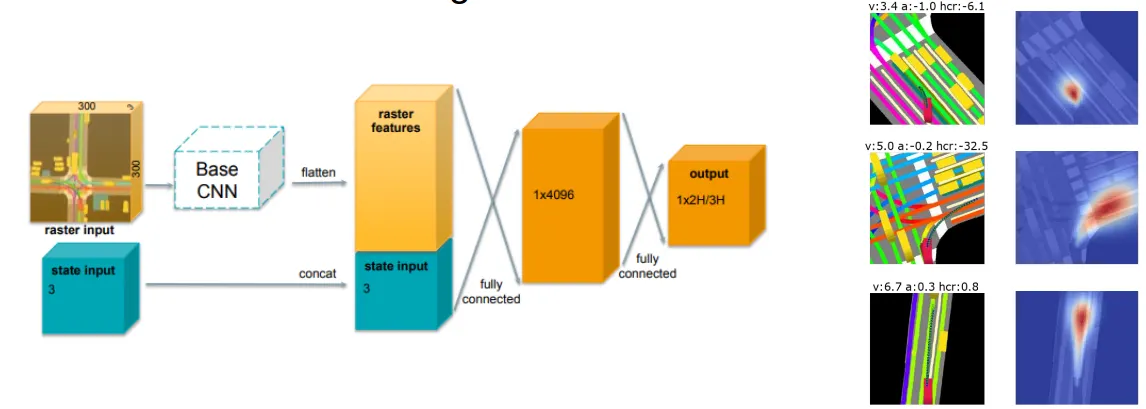
102 | * also possible to use LSTM networks to generate waypoints in the trajectory sequentially.
103 |
104 | * Challenge: Multimodality (distribution of different modes) - future uncertain
105 |
106 |
110 |
111 |
112 | ## Planning
113 |
114 | - Decision making and generate trajectory
115 | - input: route (from A to B), context map, prediction for nearby agents
116 |
117 | - proposal: what are possible options for the plan (mathematical methods vs imitation learning) - predict what is optimal
118 |
119 | * Hierarchical RL can be used
120 | * high level planner: yield, stop, turn left/right, lane following, etc)
121 | * low level planner: execute commands
122 |
123 | - motion validation: check e.g. collision, red light, etc -> reject + ranking
124 |
125 |
126 |
127 | ## Multi task approaches
128 |
129 | * ### Perception + Behavior prediction
130 | * Fast& Furious (Uber):
131 | * Tasks: Detection, tracking, short term (e.g. 1 sec) motion forecasting
132 | * create BEV from point cloud data:
133 | * quantize 3D → 3D voxel grid (binary for occupation) → height>channel(3rd dimension) in RGB + time as 4th dimension → Single stage detector similar to SSD
134 | * deal with temporal dimension in two ways:
135 | * early fusion (aggregate temporal info at the very first layer)
136 | * late fusion (gradually merge the temporal info: allows the model to capture high-level motion features.)
137 | * use multiple predefined boxes for each feature map location (similar to SSD)
138 | * two branches after the feature map:
139 | * binary classification (P (being a vehicle) for each pre-allocated box)
140 | * predict (regress) the BB over the current frame as well as n − 1 frames into the future → size and heading
141 | 
142 | * IntentNet: learning to predict intent from raw sensor data (Uber)
143 | * Fuse BEV generated from the point cloud + HDMap info to do detection, intention prediction, and trajectory prediction.
144 | * I: Voxelized LiDAR in BEV, Rasterized HDMap
145 | * O: detected objects, trajectory, 8-class intention (keep lane, turn left, etc)
146 | ![]()
147 | 
148 |
149 | * ### Behavior Prediction + Planning (Mid-to-Mid Model)
150 |
151 | * ChauffeurNet (Waymo)
152 | * prediction and planning using single NN using Imitation Learning (IL)
153 | * More info [here](https://medium.com/aiguys/behavior-prediction-and-decision-making-in-self-driving-cars-using-deep-learning-784761ed34af)
154 |
155 | * ### End to end
156 |
157 | * Learning to drive in a day (wayve.ai)
158 | * RL to train a driving policy to follow a lane from scratch in less than 20 minutes!
159 | * Without any HDMap and hand-written rules!
160 | * Learning to Drive Like a Human
161 | * Imitation learning + RL
162 | * used some auxiliary tasks like segmentation, depth estimation, and optical flow estimation to learn a better representation of the scene and use it to train the policy.
163 |
164 | ---
165 |
166 | # Example
167 | Design an ML system to detect if a pedestrian is going to do jaywalking.
168 |
169 |
170 | ### 1. Problem Formulation
171 |
172 | - Jaywalking: a pedestrian crossing a street where there is no crosswalk or intersection.
173 | - Goal: develop an ML system that can accurately predict if a pedestrian is going to do jaywalking over a short time horizon (e.g. 1 sec) in real-time.
174 |
175 | - Pedestrian action prediction is harder than vehicle: future behavior depends on other factors such as body pose, activity, etc.
176 |
177 | * ML Objective
178 | * binary classification (predict if a pedestrian is going to do jaywalking or not in the next T seconds.)
179 |
180 | * Discuss data sources and availability.
181 |
182 | ### 2. Metrics
183 | #### Component level metrics
184 | * Object detection
185 | * Precision
186 | * calculated based on IOU threshold
187 | * AP: avg. across various IOU thresholds
188 | * mAP: mean of AP over C classes
189 | * jaywalking detection:
190 | * Precision, Recall, F1
191 | #### End-to-end metrics
192 | * Manual intervention
193 | * Simulation Errors
194 | * historical log (scene recording) w/ expert driver
195 | * input to our system and compare the decisions with the expert driver
196 |
197 |
198 | ### 3. Architectural Components
199 | * Visual Understanding System
200 | * Camera: Object detection (pedestrian, drivable region?) + tracking
201 | * [Optional] Camera + object detection: Activity recognition
202 | * Radar: 3D Object detection (skip)
203 | * Behavior prediction system
204 | * Trajectory estimation
205 | * require motion history
206 | * Ml based approach (classification)
207 | * Input:
208 | * Vision: local context: seq. of ped's cropped image (last k frames) + global context (semantically segmented images over last k frames)
209 | * Non-vision: Ped's trajectory (as BBs, last k frames) + context map + context(location, age group, etc)
210 |
211 | ### 4. Data Collection and Preparation
212 |
213 |
214 | * Data collection and annotation:
215 | * Collect datasets of pedestrian behavior, including both jaywalking and non-jaywalking behavior. This data can be obtained through public video footage or by recording video footage ourselves.
216 | * Collect a diverse dataset of video clips or image sequences from various locations, including urban and suburban areas, with different pedestrian behaviors, traffic conditions, and lighting conditions.
217 | * Annotate the data by marking pedestrians, their positions, and whether they are jaywalking or not. This can be done by drawing bounding boxes around pedestrians and labeling them accordingly (initially human labelers eventually auto-labeler system)
218 | * Targeted data collection:
219 | * in later iterations, we check cases where driver had to intervene when pedestrian jaywalking, check performance on last 20 frames, and ask labelers to label those and add to the dataset (examples need to be seen)
220 |
221 | * Labeling:
222 | * each video frame annotated with BB + pose info of the ped + activity tags (walking, standing, crossing, looking, etc) + attributes of pedestrian (age, gender, location, ets),
223 | * each video is annotated weather conditions and time of day.
224 |
225 | * Data preprocessing:
226 | * Split the dataset into training, validation, and test sets.
227 | * Normalize and resize the images to maintain consistency in input data.
228 | * Apply data augmentation techniques (e.g., rotation, flipping, brightness adjustments) to increase the dataset's size and improve model generalization.
229 | * enhance or augment the data with GANs
230 |
231 | * Data augmentation
232 |
233 |
234 |
235 | ### 5. Feature Engineering
236 |
237 | * relevant features from the video footage, such as the pedestrian's position, speed, and direction of movement.
238 | * We can also use computer vision techniques to extract features like the presence of a crosswalk, traffic lights, or other relevant environmental cues.
239 |
240 | * features from frames: fc6 features by Faster R-CNN object detector at each BB (4096T vector)
241 | * assume: we can query cropped images of last T (e.g. 5) frames of detected pedestrians from built-in object detector and tracking system
242 | * features from cropped frames: activity recognition
243 | * context map : traffic signs, street width, etc
244 | * ped's history (seq. of BB info) + current info (BB + pose info (openPose) + activity + local context) + global context (context map) + context(location, age group, etc) -> JW/NJW classifier
245 | * other features that can be fused: ped's pose, BB, semantic segmentation maps (semantic masks for relevant objects), road geometry, surrounding people, interaction with other agents
246 |
247 |
248 | ### 6. Model Development and Offline Evaluation
249 |
250 | Model selection and architecture:
251 |
252 | Assume built-in object detector and tracker. If not,
253 | * Object detection: Use a pre-trained object detection model like Faster R-CNN, YOLO, or SSD to identify and localize pedestrians in the video frames.
254 | * Object tracking:
255 | * use EKF based method or ML based method (SORT or DeepSORT)
256 | * Activity recognition:
257 | * 3D CNN, or CNN + RNN(GRU) (chose this to fit the rest of the architecture)
258 |
259 | (Output of object detection and tracking can be converted into rasterized image for each actor -> Base CNN )
260 |
261 | * Encoders:
262 | * Visual Encoder: vision content (last k frames) -> CNN base encoders + RNN for temporal info(GRU) [Another option is to use 3D CNNs]
263 | * CNN base encoder -> another RNN for activity recognition
264 | * Non-vision encoder: for temporal content use GRU
265 |
266 | * Fusion strategies:
267 | * early fusion
268 | * late fusion
269 | * hierarchical fusion
270 |
271 | * Jaywalking clf: Design a custom clf layer to classify detected pedestrians as jaywalking or not.
272 | * Example: RF, or a FC layer
273 |
274 | * we can do ablation study for selection of the fusion architecture + visual and non-visual encoders
275 | Another example:
276 | 
277 |
278 | Model training and evaluation:
279 | a. Train model(s) using the annotated dataset,
280 | + loss functions for object detection (MSE, BCE, IoU)
281 | + jaywalking classification tasks (BCE).
282 |
283 | b. Regularly evaluate the model on the validation set to monitor performance and avoid overfitting. Adjust hyperparameters, such as learning rate and batch size, if necessary.
284 |
285 | c. Once the model converges, evaluate its performance on the test set, using relevant metrics like precision, recall, F1 score, and Intersection over Union (IoU).
286 |
287 | Transfer learning for object detection (use powerful feature detectors from pre-trained models)
288 | * for fine tuning e.g. use 500 videos each 5-10 seconds, 30fps
289 |
290 | ### 7. Prediction Service
291 | * SDV on the road: will receive real-time images -> ...
292 |
293 | * Model optimization: Optimize the model for real-time deployment by using techniques such as model pruning, quantization, and TensorRT optimization.
294 |
295 | ### 8. Online Testing and Deployment
296 |
297 | Deployment: Deploy the trained model on edge devices or servers equipped with cameras to monitor real-time video feeds (e.g. traffic camera system) and detect jaywalking instances. Integrate the system with existing traffic infrastructure, such as traffic signals and surveillance systems.
298 |
299 |
300 | ### 9. Scaling, Monitoring, and Updates
301 |
302 |
303 | Continuous improvement: Regularly update the model with new data and retrain it to improve its performance and adapt to changing pedestrian behaviors and environmental conditions.
304 |
305 |
306 | * Other points:
307 | * Occlusion detection
308 | * hallucinated agent
309 | * when visual signal is imprecise
310 | * poor lighting conditions
311 |
312 |
--------------------------------------------------------------------------------
/src/MLC/notebooks/k_means.ipynb:
--------------------------------------------------------------------------------
1 | {
2 | "cells": [
3 | {
4 | "attachments": {},
5 | "cell_type": "markdown",
6 | "id": "functional-corrections",
7 | "metadata": {},
8 | "source": [
9 | "## K-means "
10 | ]
11 | },
12 | {
13 | "attachments": {},
14 | "cell_type": "markdown",
15 | "id": "109c1cfe",
16 | "metadata": {},
17 | "source": [
18 | "K-means clustering is a popular unsupervised machine learning algorithm used for grouping similar data points into k - clusters. Goal: to partition a given dataset into k (predefined) clusters.\n",
19 | "\n",
20 | "The k-means algorithm works by first randomly initializing k cluster centers, one for each cluster. Each data point in the dataset is then assigned to the nearest cluster center based on their distance. The distance metric used is typically Euclidean distance, but other distance measures such as Manhattan distance or cosine similarity can also be used.\n",
21 | "\n",
22 | "After all the data points have been assigned to a cluster, the algorithm calculates the new mean for each cluster by taking the average of all the data points assigned to that cluster. These new means become the new cluster centers. The algorithm then repeats the assignment and mean calculation steps until the cluster assignments no longer change or until a maximum number of iterations is reached.\n",
23 | "\n",
24 | "The final output of the k-means algorithm is a set of k clusters, where each cluster contains the data points that are most similar to each other based on the distance metric used. The algorithm is commonly used in various fields such as image segmentation, market segmentation, and customer profiling.\n",
25 | "\n",
26 | "\n",
27 | "```\n",
28 | "Initialize:\n",
29 | "- K: number of clusters\n",
30 | "- Data: the input dataset\n",
31 | "- Randomly select K initial centroids\n",
32 | "\n",
33 | "Repeat:\n",
34 | "- Assign each data point to the nearest centroid (based on Euclidean distance)\n",
35 | "- Calculate the mean of each cluster to update its centroid\n",
36 | "- Check if the centroids have converged (i.e., they no longer change)\n",
37 | "\n",
38 | "Until:\n",
39 | "- The centroids have converged\n",
40 | "- The maximum number of iterations has been reached\n",
41 | "\n",
42 | "Output:\n",
43 | "- The final K clusters and their corresponding centroids\n",
44 | "```\n"
45 | ]
46 | },
47 | {
48 | "attachments": {},
49 | "cell_type": "markdown",
50 | "id": "36cafa73",
51 | "metadata": {},
52 | "source": [
53 | "## Code \n",
54 | "Here's an implementation of k-means clustering algorithm in Python from scratch:"
55 | ]
56 | },
57 | {
58 | "cell_type": "code",
59 | "execution_count": 1,
60 | "id": "ab3cb277",
61 | "metadata": {},
62 | "outputs": [],
63 | "source": [
64 | "import numpy as np\n",
65 | "\n",
66 | "class KMeans:\n",
67 | " def __init__(self, k, max_iterations=100):\n",
68 | " self.k = k\n",
69 | " self.max_iterations = max_iterations\n",
70 | " \n",
71 | " def fit(self, X):\n",
72 | " # Initialize centroids randomly\n",
73 | " self.centroids = X[np.random.choice(range(len(X)), self.k, replace=False)]\n",
74 | " \n",
75 | " for i in range(self.max_iterations):\n",
76 | " # Assign each data point to the nearest centroid\n",
77 | " cluster_assignments = []\n",
78 | " for j in range(len(X)):\n",
79 | " distances = np.linalg.norm(X[j] - self.centroids, axis=1)\n",
80 | " cluster_assignments.append(np.argmin(distances))\n",
81 | " \n",
82 | " # Update centroids\n",
83 | " for k in range(self.k):\n",
84 | " cluster_data_points = X[np.where(np.array(cluster_assignments) == k)]\n",
85 | " if len(cluster_data_points) > 0:\n",
86 | " self.centroids[k] = np.mean(cluster_data_points, axis=0)\n",
87 | " \n",
88 | " # Check for convergence\n",
89 | " if i > 0 and np.array_equal(self.centroids, previous_centroids):\n",
90 | " break\n",
91 | " \n",
92 | " # Update previous centroids\n",
93 | " previous_centroids = np.copy(self.centroids)\n",
94 | " \n",
95 | " # Store the final cluster assignments\n",
96 | " self.cluster_assignments = cluster_assignments\n",
97 | " \n",
98 | " def predict(self, X):\n",
99 | " # Assign each data point to the nearest centroid\n",
100 | " cluster_assignments = []\n",
101 | " for j in range(len(X)):\n",
102 | " distances = np.linalg.norm(X[j] - self.centroids, axis=1)\n",
103 | " cluster_assignments.append(np.argmin(distances))\n",
104 | " \n",
105 | " return cluster_assignments"
106 | ]
107 | },
108 | {
109 | "attachments": {},
110 | "cell_type": "markdown",
111 | "id": "538027c3",
112 | "metadata": {},
113 | "source": [
114 | "The KMeans class has an __init__ method that takes the number of clusters (k) and the maximum number of iterations to run (max_iterations). The fit method takes the input dataset (X) and runs the k-means clustering algorithm. The predict method takes a new dataset (X) and returns the cluster assignments for each data point based on the centroids learned during training.\n",
115 | "\n",
116 | "Note that this implementation assumes that the input dataset X is a NumPy array with each row representing a single data point and each column representing a feature. The algorithm also uses Euclidean distance to calculate the distances between data points and centroids.\n"
117 | ]
118 | },
119 | {
120 | "attachments": {},
121 | "cell_type": "markdown",
122 | "id": "1724d308",
123 | "metadata": {},
124 | "source": [
125 | "### Test "
126 | ]
127 | },
128 | {
129 | "cell_type": "code",
130 | "execution_count": 2,
131 | "id": "141e9843",
132 | "metadata": {},
133 | "outputs": [
134 | {
135 | "name": "stdout",
136 | "output_type": "stream",
137 | "text": [
138 | "[1, 1, 1, 1, 1, 0, 0, 0, 0, 0]\n",
139 | "[[-5.53443211 -5.13920695]\n",
140 | " [ 4.46522152 5.04931144]]\n"
141 | ]
142 | }
143 | ],
144 | "source": [
145 | "\n",
146 | "x1 = np.random.randn(5,2) + 5\n",
147 | "x2 = np.random.randn(5,2) - 5\n",
148 | "X = np.concatenate([x1,x2], axis=0)\n",
149 | "\n",
150 | "# Initialize the KMeans object with k=3\n",
151 | "kmeans = KMeans(k=2)\n",
152 | "\n",
153 | "# Fit the k-means model to the dataset\n",
154 | "kmeans.fit(X)\n",
155 | "\n",
156 | "# Get the cluster assignments for the input dataset\n",
157 | "cluster_assignments = kmeans.predict(X)\n",
158 | "\n",
159 | "# Print the cluster assignments\n",
160 | "print(cluster_assignments)\n",
161 | "\n",
162 | "# Print the learned centroids\n",
163 | "print(kmeans.centroids)"
164 | ]
165 | },
166 | {
167 | "attachments": {},
168 | "cell_type": "markdown",
169 | "id": "04430ff9",
170 | "metadata": {},
171 | "source": [
172 | "### Visualize"
173 | ]
174 | },
175 | {
176 | "cell_type": "code",
177 | "execution_count": 4,
178 | "id": "fa0fb8d4",
179 | "metadata": {},
180 | "outputs": [
181 | {
182 | "data": {
183 | "image/png": "iVBORw0KGgoAAAANSUhEUgAAAXIAAAD4CAYAAADxeG0DAAAAOXRFWHRTb2Z0d2FyZQBNYXRwbG90bGliIHZlcnNpb24zLjQuMywgaHR0cHM6Ly9tYXRwbG90bGliLm9yZy/MnkTPAAAACXBIWXMAAAsTAAALEwEAmpwYAAAPAUlEQVR4nO3df6hkZ33H8c/n7ir11kjEvRKa3Z1JaFOaaiBlEizBWpMoUZekf/QP7UTS+sfQUEMChjTxQv+7IFrUglIZ0pSCAyForEW0mrRW6B9GZ/PDGjeREPZuNhoysQWlVxKW/faPmdvdvbl379x7njmz33PfL1jmzjNnn/M97O5nnj3Pc85xRAgAkNfCvAsAAFRDkANAcgQ5ACRHkANAcgQ5ACS3fx47PXDgQLTb7XnsGgDSOnr06CsRsbSxfS5B3m63NRwO57FrAEjL9upm7ZxaAYDkCHIASI4gB4DkCHIASI4gB4DkCHIAmKHBQGq3pYWF8etgUH4fc1l+CAB7wWAg9XrS2tr4/erq+L0kdbvl9sOIHABmZHn5TIivW1sbt5dEkAPAjJw4sbP23SLIAWBGDh/eWftuEeQAMCMrK9Li4rlti4vj9pIIcgCYkW5X6velVkuyx6/9ftmJTolVKwAwU91u+eDeqMiI3PbFtr9i+xnbx2z/YYl+AQDbKzUi/ztJ/xoRf2r7jZIWt/sNAIAyKge57bdI+iNJfy5JEfGapNeq9gsAmE6JUyuXSxpJ+kfbT9i+3/ZvbtzIds/20PZwNBoV2C0AQCoT5Psl/YGkv4+IqyX9r6R7N24UEf2I6EREZ2npdU8qAgDsUokgPynpZEQ8Nnn/FY2DHQBQg8pBHhEvSXrB9u9Omm6Q9JOq/QIAplNq1codkgaTFSvPS/qLQv0CALZRZB15RDw5Of99VUT8SUT8T4l+ATRPHffn3mu4shNAbeq6P/dew71WANSmrvtz7zUEOYDa1HV/7r2GIAdQm7ruz73XEOQAalPX/bkvRLOc5CXIAdSmrvtzX2jWJ3lXV6WIM5O8pcKcIAdQq25XOn5cOn16/JotxAeDgdrtthYWFtRutzWYIo1nPcnL8kMAmNJgMFCv19PaJJVXV1fVm6yf7J7nG2nWk7yMyAFgSsvLy/8f4uvW1ta0vM3QetaTvAQ5AEzpxBZD6K3a1816kpcgB4ApHd5iCL1V+7pZT/IS5AAwpZWVFS1uGFovLi5qZYqh9SwneQlyAJhSt9tVv99Xq9WSbbVaLfX7/fNOdNbBEVH7TjudTgyHw9r3CwCZ2T4aEZ2N7YzIASA5ghwAkiPIASA5ghwAkiPIAWBG6nqsHfdaAYAZqPOxdozIAWAG6nysHUEOADNQ52PtigW57X22n7D9jVJ9AkBWdT7WruSI/E5Jxwr2BwBp1flYuyJBbvugpA9Jur9EfwCQ3dl3PJSkffvOnCMvvXql1KqVz0u6R9JFW21guyepJ21/y0cAaIL11SmzXr1SeURu+4iklyPi6Pm2i4h+RHQiorO0tFR1twCQQh2rV0qcWrlO0s22j0t6UNL1tr9coF8ASK+O1SuVgzwi7ouIgxHRlvRhSf8eEbdWrgwAGqCO1SusIweAGapj9UrRII+I/4iIIyX7BIDMZv28Tol7rQDAzHW75e+vcjZOrQBAcgQ5ACRHkANAcgQ5ACRHkANAcgQ5ACRHkANAcgQ5ACRHkANAcgQ5ACRHkANAcgQ5ACRHkANAcgQ5ACRHkANAcgQ5ACRHkANAcgQ5ACRHkANAcgQ5ACRXOchtH7L9XdvHbD9t+84ShQEAprO/QB+nJH0iIh63fZGko7YfiYifFOgbALCNyiPyiPh5RDw++flXko5JurRqvwCA6RQ9R267LelqSY9t8lnP9tD2cDQaldwtAOxpxYLc9pslfVXSXRHxy42fR0Q/IjoR0VlaWiq1WwDY84oEue03aBzig4h4uESfAIDplFi1Ykn/IOlYRHy2ekkAgJ0oMSK/TtJHJV1v+8nJrw8W6BcAMIXKyw8j4j8luUAtAIBd4MpOAEiOIAeA5AhyAEiOIAeA5AhyAEiOIAeA5AhyAEiOIAeA5AhyAEiOIAeA5AhyAEiOIAeA5AhyAEiOIAeA5AhyAEiOIAeA5AhyAEiOIAeA5AhyAEiOIAeA5AhyAEiOIAeA5IoEue2bbD9r+znb95boEwAwncpBbnufpC9K+oCkKyV9xPaVVfsFAEynxIj8WknPRcTzEfGapAcl3VKgXwDAFEoE+aWSXjjr/clJ2zls92wPbQ9Ho1GB3QIApDJB7k3a4nUNEf2I6EREZ2lpqcBuAQBSmSA/KenQWe8PSvpZgX4BAFMoEeQ/lPQ7ti+z/UZJH5b0LwX6BQBMYX/VDiLilO2PS/q2pH2SHoiIpytXBgCYSuUgl6SI+Kakb5boCwCwM1zZCQDJEeQAkBxBDgDJEeQAkBxBDgDJEeQAkBxBDgDJEeQAkBxBDgDJEeQAkBxBDgDJEeQAkBxBDgDJEeQAkBxBDgDJEeQAkBxBDgDJEeQAkBxBDgDJEeQAkBxBDgDJVQpy25+x/YztH9n+mu2LC9UFAJhS1RH5I5LeERFXSfqppPuqlwQA2IlKQR4R34mIU5O335d0sHpJAICdKHmO/GOSvrXVh7Z7toe2h6PRqOBuAWBv27/dBrYflXTJJh8tR8TXJ9ssSzolabBVPxHRl9SXpE6nE7uqFgDwOtsGeUTceL7Pbd8m6YikGyKCgAaAmm0b5Odj+yZJfy3pPRGxVqYkAMBOVD1H/gVJF0l6xPaTtr9UoCYAwA5UGpFHxG+XKgQAsDtc2QkAyRHkAJAcQQ4AyRHkAJAcQQ4AyRHkAJAcQQ4AyRHkAJAcQQ4AyRHkAJAcQQ4AyRHkAJAcQQ4AyRHkAJAcQQ4AyRHkAJAcQQ4AyRHkAJAcQQ4AyRHkAJAcQQ4AyRHkAJBckSC3fbftsH2gRH8AgOlVDnLbhyS9T9KJ6uUAAHaqxIj8c5LukRQF+gIA7FClILd9s6QXI+KpKbbt2R7aHo5Goyq7BQCcZf92G9h+VNIlm3y0LOmTkt4/zY4ioi+pL0mdTofROwAUsm2QR8SNm7XbfqekyyQ9ZVuSDkp63Pa1EfFS0SoBAFvaNsi3EhH/Jent6+9tH5fUiYhXCtQFAJgS68gBILliQR4R7bmPxgcDqd2WFhbGr4PBXMsBgDo0Z0Q+GEi9nrS6KkWMX3u9+YQ5XygAatScIF9eltbWzm1bWxu31+lC+kIBsCc0J8hPbHFh6Vbts3KhfKEA2DOaE+SHD++sfVYulC8UAHtGc4J8ZUVaXDy3bXFx3F6nC+ULBcCe0Zwg73alfl9629vOtL3pTfXXcaF8oQDYM5oT5Ot+/eszP//iF/VPNK5/obRakj1+7ffH7QAwA46o/7YnnU4nhsNh+Y7b7fEqkY1aLen48fL7A4Aa2T4aEZ2N7c0akW8yoTiQ1F5d1cLCgtrttgYsAwTQMM0K8g0TigNJPUmrkiJCq6ur6vV6hDmARskT5NNcLblhonFZ0oYV3VpbW9Mya7oBNMiu735Yq/WrJdcvtFm/WlI6dxJx/eflZenECZ3Y4vz/CdZ0A2iQHCPynVwt2e2OJzZPn9bhVmvT7g6zphtAg+QI8l1eLbmysqLFDWu6FxcXtcKabgANkiPId3m1ZLfbVb/fV6vVkm21Wi31+311WdMNoEFyrCPfeI5cGk9qcqENgD0k9zpyrpYEgC3lWLUijUOb4AaA18kxIgcAbIkgB4DkCHIASK5ykNu+w/aztp+2/ekSRQEApldpstP2eyXdIumqiHjV9tvLlAUAmFbVEfntkj4VEa9KUkS8XL0kAMBOVA3yKyS92/Zjtr9n+5qtNrTdsz20PRyNRhV3CwBYt+2pFduPSrpkk4+WJ7//rZLeJekaSQ/Zvjw2uVw0IvqS+tL4ys4qRQMAztg2yCPixq0+s327pIcnwf0D26clHZDEkBsAalL11Mo/S7pekmxfIemNkl6p2CcAYAeqBvkDki63/WNJD0q6bbPTKrWY5glCANBAlZYfRsRrkm4tVMvuTfsEIQBooGZc2bmTJwgBQMM0I8h3+QQhAGiCZgT5Lp8gBABN0IwgX1kZPzHobIuL43YAaLhmBDlPEAKwh+V5QtB2eIIQgD2qGSNyANjDCHIASI4gB4DkCHIASI4gB4DkPI97XNkeSVqt0MUBNfsui00+Po4tryYfX5Zja0XE0sbGuQR5VbaHEdGZdx2z0uTj49jyavLxZT82Tq0AQHIEOQAklzXI+/MuYMaafHwcW15NPr7Ux5byHDkA4IysI3IAwARBDgDJpQ5y23fYftb207Y/Pe96SrN9t+2wfWDetZRk+zO2n7H9I9tfs33xvGuqyvZNk7+Lz9m+d971lGT7kO3v2j42+bd257xrKs32PttP2P7GvGvZjbRBbvu9km6RdFVE/L6kv51zSUXZPiTpfZKa+Ly6RyS9IyKukvRTSffNuZ5KbO+T9EVJH5B0paSP2L5yvlUVdUrSJyLi9yS9S9JfNez4JOlOScfmXcRupQ1ySbdL+lREvCpJEfHynOsp7XOS7pHUuNnoiPhORJyavP2+pIPzrKeAayU9FxHPR8Rrkh7UeJDRCBHx84h4fPLzrzQOvEvnW1U5tg9K+pCk++ddy25lDvIrJL3b9mO2v2f7mnkXVIrtmyW9GBFPzbuWGnxM0rfmXURFl0p64az3J9WgoDub7bakqyU9NudSSvq8xoOm03OuY9cu6CcE2X5U0iWbfLSsce1v1fi/etdIesj25ZFkPeU2x/ZJSe+vt6Kyznd8EfH1yTbLGv+3fVBnbTPgTdpS/D3cCdtvlvRVSXdFxC/nXU8Jto9Iejkijtr+4zmXs2sXdJBHxI1bfWb7dkkPT4L7B7ZPa3zjm1Fd9VWx1bHZfqekyyQ9ZVsan3Z43Pa1EfFSjSVWcr4/O0myfZukI5JuyPLlex4nJR066/1BST+bUy0zYfsNGof4ICIennc9BV0n6WbbH5T0G5LeYvvLEXHrnOvakbQXBNn+S0m/FRF/Y/sKSf8m6XADQuEcto9L6kREhjuzTcX2TZI+K+k9EZHii/d8bO/XeNL2BkkvSvqhpD+LiKfnWlghHo8o/knSf0fEXXMuZ2YmI/K7I+LInEvZscznyB+QdLntH2s8uXRb00K8wb4g6SJJj9h+0vaX5l1QFZOJ249L+rbGE4EPNSXEJ66T9FFJ10/+vJ6cjGBxgUg7IgcAjGUekQMARJADQHoEOQAkR5ADQHIEOQAkR5ADQHIEOQAk93+igTL51gL1hQAAAABJRU5ErkJggg==",
184 | "text/plain": [
185 | ""
186 | ]
187 | },
188 | "metadata": {
189 | "needs_background": "light"
190 | },
191 | "output_type": "display_data"
192 | }
193 | ],
194 | "source": [
195 | "from matplotlib import pyplot as plt\n",
196 | "# Plot the data points with different colors based on their cluster assignments\n",
197 | "colors = ['r', 'b']\n",
198 | "for i in range(kmeans.k):\n",
199 | " plt.scatter(X[np.where(np.array(cluster_assignments) == i)][:,0], \n",
200 | " X[np.where(np.array(cluster_assignments) == i)][:,1], \n",
201 | " color=colors[i])\n",
202 | "\n",
203 | "# Plot the centroids as black circles\n",
204 | "plt.scatter(kmeans.centroids[:,0], kmeans.centroids[:,1], color='black', marker='o')\n",
205 | "\n",
206 | "# Show the plot\n",
207 | "plt.show()"
208 | ]
209 | },
210 | {
211 | "attachments": {},
212 | "cell_type": "markdown",
213 | "id": "69fc2d74",
214 | "metadata": {},
215 | "source": [
216 | "### Optimization \n",
217 | "Here are some ways to optimize the k-means clustering algorithm:\n",
218 | "\n",
219 | "Random initialization of centroids: Instead of initializing the centroids using the first k data points, we can randomly initialize them to improve the convergence of the algorithm. This can be done by selecting k random data points from the input dataset as the initial centroids.\n",
220 | "\n",
221 | "Early stopping: We can stop the k-means algorithm if the cluster assignments and centroids do not change after a certain number of iterations. This helps to avoid unnecessary computation.\n",
222 | "\n",
223 | "Vectorization: We can use numpy arrays and vectorized operations to speed up the computation. This avoids the need for loops and makes the code more efficient.\n",
224 | "\n",
225 | "Here's an optimized version of the k-means clustering algorithm that implements these optimizations:"
226 | ]
227 | },
228 | {
229 | "cell_type": "code",
230 | "execution_count": 5,
231 | "id": "121e7b70",
232 | "metadata": {},
233 | "outputs": [],
234 | "source": [
235 | "import numpy as np\n",
236 | "\n",
237 | "class KMeans:\n",
238 | " def __init__(self, k=3, max_iters=100, tol=1e-4):\n",
239 | " self.k = k\n",
240 | " self.max_iters = max_iters\n",
241 | " self.tol = tol\n",
242 | " \n",
243 | " def fit(self, X):\n",
244 | " # Initialize centroids randomly\n",
245 | " self.centroids = X[np.random.choice(X.shape[0], self.k, replace=False)]\n",
246 | " \n",
247 | " # Iterate until convergence or maximum number of iterations is reached\n",
248 | " for i in range(self.max_iters):\n",
249 | " # Assign each data point to the closest centroid\n",
250 | " distances = np.linalg.norm(X[:, np.newaxis] - self.centroids, axis=2)\n",
251 | " cluster_assignments = np.argmin(distances, axis=1)\n",
252 | " \n",
253 | " # Update the centroids based on the new cluster assignments\n",
254 | " new_centroids = np.array([np.mean(X[np.where(cluster_assignments == j)], axis=0) \n",
255 | " for j in range(self.k)])\n",
256 | " \n",
257 | " # Check for convergence\n",
258 | " if np.linalg.norm(new_centroids - self.centroids) < self.tol:\n",
259 | " break\n",
260 | " \n",
261 | " self.centroids = new_centroids\n",
262 | " \n",
263 | " def predict(self, X):\n",
264 | " # Assign each data point to the closest centroid\n",
265 | " distances = np.linalg.norm(X[:, np.newaxis] - self.centroids, axis=2)\n",
266 | " cluster_assignments = np.argmin(distances, axis=1)\n",
267 | " \n",
268 | " return cluster_assignments\n"
269 | ]
270 | },
271 | {
272 | "attachments": {},
273 | "cell_type": "markdown",
274 | "id": "0a8514c5",
275 | "metadata": {},
276 | "source": [
277 | "This optimized version initializes the centroids randomly, uses vectorized operations for computing distances and updating the centroids, and checks for convergence after each iteration to stop the algorithm if it has converged."
278 | ]
279 | },
280 | {
281 | "attachments": {},
282 | "cell_type": "markdown",
283 | "id": "a98d4ac5",
284 | "metadata": {},
285 | "source": [
286 | "Follow ups:\n",
287 | "\n",
288 | "* Computattional complexity: O(it * knd)\n",
289 | "* Improve space: use index instead of copy\n",
290 | "* Improve time: \n",
291 | " * dim reduction\n",
292 | " * subsample (cons?)\n",
293 | "* mini-batch\n",
294 | "* k-median https://mmuratarat.github.io/2019-07-23/kmeans_from_scratch"
295 | ]
296 | },
297 | {
298 | "cell_type": "markdown",
299 | "id": "a756163a",
300 | "metadata": {},
301 | "source": []
302 | }
303 | ],
304 | "metadata": {
305 | "kernelspec": {
306 | "display_name": "Python 3",
307 | "language": "python",
308 | "name": "python3"
309 | },
310 | "language_info": {
311 | "codemirror_mode": {
312 | "name": "ipython",
313 | "version": 3
314 | },
315 | "file_extension": ".py",
316 | "mimetype": "text/x-python",
317 | "name": "python",
318 | "nbconvert_exporter": "python",
319 | "pygments_lexer": "ipython3",
320 | "version": "3.9.7"
321 | }
322 | },
323 | "nbformat": 4,
324 | "nbformat_minor": 5
325 | }
326 |
--------------------------------------------------------------------------------
 12 |
12 |