 3 |
3 |
2 |
3 |
All about orthogonal polynomials.
4 | 5 | 6 | [](https://pypi.org/project/orthopy) 7 | [](https://pypi.org/pypi/orthopy/) 8 | [](https://github.com/nschloe/orthopy) 9 | [](https://pepy.tech/project/orthopy) 10 | 11 | 12 | 13 | [](https://discord.gg/hnTJ5MRX2Y) 14 | [](https://github.com/nschloe/orthopy) 15 | 16 | orthopy provides various orthogonal polynomial classes for 17 | [lines](#line-segment--1-1-with-weight-function-1-x%CE%B1-1-x%CE%B2), 18 | [triangles](#triangle-42), 19 | [disks](#disk-s2), 20 | [spheres](#sphere-u2), 21 | [n-cubes](#n-cube-cn), 22 | [the nD space with weight function exp(-r2)](#nd-space-with-weight-function-exp-r2-enr2) 23 | and more. 24 | All computations are done using numerically stable recurrence schemes. Furthermore, all 25 | functions are fully vectorized and can return results in _exact arithmetic_. 26 | 27 | ### Installation 28 | 29 | Install orthopy [from PyPI](https://pypi.org/project/orthopy/) with 30 | 31 | ``` 32 | pip install orthopy 33 | ``` 34 | 35 | ### How to get a license 36 | 37 | Licenses for personal and academic use can be purchased 38 | [here](https://buy.stripe.com/aEUg1H38OgDw5qMfZ3). 39 | You'll receive a confirmation email with a license key. 40 | Install the key with 41 | 42 | ``` 43 | plm add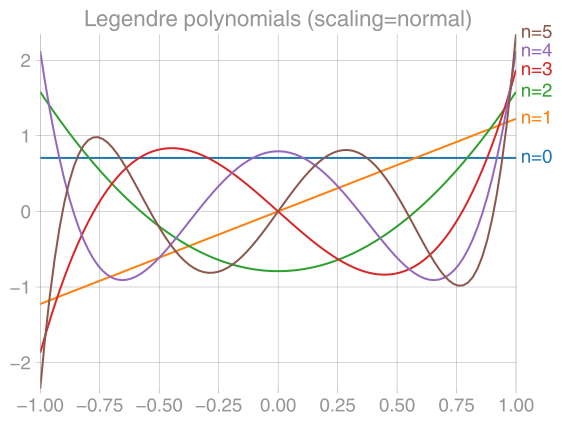 |
|  |
|  |
123 | | :---------------------------------------------------------------------------------------------: | :-----------------------------------------------------------------------------------------------: | :-----------------------------------------------------------------------------------------------: |
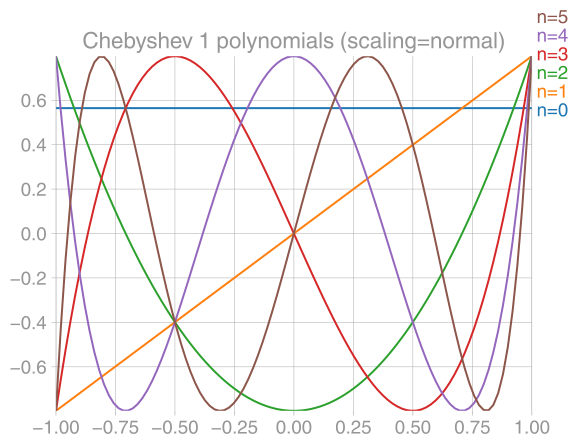
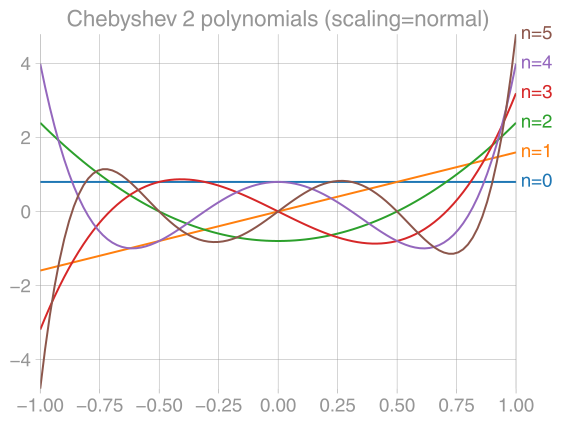
124 | | Legendre | Chebyshev 1 | Chebyshev 2 |
125 |
126 | Jacobi, Gegenbauer (α=β), Chebyshev 1 (α=β=-1/2), Chebyshev 2 (α=β=1/2), Legendre
127 | (α=β=0) polynomials.
128 |
129 |
130 |
131 | ```python
132 | import orthopy
133 |
134 | orthopy.c1.legendre.Eval(x, "normal")
135 | orthopy.c1.chebyshev1.Eval(x, "normal")
136 | orthopy.c1.chebyshev2.Eval(x, "normal")
137 | orthopy.c1.gegenbauer.Eval(x, "normal", lmbda)
138 | orthopy.c1.jacobi.Eval(x, "normal", alpha, beta)
139 | ```
140 |
141 | The plots above are generated with
142 |
143 | ```python
144 | import orthopy
145 |
146 | orthopy.c1.jacobi.show(5, "normal", 0.0, 0.0)
147 | # plot, savefig also exist
148 | ```
149 |
150 | Recurrence coefficients can be explicitly retrieved by
151 |
152 | ```python
153 | import orthopy
154 |
155 | rc = orthopy.c1.jacobi.RecurrenceCoefficients(
156 | "monic", # or "classical", "normal"
157 | alpha=0, beta=0, symbolic=True
158 | )
159 | print(rc.p0)
160 | for k in range(5):
161 | print(rc[k])
162 | ```
163 |
164 | ```
165 | 1
166 | (1, 0, None)
167 | (1, 0, 1/3)
168 | (1, 0, 4/15)
169 | (1, 0, 9/35)
170 | (1, 0, 16/63)
171 | ```
172 |
173 | ### 1D half-space with weight function xα exp(-r)
174 |
175 |
|
123 | | :---------------------------------------------------------------------------------------------: | :-----------------------------------------------------------------------------------------------: | :-----------------------------------------------------------------------------------------------: |
124 | | Legendre | Chebyshev 1 | Chebyshev 2 |
125 |
126 | Jacobi, Gegenbauer (α=β), Chebyshev 1 (α=β=-1/2), Chebyshev 2 (α=β=1/2), Legendre
127 | (α=β=0) polynomials.
128 |
129 |
130 |
131 | ```python
132 | import orthopy
133 |
134 | orthopy.c1.legendre.Eval(x, "normal")
135 | orthopy.c1.chebyshev1.Eval(x, "normal")
136 | orthopy.c1.chebyshev2.Eval(x, "normal")
137 | orthopy.c1.gegenbauer.Eval(x, "normal", lmbda)
138 | orthopy.c1.jacobi.Eval(x, "normal", alpha, beta)
139 | ```
140 |
141 | The plots above are generated with
142 |
143 | ```python
144 | import orthopy
145 |
146 | orthopy.c1.jacobi.show(5, "normal", 0.0, 0.0)
147 | # plot, savefig also exist
148 | ```
149 |
150 | Recurrence coefficients can be explicitly retrieved by
151 |
152 | ```python
153 | import orthopy
154 |
155 | rc = orthopy.c1.jacobi.RecurrenceCoefficients(
156 | "monic", # or "classical", "normal"
157 | alpha=0, beta=0, symbolic=True
158 | )
159 | print(rc.p0)
160 | for k in range(5):
161 | print(rc[k])
162 | ```
163 |
164 | ```
165 | 1
166 | (1, 0, None)
167 | (1, 0, 1/3)
168 | (1, 0, 4/15)
169 | (1, 0, 9/35)
170 | (1, 0, 16/63)
171 | ```
172 |
173 | ### 1D half-space with weight function xα exp(-r)
174 |
175 | 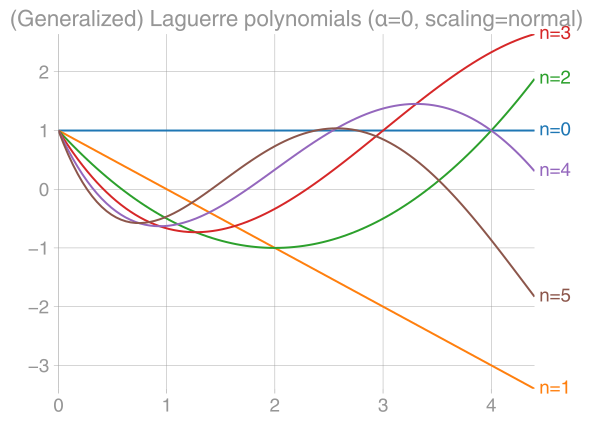 176 |
177 | (Generalized) Laguerre polynomials.
178 |
179 |
180 |
181 | ```python
182 | evaluator = orthopy.e1r.Eval(x, alpha=0, scaling="normal")
183 | ```
184 |
185 | ### 1D space with weight function exp(-r2)
186 |
187 |
176 |
177 | (Generalized) Laguerre polynomials.
178 |
179 |
180 |
181 | ```python
182 | evaluator = orthopy.e1r.Eval(x, alpha=0, scaling="normal")
183 | ```
184 |
185 | ### 1D space with weight function exp(-r2)
186 |
187 | 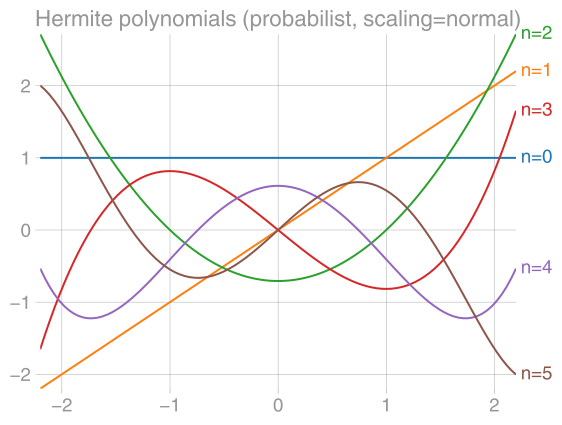 188 |
189 | Hermite polynomials come in two standardizations:
190 |
191 | - `"physicists"` (against the weight function `exp(-x ** 2)`
192 | - `"probabilists"` (against the weight function `1 / sqrt(2 * pi) * exp(-x ** 2 / 2)`
193 |
194 |
195 |
196 | ```python
197 | evaluator = orthopy.e1r2.Eval(
198 | x,
199 | "probabilists", # or "physicists"
200 | "normal"
201 | )
202 | ```
203 |
204 | #### Associated Legendre "polynomials"
205 |
206 |
188 |
189 | Hermite polynomials come in two standardizations:
190 |
191 | - `"physicists"` (against the weight function `exp(-x ** 2)`
192 | - `"probabilists"` (against the weight function `1 / sqrt(2 * pi) * exp(-x ** 2 / 2)`
193 |
194 |
195 |
196 | ```python
197 | evaluator = orthopy.e1r2.Eval(
198 | x,
199 | "probabilists", # or "physicists"
200 | "normal"
201 | )
202 | ```
203 |
204 | #### Associated Legendre "polynomials"
205 |
206 | 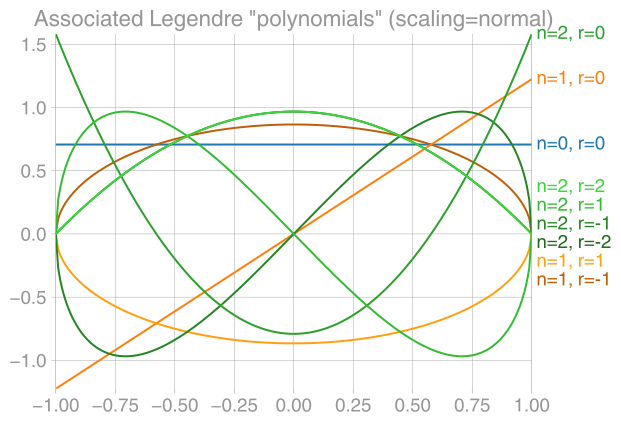 207 |
208 | Not all of those are polynomials, so they should really be called associated Legendre
209 | _functions_. The kth iteration contains _2k+1_ functions, indexed from
210 | _-k_ to _k_. (See the color grouping in the above plot.)
211 |
212 |
213 |
214 | ```python
215 | evaluator = orthopy.c1.associated_legendre.Eval(
216 | x, phi=None, standardization="natural", with_condon_shortley_phase=True
217 | )
218 | ```
219 |
220 | ### Triangle (_T2_)
221 |
222 |
207 |
208 | Not all of those are polynomials, so they should really be called associated Legendre
209 | _functions_. The kth iteration contains _2k+1_ functions, indexed from
210 | _-k_ to _k_. (See the color grouping in the above plot.)
211 |
212 |
213 |
214 | ```python
215 | evaluator = orthopy.c1.associated_legendre.Eval(
216 | x, phi=None, standardization="natural", with_condon_shortley_phase=True
217 | )
218 | ```
219 |
220 | ### Triangle (_T2_)
221 |
222 | 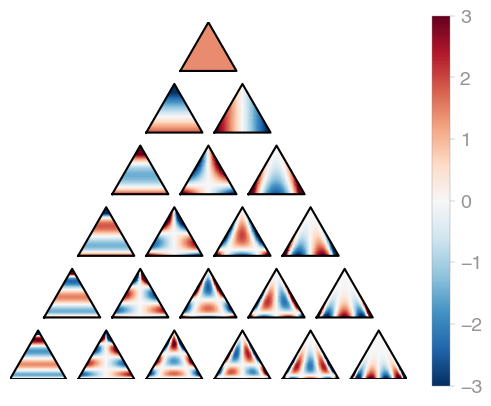 223 |
224 | orthopy's triangle orthogonal polynomials are evaluated in terms of [barycentric
225 | coordinates](https://en.wikipedia.org/wiki/Barycentric_coordinate_system), so the
226 | `X.shape[0]` has to be 3.
227 |
228 | ```python
229 | import orthopy
230 |
231 | bary = [0.1, 0.7, 0.2]
232 | evaluator = orthopy.t2.Eval(bary, "normal")
233 | ```
234 |
235 | ### Disk (_S2_)
236 |
237 | |
223 |
224 | orthopy's triangle orthogonal polynomials are evaluated in terms of [barycentric
225 | coordinates](https://en.wikipedia.org/wiki/Barycentric_coordinate_system), so the
226 | `X.shape[0]` has to be 3.
227 |
228 | ```python
229 | import orthopy
230 |
231 | bary = [0.1, 0.7, 0.2]
232 | evaluator = orthopy.t2.Eval(bary, "normal")
233 | ```
234 |
235 | ### Disk (_S2_)
236 |
237 | | 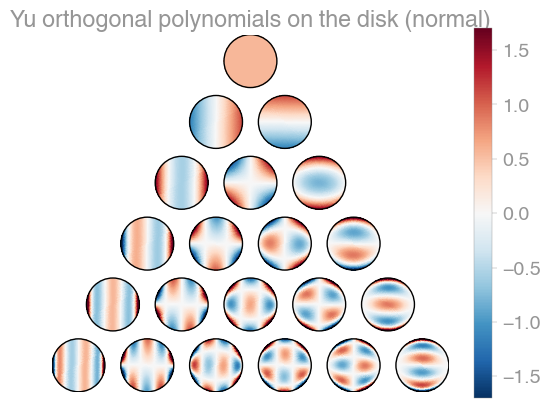 |
|  |
|  |
238 | | :------------------------------------------------------------------------------------------------: | :-----------------------------------------------------------------------------------------------------: | :------------------------------------------------------------------------------------------------------: |
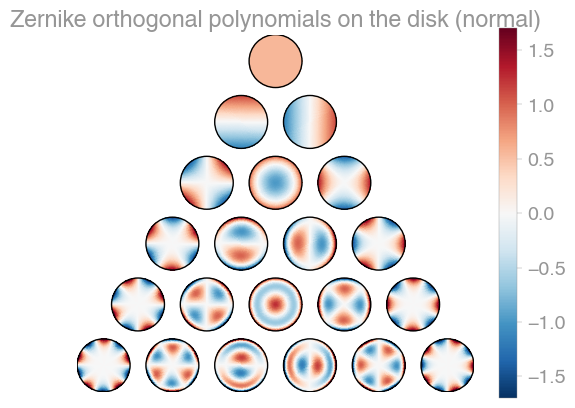
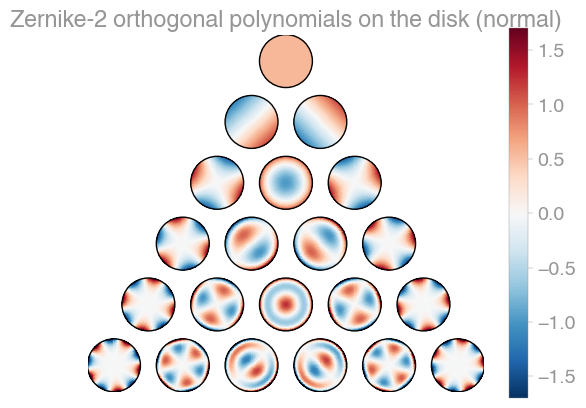
239 | | Xu | [Zernike](https://en.wikipedia.org/wiki/Zernike_polynomials) | Zernike 2 |
240 |
241 | orthopy contains several families of orthogonal polynomials on the unit disk: After
242 | [Xu](https://arxiv.org/abs/1701.02709),
243 | [Zernike](https://en.wikipedia.org/wiki/Zernike_polynomials), and a simplified version
244 | of Zernike polynomials.
245 |
246 | ```python
247 | import orthopy
248 |
249 | x = [0.1, -0.3]
250 |
251 | evaluator = orthopy.s2.xu.Eval(x, "normal")
252 | # evaluator = orthopy.s2.zernike.Eval(x, "normal")
253 | # evaluator = orthopy.s2.zernike2.Eval(x, "normal")
254 | ```
255 |
256 | ### Sphere (_U3_)
257 |
258 |
|
238 | | :------------------------------------------------------------------------------------------------: | :-----------------------------------------------------------------------------------------------------: | :------------------------------------------------------------------------------------------------------: |
239 | | Xu | [Zernike](https://en.wikipedia.org/wiki/Zernike_polynomials) | Zernike 2 |
240 |
241 | orthopy contains several families of orthogonal polynomials on the unit disk: After
242 | [Xu](https://arxiv.org/abs/1701.02709),
243 | [Zernike](https://en.wikipedia.org/wiki/Zernike_polynomials), and a simplified version
244 | of Zernike polynomials.
245 |
246 | ```python
247 | import orthopy
248 |
249 | x = [0.1, -0.3]
250 |
251 | evaluator = orthopy.s2.xu.Eval(x, "normal")
252 | # evaluator = orthopy.s2.zernike.Eval(x, "normal")
253 | # evaluator = orthopy.s2.zernike2.Eval(x, "normal")
254 | ```
255 |
256 | ### Sphere (_U3_)
257 |
258 | 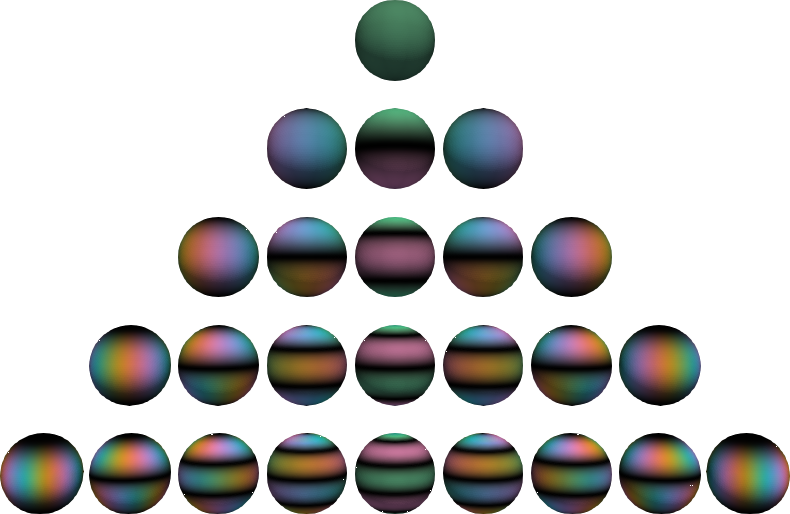 259 |
260 | Complex-valued _spherical harmonics,_ (black=zero, green=real positive,
261 | pink=real negative, blue=imaginary positive, yellow=imaginary negative). The
262 | functions in the middle are real-valued. The complex angle takes _n_ turns on
263 | the nth level.
264 |
265 |
266 |
267 | ```python
268 | evaluator = orthopy.u3.EvalCartesian(
269 | x,
270 | scaling="quantum mechanic" # or "acoustic", "geodetic", "schmidt"
271 | )
272 |
273 | evaluator = orthopy.u3.EvalSpherical(
274 | theta_phi, # polar, azimuthal angles
275 | scaling="quantum mechanic" # or "acoustic", "geodetic", "schmidt"
276 | )
277 | ```
278 |
279 |
280 |
281 |
282 |
283 |
284 |
285 |
286 |
287 |
288 |
289 |
290 | ### _n_-Cube (_Cn_)
291 |
292 | |
259 |
260 | Complex-valued _spherical harmonics,_ (black=zero, green=real positive,
261 | pink=real negative, blue=imaginary positive, yellow=imaginary negative). The
262 | functions in the middle are real-valued. The complex angle takes _n_ turns on
263 | the nth level.
264 |
265 |
266 |
267 | ```python
268 | evaluator = orthopy.u3.EvalCartesian(
269 | x,
270 | scaling="quantum mechanic" # or "acoustic", "geodetic", "schmidt"
271 | )
272 |
273 | evaluator = orthopy.u3.EvalSpherical(
274 | theta_phi, # polar, azimuthal angles
275 | scaling="quantum mechanic" # or "acoustic", "geodetic", "schmidt"
276 | )
277 | ```
278 |
279 |
280 |
281 |
282 |
283 |
284 |
285 |
286 |
287 |
288 |
289 |
290 | ### _n_-Cube (_Cn_)
291 |
292 | | 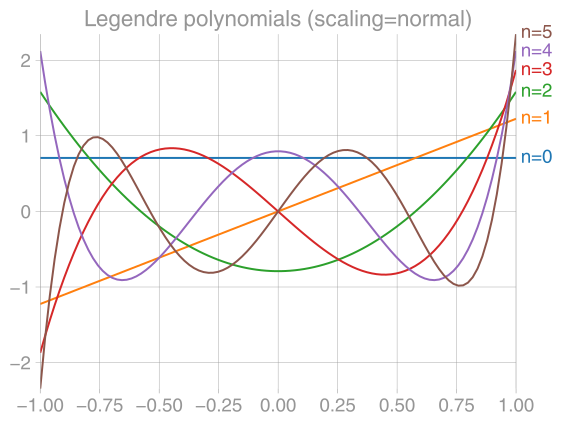 |
| 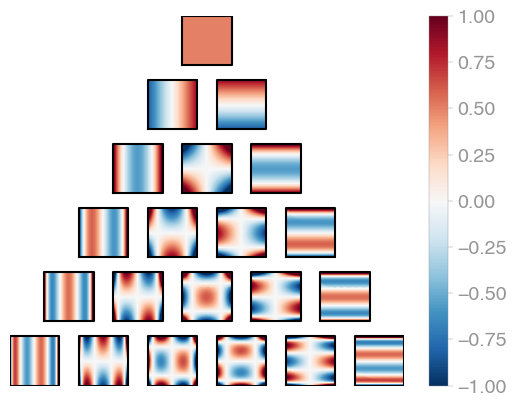 |
| 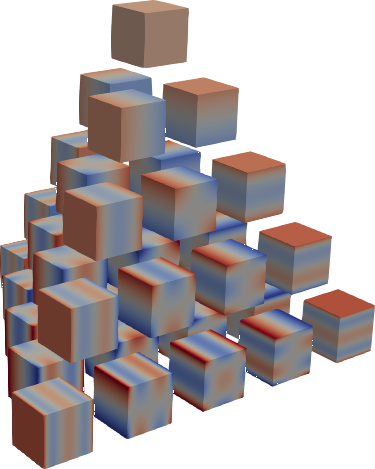 |
293 | | :---------------------------------------------------------------------------------------: | :---------------------------------------------------------------------------------------: | :---------------------------------------------------------------------------------------: |
294 | | C1 (Legendre) | C2 | C3 |
295 |
296 | Jacobi product polynomials.
297 | All polynomials are normalized on the n-dimensional cube. The dimensionality is
298 | determined by `X.shape[0]`.
299 |
300 |
301 |
302 | ```python
303 | evaluator = orthopy.cn.Eval(X, alpha=0, beta=0)
304 | values, degrees = next(evaluator)
305 | ```
306 |
307 | ### nD space with weight function exp(-r2) (_Enr2_)
308 |
309 | | |
|
293 | | :---------------------------------------------------------------------------------------: | :---------------------------------------------------------------------------------------: | :---------------------------------------------------------------------------------------: |
294 | | C1 (Legendre) | C2 | C3 |
295 |
296 | Jacobi product polynomials.
297 | All polynomials are normalized on the n-dimensional cube. The dimensionality is
298 | determined by `X.shape[0]`.
299 |
300 |
301 |
302 | ```python
303 | evaluator = orthopy.cn.Eval(X, alpha=0, beta=0)
304 | values, degrees = next(evaluator)
305 | ```
306 |
307 | ### nD space with weight function exp(-r2) (_Enr2_)
308 |
309 | | | 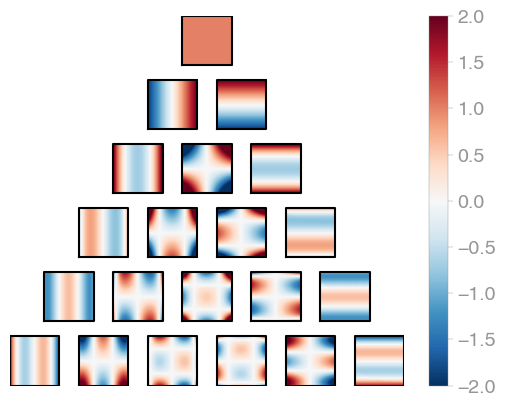 |
| 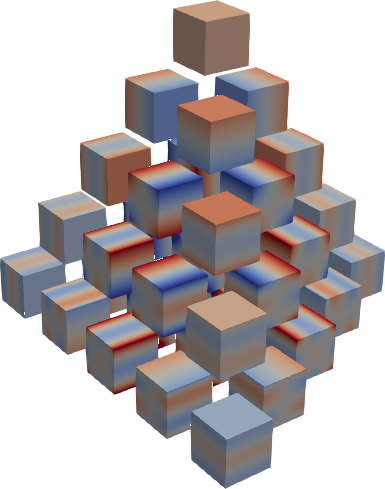 |
310 | | :-----------------------------------------------------------------------------------------: | :-----------------------------------------------------------------------------------------: | :-----------------------------------------------------------------------------------------: |
311 | | _E1r2_ | _E2r2_ | _E3r2_ |
312 |
313 | Hermite product polynomials.
314 | All polynomials are normalized over the measure. The dimensionality is determined by
315 | `X.shape[0]`.
316 |
317 |
318 |
319 | ```python
320 | evaluator = orthopy.enr2.Eval(
321 | x,
322 | standardization="probabilists" # or "physicists"
323 | )
324 | values, degrees = next(evaluator)
325 | ```
326 |
327 | ### Other tools
328 |
329 | - Generating recurrence coefficients for 1D domains with
330 | [Stieltjes](https://github.com/nschloe/orthopy/wiki/Generating-1D-recurrence-coefficients-for-a-given-weight#stieltjes),
331 | [Golub-Welsch](https://github.com/nschloe/orthopy/wiki/Generating-1D-recurrence-coefficients-for-a-given-weight#golub-welsch),
332 | [Chebyshev](https://github.com/nschloe/orthopy/wiki/Generating-1D-recurrence-coefficients-for-a-given-weight#chebyshev), and
333 | [modified
334 | Chebyshev](https://github.com/nschloe/orthopy/wiki/Generating-1D-recurrence-coefficients-for-a-given-weight#modified-chebyshev).
335 |
336 | - The the sanity of recurrence coefficients with test 3 from [Gautschi's article](https://doi.org/10.1007/BF02218441):
337 | computing the weighted sum of orthogonal polynomials:
338 |
339 |
340 | ```python
341 | orthopy.tools.gautschi_test_3(moments, alpha, beta)
342 | ```
343 |
344 | - [Clenshaw algorithm](https://en.wikipedia.org/wiki/Clenshaw_algorithm) for
345 | computing the weighted sum of orthogonal polynomials:
346 |
347 | ```python
348 | vals = orthopy.c1.clenshaw(a, alpha, beta, t)
349 | ```
350 |
351 | ### Relevant publications
352 |
353 | - [Robert C. Kirby, Singularity-free evaluation of collapsed-coordinate orthogonal polynomials, ACM Transactions on Mathematical Software (TOMS), Volume 37, Issue 1, January 2010](https://doi.org/10.1145/1644001.1644006)
354 | - [Abedallah Rababah, Recurrence Relations for Orthogonal Polynomials on Triangular Domains, MDPI Mathematics 2016, 4(2)](https://doi.org/10.3390/math4020025)
355 | - [Yuan Xu, Orthogonal polynomials of several variables, arxiv.org, January 2017](https://arxiv.org/abs/1701.02709)
356 |
--------------------------------------------------------------------------------
|
310 | | :-----------------------------------------------------------------------------------------: | :-----------------------------------------------------------------------------------------: | :-----------------------------------------------------------------------------------------: |
311 | | _E1r2_ | _E2r2_ | _E3r2_ |
312 |
313 | Hermite product polynomials.
314 | All polynomials are normalized over the measure. The dimensionality is determined by
315 | `X.shape[0]`.
316 |
317 |
318 |
319 | ```python
320 | evaluator = orthopy.enr2.Eval(
321 | x,
322 | standardization="probabilists" # or "physicists"
323 | )
324 | values, degrees = next(evaluator)
325 | ```
326 |
327 | ### Other tools
328 |
329 | - Generating recurrence coefficients for 1D domains with
330 | [Stieltjes](https://github.com/nschloe/orthopy/wiki/Generating-1D-recurrence-coefficients-for-a-given-weight#stieltjes),
331 | [Golub-Welsch](https://github.com/nschloe/orthopy/wiki/Generating-1D-recurrence-coefficients-for-a-given-weight#golub-welsch),
332 | [Chebyshev](https://github.com/nschloe/orthopy/wiki/Generating-1D-recurrence-coefficients-for-a-given-weight#chebyshev), and
333 | [modified
334 | Chebyshev](https://github.com/nschloe/orthopy/wiki/Generating-1D-recurrence-coefficients-for-a-given-weight#modified-chebyshev).
335 |
336 | - The the sanity of recurrence coefficients with test 3 from [Gautschi's article](https://doi.org/10.1007/BF02218441):
337 | computing the weighted sum of orthogonal polynomials:
338 |
339 |
340 | ```python
341 | orthopy.tools.gautschi_test_3(moments, alpha, beta)
342 | ```
343 |
344 | - [Clenshaw algorithm](https://en.wikipedia.org/wiki/Clenshaw_algorithm) for
345 | computing the weighted sum of orthogonal polynomials:
346 |
347 | ```python
348 | vals = orthopy.c1.clenshaw(a, alpha, beta, t)
349 | ```
350 |
351 | ### Relevant publications
352 |
353 | - [Robert C. Kirby, Singularity-free evaluation of collapsed-coordinate orthogonal polynomials, ACM Transactions on Mathematical Software (TOMS), Volume 37, Issue 1, January 2010](https://doi.org/10.1145/1644001.1644006)
354 | - [Abedallah Rababah, Recurrence Relations for Orthogonal Polynomials on Triangular Domains, MDPI Mathematics 2016, 4(2)](https://doi.org/10.3390/math4020025)
355 | - [Yuan Xu, Orthogonal polynomials of several variables, arxiv.org, January 2017](https://arxiv.org/abs/1701.02709)
356 |
--------------------------------------------------------------------------------