├── license.md
├── README.md
├── visas.md
├── H-1B1.md
├── green-card.md
├── TN.md
├── L-1.md
├── EAD.md
└── EB.md
/license.md:
--------------------------------------------------------------------------------
1 | To the extent possible under law, the authors of the US Immigration FAQ have waived all copyright and related or neighboring rights
2 | to the US Immigration FAQ. See .
3 |
--------------------------------------------------------------------------------
/README.md:
--------------------------------------------------------------------------------
1 | ## Why does this FAQ exist?
2 | There are certain questions related to US immigration for tech workers that are frequently asked, either directly to Brian, or through a forum such as [Quora](https://www.quora.com/) or [Blind](http://us.teamblind.com/), as well as certain misconceptions that resurface periodically. Brian created this FAQ in order to answer those questions and correct those misconceptions the best he can, as well as to invite contributions from other people. This FAQ does not consist of legal advice, and in order to get a work visa or employment-based green card, you'll almost always need the assistance of a qualified immigration lawyer. However, we hope that the FAQ will give you a sense of what's possible and what can be expected should you make the decision to proceed down various paths, such as studying a master's degree in computer science in the United States.
3 |
4 | ## Can't the answers to these questions already be found online?
5 | In some cases, yes. Brian's personal experience is that when qualified immigration lawyers give answers online, they tend to hedge their words in order to protect their reputations, whereas answers given by people other than immigration lawyers often consist of guesswork and anecdotes, and regardless of who's answering, the answers can easily become outdated.
6 |
7 | ## Why should I believe the answers on this FAQ then?
8 | Brian believes that you should believe his answers about US immigration for the same reason why you believe his answers on other topics---not because he is some sort of "expert", but because they make sense in the context of what you already know about the topic.
9 |
10 | That being said, whenever possible, we will provide citations to the relevant statutes, regulations, and current practices, including the Immigration and Nationality Act, title 8 of the Code of Federal Regulations, the State Department's *Foreign Affairs Manual*, and the CBP Field Manual, as well as to other sources written by more qualified individuals that you may or may not consider authoritative.
11 |
12 | ## Which section of the FAQ should I read?
13 | * [general.md](general.md) for general questions about the US immigration system
14 | * [green-card.md](green-card.md) for questions about green cards and LPR status
15 | * [EB.md](EB.md) for questions specific to employment-based immigration
16 | * [H-1B.md](H-1B.md) for questions about H-1B visas/status
17 | * [H-1B1.md](H-1B1.md) for questions about H-1B1 visas/status, which shares some similarities with H-1B status but also some significant differences
18 | * [L-1.md](L-1.md) for questions about L-1A and L-1B visas/status
19 | * [TN.md](TN.md) for questions about TN visas/status
20 | * [visas.md](visas.md) for questions about visas in general (stamped into your passport by the State Department)
21 | * [EAD.md](EAD.md) for questions about Employment Authorization Documents (EADs)
22 |
--------------------------------------------------------------------------------
/visas.md:
--------------------------------------------------------------------------------
1 | # Questions about visas
2 | Before reading this section, be sure to familiarize yourself with the [difference between a visa and a status](general.md#whats-the-difference-between-visa-and-status).
3 |
4 | ## Which foreign nationals do not need a visa to enter the US?
5 | While most foreign nationals must present a visa in order to enter the US, there are several exceptions, some of which are listed below:
6 | * Returning lawful permanent residents should present their Permanent Resident Card (green card) or certain other documents [1].
7 | * Nationals of certain countries may visit the US for business or pleasure using the [Visa Waiver Program](https://travel.state.gov/content/travel/en/us-visas/tourism-visit/visa-waiver-program.html). Note that "business" doesn't include "work". In addition, there are several restrictions on the VWP, including:
8 | * If arriving by air or sea, you will need to apply for advance authorization [2] through [ESTA](https://esta.cbp.dhs.gov/esta/).
9 | * A foreign national who was admitted under the VWP and overstayed their visit becomes permanently ineligible for the VWP [3]. This means they will need a visa in the future unless they qualify for some other exemption.
10 | * Similarly, aliens previously removed from the US are permanently ineligible for the VWP [4].
11 | * Being refused a visa or admission to the United States makes it unlikely, but not impossible, to qualify under the VWP in the future. [5]
12 | * Foreign nationals admitted under the VWP are ineligible for extension of stay [6], change of nonimmigrant status [7], and adjustment of status unless as the immediate relative of a US citizen [8].
13 | * Canadian and Bermudian citizens seeking admission as nonimmigrants using their Canadian or Bermudian passport are visa-exempt unless they are seeking admission in E, K, S, or V status [9]. The restrictions described above on the Visa Waiver Program do not apply to Canadians and Bermudians. However, Canadians and Bermudians cannot simply stroll into the US. If they want to be admitted in a status that requires additional documentation, such as F-1 or H-1B status, they must still present the required documentation at the port of entry.
14 | * Mexican nationals seeking to visit the US for short periods of time can use their Border Crossing Card [10], but this is not really an exception since a Border Crossing Card can also be used as a B-1/B-2 visa.
15 |
16 | ## Can I renew a visa while in the US?
17 | The expiration of your visa has no bearing on whether or not you may remain in the United States. However, nonimmigrants who aren't visa-exempt (see above) will need to present a visa the next time they leave and re-enter the US. Nonimmigrants who have made the US their home and who don't want to be stranded outside the US are often interested in knowing whether it's possible to renew their visa while they're still in the US, so that they can depart the US with a new visa already secured. Unfortunately, with very few exceptions, visas can only be issued outside the US at a consular post [12]. Even though federal regulations theoretically allow renewal of an E, H, I, L, O, or P visa while in the US, it doesn't seem that that option is currently available. Therefore, all H-1B, L-1, and other temporary workers in the US, other than those who are visa-exempt, should be prepared for the possibility that delays in obtaining a new visa will delay their return to the US after a trip abroad.
18 |
19 | ## Does a visa expire when the passport holding it expires?
20 | No. A US visa remains valid until its indicated expiration date or until it is cancelled or revoked, even if the containing passport expires. The holder of the expired passport with the visa still in it can use that visa together with an unexpired passport bearing the same name. [13]
21 |
22 | ## Under which circumstances can an expired visa be used to enter the US?
23 | Some nonimmigrants with expired visas can return to the US using the expired visa after a visit solely to foreign contiguous territory or adjacent islands for 30 days or less. It may be possible to take advantage of this provision even if the expired passport is for a different nonimmigrant classification than the one you hold at the time of departure and in which you intend to return. The regulations for so-called "automatic revalidation" are set out in [22 CFR §41.112(d)](https://www.law.cornell.edu/cfr/text/22/41.112#d) and [8 CFR 214.1(b)](https://www.law.cornell.edu/cfr/text/8/214.1#b). For a more readable overview, see [here](https://travel.state.gov/content/travel/en/us-visas/visa-information-resources/visa-expiration-date/auto-revalidate.html).
24 |
25 | **Note that automatic visa revalidation can never be used to extend status!** The relevant regulations permit the nonimmigrant to apply for readmission within the authorized period of initial admission or extension of stay
, meaning that the nonimmigrant may apply at the port of entry to *resume* their previous period of admission, which had been granted by an admission or an extension of stay. In effect, the nonimmigrant who uses automatic revalidation is asking CBP to allow them to resume their most recent I-94. A nonimmigrant who wishes to stay longer must either file for an extension with USCIS, or apply for readmission without using automatic visa revalidation. In this latter case, citizens of most countries will need an unexpired visa with the correct classification.
26 |
27 | ## Do I need a visa to attend a job interview in the US?
28 | Attending a job interview is not "work", and is a permitted activity for visitors to the US. This means you don't need sponsorship from the company you're applying to merely to attend the job interview, and you may qualify for one of the visa exemptions listed above; for example, Canadians interviewing in the US only need their passport, while most Europeans will only need their passport and approved ESTA. Otherwise, a B-1 visa (or B-2 if the primary purpose of the trip is pleasure) is appropriate. However, you will have to leave and re-enter the US with an appropriate status (such as H-1B) in order to actually begin working. If the CBP officer believes that you're not going to comply with this rule, they will deny you entry.
29 |
30 | ## How can I apply for a nonimmigrant work visa?
31 | In most cases, this process involves both you and your sponsoring employer.
32 | 1. Your sponsoring employer must first file a petition with USCIS to establish your eligibility for one of the nonimmigrant classes eligible for employment in the US
33 | 2. Once this petition is approved, **you** can use it to apply for the corresponding visa type at a consular post; see [here](https://travel.state.gov/content/travel/en/us-visas/employment/temporary-worker-visas.html) for instructions. Your employer does not need to be involved when you are applying for the visa itself.
34 |
35 | Those who are visa-exempt would still need the approved petition from step 1 in order to obtain the nonimmigrant status you are seeking.
36 |
37 | There are exceptions to this rule. Canadians who want to work in [TN status](TN.md) are exempt from both steps; they do not need visas, and can apply for admission at the border without any prior petition approval. (TODO: also discuss H-1B1 and E-3 visas here.)
38 |
39 | ## Can I visit Canada with a US visa?
40 | No. You need a Canadian visa, unless you're a citizen of one of the [visa-exempt countries](https://www.canada.ca/en/immigration-refugees-citizenship/services/visit-canada/entry-requirements-country.html).
41 |
42 | ## Can I visit Mexico with a US visa?
43 | Yes. If you have a valid and unexpired US visa, then you don't need a Mexican visa to visit Mexico. [11]
44 |
45 | ## Are Canadians still visa-exempt even if they've violated immigration laws or been denied admission or denied an immigration benefit?
46 | Yes. Federal regulations [9] do not appear to contemplate any exceptions to the visa exemptions enjoyed by Canadians seeking admission as nonimmigrants other than in E, K, S, or V status. Thus, being denied entry to the US, or making some other request for an immigration benefit which ends up denied, does not create a requirement for Canadians to apply for visas in the future; nor do violations, ranging from minor ones such as overstaying by a few days, to the more serious, such as engaging in unauthorized employment.
47 |
48 | Thus, as discussed previously, the rules are quite different for Canadians and other visa-exempt nationals, such as Australians; circumstances such as overstays that would force other nationals to apply for visas for future visits to the US do not have the same effect on Canadians.
49 |
50 | It is important to remember that aliens in general, including Canadians, may become inadmissible to the US if they were previously removed or committed certain severe crimes or violations of US immigration law. Even in such cases, there is no point in a Canadian trying to apply for a visa, since the application will be denied due to inadmissibility anyway. It is sometimes possible to have grounds of inadmissibility waived by filing the appropriate form. If the waiver application is approved, the Canadian is then once again eligible for visa-free entry.
51 |
52 | ## If someone is subject to a travel ban, can they still obtain a visa?
53 | Typically, a noncitizen who is inadmissible is also banned from obtaining a visa [26]. For example, if a noncitizen has accumulated enough unlawful presence in the US that they are subject to a statutory bar on re-entering the US, then that person also cannot obtain a US visa (unless their ban has been waived). They must wait out their ban period before they can be issued a visa.
54 |
55 | However, travel bans issued by the President (such as the well known Trump-era nationality bans [22][23]) fall under one specific section of the law, INA §212(f). While §212(f) gives the President authority to suspend entry of a class of noncitizens, it does **not** give the President authority to deny visas to those noncitizens. Despite this, the State Department has long taken the position that §212(f) applies to both entry *and* visa issuance, and has therefore denied visas to various noncitizens on the basis of §212(f). In other words, the State Department's position is that individuals who are subject to §212(f) travel bans are not eligible to be issued a visa, unless:
56 | * they can demonstrate that they fall under one of the exemptions in the proclamation;
57 | * they are applying for a visa in a category that is not banned by the proclamation; or
58 | * they are granted a waiver when they apply for the visa.
59 |
60 | A banned individual who applied for a visa would thus either receive an outright denial under section 212(f), or be referred to administrative processing to determine whether the individual may qualify for an exemption or waiver (for example, see [24]).
61 |
62 | We will discuss the specific case of the regional COVID-19 travel bans proclaimed during the Trump and Biden administrations. These proclamations, in general, suspended the entry of noncitizens if they had been physically present in certain countries for 14 days prior to seeking entry to the US (they were not, however, based on the nationality of the traveller). See for example [17–19]. As of Jan 1, 2022, there were no such regional proclamations in effect, although it is possible for them to be reintroduced in the future, so we will discuss the legal issues here. The State Department's policy was particularly impactful in the case of the regional COVID-19 travel bans. For example, Brazil was one of the countries subjected to a regional COVID-19 travel ban. This meant that a Brazilian citizen who already had a US visa prior to the proclamation, and who was hoping to travel to the US, would have been able to enter the US by first travelling to Mexico for 14 days and then proceeding to the US. However, a Brazilian citizen who did not already have a US visa, and was planning on travelling to Mexico and then the US, would have been refused a visa by the US embassy and consulates in Brazil during the proclamation, and would most likely not have been able to enter the US.
63 |
64 | A number of legal challenges were mounted to the State Department's policy, asserting that §212(f) may only be used to ban *entry*, and not issuance of visas (therefore, in the hypothetical situation previously discussed, the Brazilian citizen should have been able to obtain a US visa in Brazil despite the fact that they would have to spend 14 days in a non-banned country prior to using said visa). Most of these lawsuits sought injunctions allowing plaintiffs to obtain visas. On October 5, 2021, in the case *Kinsley v. Blinken*, the District Court for the District of Columbia actually concluded that the State Department's policy is unlawful (see [29]), though it stopped short of entering a [universal injunction](https://en.wikipedia.org/wiki/National_injunctions) so the State Department was not actually forced to revise its guidance. On October 25, 2021, the regional COVID-19 travel bans were replaced with Proclamation 10294, whch imposes a vaccination requirement for noncitizens from all countries [30] and explicitly states that the proclamation applies only to entry and not to visa issuance. This may indicate that the State Department's preferred method to deal with the court's ruling was to moot it out and reserve the possibility of eventually banning visa issuance again during a future presidential proclamation.
65 |
66 | Note that the Trump-era nationality bans were rescinded on January 20, 2020 [27], the immigrant visa ban [15] was rescinded on February 24, 2021 [28], and the work visa ban [16] expired at the end of March 31, 2021 [20]. These bans are no longer in effect.
67 |
68 | # References
69 | [1] [8 CFR §211.1(a)](https://www.law.cornell.edu/cfr/text/8/211.1#a)
70 | [2] [8 CFR §217.5(a)](https://www.law.cornell.edu/cfr/text/8/217.5#a)
71 | [3] INA 217(a)(7) ([8 USC §1187(a)(7)](https://www.law.cornell.edu/uscode/text/8/1187#a_7))
72 | [4] [8 CFR §217.2(b)(2)](https://www.law.cornell.edu/cfr/text/8/217.2#b_2)
73 | [5] https://help.cbp.gov/app/answers/detail/a_id/1097/~/previously-denied-a-visa-or-immigration-benefit
74 | [6] [8 CFR §214.1(c)(3)(i)](https://www.law.cornell.edu/cfr/text/8/214.1#c_3_i)
75 | [7] INA 248(a)(4) ([8 USC §1258(a)(4)](https://www.law.cornell.edu/uscode/text/8/1258#a_4))
76 | [8] INA 245(c)(4) ([8 USC §1255(c)(4)](https://www.law.cornell.edu/uscode/text/8/1255#c))
77 | [9] [8 CFR §212.1(a)(1)](https://www.law.cornell.edu/cfr/text/8/212.1#a_1)
78 | [10] [8 CFR §212.1(c)(1)(i)](https://www.law.cornell.edu/cfr/text/8/212.1#c_1_i)
79 | [11] https://consulmex.sre.gob.mx/sanfrancisco/index.php/visas-traveling-to-mexico
80 | [12] [22 CFR §41.111](https://www.law.cornell.edu/cfr/text/22/41.111)
81 | [13] [9 FAM 403.9-3(B)(4)](https://fam.state.gov/FAM/09FAM/09FAM040309.html)
82 | [14] INA 221(g) ([8 USC §1201(g)](https://www.law.cornell.edu/uscode/text/8/1201#g))
83 | [15] [Proclamation Suspending Entry of Immigrants Who Present Risk to the U.S. Labor Market During the Economic Recovery Following the COVID-19 Outbreak](https://www.whitehouse.gov/presidential-actions/proclamation-suspending-entry-immigrants-present-risk-u-s-labor-market-economic-recovery-following-covid-19-outbreak/)
84 | [16] [Proclamation Suspending Entry of Aliens Who Present a Risk to the U.S. Labor Market Following the Coronavirus Outbreak](https://www.whitehouse.gov/presidential-actions/proclamation-suspending-entry-aliens-present-risk-u-s-labor-market-following-coronavirus-outbreak/)
85 | [17] [Presidential Proclamation 9984](https://www.trumpwhitehouse.gov/presidential-actions/proclamation-suspension-entry-immigrants-nonimmigrants-persons-pose-risk-transmitting-2019-novel-coronavirus/)
86 | [18] [Presidential Proclamation 9992](https://www.trumpwhitehouse.gov/presidential-actions/proclamation-suspension-entry-immigrants-nonimmigrants-certain-additional-persons-pose-risk-transmitting-coronavirus/)
87 | [19] https://www.whitehouse.gov/briefing-room/presidential-actions/2021/01/25/proclamation-on-the-suspension-of-entry-as-immigrants-and-non-immigrants-of-certain-additional-persons-who-pose-a-risk-of-transmitting-coronavirus-disease/
88 | [20] [Presidential Proclamation 10131](https://www.federalregister.gov/documents/2021/01/06/2021-00039/suspension-of-entry-of-immigrants-and-nonimmigrants-who-continue-to-present-a-risk-to-the-united)
89 | [21] (Reserved)
90 | [22] [Presidential Proclamation 9645](https://www.whitehouse.gov/presidential-actions/presidential-proclamation-enhancing-vetting-capabilities-processes-detecting-attempted-entry-united-states-terrorists-public-safety-threats/)
91 | [23] [Presidential Proclamation 9983](https://www.whitehouse.gov/presidential-actions/proclamation-improving-enhanced-vetting-capabilities-processes-detecting-attempted-entry/)
92 | [24] https://twitter.com/gsiskind/status/1275792561454579712
93 | [25] https://www.natlawreview.com/article/update-gomez-v-trump
94 | [26] INA 212(a) ([8 USC 1182(a)](https://www.law.cornell.edu/uscode/text/8/1182#a))
95 | [27] https://www.whitehouse.gov/briefing-room/presidential-actions/2021/01/20/proclamation-ending-discriminatory-bans-on-entry-to-the-united-states/
96 | [28] https://www.whitehouse.gov/briefing-room/presidential-actions/2021/02/24/a-proclamation-on-revoking-proclamation-10014/
97 | [29] https://www.immigrationissues.com/update-on-travel-ban-litigation-kinsley-v-blinken/
98 | [30] https://www.whitehouse.gov/briefing-room/presidential-actions/2021/10/25/a-proclamation-on-advancing-the-safe-resumption-of-global-travel-during-the-covid-19-pandemic/
99 |
--------------------------------------------------------------------------------
/H-1B1.md:
--------------------------------------------------------------------------------
1 | ## What's the difference between H-1B and H-1B1?
2 | The H-1B1 visa is similar to the [H-1B](H-1B.md) visa: it is a nonimmigrant visa that allows an alien to perform skilled labor temporarily for an employer in the United States. However, there are several differences, of which the most important are summarized below:
3 |
4 | * H-1B1 status is only available to citizens of Chile and Singapore.
5 | * H-1B1 quotas have never been reached.
6 | * Petitions are not required in order to obtain an H-1B1 visa.
7 | * H-1B1 status is granted in 1-year increments, whereas H-1B status is granted in 3-year increments.
8 | * There is no explicit 6-year limit on the number of times H-1B1 status can be extended.
9 | * H-1B1 workers cannot avail themselves of INA 214(n) portability.
10 | * H-1B1 status does not explicitly allow dual intent.
11 |
12 | References for the above claims are provided with the more detailed answers further down this page.
13 |
14 | ## Who qualifies for an H-1B1 visa?
15 | H-1B1 status is only available to nationals of Chile and Singapore, pursuant to free trade agreements that those countries have signed with the United States [1][2][3]. Like H-1B status, H-1B1 status is only available to an alien in a specialty occupation who is being sponsored by an employer that has filed a labor condition application with the Department of Labor [1]. The definition of "specialty occupation" for H-1B1 status [4] is very slightly different from the definition for H-1B status.
16 |
17 | As is the case with H-1B status, the "specialty occupation" criterion for H-1B1 status is subjective and it is not possible for a layman to understand the nuances of the interpretation of the statute, but an employer that frequently sponsors employees for H-1B visas for a particular role will almost certainly be able to sponsor H-1B1 visas as well, provided that their lawyers are familiar with the H-1B1 classification. As is the case with H-1B status, H-1B1 status is generally available to software engineers (for the time being) despite the fact that many software engineers do not have a bachelor's degree in computer science or a related speciality.
18 |
19 | I don't know whether increased scrutiny on H-1B applications has also affected H-1B1 applications. If you have information about this, feel free to contribute.
20 |
21 | ## Why should I apply for an H-1B1 visa as opposed to H-1B or some other work visa?
22 | For those who qualify—only Chileans and Singaporeans—the H-1B1 visa is often the most convenient choice because of the fact that its annual quota has never been reached; while there is a lottery for H-1B visas every year, there is no H-1B1 lottery. Like the H-1B visa, the H-1B1 visa [can be preferable](H-1B.md#why-should-i-apply-for-h-1b-as-opposed-to-other-work-visas) to the [L-1](L-1.md) visa because it doesn't require working for an employer outside the US for 1 year, and to the [O-1](O-1.md) visa because it is much easier to qualify for.
23 |
24 | ## What is the process to apply for an H-1B1 visa or status?
25 | Due to the terms of the free trade agreements, a petition is not required in order to obtain an H-1B1 visa [5]. However, note that the treaties did *not* grant exemptions from the requirement to obtain a [visa](visas.md) to enter the US. Thus, an alien outside the US, whose employer has filed a labor certification application with the Department of Labor, would apply for an H-1B1 visa at a consular post, submitting documents directly to the consular post rather than to USCIS [6].
26 |
27 | An alien already in the United States wishing to change status to H-1B1, however, must have Form I-129 filed on their behalf by their sponsoring employer [7]. The adjudication of Form I-129 is a two-step process, in which USCIS first determines whether the petition is approvable, then determines whether the beneficiary qualifies for the change of status sought [8]. Usually, both steps will be approved, in which case USCIS sends Form I-797A, containing an I-94 indicating the new H-1B status and authorized period of stay [9]. However, it's possible that the petition is approved while the change of status is denied—typically because USCIS has determined that the beneficiary has violated their status, making them ineligible for a change of status—and the beneficiary must usually leave the United States and apply for a visa.
28 |
29 | It should be noted that H-1B1 petitions are not eligible for premium processing [12], so leaving the US to apply for an H-1B1 visa will probably be a faster method of obtaining H-1B1 status than changing status to H-1B1 within the US (which requires the petition).
30 |
31 | ## How long does H-1B1 status last?
32 | Unlike H-1B status, H-1B1 status may only be granted for 1 year at a time, and can be extended in 1-year increments [10]. Extensions of H-1B1 status are done using Form I-129 [7]. However, there is no statutory or regulatory limit on the number of extensions that can be granted. Therefore, H-1B1 workers who have already worked in the US for 6 years in H-1B1 status can continue to extend their status.
33 |
34 | However, H-1B1 status does not allow [dual intent](general.md#what-is-dual-intent), so aliens who work in the US in H-1B1 status for many years could eventually be denied further extensions on the grounds that they seem to be an intending immigrant. For this reason, H-1B1 workers often switch to H-1B status and apply for a green card, or, in some cases, start the green card process while still in H-1B1 status. (We'll discuss the issue of dual intent further below.)
35 |
36 | ## What happens if my employer applies to extend my stay, but my I-94 expires while the petition is pending?
37 | The [general rules about I-94 expiration with a pending extension](general.md#what-happens-if-my-nonimmigrant-status-expires-while-my-change-of-status-extension-of-stay-or-adjustment-of-status-application-is-pending) apply to this scenario. Provided that the extension was timely filed and the alien did not engage in any unauthorized employment, the alien will be protected from accrual of unlawful presence as long as the extension remains pending; if it is denied after the previous I-94 expired, then unlawful presence will only begin to accrue *after* the extension petition is denied.
38 |
39 | In this scenario, for a 240 day period after the previous petition expires, the alien is authorized to continue employment with the same employer (such employment is not considered unauthorized
). Again, while the extension is pending, employment authorization continues **only for up to 240 days after the expiration of the petition** (unless the extension petition is denied) [15] Thus, as long as USCIS continues to adjudicate petitions within 240 days, there should generally be no reason for your H-1B1 employment to be interrupted, as long as the employer always files for an extension **before your I-94 expires**. However, in rare cases where the 240 day clock runs out, **you can still stay in the US, but you can't work.** This is because of the general rule about extensions mentioned in the previous paragraph.
40 |
41 | If a denial occurs during the 240 day period, then employment authorization immediately ceases since the petition is no longer pending [15].
42 |
43 | ## Can I do any work other than for my sponsoring employer?
44 | An H-1B1 worker who does not have an EAD is only permitted to work for their sponsoring employer [11]. It is permitted to work for multiple employers concurrently, but only as long as each employer wishing to employ the H-1B1 alien has met the applicable requirements. In other words, an H-1B1 alien in the United States who wants to begin new concurrent employment must wait until the new employer has had Form I-129 approved (and the new employer must have filed a labor condition application); while the Foreign Affairs Manual is not clear on this, it appears that an alien outside the United States, who already has an H-1B1 visa authorizing employment with one employer, who wishes to work for both that employer and a new employer concurrently upon their return to the US, must apply for a new H-1B1 visa, presenting required evidence concerning the new employment to a consular post, and explaining that they intend to work for both employers. See for example [here](https://immigrationworkvisa.com/h1b1-visa/).
45 |
46 | ## Can I be self-employed while in H-1B1 status?
47 | According to the U.S. embassy in [Chile](https://cl.usembassy.gov/visas/nonimmigrant-visas/), H-1B1 workers cannot be self-employed or independent contractors. See the [answer](H-1B.md#can-i-be-self-employed-while-in-h-1b-status) to the similar question about H-1B status. Although the regulations are not crystal clear, it seems reasonable to assume that the nuances of the H-1B employer-employee relationship requirement also apply to H-1B1 status. However, note again that if you have an EAD, you can work for any employer, including being self-employed.
48 |
49 | ## How can I get an Employment Authorization Document (EAD)?
50 | The answer to this question is the same as for [H-1B](H-1B.md#how-can-i-get-an-employment-authorization-document-ead) workers.
51 |
52 | ## Can the spouse of an H-1B1 nonimmigrant obtain an H-4 EAD?
53 | The H-4 EAD program only applies to certain spouses of H-1B nonimmigrants [21]. As discussed above, the H-1B1 status is a distinct status from H-1B, and is not a subtype thereof. Therefore, an H-4 spouse of an H-1B1 nonimmigrant is not eligible for the H-4 EAD program. The H-4 spouse of an H-1B1 nonimmigrant might, however, qualify for the [compelling circumstances EAD
](H-1B.md#how-can-i-get-an-employment-authorization-document-ead).
54 |
55 | ## How can I change employers in H-1B1 status?
56 | Since, as discussed above, H-1B1 nonimmigrants are generally authorized only to work for a sponsoring employer, if an H-1B worker wants to change jobs, the new company must be one that is willing to sponsor H-1B1s. If you want to switch employers while in the US, the new employer must file a petition on Form I-129. If you intend to leave the US and then return to work for the new employer, while the Foreign Affairs Manual does not specifically cover this situation, some online resources (*e.g.*, [here](https://immigrationworkvisa.com/h1b1-visa/) and [here](https://visaguide.world/us-visa/nonimmigrant/employment/h1b/h1b1/)) indicate that it is necessary to apply for a new H-1B1 visa for the new employer, and the original H-1B1 visa will be cancelled if you no longer intend to work for the old employer.
57 |
58 | One important difference between H-1B and H-1B1 status is that an H-1B1 worker may **not** start working at the new employer while the new petition is pending. They must wait for the petition to be approved. This is because the text of INA 214(n) [13] specifically refers to the paragraph of the Immigration and Nationality Act that defines H-1B status, whereas H-1B1 status is defined in the following paragraph. The fact that H-1B1 workers do not benefit from INA 214(n) portability is also noted in the federal regulations [14]. Unfortunately, immigration lawyers providing answers on the internet often seem to believe, mistakenly, that INA 214(n) portability applies to H-1B1 workers. Thus, the options are to have the new employer file an H-1B1 petition and wait for it to be *approved* before switching to the new employer, or to leave the US and apply for a new H-1B1 visa.
59 |
60 | Since premium processing is not available for H-1B1 petitions [12], leaving the US and applying for a new H-1B1 visa for the new employer is likely to be faster than switching employers while in the US. (However, the new employer's filing of the petition does not terminate your work authorization at your old employer, so going the I-129 route does not require being temporarily unemployed; you can hand in your resignation after the new petition is approved.)
61 |
62 | If you really want to file with USCIS to change employers, then you can stay in the US while the new petition is pending, thanks to the [general rules about I-94 expiration with a pending extension](general.md#what-happens-if-my-nonimmigrant-status-expires-while-my-change-of-status-extension-of-stay-or-adjustment-of-status-application-is-pending), but again, you're not allowed to work for the new employer during that period. You can resign from your current employer, and just sit around waiting for the new petition to be approved. Because H-1B1 status is only granted in 1-year increments, by the time the petition gets approved, a substantial fraction of the 1-year period requested by the new employer will have passed already, so the new employer will also have to file an extension petition soon (they can avail themselves of the 240-day rule; see above). Despite this inconvenience, this option can be useful for H-1B1 workers who cannot travel for some reason.
63 |
64 | ## Can I apply for a green card from H-1B1 status?
65 | H-1B1 workers may be able to qualify for a green card through the same paths as [H-1B](H-1B.md) workers: that is, most often through an [employment-based category](EB.md), and most often through the same employer that is sponsoring their H-1B1 visa, but this has some risks that it is important to be aware of. This is due to two important differences between H-1B and H-1B1 status:
66 |
67 | * H-1B1 status does not permit dual intent [18], even though H-1B status does. If you are an intending immigrant, you may no longer be admitted on an H-1B1 visa or be granted any further 1-year extensions of H-1B1 status. Once you have filed for adjustment of status, you have revealed your intent as an intending immigrant.
68 | * H-1B1 status is only granted in 1-year increments, so it is quite likely for your I-94 to expire before your adjustment of status can be approved, and as explained in the previous item, further extensions are not possible.
69 |
70 | Some H-1B1 workers will accept these risks (explained in more detail in the [green card FAQ](green-card.md)), while others will take the safer route of entering the H-1B lottery and only applying for a green card once H-1B status has been secured. (Entering the H-1B lottery does not affect your ability to continue to qualify for H-1B1 status.)
71 |
72 | ## Since H-1B1 status does not permit dual intent, how can I avoid being considered an intending immigrant?
73 | The determination of whether an alien seeking an H-1B1 visa or H-1B1 status is made based on the subjective judgement of consular officials, CBP agents, and USCIS officers each time a visa, admission, or extension or change of status is sought. Thus, it's usually not possible to be absolutely certain that you will or will not be regarded as an intending immigrant. However, some important considerations are listed below:
74 |
75 | * Filing Form I-485 is the most unambiguous evidence of immigrant intent. However, having an employer file a labor certification application for you (the first step in the EB-2 and EB-3 green card process, other than National Interest Waiver cases) does not affect your ability to seek H-1B1 status since it is filed with the Department of Labor, rather than USCIS or the State Department.
76 | * Unlike applicants for B, F, or J status, an H-1B1 applicant is not explicitly required to demonstrate that they have a residence abroad that they have no intention of abandoning [1]. Therefore, the approval of the H-1B1 petition, together with the absence of factors that would arouse a suspicion of immigrant intent, is generally sufficient to satisfy [INA 214(b)](https://www.law.cornell.edu/uscode/text/8/1184#b).
77 | * The Foreign Affairs Manual recognizes [19] that *"an intent to immigrate in the future, which is in no way connected to the proposed immediate trip, need not in itself result in a finding that the immediate trip is not temporary. An extended stay, even in terms of years, may be temporary, as long as there is no immediate intent to immigrate."* Therefore:
78 | * Multiple extensions and renewals are possible, but not if you appear to be using H-1B1 status to live in the US permanently in order to avoid the need to go through the green card process. It is of course quite common for people to work in the US for many years while still maintaining an intent to eventually go back to their home country. But there may come a point when, based on the subjective judgement of the officials concerned, you appear to be trying to live in the US permanently. Therefore, if you do want to live in the US permanently, you should usually start the green card process early on in order to minimize this risk.
79 | * The fact that your employer is likely to eventually sponsor you for a green card does not imply that the *immediate trip* should be denied based on immigrant intent. However, if a CBP agent asks you whether you're going to apply for a green card and you say something stupid like "yeah, my employer is probably going to start the process in a few months" then you are likely to be denied entry since it now appears that you are going to immigrate on the immediate trip.
80 |
81 | ## Is there a grace period for H-1B1 workers?
82 | Yes, an H-1B1 worker may be eligible for a grace period of up to 60 days. This is discussed [in the general FAQ](https://github.com/t3nsor/us-immigration-faq/blob/master/general.md#if-i-am-fired-from-my-job-or-quit-what-happens-to-my-status). H-1B1 is specifically listed as one of the classifications eligible for the grace period according to the regulations.
83 |
84 | During the grace period, one may transfer to another employer, change status, adjust status, or depart the US. Note however that as discussed above, there is no AC21 portability available for H-1B1 workers. Therefore, if you do choose to have a new employer file for an H-1B1 transfer within the US, you will have to remain unemployed for several months while you wait for it to be approved.
85 |
86 | ## Were H-1B1 visas affected by the work visa ban of June 22, 2020?
87 | The proclamation [16] (which expired at the end of March 31, 2021 and is thus no longer in effect) covered H-1B, H-2B, J-1, and L-1 visas. The H-1B1 visa is distinct from the H-1B visa: the above questions and answers give some examples of ways in which statutory provisions that apply to H-1B visas do *not* apply to H-1B1 visas unless explicitly specified. That is, **the H-1B1 visa is not a subtype of the H-1B visa** and therefore, as written, the proclamation did not affect the issuance of H-1B1 visas.
88 |
89 | The US embassy in Singapore initially refused H-1B1 visa applications [17] without legal basis, but later determined that H-1B1 visas were not subject to the ban [20].
90 |
91 | # References
92 | [1] INA 101(a)(15)(H)(i)(b1) ([8 USC §1101(a)(15)(H)(i)(b1)](https://www.law.cornell.edu/uscode/text/8/1101#a_15_H))
93 | [2] INA 214(g)(8)(A) ([8 USC §1184(g)(8)(A)](https://www.law.cornell.edu/uscode/text/8/1184#g_8_A))
94 | [3] [9 FAM 402.10-5(B)](https://fam.state.gov/fam/09FAM/09FAM040210.html#M402_10_5)
95 | [4] INA 214(i)(3) ([8 USC §1184(i)(3)](https://www.law.cornell.edu/uscode/text/8/1184#i_3))
96 | [5] [INA 214(c)(1)](https://www.law.cornell.edu/uscode/text/8/1184#c_1) explicitly exempts the H-1B1 classification from its petition requirement.
97 | [6] [9 FAM 402.10-5(D)](https://fam.state.gov/fam/09FAM/09FAM040210.html#M402_10_5)
98 | [7] [Instructions for Petition for Nonimmigrant Worker](https://www.uscis.gov/sites/default/files/files/form/i-129instr.pdf)
99 | [8] USCIS-AFM 30.3(d)(3), [archived August 24, 2019](http://web.archive.org/web/20190824032609/https://www.uscis.gov/ilink/docView/AFM/HTML/AFM/0-0-0-1/0-0-0-12693/0-0-0-12947.html)
100 | [9] *Ibid.*, (d)(7)(A)
101 | [10] INA 214(g)(8)(C) ([8 USC §1184(g)(8)(C)](https://www.law.cornell.edu/uscode/text/8/1184#g_8_C))
102 | [11] [8 CFR §274a.12(b)(9)](https://www.law.cornell.edu/cfr/text/8/274a.12#b_9)
103 | [12] https://www.uscis.gov/i-129-addresses
104 | [13] INA 214(n) ([8 USC §1184(n)](https://www.law.cornell.edu/uscode/text/8/1184#n))
105 | [14] [20 CFR §655.700(d)(1)](https://www.law.cornell.edu/cfr/text/20/655.700#d_1)
106 | [15] [8 CFR §274a.12(b)(20)](https://www.law.cornell.edu/cfr/text/8/274a.12#b_20)
107 | [16] [Proclamation Suspending Entry of Aliens Who Present a Risk to the U.S. Labor Market Following the Coronavirus Outbreak](https://www.whitehouse.gov/presidential-actions/proclamation-suspending-entry-aliens-present-risk-u-s-labor-market-following-coronavirus-outbreak)
108 | [17] https://twitter.com/gsiskind/status/1276381233602269185
109 | [18] See [9 FAM 402.10-10(A)(a)](https://fam.state.gov/fam/09FAM/09FAM040210.html#M402_10_10). Note that as the State Department's policy in this case is derived from INA 214(b) and 214(h), USCIS is bound to follow similar policy.
110 | [19] [9 FAM 402.10-5(F)(a)](https://fam.state.gov/fam/09FAM/09FAM040210.html#M402_10_5_F)
111 | [20] https://twitter.com/gsiskind/status/1278766478477713409
112 | [21] [8 CFR §274a.12(c)(26)](https://www.law.cornell.edu/cfr/text/8/274a.12#c_26)
113 |
--------------------------------------------------------------------------------
/green-card.md:
--------------------------------------------------------------------------------
1 | ## Is applying for a green card the only way to live in the US permanently?
2 | Yes, with a few exceptions. Almost all nonimmigrant statuses are for a limited period of time and require "nonimmigrant intent", which means that DoS and CBP have discretion to stop granting you visas/status if they can see that you are trying to live in the US permanently. Some exceptions include:
3 | * [O-1](O-1.md) status is exempt from the requirement to maintain a residence abroad [1], and can therefore be renewed indefinitely in 3-year increments. However, you must continue to work in the area of extraordinary ability for as long as you want to remain in O-1 status.
4 | * American Indians born in Canada may live in the US permanently and are immune to deportation [2][3].
5 | * Most citizens of the Federated States of Micronesia, the Republic of the Marshall Islands, and Palau may live and work in the US indefinitely under the terms of the Compact of Free Association [4][5].
6 | * There are a few paths to US citizenship that bypass the usual requirement of first becoming a permanent resident. The most common one involves applying for naturalization during a temporary visit to the US when you have a US citizen parent (possibly an adoptive parent) who resides with you outside the US [61]. The others are more obscure.
7 |
8 | ## Are there any reasons why I might not want a green card?
9 | Yes. Lawful permanent resident (LPR) status in the United States confers both rights and responsibilities. Here are some reasons why you might not want to become an LPR:
10 | * Permanent residents, if male and between the ages of 18 and 26, are required to register for the Selective Service [6].
11 | * An LPR is subject to taxation as a resident alien even if they reside outside the US for most of the year [7].
12 | * You must actually reside in the US in order to maintain the rights associated with LPR status. If you abandon your residence in the US, you will need to file Form I-407 to renounce that status before you can be readmitted to the US as a nonimmigrant. If you have been an LPR for 8 or more years at the time when you give up that status, you may be subject to an expatriation tax [8].
13 |
14 | ## How can I apply for lawful permanent residence (green card status)?
15 | You can qualify to become an LPR as:
16 | * a family-based immigrant [12][13],
17 | * an employment-based immigrant [14],
18 | * a diversity immigrant [15],
19 | * an asylee or refugee [16], or
20 | * a spouse or child of someone who falls into one of the above categories.
21 |
22 | There are a few other, less common routes to LPR status that have been omitted from the above list. Since the Immigration Act of 1990, there is no general category you can "wait in line" for. You need to qualify under one of the specific provisions of the law. [17]
23 |
24 | In family-based and employment-based cases, you must have a petition filed by your sponsoring family member or sponsoring employer (some employment-based categories allow self-petition) and approved by USCIS in order to establish your eligibility [18][19]. For all employment-based categories and most family-based categories, there is an annual quota, so following the approval of the petition, you may need to wait months or years before it becomes your turn to apply for LPR status.
25 |
26 | When the time finally comes for you to apply for LPR status, you can obtain that status either by applying for an immigrant visa and using it enter the US [9] or by applying for adjustment of status while already in the US [10]. For employment-based applicants, the adjustment of status route is more common, since the applicant will usually already be working for the sponsoring employer in a nonimmigrant status at the time when they become eligible to apply for LPR status.
27 |
28 | Although adjustment of status applicants don't receive immigrant visas, it is customary to refer to both types of immigrants as immigrant visa applicants. For example, a petition such as an I-130 (family-based) or I-140 (employment-based) is referred to as an "immigrant visa petition" even though, once approved, it can be used for either an immigrant visa application *or* adjustment of status. Similarly, limitations on numbers of immigrant visas that may be issued per year also apply to adjustment of status applicants [27].
29 |
30 | You become an LPR, and are entitled to the associated rights and privileges, as soon as you are admitted under an immigrant visa or your adjustment of status is approved. However, it takes a few months to produce the plastic green card bearing your photo and other information, which will be mailed to you when it is ready.
31 |
32 | ## What is the typical application process for employer-sponsored immigration?
33 | See [the EB FAQ](EB.md).
34 |
35 | ## What is the 7% per-country cap?
36 | This is a rule that, out of the total quota of employment-based and family-based visas available per fiscal year, each country's natives are initially limited to receiving up to 7% of those visas [22]. (If this rule would result in some visas going unused, then the remaining visas can be issued in excess of the 7% limit.) The practical details of how the State Department enforces this limit are complex and not fully understood, but the overall result is long waiting times for applicants from certain countries, if they are applying for an immigrant classification that many other people from their country are also applying for. For example, family-based waiting times are very for natives of Mexico, and employment-based waiting times are very long for natives of India.
37 |
38 | ## Why are the per-country quotas on immigration based on country of birth rather than country of citizenship?
39 | It is a common practice for countries to treat foreign nationals differently depending on the specific foreign country of nationality: for example, almost all countries maintain a list of other countries whose citizens they grant visa-free access to. (The US Visa Waiver Program is no exception: citizens of most European countries, and a few other rich countries such as Australia and Japan, may travel to the US for up to 90 days for business or pleasure without obtaining a visa.) Some countries also have a simple path to permanent residence for citizens of other specified countries: the EU for other EU countries, Australia and New Zealand for each other, and so on. However, discrimination based on country of birth is a quirk of the American immigration system that exists partially for historical reasons and partially for political reasons.
40 |
41 | Historically, country of birth quotas were originally introduced as part of the Immigration Act of 1924, which is infamous for including the National Origins Formula
. The purpose of the National Origins Formula was to attempt to revert the racial demographic profile of the United States to be more similar to what it had been a few decades prior, when most immigrants were from northern and western Europe. As such, the National Origins Formula was different from the current quota system in one important way: it had a different quota for each country, and immigration from most of Asia was completely banned. In such times, nationality was a fuzzier concept than it is today (in part due to colonialism) and many people around the world had no nationality; it seems likely that Congress decided that charging immigrants to the quota of their country of birth would be the simplest and cleanest way to accomplish their racial demographic shaping objectives.
42 |
43 | The National Origins Formula was repealed by the Immigration and Nationality Act of 1965, which set the current 7% quota for immigrants born in any one foreign country (though *total* quotas were later adjusted by the Immigration Act of 1990). It's not clear whether there was any debate at the time about whether the quota system should have been changed to be based on country of nationality rather than country of birth.
44 |
45 | In the modern era, debates about the per-country quota tend to be centered around whether the rule should be abolished, at least for employment-based immigrants (some proposals also raise the per-country quota for family-based immigrants from 7% to 15%). Proponents of maintaining the per-country quotas insist that they are necessary in order to preserve diversity and avoid the formation of ethnic enclaves within the US. There is no significant advocacy for changing the formula to be based on country of citizenship, since opponents of the per-country quota contend that the US should simply accept a number of the most qualified immigrants from all over the world instead of limiting the number that can come from specific countries.
46 |
47 | ## Can I be charged to the quota of a country other than my country of birth?
48 | As explained above, becoming a citizen of another country doesn't affect which country you're charged to for the purposes of the 7% per-country limitation. However, under some conditions, it is possible to be charged to a different country. If your country of birth is different from that of both of your parents, and neither parent had a residence in your country of birth at the time of your birth, you may be able to be charged to one of your parents' countries of birth instead. Also, you can be "cross-charged" to your spouse's country of birth if it is different from yours [20]. The *Foreign Affairs Manual* explains that, for example, an EB-2 applicant born in India and has a spouse born in France could elect to be charged to France, thus having their priority date become current sooner [21]. (However, if your plan is to find someone to marry specifically to speed up your green card process, why not just marry an American?)
49 |
50 | ## What do I need to do in order to maintain my LPR status?
51 | Once you are granted LPR status, you must observe many rules in order to avoid losing that status, some of which are listed here:
52 | * Maintain your domicile in the US by living in the US and only making temporary trips abroad. This is a complex topic for which many other resources are available online, so we won't have much more to say about this here.
53 | * Inform DHS of any change of address in the United States by filing [Form AR-11](https://www.uscis.gov/ar-11) with USCIS.
54 | * This is required by law and failing to do so could theoretically, by itself, serve as a ground for deportation [28]. While I'm not aware that anyone has ever been deported for this reason alone, I do not recommend handing the current administration an excuse to deport you on a silver platter.
55 | * More practically, if USCIS or ICE needs to send you any written communication, they will send it to your address on file. Failure to receive such communication, such as a Notice To Appear, could have adverse consequences for your immigration status.
56 | * Keep in mind that there are various criminal convictions that can serve as grounds for inadmissibility and/or deportation [29][30]. If you consider deportation to be a more serious punishment than incarceration, you may want to be more careful than you would otherwise be when doing anything that could possibly lead to a criminal conviction.
57 | * Do not attempt to vote. While this may seem obvious, it's easy to accidentally sign a petition for a ballot proposition (particularly in California). You should keep in mind that this is not allowed [31] until you become a US citizen and register to vote.
58 | * Never misrepresent yourself as a US citizen [32]. You are already entitled to most of the rights that US citizens enjoy, so there is usually no reason to do so. For example, LPRs can engage in employment, invest, obtain mortgages, and purchase firearms on the same terms as US citizens.
59 | * Never enter the United States other than at a designated port of entry [33].
60 | * When entering the United States, have in your possession your valid unexpired green card or temporary I-551, re-entry permit, or returning resident visa [34].
61 | * If your LPR status was granted on a conditional basis (indicated by a green card that expires 2 years after the date on which you become an LPR), you must apply to remove conditions during the 90-day period preceding said expiration [37][38][39]. Failure to do so will result in the expiration of your status, upon which you may be deported.
62 | * If you are issued a Notice To Appear, you **must** attend (either personally or in some other prescribed manner) even if you are certain that you are not removable. Failure to attend can result in being barred from the US for 5 years [41]. If you don't attend, and the removal proceedings conclude that you are removable, then you will be ordered removed *in absentia*, which may result in being barred from the US for 10 years [40][42].
63 |
64 | If the above rules sound burdensome to you, consider applying for naturalization once you become eligible. Naturalized US citizens are not subject to any of these restrictions.
65 |
66 | ## Do I need to carry my green card with me at all times?
67 | Failure to carry your green card or other evidence of your LPR status while in the United States is not a deportable offense, but is a misdemeanor [35]. While few people are convicted for failing to carry their green card, it's quite possible that ICE agents demand to see your green card, refuse to believe you when you say you left it at home, and place you under detention, releasing you only once they are satisfied that you are an LPR (and there's no telling how long that will take). Why expose yourself to that risk?
68 |
69 | ## What happens when my green card expires?
70 | If you have conditional status, your green card will expire at the same time as your status---namely, 2 years after you become an LPR. You must apply to have the conditions removed [using the appropriate form](https://www.uscis.gov/green-card/after-green-card-granted/conditional-permanent-residence). Upon approval of this application, you will receive a green card valid for 10 years. Failure to do so can result in removal from the United States [37].
71 |
72 | If your 10-year green card is expiring, you are required to apply for a new card [36] using [Form I-90](https://www.uscis.gov/i-90). The expiration of a 10-year green card does not result in the loss of LPR status (see *e.g.,* [here](https://www.uscis.gov/sites/default/files/files/pressrelease/GreenCardRenewal_110702.pdf)), but an expired green card generally cannot be used as proof of LPR status, so failure to renew your expired card will make life more difficult for you.
73 |
74 | ## If I give up my green card, will it prevent me from applying for a green card in the future?
75 | The voluntary loss of LPR status (*i.e.,* not as a result of being deported or removed from the United States) is not among the grounds of inadmissibility set out in INA 212(a) ([8 USC §1182(a)](https://www.law.cornell.edu/uscode/text/8/1182#a)), and therefore does not, in general, act as a bar to future admission to the US as a nonimmigrant or as an immigrant, provided that you meet all the necessary qualifications, just as is required of any other alien who was not previously an LPR.
76 |
77 | There is a single exception: if you, as an LPR, leave the US in order to avoid the draft, you become permanently ineligible to immigrate to the US [23][24]. It is possible to return to the US temporarily (*i.e.,* as a nonimmigrant), but a waiver is required [25]. Yikes.
78 |
79 | If you wish to return to the US as an immigrant in the future after giving up LPR status, you will need to go through the whole process all over again. You cannot reuse the priority date that you used for your previous immigrant visa application when you are applying for your new immigrant visa [26]. You might wonder if there's a loophole: if you had two I-140s approved, and you used the priority date of the earlier one for your immigrant visa application, becoming an LPR, could you later use the priority date of the later one for a subsequent immigrant visa application? The answer doesn't seem to be written down anywhere, and no immigration lawyer I spoke to had ever heard of such an unusual case. All I can say is that it would be unwise to expect this to be allowed. You should simply assume that you will have to start from scratch, with none of your old priority dates being available.
80 |
81 | ## Can I bring my family with me when I immigrate to the US?
82 | This is a complicated topic. The general principles are as follows:
83 | * Terminology: the alien who directly qualifies for an immigrant visa or adjustment of status is known as the *principal applicant*. Some immigration categories allow *derivative applicants*: that is, additional individuals, namely the spouse and children of the principal, are eligible to immigrate as well by virtue of their relationship to the principal. Some categories do not allow derivatives. For example, if Form I-140 was filed on your behalf by your employer, then you are a principal applicant and your spouse and children can be included as derivatives; they derive their eligibility from you, rather than through their own employment.
84 | * In the Immigration and Nationality Act, "child" means unmarried child under the age of 21, including stepchildren and adopted children under some circumstances [44]. A child who is married or over the age of 21 cannot be included as a derivative. Instead, you may eventually be able to sponsor them as a principal in a family-based immigration category [13], at which time they can bring their own derivatives. However, the waiting time for this is often years or decades.
85 | * Derivative applicants outside the US may either accompany the principal (enter the US on immigrant visas at the same time as the principal) or follow to join (enter the US on immigrant visas after the principal has immigrated) [43][45]. Derivative applicants in the US may file for adjustment of status either concurrently with the principal or at a later time [46].
86 | * Your spouse can only qualify as a derivative if you married them before you entered the US on an immigrant visa [45] or before your adjustment of status was approved [46]. A similar rule exists for children, but there are exceptions, for which see [45]. If you get married after you become an LPR, your spouse cannot qualify as a derivative, and must instead be sponsored as a principal. Since, at the time of writing, there is roughly a 2-year backlog for spouses of LPRs [47], you are advised to consider getting married before you acquire LPR status.
87 | * A child born outside the US to a mother who is already an LPR does not need to receive an immigrant visa as a derivative, but may instead be admitted to the US as an immigrant when accompanying the mother on her first return to the US after the birth of the child [48]. (A child born *in* the US, on the other hand, is already a citizen.)
88 |
89 | ## Which immigrant classifications allow family members to be derivative beneficiaries?
90 | In this answer, we will only cover the previously mentioned [routes to LPR status](#how-can-i-apply-for-lawful-permanent-residence-green-card-status). Eligibility for derivative classification, as a spouse or child of the principal applicant, is subject to the caveats discussed above.
91 | * A principal classified as the immediate relative of a US citizen (spouse, unmarried child under 21, or parent) cannot have derivative benficiaries; their spouses and children must be separately sponsored as principals [52]. (We defer further discussion of this topic to a possible future section of the FAQ dealing specifically with family-based immigration.)
92 | * [Employment-based](EB.md) immigrants, that is, immigrants with classification EB-1, EB-2, EB-3, EB-4, and EB-5, can have derivative beneficiaries [43].
93 | * Family-based preference immigrants (F1, F2A, F2B, F3, or F4) can have derivative beneficiaries [43]. However, F1 and F2B immigrants cannot have derivative spouses since those classifications require the principal to be unmarried.
94 | * Diversity immigrants can have derivative beneficiaries [43].
95 | * Asylees and refugees can have derivative beneficiaries [49][50]. The derivatives are accorded the same status as the principals, and therefore must apply for LPR status after one year, just as the principal does [51].
96 |
97 | ## What happens when an adjustment of status application is denied?
98 | Denial of Form I-485 results in your status not being adjusted; for example, if you were in H-1B status at the time when Form I-485 was denied, then you continue in H-1B status. However, if your nonimmigrant status has expired by the time that Form I-485 is denied, then you are in trouble, since USCIS has decided to start referring to removal proceedings all denied I-485 applicants who are unlawfully present upon denial [60]. It is therefore advisable to, whenever possible, keep renewing your nonimmigrant status while waiting for your I-485 to be adjudicated. (Unfortunately, there are some nonimmigrant classifications, such as K-1 and K-2, for which this isn't possible.)
99 |
100 | ## How can I get an Employment Authorization Document (EAD)?
101 | There are many ways to get an EAD, but only two will be discussed in this section of the FAQ.
102 |
103 | Aliens applying for adjustment of status can apply for an EAD [55]. USCIS allows Form I-765, Application for Employment Authorization, to be filed either concurrently with Form I-485, or while Form I-485 is pending [56]. This should be indicated as category (C)(9) on form I-765 [56]. The only requirement to apply for a (C)(9) EAD is that you have filed Form I-485 and Form I-485 is still pending. In nearly all cases, form I-765 is approved before form I-485, which provides the alien with temporary work authorization while they wait for their form I-485 to be approved. Those who are interested in obtaining an EAD would be well advised to apply sooner rather than later, because it can take several months for the EAD to be issued.
104 |
105 | As an exception, asylees and refugees qualify for employment authorization "incident to status" [59], and even though they may have a pending I-485, they should apply for employment authorization on the basis of their status, not on the basis of the pending I-485 [56].
106 |
107 | ## If my I-485 is denied, does my EAD get revoked?
108 | USCIS may revoke an EAD when it determines that a change in circumstances results in you no longer being eligible for employment authorization [57]. Thus, if you received an EAD due to a pending I-485 and the I-485 is denied, USCIS has grounds to revoke the EAD upon written notice, which gives you 15 days to respond (for example, by filing a motion to reopen the adjustment case). Some immigration lawyers claim that regardless of whether or not USCIS notifies you that they are revoking your EAD, the denial of Form I-485 results in automatic revocation of the EAD. Others, however, recognize that federal regulations explicitly require written notice of revocation (see, *e.g.*, [Silzer, 2009](http://ilw.com/articles/2009,0723-silzer.shtm)).
109 |
110 | Note, however, that if you are placed in removal proceedings upon the denial of the adjustment of status application (see above), then this has a side effect of automatically revoking your EAD; USCIS is not required to send notice of revocation in such cases [58].
111 |
112 | ## Has USCIS stopped approving I-485s because of the immigrant visa ban of April 22, 2020?
113 | No. The proclamation in question [62] applies to the issuance of immigrant visas at consular posts. It does not prevent USCIS from issuing green cards to individuals who have applied for adjustment of status from within the US. There had been some [speculation](https://www.rollcall.com/2020/06/12/administration-puts-hold-on-green-card-requests-from-us/) that I-485 processing had been paused, but the author of that article later posted an [update](https://www.rollcall.com/2020/06/17/immigration-agency-resumes-processing-u-s-based-green-cards/) clarifying that the supposed pause on I-485 adjudication was related to prioritizing limited USCIS resources and was not related to the immigrant visa ban. I-485s for all categories continued to be processed despite the proclamation of April 22, 2020.
114 |
115 | The immigrant visa ban was rescinded on February 24, 2021.
116 |
117 | # References
118 | [1] INA 101(a)(15)(O)(i) ([8 USC §1101(a)(15)(O)(i)](https://www.law.cornell.edu/uscode/text/8/1101#a_15_O_i))
119 | [2] INA 289 ([8 USC §1359](https://www.law.cornell.edu/uscode/text/8/1359))
120 | [3] *Matter of Yellowquil*, 16 I. & N. Dec. 576 (BIA 1978) (https://www.justice.gov/sites/default/files/eoir/legacy/2012/08/17/2664.pdf)
121 | [4] [48 USC §1901](https://www.gpo.gov/fdsys/pkg/USCODE-2009-title48/html/USCODE-2009-title48-chap18-subchapI-partA-sec1901.htm)
122 | [5] [48 USC §1931](https://www.gpo.gov/fdsys/pkg/USCODE-2009-title48/html/USCODE-2009-title48-chap18-subchapII-partA-sec1931.htm)
123 | [6] [50 USC §3802(a)](https://www.law.cornell.edu/uscode/text/50/3802)
124 | [7] This is the so-called "green card test", codified at [26 USC §7701(b)(1)(A)(i)](https://www.law.cornell.edu/uscode/text/26/7701#b_1_A_i)
125 | [8] [26 USC §877(e)(2)](https://www.law.cornell.edu/uscode/text/26/877#e_2)
126 | [9] [8 CFR §211.1(a)](https://www.law.cornell.edu/cfr/text/8/211.1#a)
127 | [10] INA 245(a) ([8 USC §1255(a)](https://www.law.cornell.edu/uscode/text/8/1255#a))
128 | [11] [8 CFR §245.1(a)](https://www.law.cornell.edu/cfr/text/8/245.1#a)
129 | [12] INA 201(b) ([8 USC §1151(b)](https://www.law.cornell.edu/uscode/text/8/1151#b))
130 | [13] INA 203(a) ([8 USC §1153(a)](https://www.law.cornell.edu/uscode/text/8/1153#a))
131 | [14] INA 203(b) ([8 USC §1153(b)](https://www.law.cornell.edu/uscode/text/8/1153#b))
132 | [15] INA 203(c) ([8 USC §1153(c)](https://www.law.cornell.edu/uscode/text/8/1153#c))
133 | [16] INA 207–209 ([8 USC §1157–1159](https://www.law.cornell.edu/uscode/text/8/chapter-12/subchapter-II/part-I))
134 | [17] INA 201(a) ([8 USC §1151(a)](https://www.law.cornell.edu/uscode/text/8/1151#a))
135 | [18] INA 204(a) ([8 USC §1154(a)](https://www.law.cornell.edu/uscode/text/8/1154#a))
136 | [19] [8 CFR §204.1](https://www.law.cornell.edu/cfr/text/8/204.1)
137 | [20] INA 202(b) ([8 USC §1152(b)](https://www.law.cornell.edu/uscode/text/8/1152#b))
138 | [21] [9 FAM 503.2-4(A)(h)](https://fam.state.gov/FAM/09FAM/09FAM050302.html)
139 | [22] INA 202(a)(2) ([8 USC §1152(a)(2)](https://www.law.cornell.edu/uscode/text/8/1152#a_2))
140 | [23] INA 212(a)(8)(B)([8 USC §1182(a)(8)(B)](https://www.law.cornell.edu/uscode/text/8/1182#a_8_B))
141 | [24] [9 FAM 305.2-10(B)](https://fam.state.gov/FAM/09FAM/09FAM030502.html)
142 | [25] [9 FAM 305.3-10(B)](https://fam.state.gov/FAM/09FAM/09FAM030503.html)
143 | [26] [9 FAM 503.3-3(A)](https://fam.state.gov/FAM/09FAM/09FAM050303.html)
144 | [27] INA 245(a)(3) ([8 USC §1255(a)(3)](https://www.law.cornell.edu/uscode/text/8/1255#a))
145 | [28] INA 237(a)(3)(A) ([8 USC §1227(a)(3)(A)](https://www.law.cornell.edu/uscode/text/8/1227#a_3_A))
146 | [29] INA 237(a)(2) ([8 USC §1227(a)(2)](https://www.law.cornell.edu/uscode/text/8/1227#a_2))
147 | [30] INA 212(a)(2) ([8 USC §1182(a)(2)](https://www.law.cornell.edu/uscode/text/8/1182#a_2))
148 | [31] INA 237(a)(6) ([8 USC §1227(a)(6)](https://www.law.cornell.edu/uscode/text/8/1227#a_6))
149 | [32] INA 237(a)(3)(D)(i) ([8 USC §1227(a)(3)(D)(i)](https://www.law.cornell.edu/uscode/text/8/1227#a_3_D_i))
150 | [33] INA 212(a)(6)(A)(i) ([8 USC §1182(a)(6)(A)(i)](https://www.law.cornell.edu/uscode/text/8/1182#a_6_A_i))
151 | [34] INA 212(a)(7)(A)(i)(I) ([8 USC §1182(a)(7)(A)(i)(I)](https://www.law.cornell.edu/uscode/text/8/1182#a_7_A_i_I))
152 | [35] INA 264(e) ([8 USC §1304(e)](https://www.law.cornell.edu/uscode/text/8/1304#e))
153 | [36] [8 CFR §264.5(b)(2)](https://www.law.cornell.edu/cfr/text/8/264.5#b_2)
154 | [37] INA 237(a)(1)(D) ([8 USC §1227(a)(1)(D)](https://www.law.cornell.edu/uscode/text/8/1227#a_1_D))
155 | [38] [8 USC §1186a](https://www.law.cornell.edu/uscode/text/8/1186a)
156 | [39] [8 USC §1186b](https://www.law.cornell.edu/uscode/text/8/1186b)
157 | [40] [8 USC §1229a(b)(5)](https://www.law.cornell.edu/uscode/text/8/1229a#b_5)
158 | [41] INA 212(a)(6)(B) ([8 USC §1182(a)(6)(B)](https://www.law.cornell.edu/uscode/text/8/1182#a_6_B))
159 | [42] INA 212(a)(9)(A) ([8 USC §1182(a)(9)(A)](https://www.law.cornell.edu/uscode/text/8/1182#a_9_A))
160 | [43] INA 203(d) ([8 USC §1153(d)](https://www.law.cornell.edu/uscode/text/8/1153#d))
161 | [44] INA 101(b)(1) ([8 USC §1101(b)(1)](https://www.law.cornell.edu/uscode/text/8/1101#b_1))
162 | [45] [9 FAM 502.1-1(C)(2)(b)](https://fam.state.gov/FAM/09FAM/09FAM050201.html)
163 | [46] [Instructions for Form I-485](https://www.uscis.gov/sites/default/files/files/form/i-485instr.pdf)
164 | [47] [January 2019 visa bulletin](https://travel.state.gov/content/travel/en/legal/visa-law0/visa-bulletin/2019/visa-bulletin-for-january-2019.html)
165 | [48] [8 CFR §211.1(b)(1)](https://www.law.cornell.edu/cfr/text/8/211.1#b_1)
166 | [49] INA 207(c)(2)(A) ([8 USC §1157(c)(2)(A)](https://www.law.cornell.edu/uscode/text/8/1157#c_2_A))
167 | [50] INA 208(b)(3)(A) ([8 USC §1158(b)(3)(A)](https://www.law.cornell.edu/uscode/text/8/1158#b_3_A))
168 | [51] INA 209(b)(3) ([8 USC §1159(b)(3)](https://www.law.cornell.edu/uscode/text/8/1159#b_3))
169 | [52] [8 CFR §204.2(a)(4)](https://www.law.cornell.edu/cfr/text/8/204.2#a_4)
170 | [53] *Ibid.*, (d)(4)
171 | [54] *Ibid.*, (f)(4)
172 | [55] [8 CFR §274a.12(c)(9)](https://www.law.cornell.edu/cfr/text/8/274a.12#c_9)
173 | [56] [Instructions for Form I-765](https://www.uscis.gov/sites/default/files/files/form/i-765instr.pdf)
174 | [57] [8 CFR §274a.14(b)](https://www.law.cornell.edu/cfr/text/8/274a.14#b)
175 | [58] *Ibid.*, (a)
176 | [59] [8 CFR §274a.12(a)(3–5)](https://www.law.cornell.edu/cfr/text/8/274a.12#a)
177 | [60] [Notice to Appear Policy Memorandum](https://www.uscis.gov/legal-resources/notice-appear-policy-memorandum)
178 | [61] INA 322 ([8 USC §1433](https://www.law.cornell.edu/uscode/text/8/1433))
179 | [62] [Proclamation Suspending Entry of Immigrants Who Present Risk to the U.S. Labor Market During the Economic Recovery Following the COVID-19 Outbreak](https://www.whitehouse.gov/presidential-actions/proclamation-suspending-entry-immigrants-present-risk-u-s-labor-market-economic-recovery-following-covid-19-outbreak/)
180 | [63] https://www.whitehouse.gov/briefing-room/presidential-actions/2021/02/24/a-proclamation-on-revoking-proclamation-10014/
181 |
--------------------------------------------------------------------------------
/TN.md:
--------------------------------------------------------------------------------
1 | ## Who qualifies for TN status?
2 | TN status is limited to citizens of Canada and Mexico [1]. Permanent residents of Canada, for example, do not qualify [4]. However, citizens of Canada and Mexico admitted in TN status can bring along their [dependents](general.md#as-a-nonimmigrant-can-i-bring-my-family-with-me-to-the-us) regardless of said dependents' nationalities [5].
3 |
4 | A TN worker must be coming to the US as a "professional" in one of the professions listed in Appendix 1603.D.1 of NAFTA [2] and must meet the minimum credential requirement set out therein. This list of qualifying professions and minimum credentials is reproduced in the federal regulations [3]. Self-employment is not permitted [4][7].
5 |
6 | ## Does my degree have to be in the same field as my occupation?
7 | Many of the professions that qualify for TN status require a bachelor's degree or similar credential. There is no specific requirement regarding how closely related the major area of study for the degree must be to the profession the alien intends to engage in, either in the NAFTA text [2], or in the federal regulations [3], although the State Department does seem to take the view that there must be "significant overlap" [9]. A common example is that individuals with a bachelor's degree in Mathematics or Physics often receive TN status to engage in software engineering. However, when the degree appears unrelated to the profession, there is a significant probability of being denied admission at the port of entry, or being issued a Request for Evidence (RFE) by USCIS.
8 |
9 | As such decisions made by CBP officers are unpredictable to a certain extent, it is normally recommended that if a US employer seeks to employ someone in TN status who has an unrelated degree, the employer should file an I-129 petition with USCIS (see below) rather than having the question of the prospective employee's entitlement to TN status determined at the port of entry. This [often](https://www.google.com/search?q=TN+RFE+unrelated+degree) results in an RFE, but this can often be overcome. The legal justification for the RFE is that federal regulations require that the TN nonimmigrant must demonstrate "status as a professional" [6] which can be viewed as implicit within NAFTA, as an unqualified person cannot "engage in business activities at a professional level". While a bachelor's degree in a *related* field may meet both the explicit requirement of a degree *and* the additional requirement of status as a professional, a degree in an unrelated field may only satisfy the first criterion. Therefore, overcoming the RFE requires additional evidence that the alien has the status of a professional in the classification sought. See [8] for more detail.
10 |
11 | ## What is the advantage of TN status over H-1B?
12 | There are at least two significant advantages.
13 |
14 | In this day and age, the biggest advantage is that there is no limit on the number of people who can enter the US in TN status every year. Therefore, unlike [H-1B](H-1B.md) status, TN status can be obtained at any time of year, without having to wait for a visa to become available and without having to win a lottery. Although NAFTA allowed the United States to impose an annual limitation on the number of new Mexican TN professionals per year, which was initially set to 5500, this provision was scheduled to sunset within 10 years [10] Therefore, effective Jan 1, 2004, the annual limitation was repealed, so neither Canadian nor Mexican TN professionals are subject to an annual limit [11].
15 |
16 | The second most important advantage is that the requirements for an employer to sponsor an individual for TN status are considerably less onerous than the corresponding requirements for H-1B status. In most cases, the employer merely needs to provide a letter stating that it wishes to employ the alien as a TN nonimmigrant professional, stating the profession the alien will engage in, a job description, the alien's qualifications, and the salary offered [12]. There is no requirement for the employer to file a labor condition application with the Department of Labor or to otherwise apply for or receive approval prior to the alien seeking a visa or status at the port of entry, as NAFTA forbade the imposition of labor certification requirements [14] and the ratification of NAFTA therefore carved out a statutory exception to the usual labor certification requirement of US immigration law [13].
17 |
18 | Both of these factors make it easier for an employer to sponsor an employee for TN status than for H-1B status: the employer can fill the position immediately instead of having to deal with having to wait an uncertain number of years for the prospective employee to win the H-1B lottery, and the employer usually can provide a simple letter drafted by management and human resources instead of involving a lawyer to make a labor condition application and file an I-129 petition with USCIS. Thus, some employers that have decided not to sponsor H-1Bs may still sponsor TNs, or may be persuaded to do so.
19 |
20 | ## How do I apply for TN status?
21 | Canadians are [visa-exempt](visas.md) [16][17], whereas Mexicans are required to obtain visas prior to arrival in the United States [15]. Thus, Canadians will usually apply for TN status directly at the port of entry, whereas Mexicans will have to appear at a consular post. Both Canadians and Mexicans must present the same documentation, namely a letter from the prospective employer that states [12][18]:
22 |
23 | * The profession the applicant is coming to the United States to engage in, which must be one of the professions listed in NAFTA [2];
24 | * A detailed job description;
25 | * The anticipated length of stay (typically 3 years, as this is the maximum period of admission in TN status);
26 | * The applicant's qualifications, which must be at least those required by NAFTA [2] such as a degree or professional license, and supported by documentation such as a university diploma;
27 | * The salary that the applicant will be paid.
28 |
29 | Of course, the applicant must establish Canadian or Mexican citizenship. For Mexican citizens, a Mexican passport is therefore required. For Canadian citizens, a Canadian passport is sufficient, although a NEXUS card is also accepted.
30 |
31 | A Mexican TN visa applicant must pay the visa application fee indicated by the consular post. A Canadian citizen applying for TN status at the border must pay a fee to CBP [19]. This fee can be found at [20] and is, at the time of writing, $50. When arriving at a land border, an additional fee for I-94 issuance applies [21] which, at the time of writing, is $6.
32 |
33 | Although Canadians usually do not need visas, they are entitled to apply for visas and be considered in the same manner as Mexican applicants. The *Foreign Affairs Manual* explains that this can sometimes be necessary when the Canadian citizen will be travelling with non-Canadian family members [22].
34 |
35 | An alternative procedure for a Canadian citizen to be admitted as a TN nonimmigrant is to have the prospective employer file a petition with USCIS on Form I-129. The documentary evidence required will be the same, but the adjudication will be done by USCIS, and the approved petition can then be used to apply for admission at a port of entry [23][24]. The fee for this is much greater, particularly if Premium Processing is requested in order to obtain a decision within 15 days. Due to the greater fees and processing time, this method is typically only used if there is a significant risk that the applicant may not be approved for TN status if the decision is being made by the CBP officer.
36 |
37 | Thus, there are a total of three methods:
38 |
39 | * Canadian citizens may apply directly at the port of entry.
40 | * Canadian citizens may bring the approval notice for Form I-129 filed by their prospective employer to the port of entry.
41 | * Canadian and Mexican citizens may apply for a TN visa at a consular post, and present the visa at the port of entry.
42 |
43 | ## How can I switch employers?
44 | ### I-129 process
45 | A TN nonimmigrant who is the United States and who wishes to switch to a different employer, or to add a new employer they will work for concurrently, can do so without having to leave the United States, if the new employer agrees to file Form I-129 [24][25] with the same supporting documentation that would be required for an initial admission. Form I-129 must be filed by the employer, not the employee [24][25]. Typically, the new employer will request a 3 year period of admission and will check the Extend the status
box on Form I-129. However, even if the new employer does not want to request any additional time beyond the current expiration date of the TN nonimmigrant's status, the Extend the status
box must still be used. (Extend the status
and Change status
are the only two applicable options. Changing or adding employers while remaining in the same status is not a change of status.) In other words, any petition for change of employment in TN status, for a noncitizen who is already in TN status, is always considered to be an extension application. This reflects the fact that prior to the approval of such petition, the TN nonimmigrant has *no* status allowing them to work for the new employer. Any grant of such authorization by USCIS is, effectively, extending
the benefits of their current status.
46 |
47 | The general rules that are applicable to extensions of stay will therefore also apply to any request to change or add employment for a TN nonimmigrant. In particular, the TN nonimmigrant must be maintaining status at the time of filing in order to be eligible for an extension of stay [52]. USCIS requires Form I-129 to be filed with evidence that the beneficiary is maintaining status at the time of filing. Because a TN nonimmigrant must remain employed in order to maintain status (other than during a grace period, discussed below), USCIS requires the submission of copies of the two most recent pay stubs issued to the TN nonimmigrant [24].
48 |
49 | TN status does not have a portability
provision like H-1B status does, so employment with the new employer may not begin until the Form I-129 is approved [25].
50 |
51 | When USCIS approves an application to extend stay on Form I-129, USCIS will issue a Form I-797A approval notice, which contains a new I-94 [54]. Following such an approval, a TN worker may begin the new employment requested. If the TN worker then wishes to travel outside the US and then return to the US to resume work, they are eligible to be readmitted by presenting their most recent I-94 [53]. (Mexican citizens must also present a valid unexpired TN visa, unless [automatic revalidation](visas.md#under-which-circumstances-can-an-expired-visa-be-used-to-enter-the-us) applies.) The federal regulations do not require the approval notice for the I-129 to be presented in order to resume a previously granted I-94 in TN status. However, since some CBP officers may be unfamiliar with this area of the regulations [55], a TN nonimmigrant might still wish to carry a copy of their most recent I-797 (if any) every time they travel outside the US.
52 |
53 | ### Application at the port of entry
54 | There are several reasons why a TN nonimmigrant, and their prospective new employer, might not wish to use the I-129 process. One is that filing an I-129 is typically expensive for employers, as most human resources departments do not have the expertise to fill out USCIS forms, and must hire a lawyer to deal with the paperwork. Another is that the processing times for I-129s can be long (and there is a hefty fee to request premium processing). A third reason is that the TN nonimmigrant might have already failed to maintain status, in which case they are not eligible for an extension of stay [52]. In lieu of the TN process, the employee can depart the United States and apply for a new period of admission in TN status with the new employer (or for admission in TN status with authorization to work for both the old and new employer concurrently) [26].
55 |
56 | The port of entry process for changing employers (or adding a concurrent employer) is typically quick for Canadian citizens. After leaving the United States, they simply have to appear at a port of entry with the same documentation that would be required for a first-time TN application (see above). Mexican citizens, however, are visa-required and must have a valid visa in order to seek admission at a port of entry. Thus, a Mexican citizen seeking to use the port of entry process to change employers or to add a concurrent employer is subject to an additional requirement: they must ensure that their visa is still valid at the time of re-entry, or must obtain a new TN visa prior to travelling to the port of entry [26][27][29][30][31].
57 |
58 | A Mexican citizen can also apply for a TN change of employer, or the addition of a concurrent employer, at a consular post (presumably, this option is also open to Canadian citizens, though rarely used). The State Department rules apparently state that an approved request for new employment that is made at a consular post will be added as an annotation on the TN visa [28], although this option doesn't seem very useful in practice because the reciprocity schedule limits the validity of a TN visa for a Mexican citizen to 12 months [50]. Typically, a Mexican citizen will obtain a new TN visa stamp indicating the new employer (possibly in addition to the old employer, in the case of intended concurrent employment).
59 |
60 | ### Validity of visa
61 | A change of employer does not invalidate a TN visa that is still valid; therefore, a Mexican citizen who has changed TN employers, and who wishes to travel and return to the US, can use their old TN visa as long as it is still valid [30][31].
62 |
63 | ## Is there a grace period for TN workers?
64 | Yes. The grace period for TN workers is available subject to the general rules discussed [in the general FAQ](https://github.com/t3nsor/us-immigration-faq/blob/master/general.md#if-i-am-fired-from-my-job-or-quit-what-happens-to-my-status). In particular, TN is one of the classifications listed in the regulations as being eligible for the grace period of up to 60 days per authorized validity period.
65 |
66 | During the grace period, it is possible to ask a new employer to file a TN petition so you can start a new job without leaving the US. However, you can't work until the petition is approved. Canadian TN nonimmigrants may therefore find it easier to simply leave the US and apply for TN status with the new employer at the port of entry with CBP. Mexican TN nonimmigrants likewise may do so if their visa is still valid (see above) or if the Mexican citizen qualifies for [automatic revalidation](visas.md#under-which-circumstances-can-an-expired-visa-be-used-to-enter-the-us) during this trip (which will usually be the case if the Mexican citizen has made a short visit solely to Mexico).
67 |
68 | ## How long is TN status valid for?
69 | A TN nonimmigrant may be admitted for up to three years [19] and may travel out of the US and seek re-admission within that three-year period [32]. A new three-year period may be requested either by filing Form I-129, or by presenting the same documentation at the port of entry as would be required for an initial admission [33]; of course, in the case of a Mexican citizen, if their visa has expired, a new visa must be obtained as well.
70 |
71 | ## How many times can TN status be renewed?
72 | Each time a TN nonimmigrant files to extend their stay in the US or applies for a new period of TN status at the border, they can be granted up to 3 years. There is no particular limit on the total number of times that such renewals may be made.
73 |
74 | The length of time for which the applicant has already lived in the US is a factor that may be considered by CBP in determining whether the applicant still has the requisite intent to render professional services in the United States for a *temporary* period [34][35][36]. The *Foreign Affairs Manual* states that TN applicants are required to "demonstrate ... their maintenance of a residence abroad" but this requirement is not consistently enforced, and may be an error, as the requirement to maintain a residence abroad is not found in the Immigration and Nationality Act [38], and elsewhere in the *FAM*, it is stated that it does not apply to TN applicants [37].
75 |
76 | Although lawyers will generally advise that extended periods of stay in TN status may eventually result in a denial, there does not appear to be any specific guidance regarding how long is too long. Some TN nonimmigrants have managed to renew their status basically indefinitely [51]. However, denial can always occur if the applicant gives CBP a reason to issue a denial. Applicants are often unaware or caught off-guard and end up admitting to CBP officers in some way that their intent is non-temporary. It is therefore recommended that applicants for TN status should, upon each instance of seeking entry (including the very first one) be prepared to be questioned about their intent. Noncitizens seeking admission to the United States should not lie to immigration officers, and should therefore be prepared to present the following truthful narrative in order to avoid being denied admission:
77 |
78 | 1. That their employer has requested their services for the period of time indicated;
79 | 2. That they do not currently have any specific plans regarding their future activities beyond the end of the period of time indicated;
80 | 3. That they currently intend to return to Canada or Mexico upon completion of their assignment.
81 |
82 | If you eventually change your mind after admission and decide to apply for a green card, it's legal to do so. This issue will be discussed more below.
83 |
84 | ## As a TN worker, why should I switch to H-1B?
85 | The main reason for TN workers to attempt to switch to [H-1B](H-1B.md) status is so that they can have their employer [sponsor](EB.md) them for a [green card](green-card.md). This step is not strictly necessary; applying for a green card while still in TN status is possible. However, switching to H-1B first avoids many risks. See below for a description.
86 |
87 | The easiest way to switch from TN to H-1B is to stay at the same employer and have them submit an H-1B petition for you every year in April until you win the [lottery](H-1B.md#why-do-you-have-to-win-a-lottery-in-order-to-get-an-h-1b) (which will usually take multiple tries). If you end up not winning the lottery, it won't affect your TN status and your current employment.
88 |
89 | ## Can my dependents study and work in TD status?
90 | TD nonimmigrants are permitted to study [48]. They are generally not permitted to work [47][48].
91 |
92 | However, if your spouse is also Canadian or Mexican, then they might be able to qualify for TN status in their own right. If they are in one of the NAFTA professions and they find a willing employer, they could switch from TD to TN status either by leaving and re-entering the US with the appropriate documentation and asking to be admitted in TN status, or by having the employer file Form I-129 for them with the appropriate documentation.
93 |
94 | If your spouse needs to work in a non-NAFTA profession, or be self-employed, often the quickest way to make that happen is to apply for a green card for yourself and your family. As long as at least one of you (you or your spouse) is not from a backlogged country, you can typically move on to filing Form I-485 within a year, at which point both of you (as well as any dependent children) can be issued an Employment Authorization Document (EAD) while you wait to receive your green cards.
95 |
96 | If both you and your spouse are from backlogged countries, consider [L-1](L-1.md) status as an alternative to TN status. Your spouse could then have L-2 dependent status, making them eligible for an EAD.
97 |
98 | If you and your spouse are already in the US, you're not willing to leave the country for 1 year in order to qualify for L-1 status, and you are both from backlogged countries so you will not be receiving your green cards soon, your spouse might still be able to get employment authorization if you switch to H-1B status (and your spouse switchs to H-4 dependent status). H-4 spouses can get an EAD if the H-1B principal has an approved employment-based immigrant petition (I-140). However, this option may go away soon under the Trump administration. (TODO: add link to more information.)
99 |
100 | ## What happens if I apply for a green card while in TN status?
101 | The [employment-based green card process](EB.md) involves Form I-140, Immigrant Petition for Alien Worker. In most cases, the Department of Labor must approve a labor certification before Form I-140 can be filed with USCIS.
102 |
103 | The labor certification process has no effect on TN status because it is filed with the Department of Labor. Once Form I-140 is filed, regardless of whether it is pending or approved, USCIS is aware that the beneficiary may use it to immigrate in the future. Similarly, when seeking readmission at a port of entry, CBP can see that the I-140 was filed. When applying to renew a TN visa at a consulate, the nonimmigrant visa application form asks whether an immigrant petition has ever been filed on your behalf, and you are required to answer truthfully. Thus, the possibility exists that renewal of a TN visa, extension of TN status, or readmission in TN status may be denied on the basis of the I-140.
104 |
105 | However, CBP has said on at least two occasions, in 1996 [39] and 2008 [40], that the I-140 alone is not sufficient grounds for an INA 214(b) denial. This is consistent with the State Department's guidance [34] that *"An intent to immigrate in the future that is in no way connected to the proposed immediate trip need not in itself result in a finding that the immediate trip is not temporary."* (In fact, this is similar to the standard that is applied to B visa applicants [41]. Otherwise, aliens waiting in long queues for family-based immigrant visas would not be able to visit their family in the US during their wait.) Thus, the I-140 should not pose an issue as long as the TN nonimmigrant has no immediate intent to immigrate. Of course, one's intent can change later, so, contrary to popular belief, moving to the final I-485 filing stage while in TN status is not necessarily considered fraudulent. However, it is generally advised that the I-485 be filed more than 90 days after the most recent admission in TN status in order to avoid triggering a presumption that the alien misrepresented their intent at the time of admission (see *e.g.* [42] and [43]).
106 |
107 | Once Form I-485 has been filed, of course, one could not seek an extension of TN status as the filing of Form I-485 indicates an unambiguous intent to remain permanently. Nor could one, after filing Form I-485, expect to be able to travel and be re-admitted in TN status. An individual in TN status with a pending I-485 must apply for and receive advance parole before leaving the US, otherwise the I-485 is considered abandoned [44]. Upon return to the US, since the alien would not be eligible for TN status, they must use their advance parole, and will be paroled, rather than admitted. Thus, filing for adjustment of status while in TN status carries the following risks:
108 |
109 | 1. An applicant might have a family emergency or other circumstance requiring them to travel abroad after the I-485 filing but before advance parole is granted (which takes a few months). Such an alien would not only abandon their I-485 by leaving the United States, but would have difficulty in being re-admitted in TN status since, at the time of filing of the I-485, they had an unambiguous intent to immigrate.
110 | 2. An applicant who uses advance parole to travel and return to the United States will be unlawfully present if their I-485 is subsequently denied. Such an applicant, having not been admitted, would not be eligible to file another employment-based I-485 while remaining in the United States [45][46]. Instead, they would typically be forced to depart the US and apply for an immigrant visa at a consular post in lieu of re-filing the I-485, which could disrupt their employment and family ties in the US.
111 | 3. An applicant's TN status might expire while Form I-485 is pending; the subsequent denial of the I-485 would then pose issues similar to those described in item 2. However, this risk can be minimized by proper timing (*i.e.,* so that your I-94 will still be valid for 2+ years at the time that Form I-485 is filed). In particular, for Rest of World applicants (born in neither India nor China), it's often possible to complete the entire green card process before the initial 3-year period of admission expires.
112 |
113 | If you are interested in pursuing a green card while in TN status, be sure to discuss the risks with your lawyer. If you were born in India or China, it would also be advisable to have your employer try to switch you to [H-1B](H-1B.md) status each year while you wait for your priority date to become current, since all of the risks discussed here vanish once you receive an H-1B visa (or, in the case of a Canadian citizen, have an approved Form I-129 for H-1B classification). Many immigration lawyers have traditionally recommended waiting for H-1B approval before starting the green card process. However, for natives of India, as the EB-2 and EB-3 backlogs grow longer every year, getting an I-140 approved as soon as possible, without waiting to win the H-1B lottery, may minimize the amount of time you will have to spend waiting for a immigrant visa number; and in the early years, when your priority date is far from being current, the I-140 is unlikely to cause any issues with TN status, as immigrating on the "proposed immediate trip" is not even a legal option.
114 |
115 | The reader of this FAQ may wish to read a [well-known thread](https://forums.immigration.com/threads/i-am-no-longer-curious-i-am-appppprrrroooooveeedd.141272/#post-1041766) which discusses the experience of pursuing a green card while in TN status. (However, while curiousGeorge suggests that applying for a TN "with a **new** company once you've filed an I-140" will cause problems, there does not seem to be any evidence that this is particularly problematic. Indeed, switching companies should *reduce* the suspicion of immigrant intent, since the new company would need to file a new I-140.)
116 |
117 | ## Did the work visa ban of June 22, 2020 apply to TN visas?
118 | No. The proclamation [49] (which expired at the end of March 31, 2021) only applied to [H-1B](H-1B.md), H-2B, J-1, and [L-1](L-1.md) visas. TN status was not affected by the proclamation, although reduced capacity at consulates may have impacted Mexican citizens, who require a visa to enter in TN status. In addition, any person who was already inside the US with TN status still had the option to apply for a Change of Status to H-1B despite the proclamation.
119 |
120 | ## References
121 | [1] INA 214(e)(2) ([8 USC §1184(e)(2)](https://www.law.cornell.edu/uscode/text/8/1184#e_2))
122 | [2] [NAFTA Appendix 1603.D.1](https://www.nafta-sec-alena.org/Home/Texts-of-the-Agreement/North-American-Free-Trade-Agreement?mvid=1&secid=8fd98e3e-4495-43a8-ba47-4a6955d6b5db#Ap1603.D.1)
123 | [3] [8 CFR §214.6(c)](https://www.law.cornell.edu/cfr/text/8/214.6#c)
124 | [4] [9 FAM 402.17-2(B)](https://fam.state.gov/FAM/09FAM/09FAM040217.html#M402_17_2_B)
125 | [5] [9 FAM 402.17-10(d)](https://fam.state.gov/FAM/09FAM/09FAM040217.html#M402_17_10)
126 | [6] [8 CFR §214.6(b)](https://www.law.cornell.edu/cfr/text/8/214.6#b)
127 | [7] [9 FAM 402.17-5(A)(3)](https://fam.state.gov/FAM/09FAM/09FAM040217.html#M402_17_5_A)
128 | [8] [*Does My Degree Have to Be Related to My TN Profession?* by Law Offices of James D. Eiss](http://www.usvisahelp.com/newswire/?action=viewArticle&articleId=20)
129 | [9] [9 FAM 402.17-5(C)(a)(2)](https://fam.state.gov/FAM/09FAM/09FAM040217.html#M402_17_5_C)
130 | [10] [NAFTA Appendix 1603.D.4](https://www.nafta-sec-alena.org/Home/Texts-of-the-Agreement/North-American-Free-Trade-Agreement?mvid=1&secid=8fd98e3e-4495-43a8-ba47-4a6955d6b5db#Ap1603.D.4)
131 | [11] [69 FR 11287–11290](https://www.govinfo.gov/content/pkg/FR-2004-03-10/pdf/04-5324.pdf)
132 | [12] [8 CFR §214.6(d)(3)(ii)](https://www.law.cornell.edu/cfr/text/8/214.6#d_3_ii)
133 | [13] INA 214(a)(5)(A)(i) ([8 USC §1184(a)(5)(A)(i)](https://www.law.cornell.edu/uscode/text/8/1182#a_5_A_i))
134 | [14] [NAFTA Annex 1603.D.2(a)](https://www.nafta-sec-alena.org/Home/Texts-of-the-Agreement/North-American-Free-Trade-Agreement?mvid=1&secid=8fd98e3e-4495-43a8-ba47-4a6955d6b5db#An1603)
135 | [15] [8 CFR §214.6(d)(1)](https://www.law.cornell.edu/cfr/text/8/214.6#d_1)
136 | [16] *Ibid*, (d)(2)
137 | [17] [8 CFR §212.1(a)(1)](https://www.law.cornell.edu/cfr/text/8/212.1#a_1)
138 | [18] [9 FAM 402.17-6(c)](https://fam.state.gov/FAM/09FAM/09FAM040217.html#M402_17_6)
139 | [19] [8 CFR §214.6(e)](https://www.law.cornell.edu/cfr/text/8/214.6#e)
140 | [20] [8 CFR §103.7(b)(1)(ii)(K)](https://www.law.cornell.edu/cfr/text/8/103.7#b_1_ii_K)
141 | [21] *Ibid.*, (b)(1)(ii)(D)
142 | [22] [9 FAM 402.17-6(a)(2)](https://fam.state.gov/FAM/09FAM/09FAM040217.html#M402_17_6)
143 | [23] https://www.uscis.gov/working-united-states/temporary-workers/tn-nafta-professionals
144 | [24] [Instructions for Petition for Nonimmigrant Worker](https://www.uscis.gov/sites/default/files/files/form/i-129instr.pdf)
145 | [25] [8 CFR §214.6(i)(1)](https://www.law.cornell.edu/cfr/text/8/214.6#i_1)
146 | [26] *Ibid*, (i)(2)
147 | [27] [9 FAM 402.17-5(A)(7)(b)](https://fam.state.gov/FAM/09FAM/09FAM040217.html#M402_17_5_A)
148 | [28] *Ibid*., (7)(c)
149 | [29] [*Changing TN Visa Employers* by The Law Office of Brian D. Zuccaro, PLLC](https://bdzlaw.com/change-or-addition-tn-employer)
150 | [30] [*TN Visa Change of Employer: Things You Should Know* by VisaPro](http://www.visapro.com/resources/article/tn-visa-change-of-employer/)
151 | [31] [*Can TNs Work for Multiple Concurrent Employers?* by Capitol Immigration Law Group PLLC](https://www.cilawgroup.com/news/2016/09/15/can-tns-work-multiple-concurrent-employers/)
152 | [32] [8 CFR §214.6(g)](https://www.law.cornell.edu/cfr/text/8/214.6#g)
153 | [33] *Ibid*, (h)
154 | [34] [9 FAM 402.17-7](https://fam.state.gov/fam/09FAM/09FAM040217.html#M402_17_7)
155 | [35] [*Ibid*, 12(d)](https://fam.state.gov/fam/09FAM/09FAM040217.html#M402_17_12)
156 | [36] *CBP Inspector's Field Manual*, 15.5(f)(7)(C)
157 | [37] [9 FAM 402.2-2(C)](https://fam.state.gov/FAM/09FAM/09FAM040202.html#M402_2_2_C)
158 | [38] INA 214(e) ([8 USC §1184(e)](https://www.law.cornell.edu/uscode/text/8/1184#e))
159 | [39] [*I-140 Filing Not Dispositive for TN*, AILA Doc. No. 96061891](https://www.aila.org/infonet/ins-i-140-filing-not-dispositive-for-tn)
160 | [40] [AILA Doc. No. 09021280](https://bdzlaw.com/s/CBP-P-Morris-Letter-Immigrant-Intent-03-21-08.pdf)
161 | [41] [9 FAM 401.1-3(F)(2)(e)](https://fam.state.gov/fam/09FAM/09FAM040101.html#M401_1_3_F_2)
162 | [42] [*USCIS Updates Policy Manual to Address DOS 90-Day Rule for Presumption of Misrepresentation* by My Attorney USA](http://myattorneyusa.com/uscis-updates-policy-manual-to-address-dos-90-day-rule-for-presumption-of-misrepresentation)
163 | [43] [*Does the 90-day rule apply to adjustment of status cases?* by Boundless](https://www.boundless.com/blog/90-day-rule/)
164 | [44] [8 CFR §245.2(a)(4)(ii)](https://www.law.cornell.edu/cfr/text/8/245.2#a_4_ii)
165 | [45] INA 245(c)(7) ([8 USC §1255(c)(7)](https://www.law.cornell.edu/uscode/text/8/1255#c))
166 | [46] INA 245(k)(1) ([8 USC §1255(k)(1)](https://www.law.cornell.edu/uscode/text/8/1255#k_1)
167 | [47] [8 CFR §214.6(j)(4)](https://www.law.cornell.edu/cfr/text/8/214.6#j_4)
168 | [48] [9 FAM 402.17-10(a)](https://fam.state.gov/FAM/09FAM/09FAM040217.html#M402_17_10)
169 | [49] [Proclamation Suspending Entry of Aliens Who Present a Risk to the U.S. Labor Market Following the Coronavirus Outbreak](https://www.whitehouse.gov/presidential-actions/proclamation-suspending-entry-aliens-present-risk-u-s-labor-market-following-coronavirus-outbreak)
170 | [50] https://travel.state.gov/content/travel/en/us-visas/Visa-Reciprocity-and-Civil-Documents-by-Country/Mexico.html
171 | [51] https://forums.immigration.com/threads/limits-on-tn-renewal.329843/
172 | [52] [8 CFR §214.1(c)(4)](https://www.law.cornell.edu/cfr/text/8/214.1#c_4)
173 | [53] [8 CFR §214.6(g)](https://www.law.cornell.edu/cfr/text/8/214.6#g)
174 | [54] [USCIS-AFM §30.2(d)(7)(A)](https://www.uscis.gov/sites/default/files/document/policy-manual-afm/afm30-external.pdf)
175 | [55] [*An I-797 Approval Notice Is Not Always Required for Entry to U.S. Under TN Visa Status* by The Law Office of Brian D. Zuccaro, PLLC](https://bdzlaw.com/nafta-tn-blog/2013/5/15/2013/an-i-797-approval-notice-is-not-always-required-for-entry-to-us-under-tn-visa-status)
176 |
--------------------------------------------------------------------------------
/L-1.md:
--------------------------------------------------------------------------------
1 | ## Why should I apply for L-1 as opposed to other work visas?
2 | Most people who want to work in the United States will only be able to qualify for either [H-1B](H-1B.md) or L-1 status, although you can find a list of other work visas on the [general FAQ](general.md). There are a number of reasons why the H-1B visa may be regarded as more desirable, but it is also difficult to obtain because of the annual lottery. The low probability of winning the lottery discourages employers from sponsoring candidates for H-1B visas. The L-1 visa is a practical alternative as it has no annual quota and therefore no lottery.
3 |
4 | The L-1 visa has different requirements from the H-1B visa. In particular, the alien does not need to prove that they have specialized knowledge about the field they work in; instead, to obtain an L-1B visa, it is only necessary that they have specialized knowledge about the operations of the company that is transferring them to the United States. Thus, even a person without a post-secondary degree can qualify for an L-1B visa, whereas qualifying for an H-1B visa would be much more challenging. To obtain an L-1A visa, the alien must be coming to the United States in a managerial capacity.
5 |
6 | The spouse of an L-1 visa holder is authorized by the Immigration and Nationality Act to be employed without restriction [1][46]; this benefit is not extended to the spouses of [TN](TN.md), [O-1](O-1.md), or [H-1B1](H-1B1.md) workers. While spouses of [H-1B](H-1B.md) workers may qualify for employment authorization, this benefit is generally not available immediately since it requires the H-1B principal to have proceeded to a certain stage of the [EB.md](employment-based green card process).
7 |
8 | The biggest disadvantage to L-1 status is that it does not provide any easy way to change employers while in the US. For this reason, many L-1 employees will seek to eventually transition to H-1B status. Besides that, Indian applicants for an [employment-based green card](EB.md) may eventually max out their allowable stay in L-1 status and must also switch to H-1B status in order to avoid disruption to their employment in the US. We will discuss these issues further below.
9 |
10 | ## Who qualifies for L-1 status?
11 | An L-1 is a nonimmigrant alien who [23]:
12 |
13 | > within 3 years preceding the time of his application for admission into the United States, has been employed continuously for one year by a firm or corporation or other legal entity or an affiliate or subsidiary thereof and who seeks to enter the United States temporarily in order to continue to render his services to the same employer or a subsidiary or affiliate thereof in a capacity that is managerial, executive, or involves specialized knowledge
14 |
15 | There are therefore two criteria that must both be satisfied:
16 |
17 | 1. Within the 3 years before applying for L-1 status, the alien has worked outside the United States for at least one continuous year for some company and is now applying to work for the same
company in the US (we won't get into the specifics of what this means).
18 | 2. The alien's employment in the US must be in a managerial or executive capacity, or involve specialized knowledge
.
19 |
20 | To be more specific:
21 |
22 | * An alien is considered to have specialized knowledge
if: the alien has a special knowledge of the company product and its application in international markets or has an advanced level of knowledge of processes and procedures of the company.
[24] In other words, the specialized knowledge possessed by the alien must pertain specifically to the company; it is not sufficient to merely have specialized knowledge related to the alien's occupation [28]. However, according to USCIS, specialized knowledge does not necessarily need to be proprietary or unique
to the petitioner. [33]
23 | * An employee may come to the US to open a new office provided that the necessary relationship exists between the US entity and the foreign entity [26].
24 | * The qualifying year of employment must have been outside the US [25][26]. Thus, any time spent working for the same employer *in* the US does not count toward the one year requirement.
25 | * Both the qualifying year of experience abroad, and the intended employment in the US, must be in a managerial, executive, or specialized knowledge capacity [26]. However, they don't have to be in the same capacity. For example, a specialized knowledge employee outside the US could be transferred to the US to be a manager or vice versa. [27]
26 |
27 | L-1 status does not have restrictions as to the occupation of the employee, and may therefore be available to employees whose occupations do not qualify them for [H-1B status](H-1B.md). Many employees at multinational corporations could potentially qualify for a transfer to the US in L-1 status. However, if USCIS believes that a company is using the specialized knowledge category to transfer employees who are merely skilled workers and do not possess a significant level of specialized knowledge about the company, this can attract additional scrutiny of L-1 petitions.
28 |
29 | ## What is the process to apply for an L-1 visa or L-1 status?
30 | L-1A and L-1B are petition-based classifications; an L-1 visa or change of status to L-1 cannot be granted unless the employer has filed an appropriate petition [2]. There are two types of L-1 petitions: individual petitions and blanket petitions. An individual petition is an application to classify a single alien beneficiary. A blanket petition is an application to USCIS to pre-approve the company to transfer employees to the US, including future employees whose identities and number are not yet known. Individual and blanket petitions are both filed on Form I-129 [3]. You don't have to worry about this form too much, since it will always be prepared by your employer or by a lawyer on your employer's behalf. However, we will make occasional references to it.
31 |
32 | The two petitioning procedures will be discussed below. In both cases, keep in mind that the beneficiary will usually be required to apply for a [visa](visas.md) in order to apply for admission to the United States in L-1 status.
33 |
34 | ### Individual petition
35 | The I-129 petition must be approved in order for an alien to receive a visa. It is not required to present a the physical approval notice (I-797) to the consular officer [4] but many lawyers will recommend carrying a copy to the interview anyway.
36 |
37 | The consular officer will annotate the visa with the name of the petitioner (employer), the petition receipt number, and the expiration date of the petition [5]. The CBP Inspector's Field Manual states that such an annotated visa is sufficient for admission [6], however many lawyers will recommend carrying a copy of the approval notice just to be safe.
38 |
39 | If the beneficiary is visa-exempt, then they must present a copy of the approval notice at the port of entry in order to be admitted in L-1 status [6] (however, there are special rules for Canadian citizens, for which see below).
40 |
41 | Due to the requirements of L-1 status, it is uncommon to apply for L-1 status while already in the United States; however, it is not impossible. An employer can request to change the status of an alien to L-1 at the time when it files the Form I-129 [7][10]. The adjudication of such a request is a two-step process, in which USCIS first determines whether the beneficiary qualifies for intracompany transferee classification, and then determines whether the beneficiary qualifies to change their status to L-1 while in the United States [8]. Usually, both steps will be approved, in which case USCIS sends Form I-797A, containing an I-94 indicating the new L-1 status and authorized period of stay [9]. However, it's possible that the petition is approved while the change of status is denied—typically because USCIS has determined that the beneficiary has violated their status, making them ineligible for a change of status—and the beneficiary must usually leave the United States and apply for a visa or for status at the port of entry.
42 |
43 | ### Blanket petition
44 | When USCIS approves a blanket I-129 petition, the employer will receive an I-797 approval notice.
45 |
46 | Form I-129S is used to request classification of a *particular* alien employee based on a blanket I-129 petition that has already been approved [11]. Form I-129S will be adjudicated by the consular officer at the time of visa application. In order for the employee to apply for the visa, the employer must complete Form I-129S and give the employee in question the original and two copies. The original and each copy of Form I-129S that are given to the employee must be attached to a copy of the approval notice of the blanket petition, and the employee must present the original and both copies to a consular officer to apply for an L-1 visa [12].
47 |
48 | The consular officer may only approve the Form I-129S and grant the visa if they determine that the I-129S is clearly approvable
, that is, the alien in question clearly qualifies for specialized knowledge, executive, or managerial classification with respect to the sponsoring employer [13]. If there is any doubt that the applicant qualifies, the consular officer will deny the application under INA 221(g). The employer then has the option of filing an individual L-1 petition for the employee under the procedure described in the previous section. [14]
49 |
50 | When the consular officer approves Form I-129S, they will stamp the original and both copies, return the original and one copy to the applicant, and retain the second copy for their records [17]. At the port of entry, the employee must present the visa together with a copy of both the I-797 approval notice for the blanket petition, *and* the approved Form I-129S [15].
51 |
52 | If the beneficiary is visa-exempt, form I-129S may be adjudicated by USCIS. The employer must file an original form I-129S with one copy, both of which have the I-797 approval notice for the blanket petition attached. If USCIS approves form I-129S, it will stamp both the original and the copy, returning the original to the employer and retaining the copy [16][18]. Again, the employee would have to present the I-797 and the stamped I-129S at the port of entry in order to be admitted. However, there are also special procedures for Canadian citizens, for which see below.
53 |
54 | If the employee is already in the United States in some other nonimmigrant status and their employer wishes to change their status to L-1, the employer must submit Form I-129 and Form I-129S together to USCIS [19]. See the section on individual petitions for a discussion of the adjudication process for L-1 change of status petitions.
55 |
56 | ### Special procedures for Canadian citizens
57 | Canadian citizens do not require L-1 visas. Consular officers therefore do not play a role in the adjudication of eligibility for L-1 status in the case of Canadian citizens (unless the Canadian citizen specifically decides to apply for a visa for some reason).
58 |
59 | In individual L-1 cases, an original Form I-129 and one copy, together with supporting documentation and fees may be filed at the port of entry by the Canadian citizen seeking entry; the employer does not need to submit it to USCIS in advance of the employee's entry to the US [20]. If it is approved, the CBP officer will place an approval stamp, issue, an I-94, and forward the original I-129 to USCIS, which will eventually issue an I-797 approval notice [6].
60 |
61 | An employer is not *required* to have the CBP officer adjudicate the individual L-1 petition for a Canadian employee. The employer may opt to file Form I-129 with USCIS in advance just as they would for a non-Canadian employee [22]. In this case, the I-797 approval notice could be used by the Canadian employee for admission to the US.
62 |
63 | In blanket L-1 cases, the alien must present one original I-129S and two copies at the port of entry, together with the required fee and supporting documentation. The original and both copies must each have an attached I-797 approval notice for the blanket petition [21]. Again, the employer is not required to avail itself of this procedure; advance filing of Form I-129S also appears to be allowed [22]. However, the instructions for this are not clear.
64 |
65 | ## How long does L-1 status last for?
66 | An L-1 nonimmigrant will receive an I-94 upon admission which determines their allowable period of stay unless it is extended afterward. This section explains how long you can generally expect to be admitted for; however, as always, the actual period of allowable stay will be determined by CBP at the time of admission and will be reflected on the issued Form I-94.
67 |
68 | ### Individual petitions
69 | An individual petition can be approved for up to 3 years [30]. The beneficiary can enter the US up to 10 days before the petition validity begins, and will normally be issued an I-94 that expires 10 days after the petition expires [29]. However, the petition only grants the employee work authorization during the petition validity, and not during the 10 day periods before and after.
70 |
71 | ### Blanket petitions
72 | An employee admitted under a blanket petition will normally be admitted for 3 years even though the blanket petition may expire before the end of the 3 year period [31]. For example, suppose a blanket petition was valid from Jan 1, 2010 to Dec 31, 2012. Suppose an employee was transferred using this petition, and was admitted on Jan 1, 2012, receiving an I-94 valid until Dec 31, 2014. Initially, the employee would only have work authorization until the expiration of the petition, Dec 31, 2012. However, if the employer filed for and obtained an extension of the blanket petition, the employee's work authorization would have been automatically extended until Dec 31, 2014 and no additional action would be required for the employee to complete their full 3 year period of authorized admission ending on Dec 31, 2014.
73 |
74 | If a blanket petition expires during a beneficiary's 3 year period of admission, and the employer decided *not* to extend the blanket petition, or the extension petition were denied, the employee's work authorization expires together with the petition expiration (in the example above, the beneficiary's status would have expired on Dec 31, 2012 even though their I-94 is valid until Dec 31, 2014). However, the employer can file an *individual* L-1 petition in order to extend the employee's status beyond the expiration of the blanket petition. If the employer also chooses not to do this, the employee could not continue to maintain L-1 status after the blanket petition's expiration and would have had to switch to another status or leave the US. [31]
75 |
76 | To summarize, admitting the employee for 3 years, even though the blanket petition might expire earlier, is a practice that affords convenience to the employer and employee in the common case where the petition validity is later extended, but it does not mean the employee will automatically get 3 years if the employer does not obtain the extension.
77 |
78 | A beneficiary of a blanket petition who travels outside the US and then returns to the US to resume work for the petitioner will normally be readmitted for a new 3 year period (not for the remainder of the initial 3 year period) [6] unless this would exceed the maximum period of allowed stay (see below).
79 |
80 | ## What is the maximum period of stay allowed for L-1 nonimmigrants?
81 | For L-1B (specialized knowledge), the maximum period is 5 years. For L-1A (managerial and executive), the maximum period is 7 years. Only days during which an employee is actually in the US count toward this limit, so it is possible to recapture
time spent on brief trips abroad [34]. Time spent in L-2 status does not count toward the limit [35]. Once the limit is reached, it is not possible to extend L-1 status anymore. If the employee wishes to continue in L-1 status, they must first spend at least 1 year physically outside the US [32].
82 |
83 | There is no AC21 exemption to the 5- and 7-year limits for L-1 employees. Therefore, an L-1 employee who is pursuing a green card, but may not able to file for adjustment of status before the limit is reached, should attempt to switch to [H-1B status](H-1B.md) in order to be able to continue extending their stay in the US pursuant to AC21.
84 |
85 | Note that time spent in L-1 status also counts toward the 6 year limit on [H-1B](H-1B.md) time. Thus, if an L-1B worker has used their full 5 years, they would normally only be eligible for 1 year in H-1B status unless they first leave the US for a year; however, they may qualify for an AC21 exemption to this limit. If an L-1A worker has used their full 7 years, or at least 6 years out of the 7, it is not clear whether AC21 can be used in this situation, so said worker might not be able to obtain H-1B status at all without first leaving the US for 1 year.
86 |
87 | ## How can I extend my stay in L-1 status?
88 | The extension procedures are different for individual and blanket petitions. We will discuss both below. In both cases, an extension of stay can be granted for up to 2 years at a time [37]. Keep in mind that there is a maximum period of stay for L-1 nonimmigrants (discussed above) and no further extensions could be granted beyond that period. Thus, an L-1B employee initially admitted for 3 years could receive one extension of 2 years. An L-1A employee initially admitted for 3 years could receive up to two extensions of 2 years each.
89 |
90 | ### Individual petitions
91 | The beneficiary of an individual petition may have their stay extended by the filing Form I-129 if they are physically present in the US and meet the other requirements for extension of stay. Since L-1 status requires an approved petition, the filing of Form I-129 to extend the employee's stay is also a request to extend the *petition* [36]. (As an alternative, the employer could seek to extend the petition alone. In that case, the employee would need to leave the US, possibly obtain a new visa if the previous L-1 visa had expired, and be re-admitted in order to obtain a new I-94 with the new expiration date.)
92 |
93 | The request to extend the petition and the request to extend the employee's stay are adjudicated as two separate steps. The employee's stay cannot be extended if the petition extension is denied. If the petition extension is approved, then the employee's extension of stay will usually also be approved. In that case, the employee would receive a new I-94 [39] whose expiration date would be that of the extended petition [36], plus (usually) a 10 day grace period [29]. However, since USCIS is required to make a separate determination regarding the petition extension and the extension of stay, it is possible for the former to be approved and the latter denied (such as if the beneficiary has failed to maintain status and therefore cannot receive an extension). In that case the employee would need to leave the US and be re-admitted to the new expiration date. They would also need to apply for and receive a new L-1 visa if their previous L-1 visa had already expired.
94 |
95 | ### Blanket petitions
96 | Recall from above that a blanket petition is initially approved for a period of 3 years and, if an extension is granted, then the blanket petition will remain valid indefinitely. However, an individual employee will be admitted for up to 3 years at a time, as discussed above. Thus, if an employee is admitted under an initial blanket petition, the employer must apply to extend the blanket petition on Form I-129 [38] and must also apply for the employee's extension of stay. If an employee is admitted under an indefinitely valid blanket petition, the employer must still apply for the employee's extension of stay.
97 |
98 | If the employer fails to extend the blanket petition, or the extension of the blanket petition is denied, then the work authorization of each employee who was admitted based on that blanket petition will expire when the original blanket petition expires, and the employer would be required to file an individual L-1 petition for each employee in order to continue employing them beyond that date [31].
99 |
100 | Assuming that the employer already has indefinite blanket validity, or has filed the necessary extension for the blanket petition, the procedure for requesting the employee's extension of stay based on the blanket petition involves filing Form I-129 together with a new Form I-129S [19][36]. If the extension of stay is approved, the employee will receive a new I-94 [39].
101 |
102 | Unfortunately, USCIS materials do not seem to give a clear description regarding denials of extensions based on blanket petitions. It can be assumed that the individual petition process is still available if the employee's extension based on a blanket petition is denied. However, online materials do not give a clear answer as to whether an employee who is ineligible for an extension of stay (for example, due to untimely filing) could still receive an I-129S approval notice that could be used to apply for a visa abroad without the need for an additional petition.
103 |
104 | ### Switching between the two categories
105 | It is possible for an L-1 employee who was admitted based on a blanket petition to receive an extension of stay based on an individual petition. As discussed previously, this can happen if the employer's petition to extend the blanket petition is denied or if the employer could not file for a blanket petition extension for some reason.
106 |
107 | It is not clear from USCIS materials whether an employee initially admitted under an individual L-1 petition could seek an extension based on a blanket petition.
108 |
109 | ## Can I change employers while in L-1 status?
110 | This is usually not possible. As discussed above, you can obtain L-1 status to work at a company in the US only if you have already worked at the same
company (generally a parent or subsidiary) abroad for at least 1 year during the previous 3 years. Thus, if you are already in the US working in L-1 status, and you wanted to begin working for another company in L-1 status, you would need to also be able to prove that you worked for the new company abroad for at least 1 year out of the last 3 years. This is not a condition that is typically met.
111 |
112 | It is much easier to switch employers if the new employer can sponsor you for [H-1B](H-1B.md) or [O-1](O-1.md) status.
113 |
114 | ## Does an L-1A visa lead to a green card?
115 | The requirements for the L-1A classification are similar to those of the [EB-1C classification](EB.md#what-do-the-acronyms-eb-1-eb-2-and-eb-3-stand-for). Nevertheless, there is no automatic
conversion between the two. An L-1A employee who wishes to pursue an EB-1C green card must still have their employer file an I-140 petition on their behalf for the EB-1C classification, and such petition will be reviewed in the same manner as any other EB-1C petition. Furthermore, it is possible for an employee to run out of L-1A time (use up all 7 years) before they become eligible to file for an EB-1C green card. In such cases, the employee must generally seek to change to [H-1B](H-1B.md) or [O-1](O-1.md) status in order to continue working in the US while they wait for their priority date to become current.
116 |
117 | ## Why might an L-1 employee want to change to H-1B status?
118 | The L-1 classification has three major advantages over H-1B, which were mentioned previously:
119 |
120 | 1. It is not numerically limited, and thus can be obtained at any time of year without the uncertainty of going through a lottery process.
121 | 2. All L-2 spouses can obtain [employment authorization](EAD.md) [1]. Although some H-4 spouses are also eligible for employment authorization, it is not immediate (since it can only be obtained after reaching a certain stage in the green card process) [40] and may be subject to revocation by the Trump administration.
122 | 3. You can obtain L-1 status even if your occupation or your educational background does not qualify you for H-1B status.
123 |
124 | However, L-1 also has two major disadvantages. One is that there is no easy way to change employers in L-1 status, whereas it is usually straightforward to [switch employers in H-1B status](H-1B.md#how-can-i-change-employers-in-h-1b-status). The other is that there is no way to extend L-1 status beyond the time limit (7 years for L-1A, 5 years for L-1B). If you are waiting to be able to file for a green card, and you are at risk of running out of L-1 time, then it is best to switch to H-1B, or [O-1](O-1.md) if you are eligible. The H-1B can be extended indefinitely if you have an approved I-140 and are waiting for a green card to become available [41], and the O-1 can be extended indefinitely until the time of I-485 filing.
125 |
126 | Thus, for an L-1 employee who is not married and not planning on getting married in the near future, and who meets the requirements for H-1B status, there are significant advantages and almost no disadvantages in trying to get their employer to switch them from L-1 status to H-1B status as early as possible. This may require several tries (since the employee may not be able to win the lottery on the first entries or even the first few entries). Until H-1B status is obtained, there is no easy way to switch employers and the risk of running out of L-1 time looms over your head.
127 |
128 | Some people think that L-1A status is better
than H-1B because it makes them eligible for an [EB-1C green card](EB.md#what-do-the-acronyms-eb-1-eb-2-and-eb-3-stand-for). However, technically there is no requirement for an EB-1C green card applicant to have ever held L-1A status, as the qualifications for L-1A and EB-1C are separate (despite being similar). Furthermore, switching to H-1B status does not invalidate an EB-1C I-140: that is, if someone is waiting for an EB-1C green card, they can stay in line
[even if they switch to H-1B status](EB.md#what-happens-to-my-perm-or-i-140-if-i-change-my-nonimmigrant-status).
129 |
130 | ## How can an L-2 spouse obtain an EAD?
131 | Any L-2 nonimmigrant who is in status as the *spouse* of an L-1 nonimmigrant is considered employment authorized incident to status
[46]. This means that by virtue of their status alone, they are allowed to work in the United States and do not need any additional permission from USCIS. An L-2 nonimmigrant may take up employment in any field of their choice, since there are no restrictions specified in the Immigration and Nationality Act [1].
132 |
133 | This was not always the case. In the past, USCIS required L-2 spouses to obtain an [EAD](EAD.md) before being allowed to work. Accordingly, the I-9 regulations [47] do not permit employers to employ L-2 nonimmigrants purely based on evidence of their status as an L-2 spouse; they must present an EAD. This policy was challenged in the *Shergill et al. v. Mayorkas* case [48], alleging that USCIS policy was contrary to law. On November 10, 2021, the case was settled, with DHS agreeing that L-2 spouses are considered employment authorized incident to status.
134 |
135 | As part of the settlement, DHS agreed that USCIS and CBP will make changes to Form I-94 such that it will indicate whether the holder is an L-2 spouse. Once such updated I-94s are available, they will be usable as evidence of employment authorization. Therefore, the holder of such an updated I-94 will not need an EAD in order to work for any employer in the United States. Until such updated I-94s are available, L-2 spouses will still need an EAD in order to work for an employer in the United States, but will not need an EAD in order to be self-employed in the United States (since self-employment does not require I-9 verification).
136 |
137 | ## Do L-2 EAD holders qualify for the 180-day automatic extension?
138 | L-2 spouses who have an I-94 indicating the class of admission L-2S
(possibly without the hyphen), or who have received a notice from USCIS indicating that it can be used for I-9 verification, do not need EADs at all and can skip this section [50]. L-2 spouses who are self-employed or otherwise exempt from I-9 requirements do not need any documentation at all in order to work in the US, as long as they ensure that they maintain L-2 status, and can likewise skip this section.
139 |
140 | L-2 spouses who need an EAD may benefit from the [180 day automatic EAD extension rule](EAD.md#what-is-the-automatic-180-day-extension-for-eads) [46], thanks to the *Shergill* settlement [48]. To be precise, if:
141 |
142 | * An L-2 spouse already has an L-2 EAD; and
143 | * The L-2 spouse has applied for a renewal of their L-2 EAD prior to the expiration date on the card; and
144 | * The applicant has an I-94 indicating L-2 status that will expire *later* than their EAD, and is still maintaining this status;
145 |
146 | then the L-2 EAD will be considered automatically extended until the expiration date of the I-94, but not to exceed 180 days. The automatic extension will terminate when USCIS issues a decision on the renewal EAD application.
147 |
148 | ## Who was covered by the L-1 visa ban of June 22, 2020?
149 | **The work visa ban [42][45] expired at the end of March 31, 2021 and is thus no longer in effect.** Due to the Proclamation, L-1A, L-1B, and L-2 visas were not issued between June 24, 2020 and March 31, 2021, except to individuals who fell under one of the following exemptions:
150 |
151 | * Persons who were physically present in the US on June 24, 2020 at 12:01 AM ET
152 | * Persons who possessed an L-1 visa that is valid on June 24, 2020 at 12:01 AM ET
153 | * Persons who possessed an advance parole document or other travel document issued by the US, which was valid on June 24, 2020 at 12:01 AM ET
154 | * Spouses and children of US citizens
155 | * Persons whose job in the US was essential to the US food supply chain, in the opinion of the State Department or DHS
156 | * Persons whose entry to the US would be in the national interest, for example, for national security or defense reasons, or because they are involved in health care related to COVID-19. This determination was be made by the State Department or DHS.
157 |
158 | There has been some confusion over how the State Department interpreted the exemptions. Please see [the H-1B FAQ](H-1B.md#who-is-covered-by-the-h-1b-visa-ban-of-june-22-2020) for more details regarding this situation (but replace H-1B
with L-1
, and H-4
with L-2
). In any case, a person who has a valid L-1 visa and who remains eligible for L-1 status, or who has a valid L-2 visa and remains eligible for L-2 status, can still use their valid visa to enter the US.
159 |
160 | Since the Proclamation only affected visa issuance, it did not affect the ability of Canadian citizens to enter the US in L-1 or L-2 status, since they do not require visas in order to apply for L-1 or L-2 status at the port of entry. Canadian citizens could still enter the US in L-1 status if they have a valid petition approved by USCIS, even if they did not fall under any of the exemptions listed above. [43][44]
161 |
162 | ## Did the L-1 visa ban of June 22, 2020 affect L-1 extensions?
163 | No. [A visa is distinct from status](general.md#whats-the-difference-between-visa-and-status). A visa is also not the same thing as an L-1 petition. The proclamation [42], as written, applieed to visas, and therefore did not affect the approval of L-1 petitions or Extension of Stay based on an L-1 petition. Similarly, extensions of L-2 status and Change of Status to L-2 were unaffected.
164 |
165 | # References
166 | [1] INA 214(c)(2)(E) ([8 USC §1184(c)(2)(E)](https://www.law.cornell.edu/uscode/text/8/1184#c_2_E))
167 | [2] *Ibid.*, (c)(1)
168 | [3] [8 CFR §214.2(l)(2)](https://www.law.cornell.edu/cfr/text/8/214.2#l_2)
169 | [4] [9 FAM 402.12-5(B)](https://fam.state.gov/FAM/09FAM/09FAM040212.html#M402_12_5_B)
170 | [5] *Ibid.*, 402.12-7(D)
171 | [6] *CBP Inspector's Field Manual*, 15.4(l)
172 | [7] USCIS-AFM 30.3(a), [archived August 24, 2019](http://web.archive.org/web/20190824032609/https://www.uscis.gov/ilink/docView/AFM/HTML/AFM/0-0-0-1/0-0-0-12693/0-0-0-12947.html)
173 | [8] *Ibid.*, (d)(3)
174 | [9] *Ibid.*, (d)(7)(A)
175 | [10] [Instructions for Petition for Nonimmigrant Worker](https://www.uscis.gov/sites/default/files/files/form/i-129instr-pc.pdf)
176 | [11] https://www.uscis.gov/i-129s
177 | [12] [8 CFR §214.2(l)(5)(ii)(A)](https://www.law.cornell.edu/cfr/text/8/214.2#l_5_ii_A)
178 | [13] *Ibid.*, (l)(5)(ii)(E)
179 | [14] *Ibid.*, (l)(5)(ii)(F)
180 | [15] *Ibid.*, (l)(13)(i)
181 | [16] *Ibid.*, (l)(5)(ii)(C)
182 | [17] [9 FAM 402.12-8(F)](https://fam.state.gov/FAM/09FAM/09FAM040212.html#M402_12_8_F)
183 | [18] USCIS-AFM 32.5(d), [archived August 24, 2019](http://web.archive.org/web/20190824032752/https://www.uscis.gov/ilink/docView/AFM/HTML/AFM/0-0-0-1/0-0-0-15111/0-0-0-15293.html)
184 | [19] [Instructions for Form I-129S](https://www.uscis.gov/system/files_force/files/form/i-129sinstr.pdf)
185 | [20] [8 CFR §214.2(l)(17)(i)](https://www.law.cornell.edu/cfr/text/8/214.2#l_17_i)
186 | [21] *Ibid.*, (l)(17)(ii)
187 | [22] *Ibid.*, (l)(17)(iii)
188 | [23] INA 101(a)(15)(L) ([8 USC §1101(a)(15)(L)](https://www.law.cornell.edu/uscode/text/8/1101#a_15_L))
189 | [24] INA 214(c)(2)(B) ([8 USC §1184(c)(2)(B)](https://www.law.cornell.edu/uscode/text/8/1184#c_2_B))
190 | [25] [8 CFR §214.2(l)(1)(i)](https://www.law.cornell.edu/cfr/text/8/214.2#l_1_i)
191 | [26] *Ibid.*, (l)(3)
192 | [27] USCIS-AFM 32.3(b), [archived August 24, 2019](http://web.archive.org/web/20190824032744/https://www.uscis.gov/ilink/docView/AFM/HTML/AFM/0-0-0-1/0-0-0-15111/0-0-0-15152.html#0-0-0-1395)
193 | [28] [9 FAM 402.12-14(E)](https://fam.state.gov/FAM/09FAM/09FAM040212.html#M402_12_14_E)
194 | [29] [8 CFR §214.1(l)](https://www.law.cornell.edu/cfr/text/8/214.1#l)
195 | [30] [8 CFR §214.2(l)(7)(i)(A)(2)](https://www.law.cornell.edu/cfr/text/8/214.2#l_7_i_A_2)
196 | [31] *Ibid.*, (l)(11)
197 | [32] *Ibid.*, (l)(12)(i)
198 | [33] USCIS-AFM 32.6(e)(2)(B), [archived August 24, 2019](http://web.archive.org/web/20190824032755/https://www.uscis.gov/ilink/docView/AFM/HTML/AFM/0-0-0-1/0-0-0-15111/0-0-0-15335.html)
199 | [34] *Ibid.*, (g)
200 | [35] *Ibid.*, (h)
201 | [36] [8 CFR §214.2(l)(15)(i)](https://www.law.cornell.edu/cfr/text/8/214.2#l_15_i)
202 | [37] *Ibid.*, (l)(15)(ii)
203 | [38] *Ibid.*, (l)(14)(iii)
204 | [39] USCIS-AFM 30.2(d)(7)(A), [archived August 24, 2019](http://web.archive.org/web/20190824032600/https://www.uscis.gov/ilink/docView/AFM/HTML/AFM/0-0-0-1/0-0-0-12693/0-0-0-12738.html)
205 | [40] [8 CFR §214.2(h)(9)(iv)](https://www.law.cornell.edu/cfr/text/8/214.2#ii_9_iv)
206 | [41] *Ibid.* (h)(13)(iii)(E)
207 | [42] [Proclamation Suspending Entry of Aliens Who Present a Risk to the U.S. Labor Market Following the Coronavirus Outbreak](https://www.whitehouse.gov/presidential-actions/proclamation-suspending-entry-aliens-present-risk-u-s-labor-market-following-coronavirus-outbreak)
208 | [43] [Seyfarth Shaw LLP - FAQ - New Proclamation Suspending Entry of H-1B, L-1, J-1, and H-2B Nonimmigrant](https://www.seyfarth.com/news-insights/faq-new-proclamation-suspending-entry-of-h-1b-l-1-j-1-and-h-2b-nonimmigrant.html)
209 | [44] https://twitter.com/gsiskind/status/1275888516459827200
210 | [45] [Proclamation on Amendment to Proclamation 10052](https://www.whitehouse.gov/presidential-actions/proclamation-amendment-proclamation-10052/)
211 | [46] [USCIS Policy Manual, Volume 10, Part B, Chapter 2](https://www.uscis.gov/policy-manual/volume-10-part-b-chapter-2)
212 | [47] [8 CFR §274a.2(b)(1)(v)](https://www.law.cornell.edu/cfr/text/8/274a.2#b_1_v)
213 | [48] https://www.wasdenbanias.com/shergill
214 | [49] [8 CFR §274a.13(d)](https://www.law.cornell.edu/cfr/text/8/274a.13#d)
215 | [50] https://www.uscis.gov/sites/default/files/document/policy-manual-updates/20220318-EmploymentAuthorization.pdf
216 |
--------------------------------------------------------------------------------
/EAD.md:
--------------------------------------------------------------------------------
1 | # Questions about employment authorization documents (EADs)
2 |
3 | ## What is an employment authorization document (EAD)?
4 | An EAD is a wallet-sized card issued by USCIS that can be used as a List A document (evidence of both identity and US employment authorization) [1]. EADs issued since 2017 look like this:
5 |
6 | 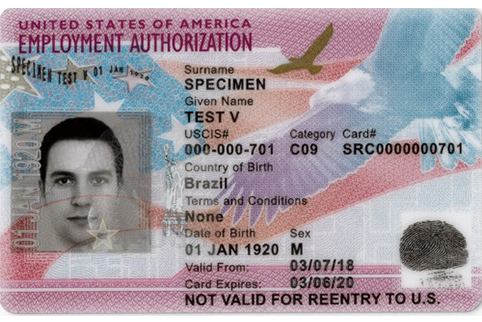
7 |
8 | ## Is the USCIS#
on an EAD the same as the holder's Alien Number?
9 | As of 2019, USCIS ominously states that *at this time*, the USCIS# on an EAD is just the holder's Alien Number, except that an Alien Number is written with a leading letter A
and the USCIS Number is not [12]. The [USCIS Glossary](https://www.uscis.gov/tools/glossary) has two separate entries for Alien Number
and USCIS Number
, which is an additional indication that at some point in the future, the two numbers may become different, but this hasn't occurred yet.
10 |
11 | ## How do I know whether I need an EAD?
12 | According to USCIS, there are three different categories of aliens who are eligible for work authorization in the US [2]:
13 |
14 | (a) Aliens whose status in the US authorizes them to work for any employer
15 | (b) Aliens whose status in the US authorizes them to work for a specific employer
16 | (c) Aliens whose status in the US makes them eligible to apply for employment authorization
17 |
18 | An alien described in section (a) is automatically work-authorized simply by virtue of their status. This category includes lawful permanent residents, asylees, refugees, and aliens with Temporary Protected Status (TPS) [3][44]. A lawful permanent resident is not issued an EAD, because the Green Card serves the equivalent purpose, but any other alien described in section (a) may apply for an employment authorization document to use as proof of their work authorization. Depending on the specific category, some aliens described in section (a) may also use alternative documents as proof of work authorization rather than an EAD (see for example [6]). If an alien described in section (a) chooses to be self-employed, then an EAD is not necessary; the EAD is evidence of employment authorization, but the employment authorization itself is an inherent aspect of their status.
19 |
20 | Aliens described in section (b) include [H-1B](H-1B.md), [L-1](L-1.md), and [TN](TN.md) nonimmigrants. These aliens are sponsored by a particular employer and do not receive an EAD [4].
21 |
22 | Aliens described in section (c) include international students, adjustment of status applicants, J-2 nonimmigrants, and some H-4 nonimmigrant spouses [5]. For example, a J-2 nonimmigrant may not begin working immediately upon their admission to the US, but rather, their J-2 status makes them eligible to apply for an EAD, and if the EAD is granted, then they are allowed to work in the US. Similarly, if an alien has a pending application for adjustment of status, this does not mean they are automatically work-authorized, but it means they can use their pending application to separately apply for work authorization.
23 |
24 | ## What does the category code mean on an EAD?
25 | The category code, such as C09
on the image shown above, refers to a particular paragraph of 8 CFR §274a.12: for example, if an alien requests an EAD based on 8 CFR §274a.12(c)(9), which means adjustment of status applicant, the alien's EAD will have the code C09
.
26 |
27 | As special cases, A17 means dependent spouse of E-1/E-2/E-3 worker, and A18 means dependent spouse of L-1 worker [13] but these categories are not mentioned in 8 CFR §274a.12.
28 |
29 | The codes C09P
and C16P
have the same meaning as C09
and C16
, respectively [16]. The letter P
means that the EAD is a combo card that also serves as Advance Parole (see below) [14][15].
30 |
31 | ## If I have an EAD, can I work for any employer?
32 | Aliens who are authorized employment incident to status (described in section (a)) are authorized to be employed in the United States without restrictions as to location or type of employment
[3], so they can work for any employer unless otherwise prohibited by law (*e.g.,* some employers must hire US citizens only).
33 |
34 | Aliens described in section (c) may be subject to restrictions on their employment, however most subcategories do not have any such restrictions.
35 |
36 | For instance, USCIS declined to impose any restrictions as to the occupations that H-4 EAD holders may work in [24]. This is also true of other dependent categories: if an alien is described in section (b), and if their dependents are eligible for work authorization under section (c), then the dependents' work authorization does not have the same restrictions as the principal alien; they can work in any occupation. These dependent subcategories are: A17, A18, C01, C02, C04, C05, C07, C12, C26, and C34. However, a C12 spouse does have the same geographical restriction as the principal [5].
37 |
38 | Some categories in section (c) are based on a pending application for a status that grants work authorization incident to status: for example, category C09 is based on a pending application for adjustment of status to lawful permanent resident (category A01). This eligibility category was codified in 1981. The INS explained that this discretionary grant of employment authorization was based on the alien's pending application for a permanent status in the United States [30], and indicated that some classes of employment authorized aliens such as H-1 and L-1 (listed in 8 CFR §109.1(a)(6), which later became 8 CFR §274a.12(b)) may only engage in employment consistent with their status, while imposing no such restriction on applicants for adjustment of status or asylum [29]. Adjustment of status applicants thus became eligible for unrestricted employment authorization, which is still the case today [25]. Other subcategories in this group are C08, C09, C10, C16, C19, C20, C22, and C24.
39 |
40 | Notably, however, the F-1 OPT EAD (C03A, C03B, or C03C) is restricted. The regulation states that "a student may apply to USCIS for authorization for temporary employment for optional practical training directly related to the student's major area of study." [28] USCIS and ICE have interpreted this to mean that the EAD, once granted, may only be used for employment related to the student's major [26][27]. For example, even if the F-1 nonimmigrant is maintaining employment related to their field of study at all times, they should not attempt to engage in unrelated side employment, such as driving for Uber or Lyft. ICE recommends that students maintain evidence that their employment is related to their degree. That being said, an OPT EAD holder is authorized for ordinary full-time employment, contract (*i.e.,* 1099
employment), and self-employment [27]. M-1 OPT EAD holders (category C06) are similarly restricted to employment in their field of study [5][26].
41 |
42 | ## How do I apply for an EAD?
43 | Refugees and some asylees [6] will receive an EAD without having to make a separate application. An alien who qualifies for an EAD (see above) but does not receive one automatically must file Form I-765 with the required evidence stated in the form instructions [7].
44 |
45 | ## If I have a valid and unexpired EAD, does that mean I am in the US legally?
46 | Not necessarily. For example, DACA beneficiaries qualify for EADs [5] but it is clear that they are not lawfully present in the US. However, in some cases, an EAD might be usable as evidence of legal status. For example, see [8].
47 |
48 | There is one situation where the approval of an EAD application actually gives legal status: if an F-1 international student obtains a post-completion OPT EAD, they receive a period of status until 60 days after their employment authorization expires [9].
49 |
50 | There is also one situation where the approval of an EAD application does not confer any status, but does protect the alien from unlawful presence, namely: when an alien holds a compelling circumstances EAD
(category (c)(35) or (c)(36)). The EAD prevents the alien from accruing unlawful presence for as long as it remains valid. In addition, unlawful presence also does not accrue while the application for the compelling circumstances EAD is pending, provided that the application was timely filed and non-frivolous. [10][11]
51 |
52 | In all other cases, when USCIS approves an EAD, they are *only* granting employment authorization to the applicant, and not any other immigration benefit.
53 |
54 | ## If my EAD expires, am I out of status?
55 | As mentioned above, approval of an EAD does not confer status. It therefore stands to reason that, when an EAD expires, it does not cause the bearer to lose status, either.
56 |
57 | This is particularly confusing for adjustment of status applicants, who sometimes assume that obtaining an EAD based on their pending I-485 gives them a temporary status that enables them to remain in status if their previous status expires or is otherwise lost. In actual fact, an alien who has properly filed a form I-485 is in a period of authorized stay
while their form I-485 is pending [46], regardless of whether they have an EAD or not. If an alien's EAD expires while form I-485 is still pending, therefore, the alien remains in authorized stay, but may lose work authorization.
58 |
59 | ## Do I need to carry my EAD with me when I am in the US?
60 | Unlike a green card, an EAD does not necessarily need to be carried by its holder at all times.
61 |
62 | There are two separate issues here. First, there is INA 264(e) [17], which requires aliens in the United States to carry proof of alien registration. An EAD *may* be used for this purpose [18]; an alien would only be obligated to carry their EAD if they had no other registration document. This issue is also discussed in the [general FAQ](general.md).
63 |
64 | However, another issue is that aliens may wish to carry with them proof that they have legal status or have complied with the immigration laws. While it is not legally required to carry such proof, it may help avoid unnecessary detention based on the suspicion that the alien is not lawfully present. Since an EAD will usually not constitute proof of authorized stay (see above), it is advised to carry the documents relating to the underlying basis of legal status or authorized stay. For example, if an alien has an expired I-94 but has timely filed an I-485, then a copy of the receipt notice should be carried since it is the pending I-485 that grants an authorized period of stay. Such an alien would have an authorized period of stay regardless of whether they had an EAD or not.
65 |
66 | ## What should I do if my EAD is lost or stolen?
67 | Technically, losing the physical card does not revoke your employment authorization but some aliens will not be able to complete Form I-9 without having the card in hand and would therefore be barred from starting new employment. To continue employment with the same employer or engage in self-employment, it is not required to replace the physical card as long as you are still within the validity period for which employment was authorized by USCIS, or you fall into a category for which employment authorization does not expire.
68 |
69 | If you do need to replace the physical card within its validity period (*e.g.,* to begin new employment) then you must file Form I-765 again and pay the required filing fee in order to replace the EAD [21]. Some categories of aliens are exempt from paying the fee for a *renewal* EAD, but a *replacement* of an EAD that is still within its validity period is different from a renewal. At the time of writing, the Form I-765 instructions state that a fee is always required for a replacement, except for adjustment of status applicants who paid the I-485 filing fee [21]. When filing for a replacement, be sure to carefully read the instructions that are in effect at the time of application.
70 |
71 | ## What should I do if my EAD has expired or is about to expire?
72 | An expired EAD cannot be used as evidence of employment authorization for Form I-9. If you used your EAD to establish employment authorization when you completed Form I-9, then your employer is required to reverify your employment authorization when your EAD expires [32]. At that point, you must show that you have a new or renewed EAD with a future expiration date, or some other evidence of employment authorization, otherwise your employer must terminate your employment. However, if your EAD is eligible for automatic extensions, then reverification can be completed using the receipt notice for the renewal (we will discuss this below).
73 |
74 | Aliens described in section (a) who are maintaining their status continue to be authorized for employment even if their EAD expires since they are employment authorized incident to status. Such aliens may be able to present some other proof of their employment authorization if they do not obtain a new or renewed EAD. They may also begin or continue any employment that does not require Form I-9, such as self-employment.
75 |
76 | For aliens described in section (c), however, their employment authorization expires when the EAD expires [33]. Such aliens cannot begin or continue any employment after the EAD expires unless they have obtained a new or renewed EAD, are eligible for an automatic extension (see below), or have some other employment authorization.
77 |
78 | Some types of EADs can be renewed. Form I-765 must be used to apply for a renewal EAD. Be sure to read the instructions [21] for details on whether your EAD can be renewed. The earliest date you can apply for a renewal is 180 days before your current EAD expires [31]. It is recommended that you apply as soon as possible since EAD processing times can be several months. If your EAD has already expired, you can still apply for a renewal, but you won't be eligible for an automatic extension.
79 |
80 | If you are applying for a renewal of an EAD/AP combo card, the same time frame applies: the earliest date you can file is 180 days before the expiration of your current card [43].
81 |
82 | ## What is the automatic 180-day extension for EADs?
83 | In some cases, applying to renew an EAD causes the original EAD's expiration date to be postponed by 180 days. In order for this automatic extension to occur, all of the following conditions must be met [35]:
84 |
85 | 1. The renewal I-765 application must have been filed while the original EAD is still unexpired. For example, if the last day of your EAD validity is April 27, 2020, then USCIS must receive the new I-765 on or before April 27, 2020. If there is any gap—for example, USCIS only receives the new I-765 on May 1, 2020—then the original EAD expires and the alien must wait for the new EAD to be approved.
86 | 2. The new EAD application must be for the same category as the original EAD; for example, if the original EAD had code A08 (Compact of Free Association) and the alien has filed an application for a C09 EAD (pending AOS) then the latter application would not cause the former EAD to be extended.
87 | 3. USCIS must have designated the EAD category as being eligible for automatic extensions.
88 |
89 | At the time of writing, the categories that are eligible for automatic extensions are A03, A05, A07, A08, A10, A12, A17, A18, C08, C09, C10, C16, C19, C20, C22, C24, C26, and C31 [50]. In order for a category to qualify for automatic extensions, it must be possible for the underlying basis of eligibility to continue beyond the original EAD expiration date without requiring a separate adjudication [34]. For example, a DACA beneficiary qualifies for an EAD because they have been granted deferred action, which means that in order to renew their EAD, they must apply for an additional period of deferred action. If the additional period of deferred action is not granted by USCIS, there is no basis for a further period of employment authorization. Therefore, DACA-based EADs (category C33) are not eligible for automatic extensions.
90 |
91 | For example, if an alien's C09 EAD reaches its printed expiration date when a renewal application is already pending, the original EAD, though expired on its face, is considered to be unexpired for the next 180 days. If the alien is completing Form I-9, they must present the original EAD together with the receipt notice for the renewal application in order to establish eligibility for employment [16][35]. An alien with a C09 EAD should still not procrastinate on filing for a renewal, just in case the renewal happens to take longer than 180 days to adjudicate (which is uncommon, but possible). If the renewal application is still pending 180 days after the original EAD's printed expiration date is reached, then the original EAD finally expires, and cannot be used anymore.
92 |
93 | If the renewal application is denied, then the automatic 180-day extension terminates [35]. In that case, an alien described in section (c) must stop working immediately even though their employer may not be notified about the denial. If the renewal application is approved, the alien should be reverified at some point before the end of the 180-day period.
94 |
95 | Note that in the case of H-4 EAD and L-2 EAD holders, since the underlying basis of eligibility is a nonimmigrant status, automatic extensions may not extend beyond the period of H-4 or L-2 status, respectively. See the [H-1B FAQ](H-1B.md#do-h-4-ead-holders-qualify-for-the-180-day-automatic-extension) and [L-1 FAQ](L-1.md#do-l-2-ead-holders-qualify-for-the-180-day-automatic-extension) for more details. Unfortunately, most H-4 EAD and L-2 EAD holders will not qualify for an automatic extension, because they typically have an I-94 that expires at the same time as the EAD itself. Thus, an H-4 EAD or L-2 EAD holder should make an effort to submit a renewal I-765 as early as possible and hope the new EAD is approved before the old one expires; otherwise they will have a gap in their employment authorization.
96 |
97 | There is one exception to rule 2 above: category codes A12 (Temporary Protected Status) and C19 (pending TPS), for the purposes of automatic EAD extensions, are considered as if they were the same code. A TPS EAD holder may also receive an automatic extension without having to apply for one, if such extension is announced in the Federal Register [16].
98 |
99 | Note that in the case of an EAD/AP combo card, filing for a renewal does extend the employment authorization, but does not extend the parole authorization.
100 |
101 | ## Did USCIS announce any additional eligibility for EAD extensions due to the COVID-19 pandemic?
102 | As of the time of writing (April 25, 2020), the answer is **no.** Although some news sources reported that USCIS announced automatic 240-day extensions of employment authorization, the [actual announcement by USCIS](https://www.uscis.gov/news/alerts/covid-19-delays-extensionchange-status-filings) **merely reiterates existing policy** regarding extensions of [H-1B status](H-1B.md#what-happens-if-my-employer-applies-to-extend-my-stay-but-my-i-94-expires-while-the-petition-is-pending) and other statuses that provide employment authorization as described in section (b). There is no special relief for aliens whose EADs are expiring or have expired.
103 |
104 | ## If I have an EAD, can my dependents receive an EAD?
105 | If you have an EAD, your spouse and children will often, but not always, be able to obtain an EAD in the same category. It is important to remember that their qualification for an EAD usually is derived *from their own status*, and not *from your EAD*.
106 |
107 | This distinction is often crucial in the case of C09 EADs. An alien qualifies for a C09 EAD if they have filed an I-485 and it is still pending. If a principal I-485 filer has obtained a C09 EAD, and they have a spouse or dependent children, those dependents usually can also file I-485s based on the principal's petition either concurrently with the principal or at a later time. This implies that:
108 |
109 | * If a dependent has filed an I-485, then they would also be able to obtain a C09 EAD.
110 | * If a dependent *cannot* file an I-485 (possibly because the dates have retrogressed since the principal filed) then they would not be able to get a C09 EAD. This is because C09 EAD eligibility is solely based on a pending I-485. One cannot apply for a C09 EAD on the basis that they are the dependent of a person who already has a C09 EAD.
111 | * If the principal doesn't need their C09 EAD for some reason, and chooses not to apply for one, but the dependents have their own pending I-485s, the dependents can apply for EADs without the principal. (However, since there is no application fee for most C09 EADs, this is not typical.)
112 |
113 | There is one exception to the general rule. This exception is for categories C35 and C36 (compelling circumstances with I-140) [35]:
114 |
115 | * Dependents of C35 EAD holders can apply for C36 EADs.
116 | * The dependent does not need to have a separate petition since the principal's I-140 petition will eventually be usable for adjustment of both the principal and dependents.
117 | * Dependents cannot be granted C36 EADs until the principal has been granted their C35 EAD.
118 |
119 | ## If I use my EAD based on a pending Adjustment of Status, does it violate my nonimmigrant status?
120 | Most employment-based adjustment of status applicants have valid nonimmigrant status (such as [H-1B](H-1B.md)) at the time of filing their I-485. They are not obligated to maintain status *after* form I-485 is filed [47]; failure to maintain status after the I-485 is filed will not result in a denial. Even still, many employment-based applicants prefer to maintain nonimmigrant status throughout the pendency of their I-485. This is a safeguard against the I-485 being denied for some other reason such as insufficient documentation. A noncitizen who still has nonimmigrant status at the time of their I-485 denial will still be lawfully present and can take some time to wrap up their affairs before leaving the US, seek an [extension](general.md#can-i-extend-my-nonimmigrant-status-without-leaving-the-us) or change of status, or file a second I-485 with more evidence. A noncitizen who doesn't have valid status anymore, and whose I-485 is denied, is usually required to immediately depart the US due to the lack of a valid status.
121 |
122 | Applicants who wish to maintain their nonimmigrant status while their I-485 is pending are occasionally faced with the following issue: typically, they will have filed form I-765 and received an EAD based on their pending I-485 (category (C)(9)). What will happen to their nonimmigrant status if they use the EAD to take up employment?
123 |
124 | Most lawyers believe that *any* use of a (C)(9) EAD will automatically terminate any nonimmigrant status that the noncitizen holds. Those lawyers advise their clients that if they wish to maintain nonimmigrant status, they can apply for a (C)(9) EAD and put it in a drawer somewhere in case they really need it, but when it comes to employment, they should act as if they don't have it. A minority of lawyers will advise clients that as long as they comply with all conditions of their nonimmigrant status, they can use their (C)(9) EAD to take up employment and still keep their nonimmigrant status.
125 |
126 | ### Why is this controversial?
127 | First, we should discuss the part that's *not* controversial. Regardless of whether an individual has an EAD or not, there are certain conditions of their nonimmigrant status that they must comply with, if they wish to keep that status. For example, in order for an H-1B worker to maintain status, they must have a valid employer-sponsored petition that covers their period of stay in the US, and they must actually do the job that the petition is based on. If they violate these conditions, their status is lost. This implies that if an H-1B worker quits the employer that sponsored their position, and uses their EAD to start working for a different employer without getting a new H-1B petition, they no longer meet the conditions of H-1B status and their H-1B status will automatically terminate [39].
128 |
129 | All immigration lawyers also agree that if an I-485 applicant simply files form I-765 to *obtain* a (C)(9) EAD, but never actually *uses* that EAD (*i.e.,* they only do activities that would have been legal without the EAD), then their status is not affected.
130 |
131 | Finally, it is clear from 8 CFR §214.1(e) that *any* unauthorized employment whatsoever causes the automatic termination of nonimmigrant status. For example, if an H-4 nonimmigrant doesn't have an EAD, but they start working anyway, they lose H-4 status. But lawyers do not all agree on what happens if a nonimmigrant *has* a (C)(9) EAD and uses it to take up employment. Employment that is performed by someone with a (C)(9) EAD is **authorized** employment, because a (C)(9) EAD confers unrestricted work authorization. Therefore, using a (C)(9) EAD to take up employment does not trigger 8 CFR §214.1(e).
132 |
133 | What lawyers disagree about is what happens in a situation where a nonimmigrant complies with all the terms of their status, but they *also* use their EAD. One example was given in the previous paragraph: an H-4 nonimmigrant using their (C)(9) EAD to work (normally, an H-4 nonimmigrant cannot work). Another example would be a full-time software engineer in H-1B status, who has a (C)(9) EAD, who continues doing their day job normally (as is required to maintain H-1B status), but also earns some extra income on the side as a career coach or a tutor for coding interviews. Again, as long as they have a valid EAD, this is *authorized* employment. But does it cause the termination of their H-1B status?
134 |
135 | ### The "you can't do that" point of view
136 | Most lawyers believe that any use of a (C)(9) EAD automatically causes the loss of nonimmigrant status in almost all cases: for example, any H-1B nonimmigrant would lose status if they used a (C)(9) EAD to start a side job, and an H-4 nonimmigrant can only work if they use a (C)(26) EAD (which is specific to H-4 nonimmigrants); any use of a (C)(9) EAD (based on adjustment of status) would result in the loss of H-4 status. These lawyers advise their clients not to use their (C)(9) EAD if they want to maintain their nonimmigrant status.
137 |
138 | These lawyers argue that complying with the terms of their nonimmigrant status while also using the (C)(9) EAD is inherently contradictory. For example, they would argue that H-1B status has an inherent condition to work *only* for the sponsoring employer(s), therefore, use of a (C)(9) EAD to take up side employment, while completely legal, is still failing to comply with the conditions of the H-1B status, therefore such status is lost. Similarly, they believe that H-4 status has an inherent condition to not work at all unless one is granted an H-4 EAD specifically (category (C)(26)); thus, the use of a (C)(9) EAD would violate the status.
139 |
140 | In support of this point of view is an old USCIS page [48] that says H-1B aliens may work for more than one U.S. employer, but must have a Form I-129 petition approved by each employer.
This seems to impose the condition that any employment by an H-1B nonimmigrant that is not based on an approved I-129 is unconditionally considered a violation of status (even if it is authorized anyway, due to having an EAD). However, this wording is no longer present on the USCIS website.
141 |
142 | This view is commonly believed by laymen as well, but for the wrong reason. Laymen typically believe that as you use your EAD, your nonimmigrant status automatically *changes* to EAD status
(sometimes referred to as being on EAD
). As we've explained on this page already, EAD is **not** a status, therefore this particular argument is without merit.
143 |
144 | ### The "only dependents can do it" point of view
145 | Some people argue that a *principal* employment-based nonimmigrant will lose their status if they use their (C)(9) EAD to take up side employment, but a *dependent* nonimmigrant, or a principal with some other kind of status, will be able to keep their status even if they use their (C)(9) EAD. (For some reason, it seems that lawyers rarely opine about this issue as it applies to dependent nonimmigrants.)
146 |
147 | The reasoning behind this point of view is the idea that employment-based principals, such as H-1B noncitizens, have an implicit condition of their status to only work for their sponsoring employer(s); for example an H-1B worker can only work for employers who have filed a form I-129. Therefore, they conclude that even when a noncitizen can *legally* work for some other employer thanks to having an EAD, it is still a status violation. However, they might still believe that a *dependent* nonimmigrant, such as H-4, is allowed to use their (C)(9) EAD while keeping their status, because there is no rule that says that H-4 status is incompatible with work. It's simply that H-4 nonimmigrants *by default* are not work-authorized. But if they somehow become work-authorized, then there is no problem with working and maintaining status at the same time.
148 |
149 | ### The "no rule says you can't do it" point of view
150 | A minority of lawyers believe that using a (C)(9) EAD to take up employment will not result in the termination of nonimmigrant status (as long as all conditions of the nonimmigrant status are met). However, this is mostly anecdotal and these lawyers have not given detailed legal reasoning. So we (the authors of the FAQ) will try to do so, even though we are not lawyers.
151 |
152 | To argue that one can maintain nonimmigrant status while also using their (C)(9) EAD, one could simply point out that the arguments for the other points of view are not convincing. Nowhere in the laws or regulations can we find a clear statement that an H-1B nonimmigrant may not engage in side employment (provided that they have found a way to make such side employment authorized, *i.e.* by obtaining an EAD), nor is there anything that says that a requirement of H-4 status is to only work using a (C)(26) EAD and not a (C)(9) EAD. An outdated USCIS web page [48] cannot be regarded as creating a binding legal requirement. Therefore, from this point of view, there no legal reason why the use of a (C)(9) EAD, in and of itself, should automatically and always result in the loss of H-1B or H-4 status. Since there is no legal basis for the termination of status, it means the status is maintained.
153 |
154 | This also implies that L-1 and H-1B nonimmigrants, and their dependents, who have applied for adjustment of status and use their (C)(9) EADs, can even continue extending their status afterward, since they are exempt from INA 214(b) [36][37][38].
155 |
156 | Some support for this view is found in [41], in which one H-1B nonimmigrant mentions being told by USCIS directly that they can maintain their status if they use the EAD for additional jobs, as long as they don't interfere with the primary job. An internet poster also said in [40] that they had no issue with extending H-4 status despite having used their (C)(9) EAD and admitting this fact to the immigration service. (If using the (C)(9) EAD truly resulted in a loss of H-4 status, it would not be possible to extend status, because you can only extend status while you're still in status.)
157 |
158 | Other evidence for this point of view is the fact that, if there really were a requirement to avoid using a (C)(9) EAD in order to maintain status, then one would imagine that USCIS would attempt to enforce it. When an alien applies for extension of stay, change of status, or adjustment of status, they must answer a question about whether they have ever engaged in unauthorized employment, since this can affect their eligibility for the benefit sought. But no USCIS form has any question of the form have you ever used an Employment Authorization Document to engage in any employment that was not authorized by your nonimmigrant status
, and USCIS does not receive this information automatically from anywhere either (since I-9 forms are retained by employers and not sent to USCIS). Since USCIS doesn't ask about this behaviour, it's evidence that they don't care.
159 |
160 | ### Conclusion
161 | The authors of this FAQ believe that a nonimmigrant, who complies with all terms of their status, can use a (C)(9) EAD to take up employment without terminating their status, because the contrary views are not well supported. This is, of course, ***not*** legal advice.
162 |
163 | As an aside, there is some evidence that USCIS has different rules for the compelling circumstances EAD ((C)(35) and (C)(36)). In some ways, USCIS seems to treat the compelling circumstances EAD as a pseudo-status (for example, C36 is like the dependent status
of C35 as described in the previous section). The Federal Register article that announced the introduction of the compelling circumstances EAD [42] also mentions several times that nonimmigrants may lose their nonimmigrant status if they use a compelling circumstances EAD. This should not be read as applying to (C)(9) EADs.
164 |
165 | ## Can I apply for an initial or renewal EAD while I am outside the United States?
166 | USCIS takes the position that an alien must be inside the United States in order to file Form I-765 [7][21][45]. It is not clear how strictly USCIS enforces this requirement, although the requirement to appear for biometrics for most EAD application types may serve as a (possibly unintentional) form of enforcement. It is generally not required to remain in the United States for the entire time while the I-765 is pending. However, one should be aware of the fact that departure from the United States may trigger the [abandonment of a pending change of nonimmigrant status](general.md#what-happens-if-i-travel-while-i-have-a-pending-application-to-change-my-nonimmigrant-status). If the EAD application is based on the status sought, it too must be denied. For example, if an alien in TD status files concurrently for a change of status to L-2 status, and an L-2 EAD, then leaves the US while the change of status is pending, the L-2 change of status will be denied. Since the L-2 change of status is denied, there is no basis to approve an L-2 EAD.
167 |
168 | ## Are E and L dependent spouses employment-authorized incident to status?
169 | The EAD category code A17 is used for almost all E spouse EADs (other than the special case of the E-1 TECRO and E-2 CNMI categories). The code A18 is used for L-2 EADs [13]. As of November 12, 2021, USCIS considers these dependent spouses to be employment authorized incident to status [51]. This means that, like lawful permanent residents, they derive automatic work authorization from their status, without needing any separate permission from USCIS in order to work, as long as they maintain that status.
170 |
171 | This has not always been the case, despite the fact that these category codes begin with the letter A
. In the past, USCIS policy was that E and L spouses could not work until USCIS granted them an EAD. At issue is the statutes [22][23] that authorize E and L spouses to engage in employment. These statues have the wording the Attorney General shall authorize the alien spouse to engage in employment in the United States
. One way to interpret this is that it requires USCIS to act affirmatively to grant employment authorization. This is the position that USCIS historically took. However, in the case *In re Do Kyung Lee* (BIA Nov. 5, 2013) [49] (concerning an E-2 spouse who was denied adjustment of status on the basis of unauthorized employment), the BIA rejected this interpretation and found that, since the federal regulations did not list E-2 spouses under the category of aliens who must apply for employment authorization
, the statute together with the absence of such a regulation implies that E-2 spouses are, in effect, employment authorized incident to status. Because this was an unpublished decision of the BIA, it did not create a binding precedent, and USCIS continued to follow its interpretation that E and L spouses are *not* employment authorized incident to status, and refused to allow evidence of E and L status to be used to complete I-9 verification. Eventually, DHS was sued directly in federal court [52] in the case *Shergill et al. v. Mayorkas*, alleging that USCIS policy was illegal. The case was settled when DHS finally agreed that E and L spouses are employment authorized incident to status.
172 |
173 | Although USCIS agreed as of November 12, 2021 to consider E and L dependent spouses to be employment-authorized incident of status, this did not immediately provide E and L dependent spouses with any way to complete Form I-9 other than by presenting a USCIS-issued EAD, which usually takes several months to obtain. Finally, on March 18, 2022, USCIS issued a policy alert stating that in the future, newly admitted E and L dependent spouses will receive an I-94 indicating their status as a dependent spouse and that can be used as a List C document for Form I-9 (thus obviating the need for an EAD). USCIS also stated that E and L dependent spouses who did not already have such I-94s would receive a separate notice that could be used to satisfy I-9 requirements. [53]
174 |
175 | # References
176 | [1] [Form I-9 Acceptable Documents - USCIS](https://www.uscis.gov/i-9-central/acceptable-documents/list-documents/form-i-9-acceptable-documents)
177 | [2] [8 CFR §274a.12](https://www.law.cornell.edu/cfr/text/8/274a.12)
178 | [3] *Ibid.*, (a)
179 | [4] *Ibid.*, (b)
180 | [5] *Ibid.*, (c)
181 | [6] [I am a refugee or asylee; How do I show my employer that I am authorized to work in the United States? - USCIS](https://www.uscis.gov/sites/default/files/USCIS/Resources/D2en.pdf)
182 | [7] [I-765, Application for Employment Authorization - USCIS](https://www.uscis.gov/i-765)
183 | [8] [REAL ID Frequently Asked Questions - DHS](https://www.dhs.gov/real-id-frequently-asked-questions)
184 | [9] [8 CFR §214.2(f)(10)(ii)(D)](https://www.law.cornell.edu/cfr/text/8/214.2#f_10_ii_D)
185 | [10] [81 FR 82425–82426](https://www.govinfo.gov/content/pkg/FR-2016-11-18/pdf/2016-27540.pdf)
186 | [11] [Employment Authorization in Compelling Circumstances - USCIS](https://www.uscis.gov/working-united-states/employment-authorization-compelling-circumstances)
187 | [12] [Instructions for Form I-9, Employment Eligibility Verification](https://www.uscis.gov/system/files_force/files/form/i-9instr.pdf)
188 | [13] [Employment Authorization Document Codes - USCIS](https://save.uscis.gov/web/media/resourcesContents/EAD_Code_Table.pdf)
189 | [14] [USCIS Employment Authorization Documents - Fiscal Year 2017 Report to Congress](https://www.dhs.gov/sites/default/files/publications/USCIS%20-%20USCIS%20Employment%20Authorization%20Documents_2.pdf)
190 | [15] [Special Advisory Regarding Combination Employment Authorization/Advance Parole Card - USCIS (retrieved August 24, 2019)](http://web.archive.org/web/20190824033529/https://www.uscis.gov/sites/default/files/ilink/docView/AFM/DATAOBJECTS/App55-5f.pdf)
191 | [16] [USCIS Handbook for Employers M-274, Section 4.4](https://web.archive.org/web/20211220105319/https://www.uscis.gov/i-9-central/form-i-9-resources/handbook-for-employers-m-274/40-completing-section-2-of-form-i-9/44-automatic-extensions-of-employment-authorization-documents-eads-in-certain-circumstances). Archived December 20, 2021 from [the original](https://www.uscis.gov/i-9-central/form-i-9-resources/handbook-for-employers-m-274/40-completing-section-2-of-form-i-9/44-automatic-extensions-of-employment-authorization-documents-eads-in-certain-circumstances).
192 | [17] [INA 264(e) (8 USC §1304(e))](https://www.law.cornell.edu/uscode/text/8/1304#e)
193 | [18] [8 CFR §264.1(b)](https://www.law.cornell.edu/cfr/text/8/264.1#b)
194 | [19] [81 FR p. 91654](https://www.govinfo.gov/content/pkg/FR-2016-12-19/pdf/2016-30459.pdf)
195 | [20] [8 CFR §1.4](https://www.law.cornell.edu/cfr/text/8/1.4)
196 | [21] [Instructions for Application for Employment Authorization](https://www.uscis.gov/sites/default/files/files/form/i-765instr.pdf)
197 | [22] [INA 214(c)(2)(E) (8 USC §1184(c)(2)(E))](https://www.law.cornell.edu/uscode/text/8/1184#c_2_E)
198 | [23] *Ibid.*, (e)(6)
199 | [24] [80 FR p. 10294](https://www.govinfo.gov/content/pkg/FR-2015-02-25/pdf/2015-04042.pdf)
200 | [25] [Murthy Law Firm - What You Want to Know About the Pending I-485-Based EAD](https://www.murthy.com/2011/01/07/what-you-want-to-know-about-the-pending-i-485-based-ead/)
201 | [26] [Students and Employment - USCIS](https://www.uscis.gov/working-united-states/students-and-exchange-visitors/students-and-employment)
202 | [27] [SEVP Policy Guidance 0801-02: Updates to Post-Completion Optional Practical Training](https://www.aila.org/File/DownloadEmbeddedFile/47746)
203 | [28] [8 CFR §214.2(f)(10)(ii)(A)](https://www.law.cornell.edu/cfr/text/8/214.2#f_10_ii_A)
204 | [29] [46 FR pp. 25079–25081](https://www.govinfo.gov/content/pkg/FR-1981-05-05/pdf/FR-1981-05-05.pdf)
205 | [30] [45 FR pp. 19563–19564](https://www.govinfo.gov/content/pkg/FR-1980-03-26/pdf/FR-1980-03-26.pdf)
206 | [31] [Employment Authorization Document - USCIS](https://www.uscis.gov/greencard/employment-authorization-document)
207 | [32] [Completing Section 3, Reverification and Rehires - USCIS](https://www.uscis.gov/i-9-central/complete-correct-form-i-9/completing-section-3-reverification-and-rehires)
208 | [33] [8 CFR §274a.14(a)(1)(i)](https://www.law.cornell.edu/cfr/text/8/274a.14#a_1_i)
209 | [34] [8 CFR §274a.13(d)](https://www.law.cornell.edu/cfr/text/8/274a.13#d)
210 | [35] [8 CFR §204.5(p)](https://www.law.cornell.edu/cfr/text/8/204.5#p)
211 | [36] [8 CFR §214.2(l)(16)](https://www.law.cornell.edu/cfr/text/8/214.2#l_16)
212 | [37] *Ibid.*, (h)(16)(i)
213 | [38] [9 FAM 402.10-10(A)(c)](https://fam.state.gov/FAM/09FAM/09FAM040210.html#M402_10_10_A)
214 | [39] [Cronin memo - INS, 2000](http://myattorneyusa.com/storage/upload/files/etc/memo-cronin-70-2-8-6-h-l-advance-parole-may-16-2000.pdf)
215 | [40] [How can H4 maintain legal status after using EAD? (Post #17)](https://forums.immigration.com/threads/how-can-h4-maintain-legal-status-after-using-ead.167419/#post-1208477)
216 | [41] [Concurrent work on EAD and H1B (Post #20)](https://forums.immigration.com/threads/concurrent-work-on-ead-and-h1b.277647/#post-2352761)
217 | [42] [Retention of EB-1, EB-2, and EB-3 Immigrant Workers and Program Improvements Affecting High-Skilled Nonimmigrant Workers (81 FR 82398–82492)](https://www.govinfo.gov/content/pkg/FR-2016-11-18/pdf/2016-27540.pdf)
218 | [43] You can get this information from Ask Emma
on the USCIS website, by asking When can I renew my combo card?
219 | [44] In a [2003 memo](https://www.hsdl.org/?view&did=20015), USCIS clarified that the language must apply to the Service for a
220 | document evidencing such employment
and as evidenced by an employment authorization document issued by the Service
do not mean that section (a) aliens need approval from USCIS in order to be employment-authorized. They receive employment authorization automatically when their status begins. However, some section (a) aliens cannot prove their employment authorization without an EAD, and so must apply to USCIS for an EAD before they can complete form I-9.
221 | [45] [Form I-765, 08/25/20 edition, page 4](https://www.uscis.gov/sites/default/files/document/forms/i-765.pdf)
222 | [46] USCIS-AFM 40.9.2(b)(3)(A), [archived May 7, 2020](http://web.archive.org/web/20200507080142/http://www.uscis.gov/ilink/docView/AFM/HTML/AFM/0-0-0-1/0-0-0-17138/0-0-0-18383.html#0-0-0-1885)
223 | [47] [USCIS-PM 7(B)(4)(G)](https://www.uscis.gov/policy-manual/volume-7-part-b-chapter-4#S-G)
224 | [48] [Who can an H-1B alien work for? (Wayback Machine)](http://web.archive.org/web/20100201141716/http://www.uscis.gov/portal/site/uscis/menuitem.5af9bb95919f35e66f614176543f6d1a/?vgnextoid=186aec897643f010VgnVCM1000000ecd190aRCRD&vgnextchannel=1847c9ee2f82b010VgnVCM10000045f3d6a1RCRD)
225 | [49] https://allusavisas.files.wordpress.com/2014/01/184439289-do-kyung-lee-a089-047-352-bia-nov-5-2013.pdf
226 | [50] [Automatic Employment Authorization Document (EAD) Extension - USCIS](https://web.archive.org/web/20220105085839/https://www.uscis.gov/working-in-the-united-states/information-for-employers-and-employees/automatic-employment-authorization-document-ead-extension). Archived January 5, 2022 from [the original](https://www.uscis.gov/working-in-the-united-states/information-for-employers-and-employees/automatic-employment-authorization-document-ead-extension).
227 | [51] [USCIS-PM 10(B)(2)](https://www.uscis.gov/policy-manual/volume-10-part-b-chapter-2)
228 | [52] https://www.wasdenbanias.com/shergill
229 | [53] https://www.uscis.gov/sites/default/files/document/policy-manual-updates/20220318-EmploymentAuthorization.pdf
230 |
--------------------------------------------------------------------------------
/EB.md:
--------------------------------------------------------------------------------
1 | ## What are the requirements for an individual to obtain an employment-based green card?
2 | * The individual must be admissible to the United States. This means they must not have any disqualifying conditions, such as certain immigration violations, certain criminal convictions, or a likelihood of becoming a public charge.
3 | * The individual must have a qualifying offer of *future* employment (see below for more details), and must intend to accept that job offer. Or, they must have exceptional ability in a particular field, and intend to work in that field in the United States. In all cases, USCIS must approve a visa petition for the individual, which is filed on Form I-140.
4 | * There must be an available immigrant visa for the individual. In other words, they must wait until other people who are in line ahead of them receive their green cards first.
5 |
6 | ## What do the acronyms EB-1, EB-2, and EB-3 stand for?
7 | These codes are [used by USCIS](https://www.uscis.gov/working-united-states/permanent-workers) to refer to the three levels of *preference* [10] for employment-based immigrants, into which most employment-based immigrants fall:
8 | 1. Aliens with extraordinary ability (EB-1A), outstanding professors and researchers (EB-1B), and multinational managers and executives (EB-1C).
9 | 2. Aliens with advanced degrees (master's or higher) or exceptional ability. [9]
10 | 3. Skilled workers, professionals, and other workers.
11 |
12 | Each preference level has its own annual quota. If the EB-1 quota is not completely used up, the unused numbers "spill over", that is, become available for EB-2 applicants. Likewise, any unused numbers from EB-2 spill over into EB-3 [10]. In general, fewer people qualify for EB-1 than EB-2 and fewer qualify for EB-2 than EB-3, so waiting times are usually shorter for EB-1 than EB-2 and shorter for EB-2 than EB-3. However, this is not always the case.
13 |
14 | ## What does it mean that EB applications are for future employment
?
15 | Many people imagine that an employment-based immigration system works roughly like this: you first need to get a work visa in the destination country, and then, after you've been working for a few years on a work visa, you can apply to convert the work visa into a permanent residence permit. Many countries do have such a system, including most countries in Europe, Australia, New Zealand, and Hong Kong.
16 |
17 | The United States immigration system, however, issues immigrant visas and green cards to qualified individuals based on the concept that the US has a need for certain types of permanent workers, and a permanent worker must have a green card—therefore, certain aliens may receive green cards *in order to convert them into permanent workers* that the US needs. A person who has worked in the US for many years under temporary worker status will not automatically qualify for a green card; they must establish that they will continue to be needed for an indefinite period of time in the future. Another person who has work experience outside the US, but has never been to the US, may be able to establish that the US needs them as a permanent worker; such a person would then be able to receive an immigrant visa, and receive a green card as soon as they enter the US. In both cases, the green card is issued on the basis of *prospective* employment.
18 |
19 | Thus, an employer can sponsor either a current *or* prospective employee for a green card, if they believe that employee is needed in the US on a permanent basis [29]. USCIS will grant or deny the petition filed by the employer, based on whether the position meets the legal requirements to be filled by a permanent foreign worker and whether the particular alien is qualified for that position [10]. If the petition is approved, the alien can apply for an immigrant visa [43] to enter the US or adjust their status within the US to lawful permanent resident [44]. Finally, having obtained permanent residence through their employer, the alien must do the job they were sponsored for on a permanent
basis, since the immigrant visa or status was granted specifically in order to allow them to do that job on a permanent basis [33]. (Note that permanent
does not mean eternal
. We will discuss this issue later.)
20 |
21 | The temporary and permanent work visa systems in the US are not directly related to each other, and it is incumbent upon the alien and their employer to determine which type of visa to apply for. Depending on one's qualifications and intents, one may apply for a temporary visa only, one may apply for a permanent visa only, or one may apply for a temporary visa first and then later make an application for a permanent visa, in which case the latter will be a totally separate process from the former. An employer may choose to initiate the temporary visa process and the permanent visa process for the same employee in parallel, as the former will typically have a shorter processing time.
22 |
23 | Note that there are some categories of employment-based immigrant visas that don't require a sponsoring employer (see below). However, the applicant, in those cases, must still establish that their skills are needed in the US on a permanent basis. The green card is issued to such an applicant based on the prospect of them rendering a benefit to the US by working in the US, in their area of expertise, on a permanent basis.
24 |
25 | ## So an employer can sponsor a green card even for someone who does not work for them?
26 | Yes. The fact that permanent work visas are granted on the basis of *prospective* future employment implies that the beneficiary of a permanent work visa does not necessarily have to work for the sponsoring employer *before* obtaining the visa (see *e.g.* [41] and [45]), but does have to work for the sponsoring employer *after* obtaining the visa. Most employers will *not* start the green card process for someone who is not currently on their payroll (since it is expensive and time-consuming), but the possibility exists. Another important implication is that during the green card application process, it is not whether you are employed
that matters, but rather whether a permanent job offer is available to you
, since the latter is the criterion for eligibility (see *e.g.* [41]). We will discuss these issues further in the following sections of this FAQ.
27 |
28 | In cases where a job offer is not required, a similar principle applies. An individual does not need to work in the US prior to obtaining the green card, but they must make a commitment to work in their field on a permanent basis after receiving the green card.
29 |
30 | ## Are there exceptions to the rule that EB green cards are for future employment?
31 | [Physicians in underserved areas](https://www.uscis.gov/greencard/physician-NIW) and [special immigrant religious workers](https://www.uscis.gov/working-united-states/permanent-workers/employment-based-immigration-fourth-preference-eb-4/special-immigrant-religious-workers) can earn
a green card by completing a certain required amount of employment in the US, although the purpose of these green card programs is still to allow these individuals to continue to render their services in the US on a permanent basis.
32 |
33 | [Employees of certain international organizations](https://www.uscis.gov/green-card/other-ways-get-green-card/green-card-international-organization-employees), with at least 15 years of tenure, can obtain green cards after their retirement. [47]
34 |
35 | ## What is the typical application process for employment-sponsored immigration?
36 | Most employment-based immigrants will fall under Third Preference or Second Preference (advanced degree, not exceptional ability) and will need to be sponsored by an employer and go through the following steps:
37 |
38 | 1. Labor certification, in which the employer must establish, and the Department of Labor must agree, that they need to fill a position in the United States and cannot fill it by hiring a U.S. worker [1][2][3][4].
39 | 2. Filing and approval of Form I-140, Immigrant Petition for Alien Worker by the sponsoring employer [5]. In this step, USCIS reviews the employer and the prospective employment, but also determines whether the particular alien has the requisite qualifications.
40 | 3. Filing and approval of Form I-485, Application to Register Permanent Residence or Adjust Status [6]. In this step, USCIS verifies that the alien still has an available job offer, and meets other requirements to immigrate to the United States related to (for example) health, criminal background, and national security issues.
41 |
42 | Arguably, there is also "step 0", which is to get a job that offers green card sponsorship in the first place, which is fairly difficult. Many software engineering jobs do offer green card sponsorship, but employers are usually only willing to start the green card process after the employee starts working at one of the employer's US offices, which is itself not always easy, given visa requirements. Outside the software engineering sector, relatively few jobs offer green card sponsorship. This is partially because step 1 is expensive and often difficult, which acts as a deterrent to sponsoring foreign nationals. Large tech companies such as Google usually have well-established procedures to maximize the chances of approval of the labor certification for software engineers and other technical employees. However, getting a labor certification approved can be a (sometimes insurmountable) challenge for smaller employers and for employers seeking to sponsor employees for non-STEM roles.
43 |
44 | The acronym *PERM*, referring to the electronic system for labor certification, is often used as a metonym for the labor certification process.
45 |
46 | Your *priority date* is the date on which the labor certification application was accepted for processing by the Department of Labor [7]. This priority date represents your place in line; other employment-based immigration applicants who filed before you will be eligible to receive an immigrant visa or adjustment of status from the annually limited pool before you. You can apply for adjustment of status once the cut-off date published by the State Department becomes later than your priority date [8]. If, upon labor certification approval, the cut-off date is later than your priority date, then you can file Forms I-140 and I-485 concurrently. Otherwise, your employer or authorized representative will file Form I-140 first, the approval of which "locks in" your priority date, and you will have to wait for your priority date to become current before you can file Form I-485.
47 |
48 | ## Which employment-based immigration categories don't require a sponsoring employer?
49 | Aliens with extraordinary ability may self-petition for EB-1A classification [21]. This petition does not require a sponsoring employer; the alien may file it on their own behalf. However, a prospective employer *may* be involved in the petitioning process (*e.g.,* by paying legal fees); indeed, a job offer with a high level of compensation may be used as one piece of evidence for the alien's claim to extraordinary ability [22].
50 |
51 | Aliens with exceptional ability, who believe that their employment in the United States would greatly benefit the nation, may self-petition for EB-2 classification and request a National Interest Waiver (NIW) in lieu of obtaining sponsorship from a US employer [23][24]. Again, a prospective employer *may* be involved, but does not have to be.
52 |
53 | ## Which employment-based immigration categories don't require a labor certification?
54 | The labor certification process usually takes several months (see below) so, if you're appropriately qualified, you might want to be apply for a category that doesn't require a labor certification, in order to get approved as quickly as possible.
55 |
56 | By statute, the labor certification requirement applies to EB-2 and EB-3 classifications [25]. Therefore aliens who apply for EB-1 classification for extraordinary ability, as outstanding professor or researcher, or multinational manager or executive, are not subject to the labor certification requirement [26][27][28]. Outstanding professors and researchers do require a job offer for an appropriate teaching or research position from an appropriate institution, but a labor certification is not required; only an offer letter from the institution is required [27]. Multinational managers and executives must, of course, have a qualifying job offer, and the employer must provide evidence that the job meets the requirements of the EB-1C classification, but still, no labor certification is required [28].
57 |
58 | Aliens with exceptional ability who qualify for an EB-2 National Interest Waiver (as discussed above) do not require a labor certification [24].
59 |
60 | In all cases, Form I-140 must be used [5], and if a sponsoring employer is required, then Form I-140 must be filed by the employer or authorized representative thereof [29]. So there are basically three sets of steps, depending on which classification you are seeking:
61 |
62 | * (EB-3 and most EB-2 cases) Find a sponsoring employer, have them file a labor certification, have them file Form I-140, and then file Form I-485; or
63 | * (EB-1B and EB-1C cases) Find an employer willing to offer you an appropriate position, have them file Form I-140 with an offer letter and other required evidence, and then file Form I-485; or
64 | * (EB-1A and EB-2 NIW cases) File form I-140, and then file form I-485.
65 |
66 | The EB-1A, EB-1B, and EB-2 NIW routes are therefore often faster than other routes, but relatively few people have a sufficient level of accomplishment to qualify for them.
67 |
68 | ## I don't think I have any skills that US-based workers don't have. Can my labor certification be approved?
69 | You may be more unique than you believe, and your employer, working together with a good immigration law firm, will try to make that case. Your employer might be sponsoring you for a role that requires experience in specific areas, say, MapReduce together with C++ API design. If you're an experienced software engineer, you probably have many skills that allow you to contribute to the company in a specific and valuable capacity. Even if you're a new grad, you might have done internships or taken specific courses where you learned such specific skills. If not, then in a couple of years, you might have acquired such skills through your full-time experience, and at that point you may be able to start the labor certification process.
70 |
71 | It does tend to be more difficult to hire foreign nationals on a permanent basis for non-STEM jobs, unfortunately. Many employers won't even try.
72 |
73 | ## How long does the labor certification process take?
74 | Between a few months and a year. When immigration lawyers tell you that it's difficult to predict how long this takes, they're not just hedging their words. It's actually quite unpredictable, since it involves three steps, each of which takes an uncertain amount of time:
75 | 1. Prevailing wage determination by the Department of Labor, in which the DOL determines how much compensation the employer must offer to U.S. workers in order to entice them to apply for the job;
76 | 2. Recruitment, in which your sponsoring employer attempts to recruit a U.S. worker for the position at the prevailing wage, and documents their failure to do so;
77 | 3. The application for the labor certification itself, submitted to DOL, which takes time to process, and which may or may not be audited by DOL (meaning that they don't believe the company and will watch them closely as they again attempt to recruit U.S. workers for the position), adding a few more months.
78 |
79 | The process can be sped up by "guessing" what the prevailing wage is going to be, and then recruiting at or above that wage level while waiting for the DOL to issue the prevailing wage determination. However, if the DOL's prevailing wage ends up being higher than anticipated, the recruitment process has to be started all over again at the prevailing wage.
80 |
81 | You are also responsible for obtaining letters signed by your former employers' HR departments, your former managers, or other individuals who can attest that you gained the experience required for the role in question while working with them. Typically, the employer's lawyers will draft a job description for your case and ask you to obtain letters from your previous employers that attest to the fact that you have all the qualifications in the job description. (This can occasionally be difficult.) If you're not able to obtain these letters in a timely fashion, the employer may not be willing to begin the recruitment and prevailing wage determination steps, since they will be useless unless you're able to get the required letters. If the employer begins the recruitment and prevailing wage determination but in the end, you're not able to obtain some of the letters, it will probably be necessary to edit the job description (to only contain qualifications you're actually able to prove) and begin the process over again. Thus, this can introduce delays.
82 |
83 | ## How long does the I-140 take?
84 | This question is usually easy to answer; USCIS provides a [website](https://egov.uscis.gov/processing-times/) where you can look up how backlogged they are. For example, if it tells you that they're currently processing I-140s filed 5 months ago, then you can estimate that your I-140 will take about 5 months to get approved. Unfortunately, that website appears to be broken at the time of writing this answer. Hopefully they'll fix it soon.
85 |
86 | It's possible to expedite the I-140 by paying a $1225 [premium processing](https://www.uscis.gov/forms/how-do-i-use-premium-processing-service) fee. If USCIS accepts the fee, they will either render a decision within 15 calendar days or refund the fee. Unfortunately, sometimes they will simply flat-out reject the fee, saying that premium processing isn't available at the moment.
87 |
88 | If your employer doesn't pay the premium processing fee for you, they may give you the option of paying it yourself. In cases where you will have to wait many years before filing the I-485, getting premium processing for the I-140 doesn't speed this up, because your priority date is determined by when the labor certification application was filed, not by when the I-140 gets approved. Nevertheless, Brian highly recommends getting premium processing, because the sooner your I-140 is approved, the sooner you can rest assured that your priority date has been locked in. Then, even if you are fired or laid off, or you quit, the priority date will be retained for future immigration applications by another employer (see below for more information).
89 |
90 | ## How long will I have to wait before my priority date becomes current?
91 | You are sorted into a bucket based on your preference category (EB-1, EB-2, or EB-3) and your country of birth. The reason why country of birth is relevant is that no more than 7% of the annual EB quota can be used by natives of any single country [11]. As a consequence of this rule:
92 | * EB-2 and EB-3 waiting times for people born in India are in the decades. The [December 2018 visa bulletin](https://travel.state.gov/content/travel/en/legal/visa-law0/visa-bulletin/2019/visa-bulletin-for-december-2018.html) shows that individuals who applied back in 2009 are having their priority dates become current this year. However, because of high numbers of applicants in recent years, the cut-off dates move forward by only 1 to 2 weeks per month. This means that if your priority date is in 2018 then you will probably have to wait for much longer than 9 years.
93 | * EB-2 and EB-3 waiting times are a few years for people born in (mainland) China.
94 | * Waiting times tend to be shorter for EB-2 and EB-3 applicants not born in China or India, and for EB-1 applicants. Often, these categories are "current", meaning that Form I-485 should be filed without delay.
95 |
96 | Note that EB-2 Advanced Degree, EB-2 Exceptional Ability, and EB-2 Exceptional Ability National Interest Waiver cases all have the same priority level. Getting a National Interest Waiver does not put you at the front of the EB-2 queue. Thus, Indians and Chinese cannot avoid the long waiting times by qualifying for a National Interest Waiver.
97 |
98 | You can find out which priority dates are becoming current each month by reading the [visa bulletin](https://travel.state.gov/content/travel/en/legal/visa-law0/visa-bulletin.html). You'll have to compare cut-off dates across multiple editions of the visa bulletin to get a sense of how quickly each bucket is moving.
99 |
100 | Unfortunately, USCIS doesn't publish information about how many people are waiting to adjust status in each bucket, so it's impossible to produce *accurate* estimates for when you'll reach the front of the line.
101 |
102 | ## I was born in India. What's the point of applying for a green card if I'll probably die of old age before I get it?
103 | Having an approved I-140 exempts you from the 6 year limit on [H-1B](H-1B.md) time [12][13]. Therefore, most Indians who want to work in the US indefinitely should apply for a green card and, while waiting, continue to extend their H-1B status. Otherwise, once they've used up their 6 years of H-1B time, they have to spend a year physically outside the US before they can qualify for H-1B status again [14].
104 |
105 | ## If I switch employers, do I have to start the whole green card process over again?
106 | The answer depends on whether or not the classification you're applying for requires a sponsoring employer.
107 |
108 | As discussed above, the EB-1A and EB-2 NIW classifications don't require a sponsoring employer. Therefore, the EB-1A and EB-2 NIW processes do not need to be restarted when changing employers. However, in order for your Form I-485 to be approved, you must continue to be eligible for the classification granted by your I-140 [30]; therefore switching *occupational fields* may cause issues, which we won't get into here, as it is not a common scenario.
109 |
110 | As the other categories are tied to a specific employer, and the Form I-140 filed by the employer is only valid for the job offer from that particular employer, you cannot move to the I-485 stage if the job offer on which Form I-140 was based is no longer available to you [31]. Usually (but not always), if you are going to switch jobs, it means you don't have the intention of working at the original employer anymore, and that employer is no longer holding a future job open for you, so that means there is no longer a valid job offer for immigration purposes, and it follows that you would need a new I-140 in order to move on to the I-485 stage.
111 |
112 | If your new I-140 is for a classification that requires a labor certification, then the new employer would have to go through the labor certification process. Any previous labor certification could not be re-used to file a new I-140 since the I-140 is for a specific job offer and the required labor certification would need to be for that particular job.
113 |
114 | However, once you have an approved Form I-140 for any EB-1, EB-2, or EB-3 classification, if you later file a new Form I-140 or have a new Form I-140 filed on your behalf, and it is also for an EB-1, EB-2, or EB-3 classification (it may be for the same classification as the old I-140, or for a different one) then the new Form I-140, when approved, would receive the priority date of the old I-140 [15]. Indeed, even if the previous employer withdraws the I-140 they filed on your behalf, this does not stop you from retaining the priority date according to the AC21 regulations [16][17], regardless of whether the new I-140 is filed before or after the old I-140 was revoked. **There is no 180-day waiting period for priority date retention; a priority date becomes portable as soon as the original I-140 is approved and withdrawal does not remove portability** (see below).
115 |
116 | Thus, once you find an employer willing to sponsor you for a green card, but you want to switch companies, it may be wise to wait until after the I-140 is approved before switching, thus ensuring that you will lock in your priority date as early as possible. If you are from an oversubscribed country—meaning that it will be many years before you're eligible to file Form I-485—you can switch employers without delaying the green card process, as long as you had an approved Form I-140 with the original employer, and the new employer is able to get a new Form I-140 approved by the time your priority date becomes current.
117 |
118 | If the new classification does not require a labor certification, then obviously it would not be necessary to redo the labor certification process. For example, an EB-1B researcher changing institutions would need a new Form I-140 filed by the new institution in order to demonstrate that there is a qualifying job offer from the new institution, but no labor certification would be required.
119 |
120 | The EB-1C classification is a special case because it requires the multinational manager or executive to have been employed by the *same* employer or by an affiliate or subsidiary outside the United States for at least 1 year (see [32] for more information). Therefore, if an alien with an approved EB-1C petition who is currently working for the sponsoring employer wishes to switch to a new employer, they would need a new I-140 filed by the new employer and if they wanted the new I-140 to also be in the EB-1C classification, they would need to leave the United States for 1 year to work for the new employer in order to be eligible for that new I-140. That being said, a beneficiary of an EB-1C petition may decide to seek a different classification such as EB-2 or EB-3 with the new employer, removing the need to leave the US for 1 year; the priority date could be retained. This may not be of much use for Indian beneficiaries, however, since a given priority date would take much longer to become current in the EB-2 or EB-3 classifications than in EB-1.
121 |
122 | There is a special I-485 portability rule that applies if your I-485 has been pending for at least 180 days, which eliminates the need for a new labor certification and new I-140 provided that the new employment is in "the same or a similar occupational classification" [18][19]. This portability rule is available for all classifications that require a job offer, namely EB-1B, EB-1C, EB-2 (except NIW), and EB-3. (An EB-1A or EB-2 NIW applicant would have no need for it.) We will discuss this portability rule further in a separate section below.
123 |
124 | ## What happens to my PERM or I-140 if I change my nonimmigrant status?
125 | In general, a change of status has absolutely no effect on the PERM or I-140 process. If the PERM or I-140 is pending, it continues to be pending. If the PERM or I-140 is approved, it remains approved. The reason for this is that every EB petition is a petition for future employment (see above). As long as the alien continues to maintain the intent to perform the qualifying employment *after they become a permanent resident*, and as long as the sponsoring employer (if required) continues to maintain the intent to employ the beneficiary *after they become a permanent resident*, the nonimmigrant status of the employee prior to obtaining permanent resident status is irrelevant.
126 |
127 | In particular, an EB-1C petition filed for an L-1A nonimmigrant remains valid if the L-1A nonimmigrant changes to some other status such as H-1B.
128 |
129 | ## Why should I wait for 180 days after I-140 approval before switching jobs?
130 | If an I-140 remains approved for at least 180 days before being withdrawn by the sponsoring employer, it *remains approved* despite having been withdrawn [20]. Thus, you might want to stay for 180 days so that your employer doesn't withdraw the I-140 within that time period, and the I-140 will remain approved after you leave.
131 |
132 | However, for priority date retention, this actually doesn't matter. Priority date retention under [16][17] only requires that you have an I-140 *that was once approved*. So even if it becomes revoked because the sponsoring employer withdrew it within 180 days, this doesn't affect your ability to retain the priority date. In other words, you can leave right after the I-140 is approved, and even if the employer withdraws it, you can still retain the priority date.
133 |
134 | Where it *does* matter is for post 6th-year H-1B extensions [13], which require a *currently approved* I-140. Thus, if an approved I-140 is withdrawn within 180 days of approval, that I-140 can no longer be used for post 6th-year H-1B extensions. If it is withdrawn after 180 days of approval, it remains approved and can still be used for post 6th-year H-1B extensions. Staying at the employer that sponsored the I-140 for at least 180 days after approval therefore helps to prevent possible interruption in your work authorization (due to possible ineligibility H-1B extensions) when you switch to a new employer.
135 |
136 | ## How can I port my I-485 to another job?
137 | First of all, if you are applying in the EB-1A or EB-2 NIW category, then your eligibility is not based on a particular job offer. Here, we will only be discussing the case where the I-485 is based on a specific job offer in the EB-1B, EB-1C, EB-2 (except NIW), or EB-3 categories.
138 |
139 | Recall that when you file Form I-485, it has to be based on an I-140 representing a valid *future* job offer. Note that if you have multiple approved I-140s, including some from job offers that have been withdrawn or are otherwise no longer valid, then you can file Form I-485 based on the earliest priority date. However, regardless of which I-140 you got your priority date from, your I-485 must be filed on the basis of one particular I-140 whose job offer is currently valid (meaning that the employer intends for you to begin or continue doing that job when your I-485 is approved) [37]. In effect, the I-485 is a petition for USCIS to grant you LPR status so that you can do that job on a permanent basis. ("Permanent" does not mean "eternal"; see below.)
140 |
141 | You do not necessarily need to be working for the sponsoring employer when your I-140 and I-485 are filed. However, the intent must exist for you to work there after your I-485 is approved. That intent must exist at both the time when the I-485 is filed, and at the time when it is adjudicated (usually several months later, although it can occasionally take up to 2 years) [37]. In many cases, the applicant will be working for the I-140 sponsor as a nonimmigrant worker (*e.g.*, in H-1B or L-1 status) at the time when the I-140 is filed, at the time when the I-485 is filed, and at the time when the I-485 is approved. In that case, the requisite job offer and intent exist throughout the process.
142 |
143 | However, once the I-485 has been pending for at least 180 days, you are allowed to "replace" the job offer that it is based on. That is, you may abandon the intent to work for the I-140 sponsor (or said sponsor may withdraw its intent to employ you), and the I-485 may be adjudicated on the basis of a different job offer: that is, at the time of adjudication, you must have the intent to do a job upon approval, but that job doesn't have to be the same one as the I-140 job. Furthermore, **a new I-140 is not required for the new job offer.** In order to qualify for this portability rule, the new job has to be in "the same or a similar occupational classification" as the I-140 job offer [18]. If this condition is not met, then a new I-140 would be required (including a new labor certification, in the EB-2 and EB-3 cases).
144 |
145 | In order to apply for I-485 portability, you have to complete Form I-485J, also known as Supplement J to Form I-485 [37]. Form I-485J can only be filed once Form I-485 has been pending for at least 180 days and a new job offer exists in the same or a similar occupational classification. You can file Supplement J prospectively in order to check whether USCIS considers your new job offer to be valid for porting, or you can file it when USCIS asks for it (such as in response to an RFE or NOID [38], or by bringing it to the interview). Some people have reported that Supplement J simply gets lost in the shuffle when filed prospectively, so this is not necessarily recommended. If you have some doubt about whether the new job offer is similar enough to the I-140 job offer, and the best strategy for filing Supplement J in your case, consult your prospective new employer's immigration attorney prior to accepting an offer. If you don't trust them, consult an attorney independently as well.
146 |
147 | ## Can I use I-485 portability if the I-140 is still pending?
148 | If you have filed Form I-485 based on an I-140 that was concurrently filed or pending, it's possible that once the I-485 has been pending 180 days, the I-140 is *also* still pending. In that case, you are still eligible for portability.
149 |
150 | When you submit Supplement J, if your I-140 is still pending, USCIS will first examine the facts to determine whether or not the I-140 *would have been approvable* if it had been adjudicated at the 180 day mark. If so, the I-140 will be approved, and then USCIS will adjudicate Supplement J. If the I-140 is denied, then portability cannot be granted. [38][39]
151 |
152 | To be more precise, when USCIS receives a Supplement J requesting portability, but the underlying I-140 is still pending, USCIS will approve the I-140 if it determines that:
153 | * the ability-to-pay requirement was met on the date when the I-140 was filed (not necessarily after), and
154 | * all other requirements for I-140 approval were met on the date when the I-140 was filed and continued to be met until the I-485 had been pending 180 days. [17][39]
155 |
156 | Porting with a pending I-140 is considered risky. Even if you believe that the I-140 should be approved, it's possible that USCIS will issue an RFE on the I-140, as the law firm acting on behalf of the I-140 employer may have made a mistake such as forgetting to submit some required document. (There are also allegations that USCIS sometimes asks for documents that shouldn't actually be required.) In that case, it's the I-140 employer's responsibility to provide the missing evidence in order to respond to the RFE, and they may not be interested in doing so for a former employee. If the RFE is not adequately addressed, the I-140 will be denied, and the applicant would have to start over with a new I-140.
157 |
158 | ## Can I use I-485 portability if the I-140 was withdrawn after approval?
159 | A revoked I-140 cannot be used as the basis for I-485 portability [40] and the revocation of the I-140 will therefore jeopardize a pending I-485 based on that I-140. However, if the withdrawal occurred when the associated I-485 had already been pending for at least 180 days, then the applicant retains eligibility for portability [17][20][48]. In other words, once the applicant hits the 180 day mark and becomes eligible to port their I-485, the original I-140 sponsor can no longer prevent portability by withdrawing the I-140.
160 |
161 | If USCIS finds that an I-485 **has been pending for at least 180 days** at the point when the underlying I-140 is withdrawn, USCIS will send a Notice of Intent to Deny (NOID) on the pending I-485 case because it is no longer based on a valid job offer [38][46]. In general, the applicant will be given 30 days to respond to an NOID. They will be expected to submit evidence of a new qualifying offer of employment
[46], which is done using Supplement J [38]. If the applicant is unable to provide satisfactory evidence of a qualifying job offer (for AC21 portability purposes) before the NOID response deadline, the I-485 will be denied. (Note that the deadline is not 30 days after the petitioner withdraws the I-140. It is 30 days after USCIS sends the NOID.) However, if the applicant provides a satisfactory response, USCIS will consider the I-485 to be ported to the new job offer.
162 |
163 | If USCIS finds that the I-485 **has not been pending 180 days** at the time when the I-140 is withdrawn, then there is a gap in eligibility between the time of the I-140 withdrawal and the time when the immigrant would become eligible for AC21 portability (*i.e.* 180 days after the I-485 filing) because a job offer is required for EB immigration, but the job offer has been rescinded. Any gap in eligibility for an immigrant benefit between the time of filing and the time of adjudication generally results in a denial [49]. Thus, USCIS will generally deny the I-485 in this situation. [46][48]
164 |
165 | Note that we have to be careful to distinguish between the *approval status of an I-140* and what happens to the I-485. If the I-485 has been pending less than 180 days but the I-140 has been approved for at least 180 days ago, then the I-140 *is not revoked* by the withdrawal [20] and it will remain valid for various purposes such as post 6th year H-1B extension eligibility. However, even though the I-140 is not revoked, the job offer is rescinded prior to the date when the immigrant can use AC21 portability. USCIS guidance is not totally explicit on this matter, but appears to state that the I-485 will be denied even though the I-140 is still approved [48].
166 |
167 | If the immigrant finds out that the petitioner has submitted a request to withdraw the I-140 less than 180 days after the I-485 was filed, then the immigrant should assume that the I-485 will be denied, even if USCIS has not taken any action as of 180 days after filing. This is because USCIS will note the date on which the I-140 withdrawal request was received, and will eventually review it when they are adjudicating the I-485 (whenever that happens to take place). For example, the following nightmare
scenario is possible:
168 |
169 | 1. Forms I-140 and I-485 are filed concurrently on April 1, 2019.
170 | 2. On April 16, 2019, USCIS approves Form I-140.
171 | 3. On June 14, 2019, the beneficiary is laid off and the employer withdraws the I-140. USCIS receives the withdrawal request, but does not process it immediately (and therefore does not issue any online update or send back any written correspondence).
172 | 4. On August 3, 2019, the beneficiary starts work at a new employer.
173 | 5. On December 1, 2019, the beneficiary attends the interview for their Form I-485, bringing along a signed Supplement J requesting portability to the new job offer as is standard practice. The beneficiary shows the Supplement J to the officer, but the officer explains that since the original I-140 was withdrawn on June 14, 2019, it is considered revoked as of June 14, 2019. Because of this, portability could not be used even though the interview date is more than 180 days after the I-485 was filed. Consequently, the officer denies the form I-485.
174 |
175 | Please keep in mind, however, that this only applies to the I-140 that is used as the basis for the I-485. If any earlier I-140s, which were solely used for priority date retention, were withdrawn, then this would not affect the I-485.
176 |
177 | ## Can I use I-485 portability if the I-140 was withdrawn prior to approval?
178 | Previously, we [discussed](#can-i-use-i-485-portability-if-the-i-140-is-still-pending) the fact that it is still possible, although risky, to use AC21 portability if the I-140 is still pending. It is, however, risky to do so, since the I-140 must be approvable
in order for this to succeed, and the beneficiary cannot know for sure that the I-140 is approvable until USCIS actually approves it.
179 |
180 | Beneficiaries may also be interested in the scenario where (either because their employment has been terminated, or for some other reason) the I-140 petitioner chooses to withdraw the I-140 before USCIS makes a decision. This scenario is similar to the previous one, and is explicitly discussed in the USCIS Policy Manual. The rule is that if the withdrawal occurs before the I-485 has been pending 180 days, then the I-485 is denied; but if the withdrawal occurs after the I-485 has been pending 180 days, then USCIS may determine that it is approvable (despite the fact that the original petitioner has withdrawn it) and permit the beneficiary to port their I-485 [48]. Again, it is risky for a beneficiary to attempt such porting, because they cannot be sure that the I-140 was approvable. However, if a beneficiary has ended up in this situation despite their best efforts, then attempting to port may help them receive their green card sooner than asking a new employer to start the PERM/I-140 process over again.
181 |
182 | ## Can I use I-485 portability if the I-140 job offer was rescinded but the I-140 itself was not?
183 | As discussed in the previous question, if the I-140 is withdrawn, then the I-485 will be denied unless, at the time the withdrawal request was submitted, the I-485 has already been pending for at least 180 days. However, there is an additional scenario that deserves some elaboration: the case where the employee is terminated (so that, in reality, the intent to employ no longer exists) but as a courtesy to the terminated employee, the employer *chooses not to withdraw the I-140*. This situation is common, since there is no legal requirement for an employer to withdraw an I-140 once it decides it no longer wishes to employ the beneficiary.
184 |
185 | For example, suppose that Form I-140 and Form I-485 are filed concurrently on Oct 1, 2019 with premium processing for the I-140. The I-140 is approved on Oct 16, 2019. On Jan 2, 2020, the employee is fired and it is clear that they will not be rehired, but the employer *does not withdraw the I-140*. In this case, what will happen to the employee's pending I-485?
186 |
187 | USCIS might become aware of the termination (for example because the employee had been in H-1B status, and the H-1B petition is withdrawn following termination), or they might not. However, USCIS will not, in general, be aware that the *future job offer* that is required for EB immigration has been withdrawn. (Only formal withdrawal of the I-140 would tell USCIS that the *future job offer* has been rescinded.) Because of this, USCIS might have to send a Request For Evidence (RFE) to ask the beneficiary to clarify whether they still have a qualifying job offer. They will typically be given 12 weeks to respond to the RFE, which means that by the time the response is due, the I-485 will typically have crossed the 180 day pending mark already, and the beneficiary will have had the opportunity to find a new job offer to port their I-485 to.
188 |
189 | A USCIS policy memo from 2005 [41] states that the fact that the employee was terminated should not, in and of itself, be the basis to deny a portability request, since the I-140 and I-485 are based on an offer of *future* employment. It then goes on to state:
190 |
191 | > However, in all cases an offer of employment must have been bona fide. This means that, as of the time the I-140 was filed and at the time of filing the I-485 if not filed concurrently, the I-140 petitioner must have had the intent to employ the beneficiary, and the alien must have intended to undertake the employment, upon adjustment. Adjudicators should not presume absence of such intent and may take the I-140 and supporting documents themselves as prima facie evidence of such intent, but in appropriate cases additional evidence or investigation may be appropriate.
192 |
193 | Thus, it appears that the USCIS policy described in the memo is as follows: when USCIS is considering a portability request, where the I-140 has not been withdrawn but the employee has left the sponsoring employer, USCIS will determine whether the intent to employ the applicant existed at two points in time: (1) the time when the I-140 was filed, and (2) the time when the I-485 was filed. USCIS will not require the beneficiary to submit evidence that the original job offer continued to be available through the 179th day after I-485 filing. Thus, portability would still be possible in the example scenario!
194 |
195 | This policy was made more explicit by the AC21 regulations, which explicitly state that there must be a valid job offer "at the time the application [...] is filed and at the time the [...] application [...] is adjudicated" [37]. This requirement thus doesn't appear to hold at any time in between. Thus, it is acceptable for the applicant to have lost their job offer at some point before the 180 day mark, provided that they then replace it with a new job offer (in the same or a similar occupational classification) at some point after the 180 day mark, before the I-485 is adjudicated.
196 |
197 | This appears to be an exception to the general rule that an applicant must maintain eligibility continuously from the time of filing (an I-485 or some other form) until the time of adjudication [49]. It seems that USCIS considers that an actionable break in eligibility does not actually exist as long as the I-140 has not actually been withdrawn. So long as the I-140 remains intact until the I-485 has been pending 180 days, the applicant can port after the 180 day mark is reached. Murthy Law Firm [has reported](http://web.archive.org/web/20120516182424/http://www.murthy.com/news/n_nuacp1.html) that they have had clients who have successfully ported in this situation.
198 |
199 | (There is another situation where a gap in eligibility does not result in I-485 denial: when the applicant must find a new job offer in order to use AC21 portability because their previous job offer was rescinded more than 180 days after the I-485 was filed. In general, this will take some time: for example, if the I-140 is withdrawn more than 180 days after the I-485 is filed, the applicant might take a month to find a new job, after which they could submit a supplement J and port their I-485 to the new job offer. USCIS does not require the immigrant to have a job offer *at all times* during the pendency of the I-485, because such a requirement would make it almost impossible to use AC21 portability. It would be an unnecessarily restrictive reading of the portability statute that is unlikely to be what Congress intended.)
200 |
201 | It should be emphasized, however, that USCIS could, at any point, ask the applicant and their employer to re-affirm the existence of a qualifying job offer by issuing an Request for Evidence (RFE) [34][38]. Generally, you will have 12 weeks to respond to an RFE. So, if the applicant happens to leave their employer and USCIS happens to issue an RFE early enough in the I-485 process—such that the 180 day mark will not be reached by the time the deadline for the RFE expires—the applicant will find themselves out of luck as they will not be able to request portability. The I-485 would be denied in such a situation.
202 |
203 | ## How long do I have to stay at my sponsoring employer after my green card is approved?
204 | An employment-based green card, or admission on an employment-based immigrant visa, is granted on the basis of future employment. In all cases, the alien must have the intent to engage in the qualifying employment *after* lawful permanent resident status is granted [26][33].
205 |
206 | In the case of EB-1B, EB-1C, EB-2 (except NIW), and EB-3 immigrants, the regulations [33] state that:
207 |
208 | > In all cases, the applicant and his or her intended employer must demonstrate the intention for the applicant to be employed under the continuing or new employment offer (including self-employment) described in paragraphs (a)(1) and (2) of this section, as applicable, within a reasonable period upon the applicant's grant of lawful permanent resident status.
209 |
210 | Many lawyers recommend staying at the sponsoring employer for 6 months after the green card is approved (or 6 months after admission using an immigrant visa, as the case may be). Some lawyers recommend a year. [35] There is no specific amount of time specified in the regulations. However, some individuals have reported that staying for less than 6 months caused them to be questioned about their actions when they eventually applied for naturalization.
211 |
212 | For example, in 2019, a user on Blind posted that 7 years ago, they had left their company after 3 months, and when they applied for citizenship, they were questioned about it by an immigration officer. The immigration officer was satisfied once he saw a letter the applicant provided stating that the job they switched to was for the same manager and the same responsibilities as the job offer their green card was based on. [36]
213 |
214 | Some observers believe that the passage of AC21 and its I-485 portability provision abrogated the requirement to stay with the sponsoring employer after I-485 approval. Their argument is that since one is allowed to switch employers 6 months after Form I-485 has been filed, and this does not cause the I-485 to be denied, it ought to be the case that switching after Form I-485 has already been *approved* should, likewise, not invalidate the approval of the I-485. However, this argument is contradicted by the clear wording of the regulations [33] (previously quoted). Paragraph (a)(3) states that the intent to be employed "within a reasonable period upon the applicant's grant of lawful permanent resident status" must exist with respect to either the original job offer on which the adjustment of status was based, or the new employment offer used for porting the I-485. That is, whichever job you have at the time of approval—whether it was the job offer in the I-140, or a new job offer that was used for porting—that is the one you must have the intent to remain at "within a reasonable period".
215 |
216 | Note that paragraph (a) also states:
217 |
218 | > An alien who has a pending application to adjust status to that of a lawful permanent resident based on an approved employment-based immigrant visa petition filed under section 204(a)(1)(F) of the Act on the applicant's behalf must have a valid offer of employment based on a valid petition at the time the application to adjust status is filed and at the time the alien's application to adjust status is adjudicated, and the applicant must intend to accept such offer of employment.
219 |
220 | Here, again, we see that the requirement to have a valid offer of employment, which the applicant intends to accept, applies both at the time of the I-485 filing and at the time of approval. In conclusion: despite the AC21 portability provisions, it remains true that the I-485 applicant, who was approved on the basis of a particular job offer, must be employed in that job for some time after approval.
221 |
222 | EB-1A and EB-2 NIW immigrants, if applying for adjustment of status, must sign a statement affirming that they intend to work in the occupational field of extraordinary or exceptional ability, respectively [34]. Again, there is no specific length of time required, but one could imagine that switching one's career to a totally different occupational field within 6 months would raise some red flags.
223 |
224 | # References
225 | [1] INA 212(a)(5)(A)(i) ([8 USC §1182(a)(5)(A)(i)](https://www.law.cornell.edu/uscode/text/8/1182#a_5_A_i))
226 | [2] [8 CFR §204.5(k)(4)(i)](https://www.law.cornell.edu/cfr/text/8/204.5#k_4_i)
227 | [3] [8 CFR §204.5(l)(3)(i)](https://www.law.cornell.edu/cfr/text/8/204.5#l_3_i)
228 | [4] [20 CFR §656.17(e)](https://www.law.cornell.edu/cfr/text/20/656.17#e)
229 | [5] [8 CFR §204.5(a)](https://www.law.cornell.edu/cfr/text/8/204.5#a)
230 | [6] [8 CFR §245.2(a)(3)](https://www.law.cornell.edu/cfr/text/8/245.2#a_3)
231 | [7] [8 CFR §204.5(d)](https://www.law.cornell.edu/cfr/text/8/204.5#d)
232 | [8] [8 CFR §245.1(g)(1)](https://www.law.cornell.edu/cfr/text/8/245.1#g_1)
233 | [9] The bar for "exceptional ability" is not as high as the bar for "extraordinary ability".
234 | [10] INA 203(b) ([8 USC §1153(b)](https://www.law.cornell.edu/uscode/text/8/1153#b))
235 | [11] INA 202(a)(2) ([8 USC §1152(a)(2)](https://www.law.cornell.edu/uscode/text/8/1152#a_2))
236 | [12] [AC21 §104(c)](https://www.congress.gov/bill/106th-congress/senate-bill/2045/text)
237 | [13] [8 CFR §214.2(h)(13)(iii)(E)](https://www.law.cornell.edu/cfr/text/8/214.2#h_13_iii_E)
238 | [14] [8 CFR §214.2(h)(13)(iii)(A)](https://www.law.cornell.edu/cfr/text/8/214.2#h_13_iii_A)
239 | [15] [8 CFR §204.5(e)(1)](https://www.law.cornell.edu/cfr/text/8/204.5#e_1)
240 | [16] [8 CFR §204.5(e)(2)](https://www.law.cornell.edu/cfr/text/8/204.5#e_2)
241 | [17] See also "Retention of EB-1, EB-2, and EB-3 Immigrant Workers...", [81 FR 82398](https://www.federalregister.gov/documents/2016/11/18/2016-27540/retention-of-eb-1-eb-2-and-eb-3-immigrant-workers-and-program-improvements-affecting-high-skilled), where this is stated explicitly.
242 | [18] INA 204(j) ([8 USC §1154(j)](https://www.law.cornell.edu/uscode/text/8/1154#j))
243 | [19] [USCIS Policy Memorandum 602-0122.1](https://www.uscis.gov/sites/default/files/USCIS/Laws/Memoranda/2016/Final_Same_or_Similar_Policy_Final_Memorandum_3-18-16.pdf)
244 | [20] [8 CFR §205.1(a)(3)(iii)(C)](https://www.law.cornell.edu/cfr/text/8/205.1#a_3_iii_C)
245 | [21] INA 204(a)(1)(E) ([8 USC §1154(a)(1)(E)](https://www.law.cornell.edu/uscode/text/8/1154#a_1_E))
246 | [22] [8 CFR §204.5(h)(3)(ix)](https://www.law.cornell.edu/cfr/text/8/204.5#h_3_ix)
247 | [23] [8 CFR §204.5(k)(1)](https://www.law.cornell.edu/cfr/text/8/204.5#k_1)
248 | [24] *Ibid.*, (k)(4)(ii)
249 | [25] INA 212(a)(5)(D) ([8 USC §1182(a)(5)(D)](https://www.law.cornell.edu/uscode/text/8/1182#a_5_D))
250 | [26] [8 CFR §204.5(h)(5)](https://www.law.cornell.edu/cfr/text/8/204.5#h_5)
251 | [27] *Ibid.*, (i)
252 | [28] *Ibid.*, (j)(5)
253 | [29] INA 204(a)(1)(F) ([8 USC §1154(a)(1)(F)](https://www.law.cornell.edu/uscode/text/8/1154#a_1_F))
254 | [30] USCIS-AFM 23.5(f)(1), [archived May 11, 2020](http://web.archive.org/web/20200511012136/https://www.uscis.gov/ilink/docView/AFM/HTML/AFM/0-0-0-1/0-0-0-8624/0-0-0-9232.html#0-0-0-1583)
255 | [31] [8 CFR §245.25(a)(1)](https://www.law.cornell.edu/cfr/text/8/245.25#a_1)
256 | [32] [8 CFR §204.5(j)(3)(i)](https://www.law.cornell.edu/cfr/text/8/204.5#j_3_i)
257 | [33] [8 CFR §245.25(a)(3)](https://www.law.cornell.edu/cfr/text/8/245.25#a_3)
258 | [34] [Form I-485 Instructions](https://www.uscis.gov/sites/default/files/files/form/i-485instr.pdf)
259 | [35] [Murthy Law Firm: Changing Employers After Receiving Employment-Based Green Card](https://www.murthy.com/2019/07/29/changing-employers-after-receiving-employment-based-green-card/)
260 | [36] https://www.trackitt.com/usa-discussion-forums/i140/2040986077/switching-jobs-after-i-485-approval
261 | [37] [8 CFR §245.25(a)](https://www.law.cornell.edu/cfr/text/8/245.25#a)
262 | [38] [I-485 Supplement J Instructions](https://www.uscis.gov/system/files_force/files/form/i-485supjinstr.pdf?download=1)
263 | [39] [8 CFR §245.25(a)(2)(ii)(B)](https://www.law.cornell.edu/cfr/text/8/245.25#a_2_ii_B)
264 | [40] *Ibid.*, (a)(2)(iii)
265 | [41] [Interim guidance for processing I-140 employment-based immigrant petitions and I-485 and H-1B petitions affected by the American Competitiveness in the Twenty-First Century Act of 2000 (AC21) (Public Law 106-313))](https://www.uscis.gov/sites/default/files/USCIS/Laws/Memoranda/Static_Files_Memoranda/Archives%201998-2008/2005/ac21intrm122705.pdf)
266 | [42] See [17], but note specifically the wording (emphasis mine): "This provision was intended to build upon existing DHS policies that have governed the validity of Form I-140 petitions in the event of withdrawal or business termination **before and after** beneficiaries are eligible to change jobs or employers under INA 204(j)."
267 | [43] [9 FAM 502.4](https://fam.state.gov/FAM/09FAM/09FAM050204.html)
268 | [44] [8 CFR §245.2(a)(2)(i)(B)](https://www.law.cornell.edu/cfr/text/8/245.2#a_2_i_B)
269 | [45] [81 FR 82416](https://www.govinfo.gov/content/pkg/FR-2016-11-18/pdf/2016-27540.pdf)
270 | [46] USCIS-AFM 20.2(c), [archived April 11, 2020](http://web.archive.org/web/20200411010520/https://www.uscis.gov/ilink/docView/AFM/HTML/AFM/0-0-0-1/0-0-0-2872/0-0-0-2977.html#0-0-0-1473)
271 | [47] The US does not issue green cards to these individuals while they are still employed, since it would be inappropriate from a foreign policy perspective. They must be retired so that the US does not have the appearance of compromising their ability to perform their official duties. However, this restriction does not apply to the children of these individuals, who may receive green cards after completing 7 years of residence.
272 | [48] [7 USCIS-PM E.5.B.3](https://www.uscis.gov/policy-manual/volume-7-part-e-chapter-5#S-B-3)
273 | [49] [8 CFR §103.2(b)(1)](https://www.law.cornell.edu/cfr/text/8/103.2#b_1)
274 |
--------------------------------------------------------------------------------