├── X7.png
├── X0-4.png
├── ccby.png
├── Modulform.pdf
├── quat-domain.png
├── Errata-Modulform.pdf
├── Errata-Modulform-old.pdf
├── Errata-Modulform-v1.pdf
├── Makefile
├── Errata-Modulform.tex
├── font-setup-open.tex
├── AJerrata.cls
├── myarrows.sty
├── Modulform.tex
├── README.md
├── Errata-Modulform-v1.tex
├── titles-setup.tex
├── coverpage.tex
├── mycommand.sty
├── Errata-Modulform-v0.tex
├── AJbook.cls
├── app3.tex
├── LICENSE
├── quat-domain.svg
├── intro.tex
├── X0-4.svg
└── app1.tex
/X7.png:
--------------------------------------------------------------------------------
https://raw.githubusercontent.com/wenweili/Modulform/HEAD/X7.png
--------------------------------------------------------------------------------
/X0-4.png:
--------------------------------------------------------------------------------
https://raw.githubusercontent.com/wenweili/Modulform/HEAD/X0-4.png
--------------------------------------------------------------------------------
/ccby.png:
--------------------------------------------------------------------------------
https://raw.githubusercontent.com/wenweili/Modulform/HEAD/ccby.png
--------------------------------------------------------------------------------
/Modulform.pdf:
--------------------------------------------------------------------------------
https://raw.githubusercontent.com/wenweili/Modulform/HEAD/Modulform.pdf
--------------------------------------------------------------------------------
/quat-domain.png:
--------------------------------------------------------------------------------
https://raw.githubusercontent.com/wenweili/Modulform/HEAD/quat-domain.png
--------------------------------------------------------------------------------
/Errata-Modulform.pdf:
--------------------------------------------------------------------------------
https://raw.githubusercontent.com/wenweili/Modulform/HEAD/Errata-Modulform.pdf
--------------------------------------------------------------------------------
/Errata-Modulform-old.pdf:
--------------------------------------------------------------------------------
https://raw.githubusercontent.com/wenweili/Modulform/HEAD/Errata-Modulform-old.pdf
--------------------------------------------------------------------------------
/Errata-Modulform-v1.pdf:
--------------------------------------------------------------------------------
https://raw.githubusercontent.com/wenweili/Modulform/HEAD/Errata-Modulform-v1.pdf
--------------------------------------------------------------------------------
/Makefile:
--------------------------------------------------------------------------------
1 | MAINFILE=Modulform
2 | ERRATA=Errata-Modulform
3 | LATEXMK=latexmk
4 |
5 | default:
6 | # Generating $(MAINFILE).pdf
7 | $(LATEXMK) -pdf -pdflatex="xelatex -synctex=1 -shell-escape -interaction=nonstopmode %O %S" $(MAINFILE)
8 |
9 | nosync:
10 | # Generating $(MAINFILE).pdf
11 | $(LATEXMK) -pdf -pdflatex="xelatex -shell-escape -interaction=nonstopmode %O %S" $(MAINFILE)
12 |
13 | errata:
14 | # Generating $(ERRATA).pdf
15 | $(LATEXMK) -pdf -pdflatex="xelatex -shell-escape -interaction=nonstopmode %O %S" $(ERRATA)
16 |
17 | clean:
18 | # Cleaning...
19 | @rm -f *.aux *.log *.idx *.ind *.thm *.toc *.blg *.bbl *.bcf *.out
20 | @rm -f *.fls *.fdb_latexmk *.run.xml *.synctex.gz *.xdv *~ *.lof *.lot
21 | @rm -f .metadonnees*
22 |
23 | tarball:
24 | @rm -f ../Modulform.tar.zst
25 | @tar --exclude .git -cf ../Modulform.tar.zst .
26 |
27 | .PHONY: clean
28 |
--------------------------------------------------------------------------------
/Errata-Modulform.tex:
--------------------------------------------------------------------------------
1 | %!TEX TS-program = xelatex
2 | %!TEX encoding = UTF-8
3 |
4 | % LaTeX source for the errata of the book ``模形式初步'' in Chinese
5 | % Copyright 2023 李文威 (Wen-Wei Li).
6 | % Permission is granted to copy, distribute and/or modify this
7 | % document under the terms of the Creative Commons
8 | % Attribution 4.0 International (CC BY 4.0)
9 | % http://creativecommons.org/licenses/by/4.0/
10 |
11 | % 《模形式初步》勘误表 / 李文威
12 | % 使用自定义的文档类 AJerrata.cls. 自动载入 xeCJK.
13 |
14 | \documentclass{AJerrata}
15 |
16 | \usepackage{unicode-math}
17 |
18 | \usepackage[unicode, colorlinks, psdextra, bookmarksnumbered,
19 | pdfpagelabels=true,
20 | pdfauthor={李文威 (Wen-Wei Li)},
21 | pdftitle={模形式初步勘误},
22 | pdfkeywords={}
23 | ]{hyperref}
24 |
25 | \setmainfont[
26 | BoldFont={texgyretermes-bold.otf},
27 | ItalicFont={texgyretermes-italic.otf},
28 | BoldItalicFont={texgyretermes-bolditalic.otf},
29 | PunctuationSpace=2
30 | ]{texgyretermes-regular.otf}
31 |
32 | \setsansfont[
33 | BoldFont=FiraSans-Bold.otf,
34 | ItalicFont=FiraSans-Italic.otf
35 | ]{FiraSans-Regular.otf}
36 |
37 | \setCJKmainfont[
38 | BoldFont=Noto Serif CJK SC Bold
39 | ]{Noto Serif CJK SC}
40 |
41 | \setCJKsansfont[
42 | BoldFont=Noto Sans CJK SC Bold
43 | ]{Noto Sans CJK SC}
44 |
45 | \setCJKfamilyfont{emfont}[
46 | BoldFont=FandolHei-Regular.otf
47 | ]{FandolHei-Regular.otf} % 强调用的字体
48 |
49 | \renewcommand{\em}{\bfseries\CJKfamily{emfont}} % 强调
50 |
51 | \setmathfont[
52 | Extension = .otf,
53 | math-style= TeX,
54 | ]{texgyretermes-math}
55 |
56 | \usepackage{mathrsfs}
57 | \usepackage{stmaryrd} \SetSymbolFont{stmry}{bold}{U}{stmry}{m}{n} % 避免警告 (stmryd 不含粗体故)
58 | % \usepackage{array}
59 | % \usepackage{tikz-cd} % 使用 TikZ 绘图
60 | \usetikzlibrary{positioning, patterns, calc, matrix, shapes.arrows, shapes.symbols}
61 |
62 | \usepackage{myarrows} % 使用自定义的可伸缩箭头
63 | \usepackage{mycommand} % 引入自定义的惯用的命令
64 |
65 | \newcommand{\bomega}{\symbf{\omega}} % Boldface omega, for sheaves of differentials
66 |
67 | \title{\bfseries 《模形式初步》勘误表 \\ 跨度: 2024 年 8 月迄今}
68 | \author{李文威}
69 | \date{\today}
70 |
71 | \begin{document}
72 | \maketitle
73 |
74 | \begin{Errata}
75 | \item[定义 A.6.1 的第一个显示公式]
76 | \Orig $f(c + iy) \ll (1 + |y|)^M$
77 | \Corr $F(c + iy) \ll (1 + |y|)^M$
78 | \Thx{感谢王子宣指正}
79 |
80 | \item[定义 B.1.1 最后的显示公式]
81 | \Orig $\rho^W_{V_i}$
82 | \Corr $\rho^V_{W_i}$
83 | \Thx{感谢王子宣指正}
84 | \end{Errata}
85 | \end{document}
86 |
--------------------------------------------------------------------------------
/font-setup-open.tex:
--------------------------------------------------------------------------------
1 | % Copyright 2020 李文威 (Wen-Wei Li).
2 | % Permission is granted to copy, distribute and/or modify this
3 | % document under the terms of the Creative Commons
4 | % Attribution 4.0 International (CC BY 4.0)
5 | % http://creativecommons.org/licenses/by/4.0/
6 |
7 | % 目的: 字体相关设置, 呼叫相关宏包.
8 | % 将由 AJbook.cls 引入
9 | % 必须提供 \kaishu, \songti, \heiti, \thmheiti, \fangsong 几种字型切换命令, 在文档类中使用.
10 | \ProvidesFile{font-setup-open.tex}[2018/03/04]
11 |
12 | % 设置 xeCJK 字体及中文数字
13 | %\setmainfont{TeX Gyre Pagella} % 设置西文衬线字体
14 | \setmainfont[
15 | BoldFont={TeX Gyre Termes Bold},
16 | ItalicFont={TeX Gyre Termes Italic},
17 | BoldItalicFont={TeX Gyre Termes Bold Italic},
18 | PunctuationSpace=2
19 | ]{TeX Gyre Termes}
20 |
21 | \setsansfont[
22 | BoldFont=FiraSans-Bold.otf, ItalicFont=FiraSans-Italic.otf]{FiraSans-Regular.otf}
23 | \RequirePackage{unicode-math}
24 | %\setmathfont{Asana-Math.otf}
25 | \setmathfont
26 | [Extension = .otf,
27 | math-style= TeX,
28 | % BoldFont = texgyrepagella-bold,
29 | % BoldItalicFont = texgyrepagella-bolditalic,
30 | % ItalicFont = texgyrepagella-italic,
31 | %]{xits-math}
32 | BoldFont = XITSMath-Bold.otf,
33 | BoldItalicFont = XITS-BoldItalic.otf
34 | ]{XITSMath-Regular}
35 |
36 | \setmathfont[version=bold]{XITSMath-Bold.otf} % Set the "bold version", for use in emphasized situations.
37 |
38 |
39 | \setCJKmainfont[
40 | BoldFont=FandolSong-Bold.otf,
41 | ItalicFont=FandolKai-Regular.otf,
42 | ]{FandolSong-Regular.otf}
43 |
44 | \setCJKsansfont[
45 | BoldFont=FandolHei-Bold.otf,
46 | ]{FandolHei-Regular.otf}
47 |
48 | \setCJKmonofont[
49 | BoldFont=FandolHei-Bold.otf,
50 | ]{FandolHei-Regular.otf}
51 |
52 | \setCJKfamilyfont{kai}[
53 | BoldFont=FandolKai-Regular.otf, ItalicFont=FandolKai-Regular.otf
54 | ]{FandolKai-Regular.otf}
55 |
56 | \setCJKfamilyfont{song}[
57 | BoldFont=FandolSong-Bold.otf,
58 | ItalicFont=FandolKai-Regular.otf
59 | ]{FandolSong-Regular.otf}
60 |
61 | \setCJKfamilyfont{fangsong}[
62 | BoldFont=FandolSong-Bold.otf,
63 | ItalicFont=FandolKai-Regular.otf
64 | ]{FandolFang-Regular.otf}
65 |
66 | \setCJKfamilyfont{hei}[
67 | BoldFont=FandolHei-Bold.otf,
68 | ItalicFont=FandolHei-Regular.otf
69 | ]{FandolHei-Regular.otf}
70 |
71 | \setCJKfamilyfont{hei2}[
72 | ]{Noto Sans CJK SC}
73 |
74 | \setCJKfamilyfont{sectionfont}[
75 | BoldFont=* Black
76 | ]{Noto Sans CJK SC}
77 |
78 | \setCJKfamilyfont{chapterfont}[
79 | BoldFont=* Black]
80 | {Noto Serif CJK SC} % 各章章名字体
81 |
82 | \setCJKfamilyfont{pffont}[
83 | BoldFont=* Medium]
84 | {Noto Sans CJK SC} % 证明用的字体
85 |
86 | \setCJKfamilyfont{emfont}[
87 | BoldFont=FandolHei-Regular.otf]
88 | {FandolHei-Regular.otf} % 强调用的字体
89 |
90 | \defaultfontfeatures{Ligatures=TeX}
91 | \XeTeXlinebreaklocale "zh"
92 | \XeTeXlinebreakskip = 0pt plus 1pt minus 0.1pt
93 |
94 | % 以下设置字体相关命令, 用于定理等环境中.
95 | \newcommand\kaishu{\CJKfamily{kai}} % 楷体
96 | \newcommand\songti{\CJKfamily{song}} % 宋体
97 | \newcommand\heiti{\CJKfamily{hei}} % 黑体
98 | \newcommand\thmheiti{\CJKfamily{hei2}} % 用于定理名称的黑体
99 | \newcommand\fangsong{\CJKfamily{fangsong}} % 仿宋
100 | \renewcommand{\em}{\bfseries\mathversion{bold}\CJKfamily{emfont}} % 强调
101 |
--------------------------------------------------------------------------------
/AJerrata.cls:
--------------------------------------------------------------------------------
1 | % The class file for the book project 《代数学方法》-- Errata
2 | % Copyright 2018 李文威 (Wen-Wei Li).
3 | % Permission is granted to copy, distribute and/or modify this
4 | % document under the terms of the Creative Commons
5 | % Attribution 4.0 International (CC BY 4.0)
6 | % http://creativecommons.org/licenses/by/4.0/
7 |
8 | % Identification
9 | % --------------
10 | \NeedsTeXFormat{LaTeX2e}
11 | \ProvidesClass{AJerrata}[2018/12/08 Class for the errata for the book project Methods of Algebra]
12 |
13 | % Package loading
14 | % ---------------------
15 | % 基于 book class, 选项一并载入.
16 |
17 | \LoadClass[10pt]{article}
18 |
19 | \RequirePackage{fontspec} % XeLaTeX
20 | \RequirePackage[CJKchecksingle]{xeCJK} % XeCJK
21 | \RequirePackage{zhnumber} % 中文数字转换
22 |
23 | % 引入 AMS 宏包 + mathtools
24 | \RequirePackage[intlimits]{amsmath}
25 | \RequirePackage{amssymb}
26 | \RequirePackage[centercolon]{mathtools}
27 |
28 | % 引入 tcolorbox 和 xcolor
29 | \RequirePackage[svgnames]{xcolor}
30 | \RequirePackage[many]{tcolorbox}
31 |
32 | % 载入 paralist 以制作列表
33 | \RequirePackage{paralist}
34 |
35 | \RequirePackage[iso, english]{isodate} % 使 \today 印出 yyyy-mm-dd
36 |
37 | \setlength{\parindent}{2em} % 设置适合于汉语排版的段落缩进
38 |
39 | \defaultfontfeatures{Ligatures=TeX}
40 | \XeTeXlinebreaklocale "zh"
41 | \XeTeXlinebreakskip = 0pt plus 1pt minus 0.1pt
42 |
43 | \RequirePackage{zhlineskip} % 设置适合中文排版的间距
44 |
45 | % 排版``原文''方块
46 | \newtcbox{\OriginalBox}{
47 | enhanced,
48 | nobeforeafter,
49 | tcbox raise base,
50 | boxrule = 0.4pt,
51 | arc = 0mm,
52 | top = 0mm,
53 | bottom = 0mm,
54 | right = 0mm,
55 | left = 0.5mm,
56 | right skip = 4mm,
57 | boxsep = 2pt,
58 | colframe = red!70!black,
59 | coltext=red!60!black,
60 | colback=yellow!10!white,
61 | fontupper = \sffamily,
62 | overlay = {
63 | \coordinate (A) at (frame.north east);
64 | \coordinate (B) at (frame.south east);
65 | \coordinate (C) at ($(A)!.5!30:(B)$);
66 | \fill[color=red!70!black] (A) -- (B) -- (C) --cycle;
67 | }
68 | }
69 |
70 | % 排版``更正''方块
71 | \newtcbox{\CorrectionBox}{
72 | enhanced,
73 | nobeforeafter,
74 | tcbox raise base,
75 | boxrule = 0.4pt,
76 | arc = 0mm,
77 | top = 0mm,
78 | bottom = 0mm,
79 | right = 0mm,
80 | left = 0.5mm,
81 | right skip = 4mm,
82 | boxsep = 2pt,
83 | colframe = green!70!black,
84 | coltext=green!60!black,
85 | colback=green!10!white,
86 | fontupper = \sffamily,
87 | overlay = {
88 | \coordinate (A) at (frame.north east);
89 | \coordinate (B) at (frame.south east);
90 | \coordinate (C) at ($(A)!.5!30:(B)$);
91 | \fill[color=green!70!black] (A) -- (B) -- (C) --cycle;
92 | }
93 | }
94 |
95 | \newcommand{\Orig}{\OriginalBox{原文}} % ``原文''命令
96 | \newcommand{\Corr}{\;\CorrectionBox{更正}} % ``更正''命令
97 | \newcommand{\Thx}[1]{\hspace{1em}\hfill\textsf{\footnotesize #1}} % ``感谢''命令
98 |
99 | \AtEndPreamble{
100 | % 设置页面尺寸
101 | \RequirePackage{geometry}
102 | \geometry{
103 | paper=b5paper,
104 | headheight=5ex,
105 | headsep=5ex,
106 | textwidth=132mm,
107 | textheight=198mm,
108 | twoside,
109 | % bindingoffset=18pt,
110 | asymmetric % 单双数页不分
111 | }
112 |
113 | \renewcommand{\descriptionlabel}[1]{$\diamond$ {\bfseries #1}\hspace{1em}}
114 | \newenvironment{Errata}{%
115 | \begin{description}%
116 | }{ % 结束
117 | \end{description}
118 | }
119 | }
120 |
--------------------------------------------------------------------------------
/myarrows.sty:
--------------------------------------------------------------------------------
1 | % Copyright 2018 李文威 (Wen-Wei Li).
2 | % Permission is granted to copy, distribute and/or modify this
3 | % document under the terms of the Creative Commons
4 | % Attribution 4.0 International (CC BY 4.0)
5 | % http://creativecommons.org/licenses/by/4.0/
6 |
7 | \NeedsTeXFormat{LaTeX2e}
8 | \ProvidesPackage{myarrows}[2020/06/30 Package for extendable arrows]
9 | \RequirePackage{amsmath}
10 | \RequirePackage{tikz-cd}
11 |
12 | % 以下用 tikz 定义可伸缩箭头, 不用 amsmath 和 extarrows 的版本以免 unicode-math 产生问题. 代码借自 Antal Spector-Zabusky
13 | % 重定义 \xrightarrow[below]{above}
14 | \makeatletter
15 | \newbox\xratbelow
16 | \newbox\xratabove
17 | \renewcommand{\xrightarrow}[2][]{%
18 | \setbox\xratbelow=\hbox{\ensuremath{\scriptstyle #1}}%
19 | \setbox\xratabove=\hbox{\ensuremath{\scriptstyle #2}}%
20 | \pgfmathsetlengthmacro{\xratlen}{max(\wd\xratbelow, \wd\xratabove) + .6em}%
21 | \mathrel{\tikz [->, baseline=-.75ex]
22 | \draw (0,0) -- node[below=-2pt] {\box\xratbelow}
23 | node[above] {\box\xratabove}
24 | (\xratlen,0) ;}}
25 | % 重定义 \xlefttarrow[below]{above}
26 | \renewcommand{\xleftarrow}[2][]{%
27 | \setbox\xratbelow=\hbox{\ensuremath{\scriptstyle #1}}%
28 | \setbox\xratabove=\hbox{\ensuremath{\scriptstyle #2}}%
29 | \pgfmathsetlengthmacro{\xratlen}{max(\wd\xratbelow, \wd\xratabove) + .6em}%
30 | \mathrel{\tikz [<-, baseline=-.75ex]
31 | \draw (0,0) -- node[below] {\box\xratbelow}
32 | node[above] {\box\xratabove}
33 | (\xratlen,0) ;}}
34 | % 重定义 \xleftrightarrow[below]{above}
35 | \renewcommand{\xleftrightarrow}[2][]{%
36 | \setbox\xratbelow=\hbox{\ensuremath{\scriptstyle #1}}%
37 | \setbox\xratabove=\hbox{\ensuremath{\scriptstyle #2}}%
38 | \pgfmathsetlengthmacro{\xratlen}{max(\wd\xratbelow, \wd\xratabove) + .6em}%
39 | \mathrel{\tikz [<->, baseline=-.75ex]
40 | \draw (0,0) -- node[below] {\box\xratbelow}
41 | node[above] {\box\xratabove}
42 | (\xratlen,0) ;}}
43 | % 重定义 \xhookrightarrow[below]{above}, 使用 tikz-cd 的 hookrightarrow
44 | \renewcommand{\xhookrightarrow}[2][]{%
45 | \setbox\xratbelow=\hbox{\ensuremath{\scriptstyle #1}}%
46 | \setbox\xratabove=\hbox{\ensuremath{\scriptstyle #2}}%
47 | \pgfmathsetlengthmacro{\xratlen}{max(\wd\xratbelow, \wd\xratabove) + .6em}%
48 | \mathrel{\tikz [baseline=-.75ex]
49 | \draw (0,0) edge[commutative diagrams/hookrightarrow] node[below] {\box\xratbelow}
50 | node[above] {\box\xratabove}
51 | (\xratlen,0) ;}}
52 | % 重定义 \xhooklefttarrow[below]{above}, 使用 tikz-cd 的 hookleftarrow
53 | \renewcommand{\xhookleftarrow}[2][]{%
54 | \setbox\xratbelow=\hbox{\ensuremath{\scriptstyle #1}}%
55 | \setbox\xratabove=\hbox{\ensuremath{\scriptstyle #2}}%
56 | \pgfmathsetlengthmacro{\xratlen}{max(\wd\xratbelow, \wd\xratabove) + .6em}%
57 | \mathrel{\tikz [baseline=-.75ex]
58 | \draw (0,0) edge[commutative diagrams/hookleftarrow] node[below] {\box\xratbelow}
59 | node[above] {\box\xratabove}
60 | (\xratlen,0) ;}}
61 |
62 | % 重定义 \xmapsto[below]{above}, 使用 tikz-cd 的 mapsto
63 | \renewcommand{\xmapsto}[2][]{%
64 | \setbox\xratbelow=\hbox{\ensuremath{\scriptstyle #1}}%
65 | \setbox\xratabove=\hbox{\ensuremath{\scriptstyle #2}}%
66 | \pgfmathsetlengthmacro{\xratlen}{max(\wd\xratbelow, \wd\xratabove) + .6em}%
67 | \mathrel{\tikz [baseline=-.75ex]
68 | \draw (0,0) edge[commutative diagrams/mapsto] node[below] {\box\xratbelow}
69 | node[above] {\box\xratabove}
70 | (\xratlen,0) ;}}
71 |
72 | % 定义 \xlongequal[below]{above}, 使用 tikz-cd 的等号
73 | \newcommand{\xlongequal}[2][]{%
74 | \setbox\xratbelow=\hbox{\ensuremath{\scriptstyle #1}}%
75 | \setbox\xratabove=\hbox{\ensuremath{\scriptstyle #2}}%
76 | \pgfmathsetlengthmacro{\xratlen}{max(\wd\xratbelow, \wd\xratabove) + .6em}%
77 | \mathrel{\tikz [baseline=-.75ex]
78 | \draw (0,0) edge[commutative diagrams/equal] node[below] {\box\xratbelow}
79 | node[above] {\box\xratabove}
80 | (\xratlen,0) ;}}
81 | \makeatother
82 |
83 | \endinput
84 |
--------------------------------------------------------------------------------
/Modulform.tex:
--------------------------------------------------------------------------------
1 | %!TEX TS-program = xelatex
2 | %!TEX encoding = UTF-8
3 |
4 | % 以 XeLaTeX 编译
5 | % LaTeX source for book ``模形式初步'' in Chinese
6 | % Copyright 2020 李文威 (Wen-Wei Li).
7 | % Permission is granted to copy, distribute and/or modify this
8 | % document under the terms of the Creative Commons
9 | % Attribution 4.0 International (CC BY 4.0)
10 | % http://creativecommons.org/licenses/by/4.0/
11 |
12 | \documentclass[
13 | % draftmark = false,
14 | % colors = false,
15 | CJKthechapter = false,
16 | coverpage = coverpage.tex,
17 | % coverpage = coverpage.pdf,
18 | fontsetup = font-setup-open.tex,
19 | titlesetup = titles-setup.tex
20 | ]{AJbook}
21 |
22 | \usepackage{tikz-cd} % 使用 TikZ 绘图
23 | \usetikzlibrary{matrix, positioning, backgrounds, shapes.arrows, arrows, patterns, calc} % 导入所需的 TikZ 库
24 | \usepackage{tkz-euclide} % 导入 tkz-euclide 用于封面绘制等.
25 |
26 | \usepackage{pgfplots} % 使用 PGF 描绘函数图形
27 | \pgfplotsset{compat=newest}
28 |
29 | \usepackage{stmaryrd} \SetSymbolFont{stmry}{bold}{U}{stmry}{m}{n} % 避免警告 (stmryd 不含粗体故)
30 |
31 | \usepackage{myarrows} % 使用自定义的可伸缩箭头
32 | \usepackage{mycommand} % 引入自定义的惯用的命令
33 |
34 | % 生成索引: 选用 xindy
35 | \usepackage[xindy, splitindex]{imakeidx}
36 | \makeindex[columns=2, program=truexindy, intoc=true, options=-M texindy -I xelatex -C utf8, title={名词索引暨英译}] % 名词索引
37 | \makeindex[columns=3, program=truexindy, intoc=true, options=-M numeric-sort -M latex -M latex-loc-fmts -M makeindex -I xelatex -C utf8, name=sym1, title={符号索引}] % 符号索引
38 |
39 | \usepackage[unicode, bookmarksnumbered]{hyperref} % 启动超链接和 PDF 文档信息所需
40 | % 设置 PDF 文件信息
41 | \hypersetup{
42 | pdfauthor = {李文威 (Wen-Wei Li)},
43 | pdftitle = {模形式初步},
44 | pdfkeywords = {Modular forms},
45 | CJKbookmarks=true} % 避免 Improper alphabetic constant 问题
46 |
47 | % Modular forms
48 | \newcommand{\modact}[1]{\;\ensuremath{\big|_{#1} \;}}
49 | \newcommand{\twomatrix}[4]{ \ensuremath{\bigl(\begin{smallmatrix} #1 & #2 \\ #3 & #4 \end{smallmatrix}\bigr)} }
50 | \newcommand{\twobigmatrix}[4]{ \ensuremath{\begin{pmatrix} #1 & #2 \\ #3 & #4 \end{pmatrix}} }
51 | \newcommand{\sumprime}{\sideset{}{'}\sum}
52 | \newcommand{\Div}{\operatorname{Div}}
53 | \newcommand{\Jac}{\operatorname{Jac}}
54 | \newcommand{\HkT}{\ensuremath{\mathbb{T}}}
55 | \newcommand{\Mat}{\operatorname{M}}
56 | \newcommand{\charfcn}{\symbf{1}} % The characteristic function 1
57 | \newcommand{\innerp}[2]{\ensuremath{\left( #1 \middle| #2 \right)}} % Inner product
58 | \newcommand{\innerPet}[2]{\innerp{#1}{#2}_{\mathrm{Pet}}} % Petersson inner product
59 | \newcommand{\bomega}{\symbf{\omega}} % Boldface omega, for sheaves of differentials
60 |
61 | % 用 bibLaTeX 引入书目库
62 | \addbibresource{Modulform.bib}
63 |
64 | % 公式和图片按节编号
65 | \numberwithin{equation}{section}
66 | \numberwithin{figure}{section}
67 | %\renewcommand{\theequation}{\thesection--\arabic{equation}}
68 |
69 | % 脚注格式手动定制
70 | \renewcommand{\thefootnote}{\arabic{footnote})}
71 |
72 | \begin{document}
73 | \frontmatter % 制作封面和目录.
74 |
75 | \mainmatter % 正文开始
76 | \include{intro}
77 | \include{chap1}
78 | \include{chap2}
79 | \include{chap3}
80 | \include{chap4}
81 | \include{chap5}
82 | \include{chap6}
83 | \include{chap7}
84 | \include{chap8}
85 | \include{chap9}
86 | \include{chap10}
87 |
88 | \appendix
89 | \include{app1}
90 | \include{app2}
91 | \include{app3}
92 |
93 | \backmatter
94 |
95 | % 使用 bibLaTeX 制作书目
96 | \printbibliography[heading=bibintoc]
97 |
98 | % 制作索引: 先是符号索引, 继而是名词索引暨英译
99 | {\footnotesize
100 | \printindex[sym1]
101 | \indexprologue{中文术语按汉语拼音排序.}
102 | \printindex
103 | % 如有需要, 加入表格和图片索引
104 | % \cleardoublepage
105 | % \phantomsection
106 | % \addcontentsline{toc}{chapter}{\listfigurename}
107 | % \listoffigures
108 | % \cleardoublepage
109 | % \phantomsection
110 | % \addcontentsline{toc}{chapter}{\listtablename}
111 | % \listoftables
112 | }
113 |
114 | \end{document}
115 |
--------------------------------------------------------------------------------
/README.md:
--------------------------------------------------------------------------------
1 | This is the LaTeX source for the textbook **Introduction to modular forms** (in Chinese: 模形式初步), revised version (August 2024).
2 |
3 | The book has been published by Science Publishing (Beijing), June 2020. ISBN: 978-7-03-064531-9; the revised version (2024) is in print. The PDF version and the errata are also available on the author's web page.
4 |
5 | # How to compile
6 |
7 | ## System requirements
8 | The files are to be compiled using XeLaTeX with the xeCJK package. The reader is assumed to work under the UN*X + bash environment.
9 |
10 | The recipes below can be tweaked to work under Windows, but this is not recommended. The simplest solution is to go open-source.
11 |
12 | We only need the standard packages and fonts, such as
13 | - [TeX Live](https://tug.org/texlive), including the programs latexmk, xindy and biber.
14 | - Standard fonts included in TeX Live, in particular the Fandol fonts. For some strange reason I used and installed the TeX Gyre Termes fonts in the system. In case of error messages related to these fonts, please look for the OTF files (inside the directories in your computer which store TeX-related fonts) whose names start with **texgyretermes**, and install them manually in your system.
15 | - The **Noto Sans CJK SC** fonts from [Noto CJK](https://github.com/googlei18n/noto-cjk), which should also be installed system-wide.
16 |
17 | The author apologizes for these strange configurations of fonts. One may also try to modify these settings in the file font-setup-open.tex.
18 |
19 | Please make sure that all the relevant packages/programs are installed. For reference, the author made the compilation using Arch-based Linux distributions with TeX Live 2020; the packages **biber** and **texlive-science** are required.
20 |
21 | ## Clone the files
22 | Assume that [Git](https://git-scm.com/) has been installed on your computer. As a preparation for the compilation process, we will clone the files into `~/Modulform` in our home directory. In command line, type
23 | ```
24 | cd ~
25 | git clone https://github.com/wenweili/Modulform
26 | ```
27 |
28 | All the source files are encoded in UTF-8, the de facto standard for storing multilingual texts. If you encounter problems in opening the source files under Windows, try to re-configure your editor or convert the encoding manually.
29 |
30 | ## Compile the TeX source
31 |
32 | Make sure that the necessary pacakges and fonts are installed and move to the directory we just cloned
33 | ```
34 | cd ~/Modulform
35 | ```
36 | Then, either type
37 | ```
38 | latexmk -pdf -pdflatex="xelatex -shell-escape -interaction=nonstopmode %O %S" Modulform
39 | ```
40 | under bash, or more simply
41 | ```
42 | make
43 | ```
44 |
45 | Have a cup of coffee since this will take several minutes. The resulting PDF file should appear as **Modulform.pdf** in the same directory. Note that the main file is **Modulform.tex**.
46 |
47 | To clean up everything in our directory except the PDF file, type
48 | ```
49 | make clean
50 | ```
51 |
52 | # The document class AJbook
53 | The book is written in the **AJbook** class (AJbook.cls). The document class is originally designed for the book [Methods of Algebra, Volume 1](https://github.com/wenweili/AlJabr-1). Please refer to that page for further illustrations.
54 |
55 | # The errata
56 | The errata is produced from **Errata-Modulform.tex**, which is based on the really simple document class file **AJerrata.cls** bundled with the **AJbook** class. Apart from the standard fonts bundled with TeX, it also depends on **Noto Serif CJK SC** and **Noto Sans CJK SC**; you can install them from [Noto CJK fonts](https://github.com/googlei18n/noto-cjk).
57 |
58 | To compile the errata, type
59 | ```
60 | xelatex Errata-Modulform
61 | ```
62 | or
63 | ```
64 | make errata
65 | ```
66 | in the same directory.
67 |
68 | # Feedback
69 | In case of problems of compilation, please kindly report to the author. Make sure that all the system requirements above are met, and provide detailed error messages. Other suggestions are also welcome.
70 |
71 | # License
72 | The entire codebase is under [CC BY 4.0](http://creativecommons.org/licenses/by/4.0/).
73 |
74 | # Star History
75 |
76 | [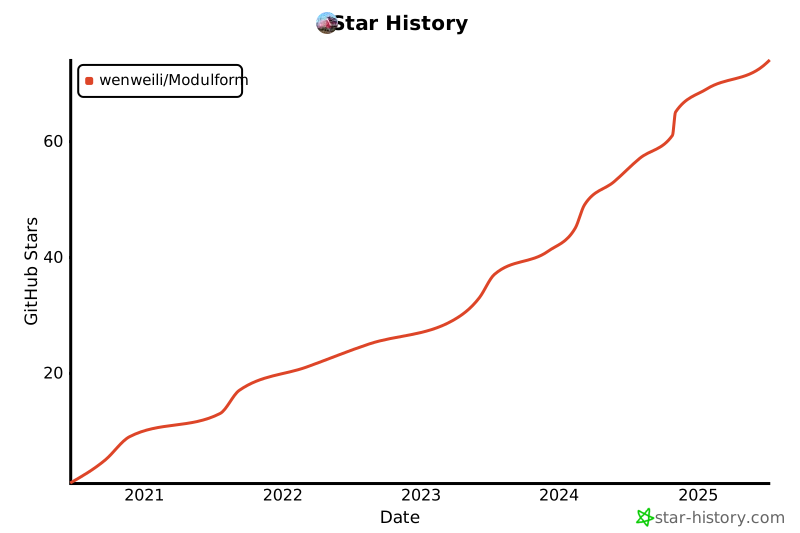](https://star-history.com/#wenweili/Modulform&Date)
77 |
--------------------------------------------------------------------------------
/Errata-Modulform-v1.tex:
--------------------------------------------------------------------------------
1 | %!TEX TS-program = xelatex
2 | %!TEX encoding = UTF-8
3 |
4 | % LaTeX source for the errata of the book ``模形式初步'' in Chinese
5 | % Copyright 2023 李文威 (Wen-Wei Li).
6 | % Permission is granted to copy, distribute and/or modify this
7 | % document under the terms of the Creative Commons
8 | % Attribution 4.0 International (CC BY 4.0)
9 | % http://creativecommons.org/licenses/by/4.0/
10 |
11 | % 《模形式初步》勘误表 / 李文威
12 | % 使用自定义的文档类 AJerrata.cls. 自动载入 xeCJK.
13 |
14 | \documentclass{AJerrata}
15 |
16 | \usepackage{unicode-math}
17 |
18 | \usepackage[unicode, colorlinks, psdextra, bookmarksnumbered,
19 | pdfpagelabels=true,
20 | pdfauthor={李文威 (Wen-Wei Li)},
21 | pdftitle={模形式初步勘误},
22 | pdfkeywords={}
23 | ]{hyperref}
24 |
25 | \setmainfont[
26 | BoldFont={texgyretermes-bold.otf},
27 | ItalicFont={texgyretermes-italic.otf},
28 | BoldItalicFont={texgyretermes-bolditalic.otf},
29 | PunctuationSpace=2
30 | ]{texgyretermes-regular.otf}
31 |
32 | \setsansfont[
33 | BoldFont=FiraSans-Bold.otf,
34 | ItalicFont=FiraSans-Italic.otf
35 | ]{FiraSans-Regular.otf}
36 |
37 | \setCJKmainfont[
38 | BoldFont=Noto Serif CJK SC Bold
39 | ]{Noto Serif CJK SC}
40 |
41 | \setCJKsansfont[
42 | BoldFont=Noto Sans CJK SC Bold
43 | ]{Noto Sans CJK SC}
44 |
45 | \setCJKfamilyfont{emfont}[
46 | BoldFont=FandolHei-Regular.otf
47 | ]{FandolHei-Regular.otf} % 强调用的字体
48 |
49 | \renewcommand{\em}{\bfseries\CJKfamily{emfont}} % 强调
50 |
51 | \setmathfont[
52 | Extension = .otf,
53 | math-style= TeX,
54 | ]{texgyretermes-math}
55 |
56 | \usepackage{mathrsfs}
57 | \usepackage{stmaryrd} \SetSymbolFont{stmry}{bold}{U}{stmry}{m}{n} % 避免警告 (stmryd 不含粗体故)
58 | % \usepackage{array}
59 | % \usepackage{tikz-cd} % 使用 TikZ 绘图
60 | \usetikzlibrary{positioning, patterns, calc, matrix, shapes.arrows, shapes.symbols}
61 |
62 | \usepackage{myarrows} % 使用自定义的可伸缩箭头
63 | \usepackage{mycommand} % 引入自定义的惯用的命令
64 |
65 | \newcommand{\bomega}{\symbf{\omega}} % Boldface omega, for sheaves of differentials
66 |
67 | \title{\bfseries 《模形式初步》勘误表 \\ 跨度: 2022 年至 2024 年 8 月}
68 | \author{李文威}
69 | \date{\today}
70 |
71 | \begin{document}
72 | \maketitle
73 |
74 | \begin{Errata}
75 | \item[第 2 页第一行 (仅 PDF 版)]
76 | \Orig 透过过
77 | \Corr 透过
78 |
79 | \item[导言的拓扑空间符号部分]
80 | \Orig $\partial D := D \smallsetminus D^\circ$
81 | \Corr $\partial D := \overline{D} \smallsetminus D^\circ$
82 | \Thx{感谢雷嘉乐指正}
83 |
84 | \item[导言的矩阵符号部分中部]
85 | \Orig $\Image[\SL(n, R) \to \PGL(n, \R)]$
86 | \Corr $\Image[\SL(n, R) \to \PGL(n, R)]$
87 | \Thx{感谢雷嘉乐指正}
88 |
89 | \item[\S 1.1 第一个脚注 (仅纸本)]
90 | \Orig [50]
91 | \Corr [59]
92 | \Thx{感谢孙超超指正}
93 |
94 | \item[命题 1.4.12 关于 $\Stab_{\SL(2, \Z)}(\rho)$ 生成元的描述]
95 | \Orig $\bigl(\begin{smallmatrix} & -1 \\ 1 & -1 \end{smallmatrix}\bigr)$
96 | \Corr $\bigl(\begin{smallmatrix} & 1 \\ -1 & 1 \end{smallmatrix}\bigr)$
97 | \Thx{感谢余君指正}
98 |
99 | \item[引理 2.1.5 证明倒数第二行 (仅 PDF 版)]
100 | \Orig $n^!$
101 | \Corr $n!$
102 | \Thx{感谢 Wenjun Huang 指正}
103 |
104 | \item[例 3.5.4 之前的 (i)]
105 | \Orig 线性代群
106 | \Corr 线性代数群
107 | \Thx{感谢杨箐浩指正}
108 |
109 |
110 | \item[定义 3.6.4 之后的讨论条列第二项]
111 | 从``变 $\alpha$ 为 $\alpha\beta$...'' 之后关于 $g^*$ 的公式起, 直到 ``... 只差一个因子 $a^{-k}$.'' 为止, 所有的 $a^{-k}$ 都应该改成 $a^k$ (共 5 处)
112 | \Thx{感谢余君指正}
113 |
114 | \item[定理 5.2.7 证明第一段最末]
115 | \Orig 所以 $\gamma \in \Gamma$
116 | \Corr 所以 $\gamma' \in \Gamma$
117 | \Thx{感谢张羽扬指正}
118 |
119 | \item[等式 (5.2.1) 的下一行]
120 | \Orig $\Gamma \cdot \Gamma \alpha \Gamma$
121 | \Corr $\Gamma' \cdot \Gamma \alpha \Gamma$
122 | \Thx{感谢汤一鸣指正}
123 |
124 | \item[等式 (5.4.1) 的下一行]
125 | \Orig $f(\delta_1 \delta_1)$
126 | \Corr $f(\delta_1 \delta_2)$
127 | \Thx{感谢汤一鸣指正}
128 |
129 | \item[公式 (6.2.3)]
130 | 将两处 $L/L'$ 改成 $L'/L$.
131 |
132 | \Thx{感谢张羽扬指正}
133 |
134 | \item[定理 6.5.1 证明]
135 | 将证明中间``定义 $S_k(\Gamma(N))$ 的线性自同态...''之前一行的显示公式中的 $\alpha_n(f)$ 改为 $\alpha_n(\varphi)$.
136 |
137 | \Thx{感谢余君指正}
138 |
139 | \item[定理 7.1.2 证明第一行]
140 | 在``命题 2.6.3''之后加上一条脚注: ``该节构造的 Eisenstein 级数, 其 Fourier 展开和对应的直和分解都可以通过解析延拓推及 $k = 1, 2$ 的情形, 细节比较复杂, 详阅 [41, \S 7.2].''
141 |
142 | \Thx{感谢彭也博指正}
143 |
144 | \item[命题 7.3.4 之上的显示公式]
145 | 将 $r_m(n) := \cdots$ 右边的 $k$ 都代换为 $m$ (三处), 将 $\cdots = m$ 代换为 $\cdots = n$.
146 |
147 | \Thx{感谢金志扬指正}
148 |
149 | \item[(9.1.5) 之下第三行]
150 | \Orig $\in \Gamma(\mathcal{H}, \bomega)$
151 | \Corr $\in \Gamma(\mathcal{H}, \bomega^{\otimes k})$
152 |
153 | \item[练习 10.1.3 之前一行]
154 | \Orig ...有奇点
155 | \Corr ...无奇点
156 | \Thx{感谢刘亚迪指正}
157 |
158 | \item[引理 A.1.2 之前两行]
159 | \Orig ... 连续的最粗拓扑
160 | \Corr ... 连续的最细拓扑
161 | \Thx{感谢李钦浩指正}
162 |
163 | \item[引理 A.1.10 证明第三行]
164 | \Orig $G/K$
165 | \Corr $G/H$
166 | \end{Errata}
167 | \end{document}
168 |
--------------------------------------------------------------------------------
/titles-setup.tex:
--------------------------------------------------------------------------------
1 | % Copyright 2020 李文威 (Wen-Wei Li).
2 | % Permission is granted to copy, distribute and/or modify this
3 | % document under the terms of the Creative Commons
4 | % Attribution 4.0 International (CC BY 4.0)
5 | % http://creativecommons.org/licenses/by/4.0/
6 |
7 | % 目的: 设置章节标题格式及目录的显式方式.
8 | % 由 AJbook.cls 引入
9 | \ProvidesFile{titles-setup.tex}[2018/03/03]
10 |
11 | \RequirePackage[calcwidth, nobottomtitles, explicit, newparttoc, indentafter]{titlesec} % 标题格式: explicit 选项导致须在 titleformat 的 before-code 中加 #1. 选项 newparttoc 用来将各部分加入目录. indentafter: 首行一律缩进
12 | \RequirePackage{titletoc} % 目录格式
13 |
14 | % 目录部分: 章名除附录外仍用中文标号, 黑体显示. 以参数是否为大写拉丁字母来判定是否在附录 (烂招)
15 | \if@AJ@CJKthechapter
16 | \providecommand{\AJchapterttl}[1]{\IfSubStr{ABCDEFGHIJKLMNOPQRSTUVWXYZ}{#1}{附录 #1 }{第\zhnumber{#1}章}}
17 | \else
18 | \providecommand{\AJchapterttl}[1]{\IfSubStr{ABCDEFGHIJKLMNOPQRSTUVWXYZ}{#1}{附录 #1 }{第 #1 章}}
19 | \fi
20 |
21 | \newlength{\BoxTtlwidth} % 用来计算各种盒子所需宽度
22 |
23 | % 各章标题排版
24 | \titleformat{\chapter}
25 | {\filleft\normalfont\Huge\bfseries\mathversion{bold}\CJKfamily{chapterfont}}
26 | {\AJchapterttl{\thechapter}}
27 | {5mm}
28 | {#1}
29 | [{\vspace{2em} \titleline[c]{\titlerule[1pt]}}]
30 |
31 | \titlespacing*{\chapter}{1pc}{*4}{5em}
32 |
33 | \titleformat{name=\chapter, numberless}
34 | {\filleft\normalfont\Huge\bfseries\mathversion{bold}\CJKfamily{chapterfont}} % Format
35 | {} % Label
36 | {5mm} % Sep
37 | {#1} % Before-code
38 | [{\vspace{2em} \titleline[c]{\titlerule[1pt]}
39 | \if@mainmatter
40 | \addcontentsline{toc}{chapter}{#1}
41 | \markboth{#1}{}
42 | \fi
43 | }] % After-code: 无号章如果出现在正文中, 就加入目录并相应地设置天眉.
44 |
45 | \titlespacing*{name=\chapter, numberless} % 设置间隔
46 | {1pc}{*4}{1em} % {left}{before-sep}{after-sep}
47 |
48 | \titleformat{\section}
49 | {\filright\bfseries\mathversion{bold}\Large\sffamily\CJKfamily{sectionfont}}
50 | { % 烂招: 直接将整个标题插入为 label
51 | \settowidth{\BoxTtlwidth}{\Huge \thesection \hspace{0.7em} \Large #1} % 首先计算宽度
52 | \ifdim \BoxTtlwidth < \textwidth % 一般情形下调用 \MakeSectBox
53 | \MakeSectBox{\Huge \thesection \hspace{0.7em} \Large #1} %
54 | \else % 万一标题过长则改用 minipage 以确保正常断行 (烂招)
55 | \begin{minipage}[c]{\textwidth} %
56 | \Huge \underline{\thesection} \hspace{0.7em} \Large #1 %
57 | \end{minipage} %
58 | \fi %
59 | }
60 | {0.7em}
61 | {}
62 | []
63 | \titlespacing*{\section}{1pc}{*1.3}{*1} % \titlespacing{command}{left}{before-sep}{after-sep}
64 |
65 | \titleformat{name=\section, numberless}
66 | {\filleft\bfseries\mathversion{bold}\Large\sffamily\CJKfamily{sectionfont}}
67 | { % 烂招: 直接将整个标题插入为 label
68 | \settowidth{\BoxTtlwidth}{\Large #1} % 首先计算宽度
69 | \ifdim \BoxTtlwidth < \textwidth % 一般情形下调用 \MakeSectBox
70 | \MakeSectBox{\Large #1} %
71 | \else % 万一标题过长则改用 minipage 以确保正常断行 (烂招)
72 | \begin{minipage}[c]{\textwidth} %
73 | \Large #1 %
74 | \end{minipage} %
75 | \fi %
76 | }
77 | {0mm}
78 | {}
79 | []
80 |
81 | \titleformat{name=\subsection} % 各子节标题, 采取 runin 形式较美观
82 | [runin]
83 | {\filleft\normalfont\sffamily\bfseries\mathversion{bold}\CJKfamily{sectionfont}}
84 | {\Large\thesubsection} % Label
85 | {3mm} % Sep
86 | {#1} % Before-code
87 | [] % After-code
88 |
89 | \titleformat{name=\subsection, numberless}
90 | [runin]
91 | {\filleft\normalfont\sffamily\bfseries\mathversion{bold}\CJKfamily{sectionfont}}
92 | {} % Label
93 | {0mm} % Sep
94 | {#1} % Before-code
95 | [] % After-code
96 |
97 | \titlespacing*{name=\subsection} % 设置间隔
98 | {0pt}{*1}{1em} % {left}{before-sep}{after-sep}
99 |
100 | \titleformat{name=\subsubsection} % 次子节标题, 采取 runin 形式较美观
101 | [runin]
102 | {\filleft\normalfont\sffamily\bfseries\mathversion{bold}\CJKfamily{sectionfont}}
103 | {\thesubsubsection} % Label
104 | {3mm} % Sep
105 | {#1} % Before-code
106 | [] % After-code
107 |
108 | \titleformat{name=\subsubsection, numberless}
109 | [runin]
110 | {\filleft\normalfont\sffamily\bfseries\mathversion{bold}\CJKfamily{sectionfont}}
111 | {} % Label
112 | {0mm} % Sep
113 | {#1} % Before-code
114 | [] % After-code
115 |
116 | \titlespacing*{name=\subsubsection} % 设置间隔
117 | {0pt}{*1}{1em} % {left}{before-sep}{after-sep}
118 |
119 | % 部分编号汉化
120 | \renewcommand{\thepart}{\zhnum{part}}
121 | \titleformat{name=\part}[display] % 各部分标题
122 | {\filcenter\sffamily\bfseries\mathversion{bold}\CJKfamily{song}\Huge} % Format
123 | {第{\thepart}部分} % Label
124 | {1.5em} % Sep
125 | {#1} % Before-code
126 | [] % After-code
127 |
128 | % 各节标题排版: \MakeSectBox{文字}
129 | \newtcbox{\MakeSectBox}{
130 | enhanced,
131 | arc = 0pt, outer arc = 0pt,
132 | before skip = 0pt, after skip = 0.4em, left skip = 0pt, right skip = 0pt,
133 | top = 10pt, left = 0pt, right = 0pt, bottom = 1.5mm,
134 | sharp corners = all,
135 | colback = white,
136 | colframe = white,
137 | boxsep = 0pt, leftrule = 0pt, rightrule=0pt, toprule=0pt,
138 | bottomrule = 0pt,
139 | valign=bottom,
140 | overlay = { \draw[line width=1pt] (interior.south west) -- (interior.south east); }
141 | }
142 |
143 | \titlecontents{chapter}
144 | [0pt]
145 | {\addvspace{1pc}\heiti}
146 | {\contentsmargin{0pt}\large\AJchapterttl{\thecontentslabel} \quad}
147 | {\contentsmargin{0pt}\large}
148 | {\titlerule*[.7pc]{.}\contentspage}
149 |
150 | \titlecontents{section}
151 | [1.5em]
152 | {}
153 | {\thecontentslabel\quad}
154 | {\thecontentslabel}
155 | {\titlerule*[.7pc]{.}\contentspage}
156 |
157 | \titlecontents{subsection}
158 | [3.9em]
159 | {\small}
160 | {\thecontentslabel\quad}
161 | {\ (\thecontentspage)}
162 | {\titlerule*[.7pc]{.}\contentspage}
163 |
164 | \titlecontents{part}
165 | [0cm]
166 | {\addvspace{1pc}\songti}
167 | {\contentsmargin{0pt} \large{第{\thecontentslabel}部分}\quad}
168 | {\large}
169 | {\titlerule*[.7pc]{.}\contentspage}
170 |
--------------------------------------------------------------------------------
/coverpage.tex:
--------------------------------------------------------------------------------
1 | % Copyright 2022 李文威 (Wen-Wei Li).
2 | % Permission is granted to copy, distribute and/or modify this
3 | % document under the terms of the Creative Commons
4 | % Attribution 4.0 International (CC BY 4.0)
5 | % http://creativecommons.org/licenses/by/4.0/
6 |
7 | % 《模形式初步》自订封面页, 由主档引入.
8 |
9 | \setCJKfamilyfont{coverfont}{Noto Sans CJK SC Black} % 设置书名字体
10 | \setCJKfamilyfont{cover-author-font}{Noto Sans CJK SC Medium} % 设置作者字体
11 |
12 | \colorlet{geod}{cyan!50!gray}
13 | \colorlet{leftblock}{red!25!green!50!blue}
14 | \colorlet{rightblock}{-red!75}
15 | \colorlet{domain}{teal!80}
16 |
17 | \begin{titlepage}\begin{tikzpicture}[remember picture, overlay,
18 | geod/.style={
19 | color=geod, ultra thick
20 | },
21 | fdomain/.style={
22 | color=domain,
23 | line width=1.7pt,
24 | }
25 | ]
26 |
27 | \coordinate (CIRCLE) at ([xshift=-1em, yshift=-14em] current page.north east); % 圆心
28 |
29 | \coordinate (TITLE-NE) at ([xshift=40em, yshift=35em] current page.south west); % 书名区块, 东北角
30 | \coordinate (TITLE-SE) at ([xshift=40em, yshift=15em] current page.south west); % 书名区块, 东南角
31 | \coordinate (TITLE-SE-W) at ([xshift=30em, yshift=15em] current page.south west); % 书名区块, 东南角向西平移
32 | \coordinate (TITLE-NE-W) at ([xshift=30em, yshift=35em] current page.south west); % 书名区块, 东北角向西平移
33 | \coordinate (TITLE-SW) at ([yshift=15em] current page.south west); % 书名区块, 西南角
34 |
35 |
36 | \begin{scope}[shift=(CIRCLE)]
37 | \def\x{10}
38 | \def\y{2}
39 | \def\a{180}
40 | \tkzDefPoint(0,0){O}
41 | \tkzDefPoint(-0.6*\x,0){L}
42 | \tkzDefPoint(-0.7*\x,0){M}
43 | \tkzDefPoint(-0.8*\x,0){N}
44 | \tkzDefPoint(-\x,0){A}
45 |
46 |
47 | \tkzFillCircle[color=geod!5](L,A) % Bigger tangent circle
48 | \tkzFillCircle[color=geod!10](M,A) % Tangent circle
49 | \tkzFillCircle[color=geod!20](N,A) % % Smaller tangent circle
50 |
51 | \tkzDrawCircle[geod](O,A)
52 | \tkzClipCircle(O,A)
53 |
54 | \tkzDefPoint(\a:\x+\y){p1}
55 | \tkzDefPoint(\a+30:\x+\y){p2}
56 | \tkzDefPoint(\a+75:\x+\y){p4}
57 |
58 | \tkzDefPoint(\a+45:\x+\y){q1}
59 | \tkzDefPoint(\a+90:\x+\y){q2}
60 | \tkzDefPoint(\a+120:\x+\y){q3}
61 |
62 | \tkzDefPoint(\a+300:\x+\y){r5}
63 |
64 |
65 | % 以下适用于新版 tkz-euclide
66 | \tkzDefCircle[orthogonal through=p1 and p2](O,A)
67 | \tkzGetPoint{c}
68 | \tkzDrawCircle[geod, opacity=0.5](c,p1)
69 | \tkzDefCircle[orthogonal through=p1 and p4](O,A)
70 | \tkzGetPoint{c}
71 | \tkzDrawCircle[geod, opacity=0.5](c,p1)
72 | \tkzDefCircle[orthogonal through=q1 and p1](O,A)
73 | \tkzGetPoint{c}
74 | \tkzDrawCircle[geod, opacity=0.3](c,q1)
75 | \tkzDefCircle[orthogonal through=q1 and q2](O,A)
76 | \tkzGetPoint{c}
77 | \tkzDrawCircle[geod, opacity=0.5](c,q1)
78 | \tkzDefCircle[orthogonal through=q1 and q3](O,A)
79 | \tkzGetPoint{c}
80 | \tkzDrawCircle[geod, opacity=0.2](c,q1)
81 | \tkzDefCircle[orthogonal through=q2 and q3](O,A)
82 | \tkzGetPoint{c}
83 | \tkzDrawCircle[geod, opacity=0.2](c,q2)
84 | \tkzDefCircle[orthogonal through=p1 and r5](O,A)
85 | \tkzGetPoint{c}
86 | \tkzDrawCircle[geod, opacity=0.3](c,p1)
87 |
88 | % 以下仅适用于旧版 tkz-euclide
89 | % \tkzDrawCircle[geod, opacity=0.5, orthogonal through=p1 and p2](O,A)
90 | % \tkzDrawCircle[geod, opacity=0.5, orthogonal through=p1 and p4](O,A)
91 | % \tkzDrawCircle[geod, opacity=0.3, orthogonal through=q1 and p1](O,A)
92 | % \tkzDrawCircle[geod, opacity=0.5, orthogonal through=q1 and q2](O,A)
93 | % \tkzDrawCircle[geod, opacity=0.2, orthogonal through=q1 and q3](O,A)
94 | % \tkzDrawCircle[geod, opacity=0.2, orthogonal through=q2 and q3](O,A)
95 | % \tkzDrawCircle[geod, opacity=0.3, orthogonal through=p1 and r5](O,A)
96 | \end{scope}
97 |
98 | \begin{scope}[shift=(CIRCLE)]
99 | \path (-10cm, 0) arc[start angle=180, end angle=225, radius=10cm] node[sloped, midway, below, color=geod] {\small\sffamily \today};
100 | \end{scope}
101 |
102 | \fill[color=leftblock] (TITLE-NE) rectangle (TITLE-SW);
103 |
104 | \fill[color=rightblock] (TITLE-NE) rectangle (TITLE-SE-W);
105 | \begin{scope}[shift=(TITLE-SW)]
106 | \node[color=white, anchor=south west] at (1.8, 3.5) {\fontsize{45}{45}\CJKfamily{coverfont}模形式初步};
107 | \node[color=white, anchor=south west] at (2, 1.5) {\fontsize{22}{22}\CJKfamily{cover-author-font}李文威 \quad 著};
108 | \end{scope}
109 |
110 | \begin{scope}
111 | \coordinate (ORIG) at ([xshift=1em] TITLE-SE-W); % 左半圆圆心
112 | \coordinate (ORIG-N) at ([xshift=1em] TITLE-NE-W); % 左半圆圆心对应的天花板.
113 |
114 | \clip (TITLE-SE-W) rectangle (TITLE-NE); % 切除不用部分
115 | \fill[pattern=north west lines, pattern color=domain] ([xshift=2.5em] ORIG) -- ([xshift=2.5em] ORIG-N) -- (TITLE-NE-W) -- (TITLE-SE-W) --cycle; % 基本区域
116 | \draw[fdomain, fill=rightblock] (ORIG) circle[radius=5em]; % 左半圆
117 | \draw[fdomain] ([xshift=5em] ORIG) circle[radius=5em]; % 中半圆
118 | \draw[fdomain] ([xshift=10em] ORIG) circle[radius=5em]; % 右半圆
119 | \draw[fdomain] ([xshift=-5em] ORIG) circle[radius=5em]; % 最左半圆
120 | \draw[fdomain] ([xshift=2.5em] ORIG) -- ([xshift=2.5em] ORIG-N); % 竖线
121 | \filldraw[fill=red, draw=domain] ([xshift=2.5em, yshift=4.33em] ORIG) circle[radius=4pt]; % 顶点填满
122 | \node[color=domain!80!black] at ([yshift=6.5em, xshift=5.5em] ORIG) {$\rho := \frac{1 + \sqrt{-3}}{2}$}; % 顶点数学公式
123 | \end{scope}
124 | \end{tikzpicture}
125 |
126 | \clearpage % 进入内页
127 | \begin{center}
128 | \Large{\sffamily\bfseries\thmheiti 网络版 \\ 2022 年 6 月修订} \\ \vspace{2em}
129 | \Large{\sffamily\bfseries\thmheiti 编译日期: \today} \\ \vspace{1em}
130 | % 版面: B5 (176×250mm) \\ \vspace{1em}
131 | 本书已由科学出版社出版 \\
132 | (2020 年 6 月第 1 版) \\
133 | \texttt{ISBN: 978-7-03-064531-9}
134 | \end{center}
135 | \vfill
136 |
137 |
138 | \begin{flushleft} \small
139 | 李文威 \\
140 | 个人主页: \href{https://www.wwli.asia}{www.wwli.asia} \\
141 | (含勘误表等信息)
142 | \end{flushleft}
143 | \vspace{1.5em}
144 | \begin{tabular*}{\textwidth}{ccc}
145 | \includegraphics{ccby.png}
146 | & \begin{minipage}[b]{0.6\textwidth}
147 | \small\sffamily
148 | 本作品采用知识共享 署名 4.0 国际 许可协议进行许可. 访问 \url{http://creativecommons.org/licenses/by/4.0/} 查看该许可协议.
149 | \end{minipage}
150 | \end{tabular*}
151 |
152 | \cleardoublepage
153 | \end{titlepage}
154 |
--------------------------------------------------------------------------------
/mycommand.sty:
--------------------------------------------------------------------------------
1 | % Copyright 2018 李文威 (Wen-Wei Li).
2 | % Permission is granted to copy, distribute and/or modify this
3 | % document under the terms of the Creative Commons
4 | % Attribution 4.0 International (CC BY 4.0)
5 | % http://creativecommons.org/licenses/by/4.0/
6 |
7 | % Some custom commands that I prefer
8 | \NeedsTeXFormat{LaTeX2e}
9 | \ProvidesPackage{mycommand}[2018/02/20 Package for my own commands]
10 |
11 | \newcommand\hmmax{0} % default 3, Increase the capacity of fonts
12 | \newcommand\bmmax{0} % default 4, Increase the capacity of fonts...
13 | \RequirePackage{bm} % Bolface + other functionalities
14 |
15 | \renewcommand*\arraystretch{1.5} % Increase the space in arrays
16 |
17 | \RequirePackage{euscript} % "Euler script" fonts
18 |
19 | % Customize the list structures (using paralist)
20 | \setdefaultitem{$\diamond$}{}{}{}
21 | \renewcommand{\descriptionlabel}[1]{\hspace{\labelsep} $\vartriangleright$\enskip {\heiti #1} \;}
22 | \renewcommand{\paradescriptionlabel}[1]{\normalfont \heiti #1 \enskip}
23 |
24 | % Some commands that I am used to.
25 | % Well-known algebraic structures
26 | \newcommand{\N}{\ensuremath{\mathbb{N}}}
27 | \newcommand{\Z}{\ensuremath{\mathbb{Z}}}
28 | \newcommand{\Q}{\ensuremath{\mathbb{Q}}}
29 | \newcommand{\R}{\ensuremath{\mathbb{R}}}
30 | \newcommand{\CC}{\ensuremath{\mathbb{C}}}
31 | \newcommand{\F}{\ensuremath{\mathbb{F}}}
32 | \newcommand{\A}{\ensuremath{\mathbb{A}}}
33 |
34 |
35 | % Algebra
36 |
37 | \newcommand{\gr}{\operatorname{gr}}
38 | \newcommand{\Ass}{\operatorname{Ass}}
39 | \newcommand{\topwedge}{\ensuremath{\bigwedge^{\mathrm{max}}}}
40 | \newcommand{\rank}{\operatorname{rk}}
41 | \newcommand{\Aut}{\operatorname{Aut}}
42 | \newcommand{\Isom}{\operatorname{Isom}}
43 | \newcommand{\Hm}{\operatorname{H}} % Homology/cohomology
44 | \newcommand{\Tr}{\operatorname{Tr}} % trace
45 | \newcommand{\Nm}{\operatorname{N}} % norm
46 | \newcommand{\Ann}{\operatorname{Ann}}
47 | \newcommand{\Resprod}{\ensuremath{{\prod}'}}
48 | \newcommand{\Sym}{\operatorname{Sym}}
49 | \newcommand{\ord}{\operatorname*{ord}}
50 | \newcommand{\trdeg}{\operatorname{tr.deg}}
51 | \newcommand{\Gras}{\ensuremath{\mathbf{G}}} % Grassmannians
52 | \newcommand{\WittV}{\operatorname{W}} % Witt vectors
53 |
54 | % Analysis
55 | \newcommand{\dd}{\mathop{}\!\mathrm{d}}
56 | \newcommand{\champ}[1]{\ensuremath{\frac{\partial}{\partial #1}}}
57 | \newcommand{\norme}[1]{\ensuremath{\| #1 \|}}
58 | \newcommand{\normeL}[2]{\ensuremath{\| #2 \|_{L^{#1}}}}
59 | \newcommand{\normeLs}[3]{\ensuremath{\| #3 \|_{L^{#1}, #2}}}
60 |
61 | % General things...
62 | \newcommand{\ceil}[1]{\ensuremath{\lceil #1 \rceil}}
63 | \newcommand{\lrangle}[1]{\ensuremath{\left\langle #1 \right\rangle}}
64 | \newcommand{\mes}{\operatorname{vol}}
65 | \newcommand{\sgn}{\operatorname{sgn}}
66 | \newcommand{\Stab}{\operatorname{Stab}}
67 | \newcommand{\pr}{\ensuremath{\mathbf{pr}}} % projection morphism
68 |
69 | % Categorical Terms (in my view)
70 | \newcommand{\Obj}{\operatorname{Ob}} % Objects
71 | \newcommand{\Mor}{\operatorname{Mor}} % Morphisms
72 | \newcommand{\cate}[1]{\ensuremath{\mathsf{#1}}} % Font series for categories
73 | \newcommand{\dcate}[1]{\ensuremath{\text{-}\mathsf{#1}}} % Categories with a pre-dash
74 | \newcommand{\cated}[1]{\ensuremath{\mathsf{#1}\text{-}}} % Categories with a post-dash
75 | \newcommand{\identity}{\ensuremath{\mathrm{id}}}
76 | \newcommand{\prolim}{\ensuremath{\underleftarrow{\lim}}}
77 | \newcommand{\indlim}{\ensuremath{\underrightarrow{\lim}}}
78 | \newcommand{\Hom}{\operatorname{Hom}}
79 | \newcommand{\iHom}{\ensuremath{\EuScript{H}\mathrm{om}}}
80 | \newcommand{\End}{\operatorname{End}}
81 | \newcommand{\rightiso}{\ensuremath{\stackrel{\sim}{\rightarrow}}}
82 | \newcommand{\longrightiso}{\ensuremath{\stackrel{\sim}{\longrightarrow}}}
83 | \newcommand{\leftiso}{\ensuremath{\stackrel{\sim}{\leftarrow}}}
84 | \newcommand{\longleftiso}{\ensuremath{\stackrel{\sim}{\longleftarrow}}}
85 | \newcommand{\utimes}[1]{\ensuremath{\overset{#1}{\times}}}
86 | \newcommand{\dtimes}[1]{\ensuremath{\underset{#1}{\times}}}
87 | \newcommand{\dotimes}[1]{\ensuremath{\underset{#1}{\otimes}}}
88 | \newcommand{\dsqcup}[1]{\ensuremath{\underset{#1}{\sqcup}}}
89 | \newcommand{\munit}{\ensuremath{\mathbf{1}}} % unit in a monoidal category
90 | \newcommand{\Yinjlim}{\ensuremath{\text{\textquotedblleft}\varinjlim\text{\textquotedblright}}} % injective limit in the Yoneda category
91 | \newcommand{\Yprojlim}{\ensuremath{\text{\textquotedblleft}\varprojlim\text{\textquotedblright}}} % projective limit in the Yoneda category
92 |
93 | % Homological Algebra
94 | \newcommand{\Ker}{\operatorname{ker}}
95 | \newcommand{\Coker}{\operatorname{coker}}
96 | \newcommand{\Image}{\operatorname{im}}
97 | \newcommand{\Coim}{\operatorname{coim}}
98 | \newcommand{\Ext}{\operatorname{Ext}}
99 | \newcommand{\Tor}{\operatorname{Tor}}
100 | \newcommand{\otimesL}{\ensuremath{\overset{\mathrm{L}}{\otimes}}}
101 |
102 | % Geometry
103 | \newcommand{\Der}{\operatorname{Der}}
104 | \newcommand{\Lie}{\operatorname{Lie}}
105 | \newcommand{\Ad}{\operatorname{Ad}}
106 | \newcommand{\ad}{\operatorname{ad}}
107 | \newcommand{\Frob}{\operatorname{Fr}}
108 | \newcommand{\Spec}{\operatorname{Spec}}
109 | \newcommand{\MaxSpec}{\operatorname{MaxSpec}}
110 | \newcommand{\PP}{\ensuremath{\mathbb{P}}}
111 | \newcommand{\mult}{\operatorname{mult}}
112 | \newcommand{\divisor}{\operatorname{div}}
113 | \newcommand{\Gm}{\ensuremath{\mathbb{G}_\mathrm{m}}}
114 | \newcommand{\Ga}{\ensuremath{\mathbb{G}_\mathrm{a}}}
115 | \newcommand{\Pic}{\operatorname{Pic}}
116 | \newcommand{\Supp}{\operatorname{Supp}}
117 | \newcommand{\Res}{\operatorname{Res}}
118 |
119 | % Groups
120 | \newcommand{\Gal}{\operatorname{Gal}}
121 | \newcommand{\GL}{\operatorname{GL}}
122 | \newcommand{\SO}{\operatorname{SO}}
123 | \newcommand{\Or}{\operatorname{O}}
124 | \newcommand{\GSpin}{\operatorname{GSpin}}
125 | \newcommand{\Spin}{\operatorname{Spin}}
126 | \newcommand{\UU}{\operatorname{U}}
127 | \newcommand{\SU}{\operatorname{SU}}
128 | \newcommand{\PGL}{\operatorname{PGL}}
129 | \newcommand{\PSL}{\operatorname{PSL}}
130 | \newcommand{\SL}{\operatorname{SL}}
131 | \newcommand{\Sp}{\operatorname{Sp}}
132 | \newcommand{\GSp}{\operatorname{GSp}}
133 | \newcommand{\PSp}{\operatorname{PSp}}
134 | \newcommand{\gl}{\ensuremath{\mathfrak{gl}}}
135 | \newcommand{\sli}{\ensuremath{\mathfrak{sl}}}
136 | \newcommand{\so}{\ensuremath{\mathfrak{so}}}
137 | \newcommand{\spin}{\ensuremath{\mathfrak{spin}}}
138 | \newcommand{\syp}{\ensuremath{\mathfrak{sp}}}
139 | \newcommand{\Ind}{\operatorname{Ind}}
140 |
--------------------------------------------------------------------------------
/Errata-Modulform-v0.tex:
--------------------------------------------------------------------------------
1 | %!TEX TS-program = xelatex
2 | %!TEX encoding = UTF-8
3 |
4 | % LaTeX source for the errata of the book ``模形式初步'' in Chinese
5 | % Copyright 2022 李文威 (Wen-Wei Li).
6 | % Permission is granted to copy, distribute and/or modify this
7 | % document under the terms of the Creative Commons
8 | % Attribution 4.0 International (CC BY 4.0)
9 | % http://creativecommons.org/licenses/by/4.0/
10 |
11 | % 《模形式初步》勘误表 / 李文威
12 | % 使用自定义的文档类 AJerrata.cls. 自动载入 xeCJK.
13 |
14 | \documentclass{AJerrata}
15 |
16 | \usepackage{unicode-math}
17 |
18 | \usepackage[unicode, colorlinks, psdextra, bookmarksnumbered,
19 | pdfpagelabels=true,
20 | pdfauthor={李文威 (Wen-Wei Li)},
21 | pdftitle={模形式初步勘误},
22 | pdfkeywords={}
23 | ]{hyperref}
24 |
25 | \setmainfont[
26 | BoldFont={texgyretermes-bold.otf},
27 | ItalicFont={texgyretermes-italic.otf},
28 | BoldItalicFont={texgyretermes-bolditalic.otf},
29 | PunctuationSpace=2
30 | ]{texgyretermes-regular.otf}
31 |
32 | \setsansfont[
33 | BoldFont=FiraSans-Bold.otf,
34 | ItalicFont=FiraSans-Italic.otf
35 | ]{FiraSans-Regular.otf}
36 |
37 | \setCJKmainfont[
38 | BoldFont=Noto Serif CJK SC Bold
39 | ]{Noto Serif CJK SC}
40 |
41 | \setCJKsansfont[
42 | BoldFont=Noto Sans CJK SC Bold
43 | ]{Noto Sans CJK SC}
44 |
45 | \setCJKfamilyfont{emfont}[
46 | BoldFont=FandolHei-Regular.otf
47 | ]{FandolHei-Regular.otf} % 强调用的字体
48 |
49 | \renewcommand{\em}{\bfseries\CJKfamily{emfont}} % 强调
50 |
51 | \setmathfont[
52 | Extension = .otf,
53 | math-style= TeX,
54 | ]{texgyretermes-math}
55 |
56 | \usepackage{mathrsfs}
57 | \usepackage{stmaryrd} \SetSymbolFont{stmry}{bold}{U}{stmry}{m}{n} % 避免警告 (stmryd 不含粗体故)
58 | % \usepackage{array}
59 | % \usepackage{tikz-cd} % 使用 TikZ 绘图
60 | \usetikzlibrary{positioning, patterns, calc, matrix, shapes.arrows, shapes.symbols}
61 |
62 | \usepackage{myarrows} % 使用自定义的可伸缩箭头
63 | \usepackage{mycommand} % 引入自定义的惯用的命令
64 |
65 | \newcommand{\bomega}{\symbf{\omega}} % Boldface omega, for sheaves of differentials
66 |
67 | \title{\bfseries 《模形式初步》勘误表 \\ 跨度: 2020---2022}
68 | \author{李文威}
69 | \date{\today}
70 |
71 | \begin{document}
72 | \maketitle
73 | 以下页码和标号等信息参照科学出版社 2020 年 6 月出版之《模形式初步》, ISBN: 978-7-03-064531-9, 和网络版可能有异. 部分错误未见于网络版. 列出的错误均已在修订版改正 (2022 年 4 月网络发布, 纸本待出).
74 |
75 | \begin{Errata}
76 | \item[引理 1.1.1 证明]
77 | \Orig $az + d$
78 | \Corr $az + b$
79 | \Thx{感谢胡龙龙指正}
80 |
81 | \item[命题 1.1.9 证明最后一行]
82 | 去掉``这''字, 改为 ``如此就描述了...''
83 |
84 | \item[(1.5.3)]
85 | \Orig 在 $\Gamma$ 作用下不变
86 | \Corr 在 $\gamma$ 作用下不变
87 | \Thx{感谢冯煜阳指正}
88 |
89 | \item[定义 1.6.7 第二项]
90 | \Orig $\delta' \Delta(x_0)$
91 | \Corr $\delta' D(x_0)$
92 | \Thx{感谢朱子阳指正}
93 |
94 | \item[定理 2.1.6 证明第一段结尾]
95 | \Orig ...... 给出 $\CC$ 上处处非零的全纯函数
96 | \Corr ...... 给出 $\CC$ 上的全纯函数, 在负整数处有一阶零点.
97 | \Thx{感谢李时璋指正}
98 |
99 | \item[(2.5.4) 上两行]
100 | \Orig $J(-x, \tau) = J(x, \tau)$
101 | \Corr $J(-x, \tau) = -J(x, \tau)$
102 | \Thx{感谢冯煜阳指正}
103 |
104 | \item[定理 2.5.8 (iv) 最后一行]
105 | \Orig $\sigma^{\bar{v}}_r(n) := \cdots$
106 | \Corr $\sigma^{\bar{v}}_{k-1}(n) := \cdots$
107 | \Thx{感谢汤一鸣指正}
108 |
109 | \item[命题 3.5.6 的叙述和证明 (出现三次)]
110 | \Orig $\mathrm{Nrd}(q)^{-1} q$
111 | \Corr $\mathrm{Nrd}(q)^{-1} \overline{q}$
112 | \Thx{感谢李时璋指正}
113 |
114 | \item[命题 3.6.7 证明最后一段]
115 | \Orig 而且该极限对 $u \in [0,x]$ 是一致的 ... 因为 $u \in [0,x]$
116 | \Corr 而且该极限对 $u \in [0,y]$ 是一致的 ... 因为 $u \in [0,y]$
117 | \Thx{感谢李时璋指正}
118 |
119 | \item[命题 3.7.4 的前一段话 (纸本)]
120 | \Orig 内积系, 相对于
121 | \Corr 内积系相对于
122 |
123 | \item[注记 3.8.16]
124 | \Orig 对于全实域 $F$ 上仅对一个嵌入 $F \hookrightarrow \mathbb{R}$ 分裂的四元数代数 $B$
125 | \Corr 对于 $\mathbb{Q}$ 上对嵌入 $\mathbb{Q} \hookrightarrow \mathbb{R}$ 分裂, 但在 $\mathbb{Q}$ 上非分裂的四元数代数 $B$
126 | \Thx{感谢李时璋指正}
127 |
128 | \item[\S 4.4 第二段 (网络版)]
129 | ``定义了模判别式...'' 之前 2.4 多出现了一次.
130 | \Thx{感谢汤一鸣指正}
131 |
132 | \item[练习 4.4.7 的表述]
133 | 将列表第一项的 $M(1)_k$ 改为 $M_k(1)$.
134 |
135 | 将最后一句``进一步, 说明 $S(1)$ 也来自一个分次理想 $S(1)_{\mathbb{Z}} \subset M(1)_{\mathbb{Z}}$.'' 改为: ``进一步描述 $M(1)_{\mathbb{Z}}$ 的分次理想 $M(1)_{\mathbb{Z}} \cap S(1)$.''
136 | \Thx{感谢李时璋指正}
137 |
138 | \item[练习 4.4.7 提示的第一句]
139 | \Orig 取 ...... $M(1)_{\mathbb{Z}} \cdot \Delta$
140 | \Corr 取 $M(1)_{\Z}$ 为所有 Fourier 系数均为整数的模形式给出的子环, 并应用前述定理.
141 |
142 | 上一句经过修正后, 结尾处再插入以下脚注: ``相关的整性问题可以参考 Serge Lang 的 \textit{Introduction to Modular Forms} (Grundlehren der mathematischen Wissenschaften, Volume 222), Chapter X, Theorems 4.2---4.4. 论证是初等的.''
143 | \Thx{感谢李时璋指正}
144 |
145 | \item[\S 4.5 第一句]
146 | 补上一句 ``所有 Riemann 曲面均默认为紧的.''
147 | \Thx{感谢李时璋指正}
148 |
149 | \item[定理 5.5.5 (i)]
150 | \Orig 则 $[\Gamma'_\lambda]$ 是中心元;
151 | \Corr 则对所有 $(h, k) \in \mathcal{D}$ 皆有 $[\Gamma'_{h,k}] \star [\Gamma'_\lambda] = [\Gamma'_{hd, kd}]$;
152 | \Thx{感谢于惠施指正}
153 |
154 | \item[定理 5.5.5 证明的第一条显示公式]
155 | \Orig $\displaystyle\bigsqcup_{a \in A}^n$
156 | \Corr $\displaystyle\bigsqcup_{a \in A}$
157 |
158 | \item[命题 5.5.7 证明中第三条显示公式末项]
159 | \Orig $\Z/kk'$
160 | \Corr $\Z/kk' \Z$
161 | \Thx{感谢朱子阳指正}
162 |
163 | \item[定理 6.2.5 (i)]
164 | \Orig 则 $[\Gamma'_\lambda(N)]$ 是中心元;
165 | \Corr 则对所有 $(h, k) \in \mathcal{D}(N)$ 皆有 $[\Gamma'_{h,k}(N)] \star [\Gamma'_\lambda(N)] = [\Gamma'_{hd, kd}(N)]$;
166 |
167 | \item[命题 6.3.2 之前]
168 | 将``回忆到 \S 6.2 定义的子代数...''一句和后续的表格删除, 因为不正确而且不需要 (见下一条更正).
169 | \Thx{感谢李时璋指正}
170 |
171 | \item[命题 6.3.2 证明倒数第二段]
172 | \Orig 基于 $\EuScript{H}_1(N)$ 已知的结构... 由引理 6.1.4 料理.
173 | \Corr 基于和引理 6.1.4 相同的论证, 说明 $\Gamma_1(N) \gamma\alpha\gamma^{-1} \Gamma_1(N) = \Gamma_1(N)\alpha\Gamma_1(N)$ 即可. 易见 $\gamma\alpha\gamma^{-1}$ 既属于 $\Delta_1(N)$, 又属于 $\alpha$ 的 $\Gamma_0(N)$-双陪集, 而定理 6.2.9 说明 \linebreak $\Gamma_1(N) \backslash \Delta_1(N) / \Gamma_1(N) \to \Gamma_0(N) \backslash \Delta_0(N) / \Gamma_0(N)$ 是双射, 于是 $\gamma\alpha\gamma^{-1}$ 和 $\alpha$ 确实属于相同的 $\Gamma_1(N)$-双陪集.
174 | \Thx{感谢李时璋指正}
175 | % 引理 6.1.4 = \ref{prop:diamond-T_p-comm}, 定理 6.2.9 = \ref{prop:Gamma_1-Gamma_0}
176 |
177 | \item[练习 6.4.9 倒数第二句]
178 | \Orig $X^2 - a_p(f) X + p^{k-1} \chi(p)$
179 | \Corr $X^2 - a_p(f) X + p^{k-1} \chi_f(p)$
180 | \Thx{感谢王梓川指正}
181 |
182 | \item[\S 7.5 第一行 ``沿用...... 亦即 $a_0(f)=0$.'']
183 | 删除此行.
184 |
185 | \item[练习 8.6.2 之前的显示公式]
186 | \Orig $\cdots \oplus \frac{1 + \sqrt{D}}{2}$
187 | \Corr $\cdots \oplus \Z \frac{1 + \sqrt{D}}{2}$
188 |
189 | \item[定理 8.6.4 的陈述]
190 | \Orig $[\cdot]: \End(E) \rightiso \mathcal{O}$
191 | \Corr $[\cdot]: \mathcal{O} \rightiso \End(E)$
192 |
193 | \Orig ... 都有 $[\alpha]^* \omega$...
194 | \Corr ... 和 $\alpha \in \mathcal{O}$ 都有 $[\alpha]^* \omega$...
195 |
196 | \item[定义 9.1.6 条列]
197 | 将条列的两项修正为:
198 | \begin{itemize}
199 | \item $\Gamma(V, \bomega_\Gamma) := \mathcal{O}_V (\dd z \cdot \alpha^{-1}) |_{U \smallsetminus \{t\}}$, 其中 $V := \pi(U)$, 截面的限制映射按自明方式定义;
200 | \item $1 \mapsto \dd z \cdot \alpha^{-1}$ 给出平凡化 $\mathcal{O}_V \rightiso \bomega_\Gamma |_V$.
201 | \end{itemize}
202 |
203 | \item[引理 9.2.1]
204 | 在引理陈述的最后, 亦即公式 (9.2.3) 之后补充一句 ``对 $\bomega^{\otimes (-1)}$ 的群作用是按 (9.1.4) 定义的.''
205 | \Thx{感谢李时璋指正}
206 | % (9.1.4) = \eqref{eqn:omega-dual-transport}
207 |
208 | \item[命题 9.2.4 之后的第一条显示公式]
209 | \Orig $\cdots \xrightarrow{\dd} \mathcal{O}_{Y(\Gamma)} \to 0,$
210 | \Corr $\cdots \xrightarrow{\dd} \Omega_{Y(\Gamma)} \to 0,$
211 | \Thx{感谢杜长江指正}
212 |
213 | \item[引理 9.3.4 证明]
214 | 将第一句末的``定义--命题 9.3.1'' 改成``定义 9.3.2''. 将证明中最后一条显示公式中的 $\dd\xi_k = f_k$ 改成 $\xi_k = \dd f_k$.
215 | \Thx{感谢杜长江指正}
216 |
217 | \item[注记 9.4.14 之上一句]
218 | \Orig 这是 Petersson 的...
219 | \Corr 这是 Petersson 内积的...
220 |
221 | \item[(10.1.1)] 将图表中的
222 | $\begin{tikzcd} \mathbb{C} \arrow[twoheadrightarrow, r, "\sim"] & \mathbb{C}^\times \end{tikzcd}$
223 | 改成
224 | $\begin{tikzcd} \mathbb{C} \arrow[twoheadrightarrow, r] & \mathbb{C}^\times \end{tikzcd}$ .
225 |
226 | \item[介于 (10.4.1) 和 (10.4.2) 之间的显示公式]
227 | 将后半部两个 $\cdots(Y_1(N), \mathrm{R}^1 \pi_*(\Q_\ell))$ 都改成 $\cdots(Y_1(N), \Sym^k \mathrm{R}^1 \pi_*(\Q_\ell))$.
228 | \Thx{感谢杜长江指正}
229 |
230 | \item[定义 10.4.1]
231 | \Orig ... $\mathcal{W}_{\ell, p} \times \mathcal{W}_{\ell, p} \to \mathbb{Q}_\ell$, 满足 ...
232 | \Corr ... $\mathcal{W}_{\ell, p} \times \mathcal{W}_{\ell, p} \to \mathbb{Q}_\ell(-k-1)$, 其中 $\mathbb{Q}_\ell(-k-1)$ 是所谓的 Tate 挠 (仅影响 Galois 作用), 满足...
233 |
234 | \item[命题 10.5.5 (i)]
235 | 将第二个 $\to$ 改成 $\rightiso$.
236 |
237 | \item[练习 10.6.5]
238 | 删除提示.
239 |
240 | \item[注记 10.6.9]
241 | \Orig 故 $V_\ell(J)$ 为 $\Z_\ell$-模
242 | \Corr 故它们的 $\varprojlim_m$ 为 $\Z_\ell$-模
243 |
244 | 另外, 将显示公式 $V_{f, \lambda} := V_\ell(J) \dotimes{\mathbb{T}_\ell, \phi_f} K_{f, \lambda}$ 及其下一行出现的 $\phi_f$ 都改为 $\phi_{f, \lambda}$.
245 |
246 | \item[定理 10.6.10 之后第二段, 从 ``回忆推论 6.5.6 和 6.5.7 ...'' 起]
247 | 删除 ``回忆推论 6.5.6 和 6.5.7 ...'' 一段, 删除后续的命题 10.6.11 及其证明, 代换为 ``今后主要考虑 $f$ 为新形式的情形.'' (起新行), 接上原有的``我们以关于定理 10.6.7 的几点注记收尾.''
248 |
249 | \item[定义 10.7.2 之下两行 (纸本)]
250 | \Orig 同源等价
251 | \Corr 同源等价类.
252 |
253 | \item[练习 10.7.3 之后第二段: ``模性有一系列等价陈述...'']
254 | \Orig 无非是 Abel--Jacobi 映射 $\phi: X_0(N) \to J_0(N)$ 和 ...
255 | \Corr 无非是 Abel--Jacobi 映射 $\phi: X_0(N) \to J_0(N)$ (选定基点) 和 ...
256 |
257 | \item[定义 B.5.2 之上四段, 加粗部分]
258 | \Orig 平凡从
259 | \Corr 平凡丛
260 | \Thx{感谢王未指正}
261 |
262 | \item[参考文献 56] 该书已经正式出版 (Graduate Texts in Mathematics 288, Springer, 2021).
263 | % BibTeX entry:
264 | % @book {Voi,
265 | % AUTHOR = {Voight, John},
266 | % TITLE = {Quaternion algebras},
267 | % SERIES = {Graduate Texts in Mathematics},
268 | % VOLUME = {288},
269 | % PUBLISHER = {Springer, Cham},
270 | % YEAR = {[2021] \copyright 2021},
271 | % PAGES = {xxiii+885},
272 | % ISBN = {978-3-030-56692-0; 978-3-030-56694-4},
273 | % MRCLASS = {11R52 (11-02 11E12 11F06 16H05 16U60 20H10)},
274 | % MRNUMBER = {4279905},
275 | % DOI = {10.1007/978-3-030-56694-4},
276 | % URL = {https://doi.org/10.1007/978-3-030-56694-4},
277 | % }
278 | \end{Errata}
279 | \end{document}
280 |
--------------------------------------------------------------------------------
/AJbook.cls:
--------------------------------------------------------------------------------
1 | % The class file for the book project 《代数学方法》
2 | % Copyright 2018 李文威 (Wen-Wei Li).
3 | % Permission is granted to copy, distribute and/or modify this
4 | % document under the terms of the Creative Commons
5 | % Attribution 4.0 International (CC BY 4.0)
6 | % http://creativecommons.org/licenses/by/4.0/
7 |
8 | % We make use of etoolbox. The package ntheorem is implicitly required.
9 | % It will also import the files titles-setup.tex (for titles of sections) and font-setup-open.tex/font-setup-HEP.tex (for fonts).
10 |
11 | % Identification
12 | % --------------
13 | \NeedsTeXFormat{LaTeX2e}
14 | \ProvidesClass{AJbook}[2018/03/04 Class for the book project Methods of Algebra]
15 |
16 | % 使用 key-val 格式指定选项之用, 一切以 @AJ 起始.
17 | \RequirePackage{kvoptions}
18 | \RequirePackage{etoolbox}
19 |
20 | \SetupKeyvalOptions{
21 | family = @AJ,
22 | prefix = @AJ@
23 | }
24 |
25 | % Declaration of options
26 | % ----------------------
27 | \DeclareBoolOption[false]{draftmark} % 是否打上未定稿标记
28 | \DeclareBoolOption[true]{colors} % 是否让链接带颜色
29 | \DeclareBoolOption[true]{CJKthechapter} % 是否让天眉的各章编号使用中文数字
30 | \DeclareBoolOption[false]{traditional} % 是否使用繁体中文
31 | \DeclareStringOption[]{coverpage} % 封面档档名, 默认为空
32 | \DeclareStringOption{fontsetup} % 字体设定档档名
33 | \DeclareStringOption{titlesetup} % 章节标题设定档档名
34 | \DeclareStringOption[b5]{geometry} % 版面 (默认 b5)
35 |
36 | \PassOptionsToPackage{dvipsnames}{xcolor} % 让 xcolor 带 dvipsnames 选项; tikz 随后会载入之.
37 |
38 |
39 | % Execution of options
40 | % ---------------------
41 | \ProcessKeyvalOptions*
42 | \relax
43 |
44 | % Package loading
45 | % ---------------------
46 | % 基于 book class, 选项一并载入.
47 | \LoadClass[10pt]{book}
48 |
49 | \RequirePackage{fontspec} % XeLaTeX
50 | \RequirePackage[CJKchecksingle]{xeCJK} % XeCJK
51 | \RequirePackage{zhnumber} % 中文数字转换
52 |
53 | % 引入 AMS 宏包 + mathtools
54 | \RequirePackage[intlimits]{amsmath}
55 | \RequirePackage{amssymb}
56 | \RequirePackage[centercolon]{mathtools}
57 |
58 | % 支持直接引入 PDF 页面
59 | \RequirePackage{pdfpages}
60 |
61 | % 加入字串处理功能
62 | \RequirePackage{xstring}
63 |
64 | \RequirePackage{emptypage}
65 | \RequirePackage[many]{tcolorbox} % 制作方框
66 |
67 | \RequirePackage{setspace} % 设定适于中文排版的行距
68 |
69 | % 使用 biblatex + biber 制作书目
70 | \RequirePackage[backend=biber, hyperref=auto, backref=true, backrefstyle=three]{biblatex}
71 |
72 | % 要求载入 TikZ
73 | \RequirePackage{tikz}
74 |
75 | % 载入 paralist
76 | \RequirePackage{paralist}
77 |
78 | % Main codes
79 | % ----------
80 |
81 | \usetikzlibrary{shapes.symbols} % 稍后定义 hint 环境所需
82 |
83 | % 定义在 draftmark=true 模式下显示版本信息的指令
84 | \RequirePackage[iso, english]{isodate} % 使 \today 印出 yyyy-mm-dd
85 | \providecommand{\@AJ@draftstring}{{\color{gray!40}\heiti 未定稿: \today}}
86 |
87 | \onehalfspacing % 行距
88 | %\raggedbottom % 减小页面空白
89 |
90 | \setlength{\parindent}{2em} % 设置适合于汉语排版的段落缩进
91 |
92 | % 扩展 \frontmatter: 制作封面和目录
93 | \g@addto@macro\frontmatter{
94 | % 当 coverpage 参数非空时, 引入封面档制作封面, 否则 \relax.
95 | \ifdefempty{\@AJ@coverpage}{%
96 | \relax
97 | }{%
98 | \pagestyle{empty}% 清空页面风格
99 | \renewcommand{\thepage}{C\arabic{page}}% 封面部分页码以 C 开头 (PDF: logical page numbers)
100 | \IfEndWith{\@AJ@coverpage}{.pdf}{% 如果档名以 .pdf 或 .PDF 结尾则引入 PDF
101 | \includepdf{\@AJ@coverpage}
102 | }{%
103 | \IfEndWith{\@AJ@coverpage}{.PDF}{%
104 | \includepdf{\@AJ@coverpage}
105 | }{%
106 | \input{\@AJ@coverpage} % 否则引入 .tex 源代码
107 | }
108 | }%
109 | \pagestyle{fancy} % 复原页面风格为 fancy
110 | \pagenumbering{roman} % 页码复原为小写罗马字母
111 | }
112 |
113 | % 重设页数: 封面页结束时应已经 \cleardoublepage
114 | \setcounter{page}{1}
115 | \thispagestyle{empty}
116 | \addtocontents{toc}{\protect\thispagestyle{empty}}
117 |
118 | % 重置目录标题
119 | \if@AJ@traditional
120 | \renewcommand{\contentsname}{目錄}
121 | \else
122 | \renewcommand{\contentsname}{目录}
123 | \fi
124 |
125 | \tableofcontents % 印出目录
126 | }
127 |
128 | % 扩张 \appendix: 重置天眉
129 | \g@addto@macro\appendix{
130 | % 为附录重置天眉格式
131 | \if@AJ@traditional
132 | \renewcommand{\appendixname}{附錄}
133 | \renewcommand{\chaptermark}[1]{\markboth{附錄 \thechapter \quad #1}{}}
134 | \else
135 | \renewcommand{\appendixname}{附录}
136 | \renewcommand{\chaptermark}[1]{\markboth{附录 \thechapter \quad #1}{}}
137 | \fi
138 | \renewcommand{\sectionmark}[1]{\markright{\S\thesection \quad #1}}
139 | }
140 |
141 | % 扩展 \backmatter: 设置文献显示方式. 注意: 若有附录则须重置天眉格式
142 | \g@addto@macro\backmatter{
143 | \renewcommand{\em}{\itshape} % 书目部分以斜体表示强调
144 | % 汉化参考文献标题
145 | \if@AJ@traditional
146 | \renewcommand{\refname}{參考文獻}
147 | \renewcommand{\bibname}{參考文獻}
148 | \else
149 | \renewcommand{\refname}{参考文献}
150 | \renewcommand{\bibname}{参考文献}
151 | \fi
152 | }
153 |
154 | % 以下设置 biblatex.
155 | % bibLaTeX 部分第一步: 基本设置与汉化.
156 | \DeclareFieldFormat{postnote}{#1} % 功能是印出 \cite[postnote]{Book}
157 | \if@AJ@traditional
158 | \DefineBibliographyStrings{english}{%
159 | in = {刊於},
160 | editor = {主編},
161 | byeditor = {編者為},
162 | backrefpage = {引用於 p.\!},
163 | backrefpages = {引用於 pp.\!},
164 | }
165 | \else
166 | \DefineBibliographyStrings{english}{%
167 | in = {刊于},
168 | editor = {主编},
169 | byeditor = {编者为},
170 | backrefpage = {引用于 p.\!},
171 | backrefpages = {引用于 pp.\!},
172 | }
173 | \fi
174 | % biblatex 部分第二步: 要求在 doi 和 URL 并存时移除 URL. 仅适用于 Biblatex + Biber. 源码取自 https://tex.stackexchange.com/questions/119136/biblatex-convert-doi-url-into-doi-field 原文如下.
175 | % The actual value inside \regexp can be adjusted.
176 | % In the first step we create a doi field for each entry where the url field matches the regexp, and the novel field has the value of the url field. In the second step we remove the doi "namespace".
177 | % In the second \map sequence the url and urldate fields are cleared if a doi field is present, to mimic the behavior in the first part of the original question.
178 | \DeclareSourcemap{
179 | \maps[datatype=bibtex]{
180 | \map{
181 | \step[ % copies url to doi field if it starts with http://dx.doi.org/
182 | fieldsource=url,
183 | match=\regexp{http://dx.doi.org/(.+)},
184 | fieldtarget=doi,
185 | ]
186 | \step[ % removes http://dx.doi.org/ string from doi field
187 | fieldsource=doi,
188 | match=\regexp{http://dx.doi.org/(.+)},
189 | replace=\regexp{$1}
190 | ]
191 | }
192 | \map{ % removes url + urldate field from all entries that have a doi field
193 | \step[fieldsource=doi, final]
194 | \step[fieldset=url, null]
195 | \step[fieldset=urldate, null]
196 | }
197 | }
198 | }
199 |
200 | % 汉化 figure 和 table 环境
201 | \if@AJ@traditional
202 | \renewcommand{\figurename}{圖}
203 | \renewcommand{\tablename}{表}
204 | \else
205 | \renewcommand{\figurename}{图}
206 | \renewcommand{\tablename}{表}
207 | \fi
208 |
209 | % 汉化 figure 和 table 索引
210 | \if@AJ@traditional
211 | \renewcommand{\listfigurename}{圖片索引}
212 | \renewcommand{\listtablename}{表格索引}
213 | \else
214 | \renewcommand{\listfigurename}{图片索引}
215 | \renewcommand{\listtablename}{表格索引}
216 | \fi
217 |
218 | % 将 figure 和 table 索引加入目录: 使用 etoolbox 提供的 patching
219 | \pretocmd{\listoffigures}{%
220 | \cleardoublepage
221 | \phantomsection
222 | \addcontentsline{toc}{chapter}{\listfigurename}
223 | }{}{}
224 | \pretocmd{\listoftables}{%
225 | \cleardoublepage
226 | \phantomsection
227 | \addcontentsline{toc}{chapter}{\listtablename}
228 | }{}{}
229 |
230 | % 输入字体设置
231 | \input{\@AJ@fontsetup}
232 | % 输入章节标题设置
233 | \input{\@AJ@titlesetup}
234 |
235 | % 设置习题环境, 置于每章最后: 不用 \section* 以免格式混淆
236 | \if@AJ@traditional
237 | \newenvironment{Exercises}{%
238 | \markright{習題}
239 | \addcontentsline{toc}{section}{習題}
240 | \vspace{1em}\begin{center}
241 | \Large\CJKfamily{sectionfont} 習題
242 | \end{center}\vspace{0.7em}
243 | \begin{small}\begin{enumerate}[\bfseries 1.] %
244 | }{ % 结束
245 | \end{enumerate}\end{small}
246 | }
247 | \else
248 | \newenvironment{Exercises}{%
249 | \markright{习题}
250 | \addcontentsline{toc}{section}{习题}
251 | \vspace{1em}\begin{center}
252 | \Large\CJKfamily{sectionfont} 习题
253 | \end{center}\vspace{0.7em}
254 | \begin{small}\begin{enumerate}[\bfseries 1.] %
255 | }{ % 结束
256 | \end{enumerate}\end{small}
257 | }
258 | \fi
259 |
260 | % 习题提示 (定义为环境, 穿插文中)
261 | \newenvironment{hint}{%
262 | \ifvmode % 用 \ifvmode 测试: 如果提示另起新段, 则不加空白.
263 | \ignorespaces % 消除横向空白, 优于 \unskip
264 | \else
265 | \quad % 否则加入空白.
266 | \fi
267 | \begin{tikzpicture}[baseline=(H.base), every node/.style={signal, draw, very thin, signal to=east, signal from=nowhere, signal pointer angle=120, inner sep=2pt}]
268 | \node[anchor=mid west] (H) at (0,0) {\heiti\footnotesize 提示};
269 | \end{tikzpicture}
270 | }{}
271 |
272 | % 每章开头的学习提示 (定义为环境)
273 | \if@AJ@traditional
274 | \newtcolorbox{wenxintishi}{
275 | breakable,
276 | enhanced,
277 | width = \textwidth,
278 | colback = white, colbacktitle = white,
279 | colframe = gray!50, boxrule=0.2mm,
280 | coltitle = black,
281 | fonttitle = \sffamily,
282 | attach boxed title to top left = {yshift=-\tcboxedtitleheight/2, xshift=\tcboxedtitlewidth/4},
283 | boxed title style = {boxrule=0pt, colframe=white},
284 | before skip = 0.5cm,
285 | top = 3mm,
286 | bottom = 3mm,
287 | title={閱讀提示}
288 | }
289 | \else
290 | \newtcolorbox{wenxintishi}{
291 | breakable,
292 | enhanced,
293 | width = \textwidth,
294 | colback = white, colbacktitle = white,
295 | colframe = gray!50, boxrule=0.2mm,
296 | coltitle = black,
297 | fonttitle = \sffamily,
298 | attach boxed title to top left = {yshift=-\tcboxedtitleheight/2, xshift=\tcboxedtitlewidth/4},
299 | boxed title style = {boxrule=0pt, colframe=white},
300 | before skip = 0.5cm,
301 | top = 3mm,
302 | bottom = 3mm,
303 | title={阅读提示}
304 | }
305 | \fi
306 |
307 | \AtEndPreamble{
308 | \RequirePackage[thmmarks, amsmath, hyperref]{ntheorem} % 设置定理环境所需
309 |
310 | % 若 hyperref 已载入, 则按 colors 的 Bool 值设置链接色彩.
311 | \@ifpackageloaded{hyperref}{
312 | \if@AJ@colors
313 | \hypersetup{
314 | colorlinks = true,
315 | linkcolor = blue,
316 | citecolor = red,
317 | urlcolor = teal}
318 | \else
319 | \hypersetup{hidelinks}
320 | \fi}
321 | {}
322 |
323 | % 设置页面尺寸
324 | \RequirePackage{geometry}
325 | \IfStrEq{\@AJ@geometry}{b5}{% 载入 b5 版面设置
326 | \geometry{
327 | paper=b5paper,
328 | headheight=5ex,
329 | headsep=5ex,
330 | textwidth=132mm,
331 | textheight=198mm,
332 | twoside,
333 | % bindingoffset=18pt,
334 | asymmetric % 单双数页不分
335 | }}{}
336 |
337 | \IfStrEq{\@AJ@geometry}{a4}{% 载入 a4 版面设置
338 | \geometry{
339 | paper=a4paper,
340 | top=3cm,
341 | inner=2.54cm,
342 | outer=2.54cm,
343 | bottom=3cm,
344 | headheight=6ex,
345 | headsep=6ex,
346 | twoside,
347 | asymmetric
348 | }}{}
349 |
350 | % 设置天眉所需
351 | \RequirePackage{fancyhdr}
352 | % 使空页恒空
353 | \fancypagestyle{plain}{
354 | \fancyhead{}
355 | \renewcommand{\headrulewidth}{0pt}
356 | }
357 |
358 | % 设置天眉
359 | \pagestyle{fancy}
360 | \if@AJ@CJKthechapter
361 | \renewcommand{\chaptermark}[1]{\markboth{
362 | 第\zhnumber{\thechapter}章\quad #1
363 | }{}}
364 | \else
365 | \renewcommand{\chaptermark}[1]{\markboth{
366 | 第 \thechapter 章\quad #1
367 | }{}}
368 | \fi
369 | \renewcommand{\sectionmark}[1]{\markright{\S\arabic{chapter}.\arabic{section} \quad #1}}
370 | \fancyhf{} % 先清空
371 | \fancyhead[EC]{\CJKfamily{hei2}\footnotesize{\leftmark}\vspace{1mm}}
372 | \fancyhead[OC]{\CJKfamily{hei2}\footnotesize{\rightmark}\vspace{1mm}}
373 | \fancyhead[LE,RO]{{\footnotesize \thepage}\vspace{1mm}} %
374 | \fancyhead[RE,LO]{}
375 | \if@AJ@draftmark
376 | \fancyfoot[C]{\@AJ@draftstring} % 在 draftmark=true 时打印版本信息
377 | \fi
378 | \renewcommand{\headrulewidth}{0pt} % 天眉暂不加横线
379 | \renewcommand{\footrulewidth}{0pt}
380 | \addtolength{\headheight}{0.5pt}
381 | }
382 |
383 | \AtBeginDocument{
384 | % 重置 \Re, \Im, \emptyset. 由于可能用到 unicode-math, 这必须在 \begin{document} 后进行.
385 | \renewcommand{\Re}{\operatorname{Re}}
386 | \renewcommand{\Im}{\operatorname{Im}}
387 | \renewcommand{\emptyset}{\ensuremath{\varnothing}}
388 |
389 | \newcommand{\openbox}{\leavevmode % 复制 amsthm 的 QED 符号: 空心方格
390 | \hbox to.77778em{%
391 | \hfil\vrule
392 | \vbox to.675em{\hrule width.6em\vfil\hrule}%
393 | \vrule\hfil}}
394 |
395 | \theorembodyfont{\fangsong} % 以下用 ntheorem 定义定理等环境
396 | \theoremheaderfont{\sffamily\bfseries\thmheiti} % 须与 \setsansfont 选择的字体兼容
397 | \theoremseparator{\ }
398 | \setlength{\theorempreskipamount}{2mm}
399 | \setlength{\theorempostskipamount}{2mm}
400 |
401 | \if@AJ@traditional
402 | \newtheorem{theorem}{定理}[section] % 按section编号
403 | \newtheorem{corollary}[theorem]{推論}
404 | \newtheorem{lemma}[theorem]{引理}
405 | \newtheorem{proposition}[theorem]{命題}
406 | \newtheorem{definition}[theorem]{定義}
407 | \newtheorem{definition-theorem}[theorem]{定義--定理}
408 | \newtheorem{definition-proposition}[theorem]{定義--命題}
409 | \newtheorem{hypothesis}[theorem]{假設}
410 | \newtheorem{conjecture}[theorem]{猜想}
411 |
412 | \theorembodyfont{\songti}
413 | \newtheorem{example}[theorem]{例}
414 | \newtheorem{remark}[theorem]{注記}
415 | \newtheorem{convention}[theorem]{約定}
416 | \newtheorem{exercise}[theorem]{練習} % 穿插于文中的习题
417 |
418 | \theorembodyfont{}
419 | \theoremstyle{nonumberplain}
420 | \theoremheaderfont{\sffamily\bfseries\CJKfamily{pffont}}
421 | \theoremseparator{\enspace}
422 | \theoremsymbol{\openbox} % 模拟标准的 Proof 环境
423 | \newtheorem{proof}{證明}
424 | \else
425 | \newtheorem{theorem}{定理}[section] % 按section编号
426 | \newtheorem{corollary}[theorem]{推论}
427 | \newtheorem{lemma}[theorem]{引理}
428 | \newtheorem{proposition}[theorem]{命题}
429 | \newtheorem{definition}[theorem]{定义}
430 | \newtheorem{definition-theorem}[theorem]{定义--定理}
431 | \newtheorem{definition-proposition}[theorem]{定义--命题}
432 | \newtheorem{hypothesis}[theorem]{假设}
433 | \newtheorem{conjecture}[theorem]{猜想}
434 |
435 | \theorembodyfont{\songti}
436 | \newtheorem{example}[theorem]{例}
437 | \newtheorem{remark}[theorem]{注记}
438 | \newtheorem{convention}[theorem]{约定}
439 | \newtheorem{exercise}[theorem]{练习} % 穿插于文中的习题
440 |
441 | \theorembodyfont{}
442 | \theoremstyle{nonumberplain}
443 | \theoremheaderfont{\sffamily\bfseries\CJKfamily{pffont}}
444 | \theoremseparator{\enspace}
445 | \theoremsymbol{\openbox} % 模拟标准的 Proof 环境
446 | \newtheorem{proof}{证明}
447 | \fi
448 | }
449 |
450 | \AtEndDocument{
451 | }
452 |
--------------------------------------------------------------------------------
/app3.tex:
--------------------------------------------------------------------------------
1 | % LaTeX source for book ``模形式初步'' in Chinese
2 | % Copyright 2020 李文威 (Wen-Wei Li).
3 | % Permission is granted to copy, distribute and/or modify this
4 | % document under the terms of the Creative Commons
5 | % Attribution 4.0 International (CC BY 4.0)
6 | % http://creativecommons.org/licenses/by/4.0/
7 |
8 | \chapter{算术背景}
9 | 本附录旨在简要勾勒和代数或数论有关的语言, 限于最浅显的部分. 这部分材料主要用于第九章和第十章.
10 |
11 | \section{群的上同调}\label{sec:group-cohomology}
12 | 本节选定群 $G$, 其运算写作乘法. 群上同调的完整理论可参阅 \cite{AM04} 或代数数论的进阶教材.
13 |
14 | \begin{definition}\label{def:G-module} \index{G-mo@$G$-模}
15 | 设 $E$ 是加法群, 而 $G$ 透过群自同态在 $E$ 上左作用; 今后称此结构为 $G$-模. 全体 $G$-模对态射 (或称等变同态) 构成范畴, 这是一个 Abel 范畴.
16 | \end{definition}
17 |
18 | 对于任意 $G$-模 $E$, 记 $E^G := \left\{ x \in E : \forall g \in G\; gx = x \right\}$.
19 |
20 | \begin{definition}[群的上同调]
21 | 对于任何 $G$-模 $E$, 命
22 | \begin{gather*}
23 | C^n(G, E) := \left\{ \text{映射}\; f: G^n \to E \right\} \quad n \in \Z_{\geq 0}, \\
24 | \dd: C^n(G, E) \longrightarrow C^{n+1}(G, E),
25 | \end{gather*}
26 | 每一项都构成加法群, 其中
27 | \begin{multline*}
28 | \dd f(g_1, \ldots, g_{n+1}) = g_1 f(g_2, \ldots, g_{n+1}) + \\
29 | \sum_{h=1}^n (-1)^h f(g_1, \ldots, g_h g_{h+1}, \ldots, g_{n+1}) + (-1)^{n+1} f(g_1, \ldots, g_n);
30 | \end{multline*}
31 | 另对 $n < 0$ 定义 $C^n(G, E) = \{0\}$. 这给出复形 $(C^\bullet(G, E), \dd)$, 定义
32 | \[ \Hm^n(G, E) := \Hm^n\left(C^\bullet(G, E), \dd \right) = \dfrac{\Ker[\dd: C^n(G, E) \to C^{n+1}(G, E)]}{\Image[\dd: C^{n-1}(G, E) \to C^n(G, E) ]}. \]
33 | \end{definition}
34 |
35 | 上同调具有函子性: 对 $G$ 的同态可以拉回, 对 $E$ 的等变同态可以推出. 事实上 $\Hm^\bullet(G, \cdot)$ 是 $E \mapsto E^G$ 的右导出函子. 若 $E$ 是交换环 $R$ 上的模, 而 $G$ 以 $R$-模自同态作用在 $E$ 上, 则称 $E$ 为 $R[G]$-模, 此时 $\Hm^n(G, E)$ 对每个 $n$ 都成为 $R$-模. 取 $R = \Z$ 就回到初始定义.
36 |
37 | 如果 $N \lhd G$ 为正规子群, 则对任何 $G$-模 $E$, 各阶上同调 $\Hm^\bullet(N, E)$ 也带自然之 $G/N$-作用. 若进一步假设
38 | \[ \forall n > 0, \quad \Hm^n\left(G/N, E^N \right) = \{0\} \]
39 | 则群上同调理论中的 \emph{Lyndon--Hochschild--Serre 谱序列}退化成自然同构
40 | \[ \Hm^\bullet\left(G, E\right) \simeq \Hm^\bullet\left( N, E \right)^{G/N}; \]
41 | 同构具体是透过 $N \hookrightarrow G$ 的拉回诱导的. 作为推论, 此时拉回 $\Hm^n(G, E) \to \Hm^n(N, E)$ 对所有 $n$ 都是单射.
42 |
43 | \begin{remark}\label{rem:HS-sequence-degenerate}
44 | 如果上述讨论中 $G/N$ 是有限群, $\CC$-向量空间 $E$ 是 $G$ 的有限维线性表示, 那么 $H^{\geq 1}(G/N, E^N) = \{0\}$ 自动成立. 这是有限群表示论中 Maschke 定理的直接结果: 函子 $A \mapsto A^{G/N}$ 是正合的, 故其高阶导出函子为零.
45 | \end{remark}
46 |
47 | \section{\texorpdfstring{Galois 群及 $p$-进数}{Galois 群及 p 进数}}\label{sec:p-adic}
48 | \begin{convention}\index[sym1]{GK@$G_K$}
49 | 设 $K$ 为域. 对于取定的可分闭包 $\overline{K}|K$, 记
50 | \[ G_K := \Gal(\overline{K}|K) = \varprojlim_{\substack{L|K \\ \text{有限 Galois 子扩张} }} \Gal(L|K), \]
51 | 它是 pro-有限群, 其拓扑以形如 $\Gal(\overline{K}|L)$ 的正规子群作为 $1$ 的一族邻域基, 其中 $L|K$ 取遍 $\overline{K}|K$ 的有限 Galois 子扩张.
52 | \end{convention}
53 |
54 | 此拓扑称为 \emph{Krull 拓扑}, 相关的一般理论可见 \cite[定义 4.10.5]{Li1}.
55 |
56 | \begin{definition}[绝对值]\index{jueduizhi@绝对值 (absolute value)}
57 | 域 $K$ 上的\emph{绝对值}指的是一个函数 $|\cdot|: K \to \R_{\geq 0}$, 满足以下条件:
58 | \begin{compactenum}[(i)]
59 | \item $|x|=0 \iff x=0$,
60 | \item $|xy|=|x| |y|$,
61 | \item $|x+y| \leq |x|+|y|$ (三角不等式).
62 | \end{compactenum}
63 |
64 | 绝对值 $|\cdot|$ 透过 $d(x,y) := |x-y|$ 使 $K$ 成为度量空间. 如果存在 $t > 0$ 使得 $|\cdot|^t = |\cdot|'$, 则称绝对值 $|\cdot|$, $|\cdot|'$ 是\emph{等价}的, 它们诱导相同的拓扑. 如果 $\left\{ |n| : n \in \Z \right\}$ 无界, 则称 $|\cdot|$ 是 \emph{Archimedes} 的. 如果 $x \neq 0 \implies |x|=1$, 则称 $|\cdot|$ 是平凡绝对值.
65 | \end{definition}
66 |
67 | 两则事实:
68 | \begin{compactitem}
69 | \item 对于任何非 Archimedes 而且非离散的绝对值, 不等式 $|\cdot| \leq 1$ 截出 $K$ 的子环 $\mathcal{O}$, 而 $|\cdot| < 1$ 截出 $\mathcal{O}$ 的极大理想 $\mathfrak{m}$. 称 $\mathcal{O}/\mathfrak{m}$ 为 $(K, |\cdot|)$ 的\emph{剩余类域}.
70 | \item 若 $L|K$ 是代数扩张, 则 $K$ 的任何非 Archimedes 绝对值都能延拓到 $L$ 上.
71 | \end{compactitem}
72 |
73 | \begin{convention}
74 | 设 $L|K$ 为代数扩张, $w$ (或 $v$) 是 $L$ (或 $K$) 上的绝对值的一个等价类. 那么符号 $w \mid v$ 意谓 $w|_K$ 和 $v$ 等价.
75 | \end{convention}
76 |
77 | 绝对值有时也称为取值在 $\R_{\geq 0}$ 中的\emph{赋值}, 但后者在一些场合专指非 Archimedes 情形. 域 $K$ 对绝对值 $|\cdot|$ 的完备化仅依赖于 $|\cdot|$ 的等价类 $v$, 记为 $K_v$; 可以证明 $K_v$ 仍是域, 包含 $K$ 作为稠密子域 (见 \cite[\S 10.4]{Li1}). 以下专注于 $K = \Q$ 的情形. \index{fuzhi@赋值 (valuation)}
78 |
79 | \begin{example}
80 | 在 $\Q$ 上取数学分析中标准的绝对值, 这是 Archimedes 绝对值, 相应的完备化无非是 $\R$. 记此绝对值为 $|\cdot|_\infty$.
81 | \end{example}
82 |
83 | \begin{example}[$p$-进绝对值] \index[sym1]{Qp@$\Q_p$} \index[sym1]{Zp@$\Z_p$}
84 | 设 $p$ 为素数, 定义 $v_p: \Z \to \Z_{\geq 0} \sqcup \{\infty\}$ 如下
85 | \[ v_p(n) := \max\{ a: p^a \mid n \}, \quad n \in \Z, \]
86 | 再以 $v_p(r/s) := v_p(r) - v_p(s)$ 将其扩充为 $v_p: \Q \to \Z \sqcup \{\infty\}$. 对应的 $p$-进绝对值取为
87 | \[ |x|_p := p^{-v_p(x)}, \quad x \in \Q, \]
88 | 这是非 Archimedes 的. 以 $|\cdot|_p$ 对 $\Q$ 作完备化得到 $p$-进数域 $\Q_p$, 对 $\Z$ 作完备化则得到 $p$-进整数环 $\Z_p \subset \Q_p$.
89 | \end{example}
90 |
91 | Ostrowski 定理 \cite[定理 10.4.6]{Li1} 说明: 精确到等价, 这两类绝对值穷尽了 $\Q$ 的所有非平凡绝对值, 既不重复也不遗漏. 可以证明 $\Q_p = \Z_p\left[\frac{1}{p}\right]$, 而且存在拓扑环的同构
92 | \[ \Z_p \rightiso \varprojlim_{n \geq 1} \Z/p^n \Z, \]
93 | 由此还能导出 $\Z_p$ 的剩余类域是 $\Z_p/p\Z_p \simeq \F_p$. 详见 \cite[例 10.2.1 + \S 10.3]{Li1}.
94 |
95 | 任取代数闭包 $\overline{\Q_p}|\Q_p$ 和 $\overline{\F_p}| \F_p$. 存在域嵌入 $\iota: \overline{\Q} \to \overline{\Q_p}$ 使下图交换
96 | \begin{equation}\label{eqn:specialization} \begin{tikzcd}[row sep=small, column sep=small]
97 | \overline{\Q} \arrow[r, "\iota"] & \overline{\Q_p} \\
98 | \Q \arrow[r] \arrow[u] & \Q_p \arrow[u]
99 | \end{tikzcd}\end{equation}
100 | 相应地有对 Krull 拓扑连续的群嵌入 $G_{\Q_p} \hookrightarrow G_{\Q}$, 映 $g \mapsto g \iota$; 注意到 $\iota$ 在下述意义唯一: 对任两个 $\iota, \iota'$, 存在 $\tau \in G_{\Q}$ 和 $\sigma \in G_{\Q_p}$ 使得 $\iota' = \sigma \iota \tau$; 以上全是标准结果, 见 \cite[定理 10.7.5]{Li1}.
101 |
102 | 给定 $\overline{\Q}|\Q$ 的 Galois 子扩张 $K|\Q$ (容许无穷), 则资料 \eqref{eqn:specialization} 诱导 $\iota: K \hookrightarrow \overline{\Q_p}$, 从而根据前引定理确定了 $K$ 的赋值 $v \mid p$; 进一步, 资料 \eqref{eqn:specialization} 也诱导连续嵌入 $\Gal(K_v|\Q_p) \hookrightarrow \Gal(K|\Q)$.
103 |
104 | 对任意素数 $p$, 存在拓扑群的典范短正合列
105 | \[ 1 \to I_p \to G_{\Q_p} \to G_{\F_p} \to 1, \]
106 | 其中 $I_p \lhd G_{\Q_p}$ 称为\emph{惯性子群}. 群 $G_{\F_p}$ 有熟悉的拓扑生成元
107 | \[ \Frob_p: x \mapsto x^p, \quad x \in \overline{\F_p}, \]
108 | 称为 \emph{Frobenius 自同构}. 若 $\overline{\Q}|\Q$ 的 Galois 子扩张 $K|\Q$ 在 $p$ 上非分歧, 按上一段的方式选定 $K$ 的赋值 $v \mid p$, 则 $\Frob_p$ 可以视为 $\Gal(K_v|\Q_p)$ 的元素, 继而放入 $\Gal(K|\Q)$. 尽管 $\Frob_p$ 在 $\Gal(K|\Q)$ 中的像依赖于 \eqref{eqn:specialization} 的选取, 它的共轭类终归是良定义的.
109 |
110 | 在代数几何的脉络下, 常称 $\Frob_p$ 为\emph{算术 Frobenius}, $\Frob_p^{-1}$ 为\emph{几何 Frobenius}.
111 |
112 | 与这些概念相关的是代数数论中著名的 Chebotarev 密度定理. 本书只需要以下的弱形式.
113 | \begin{theorem}[N.\ Chebotarev]\label{prop:Chebotarev-0}
114 | 设 $S \subset \{ p: \text{素数} \}$ 为有限集, 而 $K|\Q$ 是在 $S$ 之外非分歧的 Galois 扩张, 则所有 $\Frob_p$ 的共轭类 (取遍 $p \notin S$) 之并在 $\Gal(K|\Q)$ 中稠密.
115 | \end{theorem}
116 |
117 | \section{Galois 表示和平展上同调}\label{sec:Galois-rep}
118 | 称 $\Q$ 的有限扩张为\emph{数域}\index{shuyu@数域 (number field)}. 代数数论的宗旨是对一切数域 $K$ 探究紧拓扑群 $G_K$ 的结构; 相关背景知识可见任何一本相关教材或 \cite[第十章]{Li1}. 简单起见, 本节只论 $K = \Q$ 的情形. 标准的进路之一是研究 $G_{\Q}$ 的一切有限维连续表示, 亦即同态
119 | \[ \rho: G_{\Q} \to \GL(V) \xrightarrow[\text{取基}]{\sim} \GL(n, E), \]
120 | 其中
121 | \begin{compactitem}
122 | \item $E$ 是选定的拓扑域;
123 | \item $V$ 是有限维 $E$-向量空间, 拓扑由 $E$ 诱导, $n := \dim_E V$;
124 | \item 作用映射 $G_{\Q} \times V \to V: (g, v) \mapsto \rho(g)v$ 是连续的.
125 | \end{compactitem}
126 | 一旦选定域 $E$, 群 $G_{\Q}$ 的有限维连续表示便构成加性范畴, 对之可以探讨子表示, 直和等等概念. 今后径称这般表示 $\rho$ 为 \emph{Galois 表示}. \index{Galois 表示 (Galois representation)}
127 |
128 | \begin{definition}
129 | 若 Galois 表示 $\rho: G_{\Q} \to \GL(V)$ 除 $\{0\}$ 和 $V$ 以外无其它子表示, 则称 $\rho$ 不可约; 如果 $\rho$ 可写作不可约子表示的直和, 则称 $\rho$ 半单. 任何 Galois 表示 $\rho: G_{\Q} \to \GL(V)$ 都有合成列, 定义 $\rho$ 的半单化 $\rho^{\mathrm{ss}}$ 为所有合成因子的直和; 特别地, $\rho$ 不可约时 $\rho \simeq \rho^{\mathrm{ss}}$.
130 |
131 | 对于任意扩域 $E'|E$, 从 $\rho$ 自然地导出 $\rho \otimes E' : G_{\Q} \to \GL(V \dotimes{E} E')$. 若对于代数闭包 $E^{\mathrm{alg}} | E$, 表示 $\rho \otimes E^{\mathrm{alg}}$ 仍不可约, 则称 $\rho$ 为绝对不可约表示.
132 | \end{definition}
133 |
134 | 对每个 $g \in G_{\Q}$, 考虑 $\rho(g)$ 的特征多项式
135 | \[ \det(X - \rho(g) | V) = X^n - c_1(g) X^{n-1} + \cdots + (-1)^n c_n(g), \]
136 | 每个系数 $c_i: G_{\Q} \to E$ 都是共轭不变的连续函数, 仅依赖于 $\rho^{\mathrm{ss}}$; 特别地, 对于特征标 $c_1 = \Tr(\rho)$ 和行列式 $c_n = \det\rho$ 也是如此. 以下的代数学基本事实述而不证.
137 |
138 | \begin{proposition}[Brauer--Nesbitt--Schur]\label{prop:rep-character}
139 | 设 $\rho, \rho'$ 为 $G_{\Q}$ 的 $n$ 维 Galois 表示. 那么 $\rho^{\mathrm{ss}} \simeq (\rho')^{\mathrm{ss}}$ 当且仅当 $\rho, \rho'$ 对所有 $g \in G_{\Q}$ 都有相同的特征多项式. 若要求 $\mathrm{char}(E) = 0$ 或 $\mathrm{char}(E) > n$, 则充要条件可以放宽为 $\Tr(\rho) = \Tr(\rho')$.
140 | \end{proposition}
141 |
142 | 对 Galois 表示 $(\rho, V)$ 和素数 $p$, 注意到 $I_p$-不变子空间 $V^{I_p}$ 是 $G_{\F_p}$ 的表示. 考虑 $\Frob_p$ 在 $V^{I_p}$ 上作用的特征多项式 $\det\left( X - \rho(\Frob_p) | V^{I_p} \right)$, 它无关资料 \eqref{eqn:specialization} 的选取. 若 $V^{I_p} = V$ 则称 $(\rho, V)$ 在 $p$ 处\emph{非分歧}, 此概念也不依赖 \eqref{eqn:specialization}.
143 | \begin{compactitem}
144 | \item 设 $S \subset \{p: \text{素数}\}$ 为有限集, 若对每个 $p \notin S$, 表示 $(\rho, V)$ 皆在 $p$ 处非分歧, 则称 $(\rho, V)$ 在 $S$ 之外非分歧;
145 | \item 设 $\mathfrak{m} \in \Z$, 若 $(\rho, V)$ 在 $S := \{p: p \mid \mathfrak{m} \}$ 之外非分歧, 则称 $(\rho, V)$ 在 $\mathfrak{m}$ 外非分歧.
146 | \end{compactitem}
147 |
148 | \begin{theorem}\label{prop:Chebotarev}
149 | 设 $\rho, \rho'$ 为 $G_{\Q}$ 的 $n$ 维 Galois 表示, 在有限集 $S \subset \{p: \text{素数}\}$ 外非分歧. 假设对所有 $p \notin S$, 算子 $\rho(\Frob_p)$ 和 $\rho'(\Frob_p)$ 的特征多项式相同, 则 $\rho^{\mathrm{ss}} \simeq (\rho')^{\mathrm{ss}}$. 若要求 $\mathrm{char}(E) = 0$ 或 $\mathrm{char}(E) > n$, 则条件可以放宽为 $\Tr\rho(\Frob_p) = \Tr\rho'(\Frob_p)$ ($\forall p \notin S$).
150 | \end{theorem}
151 | \begin{proof}
152 | 取 $\Q_S|\Q$ 为极大 $S$ 之外非分歧扩张, 则 $\rho, \rho'$ 来自 $\Gal(\Q_S|\Q)$ 的 $n$ 维连续表示, 再结合定理 \ref{prop:Chebotarev-0} 和命题 \ref{prop:rep-character} 便是.
153 | \end{proof}
154 |
155 | \begin{example}\label{eg:classfield-theory}
156 | 回到原始问题. 研究 $G_{\Q}$ 的第一步自然是考虑其 $1$ 维表示, 这相当于研究 $G_{\Q}$ 的交换化 $G_{\Q, \mathrm{ab}} = \Gal(\Q^{\mathrm{ab}}|\Q)$ 及所有连续同态
157 | \[ \chi: G_{\Q} \twoheadrightarrow G_{\Q, \mathrm{ab}} \to E^\times, \]
158 | 此处 $\Q^{\mathrm{ab}} \subset \overline{\Q}$ 是 $\Q$ 的极大交换扩张. 类域论中的 Kronecker--Weber 定理给出
159 | \begin{align*}
160 | \Q^{\mathrm{ab}} & = \bigcup_{n \geq 1} \Q(\zeta_n) = \varinjlim_{\substack{n \geq 1 \\ \text{按整除性赋序}}} \Q(\zeta_n), \qquad \zeta_n \in \overline{\Q}: \; \text{$n$ 次本原单位根}, \\
161 | G_{\Q, \mathrm{ab}} & \rightiso \varprojlim_{\substack{n \geq 1 \\ \text{按整除性赋序}}} \Gal\left( \Q(\zeta_n) | \Q \right) \rightiso \varprojlim_{\substack{n \geq 1 \\ \text{按整除性赋序}}} (\Z/n\Z)^\times \\
162 | & \simeq \prod_{p: \text{素数}} \; \varprojlim_{m = 1, 2, 3 \ldots} (\Z/p^m \Z)^\times \simeq \prod_{p} \Z_p^\times \quad \text{(作为拓扑群.)}
163 | \end{align*}
164 | 这里用到了同构 $\Gal\left( \Q(\zeta_n) | \Q \right) \rightiso (\Z/n\Z)^\times$, 映 $g$ 为 $a(g) \in \Z/n\Z$ 使得 $g\zeta_n = \zeta_n^{a(g)}$, 它不依赖 $\zeta_n$ 的选择.
165 |
166 | 表示理论的经典进路是取 $E = \CC$. 因为 $\chi$ 连续, 存在紧开正规子群 $U \subset G_{\Q}$ 使得 $\chi(U) \subset \{z \in \CC^\times : |z| < 1 \}$, 但右边除 $\{1\}$ 之外不含任何子群, 所以 $\chi$ 分解为 $G_{\Q}/U \to E^\times$. 根据以上对 $G_{\Q, \mathrm{ab}}$ 的描述, 存在充分可除的 $n$ 使得 $\chi$ 透过 $G_{\Q, \mathrm{ab}} \twoheadrightarrow (\Z/n\Z)^\times$ 分解. 换言之, $\chi$ 是 Dirichlet 特征标; 这说明系数在 $\CC$ 上的 $1$ 维 Galois 表示并不多, 而且无涉 $\CC$ 的拓扑.
167 |
168 | 若改取 $E = \Q_\ell$, 其中 $\ell$ 是素数, 则能得到更多的特征标. 其中特别重要的一员是 $\ell$-进\emph{分圆特征标} $\chi_\ell: G_{\Q} \to \Z_\ell^\times \subset \Q_\ell^\times$, 定义为 $G_{\Q, \mathrm{ab}} \rightiso \prod_p \Z_p^\times \twoheadrightarrow \Z_\ell^\times$, 或者重新写为合成 \index{fenyuantezhengbiao@分圆特征标 (cyclotomic character)}
169 | \[ G_{\Q} \twoheadrightarrow \Gal\left( \Q(\zeta_{\ell^\infty}) | \Q \right) \simeq \varprojlim_{m \geq 1} \Gal\left( \Q(\zeta_{\ell^m}) | \Q \right) \simeq \varprojlim_{m \geq 1} (\Z/\ell^m \Z)^\times = \Z_\ell^\times, \]
170 | 其中 $\zeta_{\ell^m}$ 是任意 $\ell^m$ 次本原单位根, $\Q(\zeta_{\ell^\infty}) := \bigcup_{m \geq 1} \Q(\zeta_{\ell^m})$; 它映 $g$ 为 $(a_m)_{m \geq 1}$ 使得 $g\zeta_{\ell^m} = \zeta_{\ell^m}^{a_m}$.
171 |
172 | 关于分圆域的一则事实是 $\Q(\zeta_{\ell^m}) | \Q$ 在 $\ell$ 之外非分歧, $m = 1, 2, \ldots, \infty$. 从定义可以验证:
173 | \begin{itemize}
174 | \item 对于素数 $p \neq \ell$, 将 $\Frob_p$ 提升为 $\Gal\left( \Q(\zeta_{\ell^\infty}) | \Q \right)$ 中的共轭类, 则 $\chi_\ell(\Frob_p) = p$.
175 | \item 记 $\text{conj} \in G_{\Q}$ 为复共轭, 则 $\chi_\ell(\text{conj}) = -1$.
176 | \end{itemize}
177 | \end{example}
178 |
179 | 今后只论系数在 $\Q_\ell$ 或其代数扩张上的 Galois 表示. 我们已经看到 $1$ 维 Galois 表示无非是类域论. 下一站自然是 $2$ 维 Galois 表示, 基于模形式的相关构造是 \S\ref{sec:Deligne-Shimura} 的主题, 其技术基于\emph{平展上同调}, 以下略述一二. \index{pingzhanshangtongdiao@平展上同调 (étale cohomology)}
180 |
181 | 任何概形 $X$ 上都可以定义平展拓扑, 以及相应的层范畴 $\cate{Shv}_{\text{ét}}(X)$. 在一些合理的假设下\footnote{分离, 有限型态射; 拟紧拟分离概形.}, 可以对态射 $f: X \to Y$ 和层定义导出函子 $\mathrm{R}^\bullet f_*$ 和 $\mathrm{R}^\bullet f_!$ 等等. 若 $C$ 是可分闭域, 则 $\cate{Ab} \xrightarrow[\text{取常值层}]{\sim}\cate{Shv}_{\text{ét}}(\Spec C)$. 是故可分闭域 \footnote{确切地说应是严格 Hensel 环.} 的 $\Spec$ 在平展拓扑下扮演的角色类似于独点集 $\{\mathrm{pt}\}$.
182 |
183 | 特别地, 设 $X \xrightarrow{a} \Spec(C)$ 是可分闭域 $C$ 上的概型, 考虑素数 $\ell$ 和 $X$ 上的常值层 $\Z/\ell^m \Z$, 可定义~$\ell$-进平展上同调
184 | \begin{align*}
185 | \Hm^\bullet(X, \Z/\ell^m \Z) & := \mathrm{R}^\bullet a_* (\Z/\ell^m \Z) \qquad (m \geq 1), \\
186 | \Hm^\bullet(X, \Z_\ell) & := \varprojlim_{m \geq 1} \Hm^\bullet(X, \Z/\ell^m \Z), \\
187 | \Hm^\bullet(X, \Q_\ell) & := \Hm^\bullet(X, \Z_\ell) \dotimes{\Z_\ell} \Q_\ell.
188 | \end{align*}
189 | 它们分别是 $\Z/\ell^m \Z$, $\Z_\ell$ 和 $\Q_\ell$-模. 拓扑学中熟悉的操作如拉回, 迹映射等都有 $\ell$-进平展上同调的版本. 同理还可以定义 $\Hm^\bullet_c(X, \cdot) = \mathrm{R}^\bullet a_!$ 等等.
190 | \begin{enumerate}
191 | \item 取 $C = \CC$. \emph{比较定理}说明只要 $X$ 满足一定的有限性和分离性条件, 考虑相系的复解析空间 $X^{\mathrm{an}}$ 上的上同调函子 $\Hm^\bullet(X^{\mathrm{an}}, \cdot)$, 则有典范同构
192 | \[ \Hm^\bullet(X, R) \simeq \Hm^\bullet(X^{\mathrm{an}}; R), \quad R \in \{ \Z/\ell^m \Z, \Z_\ell, \Q_\ell \}. \]
193 |
194 | \item 如果 $X$ 定义在一般的域 $K$ 上, $L|K$ 为任意扩域, 记 $X_L$ 为 $X$ 沿着 $L|K$ 的基变换. 取可分闭包 $\overline{K}|K$, 那么 $\Hm^\bullet(X_{\overline{K}}, \Q_\ell)$ 上带有自然的连续 $G_K$-表示.
195 | \item 在以上构造中取 $K \subset \CC$ 为数域, 选定嵌入 $K \hookrightarrow \overline{K} := \overline{\Q} \subset \CC$, 并假设 $X$ 光滑, 则有典范同构
196 | \begin{equation}\label{eqn:etale-comparison}
197 | \Hm^\bullet(X_{\overline{\Q}}, R) \xrightarrow[\text{光滑基变换}]{\sim} \Hm^\bullet(X_{\CC}, R) \xrightarrow[\text{比较定理}]{\sim} \Hm^\bullet(X_{\CC}^{\mathrm{an}}; R).
198 | \end{equation}
199 | 一切对 $\Hm^\bullet_c$ 同样成立. 左项带有的 Galois 作用是复解析理论所未见的.
200 | \end{enumerate}
201 |
202 | 从定义可见常系数 $\Q_\ell$ 的平展上同调其实是从 $\Z/\ell^m \Z$ 逐步逼近的; 直接在定义中取常值层 $\Z$ 为系数并不会给出期望的结果. 是故 $\Z_\ell$ 系数实属必要. 透过适当的理论包装, 例如 pro-平展拓扑, 仍然可以在平展拓扑下定义 $\Q_\ell$-层以及 $\Q_\ell$-局部系统来充当平展上同调的系数; 上述所有性质都能推及一般的 $\Q_\ell$-局部系统. 这是 \S\ref{sec:Eichler-Shimura-cong} 所需的情形.
203 |
--------------------------------------------------------------------------------
/LICENSE:
--------------------------------------------------------------------------------
1 | Attribution 4.0 International
2 |
3 | =======================================================================
4 |
5 | Creative Commons Corporation ("Creative Commons") is not a law firm and
6 | does not provide legal services or legal advice. Distribution of
7 | Creative Commons public licenses does not create a lawyer-client or
8 | other relationship. Creative Commons makes its licenses and related
9 | information available on an "as-is" basis. Creative Commons gives no
10 | warranties regarding its licenses, any material licensed under their
11 | terms and conditions, or any related information. Creative Commons
12 | disclaims all liability for damages resulting from their use to the
13 | fullest extent possible.
14 |
15 | Using Creative Commons Public Licenses
16 |
17 | Creative Commons public licenses provide a standard set of terms and
18 | conditions that creators and other rights holders may use to share
19 | original works of authorship and other material subject to copyright
20 | and certain other rights specified in the public license below. The
21 | following considerations are for informational purposes only, are not
22 | exhaustive, and do not form part of our licenses.
23 |
24 | Considerations for licensors: Our public licenses are
25 | intended for use by those authorized to give the public
26 | permission to use material in ways otherwise restricted by
27 | copyright and certain other rights. Our licenses are
28 | irrevocable. Licensors should read and understand the terms
29 | and conditions of the license they choose before applying it.
30 | Licensors should also secure all rights necessary before
31 | applying our licenses so that the public can reuse the
32 | material as expected. Licensors should clearly mark any
33 | material not subject to the license. This includes other CC-
34 | licensed material, or material used under an exception or
35 | limitation to copyright. More considerations for licensors:
36 | wiki.creativecommons.org/Considerations_for_licensors
37 |
38 | Considerations for the public: By using one of our public
39 | licenses, a licensor grants the public permission to use the
40 | licensed material under specified terms and conditions. If
41 | the licensor's permission is not necessary for any reason--for
42 | example, because of any applicable exception or limitation to
43 | copyright--then that use is not regulated by the license. Our
44 | licenses grant only permissions under copyright and certain
45 | other rights that a licensor has authority to grant. Use of
46 | the licensed material may still be restricted for other
47 | reasons, including because others have copyright or other
48 | rights in the material. A licensor may make special requests,
49 | such as asking that all changes be marked or described.
50 | Although not required by our licenses, you are encouraged to
51 | respect those requests where reasonable. More_considerations
52 | for the public:
53 | wiki.creativecommons.org/Considerations_for_licensees
54 |
55 | =======================================================================
56 |
57 | Creative Commons Attribution 4.0 International Public License
58 |
59 | By exercising the Licensed Rights (defined below), You accept and agree
60 | to be bound by the terms and conditions of this Creative Commons
61 | Attribution 4.0 International Public License ("Public License"). To the
62 | extent this Public License may be interpreted as a contract, You are
63 | granted the Licensed Rights in consideration of Your acceptance of
64 | these terms and conditions, and the Licensor grants You such rights in
65 | consideration of benefits the Licensor receives from making the
66 | Licensed Material available under these terms and conditions.
67 |
68 |
69 | Section 1 -- Definitions.
70 |
71 | a. Adapted Material means material subject to Copyright and Similar
72 | Rights that is derived from or based upon the Licensed Material
73 | and in which the Licensed Material is translated, altered,
74 | arranged, transformed, or otherwise modified in a manner requiring
75 | permission under the Copyright and Similar Rights held by the
76 | Licensor. For purposes of this Public License, where the Licensed
77 | Material is a musical work, performance, or sound recording,
78 | Adapted Material is always produced where the Licensed Material is
79 | synched in timed relation with a moving image.
80 |
81 | b. Adapter's License means the license You apply to Your Copyright
82 | and Similar Rights in Your contributions to Adapted Material in
83 | accordance with the terms and conditions of this Public License.
84 |
85 | c. Copyright and Similar Rights means copyright and/or similar rights
86 | closely related to copyright including, without limitation,
87 | performance, broadcast, sound recording, and Sui Generis Database
88 | Rights, without regard to how the rights are labeled or
89 | categorized. For purposes of this Public License, the rights
90 | specified in Section 2(b)(1)-(2) are not Copyright and Similar
91 | Rights.
92 |
93 | d. Effective Technological Measures means those measures that, in the
94 | absence of proper authority, may not be circumvented under laws
95 | fulfilling obligations under Article 11 of the WIPO Copyright
96 | Treaty adopted on December 20, 1996, and/or similar international
97 | agreements.
98 |
99 | e. Exceptions and Limitations means fair use, fair dealing, and/or
100 | any other exception or limitation to Copyright and Similar Rights
101 | that applies to Your use of the Licensed Material.
102 |
103 | f. Licensed Material means the artistic or literary work, database,
104 | or other material to which the Licensor applied this Public
105 | License.
106 |
107 | g. Licensed Rights means the rights granted to You subject to the
108 | terms and conditions of this Public License, which are limited to
109 | all Copyright and Similar Rights that apply to Your use of the
110 | Licensed Material and that the Licensor has authority to license.
111 |
112 | h. Licensor means the individual(s) or entity(ies) granting rights
113 | under this Public License.
114 |
115 | i. Share means to provide material to the public by any means or
116 | process that requires permission under the Licensed Rights, such
117 | as reproduction, public display, public performance, distribution,
118 | dissemination, communication, or importation, and to make material
119 | available to the public including in ways that members of the
120 | public may access the material from a place and at a time
121 | individually chosen by them.
122 |
123 | j. Sui Generis Database Rights means rights other than copyright
124 | resulting from Directive 96/9/EC of the European Parliament and of
125 | the Council of 11 March 1996 on the legal protection of databases,
126 | as amended and/or succeeded, as well as other essentially
127 | equivalent rights anywhere in the world.
128 |
129 | k. You means the individual or entity exercising the Licensed Rights
130 | under this Public License. Your has a corresponding meaning.
131 |
132 |
133 | Section 2 -- Scope.
134 |
135 | a. License grant.
136 |
137 | 1. Subject to the terms and conditions of this Public License,
138 | the Licensor hereby grants You a worldwide, royalty-free,
139 | non-sublicensable, non-exclusive, irrevocable license to
140 | exercise the Licensed Rights in the Licensed Material to:
141 |
142 | a. reproduce and Share the Licensed Material, in whole or
143 | in part; and
144 |
145 | b. produce, reproduce, and Share Adapted Material.
146 |
147 | 2. Exceptions and Limitations. For the avoidance of doubt, where
148 | Exceptions and Limitations apply to Your use, this Public
149 | License does not apply, and You do not need to comply with
150 | its terms and conditions.
151 |
152 | 3. Term. The term of this Public License is specified in Section
153 | 6(a).
154 |
155 | 4. Media and formats; technical modifications allowed. The
156 | Licensor authorizes You to exercise the Licensed Rights in
157 | all media and formats whether now known or hereafter created,
158 | and to make technical modifications necessary to do so. The
159 | Licensor waives and/or agrees not to assert any right or
160 | authority to forbid You from making technical modifications
161 | necessary to exercise the Licensed Rights, including
162 | technical modifications necessary to circumvent Effective
163 | Technological Measures. For purposes of this Public License,
164 | simply making modifications authorized by this Section 2(a)
165 | (4) never produces Adapted Material.
166 |
167 | 5. Downstream recipients.
168 |
169 | a. Offer from the Licensor -- Licensed Material. Every
170 | recipient of the Licensed Material automatically
171 | receives an offer from the Licensor to exercise the
172 | Licensed Rights under the terms and conditions of this
173 | Public License.
174 |
175 | b. No downstream restrictions. You may not offer or impose
176 | any additional or different terms or conditions on, or
177 | apply any Effective Technological Measures to, the
178 | Licensed Material if doing so restricts exercise of the
179 | Licensed Rights by any recipient of the Licensed
180 | Material.
181 |
182 | 6. No endorsement. Nothing in this Public License constitutes or
183 | may be construed as permission to assert or imply that You
184 | are, or that Your use of the Licensed Material is, connected
185 | with, or sponsored, endorsed, or granted official status by,
186 | the Licensor or others designated to receive attribution as
187 | provided in Section 3(a)(1)(A)(i).
188 |
189 | b. Other rights.
190 |
191 | 1. Moral rights, such as the right of integrity, are not
192 | licensed under this Public License, nor are publicity,
193 | privacy, and/or other similar personality rights; however, to
194 | the extent possible, the Licensor waives and/or agrees not to
195 | assert any such rights held by the Licensor to the limited
196 | extent necessary to allow You to exercise the Licensed
197 | Rights, but not otherwise.
198 |
199 | 2. Patent and trademark rights are not licensed under this
200 | Public License.
201 |
202 | 3. To the extent possible, the Licensor waives any right to
203 | collect royalties from You for the exercise of the Licensed
204 | Rights, whether directly or through a collecting society
205 | under any voluntary or waivable statutory or compulsory
206 | licensing scheme. In all other cases the Licensor expressly
207 | reserves any right to collect such royalties.
208 |
209 |
210 | Section 3 -- License Conditions.
211 |
212 | Your exercise of the Licensed Rights is expressly made subject to the
213 | following conditions.
214 |
215 | a. Attribution.
216 |
217 | 1. If You Share the Licensed Material (including in modified
218 | form), You must:
219 |
220 | a. retain the following if it is supplied by the Licensor
221 | with the Licensed Material:
222 |
223 | i. identification of the creator(s) of the Licensed
224 | Material and any others designated to receive
225 | attribution, in any reasonable manner requested by
226 | the Licensor (including by pseudonym if
227 | designated);
228 |
229 | ii. a copyright notice;
230 |
231 | iii. a notice that refers to this Public License;
232 |
233 | iv. a notice that refers to the disclaimer of
234 | warranties;
235 |
236 | v. a URI or hyperlink to the Licensed Material to the
237 | extent reasonably practicable;
238 |
239 | b. indicate if You modified the Licensed Material and
240 | retain an indication of any previous modifications; and
241 |
242 | c. indicate the Licensed Material is licensed under this
243 | Public License, and include the text of, or the URI or
244 | hyperlink to, this Public License.
245 |
246 | 2. You may satisfy the conditions in Section 3(a)(1) in any
247 | reasonable manner based on the medium, means, and context in
248 | which You Share the Licensed Material. For example, it may be
249 | reasonable to satisfy the conditions by providing a URI or
250 | hyperlink to a resource that includes the required
251 | information.
252 |
253 | 3. If requested by the Licensor, You must remove any of the
254 | information required by Section 3(a)(1)(A) to the extent
255 | reasonably practicable.
256 |
257 | 4. If You Share Adapted Material You produce, the Adapter's
258 | License You apply must not prevent recipients of the Adapted
259 | Material from complying with this Public License.
260 |
261 |
262 | Section 4 -- Sui Generis Database Rights.
263 |
264 | Where the Licensed Rights include Sui Generis Database Rights that
265 | apply to Your use of the Licensed Material:
266 |
267 | a. for the avoidance of doubt, Section 2(a)(1) grants You the right
268 | to extract, reuse, reproduce, and Share all or a substantial
269 | portion of the contents of the database;
270 |
271 | b. if You include all or a substantial portion of the database
272 | contents in a database in which You have Sui Generis Database
273 | Rights, then the database in which You have Sui Generis Database
274 | Rights (but not its individual contents) is Adapted Material; and
275 |
276 | c. You must comply with the conditions in Section 3(a) if You Share
277 | all or a substantial portion of the contents of the database.
278 |
279 | For the avoidance of doubt, this Section 4 supplements and does not
280 | replace Your obligations under this Public License where the Licensed
281 | Rights include other Copyright and Similar Rights.
282 |
283 |
284 | Section 5 -- Disclaimer of Warranties and Limitation of Liability.
285 |
286 | a. UNLESS OTHERWISE SEPARATELY UNDERTAKEN BY THE LICENSOR, TO THE
287 | EXTENT POSSIBLE, THE LICENSOR OFFERS THE LICENSED MATERIAL AS-IS
288 | AND AS-AVAILABLE, AND MAKES NO REPRESENTATIONS OR WARRANTIES OF
289 | ANY KIND CONCERNING THE LICENSED MATERIAL, WHETHER EXPRESS,
290 | IMPLIED, STATUTORY, OR OTHER. THIS INCLUDES, WITHOUT LIMITATION,
291 | WARRANTIES OF TITLE, MERCHANTABILITY, FITNESS FOR A PARTICULAR
292 | PURPOSE, NON-INFRINGEMENT, ABSENCE OF LATENT OR OTHER DEFECTS,
293 | ACCURACY, OR THE PRESENCE OR ABSENCE OF ERRORS, WHETHER OR NOT
294 | KNOWN OR DISCOVERABLE. WHERE DISCLAIMERS OF WARRANTIES ARE NOT
295 | ALLOWED IN FULL OR IN PART, THIS DISCLAIMER MAY NOT APPLY TO YOU.
296 |
297 | b. TO THE EXTENT POSSIBLE, IN NO EVENT WILL THE LICENSOR BE LIABLE
298 | TO YOU ON ANY LEGAL THEORY (INCLUDING, WITHOUT LIMITATION,
299 | NEGLIGENCE) OR OTHERWISE FOR ANY DIRECT, SPECIAL, INDIRECT,
300 | INCIDENTAL, CONSEQUENTIAL, PUNITIVE, EXEMPLARY, OR OTHER LOSSES,
301 | COSTS, EXPENSES, OR DAMAGES ARISING OUT OF THIS PUBLIC LICENSE OR
302 | USE OF THE LICENSED MATERIAL, EVEN IF THE LICENSOR HAS BEEN
303 | ADVISED OF THE POSSIBILITY OF SUCH LOSSES, COSTS, EXPENSES, OR
304 | DAMAGES. WHERE A LIMITATION OF LIABILITY IS NOT ALLOWED IN FULL OR
305 | IN PART, THIS LIMITATION MAY NOT APPLY TO YOU.
306 |
307 | c. The disclaimer of warranties and limitation of liability provided
308 | above shall be interpreted in a manner that, to the extent
309 | possible, most closely approximates an absolute disclaimer and
310 | waiver of all liability.
311 |
312 |
313 | Section 6 -- Term and Termination.
314 |
315 | a. This Public License applies for the term of the Copyright and
316 | Similar Rights licensed here. However, if You fail to comply with
317 | this Public License, then Your rights under this Public License
318 | terminate automatically.
319 |
320 | b. Where Your right to use the Licensed Material has terminated under
321 | Section 6(a), it reinstates:
322 |
323 | 1. automatically as of the date the violation is cured, provided
324 | it is cured within 30 days of Your discovery of the
325 | violation; or
326 |
327 | 2. upon express reinstatement by the Licensor.
328 |
329 | For the avoidance of doubt, this Section 6(b) does not affect any
330 | right the Licensor may have to seek remedies for Your violations
331 | of this Public License.
332 |
333 | c. For the avoidance of doubt, the Licensor may also offer the
334 | Licensed Material under separate terms or conditions or stop
335 | distributing the Licensed Material at any time; however, doing so
336 | will not terminate this Public License.
337 |
338 | d. Sections 1, 5, 6, 7, and 8 survive termination of this Public
339 | License.
340 |
341 |
342 | Section 7 -- Other Terms and Conditions.
343 |
344 | a. The Licensor shall not be bound by any additional or different
345 | terms or conditions communicated by You unless expressly agreed.
346 |
347 | b. Any arrangements, understandings, or agreements regarding the
348 | Licensed Material not stated herein are separate from and
349 | independent of the terms and conditions of this Public License.
350 |
351 |
352 | Section 8 -- Interpretation.
353 |
354 | a. For the avoidance of doubt, this Public License does not, and
355 | shall not be interpreted to, reduce, limit, restrict, or impose
356 | conditions on any use of the Licensed Material that could lawfully
357 | be made without permission under this Public License.
358 |
359 | b. To the extent possible, if any provision of this Public License is
360 | deemed unenforceable, it shall be automatically reformed to the
361 | minimum extent necessary to make it enforceable. If the provision
362 | cannot be reformed, it shall be severed from this Public License
363 | without affecting the enforceability of the remaining terms and
364 | conditions.
365 |
366 | c. No term or condition of this Public License will be waived and no
367 | failure to comply consented to unless expressly agreed to by the
368 | Licensor.
369 |
370 | d. Nothing in this Public License constitutes or may be interpreted
371 | as a limitation upon, or waiver of, any privileges and immunities
372 | that apply to the Licensor or You, including from the legal
373 | processes of any jurisdiction or authority.
374 |
375 |
376 | =======================================================================
377 |
378 | Creative Commons is not a party to its public
379 | licenses. Notwithstanding, Creative Commons may elect to apply one of
380 | its public licenses to material it publishes and in those instances
381 | will be considered the “Licensor.” The text of the Creative Commons
382 | public licenses is dedicated to the public domain under the CC0 Public
383 | Domain Dedication. Except for the limited purpose of indicating that
384 | material is shared under a Creative Commons public license or as
385 | otherwise permitted by the Creative Commons policies published at
386 | creativecommons.org/policies, Creative Commons does not authorize the
387 | use of the trademark "Creative Commons" or any other trademark or logo
388 | of Creative Commons without its prior written consent including,
389 | without limitation, in connection with any unauthorized modifications
390 | to any of its public licenses or any other arrangements,
391 | understandings, or agreements concerning use of licensed material. For
392 | the avoidance of doubt, this paragraph does not form part of the
393 | public licenses.
394 |
395 | Creative Commons may be contacted at creativecommons.org.
396 |
--------------------------------------------------------------------------------
/quat-domain.svg:
--------------------------------------------------------------------------------
1 |
2 |
4 |
5 |
711 |
--------------------------------------------------------------------------------
/intro.tex:
--------------------------------------------------------------------------------
1 | % LaTeX source for book ``模形式初步'' in Chinese
2 | % Copyright 2020 李文威 (Wen-Wei Li).
3 | % Permission is granted to copy, distribute and/or modify this
4 | % document under the terms of the Creative Commons
5 | % Attribution 4.0 International (CC BY 4.0)
6 | % http://creativecommons.org/licenses/by/4.0/
7 |
8 | \chapter*{导言}
9 | 模形式是一类具备特定对称性和增长条件的复变函数. 据传, 数学家 M.\ Eichler 曾在一次访谈中说过: 数学有五种基本运算 --- 加, 减, 乘, 除, 模形式. 此说或出于杜撰, 以讹传讹, 但不妨借作这份导言的引子, 简单谈谈模形式的由来和地位.
10 |
11 | \section*{简史}
12 | 模形式的研究始于 19 世纪, 严肃的史论留待相关专著如 \cite{Ro17} 处理. 以下仅论其大要, 涉及的数学将在后续章节详细讨论. 也请读者参酌相关的综述或专著.
13 |
14 | \subsection*{前传}
15 | 本书所探讨的模形式也称为椭圆模形式, 以区别于更广义的版本. 它起源于求椭圆周长的经典问题, 相应的积分也称为椭圆积分, 可以化作
16 | \[ \int \frac{1 - e^2 x^2}{\sqrt{(1 - x^2)(1 - e^2 x^2)}} \dd x \quad (e := \text{椭圆的离心率}) \]
17 | 的形式. 当 $e \neq 1$ 时, 这类不定积分无法以初等函数表达. N.\ H.\ Abel 和 C.\ G.\ J.\ Jacobi 等先驱的洞见在于视此为复平面上的道路积分, 则其反函数将呈现丰富的数学内涵: 它们是复平面上对某个格 $\Lambda = \Z u \oplus \Z v$ 具有周期性的亚纯函数, 其中 $u, v$ 是 $\CC$ 作为 $\R$-向量空间的基; $\Lambda$ 依赖于参数 $e$. 这样的函数称为以 $\Lambda$ 为周期格的椭圆函数, 换言之,它们是复环面 $\CC/\Lambda$ (作为紧 Riemann 曲面) 上的亚纯函数. 非常值椭圆函数的构造并非显然. 为此, K.\ Weierstrass 以收敛无穷级数定义了
18 | \[ \wp(z) = \dfrac{1}{z^2} + \sum_{\substack{\omega \in \Lambda \\ \omega \neq 0}} \left( \dfrac{1}{(z - \omega)^2} - \dfrac{1}{\omega^2} \right). \]
19 | 可以证明这确是椭圆函数, 在 $z=0$ 处有 $2$ 阶极点. 除了参数 $z \in \CC$, 它还隐含一个指向复环面的参数 $\Lambda$. 我们自然要问: 复环面如何参数化?
20 |
21 | 有充分的理由定义复环面之间的同构 $\CC/\Lambda \rightiso \CC/\Lambda'$ 为形如 $z + \Lambda \mapsto \alpha z + \Lambda'$ 的全纯映射, 其中 $\alpha \in \CC^\times$ 须满足 $\alpha\Lambda = \Lambda'$. 精确到同构, 复环面都能表作 $E_\tau := \CC/(\Z\tau \oplus \Z)$, 其中 $\tau$ 属于上半平面 $\mathcal{H}$. 现在记 $\SL(2, \R)$ 为行列式为 $1$ 的 $2 \times 2$ 实矩阵对乘法构成的群, 它透过线性分式变换 $\twomatrix{a}{b}{c}{d}: \tau \mapsto \frac{a\tau + b}{c\tau + d}$ 左作用在 $\mathcal{H}$ 上. 命 $\SL(2, \Z)$ 为 $\SL(2, \R)$ 中由整系数矩阵构成的离散子群, 称为模群. 可以证明
22 | \[ E_\tau \simeq E_\eta \iff \exists \gamma \in \SL(2, \Z), \; \eta = \gamma\tau. \]
23 | 这表明商空间 $\SL(2, \Z) \backslash \mathcal{H}$ 完全分类了所有复环面. 我们称 $\SL(2, \Z) \backslash \mathcal{H}$ 是复环面的粗模空间. ``模''字在此作``参数''解\footnote{模的原文是拉丁文阳性名词 modulus, 复数 moduli. 本意是微小的度量.}. 除了椭圆函数, 至此还出现了两类饶富兴味的数学对象:
24 | \begin{compactitem}
25 | \item 上半平面 $\mathcal{H}$ 对 Riemann 度量 $\frac{\dd x^2 + \dd y^2}{y^2}$ 构成平面双曲几何的模型, 而 $\SL(2, \R)$ 在其上的作用是保距的.
26 |
27 | \item 复环面可以通过 $\wp$ 和 $\wp'$ 嵌入为复射影空间 $\PP^2$ 中的三次代数曲线, 这一观点通过代数几何推广到一般域上, 称为椭圆曲线.
28 | \end{compactitem}
29 |
30 | 现在可以给出模形式最初步的定义: 全纯函数 $f: \mathcal{H} \to \CC$ 称为是级为 $\SL(2, \Z)$, 权为 $k \in \Z$ 的模形式, 如果
31 | \begin{compactitem}
32 | \item 它具备对称性 $(c\tau + d)^{-k} f\left( \dfrac{a\tau+b}{c\tau+d} \right) = f(\tau)$, 其中 $\twomatrix{a}{b}{c}{d} \in \SL(2,\Z)$ 任取;
33 | \item 当 $\Im(\tau) \to +\infty$ 时 $|f(\tau)|$ 有界. 极限 $\Im(\tau) \to +\infty$ 视作商空间 $\SL(2, \Z) \backslash \mathcal{H}$ 在无穷远处的``尖点'', 条件相当于说 $f$ 在尖点处也全纯.
34 | \end{compactitem}
35 | 在这些条件下, $f$ 对尖点 $\infty$ 具有称为 Fourier 展开的表达式 $f(\tau) = \sum_{n \geq 0} a_n(f) q^n$, 其中 $q := e^{2\pi i\tau}$.
36 |
37 | 椭圆函数的研究自然地引出模形式. 举例明之, $\wp(z)$ 在 $z=0$ 处的 Laurent 展开可以写作
38 | \[ \wp(z) = \dfrac{1}{z^2} + \sum_{n \in 2\Z_{\geq 1}} (n+1) G_{n+2}(\Lambda) z^n; \]
39 | 取 $\Lambda = \Z\tau \oplus \Z$, 则函数 $G_k(\Lambda)$ 对 $\tau \in \mathcal{H}$ 全纯, 给出了一类称为 Eisenstein 级数的模形式, 其级为 $\SL(2, \Z)$ 而权为 $k$.
40 |
41 | C.\ F.\ Gauss 在对算术--几何平均数的研究中很可能已经有了椭圆函数的概念, 见 \cite[Chapter 2]{Ro17}. L.\ Euler 的五边形数定理
42 | \[ \sum_{n \in \Z} (-1)^n q^{(3n^2 + n)/2} = \prod_{n \geq 1} (1 - q^n) \]
43 | 也暗藏着与模形式密切相关的 Dedekind $\eta$ 函数. Jacobi 处理平方和问题的方法依赖于 $\theta$-级数 $\sum_{n \in \Z} q^{n^2}$ 的解析性质和函数方程, 这是因为无穷级数的乘法给出
44 | \[ \theta^m = \sum_{n \geq 0} r_m(n) q^n, \quad r_m(n) := \left| \left\{ (x_i)_{i=1}^m \in \Z^m : \sum_{i=1}^m x_i^2 = n \right\} \right|, \]
45 | 这同样导向一类特殊的模形式. 不出所料, 模形式还蕴藏于 L.\ Kronecker, G.\ Eisenstein, K.\ Weierstrass 等大家关于椭圆函数的深刻工作中.
46 |
47 | 模形式的正式赋名要等到 F.\ Klein 和 R.\ Fricke 的著作 \cite{KF1}. 他们以模形式为工具研究形如 $\Gamma \backslash \mathcal{H}$ 的 Riemann 曲面及其射影嵌入, 其中 $\Gamma$ 是 $\SL(2, \R)$ 的离散子群, 一并探讨了 $\Gamma$ 的代数性质. 这类商空间在复变函数论中是自然的对象, 关系到 Riemann 曲面的均一化问题. 典型例子如下: 给定 $N \in \Z_{\geq 1}$, 定义子群
48 | \begin{align*}
49 | \Gamma_0(N) & := \left\{ \gamma \in \SL(2, \Z): \gamma \equiv \twomatrix{*}{*}{}{*} \pmod{N} \right\}, \\
50 | \Gamma_1(N) & := \left\{ \gamma \in \SL(2, \Z): \gamma \equiv \twomatrix{1}{*}{}{1} \pmod{N} \right\}, \\
51 | \Gamma(N) & := \left\{ \gamma \in \SL(2, \Z): \gamma \equiv \twomatrix{1}{}{}{1} \pmod{N} \right\},
52 | \end{align*}
53 | 矩阵的空白部分代表 $0$. 设 $\Gamma \in \{\Gamma_0(N), \Gamma_1(N), \Gamma(N) \}$, 则商空间 $\Gamma \backslash \mathcal{H}$ 等分类了带相应的级结构的复环面; 这些商空间具有自然的紧化, 给出称为模曲线的一类复代数曲线 (复 $1$ 维, 实 $2$ 维). 如果 $\SL(2, \Z)$ 的子群 $\Gamma$ 包含某个 $\Gamma(N)$, 则我们称 $\Gamma$ 为同余子群.
54 |
55 | 模形式的对称性条件可以放宽到 $\SL(2, \R)$ 的离散子群 $\Gamma$, 前提是 $\mes(\Gamma \backslash \mathcal{H})$ 有限, 这涵摄所有同余子群; 但模形式在无穷远或谓``尖点''处的条件将变得复杂, 涉及 $\Gamma \backslash \mathcal{H}$ 的几何. 所有级 $\Gamma$, 权 $k$ 的模形式构成有限维 $\CC$-向量空间 $M_k(\Gamma)$; 粗略地说, 在所有尖点附近趋近于 $0$ 的模形式称为尖点形式, 构成子空间 $S_k(\Gamma)$. 最容易写下的尖点形式当属模判别式
56 | \[ \Delta(\tau) = q \prod_{n=1}^\infty (1-q^n)^{24} \; \in S_{12}(\SL(2, \Z)), \quad q := e^{2\pi i\tau}. \]
57 | 令 $E_k := (2\zeta(k))^{-1} G_k$, 其中 $k > 2$ 为偶数. 模不变量或 $j$-不变量定义为 $\SL(2, \Z) \backslash \mathcal{H}$ 上的亚纯函数
58 | \[ j(\tau) := \dfrac{E_4(\tau)^3}{\Delta(\tau)} = 1728 \cdot \dfrac{E_4(\tau)^3}{E_4(\tau)^3 - E_6(\tau)^2}, \]
59 | 它给出全纯同构 $\SL(2,\Z) \backslash \mathcal{H} \xrightarrow[\sim]{j} \CC$, 映尖点为 $\infty$, 这就回答了一开始的复环面分类问题 --- 我们说 $\CC$ 是复环面的粗模空间. 之所以粗, 是因为我们只论同构类, 不管复环面的自同构.
60 |
61 | 大约在同一时期, Poincaré 始于其博士论文的研究对 Klein 学派形成了有力的竞争. 他对 $\SL(2, \R)$ 的离散子群展开了自守形式的研究, 并将这些子群 (或它们在 $\PSL(2, \R) := \SL(2, \R) \big/ \{\pm 1\}$ 中的像) 称为 Fuchs 群. 这些工作为双曲几何与离散群作用的后续研究奠定了基础.
62 |
63 | \subsection*{Hecke 的工作和 $L$-函数}
64 | 模形式真正成为一门自为的学科, 有待 E.\ Hecke 在 20 世纪初的工作. 他的成就之一是对于一大类的同余子群 $\Gamma$ 定义了 $M_k(\Gamma)$ 上的一族平均化算子, 现称 Hecke 算子, 它们保持子空间 $S_k(\Gamma)$. 简单起见取 $\Gamma_0(N)$ 为例. Hecke 定义了一族相交换的算子 $(T_n)_{n=1}^\infty$. 任何模形式 $f \in M_k(\Gamma_0(N))$ 皆有所谓的 Fourier 展开
65 | \[ f(\tau) = \sum_{n = 0}^\infty a_n(f) q^n, \quad q := e^{2\pi i\tau}. \]
66 | Hecke 说明了一旦 $f$ 是所有 $T_n$ 共同的特征向量, 并且 $a_1(f) = 1$, 那么 $T_n f = a_n(f) \cdot f$. 这般的 $f$ 称为正规化 Hecke 特征形式.
67 |
68 | 且先岔题来回顾 Dirichlet 级数. 这是形如 $s \mapsto \sum_{n=1}^\infty a_n n^{-s}$ 的复变函数, 其中 $(a_n)_{n=1}^\infty$ 是一列复数, 要求 $|a_n|$ 至多按 $n$ 的多项式增长, 以确保 $\Re(s) \gg 0$ 时级数收敛并且对 $s$ 全纯. 熟知的 Riemann $\zeta$ 函数 (对应到 $a_n = 1$) 是最初步的例子, 它所具备的亚纯延拓, Euler 乘积
69 | \[ \zeta(s) = \prod_{p: \text{素数}} \left( 1 - p^{-s} \right)^{-1}, \quad \Re(s) > 1 \]
70 | 函数方程
71 | \[ \zeta(s) = 2^s \pi^{s-1} \sin\left( \frac{s\pi}{2} \right) \Gamma(1-s) \zeta(1-s), \]
72 | 特殊值公式, 以及零点分布 (Riemann 假设!) 等性质对解析数论至关重要.
73 |
74 | 回到模形式. Hecke 定义 $f \in M_k(\Gamma_0(N))$ 的 $L$-函数为以下 Dirichlet 级数
75 | \[ L(s, f) := \sum_{n=1}^\infty a_n(f) n^{-s}, \quad \Re(s) \gg 0. \]
76 | 他估计了 $|a_n(f)|$ 的增长速度, 证明 $L(s, f)$ 亚纯延拓到整个复平面, 对 $s \leftrightarrow k - s$ 具有函数方程, 并且在 $f$ 是正规化 Hecke 特征形式时具有 Euler 乘积
77 | \[ L(s, f) = \prod_{p: \text{素数}} \left( 1 - a_p(f) p^{-s} + p^{k-1-2s} \right)^{-1}. \]
78 | Euler 乘积折射算术函数 $n \mapsto a_n(f)$ 的某种``乘性'', 根本上反映 Hecke 算子之间的乘法性质. 另一方面, 函数方程和亚纯延拓是模形式对称性的深刻体现, 单就 Dirichlet 级数观点看是毫不显然的; Hecke 的证明是将 $L(s, f)$ 表达成函数 $f(it) - a_0(f)$ 的 Mellin 变换 ($t \in \R_{> 0}$), 几何上来说则是考虑 $f$ 沿着适当 $\twomatrix{*}{}{}{*}$-轨道的周期积分.
79 |
80 | 正规化 Hecke 特征形式蕴藏深刻的算术信息, 往往呈露于 Fourier 系数 $a_n(f)$ 的性状, 或 $L(s, f)$ 及其高阶导数的特殊值. 以 $\Delta$ 为例, 其 Fourier 展开写作 $\sum_{n \geq 1} \tau(n) q^n$; Ramanujuan 猜想 $\tau(p) \leq 2p^{11/2}$, 其中 $p$ 是任意素数. 这一猜想的完整证明归功于 Deligne 的工作, 几乎用上了算术代数几何迄 1980 年代为止的泰半家当. 此外, 关于 $L$-函数的各种估计占据了解析数论的半壁江山.
81 |
82 | 自然地, 一个问题是如何在 $S_k(\Gamma_0(N))$ (或者更大的 $S_k(\Gamma_1(N))$) 或其适当的子空间中找出一组由正规化 Hecke 特征形式构成的基. Atkin--Lehner 理论提供了一个答案, 对应之基的元素称为新形式; 这已是 1970 年的事了.
83 |
84 | \subsection*{沉寂与复兴}
85 | 在两次世界大战的间隙, 现今熟悉的代数学, 代数拓扑等开始席卷学界. 模形式和椭圆函数的地位一度跌入低谷. 其间仅有 M.\ Eichler, H.\ Maass, R.\ A.\ Rankin, C.\ L.\ Siegel 等人持灯前行. Maass 放宽了模形式的全纯条件. Siegel 以辛群取代 $\SL(2)$, 探讨了现称 Siegel 模形式的多变元推广, 根本动机仍是数论中经典的二次型表整数问题. 华罗庚在相关的矩阵论和多复变函数论问题上也有所创发.
86 |
87 | 短暂低潮后, 模形式在战后的晨光熹微中复生. 这时期的视角切换到一般的约化 Lie 群 $G$ (例如 $n \times n$ 可逆矩阵群 $\GL(n, \R)$) 及其离散子群 $\Gamma$, 对之可以定义自守形式 $f: \Gamma \backslash G \to \CC$ 的概念; 这包含前述的所有模形式作为特例, 包括非全纯的 Maass 形式. 自守形式生成自守表示, 后者乃是无穷维表示理论的胜场. 现代观点更倾向于用 $\Q$ 的有限扩域 (称为数域) 上的约化代数群 (如 $\GL(n)$) 及其 adèle 点来表述自守形式, 并且以拓扑群上的调和分析来诠释 Hecke 算子; 此一视角宜另待专著介绍.
88 |
89 | 这一发展阶段的主角有苏联的 I.\ M.\ Gelfand 学派, 法国的 R.\ Godement 和美国的 Harish-Chandra. 新一代学者如谷山丰, 志村五郎等也逐渐展露头角. 后两位的工作标识着相关研究逐渐与模形式, 模曲线和椭圆曲线的算术性质接轨, 这点当然离不开战后算术代数几何学的发展; A.\ Weil 亦功不可没. 志村五郎在这一时期的名作 \cite{Shi71} 至今锋芒不减. 没有这一切铺垫, 下面要讨论的 Langlands 纲领便无从问世.
90 |
91 | \subsection*{Langlands 纲领}
92 | 记 $\Q$ 的绝对 Galois 群为 $G_{\Q}$, 这是代数数论关切的终极对象之一. 假如只看它的交换化 $G_{\Q, \mathrm{ab}}$, 则其结构反映 $\Q$ 的所有交换扩张, 这一情形是代数数论中称为类域论的一系列结果, 归功于 D.\ Hilbert, P.\ Furtwängler, 高木贞治, H.\ Hasse 和 E.\ Artin 等人在 20 世纪初的工作. 为了从 $G_{\Q, \mathrm{ab}}$ 往前一步, 群表示理论提示我们考虑 $G_{\Q}$ 的一切有限维连续表示, 简称 Galois 表示, 系数取在合适的域上.
93 |
94 | R.\ P.\ Langlands 在一封 1967 年写给 A.\ Weil 的信中猜测 $\GL(n)$ 的自守表示 $\pi$ 和 $G_{\Q}$ 的 $n$ 维 Galois 表示 $\sigma$ 之间应该存在对应. 如何思考这一对应? 对两边都能赋予解析不变量, 一边是自守表示的 Godement--Jacquet $L$-函数 $L(s, \pi)$, 另一边则是 Galois 表示的 Artin $L$-函数 $L(s, \sigma)$, 两者都有 Euler 乘积分解. Langlands 断言当 $\pi$ 对应到 $\sigma$ 时, $L(s, \pi)$ 和 $L(s, \sigma)$ 的 Euler 乘积能够逐项对应, 至多有限个素数 $p$ 除外; 特别地, $L(s, \pi)$ 和 $L(s, \sigma)$ 至多差一些``无害''的项. 一旦得证, 这将蕴涵关于 $L(s, \sigma)$ 的 Artin 猜想.
95 |
96 | 暂且不深究这些 $L$-函数的定义. 此外, 实践表明猜想的 Galois 侧需要比 $G_{\Q}$ 大得多的群, 但现阶段只论 $G_{\Q}$.
97 |
98 | 猜想在 $n=1$ 的情形简化为类域论. 对于 $n=2$ 情形, 第一道证据来自模形式: 从权 $\geq 2$, 级 $\Gamma_1(N)$ 的 Hecke 特征尖点形式 $f$ 出发 (不妨假定为新形式), Deligne 说明了如何构造相应的 $2$ 维 Galois 表示; 事实上 $f$ 自然地给出 $\GL(2)$ 的自守表示\footnote{严格来说, 模形式首先给出 $\SL(2)$ 的自守形式, 或者从实 Lie 群角度看是 $\GL(2, \R)^+$ 的自守形式, 然后再适当地扩展到 $\GL(2)$ 以得到自守表示; 细节留给自守形式的专著说明.}, 而 $L(s, f)$ 正是其 $L$-函数. 构造工序分三步.
99 | \begin{enumerate}[(i)]
100 | \item 第一步是在模曲线 $Y_1(N) := \Gamma_1(N) \backslash \mathcal{H}$ 取适当系数的上同调里实现模形式及其复共轭, 这称作 Eichler--志村同构;
101 | \item 其次, Hecke 算子生成的代数 $\HkT$ 不仅作用于模形式, 同样能作用于上同调, 我们从上同调截下和 $f$ 按相同方式变换的部分, 这给出 Galois 表示;
102 | \item 为了将两种 $L$-函数的 Euler 乘积逐项等同, 必须对几乎所有素数 $p$ 比较 Hecke 算子 $T_p$ 和 Frobenius 自同构 $\Frob_p$ 对上同调的作用, 最后这步基于 Eichler--志村同余关系.
103 | \end{enumerate}
104 | 拓扑学中寻常的上同调理论还不足以实现 (iii), 因为它涉及有限域上的代数几何. 这自然将我们引向模曲线的算术理论和 Grothendieck 的 $\ell$-进平展上同调, 其中 $\ell$ 是选定的素数, $p \nmid N\ell$. 相应的 Galois 表示的系数取在 $\ell$-进数域 $\Q_\ell$ 上, 或者在其有限扩张上.
105 |
106 | 从以上讨论已能瞥见算术 (Galois 表示), 分析 (模形式) 与几何 (模曲线) 的紧密勾连, 正是 Langlands 纲领的本色. Langlands 纲领在考虑一般的约化群时显现最大的威力, 这点是 Langlands 函子性猜想的内涵; 相关陈述需要较多的理论准备, 按下不表.
107 |
108 | 基于此, 我们可以谈论一个 $2$ 维 $\ell$-进 Galois 表示的模性, 换言之, 探讨它是否来自于模形式. 模性最著名的应用当属 Taylor--Wiles 及后继合作者对谷山--志村猜想的证明: 对于 $\Q$ 上所有的椭圆曲线 $E$, 其 Tate 模 $T_\ell E$ 给出的 Galois 表示都来自权为 $2$, 级为 $\Gamma_1(N_E)$ 的模形式; 此处 $N_E \in \Z_{\geq 1}$ 是 $E$ 的``导子''. 证明关键之一在于 Hecke 代数 $\HkT$ 的环论性质. 由此可以导出 Fermat 大定理: 当 $n \geq 3$ 时, 方程 $X^n + Y^n = Z^n$ 无满足 $XYZ \neq 0$ 的整数解. 这是算术--几何--模形式交融的又一个例子.
109 |
110 | \subsection*{展望}
111 | 从 19 世纪发展迄今, 模形式或自守形式的相关理论从几何, 算术等方面汲取了源源不绝的动能, 终在 20 世纪后半叶汇为 Langlands 纲领. 从 20 世纪末以来, 这方面涌现的新势头包括但不限于
112 | \begin{itemize}
113 | \item 几何 Langlands 纲领: 将数域 (如 $\Q$) 代换为代数曲线的函数域, 曲线定义在 $\CC$ 或有限域 $\F_q$ 上, 并将自守形式代换为某类 $\mathscr{D}$-模或 $\ell$-进反常层;
114 | \item 和高能物理的联系, 譬如散射振幅与模形式的关联, 参见 \cite{FGHK18}, 以及量子场论所催生的量子 Langlands 纲领;
115 | \item 渊源于同伦论的拓扑模形式, 一样关乎理论物理, 同时还是 J.\ Lurie 发展导出代数几何学的动机之一.
116 | \end{itemize}
117 | 本书无法细谈这些主题, 还请感兴趣的读者自行搜寻相关资源, 或访问 \href{http://mathoverflow.net}{MathOverflow} 等专业网站.
118 |
119 | 要而言之, Langlands 纲领基于其深刻, 广博和开放, 充分展现了作为数学中一门大一统理论的威力, 左右逢源, 其道大光. 所谓``第五种运算'', 良有以也.
120 |
121 | \section*{学习模形式}
122 | 广博是模形式理论的突出特征, 需要学者凭精湛的识力来统合. 从背景知识衡量, 除了大学本科的基础, 特别是复变函数论, 模形式还要求对拓扑与几何工具能运用自如, 尤其是代数几何. 这些事实自然引向了一个问题: 如何学习模形式? 为此, 又不能不先处理另一个问题: 为何要学习模形式?
123 |
124 | 之前约略介绍过模形式的内禀美感与意义; 从应用角度看, 它对解析数论, 代数数论, 算术代数几何等领域又是绕不过的基本功, 差别仅在横看成岭侧成峰. 但审美毕竟是主观选择, 对于一门理论的鉴赏贵在自得, 否则外人目为前沿者, 于己终是苦役. 另一方面, 应用的需求又因人而异. 本书的对象包括本科中高年级的读者, 对数学的兴趣未必定型, 也没必要过早定型; 面对铺天盖地的背景知识, 指数增长的书单, 是否值得投入精力来学习模形式及相关理论? 基于两个理由, 笔者的建议是肯定的.
125 |
126 | \begin{description}
127 | \item[承接本科基础] 许多有志学术的学生在完成必修课程后, 往往拔剑四顾心茫然, 不知路在何方. 在这一关口的走向如何, 关系到学校师资和同侪砥砺, 这两点条件并非处处能够达标. 机遇一旦错失, 或者陷入消极, 或者沦入名曰基础数学研究, 实则近似于工厂流水线的重复劳动. 笔者参与研究生面试工作多年, 对此不无感触.
128 |
129 | 选题是这一节点的决定性因素. 模形式由于四通八达, 案例具体, 又能从相对低的起点切入, 进可攻退可守, 当然是自修或组织读书会的上选.
130 |
131 | \item[活化既有知识] 通过浸淫于一门彻上彻下, 勾连四方的学问, 能有效组织被本科课程分割承包的知识, 进而将数学还原到浑然一体的面貌. 眼界决定品味, 所关非小; 即便只为强化记忆, 这也是最好最自然的途径.
132 | \end{description}
133 |
134 | 那么如何学习模形式? 初步定义只需复变函数论和线性代数, 不超出大二或大三的知识范围, 而且由此已经能进行许多有趣的计算. 于是从经典理论起步, 步步为营的学习是一种合理的选择. 但战术要服从于战略, 一旦画地自限, 前述学习理由便沦为虚文. 在此建议初学的读者, 毋须畏惧模形式背后的巨大理论, 应当以此为契机, 敢于登堂入室, 敢于纵浪江湖. 这是学习过程中的一大乐事.
135 |
136 | 如果对模形式只求宏观的了解, 并接触最富代表性的一些例子, 宜先参阅相关综述或短小精悍的教科书, 例如 J.-P.\ Serre 颇受推崇的讲义 \cite{Se73}. 本书虽名``初步'', 总归要寻求一定的条贯, 当然不如短文痛快. 大小精粗之间有分寸存焉, 本书拿捏如何, 还要由读者评价. 以下便来介绍本书的大致精神.
137 |
138 |
139 | \section*{本书的旨趣, 风格和限度}
140 | 本书目的是在本科中高年级或研究生低年级的知识范围内铺陈模形式的基础, 进而勾画相关的数论和几何面向. 起点是复变函数论的经典视角. 如此安排, 是希望在表述必要的定义和性质之外, 还能兼顾解析数论和算术几何方向的学习需求. 背景知识虽以本科阶段的数学专业课程为主, 偶尔超纲势不可免; 这是因为我们面对的是一门难以划界的数学. 称之为学科或领域都不准确, 更能达意的比喻兴许是一片浩瀚的星云.
141 |
142 | 由于背景知识和篇幅的双重约束, 本书基本避开了自守表示论的视角和算术几何, 后者只在末尾的第十章有惊鸿一瞥. 职是之故, 对 Langlands 纲领仅是点到为止. 同理, 本书也不讨论半整权模形式 (例如 $\theta$-级数) 或迹公式. 本科课程较少触及的一些基础知识另置于附录.
143 |
144 | 虽然遗珠不少, 本书依然谋求完整性, 期望读者一旦通达主要内容, 便能顺利承接模形式/自守形式的进阶教材或论文. 正文将会穿插对这些材料的引用或推荐. 所以本书并不是为国际上其它入门教材准备的辅导书, 更不是学前班. 此一定位导致的特色包括:
145 | \begin{compactitem}
146 | \item 在模形式的定义中容许一般的级, 包括非同余子群, 乃至非算术子群;
147 | \item 严肃对待经典理论所涉及的双曲几何学;
148 | \item 对双陪集和 Hecke 算子给出较细致的梳理;
149 | \item 对尖点形式的 Fourier 系数和 $L$-函数收敛范围给出比一般教材更佳的估计;
150 | \item 在探讨 Eichler--志村同构和构造 Galois 表示时, 容许所有 $\geq 2$ 的权.
151 | \end{compactitem}
152 | 如此一来自然要求广泛的知识面, 而且无法完整证明所有断言, 这大概是进阶教材的共性.
153 |
154 | 撰写模形式教材向来是笔者心愿, 直接动力则是 2016 年秋季学期在中国科学院大学雁栖湖校区开设的本科选修课《模形式导论》, 60 学时; 全书近半内容脱胎自课堂讲义, 嗣后又经反复改写扩充, 层累痕迹显然. 从开始备课到全书定稿, 费时不超过三年, 讲授仅止一轮, 草草急就三百余页. 锤炼太少而错讹太多, 料不能免于前辈们的责难. 不知我者, 谓我何求, 望读者理解于万一.
155 |
156 | 不讳言, 本书的明显缺陷还包括实例偏少, 练习偏少, 数论面向讨论不足, 延伸主题意犹未尽, 以及缺少算法或数学软件的讨论等; 关于最后一点, 谨推荐开源软件 \href{http://www.sagemath.org}{SageMath}, 相关文档和以此为基础的教科书 \cite{St07} (可在作者 W.\ Stein 的主页浏览). 笔者当初在组织相关内容时颇觉棘手, 固然是篇幅和野心之间的张力使然, 另一方面也是学识所限, 但学者从不能以``超纲''来自我开脱, 只好勉力前行. 倘若读者诸君能在文字间隙里读出当时的踟蹰, 则可谓知音矣.
157 |
158 | 本书在许多方面借鉴于既有的教材如 \cite{Shi71, Mi89, Bu97, DS05} 等等, 不及备载. 编撰过程中吸取了黎景辉和 Arno Kret 的宝贵建议, 并且承蒙熊锐, 周潇翔, 朱子阳等人斧正; 谨向他们和当年《模形式导论》的全体听众致谢. 在此也一并感谢科学出版社胡庆家编辑对原稿的审阅和指点.
159 |
160 | \vspace{0.5em}
161 | \begin{flushright}\begin{minipage}{0.3 \textwidth}
162 | \begin{tabular}{c}
163 | {\kaishu 李文威} \\
164 | 2018 年 11 月于镜春园
165 | \end{tabular}
166 | \end{minipage}\end{flushright}
167 | \vspace{1em}
168 |
169 | \section*{阅读指南}
170 | 本书出现的数学名词一律汉译, 名词索引中将附上英文. 人名以拉丁字母转写为主, 但中日韩越人名则使用汉字.
171 |
172 | 练习穿插于正文间, 目的是希望读者随读随做, 或者查阅相关材料. 少部分练习的结果为后续段落所需, 这类习题或者是平凡的, 或者附有充分的提示.
173 |
174 | 各章开头有简短介绍, 目的仅仅是帮助读者获取全局的理解, 远非该章的要点总目. 附录部分集中介绍了全书需要的一些技术, 语言或者符号; 各附录或可独立阅读, 但绝不能替代扎实的学习. 以下简介各章纲要.
175 |
176 | \begin{asparadesc}
177 | \item[第一章: 基本定义] 开宗明义, 此章目的是介绍模形式的初步定义, 只需要复变函数, 群论和简单的微分几何常识; 考虑的级仅限于同余子群, 相应的基本区域和尖点集能够有相对简单的处理. 我们也连带介绍双曲平面几何的初步知识, 这不仅必要, 而且有趣. 最后的 \S\ref{sec:Dirichlet-domain} 介绍构造基本区域的一般手法, 称为 Dirichlet 区域; 所需论证比较曲折, 但终究是基于几何直观; 相关内容将在第三章用上.
178 |
179 | \item[第二章: 案例研究] 此章转趋复变函数的经典风格. 主角是级为 $\SL(2, \Z)$ 的模形式. 我们先回顾 $\Gamma$ 函数和 Riemann $\zeta$ 函数的基本性质, 再显式构造著名的全纯 Eisenstein 级数 $E_k, G_k$ 和 $\Delta, \eta, j$ 等函数. 由此可见即便在 $\SL(2, \Z)$ 情形, 模形式已经具有极丰富的内涵. 进一步, 我们显式计算主同余子群 $\Gamma(N)$ 的 Eisenstein 级数, 由此就能抽象地将同余子群的模形式空间分解成尖点部分和 Eisenstein 部分的直和. 类似分解可推及更广的级, 但本书未予讨论.
180 |
181 | \item[第三章: 模曲线的解析理论] 解析与算术相对, 后者是第十章的主题. 此章前半部说明如何对一般的离散子群 $\Gamma \subset \SL(2, \R)$ 赋予 $Y(\Gamma) := \Gamma \backslash \mathcal{H}$ 复结构, 接着说明如何向 $Y(\Gamma)$ 加入``尖点''以得到 Riemann 曲面 $X(\Gamma)$, 本书称之为模曲线. 当 $\Gamma \backslash \mathcal{H}$ 的双曲测度有限时 $X(\Gamma)$ 为紧, 这种 $\Gamma$ 称为余有限 Fuchs 群. 相应性质在 $\Gamma$ 是同余子群时有简单的证明, 一般情形则是 Siegel 的定理, 需要基于双曲几何的较长论证. 若级 $\Gamma$ 不够``深'', 群作用下的椭圆点将对一切论证带来额外的麻烦, 这时 $Y(\Gamma)$ 其实是个``叠''而不是 Riemann 曲面.
182 |
183 | 一旦万事俱备, 便可以对余有限 Fuchs 群 $\Gamma$ 定义相应的模形式, 尖点形式及其上的 Petersson 内积. 最常见的 $\Gamma$ 是 $\SL(2, \R)$ 的算术子群, 例如来自四元数代数的子群, 在 \S\ref{sec:quaternion} 将有简略讨论. 本章部分相关内容是第一章的重新搬演, 但深度和广度皆异. 最后的 \S\ref{sec:cplx-tori} 探讨当 $\Gamma \in \left\{ \Gamma_1(N), \Gamma_0(N), \Gamma(N) \right\}$ 时, 开模曲线 $Y(\Gamma)$ 如何分类带级结构的复环面. 这一节是连接模形式和椭圆曲线的枢纽, 篇幅也更长.
184 |
185 | \item[第四章: 维数公式与应用] 透过将偶数权模形式理解为 $X(\Gamma)$ 上某些全纯线丛的截面, 可以在许多情形下计算模形式和尖点形式空间的维数, 其中一个特别有用的结论是权 $k < 0$ 的模形式必为零. 虽和第九章的立足点类似, 但侧重不同, 此章更强调公式与实例的计算, 主要依靠紧 Riemann 曲面的 Riemann--Roch 定理. 奇数权情形的论证比较迂回, 但维数公式能表成相似的形式. 相关应用包括级为 $\SL(2, \Z)$ 的模形式空间的精确描述, $E_4$ 和 $E_6$ 的零点, Ramanujan 同余等等, 部分结论将在后续章节用上.
186 |
187 | \item[第五章: Hecke 算子通论] 论模形式不论 Hecke 算子则不备. 按群论视角, 这些算子可以从双陪集运算来理解. 此章前半部从可公度性出发, 定义了一般的双陪集代数. 后半部说明如何应用于模形式. 在级为 $\SL(2, \Z)$ 的情形, 双陪集代数有基于线性代数的描述, 称为 Hall 代数. 基于反对合的技巧表明 Hecke 算子在许多场景下相交换, 这时可以考虑模形式空间在 Hecke 算子作用下的共同特征向量, 称为 Hecke 特征形式; \S\ref{sec:eigenform-full-level} 的相关讨论仅只是下一章的预热.
188 |
189 | \item[第六章: 同余子群的 Hecke 算子] 此章对于级为 $\Gamma_0(N)$, $\Gamma_1(N)$ 的情形进一步考察 Hecke 算子. 关键是在模形式空间上为每个素数 $p$ 定义 Hecke 算子 $T_p$, 并且对每个与 $N$ 互素的 $d$ 定义所谓菱形算子 $\lrangle{d}$ (非互素时命 $\lrangle{d} := 0$). 同样运用线性代数的语言, 对应的双陪集和代数结构能明确写下. 最关键的结果是模形式 $f$ 的 Fourier 系数 $a_n(f)$ 在 $T_p$ 作用下的变换公式, 由此推出 Hecke 算子的特征值和 $a_n(f)$ 之间的联系.
190 |
191 | 必需说明的是 Hecke 算子有比本章进路更简单的定义方式. 本书之所以取道双陪集, 目的是将 Hecke 算子理解为某种卷积运算. 这有益于承接自守表示的理论.
192 |
193 | Hecke 算子的同步对角化问题催生了 \S\ref{sec:oldform} 和 \S\ref{sec:AT} 讨论的旧形式/新形式理论. 这部分需要精密的论证, 所涉及的 Fricke 对合还会在第七章用上.
194 |
195 | \item[第七章: $L$-函数] 与 $L$-函数相关的内容是写不尽的. 此章的主角仅限于模形式的 $L$-函数, 主要结果限于 $L$-函数的四个基本性质---收敛范围, Euler 乘积, 函数方程, 和在竖带上的界; 其中 Euler 乘积仅适用 Hecke 特征形式. 相关应用仅举 $\vartheta$ 级数与平方和问题的联系, 譬如, 借助对 $M_4(\Gamma_0(4))$ 的知识 (维数公式!) 可以用解析方法证明 Lagrange 的四平方和定理, 八平方和问题亦可如法炮制. 在 \S\ref{sec:convexity} 谈及的凸性界是解析数论的基本概念, 遗憾的是本书无法进一步发挥.
196 |
197 | \item[第八章: 椭圆函数和复椭圆曲线] 既然本书所谓的模形式又称椭圆模形式, 当然与椭圆曲线有内在的联系, 此章目的便在介绍椭圆曲线的基本概念. 从 Riemann 曲面论的视角, 复椭圆曲线无非是第三章涉及的复环面, 它们本质上是代数几何的对象, 其群结构也同样有代数几何的刻画; 假如承认代数几何的基本知识, 那么椭圆曲线便能定义在一般的域, 乃至于一般的概形上, 这是从算术几何视角研究模形式的第一步. 我们还会介绍椭圆函数与椭圆积分的联系, 以及复乘的初步理论, 后者可用以证明 $j$ 函数在复乘点取值为代数数.
198 |
199 | \item[第九章: 上同调观模形式] 第一步是说明在余有限 Fuchs 群 $\Gamma$ 充分小的假设下, 如何将权 $k$ 的模形式实现为线丛 $\omega^{\otimes k}$ 的截面. 第二步也是相对困难的一步, 则是用尖点形式空间 $S_{k+2}(\Gamma)$ 及其共轭来分解 $Y(\Gamma)$ 上某个局部系统 (本书记为 ${}^k V_\Gamma$) 的抛物上同调 $\widetilde{\Hm}^1$, 称为 Eichler--志村同构. 从几何的角度, 这相当于赋予 $\widetilde{\Hm}^1\left(Y(\Gamma), {}^k V_\Gamma\right)$ 一个权为 $k+1$ 的纯 Hodge 结构; 当 $k=0$ 时这无非是 $\Hm^1(X(\Gamma); \CC)$ 的 Hodge 分解. Hecke 算子自然地反映在 $\widetilde{\Hm}^1$ 上. Eichler--志村同构是沟通模形式和模曲线算术/几何性质的津梁之一. 本章需要一些层论和同调代数知识.
200 |
201 | \item[第十章: 模形式与模空间] 此章主题最深, 涉及的知识也最多. 我们先给出模形式的几何定义, 这需要对定义在一般环上的椭圆曲线有所了解, 而模形式的 Fourier 展开则透过 Tate 曲线来诠释, 后者给出模空间在尖点附近的``形式坐标''. 其次, 级为 $\Gamma_1(N)$ 的 Hecke 算子同样有基于模空间的诠释, 它们作用于抛物上同调, 从而反映于 $S_{k+2}(\Gamma_1(N))$ 及其共轭. 通过代数几何中的 $\ell$-进平展上同调理论, 这些构造给出称为 Eichler--志村关系的分解, 当 $p \nmid N\ell$ 时它将 $T_p$ 分解为两种 $\bmod\; p$ 世界的运算 --- Frobenius 自同态及其转置, 或者差一个菱形算子. 我们用 Eicher--志村关系说明如何从 Hecke 特征形式 $f \in S_{k+2}(\Gamma_1(N))$ 构造 $2$ 维 Galois 表示, 然后简略地介绍模性的概念. 本章不给出 Eichler--志村关系的关键证明, 因为那需要对模曲线的 $\bmod\;p$ 约化有较深的理解.
202 |
203 | \item[附录 A: 分析学背景] 前半部涉及拓扑群及其作用, 特别是介绍了基本区域和商空间的关系. 后半部偏于分析学, 介绍收敛性, 无穷乘积与 Fourier 变换的基本结果, 以及复变函数论中 Phragmén--Lindelöf 原理的一个较广形式.
204 |
205 | \item[附录 B: Riemann 曲面背景] 此附录集中收集了关于 Riemann 曲面的基本语汇, 采取拓扑和复变函数论视角, 并以 Riemann--Roch 定理的陈述作结, 但一些关键定理未予证明.
206 |
207 | \item[附录 C: 算术背景] 这部分较为简短, 内容包括群的上同调, $\Q_p$ 的基本性质, Galois 表示和概形平展上同调. 旨在确立符号, 几乎不含证明.
208 |
209 | \end{asparadesc}
210 |
211 | 章节不尽是按直线编排, 但前后总有逻辑联系, 其中第四章和第八章与其它部分的连接相对弱. 跳跃式阅读是可行的, 但宜有师长或配套材料指路. 考虑到教学和阅读的体验, 少部分内容有所重复. 具体制订讲授, 讨论或自学方案时, 有几种可能的取舍方案如下, 供读者参考.
212 |
213 | \begin{enumerate}
214 | \item 若只谈级为 $\SL(2, \Z)$ 的模形式, 则第一章略去 \S\ref{sec:Dirichlet-domain}, 双曲几何仅择必要部分. 第二章略去 \S\S\ref{sec:Eisenstein-congruence-subgroup}---\ref{sec:Eisenstein-congruence-subgroup2}. 第三章只讲 $\infty$ 附近的复结构, 以及 \S\ref{sec:cong-compactification} 与 \S\ref{sec:cplx-tori} 的 $N=1$ 情形. 第四章只讲 \S\ref{sec:dimension-full} 和所需背景. 第五章只讲 \S\S\ref{sec:Hecke-full-level}---\ref{sec:eigenform-full-level} 和所需背景. 第六章全部略过. 第七章处处假设 $N=1$. 第八章随意. 第九第十章略过.
215 |
216 | \item 若只谈同余子群的模形式, 则第一章略去 \S\ref{sec:Dirichlet-domain}, 双曲几何仅择必要部分. 第三章略去 \S\S\ref{sec:Siegel-thm}---\ref{sec:modular-form-general}. 第四至七章自行取舍, 但建议初学略过 \S\S\ref{sec:oldform}---\ref{sec:AT}, 而且关于 Hecke 算子部分可只讲 $T_p$, $\lrangle{d}$ 的定义和交换性. 第八章随意. 对算术几何感兴趣者宜留意第九第十章, 特别是 \S\ref{sec:Hecke-revisited} 收录的一些应用.
217 |
218 | \item 若要谈任意级的模形式, 但侧重解析面向, 则一到五章全讲, 第六和第七章视情形斟酌, 但 \S\S\ref{sec:oldform}---\ref{sec:AT} 同样可先略过. 第八章至少介绍 \S\ref{sec:elliptic-function} 和 \S\ref{sec:wp-application}. 第九第十章且先略过.
219 |
220 | \item 对于以模形式, 模曲线和 Galois 表示为主攻方向的受众, 建议全讲.
221 | \end{enumerate}
222 |
223 | 至于附录部分, 请读者按需求定制阅读方式.
224 |
225 | 在从讲稿向书籍转化的过程中, 对一些内容不可避免地进行了精炼与抽象化. 课堂讲授时宜对相关部分进行反向的解码.
226 |
227 | \section*{惯例}
228 | 对章节以符号 \S 和阿拉伯数字进行参照, 例如 \S 1.1 代表第一章第一节, 依此类推. 证明结尾以 $\Box$ 标记.
229 |
230 | \subsection*{基本符号}
231 | 本书采取标准的逻辑符号, 如等价 $\iff$, 蕴涵 $\implies$ 等等; 符号 $\exists!$ 表示``存在唯一的...'' 符号 $A := B$ 意谓``$A$ 定义为 $B$'', 依此类推. 若一个数学对象由某些表达式或一系列操作无歧义地确定, 无关一切辅助资料的选取, 则称之为良定义的, 简称良定.
232 |
233 | 集合 $E$ 的基数记为 $|E|$. 一族集合 $\{E_i\}_{i \in I}$ 的无交并记为 $\bigsqcup_{i \in I} E_i$, 以与普通的并 $\cup$ 区隔; 有限无交并也记为 $E_1 \sqcup \cdots \sqcup E_n$ 等等. 差集记为 $A \smallsetminus B := \{a \in A: a \notin B \}$; 留意到这与稍后将定义的陪集空间 $A \backslash B$ 是两回事.
234 |
235 | 我们经常对映射, 同态乃至于一般范畴中的态射谈论交换图表, 例如
236 | $\begin{tikzcd}
237 | A \arrow[r, "f"] \arrow[d, "h"'] & B \arrow[d, "g"] \\
238 | C \arrow[r, "k"'] & D
239 | \end{tikzcd}$
240 | 交换意谓 $gf = kh$. 范畴以无衬线字体 (\textsf{Sans-serif}) 标记.
241 |
242 | 集合之间的映射以箭头 $\to$ 代表: $A \hookrightarrow B$ 表单射, $A \twoheadrightarrow B$ 表满射. 双射常记为 $\xleftrightarrow{1:1}$. 集合 $A$ 到自身的恒等映射记为 $\identity = \identity_A$. 符号 $A \rightiso B$ 则表示结构之间的同构 (譬如群, 环, 拓扑空间或 Riemann 曲面等等). 映射 $f: A \to B$ 的像记为 $\Image(f)$, 任意子集 $B' \subset B$ 对 $f$ 的原像则记为 $f^{-1}B' \subset A$. 对于给定的映射 $A \to B$, 符号 $a \mapsto b$ 意谓 $a \in A$ 被映为 $b$; 习称 $f^{-1}(a) \subset B$ 为 $a \in A$ 上的``纤维''.
243 |
244 | 谈论角度时一律采取弧度制. 对数函数 $\log$ 一律以 $e$ 为底. 选定 $-1$ 的平方根 $i$. 常见的数系记法如下.
245 | \[\begin{tikzcd}[row sep=tiny, column sep=small]
246 | \Z \arrow[phantom, r, "\subset" description] & \Q \arrow[phantom, r, "\subset" description] & \R \arrow[phantom, r, "\subset" description] & \CC \\
247 | \text{整数} & \text{有理数} & \text{实数} & \text{复数}
248 | \end{tikzcd}\]
249 |
250 | \subsection*{代数}
251 | 如果群的运算写作乘法, 则本书一般将其单位元记为 $1$, 如有混淆之虞将另外标注. 子群 $H \subset G$ 的指数记为 $(G:H)$. 相应的陪集空间记为 $G/H = \{gH : g \in G\}$ 和 $H \backslash G = \{ Hg : g \in G \}$. 群 $G$ 中由元素 $g, g', \ldots$ 生成的子群记为 $\lrangle{g, g', \ldots}$. 若群运算写作乘法, $g \in G$ 生成的子群也记为 $g^{\Z}$. 若交换群 $G$ 的运算写作加法, $g, g', \ldots$ 生成的子群也记为 $\Z g + \Z g' + \cdots$. 群同态 $\varphi$ 的核, 余核分别记为 $\Ker\varphi$, $\Coker\varphi$.
252 |
253 | 若群 $\Gamma$ 左作用在集合 $X$ 上, 则记 $x \in X$ 的轨道为 $\Gamma x$, 记稳定化子群 $\left\{ \gamma \in \Gamma: \gamma \tau = \tau \right\}$ 为 $\Stab_\Gamma(\tau)$ 或 $\Gamma_\tau$; 右作用亦同. 保持群作用的映射称为等变映射. \index[sym1]{Gammatau@$\Gamma_\tau$} \index{dengbian@等变 (equivariant)}
254 |
255 | Lie 群以大写拉丁字母表示, 对应的 Lie 代数以小写 $\mathfrak{fraktur}$ 字体表示.
256 |
257 | 如无另外说明, 本书考虑的环皆含乘法幺元. 环 $R$ 的所有可逆元对乘法成群, 记为 $R^\times$; 若 $R$ 是零环则规定 $R^\times$ 为平凡群 $\{1\}$.
258 |
259 | 对于任意交换环 $R$ 和正整数 $N$, 定义 $R^\times$ 的子群 $\mu_N(R) := \left\{ r \in R^\times: r^N = 1 \right\}$. 习惯记 $\mu_N := \mu_N(\CC)$. 于是 $\mu_N$ 中的 $N$ 阶元无非是 $N$ 次本原单位根. \index[sym1]{muN@$\mu_N$}
260 |
261 | 若 $V$ 是域 $\Bbbk$ 上的向量空间, 其对偶空间记为 $V^\vee := \Hom_\Bbbk(V, \Bbbk)$. \index[sym1]{Vvee@$V^\vee$}
262 |
263 | 本书将域扩张 $K \hookrightarrow L$ 写作 $L|K$ 的形式. Galois 扩张 $L|K$ 的 Galois 群记为 $\Gal(L|K)$. 恰有 $q$ 个元素的有限域记为 $\F_q$. \index[sym1]{Fq@$\F_q$}
264 |
265 | 记以 $q$ 为变元, 系数在交换环 $R$ 上的多项式环为 $R[q]$, 形式幂级数环为 $R\llbracket q \rrbracket$, Laurent 级数环为 $R(\!(q)\!) := R\llbracket q\rrbracket \left[\frac{1}{q}\right]$.
266 |
267 | \subsection*{整数} \index[sym1]{gcd@$\gcd$}
268 | 整数 $a,b$ 的最大公因数记为 $\gcd(a,b) \in \Z_{\geq 0}$, 它按环论观点由 $a\Z + b\Z = \gcd(a,b) \Z$ 刻画, 特别地 $\gcd(n,0) = |n|$ 对所有 $n$ 成立. 同余式 $a \equiv b \pmod N$ 意谓 $N \mid (a-b)$. 实数 $x$ 的向下取整记为 $\lfloor x \rfloor$, 向上取整记为 $\lceil x \rceil$.
269 |
270 | \subsection*{射影空间}
271 | 设 $F$ 为域, $n$ 维射影空间 $\PP^n(F)$ 按定义由 $F^{n+1}$ 的所有一维子空间构成, 其中由非零向量 $(x_0, \ldots, x_n) \in F^{n+1}$ 张出的直线记为 $(x_0 : \ldots : x_n) \in \PP^n(F)$, 这种表示法称为 $\PP^n(F)$ 的齐次坐标. 不致混淆时简记 $\PP^n := \PP^n(F)$. 我们也称 $\PP^1$ 为射影直线, $\PP^2$ 为射影平面. 关于射影几何的基本概念可以参看 \cite[\S 5.3]{Xi18}. \index{qicizuobiao@齐次坐标 (homogeneous coordinate)} \index[sym1]{$(x_0 : \cdots : x_n)$}
272 |
273 | \subsection*{拓扑空间}
274 | 对于拓扑空间 $X$ 的子集 $D$, 记其内点集为 $D^\circ$, 边界为 $\partial D := \overline{D} \smallsetminus D^\circ$. 度量空间上的距离函数一般记为 $d(\cdot, \cdot)$. 测度空间 $E$ 的体积记为 $\mathrm{vol}(E)$. 设 $f: X \to Y$ 为连续映射, 若对所有紧子集 $C \subset Y$, 逆像 $f^{-1}C$ 仍然紧, 则称 $f$ 为逆紧映射.
275 |
276 | \subsection*{矩阵}
277 | 按惯例, $n \times m$ 矩阵皆以横行竖列表示:
278 | \[ (a_{ij})_{\substack{1 \leq i \leq n \\ 1 \leq j \leq m}} = \begin{tikzpicture}[baseline]
279 | \matrix (M) [matrix of math nodes, left delimiter=(, right delimiter=)] {
280 | & \vdots & \\
281 | \cdots & a_{ij} & \cdots \\
282 | & \vdots & \\
283 | };
284 | \node[right=2.5em] at (M-2-3) {\scriptsize 第 $i$ 行};
285 | \node[below=1em] at (M-3-2) {\scriptsize 第 $j$ 列};
286 | \end{tikzpicture}\]
287 | 本书惯例是将矩阵的零元经常略去, 并且用通配符 $*$ 表示不重要的矩阵元, 譬如固定列向量 $\bigl(\begin{smallmatrix} 1 \\ \hspace{0pt} \end{smallmatrix}\bigr) = \bigl(\begin{smallmatrix} 1 \\ 0 \end{smallmatrix}\bigr)$ 不动的 $2$ 阶方阵形如 $\twomatrix{1}{*}{}{*}$.
288 |
289 | \index[sym1]{MatnR@$\Mat_n(R)$}
290 | 对任意交换环 $R$ 及正整数 $n$, 定义 $\Mat_n(R)$ 为全体 $n \times n$ 矩阵构成的 $R$-代数. 行列式记为 $\det$, 单位矩阵记为 $1$. 以下集合对矩阵乘法成群.
291 | \begin{align*}
292 | \GL(n,R) & := \left\{ \gamma \in \Mat_n(R) : \det\gamma \in R^\times \right\}, \\
293 | \SL(n,R) & := \left\{ \gamma \in \Mat_n(R) : \det\gamma = 1 \right\}, \\
294 | \end{align*}
295 | 它们按矩阵乘法在 $R^n$ 上左作用 (视为列向量) 或右作用 (视为行向量). 按 $t \mapsto \left(\begin{smallmatrix} t & & \\ & \ddots & \\ & & t \end{smallmatrix}\right)$ 将 $R^\times$ 嵌入 $\GL(n,R)$, 其像正是群 $\GL(n,R)$ 的中心. 故可定义 \index[sym1]{PGLn@$\PGL(n,R)$} \index[sym1]{PSLn@$\PSL(n,R)$}
296 | \begin{align*}
297 | \PGL(n,R) & := \GL(n,R)/R^\times, \\
298 | \PSL(n,R) & := \SL(n,R) \big/ \left( R^\times \cap \SL(n,R) \right) = \SL(n,R) \big/ \mu_n(R) \\
299 | & \simeq \Image\left[ \SL(n,R) \to \PGL(n,R) \right].
300 | \end{align*}
301 | 本书惯用以下记法: 若 $\Gamma$ 是 $\SL(n,R)$ 的子群, 则它在 $\PSL(n,R)$ 中的像记为 $\overline{\Gamma}$. \index[sym1]{Gammabar@$\overline{\Gamma}$}
302 |
303 | 任何环同态 $\varphi: R \to R'$ 都自然地诱导环同态 $\Mat_n(R) \to \Mat_n(R')$ 和群同态 $\GL(n, R) \to \GL(n, R')$ 和 $\SL(n,R) \to \SL(n,R')$ 等等, 方式是映矩阵 $(a_{ij})_{i,j}$ 为 $(\varphi(a_{ij}))_{i,j}$.
304 |
305 | 设 $\gamma = (a_{ij})_{i,j}$ 和 $\gamma' = (a'_{ij})_{i,j}$ 是 $\Mat_n(\Z)$ 的元素, 则符号 $\gamma \equiv \gamma' \pmod{N}$ 意谓 $a_{ij} = a'_{ij} \pmod{N}$ 对所有 $1 \leq i,j \leq N$ 成立. 推而广之, 以一般的环 $R$ 及其理想 $I$ 代替 $\Z$ 和 $N\Z$, 则矩阵同余的定义类似.
306 |
307 | 以 $\gamma \mapsto {}^t \gamma$ 表矩阵转置. 在实数域上有正交群
308 | \begin{align*}
309 | \Or(n,\R) & := \left\{ \gamma \in \GL(n,\R) : \gamma \cdot {}^t \gamma = 1 \right\}, \\
310 | \SO(n,\R) & := \Or(n, \R) \cap \SL(n,\R).
311 | \end{align*}
312 | 此外, 定义 \index[sym1]{GLnR+@$\GL(n, \R)^+, \GL(n, \Q)^+$}
313 | \[ \GL(n,\R)^+ := \left\{ \gamma \in \GL(n,\R) : \det\gamma > 0 \right\}, \quad \GL(n,\Q)^+ := \GL(n,\Q) \cap \GL(n,\R)^+. \]
314 |
315 | \subsection*{阶的估计}
316 | 以下符号是标准的. 我们探讨定义在某拓扑空间上的复数值函数 $g(x)$ 在 $x \to a$ 时的增长, 其中 $a$ 是给定的极限点.
317 | \begin{enumerate}
318 | \item 设 $f(x)$ 为正值函数, 符号 $g \ll f$ 或 $g = O(f)$ 表示存在常数 $C \geq 0$ 使得当 $x$ 足够接近 $a$ 时 $|g| \leq C f$.
319 | \item 符号 $g = o(f)$ 表示 $\lim_{x \to a} \frac{g}{f} = 0$.
320 | \item 符号 $g \sim f$ 表示 $\lim_{x \to a} \frac{g}{f} = 1$.
321 | \end{enumerate}
322 |
323 | 估计中的常数 $C$ 等往往依赖于其它给定的资料, 必须另外说明. 此诸定义也适用于 $f, g$ 为数列的情形, 此时 $x \in \Z_{\geq 1}$ 而 $a := \infty$.
324 |
325 | \subsection*{复分析}
326 | 复数 $z$ 的实部记为 $\Re(z)$, 虚部记为 $\Im(z)$. 复平面上的\emph{竖带}定为形如
327 | \[ \left\{s \in \CC : a \leq \Re(s) \leq b \right\} \]
328 | 的集合, 通常默认竖带的宽度有限, 亦即 $-\infty < a \leq b < +\infty$; 更多相关定义见 \S\ref{sec:PL}
329 |
330 | 按惯例, 我们向 $\CC$ 添入无穷远点以得到 $\CC \sqcup \{\infty\}$; 它透过球极投影和单位球面 $\mathbb{S}^2$ 等同, 故亦称为 Riemann 球面, 这也赋予 $\CC \sqcup \{\infty\}$ 自明的拓扑结构.
331 |
332 | 复平面里的上半平面和单位开圆盘分别记为
333 | \begin{align*}
334 | \mathcal{H} & := \left\{ \tau \in \CC: \Im(\tau) > 0 \right\}, \\
335 | \mathcal{D} & := \left\{ z \in \CC: |z| < 1 \right\}.
336 | \end{align*}
337 |
338 | 读者理应熟悉单变量全纯函数 (即复解析函数) 和亚纯函数的概念, 例如 \cite{TW06} 的前半部内容. 设 $U$ 为 $\CC$ 的开子集, $f$ 是 $U$ 上的亚纯函数, 在 $x \in U$ 附近不恒为零, 那么 $f$ 在 $x$ 处的消没次数记为 $\ord_x(f)$: 按定义, $(z-x)^{-\ord_x(f)} f(z)$ 在 $x$ 的一个开邻域上全纯而且处处非零. 若 $f$ 在 $x$ 附近恒为零, 则定义 $\ord_x(f)$ 为无穷大.
339 |
340 | 由于消没次数的定义是局部的, 并且在局部坐标变换下不变, 它可以推广到任意 Riemann 曲面上.
341 |
--------------------------------------------------------------------------------
/X0-4.svg:
--------------------------------------------------------------------------------
1 |
2 |
3 |
4 |
--------------------------------------------------------------------------------
/app1.tex:
--------------------------------------------------------------------------------
1 | % LaTeX source for book ``模形式初步'' in Chinese
2 | % Copyright 2020 李文威 (Wen-Wei Li).
3 | % Permission is granted to copy, distribute and/or modify this
4 | % document under the terms of the Creative Commons
5 | % Attribution 4.0 International (CC BY 4.0)
6 | % http://creativecommons.org/licenses/by/4.0/
7 |
8 | \chapter{分析学背景}
9 | 本附录大致分为两部分. \S\S\ref{sec:topological-group}--\ref{sec:fundamental-domain} 围绕群作用, 商空间和基本区域. \S\S\ref{sec:holomorphy}--\ref{sec:PL} 则是来自调和分析和复变函数论的一些经典工具. 相关内容都是标准的, 但未必被纳入大学课程和标准教材.
10 |
11 | \section{拓扑群及其作用}\label{sec:topological-group}
12 | 本节需要点集拓扑的基本语汇, 标准的参考资料包括但不限于 \cite{Xiong, You},
13 |
14 | \emph{拓扑群}是指一个具有 Hausdorff 拓扑空间结构的群 $G$, 使得乘法 $G \times G \to G$ 及取逆 $G \to G$ 都是连续映射. 如果进一步要求 $G$ 是 $C^\infty$ 流形, 而乘法与取逆都是流形之间的 $C^\infty$ 映射, 那么 $G$ 称作 Lie 群. 设 $X$ 为局部紧 Hausdorff 拓扑空间, 若 $G$ 左作用于 $X$ 上, 而按 $a(g,x) = gx$ 定义的作用映射 $a: G \times X \to X$ 连续, 则此作用称为是连续的. 如果 $X$ 是 $C^\infty$ 流形, $G$ 是 Lie 群而 $a$ 是 $C^\infty$ 映射, 那么这个作用称为 $C^\infty$ 或光滑的. 对任意 $x \in X$, 稳定化子群 $\Stab_G(x)$ 是 $G$ 的闭子群. 若 $X$ 在 $G$ 作用下仅有一个轨道, 则称 $G$ 的作用\emph{可递}, 而 $X$ 是 $G$ 作用下的\emph{齐性空间}. 若对每个 $x \in X$ 皆有 $\Stab_G(x)=\{1\}$, 则称 $G$ 的作用\emph{自由}. 如赋予 $X$ 一个 Riemann 度量, 而且要求每个群元素的作用 $a(g, \cdot): X \to X$ 都保持 Riemann 度量, 则我们称 $G$ 的作用\emph{保距}. 基于对称性, 保距作用下的齐性空间必为常曲率空间. 右作用的情形全然相同. 拓扑群的一般理论可见 \cite{FL14}.
15 |
16 | \begin{exercise}
17 | 设 $G$ 为离散群. 证明 $G$ 在空间 (或流形) $X$ 上的作用是连续 (或 $C^\infty$) 的, 当且仅当每个 $g \in G$ 给出的 $X \to X$ 都是连续 (或 $C^\infty$) 的.
18 | \end{exercise}
19 |
20 | 空间若具有一族可数的拓扑基, 则称其满足\emph{第二可数公理}; 见 \cite[第一章, \S 3.3 和 第二章, \S 1.3]{You}. 流形按定义 \cite[Chapter 1]{Lee13}皆满足第二可数公理.
21 |
22 | 对于连续的群作用可定义商空间 $G \backslash X$, 由全体 $G$ 的轨道构成, 带有使商映射 $\pi: X \to G \backslash X$ 连续的最细拓扑; 等价的说法是 $U \subset G \backslash X$ 为开当且仅当 $\pi^{-1}(U) \subset X$ 为开. 此即商拓扑. \index{shangtuopu@商拓扑 (quotient topology)}
23 |
24 | \begin{lemma}\label{prop:quotient-common-sense}
25 | 对于连续群作用如上, $X \xrightarrow{\pi} G \backslash X$ 是开映射. 若 $X$ 满足第二可数公理, 则 $G \backslash X$ 亦然.
26 | \end{lemma}
27 | \begin{proof}
28 | 给定开集 $U \subset X$, 我们有 $\pi^{-1}(\pi(U)) = \bigcup_{g \in G} gU$ 为开, 故 $\pi(U)$ 亦开, 第一条断言得证. 对于第二条, 设 $\mathcal{U}$ 是 $X$ 的一族可数拓扑基, 证明 $\mathcal{V} := \{\pi(U) : U \in \mathcal{U} \}$ 为拓扑基即可. 诚然, 给定开子集 $V \subset G \backslash X$, 可将 $\pi^{-1}(V)$ 写成 $\mathcal{U}$ 中一族元素之并; 于是 $V = \pi(\pi^{-1}(V))$ 相应地成为 $\mathcal{V}$ 中元素之并.
29 | \end{proof}
30 | 上述结果对右作用同样成立. 商空间的重要特例是拓扑群的陪集空间.
31 |
32 | \begin{proposition}\label{prop:coset-space}
33 | 设 $H$ 是拓扑群 $G$ 的子群, 赋予 $G/H$ 商拓扑, 那么
34 | \begin{compactenum}[(i)]
35 | \item 商映射 $\pi: G \to G/H$ 是开的;
36 | \item 若 $G$ 局部紧, 则 $G/H$ 亦然;
37 | \item $G/H$ 是 Hausdorff 空间当且仅当 $H$ 闭;
38 | \end{compactenum}
39 | \end{proposition}
40 | \begin{proof}
41 | 引理 \ref{prop:quotient-common-sense} 已包含 (i). 对于 (ii), 基于 $G$ 在 $G/H$ 上作用的可递性, 仅须证明 $1 \cdot H \in G/H$ 有紧邻域. 取 $1 \in G$ 的紧邻域 $K$, 再以乘法连续性取 $1 \in G$ 的邻域 $U$ 使得 $U^{-1} U \subset K$. 我们断言 $\overline{\pi(U)} \subset \pi(K)$. 诚然, 若陪集 $gH \in \overline{\pi(U)}$, 那么其邻域 $UgH$ 必交 $\pi(U)$, 亦即存在 $u, u' \in U$ 使得 $ugH = u'H$, 这就导致
42 | \[ gH = u^{-1} u'H \in \pi(U^{-1} U) \subset \pi(K). \]
43 | 由于 $\pi(K)$ 为紧, 上述断言遂蕴涵 $\overline{\pi(U)}$ 是 $\pi(1) = 1 \cdot H$ 的紧邻域.
44 |
45 | 对于 (iii), 设若 $G/H$ 是 Hausdorff 的, 那么 $H = \pi^{-1}(\pi(1))$ 为闭. 反之设 $H$ 闭. 对给定之陪集 $xH \neq yH$, 存在 $G$ 中的开邻域 $V \ni 1$ 使得 $Vx \cap yH = \emptyset$, 或等价地说 $VxH \cap yH = \emptyset$. 再取 $G$ 中开邻域 $U \ni 1$ 使得 $U^{-1} U \subset V$. 这就使得 $UxH \cap UyH = \emptyset$, 如是给出 $\pi(x)$, $\pi(y)$ 的无交开邻域.
46 | \end{proof}
47 |
48 | 精确到同构, 陪集空间穷尽了所有的局部紧 $G$-齐性空间.
49 | \begin{theorem}\label{prop:homogeneous-space}
50 | 设 $G$ 是满足第二可数公理的局部紧群, 局部紧拓扑空间 $X$ 带有可递的连续 $G$-作用, 而 $x \in X$, 那么轨道映射
51 | \begin{align*}
52 | \mathrm{orb}_x: G/\Stab_G(x) & \longrightarrow X \\
53 | g & \longmapsto gx
54 | \end{align*}
55 | 是同胚.
56 |
57 | 进一步, 若 $G$ 是 Lie 群而 $H$ 是其闭 Lie 子群, 那么空间 $G/H$ 上带有唯一的 $C^\infty$ 结构, 使得 $G$ 在 $G/H$ 上的左平移作用是 $C^\infty$ 的, 而且 $G \to G/H$ 是 $C^\infty$ 浸没 (即: 切映射处处满秩). 设 $C^\infty$ 流形 $X$ 是 Lie 群 $G$ 左作用下的齐性空间, $x \in X$ 并赋予 $G/\Stab_G(x)$ 上述之流形结构, 那么 $\mathrm{orb}_x$ 实际还是 $C^\infty$ 流形之间的同构.
58 | \end{theorem}
59 |
60 | 对于右作用和陪集空间 $H \backslash G$ 自然也有相应的结果, 这里不再赘述.
61 | \begin{proof}
62 | 对于 Lie 群情形, 这是微分流形理论中的基本事实, 见 \cite[Theorem 21.17, Theorem 21.18]{Lee13}. 以下仅讨论第一部分. 已知 $\mathrm{orb}_x$ 是连续双射, 再证其为开映射即可. 但根据商拓扑的定义, 证明 $g \mapsto gx$ 是从 $G$ 到 $X$ 的开映射即足.
63 |
64 | 考虑 $G$ 中的紧邻域 $K \ni 1$. 第二可数公理确保 $G$ 有稠密可数子集 $\{ g_i \}_{i=1}^\infty$, 故 $G = \bigcup_{i \geq 1} g_i K$, 故 $X = \bigcup_{i \geq 1} g_i K x$. 既然 $g_i K x$ 紧, 它们在 $X$ 中是闭的. 故 Baire 定理蕴涵存在 $i$ 使得 $(g_i K x)^\circ \neq \emptyset$. 左平移给出同胚 $g_i K x \rightiso Kx$, 故存在 $kx \in (Kx)^\circ$. 再作平移遂导出 $x \in (k^{-1} Kx)^\circ \subset (K^{-1} Kx)^\circ$.
65 |
66 | 接着考虑任意开子集 $V \subset G$ 和 $g \in V$. 取 $G$ 中的紧邻域 $K \ni 1$ 使得 $gK^{-1}K \subset V$, 那么 $gx \in gK^{-1}Kx \subset Vx$. 既然已知 $x \in (K^{-1} Kx)^\circ$, 平移后 $gx \in (gK^{-1} Kx)^\circ \subset (Vx)^\circ$. 综上, $Vx$ 的每一点都是内点, 故 $Vx$ 为开子集.
67 | \end{proof}
68 |
69 |
70 | 拓扑群 $G$ 的子群 $\Gamma$ 若是 $G$ 的离散子集, 则称其为\emph{离散子群}. 子群 $\Gamma \subset G$ 离散当且仅当存在开集 $U \subset G$ 使 $U \cap \Gamma = \{1\}$, 或者说 $\{1\}$ 在 $\Gamma$ 中离散, 因为如此一来对所有 $\gamma \in \Gamma$ 皆有 $\gamma U \cap \Gamma = \{\gamma\}$, 而 $\gamma U \ni \gamma$ 为开集. \index{lisanziqun@离散子群 (discrete subgroup)}
71 |
72 | \begin{lemma}\label{prop:discrete-closed}
73 | 拓扑群 $G$ 的离散子群 $\Gamma$ 总是闭的.
74 | \end{lemma}
75 | \begin{proof}
76 | 选定 $g \notin \Gamma$, 只消说明 $g$ 有不交 $\Gamma$ 的开邻域. 选择开邻域 $U \ni 1$ 使得 $U \cap \Gamma = \{1\}$. 因为乘法连续, 存在开邻域 $V \ni g$ 满足 $VV^{-1} \subset U$; 于是对 $x,y \in V$ 有 $xy^{-1} \in \Gamma \iff x=y$. 是故 $|V \cap \Gamma| \leq 1$. 若 $V \cap \Gamma = \emptyset$ 则可收工, 否则设 $V \cap \Gamma = \{x\}$. 因为 $G$ 是 Hausdorff 空间, 存在开集 $W$ 使得 $g \in W$ 而 $x \notin W$. 取开集 $W \cap V \ni g$ 即所求.
77 | \end{proof}
78 |
79 | \begin{definition}\label{def:discontinuous-action} \index{zhengchangzuoyong@正常作用 (proper action)}
80 | 设离散群 $\Gamma$ 连续地作用在局部紧 Hausdorff 拓扑空间 $X$ 上. 如果对任何紧子集 $K_1, K_2 \subset X$, 集合 $\{\gamma \in \Gamma : \gamma K_1 \cap K_2 \neq \emptyset \}$ 皆有限, 则称 $\Gamma$ 的作用是\emph{正常}的\footnote{这种作用旧称为``不连续''作用, 如 \cite[p.18]{Bu97}, 易滋误会, 在此采纳了 \cite[\S 21]{Lee13} 的建议.}.
81 | \end{definition}
82 |
83 | \begin{exercise}
84 | 对于正常作用, 验证每个 $x \in X$ 皆满足
85 | \begin{inparaenum}[(a)]
86 | \item $\Stab_\Gamma(x)$ 有限,
87 | \item 轨道 $\Gamma x$ 离散.
88 | \end{inparaenum}
89 | \begin{hint}
90 | 对于 (a), 在定义中取 $K_1 = K_2 = \{x\}$. 对于 (b), 仅须证明 $x$ 的任何紧邻域 $K$ 交 $\Gamma x$ 于有限多个点 (取 $K_1 = \{x\}$, $K_2 = K$), 再将此邻域适当缩小.
91 | \end{hint}
92 | \end{exercise}
93 |
94 | \begin{proposition}\label{prop:nbhd-normal-action}
95 | 设 $\Gamma$ 在 $X$ 上的作用正常, 而且 $X$ 满足第二可数公理, 则每个 $x \in X$ 都有开邻域 $U$ 使得对任意 $y, y' \in U$,
96 | \[ \forall \gamma \in \Gamma, \; \left[ \gamma y = y' \implies \gamma \in \Stab_\Gamma(x) \right]. \]
97 | \end{proposition}
98 | \begin{proof}
99 | 设若不然, 则存在 $X$ 中的收敛点列 $y_i \to x$, $y'_i \to x$ 以及 $\Gamma$ 中的点列 $\gamma_i \in \Gamma \smallsetminus \Stab_\Gamma(x)$, 使得 $y'_i = \gamma_i y_i$. 可取 $y_i, y'_i$ 全在 $x$ 的一个紧邻域中, 正常作用遂蕴涵 $\gamma_i$ 的选择有限. 萃取子序列后可进一步假设 $\gamma_i$ 为常元 $\gamma \in \Gamma$. 对 $y'_i = \gamma y_i$ 取极限 $i \to \infty$ 导出 $\gamma \in \Stab_\Gamma(x)$, 矛盾.
100 | \end{proof}
101 |
102 | \begin{proposition}\label{prop:quot-Hausdorff}
103 | 对于 $\Gamma$ 在 $X$ 上的正常作用, 商空间 $\Gamma \backslash X$ 也是局部紧 Hausdorff 的.
104 | \end{proposition}
105 | \begin{proof}
106 | 已知 $X \to \Gamma \backslash X$ 是开映射, 而连续映射映紧集为紧集, 由此知 $\Gamma \backslash X$ 也是局部紧空间. 为了证明 Hausdorff 性质, 考虑 $x, y \in X$ 使得轨道 $\bar{x} \neq \bar{y} \in \Gamma \backslash X$ 者. 因为 $X$ 局部紧, 可取开邻域 $A \ni x$ 和 $B \ni y$ 使得闭包 $\bar{A}, \bar{B}$ 紧, 并且由假设知 $\{\gamma : \gamma\bar{A} \cap \bar{B} \neq \emptyset \}$ 有限, 其元素枚举为 $\gamma_1, \ldots, \gamma_n$. 既然 $X$ 是 Hausdorff 的, 而且对所有 $1 \leq i \leq n$ 皆有 $\gamma_i x \neq y$, 对每个 $i$ 可取开邻域 $U_i \ni \gamma_i x$ 和 $V_i \ni y$ 使得 $U_i \cap V_i = \emptyset$. 进一步取开集
107 | \begin{align*}
108 | x \in U & := A \cap \bigcap_{i=1}^n \gamma_i^{-1} U_i, \\
109 | y \in V & := B \cap \bigcap_{i=1}^n V_i,
110 | \end{align*}
111 | 以确保 $\gamma U \cap V = \emptyset$ 对所有 $\gamma$ 成立, 那么 $U, V$ 在 $\Gamma \backslash X$ 中的像给出 $\bar{x}, \bar{y}$ 的无交开邻域.
112 | \end{proof}
113 |
114 | 若 $H \subset G$ 为局部紧拓扑群的闭子群, 则命题 \ref{prop:coset-space} 说明 $G/H$ 是局部紧 Hausdorff 空间, 由此可以谈论离散群对 $G/H$ 的作用是否正常. 以下提供的判准需要一点准备工作. 回忆到一个连续映射 $f: A \to B$ 被称为\emph{逆紧}的, 如果紧集的逆像仍为紧.
115 |
116 | \begin{lemma}\label{prop:proper-quotient-compact}
117 | 设 $G$ 为拓扑群而 $H \subset G$ 为闭子群, 则商映射 $\pi: G \to G/H$ 逆紧蕴涵 $H$ 为紧群; 如果 $G$ 是局部紧群, 则其逆亦真.
118 | \end{lemma}
119 | \begin{proof}
120 | 设 $\pi$ 逆紧, 则 $H$ 作为 $\left\{ 1 \cdot H \right\} \subset G/H$ 的逆像也是紧的.
121 |
122 | 以下设 $H$ 紧而 $G$ 局部紧. 设 $E \subset G/H$ 为紧子集, 对每个 $x \in G$ 取开集 $U_x \ni x$ 使得 $\overline{U_x}$ 紧. 基于 $\pi$ 为开映射这一事实, $\left\{\pi(U_x): x \in G \right\}$ 给出 $E \subset G/H$ 的开覆盖, 从中选取有限子覆盖 $\pi(U_{x_1}), \ldots \pi(U_{x_n})$. 于是
123 | \[ \pi^{-1}(E) \subset \pi^{-1}\left( \bigcup_{i=1}^n \pi\left(\overline{U_{x_i}}\right) \right) = \left( \bigcup_{i=1}^n \overline{U_{x_i}} \right) \cdot H, \]
124 | 而右式是紧的, $\pi^{-1}(E)$ 闭, 故 $\pi^{-1}(E)$ 紧.
125 | \end{proof}
126 |
127 | \begin{proposition}\label{prop:discrete-group-discontinuous}
128 | 设 $G$ 为局部紧拓扑群, $H \subset G$ 为紧子群而 $\Gamma \subset G$ 为离散子群, 则 $\Gamma$ 在 $G/H$ 上的左乘作用为正常作用.
129 | \end{proposition}
130 | \begin{proof}
131 | 引理 \ref{prop:proper-quotient-compact} 蕴涵商映射 $\pi: G \to G/H$ 逆紧. 今取定紧子集 $K_1, K_2 \subset G/H$, 对任意 $\gamma \in G$, 我们有
132 | \begin{align*}
133 | \gamma K_1 \cap K_2 \neq \emptyset & \iff \left[ \begin{array}{ll} \exists \kappa_1 \in \pi^{-1}(K_1), \\ \exists \kappa_2 \in \pi^{-1}(K_2), \end{array} \quad \gamma \kappa_1 \in \kappa_2 H \right] \\
134 | & \implies \gamma \in \kappa_2 H \kappa_1^{-1} \subset \pi^{-1}(K_2) \cdot \pi^{-1}(K_1)^{-1}.
135 | \end{align*}
136 | 然而 $A := \pi^{-1}(K_2) \cdot \pi^{-1}(K_1)^{-1}$ 为紧; 作为紧集 $A$ 的离散子集, 引理 \ref{prop:discrete-closed} 蕴涵 $\Gamma \cap A$ 必有限. 证毕.
137 | \end{proof}
138 |
139 | 取特例 $H = \{1\}$ 可知任何离散子群 $\Gamma$ 在局部紧群 $G$ 上的平移作用皆正常.
140 |
141 | \section{基本区域}\label{sec:fundamental-domain}
142 | 本节谈论的空间都是局部紧 Hausdorff 空间, 群都是离散群.
143 |
144 | \begin{definition}\label{def:fundamental-domain} \index{jibenquyu}
145 | 设群 $\Gamma$ 在空间 $X$ 上正常地作用. 当子集 $\mathcal{F} \subset X$ 满足以下条件时, 称 $\mathcal{F}$ 是 $X$ 的\emph{基本区域}.
146 | \begin{enumerate}[\bfseries {F}.1]
147 | \item $\mathcal{F}$ 是 $\mathcal{F}^\circ$ 的闭包;
148 | \item 对任意相异的 $\gamma, \gamma' \in \Gamma$ 皆有 $(\gamma \mathcal{F})^\circ \cap (\gamma' \mathcal{F})^\circ = \emptyset$;
149 | \item $X = \bigcup_{\gamma \in \Gamma} \gamma \mathcal{F}$,而且此覆盖是局部有限的: 对任意 $x \in X$, 存在开邻域 $U \ni x$ 使得仅有有限多个 $\gamma \in \Gamma$ 使得 $U \cap \gamma\mathcal{F} \neq \emptyset$. \index{jubuyouxian@局部有限 (locally finite)}
150 | \end{enumerate}
151 | 上述形如 $\gamma \mathcal{F}$ 的子集也称为 $\mathcal{F}$ 的一个 $\Gamma$-平移.
152 | \end{definition}
153 |
154 | 下面是一个简单的观察: 小群的基本区域能从大群得到.
155 | \begin{proposition}\label{prop:fundamental-domain-sub}
156 | 设 $\Gamma'$ 在 $X$ 上正常地作用, 并且有基本区域 $\mathcal{F}'$. 若子群 $\Gamma \subset \Gamma'$ 满足 $k = (\Gamma':\Gamma)$ 有限, 任选陪集分解
157 | \[ \Gamma' = \bigsqcup_{i=1}^k \Gamma g_i, \quad g_1, \ldots, g_k \in \Gamma', \]
158 | 则 $\mathcal{F} := \bigcup_{i=1}^k g_i\mathcal{F}'$ 是 $\Gamma$ 的基本区域.
159 | \end{proposition}
160 | \begin{proof}
161 | 关于 $\textbf{F.1}$ 的验证是初等的. 至于 \textbf{F.3}, 首先有
162 | \[ X = \bigcup_{i=1}^k \bigcup_{\gamma \in \Gamma} \gamma g_i \mathcal{F}' = \bigcup_{\gamma \in \Gamma} \gamma \cdot \bigcup_{i=1}^k g_i \mathcal{F}' = \bigcup_{\gamma \in \Gamma} \gamma \mathcal{F}. \]
163 | 接着验证 \textbf{F.3} 中的局部有限性: 对任意 $x$, 取开邻域 $U \ni x$ 使得
164 | \[ \Xi := \left\{ \gamma \in \Gamma: \gamma\mathcal{F}' \cap U \neq \emptyset \right\} \]
165 | 是有限集. 若 $\gamma \mathcal{F} \cap U = \bigcup_{i=1}^k \gamma \left( g_i \mathcal{F}' \cap U \right)$ 非空, 则 $\gamma$ 属于有限集 $\bigcup_{i=1}^k \Xi g_i^{-1}$.
166 |
167 | 以下证明 \textbf{F.2}. 由于
168 | \[ \bigsqcup_{i=1}^k g_i(\mathcal{F}')^\circ \stackrel{\text{开}}{\subset} \mathcal{F}^\circ \subset \mathcal{F} = \bigcup_{i=1}^k g_i\mathcal{F}' , \]
169 | 从 $(\mathcal{F}')^\circ$ 在 $\mathcal{F}'$ 中稠密导出 $\bigsqcup_i g_i(\mathcal{F}')^\circ$ 在 $\mathcal{F}$ 中稠密, 故 $\mathcal{F}^\circ$ 也在 $\mathcal{F}$ 中稠密. 若存在 $x \in \gamma \mathcal{F}^\circ \cap \mathcal{F}^\circ$, 其中 $\gamma \in \Gamma$, 那么由于 $\gamma\mathcal{F}^\circ \cap \mathcal{F}^\circ$ 为开, 稠密性蕴涵存在 $i,j$ 使得 $x$ 可以扰动到 $\gamma g_i (\mathcal{F}')^\circ \cap g_j(\mathcal{F}')^\circ$ 中, 故 $\gamma = g_j g_i^{-1}$. 若 $i=j$ 则 $\gamma = 1$. 若 $i \neq j$ 则 $\gamma = g_j g_i^{-1} \notin \Gamma$, 矛盾.
170 | \end{proof}
171 |
172 | 基本区域 $\mathcal{F}$ 是研究商空间 $\Gamma \backslash X$ 的有力工具. 在 $\mathcal{F}$ 上定义等价关系
173 | \[ \forall x,y \in \mathcal{F}, \quad x \sim y \iff \exists \gamma \in \Gamma, \; \gamma x = y. \]
174 | 根据 \textbf{F.2}, 此关系仅在 $\mathcal{F}$ 的边界 $\partial \mathcal{F}$ 上才是非平凡的. 存在自然的映射
175 | \[ \theta: (\mathcal{F}/\sim) \longrightarrow \Gamma \backslash X. \]
176 | 赋予 $\mathcal{F}$ 子空间拓扑, 再赋予 $\mathcal{F}/\sim$ 商拓扑. 下述结果说明将 $\mathcal{F}$ 沿边按 $\sim$ 粘合, 就能得出 $\Gamma\backslash X$.
177 | \begin{proposition}\label{prop:fundamental-domain-paste}
178 | 映射 $\theta$ 是同胚.
179 | \end{proposition}
180 | \begin{proof}
181 | 根据基本区域的定义可知 $\theta$ 是双射. 从商拓扑定义和交换图表
182 | \[\begin{tikzcd}
183 | \mathcal{F} \arrow[d, twoheadrightarrow, "\pi"'] \arrow[r, hookrightarrow] & X \arrow[d, twoheadrightarrow, "\pi_X"] \\
184 | \mathcal{F}/\sim \arrow[r, "\theta"'] & \Gamma\backslash X
185 | \end{tikzcd}\]
186 | 可知 $\theta$ 连续, 问题归结为证明 $\theta$ 是开映射. 令 $U \subset \mathcal{F}/\sim$ 为开集, 存在开集 $\tilde{U} \subset X$ 使得 $\pi^{-1}(U) = \mathcal{F} \cap \tilde{U}$. 定义 $X$ 的 $\Gamma$-不变子集
187 | \[ V := \bigcup_{\gamma \in \Gamma} \gamma (\mathcal{F} \cap \tilde{U}). \]
188 | 它满足
189 | \[ \pi_X(V) = \pi_X(\mathcal{F} \cap \tilde{U}) = \pi_X(\pi^{-1}(U)) = \theta(U). \]
190 | 既然 $\pi_X$ 是开映射, 证 $V$ 为 $X$ 的开子集即足. 下面证明每个 $x \in V$ 都有包含于 $V$ 的开邻域. 根据局部有限性, 存在 $X$ 中的开邻域 $W \ni x$ 使得 $W \subset \bigcup_{i=1}^k \gamma_i \mathcal{F}$, 其中 $\forall \gamma_i \in \Gamma$. 因 $\mathcal{F}$ 为闭, 缩小 $W$ 后还可以假设 $\forall i, \; x \in \gamma_i\mathcal{F}$.
191 |
192 | 由 $\pi(\gamma_i^{-1} x) = \pi(x) \in U$ 可知 $\gamma_i^{-1}x \in \pi^{-1}(U) = \mathcal{F} \cap \tilde{U} \subset \tilde{U}$. 于是乎每个开集 $\gamma_i \tilde{U}$ 皆包含 $x$; 进一步缩小 $W$ 可确保 $W \subset \bigcap_{i=1}^k \gamma_i \tilde{U}$. 最后观察到 $W \subset V$: 若 $w \in W$, 取 $1 \leq i \leq k$ 使得 $w \in \gamma_i \mathcal{F}$, 于是 $w \in \gamma_i \mathcal{F} \cap \gamma_i\tilde{U} = \gamma_i(\mathcal{F} \cap \tilde{U}) \subset V$. 证毕.
193 | \end{proof}
194 |
195 | \begin{example}
196 | 取 $X = \R$, 离散群 $\Gamma := \Z$ 以加法作用在 $X$ 上. 极易看出区间 $[0,1]$ 满足定义 \ref{def:fundamental-domain} 的所有条件, 因而是基本区域. 如果考虑 $\Z$ 的子群 $2\Z$, 那么 $[0,2] = [0,1] \cup (1 + [0,1])$ 是相对于 $2\Z$ 的基本区域, 正与命题 \ref{prop:fundamental-domain-sub} 一致. 根据命题 \ref{prop:fundamental-domain-paste}, 将 $[0,1]$ 两端粘合便可描述商空间 $\R/\Z$, 显然粘合后的空间同胚于圆环 $\mathbb{S}^1$. 更直接的同胚 $\R/\Z \rightiso \mathbb{S}^1$ 可由 $x + \Z \mapsto e^{2\pi ix}$ 给出.
197 | \end{example}
198 |
199 | 最后考察 $X$ 为 Riemann 流形的情形. 假定 $\Gamma$ 的作用保距, 则 $\Gamma$ 也保持相应的测度.
200 | \begin{proposition}\label{prop:fundamental-domain-vol}
201 | 设离散群 $\Gamma$ 透过保距变换正常地作用在 Riemann 流形 $X$ 上. 设 $\mathcal{F}_1$, $\mathcal{F}_2$ 是 $\Gamma$ 作用下的两个基本区域, 并且 $\partial\mathcal{F}_1$ 和 $\partial\mathcal{F}_2$ 皆为零测集, 则 $\mathrm{vol}(\mathcal{F}_1) = \mathrm{vol}(\mathcal{F}_2)$.
202 | \end{proposition}
203 | \begin{proof}
204 | 基于对称性, 证 $\mathrm{vol}(\mathcal{F}_1) \geq \mathrm{vol}(\mathcal{F}_2)$ 即可. 基本区域的性质和题设给出
205 | \begin{align*}
206 | \mathrm{vol}(\mathcal{F}_1) & \geq \sum_{\gamma \in \Gamma} \mathrm{vol}\left( \mathcal{F}_1 \cap \gamma\mathcal{F}_2^\circ \right) = \sum_{\gamma \in \Gamma} \mathrm{vol}\left( \gamma^{-1}\mathcal{F}_1 \cap \mathcal{F}_2^\circ \right) \\
207 | & \geq \mathrm{vol}\left( \left(\bigcup_{\gamma \in \Gamma} \gamma^{-1}\mathcal{F}_1\right) \cap \mathcal{F}_2^\circ \right) \\
208 | & = \mathrm{vol}\left( \mathcal{F}_2^\circ \right) = \mathrm{vol}\left( \mathcal{F}_2 \right).
209 | \end{align*}
210 | 明所欲证.
211 | \end{proof}
212 |
213 | \begin{remark}\label{rem:fundamental-domain-vol}
214 | 假设存在边界为零测集的基本区域 $\mathcal{F}$, 则命题 \ref{prop:fundamental-domain-vol} 表明 $\mathrm{vol}(\mathcal{F})$ 实则是 $X$ 在 $\Gamma$ 作用下的不变量, 无关 $\mathcal{F}$ 的选择. 此量可理解为商空间 $\Gamma \backslash X$ 的体积, 然而这并不严谨, 因为当 $\Gamma$ 作用非自由时, 要说清 $\Gamma \backslash X$ 的几何结构是颇费周折的.
215 | \end{remark}
216 |
217 | \section{正规收敛与全纯函数}\label{sec:holomorphy}
218 | 请回忆: 从度量空间 $(X, d)$ 到 $(X', d')$ 的函数 $f$ 被称为是\emph{一致连续}的, 如果对任意 $\epsilon > 0$ 存在 $\delta$ 使得
219 | \[ d(x, y) < \delta \implies d'(f(x), f(y)) < \epsilon. \]
220 | 一族以集合 $T$ 为下标的函数 $(f_t: X \to X')_{t \in T}$ 称为是\emph{等度连续}的, 如果以上条件改为
221 | \[ d(x, y) < \delta \implies \forall t \in T, \; d'\left(f_t(x), f_t(y)\right) < \epsilon. \]
222 |
223 | 令 $\Omega$ 为 $\CC$ 的非空开子集, $T$ 为局部紧 Hausdorff 拓扑空间, $\mu$ 是其上的 Radon 测度. 本书实际用到的具体情形仅有
224 | \begin{compactitem}
225 | \item $T = \Z_{\geq 1}$ 带离散拓扑, $\mu$ 是计数测度;
226 | \item $T$ 是 $\R^n$ 的开子集, $\mu$ 是 Lebesgue 测度;
227 | \item $T$ 是 $\CC$ 或更一般的 Riemann 曲面上的一条曲线, $\mu$ 来自曲线的某个参数化, 这用于处理围道积分.
228 | \end{compactitem}
229 |
230 | \begin{definition}\label{def:normal-convergence} \index{zhengguishoulian@正规收敛 (normal convergence)}
231 | 设 $(f_t)_{t \in T}$ 是一族 $\Omega$ 上的函数, 并且假设 $t \mapsto f_t(s)$ 对每个 $s \in \Omega$ 都 $\mu$-可测. 对于子集 $K \subset \Omega$, 若积分
232 | \[ \int_{t \in T} \sup_{s \in K}|f_t(s)| \; \dd\mu(t) \]
233 | 有限, 则称积分 $f(s) := \int_T f_t(s) \dd\mu(t)$ 在 $K$ 上\emph{正规收敛}; 若此性质对所有紧子集 $K \subset \Omega$ 都成立, 则称该积分在 ($\Omega$ 的)\emph{紧子集上正规收敛}.
234 | \end{definition}
235 |
236 | 取 $T = \Z_{\geq 1}$ 和计数测度 $\mu$, 则积分化为无穷级数, 按此可以讨论 $\sum_{n \geq 1} f_n(s)$ 的正规收敛性. 数学分析中, Weierstrass 判别法给出的就是级数的正规收敛性.
237 |
238 | \begin{lemma}\label{prop:equicontinuity}
239 | 设积分 $\int_T f_t(s) \dd\mu(t)$ 在紧子集上正规收敛, 并且对 $T \times \Omega$ 的所有紧子集 $E \times K$, 函数族 $\left\{ f_t|_K: K \to \CC \right\}_{t \in E}$ 等度连续, 那么 $f$ 也连续.
240 |
241 | 关于等度连续的前提在以下两种情形自动成立:
242 | \begin{compactenum}[(a)]
243 | \item $T$ 是度量空间而 $f_t(s)$ 是 $(t,s)$ 的连续函数;
244 | \item $T$ 离散 (例如 $T = \Z_{\geq 0}$) 而且每个 $f_t$ 皆连续.
245 | \end{compactenum}
246 | \end{lemma}
247 | \begin{proof}
248 | 先说明 $f$ 的连续性. 给定 $\epsilon > 0$. 连续性对变量 $s$ 是局部性质, 所以不妨设 $s, s'$ 属于 $\Omega$ 的某个紧子集 $K$; 再取紧子集 $E \subset T$ 使得 $\int_{T \smallsetminus E} \sup_{s \in \Omega} |f_t(s)| \; \dd\mu(t) < \frac{\epsilon}{3}$; 留意到 $\mu(E)$ 有限. 当 $|s-s'|$ 充分小时, 等度连续导致 $\sup_{t \in E} |f_t(s) - f_t(s')| < \mu(E)^{-1} \frac{\epsilon}{3}$. 所以
249 | \begin{multline*}
250 | \left| f(s) - f(s') \right| \leq \left( \int_E + \int_{T \smallsetminus E} \right) |f_t(s) - f_t(s')| \dd\mu(t) \\
251 | \leq \int_E |f_t(s) - f_t(s')| \dd\mu(t) + 2 \int_{T \smallsetminus E} \sup_{s \in \Omega} |f_t(s)| \dd\mu(t) < \frac{\epsilon}{3} + \frac{2\epsilon}{3} = \epsilon.
252 | \end{multline*}
253 |
254 | 接着说明等度连续性成立的情形. 在情形 (a), $T \times \Omega$ 的拓扑来自度量
255 | \[ d((t,s), (t',s')) := \max\left\{ d_T(t,t'), \|s - s'\| \right\}. \]
256 | 按条件可知 $(t,s) \mapsto f_t(s)$ 在紧集 $E \times K$ 上一致连续. 因为
257 | \[ \forall t \in E, \; d((t, s), (t, s')) = \|s - s' \|, \]
258 | 一致连续蕴涵 $\{f_t|_K \}_{t \in E}$ 等度连续. 因为离散空间是度量空间, 情形 (b) 是 (a) 的一个特例.
259 | \end{proof}
260 |
261 | \begin{proposition}\label{prop:integral-holomorphy}
262 | 设 $(f_t)_{t \in T}$ 是 $\Omega$ 上的一族全纯函数, 服从于引理 \ref{prop:equicontinuity} 的前提, 则 $f := \int_T f_t \dd\mu(t)$ 也是 $\Omega$ 上的全纯函数, 而且
263 | \[ f^{(m)} = \int_T f^{(m)}_t \dd\mu(t), \quad m \in \Z_{\geq 0}. \]
264 | \end{proposition}
265 | \begin{proof}
266 | 引理 \ref{prop:equicontinuity} 确保 $f$ 连续. 考虑 $\Omega$ 中任一个由逐段光滑曲线围出的单连通区域 $\Delta$, 则 Fubini 定理给出
267 | \[ \oint_{\partial \Delta} f(s) \dd s = \oint_{\partial \Delta} \int_T f_t(s) \dd\mu(t) \dd s = \int_T \oint_{\partial \Delta} f_t(s) \dd s \dd\mu(t) \]
268 | 因 $f_t$ 全纯故积分为 $0$, 由 Morera 定理 \cite[\S 3.3, 定理 3]{TW06} 遂得 $f$ 全纯.
269 |
270 | 设 $m \in \Z_{\geq 1}$ 而 $s \in \Omega$. 取 $\epsilon \in \R_{>0}$ 充分小, Cauchy 积分公式配合 Fubini 定理给出
271 | \begin{align*}
272 | f^{(m)}(s) & = \frac{m!}{2\pi i} \oint_{|z -s| = \epsilon} \dfrac{f(z)}{(z-s)^{m+1}}\; \dd z \\
273 | & = \frac{m!}{2\pi i} \oint_{|z -s| = \epsilon} \int_T \dfrac{f_t(z)}{(z-s)^{m+1}}\; \dd\mu(t) \dd z \\
274 | & = \int_T \frac{m!}{2\pi i} \oint_{|z -s| = \epsilon} \dfrac{f_t(z)}{(z-s)^{m+1}}\; \dd z \dd\mu(t) \\
275 | & = \int_T f^{(m)}_t(s) \;\dd\mu(t).
276 | \end{align*}
277 | 明所欲证.
278 | \end{proof}
279 |
280 | \begin{proposition}\label{prop:sum-holomorphy}
281 | 设 $f_1, f_2, \ldots$ 是 $\Omega$ 上的一族全纯函数, 并且 $\sum_{n \geq 1} f_n$ 在紧子集上正规收敛, 则 $f := \sum_{n \geq 1} f_n$ 也是 $\Omega$ 上的全纯函数, 而且
282 | \[ f^{(m)} = \sum_{n \geq 1} f^{(m)}_n, \quad m \in \Z_{\geq 0}. \]
283 | \end{proposition}
284 | \begin{proof}
285 | 在命题 \ref{prop:integral-holomorphy} 中取 $T = \Z_{\geq 1}$ 而 $\mu$ 为计数测度, 化积分为级数. 因为 $f_1, f_2, \ldots$ 皆连续, 所需的等度连续性根据引理 \ref{prop:equicontinuity} 自动成立.
286 | \end{proof}
287 |
288 | \section{无穷乘积}
289 | \begin{definition}
290 | 考虑复数列 $u_1, u_2, \ldots$. 若乘积 $\Pi_N := u_1 \cdots u_N$ 在当 $N \to \infty$ 时有非零的极限, 则称无穷乘积 $\prod_{k=1}^\infty u_k$ \emph{条件收敛}.
291 | \end{definition}
292 |
293 | 极限非零蕴涵各项 $u_k$ 皆非零, 而 $\lim_{k \to \infty} u_k = 1$. 若 $\prod_k u_k$ 收敛, 则 $\prod_k u_k^a = (\prod_k u_k)^a$ 亦然 ($a \in \Z$).
294 |
295 | \begin{remark}
296 | 因为探讨 $\prod_k u_k$ 的收敛性时可以舍弃有限项, 有时不妨便宜行事, 容许 $u_1, u_2, \ldots$ 中至多有限项取零, 其余仍收敛如上, 这时也可说 $\prod_{k \geq 1} u_k$ ``收敛到零''. 譬如复变函数论经典的公式 (见 \cite[\S 1.7 (3)]{GW})
297 | \[ \frac{\sin(\pi s)}{\pi s} = \prod_{n=1}^\infty \left( 1 - \frac{s^2}{n^2} \right) \]
298 | 即是一例: 当 $s \in \Z \smallsetminus \{0\}$ 时第 $n = |s|$ 项取零, 正对应 $\frac{\sin(\pi s)}{\pi s}$ 的所有零点. 本节关于收敛性和全纯性的结果都能延伸到这类情形.
299 | \end{remark}
300 |
301 | 以下将无穷乘积的通项写为
302 | \[ u_k = 1 + a_k, \quad a_k \in \CC \smallsetminus \{-1\}, \quad \lim_{k \to \infty} a_k = 0. \]
303 | 这时对充分大的 $k$ 有 $|a_k| < 1$, 从而可取 $\log(1 + a_k)$ 使其幅角落在 $[\frac{-\pi}{2}, \frac{\pi}{2}]$; 对于其它有限多项, 取 $\log(1 + a_k)$ 的任意分支. 综之,
304 | \begin{equation}\label{eqn:infinite-product-log}
305 | \prod_{k = 1}^N (1 + a_k) = \exp\left( \sum_{k=1}^N \log(1 + a_k) \right).
306 | \end{equation}
307 | 兹断言
308 | \[ \prod_{k=1}^\infty (1 + a_k)\; \text{条件收敛} \iff \sum_{k=1}^\infty \log(1 + a_k) \; \text{条件收敛}. \]
309 | 诚然, 方向 $\impliedby$ 由 \eqref{eqn:infinite-product-log} 一眼可见. 现在假设 $\prod_k (1 + a_k)$ 条件收敛到 $\exp(L) \in \CC \smallsetminus \{0\}$. 当 $N \to \infty$ 时 \eqref{eqn:infinite-product-log} 导致 $\sum_{k=1}^N \log(1 + a_k)$ 在 $\bmod \; 2\pi i\Z$ 意义下趋近 $L$; 然而 $\log(1 + a_k) \to 0$ 而 $2\pi i\Z$ 是 $\CC$ 的离散子群, 所以 $\sum_k \log(1 + a_k)$ 必收敛到某个 $L + 2\pi i m$, 其中 $m \in \Z$, 故 $\implies$ 得证.
310 |
311 | \begin{definition}\label{def:infinite-product-abs}
312 | 若 $\sum_{k=1}^\infty \left|\log(1 + a_k)\right|$ 收敛, 则我们称无穷乘积 $(1 + a_1) (1 + a_2) \cdots$ \emph{绝对收敛}于 $\prod_{k=1}^\infty (1 + a_k)$, 或径称\emph{收敛}. 当 $\forall a_k \geq 0$ 时, 这等价于条件收敛.
313 | \end{definition}
314 |
315 | 由于绝对收敛的无穷级数可以任意重排, 根据 \eqref{eqn:infinite-product-log}, 绝对收敛的无穷乘积亦然.
316 |
317 | \begin{proposition}\label{prop:infinite-product-conv}
318 | 对任意复数列 $a_1, a_2, \ldots \in \CC \smallsetminus \{-1\}$, 无穷乘积 $\prod_{k=1}^\infty (1 + a_k)$ 绝对收敛当且仅当 $\sum_{k=1}^\infty a_k$ 绝对收敛.
319 | \end{proposition}
320 | \begin{proof}
321 | 两边的条件都蕴涵 $a_k \to 0$. 不妨设 $|a_k| < 1$, 则有
322 | \begin{align*}
323 | \left| \frac{\log(1 + a_k)}{a_k} - 1 \right| & = \left| \sum_{m \geq 1} (-1)^m \frac{|a_k|^m}{m+1} \right| \leq \sum_{m \geq 1} |a_k|^m \\
324 | & = |a_k| (1 - |a_k|)^{-1} \xrightarrow{k \to \infty} 0.
325 | \end{align*}
326 | 特别地, $k \to \infty$ 时 $|\log(1 + a_k)| \sim |a_k|^{-1}$. 由此见得 $\sum_k \left| \log(1 + a_k) \right|$ 和 $\sum_k |a_k|$ 的收敛性等价.
327 | \end{proof}
328 |
329 | 现给定 $\CC$ 的非空开子集 $\Omega$ 和一族函数 $f_n: \Omega \to \CC \smallsetminus \{0\}$. 考虑无穷乘积 $\prod_{n \geq 1} f_n(s)$, 其中 $s \in \Omega$. 按前述办法用 $\log$ 化乘积为级数, 就可代入 \S\ref{sec:holomorphy} 的框架.
330 |
331 | \begin{proposition}\label{prop:infinite-product-holomorphy}
332 | 设 $f_n: \Omega \to \CC \smallsetminus \{0\}$ 是一族全纯函数 ($n \in \Z_{\geq 1}$), 并且假设在 $\Omega$ 的每个紧子集上 $f_n$ 皆有以下性质
333 | \begin{compactitem}
334 | \item 当 $n$ 充分大时, 存在 $g_n$ 使得 $f_n(s) = \exp(g_n(s))$;
335 | \item 承上, $\sum_n g_n(s)$ 在该紧子集上正规收敛.
336 | \end{compactitem}
337 | 则 $\prod_{n \geq 1} f_n$ 收敛到全纯函数 $f: \Omega \to \CC \smallsetminus \{0\}$, 进一步, $f$ 满足于
338 | \[ \frac{f'}{f} = \sum_{n \geq 1} \frac{f'_n}{f_n}. \]
339 | \end{proposition}
340 | \begin{proof}
341 | 鉴于之前讨论和 \eqref{eqn:infinite-product-log}, 这是命题 \ref{prop:sum-holomorphy} 的直接结论.
342 | \end{proof}
343 |
344 | \begin{theorem}[Euler 乘积]\label{prop:Euler-product-general} \index{Euler chengji}
345 | 假设复数列 $(a_n)_{n \geq 1}$ 满足乘性, 亦即
346 | \[ n, m \;\text{互素} \implies a_{nm} = a_n a_m, \quad a_1 = 1, \]
347 | 则 $\sum_{n \geq 1} |a_n|$ 收敛当且仅当 $\prod_{p: \text{素数}} \sum_{k \geq 0} |a_{p^k}|$ 收敛, 而此时
348 | \[ \sum_{n=1}^\infty a_n = \prod_{p: \text{素数}} \left( \sum_{k \geq 0} a_{p^k} \right), \]
349 | 右式是按定义 \ref{def:infinite-product-abs} 绝对收敛的无穷乘积.
350 | \end{theorem}
351 | \begin{proof}
352 | 先注意到若 $(a_n)_{n \geq 1}$ 满足乘性, 则 $(|a_n|)_{n \geq 1}$ 亦然. 对任意素数 $p_1 < \cdots < p_h$ 及非负整数 $e_1, \ldots, e_h$, 正整数的唯一分解性给出
353 | \begin{equation}\label{eqn:Euler-prod-aux}
354 | \sum_{k=0}^{e_1} a_{p_1^k} \cdots \sum_{k=0}^{e_h} a_{p_h^k}
355 | = \sum_{\substack{n = p_1^{f_1} \cdots p_h^{f_h} \\ \forall i,\; 0 \leq f_i \leq e_i }} a_n.
356 | \end{equation}
357 |
358 | 现在设 $\sum_{n \geq 1} |a_n|$ 收敛. 对每个素数 $p$, 命
359 | \[ A_p := \sum_{k \geq 0} a_{p^k} = 1 + \sum_{k \geq 1} a_{p^k}. \]
360 |
361 | 命题 \ref{prop:infinite-product-conv} 说明无穷乘积 $\prod_p A_p$ 绝对收敛: 仅须注意到 $\sum_p \left| \sum_{k \geq 1} a_{p^k} \right|$ 被 $\sum_{n \geq 1} |a_n|$ 控制即可. 以 $|a_n|$ 代 $a_n$, 立见此时 $\prod_{p: \text{素数}} \sum_{k \geq 0} |a_{p^k}|$ 也收敛.
362 |
363 | 依然设 $\sum_{n \geq 1} |a_n|$ 收敛. 对任意正整数 $N$, 绝对收敛级数的相乘理论给出
364 | \[ \left| \sum_{n \geq 1} a_n - \prod_{p < N} A_p \right| \leq \sum_{\substack{n \geq 1 \\ \text{有素因子}\; \geq N}} |a_n| \leq \sum_{n \geq N} |a_n|. \]
365 | 最右式在 $N \to \infty$ 时趋近于 $0$. 因之 $\sum_{n \geq 1} a_n = \prod_p A_p$.
366 |
367 | 反过来假设 $\prod_p \sum_{k \geq 0} |a_{p^k}|$ 收敛, 从 \eqref{eqn:Euler-prod-aux} 对 $|a_n|$ 的情形可见对所有正整数 $N$,
368 | \[ \sum_{n=1}^N |a_n| \leq \prod_{\substack{p: \text{素数} \\ p \leq N}} \left( 1 + \sum_{k=1}^\infty |a_{p^k}| \right) \leq \prod_{p: \text{素数}} \left( 1 + \sum_{k=1}^\infty |a_{p^k}| \right) \]
369 | 故 $\sum_{n \geq 1} |a_n|$ 也收敛.
370 | \end{proof}
371 |
372 | 关于 Euler 乘积, 最著名的例子是取乘性复数列 $a_n = n^{-s}$ 代入定理 \ref{prop:Euler-product-general}, 其中 $s \in \CC$. 相应的无穷乘积是 $\prod_p (1 + p^{-s} + p^{-2s} + \cdots)$. 回忆到 $\sum_{n \geq 1} n^{-s}$ 绝对收敛的充要条件是 $\Re(s) > 1$, 对之得到无穷乘积
373 | \[ \prod_{p: \text{素数}} \left( 1 - p^{-s} \right)^{-1} = \prod_{p: \text{素数}} \sum_{k \geq 0} p^{-ks}, \quad \Re(s) > 1. \]
374 |
375 | 相关的一则有趣应用是取 $a_n := \frac{1}{n} > 0$, 推导
376 | \[ \sum_{p: \text{素数}} \frac{1}{p} = +\infty. \]
377 | 设若不然, 应用命题 \ref{prop:infinite-product-conv} 可知 $\prod_p (1 - p^{-1})$ 收敛, 故 $\prod_p (1 - p^{-1})^{-1} = \prod_p \sum_{k \geq 0} p^{-k}$ 亦收敛. 代入定理 \ref{prop:Euler-product-general} 可知 $\sum_{n \geq 1} \frac{1}{n}$ 亦收敛, 矛盾.
378 |
379 | Euler 依此给出素数个数无限的解析证明. 此结果也是解析数论的开端之一.
380 |
381 | \section{调和分析}\label{sec:Poisson}
382 | 本节旨在摘录 $\R^n$ 或 $\R^n/\Z^n$ 上关于 Fourier 变换的基本结果, 继而导出 Poisson 求和公式, 这是探究模形式或自守形式理论的一件利器. 理论细节是分析学的任务, 这里就不掠美了.
383 |
384 | 定义 $\mathbb{S}^1 := \{z \in \CC^\times: |z|=1 \}$, 它对乘法成为拓扑群. 以下将考虑一对交换群 $A$ 和 $A^\vee$, 群运算记为加法, 它们都带有
385 | \begin{compactitem}
386 | \item 局部紧 Hausdorff 拓扑群的结构,
387 | \item 平移不变测度,
388 | \item 连续映射 $[\cdot, \cdot]: A \times A^\vee \to \{z \in \CC^\times : |z| = 1 \}$, 满足于
389 | \begin{gather*}
390 | [a + b, \alpha] = [a, \alpha] [b, \alpha], \quad [a, \alpha+\beta] = [a,\alpha] [a,\beta], \\
391 | [a, \cdot] = 1 \iff a=0, \qquad [\cdot, \alpha]=1 \iff \alpha=0.
392 | \end{gather*}
393 | \end{compactitem}
394 | 固定 $n \in \Z_{\geq 1}$. 本节仅考虑三种具体情形:
395 | \begin{enumerate}[(a)]
396 | \item 向量空间 $A = A^\vee = \R^n$, 带有 Lebesgue 测度和标准的拓扑群结构.
397 | \item $n$ 维环面 $A = \R^n/\Z^n \simeq (\R/\Z)^n$, $A^\vee = \Z^n$. 赋 $A$ 以 Lebesgue 测度的商测度, 它是 $A$ 上满足 $\text{vol}(A)=1$ 的不变测度, 具下述性质: 如果 $f$ 是 $\R^n$ 上的 $\Z^n$-不变连续函数, 则
398 | \begin{equation}\label{eqn:quotient-measure}
399 | \int_{\R^n/\Z^n} f(\bar{x}) \dd\bar{x} = \int_{[0,1]^n} f(x) \dd x ;
400 | \end{equation}
401 | 实际上 $[0,1]^n$ 是 $\R^n$ 在 $\Z^n$ 平移作用下的基本区域, 见定义 \ref{def:fundamental-domain}. 另一方面, 赋予 $A^\vee$ 离散拓扑和计数测度, 亦即 $\int_{\Z^n} g(\xi) \dd\xi = \sum_{\xi \in \Z^n} g(\xi)$.
402 | \item 同上, 但取 $A = \Z^n$ 而 $A^\vee = \R^n/\Z^n$.
403 | \end{enumerate}
404 | 用 $(x, \xi) \mapsto x \cdot \xi$ 表示 $\R^n$ 空间上的标准内积. 对每一情况都取 $[\cdot, \cdot]$ 为
405 | \[ [x, \xi] := e^{2\pi i x \cdot \xi}, \quad x \in A, \; \xi \in A^\vee. \]
406 | 请读者验证此式在每个具体情形下都是良定的, 而且满足上述要求. 测度既然取定, 对于 $A$ 或 $A^\vee$ 上的函数可以谈论可积性, $L^p$ 范数等等; 可积函数也径称为 $L^1$ 函数.
407 |
408 | 对于 $A$ 上的 $L^1$ 函数 $f$, 定义 $A^\vee$ 上函数
409 | \[ \check{f}(\xi) := \int_A f(x) [x, \xi] \dd x. \]
410 |
411 | 有时 $\check{f}$ 也标作 $f^{\vee}$ 或 $\mathcal{F}f$. 积分的收敛性和连续性来自以下结果.
412 |
413 | \begin{lemma}\label{prop:Fourier-continuity}
414 | 设 $f \in L^1(A)$, 则定义 $\check{f}(\xi)$ 的积分收敛, 并给出 $A^\vee$ 上的一致连续函数.
415 | \end{lemma}
416 | \begin{proof}
417 | 收敛性缘于 $|\check{f}(\xi)| \leq \int_A |f(x)| \dd x = \|f\|_{L^1}$. 进一步,
418 | \begin{align*}
419 | \left|\check{f}(\xi+\eta) - \check{f}(\xi) \right| & \leq \int_A |f(x)| \cdot \bigg| [x, \xi+\eta] - [x, \xi] \bigg| \dd x \\
420 | & = \int_A |f(x)| \cdot \bigg| [x, \eta] - 1 \bigg| \dd x.
421 | \end{align*}
422 | 末项和 $\xi$ 无关. 由于 $|f(x)| \cdot \left| [x, \eta] - 1 \right| \leq 2|f(x)|$, Lebesgue 控制收敛定理说明当 $\eta \to 0$ 时 $\int_A |f(x)| \cdot \bigg| [x, \eta] - 1 \bigg| \dd x$ 趋近于 $0$. 证毕.
423 | \end{proof}
424 |
425 | 基于定义的对称性, 如果 $f^\vee$ 在 $A^\vee$ 上也是 $L^1$, 那么还能考虑 $A$ 上的函数 $f^{\vee\vee}$. 下面摘录关于 Fourier 反演的两条标准事实.
426 | \begin{theorem}[Fourier 反演]\label{prop:Fourier-inversion}
427 | 如果 $f, \check{f}$ 都是 $L^1$ 的, 那么 $f^{\vee\vee}(x) = f(-x)$ 在 $A$ 上几乎处处成立.
428 |
429 | 在 $A = \R$ 或 $A = \R/Z$ 的情形, 如果 $f \in L^1(A)$ 是局部有界变差函数, 那么
430 | \[ \frac{f(x-) + f(x+)}{2} = \begin{cases}
431 | \displaystyle\lim_{T \to +\infty} \int_{-T}^{T} f^\vee(\xi) [x, \xi] \dd\xi, & A = \R \\
432 | \displaystyle\lim_{N \to +\infty} \sum_{\xi = -N}^N f^\vee(\xi) [x, \xi], & A = \R/\Z
433 | \end{cases}\]
434 | 也处处成立; 右式是所谓的 Cauchy 主值积分. 见 \cite[\S 1.9, Theorem 3]{Ti86}.
435 | \end{theorem}
436 | \begin{proof}
437 | 第一部分是基础调和分析: 对于 $A = \R^n$ 情形, 可参考 \cite[Exercise 2.2.6]{Gra14}; 环面情形可参考 \cite[Theorem 3.1.14]{Gra14}. 关于 $\R$ 或 $\R/\Z$ 的第二部分则是 Jordan--Dirichlet 定理, 见 \cite[\S 1.9, Theorem 3]{Ti86}.
438 | \end{proof}
439 |
440 | \begin{theorem}[Parseval 公式]\label{prop:Parseval}
441 | 定义在 $L^1(A) \cap L^2(A)$ 上的变换 $f \mapsto \check{f}$ 唯一地延拓为等距同构 $L^2(A) \rightiso L^2(A^\vee)$.
442 | \end{theorem}
443 | \begin{proof}
444 | 文献同上.
445 | \end{proof}
446 |
447 | 尚有一则观察: 将 $\R^n$ 的元素等同于列向量, 设 $f \in L^1(\R^n)$, $a \in \GL(n, \R)$ 而 $f_a(x) := f(ax)$, 那么在积分中换元可得
448 | \begin{equation}\label{eqn:Fourier-dilation}
449 | (f_a)^\vee(\xi) = |\det(a)^{-1}| \check{f}\left({}^t a^{-1}\xi\right), \quad \xi \in \R^n.
450 | \end{equation}
451 |
452 | \begin{theorem}[Poisson 求和公式]\label{prop:Poisson-sum} \index{Poisson 求和公式 (Poisson summation formula)}
453 | 假定 $f, \check{f} \in L^1(\R^n)$, 并且存在常数 $C, \delta > 0$ 使得
454 | \[ \sup\left\{ |f(x)|, \; |\check{f}(x)| \right\} \leq C(1 + |x|)^{-n-\delta}, \quad x \in \R^n. \]
455 | 那么 $f, \check{f}$ 都是连续函数, 而且
456 | \[ \sum_{\xi \in \Z^n} \check{f}(\xi) e^{-2\pi ix \cdot \xi} = \sum_{\xi \in \Z^n} f(x + \xi), \quad x \in \R^n. \]
457 | 代入 $x=0$ 给出 $\sum_{\xi \in \Z^n} \check{f}(\xi) = \sum_{\xi \in \Z^n} f(\xi)$.
458 | \end{theorem}
459 | \begin{proof}
460 | 我们复述 \cite[Theorem 3.1.17]{Gra14} 的标准论证. 首先 $\check{f}$ 的连续性缘于 \ref{prop:Fourier-continuity}, 同理知 $f(x) = f^{\vee \vee}(-x)$ (定理 \ref{prop:Fourier-inversion}) 连续. 今定义 $\phi(x) = \sum_{\xi \in \Z^n} f(x+\xi)$, 定理的条件确保其收敛, 并且 $\|\phi\|_{L^1(\R^n/\Z^n)} = \|f\|_{L^1(\R^n)} < +\infty$. 对任意 $\xi \in \Z^n$, 因为 $\eta \in \Z^n \implies e^{2\pi i(x+\eta)\cdot\xi} = e^{2\pi ix \cdot \xi}$, 商测度的性质 \eqref{eqn:quotient-measure} 蕴涵
461 | \begin{align*}
462 | \check{\phi}(\xi) & = \int_{\R^n/\Z^n} \phi(x) e^{2\pi ix \cdot \xi} = \sum_{\eta \in \Z^n} \int_{\eta + [0,1]^n} f(x) e^{2\pi ix \cdot \xi} \dd x \\
463 | & = \int_{\R^n} f(x) e^{2\pi ix \cdot \xi} \dd x = \check{f}(\xi).
464 | \end{align*}
465 | 又 $\sum_\xi \check{\phi}(\xi) = \sum_\xi \check{f}(\xi)$ 按定理的条件也收敛, 换言之 $\check{\phi} \in L^1(\Z^n)$. 现在对 $\phi$ 应用 $\R^n/\Z^n$ 上的 Fourier 反演 (定理 \ref{prop:Fourier-inversion}) 导出
466 | \begin{align*}
467 | \sum_{\xi \in \Z^n} \check{f}(\xi) e^{-2\pi ix \cdot \xi} & = \sum_{\xi \in \Z^n} \check{\phi}(\xi) [\xi, -x] \\
468 | & = \phi(x) = \sum_{\xi \in \Z^n} f(x + \xi).
469 | \end{align*}
470 | 明所欲证.
471 | \end{proof}
472 |
473 | 证明中的 $\sum_{\eta \in \Z^n} \int_{\eta + [0,1]^n} = \int_{\R^n}$ 是自守形式理论常见``开折''技巧的原型, 值得留意. \index{kaizhe}
474 |
475 | 调和分析的抽象理论可以拓展到一般的局部紧交换群 $A$ 上, 这对自守形式的研究十分重要, 有兴趣的读者不妨移驾 \cite[第三章]{FL14}.
476 |
477 | \section{Phragmén--Lindelöf 原理}\label{sec:PL}
478 | 本节论及任意子集 $S \subset \R$ 的下确界 $\inf S$; 约定在 $S$ 无下界时 $\inf S = -\infty$, 而 $\inf\emptyset = +\infty$. 凡是关于某函数 $g(y)$ 的阶的估计, 都是对 $|y| \to +\infty$ 而论.
479 |
480 | \begin{definition}\index[sym1]{mu@$\mu, \mu_F$}
481 | 设 $a < b$ 为实数. 对定义在竖带 $\{z \in \CC: a \leq \Re(z) \leq b\}$ 上的连续函数 $F$, 记
482 | \begin{align*}
483 | \mu = \mu_F: [a,b] & \longrightarrow \R \sqcup \{\pm\infty\} \\
484 | c & \longmapsto \inf\left\{ M \in \R : F(c + iy) \ll (1 + |y|)^M \right\}
485 | \end{align*}
486 | 推而广之, 选定 $T \geq 0$, 对于定义在``单向''竖带区域
487 | \[ \left\{ z \in \CC : \Re(z) \in [a,b], \; \Im(z) \geq T \right\} \; \text{或}\; \left\{ z \in \CC : \Re(z) \in [a,b], \; \Im(z) \leq -T \right\} \]
488 | 或两者之并上的 $F$, 按同样方法定义 $\mu_F$.
489 | \end{definition}
490 |
491 | 无论是上述哪种形式的竖带区域, 本节均简称为竖带. 定义直接给出以下性质.
492 |
493 | \begin{lemma}\label{prop:PL-order-translation}
494 | 设某竖带上的函数 $G$ 皆满足 $G(c+iy) \sim (1 + |y|)^\alpha$, 其中 $\alpha \in \R$ 而 $c \in [a,b]$, 那么 $\mu_G(c) = \alpha$, 而且对该竖带上所有函数 $F$ 都有 $\mu_{FG}(c) = \mu_F(c) + \alpha$.
495 | \end{lemma}
496 |
497 | \begin{lemma}\label{prop:PL-0}
498 | 设全纯函数 $F$ 定义在包含竖带 $\left\{ z \in \CC : |\Re(z)| \leq \frac{\pi}{2}, \; \Im(z) \geq 0 \right\}$ 的某个开集上. 假设 $\Re(z) = \frac{\pm\pi}{2} \implies |F(z)| \leq 1$, 而且存在常数 $0 < \alpha < 1$ 和 $C > 0$ 使得在竖带上有估计
499 | \[ |F(z)| \ll \exp\left( C e^{\alpha |z|} \right), \]
500 | 则 $|F(z)| \leq 1$ 在竖带上成立.
501 | \end{lemma}
502 | \begin{proof}
503 | 取 $\alpha < \beta < 1$ 和 $\epsilon > 0$. 定义竖带上的全纯函数
504 | \[ G_\epsilon(z) := F(z) \exp\left( -2\epsilon \cos(\beta z)\right). \]
505 | 观察到 $\Re(\cos \beta z) = \cosh(\beta \Im(z)) \cos(\beta\Re(z))$. 既然 $0 < \beta < 1$, 条件便导致 $|z| \to +\infty$ 时 $G_\epsilon(z) \to 0$. 此外, 易见 $\Re(z) = \frac{\pm\pi}{2}$ 或 $\Im(z) = 0$ 时 $|G_\epsilon(z)| \leq |F(z)| \leq 1$. 复变函数论的极大模原理遂对竖带中的任一点 $z$ 给出 $|G_\epsilon(z)| \leq 1$, 亦即
506 | \[ |F(z)| \leq \exp\left( 2\epsilon \Re\cos(\beta z) \right). \]
507 | 令 $\epsilon \to 0$ 以导出 $|F(z)| \leq 1$.
508 | \end{proof}
509 |
510 | \begin{theorem}[Phragmén--Lindelöf]\label{prop:PL} \index{Phragmén--Lindelöf 原理}
511 | 选定实数 $T > 0$ 和 $a < b$. 设全纯函数 $F$ 定义在 $\CC$ 中包含竖带
512 | \[ D := \left\{ z \in \CC: \Re(z) \in [a,b], \; \Im(z) \geq T \right\} \]
513 | 的开集上, 并且存在 $C, \lambda \geq 0$ 使得在定义域内 $F(z) \ll \exp(C|z|^\lambda)$. 那么 $\mu$ 是 $[a,b]$ 上的凸向下函数;
514 | 换言之, $\mu$ 的函数图形落在连接 $(a, \mu(a))$ 和 $(b, \mu(b))$ 两点的线段下方.
515 |
516 | 同样性质对 $\{ z : a \leq \Re(z) \leq b, \; \Im(z) \leq -T \}$ 或整条竖带 $\{z: \Re(z) \in [a,b] \}$ 亦成立.
517 | \end{theorem}
518 | \begin{proof}
519 | 仅须处理 $\Re(z) \in [a,b]$ 且 $\Im(z) \geq T$ 的情形: 以 $\overline{F(\overline{z})}$ 代 $F(z)$ 即可导出 $\Im(z) \leq -T$ 版本; 而因为在 $\mu$ 的定义中可不论虚部 $\in [-T, T]$ 的部分, 两者并用就导出整条竖带 $\Re(z) \in [a,b]$ 的情形.
520 |
521 | 对参数 $z$ 作适当的仿射变换以化约到 $[a, b] = [\frac{-\pi}{2}, \frac{\pi}{2}]$ 情形. 选取 $\mu'(a) > \mu(a)$ 和 $\mu'(b) > \mu(b)$, 命
522 | \[ k(z) := \mu'(a) \cdot \frac{z - c}{b - a} + \mu'(b) \cdot \frac{z - a}{b - a}, \quad \Re(z) \in [a,b]. \]
523 | 因为 $T > 0$, 可在含 $D$ 的适当开集上定义
524 | \[ G(z) := \exp\left( -k(z) \log(-iz) \right) \]
525 | 这里取 $\log$ 的主分支 (定义在 $\CC \smallsetminus \R_{\geq 0}$ 上). 易见对所有 $c \in [a,b]$ 都有 $\mu_G(c) = -k(c)$, 并且 $FG$ 仍满足断言中的增长条件. 应用引理 \ref{prop:PL-0} 从 $\mu_{FG}(a), \mu_{FG}(b) < 0$ 导出 $FG$ 有界, 故 $\mu_{FG} \leq 0$; 根据引理 \ref{prop:PL-order-translation}, 这又回头给出 $\mu_F(c) \leq k(c)$. 让 $\mu'(a)$, $\mu'(b)$ 分别趋近 $\mu(b)$, $\mu(a)$ 即得所求.
526 | \end{proof}
527 |
528 | 设 $F$ 为 $\CC$ 上的全纯函数, 其\emph{阶}定义为 \index{jie@阶 (order)}
529 | \[ \inf\left\{ \lambda \geq 0: \; F(z) \ll \exp(|z|^\lambda) \right\}. \]
530 | 于是定理 \ref{prop:PL} 适用于 $\CC$ 上的一切有限阶全纯函数.
531 |
--------------------------------------------------------------------------------